
Showing 15 items matching "great ocean rd"
-
 Inverloch Historical Society
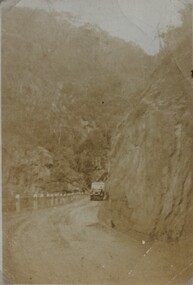
000554E - Photograph - Great Ocean Rd, Clive's old pop up caravan - Dad in black hat - C Newton
... 000554E - Photograph - Great Ocean Rd, Clive's old pop up caravan - Dad in black hat - C Newton...000554E - Photograph - Great Ocean Rd, Clive's old pop up caravan - Dad in black hat - C Newton ... -
 Glenelg Shire Council Cultural Collection
Photograph - Photograph Album - Various Victorian locations, c. 1948
... Photograph album, green covers, black and white photos of Mt Gambier, Portland, Port Fairy, Great Ocean Rd, Twelve apostles, Yallourn, and a zoo....Photograph album, green covers, black and white photos of Mt Gambier, Portland, Port Fairy, Great Ocean Rd, Twelve apostles, Yallourn, and a zoo. ...This album was handed in at Portland Transfer station, as it was never collected it was donated to the collection.Photograph album, green covers, black and white photos of Mt Gambier, Portland, Port Fairy, Great Ocean Rd, Twelve apostles, Yallourn, and a zoo. -
 Apollo Bay Museum
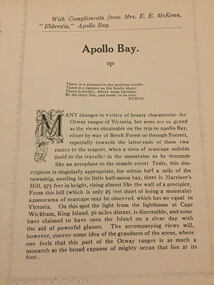
Audio - Elderslie Guesthouse tourism booklet
... ...Great Ocean Rd...Reading of tourism booklet for the Heart Maps project Apollo Bay Elderslie Guesthouse Tourism Great Ocean Rd Elderslie Guesthouse tourism booklet Audio Elderslie Guesthouse tourism booklet ...Reading of tourism booklet for the Heart Maps projectapollo bay, elderslie guesthouse, tourism, great ocean rd -
 Flagstaff Hill Maritime Museum and Village
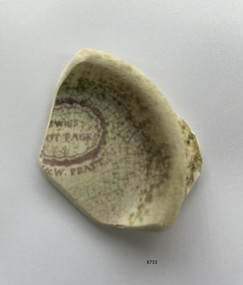
Ceramic - China Fragment, J&W Pratt/F&R Pratt, c mid nineteenth century
... ...Great Ocean Rd...Flagstaff Hill Maritime Museum and Village Earthenware Pot Lid Transferware J & W Pratt China Fragment Great Ocean Rd Red Transferware Swiss Cottage Design Bottom partial - "SWISS/OT PAGE/(inside a red scalloped border)/&W. ...J & W Pratt was an earthenware manufacturing firm operating in Lane Delph (Fenton), Stoke-on-Trent, England, from 1836 to 1859. The company produced traditional domestic earthenware and tableware, including hand-painted items like the Oriental-inspired "Indiana" pattern plates. J & W Pratt ceased operations in 1859 following a period of financial difficulty. The family's broader pottery legacy continued through F & R Pratt & Co. The object appears to be a 19th-century Victorian transferware pot lid featuring the pattern "The Swiss Cottage" (sometimes catalogued as Swiss Riverside Scene or The Alpine Cottage). The "Swiss Cottage" pattern typically features a rustic, asymmetric two-story Alpine chalet or cottage. In the foreground or mid-ground, a small wooden footbridge which spans a stream, and traveling figures or a peasant woman in local Swiss dress. The Fragment "OT PAGE" could be FOOTPAGE which suggests that the design was adapted from a specific 19th-century travel book or travel chronicle featuring steel-plate engravings with FOOTPAGE, indicating where the publisher found the original art. Pot lids were originally manufactured to seal ceramic pots that contained every day commodities like bear's grease (a popular Victorian hair pomade), cold creams, or toothpastes. Because the graphics were so beautifully detailed, Victorians would wash and save the lids once the pot was empty, often framing or mounting them. This object is significant as it represents a rare fragment of earthenware in common use in the mid nineteenth century. The popular Swiss Chalet design on the lid is an example of transfer which made decorative ceramic items more affordable and the product more appealing. Earthenware fragment with smooth edges worn by emersion in the sea. The top has red transferware design showing a two story cottage and footbridge. The underneath has crazed glazing and a partial manufacture stamp indicating J & W Pratt. The piece has a partially raised flange.Bottom partial - "SWISS/OT PAGE/(inside a red scalloped border)/&W. PRATT"flagstaff hill maritime museum and village, earthenware, pot lid, transferware, j & w pratt, china fragment, great ocean rd, red transferware, swiss cottage design -
 Anglesea and District Historical Society
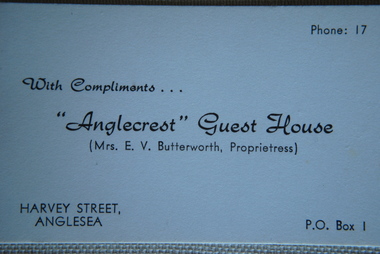
Business Cards, 1956-1963
... Butterworth Prop. Shop 79 Great Ocean Rd Anglesea 3230 Residence 51 Noble St Phone 63-1296 Card 2. 3x: With compliments 'Anglecrest' Guest House (Mrs E.V. ...Butterworth Prop. Shop 79 Great Ocean Rd Anglesea 3230 Residence 51 Noble St Phone 63-1296 Card 2. 3x: With compliments 'Anglecrest' Guest House (Mrs E.V. ...1. 2x Anglesea Drapery business cards 2. 3x 'Anglecrest' Guest House business cards Both businesses owned by Betty Butterworth from 1956 to 1963.Card 1. Anglesea Drapery Mrs E. V. Butterworth Prop. Shop 79 Great Ocean Rd Anglesea 3230 Residence 51 Noble St Phone 63-1296 Card 2. 3x: With compliments 'Anglecrest' Guest House (Mrs E.V. Butterworth Proprietress) Harvey St Anglesea PO Box 1 Vic. Phone 63-1498butterworth, anglecrest guest house, anglesea drapery, business cards -
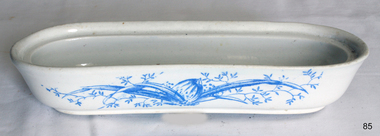 Flagstaff Hill Maritime Museum and Village
Ceramic - Container, Registration No indicate item was made between 1911-1912in the Stoke on Trent area of the UK
... Item at this time cannot be associated with an historical event, person or place, provenance is undetermined, item assessed as a collection asset given it was produced before 1950. flagstaff hill warrnambool shipwrecked coast flagstaff hill maritime museum maritime museum shipwreck coast flagstaff hill maritime village great ocean road toilet container base toilet article grooming article Rd No 58105 (year 1911) Orchid W.& W. on base Toilet article container base, porcelain with blue decoration on white background Ceramic Container ...A mass produced utilitarian item believed to have been made for domestic use in the Stoke-on-Trent area of England, no history or manufacturing provenance currently available makers mark unable to be identified at this time. Over 1500 pottery firms have operated in Stoke-on-Trent since the early 1700's - Some lasted only a few years and some for well over 200 years. Some potters built and owned their own works. Many others were tenants in works built by others and a succession of potters occupied the same works. It was also a common practice for a works to be split between two different pottery companies or for a larger manufacturer to let out a smaller section of his works to a potter who would make wares which were not of interest to the pot works owner. Some potters purchased 'blanks' from other manufacturers and put their own decoration on them some items have two back stamps. All this adds to the confusion and frustration of trying to trace details of a particular manufacturer such as the subject item.Item at this time cannot be associated with an historical event, person or place, provenance is undetermined, item assessed as a collection asset given it was produced before 1950.Toilet article container base, porcelain with blue decoration on white backgroundRd No 58105 (year 1911) Orchid W.& W. on baseflagstaff hill, warrnambool, shipwrecked coast, flagstaff hill maritime museum, maritime museum, shipwreck coast, flagstaff hill maritime village, great ocean road, toilet container base, toilet article, grooming article -
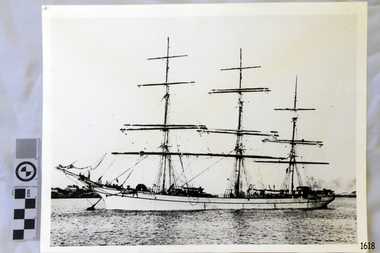 Flagstaff Hill Maritime Museum and Village
Photograph, 1907-1914
... Rd, west of Peterborough. (Ref: Flagstaff Hill Maritime Village’s “Antares” fact sheet, Victorian Heritage Database, Information Board at Peterborough, Flagstaff Hill Significance Assessment 2010) The Antares was one of the last of the 'tall ships' to be lost along the south west coast of Victoria, and is the only wreck that took the lives of all people on board. She is listed on the Victorian Heritage Register VHS S34. The Antares is significant as a sail trader carrying an international inbound cargo. It is part of the Great Ocean ...This photograph is of the sailing ship ANTARES at full sail, taken between 1907, when she was named ANTARES, and 1914, when she was wrecked.. THE ANTARES In mid-November 1914, after the beginning of the First World War, a young local man went one evening to fish near the Bay of Islands, west of Peterborough. He later arrived home hurriedly and in an agitated state declaring: "The Germans are coming!" His family laughed and disbelieved him, as this young fellow was prone to telling fictional tales. About a month later, on December 13th 1914, local farmers Phillip Le Couteur and Peter Mathieson were riding in the vicinity, checking on cattle. Phillip Le Couteur saw what he “thought was the hull of a ship below the cliffs.” He rode to Allansford and contacted police. The next day, two Constables and Phillip Le Couteur returned to the site, where they dug a trench near the top of the cliff and sank a log in it. To this they attached a rope, which they threw down the cliff face. Constable Stainsbury and Phillip Le Couteur then made the dangerous descent down the rope on the sheer cliff face. They found wreckage strewn around a small cove and a portion of a man's body under the cliffs. The hull of the ship could be seen about 300 metres out to sea. Some of the wreckage revealed the name Antares and the remains of the ship's dinghy bore the name Sutlej. During the next two weeks and with the help of the Warrnambool lifeboat and crew, two more bodies were found. Later investigations proved that the tragic wreck was indeed that of the Antares, reported overdue on the 207th day of her voyage from Marseilles, France, to Melbourne. She was a three masted, 1749 ton iron clipper, built in Glasgow in 1888 and originally named and launched as the Sutlej. Bought in 1907 by Semider Bros. from Genoa, Italy, she was refitted and renamed Antares. It was later realised that the local lad who a month earlier had declared he had seen German guns being fired, had probably seen distress flares fired from the deck of the Antares the night she was wrecked. She was last sailed under Captain Gazedo and wrecked at what is now known as Antares Rock, near the Bay of Islands. She had been carrying a large cargo of roofing tiles from France to Melbourne, consigned to Mullaly & Byrne. Many of them are now to be seen amongst the battered and scattered remains of the wreck. Some of the timbers were found to be blackened by fire. An Information Board has been erected on the cliff top near to the site of the Antares wreck, at the end of Radfords Rd, west of Peterborough. (Ref: Flagstaff Hill Maritime Village’s “Antares” fact sheet, Victorian Heritage Database, Information Board at Peterborough, Flagstaff Hill Significance Assessment 2010) The Antares was one of the last of the 'tall ships' to be lost along the south west coast of Victoria, and is the only wreck that took the lives of all people on board. She is listed on the Victorian Heritage Register VHS S34. The Antares is significant as a sail trader carrying an international inbound cargo. It is part of the Great Ocean Road Historic Shipwreck Trail. Photograph of the three masted fully rigged Antares at anchor. (ref: Ships A-B SH016.)flagstaff hill, warrnambool, shipwrecked-coast, flagstaff-hill, flagstaff-hill-maritime-museum, maritime-museum, shipwreck-coast, flagstaff-hill-maritime-village, antares, tall ship, peterborough, 1914 shipwreck, phillip le couteur, peter mathieson, constable stainsbury, sutlej, antares rock., bay of islands -
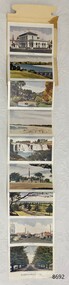 Flagstaff Hill Maritime Museum and Village
Postcard - Postcard Folder set, Valentine Publishing Co. Pty. Ltd. Melbourne and Sydney, Beautiful Views in Colour of WARRNAMBOOL VIC, 1930-50
... Great Ocean Road...Warrnambool...Flagstaff Hill...postcard...postcard folder...Warrnambool Scenes...Picturesque views of Warrnambool...Souvenir...Hopkins River...Botanic Gardens...Post Office...Beach...Hopkins Falls...War Memorial...Avenue of Pines...Liebig St...Beach Rd...Flagstaff Hill Maritime Museum and Village Great Ocean Road Warrnambool Flagstaff Hill postcard postcard folder Warrnambool Scenes Picturesque views of Warrnambool Souvenir Hopkins River Botanic Gardens Post Office Beach Hopkins Falls War Memorial Avenue of Pines Liebig St Beach Rd and Harbour 1930s 1940s Valentine Publishing Co. ...Postcard folders such as these were popular as holiday souvenirs in the early to mid-20th century and were kept in good condition by collectors. The size is convenient for posting to friends and relatives and packing as holiday luggage. The images of iconic Warrnambool sights in this postcard folder were most likely taken during the 1930s-40s looking at the cars in the picture of Liebig St. The Valentine Publishing Co. Pty. Ltd., Melbourne and Sydney, was formed in 1923 so date the folder after this date. The postcards in this folder record images of local Warrnambool history from the early to mid 20th century. They are able to be used as a record of changes to structures and land formations around Warrnambool over time.A postcard folder containing nine coloured images of photographed scenes showcasing Warrnambool and district around the 1930s-1940s. The images are printed on one side of a long strip of white paper that is Z-folded and attached to a cover of heavier cream card. The front of the folder has a picture of a tree framing a beach scene, the title ‘Beautiful Views in Colour of WARRNAMBOOL VIC.’ and an address area. Slits on the rear cover enable the folder to be secured.flagstaff hill maritime museum and village, great ocean road, warrnambool, flagstaff hill, postcard, postcard folder, warrnambool scenes, picturesque views of warrnambool, souvenir, hopkins river, botanic gardens, post office, beach, hopkins falls, war memorial, avenue of pines, liebig st, beach rd and harbour, 1930s, 1940s, valentine publishing co. pty. ltd. melbourne & sydney -
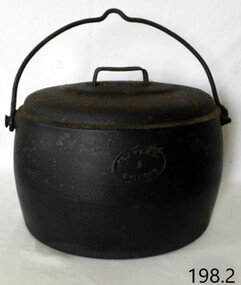 Flagstaff Hill Maritime Museum and Village
Domestic object - Cooking pot and lid, T & C Clarke and Co Ltd, 1880-1900
... T C Clark innervates the first manufacturing process of cast iron cook ware to have enamel lining in his products to alleviate the possibility of lead or arsenic contamination of food. flagstaff hill warrnambool shipwrecked coast flagstaff hill maritime museum flagstaff hill maritime village great ocean road kettle cooking pot cook ware kitchen ware cast iron kettle t c clark ltd Shakespeare Foundry "T & C Clark and Co Ltd" (Star of David) "ENGLAND", "RD 455279" "3 GALLS" "FIRST QUALITY" Lid marked "CLARK" Cooking pot cast iron with lid and handle and lid pressed sheet steel oval shaped. ...T. & C. Clark & Company Limited was based at Shakespeare Foundry in Wolverhampton England and was founded in 1795 by Thomas and Charles Clark. The company grew to be one of the largest iron foundries in Wolverhampton and were pioneering in the manufacture of enamelled cast iron cookware and sanitary wares. The company's product range included thousands of items, both domestic and industrial. T. & C. Clark were pioneers in the use of enamelled cast ironware, after taking out a patent in 1839 guaranteeing their products to be free of lead or arsenic. The company became the largest employer in Wolverhampton employing between 600 to 700 people.The item is significant as it was used as a domestic kitchen or camp fire item used to cook food safely without the concern that the metal may contain lead or arsenic as earlier cooking utensils had. T C Clark innervates the first manufacturing process of cast iron cook ware to have enamel lining in his products to alleviate the possibility of lead or arsenic contamination of food.Cooking pot cast iron with lid and handle and lid pressed sheet steel oval shaped."T & C Clark and Co Ltd" (Star of David) "ENGLAND", "RD 455279" "3 GALLS" "FIRST QUALITY" Lid marked "CLARK" flagstaff hill, warrnambool, shipwrecked coast, flagstaff hill maritime museum, flagstaff hill maritime village, great ocean road, kettle, cooking pot, cook ware, kitchen ware, cast iron kettle, t c clark ltd, shakespeare foundry -
 Flagstaff Hill Maritime Museum and Village
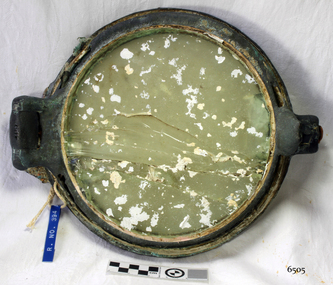
Functional object - Porthole, c 1888
... Rd, west of Peterborough. (Ref: Flagstaff Hill Maritime Village’s “Antares” fact sheet, Victorian Heritage Database, Information Board at Peterborough, Flagstaff Hill Significance Assessment 2010) The Antares was one of the last of the 'tall ships' to be lost along the south west coast of Victoria, and is the only wreck that took the lives of all people on board. She is listed on the Victorian Heritage Register VHS S34. The Antares is significant as a sail trader carrying an international inbound cargo. It is part of the Great Ocean ...This porthole was part of the ship's fittings when the Antares was constructed. THE ANTARES In mid-November 1914, after the beginning of the First World War, a young local man went one evening to fish near the Bay of Islands, west of Peterborough. He later arrived home hurriedly and in an agitated state declaring: "The Germans are coming!" His family laughed and disbelieved him, as this young fellow was prone to telling fictional tales. About a month later, on December 13th 1914, local farmers Phillip Le Couteur and Peter Mathieson were riding in the vicinity, checking on cattle. Phillip Le Couteur saw what he “thought was the hull of a ship below the cliffs.” He rode to Allansford and contacted police. The next day, two Constables and Phillip Le Couteur returned to the site, where they dug a trench near the top of the cliff and sank a log in it. To this they attached a rope, which they threw down the cliff face. Constable Stainsbury and Phillip Le Couteur then made the dangerous descent down the rope on the sheer cliff face. They found wreckage strewn around a small cove and a portion of a man's body under the cliffs. The hull of the ship could be seen about 300 metres out to sea. Some of the wreckage revealed the name Antares and the remains of the ship's dinghy bore the name Sutlej. During the next two weeks and with the help of the Warrnambool lifeboat and crew, two more bodies were found. Later investigations proved that the tragic wreck was indeed that of the Antares, reported overdue on the 207th day of her voyage from Marseilles, France, to Melbourne. She was a three masted, 1749 ton iron clipper, built in Glasgow in 1888 and originally named and launched as the Sutlej. Bought in 1907 by Semider Bros. from Genoa, Italy, she was refitted and renamed Antares. It was later realised that the local lad who a month earlier had declared he had seen German guns being fired, had probably seen distress flares fired from the deck of the Antares the night she was wrecked. She was last sailed under Captain Gazedo and wrecked at what is now known as Antares Rock, near the Bay of Islands. She had been carrying a large cargo of roofing tiles from France to Melbourne, consigned to Mullaly & Byrne. Many of them are now to be seen amongst the battered and scattered remains of the wreck. Some of the timbers were found to be blackened by fire. An Information Board has been erected on the cliff top near to the site of the Antares wreck, at the end of Radfords Rd, west of Peterborough. (Ref: Flagstaff Hill Maritime Village’s “Antares” fact sheet, Victorian Heritage Database, Information Board at Peterborough, Flagstaff Hill Significance Assessment 2010)The Antares was one of the last of the 'tall ships' to be lost along the south west coast of Victoria, and is the only wreck that took the lives of all people on board. She is listed on the Victorian Heritage Register VHS S34. The Antares is significant as a sail trader carrying an international inbound cargo. It is part of the Great Ocean Road Historic Shipwreck Trail. Porthole with glass, brass, screw dog broken off, glass has cracks through it, some encrustation. Artefact Reg No A/5, recovered from the wreck of the Antares.flagstaff hill, warrnambool, shipwrecked-coast, flagstaff-hill, flagstaff-hill-maritime-museum, maritime-museum, shipwreck-coast, flagstaff-hill-maritime-village, porthole, antares., tall ship, peterborough, 1914 shipwreck, phillip le couteur, peter mathieson, constable stainsbury, sutlej, antares rock., bay of islands, ship's fitting -
 Flagstaff Hill Maritime Museum and Village
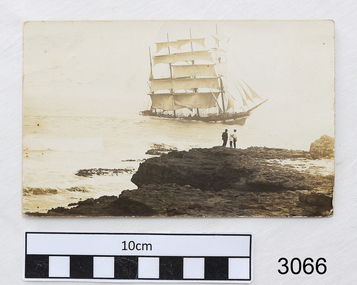
Postcard, c. Nov 1908-1910
... great ocean road...falls of halladale...peterborough...14/11/1908 shipwreck...queen victoria half penny stamp...maysie maclean warragul rd...This postcard is an example of the style of writing in Victoria in the early 1900's and of social issues and concerns, including shipwrecks. flagstaff hill warrnambool shipwrecked coast flagstaff hill maritime museum maritime museum shipwreck coast flagstaff hill maritime village great ocean road falls of halladale peterborough 14/11/1908 shipwreck queen victoria half penny stamp maysie maclean warragul rd oakleigh mrs waite warragul rd oakleigh post card postcard communication early 1900's mallee male sailor employment Note on card is addressed to Miss M. ...This postcard was written by a person referring to themselves as 'Malee Male', possibly living in the Malee area of South West Victoria. It was written after the wreck of the sailing ship Falls of Halladale, wrecked at Peterborough in November 1908, and before the reign of King George V in May 1910, at which time new postage stamps would have been issued to replace those of Queen Victoria. The writer refers to the excitement of the shipwreck and of having a sailor from the ship working for his/her mother (there was no loss of life from the shipwreck). The note is addressed to a single female family member and includes greetings to people they both know. The address of Oakleigh is approximately 20km south east of Melbourne. The writer talks of being tired and weary, inviting the receiver to visit and help with the 'office', also hinting at some matchmaking for his/her Aunt. It would be a long journey for a person to travel from Oakleigh to the South West Victoria areas. This postcard is an example of the style of writing in Victoria in the early 1900's and of social issues and concerns, including shipwrecks.Postcard, black and white photograph of the Falls of Halladale in full sail. Back of card has handwritten, black script. Top right has 2 x Half Penny stamps, green, Queen Victoria's profile. A short note addressed to a family member Miss M. (Maysie) MacLean c/o Mrs Waite, Warragul Rd, Oakleigh and signed of Mallee Male, refers to the photograph on the front and sailors from the ship.Note on card is addressed to Miss M. MacLean c/o Mrs Waite, Warragul Rd, Oakleigh and signed of Mallee Male. Message on card is ."Dear Maysee and all, too busy and tired to write but not to forget you all. This is a view of the ship Falls of Halladale, great excitement, one sailor boy came back to work for Mum and he and one crew ... When are you coming up Maysie, If you haven't any things else on hand. You can come and assist me with office. Aunt is feeling ... Do you know of any nice boys for Aunt anywhere? Dear old chicken, I am so weary so tata. Stacks of love to all and ... Mallee Male." flagstaff hill, warrnambool, shipwrecked coast, flagstaff hill maritime museum, maritime museum, shipwreck coast, flagstaff hill maritime village, great ocean road, falls of halladale, peterborough, 14/11/1908 shipwreck, queen victoria half penny stamp, maysie maclean warragul rd oakleigh, mrs waite warragul rd oakleigh, post card, postcard, communication early 1900's, mallee male, sailor employment -
 Flagstaff Hill Maritime Museum and Village
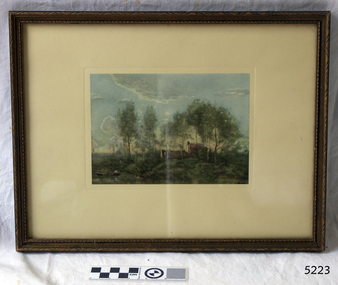
Print - Landscape, Jean Baptiste Camille Corot, Souvenir of a Journey to Coubron, 1908-mid-20th century
... Flagstaff Hill Flagstaff Hill Maritime Museum and Village Warrnambool Maritime Museum Maritime Village Great Ocean Road Shipwreck Coast Jean-Baptiste-Camille Corot French artist Jean Corot Camille Corot print Souvenir of a Journey to Coubron Coubron 19th century artist Medici Society reproduction print Westminster Art Gallery Fine Art Original artwork painted and signed by artist "COROT" White sticker with"32" Reproduction print by the Medici Society, London Stamp "Westminster Art Gallery / 91 CAMBERWELL RD. / CAMBERWELL E.6." ...Famous French artist Jean Baptiste Camille Corot, 1796-1875, was trained in the classical landscape style. His inspiration came from his travels around France and Italy. He developed a soft poetic or romantic style of work which became very popular. He had the skills to bring'light' into his paintings. The original oil on canvas painting by Corot is held at The National Gallery in the United Kingdom. It is titled 'Souvenir of a Journey to Coubron' and is one of twenty-seven of his works at the Gallery. Corot visited Coubon, east of Paris, many times. In 1873 during his stay there he sketched the scene that became the basis of this painting. This reproduction print was made by The Medici Society Ltd., founded in England 1908. The Society's aim was to make artwork affordable and available to the general public. The name Medici was chosen to honour the support and encouragement given to artists in the 15th century by Lorenzo de' Medici (1449 - 1492), known as Lorenzo the Magnificent, and his family. His profile is on the company's trademark. The Medici Society still produces Fine Art reproduction prints as well as selling original works. The print was framed by Westminster Art Gallery in Camperdown, London. The handwritten text on the back of the artwork adds some background to the artist: Corot was apprenticed to a Draper but changed to his profession at the age of 22 years. When he went from a poor artist to achieving wealth and fame he generously supported his less fortunate fellow artists. Corot found that the light and shade in a natural scene meant more to a landscape painter that what could be learned by following the principles of the academies. Corot was 51 years old before he sold his first picture. He though that he was the only artist that could really paint 'light'. The National Gallery, Victoria, has an original oil on canvas by Corot "the bent tree", created 1856-1860. It is in a similar style to this print "Souvenir of a Journey to Coubron", which was likely to have been painted around the same time.This high quality reproduction print was produced in the early-to-mid 1900;'s. This advancement in technology allowed everyday people to own and enjoy the fine art that was previously only accessible to the wealthy. The print is significant for its association with the famous 19th century artist Jean Baptiste Camille Corot.Print of a painting by Jean Baptiste Camille Corot, depicting a landscape with two buildings amongst trees and a boatman in the marshy foreground. The print is famed in carved timber with a cream matt, behind glass. there is an inscription on bottom right of print and further stamped and handwritten inscriptions of the reverse paper. The is a genuine Medici Society Fine Art reproduction print and was framed by Westminster Art Gallery.Original artwork painted and signed by artist "COROT" White sticker with"32" Reproduction print by the Medici Society, London Stamp "Westminster Art Gallery / 91 CAMBERWELL RD. / CAMBERWELL E.6." Text on Corot's history Underlined statement "GENUINE MEDICI PRINT "flagstaff hill, flagstaff hill maritime museum and village, warrnambool, maritime museum, maritime village, great ocean road, shipwreck coast, jean-baptiste-camille corot, french artist, jean corot, camille corot, print, souvenir of a journey to coubron, coubron, 19th century artist, medici society, reproduction print, westminster art gallery, fine art -
 Flagstaff Hill Maritime Museum and Village
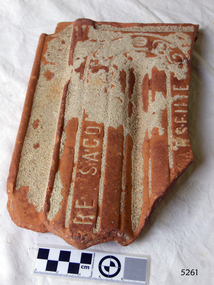
Ceramic - Roof Tile, c 1914
... Rd, west of Peterborough. (Ref: Flagstaff Hill Maritime Village’s “Antares” fact sheet, Victorian Heritage Database, Information Board at Peterborough, Flagstaff Hill Significance Assessment 2010) The Antares was one of the last of the 'tall ships' to be lost along the south west coast of Victoria, and is the only wreck that took the lives of all people on board. She is listed on the Victorian Heritage Register VHS S34. The Antares is significant as a sail trader carrying an international inbound cargo. It is part of the Great Ocean ...This terracotta clay roof tile was part of a consignment of tiles in the cargo of ANTARES. THE ANTARES In mid-November 1914, after the beginning of the First World War, a young local man went one evening to fish near the Bay of Islands, west of Peterborough. He later arrived home hurriedly and in an agitated state declaring: "The Germans are coming!" His family laughed and disbelieved him, as this young fellow was prone to telling fictional tales. About a month later, on December 13th 1914, local farmers Phillip Le Couteur and Peter Mathieson were riding in the vicinity, checking on cattle. Phillip Le Couteur saw what he “thought was the hull of a ship below the cliffs.” He rode to Allansford and contacted police. The next day, two Constables and Phillip Le Couteur returned to the site, where they dug a trench near the top of the cliff and sank a log in it. To this they attached a rope, which they threw down the cliff face. Constable Stainsbury and Phillip Le Couteur then made the dangerous descent down the rope on the sheer cliff face. They found wreckage strewn around a small cove and a portion of a man's body under the cliffs. The hull of the ship could be seen about 300 metres out to sea. Some of the wreckage revealed the name Antares and the remains of the ship's dinghy bore the name Sutlej. During the next two weeks and with the help of the Warrnambool lifeboat and crew, two more bodies were found. Later investigations proved that the tragic wreck was indeed that of the Antares, reported overdue on the 207th day of her voyage from Marseilles, France, to Melbourne. She was a three masted, 1749 ton iron clipper, built in Glasgow in 1888 and originally named and launched as the Sutlej. Bought in 1907 by Semider Bros. from Genoa, Italy, she was refitted and renamed Antares. It was later realised that the local lad who a month earlier had declared he had seen German guns being fired, had probably seen distress flares fired from the deck of the Antares the night she was wrecked. She was last sailed under Captain Gazedo and wrecked at what is now known as Antares Rock, near the Bay of Islands. She had been carrying a large cargo of roof tiles from France to Melbourne, consigned to Mullaly & Byrne. Many of them are now to be seen amongst the battered and scattered remains of the wreck. Some of the timbers were found to be blackened by fire. An Information Board has been erected on the cliff top near to the site of the Antares wreck, at the end of Radfords Rd, west of Peterborough. (Ref: Flagstaff Hill Maritime Village’s “Antares” fact sheet, Victorian Heritage Database, Information Board at Peterborough, Flagstaff Hill Significance Assessment 2010) The Antares was one of the last of the 'tall ships' to be lost along the south west coast of Victoria, and is the only wreck that took the lives of all people on board. She is listed on the Victorian Heritage Register VHS S34. The Antares is significant as a sail trader carrying an international inbound cargo. It is part of the Great Ocean Road Historic Shipwreck Trail.Part of a terracotta roof tile from the wreck of the Antares Has sand encrusted to bottom of tile. Artefact Reg No A/6.flagstaff hill, warrnambool, shipwrecked-coast, flagstaff-hill, flagstaff-hill-maritime-museum, maritime-museum, shipwreck-coast, flagstaff-hill-maritime-village, antares, tall ship, peterborough, 1914 shipwreck, phillip le couteur, peter mathieson, constable stainsbury, sutlej, antares rock., bay of islands, terracotta tile, roof tile, clay tile, roofing material, building material -
 Flagstaff Hill Maritime Museum and Village
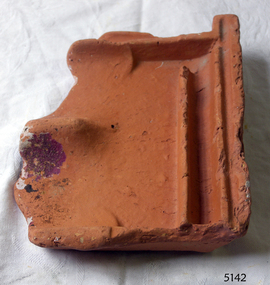
Tile, c 1914
... Rd, west of Peterborough. (Ref: Flagstaff Hill Maritime Village’s “Antares” fact sheet, Victorian Heritage Database, Information Board at Peterborough, Flagstaff Hill Significance Assessment 2010) The Antares was one of the last of the 'tall ships' to be lost along the south west coast of Victoria, and is the only wreck that took the lives of all people on board. She is listed on the Victorian Heritage Register VHS S34. The Antares is significant as a sail trader carrying an international inbound cargo. It is part of the Great Ocean ...This clay roof tile was part of the ANTARES cargo, a large consignment of tiles on its way to Melbourne. THE ANTARES In mid-November 1914, after the beginning of the First World War, a young local man went one evening to fish near the Bay of Islands, west of Peterborough. He later arrived home hurriedly and in an agitated state declaring: "The Germans are coming!" His family laughed and disbelieved him, as this young fellow was prone to telling fictional tales. About a month later, on December 13th 1914, local farmers Phillip Le Couteur and Peter Mathieson were riding in the vicinity, checking on cattle. Phillip Le Couteur saw what he “thought was the hull of a ship below the cliffs.” He rode to Allansford and contacted police. The next day, two Constables and Phillip Le Couteur returned to the site, where they dug a trench near the top of the cliff and sank a log in it. To this they attached a rope, which they threw down the cliff face. Constable Stainsbury and Phillip Le Couteur then made the dangerous descent down the rope on the sheer cliff face. They found wreckage strewn around a small cove and a portion of a man's body under the cliffs. The hull of the ship could be seen about 300 metres out to sea. Some of the wreckage revealed the name Antares and the remains of the ship's dinghy bore the name Sutlej. During the next two weeks and with the help of the Warrnambool lifeboat and crew, two more bodies were found. Later investigations proved that the tragic wreck was indeed that of the Antares, reported overdue on the 207th day of her voyage from Marseilles, France, to Melbourne. She was a three masted, 1749 ton iron clipper, built in Glasgow in 1888 and originally named and launched as the Sutlej. Bought in 1907 by Semider Bros. from Genoa, Italy, she was refitted and renamed Antares. It was later realised that the local lad who a month earlier had declared he had seen German guns being fired, had probably seen distress flares fired from the deck of the Antares the night she was wrecked. She was last sailed under Captain Gazedo and wrecked at what is now known as Antares Rock, near the Bay of Islands. She had been carrying a large cargo of roof tiles from France to Melbourne, consigned to Mullaly & Byrne. Many of them are now to be seen amongst the battered and scattered remains of the wreck. Some of the timbers were found to be blackened by fire. An Information Board has been erected on the cliff top near to the site of the Antares wreck, at the end of Radfords Rd, west of Peterborough. (Ref: Flagstaff Hill Maritime Village’s “Antares” fact sheet, Victorian Heritage Database, Information Board at Peterborough, Flagstaff Hill Significance Assessment 2010) The Antares was one of the last of the 'tall ships' to be lost along the south west coast of Victoria, and is the only wreck that took the lives of all people on board. She is listed on the Victorian Heritage Register VHS S34. The Antares is significant as a sail trader carrying an international inbound cargo. It is part of the Great Ocean Road Historic Shipwreck Trail. Piece of a clay roof tile recovered from the wreck of the Antares. Has a relief of a horse on back. Artefact Reg No A/7.flagstaff hill, warrnambool, shipwrecked-coast, flagstaff-hill, flagstaff-hill-maritime-museum, maritime-museum, shipwreck-coast, flagstaff-hill-maritime-village, antares, tall ship, peterborough, 1914 shipwreck, phillip le couteur, peter mathieson, constable stainsbury, sutlej, antares rock., bay of islands, clay tile, roofing tile, roof tile -
 Flagstaff Hill Maritime Museum and Village
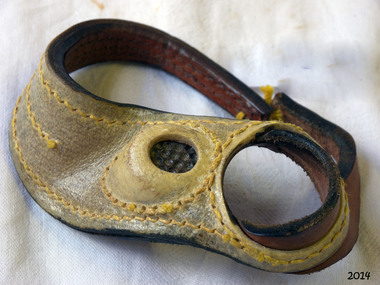
Sailmaker's Palm
... Great Ocean Road sail maker's palm sail making roping palm Leather sailmaker's or roping palm. Left hand- simular to a seaming palm, except for the much heavier indentations in the eye and thicker moulded leather guard to the thumb hole. Rd ...Leather sailmaker's or roping palm. Left hand- simular to a seaming palm, except for the much heavier indentations in the eye and thicker moulded leather guard to the thumb hole. Rd No 666761.flagstaff hill, warrnambool, shipwrecked coast, flagstaff hill, flagstaff hill maritime museum, maritime museum, shipwreck coast, flagstaff hill maritime village, great ocean road, sail maker's palm, sail making, roping palm
