
Showing 259 items matching "greece - travel"
-
 Mrs Aeneas Gunn Memorial Library
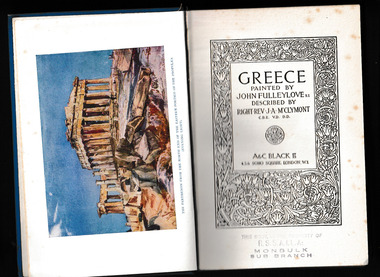
Book, A.C. Black, Greece, 1924
... ...Greece - Travel...Greece - Description Greece - Travel A travellers guide to Greece Index, ill, p.235. ...A travellers guide to GreeceIndex, ill, p.235.non-fictionA travellers guide to Greecegreece - description, greece - travel -
 Ithacan Historical Society
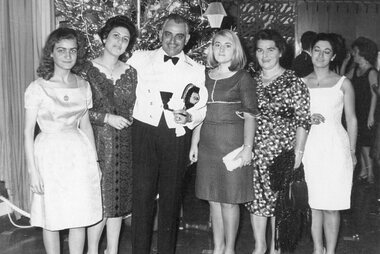
Photograph, c1960s
... The five women photographed with were travelling to Greece by ship and are picture with the captain. ...The five women photographed with were travelling to Greece by ship and are picture with the captain. ...The five women photographed with were travelling to Greece by ship and are picture with the captain. On the left are Athena Sikiotis, her mother Chrisoula Sikiotis (nee Kallinikos) and cousin Penelope Kallinikos (Billiter). The 1960s saw more and more first and second generation Ithacans travelling to Greece to visit the island to reunite or meet family. Up until the 1970s travel to and from Europe was mainly by ship and took around one month. During the 1970s air travel gradually became the norm. A black and white photograph of five women standing in a line with a man who is wearing naval uniform. -
 Ithacan Historical Society
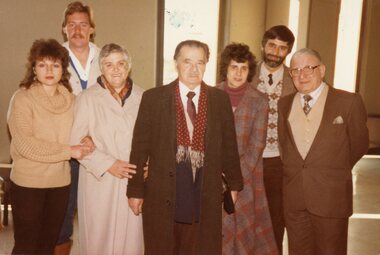
Photograph, Nick J. Varigos and family, July 1983
... The family group photographed in July 1983.at Tullamarine Airport where they were gathered to farewel Nick and Elsie Varigos who were travelling to Greece. The members of the group are from L-R: Euana Evans nee Varigos, Robert Evans, Elsie Varigos, Nick Varigos, Leah Kandiliotis nee Sikiotis, John Sikiotis, and Gerry Rigos. ...The family group photographed in July 1983.at Tullamarine Airport where they were gathered to farewel Nick and Elsie Varigos who were travelling to Greece. The members of the group are from L-R: Euana Evans nee Varigos, Robert Evans, Elsie Varigos, Nick Varigos, Leah Kandiliotis nee Sikiotis, John Sikiotis, and Gerry Rigos. ...The family group photographed in July 1983.at Tullamarine Airport where they were gathered to farewel Nick and Elsie Varigos who were travelling to Greece. The members of the group are from L-R: Euana Evans nee Varigos, Robert Evans, Elsie Varigos, Nick Varigos, Leah Kandiliotis nee Sikiotis, John Sikiotis, and Gerry Rigos. Elsie and Nick made several trips to Ithaca in the late 70s and early 80s, staying for extended periods. Nick was born in 1909 in Rhodesia where his parents had initially migrated prior to coming to Australia. Elsie was born in Melbourne in 1925. She travelled to Greece with her parents and siblings in 1939 just prior to the outbreak of war and as a result spent almost seven years on Ithaca and experienced the occupation by the Italians and the Germans, and the hardship endured by the locals.. A coloured photograph with rounded corners of three ladies and four men standing in a room. regos, varvarigos -
 Federation University Historical Collection
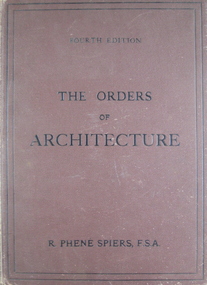
Book - Books, Spiers, R. Phene, The Order Of Architecture: Greek, Roman, and Italian, 1902 (exact)
... travelling scholarship of the Royal Academy, and the Soane medal of the R.I.B.A. He worked with Sir Digby Wyatt and William Burges. Spiers travelled in France, Spain, Egypt, Syria and the East, and besides his work as an architect, he made many water-colour sketches. His works and publications covered a wide range of subjects in architecture such as, History of Architecture, Architectural Drawing; The Architecture of Greece...travelling scholarship of the Royal Academy, and the Soane medal of the R.I.B.A. He worked with Sir Digby Wyatt and William Burges. Spiers travelled in France, Spain, Egypt, Syria and the East, and besides his work as an architect, he made many water-colour sketches. His works and publications covered a wide range of subjects in architecture such as, History of Architecture, Architectural Drawing; The Architecture of Greece ...A large brown hardcover book. Title and author's name are written in black on front cover and in gold on spine. This is the 4th ed., containing twenty-seven plates. It includes a preface to 4th and 1st ed., a list of plates, 20 p. of text and a list of references. This book contains a selection of architectural designs of the Orders as employed in ancient buildings.r phene spiers, greek roman italian architecture, the doric order, the ionic order, the corinthian order, the composite order, the temple of theseus athens, the theatre of marcellus rome, temple of vespasian rome, library plate, book plate -
 Mission to Seafarers Victoria
Booklet - Pocket Size
... traveling salesmen for evangelism. The symbol of the Gideons is a two-handled pitcher and torch recalling Gideon's victory over the Midianites. bible greek pocket size Small blue paperback bible, sheathed in a fixed thin vinyl sleeve Booklet Pocket Size ...Gideons International is an evangelical Christian association founded in 1899 in Wisconsin. The Gideons' primary activity is distributing copies of the Bible free of charge, to unite traveling salesmen for evangelism. The symbol of the Gideons is a two-handled pitcher and torch recalling Gideon's victory over the Midianites.Small blue paperback bible, sheathed in a fixed thin vinyl sleevebible, greek, pocket size -
 Lara RSL Sub Branch
Book, As You Were 1949, 1949
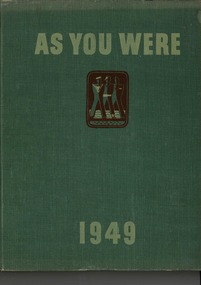
... travel and adventure and misdeeds, and above all the good comradeship of the services in the war years. Historical recount through stories, poems and illustrations of Australians in World War 2 george alan vasey palestine gaza italian pow's ae2 sea of marmora noic naavy information operations command captain sir ross smith no.1 squadron greece retreat new guinea tregonning ammunition de ruyter exeter perth java houston To the memory of the fallen ' They gave their lives. ...Compilation of articles, short stories and poems of events and experiences of servicemen and women. This volume recalls the courage and humour, the boredom and the achievements, the travel and adventure and misdeeds, and above all the good comradeship of the services in the war years.Historical recount through stories, poems and illustrations of Australians in World War 2As You Were 1949 Illustrations, photographs, Green coloured hardcover front and back with light green test on front page 'As you were' and '1949'. There is a rectangular relief showing three tri servicemen. The inside front and back covers have illustrations of Air force, Navy and Army on a dark green background. The Southern Cross is also a feature of the illustrations.To the memory of the fallen ' They gave their lives. For that public gift they received a praise which never ages and a tomb most glorious - not so much the tomb in which they lie, but that in which their fame survives, to be remembered forever when occasion comes for word or deed...'george alan vasey, palestine, gaza, italian pow's, ae2, sea of marmora, noic naavy information operations command, captain sir ross smith, no.1 squadron, greece retreat, new guinea, tregonning, ammunition, de ruyter, exeter, perth, java, houston -
 Bendigo Military Museum
Book - BOOK, GALLIPOLI, Allen and Unwin, Evan's Gallipoli: A gripping story of unlikely friendship and an incredible journey behind enemy lines, 2013
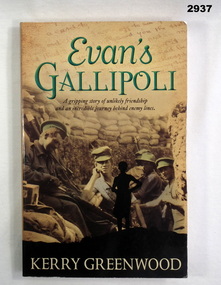
... travel to Gallipoli. Following their capture by the Turks they escape & find their way back to Australia through Turkey & Greece. ...travel to Gallipoli. Following their capture by the Turks they escape & find their way back to Australia through Turkey & Greece. ...Fictional story tracing the journey of 14 year old Evan Warrender & his father as they travel to Gallipoli. Following their capture by the Turks they escape & find their way back to Australia through Turkey & Greece. Along the way they meet unlikely friends & companions.Book, sepia coloured illustration on soft front cover with title in green lettering. Text is in diary form, black & white illustrations. End papers depict excerpt from newspapers of the time. 200 pages with cut edges.books, gallipoli, fictional -
 Monbulk RSL Sub Branch
Book, Harper Collins, The fracture zone : a return to the Balkans, 1999
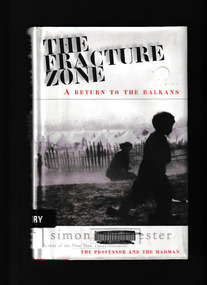
... Balkan peninsula - History Balkan peninsula - Travel Winchester travels in a scimitar-shaped journey through Croatia, Bosnia, Montenegreo, Macedonia, Bulgaria and Greece to Turkey. ...Winchester travels in a scimitar-shaped journey through Croatia, Bosnia, Montenegreo, Macedonia, Bulgaria and Greece to Turkey. He names his route the Fracture Zone, because this locale marks not only the meeting of two vast continental tectonic plates, perpetrators of geological chaos, but also the uneasy boundary between two great historical empires, the Hapsburg and the Ottoman." "The Fracture Zone weaves together history, travel and political perspective with the personal testaments of ordinary and extraordinary people. In this record of history, hatred and ruin, Simon Winchester details the conditions under which the area's refuges now live against a background of ancient political and spiritual struggleGlossary, maps, p.236.non-fictionWinchester travels in a scimitar-shaped journey through Croatia, Bosnia, Montenegreo, Macedonia, Bulgaria and Greece to Turkey. He names his route the Fracture Zone, because this locale marks not only the meeting of two vast continental tectonic plates, perpetrators of geological chaos, but also the uneasy boundary between two great historical empires, the Hapsburg and the Ottoman." "The Fracture Zone weaves together history, travel and political perspective with the personal testaments of ordinary and extraordinary people. In this record of history, hatred and ruin, Simon Winchester details the conditions under which the area's refuges now live against a background of ancient political and spiritual strugglebalkan peninsula - history, balkan peninsula - travel -
 Bendigo Historical Society Inc.
Essay - Jack Lockett Collection: Memories of Jack by Bryana Jones, Bryana Jones, 2000
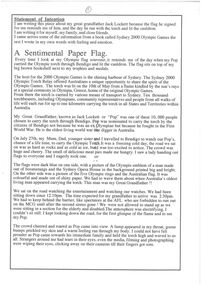
... Titled - A Sentimental Paper Flag written by Bryana Jones A beautifully written essay about her Great Grandfather Jack Lockett or "Pop" who was part of the Olympic flame relay from Greece to Sydney in 2000 and he was part of the relay because he was the oldest living World War Digger in Australia and the oldest man in Australia. Bryana tells us about travelling...Titled - A Sentimental Paper Flag written by Bryana Jones A beautifully written essay about her Great Grandfather Jack Lockett or "Pop" who was part of the Olympic flame relay from Greece to Sydney in 2000 and he was part of the relay because he was the oldest living World War Digger in Australia and the oldest man in Australia. Bryana tells us about travelling ...John Henry Lockett OAM (22 January 1891 – 25 May 2002) was the oldest man ever in Australia when he died aged 111 years, 123 days. As one of the last surviving veterans of World War I, he was acclaimed as a national hero during the last decade of his life. Lockett was born in the small Victorian town of Waanyarra, near Bendigo. He left school aged nine to work on a local farm. Later, he worked for his uncles in the Mallee. On 24 March 1916, he travelled to Mildura to enlist in the Australian Imperial Force. He served in France with the 38th Battalion, earning promotion to sergeant and was discharged on 20 September 1919. https://en.wikipedia.org/wiki/Jack_Lockett After the war, Jack returned to The Mallee and selected a 640 acres (260 ha) block of land in Linga, Victoria, deciding to make his living as a farmer. In 1923, he married Maybell Ingwerson and they had four children together. In 1963, the couple retired to Bendigo, leaving the farmland (which now covered more than 130,000 acres (53,000 ha), in the care of their children and grandchildren . The 2000 Olympic flame was relayed from Olympia in Greece to Sydney by 13400 carriers including 11000 Australians, each carrier had their own torch. Two white A4 paper pages with black print and a black line 10 centimeters from each edge. Titled - A Sentimental Paper Flag written by Bryana Jones A beautifully written essay about her Great Grandfather Jack Lockett or "Pop" who was part of the Olympic flame relay from Greece to Sydney in 2000 and he was part of the relay because he was the oldest living World War Digger in Australia and the oldest man in Australia. Bryana tells us about travelling with her family to Bendigo on July 27, a freezing cold day. She mentions the anticipation and excitement building as the crowd was waiting for Pop, then wonderful pride she felt as the crowd cheered when he came into view. Later Jack signed for her a souvenir Olympic Flag "J. H. Lockett 109"which she will treasure forever, and it will be an heirloom to be passed on to future generations. jack lockett, mabel ingwersen, olympic flame in bendigo, bryana jones -
 Ithacan Historical Society
Photograph, Family group at Station Pier, Port Melbourne, c1955
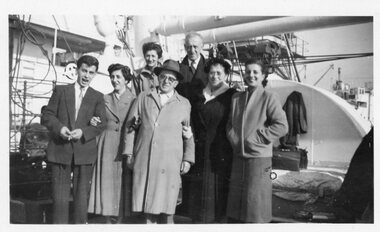
... Greece. Very few of the early Ithacan migrants returned to their homeland. It wasn't until the 1950s and 60s that travel back home to visit family became more common. ...The seven people on the deck of a ship at Station Pier some time in 1955 are: Front L-R: Arthur and Sia (Aspasia) Koutsouvelis, George and Ioulia Raftopoulos and Effie Cominos. George and Ioulia Raftopoulos are the parents of Sia and Effie. Back L-R: Chrisoula Raftopoulos and Nick Sikiotis. Family would go to Station Pier to either welcome or farewell relatives who departing to or arriving from Greece. Very few of the early Ithacan migrants returned to their homeland. It wasn't until the 1950s and 60s that travel back home to visit family became more common. Today generations born in Australia to return to Ithaca on a regular basis.A black and white photograph of seven people standing on the deck of a ship. A partial view of a tugboat can be seen in the background. -
 Ithacan Historical Society
Photograph, Visit of the SS George D. Gratsos, 1951
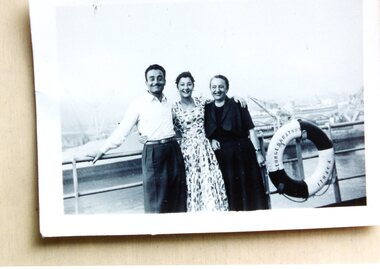
... At the time the Women's Weekly ran a double page spread featuring her. in Greece on board a ship travelling to or from Ithaca....At the time the Women's Weekly ran a double page spread featuring her. in Greece on board a ship travelling to or from Ithaca. 'George D. ...Irini Pappas and her husband Paul Anagnostou are photographed with the captain's wife (right), Irini's father's first cousin during the visit of the SS Gratsos ship. She was one of only two women ever qualified as first mate. At the time the Women's Weekly ran a double page spread featuring her. in Greece on board a ship travelling to or from Ithaca.'George D. Gratsos - Ithaca' printed on the buoy indicates that the ship was part of the Gratsos shipping company. The shipping activities of the Gratsos family from Ithaca began in 1902, when Georgios D. Gratsos (1870–1931) bought the ship Odysseus, in partnership with the Dracoulis family, of which Gratsos' wife was a member. A print of a black and white photograph of a man and two ladies on a ship's deck. A life buoy ring with the words ' George D. Gratsos - Ithaca' is on the rails on the left of the group. irini pappas, ithacan ferries -
 Ithacan Historical Society
Photograph, Anastasios Papadopoulos and friend, c1927-28
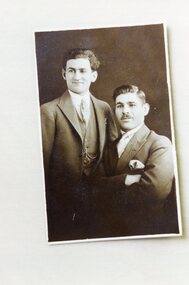
... travelling by camel train, van and on foot to reach Melbourne where they both settled. Anastasios a fish and chips shop in Chapel Street South Yarra. His daughter Irini Pappas was a highly respected actor in Melbourne's Greek community. ...travelling by camel train, van and on foot to reach Melbourne where they both settled. Anastasios a fish and chips shop in Chapel Street South Yarra. His daughter Irini Pappas was a highly respected actor in Melbourne's Greek community. unknown A sepia studio photograph of two smartly dressed men. ...Anastasios Papadopoulos is pictured on the left. The gentleman on the right was know as 'Nikolaos Kefalonitis'. Anastasios migrated to Western Australia from Ithaca in 1912 where he found work in Kalgoorlie. Following the race riots of 1916 he left W.A. together with his brother John and they hitchhiked across the Nullarbor travelling by camel train, van and on foot to reach Melbourne where they both settled. Anastasios a fish and chips shop in Chapel Street South Yarra. His daughter Irini Pappas was a highly respected actor in Melbourne's Greek community. unknownA sepia studio photograph of two smartly dressed men. One is seated with his arms crossed and the other is standing next to him. -
 Ithacan Historical Society
Photograph, Captain Gerasimos Kallinikos, c1890s
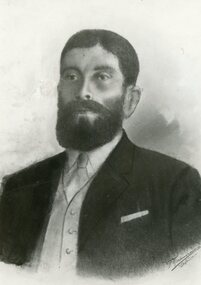
... In the 1890s a number of Ithacan Greeks travelling to Australia disembarked at Fremantle, the first Australian port which ships docked at. ...The man photographed is Captain Gerasimos Kallinikos who brought the first Greek ship to Western Australia, where the passengers disembarked and travelled to the Kalgoorlie goldfields in 1891. Gerasimos died during WW2 when as captain of the Greek steamship Meropi, the boat was torpedoed by U-566 and sank off Halifax in 1942. In the 1890s a number of Ithacan Greeks travelling to Australia disembarked at Fremantle, the first Australian port which ships docked at. Initially many of them went on to the goldfields in Kalgoorlie and later some settled in Western Australia while many moved across to the eastern states.A black and white copy of a portrait photograph of a well-dressed man, who has a neatly groomed beard and moustache. There is a message written in Greek on the back of the photograph. -
 Ithacan Historical Society
Photograph, Post office at Stavros, Ithaca, c
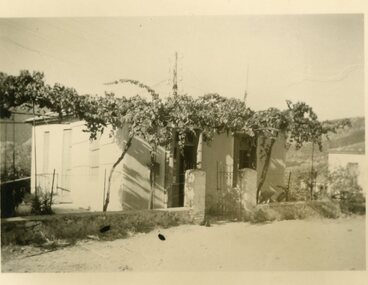
... travel to main town of Vathi to access a post office and other services. The permanent population of Ithaca is approximately 3100 (2016) with the majority based in the main town of Vathi. The population in the 1940s was over 8000. Ithaca's population declined sharply after World War II as a result of immigration and movement to larger cities of Greece ...The building in the photograph was the post office at Stavros, the main village in the north of Ithaca. Like many small villages with declining populations, the Stavros post office no longer operates and locals must travel to main town of Vathi to access a post office and other services.The permanent population of Ithaca is approximately 3100 (2016) with the majority based in the main town of Vathi. The population in the 1940s was over 8000. Ithaca's population declined sharply after World War II as a result of immigration and movement to larger cities of Greece. This decline was further exacerbated following the earthquake of 1953 which caused widespread devastation across the island.A black and white photograph with a white crinkled edge of a white rendered house with vines growing across the front. The house has been built close to the road. -
 Ithacan Historical Society
Photograph, On board ship, c 1950s
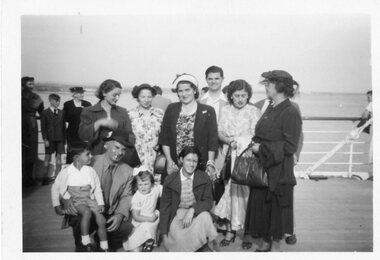
... A few Ithacans travelled back home during the 1940s and 1950s, and overtime more families made the long 30 day boat trip to Greece. The advent of air travel travel made it easier for people to travel back home regularly and today those Australian born of Ithacan descent regularly visit the island....A few Ithacans travelled back home during the 1940s and 1950s, and overtime more families made the long 30 day boat trip to Greece. The advent of air travel travel made it easier for people to travel back home regularly and today those Australian born of Ithacan descent regularly visit the island. overseas trips A black and white photograph taken on the deck of a ship while it is in port. ...The group, members of the Kallinikos family, is on board a ship, possibly farewelling a relative who is departing Melbourne for a return visit to Ithaca. A few Ithacans travelled back home during the 1940s and 1950s, and overtime more families made the long 30 day boat trip to Greece. The advent of air travel travel made it easier for people to travel back home regularly and today those Australian born of Ithacan descent regularly visit the island.A black and white photograph taken on the deck of a ship while it is in port. Three men, five ladies, a young girl and a little boy and girl are grouped together to farewell some of the people on an overseas trip. There are other people standing looking out across the bay.overseas trips -
 Ithacan Historical Society
Photograph, Stathi Raftopoulos' home cinema, c1960
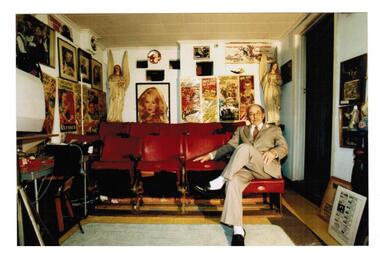
... In 1949 Stathi Raftopoulos imported the first Greek film into Australia, entitled 'Voice of the Heart'. It was screened at Nicholas Hall in Lonsdale Street. Stathis went on to become a travelling picture show man showing Greek films to the Greeks in regional centres around Australia. ...In 1949 Stathi Raftopoulos imported the first Greek film into Australia, entitled 'Voice of the Heart'. It was screened at Nicholas Hall in Lonsdale Street. Stathis went on to become a travelling picture show man showing Greek films to the Greeks in regional centres around Australia. ...Stathi Raftopoulos is pictured at his home cinema at his residence in Sylvander Street North Balwyn. In 1949 Stathi Raftopoulos imported the first Greek film into Australia, entitled 'Voice of the Heart'. It was screened at Nicholas Hall in Lonsdale Street. Stathis went on to become a travelling picture show man showing Greek films to the Greeks in regional centres around Australia. He later established a film distribution and exhibition company, The Cosmopolitan Motion Pictures, in partnership with Mr Panayioti (Peter) Giannoudis. With the advent of television in the 1950, former suburban picture theatres were being closed down. Stathi and Peter took over many of these cinemas to show imported Greek films to the post WWII burgeoning Greek community.A coloured photograph of a man seated on a red theatre seat in a home cinema. Posters, photographs and film memorabilia are displayed on the three surrounding wallsWritten on the back : 520/BAhome theatres, greek movies -
 Ithacan Historical Society
Photograph, Stathi Raftopoulos with film projector, c 1970s
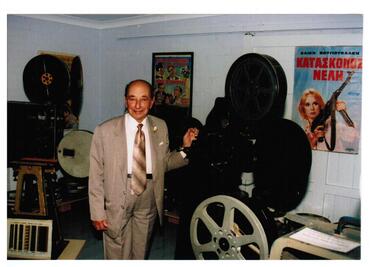
... He was a keen promoter of Greek film which he screened to the wider public as a travelling picture show man and later through the chain of Greek cinemas he was a partner in....He was a keen promoter of Greek film which he screened to the wider public as a travelling picture show man and later through the chain of Greek cinemas he was a partner in. ...Stathi Raftopoulos was passionate about film and often showed movies to family and friends in his home cinema. He was a keen promoter of Greek film which he screened to the wider public as a travelling picture show man and later through the chain of Greek cinemas he was a partner in.A coloured photograph of a man standing next to a film projector in his home cinema. Two Greek film posters are on the wall behind him. -
 Ithacan Historical Society
Photograph, Archimandrite Daniel Maravelis, c 1920s
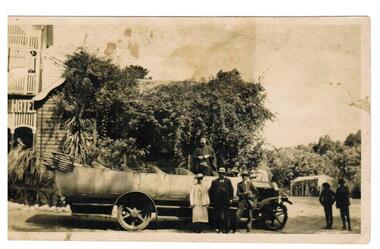
... Greek in Melbourne from 1915 to 1922. He presided over the official opening of the first IPS clubrooms located at Michael's Building, Cnr Elizabeth and Lonsdale Streets Melbourne on Sunday 23rd September 1917. Similar vehicles were used between the years 1915-1925 to travel...Greek in Melbourne from 1915 to 1922. He presided over the official opening of the first IPS clubrooms located at Michael's Building, Cnr Elizabeth and Lonsdale Streets Melbourne on Sunday 23rd September 1917. Similar vehicles were used between the years 1915-1925 to travel ...Pictured is Archimandrite, Daniel Maravelis with members of the Greek community in Mildura. He was born in Smyrna and was the Archimandrite of the Greek in Melbourne from 1915 to 1922. He presided over the official opening of the first IPS clubrooms located at Michael's Building, Cnr Elizabeth and Lonsdale Streets Melbourne on Sunday 23rd September 1917. Similar vehicles were used between the years 1915-1925 to travel to picnics.A black and white photograph of a vintage bus parked outside a weatherboard building which is partly hidden with vines. A two storey hotel building is on the LHS of the photograph. A priest is standing in the bus and two men and a lady are standing in front of the vehicle. Two other people are standing on the far RHS. A tent is visible in the middle distance.In Greek: Sigalis and Rita Nicolaidisgreek orthodox community -
 Ithacan Historical Society
Photograph, Raftopoulos family trip to Greece, 1966
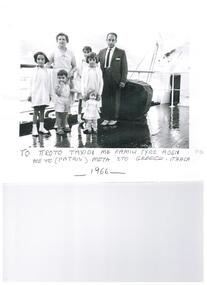
... Travelling Marine transport Written in Greek underneath the photograph and translated: THE FIRST TRIP WITH FAMILY NEAR ADEN ON PATRIS TO GREECE. ...In 1966 Stathi and Kassiani Raftopoulos together with their children, Leah, Rena, Angela and Spiros travelled to Greece and Ithaca. The family photograph was taken on board the Patris as they approached Aden. They final destination was the Greek port of Piraeus before heading to Ithaca.A scanned photograph with white surrounds mounted on a cardboard. It is a photograph of a family on the deck of a ship. One of the children is holding a doll in front of her.Written in Greek underneath the photograph and translated: THE FIRST TRIP WITH FAMILY NEAR ADEN ON PATRIS TO GREECE. ITHACA/1966.travelling, marine transport -
 Ithacan Historical Society
Photograph, Departing for Greece, 1959
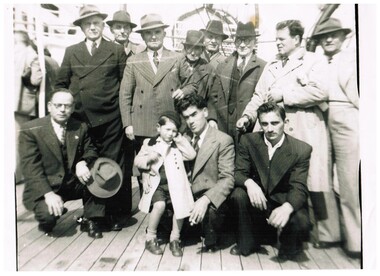
... Greeks, have remained strong. Up until the late 1960s most travelled by ship and it was common for friends and family to be permitted to board the ship to farewell those travelling. ...A group of Ithacans, all of whom had migrated to Melbourne before WW2, on board a ship farewelling Spiro Raftopoulos who was returning to Ithaca, Greece. Front row L-R: Spiro Raftopoulos, Peter Kallinikos (Peter Collins), Con Kallinikos, Gerasimos Dellaportas. Standing L-R: Unknown, Nicos (Nikoli) Moriatis, Spiros Kallinikos, unknown, Andreas Moraitis, Stathis Kavadeas, Peter Zapatos, unknown. A black and white photograph of eleven men and a boy standing on the deck of a ship. The men are dressed in suits and some are wearing overcoats and hats. Stamped on the back: ITHACAN HISTORICAL SOCIETY INCORPORATED/ 329 ELIZABETH STREET MELBOURNE/VICTORIA 3000 AUSTRALIA/ PO BOX 611D MELBOURNE 3001/ TELEPHONE (03) 670 0230greek diaspora -
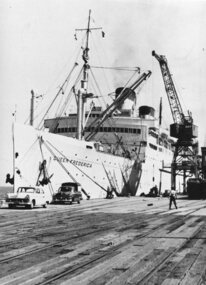 Ithacan Historical Society
Photograph, Passenger ship 'Queen Frederica', 1965
... The passenger liner 'Queen Frederica' was one of the many ships that transported Greek emigrants to Australia in the post World War 2 years up until air travel became a more efficient and faster means of travel. ...The passenger liner 'Queen Frederica' was one of the many ships that transported Greek emigrants to Australia in the post World War 2 years up until air travel became a more efficient and faster means of travel. ...The passenger liner 'Queen Frederica' was one of the many ships that transported Greek emigrants to Australia in the post World War 2 years up until air travel became a more efficient and faster means of travel. Between 1945 and 1965, two million immigrants arrived in Australia. The decision by the Australian Government to open up the nation in this way was based on the notion of ‘populate or perish’ that emerged in the wake of the Second World War. Among the new immigrants were the first government-sanctioned non-British migrants.A black and white photograph of a ship berthed at Princes Pier, Port Melbourne. Rail trucks and a crane are in the middle distance and a car, utility and trailer are parked beside the ship. The photograph has been mounted on chip board.51A/ 26port melbourne. -
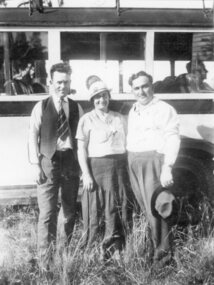 Ithacan Historical Society
Photograph, Picnic group, Early 1930s
... Bus travel to the picnic continued through to the 70s although by then the majority travelled by private cars. The bus trips were very convivial with singing of popular Greek folk music. ...The annual IPS picnic was an important event where family and friends would get together. From left Nicholas Kavadeas, Marigo Kavadeas (nee Raftopoulos), Yianni Raftopoulos (Patakia).Buses were hired to transport members to the picnic as very few owned their own cars during the in the early years. Bus travel to the picnic continued through to the 70s although by then the majority travelled by private cars. The bus trips were very convivial with singing of popular Greek folk music. Black and white photograph of two men and a lady standing in front of a bus. There is a white border around the photo.Ithacan picnic Circa Early 30s -
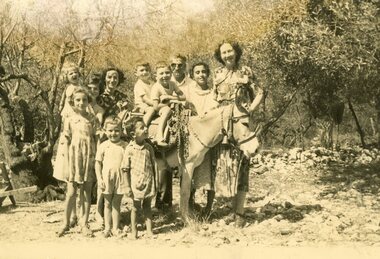 Ithacan Historical Society
Photograph - Rousso the Donkey, 1952
... Annie Vlass together with her husband Stathi Vlass and children Demetri and Con spent 6-9 months in Greece in 1952 at the Vlassopoulos (Kopela) family home in Lahos whilst in Ithaca. Although not common prior to the 1960s, some Ithacans, who had settled in Australia prior to the post war era, did travel back to their homeland to visit family and to introduce spouses and children to their place of birth. ...Donkeys were a standard form of transport and a beast of burden for Ithacans as the island is very mountainous. Stepped tracks designed for donkeys to ascend the mountains can be still be located. The donkey in the photo, 'Rousso' was owned by Achileas Benias and was used to transport the olives and produce form their farming plot. Photographed from L-R back are: Freda Lucas (nee Benia) holding Jenny Kyriakakis, Con and Demetri Vlass on the donkey, Georgos Sombola, Angeliki Lekatsa (Spiliatsos), and Annie Vlass. In the front are Georgia Benia, Michali Kavadeas, unknown.Annie Vlass together with her husband Stathi Vlass and children Demetri and Con spent 6-9 months in Greece in 1952 at the Vlassopoulos (Kopela) family home in Lahos whilst in Ithaca. Although not common prior to the 1960s, some Ithacans, who had settled in Australia prior to the post war era, did travel back to their homeland to visit family and to introduce spouses and children to their place of birth. Today many of Ithacan heritage travel to the island, particularly during the northern summer, to reconnect with their family roots.A sepia photograph of eleven people, eight children and three adults standing in a cleared wooded area around a donkey. Two of the children are on the back of the donkey.kopella -
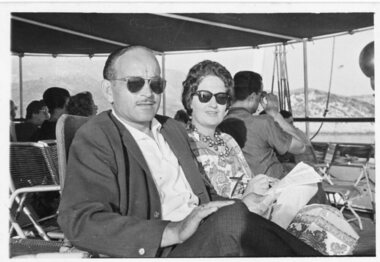 Ithacan Historical Society
Photograph, Ferry to Ithaca, 1962
... Up until the 1960s very few Ithacans travelled back to Greece. However, as air travel became more common and affordable travel became more common. ...Costa and Helen Vlassopoulos (Kopela) on board a ferry in 1962 when they were holidaying in Greece with their daughters Eugenia and Anna. It was Costa's first trip back to Ithaca since he migrated to Melbourne in 1937. Costa was reunited with his parents, Dimitri and Eugenia Vlassopoulos, who had returned to Ithaca in 1958 for their retirement. Up until the 1960s very few Ithacans travelled back to Greece. However, as air travel became more common and affordable travel became more common. Today descendants of early Ithacan immigrants return to the island on a regular basis. Some have restored family homes. A black and white photograph of a lady and a man sitting on the deck of a ferry. -
 Ithacan Historical Society
Photograph, Journey back to Ithaca, 1952
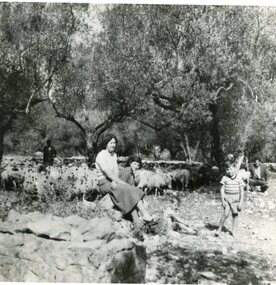
... It was quite rare for families to travel to Greece and Ithaca in the 1950s. However, over the years it has become a tradition for many Ithacan Greeks to return to their island home for the summer or for a longer stay. ...The photograph was taken when Stathi Vlass (Kopela) returned to Ithaca together with his family in 1952 for the first time since migrating to Australia in 1932. Stathi's wife Annie Vlass, is seated in the foreground with the young Freda Benia behind her. The two children are Annie's and Stathi's sons, l-r Con and Demetri (standing). It was quite rare for families to travel to Greece and Ithaca in the 1950s. However, over the years it has become a tradition for many Ithacan Greeks to return to their island home for the summer or for a longer stay. It is one way that the generations have been able to maintain family ties and their Ithacan heritage.A square black and white photograph with a white border of two women, two men and two young boys in an olive grove where goats are grazing. The two women and boys are in the foreground while the two men are in the background under the shade of the trees. A small message is written in Greek on the back of the photograph.The following translation is written in Greek on the back of the photograph. -
 Ithacan Historical Society
Photograph, Angelika ship departing Ithaca, c 1951
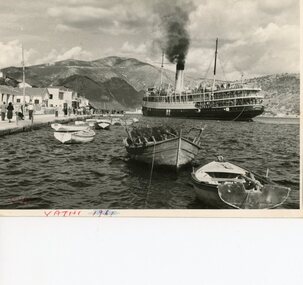
... travel to the mainland sailed by ship. The 'Angelika', photographed in Ithaca's port harbour of Vathi, transported most of the post WWII Ithacan migrants to the main Greek port of Piraeus to embark for their journey to Australia. ...travel to the mainland sailed by ship. The 'Angelika', photographed in Ithaca's port harbour of Vathi, transported most of the post WWII Ithacan migrants to the main Greek port of Piraeus to embark for their journey to Australia. ...Prior to the advent of the ferry service Ithacans who wished to travel to the mainland sailed by ship. The 'Angelika', photographed in Ithaca's port harbour of Vathi, transported most of the post WWII Ithacan migrants to the main Greek port of Piraeus to embark for their journey to Australia. Migration from Ithaca to Australia ceased during the second world war years. A second wave commenced in the post war years, particular following the 1953 earthquakes which caused catastrophic damage to the island. Today travel between Ithaca and the mainland is by ferry boats. Ships and ferry boats no longer enter the harbour at Vathi, but rather dock at Piso Aetos. A black and white photograph with a thin white border of a ship steaming out of a harbour with smaller craft in the water. People are standing on the wharf watching the boat depart; behind them are buildings and mountains across the skyline. -
 Ithacan Historical Society
Photograph, Dimitri Sofianos and siblings, C1906
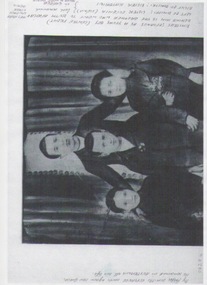
... Greece after he arrived in Australia and as such also never saw his sisters again. Dimitri Sofianos' story of a family separated by migration was a common theme amongst those who ventured beyond their country of birth in the early years of migration when overseas travel was difficult and communications slower. ...A young Dimitri Sofianos is photographed in Ithaca with his older brother and his two sisters, Eugenia and Katerini. His brother migrated to South Africa after which they never saw each other again. His two sisters remained in Greece. Dimitri never returned to Greece after he arrived in Australia and as such also never saw his sisters again.Dimitri Sofianos' story of a family separated by migration was a common theme amongst those who ventured beyond their country of birth in the early years of migration when overseas travel was difficult and communications slower. It also took years of work and hardship to establish themselves in their adopted country and as a result it was often not possible to take the time for overseas travel.A scanned black and white photograph on A4 paper of four young children - two boys and two girls - in front of a curtain. Thew oldest boy is standing behind the other three who are seated. -
 Ithacan Historical Society
Document - Australian Passport, Kalypso Sofianos, 1973
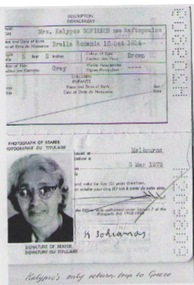
... World War 2 also prevented travel and Greece was an occupied country during those grim years. ...The Australian passport was issued to Kalypso Sofianos when she made her first and only return trip back to Greece in 1973. She arrived in Australia from Ithaca in 1936. It took many years for the Ithacans who had settled in Australia between the two world wars to be able to return to the country of their birth for a number of reasons. Many of them arrived in Australia prior to or during the Great Depression and struggled to establish themselves financially. Overseas travel was slow and expensive. World War 2 also prevented travel and Greece was an occupied country during those grim years. It wasn't until the late 1950s that some of them were able to make their journey back to their beloved Ithaca. Many never returned. A scannned copy of the first page of and Australian Passport which contains important personal details of the passport holder including a photograph. -
 Moorabbin Air Museum
Document (Item) - Simon Warrender Collection See Description for details
... Application for Allocation of Capacity to Greece. .March 1996 Antas Application International Air Charter Licence November 2, 1977 Australian World Air A Project for the Introduction of Low-Cost International Mass Passenger Air Transportation and No date for the Formation of Travel Clubs in Australia, The United Kingdom & Other overseas destinations Air Kangaroo Memorandum. ...Application for Allocation of Capacity to Greece. .March 1996 Antas Application International Air Charter Licence November 2, 1977 Australian World Air A Project for the Introduction of Low-Cost International Mass Passenger Air Transportation and No date for the Formation of Travel Clubs in Australia, The United Kingdom & Other overseas destinations Air Kangaroo Memorandum. ... -
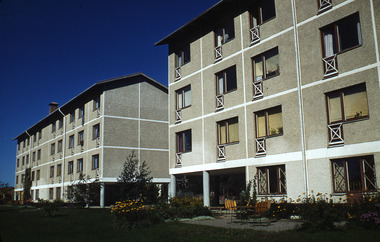 Robin Boyd Foundation
Slide, Robin Boyd, 1950
... Travelling Scholarship.” In 1948 Robin Boyd was awarded ‘joint first place’ in the Robert Haddon competition for his design of Mildura art gallery. The scholarship helped fund their first overseas trip. Robin and Patricia were passengers on the Greek...Travelling Scholarship.” In 1948 Robin Boyd was awarded ‘joint first place’ in the Robert Haddon competition for his design of Mildura art gallery. The scholarship helped fund their first overseas trip. Robin and Patricia were passengers on the Greek ...Penleigh Boyd, Robin and Patricia Boyd's son, writes “Prior to 1950 Robin, like most other amateur or hobby photographers, took black and white printed photographs. The oldest slides date from 1950 when Robin and Patricia travelled to Europe on Robin’s Robert Haddon Travelling Scholarship.” In 1948 Robin Boyd was awarded ‘joint first place’ in the Robert Haddon competition for his design of Mildura art gallery. The scholarship helped fund their first overseas trip. Robin and Patricia were passengers on the Greek ship “Cyrenia” departing in May 1950, passing through the Suez Canal and landing in Genoa five weeks later. For six months, they travelled extensively throughout Europe (predominantly driving themselves) - France, Italy, United Kingdom, Sweden, Denmark, Germany, Austria, Switzerland and Spain.Colour slide in a mount. Social housing, New Empiricism style, Stockholm, SwedenStockholm / N-E / Flats-New Empiricism (All Handwritten)haddon travelling scholarship, haddon, robin boyd, slide
