
Showing 94 items matching "ground crew "
-
 Moorabbin Air Museum
Headwear (Item) - RAF Headset Aircrew/Ground Crew 10A/12161
... RAF Headset Aircrew/Ground Crew 10A/12161....RAF Headset Aircrew/Ground Crew 10A/12161....RAF headset aircrew/ground Crew 10A/12161, with chamois leather ear cups....RAF Headset Aircrew/Ground Crew 10A/12161. Headwear RAF Headset Aircrew/Ground Crew 10A/12161. ...Ear cup stamped with 10A/12161, rear of earphone stamped with Ref No.10A/13466. -
 Moorabbin Air Museum
Booklet - GROUND CREW, FELIX SAINSBURY, 2001
... GROUND CREW...GROUND CREW...GROUND CREW Booklet GROUND CREW FELIX SAINSBURY HESPERIAN PRESS ... -
 National Vietnam Veterans Museum (NVVM)
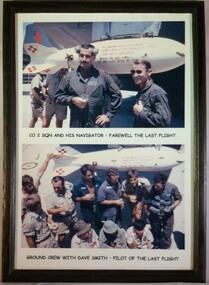
Photograph - Two Coloured Photograph is a Timber Frame Titled CO 2 Sqn and His Navigator -Farewell the last flight and Ground crew with pilot of The Last Flight Dave Smith, 1962 - 1972
... Two Coloured Photograph is a Timber Frame Titled CO 2 Sqn and His Navigator -Farewell the last flight and Ground crew with pilot of The Last Flight Dave Smith ...The bottom photograph is of several ground crew with pilot of the Last flight Dave Smith. ...Co 2 SQN and his Navigator - Farewell The Last Flight / Ground crew with Dave Smith - Pilot of The Last Flight....The bottom photograph is of several ground crew with pilot of the Last flight Dave Smith. ...Two Coloured Photograph is a Timber Frame. The top one is titled CO 2 Sqn and His Navigator -Farewell the last flight and shows the CO talking to another crewman. The bottom photograph is of several ground crew with pilot of the Last flight Dave Smith. The crew are all having a farewell drink.Co 2 SQN and his Navigator - Farewell The Last Flight / Ground crew with Dave Smith - Pilot of The Last Flight.flying officer david robert smith, o224754, no 2 squadron, raaf, royal australian air force, last flight, photograph -
 B-24 Liberator Memorial Restoration Australia Inc
Manual - Course notes for B-24 Liberator aircraft ground crew, Queen City Printers Pty Ltd, Fitters II.A Carpenter, riggers, flight riggers, Course notes, 1942
... Manual - Course notes for B-24 Liberator aircraft ground crew...Issued to RAAF ground crew in WWII....Issued to RAAF ground crew in WWII. Original WWII manual raaf manual riggers carpenters engineering school R.A.A.F. serial number 19218. ...Issued to RAAF ground crew in WWII.Original WWII manualLoose leaf manual in two-ring binder. Pale green with dark green spine.R.A.A.F. serial number 19218. Issue 4 - 1942raaf, manual, riggers, carpenters, engineering school -
Moorabbin Air Museum
Book - Details of air crew and ground crew operation and maintenance of Lancaster bomber aircraft, The Lancaster Manual The Official Air Publication for the Lancaster Mk I and III, 1942-1945, The Lancaster Manual The Official Air Publication for the Lancaster Mk I and III, 1942-1945, 1977
... Details of air crew and ground crew operation and maintenance of Lancaster bomber aircraft, The Lancaster Manual The Official Air Publication for the Lancaster Mk I and III, 1942-1945...Details of air crew and ground crew operation and maintenance of Lancaster bomber aircraft, The Lancaster Manual The Official Air Publication for the Lancaster Mk I and III, 1942-1945...Details of air crew and ground crew operation and maintenance of Lancaster bomber aircraft, The Lancaster Manual The Official Air Publication for the Lancaster Mk I and III, 1942-1945 Details of air crew and ground crew operation and maintenance of Lancaster bomber aircraft, The Lancaster Manual The Official Air Publication for the Lancaster Mk I and III, 1942-1945 Jacket cover showing photo of in flight Lancaster with blue background The Lancaster Manual The Official Air Publication for the Lancaster Mk I and III, 1942-1945 Book Details of air crew and ground crew operation and maintenance of Lancaster bomber aircraft, The Lancaster Manual The Official Air Publication for the Lancaster Mk I and III, 1942-1945 Royal Airforce ...Details of air crew and ground crew operation and maintenance of Lancaster bomber aircraft, The Lancaster Manual The Official Air Publication for the Lancaster Mk I and III, 1942-1945Jacket cover showing photo of in flight Lancaster with blue backgroundnon-fictionDetails of air crew and ground crew operation and maintenance of Lancaster bomber aircraft, The Lancaster Manual The Official Air Publication for the Lancaster Mk I and III, 1942-1945 -
Moorabbin Air Museum
Photograph (Item) - Includes photos of 22 Boston Bomber squadron Anson Wirraway Beau fighters Spitfire Boomerang DC3 ANA airways B26 Marauder Tigermoth B17G Vampire J2M-2 B24 with spots Qantas short Canberra bomber Sunderland Hawk 60 series and 100 Beaufort Hawker Dantorp Mosquitos ground crew airfield negatives, Photos of mainly WW2 era aircraft Mainly Australians in the Pacific theatre of operations
... Includes photos of 22 Boston Bomber squadron Anson Wirraway Beau fighters Spitfire Boomerang DC3 ANA airways B26 Marauder Tigermoth B17G Vampire J2M-2 B24 with spots Qantas short Canberra bomber Sunderland Hawk 60 series and 100 Beaufort Hawker Dantorp Mosquitos ground crew airfield negatives...Photos of mainly WW2 era aircraft Mainly Australians in the Pacific theatre of operations Photograph Includes photos of 22 Boston Bomber squadron Anson Wirraway Beau fighters Spitfire Boomerang DC3 ANA airways B26 Marauder Tigermoth B17G Vampire J2M-2 B24 with spots Qantas short Canberra bomber Sunderland Hawk 60 series and 100 Beaufort Hawker Dantorp Mosquitos ground crew airfield negatives ... -
Moorabbin Air Museum
Magazine (item) - includes articles on air and sea power Wirraway Australian air crew and ground crew, Wings magazine
... includes articles on air and sea power Wirraway Australian air crew and ground crew...Wings magazine Magazine includes articles on air and sea power Wirraway Australian air crew and ground crew ... -
 National Vietnam Veterans Museum (NVVM)
Photograph, Gibbons, Denis, RAN Wessex 2
... ...Navy Ground Crew...A black and white photograph of the naval ground crew preparing a Sea King helicopter for a Anti-submarine flight around Vung Tau Ferry HMAS Sydney. ...Photograph Sea King Helicopter HMAS Sydney Vung Tau Ferry 9th Battalion Royal Australian Regiment Gibbons Collection Catalogue Denis Gibbons Photographer Vietnam War Navy Ground Crew Vung Tau A black and white photograph of the naval ground crew preparing a Sea King helicopter for a Anti-submarine flight around Vung Tau Ferry HMAS Sydney. ...Denis Gibbons (1937 – 2011) Trained with the Australian Army, before travelling to Vietnam in January 1966, Denis stayed with the 1st Australian Task Force in Nui Dat working as a photographer. For almost five years Gibbons toured with nine Australian infantry battalions, posting compelling war images from within many combat zones before being flown out in late November 1970 after sustaining injuries. The images held within the National Vietnam Veterans Museum make up the Gibbons Collection.A black and white photograph of the naval ground crew preparing a Sea King helicopter for a Anti-submarine flight around Vung Tau Ferry HMAS Sydney. Sydney had entered Vietnamese waters and went on full alert as it headed for Vung Tau with the 9th Battalion, Royal Australian Regiment.photograph, sea king helicopter, hmas sydney, vung tau ferry, 9th battalion, royal australian regiment, gibbons collection catalogue, denis gibbons, photographer, vietnam war, navy ground crew, vung tau -
 Lara RSL Sub Branch
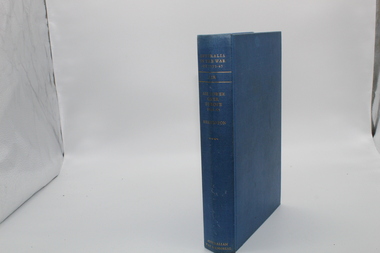
Book, Australia in the War of 1939-1945 - Air Power Over Europe 1944-1945 Volume 4. AIR. Author John Herington, First Published 1963
... ...ground crew...Historical record of the Air power over Europe 1944-1945 invasion of italy long range missiles oil normandy coastal command ardennes offensive battle of the bulge evaders prisoners rhine air force 1944-1945 wwii 453 squadron 646 squadron spitfire ground crew no.3 squadron 461 squadron 466 squadron 455 squadron Australian War Memorial Australia in the War of 1939-1945 - Air Power Over Europe 1944-1945. ...A continuation and conclusion of the story of Australian airmen who served in or beside the RAAF in the struggle against Germany and Italy. In general it covers a period when both in the Mediterranean and in Northern Europe Air superiority, the vital pre-requisite of successful air assault, had already been gained over the enemy. The emphasis is largely engagements or in the strategic bombing campaigns to the total achievement of allied air power in land and sea campaigns.Historical record of the Air power over Europe 1944-1945Australia in the War of 1939-1945 - Air Power Over Europe 1944-1945. AIR Maps, Illustrations, charts, photographsAustralian War Memorialinvasion of italy, long range missiles, oil, normandy, coastal command, ardennes offensive, battle of the bulge, evaders, prisoners, rhine, air force 1944-1945, wwii, 453 squadron, 646 squadron, spitfire, ground crew, no.3 squadron, 461 squadron, 466 squadron, 455 squadron -
Moorabbin Air Museum
Book - RAF in World War II, Experiences of War The British Airman
... ...Ground crew & other back up....RAF in World War II Sprogs The drill Oppos The line Bomber types Fighter types Coastal Air Command Transport The Mediterranean Ground crew & other back up. VE day & demob Overview of RAF experience in WWII, through eyes of participants. ...Overview of RAF experience in WWII, through eyes of participants. Circa 1989non-fictionOverview of RAF experience in WWII, through eyes of participants. Circa 1989sprogs, the drill, oppos, the line, bomber types, fighter types, coastal air command, transport, the mediterranean, ground crew & other back up., ve day & demob -
 National Vietnam Veterans Museum (NVVM)
Photograph, M113 Track Replacement
... The rear of the APC sits on the front of a tank to lift the tracks of the ground. Crews stand on the vehicles and of the ground...The rear of the APC sits on the front of a tank to lift the tracks of the ground. Crews stand on the vehicles and of the ground M113 Track Replacement Photograph Photograph ...A coloured photograph of a M113 APC habing its tracks replaced in the field. The rear of the APC sits on the front of a tank to lift the tracks of the ground. Crews stand on the vehicles and of the groundM113's nickname is "The Nympho" S/No 134photograph, m113, armoured personnel carrier -
 Bendigo Military Museum
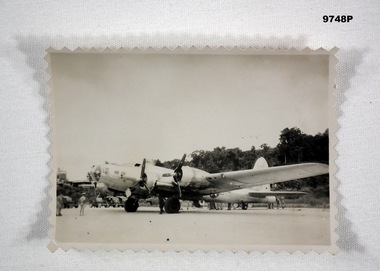
Photograph - PHOTOGRAPH, BENNETTS
... Black and white photograph of a large propellor powered aeroplane. Aircraft ground crew visible on tarmac. Four jeeps visible in background. ...Black and white photograph of a large propellor powered aeroplane. Aircraft ground crew visible on tarmac. Four jeeps visible in background. ...Part of the Bennetts Collection. See Catalogue No. 9726P for details of service for "Alva Marie Bennetts"Black and white photograph of a large propellor powered aeroplane. Aircraft ground crew visible on tarmac. Four jeeps visible in background. Photograph has a white border which has been trimmed with pinking shears.handwritten on back in black ink: American "Flying Fortress".bennetts collection, alva bennetts, flying fortress, boeing b17. -
 B-24 Liberator Memorial Restoration Australia Inc
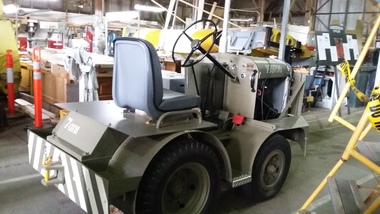
Vehicle, Mercury Aircraft Tug
... Motorised tugs were used by ground crew to move aircraft on the ground....Motorised tugs were used by ground crew to move aircraft on the ground. This tug is of historical significance to the B24-Liberator MERCURY TRUCK & TRACTOR CO LTD GLOUCESTER ENGLAND-Embossed figurehead of Mercury on front. ...Motorised tugs were used by ground crew to move aircraft on the ground.This tug is of historical significance to the B24-LiberatorMotorised Aircraft TugMERCURY TRUCK & TRACTOR CO LTD GLOUCESTER ENGLAND-Embossed figurehead of Mercury on front. The MERCURY TRUCK & TRACTOR CO GLOUCESTER , For Spare parts quote chassis no.4962. Tyre Pressure LBS.Per Sq Inch - Front 70 Rear 45 ON plate on Dashboard MORRIS COMMERCIAL embossed on gearbox housing. MT & T embossed on either side of radiator. -
 Bendigo Military Museum
Album - PHOTOGRAPH ALBUM, Unknown
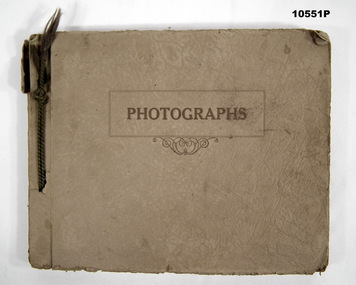
... Inside various photos of WW1 era planes and naval ships (including the HMS Hood) and some pictures of ground crew. On 1st inside page of album identifying flying squadron No. 671....Inside various photos of WW1 era planes and naval ships (including the HMS Hood) and some pictures of ground crew. On 1st inside page of album identifying flying squadron No. 671. ...Name inside was G.H. Sainsbury, Squadron 671, No. 3 Flt group. Wikipedia said this was a Glider Squadron. In WW2 that never saw action as war finished against Japan prior to entering action. Photos seem inconsistent with this in time and type. Part of the William (Bill) Thomason collection. Refer Cat No. 4136P.Brown photo album with brown string binding. Inside various photos of WW1 era planes and naval ships (including the HMS Hood) and some pictures of ground crew. On 1st inside page of album identifying flying squadron No. 671.Title on front "Photographs".collection of william (bill) thomason, photograph album -
 Bendigo Historical Society Inc.
Postcard - BASIL WATSON COLLECTION: POSTCARD, ARMY AIRSHIP 'THE GAMMA', ca. 1914
... Written in top RH corner: ' Army Airship The Gamma' Image shows tethered army airship with ground-crew holding airship down with lines. ...Written in top RH corner: ' Army Airship The Gamma' Image shows tethered army airship with ground-crew holding airship down with lines. Large buildings, possibly hangars, in background. ...Black and white postcard. Written in top RH corner: ' Army Airship The Gamma' Image shows tethered army airship with ground-crew holding airship down with lines. Large buildings, possibly hangars, in background. 'Our Aerial Defence' Series.John Drew, Aldershot & Farnboroughmilitary, aviation, airship 'the gamma' -
Moorabbin Air Museum
Manual (item) - GAF Beaufort Manual
... Seems to be a fairly comprehensive manual for ther aircraft, including notes for the pilot, aircrew, ground crew, notes on instruments and construction, etc. ...Seems to be a fairly comprehensive manual for ther aircraft, including notes for the pilot, aircrew, ground crew, notes on instruments and construction, etc. ...Seems to be a fairly comprehensive manual for ther aircraft, including notes for the pilot, aircrew, ground crew, notes on instruments and construction, etc. -
 Sorrento/Portsea RSL Sub Branch
Photograph, F4E at RAAF Darwin, October 1972
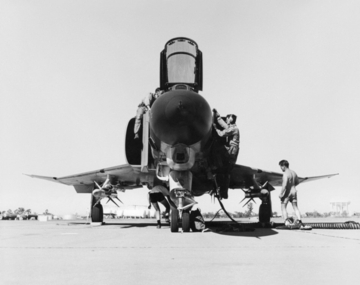
... The F4E depicted was tasked to 'cold soak" Sidewinder and Sparrow missiles in the troposphere at 53,000 feetabove Darwin in a joint exercise for the RAAF and the United States Navy in 1972.The aircraft is being readied for flight by the aircrew and ground crew at RAAF Darwin....The F4E depicted was tasked to 'cold soak" Sidewinder and Sparrow missiles in the troposphere at 53,000 feetabove Darwin in a joint exercise for the RAAF and the United States Navy in 1972.The aircraft is being readied for flight by the aircrew and ground crew at RAAF Darwin. f4e raaf missle peace time darwin vietnam noelryan F4E at start up RAAF Darwin tarmac.Armed with Sidewinder and Sparrow missiles. ...The F4E depicted was tasked to 'cold soak" Sidewinder and Sparrow missiles in the troposphere at 53,000 feetabove Darwin in a joint exercise for the RAAF and the United States Navy in 1972.The aircraft is being readied for flight by the aircrew and ground crew at RAAF Darwin.F4E at start up RAAF Darwin tarmac.Armed with Sidewinder and Sparrow missiles. Photograph taken from the aircraft nose showing raised cockpit canopies,groundcrew and aircrew readying the airrcraft for flight. Note air start is connected Aircraft Serial No. A69-217.f4e, raaf, missle, peace time, darwin, vietnam, noelryan -
 Bendigo Military Museum
Photograph - PHOTOGRAPH, AIRCRAFT, Central Press Photos Ltd, c. WWII
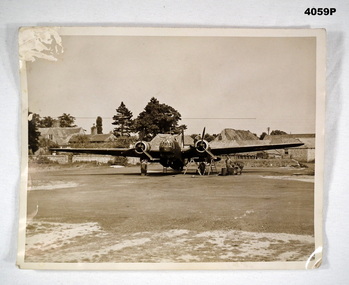
... Card details a Lancaster bomber, but in all likelihood its a Wellington bomber being serviced at an airfield by ground crew. Part of Frederick Gardner Davey DFC No.410533 RAAF Collection. ...Card details a Lancaster bomber, but in all likelihood its a Wellington bomber being serviced at an airfield by ground crew. Part of Frederick Gardner Davey DFC No.410533 RAAF Collection. ...Card details a Lancaster bomber, but in all likelihood its a Wellington bomber being serviced at an airfield by ground crew. Part of Frederick Gardner Davey DFC No.410533 RAAF Collection. See Cat. No. 3536P for his service record. Photo, black & white, white border, of an aircraft being serviced by two airmen. Buildings and trees visible in the background.On back, hand written in pencil: "Lancaster by day". On back, two stamps in purple ink: 1 "Copyright photos issued by Central Press Photos Ltd. Incorporating Central News Illustrations Service, 119 Fleet Street London E.C.4" 2 "Certified by Central Press Photos Ltd as passed by censor. Pres and censorship bureau"bombers, ww2 -
 Ringwood RSL Sub-Branch
Book - Flying the Mail, Aviation
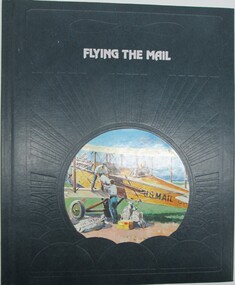
... A United States mail pilot clambers out of the cockpit as ground crew unload his cargo. In this authentically detailed scene of the airmails early years by French aviation artist Paul Lengell'e a postal clerk checks the mailbags and packages against a manifest before they are loaded into the waiting truck....A United States mail pilot clambers out of the cockpit as ground crew unload his cargo. In this authentically detailed scene of the airmails early years by French aviation artist Paul Lengell'e a postal clerk checks the mailbags and packages against a manifest before they are loaded into the waiting truck. ...Vinyl Exterior, printed paper pages.After landing his D.H.4 safely at a midwestern airfield in the face of a brewing storm. A United States mail pilot clambers out of the cockpit as ground crew unload his cargo. In this authentically detailed scene of the airmails early years by French aviation artist Paul Lengell'e a postal clerk checks the mailbags and packages against a manifest before they are loaded into the waiting truck. -
 Shepparton RSL Sub Branch
Goggles
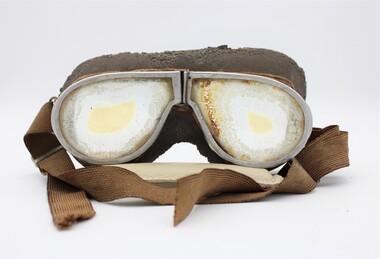
... Unlike other examples, this set does not have fur lined interior suggesting that it may have been used by ground crew rather than those at altititude....Unlike other examples, this set does not have fur lined interior suggesting that it may have been used by ground crew rather than those at altititude. flying royal australian air force raaf flying corps goggle eyemask aviation equipment pilot first world war second world war Goggles constructed of various materials: rubber edging, metal frames, plastic lens, canvas sides and elastic strap attached via metal buckles. ...Flying goggles possibly used by a member of the Flying Corps in the First or Second World War. Unlike other examples, this set does not have fur lined interior suggesting that it may have been used by ground crew rather than those at altititude.Goggles constructed of various materials: rubber edging, metal frames, plastic lens, canvas sides and elastic strap attached via metal buckles. Rubber hand stitched to convas sides. Lens cracked and yellowed in centre.flying, royal australian air force, raaf, flying corps, goggle, eyemask, aviation, equipment, pilot, first world war, second world war -
Moorabbin Air Museum
Book - History and photos of Bristol Blenheim operations during WW2, BRISTOL BLENHEIM, Chaz Bowyer, BRISTOL BLENHEIM, 1984
... Cover jacket showing two b&w photos, top of Blenheim in flight, bottom of Blenheim on ground with crew in front, all against a yellow background...History and photos of Bristol Blenheim operations during WW2, BRISTOL BLENHEIM History and photos of Bristol Blenheim operations during WW2, BRISTOL BLENHEIM Cover jacket showing two b&w photos, top of Blenheim in flight, bottom of Blenheim on ground with crew in front, all against a yellow background BRISTOL BLENHEIM Book History and photos of Bristol Blenheim operations during WW2, BRISTOL BLENHEIM Chaz Bowyer ...History and photos of Bristol Blenheim operations during WW2, BRISTOL BLENHEIMCover jacket showing two b&w photos, top of Blenheim in flight, bottom of Blenheim on ground with crew in front, all against a yellow backgroundnon-fictionHistory and photos of Bristol Blenheim operations during WW2, BRISTOL BLENHEIM -
 Bendigo Military Museum
Album - PHOTOGRAPHIC ALBUM WW2, Album of reproduced photographs featuring No 3 Squadron RAAF in Africa, Sicily, Malta and Italy
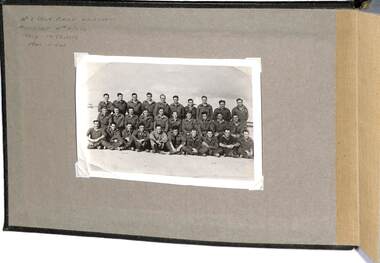
... Album dating from 1950's contains reproductions of photographs known to exist elsewhere. Featuring ground crew operations of 3 Squadron RAAF in Africa, Malta, Sicily and Italy. ...Album dating from 1950's contains reproductions of photographs known to exist elsewhere. Featuring ground crew operations of 3 Squadron RAAF in Africa, Malta, Sicily and Italy. ...Part of Thomason collection of militaria and memorabilia. Album dating from 1950's contains reproductions of photographs known to exist elsewhere. Featuring ground crew operations of 3 Squadron RAAF in Africa, Malta, Sicily and Italy. Part of the collection of William (Bill) Thomason, refer catalogue number 3136P for more items. . Photo album dating from 1950's featuring official distributed photographs featuring No 3 Squadron RAAFpostcards, ww1, ww2 -
 B-24 Liberator Memorial Restoration Australia Inc
Suitcase from Mason Day Frecker, 1930s
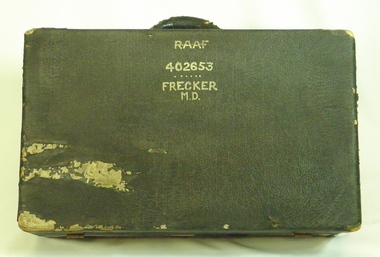
... Suitcase contains Flying Log Book RAAF, Wedding Photo, National Archives Record Search Mason Day Frecker, Distinguished Flying Medal Register WW2 x 3, Papers on Medals and Victorian Ground Crew Numbers, Files 1 - 2 - 3 - Photographs, Leaflets, Pilots' Notes, Maps - Germany (28 maps), Buttons and badges and other medals....Suitcase contains Flying Log Book RAAF, Wedding Photo, National Archives Record Search Mason Day Frecker, Distinguished Flying Medal Register WW2 x 3, Papers on Medals and Victorian Ground Crew Numbers, Files 1 - 2 - 3 - Photographs, Leaflets, Pilots' Notes, Maps - Germany (28 maps), Buttons and badges and other medals. ...Suitcase issued to aircraft captains or crew by RAAF during World War II. The contents of M D Frecker's suitcase include World War II medals awarded to the owner, photographs, maps, pilots' handbooks, language dictionaries (Malay, Pidgin, Japanese), propaganda leaflets dropped by Japanese.Has historical and social significance, also research significance. Provenance known, owner piloted B-24 Liberator bombers and General Blamey's personal aircraft; item was donated by son. Great interpretive potential.Worn dark suitcase belonging to Mason Day Frekker, strong cardboard covered with 'leatherette', metal fasteners on front, with carry handle. Suitcase contains Flying Log Book RAAF, Wedding Photo, National Archives Record Search Mason Day Frecker, Distinguished Flying Medal Register WW2 x 3, Papers on Medals and Victorian Ground Crew Numbers, Files 1 - 2 - 3 - Photographs, Leaflets, Pilots' Notes, Maps - Germany (28 maps), Buttons and badges and other medals."RAAF/402653/Frecker/M.D." on top surface, "M.D.F." on front surface under handle.b24 liberator bomber, world war ii, raaf pilot, world war ii aerial photographs, a22.00 -
4th/19th Prince of Wales's Light Horse Regiment Unit History Room
Framed Print, J Attard, The Ceremonial Opening of Hopkins Barracks 31 Oct 1985, 1986
... A Centurion tank is passing along road next to parade ground with crew commander saluting. Another tank is following....A Centurion tank is passing along road next to parade ground with crew commander saluting. Another tank is following. ...Framed print, glass fronted, landscape of opening of Hopkins Barracks by HRH the Prince Charles, Colonel-in-Chief Royal Australian Armoured Corps 31 Oct 1985. All RAAC guidons with escort are in line facing dais and guests. A Centurion tank is passing along road next to parade ground with crew commander saluting. Another tank is following.Signed by artist - "J Attard 1986" -
 Flagstaff Hill Maritime Museum and Village
Decorative object - Pen Tray, David Hay, circa 1847
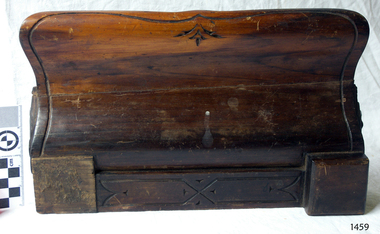
... grounded. A local indigenous man, Buckawall, braved the rough sea to take a line from the shore to the Enterprise. All five members of the crew...grounded. A local indigenous man, Buckawall, braved the rough sea to take a line from the shore to the Enterprise. All five members of the crew ...This pen tray is handmade from some of the timbers from the wreck of the schooner Enterprise. It was originally donated to the former Warrnambool Museum and Art Gallery and transferred to Flagstaff Hill Maritime Museum and Village when it was first established. The paper tag with the pen tray was inscribed "SWINBURNE". It is likely to be a reference to Charles Grant Swinburen, Mr Chas (Charles) Grant Swinburne (1864-1934), married Susan Jane Granter (1867-19 June 1935) in 1891. They were both Warrnambool residents. Swinburne was a prominent member of the Toc H. Progress Association and several other local clubs and societies. He died after a painful illness. Swinburne's wife, Susan, was the daughter of Joseph (1832-1879) and Ann Granter (nee Holley). Her father had arrived in Melbourne on the ship Marco Polo in February 1856. In 1868, he was a shareholder of the Warrnambool Steam Packet Co., His portrait is among those recognised on the historic Warrnambool Pioneers Board. The inscription on the rear of the pen holder was added at a later date. It incorrectly states that the vessel "was the first boat up the river Yarra with Fawkner", confusing this Warrnambool wreck "Enterprise" with Fawkner's vessel "Enterprize" (sometimes written "Enterprise"). THE “ENTERPRISE” 1847-1850 The wooden, two-masted schooner Enterprise was built in New Zealand in 1847 and registered in Melbourne, Australia. The Enterprise carried cargoes of agricultural produce and other commodities for trade between the ports of the Colony. On September 14, 1850, the Enterprise was at anchor in Lady Bay under its Master, James Gardiner Caughtt, loaded with a cargo of wheat and potatoes. A strong south-easterly wind caused the vessel to drag on its only anchor, and the rudder was lost. The gale-force wind blew it sideways, and it became grounded. A local indigenous man, Buckawall, braved the rough sea to take a line from the shore to the Enterprise. All five members of the crew were able to make it safely to land. The Enterprise was wrecked. The Enterprise wreck was in an area called Tramway Jetty in Lady Bay. Since then, the area became the location of the Lady Bay Hotel, and now, in 2019, it is in the grounds of the Deep Blue Apartments. In fact, with the constantly changing coastline through built-up sand, the wreck site is now apparently under the No. 2 Caravan Park on Pertobe Road, perhaps 150 metres from the high tide. Its location was found by Ian McKiggan (leader of the various searches in the 1980s for the legendary Mahogany Ship). DIFFERENTIATING the New Zealand Schooner “Enterprise” from John Fawkner’s “Enterprize“ Dr Murray Johns, Melbourne, says in his article The Mahogany Ship Story “… As I documented in 1985, the Warrnambool wreck was of an entirely different ship, also called Enterprize [with the spelling ‘Enterprise’], but built in New Zealand in 1847. Fawkner’s ship had already been sold to Captain Sullivan in 1845 and was wrecked on the Richmond Pier in northern New South Wales early in 1847. “ The pen tray is significant for its association with the wreck of the Enterprise, which is listed on the Victorian Heritage Database, VHR S238. The Enterprise is of significance as a New Zealand-built but Australian-owned coastal trader. The wreck was also significant for its association with the indigenous hero Buckawall, who saved the lives of the five crew on board. The pen tray is an example of the use of timbers salvaged from shipwrecks along the coast.Decorative pen tray; handmade and carved from timber from the vessel "Enterprise", 1847-1850. The tray is made from several pieces of wood and has a concave surface. The engraving includes a border, motifs, and decorative scrolls on the sides. The inscription on the rear was written in script. A paper tag marked 'Swinburne' was with the board."Swinburne", "from the vessel Enterprise" Writing on the back of the pen tray: "Made from / wreck of / "Enterprise" first boat / up river Yarra with / Fawkner later wrecked / at Warrnambool Vic"flagstaff hill, warrnambool, shipwrecked-coast, flagstaff-hill, flagstaff-hill-maritime-museum, maritime-museum, shipwreck-coast, flagstaff-hill-maritime-village, wood carving, carving, carving craft, 1850 wreck, john watson, james gardiner caught, tramway jetty, lady bay, rescue line, ian mckiggan, vhr s238, relic, buckawall, schooner, enterprise, coastal trader, new zealand, indigenous rescue, indigenous hero, pen holder, pen tray, wood souvenir, enterprise s ouvenir -
 Flagstaff Hill Maritime Museum and Village
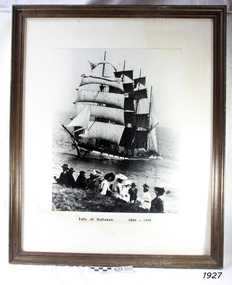
Photograph - Vessel, Sailing Ship, Falls of Halladale 1886 - 1908, 1908
... Flagstaff Hill Maritime Museum Maritime Village Flagstaff Hill Maritime Museum and Village Great Ocean Road Shipwreck Peterborough Falls Of Halladale 1908 barque Scotish 4-masted sailing ship 1886 Glasgow trade grain trade cargo windjammer fore and aft bridges Falls Line Wright Breakenridge & Co American slate roofing tiles barbed wire sewing machines oil benzene Port Campbell Rocket Crew sightseers salvage Captain David Wood Thomson Captain Thomson navigational error Clyde-built Russell & Co Typed beneath photograph "Falls of Halladale 1886 - 1908" Photograph, behind glass in a timber frame. Image of a group of people seated on the ground ...The photograph shows some of the hundreds of sightseers who visited the site of the wreced Falls of Halladale, watching the fully rigged ship slowly disintegrate over two months or more. The Falls of Halladale was a four-masted sailing ship built in 1886 in Glasgow, Scotland, for the long-distance cargo trade and was mostly used for the Pacific grain trade. The ship was sturdy. It could carry maximum cargo and maintain full sail in heavy gales. It was one of the last of the ‘windjammers’ that sailed the Trade Route, and one of the first vessels to include fore and aft lifting bridges, which kept the crew safe and dry as they moved around the decks in stormy conditions. It was one of several Falls Line ships named after the waterfalls of Glasgow by its owner, Wright, Breakenridge & Co of Glasgow. On 4th August 1908, with new sails, 29 crew, and 2800 tons of cargo, the Falls of Halladale left New York, bound for Melbourne and Sydney via the Cape of Good Hope. The cargo on board was valued at £35,000. It included 56,763 tiles of American slate roofing tiles, 5,673 coils of barbed wire, 600 stoves, 500 sewing machines, 6,500 gallons of oil, 14,400 gallons of benzene, plumbing iron, 117 cases of crockery and glassware and many other manufactured items. The Falls of Halladale had been at sail for 102 days when, at 3 am on the 14th November 1908, under full sail in calm seas with a six knots breeze behind and misleading fog along the coast, the great vessel rose upon an ocean swell and settled on top of a submerged reef near Peterborough on south-west Victoria’s coast. The ship was jammed on the rocks and began filling with water. The crew launched the two lifeboats and all 29 crew landed safely on the beach over 4 miles away at the Bay of Islands. The postmistress at Peterborough, who kept a watch for vessels in distress, saw the stranding and sent out an alert to the local people. A rescue party went to the aid of the sailors and the Port Campbell rocket crew was dispatched, but the crew had all managed to reach shore safely by the time help arrived. The ship stayed in full sail on the rocky shelf for nearly two months, attracting hundreds of sightseers who watched her slowly disintegrate until the pounding seas and dynamiting by salvagers finally broke her back, and her remains disappeared back into deeper water. The valuable cargo was largely lost, despite two salvage attempts in 1908-09 and 1910. Further salvage operations were made from 1974-1986, during which time 22,000 slate tiles were recovered with the help of 14 oil drums to float them, plus personal artefacts, ship fittings, reams of paper and other items (a list of items held at Flagstaff Hill Maritime Village is included below). The Court of Marine Inquiry in Melbourne ruled that the foundering of the ship was entirely due to Captain David Wood Thomson’s navigational error, not too technical failure of the Clyde-built ship. The shipwreck is a popular site for divers, about 300m off-shore and in 3 – 15m of water. Some of the original cargo can be seen at the site, including pieces of roof slate and coils of barbed wire. ABOUT THE ‘FALLS OF HALLADALE’ (1886 - 1908) Built: in1886 by Russell & Co., Greenock shipyards, River Clyde, Scotland, UK. The company was founded in 1870 (or 1873) as a partnership between Joseph Russell (1834-1917), Anderson Rodger and William Todd Lithgow. During the period 1882-92 Russell & Co., standardised designs, which sped up their building process so much that they were able to build 271 ships over that time. In 1886 they introduced a 3000 ton class of sailing vessel with auxiliary engines and brace halyard winches. In 1890 they broke the world output record. Owner: Falls Line, Wright, Breakenridge & Co, 111 Union Street, Glasgow, Scotland. Configuration: Four-masted sailing ship; iron-hulled barque; iron masts, wire rigging, fore & aft lifting bridges. Size: Length 83.87m x Breadth 12.6m x Depth 7.23m, Gross tonnage 2085 ton Wrecked: the night of 14th November 1908, Curdies Inlet, Peterborough south west Victoria Crew: 29The Falls of Halladale shipwreck is listed on the Victorian Heritage Register (No. S255). It was one of the last ships to sail the Trade Routes. The ship was one of the first vessels to have fore and aft lifting bridges. The wreck is an example of an International Cargo Ship and represents aspects of Victoria’s shipping industry. The wreck is protected as a Historic Shipwreck under the Commonwealth Historic Shipwrecks Act (1976).Photograph, behind glass in a timber frame. Image of a group of people seated on the ground with the stranded barque, the Falls of Halladale, in full sail nearby in the water. The photograph was taken at Peterborough, southwest Victoria, on November 13th 1908. A typed inscription is below the picture.Typed beneath photograph "Falls of Halladale 1886 - 1908"flagstaff hill, maritime museum, maritime village, flagstaff hill maritime museum and village, great ocean road, shipwreck, peterborough, falls of halladale, 1908, barque, scotish, 4-masted, sailing ship, 1886, glasgow, trade, grain trade, cargo, windjammer, fore and aft bridges, falls line, wright, breakenridge & co, american slate, roofing tiles, barbed wire, sewing machines, oil, benzene, port campbell rocket crew, sightseers, salvage, captain david wood thomson, captain thomson, navigational error, clyde-built, russell & co -
 Mission to Seafarers Victoria
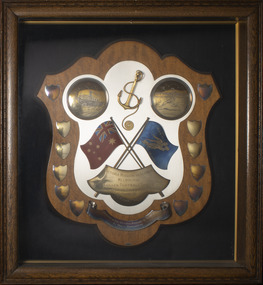
Award - Shield, Soccer Football Shield For Annual Competition by Crews of Merchant Ships, c. 1936
... ground. Soccer Football Shield For Annual Competition by Crews of Merchant Ships Award Shield Angus and Coote Angus and Coote ...Football matches were a popular onshore activity and Annual reports note Reverend Weller in the 1920s managed to establish a temporary pitch and a change room facility near Port Melbourne. The donor, Wally Nancarrow, was a tailor in the Queen Victoria Building in Sydney (from Nov. 1927- Aug. 1935 on Trove) so the relation with the Melbourne Mission is unclear. The shield can be seen hanging above the canteen on item 1713 (dated c. 1950) and in the Celia Little Room. The Annual Report 1936 mentions a shield (p11) seen on page 15: "Football: The competition has been extended this year, and in the future is to include all matches played in Australian ports. The Victorian Missions to Seamen Shield is the present trophy, and the Assistant-Chaplain has been appointed Organiser and Honorary Secretary." The shield may have been done after the one mentioned in the annual report and we can only speculate nothing was ever engraved because of WW2.The collection holds many historic and later contemporary colour photos of crew football teams posed onshore and on decks. Sports and games were an essential part of the welfare services offered by the Mission when seamen had long shore leave.Wooden shield featuring two circular disk silver plaques one on each side at the top. One with the engraving of a ship and the other with the engraving of a footballer. At the top in the centre is an anchor in relief gilded with a rope attached, falling across the front of it and coiling at the bottom of the anchor. Two flags crossing over in the middle of the shield; one the Australian Navy flag and the other the Mission to Seamen flag. Laying over the top of the poles of the flags is a brass banner with the competition description engraved on it. At the bottom is a brass scroll with an inscription about who presented it and where. The shield has 12 smaller, blank silver shields along the sides. The shield is kept inside a wooden display cabinet with a glass front and navy material back ground.engraved on brass banner: For annual competition by crew of merchant ships presented by Wally Nancarrow, Sydneyshield, soccer, football, anchor, brass, silver, wally nancarrow, mission to seafarers victoria, walter james nancarrow (1885 - 1961) -
 Mission to Seafarers Victoria
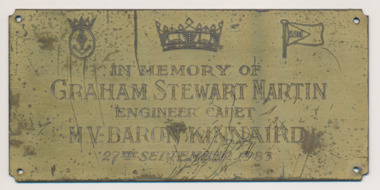
Plaque - Memorial plaque, Graham Stewart Martin, 1983
... During the celebrations, Graham climbed up some scaffolding to get a better view but a girder became disloged and he fell to the ground and was struck by the falling girder. He died shortly after despite the best efforts of the ambulance crews. ...During the celebrations, Graham climbed up some scaffolding to get a better view but a girder became disloged and he fell to the ground and was struck by the falling girder. He died shortly after despite the best efforts of the ambulance crews. ...Graham was born in 1962 in Glasgow, Scotland. He grew up in the south side of Glasgow and became an active member of the Boys Brigade, progressing through the different sections to eventually gain the organisation's highest award, the Queens Badge. During these years Graham became a proficient bugler and trumpeter, taking part in many nationwide competitions as part of the company band. After completion of his school education, Graham was accepted as an apprentice engineering officer by the Scottish Ship Management who ran a fleet of bulk carriers. After training at the Glasgow Nautical College he then went to sea, firstly on the MV Baron Napier and subsequently the MV Baron Kinnaird, the ship he was on when he travelled to Australia. On the 27th November 1983, there were parties throughout Australia to celebrate the winning of The Americas Cup yacht race, Melbourne was no exception and Graham and several colleagues went ashore to join in. During the celebrations, Graham climbed up some scaffolding to get a better view but a girder became disloged and he fell to the ground and was struck by the falling girder. He died shortly after despite the best efforts of the ambulance crews. Graham's body was returned home to Glasgow and a cremation service took place in the Linn Crematorium near where he lived and grew up. Money was donated by the ship's crew and officer and sent to the Mission (Reverend Chin) to purchase an engraved plaque in his memory. The plaque was mounted on a bench used as coffee table. In January 2025, Alain, his former girlfriend visited the Mission to view the plaque.The Mission is a place of memorial for seafarers.Rectangular brass plaque, on top 3 logos: Merchant Navy, Merchant Navy crown and flag of the SSM (Scottish Ship Management)Engraved: In Memory of / Graham Stewart Martin / Engineer Cadet / MV Baron Kinnaird / 27th September 1983graham stewart martin, engineer cadet, m.v. baron kinnaird, scottish ship management, ssm, 1983, america's cup, bench -
 Flagstaff Hill Maritime Museum and Village
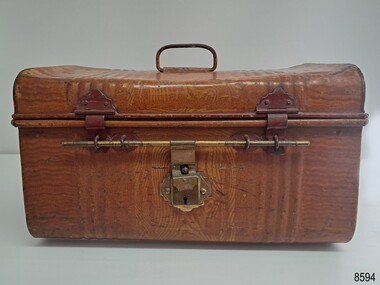
Functional object - Trunk
... The Schomberg was grounded on a sand spit near Peterborough. All passengers and crew were safely rescued. ...The Schomberg was grounded on a sand spit near Peterborough. All passengers and crew were safely rescued. ...This metal travelling trunk belonged to David and Alice Ellis, a young couple married in Dublin in 1855. They left for Australia on the Schomberg clipper ship on October 6 that same year, joining the other passengers for the luxury sailing ship’s first voyage, bound for Melbourne, Australia. The Schomberg was grounded on a sand spit near Peterborough. All passengers and crew were safely rescued. They had been allowed to take something small with them when leaving the sinking vessel, and as such, Alice took a small cane basket and coin purse. The metal trunk was also amongst the couple’s possessions, along with a pair of candlesticks and a Bible. Their trunk was later retrieved from the ship’s deck by the crew of a steamer sent from Melbourne. At that time, David was 23 years old (born in Wales, in 1832) and Alice was 26 (born in Ireland, 1829). The couple lived in Tasmania for a short period before settling in the Western Districts of Victoria. David worked as a gardener and, when land in the area was available to purchase, David and Alice claimed a selection on Noorat Road near Terang. They settled there for the remainder of their lives, expanding the property that they named, ‘Allambah’, and had six children. David died in 1911, aged 79, and Alice passed away the following year, aged 83. B, B & B. Brand: - The company was renowned for its strongly constructed and high-quality travel goods. In 1906 the company was sold and renamed Buffalo Trunk Manufacturing Co. Interestingly, the trunk maker’s promise on its printed label is certainly fulfilled: - "B B BRAND. These Goods are manufactured of the best steel sheets, and are guaranteed to give every satisfaction, and will last for years."David and Alice Ellis’s donated possessions have great significance as a group of personal belongings saved from the sinking luxury clipper ship, the Schomberg, in 1855. The strong, well-crafted metal trunk is an example of high-quality travel luggage owned by newlyweds on their journey to a new life across the world. The well-made trunk is a rare shape. It joins Flagstaff Hill’s collection of artefacts from the Schomberg shipwreck, which is listed on the Victorian Heritage Register (VHR S612). The ship has historical significance as a rare example of a large, fast clipper ship on the England to Australia run, built to carry emigrants at the time of the Victorian gold rush. The ship’s design included the technical advances needed to break sailing records between Europe and Australia. The relationship of the objects in Flagstaff Hill’s Schomberg collection allows has potential interpretation of the story of the Schomberg. The collection of objects is archaeologically significant as the remains of an international passenger ship, as it represents aspects of Victoria’s shipping history, in addition to its association with the shipwreck and the ship.Traveller's metal trunk; small brown woodgrain patterned trunk with dark red features and brass lock. This well-made strong and sturdy piece of secure hand luggage has rounded corners and sides, with the ends of the lid slightly bulbous. The lid is reinforced inside across the centre. The lid and sides have dark red metal D-shaped handles that fold down. The two hinges on the lid have their fittings inside the trunk which is hinged across the back. Two dark red painted latches secure the front along with a brass rod and lockable latch in the centre front. The metal is shaped with a group of corrugated ribs on each side of the centre, around the trunk. A white printed and lacquered label is inside the lid and has additional handwritten text. The truck was the luggage of David and Alice Ellis on the sailing ship SCHOMBERG in 1855. Printed on the label: "B B BRAND./ These Goods are manufactured of the best / steel sheets, and are guaranteed to give every / satisfaction, and will last for years." Handwritten on the label: "8/3- 7/-" (possibly meaning Eight shillings and three pence, Seven shillings)flagstaff hill maritime museum and village, great ocean road, shipwreck coast, schomberg, sailing ship, 1855, david and alice ellis, schomberg passengers, b b brand, american made, traveller's trunk, hand luggage, metal trunk, schomberg ship, 1855 shipwreck, peterborough shipwreck, ss queen, david ellis, alice ellis, allambah terang, dublin emigrants, terang presbyterian church, western district victoria, antique trunk, vintage trunk, travel goods, travelling trunk, steel trunk, tin trunk, schomberg trunk, newlyweds, b b & b, boyd boyd & boyd, pittsburgh, rare shape, luggage, vintage luggage, victorian era, travel trunk, three locks, steamer trunk -
 Flagstaff Hill Maritime Museum and Village
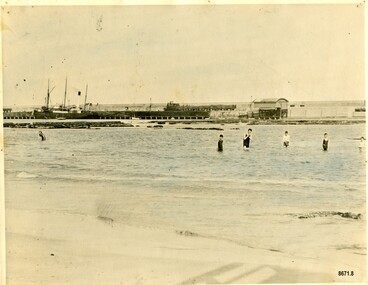
Photograph - Vessel S. S. Casino in Lady Bay Warrnambool, 1920's - 1930's
... crew except one, was a Scotsman." The S.S. Casino had several mishaps during her life. One was on 3rd January 1898 when she collided with the S.S. Flinders in Apollo Bay with minor damage. Another was on 24th October 1924 when she grounded...crew except one, was a Scotsman." The S.S. Casino had several mishaps during her life. One was on 3rd January 1898 when she collided with the S.S. Flinders in Apollo Bay with minor damage. Another was on 24th October 1924 when she grounded ...This photograph was one of ten photographs donated to Flagstaff Hill Maritime Museum and Village by Fred Trewartha. Frederick John Fox Trewartha (Fred) was a well-known Warrnambool businessman. He was born in Beeac near Geelong in 1920 and came to Warrnambool with his family as a very young child. He was apprenticed to his father John, as a saddler and later opened his own shop on Raglan Parade. He then moved into working with tarpaulins and canvases for the trucking industry. Fred was keenly interested in photography (and was a member of the Warrnambool Cine Club), yachting and boat building. He kept his yacht moored at Port Fairy for many years and participated in sailing events locally and interstate. He also built boats with his sons. He had the opportunity to meet many older sailors and it's thought this photo (and others in the set) may have been given to him by one of these men. Fred Trewartha died in 2016 in Warrnambool. Warrnambool by the 1920's and 1930's had become a popular holiday destination with visitors arriving by steamer and train. It was during these decades that a "Surf Bathers Association" began in Warrnambool in response to the growing popularity of local sea bathing. They worked with the local council to develop a "Beach Improvement Fund" and a comprehensive plan of "Beach Improvement" which included erecting and maintaining beach boxes, building a kiosk, improving paths and roads to the beach, planting marram grass on the sand dunes, building new enclosures for vehicles and horses and generally making the beach more attractive for visitors and townspeople. The 1930's was also an era when free "Herald" Learn-to-Swim classes were being held throughout Victoria. In 1931 it was reported in "The Age" newspaper that "over the past week in Warrnambool, 250 pupils had passed through the hands of the local life saving club swimming instructors". The Port of Warrnambool - In the early years the Port of Warrnambool was a busy port. Steamships and sailing ships were frequent visitors to the port. Steam navigation companies were plentiful, carrying passengers and freighting cargo such as coal, timber, food, livestock, furniture, hardware and haberdashery between Melbourne and the ports along the southwest coast of Victoria, including Warrnambool. The carts would take their loads into the township for distribution. The Breakwater was built (using 32 ton blocks of concrete) between 1874 and 1890 to provide ships with greater protection from the Southern Ocean. The Lifeboat and Rocket House - The coastline of South West Victoria has had over 600 shipwrecks and many lost lives; even in Warrnambool’s Lady Bay there were around 16 known shipwrecks between 1850 and 1905, with eight lives lost. In 1859 the first Government-built lifeboat arrived at Warrnambool Harbour and a shed was soon built to house it, followed in 1864 by a rocket house to safely store the Rocket Rescue equipment. In 1878 the buildings were moved to the Breakwater area, and in 1910 the new Lifeboat Warrnambool arrived with its ‘self-righting’ design. For almost one hundred years the lifeboat and rocket crews, mostly local volunteers, trained regularly to maintain and improve their skills, summoned when needed by alarms, gunshots, ringing bells and foghorns. Some became local heroes but all served an important role. By the end of the 1950s the lifeboat and rescue equipment had become obsolete. The S.S. Casino was a passenger and freight steamer built in Dundee, Scotland, in 1882 for the Newcastle and Hunter River Steam Navigation Company of N.S.W. She weighed 425 tons gross with a length of 160.4 feet, beam of 24.1 feet and a depth of 10.2 feet. She had saloon accommodation for 35 people, a fore cabin for 25 more people, and she carried 300 tons of cargo. While on her delivery journey on May 30th 1882, the S.S. Casino called in at the Port of Warrnambool for coal, narrowly escaping going ashore in gale force winds due to the quick action of the pilot. At that time, still at anchor, she impressed the directors of the Belfast and Koroit Steam Navigation Company so much that they bought her immediately; she was ideal for trade along the West Coast of Victoria. (The Belfast and Koroit Steam Navigation Company was first managed by Messers. Saltau and Osburne and after the passing of Mr. Osburne, by produce merchants Messers H. Sautau and Sons, who had a hay and corn store and shipping agency on the corner of Liebig and Koroit Streets in Warrnambool. ) The S.S. Casino became “the most famous steamer to operate in Victorian waters along the West Coast” by author Jack Loney. Captain Boyd was her first Master, followed by Captain Chapman, who stayed with her from 1890 until 1924. Captain W. Robertson followed for a short term, and then Captain Middleton then took command from 1925 - 1932. An article published on Monday 11th June 1932 in The Sun News Pictorial (Melbourne) giving a detailed history of S. S. Casino said "owned by Port Fairy interests, she was an integral part of the town's development ... for a long time, her arrival in Port Fairy was an event, the townspeople going down to the wharf to see her come in". It also said "Except when the weather was bad, the Casino hugged the coast on her trips and passengers obtained wonderful views of the sandstone terraces and caves. A little time ago every member of her regular crew except one, was a Scotsman." The S.S. Casino had several mishaps during her life. One was on 3rd January 1898 when she collided with the S.S. Flinders in Apollo Bay with minor damage. Another was on 24th October 1924 when she grounded on a reef at Point Hawdon near Grey River and most of her cargo (of Christmas goods) had to be dumped into the sea. Then in February 1929 she was ‘holed’ when she struck a submerged object as she entered Lady Bay, Warrnambool. In the years following the turn of the century, the S.S. Casino remained the only regular trader with normal passenger accommodation along the West Coast. From 1882 she had made at least 2,500 voyages on the one run. On the morning of 10th July 1932, after attempting to berth at Apollo Bay jetty in heavy seas, Captain Middleton decided to take her out into the bay and wait until the seas abated. It was not realised that the anchor used to steady her as she manoeuvred to her berth had pierced her hull. She put about and headed for the beach but sank. Captain Middleton and nine others lost their lives; nine people were rescued including the two female passengers. Captain Middleton had been in charge of the S.S. Casino for seven years. He was the first ship’s Master to lose his life in a shipwreck in the West Coast trade. In June 1932, the directors of the Belfast and Koroit Steam Navigation Company had proposed to celebrate the completion of fifty years of trading by the steamer Casino in August, but tragically the Casino was wrecked only one month later (and "was only one month off completing its fifty years of valuable service between Melbourne and Portland.") Flagstaff Hill’s collection has a photograph of a portrait of Captain Chapman, a ship model of the S.S. Casino that shows both forms of power under which she sailed, steam and sail. The ship is painted green and flies three flags. The inscription across the case of the ship model, incorrectly dated, tells the sad story of the wreck of the ship and the loss of lives on July 10th 1932 at Apollo Bay. A print in the Collection shows S.S. Casino underway in the heavy sea off Point Lonsdale, another two photographs show her at the Port of Warrnambool, leaving from the Breakwater in Lady Bay and another identifies the S.S. Casino as a ship from the Belfast and Koroit Steam Navigation Company. (Belfast is the original name for the township of Port Fairy).This photograph is significant because of its association with the coastal trader S.S. Casino and its significance to trade along Victoria's West Coast in the late 19th and early 20th centuries. The wreck of the S.S. Casino is considered an important part of Victorian and Australian cultural heritage and as such has been declared and protected as an Historic Shipwreck under State and Commonwealth Law in the Commonwealth Historic Shipwrecks Act (1976). It is also significant as it shows the early years of tourism in Warrnambool and the important role the beach played in the lives of residents and visitors.A black and white photograph (with colour tinting) showing Lady Bay in Warrnambool with the Breakwater in the background. The S. S. Casino is moored at the Breakwater and the lifeboat shed and a coal train can be seen on the Breakwater. Six swimmers are standing in the water. On the back of the photograph are the donor's name and telephone number (written in black biro) and the name of the S. S. Casino and its tonnage written in blue ink. A blurred number has been stamped on plus a "M' written in pencil.Donor's name, address and phone number / "S. S. Casino" / "500 TONS" / "REG" "- - - 09 " (blurred numbers) / "M"warrnambool, great ocean road, shipwreck coast, lady bay, breakwater, fred trewartha, frederick john fox trewartha, surf bathers association, sea bathing, swimming, warrnambool beach, beach improvement fund, port of warrnambool, steamships, lifeboat house, rocket house, lifeboat crew, s. s. casino, belfast and koroit steam navigation company, saltau and osburne, captain middleton, apollo bay, apollo bay shipwreck
