
Showing 12 items matching "ground radio equipment"
-
 National Vietnam Veterans Museum (NVVM)
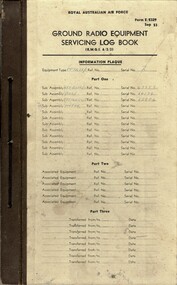
Booklet, Royal Australian Air Force, Royal Australian Air Force: Ground Radio Equipment Servicing Log Book, 1953
... Royal Australian Air Force: Ground Radio Equipment Servicing Log Book......Ground Radio Equipment...Royal Australian Air force Ground Radio Equipment Servicing Log Book RAAF Log Books A cream coloured heavy cardboard cover with a brown edging down the left hand side. ...A cream coloured heavy cardboard cover with a brown edging down the left hand side. The booklet has three punch holes down the left hand side which has a brown shoelace holdng the booklet together. royal australian air force, ground radio equipment, servicing log book, raaf log books -
 Moorabbin Air Museum
Document (item) - Weapons Research Establishment Salisbury - Radio Control Ground Equipment Used At Jervis Bay Missile Range Volume 2 Circuit Diagrams
... Weapons Research Establishment Salisbury - Radio Control Ground Equipment Used At Jervis Bay Missile Range Volume 2 Circuit Diagrams...Weapons Research Establishment Salisbury - Radio Control Ground Equipment Used At Jervis Bay Missile Range Volume 2 Circuit Diagrams...Technical Information Leaflet JB/GS No.2 Issue 2 Weapons Research Establishment Salisbury - Radio Control Ground Equipment Used At Jervis Bay Missile Range Volume 2 Circuit Diagrams Document Weapons Research Establishment Salisbury - Radio Control Ground Equipment Used At Jervis Bay Missile Range Volume 2 Circuit Diagrams ...Technical Information Leaflet JB/GS No.2 Issue 2 -
Moorabbin Air Museum
Manual (Item) - Radio Control Ground Equipment for Pacific Missile Range USA, Notes on Radio Control Ground Equipment for Pacific Missile Range USA
... Radio Control Ground Equipment for Pacific Missile Range USA...Notes on Radio Control Ground Equipment for Pacific Missile Range USA...Government Aircraft Factories Notes on Radio Control Ground Equipment for Pacific Missile Range USA Manual Radio Control Ground Equipment for Pacific Missile Range USA ...Government Aircraft Factories -
 Nhill Aviation Heritage Centre
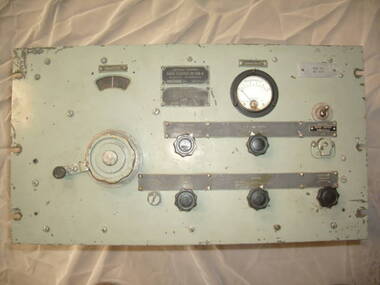
Equipment - Radio Receiver BC-639A, 1940-1949
... This type was used at the Aeradio radio receiver, bc 639, bc 639a, 639, aeradio The BC-639A is a ground based AM VHF receiver covering the nominal frequency range of 100 -156 m/cs. The set was built for the U.S. Army Air Force in WW2 as part of a communication system to communicate with aircraft. Dark grey US Military colour Equipment ...The BC-639A is a ground based AM VHF receiver covering the nominal frequency range of 100 -156 m/cs. The set was built for the U.S. Army Air Force in WW2 as part of a communication system to communicate with aircraft. A system of similar intent was built in Australia during WW2 by Radio Corporation of Victoria (ASTOR), with the addition of FM facilities. This system used the ARl7 receiver and ATl7 transmitter. Many of the sets had been modified after the war by the then Dept of Civil Aviation for use as monitoring receivers.This type was used at the AeradioThe BC-639A is a ground based AM VHF receiver covering the nominal frequency range of 100 -156 m/cs. The set was built for the U.S. Army Air Force in WW2 as part of a communication system to communicate with aircraft. Dark grey US Military colourradio receiver, bc 639, bc 639a, 639, aeradio -
 Flagstaff Hill Maritime Museum and Village
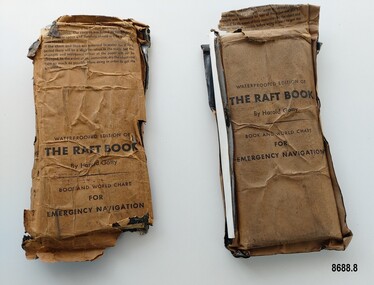
Booklet - Book and World Chart for Emergency Navigation, George Grady Press, The Raft Book, 1943
... ground speed and drift indicator which formed the basis of the automatic pilot which later came to be standard equipment on most aircraft. He worked with several record breaking pilots including Ann Morrow Lindbergh (who went on to serve as a navigator for her husband Charles Lindbergh), helped Wiley Post break the world record circumnavigating the Earth, invented a new method of "dead reckoning" that revolutionised the ability to fly safely through cloudy conditions without drifting off course and famously navigated a small plane (whilst trying to cross the Pacific) over 1900 km through fog (with no radio) and using only his dead reckoning techniques, back to their starting point in Japan after they developed fuel problems. ...ground speed and drift indicator which formed the basis of the automatic pilot which later came to be standard equipment on most aircraft. He worked with several record breaking pilots including Ann Morrow Lindbergh (who went on to serve as a navigator for her husband Charles Lindbergh), helped Wiley Post break the world record circumnavigating the Earth, invented a new method of "dead reckoning" that revolutionised the ability to fly safely through cloudy conditions without drifting off course and famously navigated a small plane (whilst trying to cross the Pacific) over 1900 km through fog (with no radio) and using only his dead reckoning techniques, back to their starting point in Japan after they developed fuel problems. ...Harold Gatty was born on January 5th, 1903 in Campbell Town, Tasmania. He was a navigator and aviation pioneer. He began his career learning navigation at the age of 14 as a midshipman at the Royal Australian Naval College but withdrew after three years and became an apprenticed ship's officer with the Patrick Steamship Company of Sydney. After W. W. 1 he joined the Australian Merchant Navy where he learned the constellations while standing night watch and became an expert in celestial navigation while serving on many ships sailing between Australia and California. In 1927 he moved to California and opened a navigation school and also a laboratory repairing navigational equipment. At this time he became very interested in air navigation and was aware of the limitations of existing methods and instruments for aerial navigation. He began researching ways of improving aerial navigation. Two early inventions of his were his air sextant and a ground speed and drift indicator which formed the basis of the automatic pilot which later came to be standard equipment on most aircraft. He worked with several record breaking pilots including Ann Morrow Lindbergh (who went on to serve as a navigator for her husband Charles Lindbergh), helped Wiley Post break the world record circumnavigating the Earth, invented a new method of "dead reckoning" that revolutionised the ability to fly safely through cloudy conditions without drifting off course and famously navigated a small plane (whilst trying to cross the Pacific) over 1900 km through fog (with no radio) and using only his dead reckoning techniques, back to their starting point in Japan after they developed fuel problems. In 1932 Gatty received the Distinguished Flying Cross from President Hoover. In 1934 Gatty formed the South Seas Commercial Company with Donald Douglas with the aim to deliver air services to the islands of the South Pacific. The Company was sold to Pan Am but he continued to work for them. In 1935 he went on a sailing expedition investigating several small islands in the South Pacific and was briefly marooned on Baker Island. He was able to use his extensive knowledge of seabird habits to save the crew. He was also very interested in the ability of the Polynesians to navigate using the stars. During the Second World War Gatty was given the honorary rank of Group Captain in the Royal Australian Air Force (RAAF) and worked for the U. S. Army Air Forces (USAAF) in the South Pacific. In 1943 he moved to Washington where he developed a survival book (The Raft Book) specifically for boat crews or air crews flying over the Pacific to help them survive and navigate their life rafts in remote areas of the ocean. The original book was 152 pages long however a condensed version was made which consisted of a 64 page booklet, combined map and star chart and calendar strip enclosed in a waterproof slipcase, to be placed in life rafts for emergency use. The booklet included navigational advice and ideas such as ocean currents, estimation of distance, using a compass, measurement of angles, recognising and steering by the stars, land indications from sea birds, migration of sea birds and insects, sounds from the land, the scent of the land and ocean currents and the colour of the sea etc. After W.W.2 Gatty moved to Fiji and formed Fiji Airways (which later became Air Pacific). Harold Gatty died in August 1957.The two copies of "The Raft Book" are significant as they are a written summary of the many methods of sea navigation (both modern and historical) that existed in the 1940's. They are also a record of Harold Gatty, who played a significant role in the development of modern day aerial navigation using his understanding of different sea navigational techniques.Two rectangular brown packets with waterproof coverings (oiled paper) titled "The Raft Book" by Harold Gatty. Each packet contains a folded 64 page paper booklet with detailed instructions for navigating a small craft in open seas, a folded chart (with a map of the world and oceans, well known constellations, latitude and longitude charts, Greenwich time and a scale for string lengths and Harp scale) and a long folded paper calendar strip.Front of package - "WATERPROOFED EDITION OF/ THE RAFT BOOK / By Harold Gatty / BOOK AND WORLD CHART / FOR / EMERGENCY NAVIGATION / To open envelope tear along above line. If the envelope is used again fold the flap to keep contents dry. 1. This envelope contains a book, chart and tape for emergency navigation. The contents are folded to take up the least possible space and therefore should not be removed until needed. 2. if the chart and tape are immersed in water for a long period, there will be a slight variation in the scale but the strength and resistence to tear of the paper will not be changed. In the event of long immersion, dry the chart and tape as much as possible before using in order to in order to get the greatest accuracy in scale. Front of booklet - THE RAFT BOOK / LORE OF THE SEA AND SKY /By Harold Gatty IMPORTANT FOR YOUR SECURITY/Upon abandoning ship you may have to be your own navigator. Take the following pre/cautions for your own safety:/ Carry a good type of pocket watch / keep it wound and have it running on Greenwich (England) / Time, which you can get from the navigating officer. / Keep track of the date at Greenwich; and on a 24-hour basis, / know whether the time is, say, 6 hours (6 A.M.) showing on / your watch, or 18 hours (6P.M.) Greenwich. / PROECT YOUR WATCH. GET A RUBBER SACK FOR IT (OBTAIN FROM PHARMACIST) AND KEEP IT DRY / KEEP A PENCIL IN YOUR POCKET/ POSITION OF SHIP WHEN ABANDONED PRINTED IN UNITED STATES OF AMERICA GEORGE GRADY PRESS, NEW YORK/COPYRIGHT, 1943, BY HAROLD AND FENNA GATTYflagstaff hill maritime museum and village, shipwreck coast, warrnambool, the raft book, harold gatty, book and world chart for emergency navigation, ww 2, ww ii, navigation, air navigation, aerial navigation, lindbergh, wiley post, dead reckoning, south seas commercial company, u.s. army airforce, usaaf, survival book, life rafts, sea navigation, emergency navigation, fiji airways, harp scale -
 Bendigo Military Museum
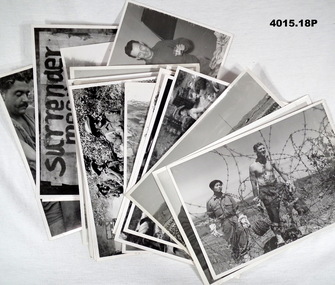
Photograph - MILITARY PHOTOGRAPHS, 1950 - 1956
... (.10) Group of soldiers lined up on the ground with explosions in front of them. (.11) Australian soldier in a trench with radio equipment gear on. (.12) Five Australian soldiers on a road with a Jeep in the rear. (.13) Five soldiers silhouetted against a bush back ground. (.14) Australian soldiers in open ground firing mortars. (.15) Nine soldiers in the back of a truck, Frank Dean on the left in front. (.16) two soldiers, one being supported by the other. (.17) Three soldiers, one in white apron cutting up bread... (.10) Group of soldiers lined up on the ground with explosions in front of them. (.11) Australian soldier in a trench with radio equipment gear on. (.12) Five Australian soldiers on a road with a Jeep in the rear. (.13) Five soldiers silhouetted against a bush back ground. (.14) Australian soldiers in open ground firing mortars. (.15) Nine soldiers in the back of a truck, Frank Dean on the left in front. (.16) two soldiers, one being supported by the other. (.17) Three soldiers, one in white apron cutting up bread ...All photos relate to the collection of Francis William (Dinky) DEAN BEM, VX93960 2nd AIF, 3742 1 RAR, 1943 - 1975. Refer Cat No 124.2 for his service history. The photos are believed to be taken during 1 RAR’s 2nd tour of Korea 1954 - 56. BCFK (British Commonwealth Foce Korea)All photos are B & W. (.1) Two soldiers beside a sign holding a bottle of beer. (.2) Shows a hand painted sign on a timber boards. (.3) Same sign on a single board. (.4) An Australian and Korean soldier laying barb wire. (.5) two soldiers in winter clothes holding a box of rations. (.6) Large parade of Australian soldiers with a camp and buildings in the back ground. (.7) Group of men lining up receiving rations. (.8) Three soldiers sitting each with a tin of Golden Circle fruit or juice. (.9) Group of Officers lined up behind sand bags. (.10) Group of soldiers lined up on the ground with explosions in front of them. (.11) Australian soldier in a trench with radio equipment gear on. (.12) Five Australian soldiers on a road with a Jeep in the rear. (.13) Five soldiers silhouetted against a bush back ground. (.14) Australian soldiers in open ground firing mortars. (.15) Nine soldiers in the back of a truck, Frank Dean on the left in front. (.16) two soldiers, one being supported by the other. (.17) Three soldiers, one in white apron cutting up bread. (.18) Soldier in a trench wearing a steel helmet.All photos have on the rear stamped in purple; “Photo No, please credit to Public relations HQ BCFK” military, british common wealth force korea -
 Bendigo Military Museum
Equipment - MESSAGE STREAMER, c. 1918 ?
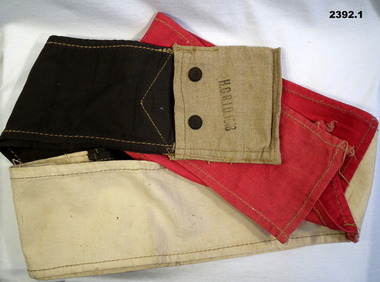
... ground before radios. Message reads: “Have burst tyre, cannot land Give V sign if search finished. If not, stand on your hands. Richy Bair S/L” Item belonged to Maxwell Lennox Matheson No 418447 RAAF. Refer Cat No 1959 for his service history. Communications signals message .1) “HGR10 1918” (stamped in centre panel) .1) Banner 6 fabric panels, 2 red, 2 beige, 2 brown centre connecting panel - hessian like fabric. .2) Folded note paper. Message written in pen on bottom left hand corner. Equipment ...Message Streamer used to communicate with the ground before radios. Message reads: “Have burst tyre, cannot land Give V sign if search finished. If not, stand on your hands. Richy Bair S/L” Item belonged to Maxwell Lennox Matheson No 418447 RAAF. Refer Cat No 1959 for his service history..1) Banner 6 fabric panels, 2 red, 2 beige, 2 brown centre connecting panel - hessian like fabric. .2) Folded note paper. Message written in pen on bottom left hand corner..1) “HGR10 1918” (stamped in centre panel)communications, signals, message -
4th/19th Prince of Wales's Light Horse Regiment Unit History Room
Equipment - Wireless Set No 19 Mk III, Pye, 1940 - 1948
... These sets were made by Pye UK and various other companies under licence Equipment used by the Regiment Radio Wireless 19 set WS-19, a HF radio designed primarily for use in armoured vehicles, but also used as truck & ground station. ...These sets were made by Pye UK and various other companies under licenceEquipment used by the RegimentWS-19, a HF radio designed primarily for use in armoured vehicles, but also used as truck & ground station. Consists of three main units - sender/receiver, power supply unit and aerial tuning unit. Freq range A Set 2-8 MCs, B Set 229-241 MCsradio, wireless, 19 set -
4th/19th Prince of Wales's Light Horse Regiment Unit History Room
Station Radio C13
... Mid 1950's to mid 1970's Equipment used by the Regiment radio c13 Radio - No 0549, Supply unit vibratory - No 1545, Aerial Tuning Unit No 1397 A HF voice and CW sender-receiver for use in vehicles or as ground station. ...Used by all Royal Australian Armoured Corps vehicles. Mid 1950's to mid 1970'sEquipment used by the RegimentA HF voice and CW sender-receiver for use in vehicles or as ground station. Consists three main units - the sender/receiver, the power supply unit, and aerial tuning unit. Power supply was either 12 or 24 volt. Frequency range 1.5 - 12.0 Mc/s. Operating range up to 25 miles.Radio - No 0549, Supply unit vibratory - No 1545, Aerial Tuning Unit No 1397radio, c13 -
4th/19th Prince of Wales's Light Horse Regiment Unit History Room
Manual - Folder, loose leaf, Technical Manual User Handbook for Single Channel Radio System HF Vehicle and Ground Stations, 1990's
... Relates to equipment used by the Regiment radio handbook raven hf rt f-100 Australian Army. Technical Manual. User Handbook for Single Channel Radio System HF Vehicle and Ground Stations 1989 Stapled photocopy of the Technical Manual User Handbook covering the vehicle and ground stations of the RAVEN Radio System HF RT-F100 detailing a general description, operating instructions and operator servicing, including amendment No 1 of Apr 1990. ...Relates to equipment used by the RegimentStapled photocopy of the Technical Manual User Handbook covering the vehicle and ground stations of the RAVEN Radio System HF RT-F100 detailing a general description, operating instructions and operator servicing, including amendment No 1 of Apr 1990. Copy is poor quality in some areas, particularly in areas that are red in originalAustralian Army. Technical Manual. User Handbook for Single Channel Radio System HF Vehicle and Ground Stations 1989radio handbook, raven, hf rt f-100 -
4th/19th Prince of Wales's Light Horse Regiment Unit History Room
Mounting Tray MT-1029/VRC, abt 1970's
... Used as part of the radio harness of all M113 vehicles and truck and ground stations Equipment used by The Regiment Radio mounting tray MT-1029/VRC No 6731B Radio mounting tray as used in all M113 family of vehicles. ...Used as part of the radio harness of all M113 vehicles and truck and ground stations Equipment used by The RegimentRadio mounting tray as used in all M113 family of vehicles. Consists of a base tray and a top tray on anti-vibration mounts. The top tray has a junction box for connecting radio and harness cablings, and two clamping devices to hold the radio MT-1029/VRC No 6731Bradio mounting tray -
4th/19th Prince of Wales's Light Horse Regiment Unit History Room
Radio RT-524/VRC, abt 1970's
... Used in the Regiment's M113 family of vehicles Equipment used by the Regiment Radio RT524 RT524/VRC No 1645 VHF radio which was used in the M113 family of vehicles. It could also be set up as truck and ground station. ...Used in the Regiment's M113 family of vehiclesEquipment used by the RegimentVHF radio which was used in the M113 family of vehicles. It could also be set up as truck and ground station. Frequency range of 30 to 75.95 MHz, manually tuned, voice only. It requires a 24 Volt DC power supply and has operating range of about 40 Km on high power.RT524/VRC No 1645radio, rt524
