
Showing 81 items matching "gun case"
-
 Trafalgar Holden Museum
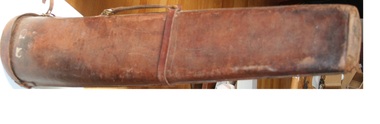
Leisure object - Gun case
... Gun case......Gun case...Hand carry gun case manufactured by Holden and Frost C1900...Leather gun case with hand hold strap and buckled top cover...Hand carry gun case manufactured by Holden and Frost C1900 Manufactured an sold by Holden and Frost Leather Hunting Gun case Leather gun case with hand hold strap and buckled top cover Leisure object Gun case ...Hand carry gun case manufactured by Holden and Frost C1900Manufactured an sold by Holden and FrostLeather gun case with hand hold strap and buckled top coverleather, hunting, gun case -
 Trafalgar Holden Museum
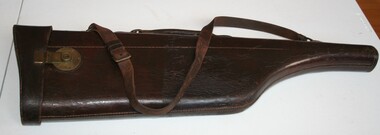
Functional object - Leg of Mutton Gun case
... Leg of Mutton Gun case......Gun case...Case used to carry a gun, manufactured by Holden and Frost...Leather lockable gun case with lockable brass stud and shoulder strap...Case used to carry a gun, manufactured by Holden and Frost Leather rifle protection case manufactured by Holden and Frost Leather Case Gun case Leather lockable gun case with lockable brass stud and shoulder strap Functional object Leg of Mutton Gun case ...Case used to carry a gun, manufactured by Holden and FrostLeather rifle protection case manufactured by Holden and FrostLeather lockable gun case with lockable brass stud and shoulder strapleather, case, gun case -
 Trafalgar Holden Museum
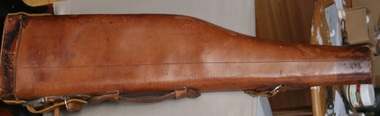
Functional object - Leather "leg of Mutton" gun case
... Leather "leg of Mutton" gun case......gun case...Enclosed leather gun case leather strap on top handle and shoulder strap...As used by recreational shooters and the safe carriage of firearms manufactured by Holden and Frost Item holds social significance manufactured by Holden and Frost Leather gun case G.B.L. Enclosed leather gun case leather strap on top handle and shoulder strap Functional object Leather "leg of Mutton" gun case ...As used by recreational shooters and the safe carriage of firearms manufactured by Holden and FrostItem holds social significance manufactured by Holden and FrostEnclosed leather gun case leather strap on top handle and shoulder strapG.B.L.leather, gun case -
 Montmorency–Eltham RSL Sub Branch
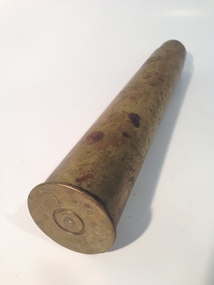
Weapon - Ordnance QF 3-Pounder Naval Gun Shell Case, Naval Gun Shell Case, 1901
... Ordnance QF 3-Pounder Naval Gun Shell Case...Naval Gun Shell Case...Brass naval gun shell case....II C V S & M 2 - 8 - 01 Brass naval gun shell case. Naval Gun Shell Case Weapon Ordnance QF 3-Pounder Naval Gun Shell Case ...Mk II Shell used by the Ordnance QF 3-pounder Vickers (47mm / L50) naval gun first tested in 1903. It was used on Royal Navy warships. Effective firing range was 2000 yards (1829m) approx.Brass naval gun shell case.II C V S & M 2 - 8 - 01 -
 Trafalgar Holden Museum
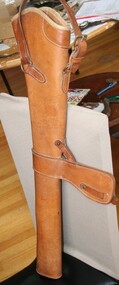
Accessory - Equestrian accessory, Saddle mount gun case
... Saddle mount gun case......Gun case...Used to carry shotgun on saddle mount and manufactured by Holden and Frost Manufactured by Holden and Frost for agriultural and civilian use Leather Agricultural Civilian Gun case Brown leather saddle mount shotgun carry case with straps and carry handle Saddle mount gun case Accessory Equestrian accessory ...Used to carry shotgun on saddle mount and manufactured by Holden and FrostManufactured by Holden and Frost for agriultural and civilian useBrown leather saddle mount shotgun carry case with straps and carry handleleather, agricultural, civilian, gun case -
 Glenelg Shire Council Cultural Collection
Equipment - Gun Case, n.d
... Gun Case...Dark brown leather gun case, lid secured with buckle, leather carry handle...Dark brown leather gun case, lid secured with buckle, leather carry handle Equipment Gun Case ...Dark brown leather gun case, lid secured with buckle, leather carry handle -
 Trafalgar Holden Museum
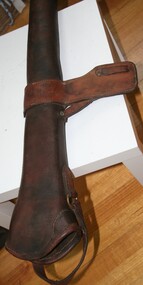
Accessory - Gun cover, Circa 1900
... Gun case...Gun case with buckle and straps with which to attach to a saddle...Fixed to offside of saddle rear arch passing the attaching strap from front to rear as manufactured by Holden and Frost Ca1900 Gun case Military Gun case with buckle and straps with which to attach to a saddle Accessory Gun cover ...Fixed to offside of saddle rear arch passing the attaching strap from front to rearas manufactured by Holden and Frost Ca1900Gun case with buckle and straps with which to attach to a saddlegun case, military -
Glenelg Shire Council Cultural Collection
Functional object - Hanimex Bouncemaster Flash Gun and Leather Case, Hanimex, n.d
... Hanimex Bouncemaster Flash Gun and Leather Case...397.1 - Collapsable flash gun 397.2 - Leather case. "Hanimex" logo embossed on lid....Functional object Hanimex Bouncemaster Flash Gun and Leather Case Hanimex ...Displayed at History House.397.1 - Collapsable flash gun 397.2 - Leather case. "Hanimex" logo embossed on lid.Front: Hanimex/Flashmaster (centre, print)photography, flash, flash gun -
 Running Rabbits Military Museum operated by the Upwey Belgrave RSL Sub Branch
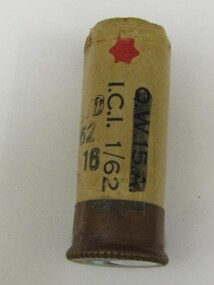
Shell Case
... Spent Flare gun case...Ammunition Boer War Army Spent Flare gun case Shell Case ...Spent Flare gun caseammunition, boer war, army -
 Running Rabbits Military Museum operated by the Upwey Belgrave RSL Sub Branch
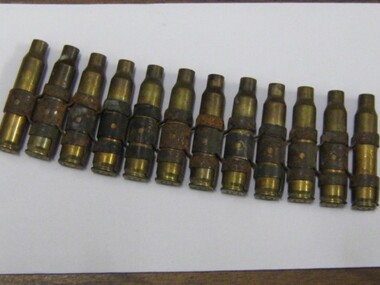
Shell Case
... 12 x 5.56cal linked machine gun cases....Ammunition WW2 Army 12 x 5.56cal linked machine gun cases. Shell Case ...12 x 5.56cal linked machine gun cases.ammunition, ww2, army -
 Bendigo Military Museum
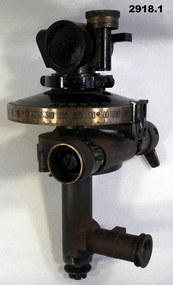
Equipment - GUN SIGHT AND CASE WW2, 1.) JWH et al, 1) 1944; .2) 1942
... GUN SIGHT AND CASE WW2....1) Gun sight for 25 pounder cannon. .2) Brown leather purpose made carrying case with leather straps & brass buckles. ...Paper label attached to closing strap. Equipment GUN SIGHT AND CASE WW2 1.) JWH .2) Dept of Defence - F & S Ltd ....1) Gun sight for 25 pounder cannon. .2) Brown leather purpose made carrying case with leather straps & brass buckles. Paper label attached to closing strap..1) Stamped on front: “Dial Sight ..? JWH 1944 Serial No 1705” .2) Tooled on lid of leather case: “D [up arrow] D Case No 107 (Aust) No 1 Dial Sight FS Ltd 1942”arms - accessories, trades - leatherworking, gun sight, equipment -
 Montmorency–Eltham RSL Sub Branch
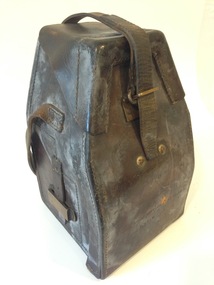
Equipment - Case for Dial Sight, 1942
... Leather case for Dial Sight for 15 pounder field gun (Case only; Dial sight not present)...DIAL SIGHT (No. obscured by scratch in leather) F.S. 1942 Leather case for Dial Sight for 15 pounder field gun (Case only; Dial sight not present) Equipment Case for Dial Sight ...Leather case for Dial Sight for 15 pounder field gun (Case only; Dial sight not present) D^D CASE NO. 107 (AUST) NO. ... DIAL SIGHT (No. obscured by scratch in leather) F.S. 1942 -
 Charlton RSL Sub Branch
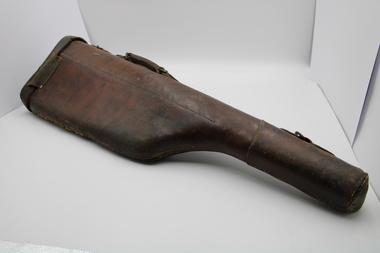
Equipment - Rifle holster, Brown leather holster with inscription
... Army leather gun case with strap, buckle and leather carry handle. 2 brass loops for carry strap...H.J.Stone Army leather gun case with strap, buckle and leather carry handle. 2 brass loops for carry strap Brown leather holster with inscription Equipment Rifle holster ...Army leather gun case with strap, buckle and leather carry handle. 2 brass loops for carry strapH.J.Stone -
 Montmorency–Eltham RSL Sub Branch
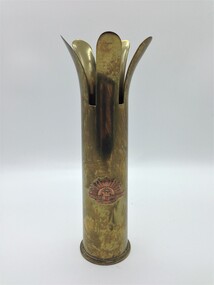
Artwork, other - Trench Art - Vase, 1941
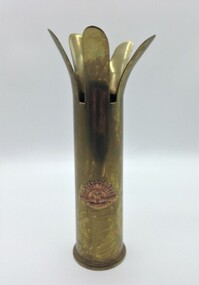
... 1941 40mm 2-pounder brass anti tank gun shell case made into a vase with 5 splayed points at top the casing with the collar insignia badge on front....Inner area under shell - 1941 113 11-41 1941 40mm 2-pounder brass anti tank gun shell case made into a vase with 5 splayed points at top the casing with the collar insignia badge on front. ...1941 40mm 2-pounder brass anti tank gun shell case made into a vase with 5 splayed points at top the casing with the collar insignia badge on front.Insignia - Australian Commonwealth Military Forces (collar badge). Outer edge under shell - 1941 LOT 110 RM/C 2PR No1. Inner area under shell - 1941 113 11-41anti-tank, gun shell, trench art, 1941, vase -
 Montmorency–Eltham RSL Sub Branch
Artwork, other - Trench Art - Vase, 1941
... 1941 40mm 2-pounder brass anti tank gun shell case made into a vase with 5 splayed points at top the casing with the collar insignia badge on front....Outer edge under shell - 1941 LOT 113 RM/C 2PR No2 Inner area under shell - 1941 110 11-41 No/2 MK1 1941 40mm 2-pounder brass anti tank gun shell case made into a vase with 5 splayed points at top the casing with the collar insignia badge on front. ...1941 40mm 2-pounder brass anti tank gun shell case made into a vase with 5 splayed points at top the casing with the collar insignia badge on front.Insignia - Australian Commonwealth Military Forces (collar badge). Outer edge under shell - 1941 LOT 113 RM/C 2PR No2 Inner area under shell - 1941 110 11-41 No/2 MK1gun shell, anti-tank, trench art, 1941, vase -
 Kew RSL
Sighting telescope
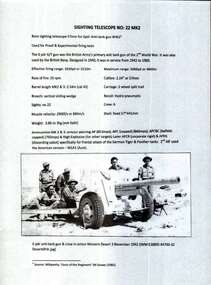
... Bore sighting telescope 57mm for 6 pounder Anti-tank gun in painted wooden case...Australian Army had about 100 telescope bore sighting, W Ottway & Co Ealing, artillery, 6 pounder cannon, World War 2 Case: #7, MK2, V1/05 588 GA Bore sighting telescope 57mm for 6 pounder Anti-tank gun in painted wooden case Sighting telescope ...bore sighting telescope for 6 pounder anti-tank cannon for calibration & testing; the canon was used in WW2 by British & other forces. Australian Army had about 100Bore sighting telescope 57mm for 6 pounder Anti-tank gun in painted wooden caseCase: #7, MK2, V1/05 588 GAtelescope bore sighting, w ottway & co ealing, artillery, 6 pounder cannon, world war 2 -
Frankston RSL Sub Branch
Munition, 18 PDR
... Artillery cartridge case from an 18 pounder field gun. This used brass case was manufactured in 1917. ...Artillery cartridge case from an 18 pounder field gun. This used brass case was manufactured in 1917. ...Artillery cartridge case from an 18 pounder field gun. This used brass case was manufactured in 1917. The 18 PDR was the main field artillery armament of the British and Commonwealth forces during WW 1. -
Frankston RSL Sub Branch
Munition, 18 PDR
... Artillery cartridge case from an 18 pounder field gun. This used brass case is the Mark ll type, manufactured in 1918. ...Artillery cartridge case from an 18 pounder field gun. This used brass case is the Mark ll type, manufactured in 1918. ...Artillery cartridge case from an 18 pounder field gun. This used brass case is the Mark ll type, manufactured in 1918. The 18 PDR was the main field artillery armament of the British and Commonwealth forces during WW 1. -
 Rye RSL Sub Branch
Binoculars and Case
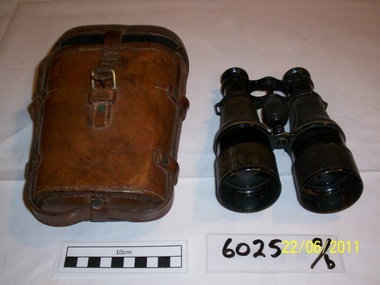
... These Binoculars and case are thought to have belonged to an officer, however they also appear on the 'Vickers" website as part of the complete equipment schedule of a 'Vickers' machine gun sighting equipment. ...These Binoculars and case are thought to have belonged to an officer, however they also appear on the 'Vickers" website as part of the complete equipment schedule of a 'Vickers' machine gun sighting equipment. ...These Binoculars and case are thought to have belonged to an officer, however they also appear on the 'Vickers" website as part of the complete equipment schedule of a 'Vickers' machine gun sighting equipment. The case is a superior quality leather of robust construction and would be as serviceable today as when first made. The Binoculars are af high quality and would likewise be as servicable today. -
 Flagstaff Hill Maritime Museum and Village
Weapon - Shotgun, Double Barrel, ISAAC HOLLIS & SONS, ca. 1904
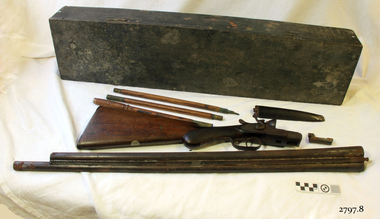
... case with a hinged lid showing inscriptions for the maker and Serial Number. Maker was I. HOLLIS & SONS, Serial Number SN 84245. David Melville Carrison of Port MacDonnell was the previous owner. A handwritten note that had the word 'Enterprise' was with the gun...gun, written in felt tip pen “ENTERPRISE”. This double-barrel shotgun is 12-gauge, complete with a cleaning rod and a wooden storage box. The firearm has been altered from its original configuration: the right barrel has been cut shorter, resulting in sharp edges at the muzzle, and a metal extension has been fitted to the stock. The cleaning rod consists of three separate segments that screw together for use. The shotgun is housed in a black-painted wooden case ...The proof marks on the barrels (a crown and letters BV) denote that the shotgun design was made from the year 1904, and that it was nitro-proof tested in Birmingham, England. David Melville Carrison (1895 to 1960) of Port MacDonnell was the previous owner of this Isaac Hollis & Sons double-barrel shotgun. His grandfather, Adam Kerrison Carrison (1833-1903), was an early settler who worked as a fisherman in that once-bustling seaport. His uncle John was a a horse-breaker, a boat hand, and a member of the lifeboat crew, receiving a medal for his part in saving the crew of a French barque. Currently, no connection has been made between the gun, its owner, and the note with the word “Enterprise”: a New Zealand-built, two-masted schooner that was wrecked in Lady Bay, Warrnambool, in 1950. Gun makers, ISAAC HOLLIS & SONS: The Hollis Brothers were first recorded as operating from 11 Weaman Row in 1840, although evidence suggests the business may have commenced before then. Over time, the firm became known as Isaac Hollis & Sons, with claims of its establishment dating back to 1814. This earlier date is supported by records of Richard and William Hollis trading in Bath Street, Birmingham, between 1814 and 1818, which raises the possibility that Isaac and Frederick Hollis were their descendants. The principal brothers involved in the business were Isaac Hollis, born in 1815, and Frederick Hollis, whose birth date remains unknown. Frederick’s life was cut short when he died on 20 December 1839. According to the 1841 census, Isaac Hollis resided in Weaman Row and was listed as a 25-year-old gun and pistol maker. He was married to Emma, who was born in 1821, and together they had two children: Isaac, born in 1837, and Henry, born in 1839. Following Frederick’s death, Isaac continued to operate under the name Hollis Brothers until 1845, after which he renamed the business Hollis Brothers & Co. This entity remained active up to 1848. In 1844, Isaac Hollis entered a brief partnership with William Tranter at 10 & 11 Weaman Row, likely to fulfil a specific contract or to supply parts. This partnership continued until 1849. In 1848, Isaac Hollis formed a partnership with Isaac Brentnall Sheath, establishing the firm of Hollis & Sheath and expanding their operations into 10 Weaman Row. The partnership saw Hollis & Sheath become licensed manufacturers of percussion breech-loading guns, positioning the company as a notable presence in the industry. In 1861, Sheath left the partnership and emigrated to New Zealand, where he conducted several enterprises and was elected as a provincial councillor. He died in Christchurch on 19th May 1897. In 1861, after Isaac Sheath left, the business name became Isaac Hollis & Sons. By approximately 1870, Isaac Hollis and Henry Hollis had assumed responsibility for the daily management of the firm, with Isaac overseeing the overall management and marketing of the company's products, and Henry managing the manufacturing processes. During this period, the company became known for producing large volumes of affordable trade guns and sporting guns, catering to customers in South Africa and the British colonies. In 1870, Isaac Hollis & Sons opened a retail location at 44a Cannon Street in London, and in 1871, it operated at 83 Cheapside Street. Isaac Hollis Jnr passed away in October 1875 in Birmingham at the age of 37, having never married. In 1876/1877, Henry Hollis registered a limited liability company under the name Isaac Hollis & Sons Ltd. However, by 1879, trading resumed under the name Isaac Hollis & Sons, and the London shop moved to 6 Great Winchester Street. From 1932 to 1933, the business operated in London as Hollis, Bentley & Playfair. The final closure of Hollis, Bentley & Playfair occurred in Birmingham in 1953. The shotgun was manufactured by Isaac Hollis & Sons, a firm with a strong reputation for producing firearms. This early 1900s example represents a standard pattern that was produced in large quantities for everyday use. This double-barrel shotgun is 12-gauge, complete with a cleaning rod and a wooden storage box. The firearm has been altered from its original configuration: the right barrel has been cut shorter, resulting in sharp edges at the muzzle, and a metal extension has been fitted to the stock. The cleaning rod consists of three separate segments that screw together for use. The shotgun is housed in a black-painted wooden case with a hinged lid showing inscriptions for the maker and Serial Number. Maker was I. HOLLIS & SONS, Serial Number SN 84245. David Melville Carrison of Port MacDonnell was the previous owner. A handwritten note that had the word 'Enterprise' was with the gun. "I. HOLLIS & SONS". SN on stock “84245”. Badge on both sides “Crown [symbol] / BV”. “Crown [symbol] / NP”, “12G inside Diamond [symbol]”, “NITRO PROOF”, “STEEL 84245” Paper note included with gun, written in felt tip pen “ENTERPRISE”. flagstaff hill, maritime museum, maritime village, warrnambool, great ocean road, shipwreck coast, firearm, gun, double-barrel, shotgun, cleaning rod, gunsmith, smithed, 12 gauge, sn 84245, serial number 84245, david melville carrison, early 1900s, richard and william hillis, herbert & co., herbert & co. london, hollis & sons, isaac hollis & sons, isaac hillis & sons ltd., hollis bentley & playfair., isaac hollis, frederick hollis, isaac brentnall sheath, isaac sheath, william tranter, gun manufacturer, pistol manufacturer, gun and pistol maker, birmingham, military supplies, enterprise, 1904 -
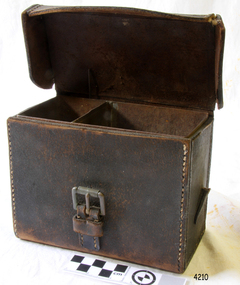 Flagstaff Hill Maritime Museum and Village
Container - Case, Early 20th century
... gun...Schermuly pistol...pistol rocket apparatus...line throwing cartridge...L.S.R.C....LSRC...leather case...Flagstaff Hill Maritime Museum and Village Flagstaff Hill Maritime Museum Maritime Village Warrnambool Great Ocean Road shipwreck life-saving lifesaving rescue crew rescue rocket rescue rocket crew lifeboat men beach rescue line rescue rescue equipment rocket firing equipment rocket rescue equipment maritime accidents shipwreck victim rocket equipment Marine technology rescue boat lifeboat volunteer lifesavers volunteer crew life saving rescue crew lifesaving rescue crew rocket apparatus rocket rescue method shore to ship rocket apparatus rescue stranded vessel line throwing mortar mortar rocket rescue apparatus line thrower line throwing line-firing pistol line throwing gun Schermuly pistol pistol rocket apparatus line throwing cartridge L.S.R.C. LSRC leather case cartridge case fuse case ammunition case Leather case, brown with contrasting stitching, protective metal insert divided into two compartments. ...This small case is lined with a metal insert and shows remnants of a carry strap. It could have been used for storing and carrying fuses or cartridges for the life saving Rocket Launcher machine. The protective metal insert would help keep the contents dry or cool and protect from flame. It is part of the collection of rescue equipment in the Rocket House used by the life saving rescue crew. Saving lives in Warrnambool – The coastline of South West Victoria is the site of over 600 shipwrecks and many lost lives; even in Warrnambool’s Lady Bay there were around 16 known shipwrecks between 1850 and 1905, with eight lives lost. Victoria’s Government responded to the need for lifesaving equipment and, in 1858, the provision of rocket and mortar apparatus was approved for the lifeboat stations. In 1859 the first Government-built lifeboat arrived at Warrnambool Harbour and a shed was soon built for it on the Tramway Jetty, followed by a rocket house in 1864 to safely store the rocket rescue equipment. In 1878 the buildings were moved to the Breakwater (constructed from 1874-1890), and in 1910 the new Lifeboat Warrnambool arrived with its ‘self-righting’ design. For almost a hundred years the lifesaving and rescue crews, mostly local volunteers, trained regularly to rehearse and maintain their rescue skills. They were summoned when needed by alarms, gunshots, ringing bells and foghorns. In July 1873 a brass bell was erected at Flagstaff Hill specifically to call the rescue crew upon news of a shipwreck. Some crew members became local heroes but all served an important role. Rocket apparatus was used as recently as the 1950s. Rocket Rescue Method - Rocket rescue became the preferred lifesaving method of the rescue crews, being much safer that using a lifeboat in rough seas and poor conditions. The Government of Victoria adopted lifesaving methods based on Her Majesty’s Coast Guard in Great Britain. It authorised the first line-throwing rescue system in 1858. Captain Manby’s mortar powered a projectile connected to rope, invented in 1808. The equipment was updated to John Dennett’s 8-foot shaft and rocket method that had a longer range of about 250 yards. From the 1860s the breeches buoy and traveller block rocket rescue apparatus was in use. It was suspended on a hawser line and manually pulled to and from the distressed vessel carrying passengers and items. In the early 1870s Colonel Boxer’s rocket rescue method became the standard in Victoria. His two-stage rockets, charged by a gunpowder composition, could fire the line up to 500-600 yards, although 1000 yards range was possible. Boxer’s rocket carried the light line, which was faked, or coiled, in a particular way between pegs in a faking box to prevent twists and tangles when fired. The angle of firing the rocket to the vessel in distress was measured by a quadrant-type instrument on the side of the rocket machine. Decades later, in 1920, Schermuly invented the line-throwing pistol that used a small cartridge to fire the rocket. . The British Board of Trade regularly published instructions for both the beach rescue crew and ship’s crew. It involved setting up the rocket launcher on shore at a particular angle, determined by the Head of the crew and measured by the quadrant, inserting a rocket that had a light-weight line threaded through its shaft, and then firing it across the stranded vessel, the line issuing freely from the faking board. A continuous whip line was then sent out to the ship’s crew, who hauled it in then followed the instructions – in four languages - on the attached tally board. The survivors would haul on the line to bring out the heavier, continuous whip line with a tail block connected to it. They then secured the block to the mast or other strong part the ship. The rescue crew on shore then hauled out a stronger hawser line, which the survivors fixed above the whip’s tail block. The hawser was then tightened by the crew pulling on it, or by using the hooked block on the shore end of the whip and attaching it to a sand anchor. The breeches buoy was attached to the traveller block on the hawser, and the shore crew then used the whip line to haul the breeches buoy to and from the vessel, rescuing the stranded crew one at a time. The rescue crew wore scarlet, numbered armbands and worked on a numerical rotation system, swapping members out to rest them. This small leather carrying case is significant for its connection with the rocket rescue equipment, local history, maritime history and marine technology. Lifesaving has been an important part of the services performed from Warrnambool's very early days, supported by State and Local Government, and based on the methods and experience of Great Britain. Hundreds of shipwrecks along the coast are evidence of the rough weather and rugged coastline. Ordinary citizens, the Harbour employees, and the volunteer boat and rescue crew, saved lives in adverse circumstances. Some were recognised as heroes, others went unrecognised. In Lady Bay, Warrnambool, there were around 16 known shipwrecks between 1850 and 1905. Many lives were saved but tragically, eight lives were lost.Leather case, brown with contrasting stitching, protective metal insert divided into two compartments. Rectangular shape. Roller buckle on front with remnants of the matching strap. Also remnants of a leather strap on the side, possibly a shoulder strap.flagstaff hill maritime museum and village, flagstaff hill, maritime museum, maritime village, warrnambool, great ocean road, shipwreck, life-saving, lifesaving, rescue crew, rescue, rocket rescue, rocket crew, lifeboat men, beach rescue, line rescue, rescue equipment, rocket firing equipment, rocket rescue equipment, maritime accidents, shipwreck victim, rocket equipment, marine technology, rescue boat, lifeboat, volunteer lifesavers, volunteer crew, life saving rescue crew, lifesaving rescue crew, rocket apparatus, rocket rescue method, shore to ship, rocket apparatus rescue, stranded vessel, line throwing mortar, mortar, rocket rescue apparatus, line thrower, line throwing, line-firing pistol, line throwing gun, schermuly pistol, pistol rocket apparatus, line throwing cartridge, l.s.r.c., lsrc, leather case, cartridge case, fuse case, ammunition case -
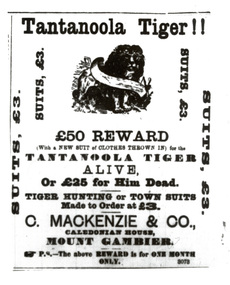 Federation University Historical Collection
Newspaper - Newsclippings, Tantanoola Tiger Newsclippings
... In the Tantanoola district children were escorted with shotgun guards to and from school, with many homes keeping guns at the ready in case the tiger suddenly appeared. ...In the Tantanoola district children were escorted with shotgun guards to and from school, with many homes keeping guns at the ready in case the tiger suddenly appeared. ...In the early 1880s a small circus travelled between Millicent and Mt Gambier, South Australia. After camping overnight they discovered their Bengal Tiger at escaped and disappeared into dense scrub. After searching for hours they continued to Mt Gambier and reported the loss of the tiger to police. Police and local volunteers continued the search for the escaped tiger, but no sighting were made. In the early 1890s sheep in the Tantanoola area started to disappear with the still unsighted tiger being blamed. In 1893 reports of an unusual animal in the Tantanoola area started, with many describing the animal as the missing tiger, or a large dog. One eye witness claimed to have seen the animal carrying a full grown sheep in its mouth. The reports grew in number and exaggeration with sightings from Robe to Bendigo. In the Tantanoola district children were escorted with shotgun guards to and from school, with many homes keeping guns at the ready in case the tiger suddenly appeared. In August 1895 Tom Donovan shot the "Tantanoola Tiger" on Mt Salt Station, around 20 kms south of Tantanoola. The corpse was taken to Marks, a Mount Gambier taxidermist, at which time the animal was identified as an Assyrian or Northern Russian Wolf. Donovan displayed the animal far and wide. Despite the animal's death sheep continued to disappear from properties in the district over many years. It was of particular concern between 1909 and 1910. At that time Herbert Allchurch, an Adelaide detective, was sent to solve the mystery. A few days after his arrival Allchruch went to the front bar of the Tiger Hotel and arrested local rabbit shooter and trapper, Charlie Edmunson, with sheep stealing. After his 1911 trial Edmunson admitted to stealing over 4,000 sheep during the previous 20 years. He was gaoled for six years with hard-labour in January 1911. Edmunson had been selling the skins of the stolen sheep, leaving the carcusses to rot. He earned around five pounds per week during the 1990s and early 1900s, a time when the economy was depressed. It is not known had the animal known as the Tantanoola Tiger came to Australia, but it is believed it survived one of three ships wrecked of the coast between 1890 and 1893, making it to shore along with some of the shipwrecked passengers. (From a card produced by the Tantanoola Tiger Hotel, where the 'tiger' is on display.)A collection of Newsclippings from 1892 - 1895 photocopied onto A4 white paper. The clippings relate to the Tantanoola Tiger. Clippings include: * Border Watch 1892 - Tantanoola Tiger Reward * Sydney Morning Herald, 04/07/1857 - Animals in Zoological Gardens, including a number of large cats. * Claims the Tantanoola Tiger was an escaped circus animal (ie The Advertiser [Adelaide], 31 October 1893) * Search parties for the Tantanoola Tiger (ie Barrier Miner 19/05/1893; Barrier Miner 03/1081893) * Thylacine claim (ie Morning Bulletin [Rockhampton] 11/03/1895 * Afghan and Indian Hunters (ie Barrier Miner 07/02/1895) * Sighting by John Bird of Scarsdale - Wanganui Herald 15/12/1900. " ... Mr Bird was travelling on foot along a lonely track through very dense scrub, when he was stricken with amazement to see a full-grown tiger standing in a small dam about 30ft away, and holding in its jaws the carcass of a newly-killed lamb. He remained long enough to thoroughly take in the animals appearance, and then beat a hasty retreat unmolested. His description of the animal is as follows: A tawny-coloured creature, with a dirty mottled skin; in general appearance like an immense cat; body 4ft long, and of a uniform thickness from shoulder to hindquarters; in bulk equal to a very large pig. The legs were hidden in the water. A similar animal is reported to gave been seen near Canico, some miles away. ..." * Victorian country sightings # Bullarto - Argus 06/05/1905 # Dean - Launceston Examiner 28/01/1895 # Bendigo - Hobart Mercury 15/03/1895 # Ballan - Launceston Examiner 03/08/1895 * South Australian register 17/06/1885 " There is a tiger or panther wandering at large in Victoria, according to a rumour. It has taken the place of the Bunyip, whom hundreds have seen but none captured. This tiger is supposed to have broken loose from a travelling menagerie in the North-eastern district. At the beginning we should like it roved that such an escape ever took place. Perhaps the showmen were afraid to report the fact to the police; at any rate they did not do so. The first story about the tiger being seen came from the neighborhood of Wangaratta, 60 miles from the place where it is said to have commenced business on its own account. He was followed, but vanished among trees. Next we hear of a strange animal, bigger than a St Bernard's dog, but shorter legged, having appeared at least 150 miles from Wangaratta. Between Lilydale and Wangaratta there is a dividing range 2,000 feet high in the lowest past, besides several large rivers. An finally, the tiger - changed from a panther - is reported as having been seen within the suburban circle, about 8 miles from the general Post Office. They show you footprints, and point to the carcasses of mangled cows and calves. Casts have been taken of the footprints for examination by scientific men, who pronounce them doglike, and yet not doglike, but panther-like, which gives a nervous turn, for the panther may take up killing children and grown-up people. One tiger will not account for so many apparitions. There must have been a general strike among the menageries, and a breaking-up companies. ... * Research article by Philip A. Clarke "Indigenous Spirit and Ghost Folklore of 'Settled' Australia. australian animal folklore collection, tantanoola tiger, tom donovan, herbert allchurch, charles edmunson, sheep, charlie edmunson, mythical, myth, folklore -
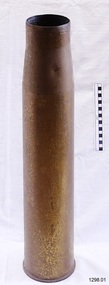 Flagstaff Hill Maritime Museum and Village
Weapon - Shell Case, Australian Army, 1940 -1941
... Around firing pin “MF I 422” “ME” “II” “4 I N” “5-“ ”MF [within rectangle]” “f” “B – [within circle]”, Shell Case 1298.02 - headstamp “N 1941 MF / F symbol [square box] LOT 679”, [in oval] 101 / 4 / S /U2) M GUNS 7 “, symbol [Australian Government Arrow], Stencil [in red circle] “B J”, symbol [Diamond with line top to bottom] Stamped in red ink “R5G 11 1 2B7”...Around firing pin “MF I 422” “ME” “II” “4 I N” “5-“ ”MF [within rectangle]” “f” “B – [within circle]”, Shell Case 1298.02 - headstamp “N 1941 MF / F symbol [square box] LOT 679”, [in oval] 101 / 4 / S /U2) M GUNS 7 “, symbol [Australian Government Arrow], Stencil [in red circle] “B J”, symbol [Diamond with line top to bottom] Stamped in red ink “R5G 11 1 2B7” Shell case: two brass 4" rimmed shell cases with headstamps (inscriptions) on the base plate around the firing pin three holes evenly spaced around the centre of the base. ...These shell cases were donated along with other items from the St Nicholas' Mission to Seamen's Church at 139 Nelson Place, Williamstown, Victoria. The Church was operated by the Mission to Seamen organisation. The symbol of the broad arrow on the base of the shell case signifies that it was owned by the Australian Army. The dates of the shell cases - 1940 and 1941 - link the shell cases with World War II. Both cases' headstamps have "N", which could indicate that they were made for use by the Navy. Shell Case 1298.01: The headstamp code on the label "MEC" means that it was made by the Explosives Factory Maribyrnong - Cordite Annexe, Maribyrnong, Melbourne, which made cordite propellant for cartridges and shells. Shell Case 1298.02: The headstamp "MF" indicates it was made by the Small Arms Manufacturing Factory in Footscray, Melbourne, and the stamped year was 1941. THE MISSIONS TO SEAMEN (Brief History): - The Missions to Seamen was an Anglican charity that has served seafarers of the world since 1856 in Great Britain. Its symbol is a Flying Angel, inspired by a Bible verse. Today, there are centres in over 200 ports worldwide where seamen of all backgrounds are offered a warm welcome and provided with a wide range of facilities. In Victoria, the organisation began in Williamstown in 1857 as a Sailors’ Church, also known as ‘Bethel’ or the ‘Floating Church’ in an old hulk floating in Hobson’s Bay, Port of Melbourne. It soon became part of the Missions to Seamen, Victoria. In the year 2000, the organisation, now named Mission to Seafarers, still operated locally in Melbourne, Portland, Geelong and Hastings. The Ladies’ Harbour Lights Guild was formed in 1906 to support the Missions to Seamen in Melbourne and other centres, such as Williamstown. Two of the most significant ladies of the Guild were founder Ethel Augusta Godfrey and foundation member Alice Sibthorpe Tracy (who established a branch of the Guild in Warrnambool in 1920). The Guild continued its work until the 1960s. In 1943, a former Williamstown bank was purchased for the Missions to Seaman Club. The chapel was named St Nicholas’ Seamen’s Church and was supported by the Ladies’ Harbour Lights Guild, the Williamstown Lightkeepers’ Auxiliary and the League of Soldiers’ and Sailors’ Friends. It ceased operation in 1966. A Missions to Seamen Chapel and Recreation Room was a significant feature of ports during the late 1800s and into the 1900s. It seemed appropriate for Flagstaff Hill to include such a representation within the new Maritime Village, so the Melbourne Board of Management of Missions to Seamen Victoria gave its permission on 21st May 1979 for the entire furnishings of the Williamstown chapel to be transferred to Flagstaff Hill. The St Nicholas Seamen’s Church was officially opened on October 11, 1981, and closely resembles the Williamstown chapel. These shell cases are significant for their relationship with the Australian Army in general and in particular with the defence of Australia during World War II. The may have also been made for the Navy. Their significance is increased by their association with the Williamstown Missions To Seamen, which donated them to Flagstaff Hill in 1979, an organisation that has supported seafarers for many years.Shell case: two brass 4" rimmed shell cases with headstamps (inscriptions) on the base plate around the firing pin three holes evenly spaced around the centre of the base. A label is attached to one shell. The shell cases are part of the St. Nicholas Seamen's Church Collection. Shell Case 1298.01 - Printed stamp “P.2BT” “M.E.C.111” “I.E. 10/43”. Stamped into base “N”, “1940” “W [within lozenge]”, “S” symbol [Australian Government Arrow] “360“ . Around firing pin “MF I 422” “ME” “II” “4 I N” “5-“ ”MF [within rectangle]” “f” “B – [within circle]”, Shell Case 1298.02 - headstamp “N 1941 MF / F symbol [square box] LOT 679”, [in oval] 101 / 4 / S /U2) M GUNS 7 “, symbol [Australian Government Arrow], Stencil [in red circle] “B J”, symbol [Diamond with line top to bottom] Stamped in red ink “R5G 11 1 2B7”flagstaff hill, warrnambool, shipwrecked-coast, flagstaff-hill, flagstaff-hill-maritime-museum, maritime-museum, shipwreck-coast, flagstaff-hill-maritime-village, munitions, shell case, ammunition 1940, ammunition 1941, firearms, cannon, australian government, borad arrow, australian army, wwii, world war 2, australian defence, australian ordinance, small arms manufacturing factory, explosives factory maribyrnong, cordite, world war ii, ww2, 1940, 1941, defence, n headstamp, footscray -
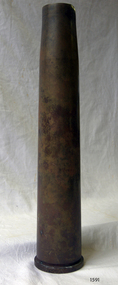 Flagstaff Hill Maritime Museum and Village
Shell Case
... Shell case brass 40mm for Bofur's gun. Patina on outside with marine concretion inside. ...flagstaff hill warrnambool shipwrecked-coast flagstaff-hill flagstaff-hill-maritime-museum maritime-museum shipwreck-coast flagstaff-hill-maritime-village Shell case brass 40mm for Bofur's gun. Patina on outside with marine concretion inside. ...Shell case brass 40mm for Bofur's gun. Patina on outside with marine concretion inside. Base marked "40m/m III Lot 855 PP/C E 1943".flagstaff hill, warrnambool, shipwrecked-coast, flagstaff-hill, flagstaff-hill-maritime-museum, maritime-museum, shipwreck-coast, flagstaff-hill-maritime-village -
Frankston RSL Sub Branch
Munition, Trench Art
... Trench art vase made from a used artillery case (or cartridge) from a Quick Firing 18 Pounder field gun. This example is the No. 1 Mark ll type and was manufactured in March 1911. ...No. 1 Mark II Manufacturer VSM 3/11 Trench art vase made from a used artillery case (or cartridge) from a Quick Firing 18 Pounder field gun. This example is the No. 1 Mark ll type and was manufactured in March 1911. ...Trench art vase made from a used artillery case (or cartridge) from a Quick Firing 18 Pounder field gun. This example is the No. 1 Mark ll type and was manufactured in March 1911. The QF 18 PDR was the main artillery armament of the British and Commonwealth forces during World War 1.No. 1 Mark II Manufacturer VSM 3/11 -
 Frankston RSL Sub Branch
Clinometer
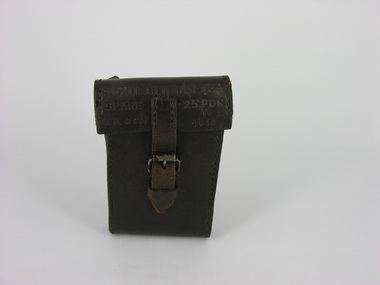
... Sight clinometer MK IV used in conjunction with the QF 25 PDR field gun. Complete with leather protective transit case, standard equipment issued with the 25 PDR artillery piece. ...gun. Complete with leather protective transit case, standard equipment issued with the 25 PDR artillery piece. ...Sight clinometer MK IV used in conjunction with the QF 25 PDR field gun. Complete with leather protective transit case, standard equipment issued with the 25 PDR artillery piece. Refer to 00111.1 and 00111.2ww2, sight, 25 pdr, qf 25 pdr, 25 pounder, field gun, sight clinometer mkiv -
 Flagstaff Hill Maritime Museum and Village
Weapon - Historic Rifles, Royal Small Arms Factory, 1877-1900
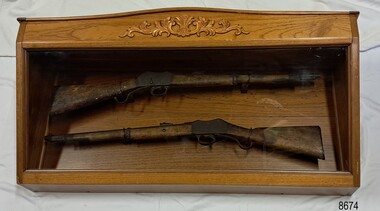
... case...British...Martini Henry Carbine...breech-loaded...rifled...Colonial...single-shot....500 calibre...weapon...gun...The decorative wood and glass display case and frame were designed to preserve the significant history of the guns. On November 1st 1999, the display was presented to Warrnambool Police and the local community due to the historical significance of the Woodford Police Station. ...The case and display each have a horizontal board with a gently curved edge and carved decorations added. The identical firearms are British-made Martini Henry Carbine breach-loaded rifled guns, supplied by Britain to its Colonial troops from around 1877. ...The case and display each have a horizontal board with a gently curved edge and carved decorations added. The identical firearms are British-made Martini Henry Carbine breach-loaded rifled guns, supplied by Britain to its Colonial troops from around 1877. ...Martini-Henry Artillery Carbin rifles were made by the Royal Small Arms Factory at Enfield, Britain, from 1877 until 1900. Many were distributed to the British Colonies, including this pair, which was allocated to the Woodford Police, Victoria Police District of Warrnambool, Southwest Victoria. The Carbine model rifles were shorter than the standard rifles and more suited to mounted police and troopers. It is likely that in the early 20th century, Victoria Police replaced the two carbines with more modern firearms, and the outdated guns were stored in the stables. The rifles were left there and likely forgotten about due to changes in police staff. In 1915, police authorities announced that they would be replacing patrol horses with bicycles and would also close some smaller police stations. This affected Woodford Police Station, which closed in 1917. The forgotten firearms remained in the stables and were noticed by schoolboy Robert Jellie in 1940 and seen again in 1946. In 1995, the property was sold by the Education Department to a private owner. The Woodford Community donated the pair of Martini-Henry Carbines to the Victoria Police Museum in the late 1990s for mounting and display, which was funded by the Victoria Police Historical Society Inc. The decorative wood and glass display case and frame were designed to preserve the significant history of the guns. On November 1st 1999, the display was presented to Warrnambool Police and the local community due to the historical significance of the Woodford Police Station. In 2025, these items were formally deaccessioned by the Victoria Police Museum, and ownership was transferred to the Warrnambool Police Station. On March 10th, 2025, the display was transferred to Flagstaff Hill Maritime Museum and Village, where the historical story of the Martini-Henry Carbines could continue to be preserved and accessed by local families, the community, visitors to the area, and online visitors. WOODFORD POLICE: - The small settlement at Woodford was established in the 1840s around the Merri River where there was a ford across the water and a bridge from 1848 to 1851. The area was settled very early in Victoria’s history, and the river crossing provided travellers with access to the early route between Port Fairy (named Belfast at that time), Warrnambool and Melbourne. Occasionally, a Warrnambool police trooper would ride through Woodford and the district. In December 1854, Woodford Police barracks and stables were built on the hill by the Merri River on Bridge Road east, where Jubilee Park now stands. A local mounted trooper kept law and order in the area. In 1856, a lock-up was installed, and the first Woodford Police Station was in action in 1857. By 1871, the police station had been moved from the hill to land across the Merri River bridge, on the southern side of Bridge Road west, near Mill Street. In 1890, the police residence there was replaced by a stone Edwardian-style building with the stables and lock-up behind it and the old police station at the rear. The police continued to have a presence in Woodford until it was closed by the Police Commissioner in July 1917 for economic reasons. The residence was used for government housing until 1923, when it was taken over by the Education Department for the school teacher’s home. In 1995, it became privately owned. THE MARTINI-HENRY ARTILLERY CARBINE: - The Martini-Henry rifles were made in Britain from 1871 at the Royal Small Arms factory at Enfield and were stamped with the symbol of the Royal Cipher (Crown over VR) over ENFIELD to identify their origin. They were named after two of several people who helped design this method: Swiss Friederich von Martini and Scotsman Alexander Henry. The design was breech-loaded, and the inner barrel was rifled. A thumb rest was incorporated into the top right of the bullet receiver’s chamber. The small teardrop lever on the right side of the rifle showed whether the rifle was ready to be shot. In 1877, the shorter, lighter-weight Carbine version of the firearm was produced for mounted troops and artillery. Its official name was “Carbine, B.L., Rifled, Martini-Henry.” The bullets were slightly lighter in weight than those used for the longer rifle. The sight position was adjusted for the shorter gun, and wings were added to the sight on the tip, making it easier to slide the rifle back into a saddle bag. Some of the later Carbines also had leather sight covers screwed to the stock to prevent them from catching on the saddle bags. The Carbines had accessories available, such as barrel extensions with bayonets and swivels for adding slings. The Martini-Henry Carbine designs were later modified to fire the British .303 ammunition. Eventually, by 1900, the Martini-Henry Carbines were replaced by the Lee Enfield gun design. The pair of Martini-Henry Carbine firearms represents policing in the early pre-1900 days of colonial settlement; Woodford was one of the first townships settled in Victoria, and it had a police presence from 1854 until 1917. The rifles and display provide a historic connection between the location of Woodford and relatives and associates. The carbine rifles show a stage in the evolution of weapon design, adapted to suit mounted troops, and adding features to streamline use and storage. The ammunition was also improved during this progression. The carbines are important for their connection to policing law and order in a remote area. They are significant for their association with the township of Woodford, which was important to travel in the southwest Victoria district, providing access across a river for a road between Port Fairy and Melbourne, and later Warrnambool, and supplying food, goods and accommodation for the travellers. A pair of mounted rifles is mounted behind glass in a timer case, accompanied by a framed display of two photographs and an account of the rifles’ history. The case and display each have a horizontal board with a gently curved edge and carved decorations added. The identical firearms are British-made Martini Henry Carbine breach-loaded rifled guns, supplied by Britain to its Colonial troops from around 1877. The rifles are lever-action, single-shot .500 calibre weapons. They have a teardrop lever on their right side. They were used by Victoria Police mounted troops at the Woodford Police Station, Victoria. The black and white photographs were taken in 1946. The left photograph has a circled area; the right photograph is an enlarged view of the circled area, showing the Woodford Police Station in detail. The printed text is on textured paper with the Victoria Police watermark. It gives a summary of the rifle’s history. There is an inscription on the left photograph. Left photograph, handwritten in white pen: “WOODFORD” Document’s print: “During the late 1840s the small town of Woodford grew around the crossing of the Merri River on the Melbourne/Port Fairy Rad. Woodford was proclaimed a township in 1854 and a police quarters was established there in 1857. The police station remained until 1917 when it was closed and police service from then on was provided from Warrnambool. The building was then used as a school residence and is now privately owned. In !940 Robert JELLIE, then a schoolboy, observed two rifles mounted on the wall of the disused stable at the rear of the old police building. Following the devastating flood of 1946 (see photograph above) the rifles were again seen in the room next to the stable but were not seen again until the building was sold by the Education Department many years later. It was a recognition of the historical value of the rifles which led to their donation to the Warrnambool Police Complex. The rifles have been authenticated by the Victoria Police Armoury as being Victoria Police issue some time before 1900. The rifles are an identical pair of the famous British-made Martini Henry, a .500 inch calibre military weapon widely used by British Colonial troops. Victoria Police and the wider community of Warrnambool are indebted to the members of the Woodford community for their fine gesture in donating the rifles for mounting so that their historical importance can be preserved and they can be displayed for generations to come. This display was funded by the Victoria Police Historical Society Incorporated, and presented on the first day of November, 1999.”flagstaff hill maritime museum and village, great ocean road, shipwreck coast, martini henry, victoria police, woodford police station, rifle, carbine, display case, british, martini henry carbine, breech-loaded, rifled, colonial, single-shot, .500 calibre, weapon, gun, 1877, troops, mounted troops, merri river, victoria police woodford, victoria police warrnambool, victoria police melbourne, police quarters, robert jellie, school residence, stable, 1946 flood, victoria police armoury, identical pair, british colonial troops, victoria police historical society incorporated, woodford, bicycles, found by a schoolboy, edwardian-style building, victoria police museum, warrnambool police station -
 Glenelg Shire Council Cultural Collection
Weapon - Artillery Shell Casing, unknown
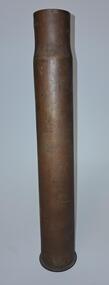
... guns. War Defence Force ammunition Base underside: Stamped with a circle, inside of circle appears further markings but they are indistinguishable. Cylindrical shaped copper shell case ...Shell casings were used to hold the propellant charge and projectile in artillery guns.An example of a shell casing used in artillery guns.Cylindrical shaped copper shell case with tapered top. Flat base with small lip. Inside base appears bright silver centre and features a small screw. Base underside: Stamped with a circle, inside of circle appears further markings but they are indistinguishable.war, defence force, ammunition -
 Montmorency–Eltham RSL Sub Branch
Weapon - British QF 2 Pounder 40mm Naval (Pom-Pom) Round, Brass Shell Case, 1931 (shell case), 1941 (projectile)
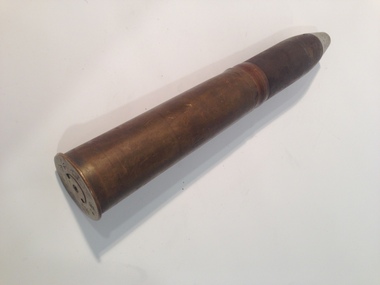
... This QF 2-pounder is not the same 2 pounder used by the British Army as an anti-tank gun and a tank gun, although they both fired 2 pounds (40mm) projectiles. anti-tank 2 PR 1 1931 CF MF LOT 15 Brass shell case with iron/steel explosive projectile Brass Shell Case Weapon British QF 2 Pounder 40mm Naval (Pom-Pom) Round ...The Ordnance QF (Quick-firing) 2-pounder was a 40mm British autocannon known as the 'pom-pom' and used as an anti-aircraft gun by the Royal Navy. The name came from the sound that the original guns made when firing. This QF 2-pounder is not the same 2 pounder used by the British Army as an anti-tank gun and a tank gun, although they both fired 2 pounds (40mm) projectiles. Brass shell case with iron/steel explosive projectile2 PR 1 1931 CF MF LOT 15anti-tank -
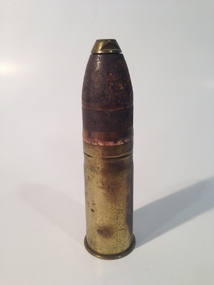 Montmorency–Eltham RSL Sub Branch
Weapon - QF 1 pounder 37mm (Pom-Pom) Round
... gun known as the Pom-pom because of its distinctive sound when firing. It was the world's first automatic cannon and was used by many different countries. It achieved notoriety when used by the Boers in the South African War 1899 - 1902. V S & M Brass case ...This round was fired by the QF 1 pounder gun known as the Pom-pom because of its distinctive sound when firing. It was the world's first automatic cannon and was used by many different countries. It achieved notoriety when used by the Boers in the South African War 1899 - 1902.Brass case and iron pom-pom projectile.V S & M
