
Showing 67 items matching "gun on flagstaff hill"
-
 Flagstaff Hill Maritime Museum and Village
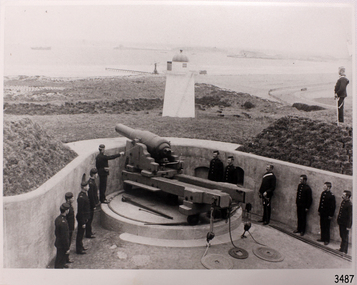
Photograph - Military, Volunteer Corp, mid-1800s
... flagstaff hill...warrnambool...flagstaff-hill-maritime-museum...Photograph...Volunteer Corp...Gun...Black and white photograph of Volunteer Corp firing the gun on Flagstaff Hill. ...It shows a point in time when local volunteers were prepared to defend the south west coast of Victoria. flagstaff hill warrnambool flagstaff-hill-maritime-museum Photograph Volunteer Corp Gun on Flagstaff Hill Fortifications Volunteer Corps. fortifications Volunteer Corps Maritime Museum Maritime Village Great Ocean Road Shipwreck Coast militia Barracks Black and white photograph of Volunteer Corp firing the gun on Flagstaff Hill. ...This photograph relates to the early group of the Volunteer Corps preparing to defend their country.The photograph is a significant record. It shows a point in time when local volunteers were prepared to defend the south west coast of Victoria.Black and white photograph of Volunteer Corp firing the gun on Flagstaff Hill. flagstaff hill, warrnambool, flagstaff-hill-maritime-museum, photograph, volunteer corp, gun on flagstaff hill, fortifications volunteer corps., fortifications, volunteer corps, maritime museum, maritime village, great ocean road, shipwreck coast, militia, barracks -
 Flagstaff Hill Maritime Museum and Village
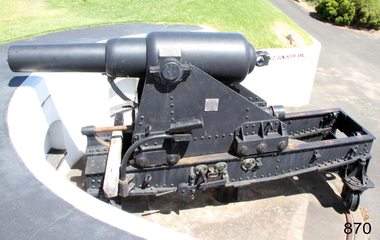
Weapon - Cannon, 1866
... flagstaff hill...warrnambool...shipwrecked coast...flagstaff hill maritime museum...maritime museum...shipwreck coast...flagstaff hill maritime village...great ocean road...colonial defences...victoria’s coastal defences...warrnambool fortification...warrnambool garrison battery...warrnambool volunteer corps...ordinance...armaments...cannon hill fortifications...4th australian light horse regiment...no 4 field battery...80 pound cannon rifled muzzle loaders (rml)...victorian colonial government...royal gun...guns mounted on field carriages. They were now a mobile unit but continued to use the Warrnambool Garrison area at Flagstaff Hill for practice. ...Made in 1866 at the Royal Gun Factory (R-G-F), Woolich, England. Gun Reg No 13. Flagstaff Hill Garrison Gun 2 (Gun No. 2). ...Made in 1866 at the Royal Gun Factory (R-G-F), Woolich, England. Gun Reg No 13. Flagstaff Hill Garrison Gun 2 (Gun No. 2). ...In the years following the Crimean War (1854-1857J) there was a great concern in the Colony that Imperial Russia would attempt an invasion. Coastal defences in the colony of Victoria were greatly strengthened by the Government as a result. Warrnambool was originally protected by cannons at Cannon Hill, approximately 1 kilometer west of the Flagstaff Hill Fortifications. These cannons included two 1866 guns, both 80 Pound Rifled Muzzle Loaders (RML) purchased by Victoria’s Colonial Government. They were part of a shipment of 26 such guns sent from England in December 1866. They are registered as No. 23 (80cwt-2qr-0lbs) - Gun 1, and No.13 (81cwt-1qr-12lbs) - Gun 2. They were cast at the Royal Gun Factory, Woolwich Arsenal, in 1866 and have a 6.3 inch bore. Both barrels carry the Royal Cypher of Queen Victoria, Insignia of the Royal Engineers, within the Garter and Motto surmounted by the Crown, with the Royal Cypher of Queen Victoria within the Garter (letters in centre “VR”, motto “HONI SOIT QUI MAL Y PENSE”, "Shame be to him who thinks evil of it."). The guns were originally supplied with wooden carriages. (The Royal Arsenal at Woolwich, England, was established eleven years after the Restoration of King Charles II. It was the principal supplier of armaments to the British and Empire Governments. At the height of its operations during World War One the factory covered 1300 acres and employed very nearly 80,000 workers. Woolwich was the Headquarters of the Royal Artillery since the raising of that Regiment in 1716. The Arsenal was closed in the late 1960’s.) These two cannons were transferred to the Warrnambool Garrison Artillery Battery Fortifications erected at Flagstaff Hill in 1887 as part of Victoria’s Coastal Defences. The original wooden carriages were subsequently replaced with the present iron garrison carriages in 1888. They are a “C” pivot. The ‘racers’ or curved track set into the floor of the gun emplacement (which enabled the guns to be traversed more quickly) are as specified for guns up to 10 inch, being of wrought iron 2.78 inches wide. A temporary third gun, now no longer on Flagstaff Hill’s site, was a 5 inch Rifled Breech Loading (BL) Armstrong gun mounted on an Elswick hydro pneumatic disappearing carriage It was faster to load and fire than the 80 pound RMLs and its arrival spelt the end of the older 80 pound guns’ useful life, apart from being used for practice sessions. The 5 inch BL gun was the main defensive weapon of the Warrnambool Battery until the Battery was downgraded in importance and the gun was recalled to Melbourne in 1910. The State of Victoria took over the ownership of the guns at the time of Australian Federation in 1901. In about 1901/1902 the Garrison Battery was converted to the Warrnambool Battery of the Australian Field Artillery (No 4 Field Battery). It was equipped with 4.7 inch naval guns mounted on field carriages. They were now a mobile unit but continued to use the Warrnambool Garrison area at Flagstaff Hill for practice. When the Fortifications were declared obsolete, the two 80 Pounder RML were relocated to Cannon Hill in 1910. On the outbreak of World War One the 4.7 inch guns were recalled to Melbourne, and the Battery was disbanded. Most of the personnel probably re-enlisted in the local 4th Australian Light Horse Regiment. The two 80 Pounder RML were moved back to the Fortifications in 1973. They were both fully restored by Army First Year Apprentices at the Ordinance Factory in Bendigo in time for the centenary year of the fortifications in 1987. The guns are capable of firing 80 pound (32.3kg) armour piercing exploding shells 3.65kms out to sea. They were original manned by volunteers before a paid Garrison was established. Now the Guns are again fired by volunteers on Special Event days. Since restoration the Gun Number 1 had been fired on a regular basis but Gun Number 2 hadn’t been fired since the mid 1990’s. In April 2015 Gun Number 2 was serviced in preparation for the firing of both cannons on the ANZAC Centenary commemorations on April 25th 2015. Other guns from the original Cannon Hill location were obsolete by the time the 1887 Warrnambool Garrison Artillery Battery was built. These guns are (1) a 32 Pounder Muzzle Loading Smooth Bore (SB) cast in 1813 at the famous Carron Foundry, number 80837 and now located in the Warrnambool Botanic Gardens (2) a 68 Pounder Muzzle Loading Smooth Bore cast in 1861 at the equally august Low Moor Foundry, number 10310 and now located on the lawn area at the entrance to Flagstaff Hill Maritime Village. Both of these guns are mounted on their original wooden garrison carriages. There are only seven 32 Pounder SB made by Carron and fifteen 68 Pounder SB made at Low Moor known to exist in the State of Victoria. Funding was received to repair Cannon No.2 and its iron carriage. After completion, both Cannon No 1 and No. 2 were 'fired' in a public re-enactment on April 4th, 2026. (Conservation Management Plan for Victorian Guns and Cannon, South Western Victoria, May 2008, ref W/F/05)The Warrnambool Garrison has been added to the Victorian Heritage Register H1250 “for its intact battery and guns, a strong reminder of Victoria’s wealth and determination to protect itself from the perceived threat of invasion in the 1880’s.” The City of Warrnambool is one of several custodians of a collection of artillery pieces of heritage significance at a state, national and international level. These pieces are directly related to the defence of south-west Victoria in the 19th century. The care and preservation come under the Heritage Act 1995. Cannon. 80 Pound Rifled Muzzle Loading (RML) Gun on iron carriage and slide, installed in the Battery at Flagstaff Hill’s Fortifications. Made in 1866 at the Royal Gun Factory (R-G-F), Woolich, England. Gun Reg No 13. Flagstaff Hill Garrison Gun 2 (Gun No. 2). Insignia of the Royal Engineers, and the weight of the gun, stamped on top of the gun’s barrel. There is a brass plate on the side of the gun with the details of 1987 restoration.Stamped into the metal on top of the barrel, Insignia of the Royal Engineers; Garter and Motto “HONI SOIT QUI MAL Y PENSE”, surmounted by the Crown, with the Royal Cypher of Queen Victoria “VR” within the Garter. Also stamped on top of the gun are 2 inward pointing arrows above the weight ”81-1-12”. Brass plate “RESTORATION / BY / FIRST YEAR / APPRENTICES / ORDANANCE FACTORY / BENDIGO 1987”flagstaff hill, warrnambool, shipwrecked coast, flagstaff hill maritime museum, maritime museum, shipwreck coast, flagstaff hill maritime village, great ocean road, colonial defences, victoria’s coastal defences, warrnambool fortification, warrnambool garrison battery, warrnambool volunteer corps, ordinance, armaments, cannon hill fortifications, 4th australian light horse regiment, no 4 field battery, 80 pound cannon rifled muzzle loaders (rml), victorian colonial government, royal gun factory england, woolwich arsenal, royal cypher of queen victoria, garrison gun -
 Flagstaff Hill Maritime Museum and Village
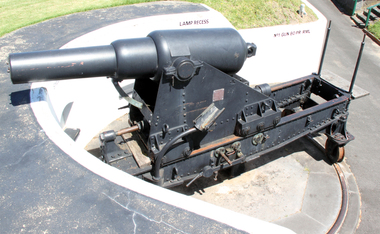
Weapon - Cannon, 1866
... flagstaff hill...warrnambool...shipwrecked coast...flagstaff hill maritime museum...maritime museum...shipwreck coast...flagstaff hill maritime village...great ocean road...cannon...80 pounder...rifled muzzle...loading...royal gun...guns mounted on field carriages. They were now a mobile unit but continued to use the Warrnambool Garrison area at Flagstaff Hill for practice. ...Made in 1866 at the Royal Gun Factory (R-G-F), Woolich, England. Gun Reg No - 23. Flagstaff Hill Garrison Gun 1 (Gun No. 1) Insignia of the Royal Engineers, and the weight of the gun, stamped on top of the gun’s barrel. ...Made in 1866 at the Royal Gun Factory (R-G-F), Woolich, England. Gun Reg No - 23. Flagstaff Hill Garrison Gun 1 (Gun No. 1) Insignia of the Royal Engineers, and the weight of the gun, stamped on top of the gun’s barrel. ...In the years following the Crimean War (1854-1857J) there was a great concern in the Colony that Imperial Russia would attempt an invasion. Coastal defences in the colony of Victoria were greatly strengthened by the Government as a result. Warrnambool was originally protected by cannons at Cannon Hill, approximately 1 kilometer west of the Flagstaff Hill Fortifications. These cannons included two 1866 guns, both 80 Pound Rifled Muzzle Loaders (RML) purchased by Victoria’s Colonial Government. They were part of a shipment of 26 such guns sent from England in December 1866. They are registered as No. 23 (80cwt-2qr-0lbs) - Gun 1, and No.13 (81cwt-1qr-12lbs) - Gun 2. They were cast at the Royal Gun Factory, Woolwich Arsenal, in 1866 and have a 6.3 inch bore. Both barrels carry the Royal Cypher of Queen Victoria, Insignia of the Royal Engineers, within the Garter and Motto surmounted by the Crown, with the Royal Cypher of Queen Victoria within the Garter (letters in centre “VR”, motto “HONI SOIT QUI MAL Y PENSE”, "Shame be to him who thinks evil of it."). The guns were originally supplied with wooden carriages. (The Royal Arsenal at Woolwich, England, was established eleven years after the Restoration of King Charles II. It was the principal supplier of armaments to the British and Empire Governments. At the height of its operations during World War One the factory covered 1300 acres and employed very nearly 80,000 workers. Woolwich was the Headquarters of the Royal Artillery since the raising of that Regiment in 1716. The Arsenal was closed in the late 1960’s.) These two cannons were transferred to the Warrnambool Garrison Artillery Battery Fortifications erected at Flagstaff Hill in 1887 as part of Victoria’s Coastal Defences. The original wooden carriages were subsequently replaced with the present iron garrison carriages in 1888. They are a “C” pivot. The ‘racers’ or curved track set into the floor of the gun emplacement (which enabled the guns to be traversed more quickly) are as specified for guns up to 10 inch, being of wrought iron 2.78 inches wide. A temporary third gun, now no longer on Flagstaff Hill’s site, was a 5 inch Rifled Breech Loading (BL) Armstrong gun mounted on an Elswick hydro pneumatic disappearing carriage It was faster to load and fire than the 80 pound RMLs and its arrival spelt the end of the older 80 pound guns’ useful life, apart from being used for practice sessions. The 5 inch BL gun was the main defensive weapon of the Warrnambool Battery until the Battery was downgraded in importance and the gun was recalled to Melbourne in 1910. The State of Victoria took over the ownership of the guns at the time of Australian Federation in 1901. In about 1901/1902 the Garrison Battery was converted to the Warrnambool Battery of the Australian Field Artillery (No 4 Field Battery). It was equipped with 4.7 inch naval guns mounted on field carriages. They were now a mobile unit but continued to use the Warrnambool Garrison area at Flagstaff Hill for practice. When the Fortifications were declared obsolete the two 80 Pounder RML were relocated to Cannon Hill in 1910. On the outbreak of World War One the 4.7 inch guns were recalled to Melbourne, and the Battery was disbanded. Most of the personnel probably re-enlisted in the local 4th Australian Light Horse Regiment. The two 80 Pounder RML were moved back to the Fortifications in 1973. They were both fully restored by Army First Year Apprentices at the Ordinance Factory in Bendigo in time for the centenary year of the fortifications in 1987. The guns are capable of firing 80 pound (32.3kg) armour piercing exploding shells 3.65kms out to sea. They were original manned by volunteers before a paid Garrison was established. Now the Guns are again fired by volunteers on Special Event days. Since restoration the Gun Number 1 had been fired on a regular basis but Gun Number 2 hadn’t been fired since the mid 1990’s. In April 2015 Gun Number 2 was serviced in preparation for the firing of both cannons on the ANZAC Centenary commemorations on April 25th 2015. Other guns from the original Cannon Hill location were obsolete by the time the 1887 Warrnambool Garrison Artillery Battery was built. These guns are (1) a 32 Pounder Muzzle Loading Smooth Bore (SB) cast in 1813 at the famous Carron Foundry, number 80837 and now located in the Warrnambool Botanic Gardens (2) a 68 Pounder Muzzle Loading Smooth Bore cast in 1861 at the equally august Low Moor Foundry, number 10310 and now located on the lawn area at the entrance to Flagstaff Hill Maritime Village. Both of these guns are mounted on their original wooden garrison carriages. There are only seven 32 Pounder SB made by Carron and fifteen 68 Pounder SB made at Low Moor known to exist in the State of Victoria On April 4th, 2026, both Cannon No 1 and the recently restored Cannon No. 2 were 'fired' in a public re-enactment. (Conservation Management Plan for Victorian Guns and Cannon, South Western Victoria, May 2008, ref W/F/04)The Warrnambool Garrison has been added to the Victorian Heritage Register H1250 “for its intact battery and guns, a strong reminder of Victoria’s wealth and determination to protect itself from the perceived threat of invasion in the 1880’s.” The City of Warrnambool is one of several custodians of a collection of artillery pieces of heritage significance at a state, national and international level. These pieces are directly related to the defence of south-west Victoria in the 19th century. The care and preservation come under the Heritage Act 1995. Cannon. 80 Pounder Rifled Muzzle Loading (RML) Gun on iron carriage and slide, installed in the Battery at Flagstaff Hill’s Fortifications.. Made in 1866 at the Royal Gun Factory (R-G-F), Woolich, England. Gun Reg No - 23. Flagstaff Hill Garrison Gun 1 (Gun No. 1) Insignia of the Royal Engineers, and the weight of the gun, stamped on top of the gun’s barrel. There is a brass plate on the side of the gun with the details of 1987 restoration.Stamped on axle cover on side of barrel “R-G-F / No 23 / 1866”. Stamped into the metal on top of the barrel, Insignia of the Royal Engineers; Garter and Motto “HONI SOIT QUI MAL Y PENSE”, surmounted by the Crown, with the Royal Cypher of Queen Victoria “VR” within the Garter. Also stamped on top of the gun are 2 inward pointing arrows above the weight ”81-2-0”. Brass plate “RESTORATION / BY / FIRST YEAR / APPRENTICES / ORDANANCE FACTORY / BENDIGO 1987”flagstaff hill, warrnambool, shipwrecked coast, flagstaff hill maritime museum, maritime museum, shipwreck coast, flagstaff hill maritime village, great ocean road, cannon, 80 pounder, rifled muzzle, loading, royal gun factory, woolich -
 Flagstaff Hill Maritime Museum and Village
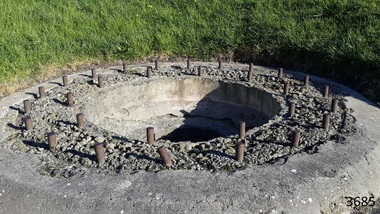
Gun Emplacement, 1890's
... flagstaff hill...warrnambool...shipwrecked coast...flagstaff hill maritime museum...maritime museum...shipwreck coast...flagstaff hill maritime village...great ocean road...colonial defences...victoria’s coastal defences...warrnambool fortification...warrnambool garrison battery...warrnambool volunteer corps...ordinance...armaments...cannon hill fortifications...flagstaff hill fortifications...4th australian light horse regiment...garrison gun...A temporary third gun, now no longer on Flagstaff Hill’s site, was the 5 inch Rifled Breech Loading (BL) Armstrong gun mounted on an Elswick hydro pneumatic disappearing carriage and installed in this very concrete base or pad. ...A temporary third gun, now no longer on Flagstaff Hill’s site, was the 5 inch Rifled Breech Loading (BL) Armstrong gun mounted on an Elswick hydro pneumatic disappearing carriage and installed in this very concrete base or pad. ...The Warrnambool Battery on Flagstaff Hill has embankments for 3 guns. Those on the left and right still have cannon in place but in the centre is an empty embankment, apart from this concrete ring with metal threaded studs. In 1898 a 5 inch breech loading gun (BL) was installed here. The gun had a hydro-pneumatic disappearing carriage (hence the sign on the concrete wall "5" BL HP").. This type of gun was faster to load and fire that the 80 pound RML’s installed on either side of it. Its arrival spelt the end of the 80 pound RML guns’ useful life, although they continued to be used for practice sessions. The 5 inch BL was the main defensive weapon of the Warrnambool Battery until the Battery was downgraded in importance. It was removed in 1904 and recalled to Melbourne in 1910. The gun emplacement ring is all that remains of the mounting for a 5 inch Armstrong rifled breech loading gun. HISTOR of the WARRNAMBOOL GUNS & CANNON In the years following the Crimean War (1854-1857J) there was a great concern in the Colony that Imperial Russia would attempt an invasion. Coastal defences in the colony of Victoria were greatly strengthened by the Government as a result. Warrnambool was originally protected by cannons at Cannon Hill, approximately 1 kilometer west of the Flagstaff Hill Fortifications. The cannons included two 1866 guns, both 80 Pound Rifled Muzzle Loaders (RML) purchased by Victoria’s Colonial Government. They were part of a shipment of 26 such guns sent from England in December 1866. They are registered as No. 23 (80cwt-2qr-0lbs) - Gun 1, and No.13 (81cwt-1qr-12lbs) - Gun 2. They were cast at the Royal Gun Factory, Woolwich Arsenal, in 1866 and have a 6.3 inch bore. Both barrels carry the Royal Cypher of Queen Victoria, Insignia of the Royal Engineers, within the Garter and Motto surmounted by the Crown, with the Royal Cypher of Queen Victoria within the Garter (letters in centre “VR”, motto “HONI SOIT QUI MAL Y PENSE”, "Shame be to him who thinks evil of it."). The guns were originally supplied with wooden carriages. (The Royal Arsenal at Woolwich, England, was established eleven years after the Restoration of King Charles II. It was the principal supplier of armaments to the British and Empire Governments. At the height of its operations during World War One the factory covered 1300 acres and employed very nearly 80,000 workers. Woolwich was the Headquarters of the Royal Artillery since the raising of that Regiment in 1716. The Arsenal was closed in the late 1960’s.) These two 80pdr cannons were transferred to the Warrnambool Garrison Artillery Battery Fortifications erected at Flagstaff Hill in 1887 as part of Victoria’s Coastal Defences. The original wooden carriages were subsequently replaced with the present iron garrison carriages in 1888. They are a “C” pivot. The ‘racers’ or curved track set into the floor of the gun emplacement (which enabled the guns to be traversed more quickly) are as specified for guns up to 10 inch, being of wrought iron 2.78 inches wide. A temporary third gun, now no longer on Flagstaff Hill’s site, was the 5 inch Rifled Breech Loading (BL) Armstrong gun mounted on an Elswick hydro pneumatic disappearing carriage and installed in this very concrete base or pad. The State of Victoria took over the ownership of the guns at the time of Australian Federation in 1901. In about 1901/1902 the Garrison Battery was converted to the Warrnambool Battery of the Australian Field Artillery (No 4 Field Battery). It was equipped with 4.7 inch naval guns mounted on field carriages. They were now a mobile unit but continued to use the Warrnambool Garrison area at Flagstaff Hill for practice. When the Fortifications were declared obsolete the two 80 Pounder RML were relocated to Cannon Hill in 1910. On the outbreak of World War One the 4.7 inch guns were recalled to Melbourne, and the Battery was disbanded. Most of the personnel probably re-enlisted in the local 4th Australian Light Horse Regiment. The two 80 Pounder RML were moved back to the Fortifications in 1973. They were both fully restored by Army First Year Apprentices at the Ordinance Factory in Bendigo in time for the centenary year of the fortifications in 1987. The guns are capable of firing 80 pound (32.3kg) armour piercing exploding shells 3.65kms out to sea. They were originally manned by volunteers before a paid Garrison was established. Now the Guns are again fired by volunteers on Special Event days. Since restoration the Gun Number 1 had been fired on a regular basis but Gun Number 2 hadn’t been fired since the mid 1990’s. In April 2015 Gun Number 2 was serviced in preparation for the firing of both cannons on the ANZAC Centenary commemorations on April 25th 2015. Other guns from the original Cannon Hill location were obsolete by the time the 1887 Warrnambool Garrison Artillery Battery was built. These guns are (1) a 32 Pounder Muzzle Loading Smooth Bore (SB) cast in 1813 at the famous Carron Foundry, number 80837 and now located in the Warrnambool Botanic Gardens. It is now mounted on a replica carriage due to the original carriage being in a fragile condition (the original carriage stored under cover at Flagstaff Hill). (2) a 68 Pounder Muzzle Loading Smooth Bore cast in 1861 at the equally august Low Moor Foundry, number 10310 and now located on the lawn area at the entrance to Flagstaff Hill Maritime Village. It is still mounted on its original wooden garrison carriage. Its wooden slide compressor mechanism is fragile and now kept in Flagstaff Hill’s storage. There are only seven 32 Pounder SB made by Carron and fifteen 68 Pounder SB made at Low Moor known to exist in the State of Victoria [references; Flagstaff Hill Maritime Village interpretation boards, information sheets and other documents; South Western Victoria Guns and Cannon report, May 2008, ref W/F/08] The Gun embankment is contained within the heritage listed Lady Bay Lighthouse Comples, on the Victorian Heritage Register VHR H1520. The gun emplacement base is evidence of the last defences installed on this stretch of coastline. The Warrnambool Garrison has been added to the Victorian Heritage Register H1250 “for its intact battery and guns, a strong reminder of Victoria’s wealth and determination to protect itself from the perceived threat of invasion in the 1880’s.” The City of Warrnambool is one of several custodians of a collection of artillery pieces of heritage significance at a state, national and international level. These pieces are directly related to the defence of south-west Victoria in the 19th century. The care and preservation come under the Heritage Act 1995. Gun emplacement; the remains of the mounting platform of a temporary third gun installed in 1898 in the centre of the battery. This consists of a circular concrete well or sump surrounded by two rings of mounting bolts, the inner of 10 and the outer of 20. The base once held a 5 inch Armstrong rifled breech loading gun with hydro-pneumatic disappearing. In the centre of the ring on the ground is a keyhole shaped space. The gun was removed in 1904. flagstaff hill, warrnambool, shipwrecked coast, flagstaff hill maritime museum, maritime museum, shipwreck coast, flagstaff hill maritime village, great ocean road, colonial defences, victoria’s coastal defences, warrnambool fortification, warrnambool garrison battery, warrnambool volunteer corps, ordinance, armaments, cannon hill fortifications, flagstaff hill fortifications, 4th australian light horse regiment, garrison gun, 5 inch breech loading gun, emplacement for hydro-pneumatic disappearing carriage, gun emplacement -
 Flagstaff Hill Maritime Museum and Village
Weapon - Cannon, 1813
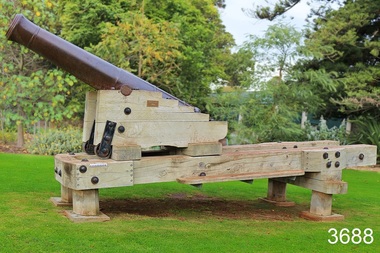
... guns mounted on field carriages. They were now a mobile unit but continued to use the Warrnambool Garrison area at Flagstaff Hill for practice. ...guns mounted on field carriages. They were now a mobile unit but continued to use the Warrnambool Garrison area at Flagstaff Hill for practice. ...This 1813 cannon is classified as a carronade, having been made by the Carron Ironworks foundry in Stirling, Scotland in 1813. It is a large calibre, short range, gun mainly used on ships. The carronade model of cannon was first used when introduced into the British Royal Navy in the American War of the Revolution (1775-1883). This cannon was originally a 28pdr, 48cwt, 8ft gun. The date ‘1837’ on the barrel probably indicates the date that the Board of Ordinance accepted the change in size to a 32pdr. It may originally have been a naval gun and the conversion undertaken when it was brought ashore. It is very probably one of the 15 guns that are known to have constituted the defences of Victoria in 1860. This group of 32pdrs was the shorter model of the 4800width and 8ft length cannon and as such are different from the 32pdrs found in NSW. It was originally located on Cannon Hill in Warrnambool when it was the site of the Warrnambool Battery Western Artillery, formed in 1866. It was obsolete by the time of the 1887 fortifications, and was moved from the Warrnambool Fortifications to the Botanic Gardens in 1910, when the Fortifications were declared obsolete. HISTORIC INFORMATION ABOUT THE CANNON IN THE WARRNAMBOOL AREA In the years following the Crimean War (1854-1857J) there was a great concern in the Colony that Imperial Russia would attempt an invasion. Coastal defences in the colony of Victoria were greatly strengthened by the Government as a result. Warrnambool was originally protected by cannons at Cannon Hill, approximately 1 kilometer west of the Flagstaff Hill Fortifications. The cannons included two 1866 guns, both 80 Pound Rifled Muzzle Loaders (RML) purchased by Victoria’s Colonial Government. They were part of a shipment of 26 such guns sent from England in December 1866. They are registered as No. 23 (80cwt-2qr-0lbs) - Gun 1, and No.13 (81cwt-1qr-12lbs) - Gun 2. They were cast at the Royal Gun Factory, Woolwich Arsenal, in 1866 and have a 6.3 inch bore. Both barrels carry the Royal Cypher of Queen Victoria, Insignia of the Royal Engineers, within the Garter and Motto surmounted by the Crown, with the Royal Cypher of Queen Victoria within the Garter (letters in centre “VR”, motto “HONI SOIT QUI MAL Y PENSE”, "Shame be to him who thinks evil of it."). The guns were originally supplied with wooden carriages. (The Royal Arsenal at Woolwich, England, was established eleven years after the Restoration of King Charles II. It was the principal supplier of armaments to the British and Empire Governments. At the height of its operations during World War One the factory covered 1300 acres and employed very nearly 80,000 workers. Woolwich was the Headquarters of the Royal Artillery since the raising of that Regiment in 1716. The Arsenal was closed in the late 1960’s.) The two 80pdr cannons were transferred to the Warrnambool Garrison Artillery Battery Fortifications erected at Flagstaff Hill in 1887 as part of Victoria’s Coastal Defences. The original wooden carriages were subsequently replaced with the present iron garrison carriages in 1888. They are a “C” pivot. The ‘racers’ or curved track set into the floor of the gun emplacement (which enabled the guns to be traversed more quickly) are as specified for guns up to 10 inch, being of wrought iron 2.78 inches wide. A temporary third gun, now no longer on Flagstaff Hill’s site, was a 5 inch Rifled Breech Loading (BL) Armstrong gun mounted on an Elswick hydro pneumatic disappearing carriage It was faster to load and fire than the 80 pound RMLs and its arrival spelt the end of the older 80 pound guns’ useful life, apart from being used for practice sessions. The 5 inch BL gun was the main defensive weapon of the Warrnambool Battery until the Battery was downgraded in importance and the gun was recalled to Melbourne in 1910. The gun emplacement still remains in place set between the 2 80pdr cannon. The State of Victoria took over the ownership of the guns at the time of Australian Federation in 1901. In about 1901/1902 the Garrison Battery was converted to the Warrnambool Battery of the Australian Field Artillery (No 4 Field Battery). It was equipped with 4.7 inch naval guns mounted on field carriages. They were now a mobile unit but continued to use the Warrnambool Garrison area at Flagstaff Hill for practice. When the Fortifications were declared obsolete the two 80 Pounder RML were relocated to Cannon Hill in 1910. On the outbreak of World War 1 the 4.7 inch guns were recalled to Melbourne, and the Battery was disbanded. Most of the personnel probably re-enlisted in the local 4th Australian Light Horse Regiment. The two 80 Pounder RML were moved back to the Fortifications in 1973. They were both fully restored by Army First Year Apprentices at the Ordinance Factory in Bendigo in time for the centenary year of the fortifications in 1987. The guns are capable of firing 80 pound (32.3kg) armour piercing exploding shells 3.65kms out to sea. They were original manned by volunteers before a paid Garrison was established. Now the Guns are again fired by volunteers on Special Event days. Since restoration the Gun Number 1 had been fired on a regular basis but Gun Number 2 hadn’t been fired since the mid 1990’s. In April 2015 Gun Number 2 was serviced in preparation for the firing of both cannons on the ANZAC Centenary commemorations on April 25th 2015. Other guns from the original Cannon Hill location were obsolete by the time the 1887 Warrnambool Garrison Artillery Battery was built. These guns are (1) a 32 Pounder Muzzle Loading Smooth Bore (SB) cast in 1813 at the famous Carron Foundry, number 80837 and now located in the Warrnambool Botanic Gardens. It is now mounted on a replica carriage due to the original carriage being in a fragile condition (the original carriage stored under cover at Flagstaff Hill). (2) a 68 Pounder Muzzle Loading Smooth Bore cast in 1861 at the equally august Low Moor Foundry, number 10310 and now located on the lawn area at the entrance to Flagstaff Hill Maritime Village. It is still mounted on its original wooden garrison carriage. Its wooden slide compressor mechanism is fragile and now kept in Flagstaff Hill’s storage. There are only seven 32 Pounder SB made by Carron and fifteen 68 Pounder SB made at Low Moor known to exist in the State of Victoria Plaque attached to the carriage “This replica carriage was constructed by the Warrnambool Tritan Woodworkers club in conjunction with the generosity of local businesses and the Warrnambool community. The original carriage (circa 1860) was removed for restoration and is now located at Flagstaff Hill Maritime Village. The timber used for the replica carriage is Monterey Cypress, which was an early planting in the gardens. 2010 marked the centenary of the cannon’s relocation in the Warrnambool Botanic Gardens.” (Reference; Victorian Guns and Cannons, South Western Victoria Assessment, May 2008, item W/B/01; Flagstaff Hill Maritime Village datasheets and archives). There are only seven 32 Pounder SB made by Carron known to exist in the State of Victoria and this is one of them. On a world level, this cannon represents a high level of rarity. Further, as it has been modified (bored up) it is representative of the historical process of amending artillery in order to ensure a longer usefulness of each piece despite rapidly advancing artillery technology. The number of surviving carriages with traversing slides in this group in South Western Victoria is unique in Australia and probably in the World. Out of 10 such platforms surviving in Australia, the South Western Victorian group has half. Several survive around the world but probably not in such a large group. The wooden sliding compressor mechanism belonging to this cannon is extremely rare, and the only one in this South Western Victorian group of Guns and Cannons. As a whole, this cannon has undergone very little restoration or modification, giving it a high level of integrity. The City of Warrnambool is one of several custodians of a collection of artillery pieces of heritage significance at a state, national and international level. These pieces are directly related to the defence of south-west Victoria in the 19th century. The care and preservation come under the Heritage Act 1995. (Reference; Victorian Guns and Cannons, South Western Victoria Assessment, May 2008).Cannon, or carronade, 32pdr with wheels. Muzzle loading smooth bore (SB) cannon. Cannon has original wooden Burmese Teak carriage and slide with wrought iron fittings and iron wheels. Manufactured by Carron in Scotland, in 1813. It has been converted from a 28pdr. There is a loop for a rope on the cascabel, which was part of the original casting. Re-bored in 1837. Marks include Serial Number, Royal Cypher of King George III, broad arrow of proofing, and numbers to represent the weight. NOTE: The cannon is displayed in the Warrnambool Botanic Gardens and is mounted on a replica wooden carriage; the original wooden carriage is now stored under cover at Flagstaff Hill Maritime Village. This carriage has 4 wheels on swivel attachments and a central gear that allows the wheels to turn on rails. Pressed into left trunnion “80837 / CARRON / 1813”, cast on barrel“symbol (Royal Cypher of King George III”, “symbol (broad arrow of proofing)” and numbers “45-3-24 / 1837” . Cascable “CV” and marks with gradations from nought to three in quarters on each side, On the carriage the end of one of the main slide members carries the mark “W symbol (broad arrow) D” incised into the timber. Plaque attached to the carriage by the Warrnambool Tritan Woodworkers club, 2010, marking the centenary of the cannon’s relocation in the Warrnambool Botanic Gardens and the addition of the replica carriage. flagstaff hill, warrnambool, shipwrecked coast, flagstaff hill maritime museum, maritime museum, shipwreck coast, flagstaff hill maritime village, great ocean road, victoria’s coastal defences, warrnambool fortification, warrnambool garrison battery, ordinance, armaments, cannon hill fortifications, victorian colonial government, carron ironwroks foundary, 32pdr smooth bore cannon, 28pdr smooth bore cannon, 1813 cannon, carronade -
 Flagstaff Hill Maritime Museum and Village
Functional object - Lead shot, Circa 1877
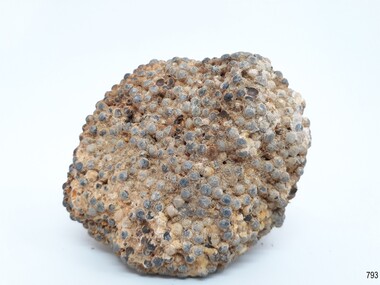
... Flagstaff Hill divers from the wreck of the Loch Ard in 1975. Included in her diverse and valuable cargo were 22 tons of lead shot, packed in cloth bags and wooden casks. Bulk quantities of lead shot, uniformly round balls of dull grey metal ranging from 2mm “birdshot” to 8mm “buckshot”, were routinely exported to the Australian colonies. Shot was used mostly as projectiles fired from smooth bored guns...Flagstaff Hill divers from the wreck of the Loch Ard in 1975. Included in her diverse and valuable cargo were 22 tons of lead shot, packed in cloth bags and wooden casks. Bulk quantities of lead shot, uniformly round balls of dull grey metal ranging from 2mm “birdshot” to 8mm “buckshot”, were routinely exported to the Australian colonies. Shot was used mostly as projectiles fired from smooth bored guns ...This artifact is a sample of small caliber lead shot recovered by Flagstaff Hill divers from the wreck of the Loch Ard in 1975. Included in her diverse and valuable cargo were 22 tons of lead shot, packed in cloth bags and wooden casks. Bulk quantities of lead shot, uniformly round balls of dull grey metal ranging from 2mm “birdshot” to 8mm “buckshot”, were routinely exported to the Australian colonies. Shot was used mostly as projectiles fired from smooth bored guns to bring down moving targets such as wild ducks and small game. It was also useful as ballast, when a dense, “pourable” weight was required to fill cavities or establish volume within a measuring container. The production of consistently round spheres of lead shot required the pouring of molten metal through a sieve and then a long drop through the atmosphere to a water filled basin for final cooling and collection. This “shot tower” process was first patented by William Watts of Bristol in 1782. His calculation of a 150 feet fall was not only to form evenly spherical droplets through surface tension, but also to provide partial cooling and solidification to each shot before they hit the water below. The value of his innovation was the minimising of indentation and shape distortion, avoiding the expense of re-smelting and re-moulding the lead. Lead shot was already being produced in Australia at the time the Loch Ard sinking in March 1878. James Moir had constructed a 157 feet circular stone shot tower near Hobart in 1870, with a peak annual production of 100 tons of lead shot sold in 28 pound linen bags. However colonial demand exceeded this source of local supply. The continued strength of the market for lead shot in the Colony of Victoria prompted substantial investment in additional productive capacity in Melbourne in the next decade. In 1882 Richard Hodgson erected the 160 feet round chimney-shaped Clifton Hill shot tower on Alexandra Parade (VHR H0709) and in 1889 Walter Coop built the 160 feet square tower-shaped Melbourne Central shot tower on La Trobe Street (VHR H0067). At its peak, the Coop Tower produced 6 tons of lead shot per week, or 312 tons per annum. History of the Loch Ard: The Loch Ard got its name from "Loch Ard" a loch that lies to the west of Aberfoyle, and the east of Loch Lomond. It means "high lake" in Scottish Gaelic. The vessel belonged to the famous Loch Line which sailed many vessels from England to Australia. The Loch Ard was built in Glasgow by Barclay, Curle & Co. in 1873, the vessel was a three-masted square-rigged iron sailing ship that measured 79.87 meters in length, 11.58 m in width, and 7 m in depth with a gross tonnage of 1693 tons with a mainmast that measured a massive 45.7 m in height. Loch Ard made three trips to Australia and one trip to Calcutta before its fateful voyage. Loch Ard left England on March 2, 1878, under the command of 29-year-old Captain Gibbs, who was newly married. The ship was bound for Melbourne with a crew of 37, plus 17 passengers. The general cargo reflected the affluence of Melbourne at the time. Onboard were straw hats, umbrellas, perfumes, clay pipes, pianos, clocks, confectionery, linen, and candles, as well as a heavier load of railway irons, cement, lead, and copper. There were other items included that were intended for display in the Melbourne International Exhibition of 1880. The voyage to Port Phillip was long but uneventful. Then at 3 am on June 1, 1878, Captain Gibbs was expecting to see land. But the Loch Ard was running into a fog which greatly reduced visibility. Captain Gibbs was becoming anxious as there was no sign of land or the Cape Otway lighthouse. At 4 am the fog lifted and a lookout aloft announced that he could see breakers. The sheer cliffs of Victoria's west coast came into view, and Captain Gibbs realised that the ship was much closer to them than expected. He ordered as much sail to be set as time would permit and then attempted to steer the vessel out to sea. On coming head-on into the wind, the ship lost momentum, the sails fell limp and Loch Ard's bow swung back towards land. Gibbs then ordered the anchors to be released in an attempt to hold their position. The anchors sank some 50 fathoms - but did not hold. By this time the ship was among the breakers and the tall cliffs of Mutton Bird Island rose behind. Just half a mile from the coast, the ship's bow was suddenly pulled around by the anchor. The captain tried to tack out to sea, but the ship struck a reef at the base of Mutton Bird Island, near Port Campbell. Waves subsequently broke over the ship and the top deck became loosened from the hull. The masts and rigging came crashing down knocking passengers and crew overboard. When a lifeboat was finally launched, it crashed into the side of Loch Ard and capsized. Tom Pearce, who had launched the boat, managed to cling to its overturned hull and shelter beneath it. He drifted out to sea and then on the flood tide came into what is now known as Lochard Gorge. He swam to shore, bruised and dazed, and found a cave in which to shelter. Some of the crew stayed below deck to shelter from the falling rigging but drowned when the ship slipped off the reef into deeper water. Eva Carmichael a passenger had raced onto the deck to find out what was happening only to be confronted by towering cliffs looming above the stricken ship. In all the chaos, Captain Gibbs grabbed Eva and said, "If you are saved Eva, let my dear wife know that I died like a sailor". That was the last Eva Carmichael saw of the captain. She was swept off the ship by a huge wave. Eva saw Tom Pearce on a small rocky beach and yelled to attract his attention. He dived in and swam to the exhausted woman and dragged her to shore. He took her to the cave and broke the open case of brandy that had washed up on the beach. He opened a bottle to revive the unconscious woman. A few hours later Tom scaled a cliff in search of help. He followed hoof prints and came by chance upon two men from nearby Glenample Station three and a half miles away. In a complete state of exhaustion, he told the men of the tragedy. Tom then returned to the gorge while the two men rode back to the station to get help. By the time they reached Loch Ard Gorge, it was cold and dark. The two shipwreck survivors were taken to Glenample Station to recover. Eva stayed at the station for six weeks before returning to Ireland by steamship. In Melbourne, Tom Pearce received a hero's welcome. He was presented with the first gold medal of the Royal Humane Society of Victoria and a £1000 cheque from the Victorian Government. Concerts were performed to honour the young man's bravery and to raise money for those who lost families in the disaster. Of the 54 crew members and passengers on board, only two survived: the apprentice, Tom Pearce, and the young woman passenger, Eva Carmichael, who lost her family in the tragedy. Ten days after the Lochard tragedy, salvage rights to the wreck were sold at auction for £2,120. Cargo valued at £3,000 was salvaged and placed on the beach, but most washed back into the sea when another storm developed. The wreck of Lochard still lies at the base of Mutton Bird Island. Much of the cargo has now been salvaged and some items were washed up into Lochard Gorge. Cargo and artifacts have also been illegally salvaged over many years before protective legislation was introduced in March 1982. One of the most unlikely pieces of cargo to have survived the shipwreck was a Minton majolica peacock- one of only nine in the world. The peacock was destined for the Melbourne 1880 International Exhibition. It had been well packed, which gave it adequate protection during the violent storm. Today the Minton peacock can be seen at the Flagstaff Hill Maritime Museum in Warrnambool. From Australia's most dramatic shipwreck it has now become Australia's most valuable shipwreck artifact and is one of very few 'objects' on the Victorian State Heritage Register.The shipwreck of the Loch Ard is of significance for Victoria and is registered on the Victorian Heritage Register ( S 417). Flagstaff Hill has a varied collection of artifacts from Loch Ard and its collection is significant for being one of the largest accumulation of artifacts from this notable Victorian shipwreck of which the subject items are a small part. The collection's objects give us a snapshot of how we can interpret the story of this tragic event. The collection is also archaeologically significant as it represents aspects of Victoria's shipping history that allows us to interpret Victoria's social and historical themes of the time. Through is associated with the worst and best-known shipwreck in Victoria's history.Lead shot; a group of mixed -sized lead shot. Small 2mm shot is embedded in a sea sediment clump of concretion. Also in the group are also 5 single 2mm shot and 4 single 4mm shot that are clean and free of sediment. The shot was recovered from the wreck of the Loch Ard.Nonewarrnambool, shipwreck coast, flagstaff hill, flagstaff hill maritime village, flagstaff hill maritime museum, shipwreck artefact, lead shot, loch ard, colonial industry, melbourne shot towers, victorian metallurgy, colonial imports -
 Flagstaff Hill Maritime Museum and Village
Equipment - Rocket set, John Dennett, ca. 1860s
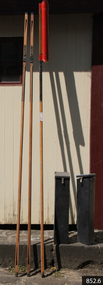
... Flagstaff Hill Maritime Museum & Village...Flagstaff Hill...Maritime Museum...Maritime Village...Warrnambool...Great Ocean Road...shipwreck...Life-saving...lifesaving...rescue crew...rescue...rocket rescue...maritime accidents...shipwreck victim...rocket crew...beach rescue...line rescue...rescue equipment...rocket firing equipment...rocket rescue equipment...rocket apparatus...beach apparatus...petticoat breeches...breeches buoy...Rocket house...rocket shed...lifeboat men...Rocket equipment...rocket machine...rocket head...rocket launcher...rocket line...Marine technology...William Schermuly...line-firing pistol...line throwing gun...Flagstaff Hill Maritime Museum & Village Flagstaff Hill Maritime Museum Maritime Village Warrnambool Great Ocean Road shipwreck Life-saving lifesaving rescue crew rescue rocket rescue maritime accidents shipwreck victim rocket crew beach rescue line rescue rescue equipment rocket firing equipment rocket rescue equipment rocket apparatus beach apparatus petticoat breeches breeches buoy Rocket house rocket shed lifeboat men Rocket equipment rocket machine rocket head rocket launcher rocket line Marine technology William Schermuly line-firing pistol line throwing gun Schermuly pistol pistol rocket apparatus Beach Rescue Set Traveller block running block pulley hawser faking faking box faked line rescue boat lifeboat Lady Bay Warrnambool Harbour Port of Warrnambool Tramway Jetty volunteer lifesavers volunteer crew Breakwater Lifeboat Warrnambool rocket rescue method rocket rescue apparatus Captain Manby mortar Henry Trengrouse sky rocket John Dennett shore to ship Colonel Boxer two-stage rocket Italian hemp quadrant Schermuly line-throwing pistol line throwing cartridge rocket apparatus rescue stranded vessel tally board light line whip line endless whip petticoat buoy traveller chair traveller block Her Majesty’s Coast Guard Harbour Board line thrower line throwing beach cart hand barrow sand anchor hawser cutter life jacket faking board Irish hand barrow rocket head toting box explosives rocket shaft rocket pole Impressed one a shaft "8" A Dennett rocket set in six parts; the rocket head, three shafts (poles) and two rocket-head toting boxes. ...This rescue line-throwing rocket set was made for the Dennett rocket system, which was used by the Rocket Rescue crews in South West Victoria from around the 1860s to the 1890s. John Dennett - John Dennett was from Carisbrooke, in the Ilse of Wight, UK. In 1826 he invented, patented and demonstrated an improved method of rocket powered, line firing rescue equipment for saving lives. The rockets had a longer range than the mortars being used, they were lighter, needed less preparation time, only needed one line for repeated shots, and fewer people were needed to move the equipment. Very favourable reports of Dennett’s rockets were received by those in charge of His Majesty’s Naval and Military services. In 1832, Dennett’s rocket-thrown line was sent out to the wreck of the ‘Bainbridge’, and was responsible for nineteen survivors coming ashore in two boatloads, along the fired line. Dennett’s rocket received national fame, and a one-year contract to supply rockets to the Coastguards. He became known as ‘Rocket Man’ and his rockets were used in rescues at least until 1890, when his son Horatio was running the business. A rocket weighing 23 lb would have a range of about 250 yards (228 metres), on average. Saving lives in Warrnambool – The coastline of South West Victoria has had over 600 shipwrecks and many lost lives; even in Warrnambool’s Lady Bay there were around 16 known shipwrecks between 1850 and 1905, with eight lives lost. In 1859 the first Government-built lifeboat arrived at Warrnambool Harbour and a shed was soon built to house it, followed in 1864 by a rocket house to safely store the Rocket Rescue equipment. In 1878 the buildings were moved to the Breakwater area, and in 1910 the new Lifeboat Warrnambool arrived with its ‘self-righting’ design. For almost one hundred years the lifeboat and rocket crews, mostly local volunteers, trained regularly to maintain and improve their skills, summoned when needed by alarms, gunshots, ringing bells and foghorns. Some became local heroes but all served an important role. By the end of the 1950s the lifeboat and rescue equipment had become obsolete. Rocket Rescue Method - The first use of a lifesaving rocket rescue system is often credited to Captain Manby and his invention of a life mortar, first used in 1808 to fire a line onto a ship to rescue lives. Henry Trengrouse’s invention of 1820 was the first to use a sky rocket’s power to throw a line, and his invention included a chair for carrying the shipwrecked victims to shore. In 1832 John Dennett invented a rocket specifically for shore to ship rescue. It had an iron case and an 8 foot pole attached and could shoot the line as far as 250 yards (about 230 metres). From the 1860s the rocket rescue apparatus was in use. It comprised a breeches buoy and traveller block that was suspended on a line and manually pulled to and from the distressed vessel carrying passengers and items. Colonel Boxer, who had invented an early line-thrower, designed a rocket in 1865 with a range from 300 to 470 yards. It was the first two-stage rocket, with two rockets placed one in front of the other in a tube that carried the rescue line. The hemp line was faked, or coiled, in a particular way in a faking box to prevent twists and tangles when fired, and the angle of firing the rocket was measured by a quadrant-type instrument on the side of the rocket machine. Schermuly invented the line-throwing pistol around 1920, which used a small cartridge to fire the rocket. Victoria’s Government adopted lifesaving methods based on Her Majesty’s Coast Guard in Great Britain, which used Colonel Boxer’s rocket apparatus rescue method. The British Board of Trade published instructions in 1850 for both the beach rescue crew and ship’s crew. It involved setting up the rocket launcher on shore at a particular angle measured by the quadrant, inserting a rocket that had a light-weight line attached, then firing it across the stranded vessel. A tally board was then sent out with instructions in four languages. The ship’s crew would haul on the line to bring out the continuous whip line and attach the whip block to a mast or sturdy part the ship. The rescue crew on shore then hauled out a heavier hawser line, which the ship’s crew fixed above the whip block. The hawser is then tightened using the block on the shore end of the whip. The breeches buoy and endless whip are then attached to the traveller block on the hawser, allowing the shore crew to haul the buoy to and from the vessel, rescuing the stranded crew one at a time. The rocket system could also be used from one ship to another.The Dennett rocket set is quite rare - there are not many examples in existence and little information is available. This Dennett's rocket set is significant for its connection with local history, maritime history and marine technology. Lifesaving has been an important part of the services performed from Warrnambool's very early days, supported by State and Local Government, and based on the methods and experience of Great Britain. Hundreds of shipwrecks along the coast are evidence of the rough weather and rugged coastline. Ordinary citizens, the Harbour employees, and the volunteer boat and rescue crew, saved lives in adverse circumstances. Some were recognised as heroes, others went unrecognised. In Lady Bay, Warrnambool, there were around 16 known shipwrecks between 1850 and 1905. Many lives were saved but tragically, eight lives were lost.A Dennett rocket set in six parts; the rocket head, three shafts (poles) and two rocket-head toting boxes. The rocket head, mounted on one of the shafts, is a long, red painted, iron tube with rounded ends and a protruding fitting around each end. The wooden rocket shafts are octagonal, with a metal sheath at the ends, carved elongated slots towards each end, and a scribed channel above the black foot. The rocket head toting boxes are thick timber, covered in fabric and painted black. They have a hinged wooden lid that slants downwards from back to front, and a metal closure. Small deliberate holes, in groups of four, on the box’s sides, indicate missing attachments, likely to have been handles. Impressed one a shaft "8"flagstaff hill maritime museum & village, flagstaff hill, maritime museum, maritime village, warrnambool, great ocean road, shipwreck, life-saving, lifesaving, rescue crew, rescue, rocket rescue, maritime accidents, shipwreck victim, rocket crew, beach rescue, line rescue, rescue equipment, rocket firing equipment, rocket rescue equipment, rocket apparatus, beach apparatus, petticoat breeches, breeches buoy, rocket house, rocket shed, lifeboat men, rocket equipment, rocket machine, rocket head, rocket launcher, rocket line, marine technology, william schermuly, line-firing pistol, line throwing gun, schermuly pistol, pistol rocket apparatus, beach rescue set, traveller, block, running block, pulley, hawser, faking, faking box, faked line, rescue boat, lifeboat, lady bay, warrnambool harbour, port of warrnambool, tramway jetty, volunteer lifesavers, volunteer crew, breakwater, lifeboat warrnambool, rocket rescue method, rocket rescue apparatus, captain manby, mortar, henry trengrouse, sky rocket, john dennett, shore to ship, colonel boxer, two-stage rocket, italian hemp, quadrant, schermuly, line-throwing pistol, line throwing cartridge, rocket apparatus rescue, stranded vessel, tally board, light line, whip line, endless whip, petticoat buoy, traveller chair, traveller block, her majesty’s coast guard, harbour board, line thrower, line throwing, beach cart, hand barrow, sand anchor, hawser cutter, life jacket, faking board, irish hand barrow, rocket head toting box, explosives, rocket shaft, rocket pole -
 Flagstaff Hill Maritime Museum and Village
Equipment - Rocket Launcher, John Dennett, 1860s
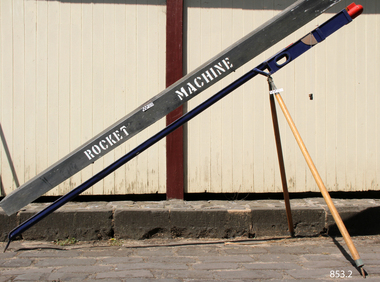
... Flagstaff Hill Maritime Museum & Village...Flagstaff Hill...Maritime Museum...Maritime Village...Warrnambool...Great Ocean Road...shipwreck...Life-saving...lifesaving...rescue crew...rescue...rocket rescue...maritime accidents...shipwreck victim...rocket crew...beach rescue...line rescue...rescue equipment...rocket firing equipment...rocket rescue equipment...rocket apparatus...beach apparatus...petticoat breeches...breeches buoy...Rocket house...rocket shed...lifeboat men...Rocket equipment...rocket machine...rocket head...rocket launcher...rocket line...Marine technology...William Schermuly...line-firing pistol...line throwing gun...Flagstaff Hill Maritime Museum & Village Flagstaff Hill Maritime Museum Maritime Village Warrnambool Great Ocean Road shipwreck Life-saving lifesaving rescue crew rescue rocket rescue maritime accidents shipwreck victim rocket crew beach rescue line rescue rescue equipment rocket firing equipment rocket rescue equipment rocket apparatus beach apparatus petticoat breeches breeches buoy Rocket house rocket shed lifeboat men Rocket equipment rocket machine rocket head rocket launcher rocket line Marine technology William Schermuly line-firing pistol line throwing gun Schermuly pistol pistol rocket apparatus Beach Rescue Set Traveller block running block pulley hawser faking faking box faked line rescue boat lifeboat Lady Bay Warrnambool Harbour Port of Warrnambool Tramway Jetty volunteer lifesavers volunteer crew Breakwater Lifeboat Warrnambool rocket rescue method rocket rescue apparatus Captain Manby mortar Henry Trengrouse sky rocket John Dennett shore to ship Colonel Boxer two-stage rocket Italian hemp quadrant protractor Schermuly line-throwing pistol line throwing cartridge rocket apparatus rescue stranded vessel tally board light line whip line endless whip petticoat buoy traveller chair traveller block Her Majesty’s Coast Guard Harbour Board line thrower line throwing beach cart hand barrow sand anchor hawser cutter life jacket faking board Welsh hand barrow rocket set On box “ROCKET MACHINE” On quadrant “10” “20” “30” “40” Rocket launcher, named a Rocket Machine, and storage box. ...This rocket launching machine is used in conjunction with the Dennett Rocket Set. Both are part of the rocket rescue equipment that launches the line-throwing rescue rockets. A light line is threaded through the carved holes in the 8 foot long shaft and attached to the scribed channel at the base of the shaft. The rocket head is fitted to the shaft and inserted into the machine. The machine is set at an angle determined by the person in charge of the rescue crew, and the legs and base of the machine are adjusted accordingly with the use of the quadrant, or protractor, and plumb-bob on the side of the machine. The rocket is then ignited and fired across the vessel in distress. John Dennett - John Dennett was from Carisbrooke, in the Ilse of Wight, UK. In 1826 he invented, patented and demonstrated an improved method of rocket powered, line firing rescue equipment for saving lives. The rockets had a longer range than the mortars being used, they were lighter, needed less preparation time, only needed one line for repeated shots, and fewer people were needed to move the equipment. Very favourable reports of Dennett’s rockets were received by those in charge of His Majesty’s Naval and Military services. In 1832, Dennett’s rocket-thrown line was sent out to the wreck of the ‘Bainbridge’, and was responsible for nineteen survivors coming ashore in two boatloads, along the fired line. Dennett’s rocket received national fame, and a one-year contract to supply rockets to the Coastguards. He became known as ‘Rocket Man’ and his rockets were used in rescues at least until 1890, when his son Horatio was running the business. A rocket weighing 23 lb would have a range of about 250 yards (228 metres), on average. Saving lives in Warrnambool – The coastline of South West Victoria is the site of over 600 shipwrecks and many lost lives; even in Warrnambool’s Lady Bay there were around 16 known shipwrecks between 1850 and 1905, with eight lives lost. In 1859 the first Government-built lifeboat arrived at Warrnambool Harbour and a shed was soon built to house it. In 1858 the provision of rocket and mortar apparatus was approved for lifeboat stations in Victoria, and in 1864 a rocket house was built to safely store the rocket rescue equipment. In 1878 the buildings were moved to the Breakwater area, and in 1910 the new Lifeboat Warrnambool arrived with its ‘self-righting’ design. For almost a hundred years the lifeboat and rocket crews, mostly local volunteers, trained regularly to maintain their rescue skills. They were summoned when needed by alarms, gunshots, ringing bells and foghorns. Some became local heroes but all served an important role. By the end of the 1950s the lifeboat and rescue equipment had become obsolete. Rocket Rescue Method - The Government of Victoria adopted lifesaving methods based on Her Majesty’s Coast Guard in Great Britain. It authorised the first line-throwing rescue system in 1858. Captain Manby’s mortar powered a projectile connected to rope, invented in 1808. The equipment was updated to John Dennett’s 8-foot shaft and rocket method that had a longer range of about 250 yards. From the 1860s the breeches buoy and traveller block rocket rescue apparatus was in use. It was suspended on a hawser line and manually pulled to and from the distressed vessel carrying passengers and items. In the early 1870s Colonel Boxer’s rocket rescue method became the standard in Victoria. His two-stage rockets, charged by a gunpowder composition, could fire the line up to 500-600 yards, although 1000 yards range was possible. Boxer’s rocket carried the light line, which was faked, or coiled, in a particular way between pegs in a faking box to prevent twists and tangles when fired. The angle of firing the rocket to the vessel in distress was measured by a quadrant-type instrument on the side of the rocket machine. Decades later, in about 1920, Schermuly invented the line-throwing pistol that used a small cartridge to fire the rocket. The British Board of Trade published instructions for both the beach rescue crew and ship’s crew. It involved setting up the rocket launcher on shore at a particular angle measured by the quadrant, inserting a rocket that had a light-weight line threaded through its shaft, and then firing it across the stranded vessel, the line issuing freely from the faking board. A tally board was then sent out to the ship with instructions in four languages. The ship’s crew would haul on the line to bring out the heavier, continuous whip line, then secure the attached whip block to the mast or other sturdy part the ship. The rescue crew on shore then hauled out a stronger hawser line, which the ship’s crew fixed above the whip block. The hawser was then tightened using the block on the shore end of the whip. The breeches buoy and endless whip are then attached to the traveller block on the hawser, allowing the shore crew to haul the breeches buoy to and from the vessel, rescuing the stranded crew one at a time. This rocket launcher machine is significant for its connection with local history, maritime history and marine technology. Lifesaving has been an important part of the services performed from Warrnambool's very early days, supported by State and Local Government, and based on the methods and experience of Great Britain. Hundreds of shipwrecks along the coast are evidence of the rough weather and rugged coastline. Ordinary citizens, the Harbour employees, and the volunteer boat and rescue crew, saved lives in adverse circumstances. Some were recognised as heroes, others went unrecognised. In Lady Bay, Warrnambool, there were around 16 known shipwrecks between 1850 and 1905. Many lives were saved but tragically, eight lives were lost.Rocket launcher, named a Rocket Machine, and storage box. Launcher has a long open metal channel with a spike at the base, and narrow, rectangular device, which is the line-firing rocket machine, at the top, all painted blue. Two hinged wooden legs are attached where the channel and machine meet. The side of the machine has an oval cut-out window and an attached quadrant, or protractor, with a plumb-bob on it. The quadrant has angles marked in degrees. The long protective box has white stencilled letters along the side. Its lid has three hinges and is fastened with two metal latches.On box “ROCKET MACHINE” On quadrant “10” “20” “30” “40”flagstaff hill maritime museum & village, flagstaff hill, maritime museum, maritime village, warrnambool, great ocean road, shipwreck, life-saving, lifesaving, rescue crew, rescue, rocket rescue, maritime accidents, shipwreck victim, rocket crew, beach rescue, line rescue, rescue equipment, rocket firing equipment, rocket rescue equipment, rocket apparatus, beach apparatus, petticoat breeches, breeches buoy, rocket house, rocket shed, lifeboat men, rocket equipment, rocket machine, rocket head, rocket launcher, rocket line, marine technology, william schermuly, line-firing pistol, line throwing gun, schermuly pistol, pistol rocket apparatus, beach rescue set, traveller, block, running block, pulley, hawser, faking, faking box, faked line, rescue boat, lifeboat, lady bay, warrnambool harbour, port of warrnambool, tramway jetty, volunteer lifesavers, volunteer crew, breakwater, lifeboat warrnambool, rocket rescue method, rocket rescue apparatus, captain manby, mortar, henry trengrouse, sky rocket, john dennett, shore to ship, colonel boxer, two-stage rocket, italian hemp, quadrant, protractor, schermuly, line-throwing pistol, line throwing cartridge, rocket apparatus rescue, stranded vessel, tally board, light line, whip line, endless whip, petticoat buoy, traveller chair, traveller block, her majesty’s coast guard, harbour board, line thrower, line throwing, beach cart, hand barrow, sand anchor, hawser cutter, life jacket, faking board, welsh hand barrow, rocket set -
 Flagstaff Hill Maritime Museum and Village
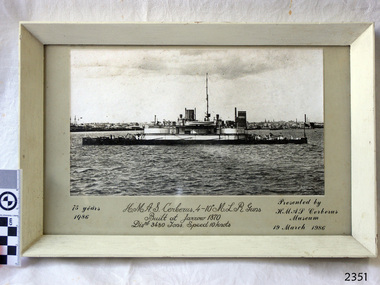
Photograph - Commemorative, Royal Australian Navy (RAN), H.M.A.S. Cerberus. 4-10" M.L.R. Guns, 1986
... guns. The ship was renamed HMAS Cerberus in 1911 when the navy became the Royal Australian Navy. The photograph was mounted by members of HMAS Cerberus at Crib Point, Western Port Bay, Victoria in 1986. It was presented to Flagstaff Hill...It is also significant for its connection with the Royal Australian Navy and its service and training of Australian defence forces. flagstaff hill warrnambool shipwrecked-coast flagstaff-hill flagstaff-hill-maritime-museum maritime-museum shipwreck-coast flagstaff-hill-maritime-village Photograph HMAS Cerberus 75 year commemoration 1876 1911 Royal Australian Navy Navy training base Point Crib RAN Cerberus commemorative photograph Western Port Bay HMVS Cerberus Original script writing in centre "H.M.A.S. Cerberus. 4-10 M.L.R. Guns ...The ship HMAS Cerberus was Built at Jarrow, Newcastle upon Tyne, England, in 1870, specifically for the colony of Victoria (Australia) and originally named HMVS Cerberus. It had a displacement of 3480 tons and could travel at the speed of 10 knots. The ship carried 4x 10 inch M.L.R. guns. The ship was renamed HMAS Cerberus in 1911 when the navy became the Royal Australian Navy. The photograph was mounted by members of HMAS Cerberus at Crib Point, Western Port Bay, Victoria in 1986. It was presented to Flagstaff Hill Maritime Village by the HMAS Cerberus Museum in 1986 to commemorate the ship's 75 years of service for the Royal Australian Navy. The photograph is significant for its connection with the colony of Victoria before Federation. It is also significant for its connection with the Royal Australian Navy and its service and training of Australian defence forces. Photograph behind glass, in timber frame. Black and white photograph of vessel HMAS Cerberus anchored , with city in the background. Frame is painted white. Photograph was taken to commemorate 75 years of the ship's service in the Royal Australian Navy. It was framed and presented to Flagstaff Hill by the HMAS Cerberus Museum on 19 March 1986. Details are hand written below the photograph.Original script writing in centre "H.M.A.S. Cerberus. 4-10 M.L.R. Guns / Built at Jarrow 1870 / Displ 3480 tons. Speed 10 knots. More recent text "75 years / 1986" "Presented by / HMAS Cerberus / Museum/ 19 March 1986"flagstaff hill, warrnambool, shipwrecked-coast, flagstaff-hill, flagstaff-hill-maritime-museum, maritime-museum, shipwreck-coast, flagstaff-hill-maritime-village, photograph, hmas cerberus, 75 year commemoration, 1876, 1911, royal australian navy, navy training base, point crib, ran, cerberus, commemorative photograph, western port bay, hmvs cerberus -
 Flagstaff Hill Maritime Museum and Village
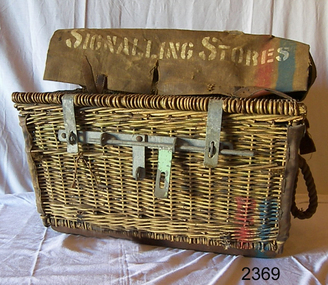
Equipment - Wicker Basket
... gun in an illustration. The item was used to carry and store flares for signalling use as the inscription on the canvas cover suggests. Given the method of storing flares is in a wicker basket that is non conducting of an electrical charge that may accidentally set of explosive materials. The writer assumes the basket was used from the early 20th century and most likely by maritime or military services to store it's flares. flagstaff hill ...A flare, also sometimes called a fusee, is a type of pyrotechnic that produces a bright light or intense heat without an explosion. Flares are used for distress signalling, illumination, communication or defensive countermeasures in civilian and military applications. Flares may be ground pyrotechnics, projectile pyrotechnics, or parachute-suspended to provide maximum illumination time over a large area. Projectile pyrotechnics may be dropped from aircraft, fired from rocket or artillery, or deployed by flare guns or hand held percussive tubes. Signalling flares have been in use by all branches of the military services since the 1920s also by the maritime services to signal other ships or for distress purposes. The earliest recorded use of gunpowder for signalling purposes was the 'signal bomb' used by the Chinese Song Dynasty as the Mongol-led Yuan Dynasty besieged Yangzhou in 1276. These soft-shelled bombs, timed to explode in mid-air, were used to send messages to a detachment of troops far in the distance. Another mention of the signal bomb appears in a text dating from 1293 requesting their collection from those still stored in Zhejiang. A signal gun appears in Korea by 1600. The (Wu I Thu Phu Thung Chih or Illustrated Military Encyclopedia) written in 1791 depicts a signal gun in an illustration. The item was used to carry and store flares for signalling use as the inscription on the canvas cover suggests. Given the method of storing flares is in a wicker basket that is non conducting of an electrical charge that may accidentally set of explosive materials. The writer assumes the basket was used from the early 20th century and most likely by maritime or military services to store it's flares.Basket cane square with metal locks & rope handles each end. Canvas reinforced on vertical sides with a canvas cover on top. Canvas cover has leather straps. Stencilled on canvas in white paint "SIGNALLING STORES" flagstaff hill, warrnambool, shipwrecked-coast, flagstaff-hill, flagstaff-hill-maritime-museum, maritime-museum, shipwreck-coast, flagstaff-hill-maritime-village, basket, cane basket, signalling stores -
 Flagstaff Hill Maritime Museum and Village
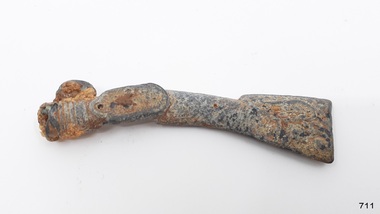
Leisure object - Toy Gun, ca 1878
... flagstaff hill...warrnambool...flagstaff hill maritime museum...shipwreck coast...flagstaff hill maritime village...great ocean road...loch line...loch ard...captain gibbs...eva carmichael...tom pearce...glenample station...mutton bird island...loch ard gorge...toy gun...Through is associated with the worst and best-known shipwreck in Victoria's history. flagstaff hill warrnambool flagstaff hill maritime museum shipwreck coast flagstaff hill maritime village great ocean road loch line loch ard captain gibbs eva carmichael tom pearce glenample station mutton bird island loch ard gorge toy gun metal toy Toy gun, lead, barrel missing. ...The lead toy gun was recovered from the wreck of the Loch Ard and could have been amongst the personal belongings of a passenger. History of the Loch Ard: The Loch Ard got its name from ”Loch Ard” a loch that lies to the west of Aberfoyle, and the east of Loch Lomond. It means "high lake" in Scottish Gaelic. The vessel belonged to the famous Loch Line which sailed many vessels from England to Australia. The Loch Ard was built in Glasgow by Barclay, Curle & Co. in 1873, the vessel was a three-masted square-rigged iron sailing ship that measured 79.87 meters in length, 11.58 m in width, and 7 m in depth with a gross tonnage of 1693 tons with a mainmast that measured a massive 45.7 m in height. Loch Ard made three trips to Australia and one trip to Calcutta before its fateful voyage. Loch Ard left England on March 2, 1878, under the command of 29-year-old Captain Gibbs, who was newly married. The ship was bound for Melbourne with a crew of 37, plus 17 passengers. The general cargo reflected the affluence of Melbourne at the time. Onboard were straw hats, umbrellas, perfumes, clay pipes, pianos, clocks, confectionery, linen and candles, as well as a heavier load of railway irons, cement, lead and copper. There were other items included that were intended for display in the Melbourne International Exhibition of 1880. The voyage to Port Phillip was long but uneventful. Then at 3 am on June 1, 1878, Captain Gibbs was expecting to see land. But the Loch Ard was running into a fog which greatly reduced visibility. Captain Gibbs was becoming anxious as there was no sign of land or the Cape Otway lighthouse. At 4 am the fog lifted and a lookout aloft announced that he could see breakers. The sheer cliffs of Victoria's west coast came into view, and Captain Gibbs realised that the ship was much closer to them than expected. He ordered as much sail to be set as time would permit and then attempted to steer the vessel out to sea. On coming head-on into the wind, the ship lost momentum, the sails fell limp and Loch Ard's bow swung back towards land. Gibbs then ordered the anchors to be released in an attempt to hold their position. The anchors sank some 50 fathoms - but did not hold. By this time the ship was among the breakers and the tall cliffs of Mutton Bird Island rose behind. Just half a mile from the coast, the ship's bow was suddenly pulled around by the anchor. The captain tried to tack out to sea, but the ship struck a reef at the base of Mutton Bird Island, near Port Campbell. Waves subsequently broke over the ship and the top deck became loosened from the hull. The masts and rigging came crashing down knocking passengers and crew overboard. When a lifeboat was finally launched, it crashed into the side of Loch Ard and capsized. Tom Pearce, who had launched the boat, managed to cling to its overturned hull and shelter beneath it. He drifted out to sea and then on the flood tide came into what is now known as Lochard Gorge. He swam to shore, bruised and dazed, and found a cave in which to shelter. Some of the crew stayed below deck to shelter from the falling rigging but drowned when the ship slipped off the reef into deeper water. Eva Carmichael a passenger had raced onto the deck to find out what was happening only to be confronted by towering cliffs looming above the stricken ship. In all the chaos, Captain Gibbs grabbed Eva and said, "If you are saved Eva, let my dear wife know that I died like a sailor". That was the last Eva Carmichael saw of the captain. She was swept off the ship by a huge wave. Eva saw Tom Pearce on a small rocky beach and yelled to attract his attention. He dived in and swam to the exhausted woman and dragged her to shore. He took her to the cave and broke the open case of brandy which had washed up on the beach. He opened a bottle to revive the unconscious woman. A few hours later Tom scaled a cliff in search of help. He followed hoof prints and came by chance upon two men from nearby Glenample Station three and a half miles away. In a complete state of exhaustion, he told the men of the tragedy. Tom then returned to the gorge while the two men rode back to the station to get help. By the time they reached Loch Ard Gorge, it was cold and dark. The two shipwreck survivors were taken to Glenample Station to recover. Eva stayed at the station for six weeks before returning to Ireland by steamship. In Melbourne, Tom Pearce received a hero's welcome. He was presented with the first gold medal of the Royal Humane Society of Victoria and a £1000 cheque from the Victorian Government. Concerts were performed to honour the young man's bravery and to raise money for those who lost family in the disaster. Of the 54 crew members and passengers on board, only two survived: the apprentice, Tom Pearce and the young woman passenger, Eva Carmichael, who lost her family in the tragedy. Ten days after the Lochard tragedy, salvage rights to the wreck were sold at auction for £2,120. Cargo valued at £3,000 was salvaged and placed on the beach, but most washed back into the sea when another storm developed. The wreck of Lochard still lies at the base of Mutton Bird Island. Much of the cargo has now been salvaged and some items were washed up into Lochard Gorge. Cargo and artefacts have also been illegally salvaged over many years before protective legislation was introduced in March 1982. One of the most unlikely pieces of cargo to have survived the shipwreck was a Minton majolica peacock- one of only nine in the world. The peacock was destined for the Melbourne 1880 International Exhibition. It had been well packed, which gave it adequate protection during the violent storm. Today the Minton peacock can be seen at the Flagstaff Hill Maritime Museum in Warrnambool. From Australia's most dramatic shipwreck, it has now become Australia's most valuable shipwreck artifact and is one of very few 'objects' on the Victorian State Heritage Register. The shipwreck of the Loch Ard is of significance for Victoria and is registered on the Victorian Heritage Register ( S 417). Flagstaff Hill has a varied collection of artefacts from Loch Ard and its collection is significant for being one of the largest accumulation of artefacts from this notable Victorian shipwreck of which the subject items are a small part. The collections objects give us a snapshot of how we can interpret the story of this tragic event. The collection is also archaeologically significant as it represents aspects of Victoria's shipping history that allows us to interpret Victoria's social and historical themes of the time. Through is associated with the worst and best-known shipwreck in Victoria's history.Toy gun, lead, barrel missing. Details have been moulded into the metal. The surface has heavy encrustation. flagstaff hill, warrnambool, flagstaff hill maritime museum, shipwreck coast, flagstaff hill maritime village, great ocean road, loch line, loch ard, captain gibbs, eva carmichael, tom pearce, glenample station, mutton bird island, loch ard gorge, toy gun, metal toy -
 Flagstaff Hill Maritime Museum and Village
Craft - Ship Model, Golden Hind
... This Ship model of the galleon Golden Hind, the flagship of Captain Sir Frances Drake, represents the first circumnavigation of the globe by an Englishman. flagstaff hill warrnambool shipwrecked-coast flagstaff-hill flagstaff-hill-maritime-museum maritime-museum shipwreck-coast flagstaff-hill-maritime-village ship model model ship galleon golden hind 1577 galleon golden hinde 1577 galleon pelican 1577 16th century galleon 16th century warship sir frances drake captain frances drake first englishman to circumnavigate the globe Nameplate "Sir Francis Drake - his ship / The Golden Hind - 1577 - 1580" Ship model, the galleon Golden Hind on timber stand. Square rigged with 2 masts each with a flag and crow's nest. 22 guns ...This is a ship model of the Golden Hind. About the “Golden Hind” The English galleon “Golden Hind”, a mid-16th century Elizabethan warship, was launched in 1577. It was formerly known as the “Pelican”. The Golden Hind was the flagship of Captain Sir Frances Drake, in which he became the first Englishman to circumnavigate the world 1577-1580. Tonnage 100-150 tons Displacement 300 tons [fully loaded] Speed 8-15 knots Armament 22 guns Crew 80 sailors, 10 officers Built Aldeburgh, Suffolk, then moved to Plymouth, Devon in 1576 Type of ship Galleon; multi-decked ship (5 decks), square rigged, 3 masted sailing ship Estimated size Length - 70 feet (21.3m); Breadth – 19 feet (5.8m); Depth – 9 feet (2.7m) The Pelican set sail in 1577 on an expedition sponsored partly by Queen Elizabeth and Sir Christopher Hatten (whose family crest was a golden hind). His companion ships were the Swan, Marigold, Benedict and the Elizabeth. During this voyage, in 1578, Drake renamed the Pelican as the Golden Hind in honour of is patron. Sir Francis Drake [1544 – 1596] brought the Golden Hind home from his circumnavigation of the globe with looted gold, percelain, jewels and cash worth 35,000,000 million pounds in today’s money. It was the largest treasure every captured at that date. Only two ships returned – the “Golden Hind” and the “Elizabeth”. This Ship model of the galleon Golden Hind, the flagship of Captain Sir Frances Drake, represents the first circumnavigation of the globe by an Englishman.Ship model, the galleon Golden Hind on timber stand. Square rigged with 2 masts each with a flag and crow's nest. 22 guns on decks. Brown hull with green stripes and decorative coloured trimmings. Nameplate "Sir Francis Drake - his ship / The Golden Hind - 1577-1580". Emblem with animal golden hind, Tudor Rose and lamp above. Nameplate "Sir Francis Drake - his ship / The Golden Hind - 1577 - 1580"flagstaff hill, warrnambool, shipwrecked-coast, flagstaff-hill, flagstaff-hill-maritime-museum, maritime-museum, shipwreck-coast, flagstaff-hill-maritime-village, ship model, model ship, galleon golden hind 1577, galleon golden hinde 1577, galleon pelican 1577, 16th century galleon, 16th century warship, sir frances drake, captain frances drake, first englishman to circumnavigate the globe -
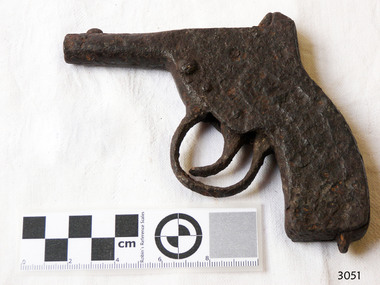 Flagstaff Hill Maritime Museum and Village
Toy Gun, 1911
... flagstaff hill...warrnambool...shipwrecked-coast...flagstaff-hill...flagstaff-hill-maritime-museum...maritime-museum...shipwreck-coast...flagstaff-hill-maritime-village...toys...cap gun...guns were a staple of toy chests. The item demonstrates how society has changed its attitudes and now regard these types of toys as morally unacceptable as they tend to promote violent attitudes towards others. The item demonstrates significantly how our societies social attitudes have changed since world war two from general societal acceptance of such toys to one of distaste. flagstaff hill warrnambool shipwrecked-coast flagstaff-hill flagstaff-hill-maritime-museum maritime-museum shipwreck-coast flagstaff-hill-maritime-village toys cap gun national fireworks distrubuting company toy guns toy pistol "National" Toy gun; cap gun. ...This cap gun was found by a local Warrnambool resident in about 1971. Cap guns first appeared following the end of the American Civil War in the mid-1860s, when firearms companies experimented with toy guns to stay in business. Cap guns became especially popular when the heroes of cinema and television rode through the West ridding the territories of villains. Many cap guns were named after or endorsed by leading matinee idols like Roy Rogers, Gene Autry, Hopalong Cassidy, The Lone Ranger, Tonto, Dale Evans, Marshal Matt Dillon, or any of countless others. Cap guns became popular after the second world war and children all over the world emulated their heroes and collected and played with these toy guns. Eventually all of the famous cap gun manufacturers either sold out to other toy companies or started manufacturing other types of toys. Before it was deemed dangerous or politically incorrect for young children to point pistols at each other and fire at will, cap guns were a staple of toy chests. The item demonstrates how society has changed its attitudes and now regard these types of toys as morally unacceptable as they tend to promote violent attitudes towards others. The item demonstrates significantly how our societies social attitudes have changed since world war two from general societal acceptance of such toys to one of distaste.Toy gun; cap gun. Cast iron toy pistol with metal trigger. Name "National" in raised embossing in the casting on the handle on both sides of the gun. Made in 1911."National" flagstaff hill, warrnambool, shipwrecked-coast, flagstaff-hill, flagstaff-hill-maritime-museum, maritime-museum, shipwreck-coast, flagstaff-hill-maritime-village, toys, cap gun, national fireworks distrubuting company, toy guns, toy pistol -
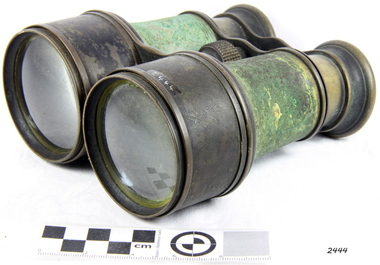 Flagstaff Hill Maritime Museum and Village
Instrument - Binoculars, Late 19th Century
... flagstaff hill...warrnambool...flagstaff-hill-maritime-museum...shipwreck-coast...flagstaff-hill-maritime-village...binoculars...the duke binocular...james henry steward...military maker...signaling...gun... warrnambool flagstaff-hill-maritime-museum shipwreck-coast flagstaff-hill-maritime-village binoculars the duke binocular james henry steward military maker signaling gun laying optician Inscribed "The Duke Binocular" Binoculars solid brass black covered with Green fabric around cylinders binoculars are complete with geared focusing and pull out lens hoods. ...James Henry Steward (1817–1896) were opticians and scientific instrument makers and became established as J.H. Steward in London in 1852. He advertised himself as a “Head Optician” and on the 1st of February, 1913 became incorporated as J.H. Steward Limited. The company produced a large range of items for military use and advertised in their catalogs that they produced instruments for ‘reconnoitering, sketching, night Marching, signaling and gun Laying’. They were well thought of with their work to such a standard that they were made opticians to 'British & Foreign Governments, the National Rifle Associations of England, India, Canada & the Colonies and the National Artillery Association. An item that was produced in large quality by a well known maker who supplied the British military during the late 19th and early 20th century.Binoculars solid brass black covered with Green fabric around cylinders binoculars are complete with geared focusing and pull out lens hoods.Inscribed "The Duke Binocular"flagstaff hill, warrnambool, flagstaff-hill-maritime-museum, shipwreck-coast, flagstaff-hill-maritime-village, binoculars, the duke binocular, james henry steward, military maker, signaling, gun laying, optician -
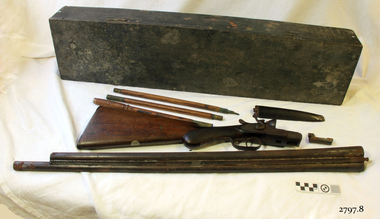 Flagstaff Hill Maritime Museum and Village
Weapon - Shotgun, Double Barrel, ISAAC HOLLIS & SONS, ca. 1904
... Flagstaff Hill...Maritime Museum...Maritime Village...Warrnambool...Great Ocean Road...Shipwreck Coast...Firearm...gun...Flagstaff Hill Maritime Museum Maritime Village Warrnambool Great Ocean Road Shipwreck Coast Firearm gun double-barrel shotgun cleaning rod gunsmith smithed 12 gauge SN 84245 Serial Number 84245 David Melville Carrison early 1900s Richard and William Hillis Herbert & Co. ...The proof marks on the barrels (a crown and letters BV) denote that the shotgun design was made from the year 1904, and that it was nitro-proof tested in Birmingham, England. David Melville Carrison (1895 to 1960) of Port MacDonnell was the previous owner of this Isaac Hollis & Sons double-barrel shotgun. His grandfather, Adam Kerrison Carrison (1833-1903), was an early settler who worked as a fisherman in that once-bustling seaport. His uncle John was a a horse-breaker, a boat hand, and a member of the lifeboat crew, receiving a medal for his part in saving the crew of a French barque. Currently, no connection has been made between the gun, its owner, and the note with the word “Enterprise”: a New Zealand-built, two-masted schooner that was wrecked in Lady Bay, Warrnambool, in 1950. Gun makers, ISAAC HOLLIS & SONS: The Hollis Brothers were first recorded as operating from 11 Weaman Row in 1840, although evidence suggests the business may have commenced before then. Over time, the firm became known as Isaac Hollis & Sons, with claims of its establishment dating back to 1814. This earlier date is supported by records of Richard and William Hollis trading in Bath Street, Birmingham, between 1814 and 1818, which raises the possibility that Isaac and Frederick Hollis were their descendants. The principal brothers involved in the business were Isaac Hollis, born in 1815, and Frederick Hollis, whose birth date remains unknown. Frederick’s life was cut short when he died on 20 December 1839. According to the 1841 census, Isaac Hollis resided in Weaman Row and was listed as a 25-year-old gun and pistol maker. He was married to Emma, who was born in 1821, and together they had two children: Isaac, born in 1837, and Henry, born in 1839. Following Frederick’s death, Isaac continued to operate under the name Hollis Brothers until 1845, after which he renamed the business Hollis Brothers & Co. This entity remained active up to 1848. In 1844, Isaac Hollis entered a brief partnership with William Tranter at 10 & 11 Weaman Row, likely to fulfil a specific contract or to supply parts. This partnership continued until 1849. In 1848, Isaac Hollis formed a partnership with Isaac Brentnall Sheath, establishing the firm of Hollis & Sheath and expanding their operations into 10 Weaman Row. The partnership saw Hollis & Sheath become licensed manufacturers of percussion breech-loading guns, positioning the company as a notable presence in the industry. In 1861, Sheath left the partnership and emigrated to New Zealand, where he conducted several enterprises and was elected as a provincial councillor. He died in Christchurch on 19th May 1897. In 1861, after Isaac Sheath left, the business name became Isaac Hollis & Sons. By approximately 1870, Isaac Hollis and Henry Hollis had assumed responsibility for the daily management of the firm, with Isaac overseeing the overall management and marketing of the company's products, and Henry managing the manufacturing processes. During this period, the company became known for producing large volumes of affordable trade guns and sporting guns, catering to customers in South Africa and the British colonies. In 1870, Isaac Hollis & Sons opened a retail location at 44a Cannon Street in London, and in 1871, it operated at 83 Cheapside Street. Isaac Hollis Jnr passed away in October 1875 in Birmingham at the age of 37, having never married. In 1876/1877, Henry Hollis registered a limited liability company under the name Isaac Hollis & Sons Ltd. However, by 1879, trading resumed under the name Isaac Hollis & Sons, and the London shop moved to 6 Great Winchester Street. From 1932 to 1933, the business operated in London as Hollis, Bentley & Playfair. The final closure of Hollis, Bentley & Playfair occurred in Birmingham in 1953. The shotgun was manufactured by Isaac Hollis & Sons, a firm with a strong reputation for producing firearms. This early 1900s example represents a standard pattern that was produced in large quantities for everyday use. This double-barrel shotgun is 12-gauge, complete with a cleaning rod and a wooden storage box. The firearm has been altered from its original configuration: the right barrel has been cut shorter, resulting in sharp edges at the muzzle, and a metal extension has been fitted to the stock. The cleaning rod consists of three separate segments that screw together for use. The shotgun is housed in a black-painted wooden case with a hinged lid showing inscriptions for the maker and Serial Number. Maker was I. HOLLIS & SONS, Serial Number SN 84245. David Melville Carrison of Port MacDonnell was the previous owner. A handwritten note that had the word 'Enterprise' was with the gun. "I. HOLLIS & SONS". SN on stock “84245”. Badge on both sides “Crown [symbol] / BV”. “Crown [symbol] / NP”, “12G inside Diamond [symbol]”, “NITRO PROOF”, “STEEL 84245” Paper note included with gun, written in felt tip pen “ENTERPRISE”. flagstaff hill, maritime museum, maritime village, warrnambool, great ocean road, shipwreck coast, firearm, gun, double-barrel, shotgun, cleaning rod, gunsmith, smithed, 12 gauge, sn 84245, serial number 84245, david melville carrison, early 1900s, richard and william hillis, herbert & co., herbert & co. london, hollis & sons, isaac hollis & sons, isaac hillis & sons ltd., hollis bentley & playfair., isaac hollis, frederick hollis, isaac brentnall sheath, isaac sheath, william tranter, gun manufacturer, pistol manufacturer, gun and pistol maker, birmingham, military supplies, enterprise, 1904 -
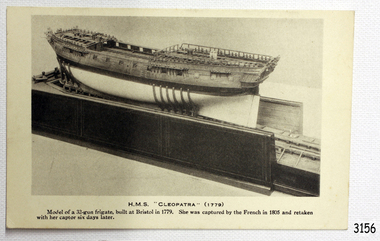 Flagstaff Hill Maritime Museum and Village
Postcard
... flagstaff hill warrnambool shipwrecked-coast flagstaff-hill flagstaff-hill-maritime-museum maritime-museum shipwreck-coast flagstaff-hill-maritime-village h.m.s cleopatra post card Postcard Black and White Postcard of a model of a 32 gun frigate, built in Bristol in 1779 H.M.S Cleopatra. ...Black and White Postcard of a model of a 32 gun frigate, built in Bristol in 1779 H.M.S Cleopatra. She was captured by the French in 1805 and retaken with her captor six days later. (SH 056 [1] Ships C - E).flagstaff hill, warrnambool, shipwrecked-coast, flagstaff-hill, flagstaff-hill-maritime-museum, maritime-museum, shipwreck-coast, flagstaff-hill-maritime-village, h.m.s cleopatra, post card, postcard -
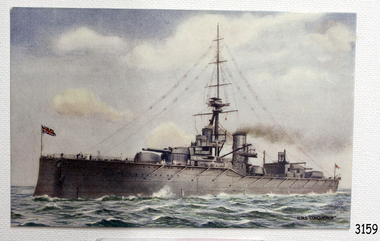 Flagstaff Hill Maritime Museum and Village
Postcard
... flagstaff hill warrnambool shipwrecked-coast flagstaff-hill flagstaff-hill-maritime-museum maritime-museum shipwreck-coast flagstaff-hill-maritime-village h.m.s. conqueror battleship Postcard post card Coloured Postcard of H.M.S. Conqueror Battleship, which was Launched 1st May 1911. Completed 1912 22,500 tons (S.H.P 27,000. 21 Knots per hour Armament, 10 13.5 inch guns ...Coloured Postcard of H.M.S. Conqueror Battleship, which was Launched 1st May 1911. Completed 1912 22,500 tons (S.H.P 27,000. 21 Knots per hour Armament, 10 13.5 inch guns. 16 4 inch guns 3 torpedo tubes. (SH 059 [1] Ships C - E).flagstaff hill, warrnambool, shipwrecked-coast, flagstaff-hill, flagstaff-hill-maritime-museum, maritime-museum, shipwreck-coast, flagstaff-hill-maritime-village, h.m.s. conqueror, battleship, postcard, post card -
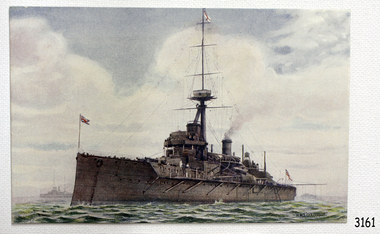 Flagstaff Hill Maritime Museum and Village
Postcard
... flagstaff hill warrnambool shipwrecked-coast flagstaff-hill flagstaff-hill-maritime-museum maritime-museum shipwreck-coast flagstaff-hill-maritime-village h.m.s. colossus super dreadnought battleship post card Postcard Coloured Postcard of H.M.S. Colossus Super Dreadnought Battleship--Launched 9th April, 1910 completed 1911. 20,000 tons S.H.P. 25,000. 21 Knots per hour. Armament, 10 12 inch guns ...Coloured Postcard of H.M.S. Colossus Super Dreadnought Battleship--Launched 9th April, 1910 completed 1911. 20,000 tons S.H.P. 25,000. 21 Knots per hour. Armament, 10 12 inch guns; 16 4 inch guns; 3 torpedo tubes. (SH 061 Ships C - E).flagstaff hill, warrnambool, shipwrecked-coast, flagstaff-hill, flagstaff-hill-maritime-museum, maritime-museum, shipwreck-coast, flagstaff-hill-maritime-village, h.m.s. colossus, super dreadnought battleship, post card, postcard -
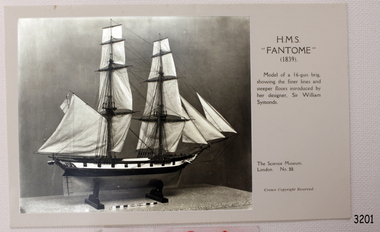 Flagstaff Hill Maritime Museum and Village
Postcard
... flagstaff hill warrnambool shipwrecked-coast flagstaff-hill flagstaff-hill-maritime-museum maritime-museum shipwreck-coast flagstaff-hill-maritime-village h.m.s. fantome sir william symonds post card postcard Black and White Postcard of H.M.S. Fantome (1839). Model of a 16-gun ...Black and White Postcard of H.M.S. Fantome (1839). Model of a 16-gun brig, showing the finer lines and steeper floors introduced by her designer, Sir William Symonds. (SH 090[2] Ships F - H).flagstaff hill, warrnambool, shipwrecked-coast, flagstaff-hill, flagstaff-hill-maritime-museum, maritime-museum, shipwreck-coast, flagstaff-hill-maritime-village, h.m.s. fantome, sir william symonds, post card, postcard -
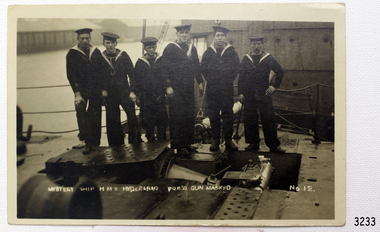 Flagstaff Hill Maritime Museum and Village
Postcard
... flagstaff hill warrnambool shipwrecked-coast flagstaff-hill flagstaff-hill-maritime-museum maritime-museum shipwreck-coast flagstaff-hill-maritime-village H.M.S. Hyderabad mystery ship WWI ship battle ship post card postcard Writing on front of card reads "Mystery ship H.M.S. Hyderabad for'd Gun ...Black and White postcard of sailors on deck Writing on front of card reads "Mystery ship H.M.S. Hyderabad for'd Gun Masked" and "No. 12". . (SH 123.2 Ships F - H).Writing on front of card reads "Mystery ship H.M.S. Hyderabad for'd Gun Masked" and "No. 12". flagstaff hill, warrnambool, shipwrecked-coast, flagstaff-hill, flagstaff-hill-maritime-museum, maritime-museum, shipwreck-coast, flagstaff-hill-maritime-village, h.m.s. hyderabad, mystery ship, wwi ship, battle ship, post card, postcard -
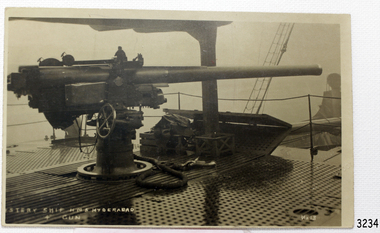 Flagstaff Hill Maritime Museum and Village
Postcard
... flagstaff hill warrnambool shipwrecked-coast flagstaff-hill flagstaff-hill-maritime-museum maritime-museum shipwreck-coast flagstaff-hill-maritime-village H.M.S. Hyderabad WWI ship mystery ship post card postcard Writing on front of card reads "Mystery ship H.M.S. Hyderabad and Gun ...Black and White postcard of sailors on deck. Writing on front of card reads "Mystery ship H.M.S. Hyderabad and Gun" and "No. 13" . (SH 123.3 Ships F - H). Writing on front of card reads "Mystery ship H.M.S. Hyderabad and Gun" and "No. 13" flagstaff hill, warrnambool, shipwrecked-coast, flagstaff-hill, flagstaff-hill-maritime-museum, maritime-museum, shipwreck-coast, flagstaff-hill-maritime-village, h.m.s. hyderabad, wwi ship, mystery ship, post card, postcard -
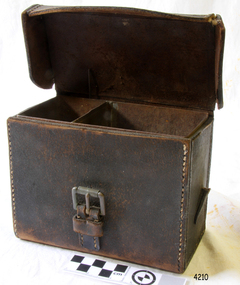 Flagstaff Hill Maritime Museum and Village
Container - Case, Early 20th century
... Flagstaff Hill Maritime Museum and Village...Flagstaff Hill...Maritime Museum...Maritime Village...Warrnambool...Great Ocean Road...shipwreck...life-saving...lifesaving...rescue crew...rescue...rocket rescue...rocket crew...lifeboat men...beach rescue...line rescue...rescue equipment...rocket firing equipment...rocket rescue equipment...maritime accidents...shipwreck victim...rocket equipment...Marine technology...rescue boat...lifeboat...volunteer lifesavers...volunteer crew...life saving rescue crew...lifesaving rescue crew...rocket apparatus...rocket rescue method...shore to ship...rocket apparatus rescue...stranded vessel...line throwing mortar...mortar...rocket rescue apparatus...line thrower...line throwing...line-firing pistol...line throwing gun...Flagstaff Hill Maritime Museum and Village Flagstaff Hill Maritime Museum Maritime Village Warrnambool Great Ocean Road shipwreck life-saving lifesaving rescue crew rescue rocket rescue rocket crew lifeboat men beach rescue line rescue rescue equipment rocket firing equipment rocket rescue equipment maritime accidents shipwreck victim rocket equipment Marine technology rescue boat lifeboat volunteer lifesavers volunteer crew life saving rescue crew lifesaving rescue crew rocket apparatus rocket rescue method shore to ship rocket apparatus rescue stranded vessel line throwing mortar mortar rocket rescue apparatus line thrower line throwing line-firing pistol line throwing gun Schermuly pistol pistol rocket apparatus line throwing cartridge L.S.R.C. ...This small case is lined with a metal insert and shows remnants of a carry strap. It could have been used for storing and carrying fuses or cartridges for the life saving Rocket Launcher machine. The protective metal insert would help keep the contents dry or cool and protect from flame. It is part of the collection of rescue equipment in the Rocket House used by the life saving rescue crew. Saving lives in Warrnambool – The coastline of South West Victoria is the site of over 600 shipwrecks and many lost lives; even in Warrnambool’s Lady Bay there were around 16 known shipwrecks between 1850 and 1905, with eight lives lost. Victoria’s Government responded to the need for lifesaving equipment and, in 1858, the provision of rocket and mortar apparatus was approved for the lifeboat stations. In 1859 the first Government-built lifeboat arrived at Warrnambool Harbour and a shed was soon built for it on the Tramway Jetty, followed by a rocket house in 1864 to safely store the rocket rescue equipment. In 1878 the buildings were moved to the Breakwater (constructed from 1874-1890), and in 1910 the new Lifeboat Warrnambool arrived with its ‘self-righting’ design. For almost a hundred years the lifesaving and rescue crews, mostly local volunteers, trained regularly to rehearse and maintain their rescue skills. They were summoned when needed by alarms, gunshots, ringing bells and foghorns. In July 1873 a brass bell was erected at Flagstaff Hill specifically to call the rescue crew upon news of a shipwreck. Some crew members became local heroes but all served an important role. Rocket apparatus was used as recently as the 1950s. Rocket Rescue Method - Rocket rescue became the preferred lifesaving method of the rescue crews, being much safer that using a lifeboat in rough seas and poor conditions. The Government of Victoria adopted lifesaving methods based on Her Majesty’s Coast Guard in Great Britain. It authorised the first line-throwing rescue system in 1858. Captain Manby’s mortar powered a projectile connected to rope, invented in 1808. The equipment was updated to John Dennett’s 8-foot shaft and rocket method that had a longer range of about 250 yards. From the 1860s the breeches buoy and traveller block rocket rescue apparatus was in use. It was suspended on a hawser line and manually pulled to and from the distressed vessel carrying passengers and items. In the early 1870s Colonel Boxer’s rocket rescue method became the standard in Victoria. His two-stage rockets, charged by a gunpowder composition, could fire the line up to 500-600 yards, although 1000 yards range was possible. Boxer’s rocket carried the light line, which was faked, or coiled, in a particular way between pegs in a faking box to prevent twists and tangles when fired. The angle of firing the rocket to the vessel in distress was measured by a quadrant-type instrument on the side of the rocket machine. Decades later, in 1920, Schermuly invented the line-throwing pistol that used a small cartridge to fire the rocket. . The British Board of Trade regularly published instructions for both the beach rescue crew and ship’s crew. It involved setting up the rocket launcher on shore at a particular angle, determined by the Head of the crew and measured by the quadrant, inserting a rocket that had a light-weight line threaded through its shaft, and then firing it across the stranded vessel, the line issuing freely from the faking board. A continuous whip line was then sent out to the ship’s crew, who hauled it in then followed the instructions – in four languages - on the attached tally board. The survivors would haul on the line to bring out the heavier, continuous whip line with a tail block connected to it. They then secured the block to the mast or other strong part the ship. The rescue crew on shore then hauled out a stronger hawser line, which the survivors fixed above the whip’s tail block. The hawser was then tightened by the crew pulling on it, or by using the hooked block on the shore end of the whip and attaching it to a sand anchor. The breeches buoy was attached to the traveller block on the hawser, and the shore crew then used the whip line to haul the breeches buoy to and from the vessel, rescuing the stranded crew one at a time. The rescue crew wore scarlet, numbered armbands and worked on a numerical rotation system, swapping members out to rest them. This small leather carrying case is significant for its connection with the rocket rescue equipment, local history, maritime history and marine technology. Lifesaving has been an important part of the services performed from Warrnambool's very early days, supported by State and Local Government, and based on the methods and experience of Great Britain. Hundreds of shipwrecks along the coast are evidence of the rough weather and rugged coastline. Ordinary citizens, the Harbour employees, and the volunteer boat and rescue crew, saved lives in adverse circumstances. Some were recognised as heroes, others went unrecognised. In Lady Bay, Warrnambool, there were around 16 known shipwrecks between 1850 and 1905. Many lives were saved but tragically, eight lives were lost.Leather case, brown with contrasting stitching, protective metal insert divided into two compartments. Rectangular shape. Roller buckle on front with remnants of the matching strap. Also remnants of a leather strap on the side, possibly a shoulder strap.flagstaff hill maritime museum and village, flagstaff hill, maritime museum, maritime village, warrnambool, great ocean road, shipwreck, life-saving, lifesaving, rescue crew, rescue, rocket rescue, rocket crew, lifeboat men, beach rescue, line rescue, rescue equipment, rocket firing equipment, rocket rescue equipment, maritime accidents, shipwreck victim, rocket equipment, marine technology, rescue boat, lifeboat, volunteer lifesavers, volunteer crew, life saving rescue crew, lifesaving rescue crew, rocket apparatus, rocket rescue method, shore to ship, rocket apparatus rescue, stranded vessel, line throwing mortar, mortar, rocket rescue apparatus, line thrower, line throwing, line-firing pistol, line throwing gun, schermuly pistol, pistol rocket apparatus, line throwing cartridge, l.s.r.c., lsrc, leather case, cartridge case, fuse case, ammunition case -
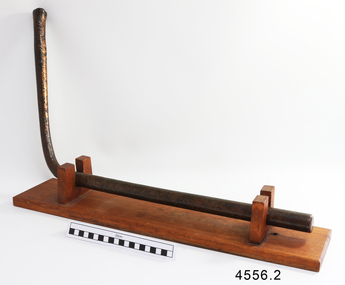 Flagstaff Hill Maritime Museum and Village
Nail, circa 1810
... The incident of the fire on board and the bravery of the convicts in making the gun powder safe is an example of the social character of the people in early Tasmanian colonisation. flagstaff hill warrnambool shipwrecked coast flagstaff hill maritime museum maritime museum shipwreck coast flagstaff hill maritime village great ocean road george iii ship construction ship nail 1835 shipwreck 19th century shipwreck william moxey d'entrecasteaux channel convict transportation copper nail dumpy bolt spike keel nail Copper nail (also called a Dumpy bolt or spike) from the convict ship George III, wrecked in 1835. ...This copper nail, sometimes known as a ‘Dumpy Bolt’ or spike, was salvaged from the hull of the wreck of the “George III”. It dates back to at least 1810. It was found by an abalone diver on the south east coast of Tasmania. The nail would have been used to hold the layers of the ship’s keel frame and the planking together. The nail has been passed from the abalone diver to an interested business man on a trip to the south of Hobart, on again to the business man’s close friend who then donated it to Flagstaff Hill Maritime Village. The metal of nails such as this one, after being in the sea for a long time, become affected by the natural reaction of the sea water, causing it to degenerate and thin, and the stress from the force of the sea over the years alters its shape. Iron nails had been used on ships previously, but they quickly corroded in the salt; ships needed regular, costly and time-consuming maintenance to replace the iron nails. Towards the end of the 18th century the British Navy trialled the use of copper nails, finding them to be very successful. Merchant ships began to adopt this process in the early 19th century, although it made ship building very expensive and was more often used for ships such as the “George III” that sailed on long voyages. The three masted sailing ship “George III” was a convict transport ship built in Deptford, England, in 1810. On 14th December 1834 she left Woolwich, England, bound for Hobart Town, Van Diemen’s Land (Tasmania), under Captain William Hall Moxey. She was carrying 220 male convicts plus crew, guards and their families, totalling 294 persons (another 2 were during the voyage). Amongst the cargo were military stores including several copper drums of gun powder. On 27th January 1835 the “George III” was near the Equator, about half way into her journey. A fire broke out and the gun powder was in danger of explosion, threatening the whole ship. Two convicts braved the heat and smoke, entered the store and seized the gun powder drums, suffering burns for their efforts but saving a probable disaster. The fire destroyed some of the provisions and food was scarce. Many became ill with scurvy and some died during the journey. Nearing the end of their journey on 10th April 1835 the “George III” was headed through the D'Entrecasteaux Channel, south east Tasmania, between the mainland and Bruny Island. She was sailing in the moonlit night to hasten her arrival in port due to the great number of sick on board. She struck uncharted rocks, known only to the local whalers, between Actaeon Reef and Southport Lagoon and within hours began to break up. The ship’s boats were used to first rescue the women and children. Firearms were used to help quell the panic of the convicts below decks and some were killed by the shots. Many convicts, including the sick, were drowned. In all, 133 lives were lost including 5 of the crew, guards and their families. It was the third worst shipping disaster in Tasmanian waters. A monument in honour of the prisoners who perished in the “George III” has been erected, noting the date of the wreck as “Friday 10th April 1835.” (NOTE: there are a few differences between sources regarding dates of the shipwreck, some saying March and others April 1835. There are also differences in the figures of those on board and the number of lives lost.) The copper nail is significant as an example of sailing ship construction; fasteners used in the early 19th century on ships carrying convicts to Australia. The nail is also significant for its association with the ship “George III”. The “George III” is registered on the Australian National Shipwreck Database, ID 7195 as an Historic Shipwreck. She is the third worst shipwreck in Tasmanian waters. She is also associated with Early Australian History and the transportation of convicts to Australia. The incident of the fire on board and the bravery of the convicts in making the gun powder safe is an example of the social character of the people in early Tasmanian colonisation. Copper nail (also called a Dumpy bolt or spike) from the convict ship George III, wrecked in 1835. Nail is long, bent in an ‘L’ shape about 3/5ths along, tapering from both ends to the bend. Both ends are flat and do not taper to a point, nor have a thread. The shorter end has been polished, showing bright copper. There is pitting along the nail and virdigris is evident on the longer, unpolished end. The nail is displayed with the longer section resting on a wooden board between two ‘U’ shaped uprights, the shorter section upright. flagstaff hill, warrnambool, shipwrecked coast, flagstaff hill maritime museum, maritime museum, shipwreck coast, flagstaff hill maritime village, great ocean road, george iii, ship construction, ship nail, 1835 shipwreck, 19th century shipwreck, william moxey, d'entrecasteaux channel, convict transportation, copper nail, dumpy bolt, spike, keel nail -
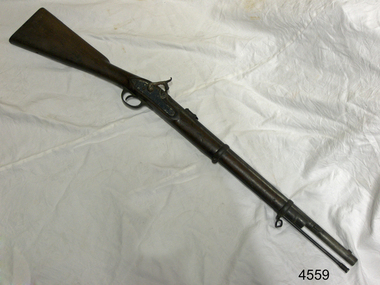 Flagstaff Hill Maritime Museum and Village
Weapon - Gun, ISAAC HOLLIS & SONS, Mid 19th Century
... Flagstaff Hill...Maritime Museum...Maritime Village...Warrnambool...Great Ocean Road...Shipwreck Coast...Firearm...gun...Probably, the gun was originally allocated to British troops or police before being transferred for use in the colony. Flagstaff Hill ...The Hollis Brothers were first recorded as operating from 11 Weaman Row in 1840, although evidence suggests that the business may have commenced prior to this date. Over time, the firm evolved and became known as Isaac Hollis & Sons, with claims of its establishment dating back to 1814. This earlier date is supported by records of Richard and William Hollis trading in Bath Street, Birmingham, between 1814 and 1818, which raises the possibility that Isaac and Frederick Hollis were their descendants. The principal brothers involved in the business were Isaac Hollis, born in 1815, and Frederick Hollis, whose birth date remains unknown. Frederick’s life was cut short when he died on 20 December 1839. According to the 1841 census, Isaac Hollis resided in Weaman Row and was listed as a 25-year-old gun and pistol maker. He was married to Emma, who was born in 1821, and together they had two children: Isaac, born in 1837, and Henry, born in 1839. Following Frederick’s death, Isaac continued to operate under the name Hollis Brothers until 1845, after which he renamed the business Hollis Brothers & Co. This entity remained active up to 1848. In 1844, Isaac Hollis entered a brief partnership with William Tranter at 10 & 11 Weaman Row, likely to fulfil a specific contract or to supply particular parts. This partnership continued until 1849. In 1848, Isaac Hollis formed a partnership with Isaac Brentnall Sheath, establishing the firm of Hollis & Sheath and expanding their operations into 10 Weaman Row. The partnership saw Hollis & Sheath become licensed manufacturers of percussion breech-loading guns, positioning the company as a notable presence in the industry. In 1861, Sheath left the partnership and emigrated to New Zealand, where he conducted several enterprises and was elected as a provincial councillor. He died in Christchurch on 19th May 1897. Following the departure of Isaac Sheath in 1861, the business underwent a name change to Isaac Hollis & Sons. By approximately 1870, Isaac Hollis and Henry Hollis had assumed responsibility for the daily management of the firm, with Isaac overseeing the overall management and marketing of the company's products, while Henry managed the manufacturing processes. During this period, the company became known for producing large volumes of affordable trade guns and sporting guns, catering to customers in South Africa and the British colonies. In 1870, Isaac Hollis & Sons opened a retail location at 44a Cannon Street in London, subsequently relocating to 83 Cheapside in 1871. Isaac Hollis Jnr passed away in October 1875 in Birmingham at the age of 37, having never married. In 1876/1877, Henry Hollis registered a limited liability company under the name Isaac Hollis & Sons Ltd. However, by 1879, trading resumed under the name Isaac Hollis & Sons, and the London shop moved to 6 Great Winchester Street. From 1932 to 1933, the business operated in London as Hollis, Bentley & Playfair. The final closure of Hollis, Bentley & Playfair occurred in Birmingham in 1953. This firearm serves as an exemplary representation of the type of weapon distributed to the colony’s military forces in 1861. It was specifically manufactured by Isaac Hollis & Sons, a prominent gunmaker of the period, to meet the requirements of military use. Distribution was facilitated through Hebbert & Sons, an established military supplier based in London. Before it arrived in Tasmania, Australia, around 1861, the firearm was likely issued from the Hythe Armoury, which functioned as a British military training facility. Probably, the gun was originally allocated to British troops or police before being transferred for use in the colony. Gun: Percussion Carbine, .577 Cal. Colonial Tasmanian issue Artillery carbine, Pattern 1861. Muzzle-loading "Cap and Ball" musket. Wood stock and ramrod. Inscriptions are on the stock and breech. Gun was made for Herbert & Co., London, by Isaac Hollis & Sons, Birmingham.Stamped on stock "SOLD 95", " ISAAC HOLLIS & SONS" "GUN & PISTOL MANUFACTURES" "BIRMINGHAM" "J ASTON ARMOURER HYTHE" "MANUFACTURED EXPRESSLY FOR HEBBERT & CO LONDON". Stamped on breech "25", and "25C ---05"flagstaff hill, maritime museum, maritime village, warrnambool, great ocean road, shipwreck coast, firearm, gun, percussion, carbine, .577 cal, colonial tasmanian issue, artillery carbine, military gun, pattern 1861, muzzle-loading, muzzle-loading musket, cap and ball, musket, wood stock, 1861, percussion breech-loading guns, richard and william hillis, herbert & co., herbert & co. london, hollis & sons, isaac hollis & sons, isaac hillis & sons ltd., hollis bentley & playfair., isaac hollis, frederick hollis, isaac brentnall sheath, isaac sheath, william tranter, gun manufacturer, pistol manufacturer, gun and pistol maker, birmingham, j aston armourer, hythe, hythe armoury, military supplies -
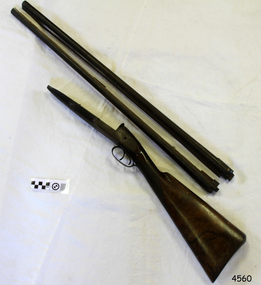 Flagstaff Hill Maritime Museum and Village
Weapon - Double Barrel Shotgun, Mid to late 19th Century
... flagstaff-hill...flagstaff-hill-maritime-museum...shipwreck-coast...flagstaff-hill-maritime-village...gun...This particular example is of a standard pattern for utilitarian use of which many were made. warrnambool shipwrecked-coast flagstaff-hill flagstaff-hill-maritime-museum shipwreck-coast flagstaff-hill-maritime-village gun shotgun double-barrel shotgun firearm muzzel loading shotgun philip webley black powder percussion cap Hunting Weapon Birmingham Gun Manufactures W & C Scott & Son P Webley & Son maker on left and right lock and P Webley & Son James St London on top of barrel. ...Philip Webley was born in 1813, he was the younger brother of James Webley who was born in 1807. Both were born in Birmingham. Towards the end of the 1800s, the firm claimed establishment in 1790, this must have been the date James and Philip's father or grandfather originally established a bullet or gun implement making business. It was not, as is often stated, the date William Davis established his business. Philip Webley was apprenticed in 1827 to Benjamin Watson. James Webley also seems to have been apprenticed but to who is not known. In 1834 James and Philip established their partnership as percussioners, lock filers and gun makers at 7 Weaman Street,Birmingham which was William Davis' old premises Davis, a gun implement maker, mould and toolmaker, died in 1831 and his wife Sarah inherited the business at 84 Weaman Street which she ran with her daughter, Caroline. On 5 January 1838 Philip Webley married Caroline. Philip was recorded at 84 Weaman Street from 1838 as a gun percussioner, lock filer and gun maker and this is when the partnership was last recorded, but the brothers apparently continued to co-operate until 1845 when Philip reportedly sold his interest to James and used the money to purchase Sarah Davis' business. Even then, they worked together particularly about the design and manufacture of percussion revolvers. Philip Webley was recorded in the 1851 census as a 38-year-old gun and pistol implement manufacturer living at 84 Weaman Street with his wife Caroline they had four sons and one daughter Thomas William, Emma, and Philip Jnr, and two other sons, James, and Henry and Philip's cousin, also lived with the family probably as a nurse, Sarah Haywood. On 4 February 1853 Philip Webley registered patent No. 335 for a hinged revolver and on 14 September 1853 he registered patent No. 2127 for improvement for the first muzzle-loading percussion cap and ball revolver which became known as the "Longspur". In 1859 Philips son Thomas William, aged 21, was made a partner in the firm, which then changed its name to P Webley & Son and described itself as "Gun and Pistol Makers and Patent Revolving Pistol Makers", probably exploiting Philip Webley's patent No. 305 of February 1853 for a revolver frame and lock, and its improvement under patent No. 2127 of September 1853. Thomas later went on to managed the shotgun side of the business. From about 1863 up to the First World War, the firm made rook rifles for Holland & Holland. From the 1890s they supplied magazine rifles. In 1863 and 1864 the firm's address was given as 83-84 Weaman Street, but from late 1864 to 1875 their address was 84 Weaman Street. By 1874 the firm had a showroom in London at an unknown address. In 1875 the firm expanded into 82-84 and 88-89 Weaman Street. The item is an early muzzle loading sporting shotgun not in very good condition and is unusable as a firearm and not very significant historically or valuable, although made by a well known and respected manufacturer of firearms there are many better examples of shotguns made by P Webley and Son in collections and for sale. This particular example is of a standard pattern for utilitarian use of which many were made. Shotgun, black powder, muzzle Loading, double barrel, percussion cap. P Webley & Son maker on left and right lock and P Webley & Son James St London on top of barrel. Barrel split in two. Has 14 stamped under each barrel with Birmingham proof marks for black powder shotguns. on undersides of both barrels. Proof marks used are early metal parts have decorative engravings of a gun dog flushing a birdwarrnambool, shipwrecked-coast, flagstaff-hill, flagstaff-hill-maritime-museum, shipwreck-coast, flagstaff-hill-maritime-village, gun, shotgun, double-barrel shotgun, firearm, muzzel loading shotgun, philip webley, black powder, percussion cap, hunting weapon, birmingham gun manufactures, w & c scott & son -
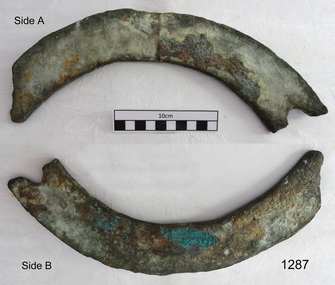 Flagstaff Hill Maritime Museum and Village
Functional object - Ship's Fitting, circa 1825
... In historical terms, ports were always square, cut into the timber originally to allow the firing of a ship's guns, and were closed in weather by a tight-fitting square hatch. Flagstaff Hill Shipwreck Museum has three portholes on display that illustrate the gradual development and adoption of circular brass portholes. ...In historical terms, ports were always square, cut into the timber originally to allow the firing of a ship's guns, and were closed in weather by a tight-fitting square hatch. Flagstaff Hill Shipwreck Museum has three portholes on display that illustrate the gradual development and adoption of circular brass portholes. ...This attractively patinated artefact was raised from the wreck site of the CHILDREN and was quite reasonably catalogued as a portion of a ship's porthole. This identification is unlikely, however, because the CHILDREN was built at Liverpool in 1824, and round portholes were not in common use until the 1850s. The catalogue identification has since been changed to "Ship's Fitting" Before the appearance of round portholes in the middle of the nineteenth century, the function of introducing light to lower decks was performed by square half-glassed ‘ports’ in the side of the hull (known as a port-sash), or ground-glass ‘bullseyes’ inserted in the deck (scuttles). In historical terms, ports were always square, cut into the timber originally to allow the firing of a ship's guns, and were closed in weather by a tight-fitting square hatch. Flagstaff Hill Shipwreck Museum has three portholes on display that illustrate the gradual development and adoption of circular brass portholes. First in sequence is a small 12.5cm diameter window (with a deep frame for thick wooden hulls) from the 1855 wreck of SCHOMBERG. The second and third are larger 25cm diameter windows (with a shallower frame for thinner iron hulls) from the 1892 wreck of the NEWFIELD and the 1908 wreck of the FALLS OF HALLADALE. Once the apparently obvious use of the brass object is discounted, an accurate and reliable alternative classification is difficult to specify. One artefact register notes it was ‘found in about the centre of the wreck site’. This would mitigate against the possibilities of (1) ‘horseshoe frame’ joining pieces of the keel and hull at the bow of the vessel, or (2) ‘deckseat’ for a binnacle at the stern. It may support the idea of a ‘head frame’ on a cooped companionway or a ‘deckseat’ for a mainmast pump. But this is only speculation. The actual identification is not known. The sip's fitting recovered from the Children's wreck is significant as part of the original fittings of the early 19th-century barque. The 1839 wreck and recovered artefacts are examples of the construction methods and materials used in that era and can be used to study the evolution of shipbuilding methods and principles. The wreck of the Children is of state significance as one of colonial Victoria’s earliest and most significant maritime disasters, and one of the first vessels lost in the Western District. This is recognised by its inclusion on the Victorian Heritage Register, VHR No. S116. Little is left on the seabed to mark the tragedy, apart from some of the house bricks intended for the Henty settlement. Ship's fitting, of heavy gauge brass circle, previously classified as a section of the ship's fitting, which was raised from the wreck of the Children. One end is broken off at an original bolt hole, and the other is severed or cut at an acute angle from the inner rim. The artefact is 6cm across and 1cm deep, indicating strength and function as a substantial and finished item of moulded metal. The upper face bears sedimentary accretion stained red/brown. The rear face has been gouged by hard or corrosive materials and bears brilliant blue/green oxidation.flagstaff hill, flagstaff hill maritime museum and village, warrnambool, maritime museum, maritime village, great ocean road, shipwreck coast, shipwreck artefact, children, childer’s cove, port campbell, 1839 shipwreck, james henty and co, henty brothers, captain h. browne, portland, portland bay, brass flange, brass rim, ship’s fitting -
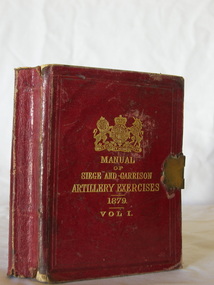 Flagstaff Hill Maritime Museum and Village
Book - Instruction Manual, British War Office, Manual of Siege and Garrison Artillery Exercises Vol 1, ca 24-06-1882
... Flagstaff Hill...Flagstaff Hill Maritime Museum and Village...Warrnambool...Maritime Museum...Maritime Village...Great Ocean Road...Shipwreck Coast...training manual...book...British garrison...garrison artillery...siege exercises...British Government training book...technical book...pocket book...Manual of Siege and Garrison Artillery Exercises Vol 1...garrison exercises...military training...defense training...British Artillery...Royal Artillery...Gunnery...Gun...The four parts included in this Volume I are: - Part 1 - Gunnery Part 2 - Ammunition Part 3 - Siege Artillery Part 4 - Garrison Gun Drills The remaining six of then parts are: - Part 5 - Material and Appliances Part 6 - Elementary Instruction Part 7 - Machines Part 8 - Mounting and Dismounting Ordnance Part 9 - Sleighs Part 10 - Sheers and Derricks The book is significant to both British and Australian history, being issued for the training of the garrison defense of both countries in the late 10th Century. It is also significant for its connection with other historical military items within the Collection at Flagstaff Hill ...This little book has been designed to fit into a small space such as a pocket, backpack or trunk. The brass book lock helps keep the pages and covers together, preserving them from being bent, torn or damaged in handling.The book includes four of ten parts of the Manual, published for use in training the garrison troops, including the placement and firing of cannon. The four parts included in this Volume I are: - Part 1 - Gunnery Part 2 - Ammunition Part 3 - Siege Artillery Part 4 - Garrison Gun Drills The remaining six of then parts are: - Part 5 - Material and Appliances Part 6 - Elementary Instruction Part 7 - Machines Part 8 - Mounting and Dismounting Ordnance Part 9 - Sleighs Part 10 - Sheers and DerricksThe book is significant to both British and Australian history, being issued for the training of the garrison defense of both countries in the late 10th Century. It is also significant for its connection with other historical military items within the Collection at Flagstaff Hill Maritime Museum and Village.Manual of Siege and Garrison Artillery Exercises Vol 1 [Parts I, II, III, IV] Publisher Her Majestys Stationery Office Date 1879, Corrected June 24th 1882 Small, red, hard-cover book with embossed gold letters and British Coat of Arms on the front. The book has a brass closure or locking clip across the text block. There are diagrams and a foldout table within the text. flagstaff hill, flagstaff hill maritime museum and village, warrnambool, maritime museum, maritime village, great ocean road, shipwreck coast, training manual, book, british garrison, garrison artillery, siege exercises, british government training book, technical book, pocket book, manual of siege and garrison artillery exercises vol 1, garrison exercises, military training, defense training, british artillery, royal artillery, gunnery, gun drill, brass book lock, british war office, locking clip, reference book -
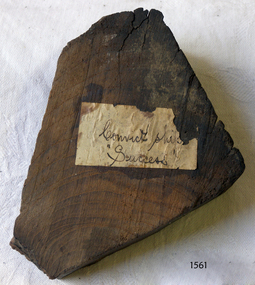 Flagstaff Hill Maritime Museum and Village
Wood Sample, 1840
... gun frigate built in1823, which was broken up in 1849. It also sailed to Australia. Statement of Significance: This piece of wood from the “Success” is connected to the ship Success, built in Burma in 1840. The “Success” is connected to the history of Australia because she was used as a merchant ship to transport immigrants to Australia, as a prison ship in Melbourne, a storage vessel, and as a floating “convict” museum, which travelled the world. flagstaff hill warrnambool shipwrecked-coast flagstaff-hill flagstaff-hill-maritime-museum maritime-museum shipwreck-coast flagstaff-hill-maritime-village Sailing vessel Success Wood sample of sailing ship Success Cockerell & Co. ...This shipwreck artefact is a section of wood from the vessel “Success, a former immigrant ship, and later a convict hulk at Melbourne. The sailing ship “Success” was a teakwood vessel built in Natmoo (Natmaw), Tenasserim, Burma (now Myanmar) in 1840 for Cockerell & Co., Calcutta. Over its lifetime of 106 years, it was used to trade in the Indian subcontinent, to transport free emigrants to Australia, as a prison hulk in the Port of Melbourne for both hardened criminals, and later for women and boys, as a storage vessel for ammunition, a reformatory, and as a floating museum sent around the world to tell the tale of the convict era. During the time “Success” was used as a museum, pamphlets were distributed to paying customers advertising erroneously, that the “Success” was the oldest ship in the world. The “Success” sank and was re-floated twice: the first in Sydney in 1885, the second in the USA in 1918, before it was finally burned and sank July 4, 1946 in Lake Erie, near Sandusky, Ohio in 1946. Although the “Success” was home to prisoners while berthed in the Port of Melbourne, it was not used as convict transport. There has been speculation that Ned Kelly’s infamous armour was displayed on the “Success”, but this cannot be verified. Another link to Ned Kelly is Henry Johnson, an Irish prisoner on the Success, who was implicated in the murder of the ship’s warder, and later Johnson was supposedly a bushranger with Ned Kelly. It is also rumoured that Ned Kelly’s father John was a passenger on the Success, but this is also unverified. There are over 16 other ships named “Success”, although one in particular causes some confusion when researching “Success” in Australia. This other ship – the “HMS Success” was a 28 gun frigate built in1823, which was broken up in 1849. It also sailed to Australia. Statement of Significance: This piece of wood from the “Success” is connected to the ship Success, built in Burma in 1840. The “Success” is connected to the history of Australia because she was used as a merchant ship to transport immigrants to Australia, as a prison ship in Melbourne, a storage vessel, and as a floating “convict” museum, which travelled the world. Section of wood from ship “Success”. Wood appears to have been partially burnt, saw marks faintly visible on wood, remnant of a label with handwriting in black inklabel marked in script handwriting “Convict ship / “Success””flagstaff hill, warrnambool, shipwrecked-coast, flagstaff-hill, flagstaff-hill-maritime-museum, maritime-museum, shipwreck-coast, flagstaff-hill-maritime-village, sailing vessel success, wood sample of sailing ship success, cockerell & co. calcutta -
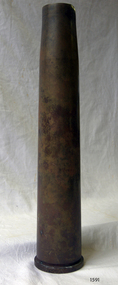 Flagstaff Hill Maritime Museum and Village
Shell Case
... flagstaff hill warrnambool shipwrecked-coast flagstaff-hill flagstaff-hill-maritime-museum maritime-museum shipwreck-coast flagstaff-hill-maritime-village Shell case brass 40mm for Bofur's gun. ...Shell case brass 40mm for Bofur's gun. Patina on outside with marine concretion inside. Base marked "40m/m III Lot 855 PP/C E 1943".flagstaff hill, warrnambool, shipwrecked-coast, flagstaff-hill, flagstaff-hill-maritime-museum, maritime-museum, shipwreck-coast, flagstaff-hill-maritime-village -
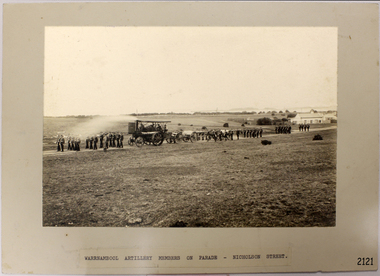 Flagstaff Hill Maritime Museum and Village
Photograph - Military group, Warrnambool Artillery Members on Parade - Nicholson Street [Warrnambool], Early 1900s
... Flagstaff Hill...Flagstaff Hill Maritime Museum and Village...Warrnambool...Maritime Museum...Maritime Village...Great Ocean Road...Shipwreck Coast...Warrnambool location...Militia...steam driven gun...Flagstaff Hill Flagstaff Hill Maritime Museum and Village Warrnambool Maritime Museum Maritime Village Great Ocean Road Shipwreck Coast Warrnambool location Militia steam driven gun carriage Nicholson Street Warrnambool "WARRNAMBOOL ARTILLERY MEMBERS ON PARADE - NICHOLSON STREET' Photograph, landscape, sepia, mounted on card. ...Photograph is a point in time with local Militia parading in an area now filled with houses. It show the means by which the cannon carriages were moved between locations, the uniforms of the soldiers and the development of the Warrnambool location.Photograph, landscape, sepia, mounted on card. Image of the Warrnambool Artillery Members on parade in Nicholson Street, Warrnambool. Figures are marching in groups with a steam driven gun carriage pulling several other gun carriages. A house is in the foreground and Lady Bay in the background. A typed label is attached to the bottom of the card."WARRNAMBOOL ARTILLERY MEMBERS ON PARADE - NICHOLSON STREET'flagstaff hill, flagstaff hill maritime museum and village, warrnambool, maritime museum, maritime village, great ocean road, shipwreck coast, warrnambool location, militia, steam driven gun carriage, nicholson street warrnambool
