
Showing 103 items matching "h. builder"
-
 Whitehorse Historical Society Inc.
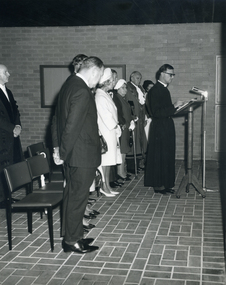
Photograph, Official Opening of new Nunawading Council Chambers, 1968
... ...h. builder...Block, architect; Mr H. McKern, builder; Mrs R.J. Hamer; Hon. R.J. Hamer, Minister for Local Government; Mrs C. ...city of nunawading .council chambers brown j.h. block g. mccall c.r.t. florence lilliam hamer rupert j. sir april j.h. mrs johnston donald rev. mckern h. builder Black and white photo of Rev. Donald W. ...Black and white photo of Rev. Donald W. Johnson delivering a prayer of dedication on behalf of the Nunawading Council of Churches at the Official Opening of the new offices and Council Chambers on Saturday 23rd March 1968. L-R: Mr. J. Brown, town clerk; Mr G. Block, architect; Mr H. McKern, builder; Mrs R.J. Hamer; Hon. R.J. Hamer, Minister for Local Government; Mrs C. McCall; Cr. C. McCall, mayor; Mrs J. Brown and Rev. Donald Johnsoncity of nunawading .council chambers, brown, j.h., block, g., mccall, c.r.t., florence lilliam, hamer, rupert j. sir, april, j.h. mrs, johnston, donald, rev., mckern, h. builder -
 Wodonga & District Historical Society Inc
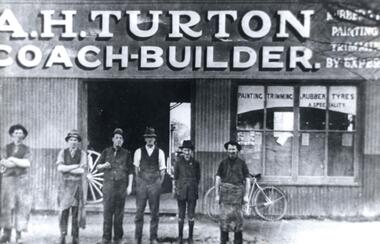
Photograph - Turtons, Wodonga, c1920
... A black and white photograph of the premises of A. H. Turton, Coach builder of Wodonga as well as 2 newspaper advertisements for this business....Above the store: A. H. TURTON / COACH BUILDER On windows: PAINTING/ TRIMMING/ RUBBER TYRES A SPECIALITY...H. Turton, Coach builder of Wodonga as well as 2 newspaper advertisements for this business. ...Abel Hoyle Turton was born in 1877 and married Hannah Richardson of Barnawartha, Victoria in 1902. He established a wheelwright and coach making business. Mr. Turton also operated a blacksmith business as a side trade. In his earlier years he was actively involved in the fire brigade, including as Secretary, and on the committee of the Wodonga Brass Band. Mr. Turton also served as secretary of the local branch of the Australian Natives Association. In 1912, despite having received a long service medal for the Wodonga Fire Brigade, Turton resigned for the brigade under a cloud after having been accused of insubordination at a fire. The brigade captain Mr. Twomey also resigned. They were both later reinstated. He died in Wodonga on 24 December 1932. After his death, the premises were taken over by George McFarlane who commenced business as a shoeing smith and general blacksmith.This image records the premises of an early 20th century Wodonga business.A black and white photograph of the premises of A. H. Turton, Coach builder of Wodonga as well as 2 newspaper advertisements for this business.Above the store: A. H. TURTON / COACH BUILDER On windows: PAINTING/ TRIMMING/ RUBBER TYRES A SPECIALITYwodonga businesses, a. h. turton, turton wheelwright wodonga -
 Bendigo Historical Society Inc.
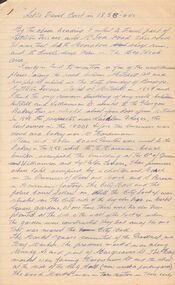
Document - LET'S TRAVEL EAST IN 1858 - 60'S
... ... Mr H Haisman Coach Builder...DOCUMENT Let's Travel East in 1858 - 60's Moorabbee Sheep Run Curr's Sheep Run Glasgow Bakery Lachlan Frazer Mr hardiman Steen and Holm Coach Painters Mr H Haisman Coach Builder Scholton and March March and S Brown Haisman Factory City Hall Police Court City Lockup Market Square Senior Citizens Club Weighbridge Dunlop tyre Service Station Tommy Burns Matt Lynch Tom & Mick Kennedy Darling Hotel The Innes Mr Bullens Fruit Shop Bricklayers Arms Hotel Cheshire Arms Hotel Mr I Boffey Newcombe's timber Yard Quinns Monumental establishment Alexandra Fountain Cumberland Hotel Sannaman's Coach Factory Town Hall Hotel Her Majesties Open Air Picture Show Mr R Anderson John Ohagan Sandhurst Hotel The Melbourne Café Haymarket Hotel The Old Haymarket Hotel The Market Ale House The Prince of Wales Theatre Manchester Hotel Mr John Doran Dr Backhaus Manchester Hall The Bendigo Star James Griffen Coach Factory Mr George Lansell Whitting's Marine Store Cartrights Marine Store Sandhurst Flour Mills Mr John Buckley Moorhead Hay and Corn Mills Brian Boru Hotel Mr M R? ...Nine pages of handwritten account of businesses from Mitchell Street, along Lyttleton Terrace and McIvor Road to the City boundary on the Bendigo side of Murphy Street.document, let's travel east in 1858 - 60's, moorabbee sheep run, curr's sheep run, glasgow bakery, lachlan frazer, mr hardiman, steen and holm coach painters, mr h haisman coach builder, scholton and march, march and s brown, haisman factory, city hall, police court, city lockup, market square, senior citizens club, weighbridge, dunlop tyre service station, tommy burns, matt lynch, tom & mick kennedy, darling hotel, the innes, mr bullens fruit shop, bricklayers arms hotel, cheshire arms hotel, mr i boffey, newcombe's timber yard, quinns monumental establishment, alexandra fountain, cumberland hotel, sannaman's coach factory, town hall hotel, her majesties open air picture show, mr r anderson, john ohagan, sandhurst hotel, the melbourne café, haymarket hotel, the old haymarket hotel, the market ale house, the prince of wales theatre, manchester hotel, mr john doran, dr backhaus, manchester hall, the bendigo star, james griffen coach factory, mr george lansell, whitting's marine store, cartrights marine store, sandhurst flour mills, mr john buckley, moorhead hay and corn mills, brian boru hotel, mr m r?dea, mr worth, mr condon, mr c cahill, nolan family, mr sides, the nailons, mrs boyan, jacky bryant, john oconnell general store, mr pierce, mr matthews, mr neil ward, mr hagan, william clapton, mr joseph dowd, mr morris, ancient briton hotel, the woolpak, the railway bridge, ampol service station, farrells dairy, farringtons brickworks, jacksons hide & tallow yard, fergusons, royal oak hotel, mr jackson, mr knight, st marys common school no812, mrs rersol, w d quinn, mr march, mr fred randall, mr steeple, the limerick hotel, back creek police shooting range, police station, stone lockup, holts service station, steepe's butcher shop, joch, john hattam -
 Flagstaff Hill Maritime Museum and Village
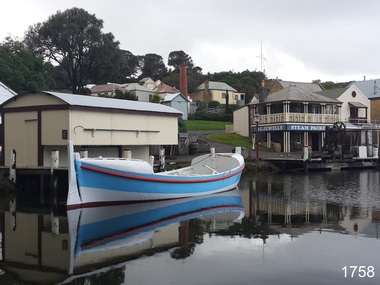
Vehicle - Vessel, Lifeboat Warrnambool, 01/09/1910
... The boat was described as “… a fine piece of workmanship and does credit to her builders and designers…” It had all the latest improvements in shape, disposition of weight and watertight compartments, and it had space for a large number of people in addition to the crew. It appears that 'H...A 'plaque' was found inside the hull of the lifeboat, made of untreated wood, disc-shaped with one straight edge (Diam 15.5cm), inscribed by one of the boat builders in pencil script "Life Boat Start building / 15/9/09 - complete 1/9/10 / (signature looks like H Meiers) / Boat Builder)."...'Plaque' inside body of boat is inscribed in pencil, script writing "Life Boat Start building / 15/9/09 - complete 1/9/10 / (signature looks like H Meiels) / Boat Builder)." ...A 'plaque' was found inside the hull of the lifeboat, made of untreated wood, disc-shaped with one straight edge (Diam 15.5cm), inscribed by one of the boat builders in pencil script "Life Boat Start building / 15/9/09 - complete 1/9/10 / (signature looks like H Meiers) / Boat Builder)." ...The construction of the lifeboat ‘Warrnambool’ began 15th September 1909 and was completed almost 12 months later, 1st September 1910. It was built at the Government Dockyard in Williamstown, Victoria, along the lines designed by the Great Britain’s Royal Lifeboat Institution, and included whaleback decks fore and aft, mast and centreboard, and rudder and tiller hung from the sternpost. It could be propelled by both sail and oar. At that time Captain Ferguson was Chief Harbour Master and Mr Beagley was foreman boat builder when he and his fellow workmen built the boat. The boat was described as “… a fine piece of workmanship and does credit to her builders and designers…” It had all the latest improvements in shape, disposition of weight and watertight compartments, and it had space for a large number of people in addition to the crew. It appears that 'H Meiers' whose signature, along with building dates, is pencilled on a concealed timber 'plaque' in the hull, was involved with the building of the lifeboat. It is interesting that the ‘Melbourne Directory’ of 1911, published by Sands and MacDougal, lists McAuley and Meiers, boat builders, Nelson Place foreshore, between Pasco and Parker Streets, Williamstown, (Victorian Heritage Database, ‘Contextual History, Maritime Facilities’), It is probably the company of the person whose name is inscribed on the lifeboat plaque. Flagstaff Hill’s documentation also mentions that the keel was laid at ‘Harry Myers, boat builders, Williamstown, Melbourne’ – the name ‘Myers’ can also be spelled ‘Meiers’, which could be the same person as the Meiers in “McAuley and Meiers” (as mentioned in genealogy lines of Myers). The new lifeboat, to be named ‘Warrnambool’ was brought to town by train and launched at the breakwater on 1st March 1911 using the Titan crane (the old lifeboat built in 1858, was then returned to Melbourne in 1911). This new lifeboat was stationed at Warrnambool in a shed located at the base of the Breakwater, adjacent to the slipway. A winch was used to bring it in and out of the water. The lifeboat ‘Warrnambool’ was similar in size to the old lifeboat but far superior in design, build and sea-going qualities such as greater manoeuvrability. The ‘self-righting, self-draining’ design was “practically non-capsizeable” and even if the boat overturned it would right itself to an even keel and the water would drain away. The hull was built of New Zealand Kauri, using double diagonal planking, laid in two layers at right angles, with a layer of canvas and red lead paint between the timbers to help seal the planking. It has “… plenty of freeboard, high watertight spaces between the deck and bottom… through which pipes lead…” The backbone timbers were made of Jarrah. The lifeboat Warrnambool was one of several rescue boats used at Port Fairy and Warrnambool in early 1900's. In late 1914 the Warrnambool lifeboat and crew were used to help find what was left of the tragic wreckage of the Antares, and were able to discover the body of one of the crewmen, which they brought back to Warrnambool. Between 1951 and 1954 the lifeboat was manned under the guidance of Captain Carrington. He held lifeboat practice each month on a Sunday morning, to comply with the Ports and Harbour’s request that lifeboats be manned by a strong and competent crew, ready for action in case of emergency. In the early 1960’s it ended its service as a lifeboat and was used in Port Fairy as a barge to help dredge the Moyne River, bolted to the Port Fairy lifeboat. Flagstaff Hill obtained the Warrnambool in 1975. In 1984 it was on display at Flagstaff Hill Maritime Village, Warrnambool. On 23rd May 1990 she was lifted from the water and placed in a cradle for restoration. The name ‘WARRNAMBOOL could be seen faintly on the lifeboat before it was restored. It was during the restoration that Flagstaff Hill's boat builder discovered the 'plaque' inside the hull. A copy of the blueprint plans has the name “V.E.E. Gotch” printed on it. His advertisement in Footscray’s ‘Independent’ newspaper of Saturday 11th May 1901 states he is “Principal and Skilled member (Naval Architect) to the Court of Marine Inquiry of Victoria and holds classes for naval architectural drawing and arithmetic.”The lifeboat WARRNAMBOOL is significant for its half century service to the local community as a lifesaving vessel. She was also used to help retrieve the body of a shipwrecked crew member of the ANTARES. Lifeboat "Warrnambool", a wooden, clinker hull, 'self-righting, self-draining design, single mast, pivoting centreboard. Complete with sail and yardarm. A 'plaque' was found inside the hull of the lifeboat, made of untreated wood, disc-shaped with one straight edge (Diam 15.5cm), inscribed by one of the boat builders in pencil script "Life Boat Start building / 15/9/09 - complete 1/9/10 / (signature looks like H Meiers) / Boat Builder)."'Plaque' inside body of boat is inscribed in pencil, script writing "Life Boat Start building / 15/9/09 - complete 1/9/10 / (signature looks like H Meiels) / Boat Builder)." flagstaff hill, warrnambool, shipwrecked-coast, flagstaff-hill, flagstaff-hill-maritime-museum, maritime-museum, shipwreck-coast, flagstaff-hill-maritime-village, lifeboat, life boat, vessel, life saving, 1910 vessel, port fairy, boat builder plaque, rescue boat, beagley, williamstown, government dockyard, v.e.e. gotch, royal lifeboat institution, captain ferguson, meiers, nelson place, non-capsizeable, self-righting, titan crane, double diagonal planking, captain carrington, barge, antares, self righting, crew of twelve, capacity of 30 survivors -
 Bendigo Historical Society Inc.
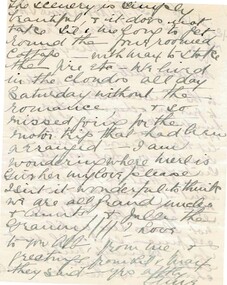
Document - BUSH COLLECTION: COLLECTION OF VARIOUS RECEIPTS (S A BUSH), 1920s
... .; Rent of cottage; Second Peace Loan; G H Vickers (Builder); Painting (Bairnsdale); E G Lucas (Builder); Neal & Woodward, Solicitors; Victorian Railways Commissioners; j Wills, Stockbroker & Sharebroker; A J Bush.....; Rent of cottage; Second Peace Loan; G H Vickers (Builder); Painting (Bairnsdale); E G Lucas (Builder); Neal & Woodward, Solicitors; Victorian Railways Commissioners; j Wills, Stockbroker & Sharebroker; A J Bush. ...COLLECTION OF VARIOUS RECEIPTS. Approximately 30 receipts - Sandhurst & Northern District Trustees Executors & Agency.; Rent of cottage; Second Peace Loan; G H Vickers (Builder); Painting (Bairnsdale); E G Lucas (Builder); Neal & Woodward, Solicitors; Victorian Railways Commissioners; j Wills, Stockbroker & Sharebroker; A J Bush.person, individual, bush collection - personal, bendigo, bush collection, collection, business, commerce, retail -
 Lakes Entrance Historical Society
Photograph - Bellevue/Maranui/Uniting Church Lakes Entrance 1992, Lakes Post Newspaper
... Black and white photograph of two workmen from H N Olvers, Builders, commencing work, on the second stage of the Bellevue complex on the site of the Maranui Motel. ...Work commenced on the 3 August 1992 Buildings Building Industry Construction Black and white photograph of two workmen from H N Olvers, Builders, commencing work, on the second stage of the Bellevue complex on the site of the Maranui Motel. ...The Bellevue Convention Centre and Maranui Restaurant was opened 15 April 1993. Work commenced on the 3 August 1992Black and white photograph of two workmen from H N Olvers, Builders, commencing work, on the second stage of the Bellevue complex on the site of the Maranui Motel. The Uniting Church is seen in the background of the image. Lakes Entrance, Victoriabuildings, building industry, construction -
 Lakes Entrance Historical Society
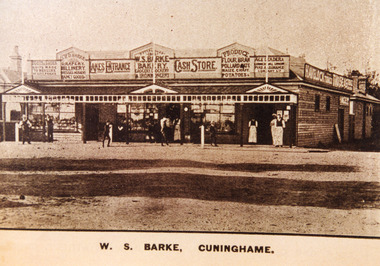
Photograph - Barke's Store Lakes Entrance Victoria c1900
... This extensive weatherboard store was built in 1893 at a cost of one thousand pounds, architect was H French, builder McKnockiter Bros and D Collins the plasterer. ...This extensive weatherboard store was built in 1893 at a cost of one thousand pounds, architect was H French, builder McKnockiter Bros and D Collins the plasterer. ...This extensive weatherboard store was built in 1893 at a cost of one thousand pounds, architect was H French, builder McKnockiter Bros and D Collins the plasterer. William Barke managed the general store, bakery and hardware, brother John Barke managed the clothing and fancy goods department. Building was demolished and replaced by Centrepoint Arcade in 1985-1986Sepia coloured photograph of Barke's Store, people in front of store. W S Barke, Cunninghameretail trade, people -
 City of Ballarat
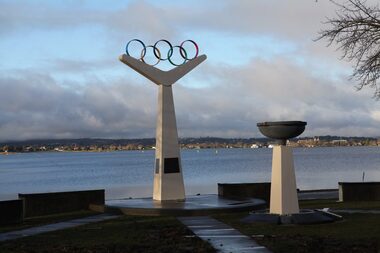
Artwork, other - Public Memorial, Olympic Monument
... The memorial was constructed by Ballarat builder H. Troon using the Olympic rings as the focal point....The memorial was constructed by Ballarat builder H. Troon using the Olympic rings as the focal point. ...The Olympic precinct redevelopment was driven by a group of Ballarat Olympians to commemorate 50 years since the 1956 Olympic rowing events on Lake Wendouree. The memorial highlights the values of the Olympic movement and honours Ballarat Olympians by bronze casts of hands or feet. The memorial was constructed by Ballarat builder H. Troon using the Olympic rings as the focal point.The monument is of historic and social significance to the people of BallaratWhite stone monument mounted with Olympic rings"The most important thing in the Olympic Games is not to win but to take part, just as the most important thing in life is not the triumph, but the struggle. The essential thing is not to have conquered, but to have fought well."olympic games, 1956 olympic -
 Bendigo Historical Society Inc.
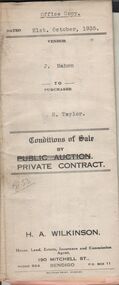
Document - H.A. & S.R. WILKINSON COLLECTION: CONTRACT OF SALE
... Attached receipt and plans to build house on that land (W. H. Ellis builder) for 500 pounds also attached detailed list of materials and labour....Attached receipt and plans to build house on that land (W. H. Ellis builder) for 500 pounds also attached detailed list of materials and labour. ...This business was owned by father and son, Henry Archibald Wilkinson and Samuel Ronald "Ron" Wilkinson. Henry (1882-1954) was born in Shepparton and died in Bendigo. He was married to Grace Hovendon in 1908. Samuel Ronald "Ron" (1914-1995), Henry's son, was married to Florence Jean McKerlie in 1937.Conditions of sale by private contract dated 21st. October, 1935 between J. Mahon (seller) and H. Taylor (buyer) for land situate Hodgkinson Street, Bendigo having a frontage of approx. 52 feet by a depth of approx. 108 feet, being parts of lots 6 and 7 on plan of subdivision registered No.13862 part of Crown allotments 6 and 7 section 38C land described in Crown grant volume 1502 folio 300225 and Crown grant volume 2642 folio 528242. Price 50 pounds. Attached receipt and plans to build house on that land (W. H. Ellis builder) for 500 pounds also attached detailed list of materials and labour.organization, business, h.a. & s.r wilkinson real estate -
 Stawell Historical Society Inc
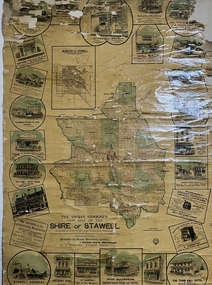
Advertising Material, Wall map of Stawell Shire & Borough of Stawell. Supplement Stawell Times & Wimmera Advertiser
... Baxter Manager. J. H. Stabb, Coach Builder. Isaac Cook, Saddler. Main Street Stawell. ...Baxter Manager. J. H. Stabb, Coach Builder. Isaac Cook, Saddler. Main Street Stawell. ...Advertised Stawell Businesses W. Whiteside, Taylor Clothiers Main Stree.t Mitchell Brothers Auctioneers, Stock & Station Agents, Stawell. The Stawell Times & Wimmera Advertiser, R.W. Baxter Manager. J. H. Stabb, Coach Builder. Isaac Cook, Saddler. Main Street Stawell. Gustav Mahnke. Fancy Bread and Biscuit Baker. McMullin Bros, Produce Merchants and Family Grocer. L.C. Phillips, Taylor & Clothier, Main Street Stawell. Victoria House, George Sprague, Family Draper Main Street. Josiah Cook Butchers, Main Street. The Town Hall Hotel, Wm Short, Main Street. R. H. Wadsworth. Practical Watchmaker & Jeweler. Main Street Stawell. John Allingham, Importer General Draper and Outfitter. Boot & Shoe Warehouse. W. Laxton. Boot and Shoe Manufacturer. Stawell Boot Factory, Main Street Stawell. Anthony Bone, Saddler, Main Street Stawell. Stawell Brewery. G. Bryant & Co. H. Edhouse Manager, Stawell West. The Stawell Coffee Palace, Main Street. T. Aldred Proprieter. S. Isaacson, Draper & Clothier . Main Street Stawell. The Wimmera Flour Mill Co. Ltd. W. Frayne, Manager. George Kay & Co. (Late Wayman & Kay) Iron & Brass Founders, Engineers , Etc Stawell. Large Paper Wall map coloured with cloth backing. Maps of Shire & Borough of Stawell & Advertising The Unique Combine's New map of the Shire of Stawell Compiled by H. E. Ward late Government Draftsmann businesses -
 Surrey Hills Historical Society Collection
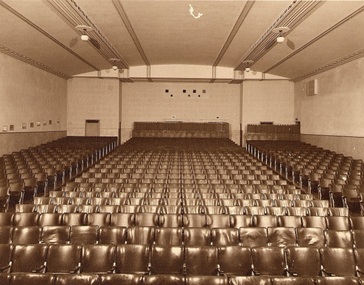
Work on paper - Photograph, Interior of Surrey Theatre at 140-148 Union Road, post 1939, 1939
... H Lord, FRAIA, Dip Arch Design who was the architect of the building. Clive Harmsworth Lord (1905-1979) was admitted as a registered architect by the Architect's Registration Board in April 1931 (REF: TROVE - The Argus, 17 April 1931). Electoral roll gives Clive Harmsworth Lord at 196 Union Road in 1954 and 1963 and in 1968 at 5 Streetham Court, Mont Albert. He died at Mont Albert; cremated Springvale. Date is approximate. Roy Dimmick of Dimmick and Long, Len Rossiter and Robert Mitchell (+ and one of the other principals of Dimmick and Long) had the theatre built; Len Rossiter was the builder...H Lord, FRAIA, Dip Arch Design who was the architect of the building. Clive Harmsworth Lord (1905-1979) was admitted as a registered architect by the Architect's Registration Board in April 1931 (REF: TROVE - The Argus, 17 April 1931). Electoral roll gives Clive Harmsworth Lord at 196 Union Road in 1954 and 1963 and in 1968 at 5 Streetham Court, Mont Albert. He died at Mont Albert; cremated Springvale. Date is approximate. Roy Dimmick of Dimmick and Long, Len Rossiter and Robert Mitchell (+ and one of the other principals of Dimmick and Long) had the theatre built; Len Rossiter was the builder ...The photo was donated to Ray Hudson Real Estate by David Lord, 9 Maude Street, Box Hill North, 3129. David Lord is son of Clive H Lord, FRAIA, Dip Arch Design who was the architect of the building. Clive Harmsworth Lord (1905-1979) was admitted as a registered architect by the Architect's Registration Board in April 1931 (REF: TROVE - The Argus, 17 April 1931). Electoral roll gives Clive Harmsworth Lord at 196 Union Road in 1954 and 1963 and in 1968 at 5 Streetham Court, Mont Albert. He died at Mont Albert; cremated Springvale. Date is approximate. Roy Dimmick of Dimmick and Long, Len Rossiter and Robert Mitchell (+ and one of the other principals of Dimmick and Long) had the theatre built; Len Rossiter was the builder; Clive H Lord was the architect. The theatre was opened by the local member and prime minister, Robert Menzies on 3rd September 1939. Dimmick & Long operated a real estate agency from the corner of the building. Owned / operated by Surrey Theatres Pty Ltd (L Rossiter and Robert Mitchell) from 3/9/1939-1/1/1952 Owned / operated by Victoria Theatres Pty Ltd from 1/11/1950 to 22/10/1960 Owned / operated by Consolidated Theatres Pty Ltd from 1/3/1958 to 22/10/1960 The theatre became a squash court in the (?) 1960s. SHNN: April-May 1986: Plans are afoot to revamp the squash courts with existing shops to remain but with the interior to be converted to office showroom space. 40-2286 is a black and white photocopy made by Jocelyn Hall. SLV have other photos including ones of the foyer.Sepia image of the interior of the Surrey Theatre at 140-148 Union Road, Surrey Hills. It is taken from the stage (screen) back towards the projection box. The two entrances can just be seen behind the curtained area behind the back row. The ceiling has typical 1930s decorative treatment.Original: Commercial Photographic Co Pty Ltd on lower RH edge. Stamp on back: Commercial Photographic Coy. / Pty. Ltd. / 217 Queensberry St., Melbourne, N3. / (Details re ordering prints) / Telephone F5266entertainment, businesses, theatres, surrey theatre, union road shops, cinemas, dimmick and long real estate agency, surrey theatres pty ltd, victoria theatres pty ltd, consolidated theatres pty ltd, clive lord, (sir) robert menzies, roy dimmick, len rossiter, surrey squash court -
 Surrey Hills Historical Society Collection
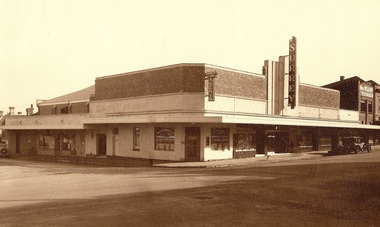
Photograph, Exterior of Surrey Theatre at 140-148 Union Road, post 1939, 1939
... H Lord, FRAIA, Dip Arch Design - architect of the building. Clive Harmsworth Lord (1905-1979) was admitted as a registered architect by the Architect's Registration Board in April 1931 (REF: TROVE - The Argus, 17 April 1931). Electoral roll gives Clive Harmsworth Lord at 196 Union Road in 1954 and 1963 and in 1968 at 5 Streetham Court, Mont Albert. He died at Mont Albert; cremated Springvale. Roy Dimmick of Dimmick and Long, Len Rossiter and Robert Mitchell (+ and one of the other principals of Dimmick and Long) had the theatre built; Len Rossiter was the builder...H Lord, FRAIA, Dip Arch Design - architect of the building. Clive Harmsworth Lord (1905-1979) was admitted as a registered architect by the Architect's Registration Board in April 1931 (REF: TROVE - The Argus, 17 April 1931). Electoral roll gives Clive Harmsworth Lord at 196 Union Road in 1954 and 1963 and in 1968 at 5 Streetham Court, Mont Albert. He died at Mont Albert; cremated Springvale. Roy Dimmick of Dimmick and Long, Len Rossiter and Robert Mitchell (+ and one of the other principals of Dimmick and Long) had the theatre built; Len Rossiter was the builder ...The photo was donated to Ray Hudson Real Estate by David Lord, 9 Maude Street, Box Hill North, 3129. David Lord is son of Clive H Lord, FRAIA, Dip Arch Design - architect of the building. Clive Harmsworth Lord (1905-1979) was admitted as a registered architect by the Architect's Registration Board in April 1931 (REF: TROVE - The Argus, 17 April 1931). Electoral roll gives Clive Harmsworth Lord at 196 Union Road in 1954 and 1963 and in 1968 at 5 Streetham Court, Mont Albert. He died at Mont Albert; cremated Springvale. Roy Dimmick of Dimmick and Long, Len Rossiter and Robert Mitchell (+ and one of the other principals of Dimmick and Long) had the theatre built; Len Rossiter was the builder; Clive H Lord was the architect. The theatre was opened by the local member and prime minister, Robert Menzies on 3rd September 1939. Dimmick & Long operated a real estate agency from the corner of the building. Owned / operated by Surrey Theatres Pty Ltd (L Rossiter and Robert Mitchell) from 3/9/1939-1/1/1952 Owned / operated by Victoria Theatres Pty Ltd from 1/11/1950 to 22/10/1960 Owned / operated by Consolidated Theatres Pty Ltd from 1/3/1958 to 22/10/1960 The theatre became a squash court in the (?) 1960s. SHNN: April-May 1986: Plans are afoot to revamp the squash courts with existing shops to remain but with the interior to be converted to office showroom space. 40-2286 is a black and white photocopy made by Jocelyn Hall; removed from its mount board on 15/3/2013. SLV have other photos including ones of the foyer.Sepia digital image of the Surrey Theatre at 140-148 Union Road, Surrey Hills taken from across the road from the corner of Bedford Avenue and Union Road. It shows the theatre entrance and the other businesses occupying the site, both facing Union Road and Croydon Road and 2 buildings to the north of the site in Union Road. These include Miss Williams Dressmaker; Dimmick and Long, Estate Agents and Royal Insurance Company Ltd. There are 2 cars parked, one in Union Road and one in Croydon Road. DImmick and Long occupies the corner site in the building.Original: Commercial Photographic Co Pty Ltd on lower RH edge. Stamp on back: Commercial Photographic Coy. / Pty. Ltd. / 217 Queensberry St., Melbourne, N3. / (Details re ordering prints) / Telephone F5266surrey theatre, entertainment, businesses, clive lord, david lord, union road shops, (sir) robert menzies, surrey squash courts, consolidated theatres pty ltd, victoria theatres pty ltd, len rossiter, robert mitchell, roy dimmick, dimmick and long -
 Federation University Historical Collection
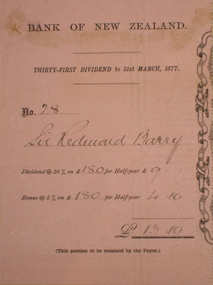
Print - Scrapbook, Ballarat School of Mines Invoice Scrapbook, 1875-1879, 1875-1879
... Longstaff, Wholesale and retail Druggist 1/5/1877 - account from H. Hunt, Builder 4/1877 - receipt from John Victor 3/7/1877 - receipt from J.Alex Sharp 15/6/1877 - receipt from Sir Redmond Barry to Revenue and Pay Office 26/6/1877 - receipt from M. ...Longstaff, Wholesale and retail Druggist 1/5/1877 - account from H. Hunt, Builder 4/1877 - receipt from John Victor 3/7/1877 - receipt from J.Alex Sharp 15/6/1877 - receipt from Sir Redmond Barry to Revenue and Pay Office 26/6/1877 - receipt from M. ...Quarter leather bound scrap book with pasted in invoices which were sent to the Ballarat School of Mines.Ballarat School of Mines Invoice Scrapbook, with many invoices made out to the Ballarat School of Mines stuck into the book (most folded over). * 01/12/1875 - 31/12/1875 - Annual account of all sums of Money for subscriptions to the Ballarat School of Mines * 31/12/1875 - Charles J. Evans - printer * 1875 - William Gooch - for Argus newspaper * 13/01/1876 - M.D. Hamilton - salary payment * 14/01/1876 - receipt for two shillings and sixpence from M.D. Hamilton * 31/1/1876 - account to R.J. Vale * 1/2/1876 - Caxton printing works - account to James Curtis * 4/12/1876 - Ballarat Gas company - receipt from J.W.Robertson * 29/1/1876 - Permewan Hunt and company - account to Hon. W.H.Barnard *28/1/1876 - Osborn, Cushing and company - account to Hon. W.H.Barnard * 7/10/1875 - Geo. H. Bliss and company - account to Hon.N.H. Barnard * 31/12/1875 - I. Longstaff - Druggist * 1875 - A. M. Leirnan * 9/12/1876 - Petty cash - M. Hamilton * 15/12/1875 - reimbursement to W.D. Barnard * 31/1/1876 - "Ballarat Star" newspaper account - Rob Wreford * 12/4/1876 - Geelong Gas company - receipt for 2 pounds and ten shillings - A.B. Langlands * 27/1/1876 - Geelong Gas company - account to School of Mines * 1/2/1876 - Cornell and King - Chemists - account to School of Mines * 10/2/1876 - Salary payment slip to M.D. Hamilton for 8 pounds 6 shillings and 8 pence * January 1876 - Stansfield and Robson, Importers - account to School of Mines * January 1876 - Stansfield and Robson - School of Mines - Dr. A.M.Leisman - account * 31/1/1876 - Charles J. Evans - account to School of Mines * 31/1/1876 - Proprietors of the Evening Post - account to School of Mines * 10/2/1876 - Petty cash receipt from W. Barnard * 1/2/1876 - Bateman, Clark and Company - account to School of Mines * 8/3/1876 - Salary payment to M.D. Hamilton from School of Mines Ballarat *1/3/1876 - William Johnson - Chemist - account to School of Mines Ballarat * 28/2/1876 - Cornell and King - Chemists - account to School of Mines Ballarat * 2/1876 - Hugh Gray and Son - Instrument makers - account from School of Mines * 28/2/1876 - J. Longstaff - druggist * 11/3/1876 - Fidelity Guarantee of Alfred B.Burne for 100 pounds from Victoria Life Insurance Co. *10/3/1876 - Petty cash slip from W.H. Barnard * 4/3/1876 - account from Alfred B. Burne * 15/3/1876 - personal expenses account from I.W. Jonan * 27/3/1876 - account from John Victor * 25/3/1876 - account from C.W. Thomas * 27/3/1876 - account from W. Schmidt - Lecturer * 25/3/1876 - account from Joseph Flude * 29/6/1876 - account from J. Thomas * 30/6/1876 - receipt from W.M. Barnard * 1/4/1876 - receipt from Joseph Flude * 1/3/1876 - account from William Blomeley, Iron and Brass Founder * 31/3/1876 - account from A.H. King, Iron Merchant * 31/3/1876 - account from W.M. Gooch, Newsagent * 13/4/1876 - salary payment to M.D. Hamilton * 12/4/1876 - Petty cash receipt * 13/4/1876 - List of subscriptions received from Alfred B. Burne (collector) (John P. Hanson, Comm. Bank of Aust., T.A. Wanliss, Andrew Cant, B. Hepburn, R. Lewis, Sovereign Hill Mining Co., Buninyong Shire Council, Union Bank Aust. Francis Taylor) * 15/2/1876 - account from Battersea Works London * 2/5/1876 - account from Charles J. Evans Lithographic Printer etc. * 11/5/1876 - salary slip to M.D. Hamilton * 30/4/1876 - subscriptions received from Alfred B. Bruce (M.P. Whiteside, S. Steele, J. Usher, Charles Walker, W.H. Bougghen, W.V. Jenkins, A.M. Gransfield, Hon. Henry Cuthbert, Aust. Bank, Borough Council, Thomas Bath, Rev. William Henderson, James Smith, S. Hamburger) * 30/4/1876 - account from The Ballarat Star Newspaper * 7/6/1876 - account from Ballarat Gas Company * 11/5/1876 - petty cash account from M.J. Barnard * 9/5/1876 - receipt from M.D. Hamilton * 6/5/1876 - account from M.D. Barnard * 4/1876 - account from W.M. Gooch - News and Advertising agents * 22/4/1876 - account from Broadbent Bros and Co. - Railway Carriers etc * 1/6/1876 - account from Bateman, Clark, and Co. * 31/5/1876 - account from J. Longstaff - Druggist * 16/2/1876 account from A.M. Leiman * 6/1876 - account from R.T. Vale - Newsagent * 31/5/1876 - receipt from Sir Redmond Barry for one shilling * 1/6/1876 - account from F.W. Niven - Stationer etc. * 31/5/1876 - account to The Ballarat Star and The Miner newspapers * 31/5/1876 - account from Stansfield and Robson, Importers * 31/5/1876 - account from The Evening Post * 8/6/1876 - Salary slip fro M.D. Hamilton * 1/6/1876 - account to J. McHutchison, Bookbinder * 1/6/1876 - account from A.H. King - Iron Merchant * 1/6/1876 - account from Cornell and King - Chemists * 31/5/1876 - account from W.M. Gooch - Advertising agent * 8/6/1876 - petty cash receipt from M.D. Barnard * 31/5/1876 - List of subscriptions from Alfred B. Bruce (T.J. Kerr, Jacob Showman, J.L. Thompson, W.J. Clarke, R.C. Baih, L. Ballhausen, James Coghlan, Parade Gold mining Co., A. Williams, Sung Hung Fat, A. Dimmock Esq.M.D., Bank Victoria, Reform Co., Gilbert, James Ward, James Stewart, Ian Kwong Yick 7/6/1876 - account to Alfred White - Custom House Agent 30/6/1876 - receipt from John Victor for twelve pounds 10 shillings 29/7/1876 - receipt from A.M. Barnard 26/6/1876 - receipt from Joseph Flude 4/6/1876 - receipt from E.S. Schmidt 22/6/1876 - receipt from John W. Tail 19/6/1876 - receipt from Jonathan Butterworth 3/7/1876 - receipt from Joseph Hurde 1/7/1876 - account from Henry Richards Caselli - Architect and Building Surveyor 30/6/1876 - account from J. Scovell - Cabinet Maker 14/7/1876 - account from H.R. Caselli - Architect and Building Surveyor 20/7/1876 - payslip to M.D. Hamilton 1/7/1876 - account from Henry Brind - Chemist 6/1876 - account from W.M. Gooch - News and Advertising Agent 21/7/1876 - account from W.D. Hamilton 26/6/1876 - account from Parkinson and co. - City Nightmen and van proprietors 19/7/1876 - petty cash receipt from M.D.Barnard 30/6/1876 - account of subscriptions received - J.A. Anderson, A. Anderson, John Osborne, J. Noble Wilson, Bateman and Clarke, National bank of Aust., James Lory, F. Atkins 27/7/1876 - account from H. Hunt - Builder 26/7/1876 - account to G. Leitch and co. 1/8/1876 - receipt to The National Insurance Co. of Aust., Ltd. 1/8/1876 - receipt from Victoria Fire and Marine Insurance Company 1/8/1876 - account to The Victoria Lime and Cement Co. 1/8/1876 - receipt from Ballarat Gas Company 1/8/1876 - account from Charles J. Evans, Printer 1/8/1876 - account from Cornell and King - Druggists and Chemists 8/8/1876 account from Cornell and King - Druggists and Chemists 5/6/1876 to 22/9/1876 - account to A.N. Lennan 11/8/1876 - receipt from W.D. Hamilton 16/9/1876 - receipt from Geelong Gas Company 7/8/1876 - account to the Geelong Gas Company 1/8/1876 - account to Bateman, Clark and Co. 31/7/1876 - account from The Ballarat Star and of The Miner 10/8/1876 - salary slip to M.D. Hamilton 1/7/1876 to 31/7/1876 - list of subscriptions from Alfred B. Burne - P. Channey, P. Pakenhagen, John Price, Ballarat Gas Co., L.E. Brann, A.H. King, M. O"Ferrall, John Foord 19/7/1876 to 10/8/1876 - Petty cash receipt from M.N. Barnard 7/ 1876 - account to W. M. Gooch - General News and Advertising agent 1/7/1876 - account to Stansfield and Robson - Importers in Oils, colours, window glass, etc. 17/8/1876 - account to Lermes Lamurk 4/8/1876 - account to James Allen "Camperdown Chronicle" general printing office from W.H. Barnard 6/9/1876 - account to Henry Masham 1/9/1876 - account to A.H. King - Iron Merchant, Furnishing and General Ironmonger 22/9/1876 - travelling expenses account from R.D. Ellery 25/9/1876 - receipt from M. Schmidt 15/9/1876 - receipt from M.D. Hamilton 1/9/1876 - account to James Curtis - Caxton Printing Works 25/8/1876 - account from William McCulloch and Co., General Carriers 18/8/1876 - account to G. Leitch and Co. 14/9/1876 - payment slip to M.D. Hamilton 10/8/1876 - petty cash account from M.H. Barnard 25/9/1876 - receipt from John Victor 25/9/1876? - receipt from M.H.Barnard 6/10/1876 - receipt from Joseph Fude 12/10/1876 - receipt from M.D. Hamilton 30/9/1876 - receipt from Joseph Fude 1/10/1876 - account to A.M. Lennan 12/10/1876 - salary slip to M.D. Hamilton 30/9/1876 - account from Ballarat Star Newspaper Office 12/10/1876 - petty cash account - M.H. Barnard 30/9/1876 - account to J. McHutchison - Bookbinder 1/8/1876 - account from Ballarat Gas Company 1/11/1876 - receipt from Ballarat Gas Company 1/11/1876 - account to Charles J. Evans - Lithographic Printer 1/11/1876 - account from Cornell and King - Chemists 9/1876 - account from W.M. Gooch - General news and advertising agent 10/1876 - account from J. and J. McDonald - Plumbers and gas fitters 13/10/1876 to 9/11/1876 - petty cash statement from M.H. Barnard 14/11/1876 - receipt from M.D. Hamilton 11/9/1876 - account from A.M. Lennan 9/11/1876 - Salary slip to M.D. Hamilton 12/10/1876 - Expenses account received by M.H. Barnard 1/11/1876 - account from J. Longstaff - Druggist 10/1876 - account from Parkinson and Co. - City Nightmen and van proprietors 6/12/1876 - account from Emanuel Steinfield, Importer of Furniture etc. 13/11/1876 - account The Geelong Gas Company 31/11/1876 - account from The Ballarat Star Newspaper office 28/11/1876 - account from R.T. Vale - bookseller, stationer and news agent 28/11/1876 - acount from John Slater and co. 1/12/1876 - account from J. Doig and co., Tinsmiths, Gasfitters etc. 14/12/1876 - Salary slip to M.D. Hamilton 14/12/1876 - receipt from M.D. Hamilton for one pound one shilling and ninepence 1/11/1876 to 31/12/1876 - petty cash statement 15/12/1876 - statement of travelling expenses for A.B. Barnes 23/12/1876 - receipt from John Victor 21/2/1877 - receipt from C.M.Thomas 23/12/1876 - receipt from Joseph Flude 29/12/1876 - receipt from Lecturer - S.Schmidt 30/12/1876 - receipt from Joseph Flude 1876 - receipt from Joseph Flude 12/1/1877 - statement of refund to W.H. Barnard 11/1/1877 - Salary slip to M.D.Hamilton 8/1/1877 - petty cash statement 18/1/1877 - receipt for Ballarat Gas company 2/1/1877 - account from Eyres Brothers - Furnishing and general ironmongers 19/12/1876 - statement from W.H. Barnard - registrar 1/1/1877 - account from Bateman, Clark and company 11/121876 - account from Parkinson and co. - City nightmen 31/12/1876 - account from Ballarat Star Newspaper office 25/1/1877 - account from J. McHutchison, Bookbinder 3/2/1877 - account from J. McHutchison, Bookbinder 1/2/1877 - account from Cornell and King - Chemists 1/2/1877 - account from Stansfield J. Robson - Importers in oils, colours, window glass etc. 1/2/1877 - account from Charles J. Evans - Bookbinder etc. 12/12/1876 - account from W. Gooch - General news and advertising agent 2/1/1877 - account from proprietors of the Evening Post 14/2/1877 - account from John F.Paten - Printer, Publisher and Bookseller "Avoca Mail" 2/2/1877 - account from T. Longstaff - wholesale and retail druggist 8/81877 - salary slip for M.D. Hamilton 21/1/1877 - account from Ballarat Star Newspaper office 9/2/1877 - account for petty cash from W.H. Barnard 7/2/1877 - account from S.C. Steele - Ballarat Fine Art Gallery 13/2/1877 account from R.T. Vale - Bookseller, Stationer and News Agent 8/2/1877 - account from Joseph Flude 13/1/1877 - account from William Johnson, Chemist 9/1877 - account to J. Flude from William Johnson, Chemist, 3 accounts 2/11/1876 to 23/1/1877 - account from A.N. Leiman 1/3/1877 - account from Bateman, Clark and company 8/3/1877 - salaray payment to M.D. Hamilton 8/3/1877 - salary payment to J. Ashley 9/3/1877 - statement from Post Office Ballarat (one shilling - for the first years rent of telegraph line on school premises) 1/2/1877 - statement from Mining and commercial stationer - J.W. Niven Dec.1876 to 15/2/1877 - account from R.T. Vale - Bookseller, Stationer, and News agent 1/1877 - statement from C.W. Thomas 8/3/1877 - petty cash account from W.H. Barnard 9/3/1877 - account from R. Gibbings - Livery and Letting Stables and carriage repository 28/2/1877 - account from Charles J. Evans - Stationer, Lithographic printer etc. 9/3/1877 - receipt from M.D. Hamilton 31/3/1877 - account from Ballarat Star and The Miner 2/1877 - receipt from Joseph Flude 8/3/1877 - receipt from F.J. Ashley 28/3/1877 salary statement from John Victor 28/4/1877 - salary statement from John A. Sharp 28/3/1877 - receipt from Joseph Flude 26/3/1877 - receipt from T.Schmidt - Lecturer 12/3/1877 - receipt from C.H. Walker 6/4/1877 - account from Mr. Ellery 27/4/1877 - account from A. M. Leiman 31/3/1877 - account from W.M. Gooch, General news and advertising agent 6/3/1877 - statement from London Remittances 12/4/1877 - salary payment to M.D. Hamilton 1877 - receipt from W.H. Barnard 1/4/1877 - account from Parkinson and company, City nightmen and van proprietors 5/4/1877 - account from William McCulloch and company, General carriers 11/4/1877 - account from S. Steele, Draper 31/3/1877 - account from Charles J. Evans, Stationer etc. 1/4/1877 - account from James Curtis - Caxton Printing Works 4/1877 - receipt from W.H. Barnard 8/3/1877 to 12/4/1877 - petty cash receipt from W.H.Barnard 12/4/1877 - receipt from C. Flude 31/3/1877 - receipt for Sir Redmond Barry for 13 pounds 10 shillings 1/1877 - receipt from Alphonse Ausaldie 1/3/1877 - 30/4/1877 - account from Joseph Flude 9/5/1877 - account from Henry Costin - Machinery Merchant 31/1/1877 to 3/5/1877 - Ballarat Gas Company 13/6/1877 - receipt to Ballarat Gas Company 9/5/1877 - salary slip to M.D. Hamilton 11/5/1877 - account for stationary from C. Flude, Registrar 23/3/1877 - account from Edmund Donelly 1/5/1877 - account from Charles J. Evans, Stationer etc. 9/4/1877 - account from W.M. Gooch, News and advertising agent 30/4/1877 - account from The Ballarat Star and The Miner 13/4/1877 - account from T. Longstaff, wholesale and retail druggist 30/4/1877 - account from Echuca railway station 1/5/1877 - account from Cornell and King, Chemists 11/5/1877 - salaray slip for C. Flude 11/5/1877 - petty cash account to the Registrar, W.H. Barnard 2/5/1877 - account from William McCulloch and co.,general carriers 5/1877 - account from William Willis and co. Locksmiths etc. 1/5/1877 - account from Joseph Flude 6/6/1877 - account from Henry Morham 31/5/1877 - account from Charles J. Evans, Stationer and Printer etc. 14/6/1877 - salary payment to M.D. Hamilton 15/6/1877 - salary payment to C. Flude 15/6/1877 - receipt from M.D. Hamilton 1/6/1877 - account from James Curtis, Caxton Printing Works 31/1/1877 - Ballarat Gas company account 23/8/1877 - receipt from Ballarat Gas company 15/6/1877 - receipt from The National Insurance Company of Aust., Ballarat Branch 1/6/1877 - account from The Ballarat Courier 3/1877 - receipt from L.M. Cook 1/6/1877 - account from J.McHutchison, Bookbinder 10/5/1877 to 14/6/1877 - petty cash account 17/5/1877 - account from William McCulloch and co., general carriers 15/6/1877 - account from T. Longstaff, Wholesale and retail Druggist 1/5/1877 - account from H. Hunt, Builder 4/1877 - receipt from John Victor 3/7/1877 - receipt from J.Alex Sharp 15/6/1877 - receipt from Sir Redmond Barry to Revenue and Pay Office 26/6/1877 - receipt from M. Shaw, Lecturer 25/6/1877 - receipt from Joseph Flude 23/6/1877 - receipt from S.Schmidt 6/1877 - account from W.M. Gooch, general news and advertising agent for Argus newspapers 6/1877 - account from the Proprietors of the Evening Post 21/6/1877 - account from John F. Paten, "Avoca Mail" and general printing office 14/6/1877 - account from Ballarat Star and The Miner Newspaper office 30/6/1877 - account from Ballarat Star Newspaper office 2/7/1877 - account from R.T. Vale, News Agent 19/6/1877 account for railway fare and personal expenses 23/5/1877 - account from William Johnson, Chemist 1/7/1877 - account from Henry Brind, Chemist and Family Pharmacist 2/7/1877 - account from Cornell and King, Druggists and Chemists 12/7/1877 - salary slip to M.D. Hamilton 14/7/1877 - salary slip to C. Flude 14/6/1877 - 12/7/1877 petty cash account from W.H. Barnard 16/6/1877 - account from William McMulloch and Co., general carriers 1/7/187 - account from Parkinson and Co., City Nightmen and Van Proprietors 1/6/1877 to 30/6/1877 - account from Joseph Flude 1/8/1877 - receipt to Victoria Fire and Marine Insurance Company 21/7/1877 - account to Brush and Drummond, Importers and Manufacturing Jewellers 11/7/1877 - account from Charles J. Evans, Printer etc. 31/7/1877 - account from The Ballarat Star Newspaper Office 1/8/1877 - account from James Curtis, Caxton Printing Works 7/71877 - account from W.M. Gooch, Advertising Agent 7/1877 - account from Hugh Gray and Son, Mechanists and Philosophical Instrument Makers 13/8/1877 - account from Ballarat Gas Company redmond barry, joseph flude, hall of commerce, george crocker, ballarat star, the miner, bank of new zealand, daniel brophy, james curtis, caxton printing works, mcdonald plumbers and gas fitters, mcvitty and co, j. mchutchison, bookbinder, niven, john warrington rogers, henry bland, rivett henry bland, telegraphy, ellery, r.t. vale, richard vale, w. johnson analytical chemist st kilda, judge warrington rogers, art gallery of ballarat, henry richards caselli, h. hunt, ballarat school of mines botanical gardens, henry caselli, charles flude, ballarat star news, john armstrong -
 Flagstaff Hill Maritime Museum and Village
Oar, early 20th century
... The boat was described as “… a fine piece of workmanship and does credit to her builders and designers…” It had all the latest improvements in shape, disposition of weight and watertight compartments, and it had space for a large number of people in addition to the crew. It appears that 'H...The boat was described as “… a fine piece of workmanship and does credit to her builders and designers…” It had all the latest improvements in shape, disposition of weight and watertight compartments, and it had space for a large number of people in addition to the crew. It appears that 'H ...This oar is from the Lifeboat Warrnambool, which is on sit at Flagstaff Hill Maritime Village. The construction of the lifeboat ‘Warrnambool’ began 15th September 1909 and was completed almost 12 months later, 1st September 1910. It was built at the Government Dockyard in Williamstown, Victoria, along the lines designed by the Great Britain’s Royal Lifeboat Institution, and included whaleback decks fore and aft, mast and centreboard, and rudder and tiller hung from the sternpost. It could be propelled by both sail and oar. At that time Captain Ferguson was Chief Harbour Master and Mr Beagley was foreman boat builder. Mr Beagley built the lifeboat with his fellow workmen. The boat was described as “… a fine piece of workmanship and does credit to her builders and designers…” It had all the latest improvements in shape, disposition of weight and watertight compartments, and it had space for a large number of people in addition to the crew. It appears that 'H Meiers' whose signature was on the plaque that was found concealed in the hull, was involved with the building of the lifeboat. His signature and the dates of the start and finish of the boat’s construction are pencilled on the raw timber 'plaque' found in the hull in the early 1990’s when the lifeboat was being restored. It is interesting that the ‘Melbourne Directory’ of 1911, published by Sands and MacDougal, lists McAuley and Meiers, boat builders, Nelson Place foreshore, between Pasco and Parker Streets, Williamstown, (Victorian Heritage Database, ‘Contextual History, Maritime Facilities’), It is quite possibly the business of the person whose name is inscribed on the lifeboat plaque. Flagstaff Hill’s documentation also mentions that the keel was laid at ‘Harry Myers, boat builders, Williamstown, Melbourne’ – the name ‘Myers’ can also be spelled ‘Meiers’, which could be the same person as the Meiers in “McAuley and Meiers” (as mentioned in genealogy lines of Myers). The new lifeboat, to be named ‘Warrnambool’ was brought to town by train and launched at the breakwater on 1st March 1911 using the Titan crane (the old lifeboat built in 1858, was then returned to Melbourne in 1911). This new lifeboat was stationed at Warrnambool in a shed located at the base of the Breakwater, adjacent to the slipway. A winch was used to bring it in and out of the water. The lifeboat ‘Warrnambool’ was similar in size to the old lifeboat but far superior in design, build and sea-going qualities such as greater manoeuvrability. The ‘self-righting, self-draining’ design was “practically non-capsizeable” and even if the boat overturned it would right itself to an even keel and the water would drain away. The hull was built of New Zealand Kauri, using double diagonal planking, laid in two layers at right angles, with a layer of canvas and red lead paint between the timbers to help seal the planking. It has “… plenty of freeboard, high watertight spaces between the deck and bottom… through which pipes lead…” The backbone timbers were made of Jarrah. The lifeboat Warrnambool was one of several rescue boats used at Port Fairy and Warrnambool in early 1900's. In late 1914 the Warrnambool lifeboat and crew were used to help find what was left of the tragic wreckage of the Antares, and were able to discover the body of one of the crewmen, which they brought back to Warrnambool. Between 1951 and 1954 the lifeboat was manned under the guidance of Captain Carrington. He held lifeboat practice each month on a Sunday morning, to comply with the Ports and Harbour’s request that lifeboats be manned by a strong and competent crew, ready for action in case of emergency. In the early 1960’s it ended its service as a lifeboat and was used in Port Fairy as a barge to help dredge the Moyne River, bolted to the Port Fairy lifeboat. Flagstaff Hill obtained the Warrnambool in 1975. In 1984 it was on display at Flagstaff Hill Maritime Village, Warrnambool. On 23rd May 1990 she was lifted from the water and placed in a cradle for restoration. The name ‘WARRNAMBOOL could be seen faintly on the lifeboat before it was restored. It was during the restoration that Flagstaff Hill's boat builder discovered the 'plaque' inside the hull. A copy of the blueprint plans has the name “V.E.E. Gotch” printed on it. His advertisement in Footscray’s ‘Independent’ newspaper of Saturday 11th May 1901 states he is “Principal and Skilled member (Naval Architect) to the Court of Marine Inquiry of Victoria and holds classes for naval architectural drawing and arithmetic.” The oar is significant for its association with the lifeboat WARRNAMBOOL, which is significant for its half century service to the local community as a lifesaving vessel. She was also used to help retrieve the body of a shipwrecked crew member of the ANTARES. Large wooden oar, shaped two handgrip with tapering shaft to large flattened blade, (2) copper reinforcing strips on blade. Sweep oar is from the Lifeboat Warrnambool. flagstaff hill, warrnambool, shipwrecked-coast, flagstaff-hill, flagstaff-hill-maritime-museum, maritime-museum, shipwreck-coast, flagstaff-hill-maritime-village, oar, lifeboat warrnambool, sweep oar -
 Flagstaff Hill Maritime Museum and Village
Craft - Ship Model, Peter Payne, Early 1930s to 1960s
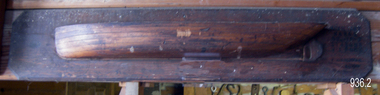
... P Payne was a very well-known boating personality, vessel captain and boat builder throughout most of the 20th century. flagstaff hill warrnambool flagstaff-hill flagstaff-hill-maritime-museum maritime-museum shipwreck-coast flagstaff-hill-maritime-village ship model half hull ship half model shipbuilding shipwright ship design Peter Payne Boat Builder Victoria Clinker Design Barge Marked "AUXILIARY BARGE 80'x16'x6' 315 TONS 4" - 1 FOOT" "P and H PAYNE?" ...Half-hull ship models were an important step in the process of building a vessel. Shipwrights or designers would construct a half-hull scale model of a ship before the vessel was built. They used it to ensure that the dimensions would work together and that the ship look balanced. They would often mount the half hull onto a board in their workshop. The half-hull ship models were also used to show prospective buyers how the design would work and look. Given the plywood construction of the model, it is believed to have been made around the 1930s as plywood construction had started in earnest in Queensland around this time and soon became the centre of the industry because of Queensland's attractive rain forest woods used which also included red cedar, silver ash, black bean, Queensland maple and silky oak. It is also believed the model was a design for a clinker-built barge to be built by Peter Payne who operated a boat building works on the Mordialloc Creek, Victoria going out of business in 1973. Records show Peter Paynes' first craft launched in 1962 and the last in 1973 from Mordialloc Creek works. However, he was one of the most prolific builders from the 1930s and produced many more vessels than the records currently show. There is at this point no further record of the subject model or whether a full version was ever built and for whom is not known at this time.A model that demonstrates the boat-building process is believed to have been made by Peter Payne or someone who worked in his yard. P Payne was a very well-known boating personality, vessel captain and boat builder throughout most of the 20th century. Model barge half hull on wooden of plywood laminated construction. Marked "AUXILIARY BARGE 80'x16'x6' 315 TONS 4" - 1 FOOT" "P and H PAYNE?" "22/E/26" flagstaff hill, warrnambool, flagstaff-hill, flagstaff-hill-maritime-museum, maritime-museum, shipwreck-coast, flagstaff-hill-maritime-village, ship model half hull, ship half model, shipbuilding, shipwright, ship design, peter payne, boat builder victoria, clinker design, barge -
 Flagstaff Hill Maritime Museum and Village
Functional object - Rowlock, early 20th century
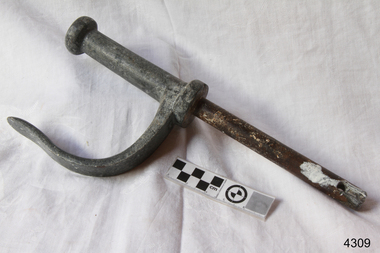
... builder. Mr Beagley built the lifeboat with his fellow workmen. It had all the latest improvements in shape, disposition of weight with watertight compartments, and it had space for a large number of people in addition to the crew. It appears that 'H...builder. Mr Beagley built the lifeboat with his fellow workmen. It had all the latest improvements in shape, disposition of weight with watertight compartments, and it had space for a large number of people in addition to the crew. It appears that 'H ...This row lock was fitted onto the Warrnambool Lifeboat, which is also on-site at Flagstaff Hill Maritime Village. The construction of the lifeboat 'Warrnambool' began 15th September 1909 and was completed almost 12 months later 1st September 1910. It was built at the Government Dockyard in Williamstown, Victoria, along the lines designed by Great Britain's Royal Lifeboat Institution, and included whale back decks fore and aft, mast and centre board, and rudder and tiller hung from the stern post. It could be propelled by both sail and oar. At that time Captain Ferguson was Chief Harbour Master and Mr Beagley was a foreman boat builder. Mr Beagley built the lifeboat with his fellow workmen. It had all the latest improvements in shape, disposition of weight with watertight compartments, and it had space for a large number of people in addition to the crew. It appears that 'H Meiers' whose signature was on the plaque that was found concealed in the hull, was involved with the building of the lifeboat. His signature and the dates of the start and finish of the boat's construction are penciled on the raw timber 'plaque' found in the hull in the early 1990s when the lifeboat was being restored. It is interesting that the 'Melbourne Directory' of 1911, published by Sands and MacDougal, lists McAuley and Meiers, boat builders, Nelson Place foreshore, between Pasco and Parker Streets, Williamstown, It is quite possibly the business of the person whose name is inscribed on the lifeboat plaque. Flagstaff Hill's documentation also mentions that the keel was laid at 'Harry Myers, boat builders, Williamstown, Melbourne the name 'Myers' can also be spelled 'Meiers', which could be the same person as the Meiers in "McAuley and Meiers" (as mentioned in genealogy lines of Myers). The new lifeboat, to be named 'Warrnambool' was brought to town by train and launched at the breakwater on 1st March 1911 using the Titan crane (the old lifeboat built-in 1858, was then returned to Melbourne in 1911). This new lifeboat was stationed at Warrnambool in a shed located at the base of the Breakwater, adjacent to the slipway. The lifeboat ‘Warrnambool’ was similar in size to the old lifeboat but far superior in design, with new sea-going qualities such as greater maneuverability. The ‘self-righting, self-draining’ design was made the vessel difficult to capsize and even if the boat overturned it would right itself to an even keel and the water would drain away. The hull was built of New Zealand Kauri, using double diagonal planking, laid in two layers at right angles, with a layer of canvas and red lead paint between the timbers to help seal the planking. It has plenty of free board. The backbone timbers were made of Jarrah. The Warrnambool lifeboat was one of several rescue boats used at Port Fairy and Warrnambool in the early 1900s. In late 1914 the Warrnambool lifeboat and crew were used to help find what was left of the tragic wreckage of the Antares and were able to discover the body of one of the crewmen. Between 1951 and 1954 the lifeboat was manned under the guidance of Captain Carrington. He held lifeboat practice each month on a Sunday morning, to comply with the Ports and Harbour’s request that lifeboats be ready for action in case of an emergency. In the early 1960’s it ended its service as a lifeboat and was used in Port Fairy as a barge to help dredge the Moyne River. Flagstaff Hill obtained the Warrnambool lifeboat in 1975. In 1984 it was on display at Flagstaff Hill Maritime Village, Warrnambool. On 23rd May 1990, she was lifted from the water and placed in a cradle for restoration. The name 'WARRNAMBOOL could be seen faintly on the lifeboat before it was restored. It was during the restoration that Flagstaff Hill's boat builder discovered the 'plaque' inside the hull. A copy of the blueprint plans has the name “V.E.E. Gotch” printed on it. His advertisement in Footscray’s ‘Independent’ newspaper of Saturday 11th May 1901 states he is “Principal and Skilled member (Naval Architect) to the Court of Marine Inquiry of Victoria and holds classes for naval architectural drawing and arithmetic.” The subject row lock is significant due to its association the Warrnambool Lifeboat which was an integral part of an important service to the local community as a lifesaving vessel for a half-century. One of the lifeboats many achievements was when it was used to help retrieve the body of a shipwrecked crew member of the ship Antares. Rowlock from the Warrnambool Lifeboat.Noneflagstaff hill, warrnambool, shipwrecked-coast, flagstaff-hill, flagstaff-hill-maritime-museum, maritime-museum, shipwreck-coast, flagstaff-hill-maritime-village, lifeboat warrnambool, life boat, life saving vessel, 1910 vessel, port fairy, boat builder plaque, rescue boat, beagley, government dockyard, williamstown, v.e.e. gotch, royal lifeboat institution, captain ferguson, non-capsizeable lifeboat, self-righting lifeboat, antares shipwreck, double diagonal planking, captain carrington, rowlock, lifeboat rowlock -
 Federation University Historical Collection
Photograph - Photograph - sepia, Ballarat looking west from the Town Hall, 1872, 1972
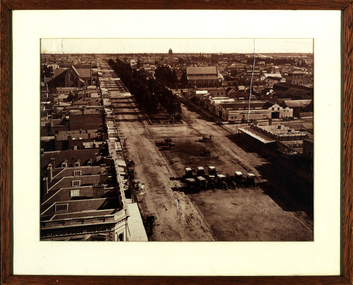
... H. Bardwell, can be found at http://bih.ballarat.edu.au/index.php/William_H._Bardwell ballarat town hall ballarat bardwell sturt street horse drawn carriage gibbings's livery stables gibbings proctor proctor coach builder ballarat hospital carriages ballarat west fire brigade ballarat streetscape ballarat townscape william bardwell fotobiennale Framed sepia photograph showing Sturt Street Ballarat as taken from the Ballarat Town Hall. ...This photograph was taken from the newly completed tower of the Ballarat Town Hall. Further details on the photographer, William H. Bardwell, can be found at http://bih.ballarat.edu.au/index.php/William_H._BardwellFramed sepia photograph showing Sturt Street Ballarat as taken from the Ballarat Town Hall. The bluestone St Patrick's Cathedral can be seen in the background to the left, with St Andrew's Kirk opposite it. The two towers in the centre background are the Ballarat West Fire Brigade and the Ballarat Hospital tower (Drummond Street).ballarat town hall, ballarat, bardwell, sturt street, horse drawn carriage, gibbings's livery stables, gibbings, proctor, proctor coach builder, ballarat hospital, carriages, ballarat west fire brigade, ballarat streetscape, ballarat townscape, william bardwell, fotobiennale -
 Flagstaff Hill Maritime Museum and Village
Rowlock, early 20th century
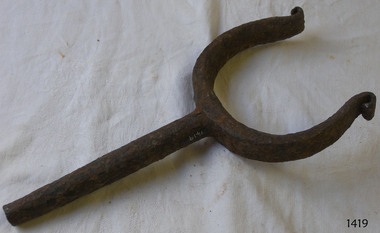
... The boat was described as “… a fine piece of workmanship and does credit to her builders and designers…” It had all the latest improvements in shape, disposition of weight and watertight compartments, and it had space for a large number of people in addition to the crew. It appears that 'H...The boat was described as “… a fine piece of workmanship and does credit to her builders and designers…” It had all the latest improvements in shape, disposition of weight and watertight compartments, and it had space for a large number of people in addition to the crew. It appears that 'H ...Rowlock from the Lifeboat Warrnambool, which is on site at Flagstaff Hill Maritime Village. The construction of the lifeboat ‘Warrnambool’ began 15th September 1909 and was completed almost 12 months later, 1st September 1910. It was built at the Government Dockyard in Williamstown, Victoria, along the lines designed by the Great Britain’s Royal Lifeboat Institution, and included whaleback decks fore and aft, mast and centreboard, and rudder and tiller hung from the sternpost. It could be propelled by both sail and oar. At that time Captain Ferguson was Chief Harbour Master and Mr Beagley was foreman boat builder. Mr Beagley built the lifeboat with his fellow workmen. The boat was described as “… a fine piece of workmanship and does credit to her builders and designers…” It had all the latest improvements in shape, disposition of weight and watertight compartments, and it had space for a large number of people in addition to the crew. It appears that 'H Meiers' whose signature was on the plaque that was found concealed in the hull, was involved with the building of the lifeboat. His signature and the dates of the start and finish of the boat’s construction are pencilled on the raw timber 'plaque' found in the hull in the early 1990’s when the lifeboat was being restored. It is interesting that the ‘Melbourne Directory’ of 1911, published by Sands and MacDougal, lists McAuley and Meiers, boat builders, Nelson Place foreshore, between Pasco and Parker Streets, Williamstown, (Victorian Heritage Database, ‘Contextual History, Maritime Facilities’), It is quite possibly the business of the person whose name is inscribed on the lifeboat plaque. Flagstaff Hill’s documentation also mentions that the keel was laid at ‘Harry Myers, boat builders, Williamstown, Melbourne’ – the name ‘Myers’ can also be spelled ‘Meiers’, which could be the same person as the Meiers in “McAuley and Meiers” (as mentioned in genealogy lines of Myers). The new lifeboat, to be named ‘Warrnambool’ was brought to town by train and launched at the breakwater on 1st March 1911 using the Titan crane (the old lifeboat built in 1858, was then returned to Melbourne in 1911). This new lifeboat was stationed at Warrnambool in a shed located at the base of the Breakwater, adjacent to the slipway. A winch was used to bring it in and out of the water. The lifeboat ‘Warrnambool’ was similar in size to the old lifeboat but far superior in design, build and sea-going qualities such as greater manoeuvrability. The ‘self-righting, self-draining’ design was “practically non-capsizeable” and even if the boat overturned it would right itself to an even keel and the water would drain away. The hull was built of New Zealand Kauri, using double diagonal planking, laid in two layers at right angles, with a layer of canvas and red lead paint between the timbers to help seal the planking. It has “… plenty of freeboard, high watertight spaces between the deck and bottom… through which pipes lead…” The backbone timbers were made of Jarrah. The lifeboat Warrnambool was one of several rescue boats used at Port Fairy and Warrnambool in early 1900's. In late 1914 the Warrnambool lifeboat and crew were used to help find what was left of the tragic wreckage of the Antares, and were able to discover the body of one of the crewmen, which they brought back to Warrnambool. Between 1951 and 1954 the lifeboat was manned under the guidance of Captain Carrington. He held lifeboat practice each month on a Sunday morning, to comply with the Ports and Harbour’s request that lifeboats be manned by a strong and competent crew, ready for action in case of emergency. In the early 1960’s it ended its service as a lifeboat and was used in Port Fairy as a barge to help dredge the Moyne River, bolted to the Port Fairy lifeboat. Flagstaff Hill obtained the Warrnambool in 1975. In 1984 it was on display at Flagstaff Hill Maritime Village, Warrnambool. On 23rd May 1990 she was lifted from the water and placed in a cradle for restoration. The name ‘WARRNAMBOOL could be seen faintly on the lifeboat before it was restored. It was during the restoration that Flagstaff Hill's boat builder discovered the 'plaque' inside the hull. A copy of the blueprint plans has the name “V.E.E. Gotch” printed on it. His advertisement in Footscray’s ‘Independent’ newspaper of Saturday 11th May 1901 states he is “Principal and Skilled member (Naval Architect) to the Court of Marine Inquiry of Victoria and holds classes for naval architectural drawing and arithmetic.” The rowlock is significant for its association with the lifeboat WARRNAMBOOL, which is significant for its half century service to the local community as a lifesaving vessel. She was also used to help retrieve the body of a shipwrecked crew member of the ANTARES. Rowlock, iron, upper ends scroll over, from the Lifeboat Warrnambool.flagstaff hill, warrnambool, shipwrecked-coast, flagstaff-hill, flagstaff-hill-maritime-museum, maritime-museum, shipwreck-coast, flagstaff-hill-maritime-village, life boat, life saving vessel, 1910 vessel, port fairy, boat builder plaque, rescue boat, beagley, government dockyard, williamstown, v.e.e. gotch, royal lifeboat institution, captain ferguson, non-capsizeable lifeboat, self-righting lifeboat, antares shipwreck, double diagonal planking, captain carrington, rowlock, lifeboat rowlock, lifeboat warrnambool -
 Flagstaff Hill Maritime Museum and Village
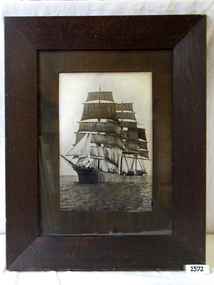
Photograph
... H F Watson for S.S.V by Capt F.K. Baxter, 74 Verdon Street, Williamstown. flagstaff hill warrnambool shipwrecked-coast flagstaff-hill flagstaff-hill-maritime-museum maritime-museum shipwreck-coast flagstaff-hill-maritime-village photograph of ship wiscombe park ship grief ship builder j.blumer sunderland captain baxter barque "shandon" Photograph of the ship "Wiscombe Park" later named "Grife" set in varnished wooden frame. ...This is a photograph of the ship "Wiscombe Park", later named "Grief". It is set in a varnished wooden frame. Written on back: steel ship in blue pen; "Wiscombe Park" later "Greif" 2075 tons reg 281 feet by 42 feet 2 ' by 21 feet 7' draught Built by J.Blumer Sunderland in 1892. Broken up in Belfast Ireland 1927. Capt Baxter when 2nd Mate to become 2nd Mate of the barque "Shandon" about 1918. Photo presented to H F Watson for S.S.V by Capt F.K. Baxter, 74 Verdon Street, Williamstown.Photograph of the ship "Wiscombe Park" later named "Grife" set in varnished wooden frame. Written on back: steel ship "Wiscombe Park" later "Greif" 2075 tons reg 281 feet by 42 feet 2 ' by 21 feet 7' draught Built by J.Blumer Sunderland in 1892. Broken up in Belfast Ireland 1927. Capt Baxter when 2nd Mate to become 2nd Mate of the barque "Shandon" about 1918. Photo presented to H F Watson for S.S.V by Capt F.K. Baxter, 74 Verdon Street, Williamstown.flagstaff hill, warrnambool, shipwrecked-coast, flagstaff-hill, flagstaff-hill-maritime-museum, maritime-museum, shipwreck-coast, flagstaff-hill-maritime-village, photograph of ship wiscombe park, ship grief, ship builder j.blumer sunderland, captain baxter, barque "shandon" -
 Flagstaff Hill Maritime Museum and Village
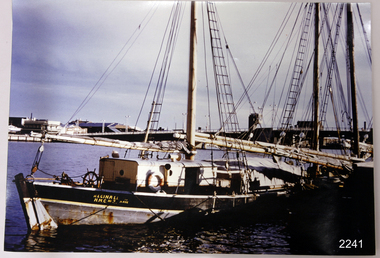
Photograph
... builder frequented all the salvage yards for materials and fittings. The Reginald M had a very shallow draft and a flat bottom that enabled it to sit high and dry at low tide. The flat bottom was also to make the ship able to skim over reefs. Wagons were able to load and unload direct from her side. Her cargo included Guano, Barley, Wool, Horses, Cattle, Timber, Explosives, Potatoes, Shell Grit and Gypsum. In 1931 she weathered a large storm in St Vincents Gulf, SA. Her crew at the time were Owner Mr John H...builder frequented all the salvage yards for materials and fittings. The Reginald M had a very shallow draft and a flat bottom that enabled it to sit high and dry at low tide. The flat bottom was also to make the ship able to skim over reefs. Wagons were able to load and unload direct from her side. Her cargo included Guano, Barley, Wool, Horses, Cattle, Timber, Explosives, Potatoes, Shell Grit and Gypsum. In 1931 she weathered a large storm in St Vincents Gulf, SA. Her crew at the time were Owner Mr John H ...This coloured photograph of the ketch Reginald M was taken when she was docked at Port Adelaide. The side of the vessel shows the letters "REGINALD M / H.M.C. No. 2 Pt ADEL" - (abbreviation H.M.C. meaning His/Her Majesty's Customs. HISTORY The Reginald M, a two-masted coastal ketch, was owned and built by Mr. Jack (John) Murch of Birkenhead, Port of Adelaide, South Australia to serve the coastal ports of South Australia. Its construction took approximately 6 months and it was launched at Largs Bay in 1922. Its purpose was to carry cargo cheaply and efficiently, and tradition has it that the keel was in fact hewn from two telegraph poles! Its builder frequented all the salvage yards for materials and fittings. The Reginald M had a very shallow draft and a flat bottom that enabled it to sit high and dry at low tide. The flat bottom was also to make the ship able to skim over reefs. Wagons were able to load and unload direct from her side. Her cargo included Guano, Barley, Wool, Horses, Cattle, Timber, Explosives, Potatoes, Shell Grit and Gypsum. In 1931 she weathered a large storm in St Vincents Gulf, SA. Her crew at the time were Owner Mr John H Murch, Wells St, Largs Bay, Skipper, John’s brother Mr R Murch, Murray, son of Mr R Murch and Seaman John Smith Reg Webb purchased Carribie Station, at Marion in the Warooka District, south of Adelaide, in 1921. He cleared the land and farmed sheep and grain. In 1923 he shipped his own wool and grain from Marion Bay, having first carted 300 bags of the barley grain, 12 bags at a time, along the unmade track to the jetty. A photograph dating about 1929 -1942 shows 2 men on the Reginald M, having just landed their fishing catch of a hammer shark. The photograph is stamped “GRENFELL STUDIO PORT LINCLON PRINT” and titled “hammer shark caught on Reginall Emm”. Reg Webb knew the Murch Brothers from Port Adelaide. The brothers had been using their ketch REGINALD M to ship Guano from the Islands, led by Captain Richard Murch. Reg approached them in 1934 about shipping grain from Marion Bay. The brothers visited the bay and thought it was an ideal place. They showed Reg where to stack his grain and they measured up the cliffs. When Reg was ready, they brought down and installed a ninety foot wooden chute. The bags of grain were then individually sent down the chute, landing in a waiting small boat then rowed to REGINALD M, 14 bags at a time. After 10 hours REGINALD M would be fully loaded with 1300 bags of grain and shipped to waiting ports. At one time a wild storm destroyed the chute but it was rebuilt and strengthened. REGINALD M was involved in shipping the grain from there until 1938. In 1940 Able Seaman Allan H Lucas served on Reginald M between September and December, being engaged and discharged from Port of Adelaide. His Certificate of Discharge was signed by ship’s Master W S Murch. It seems that at some stage Reginald M was used as a Customs vessel because a photograph in Flagstaff Hill’s collection shows the text “H.M.C. No. 3, Pt Adelaide” on the bow, the abbreviations standing for “His/Her Majesty’s Customs”. In 1969 the last freight left Marion Bay on the ketch REGINALD M carrying grain, wool and explosives. In late 1970 she was sold to the Mt. Lyell Copper Company, based in Queenstown, Tasmania, to carry explosives. In 1972 the Navy League of Strahan, Tasmania, purchased her for use by the Strahan Sea Cadet Unit and renamed her T.S. Macquarie. In 1974 Mr. Andrew Rennie, of East Brighton, Melbourne, bought her, paying $5,000 and donating a ‘Cadet of the Year” trophy to the Sea Cadets. He sailed her from Strahan to Melbourne, planning to use her for pleasure sailing. In 1975 Reginald M was sold to Melbourne Ferry Company at auction. In 1975 the Reginald M was bought by Flagstaff Maritime Museum for $20,000. She has been restored and is now one of the exhibits, tied up at the dock. Flagstaff Hill Maritime Village’s Collection holds several other artefacts associated with Reginald M. They include - Photographs of the Reginald M, including one photograph of her in Outer Harbour, S.A. dated 1947, with Skipper- R.F. Dale and Owner- John Murch. Another shows her docked at Port Adelaide, with the lettering H.M.C. No. 3 Pt ADEL (standing for His/Her Majesty’s Customs). There is a black and white photo of her at a wharf and another showing a person on board. - a lifebuoy, with Pt Adelaide on it. - a bullet found in pieces of timber when Reginald M was restored in 1979 (References: Flagstaff Hill Fact Sheet “Reginald M”, the book “The Reg Webb Story” compiled by the Warooka & District Museum. Reg Webb’s daughter Lily Ramsay (nee Webb) and her husband Howard, Lizzie Rennie (daughter of owner Andrew Rennie), brochure “Discover the Yorke Peninsula South Australia”, Ketch in Peril; Adelaide Chronicle 9 April 1931, K Gordon & Mary Filmer of Warooka; South Australian Maritime Museum) Thiis photograph is significant because of its connection to the history of the vessel REGINALD M is a coastal trading ketch from South Australia built in 1922. It is one of very few sailing coastal trading vessels still extant, and its flat bottom, single chine shape illustrates a very simple but robust method of construction, compared to other round bilged examples of trading vessels. She is now listed on the Australian Register of Historic Vessels (ARHV Number: HV000562.)Photograph of Reginald M at Port Adelaide. The side of the vessel shows the letters "REGINALD M / H.M.C. No. 2 Pt ADEL" - (abbreviation H.M.C. meaning His/Her Majesty's Customs. Painted on the side of the vessel "REGINALD M / H.M.C. No. 2 Pt ADEL" - flagstaff hill, warrnambool, shipwrecked-coast, flagstaff-hill, flagstaff-hill-maritime-museum, maritime-museum, shipwreck-coast, flagstaff-hill-maritime-village, reginald m, coastal trading ketch, trading vessel, john murch ship builder, port adelaide vessel reginald m, andrew rennie, macquarie training vessel, mt lyell copper company, queenstown navy league, ch murch, reg webb, carribie station, melbourne ferry company, grenfell studio port lincoln, vessel reginald m -
 Flagstaff Hill Maritime Museum and Village
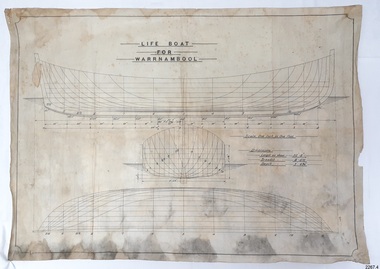
Plan - Vessel Line Drawing, Life Boat for Warrnambool, ca. 1900-1909
... The boat was described as “… a fine piece of workmanship and does credit to her builders and designers…” It had all the latest improvements in shape, disposition of weight and watertight compartments, and it had space for a large number of people in addition to the crew. It appears that 'H...The boat was described as “… a fine piece of workmanship and does credit to her builders and designers…” It had all the latest improvements in shape, disposition of weight and watertight compartments, and it had space for a large number of people in addition to the crew. It appears that 'H ...The plans were used for the construction of the lifeboat ‘Warrnambool’, which began 15th September 1909 and was completed almost 12 months later 1st September 1910. It was built at the Government Dockyard in Williamstown, Victoria, along the lines designed by Great Britain’s Royal Lifeboat Institution, and included whaleback decks fore and aft, mast and centreboard, and rudder and tiller hung from the sternpost. It could be propelled by both sail and oar. At that time Captain Ferguson was Chief Harbour Master and Mr Beagley was the foreman boat builder. Mr Beagley built the lifeboat with his fellow workmen. The boat was described as “… a fine piece of workmanship and does credit to her builders and designers…” It had all the latest improvements in shape, disposition of weight and watertight compartments, and it had space for a large number of people in addition to the crew. It appears that 'H Meiers' whose signature was on the plaque that was found concealed in the hull, was involved with the building of the lifeboat. His signature and the dates of the start and finish of the boat’s construction are pencilled on the raw timber 'plaque' found in the hull in the early 1990s when the lifeboat was being restored. It is interesting that the ‘Melbourne Directory’ of 1911, published by Sands and MacDougal, lists McAuley and Meiers, boat builders, Nelson Place foreshore, between Pasco and Parker Streets, Williamstown, (Victorian Heritage Database, ‘Contextual History, Maritime Facilities’), It is quite possibly the business of the person whose name is inscribed on the lifeboat plaque. Flagstaff Hill’s documentation also mentions that the keel was laid at ‘Harry Myers, boat builders, Williamstown, Melbourne’ – the name ‘Myers’ can also be spelled ‘Meiers’, which could be the same person as the Meiers in “McAuley and Meiers” (as mentioned in genealogy lines of Myers). The new lifeboat, to be named ‘Warrnambool’ was brought to town by train and launched at the breakwater on 1st March 1911 using the Titan crane (the old lifeboat built in 1858, was then returned to Melbourne in 1911). This new lifeboat was stationed at Warrnambool in a shed located at the base of the Breakwater, adjacent to the slipway. A winch was used to bring it in and out of the water. The lifeboat ‘Warrnambool’ was similar in size to the old lifeboat but far superior in design, build and sea-going qualities such as greater manoeuvrability. The ‘self-righting, self-draining design was “practically non-capsizeable” and even if the boat overturned it would right itself to an even keel and the water would drain away. The hull was built of New Zealand Kauri, using double diagonal planking, laid in two layers at right angles, with a layer of canvas and red lead paint between the timbers to help seal the planking. It has “… plenty of freeboard area, high watertight spaces between the deck and bottom… through which pipes lead…” The backbone timbers were made of Jarrah. The lifeboat Warrnambool was one of several rescue boats used at Port Fairy and Warrnambool in the early 1900s. In late 1914 the Warrnambool lifeboat and crew were used to help find what was left of the tragic wreckage of the Antares and were able to discover the body of one of the crewmen, which they brought back to Warrnambool. Between 1951 and 1954 the lifeboat was manned under the guidance of Captain Carrington. He held lifeboat practice each month on a Sunday morning, to comply with the Ports and Harbour’s request that lifeboats be manned by a strong and competent crew, ready for action in case of emergency. In the early 1960’s it ended its service as a lifeboat and was used in Port Fairy as a barge to help dredge the Moyne River, bolted to the Port Fairy lifeboat. Flagstaff Hill obtained the Warrnambool in 1975. In 1984 it was on display at Flagstaff Hill Maritime Village, Warrnambool. On 23rd May 1990, she was lifted from the water and placed in a cradle for restoration. The name ‘WARRNAMBOOL could be seen faintly on the lifeboat before it was restored. It was during the restoration that Flagstaff Hill's boat builder discovered the 'plaque' inside the hull. A copy of the blueprint plans has the name “V.E.E. Gotch” printed on it. His advertisement in Footscray’s ‘Independent’ newspaper of Saturday 11th May 1901 states he is “Principal and Skilled member (Naval Architect) to the Court of Marine Inquiry of Victoria and holds classes for naval architectural drawing and arithmetic.” The line drawing is significant for its connection with the lifeboat WARRNAMBOOL. The lifeboat is very significant to local and state history for its use in the lifesaving rescues of seafarers, particularly in Lady Bay. It was part of the local rescue equipment. It gave a half-century of service to the local community as a lifesaving vessel, including its involvement in retrieving the body of a shipwrecked crew member of the ANTARES. Line drawing in black ink and pencil on rectangular parchment or waxed linen. Drawing has diagrams of three profiles of a vessel, with measurements and connecting pencil lines on the left quarter. The plan is for the lifeboat named “Warrnambool”, which was built in Melbourne and completed in 1910. Old blue copies of the Lifeboat plan are archived also.“LIFE BOAT / FOR / WARRNAMBOOL” “Scale, One Inch to One Foot” “ “Length as shown 30’ – 8” “ “Breadth “ “ 8’ – 6 ½ “ “ “Depth “ “ 3’ – 4 ¾” “flagstaff hill, warrnambool, shipwrecked-coast, flagstaff-hill, flagstaff-hill-maritime-museum, maritime-museum, shipwreck-coast, flagstaff-hill-maritime-village, lifeboat, warrnambool lifeboat, boat plans, lifeboat plans, boat construction, boat building, line drawing, plan for lifeboat, life boat, life boat 'warrnambool', clinker design, 1910 lifeboat, life saving equipment, shipbuilding -
Mission to Seafarers Victoria
Photograph - Reproduction, Jay Miller, 6 June 2019
... builder's yards, in the .presence of njarge gather ing of spectators. The Archdeacon of Geelong. the Rev. O. P. C'ros-.ley. ecu ducted a short dedication service, and the other clergymen who took part in the service were the Primate of Aus tralia. the Right Rev. Dr. Sauiuarcz Smith: the Rev. A. Giirney Goldsmith, the Missions chaplain: and the Rev. H...builder's yards, in the .presence of njarge gather ing of spectators. The Archdeacon of Geelong. the Rev. O. P. C'ros-.ley. ecu ducted a short dedication service, and the other clergymen who took part in the service were the Primate of Aus tralia. the Right Rev. Dr. Sauiuarcz Smith: the Rev. A. Giirney Goldsmith, the Missions chaplain: and the Rev. H ...This photograph was published in the Geelong Advertiser on Friday 23 November 1906, page 4 with this article: "Owing to the generosity of an anonymous donor, the Victorian Missions to Seamen has been supplied with a long felt want in the shape of a modern motor launch to facilitate and render more efficient the work among the vessels in the Yarra and Hobson's Bay. The order for the construction of the boat, was placed with Mr. Chas. Blunt, of the Eastern Beach, and complimentary references were made to her graceful line- as she rode in light .trim after the launching on Wednesday afternoon. She is 31ft. long. Oft. beam, and has a depth of 3ft. The frame is of jarrah and ben* blackwood. and inch kauri planking has been used in building Iter. A neat deck-house with Oft. headroom is situat ed-umidsliip*. and a short mast is pro vided to carry the well-known blue flag of the -.fission. The launch motors will develop a speed of between nine and ten miles an hour: The finishing touches have yet to be given her. and she will afterwards be row«l to have her engines fitted in. -The launch will he ready for service for the busy wheat season com mencing at- the end of the year. The launching ceremony took place at 6 p.m. on Wednesday at the builder's yards, in the .presence of njarge gather ing of spectators. The Archdeacon of Geelong. the Rev. O. P. C'ros-.ley. ecu ducted a short dedication service, and the other clergymen who took part in the service were the Primate of Aus tralia. the Right Rev. Dr. Sauiuarcz Smith: the Rev. A. Giirney Goldsmith, the Missions chaplain: and the Rev. H. Kelly. The Bishop of Newcastle, Dr. Stretch, and the chaplain of the New castle Mission, the Rev. AYnddy. and Canon Nash were also present. The Primpte. addressing the gar boring as "My good friends of Geelong." said be had never been in sight of the hay before. bill had'gladly accepted the in vitation to say a few words in connec tion with the dedication of tiro launch. He had always been interested in mis sions of all sorts, as they ali as Christian men and women 110 doubt- were, and lie was particularly interested in Missions to Seamen, because in the Society at' borne, with which this Society was con nected, he had a son-in-law who was mission chaplain in the Medway. He therefore know something about a launch for the purpose of a mission like this, and also knew 'something about missions to seamen. In Sydney for some time past it had been doing good work—work which he was sure they would all feel was of the widest possible value. This year he was at the annual meeting of the Missions to Seamen in London presided over by the Bishop o-f Stcphney. -He (the Primate) at that meeting remarked that the Mission in it, value was personal, local and Im perial. It was of personal value to thee who came under the ministra tions of the church, and in the social as pect : it was local because where the Mission existed the feelings of the lo cality were thrown out. in sympathy with j tlie -Mission, and the people themselves thus benefited. It was also a matter of Imperial interest because it- was really i a world-wide Mission, inasmuch as the | sailors as they" went from one part of the world to another were in themselves j missionaries either for evil or for good, i Thev might he missionaries with a mcs i sago which might degrade and "work ail I evil influence amongst, men, and with i conduct which might reflect a reproach !' upon Christian profession. On the other hand, they might be Chrisian men endeavoring more and more to show the .example of the Christian life in the J midst of very big difficulties and tempta tions. • -Ho came to show liis sympathy with tlio appropriately-named '"'Southern Cross," and from what lie had boon told he believed she was a good boat, a good gift, and launched for a good purpose. They should be thankful that it was a good boat and .thankful because it was a good gift by an anonymous donor, whom he congratulated on doing such a useful thing." The idea of the launch ing ceremony was to ask the blessing of God because ".Except the Lord hless'the house their labor is hut lost'that build it." The Archdeacon expressed thanks to the Primate for attending the cere mony, and regretted that the Arch bishop was unable to attend. They dc- | sired that the boat- should always be as sociated with the.Church Congress 1906. I The opening hymn was "For those in j peril on the sea," followed hv Psalm I 107, "'They'that, go down to the sea in 1 Ships." Tlio prayers included an ap peal foiUDirine blessing on .the launch, and for tho preservation of those who may travel in her. ' Xlio Benediction was pronounced by the Primate, and the christening cere mony performed by Hiss Connibere. From the bow there was suspended a bottle of pure water covered with red, white and blue streamers and roses. Dashing the bottle in,fragments against the launch's bow. Miss Connibere named her the "Southern Cross." Cheers were given for the launch/and as she travell ed down the slip further cheers were given. She carried the Mission flag at tho masthead, and between Union Jacks at tho bow and stern, a long string of flags fluttered gaily* in the breeze. The collection was in aid of the Mis sions to Seamen and the Geelong Sailors' Rest.Reproduction of a photograph from a newspaper.Fujifilm / Quality Dry Photo papersouthern cross, motor boat, mission to seamen, seamen's mission, charles blunt, blunt boatbuilders, geelong -
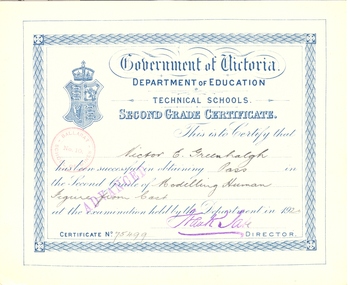 Federation University Historical Collection
Certificate, Education Department, Victoria, Victorian Education Department Certificates, 1916-1928
... Ballarat Technical Art School was a division of the Ballarat School of Mines. ann duke plain needlework victor greenhalgh frank tate ballarat technical art school arnold j. allen florence allen m.a. ansen dressmaking modelling human figure from cast ruby e. allison drawing fro memory nancy b. angwin maude arberry douglas w. arch muriel j. arch eileen bailey annie c. baker percy j. baker general design light metal work bessie m. barbery commerical arithmetic decorative needlework bert bernaldo drawing from a flat example lorna m. mccallum brush drawing stanley g.a. barnett millinery mavis g. beacham theodore k. beckwith isabel j. bell kelva e. bellingham leslie bennett olive van berkel elizabeth e. berry beatrice m. blake thomas g. blake catherine m. bowers nancy w. bowe clarice v. branagh harold r. brown architecture modelling the head from life henry bull light metalwork ivan d. brown thyra j. brown henry j. bull leila m. burford embossed leathwork lettering drawing fro dressmakers irene m. burke josephine m. callery modelling mona r. callow herbert cameron lillias cameron william e. carlyon doris l. carter ruth e. catt hiram e. chamberlain stephen chambers jack d. chand jack d. chard clara v. clegg beryl e. coad john c. collins keith m. collins robert g. collins kathleen m. conway athol b. cornish ballantyne cottier douglas s. cotton lilith s. christmas perspective doreen coughlan ivy g. crompton phyllis culliver joan m. cuthbertson alan r. cutter john l. daniel arthur dansey katherine d'arcy dorothy f. darling myrtle f. darling reginal a. davey gwladys h. davies annie dellaca henry a. deller ivy f. denovan joyce doepel bessie donacaster charles o. dowie horace b. dowsing walter dunstan mary dwyer allan r. egglestone melville g. ellingsen hugh o. elliott beryl r. ellis cecil f. engish allan e. evans matson l. eves olive j. fairlie robert j. falla mavis felstead lena featherston albert c. ferguson alma ferguson hilda m. ferguson john f. ferguson beatrice m. field clarice f. fisher philip h. fleischer building construction olive p. francis agnes fraser essie gale gilbert foster pearle fricke effie gascoigne enid m. gates clarice gear james a. geary sylvia f. greenhalgh evelyn f. geddes thomas j. gibson wavie b. gilbert edna m. gilmer nancy govan eula h. gower doris e. gray lesley j. gower henry n. graham victor e. greenhalgh melva e. gribble human anatomy roy k. griggs jack gullan robert gullan alma m. gunn dorothy j. hallan lucy hamilton james hammer dorothy e. hamond christopher j. hanlon catherin hardess lily haymes gladys hedges irene h. hewitt john hill victor j. hill olive hillings john a. hobill frances k. holmes gertrude m. hopkins alice horan marjorie hudson linda m. hughes lydia hughes winifred humphreys commercial english agnes a. humphries colin hunt kathleen hutchinson francis n. king jean king hilda knox john kopke isabel a. kopke hazel jackson freda jacobi agnes james william r. james alexander johnson edward j. jones eleanor w.h. jones nellie kau thomas kean francis kelly roy k. kelly thomas g. kierce theo e. leonard esther f. leviston bessie lockett norman h. long ena mackay gwenda e. mann robert v. maddison herbert w. malin dorothy m. marriott john c. mcarthur james p. mcculloch doris mcdougall cyril mcgibbony thelma mcgibbony jean mcgregor kenneth mciver constance m. mckenzie elsie j. mckissock alexander k.mcleod grace b. mclean john f.w. mclean rebecca mcphan vera meeny edna merritt dougald miller florence h. mingst agnes m. monteith doreen j. montgomery jean e. montgomery robert w.p. montgomery margaret b. moore harry e. morrish james mow gwendoline r. neagle gerald r. newson robert j. nicol helen f. nicholl george m. norton edward s. oliver mavis e. oliver hector h, osborne henry parker norma e. parr doris m. patterson elsie pearce celia pearlman leslie pearlman edna pearson william j. perriman eulalie perry ernest b. pinney charles e. peverill clarence r. pittock raymond b. pitts phyllis polson cynthia b. power bessie puzey john m. punshon evelyn a.v. ramsay robert i ramsay william a. rattray drawing for builders and artisans george h. reed fred reeves mavis i. regelhuth george r. renkin annie e. reynolds lizzie rice eileen l. richards henry c. riegelhuth gladys m. riley charles a. rimmington amy robson ernest w. robson florence a. rogers dorothy rppney kathleen rooney hugh n. ross stella m. rowe agnes w. ryan rosaling e. sage cora sandberg eric c. sanders douglas f. scott sylvia e. selkirk dorine a. shearer gladys sheldon emily e. simper veri slattery florence c. smith hilda m. spencer rose spiers mopna g. spiller alma m. stapleton joyce w. stark marcus m. stone commercial correspondence beatrice m. stuart ena v. sullivan margaret a. sydes rita tainsh norman b. tamlyn arthur w. thane alma m. thomas david e. thomas william h. thompson william m. thomas edgatr j.t. tippett sidnet tippett gladys tongway mavis toop hugh d. trainor annie e. treloar john h. treloar eilleen trumain linda f. treewk percival a. trompf percy trompf jean tunbridge ruth e. tunbridge allan j. twaits irene m. utting elizabeth van beek william a. wade agnes a. walker james a. walker vera v. aller john walsh marjorie walters rex warrillow edith watson bernice e. webb constance i weeks ina m. westcott pearl whan violet wheeler myrtle d. whitfield annie whitl richard l. whitla charles f. whitla grace a. wilcock murray a. wilkie andrew w. william arthur williams baden p. williams david d. williams grace f. williams maude h. williams mavis m. williams james williamson ivy wilson hector g wilson frederick w.r. wilson david s. wood Stamped Ballarat School of Mines No.10 Stamped signature "Frank Tate" 373 certificates in 2 boxes. ...Ballarat Technical Art School was a division of the Ballarat School of Mines.373 certificates in 2 boxes. Most appear to be related to subjects undertaken at the Ballarat Technical Art School. Director of education stamped signature Frank Tate.Stamped Ballarat School of Mines No.10 Stamped signature "Frank Tate"ann duke, plain needlework, victor greenhalgh, frank tate, ballarat technical art school, arnold j. allen, florence allen, m.a. ansen, dressmaking, modelling human figure from cast, ruby e. allison, drawing fro memory, nancy b. angwin, maude arberry, douglas w. arch, muriel j. arch, eileen bailey, annie c. baker, percy j. baker, general design, light metal work, bessie m. barbery, commerical arithmetic, decorative needlework, bert bernaldo, drawing from a flat example, lorna m. mccallum, brush drawing, stanley g.a. barnett, millinery, mavis g. beacham, theodore k. beckwith, isabel j. bell, kelva e. bellingham, leslie bennett, olive van berkel, elizabeth e. berry, beatrice m. blake, thomas g. blake, catherine m. bowers, nancy w. bowe, clarice v. branagh, harold r. brown, architecture, modelling the head from life, henry bull, light metalwork, ivan d. brown, thyra j. brown, henry j. bull, leila m. burford, embossed leathwork, lettering, drawing fro dressmakers, irene m. burke, josephine m. callery, modelling, mona r. callow, herbert cameron, lillias cameron, william e. carlyon, doris l. carter, ruth e. catt, hiram e. chamberlain, stephen chambers, jack d. chand, jack d. chard, clara v. clegg, beryl e. coad, john c. collins, keith m. collins, robert g. collins, kathleen m. conway, athol b. cornish, ballantyne cottier, douglas s. cotton, lilith s. christmas, perspective, doreen coughlan, ivy g. crompton, phyllis culliver, joan m. cuthbertson, alan r. cutter, john l. daniel, arthur dansey, katherine d'arcy, dorothy f. darling, myrtle f. darling, reginal a. davey, gwladys h. davies, annie dellaca, henry a. deller, ivy f. denovan, joyce doepel, bessie donacaster, charles o. dowie, horace b. dowsing, walter dunstan, mary dwyer, allan r. egglestone, melville g. ellingsen, hugh o. elliott, beryl r. ellis, cecil f. engish, allan e. evans, matson l. eves, olive j. fairlie, robert j. falla, mavis felstead, lena featherston, albert c. ferguson, alma ferguson, hilda m. ferguson, john f. ferguson, beatrice m. field, clarice f. fisher, philip h. fleischer, building construction, olive p. francis, agnes fraser, essie gale, gilbert foster, pearle fricke, effie gascoigne, enid m. gates, clarice gear, james a. geary, sylvia f. greenhalgh, evelyn f. geddes, thomas j. gibson, wavie b. gilbert, edna m. gilmer, nancy govan, eula h. gower, doris e. gray, lesley j. gower, henry n. graham, victor e. greenhalgh, melva e. gribble, human anatomy, roy k. griggs, jack gullan, robert gullan, alma m. gunn, dorothy j. hallan, lucy hamilton, james hammer, dorothy e. hamond, christopher j. hanlon, catherin hardess, lily haymes, gladys hedges, irene h. hewitt, john hill, victor j. hill, olive hillings, john a. hobill, frances k. holmes, gertrude m. hopkins, alice horan, marjorie hudson, linda m. hughes, lydia hughes, winifred humphreys, commercial english, agnes a. humphries, colin hunt, kathleen hutchinson, francis n. king, jean king, hilda knox, john kopke, isabel a. kopke, hazel jackson, freda jacobi, agnes james, william r. james, alexander johnson, edward j. jones, eleanor w.h. jones, nellie kau, thomas kean, francis kelly, roy k. kelly, thomas g. kierce, theo e. leonard, esther f. leviston, bessie lockett, norman h. long, ena mackay, gwenda e. mann, robert v. maddison, herbert w. malin, dorothy m. marriott, john c. mcarthur, james p. mcculloch, doris mcdougall, cyril mcgibbony, thelma mcgibbony, jean mcgregor, kenneth mciver, constance m. mckenzie, elsie j. mckissock, alexander k.mcleod, grace b. mclean, john f.w. mclean, rebecca mcphan, vera meeny, edna merritt, dougald miller, florence h. mingst, agnes m. monteith, doreen j. montgomery, jean e. montgomery, robert w.p. montgomery, margaret b. moore, harry e. morrish, james mow, gwendoline r. neagle, gerald r. newson, robert j. nicol, helen f. nicholl, george m. norton, edward s. oliver, mavis e. oliver, hector h, osborne, henry parker, norma e. parr, doris m. patterson, elsie pearce, celia pearlman, leslie pearlman, edna pearson, william j. perriman, eulalie perry, ernest b. pinney, charles e. peverill, clarence r. pittock, raymond b. pitts, phyllis polson, cynthia b. power, bessie puzey, john m. punshon, evelyn a.v. ramsay, robert i ramsay, william a. rattray, drawing for builders and artisans, george h. reed, fred reeves, mavis i. regelhuth, george r. renkin, annie e. reynolds, lizzie rice, eileen l. richards, henry c. riegelhuth, gladys m. riley, charles a. rimmington, amy robson, ernest w. robson, florence a. rogers, dorothy rppney, kathleen rooney, hugh n. ross, stella m. rowe, agnes w. ryan, rosaling e. sage, cora sandberg, eric c. sanders, douglas f. scott, sylvia e. selkirk, dorine a. shearer, gladys sheldon, emily e. simper, veri slattery, florence c. smith, hilda m. spencer, rose spiers, mopna g. spiller, alma m. stapleton, joyce w. stark, marcus m. stone, commercial correspondence, beatrice m. stuart, ena v. sullivan, margaret a. sydes, rita tainsh, norman b. tamlyn, arthur w. thane, alma m. thomas, david e. thomas, william h. thompson, william m. thomas, edgatr j.t. tippett, sidnet tippett, gladys tongway, mavis toop, hugh d. trainor, annie e. treloar, john h. treloar, eilleen trumain, linda f. treewk, percival a. trompf, percy trompf, jean tunbridge, ruth e. tunbridge, allan j. twaits, irene m. utting, elizabeth van beek, william a. wade, agnes a. walker, james a. walker, vera v. aller, john walsh, marjorie walters, rex warrillow, edith watson, bernice e. webb, constance i weeks, ina m. westcott, pearl whan, violet wheeler, myrtle d. whitfield, annie whitl, richard l. whitla, charles f. whitla, grace a. wilcock, murray a. wilkie, andrew w. william, arthur williams, baden p. williams, david d. williams, grace f. williams, maude h. williams, mavis m. williams, james williamson, ivy wilson, hector g wilson, frederick w.r. wilson, david s. wood -
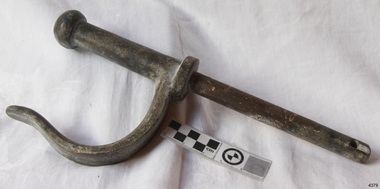 Flagstaff Hill Maritime Museum and Village
Functional object - Rowlock, early 20th century
... builder. Mr Beagley built the lifeboat with his fellow workmen. It had all the latest improvements in shape, disposition of weight with watertight compartments, and it had space for a large number of people in addition to the crew. It appears that 'H...builder. Mr Beagley built the lifeboat with his fellow workmen. It had all the latest improvements in shape, disposition of weight with watertight compartments, and it had space for a large number of people in addition to the crew. It appears that 'H ...This row lock was fitted onto the Warrnambool Lifeboat, which is also on-site at Flagstaff Hill Maritime Village. The construction of the lifeboat 'Warrnambool' began 15th September 1909 and was completed almost 12 months later 1st September 1910. It was built at the Government Dockyard in Williamstown, Victoria, along the lines designed by Great Britain's Royal Lifeboat Institution, and included whale back decks fore and aft, mast and centre board, and rudder and tiller hung from the stern post. It could be propelled by both sail and oar. At that time Captain Ferguson was Chief Harbour Master and Mr Beagley was a foreman boat builder. Mr Beagley built the lifeboat with his fellow workmen. It had all the latest improvements in shape, disposition of weight with watertight compartments, and it had space for a large number of people in addition to the crew. It appears that 'H Meiers' whose signature was on the plaque that was found concealed in the hull, was involved with the building of the lifeboat. His signature and the dates of the start and finish of the boat's construction are penciled on the raw timber 'plaque' found in the hull in the early 1990s when the lifeboat was being restored. It is interesting that the 'Melbourne Directory' of 1911, published by Sands and MacDougal, lists McAuley and Meiers, boat builders, Nelson Place foreshore, between Pasco and Parker Streets, Williamstown, It is quite possibly the business of the person whose name is inscribed on the lifeboat plaque. Flagstaff Hill's documentation also mentions that the keel was laid at 'Harry Myers, boat builders, Williamstown, Melbourne the name 'Myers' can also be spelled 'Meiers', which could be the same person as the Meiers in "McAuley and Meiers" (as mentioned in genealogy lines of Myers). The new lifeboat, to be named 'Warrnambool' was brought to town by train and launched at the breakwater on 1st March 1911 using the Titan crane (the old lifeboat built-in 1858, was then returned to Melbourne in 1911). This new lifeboat was stationed at Warrnambool in a shed located at the base of the Breakwater, adjacent to the slipway. The lifeboat ‘Warrnambool’ was similar in size to the old lifeboat but far superior in design, with new sea-going qualities such as greater maneuverability. The ‘self-righting, self-draining’ design was made the vessel difficult to capsize and even if the boat overturned it would right itself to an even keel and the water would drain away. The hull was built of New Zealand Kauri, using double diagonal planking, laid in two layers at right angles, with a layer of canvas and red lead paint between the timbers to help seal the planking. It has plenty of free board. The backbone timbers were made of Jarrah. The Warrnambool lifeboat was one of several rescue boats used at Port Fairy and Warrnambool in the early 1900s. In late 1914 the Warrnambool lifeboat and crew were used to help find what was left of the tragic wreckage of the Antares and were able to discover the body of one of the crewmen. Between 1951 and 1954 the lifeboat was manned under the guidance of Captain Carrington. He held lifeboat practice each month on a Sunday morning, to comply with the Ports and Harbour’s request that lifeboats be ready for action in case of an emergency. In the early 1960’s it ended its service as a lifeboat and was used in Port Fairy as a barge to help dredge the Moyne River. Flagstaff Hill obtained the Warrnambool lifeboat in 1975. In 1984 it was on display at Flagstaff Hill Maritime Village, Warrnambool. On 23rd May 1990, she was lifted from the water and placed in a cradle for restoration. The name 'WARRNAMBOOL could be seen faintly on the lifeboat before it was restored. It was during the restoration that Flagstaff Hill's boat builder discovered the 'plaque' inside the hull. A copy of the blueprint plans has the name “V.E.E. Gotch” printed on it. His advertisement in Footscray’s ‘Independent’ newspaper of Saturday 11th May 1901 states he is “Principal and Skilled member (Naval Architect) to the Court of Marine Inquiry of Victoria and holds classes for naval architectural drawing and arithmetic.” The subject row lock is significant due to its association the Warrnambool Lifeboat which was an integral part of an important service to the local community as a lifesaving vessel for a half-century. One of the lifeboats many achievements was when it was used to help retrieve the body of a shipwrecked crew member of the ship Antares. Rowlock from the Warrnambool Lifeboat.Noneflagstaff hill, warrnambool, shipwrecked-coast, flagstaff-hill, flagstaff-hill-maritime-museum, maritime-museum, shipwreck-coast, flagstaff-hill-maritime-village, lifeboat warrnambool, life boat, life saving vessel, 1910 vessel, port fairy, boat builder plaque, rescue boat, beagley, government dockyard, williamstown, v.e.e. gotch, royal lifeboat institution, captain ferguson, non-capsizeable lifeboat, self-righting lifeboat, antares shipwreck, double diagonal planking, captain carrington, rowlock, lifeboat rowlock -
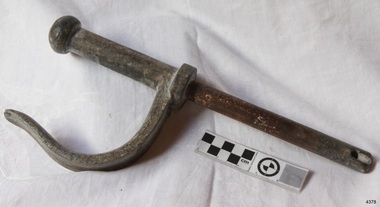 Flagstaff Hill Maritime Museum and Village
Functional object - Rowlock, early 20th century
... builder. Mr Beagley built the lifeboat with his fellow workmen. It had all the latest improvements in shape, disposition of weight with watertight compartments, and it had space for a large number of people in addition to the crew. It appears that 'H...builder. Mr Beagley built the lifeboat with his fellow workmen. It had all the latest improvements in shape, disposition of weight with watertight compartments, and it had space for a large number of people in addition to the crew. It appears that 'H ...This row lock was fitted onto the Warrnambool Lifeboat, which is also on-site at Flagstaff Hill Maritime Village. The construction of the lifeboat 'Warrnambool' began 15th September 1909 and was completed almost 12 months later 1st September 1910. It was built at the Government Dockyard in Williamstown, Victoria, along the lines designed by Great Britain's Royal Lifeboat Institution, and included whale back decks fore and aft, mast and centre board, and rudder and tiller hung from the stern post. It could be propelled by both sail and oar. At that time Captain Ferguson was Chief Harbour Master and Mr Beagley was a foreman boat builder. Mr Beagley built the lifeboat with his fellow workmen. It had all the latest improvements in shape, disposition of weight with watertight compartments, and it had space for a large number of people in addition to the crew. It appears that 'H Meiers' whose signature was on the plaque that was found concealed in the hull, was involved with the building of the lifeboat. His signature and the dates of the start and finish of the boat's construction are penciled on the raw timber 'plaque' found in the hull in the early 1990s when the lifeboat was being restored. It is interesting that the 'Melbourne Directory' of 1911, published by Sands and MacDougal, lists McAuley and Meiers, boat builders, Nelson Place foreshore, between Pasco and Parker Streets, Williamstown, It is quite possibly the business of the person whose name is inscribed on the lifeboat plaque. Flagstaff Hill's documentation also mentions that the keel was laid at 'Harry Myers, boat builders, Williamstown, Melbourne the name 'Myers' can also be spelled 'Meiers', which could be the same person as the Meiers in "McAuley and Meiers" (as mentioned in genealogy lines of Myers). The new lifeboat, to be named 'Warrnambool' was brought to town by train and launched at the breakwater on 1st March 1911 using the Titan crane (the old lifeboat built-in 1858, was then returned to Melbourne in 1911). This new lifeboat was stationed at Warrnambool in a shed located at the base of the Breakwater, adjacent to the slipway. The lifeboat ‘Warrnambool’ was similar in size to the old lifeboat but far superior in design, with new sea-going qualities such as greater maneuverability. The ‘self-righting, self-draining’ design was made the vessel difficult to capsize and even if the boat overturned it would right itself to an even keel and the water would drain away. The hull was built of New Zealand Kauri, using double diagonal planking, laid in two layers at right angles, with a layer of canvas and red lead paint between the timbers to help seal the planking. It has plenty of free board. The backbone timbers were made of Jarrah. The Warrnambool lifeboat was one of several rescue boats used at Port Fairy and Warrnambool in the early 1900s. In late 1914 the Warrnambool lifeboat and crew were used to help find what was left of the tragic wreckage of the Antares and were able to discover the body of one of the crewmen. Between 1951 and 1954 the lifeboat was manned under the guidance of Captain Carrington. He held lifeboat practice each month on a Sunday morning, to comply with the Ports and Harbour’s request that lifeboats be ready for action in case of an emergency. In the early 1960’s it ended its service as a lifeboat and was used in Port Fairy as a barge to help dredge the Moyne River. Flagstaff Hill obtained the Warrnambool lifeboat in 1975. In 1984 it was on display at Flagstaff Hill Maritime Village, Warrnambool. On 23rd May 1990, she was lifted from the water and placed in a cradle for restoration. The name 'WARRNAMBOOL could be seen faintly on the lifeboat before it was restored. It was during the restoration that Flagstaff Hill's boat builder discovered the 'plaque' inside the hull. A copy of the blueprint plans has the name “V.E.E. Gotch” printed on it. His advertisement in Footscray’s ‘Independent’ newspaper of Saturday 11th May 1901 states he is “Principal and Skilled member (Naval Architect) to the Court of Marine Inquiry of Victoria and holds classes for naval architectural drawing and arithmetic.” The subject row lock is significant due to its association the Warrnambool Lifeboat which was an integral part of an important service to the local community as a lifesaving vessel for a half-century. One of the lifeboats many achievements was when it was used to help retrieve the body of a shipwrecked crew member of the ship Antares. Rowlock from the Warrnambool Lifeboat.Noneflagstaff hill, warrnambool, shipwrecked-coast, flagstaff-hill, flagstaff-hill-maritime-museum, maritime-museum, shipwreck-coast, flagstaff-hill-maritime-village, lifeboat warrnambool, life boat, life saving vessel, 1910 vessel, port fairy, boat builder plaque, rescue boat, beagley, government dockyard, williamstown, v.e.e. gotch, royal lifeboat institution, captain ferguson, non-capsizeable lifeboat, self-righting lifeboat, antares shipwreck, double diagonal planking, captain carrington, rowlock, lifeboat rowlock -
 Flagstaff Hill Maritime Museum and Village
Book - Trade Union Rules, Shipwrights' Provident Union of the Port of London, Rules of the Shipwrights' Provident Union of the Port of London, 28-09-1895
... H B Thomas in Melbourne, most likely his employer. Flagstaff Hill Warrnambool Maritime Village Maritime Museum Shipwreck coast Great Ocean Road Norman McKenzie Norman Desmond McKenzie Belfast shipwright Shipwright's apprenticeship Harland & Wolff Limited Shipbuilding & Engineering Works the Ship Constructors’ and Shipwrights’ Association Registered Shipwright Victorian branch of the Federated Shipwrights Ship constructors Naval Architects Ships’ Draughtsmen and Boat Builders’ Association of Australia Victoria branch Shipwrights' Provident Union H.B. ...A number of items once belonging to shipwright Norman McKenzie were donated to Flagstaff Hill Maritime Museum and Village. They are related to Norman’s apprenticeship and certification as a Shipwright in Belfast, his Union membership and his employment as a shipwright in Melbourne. One of the items, a union Rules Book inscribed with the name H.B. Thomas and dated 1902, had within its pages Norman’s Indenture of Apprenticeship, dated 1941, Norman Desmond McKenzie was born in Belfast in 1925 and lived at 10 Pansy Street Belfast, Northern Ireland. At the age of 16 years, he began a 5-year Shipwright’s apprenticeship with Harland & Wolff Limited, Shipbuilding & Engineering Works, Belfast. He became a member of the Ship Constructors’ and Shipwrights’ Association, Belfast (B) Branch 20. His Registration Number was 38748. He completed his apprenticeship on December 16th, 1946, aged 21 years, his address was 26 Connsbrook Drive, Sydenham, N. Belfast. In October 1949 Norman received Clearance from his Union as a financial member to move to another branch. He completed his Apprenticeship on December 16th 1946. Two months later he migrated to Australia, and he arrived in Victoria, and he became a Financial Member of the Victorian branch of the Federated Shipwrights, Ship constructors, Naval Architects, Ships’ Draughtsmen and Boat Builders’ Association of Australia, Victoria branch. One of Norman’s donated books is the Rules of the Shipwrights' Provident Union of the Port of London. It is inscribed on several pages with the name H.B. Thomas and includes the year 1902 and the address of 29 Brickwood Street, Gardenvale. This is a location in Victoria, Australia. The Victoria Government Gazette, February 1959, in the section “Removal from Registration on The Architects Registration Board of Victoria, during the year ended 31st December 1956” lists “Deceased – Thomas, H.B., 29 Brickwood Street, Gardenvale”. The Architects Union includes Naval Architects and Shipwrights and other related trades came under the same union. It seems likely that when he was in Melbourne, Norman worked as a Shipwright for H.B. Thomas and was given the Rules book by Thomas, perhaps as a reference book or maybe as a gift. Around that same time, December 1949, Norman met his wife-to-be, Daphne, in Melbourne. Daphne had migrated from London with her family and her father found work with the Melbourne Harbour Trust. They married in Melbourne in 1953 and went on to have a family of five children. In 2003 Norman and Daphne moved to Warrnambool and then years later they celebrated their 60th wedding anniversary. Norman passed away on July 28th 2015 at Warrnambool’s South West Healthcare hospital. SUBJECTS Flagstaff Hill, Warrnambool, Maritime Village, Maritime Museum, Shipwreck coast, Great Ocean Road, Norman McKenzie, Norman Desmond McKenzie, Belfast shipwright, Shipwright's apprenticeship, Harland & Wolff Limited, Shipbuilding & Engineering Works, the Ship Constructors’ and Shipwrights’ Association, Registered Shipwright, Victorian branch of the Federated Shipwrights, Ship constructors, Naval Architects, Ships’ Draughtsmen and Boat Builders’ Association of Australia, Victoria branch, Shipwrights' Provident Union, H.B. Thomas, Architects Registration Board of Victoria, Naval Architect, Daphne, Norman and Daphne McKenzie, Indenture of Apprenticeship SIGNIFICANCE Norman McKenzie's Rules Book, Union Cards, Indenture of Apprenticeship, and other documents tell the story of a young Irish lad's work and qualifications to become a shipwright and his migration to Australia. The young man found a job and a wife who had also migrated, and they raised a family in Melbourne. He and his wife then retired to Warrnambool to enjoy their later years. The collection of documents relating to Norman McKenzie is significant for its connection with the shipping industry of the early 1900s, the migration of qualified tradesmen to Victoria, and their contribution to the development of Victoria. The collection also shows the role of the Union in the shipping industry. The documents link shipwright Norman McKenzie to the Shipwright's Union in London and in Australia, and to shipbuilder H B Thomas in Melbourne, most likely his employer.Norman McKenzie's Rules Book, Union Cards, Indenture of Apprenticeship, and other documents tell the story of a young Irish lad's work and qualifications to become a shipwright and his migration to Australia. The young man found a job and a wife who had also migrated, and they raised a family in Melbourne. He and his wife then retired to Warrnambool to enjoy their later years. The collection of documents relating to Norman McKenzie is significant for its connection with the shipping industry of the early 1900s, the migration of qualified tradesmen to Victoria, and their contribution to the development of Victoria. The collection also shows the role of the Union in the shipping industry. The documents link shipwright Norman McKenzie to the Shipwright's Union in London and in Australia, and to shipbuilder H B Thomas in Melbourne, most likely his employer. Book, small handbook. Rules of the Shipwrights' Provident Union of the Port of London. Rules were Registered with the Shipwrights' Provident Union of the Port of London, Register No. 527, September 28th 1895. A small book with dark blue textured fabric covers. Pages, 56, are bound with staples. The book has handwritten inscriptions dated 1902.Handwritten in black pen: Inside cover, "H.B. Thomas, 1902" Page 45 "H B Thomas, 29 Brickwood Street, Gardenvale" Page 49, handwritten in blue ink "H B Thomas, 1902"flagstaff hill, warrnambool, maritime village, maritime museum, shipwreck coast, great ocean road, norman mckenzie, norman desmond mckenzie, belfast shipwright, shipwright's apprenticeship, harland & wolff limited, shipbuilding & engineering works, the ship constructors’ and shipwrights’ association, registered shipwright, victorian branch of the federated shipwrights, ship constructors, naval architects, ships’ draughtsmen and boat builders’ association of australia, victoria branch, shipwrights' provident union, h.b. thomas, architects registration board of victoria, naval architect, daphne, norman and daphne mckenzie -
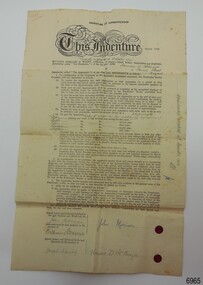 Flagstaff Hill Maritime Museum and Village
Document - Certificate, Harland & Wolff Limited, Shipbuilding & Engineering Works, Indenture of Apprenticeship, 28th October 1941
... H B Thomas in Melbourne, most likely his employer. Flagstaff Hill Warrnambool Maritime Village Maritime Museum Shipwreck coast Great Ocean Road Norman McKenzie Norman Desmond McKenzie Belfast shipwright Shipwright's apprenticeship Harland & Wolff Limited Shipbuilding & Engineering Works the Ship Constructors’ and Shipwrights’ Association Registered Shipwright Victorian branch of the Federated Shipwrights Ship constructors Naval Architects Ships’ Draughtsmen and Boat Builders’ Association of Australia Victoria branch Shipwrights' Provident Union H.B. ...A number of items once belonging to shipwright Norman McKenzie were donated to Flagstaff Hill Maritime Museum and Village. They are related to Norman’s apprenticeship and certification as a Shipwright in Belfast, his Union membership and his employment as a shipwright in Melbourne. One of the items, a union Rules Book inscribed with the name H.B. Thomas and dated 1902, had within its pages Norman’s Indenture of Apprenticeship, dated 1941, Norman Desmond McKenzie was born in Belfast in 1925 and lived at 10 Pansy Street Belfast, Northern Ireland. At the age of 16 years, he began a 5-year Shipwright’s apprenticeship with Harland & Wolff Limited, Shipbuilding & Engineering Works, Belfast. He became a member of the Ship Constructors’ and Shipwrights’ Association, Belfast (B) Branch 20. His Registration Number was 38748. He completed his apprenticeship on December 16th, 1946, aged 21 years, his address was 26 Connsbrook Drive, Sydenham, N. Belfast. In October 1949 Norman received Clearance from his Union as a financial member to move to another branch. He completed his Apprenticeship on December 16th 1946. Two months later he migrated to Australia, and he arrived in Victoria, and he became a Financial Member of the Victorian branch of the Federated Shipwrights, Ship constructors, Naval Architects, Ships’ Draughtsmen and Boat Builders’ Association of Australia, Victoria branch. One of Norman’s donated books is the Rules of the Shipwrights' Provident Union of the Port of London. It is inscribed on several pages with the name H.B. Thomas and includes the year 1902 and the address of 29 Brickwood Street, Gardenvale. This is a location in Victoria, Australia. The Victoria Government Gazette, February 1959, in the section “Removal from Registration on The Architects Registration Board of Victoria, during the year ended 31st December 1956” lists “Deceased – Thomas, H.B., 29 Brickwood Street, Gardenvale”. The Architects Union includes Naval Architects and Shipwrights and other related trades came under the same union. It seems likely that when he was in Melbourne, Norman worked as a Shipwright for H.B. Thomas and was given the Rules book by Thomas, perhaps as a reference book or maybe as a gift. Around that same time, December 1949, Norman met his wife-to-be, Daphne, in Melbourne. Daphne had migrated from London with her family and her father found work with the Melbourne Harbour Trust. They married in Melbourne in 1953 and went on to have a family of five children. In 2003 Norman and Daphne moved to Warrnambool and then years later they celebrated their 60th wedding anniversary. Norman passed away on July 28th 2015 at Warrnambool’s South West Healthcare hospital.Norman McKenzie's Rules Book, Union Cards, Indenture of Apprenticeship, and other documents tell the story of a young Irish lad's work and qualifications to become a shipwright and his migration to Australia. The young man found a job and a wife who had also migrated, and they raised a family in Melbourne. He and his wife then retired to Warrnambool to enjoy their later years. The collection of documents relating to Norman McKenzie is significant for its connection with the shipping industry of the early 1900s, the migration of qualified tradesmen to Victoria, and their contribution to the development of Victoria. The collection also shows the role of the Union in the shipping industry. The documents link shipwright Norman McKenzie to the Shipwright's Union in London and in Australia, and to shipbuilder H B Thomas in Melbourne, most likely his employer.Certificate printed on cream paper; Indenture of Apprenticeship, between Norman McKenzie of Belfast, and Harland & Wolff Ltd. of Queen's Island, Belfast on 28th October 1941. The Certificate was donated within the pages of a book, Rules of the Shipwrights' Provident Union of the Port of London published in 1895 and inscribed in 1905 with the name H. B. Thomas. Inscriptions are on the front and reverse of the certificate. There are two red wax seals beside the signatures of John Morrison and Norman D. McKenzie. Handwritten and underlined in red pen, top right of Certificate's front "1499" Printed on the Certificate, employer "HARLAND & WOLFF Limited, of Queen's Island, Belfast, Shipbuilders and Engineers" Handwritten in black pen "Twenty-eighth (day of ) October 1941" "Norman D. McKenzie, 10 Pansy Street, Belfast" "Shipwright Rates of wages as per National agreement" SIGNED: "John Morrison" "William Donald" "Joseph Kenney" "Norman D. McKenzie" Along the right margin "Apprenticeship completed 16th December 1946" In pencil on the reverse "N McKenzie, 26 Connsbrook Drive, Sydenham, N. Belfast" flagstaff hill, warrnambool, maritime village, maritime museum, shipwreck coast, great ocean road, norman mckenzie, norman desmond mckenzie, belfast shipwright, shipwright's apprenticeship, harland & wolff limited, shipbuilding & engineering works, the ship constructors’ and shipwrights’ association, registered shipwright, victorian branch of the federated shipwrights, ship constructors, naval architects, ships’ draughtsmen and boat builders’ association of australia, victoria branch, shipwrights' provident union, h.b. thomas, architects registration board of victoria, naval architect, daphne, norman and daphne mckenzie, indenture of apprenticeship -
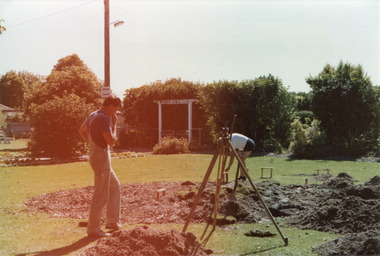 City of Moorabbin Historical Society (Operating the Box Cottage Museum)
Photograph, colour 'Reconstruction Site' Feb. 1984, February 1st 1984
... The photographs in Album 1 record the progress of the reconstruction from February 1984 to the First Public Open Day November 18th 1984 These 2 photographs show the Builders Mr Moody & Mr Smith preparing the site in Joyce Park at the commencement of the 'Reconstruction in February 1984. Mrs H ...The original small, pioneer cottage was built in the late 1840s to early1850s, by an unknown pioneer. It was located on part of a 30 Acre allotment that was originally part of Dendy’s Special Survey granted in 1841. The doors and window sashes, (made of red deal joinery timber), as well as the brass locks and fittings, are from the original cottage, and were imported from England. The fire-place bricks are from the original cottage, and are sun-dried, (not kiln fired), and are hand-made. Convict marks can be seen on two bricks. There is a small display of external cladding shingles from the original pioneer cottage. These shingles were hand-split, and most likely made from locally collected timber The nails included in this display were used to fasten the shingles on the original cottage, and are also hand-made. The cottage was occupied by William Box and family from 1865 until 1914 when it was sold to William Reitman who resided there until 1950. The enamel nameplate, “Colonial”, on the wall of the cottage, was the name chosen for the original pioneer cottage by Mr William Reitman, when he purchased the property in around 1915, for 1200 Pounds approximately. In 1974 Mr Lewis, a timber specialist, found the dilapidated building on property he had recently purchased in Jasper Rd and suggested it be reconstructed and relocated. Moorabbin Council agreed and the cottage was rebuilt just about 250 metres from its original site. The cost of the rebuild was met by 'Victoria's 150th Committee, plus a small grant from the City of Moorabbin, and Mr Laurie Lewis donated much of the timber for the reconstruction. The re-constructed cottage plan has followed faithfully the original dimensions, and plan of the original pioneer cottage, and as many original items from that cottage’s long occupation have been incorporated. The photographs in Album 1 record the progress of the reconstruction from February 1984 to the First Public Open Day November 18th 1984These 2 photographs show the Builders Mr Moody & Mr Smith preparing the site in Joyce Park at the commencement of the 'Reconstruction in February 1984. Mrs H. Deam and Mr A. Smith, CMHS members, took these photographs to record the progress of the 'Reconstruction' from February 1984 to November 1984. Although 'Box Cottage' is a re-construction, it is an unique museum that, being located in the midst of a modern community in Ormond Victoria, can educate and demonstrate many aspects of the early settler’s way of life in Victoria. As such, it is an invaluable resource for students and all kinds of visitors. The Business card of the Builders is now 30years old2 x colour photographs of work beginning on the reconstruction of Box Cottage in Joyce Park February 1984 and 1 business card of the Builders, Moody & SmithPhotographs Back : a) 1-2-84 / Box Cottage / Mr Moody & Mr Smith ; b) 1st Day 1st Feb 1984 / Box Cottage Card Front : Centre ; Moody & Smith / BUILDERS / Left ; 8 Worthing Rd / HIGHETT 3190 / MELBOURNE / TEL 95-1463 / BUS. & PRIVATE Right ; 7 North Ct. / HIGHETT 3190 / MELBOURNE / TEL 95-5310 / BUS. & PRIVATEbrighton, moorabbin, cottages, pioneers, ormond, colonial, mckinnon, dendy henry, box william, box elizabeth, reitman william, convicts lewis timber co. ltd., deam h, museums, box alonzo -
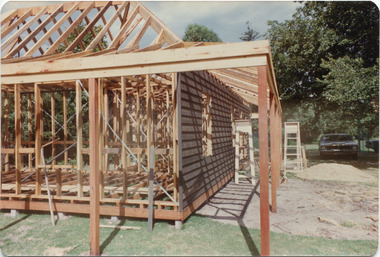 City of Moorabbin Historical Society (Operating the Box Cottage Museum)
Photograph, Colour, 'Reconstruction of Box Cottage’ 1984, 1984
... As such, it is an invaluable resource for students and all kinds of visitors. brighton, moorabbin, highett, ormond, mckinnon, cottages, pioneers, colonial, dendy henry, box william, box elizabeth, reitman william, convicts lewis timber co. ltd., deam h, museums, box alonzo, moody & smith builders highett, 3 x colour photographs of work beginning on the reconstruction of Box Cottage in Joyce Park in1984 Photograph, Colour, 'Reconstruction of Box Cottage’ 1984 Mrs H Deam & Mr A Smith ...The original small, pioneer cottage was built in the late 1840s to early1850s, by an unknown pioneer. It was located on part of a 30 Acre allotment that was originally part of Dendy’s Special Survey granted in 1841. The doors and window sashes, (made of red deal joinery timber), as well as the brass locks and fittings, are from the original cottage, and were imported from England. The fire-place bricks are from the original cottage, and are sun-dried, (not kiln fired), and are hand-made. Convict marks can be seen on two bricks. There is a small display of external cladding shingles from the original pioneer cottage. These shingles were hand-split, and most likely made from locally collected timber The nails included in this display were used to fasten the shingles on the original cottage, and are also hand-made. The cottage was occupied by William Box and family from 1865 until 1914 when it was sold to William Reitman who resided there until 1950. The enamel nameplate, “Colonial”, on the wall of the cottage, was the name chosen for the original pioneer cottage by Mr William Reitman, when he purchased the property in around 1915, for 1200 Pounds approximately. In 1974 Mr Lewis, a timber specialist, found the dilapidated building on property he had recently purchased in Jasper Rd and suggested it be reconstructed and relocated. Moorabbin Council agreed and the cottage was rebuilt just about 250 metres from its original site. The cost of the rebuild was met by 'Victoria's 150th Committee, plus a small grant from the City of Moorabbin, and Mr Laurie Lewis donated much of the timber for the reconstruction. The re-constructed cottage plan has followed faithfully the original dimensions, and plan of the original pioneer cottage, and as many original items from that cottage’s long occupation have been incorporated. The photographs in Album 1 record the progress of the reconstruction from February 1984 to the First Public Open Day November 18th 1984These 3 photographs show the 'Box Cottage' at the commencement of the 'Reconstruction in February 1984. Mrs H. Deam and Mr A. Smith, CMHS members, took these photographs to record the progress of the ‘Reconstruction’ from February 1984 to November 1984. Although 'Box Cottage' is a re-construction, it is an unique museum that, being located in the midst of a modern community in Ormond Victoria, can educate and demonstrate many aspects of the early settler’s way of life in Victoria. As such, it is an invaluable resource for students and all kinds of visitors. 3 x colour photographs of work beginning on the reconstruction of Box Cottage in Joyce Park in1984brighton, moorabbin, highett, ormond, mckinnon, cottages, pioneers, colonial, dendy henry, box william, box elizabeth, reitman william, convicts lewis timber co. ltd., deam h, museums, box alonzo, moody & smith builders highett, -
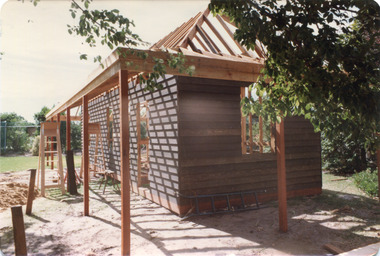 City of Moorabbin Historical Society (Operating the Box Cottage Museum)
Photograph, Colour 'Reconstruction of Box Cottage’ 1984, 1984
... As such, it is an invaluable resource for students and all kinds of visitors. brighton, moorabbin, highett, ormond, mckinnon, cottages, pioneers, colonial, dendy henry, box william, box elizabeth, reitman william, convicts lewis timber co. ltd., deam h, museums, box alonzo, moody & smith builders highett, 3 x colour photographs of work beginning on the reconstruction of Box Cottage in Joyce Park February 1984 Photograph, Colour 'Reconstruction of Box Cottage’ 1984 Mrs H Deam & Mr A Smith ...The original small, pioneer cottage was built in the late 1840s to early1850s, by an unknown pioneer. It was located on part of a 30 Acre allotment that was originally part of Dendy’s Special Survey granted in 1841. The doors and window sashes, (made of red deal joinery timber), as well as the brass locks and fittings, are from the original cottage, and were imported from England. The fire-place bricks are from the original cottage, and are sun-dried, (not kiln fired), and are hand-made. Convict marks can be seen on two bricks. There is a small display of external cladding shingles from the original pioneer cottage. These shingles were hand-split, and most likely made from locally collected timber The nails included in this display were used to fasten the shingles on the original cottage, and are also hand-made. The cottage was occupied by William Box and family from 1865 until 1914 when it was sold to William Reitman who resided there until 1950. The enamel nameplate, “Colonial”, on the wall of the cottage, was the name chosen for the original pioneer cottage by Mr William Reitman, when he purchased the property in around 1915, for 1200 Pounds approximately. In 1974 Mr Lewis, a timber specialist, found the dilapidated building on property he had recently purchased in Jasper Rd and suggested it be reconstructed and relocated. Moorabbin Council agreed and the cottage was rebuilt just about 250 metres from its original site. The cost of the rebuild was met by 'Victoria's 150th Committee, plus a small grant from the City of Moorabbin, and Mr Laurie Lewis donated much of the timber for the reconstruction. The re-constructed cottage plan has followed faithfully the original dimensions, and plan of the original pioneer cottage, and as many original items from that cottage’s long occupation have been incorporated. The photographs in Album 1 record the progress of the reconstruction from February 1984 to the First Public Open Day November 18th 1984These 3 photographs show the 'Box Cottage' at the commencement of the 'Reconstruction in February 1984. Mrs H. Deam and Mr A. Smith, CMHS members, took these photographs to record the progress of the ‘Reconstruction’ from February 1984 to November 1984. Although 'Box Cottage' is a re-construction, it is an unique museum that, being located in the midst of a modern community in Ormond Victoria, can educate and demonstrate many aspects of the early settler’s way of life in Victoria. As such, it is an invaluable resource for students and all kinds of visitors. 3 x colour photographs of work beginning on the reconstruction of Box Cottage in Joyce Park February 1984 brighton, moorabbin, highett, ormond, mckinnon, cottages, pioneers, colonial, dendy henry, box william, box elizabeth, reitman william, convicts lewis timber co. ltd., deam h, museums, box alonzo, moody & smith builders highett,
