
Showing 273 items matching "h. marks"
-
 Bendigo Historical Society Inc.
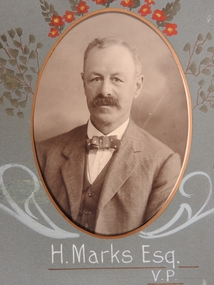
Photograph - Hopetoun Brass Band Member H. Marks, Kalma, 14/02/1913
... Hopetoun Brass Band Member H. Marks ......H. Marks Esq....Head and shoulders photo of H. Marks Esq. in a three-piece suit. Surrounded by a grey oval mount with some floral decoration and his name underneath. ...Photograph Hopetoun Brass Band Member H. Marks Kalma ...Part of the Hopetoun Brass Band Photo Collage. Head and shoulders photo of H. Marks Esq. in a three-piece suit. Surrounded by a grey oval mount with some floral decoration and his name underneath. entertainment, hopetoun brass band, bendigo, h. marks esq., kalma pall mall -
 Bendigo Historical Society Inc.
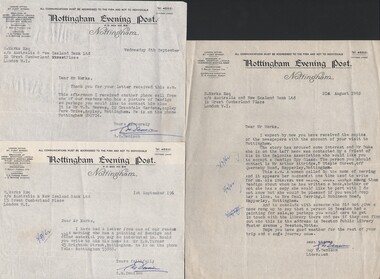
Document - HARRY BIGGS COLLECTION: NOTTINGHAM EVENING POST, !962 - 63
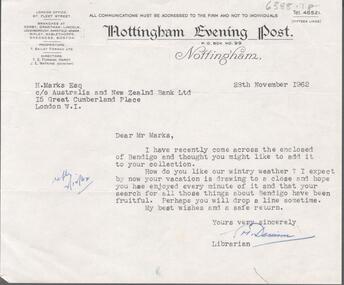
... ...H. Marks. Guy M. Denison...(a) Three letters typed on Nottingham Evening Post Letterhead, all sent to Mr. H. Marks. c/o Australia and New Zealand Bank Ltd., 15 Great Cumberland Place, London, W1, from Guy M. ...H. Marks. c/o Australia and New Zealand Bank Ltd., 15 Great Cumberland Place, London, W1, from Guy M. ...(a) Three letters typed on Nottingham Evening Post Letterhead, all sent to Mr. H. Marks. c/o Australia and New Zealand Bank Ltd., 15 Great Cumberland Place, London, W1, from Guy M. Denison, Librarian. They are all concerning a picture of Bendigo (The boxer?). (b) Invoice, from the Jockey Club 7/7/1993, Items bought (at auction?) - Tin $25, Folder $65, Horse Racing Set $45. Total $135person, individual, bendigo, h. marks. guy m. denison, nottingham, bendigo -
 Ballarat Heritage Services
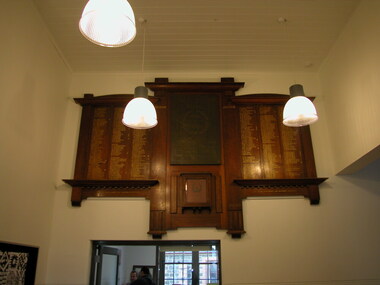
Photograph - Photograph - Colour, Clare Gervasoni, Dana Street Primary School (No. 33) World War One Honour Board, c2010, c2010
... ...H. marks...Lilburn. R.E.N. Murphy, H. marks, H.H. Martell, P.W.G. Moon. G.P. Merz, A. ...Lancaster C.W. Lee H. marks H.H. Martell P.W.G. Moon. G.P. Merz A. ...Dana Street State School was one of the earliest primary schools in Ballarat and was established in 1857.Timber honour board in the entrance foyer of Dana Street Primary School. names include: L.J. Curnow, W. Daly, M. Dixon, S.E.A. Dean, O.T. Dell, R. Eva, F. Eggington, S.P. Eddy, C. Frost, A.W. Fitzgerald, L.G. Fitzgerald, F. Feary, S. Fox, C.H. Falla, C.E. Fa;;a. H.C. Foote, J. Hammond. F.J. Harris. F.E. Hillman, J. Hunter, R.A. Hind, R.V. Horsfall, R.G. Hutson. H. Jones, R. Jamieson, C. Kerr, C.R. Kift, P. Kraiscill, A. Lancaster, C.W. Lee, I.T. Lilburn. R.E.N. Murphy, H. marks, H.H. Martell, P.W.G. Moon. G.P. Merz, A. McGoldrick, W.E. Moon, C.R. Ince, W.J. Peacock, W. Pollard, N. Pinney. C. Pike, J.R. Doney, A.R. Doney, R.E. Rowlands, A.E. Rowlands, L. Rowlands, C. Snell, R. Snell, J. Snell, W. Wilberforce, N.F. Wellington, H. Williams, E. Wallace, S. Wallace, H.S. Yates, A. Yates, T.E. Yates, l.j. curnow, w. daly, m. dixon, s.e.a. dean, o.t. dell, r. eva, f. eggington, s.p. eddy, c. frost, a.w. fitzgerald, l.g. fitzgerald, f. feary, s. fox, c.h. falla, c.e. fa, a. h.c. foote, j. hunter, r.a. hind, r.v. horsfall, r.g. hutson. h. jones, r. jamieson, c. kerr, c.r. kift, p. kraiscill, a. lancaster, c.w. lee, h. marks, h.h. martell, p.w.g. moon. g.p. merz, a. mcgoldrick, w.e. moon, c.r. ince, w.j. peacock, w. pollard, j.r. doney, a.r. doney, r.e. rowlands, a.e. rowlands, l. rowlands, c. snell, r. snell, j. snell, w. wilberforce, n.f. wellington, h. williams, e. wallace, s. wallace, h.s. yates, a. yates, t.e. yates, dana street state school, dana street primary school, j. hammond, f.j. harris, f.e. hillman, i.t. lilburne, r.e.n. murphy, n. pinney, c. pike -
 Bendigo Historical Society Inc.
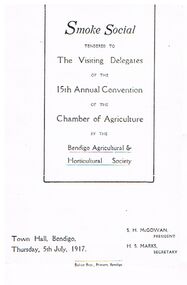
Document - SMOKE SOCIAL ANNUAL CONVENTIN CHAMBER OF AGRICULTURE 1917, 05/07/1917
... ... H S Marks...McGowan, President and H. S. Marks, Secretary. Black printing on white paper. ...McGowan, President and H. S. Marks, Secretary. Black printing on white paper. ...Smoke Social tendered to The Visiting Delegates of the 15th Annual Convention of the Chamber of Agriculture by the Bendigo Agricultural & Horticultural Society in 1917. S. H. McGowan, President and H. S. Marks, Secretary. Black printing on white paper. Bolton Bros, Printers.document, invitations, social evening, document, smoke social, 15th annual convention of the chamber of agriculture, bendigo agricultural & horticultural society, s h mcgowan, h s marks, bolton bros -
 Expression Australia
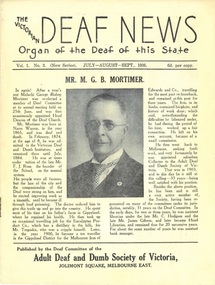
Newsletter, The Victorian Deaf News July-August-September 1936
... malachi george bishop mortimer, victorian deaf and dumb institution, tregaskis, c. hodgson, james gibson, harry puddy, warwick ashby, jonathon smalley, w. bartholomew, johnston, e. martin, j. boal, mrs t. peters ruth betts, r and m dow, cliff ellwood, p. johnston, nesbitt, v. buttacvoli, j. mclaurin, arthur boswell, ray cornell, s. ferguson, keage, j. brook, f. rees, j. murphy, e. stephens,williamson, dudley gooding, spinks, w. h. crush, j. o'grady, h. abbott, rennie, h. nathan, w. o'keefe, w. duncan, h. ah chow, kathleen may wilson, vosper wilson, elaine margery smith, george henry, gladys salmon, robert beatie, alice maud mary hartley, c. h. reynolds, mrs c. caughey, mrs f. h. marks, florrie tyzzer, james mills, cederic and douglas nesbitt, jean mccullough...Published by the Deaf Committee of the Adult Deaf and Dumb Society of Victoria 'The Victorian Deaf News' Newsletter is a significant publication as an historical record giving and insight into the people, activities and events of the Deaf Community in Victoria. malachi george bishop mortimer, victorian deaf and dumb institution, tregaskis, c. hodgson, james gibson, harry puddy, warwick ashby, jonathon smalley, w. bartholomew, johnston, e. martin, j. boal, mrs t. peters ruth betts, r and m dow, cliff ellwood, p. johnston, nesbitt, v. buttacvoli, j. mclaurin, arthur boswell, ray cornell, s. ferguson, keage, j. brook, f. rees, j. murphy, e. stephens,williamson, dudley gooding, spinks, w. h. crush, j. o'grady, h. abbott, rennie, h. nathan, w. o'keefe, w. duncan, h. ah chow, kathleen may wilson, vosper wilson, elaine margery smith, george henry, gladys salmon, robert beatie, alice maud mary hartley, c. h. reynolds, mrs c. caughey, mrs f. h. marks, florrie tyzzer, james mills, cederic and douglas nesbitt, jean mccullough Vol. 1 No. 3 (New Series) July-August-September 1936; Size 4cmHx18.5cmW; 16 pages The Victorian Deaf News July-August-September 1936 Newsletter ...Published by the Deaf Committee of the Adult Deaf and Dumb Society of Victoria'The Victorian Deaf News' Newsletter is a significant publication as an historical record giving and insight into the people, activities and events of the Deaf Community in Victoria.Vol. 1 No. 3 (New Series) July-August-September 1936; Size 4cmHx18.5cmW; 16 pagesmalachi george bishop mortimer, victorian deaf and dumb institution, tregaskis, c. hodgson, james gibson, harry puddy, warwick ashby, jonathon smalley, w. bartholomew, johnston, e. martin, j. boal, mrs t. peters ruth betts, r and m dow, cliff ellwood, p. johnston, nesbitt, v. buttacvoli, j. mclaurin, arthur boswell, ray cornell, s. ferguson, keage, j. brook, f. rees, j. murphy, e. stephens,williamson, dudley gooding, spinks, w. h. crush, j. o'grady, h. abbott, rennie, h. nathan, w. o'keefe, w. duncan, h. ah chow, kathleen may wilson, vosper wilson, elaine margery smith, george henry, gladys salmon, robert beatie, alice maud mary hartley, c. h. reynolds, mrs c. caughey, mrs f. h. marks, florrie tyzzer, james mills, cederic and douglas nesbitt, jean mccullough -
 Kadimah Jewish Cultural Centre and National Library
Programme, Motke Ganev; 1936
... ...H. Marks...Dun S. Mendelson H. Marks F. Jedwab A. Weit E. Korn B. Rosenberg J. ...Kadimah Dramatic Stage union - artistic director N. Ginter - his first performancedovid herman theatre, h. dun, s. mendelson, h. marks, f. jedwab, a. weit, e. korn, b. rosenberg, j. silman, i. shadur, j. weit, j. ginter, c. segal, l. cherny, h. smulevitch, n. rosenberg, c. maks, z. gershov -
Bendigo Historical Society Inc.
Document - ROYAL PRINCESS THEATRE COLLECTION: SPECIAL ENTERTAINMENT FOR THE BENEFIT OF THE BENDIGO EASTER FAIR, 24 April 1914
... Mistress of the Ballet: Miss G Mackay. Secretary: Mr H M Marks. Programme written by Miss Calma Boyd. ...Mistress of the Ballet: Miss G Mackay. Secretary: Mr H M Marks. Programme written by Miss Calma Boyd. ...Mistress of the Ballet: Miss G Mackay. Secretary: Mr H M Marks. Programme written by Miss Calma Boyd. ...Royal Princess Theatre - Special Entertainment for the benefit of the Bendigo Easter Fair. Friday, April 24, 1914. Stage Manageress: Miss M Eadie. Mistress of the Ballet: Miss G Mackay. Secretary: Mr H M Marks. Programme written by Miss Calma Boyd. Theatre kindly lent by Wm. Crowley, Esq. PART 1. Selected Pictures including BENDIGO ON EASTER MONDAY: THE PROCESSION AND THE FAIR. PART II. The Pierettes and Pierots Present for the first time their entire Company, introducing Miss Marjorie Eadie, Emperess of Ragtime. Miss Girlie Mackay, Genee's Revival. Miss Francie Moore, Miss Calma Boyd and Miss Jean Mackay, Shining Stars. Miss Winifred Dunstan, Dainty Balladist. Miss Dorothy Dunstan, Madame Butt's Protégé. Miss Claire Connell, Front Stall Favorite. Miss Beryl Leggo, Pianiste of Perfection. Press and other comments-'The Herald'-'Come over here?' Sir Ian Hamilton-'Spare my days!!' Madame Melba-'I never heard anything like it.' Mark Hambourg-'Miss Beryl Leggo's playing is Potslausenlililzenundgeyalikyoptor.' [don't hesitate to talk during the items--disturbing the performers really doesn't matter.] Opening Chorus-The Pierettes and Pierots. 'How do you Do, Miss Ragtime?' The Company. Chesapeake Bay, Sung by miss Eadie, with effects by Company. 'Mandy', Misses D Dunstan and C Connell, augmented by Misses Moore and Boyd. 'Here's to Love!' Miss D Dunstan (a solo of primary interest). Alabam, The Pierettes and Pierots, an effort of alleged humour. The Pierot's Wooing, Misses G Mackay and Meadie. The Dance is a result of an amicable attangement with the Pianist, Miss Beryl Leggo. Piano Solo, Miss Beryl Leggo [See Press Opinions.] 'My Sumurum Maid', The Pierettes and Pierots, [Presented with the idea of breaking up the prevailing gloom.] Interval of Ten Minutes. [If the audience can tolerate any more, they may retain their seats without extra charge.] Diamonds, Motor Cars, Confectionery, Sweets, Flowers: Gentlemen must have their name of donor attached. When you have had enough, don't hesitate to leave - the performers will sing on regardless of aching hearts. Part III. The Pierot Ballet, The Company. [Please do not throw anything harder than a brick.] Duet: 'Pretty Poll', Misses Moore and Boyd will sing to each other. 'Poor wandering One' Claimed by Miss M Eadie, with acquiescing chorus. 'Hush-a-Bye!' Part song, The Company [This item is introduced to soothe the infuriated audience.] 'Blue-eyed Baby', Miss M Eadie is associated with this number. Danse de Pierot, Miss Girlie Mackay. Leap Year!, The Pierittes- A distinctly Personal Chorus. [Gentlemen are warned that all exits will be barred]. Finale by the Pierettes. God Save The King. ___We Did It! - Cambridge Press, Bendigo.Cambridge Press, Bendigo.program, theatre, royal princess theatre, royal princess theatre - special entertainment for the benefit of the bendigo easter fair. friday, april 24, 1914. stage manageress: miss m eadie. mistress of the ballet: miss g mackay. secretary: mr h m marks. programme written by miss calma boyd. theatre lent by wm. crowley, esq. part 1. selected pictures including bendigo on easter monday: the procession and the fair. part ii. the pierettes and pierots present entire company, miss marjorie eadie, emperess of ragtime. miss girlie mackay, genee's revival. miss francie moore, miss calma boyd and miss jean mackay, shining stars. miss winifred dunstan, dainty balladist. miss dorothy dunstan, madame butt's protégé. miss claire connell, front stall favorite. miss beryl leggo, pianiste of perfection. press and other comments-'the herald'-'come over here?' sir ian hamilton-'spare my days!!' madame melba-'i never heard anything like it.' mark hambourg-'miss beryl leggo's playing is potslausenlililzenundgeyalikyoptor.' [don't hesitate to talk during the items--disturbing the performers really doesn't matter.] opening chorus-the pierettes and pierots. 'how do you do, miss ragtime?' the company. chesapeake bay, sung by miss eadie, with effects by company. 'mandy', misses d dunstan and c connell, augmented by misses moore and boyd. 'here's to love!' miss d dunstan (solo of primary interest). alabam, the pierettes and pierots, an effort of alleged humour. the pierot's wooing, misses g mackay and meadie. the dance is a result of an amicable attangement with the pianist, miss beryl leggo. piano solo, miss beryl leggo [see press opinions.] 'my sumurum maid', the pierettes and pierots, [presented with the idea of breaking up the prevailing gloom.] interval of ten minutes. [if the audience can tolerate any more, they may retain their seats without extra charge.] diamonds, motor cars, confectionery, sweets, flowers: gentlemen must have their name of donor attached. when you have had enough, don't hesitate to leave - the performers will sing on regardless of aching hearts. part iii. the pierot ballet, the company. [please do not throw anything harder than a brick.] duet: 'pretty poll', misses moore and boyd will sing to each other. 'poor wandering one' claimed by miss m eadie, with acquiescing chorus. 'hush-a-bye!' part song, the company [this item is introduced to soothe the infuriated audience.] 'blue-eyed baby', miss m eadie is associated with this number. danse de pierot, miss girlie mackay. leap year!, the pierittes- a distinctly personal chorus. [gentlemen are warned that all exits will be barred]. finale by the pierettes. god save the king. _we did it! - cambridge press, bendigo. -
 Bendigo Historical Society Inc.
Document - CONNELLY, TATCHELL, DUNLOP COLLECTION: ACCOUNTS ESTATE OF ESTHER ISABELL CANNING, 1894
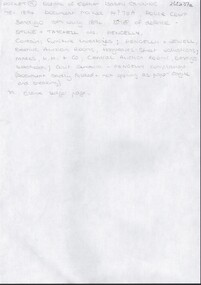
... ... Marks H M & Co...Contains furniture inventories; Pengelly & Jewell, Beehive Auction Rooms, Hargreaves Street valuations; Marks H M & Co. Central Auction Rooms, Bendigo letterheads; Court Summons - Pengelly Complainant (Document badly folded - not opening as paper fragile and breaking). 2 - Blank ledger page. 3 - 1894 - Account from Solicitors to Mrs Canning regarding alterations to her Will. ...COTTAGE Miners Connelly Tatchell and Dunlop Canning Esther Isabell Stone Tatchell Pengelly jewell Beehive Auction Rooms Marks H M & Co Central Auction Rooms Document. ...Document. Accounts - Estate of Esther Isabell Canning. 1 - 1894 - Document marked 14? 76A, Police Court Bendigo 16th July 1894. Brief of defence - Stone & Tatchell ats. Pengelly. Contains furniture inventories; Pengelly & Jewell, Beehive Auction Rooms, Hargreaves Street valuations; Marks H M & Co. Central Auction Rooms, Bendigo letterheads; Court Summons - Pengelly Complainant (Document badly folded - not opening as paper fragile and breaking). 2 - Blank ledger page. 3 - 1894 - Account from Solicitors to Mrs Canning regarding alterations to her Will. Dated March 1894cottage, miners, connelly, tatchell and dunlop, canning esther isabell, stone, tatchell, pengelly, jewell, beehive auction rooms, marks h m & co, central auction rooms -
 Bendigo Historical Society Inc.
Document - DOCUMENT - SOUVENIR OF VISIT TO BENDIGO, 05/07/1917
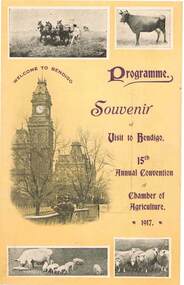
... ... H S Marks...ORGANIZATION Club/society Bendigo agricultural and horiticultural Souvenir of Visit to Bendigo 15th annual Convention of Chamber of Agriculture 1917 Bendigo Agriculture & Horticultural Society S H McGowan H S Marks Bolton Bros Bruhn's Orchestra Cr M and Mrs Hamburger Mr H S Barkell Miss Irene Dorrity Mr A J Hamilton Miss Sherlock Miss V O'Donnell Mr H Currie Miss H Veale Mr W Honeybone Mr F cavagna Messrs Wenborn & Owen Bolton Bros, Bendigo Programme with dark yellow front cover and cream inside. ...Programme with dark yellow front cover and cream inside. Souvenir of Visit to Bendigo. 15th Annual Convention of Chamber of Agriculture. At the top are two pictures, one of four horses pulling a harvester and the other, a jersey cow. At the bottom is a sow with piglets and the other some sheep. In the centre on the left is the old Post Office and clock and further away, the Law Courts. Inside is Smoke Social tendered to The Visiting Delegates of the 15th Annual Convention of the Chamber of Agriculture by the Bendigo Agricultural & Horticultural Society. Held at the Town Hall, Bendigo on Thursday, 5th July, 1917. Program details entertainment items and performers.Bolton Bros, Bendigoorganization, club/society, bendigo agricultural and horiticultural, souvenir of visit to bendigo, 15th annual convention of chamber of agriculture 1917, bendigo agriculture & horticultural society, s h mcgowan, h s marks, bolton bros, bruhn's orchestra, cr m and mrs hamburger, mr h s barkell, miss irene dorrity, mr a j hamilton, miss sherlock, miss v o'donnell, mr h currie, miss h veale, mr w honeybone, mr f cavagna, messrs wenborn & owen -
 City of Greater Bendigo - Civic Collection
Financial record - Annual report, Bendigo Hospital, Bendigo Gold District General Hospital, 1898
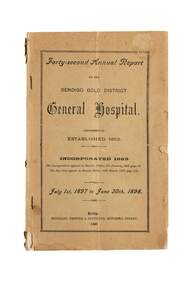
... ...Councillor H M Marks...City of Greater Bendigo Health Services Councillor McGowen Councillor H M Marks Councillor J H Abbott James Buick Printed annual report with brown paper cover. ...The Bendigo Base Hospital was established in 1853 as the Bendigo Gold District General Hospital. This forty second Annual Report provides a detailed account of finances, building and maintenance works. The report also provided information on the number of people admitted, their occupation, residence area, operations undertaken. The largest number of patients were listed as those doing domestic duties (522), with labourers (333), miners (264) and school children (220) making up the top four from a total of 1886. James Buick was the Resident Surgeon during this year and his report states that the number of in-patients by far exceeded any previous years with the Hospital at full capacity most of the time. A typhoid and a measles epidemic added to the strain on resources. Printed annual report with brown paper cover. city of greater bendigo health services, councillor mcgowen, councillor h m marks, councillor j h abbott, james buick -
 City of Greater Bendigo - Civic Collection
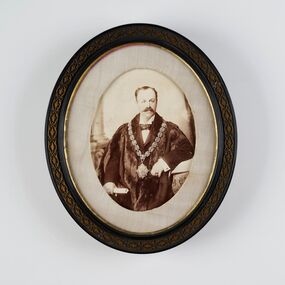
Photograph - Framed portrait of Councillor Harry Marks, Mayor City of Sandhurst 1896 - 97, Bartlett Bros, c 1896
... Councillor H M Marks...After his death Mary Marks became the senior partner in the firm HM Marks and Sons auctioneers. Mary died in 1919. Councillor H M Marks Mayor Marks Mayoress Marks Bartlett Bros. lower left on photograph. ...Harry Montague Marks was born at Pall Mall Bendigo on the 1st October 1855. At age 18 he worked for Goldsborough & Co in Melbourne learning land, wool and banking business. He returned to Bendigo aged 22 to open an auctioneers business which operated on the corner of Williamson and Hargraves Streets. Councillor Marks was elected to the seat of Darling in May 1893 and remained serving until 1902. He served as Mayor once only from 1896-97. It was noted in the Bendigo Advertiser on July 3rd 1897 that Mayor Marks appeared in new robes .. made to council order by Messrs Henderson and Goodisson who dealt in highly fashionable goods in the Beehive. (fn https://trove.nla.gov.au/newspaper/page/9088966). It is not know if these robes are still in existence. Harry Marks married Mary Leech in 1881and together they had four sons and one daughter. Harry Marks died in February 1916 aged 60. After his death Mary Marks became the senior partner in the firm HM Marks and Sons auctioneers. Mary died in 1919.Oval black and white silver gelatin print on board with fabric mount. Studio portrait of Mayor Marks. Front facing seated portrait wearing mayoral robes and chain, clutching a rolled document in right hand. Original rectangular shaped photograph has been trimmed to fit into oval frame.Bartlett Bros. lower left on photograph.councillor h m marks, mayor marks, mayoress marks -
 Bendigo Historical Society Inc.
Letter - Bendigo the Racehorse, 17th Fabruary 1968
... One page letter from Nottingham Evening Post, Nottingham, to H. Marks, c/- Australia and New Zealand Bank Ltd., 15 Great Cumberland Place, London., 28th November, 1962, re 'enclosed of Bendigo' (presumably print of Bendigo, the racehorse) from Denison, Librarian. ...One page letter from Nottingham Evening Post, Nottingham, to H. Marks, c/- Australia and New Zealand Bank Ltd., 15 Great Cumberland Place, London., 28th November, 1962, re 'enclosed of Bendigo' (presumably print of Bendigo, the racehorse) from Denison, Librarian. ...William Abednego Thompson (11 October 1811 – 23 August 1880), also known as Bendigo Thompson, was an English bare-knuckle boxer who won the heavyweight championship of England from James Burke on 12 February 1839.[3] He was inducted into The Ring magazine Hall of Fame in 1955, the International Boxing Hall of Fame in 1991[3] and the Bare Knuckle Boxing Hall of Fame in 2011. His nickname of "Bendigo" lives on in the name of a city and creek in Australia. (Wikipedia)One page letter from Nottingham Evening Post, Nottingham, to H. Marks, c/- Australia and New Zealand Bank Ltd., 15 Great Cumberland Place, London., 28th November, 1962, re 'enclosed of Bendigo' (presumably print of Bendigo, the racehorse) from Denison, Librarian. Written in pen on left hand side 'reply 2/12/62'.abednego thompson, william thompson, naming of bendigo, harold curnow, racehorse -
 Wodonga & District Historical Society Inc
Domestic object - Ironstone China Wash bowl and jug
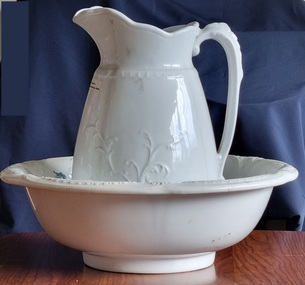
... H. Grindley was founded at the Newfield Pottery in 1880 by William Harry Grindley (principal partner). Mr Turner and Mr Alfred Meakin were also involved. Early advertisements stated that they produced Earthenware and Ironstone China - particularly for the Canadian, United States, South American and Australian markets. The mark...They are not as set as the jug bears the mark W. H. Grindley and the bowl was made by J & G Meakin....They are not as set as the jug bears the mark W. H. Grindley and the bowl was made by J & G Meakin. ...Ironstone china pieces were common domestic items during the 19th to mid 20th century in many Australian households. This kind of china is not porcelain but porous earthenware, made of clay mixed with feldspar. Patented in 1813 by Charles James Mason in Staffordshire, England, it was an immediate success and became widely produced by a range of Staffordshire potters. J & G Meakin Pottery dates back to 1845 when James Meakin started a pottery business at Lane End in Staffordshire.nIn 1848 he moved the business to Hanley in Staffordshire, before retiring in 1852 and handing the business over to his two sons James and George, who carried on with the pottery, trading as J & G Meakin. The "SOL" and sun face trademarks were registered in 1912. The firm was taken over by the Wedgwood Group in 1970. In 2000, production under the Meakin name ceased. W. H. Grindley was founded at the Newfield Pottery in 1880 by William Harry Grindley (principal partner). Mr Turner and Mr Alfred Meakin were also involved. Early advertisements stated that they produced Earthenware and Ironstone China - particularly for the Canadian, United States, South American and Australian markets. The mark on this jug was used from c1891 until 1925. W. H. Grindley China was manufactured until 1991, making it one of the last Stoke on Trent potteries.These items are representative of a common domestic item used by households in the Wodonga district and throughout Australia, many manufactured specifically for the Australian market.A white ironstone jug and bowl. The jug features a leaf design embossed on the surface. The bowl has a small circle pattern around the rim. They are not as set as the jug bears the mark W. H. Grindley and the bowl was made by J & G Meakin.Underneath Bowl: above and below image of the sun: "IRONSTONE CHINA/ REGD. SOL 391413/ J & G MEAKIN/ENGLAND Underneath jug: above and below the royal insignia: ROYAL IRONSTONE CHINA / W.H. GRINDLEY & CO. / ENGLAND"ironstone, domestic items, staffordshire pottery -
 Bendigo Historical Society Inc.
Document - TOWN HALL, RETURN BALL, 17 June, 1923
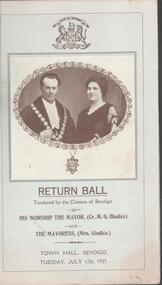
... J Denton (Treasurer), A M Poole, T Pritchard, A B Wood, W Jeffrey, W H Taylor, F Monaghan, H S Marks, H W Tilley, F Cambridge, H Newman, E A Sayer, H Whitelock, W Currie, W T Patten, J. ...J Denton (Treasurer), A M Poole, T Pritchard, A B Wood, W Jeffrey, W H Taylor, F Monaghan, H S Marks, H W Tilley, F Cambridge, H Newman, E A Sayer, H Whitelock, W Currie, W T Patten, J. ...Town Hall, Return Ball. Tendered by the Citizens of Bendigo to His Worship the Mayor, (Cr. M G Giudice) and The Mayoress, (Mrs. Giudice.) Town Hall, Bendigo. Tuesday, July 17th, 1923. Menu, Dindon Roti. Jambon de York. Canard Roti. Salad a la Francaise. Haricot Verts. Pommes de Terre a L;Anglaise. Trifle a L'Espangnole. Charlotte Russe. Crème aux Fraisee. Salade aux Fruits. Gelee au Madere. Meringues a'la Crème. Patrisserie. Gateau Assorties. Olive Farcies aux Anchois. Pailles au Parmeson. Amande a la Diable. Gingembre. Raisins. Café. The Oyster Soup will be served in Basement after Second Supper. Favaloros, Caterers. Wine List. Irvine's Great Western Champagne (Special Reserve.) Seppelt's. Penfold's. Max Cohn's. Port. Sherry. Claret. Burgundy. Muscat. Hock. Chablis. Planet. Old Scotch Whisky. Ales and Stout-Bendigo United and Cohn Bros. Aerated Waters and Cordials. Cigars Cigarettes. Toasts. His Majesty the King. - By the Chairman, 'Our Guests,' (The Mayor & Mayoress Cr & Mrs. M G Giudice.) by the Chairman. Where're they met a stranger; there they left a friend. Response by The Mayor. 'The Chairman Citizens Return Ball Committee,' (Cr E M Vains) By the Mayor. Response by the Chairman. The Citizen's Return Ball, Executive Committee - Cr E M Vains (Chairman), Mr. J Denton (Treasurer), A M Poole, T Pritchard, A B Wood, W Jeffrey, W H Taylor, F Monaghan, H S Marks, H W Tilley, F Cambridge, H Newman, E A Sayer, H Whitelock, W Currie, W T Patten, J. J. Caldwell, G H Dare, J H Sievers, F Ferguson, G J C Maxwell. F T Amer & T R J Brown; Hon. Secs. City of Bendigo logo is at the top on the front cover and an oval picture of the Mayor and Mayoress below it.Cambridge Press, Bendigoevent, entertainment, return ball, town hall -
 Bendigo Historical Society Inc.
Document - LONG GULLY HISTORY GROUP COLLECTION: POSTAL HISTORY OF LONG GULLY
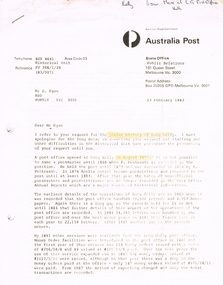
... ... Mark H Webb...Postmasters/mistresses were P Pentreath, A Pentreath, Amelia Daniel, Mrs S A Wilcock, Mark H Webb, William J H Read, Mrs Elsie Anderson, Sydney Gordon Dawson, John Henry Bennett, Miss Margaret Mulvey, John Henry Bennett, Henry William Purchase, Mr R F Warren, Mrs Margaret Cecily Kennedy, Edward Charles Landers, Mrs Margaret Landers, Shirley Egan, Brian Matthew Egan and Shirley and Max Volk....Postmasters/mistresses were P Pentreath, A Pentreath, Amelia Daniel, Mrs S A Wilcock, Mark H Webb, William J H Read, Mrs Elsie Anderson, Sydney Gordon Dawson, John Henry Bennett, Miss Margaret Mulvey, John Henry Bennett, Henry William Purchase, Mr R F Warren, Mrs Margaret Cecily Kennedy, Edward Charles Landers, Mrs Margaret Landers, Shirley Egan, Brian Matthew Egan and Shirley and Max Volk. ...BHS CollectionLetter to Mr D Egan from C Duggan for Manager - Public Relations - Australia Post, dated 23 February 1983. Letter mentions the history of the Long Gully Post Office. There are many gaps in the history. Mentioned are the number of letters, newspapers, Money Orders, telegrams, mail articles, postal notes and expenditure. Values of money orders, telegrams and postal notes are mentioned. Postmasters/mistresses were P Pentreath, A Pentreath, Amelia Daniel, Mrs S A Wilcock, Mark H Webb, William J H Read, Mrs Elsie Anderson, Sydney Gordon Dawson, John Henry Bennett, Miss Margaret Mulvey, John Henry Bennett, Henry William Purchase, Mr R F Warren, Mrs Margaret Cecily Kennedy, Edward Charles Landers, Mrs Margaret Landers, Shirley Egan, Brian Matthew Egan and Shirley and Max Volk.bendigo, history, long gully history group, the long gully history group - postal history of long gully, australia post, mr d egan, p pentreath, a pentreath, amelia daniel, mrs s a wilcock, mark h webb, william j h read, mrs elsie anderson, sydney gordon dawson, john henry bennett, miss margaret mulvey, henry william purchase, mr r f warren, mrs margaret cecily kennedy, edward charles landers, mrs margaret landers, shirley egan, brian matthew egan, shirley and max volk, c duggan -
 Bendigo Historical Society Inc.
Document - HISTORY OF BENDIGO PERFORMING ARTS 1870-1963, 1870-1963
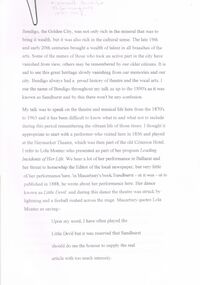
... Penfold (president), Mr. H. M. Marks(Stage manager), Mr. A. Tawse (Dick Deadeye). ...Penfold (president), Mr. H. M. Marks(Stage manager), Mr. A. Tawse (Dick Deadeye). ...History of Bendigo Performing Arts 1870 - 1963. Presented by Charles Murray Bendigo Historical Society Inc. (13 pages,paper clipped). Performers and Palaces November 24, 2000 at the Bendigo Bank Theatre BRAC View Street Bendigo. Negative of The Bendigo Liedertafel in Opera, the performance of 'Pinafore' in 1888. Names of the cast(negative) are: Back row - Miss A Gellmiek(Josephine), Mr F. Macoboy(Ralph Rackstraw), Miss Forsyth(Hebe), Mr. M. Macoboy (Sir Joseph Porter), Miss E. O'Flaherty (Little Buttercap), Mr. L. Germann(Captain Corcoran). Front Row: - Mr. C,. Pallett (Bill Bobstay), Mr. H. Monaghan(Conductor), Dr. Penfold (president), Mr. H. M. Marks(Stage manager), Mr. A. Tawse (Dick Deadeye). The Bendigo Lieddertafel waqs extablished in 1884 by MNr. A. T. Crook. Mr. William Brown, the well known solicitor, took and active part along with his brother, Mr. T. Brown, in its inauguration. Mr. W. Brown always took a warm interest in matters musical, and for many years was one of the most prominent singers in the district. Contemporary with him in the sixties were Mrs. Betham and Mrs. Ellis, and in the seventies, Mrs. E. E. Casey. Negative of halla's Premier City Band. Standing ,from left to right - H. Middleton, T. Ash, J. Graham, G. Foster, W. Hicks, S. Mauley, J. Eaton, V. Byrne (Drum Major), - Sullivan, R. Lindsay, C. Crawford, R. Meakin, D. Westphalen, W. Hall, G. Hunter, B. Broadbent, W. Higginbotham. Sitting, from left to right - T. Sayer, R. E. Crawford, C. Foster, J. Mappin, G. Meakin, G. Coleman, F. Lindsay, Nat. Hallas (Bandmaster), J. Swift, C. Anderson, J. Armstrong, W. Mappin (at back), I. Moore (in front), W. Bannister, J. Whitlam, J. Daley, Bert Daley. Negative of Mr. W. J. Dillon as 'Hamlet'. Negative of Mr. Tone and Mr. Nalder, The Grave Diggers in 'Hamlet'. Negative of Amy Castle. Negative of Mr. E. A. Bindley, Conductor. Negative of miss Pauline Bindley as Hamletta. Negative from 'Boccoccio' 1909. Mr M. Gallagher (Lotteringhi), Mr. G. Brayshaw (Scalza), Mr. A. E. Sayer (Lambertuccio). Negative of Kob Samuels.bendigo, tourism, theatre history 1870-1963 -
 Peterborough History Group
Memorabilia - Peterborough Golf Club Ladies Championship Trophy
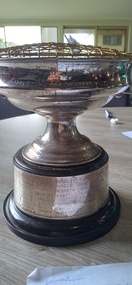
... Winners are: 1968 Mrs Peter Clarke, 1969 Mrs Mark Howard, 1970 Mrs RE Harris, 1971Mrs H McCulloch 1972 Mrs mark Howard, 1973 Mrs RE Harris, 1974 Mrs D R Cashmore, 1975 Mrs D R Cashmore 1976 Mrs D R Cashmore 1977 Mrs Mark Howard, 1978 Mrs D R Cashmore 1979 Mrs. ...Winners are: 1968 Mrs Peter Clarke, 1969 Mrs Mark Howard, 1970 Mrs RE Harris, 1971Mrs H McCulloch 1972 Mrs mark Howard, 1973 Mrs RE Harris, 1974 Mrs D R Cashmore, 1975 Mrs D R Cashmore 1976 Mrs D R Cashmore 1977 Mrs Mark Howard, 1978 Mrs D R Cashmore 1979 Mrs. ...Winner of this trophy must be a member of the Peterborough Women's Golf. This was one of the very early women's trophies. Winners are: 1968 Mrs Peter Clarke, 1969 Mrs Mark Howard, 1970 Mrs RE Harris, 1971Mrs H McCulloch 1972 Mrs mark Howard, 1973 Mrs RE Harris, 1974 Mrs D R Cashmore, 1975 Mrs D R Cashmore 1976 Mrs D R Cashmore 1977 Mrs Mark Howard, 1978 Mrs D R Cashmore 1979 Mrs. J S Irvine, 1980 Mrs J S Irvine, 1981 Mrs D R Cashmore, 1982 Mrs M Howard, 1983 Mrs R Roberts 1984 Mrs P Punch 1985 Mrs. B Clark, 1986 Faye Meade, 1987 Faye Meade, 1988 Mrs P Punch, 1989 F Meade, 1990 T Fraser, 1991 V Beer, 1992 L. Bourke, 1993 R Whitehead, 1994 T Green 1995 T Green 1996 T Green 1997 E Willox 1998 L Bourke, 1999 F Rundle 2000 F Rundle 2001 F Rundle 2002 F Rundle 2003 F Rundle 2004 F Rundle 2005 M Hesketh 2006 M Hesketh 2007 M Hesketh 2007 M Hesketh, 2008 M Hesketh, 2009 F Rundle 2010 B Drake, 2011 B Drake 2012 T Cartledge 2013 L Roberts 2014 T Cartledge 2015 T Cartledge 2016 T Cartledge 2017 N Cashmore 2018 J Walsh 2019 J Walsh 2020 J Walsh 21 J WalshMesh covered rosebowl shaped trophy on a wood coloured plastic plinth with a metal band for engraving names.Names of winners engraved -
 Bendigo Military Museum
Photograph - 4th Field Survey Squadron ANZAC Day Parade. Adelaide, SA, 1994
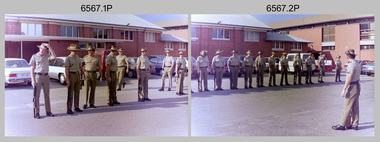
... L to R: unidentified, SPR Mark Linwood, SGT H. Evertz, SPR Mark Sinderberry, remainder unidentified. .9) - Photo, colour, 1994. ...L to R: unidentified, SPR Mark Linwood, SGT H. Evertz, SPR Mark Sinderberry, remainder unidentified. .9) - Photo, colour, 1994. ...This is a set of 11 photographs of 4th Field Survey Squadron personnel at Keswick Barracks preparing for the ANZAC Day parade through the streets of the Adelaide CBD on the 25th of April 1994. The march concluded at the Cross of Sacrifice in Pennington Gardens East followed by the ANZAC Day Service of Remembrance. Photos were also taken at Keswick Barracks at the end of the parade. See items 6565.32P and 6566.14P for more photos taken during ANZAC Day, 1994.This is a set of 11 photographs of 4th Field Survey Squadron personnel on ANZAC Day, on the 25th of April 1994. The colour photographs are on 35mm negative film and are part of the Army Survey Regiment’s Collection. The photographs were scanned at 96 dpi. .1) - Photo, colour, 1994. Unit sizing drill. L to R: CPL Brett Parkin, CPL Jeremy Archer, SGT Dave Longbottom, SPR Mark Sinderberry, SGT H. Evertz, SPR Matt Arnold, unidentified. .2) - Photo, colour, 1994. Unit sizing drill. L to R: unidentified (x5), SPR Chris Pearse, unidentified (x4), SPR Fran Calvert, SSGT Pat ‘Fuji’ Drover. .3) - Photo, colour, 1994. Unit sizing drill. L to R: CPL Brett Parkin, SPR Mark Sinderberry, unidentified, SPR Mark Linwood, remainder unidentified. WO2 Peter Hammer (far right). .4) - Photo, colour, 1994. Unit sizing drill. L to R: CPL Brett Parkin, SPR Mark Sinderberry, unidentified, SPR Mark Linwood, CPL Jeremy Archer, remainder unidentified. .5) - Photo, colour, 1994. Unit sizing drill. L to R: CPL Brett Parkin, unidentified (x2), SPR Mark Sinderberry, SPR Mark Linwood, remainder unidentified. .6) - Photo, colour, 1994. Unit sizing drill. L to R: unidentified (x4), SPR Mark Linwood, unidentified (x5), SPR Mark Sinderberry, remainder unidentified. .7) - Photo, colour, 1994. Unit uniform inspection. .8) - Photo, colour, 1994. Unit uniform inspection. L to R: unidentified, SPR Mark Linwood, SGT H. Evertz, SPR Mark Sinderberry, remainder unidentified. .9) - Photo, colour, 1994. Unit gathering post-parade. L to R: CPL Brett Parkin (partially obscured), SPR Greg Richards, SPR Mark McInerney. .10) - Photo, colour, 1994. Unit gathering post-parade. L to R: unidentified, Darby Munro (facing away), unidentified, John Harrison, SSGT John ‘Shep’ Shephard, unidentified (x2), SPR Fran Calvert, CPL Steve Wegener, remainder unidentified. .11) - Photo, colour, 1994. Unit gathering post-parade. L to R: Darby Munro, unidentified (x2), John Harrison, unidentified (x3), SPR Fran Calvert, unidentified (x2), SSGT John ‘Shep’ Shephard..1P to .11P – There are no personnel identified. ‘1994 ANZAC DAY’ annotated on negatives sleeve.royal australian survey corps, rasvy, 4 fd svy sqn -
 Bendigo Military Museum
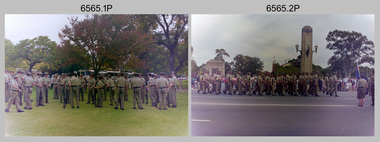
Photograph - 4th Field Survey Squadron ANZAC Day Parade. Adelaide, SA, 1994
... L to R: CAPT Tony Stephens, CPL Brett Parkin, SPR Mark Linwood, SGT H. Evertz, SPR Mark Sinderberry, unidentified (x2). .27) - Photo, colour, 1994. ...L to R: CAPT Tony Stephens, CPL Brett Parkin, SPR Mark Linwood, SGT H. Evertz, SPR Mark Sinderberry, unidentified (x2). .27) - Photo, colour, 1994. ...This is a set of 32 photographs of 4th Field Survey Squadron personnel parading through the streets of the Adelaide CBD on ANZAC Day, on the 25th of April 1994. The march concluded at the Cross of Sacrifice in Pennington Gardens East followed by the ANZAC Day Service of Remembrance. See items 6566.14P and 6567.11P for more photos taken during ANZAC Day, 1994.This is a set of 32 photographs of 4th Field Survey Squadron personnel parading through the streets of the Adelaide CBD on ANZAC Day, on the 25th of April 1994. The colour photographs are on 35mm negative film and are part of the Army Survey Regiment’s Collection. The photographs were scanned at 96 dpi. .1) - Photo, colour, 1994. Preparation. Bayonets fixed on SLR rifles. .2) - Photo, colour, 1994. Eyes right as unit passes dignitaries on the dais. .3) - Photo, colour, 1994. Eyes right as unit passes dignitaries on the dais. CAPT Rob Gray, centre of photo, OC MAJ Peter Demaine on right. .4) to .7) - Photo, colour, 1994. Eyes right as unit passes dignitaries on the dais. .8) - Photo, colour, 1994. Unit marches along the parade route. .9) to .13) - Photo, colour, 1994. Eyes right as unit passes dignitaries. .14) - Photo, colour, 1994. Unit marches along the parade route. Right file L to R: WO2 Peter Hammer, unidentified, SGT Dave Longbottom, SGT Paul Baker, unidentified. .15) - Photo, colour, 1994. Unit marches along the parade route. Right file L to R: SGT Paul Baker, unidentified (x2), SPR Fran Calvert, SPR Greg Richards, SGT H. Evertz. Centre file: SGT Mark Donnelly, SPR Mark McInerney, unidentified (x2), SPR Matt Arnold. .16) - Photo, colour, 1994. Unit marking time. Right file L to R: SGT Paul Baker, unidentified (x2), SPR Fran Calvert, SPR Greg Richards, SGT H. Evertz, CPL Brett Parkin. Centre file L to R: SPR Matt Arnold, SPR Mark Linwood. Right file L to R: unidentified, SPR Mark Sinderberry. Officers L to R: unidentified (x2), CAPT Rob Gray, CAPT Tony Stephens. .17) - Photo, colour, 1994. Unit marking time. L to R: SGT Paul Baker, unidentified, SSGT John ‘Shep’ Shephard, SGT Dave Longbottom, SPR Daryl Miller, CPL Steve Wegener, unidentified (x2), CPL Jeremy Archer, WO2 Peter Hammer, unidentified Warrant Officers (x2). .18) - Photo, colour, 1994. Unit marking time. L to R: SPR Mark Linwood, SPR Greg Richards, SPR Matt Arnold, SPR Mark Sinderberry, unidentified (x5), SPR Chris Pearse, unidentified, CPL Dick Crawford, unidentified, SSGT John ‘Shep’ Shephard, CPL Steve Wegener, unidentified, CPL Jeremy Archer, unidentified Warrant Officer. .19) - Photo, colour, 1994. Unit marking time. Officers L to R: unidentified (x2), CAPT Tony Stephens. L to R: SPR Mark Linwood, SPR Greg Richards, SPR Matt Arnold, SPR Mark Sinderberry, remainder unidentified. .20) - Photo, colour, 1994. Unit marched along the parade route. L to R: CAPT Rob Gray, unidentified officer. .21) - Photo, colour, 1994. Unit marches along the parade route. OC MAJ Peter Demaine. .22) - Photo, colour, 1994. Unit marches along the parade route. L to R: CAPT Tony Stephens, SPR Mark Linwood, SPR Matt Arnold, SPR Mark Sinderberry, unidentified (x3), SPR Chris Pearse, unidentified, CPL Dick Crawford, unidentified, SGT Dave Longbottom, SSGT John ‘Shep’ Shephard, CPL Steve Wegener, CPL Jeremy Archer, unidentified Warrant Officers (x2). .23) - Photo, colour, 1994. Unit marches along the parade route. L to R: SSGT John ‘Shep’ Shephard, SPR Daryl Miller, CPL Steve Wegener, unidentified, CPL Jeremy Archer, unidentified Warrant Officers (x2). .24) - Photo, colour, 1994. Unit marches along the parade route. L to R: unidentified, CPL Dick Crawford, SGT Dave Longbottom, SSGT John ‘Shep’ Shephard, unidentified, CPL Steve Wegener, WO2 Peter Hammer, CPL Jeremy Archer, unidentified Warrant Officers (x2). .25) - Photo, colour, 1994. Unit marches along the parade route. L to R: unidentified (x3), SPR Fran Calvert, unidentified (x2), SPR Chris Pearse, unidentified, CPL Dick Crawford, SPR Daryl Miller, SSGT John ‘Shep’ Shephard. .26) - Photo, colour, 1994. Unit marches along the parade route. L to R: CAPT Tony Stephens, CPL Brett Parkin, SPR Mark Linwood, SGT H. Evertz, SPR Mark Sinderberry, unidentified (x2). .27) - Photo, colour, 1994. Unit marches along the parade route. L to R: CPL Brett Parkin, CAPT Tony Stephens, SPR Mark Linwood, SPR Greg Richards, SPR Matt Arnold, unidentified, SPR Mark Sinderberry, unidentified (x3), SPR Chris Pearse, unidentified, CPL Dick Crawford, unidentified, SGT SSGT John ‘Shep’ Shephard, CPL Steve Wegener, CPL Jeremy Archer, unidentified Warrant Officer. .28) - Photo, colour, 1994. Unit marches along the parade route. L to R: Officers - OC MAJ Peter Demaine, unidentified (x2), CAPT Rob Gray, CAPT Tony Stephens. L to R: CPL Brett Parkin, SGT H. Evertz, SPR Mark Linwood, SSGT Pat ‘Fuji’ Drover, SPR Mark Sinderberry, unidentified. .29) - Photo, colour, 1994. Unit preparing to halt. .30) to .32) - Photo, colour, 1994. Unit ‘stand easy’..1P to .32P – There are no personnel identified. ‘1994 ANZAC DAY’ annotated on negatives sleeve.royal australian survey corps, rasvy, 4 fd svy sqn -
 Flagstaff Hill Maritime Museum and Village
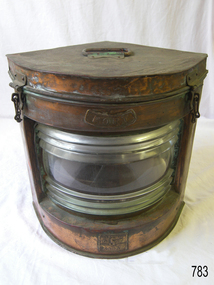
Equipment - Navigation Lamp, Port, Genton & Kessler Ltd, 1900 -1920
... Flagstaff Hill Warrnambool Shipwrecked-coast Flagstaff-Hill Flagstaff-Hill-Maritime-Museum Maritime-Museum Shipwreck-coast Flagstaff-Hill-Maritime-Village Alfred Frederick Samuel Genton Birmingham Genton & Kessler ship lamp Bingley Works J E & H Player Alfred F S Genton navigation lamp port lamp bow side lamp lighting device navigation Seahorse Great Britain Genton & Kessler Ltd. Stamped: "Seahorse GB trade mark ...Alfred Frederick Samuel Genton was born in Switzerland around 1869 and arrived in England, date unclear. By 1901, the Kelly’s Directory of Birmingham had listed the Genton & Kessler company as manufacturers of all kinds of ship and railway lamps, fog horns and general ship fittings, with their factory listed as the Bingley Works, King Edward Place, Birmingham, UK, which is listed in 1896 as being owned and run by J E & H Player. Then in February 1905 it appears the partnership of Alfred F S Genton & Julius Rudolf Kessler was dissolved and Alfred F S Genton continued to carry on the business on his own. The company continued to be managed by family members until 1961, when it ceased trading.A marine lamp made by a significant maker in Birmingham, England, in the early part of the 20th century. This item is now regarded as a collector's item. Brass lamp marked 'Port', with two small chains and hook locking mechanisms, and a hinged lid. It has a clear ribbed glass front with a red lens filter. The fuel tank and wick burner were removed. Inscriptions marked on the lamp. Manufacturer: Seahorse in Great Britain.Stamped: "Seahorse GB trade mark" "No. 54987" "PORT"flagstaff hill, warrnambool, shipwrecked-coast, flagstaff-hill, flagstaff-hill-maritime-museum, maritime-museum, shipwreck-coast, flagstaff-hill-maritime-village, alfred frederick samuel genton, birmingham, genton & kessler, ship lamp, bingley works, j e & h player, alfred f s genton, navigation lamp, port lamp, bow side lamp, lighting device, navigation, seahorse, great britain, genton & kessler ltd. -
 Flagstaff Hill Maritime Museum and Village
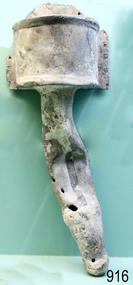
Functional object - Urinal, circa 1825
... Little is left on the seabed to mark the tragedy, apart from some of the house bricks intended for the Henty settlement. flagstaff hill warrnambool flagstaff-hill flagstaff-hill-maritime-museum shipwreck-coast shipwreck artefact the children lead ship’s plumbing crew urinal the ‘heads’ ship plumbing james henty portland bay urinal ship's urinal ship’s fitting ship’s lead plumbing ship’s toilet ship’s urinal Children Childer’s Cove Port Campbell 1839 shipwreck James Henty and Co Henty Brothers Captain H. ...The urinal was probably situated in the forward part of the ship rather than the stern, being one of two placed on either side of the deck and housed immediately adjacent to the doors into the forward castle, or crew sleeping quarters. The toilets on maritime vessels were (and still are) called the ‘heads’, after the sanitation arrangements common until the end of the eighteenth century. The name was given to the ‘head’ of the ship, forward of the forecastle and around the beak or bowsprit. These first lavatories were floored with grating or nets so the force of the sea could wash them clean, and they were always used on the lee or non-weather side so the effluent fell directly into the water rather than back on board. The Children's wrecking: The barque Children was one of the first vessels to be lost in the Western District. The vessel was wrecked to the east of Warrnambool on 14th January 1838. When it ran ashore in hurricane-force winds, 22 passengers and crew were fortunate to escape being battered to death on the rocks. The Children broke up within 20 minutes, sweeping sixteen of those on board to their deaths. After eleven days, the rescued survivors, all of whom were injured, had been taken to Portland. According to Lloyd's Shipping Register 1837-1839, the Children was built in 1825 at Liverpool and operated by owners Gordon & Co, of London. Registration number 123/1837, James Henty then bought her in 1837 as a three-masted barque of 254 tons, with a hull of “part pitch pine, felt sheathed” and “coppered in 1837” at Launceston, registered number 6/1837. In 1838, the Children, under her master Captain H. Browne, completed a successful round trip from Launceston to London (carrying wool and whale oil loaded in Portland), returning in late November of that year carrying a general cargo including house bricks used for ballast. On the 11th of January 1839, the Children sailed from Launceston for Adelaide, with 24 passengers, 14 crew, and an awkward mixed cargo, including 1500 sheep, 8 bullocks, 7 horses, farming implements, and six whaleboats with associated whaling gear. One account states that when the Children was “put out from port, she was light and badly ballasted”. The vessel immediately encountered four days of hurricane-force storms, eventually clearing on the early morning of the 14th. However, it was too late to take accurate measurements of the sun or stars to establish their position relative to the coast. The Children collided with a limestone stack at the entrance of what is now Childers Cove, and the seas smashed the vessel into pieces within half an hour. All the cargo and 16 lives were lost, including 9 children. The Henty brothers contributed £150 towards a fund for the 22 survivors at a memorial service held in Launceston later that year. It was a major financial setback for James Henty and his brothers, but one from which they recovered. In a submission to the Governor of New South Wales dated 24 March 1840, the Henrys summarised their work over the previous six years of establishing the Portland settlement, stating “Six stations have been occupied, one at Portland Bay three at the open country about 60 miles inland called ‘Merino Downs’ They have erected two houses at Portland Bay and two others at Merino Downs”.The urinal recovered from the Children's wreck is significant as part of the original fittings of the early 19th-century barque. The 1839 wreck and recovered artefacts are examples of the construction methods and materials used in that era and can be used to study the evolution of shipbuilding methods and principles. The wreck of the Children is of state significance as one of colonial Victoria’s earliest and most significant maritime disasters, and one of the first vessels lost in the Western District. This is recognised by its inclusion on the Victorian Heritage Register, VHR No. S116. Little is left on the seabed to mark the tragedy, apart from some of the house bricks intended for the Henty settlement. A lead urinal with a rounded back at the top splash plate with an attached semi-circular receptacle or basin (20cm deep and projecting forward 30cm). At the sides are flanges with bolt holes connecting to a ship's wall. The urinal is drained by a funnel-shaped outlet also made of lead, reducing from a 10cm radius to a joined 5 cm pipe. The urinal was recovered from the wreck of the CHILDREN.flagstaff hill, warrnambool, flagstaff-hill, flagstaff-hill-maritime-museum, shipwreck-coast, shipwreck artefact, the children, lead ship’s plumbing, crew urinal, the ‘heads’, ship plumbing, james henty, portland bay, urinal, ship's urinal, ship’s fitting, ship’s lead plumbing, ship’s toilet, ship’s urinal, children, childer’s cove, port campbell, 1839 shipwreck, james henty and co, henty brothers, captain h. browne, portland -
 Flagstaff Hill Maritime Museum and Village
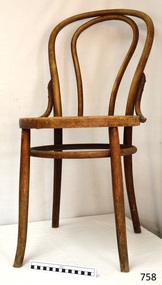
Furniture - Chair, Harnisch & Co, 1876-1918
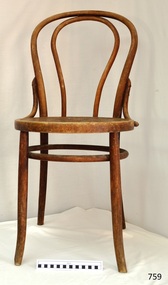
... Marks are embossed into rim under seat. Paper label, cream with black print, on rim; Right side of label has the symbol of Heraldic Shield. Text on label. Made by NEUSOHLER FABRIK FUR MOBEL, AUS MASSIV GEBOGENEM HOLZE, vorm. HARNISCH & Co, NEUSOHL (BESZTERCaZEBANYA) UNGARN ' Hand written under seat "T H....- Mark / NEUSOHLER FABRIK FUR MOBEL/ AUS MASSIV GEBOGENEM HOLZE, vorm. HARNISCH&Co / NEUSOHL (BESZTERCaZEBANYA) UNGARN ' Hand written under seat "T H" in black paint, "T H " in white chalk. ...Text on label “Trade – K.u.K.- Mark / NEUSOHLER FABRIK FUR MOBEL/ AUS MASSIV GEBOGENEM HOLZE, vorm. HARNISCH&Co / NEUSOHL (BESZTERCaZEBANYA) UNGARN ' Hand written under seat "T H" in black paint, "T H " in white chalk. ...The design of this pair (RN 758 & 759) is based on Thonet’s No. 18 chair, which was originally produced in 1876 by Thonet, and is still one of the best-selling designs for café and restaurant owners. It is elegant, sophisticated and durable. The label notes the design as “AUS MASSIV GEBOGENEM HOLZE vorm” which translates to “solid curved sandals shape”, a good description for the back of the chair. The chairs have marks, paper labels and symbols on them that show that the maker was Harnisch & Co., Neuschler (also called Banská Bystrica) Furniture Factory in Neuschol (Beszterczebanya), Hungary, privileged makers for the Imperial and Royal Austrian-Hungarian Empire 1867 – 1918. Bentwood chairs are made by a process of wetting wood in water, bending it into curved shapes, then allowing it to dry so that the shape becomes permanent. This process originated by Michael Thonet, who had been given the right to bend wood into desired curves by the Austrian Courts in 1842. In 1856 he was granted a 13 year patent to manufacture chairs and table legs of bent wood treated by steam or boiling water. In 1859 his company Gebruder Thonet produced his original design. Thonet’s early designs also featured hand carved or laminated wooden seats. His Model No. 14 produced in the 1850’s, was his most popular design. After Michael’s death in 1871 the family went on designing and producing chairs. The No. 18 chair was produced in 1876, one of a group of chars with back inserts consisting of curves and loops of bentwood. These bentwood chairs are believed to be associated with the either the original Warrnambool Town Hall or the Toc H Group in Warrnambool. The Warrnambool Town Hall played a significant role in the both the local government and the social events of local and district areas. It was a place for Council meetings, community events and entertainment, theatrical and musical.Chair, bentwood, 'French Bistro Chair' with a floral pattern carved in seat. Backrest has inverted U shape inside that extends to the seat. Supports on either side of backrest's base join to back of seat. Legs have a wooded bracing ring. Marks are embossed into rim under seat. Paper label, cream with black print, on rim; Right side of label has the symbol of Heraldic Shield. Text on label. Made by NEUSOHLER FABRIK FUR MOBEL, AUS MASSIV GEBOGENEM HOLZE, vorm. HARNISCH & Co, NEUSOHL (BESZTERCaZEBANYA) UNGARN ' Hand written under seat "T H" in black paint, "T H " in white chalk.Marks; pressed into rim under seat is "3", and "Crown [over] (N)", Paper label, cream with black print, on rim; Left side has Mark “N inside circle under crown”. Right side has symbol of Heraldic Shield. Text on label “Trade – K.u.K.- Mark / NEUSOHLER FABRIK FUR MOBEL/ AUS MASSIV GEBOGENEM HOLZE, vorm. HARNISCH&Co / NEUSOHL (BESZTERCaZEBANYA) UNGARN ' Hand written under seat "T H" in black paint, "T H " in white chalk. flagstaff hill, warrnambool, shipwrecked-coast, flagstaff-hill, flagstaff-hill-maritime-museum, maritime-museum, shipwreck-coast, flagstaff-hill-maritime-village, bentwood chair, café chair, restaurant chair, thonet design chair, neusohler fabrik fur nobel, k.u.k. approved manufacturer, hungry, harnisch & co, k.u.k., public hall chair, toc h -
 Flagstaff Hill Maritime Museum and Village
Furniture - Chair, Harnisch & Co, 1876-1918
... .- Mark / NEUSOHLER FABRIK FUR MOBEL/ AUS MASSIV GEBOGENEM HOLZE, vorm. HARNISCH & Co / NEUSOHL (BESZTERCaZEBANYA) UNGARN ' Hand written under seat "T H" in black paint, "T H " in white chalk. ....- Mark / NEUSOHLER FABRIK FUR MOBEL/ AUS MASSIV GEBOGENEM HOLZE, vorm. HARNISCH & Co / NEUSOHL (BESZTERCaZEBANYA) UNGARN ' Hand written under seat "T H" in black paint, "T H " in white chalk. ...The design of this pair (RN 758 & 759) is based on Thonet’s No. 18 chair, which was originally produced in 1876 by Thonet, and is still one of the best-selling designs for café and restaurant owners. It is elegant, sophisticated and durable. The label notes the design as “AUS MASSIV GEBOGENEM HOLZE vorm” which translates to “solid curved sandals shape”, a good description for the back of the chair. The chairs have marks, paper labels and symbols on them that show that the maker was Harnisch & Co., Neuschler (also called Banská Bystrica) Furniture Factory in Neuschol (Beszterczebanya), Hungary, privileged makers for the Imperial and Royal Austrian-Hungarian Empire 1867 – 1918. Bentwood chairs are made by a process of wetting wood in water, bending it into curved shapes, then allowing it to dry so that the shape becomes permanent. This process originated by Michael Thonet, who had been given the right to bend wood into desired curves by the Austrian Courts in 1842. In 1856 he was granted a 13 year patent to manufacture chairs and table legs of bent wood treated by steam or boiling water. In 1859 his company Gebruder Thonet produced his original design. Thonet’s early designs also featured hand carved or laminated wooden seats. His Model No. 14 produced in the 1850’s, was his most popular design. After Michael’s death in 1871 the family went on designing and producing chairs. The No. 18 chair was produced in 1876, one of a group of chars with back inserts consisting of curves and loops of bentwood. The popularity of the Bentwood chair, even now, is due to its versatility and timeless quality. Its style, whether varnished or painted, suits any room in the house. The lightweight chairs are also popular for café and restaurant seating, as well as for public gatherings. They can be easily moved around and grouped in a variety of ways to suit any occasion.Chair, bentwood, 'French Bistro Chair' with pattern carved in seat. Backrest has inverted U shape inside that extends to the seat. Supports on eitherside of backrest's base join to back of seat. Legs have a wooded bracing ring. Marks; pressed into rim under seat. Paper label, cream with black print, on rim. Right side of label has symbol of Heraldic Shield. Text on label. Made by Harnisch & Co.Marks; pressed into rim under seat is "3" and "4", and "Crown [over] N", Paper label, cream with black print, on rim; Left side has Mark “N inside circle under crown”. Right side has symbol of Heraldic Shield. Text on label “Trade – K.u.K.- Mark / NEUSOHLER FABRIK FUR MOBEL/ AUS MASSIV GEBOGENEM HOLZE, vorm. HARNISCH & Co / NEUSOHL (BESZTERCaZEBANYA) UNGARN ' Hand written under seat "T H" in black paint, "T H " in white chalk. flagstaff hill, flagstaff hill maritime museum and village, warrnambool, maritime museum, maritime village, great ocean road, shipwreck coast, bentwood chair, café chair, restaurant chair, meeting hall chair, thonet design chair, harnisch & co, k.u.k., neusohler fabrik fur nobel, approved manufacturer, neusohl (besztercazebanya) ungarn -
 Flagstaff Hill Maritime Museum and Village
Weapon - Cannon, circa 1825
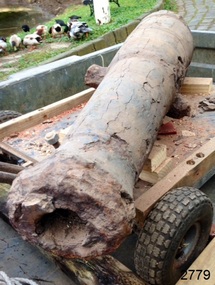
... mark the tragedy, apart from some of the house bricks intended for the Henty settlement. Flagstaff Hill Flagstaff Hill Maritime Museum and Village Warrnambool Maritime Museum Maritime Village Great Ocean Road Shipwreck Coast shipwreck artefact Children barque three-masted Liverpool Childer’s Cove Port Campbell 1839 shipwreck 1939 wreck James Henty and Co Henty Brothers Captain H. ...In an article dated 26 March 1963, the Warrnambool Standard reported: “A cannon which has lain on the ocean floor since the barque, Children, was wrecked at Childer’s Cove on January 15, 1839, was raised by three Warrnambool skindivers at the weekend … The cannon, weighing about 750 lb. and 4-ft. 6-in. in length … is in excellent order considering the length of time it has remained underwater”. No conservation measures were taken at that time, other than chipping off the marine growth with hammers and cold chisels. The minutes for the 4 February 1974 meeting of the Flagstaff Hill Planning Board recorded that “a cannon recovered some time ago was lying in the garden of [one of the three original divers] and that it could be picked up at any time”. Peter Ronald, past Manager and Diver for Flagstaff Hill, notes that the CHILDREN cannon would have been recovered by the other divers around 1964. When the cannon came into care of Flagstaff Hill, it was given basic conservation relevant to the time. (At the same meeting, the Board was advised of the recovery of an anchor from the wreck of the CHILDREN by Flagstaff Hill divers (Peter Ronald, Colin Goodall and Gary Hayden, and Hank Howey and Andrew Coffee), and its interim relocation in the sea at the end of the Warrnambool Breakwater while awaiting conservation). About the ship CHILDREN 1825-1839: The sailing ship Children was a wooden, three-masted barque constructed of pitch pine in 1825 at Liverpool. It was felt sheathed and was coppered during an upgrade in 1837. The ship was only 29 metres long and 254 tons in weight; it had two decks and a square stern. The James Henty & Co., a pioneering family from Portland, Victoria, purchased the Children in 1837 for use as a coastal trader. The Children, under the command of Captain H. Browne, was on a voyage from Launceston to Adelaide when it foundered in rough conditions at Childers Cove, west of Peterborough, on 14 January 1839. On board were 14 crew members and 24 passengers, including 9 children. The ship’s cargo was awkwardly balanced: it carried 1500 sheep, 8 bullocks, 7 horses, 5000 London house bricks, 6 whaling boats with associated gear, and general trade goods including beef, pork, tobacco, tipe, butter, lime juice, horse hair, curtains, lead shot, beer and spirits. The hurricane-force winds drove the Children into the limestone stack at the entrance to the cove. The seas smashed it into pieces within twenty minutes. The bodies of sixteen of those who had lost their lives were spread across the shore, along with wreckage from the ship and the cargo of animals. Those who survived suffered injuries; they were rescued and taken by horse and cart to Campbell’s farm, near the whaling station at Port Fairy. They arrived at Portland eleven days after the wreck. The wrecking of the Children is one of colonial Victoria’s earliest and most significant maritime disasters. Little is left to mark the tragedy, apart from some house bricks intended for the Henty family’s Portland Bay settlement. Artefacts recovered in the 1960s to early 1970s include this signal cannon, an anchor, the bottom half of her ship’s bell, and two portions of a ship’s fitting, at one time thought to be a brass porthole frame, London housing bricks and timber flooring. Despite its poor condition, the CHILDREN’s signal cannon remains an important and interpretable record of its demise. From 2015, the CHILDREN cannon has been undergoing the first stages of further conservation.The signal cannon recovered from the Children's wreck is significant as part of the original fittings of the early 19th-century barque. It is an example of maritime defence in the early to mid-19th century. The 1839 wreck and recovered artefacts are examples of the construction methods and materials used in that era and can be used to study the evolution of shipbuilding methods and principles. The wreck of the Children is of state significance as one of colonial Victoria’s earliest and most significant maritime disasters, and one of the first vessels lost in the Western District. This is recognised by its inclusion on the Victorian Heritage Register, VHR No. S116. Little is left on the seabed to mark the tragedy, apart from some of the house bricks intended for the Henty settlement. Signal cannon: a 1.3 metre iron 6pdr cannon recovered from the wreck of the CHILDREN. The shape of the cannon tapers from a thick round breech to a flared muzzle, with an 8-centimetre bore, and two side trunnions for pivoting on a wooden gun carriage. It was recovered from the shipwreck site of the CHILDREN by local divers in 1963. This small muzzle-loading signal cannon is in poor and unrestored condition. The cannon’s upper profile of smooth grey metal casing has corroded off, leaving an extensively oxidised rough red surface of crumbling iron. The bottom half of the cannon remains intact, although the outer smooth casing also appears to be separating from the iron core of the barrel. The original grey casting is also missing from the breech and muzzle ends of the cannon. Corrosion and spalling of the upper surface layer of the cannon have removed the maker’s marks and specificationsflagstaff hill, flagstaff hill maritime museum and village, warrnambool, maritime museum, maritime village, great ocean road, shipwreck coast, shipwreck artefact, children, barque, three-masted, liverpool, childer’s cove, port campbell, 1839 shipwreck, 1939 wreck, james henty and co, henty brothers, captain h. browne, first mate t. gay, second mate w. wentworth, portland, portland bay, 1939, ship’s cannon, signal cannon, conservation of marine artefacts, 6pdr small bore cannon, defence -
 Flagstaff Hill Maritime Museum and Village
Dividers, Early 20th Century
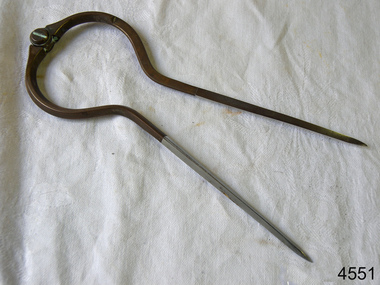
... H C (inscription). This navigational tool is used by a ship's navigator to mark the ship's position. ...H C (inscription). This navigational tool is used by a ship's navigator to mark the ship's position. ...Dividers are used by navigators to measure the distance between two points on a map or chart. Each point of the divider is places on a map point, then the distance between the points of the divider is measured against the scale of the chart or map. This helps determine the ship's path of travel, the distance travelled and the current location.Not very significant as not associated with any historical event or person, same pattern of dividers is available today from many retail outlets. Also item was probably made around 1940s to 1950sDividers; brass navigator's dividers with fine, stainless steel points. Made in Britain by W & H C (inscription). This navigational tool is used by a ship's navigator to mark the ship's position. Each end point of the divider is placed on a position on a chart or map, then the length between the points of the divider is measured on the chart's scale.Inscribed "British Made" and "W & H C". flagstaff hill, warrnambool, shipwrecked-coast, flagstaff-hill, flagstaff-hill-maritime-museum, maritime-museum, shipwreck-coast, flagstaff-hill-maritime-village, navigational dividers, navigational tool, dividers made by w & hc, w & hc britain -
 Federation University Historical Collection
Photograph, Pioneers of Ballarat
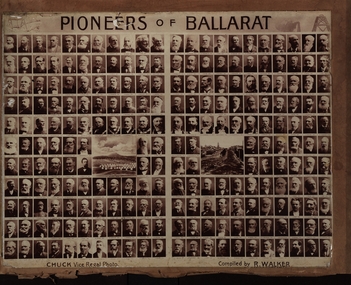
... Marks; J. Darby; T. Ray; D. McKenzie; James Robson; J. Robson; J. Moore; J. Murphy; Robert M. Serjeant; C. Ford; E.E. Campbell; P. Folland; P.J. Rickard; A. McVitty; B. Angwin; J.T. Sleep; M.P. Whiteside; W. Curtis; H...Marks J. Darby T. Ray D. McKenzie James Robson J. Robson J. Moore J. Murphy Robert M. Serjeant C. Ford E.E. Campbell P. Folland P.J. Rickard A. McVitty B. Angwin J.T. Sleep M.P. Whiteside W. Curtis H ...The Pioneers of Ballarat may have been created to the Ballarat Old Colonists' Association and the reunions held by the early Ballarat pioneers. The dates given after the pioneers time is their date of arrival into the colony.Photograph showing numerous portraits of men who were considered Pioneers of Ballarat as complied by R. Walker and produced by Chuck Vice Regal Photo. The men depicted are: J. Smith; W. Gay; W. Downie; G. Goddard; B. Varcoe; A.F. Seidal; Loius Balhausen; J. McKenzie; William irwin; M. Box; Thomas Bath; James Oddie; William Tulloch; J.W. Graham; J. Ward; W. Curnow; R.J. Binder; F.J.L. Turner; W. Eyres; C.A. Welch; B. Welch; G. Welch; J. Lake; H. Smith; J. King; R.T. Wreford; Ernest Balhausen; J. Ward; T. Trengrove; J. Truswell; J. Taylor; W. Seeley; J.P. Murray; Hon. David Ham; Andrew Anderson; E. McCartney; J.H. Smith; Joseph Edward Cowley; A. Jones; W.H. Furness; F.N. Martin; James Anderson; G. Becher; James Meek; T. Hawkins; P. Drummond; C. Barker; J. Malcolm; R. Brown; G. Tupper; A. Rose; W. Pinkerton; A. Clinton; A. Sheppard, F.C. Downes; J.A. Blight; J. Blight; T. Blight; J. Richardson; C.W. Toy; W.C. Elder; E. Towl; S. Walker; W.P. Martin; J.T Langley; J.A. Abramowitch; R, Allan; S.W. Woodward; G. Hunt; J. Bishop; F.L. Graham; R. Graham; W. A.G. Fraser; J. Davies; J. Paterson; B.G. Tucker; E. McElroy; W.H. Burton, T.C. Coates; J. Williams; J.P. Roberts; J. Ritchie; T.W. White; J. F. Harvey; Natale D'Angri; D. McCallum; W. Chisholm; P. Kohl; J. Moncrief; J.P. Marshall; R.U. Nicholls; G.L. Holthouse; C. Gray; W. Gale; James Long; Theo Williams; J.R. Ellsworth; W. Scott; Henry Josephs; D. Cooke; William Little; T.H. Thompson; E. Morey; J.G. McDonald; C.C. Shoppee; G. Douglas; W. H. Ellis; W. Hicks; J. Cameron; W. B. Koppers; F. Marendez; G. Herrmann; J. Kelly; E. Jermyn; P. Murray; P. Gay; D. McNaught; T.D. Wanliss; G. Lord; H. Glenny; J. Trethowan; J. Blandford; J. Goujon; W. Coad; A. Colliver; J. Nunn; J. Munro; W.C. Burbidge; J. Jarvie; C. Ferguson; C. Morris; J. Russell; J. Phillips; J. Coghlan; R. Clark; Thomas Stoddart; M. Wasley; B. Retallack; John Reid; M.C. Carey; P. Maloney; E. Newman; J. Lamb; J,. Pryor; J. Gibson; James Mitchell; J. Rowe; James Vallins; A. Roxburgh; A. Cant; O. Thomas; J.Y. McDonald; W.M. Acheson; A. Jack; R. Gibbings; E.W. Chamberlain; J.H. Ellsworth; J. Falconer; G.G. Lorimer; James M. Bickett; T. Sayle; Andrew McIntyre; W. Hambley; K. Coutts; T. Muir; R. Scott; G. Leach; E. Richards; R. Hearn; J. Hughan; D. Miliani; E. Parr; J. T. Irving; W.G. Williams; J. Marks; J. Darby; T. Ray; D. McKenzie; James Robson; J. Robson; J. Moore; J. Murphy; Robert M. Serjeant; C. Ford; E.E. Campbell; P. Folland; P.J. Rickard; A. McVitty; B. Angwin; J.T. Sleep; M.P. Whiteside; W. Curtis; H. Crisp; E. Major; R. Pearce; J. Waller; G. Waller; G. Abrams; J. McIntyre; J. Johnston; W. Johnston; W. Taylor; J. Knoth; J. Davey; G. Smith; N. Kent; E.O. Witherden; J.B. Cathcart; W.H. Harrow; G. Evans; L. Ure; W.T. Glen; T. Dickinson; D. Hughes; J. Strickland; J. Hillman; E. Jackson; R.J. Walker; D. Gunn; R.J. Gullan; T. McManamy; A. Gray; James trembath; W. Porter; J. Showman; C. Walker; J. Bowman; W.B. McDonald; P. Jago; J. Stout pioneers, ballarat, chuck, chuck vice regal photo, r. walker, ballarat pioneers, pioneers of ballarat, j. smith, w. gay, w. downie, g. goddard, b. varcoe, a.f. seidal, loius balhausen, j. mckenzie, william irwin, m. box, thomas bath, james oddie, william tulloch, j.w. graham, j. ward, w. curnow, r.j. binder, f.j.l. turner, w. eyres, c.a. welch, b. welch, g. welch, j. lake, h. smith, j. king, r.t. wreford, ernest balhausen, t. trengrove, j. truswell, j. taylor, w. seeley, j.p. murray, hon. david ham, andrew anderson, e. mccartney, j.h. smith, joseph edward cowley, a. jones, w.h. furness, f.n. martin, james anderson, g. becher, james meek, t. hawkins, p. drummond, c. barker, j. malcolm, r. brown, g. tupper, a. rose, w. pinkerton, a. clinton, a. sheppard, f.c. downes, j.a. blight, j. blight, t. blight, j. richardson, c.w. toy, w.c. elder, e. towl, s. walker, w.p. martin, j.t langley, j.a. abramowitch, r, allan, s.w. woodward, g. hunt, j. bishop, f.l. graham, r. graham, w. a.g. fraser, j. davies, j. paterson, b.g. tucker, e. mcelroy, w.h. burton, t.c. coates, j. williams, j.p. roberts, j. ritchie, t.w. white, j. f. harvey, natale d'angri, d. mccallum, w. chisholm, p. kohl, j. moncrief, j.p. marshall, r.u. nicholls, g.l. holthouse, c. gray, w. gale, james long, theo williams, j.r. ellsworth, w. scott, henry josephs, d. cooke, william little, t.h. thompson, e. morey, j.g. mcdonald, c.c. shoppee, g. douglas, w. h. ellis, w. hicks, j. cameron, w. b. koppers, f. marendez, g. herrmann, j. kelly, e. jermyn, p. murray, p. gay, d. mcnaught, t.d. wanliss, g. lord, h. glenny, j. trethowan, j. blandford, j. goujon, w. coad, a. colliver, j. nunn, j. munro, w.c. burbidge, j. jarvie, c. ferguson, c. morris, j. russell, j. phillips, j. coghlan, r. clark, thomas stoddart, m. wasley, b. retallack, john reid, m.c. carey, p. maloney, e. newman, j. lamb, j, . pryor, j. gibson, james mitchell, j. rowe, james vallins, a. roxburgh, a. cant, o. thomas, j.y. mcdonald, w.m. acheson, a. jack, r. gibbings, e.w. chamberlain, j.h. ellsworth, j. falconer, g.g. lorimer, james m. bickett, t. sayle, andrew mcintyre, w. hambley, k. coutts, t. muir, r. scott, g. leach, e. richards, r. hearn, j. hughan, d. miliani, e. parr, j. t. irving, w.g. williams, j. marks, j. darby, t. ray, d. mckenzie, james robson, j. robson, j. moore, j. murphy, robert m. serjeant, c. ford, e.e. campbell, p. folland, p.j. rickard, a. mcvitty, b. angwin, j.t. sleep, m.p. whiteside, w. curtis, h. crisp, e. major, r. pearce, j. waller, g. waller, g. abrams, j. mcintyre, j. johnston, w. johnston, w. taylor, j. knoth, j. davey, g. smith, n. kent, e.o. witherden, j.b. cathcart, w.h. harrow, g. evans, l. ure, w.t. glen, t. dickinson, d. hughes, j. strickland, j. hillman, e. jackson, r.j. walker, d. gunn, r.j. gullan, t. mcmanamy, a. gray, james trembath, w. porter, j. showman, c. walker, j. bowman, w.b. mcdonald, p. jago, j. stout, john smith -
 Federation University Historical Collection
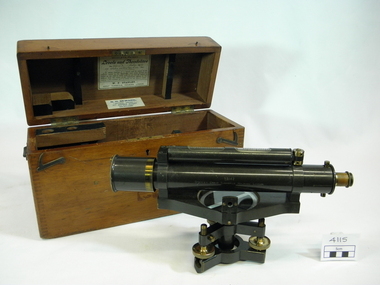
Instrument, W. H. Stanley, Surveying level, July 1899
... SEWARD, "Optical House" 457 BOURKE STREET (Near Queen Street) MELBOURNE *Engraving on brass plate encompassing the catch on front edge of the timber carry case reads: H&C L (inside an engraved heart on LSH) EUCHRE LEVER (engraved on RHS of brass plate) *Maker's mark is engraved along the length of the telescope barrel: 99142 Stanley. ...SEWARD, "Optical House" 457 BOURKE STREET (Near Queen Street) MELBOURNE *Engraving on brass plate encompassing the catch on front edge of the timber carry case reads: H&C L (inside an engraved heart on LSH) EUCHRE LEVER (engraved on RHS of brass plate) *Maker's mark is engraved along the length of the telescope barrel: 99142 Stanley. ...Used by students attending surveying classes at the School of Mines & Industries, Ballarat.Surveyor's level caste in metal with brass trimmings. Features external focus, twin inclined vertical crosshairs with stadia wires. With ray-shade clinomenter. Three levelling screws. Without transverse level (mounting provided). dust shield for object. Features glass lens x 2. Timber carry case features dovetailed joints, separate lid attached to body of case with two brass piano hinges along back side. Case has a metal carry handle screwed to each end. Matches tripod Item 4116 Item's serial number: 99142*The timber lid of the carry case has 'L3' painted on it in white paint. *The paper label glued to reverse side lid of inside carry box reads: STANLEY'S PATENT LEVELS AND THEODOLITES No.99142 July 1899 STADIA POINTS SET=1 : 100. In taking readings of a distant staff by means of the subtense points in the diaphragm, read every 1/100 foot (or metre) on the staff as being equal to one foot (or metre) of distance from the centre of the instrument adding to the reading of plus constant of 18 3/4 inchess from any distance shown. W.F. Stanley, Great Turnstile, Holborn, London. *The paper label glued to lower edge inside lid of carry box reads: N. H. SEWARD, "Optical House" 457 BOURKE STREET (Near Queen Street) MELBOURNE *Engraving on brass plate encompassing the catch on front edge of the timber carry case reads: H&C L (inside an engraved heart on LSH) EUCHRE LEVER (engraved on RHS of brass plate) *Maker's mark is engraved along the length of the telescope barrel: 99142 Stanley. Great Turnstile Holborn, London. level, theodolite, surveying instrument, surveying, scientific instruments -
 Federation University Historical Collection
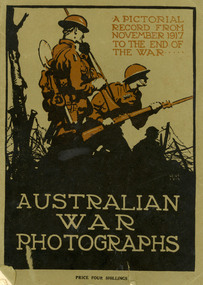
Book, Cassell and Company, Ltd, Australian War Photographs, 1917
... mark ridgeay...harold williamson...flanders...poziers...somme...becourt...mouquet farm...rupert whiteley...ypres...montauban...field cooker...gueudecourt...band...bapaume...bullecourt...h...(See http://guerin.ballarat.edu.au/aasp/is/library/collections/art_history/honour-roll/honourroll_cannon.shtml) chatham family collection chatham world war one world war 1 world war i france trenches front line birdwood mark ridgeay harold williamson flanders poziers somme becourt mouquet farm rupert whiteley ypres montauban field cooker gueudecourt band bapaume bullecourt h. murray hindernburg wire messines howitzer w. holmes. canon ted canon hill 60 gas masks siege battery menin road ambulance dressing station glencorse wood prisoners pigeons australian commonwealth military forces sgs Chatham - Holmes Family Archive Photographic history of Australians during World War One 129 page book with soft beige, brown and black cover depicting three soldiers at the front during World War One. ...Photographic history of Australians during World War One129 page book with soft beige, brown and black cover depicting three soldiers at the front during World War One. The book includes many photographs and artwork of Australians at the French front from November 1917 until the end of the war. Photographers include Frank Hurley, E. Brooks, H.F. Baldwin and G.H. Wilkins. Artists include Crozier, W.L. King, Alan Lewis, Lothian, John Davis, S. Perks, I. Picking, Daryl Lindsay, Alf Saville, L.H. Howie, Stuart Shaw, P. Huthnance, Stiggo, S. Perks, C.H. Gould, Ted Canon, Bernie Bragg, S. Shaw, Will Dyson, An introduction is written by W. Birdwood, France, 28 September 1917. A number of pages have written notes on them by someone who had obviously been on the French Front. (These pages have been scanned and uploaded onto Victorian Collections. non-fictionPhotographic history of Australians during World War Onechatham family collection, chatham, world war one, world war 1, world war i, france, trenches, front line, birdwood, mark ridgeay, harold williamson, flanders, poziers, somme, becourt, mouquet farm, rupert whiteley, ypres, montauban, field cooker, gueudecourt, band, bapaume, bullecourt, h. murray, hindernburg wire, messines, howitzer, w. holmes. canon, ted canon, hill 60, gas masks, siege battery, menin road, ambulance, dressing station, glencorse wood, prisoners, pigeons, australian commonwealth military forces, sgs, chatham - holmes family archive -
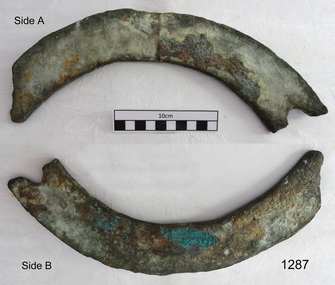 Flagstaff Hill Maritime Museum and Village
Functional object - Ship's Fitting, circa 1825
... mark the tragedy, apart from some of the house bricks intended for the Henty settlement. Flagstaff Hill Flagstaff Hill Maritime Museum and Village Warrnambool Maritime Museum Maritime Village Great Ocean Road Shipwreck Coast shipwreck artefact Children Childer’s Cove Port Campbell 1839 shipwreck James Henty and Co Henty Brothers Captain H. ...This attractively patinated artefact was raised from the wreck site of the CHILDREN and was quite reasonably catalogued as a portion of a ship's porthole. This identification is unlikely, however, because the CHILDREN was built at Liverpool in 1824, and round portholes were not in common use until the 1850s. The catalogue identification has since been changed to "Ship's Fitting" Before the appearance of round portholes in the middle of the nineteenth century, the function of introducing light to lower decks was performed by square half-glassed ‘ports’ in the side of the hull (known as a port-sash), or ground-glass ‘bullseyes’ inserted in the deck (scuttles). In historical terms, ports were always square, cut into the timber originally to allow the firing of a ship's guns, and were closed in weather by a tight-fitting square hatch. Flagstaff Hill Shipwreck Museum has three portholes on display that illustrate the gradual development and adoption of circular brass portholes. First in sequence is a small 12.5cm diameter window (with a deep frame for thick wooden hulls) from the 1855 wreck of SCHOMBERG. The second and third are larger 25cm diameter windows (with a shallower frame for thinner iron hulls) from the 1892 wreck of the NEWFIELD and the 1908 wreck of the FALLS OF HALLADALE. Once the apparently obvious use of the brass object is discounted, an accurate and reliable alternative classification is difficult to specify. One artefact register notes it was ‘found in about the centre of the wreck site’. This would mitigate against the possibilities of (1) ‘horseshoe frame’ joining pieces of the keel and hull at the bow of the vessel, or (2) ‘deckseat’ for a binnacle at the stern. It may support the idea of a ‘head frame’ on a cooped companionway or a ‘deckseat’ for a mainmast pump. But this is only speculation. The actual identification is not known. The sip's fitting recovered from the Children's wreck is significant as part of the original fittings of the early 19th-century barque. The 1839 wreck and recovered artefacts are examples of the construction methods and materials used in that era and can be used to study the evolution of shipbuilding methods and principles. The wreck of the Children is of state significance as one of colonial Victoria’s earliest and most significant maritime disasters, and one of the first vessels lost in the Western District. This is recognised by its inclusion on the Victorian Heritage Register, VHR No. S116. Little is left on the seabed to mark the tragedy, apart from some of the house bricks intended for the Henty settlement. Ship's fitting, of heavy gauge brass circle, previously classified as a section of the ship's fitting, which was raised from the wreck of the Children. One end is broken off at an original bolt hole, and the other is severed or cut at an acute angle from the inner rim. The artefact is 6cm across and 1cm deep, indicating strength and function as a substantial and finished item of moulded metal. The upper face bears sedimentary accretion stained red/brown. The rear face has been gouged by hard or corrosive materials and bears brilliant blue/green oxidation.flagstaff hill, flagstaff hill maritime museum and village, warrnambool, maritime museum, maritime village, great ocean road, shipwreck coast, shipwreck artefact, children, childer’s cove, port campbell, 1839 shipwreck, james henty and co, henty brothers, captain h. browne, portland, portland bay, brass flange, brass rim, ship’s fitting -
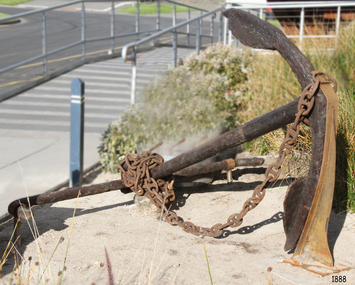 Flagstaff Hill Maritime Museum and Village
Equipment - Anchor, Before 1831
... mark the tragedy, apart from some of the house bricks intended for the Henty settlement. Flagstaff Hill Flagstaff Hill Maritime Museum and Village Warrnambool Maritime Museum Maritime Village Great Ocean Road Shipwreck Coast shipwreck artefact Children barque three-masted Liverpool Childer’s Cove Port Campbell 1839 shipwreck 1939 wreck James Henty and Co Henty Brothers Captain H. ...The anchor is from the wooden sailing ship CHILDREN, which was wrecked at Childers Cove east of Warrnambool on the 14th of January 1839 with the loss of 16 lives. The Children anchor was raised from the wreck site by Flagstaff Hill Divers: Peter Ronald, Garry Hayden (Terang, still), Tim Goodall (now Warrnambool), and Colin Goodall (now Warrnambool), on Sunday, 3rd January 1974. A week or so later, it was dragged up the cliffs and taken to Warrnambool. It is now on display near the entrance to the Maritime Museum and Village. It appears to be a Pering’s Improved Anchor, developed at Portsmouth after 1813. The addition of broad curvature to the anchor arms provided a stronger purchase than the pre-existing Admiralty Old Pattern Long Shanked Anchor with straight arms. However, the evidence of hammer-welding of the separate pieces of the arms and palms to the central shank, peaked crown and flat palms, suggests the manufacture is before the 1831 Rodger’s Anchor design, which cast both arms and their flukes as one piece that was then attached to the shank by a bolt through the crown. This identification seems consistent with the date of the CHILDREN’s construction in 1824. The CHILDREN was a three-masted barque with a wooden hull built at Liverpool in England. The vessel was bought by the Henty family of Portland (Australia Felix) in 1837 for regular coastal trading between Van Diemens Land (now Tasmania), the Port Phillip District of New South Wales and South Australia. Only 255 tons burden (92 feet in length, with a beam of 25 feet and depth of 17 feet), it sailed from Launceston bound for Adelaide in late December 1838, on its first Australian voyage and under the English master who had brought the barque out, Captain H. Browne. On board the CHILDREN were 24 passengers, including 9 children, the captain and 14 crew; livestock of 1500 sheep, 8 bullocks and 7 horses; general cargo of beef, pork, tobacco, tripe, butter, limejuice, horse hair, currants, lead shot, beer and spirits; 5,000 house bricks from London; and six whaling boats with associated whaling gear. The vessel was battered by gale-force north-westerly winds shortly after setting out from Launceston on 11 January 1839, and adverse sailing conditions persisted for the next four days. At 11 pm on the 14th of January 1839, and many miles north and east of the captain’s navigated position, the CHILDREN struck the Pinnacle, a limestone stack off what is now called Childers Cove. Within half an hour, the ship was destroyed. As well as the loss of livestock and cargo, 16 passengers and crew perished, including the captain, six men, one woman and nine children. In 1931, shifting sands at Childers Cove uncovered the skeleton of an adult male. In 1951, another two skeletons were exposed by storms, an adult male and a child. In 1963, some district scuba divers retrieved a small signal cannon from the site. And in 1974, Flagstaff Hill recovered the anchor and some house bricks. The anchor recovered from the Children's wreck is significant as part of the equipment of the early 19th-century barque. The 1839 wreck and recovered artefacts are examples of the construction methods and materials used in that era and can be used to study the evolution of shipbuilding methods and principles. The wreck of the Children is of state significance as one of colonial Victoria’s earliest and most significant maritime disasters, and one of the first vessels lost in the Western District. This is recognised by its inclusion on the Victorian Heritage Register, VHR No. S116. Little is left on the seabed to mark the tragedy, apart from some of the house bricks intended for the Henty settlement. A large forged, wrought iron anchor from the wreck of the CHILDREN. Flat hammer-welded flukes on opposing curved arms and a peaked crown. It has a metal, elbowed stock or cross-bar and a heavy-duty pinned, flat-ring shackle for the anchor chain. It is in fair condition but extensively corroded after 135 years on the seabed. flagstaff hill, flagstaff hill maritime museum and village, warrnambool, maritime museum, maritime village, great ocean road, shipwreck coast, shipwreck artefact, children, barque, three-masted, liverpool, childer’s cove, port campbell, 1839 shipwreck, 1939 wreck, james henty and co, henty brothers, captain h. browne, first mate t. gay, second mate w. wentworth, portland, portland bay, anchor, ship’s anchor, peter ronald, garry hayden, tim goodall, colin goodall, pering’s improved anchor
