
Showing 151 items matching "h. stanley"
-
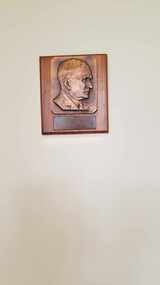 Royal Australasian College of Surgeons Museum and Archives
Painting - Plaque, Bronze relief casting of H Devine by Stanley Hammond, Stanley Hammond, H Devine
... Plaque, Bronze relief casting of H Devine by Stanley Hammond...H Devine... Stanley...Plaque, Bronze relief casting of H Devine by Stanley Hammond...H Devine Stanley Hammond Plaque, Bronze relief casting of H Devine by Stanley Hammond H Devine Painting Plaque, Bronze relief casting of H Devine by Stanley Hammond Stanley Hammond ...Plaque, Bronze relief casting of H Devine by Stanley Hammondh devine, stanley hammond -
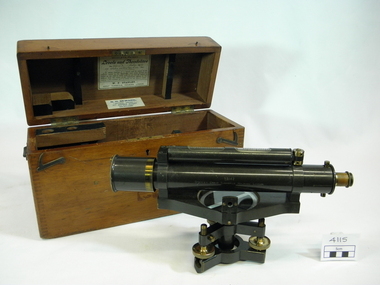 Federation University Historical Collection
Instrument, W. H. Stanley, Surveying level, July 1899
... Stanley, Great Turnstile, Holborn, London. *The paper label glued to lower edge inside lid of carry box reads: N. H...W. H. Stanley...Matches tripod Item 4116 Item's serial number: 99142 Surveying level Instrument W. H. Stanley ...Used by students attending surveying classes at the School of Mines & Industries, Ballarat.Surveyor's level caste in metal with brass trimmings. Features external focus, twin inclined vertical crosshairs with stadia wires. With ray-shade clinomenter. Three levelling screws. Without transverse level (mounting provided). dust shield for object. Features glass lens x 2. Timber carry case features dovetailed joints, separate lid attached to body of case with two brass piano hinges along back side. Case has a metal carry handle screwed to each end. Matches tripod Item 4116 Item's serial number: 99142*The timber lid of the carry case has 'L3' painted on it in white paint. *The paper label glued to reverse side lid of inside carry box reads: STANLEY'S PATENT LEVELS AND THEODOLITES No.99142 July 1899 STADIA POINTS SET=1 : 100. In taking readings of a distant staff by means of the subtense points in the diaphragm, read every 1/100 foot (or metre) on the staff as being equal to one foot (or metre) of distance from the centre of the instrument adding to the reading of plus constant of 18 3/4 inchess from any distance shown. W.F. Stanley, Great Turnstile, Holborn, London. *The paper label glued to lower edge inside lid of carry box reads: N. H. SEWARD, "Optical House" 457 BOURKE STREET (Near Queen Street) MELBOURNE *Engraving on brass plate encompassing the catch on front edge of the timber carry case reads: H&C L (inside an engraved heart on LSH) EUCHRE LEVER (engraved on RHS of brass plate) *Maker's mark is engraved along the length of the telescope barrel: 99142 Stanley. Great Turnstile Holborn, London. level, theodolite, surveying instrument, surveying, scientific instruments -
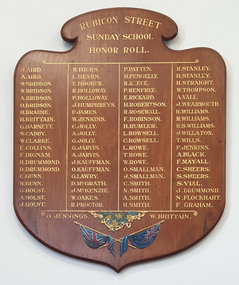 Ballarat Heritage Services
Photograph, Rubicon Street Methodist Sunday School Honor Roll
... ...H. Stanley...Smith H. Straight H. Stanley R. Stanley W. Thompson (2) A. Vale S. ...A photograph of a timber honor board with gold text indicating the names of the from the Rubicon Street Sunday School who enlisted for service during World War One. rubicon street sunday school honor roll, rubicon street methodist sunday school, a. aird, j. aird, g. barnett, a. black, h. braidie, a. bridson, s. bridson, w. bridson, h. brittain, w. brittain, s. caddy, w. clarke, e. collins, f. dignam, n. flockhart, f. graham, c. gunn, w. gunn, l. hearn, w. hicks, p. holloway, r. holloway, arnold holst, f. giffen holst, john holst, e. hooker, j. humphreys, p. james, a. jarvis, g. jarvis, w. jenkins (2), a. jolly, c. jolly, g. jolly, j. kauffman, o. kauffman, p. jenkins - o. jennings, g. lawry, f. mayall, d. mcgrath, j. mckenzie, w. oakes, p. renfree, e. rickard, h. robertson, f. robinson, l. rowe, t. rowe, w. rowe, c. rowsell, l. rowsell, r. rosewall, h. rumler, c. sheers, s. sheers, j. smallman, o. smallman, a. smith, c. smith, h. smith, n. smith, h. straight, h. stanley, r. stanley, w. thompson (2), a. vale, s. vial, j. wearmouth, j. willaton, t. wills, h. williams, h.s. williams, m. williams, d. drummond, h. drummond, j. drummond, r. proctor, p. patten, h. pengelly, world war one, honur board -
 Federation University Historical Collection
Minute Book, Eureka Stockade Memorial Park Association Minute Book No 5, 1943 - 1950
... ...j h stanley...band w a shaw eureka anniversary j birch w shaw j trevenan speilvogel eureka swimming pool returned service w marshall j h hanley j h stanley soldier s advance ballarat association w young ursula chisholm a barnett j o dell eddie callow eureka caravan park allan jones ballarat swimming club Eureka Anniversary Railway Bridge Ballarat Orphanage Brown cloth covered book, with brown packaging tape down the spine. ...Brown cloth covered book, with brown packaging tape down the spine.band, w a shaw, eureka anniversary, j birch, w shaw, j trevenan, speilvogel, eureka swimming pool, returned service, w marshall, j h hanley, j h stanley, soldier s, advance ballarat association, w young, ursula chisholm, a barnett, j o dell, eddie callow, eureka caravan park, allan jones, ballarat swimming club, eureka anniversary railway bridge, ballarat orphanage -
Port Melbourne Historical & Preservation Society
Card - Christmas card, Holy Trinity Anglican Church, 1913
... 1913 Christmas card from Holy Trinity Church - small 4pg card printed in brown with pictures of the new church and of the Vicar, Rev H. Stanley Hollow...celebrations fetes and exhibitions religion - anglican (holy trinity) rev herbert stanley hollow 1913 Christmas card from Holy Trinity Church - small 4pg card printed in brown with pictures of the new church and of the Vicar, Rev H. Stanley Hollow Card Christmas card, Holy Trinity Anglican Church ...1913 Christmas card from Holy Trinity Church - small 4pg card printed in brown with pictures of the new church and of the Vicar, Rev H. Stanley Hollowcelebrations fetes and exhibitions, religion - anglican (holy trinity), rev herbert stanley hollow -
Glen Eira Historical Society
Stanley Street 14, Elsternwick
... ...Stanley H....E. Carre Riddell Stanley H. Riddell Stanley Mrs. Riddell Walter J. ...This file contains two items., MELBOURNE WEEKLY article dated 09/06/2010 giving brief details of house features and renovation details. Includes two coloured photographs., Hand-written details on occupiers of 14 Stanley Street taken from Sands and McDougalls directories.stanley street, elsternwick, architectural features, plaster moulds, bay windows, emery, mrs marian, emery, percy e., mcdonald, wm., riddell, yolande s. carre, riddell, consett carre, riddell, miss m. e. carre, riddell, stanley h., riddell, stanley mrs., riddell, walter j. carre, riddell, thos w. carre, chairman, board of works, cavers carre, ogg, charles a., noisewood, carre street, orrong road, housenames, biggin and scott -
Glen Eira Historical Society
Document - STANLEY STREET, 14, ELSTERNWICK
... ... Riddell Stanley H....Carre Miss Riddell Stanley H. Riddell Stanley Mrs. Riddell Walter J. ...This file contains two items about this property: 1/MELBOURNE WEEKLY advertisement dated 09/06/2010 giving brief details of house features and renovation details. Includes two coloured photographs. 2/Hand-written details on occupiers of 14 Stanley Street taken from Sands and McDougalls directories.stanley street, elsternwick, architectural features, plaster moulds, bay windows, emery marian mrs, emery percy e., mcdonald wm., riddell yolande s. carre, riddell consett carre, riddell m. e. carre miss, riddell stanley h., riddell stanley mrs., riddell walter j. carre, riddell thos w. carre, chairman board of works, cavers carre, ogg charles a., noisewood, carre street, orrong road, house names, biggin and scott -
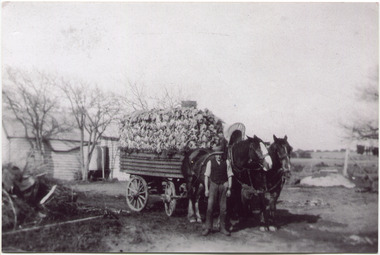 City of Moorabbin Historical Society (Operating the Box Cottage Museum)
Photograph, Black & White, V Peterson East Boundary Rd East Bentleigh loaded wagon c1900, original c1900
... Black & White photograph showing Vic Peterson beside the horse drawn wagon loaded with 35dozen ( 12x 35) cabbages setting off to market c 1900 Original re-digitised by H Stanley 2005....; bent thomas, o'shannassy john, king richard, charman stephen, highett william, ormond francis, maynard dennis, market gardeners, vineyards, orchards Back Hand written information Black & White photograph showing Vic Peterson beside the horse drawn wagon loaded with 35dozen ( 12x 35) cabbages setting off to market c 1900 Original re-digitised by H Stanley 2005 Photograph, Black & White, V Peterson East Boundary Rd East Bentleigh loaded wagon c1900 Vic Peterson family ...The Peterson family were early settlers in Moorabbin Shire and established a market garden in East Boundary Road East Bentleigh. Vic Peterson and family loaded the crop - cabbages - onto the horse drawn wagon and set off to the Melbourne market using the Plateways that ran along Centre Road and Nepean Highway. The early settlers like the Petersons , in the Parish of Moorabbin County of Bourke after Henry Dendy's Special Survey Brighton 1841, established market gardens, fruit & flower gardens, poultry & dairy farms, vineyards as well as shop businesses, blacksmiths, chemists, nursing homes and schools & Churches.Black & White photograph showing Vic Peterson beside the horse drawn wagon loaded with 35dozen ( 12x 35) cabbages setting off to market c 1900 Original re-digitised by H Stanley 2005Back Hand written informationwagons, vulcan trucks, draught horses,, peterson vic, marriott dick, cabbage crops, vegetable crops, poliomyelitis epidemics 20thc , elster creek, plateways moorabbin shire, smith j l; smith mary ann, stanley helen, smith vic, smith harry redvers, chaff cutter, horse drawn carts, toll gates brighton, motor cars 1900, steam engines, early settlers, bentleigh, mckinnon, parish of moorabbin, city of moorabbin, county of bourke, moorabbin roads board, shire of moorabbin, henry dendy's special survey 1841, were j.b.; bent thomas, o'shannassy john, king richard, charman stephen, highett william, ormond francis, maynard dennis, market gardeners, vineyards, orchards -
 Bendigo Historical Society Inc.
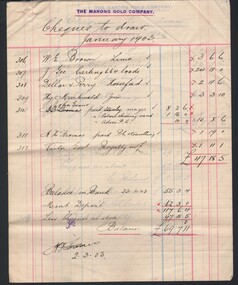
Document - THE MARONG GOLD COMPANY ACCOUNTS 1903, 1903
... H Thomas... J Stanley...Brown, J Gee, Dellar + Perry, John Evans, A. H. Thomas, J. Stanley, Whipstick Cyanide Co., Jas. ...COTTAGE Miners The Marong Gold Company W E Brown J Gee Dellar + Perry John Evans A H Thomas J Stanley Whipstick Cyanide co. Jas Maginnis J V Sanderman? ...Document. The Marong Gold Company Accounts 1903. 5 ledger pages of 'Cheques to Draw'. Accounts - Jan, Feb, Mar, Apr & May - Jul 1903. 'The Marong Gold Company' is stamped in purple ink on the top of each page. Names mentioned include W. E. Brown, J Gee, Dellar + Perry, John Evans, A. H. Thomas, J. Stanley, Whipstick Cyanide Co., Jas. Maginnis, J. V. Sanderman?, Rosenhain + Bryce, McArty, May. 5 pages pinned together along with a note of names and figures.cottage, miners, the marong gold company, w e brown, j gee, dellar + perry, john evans, a h thomas, j stanley, whipstick cyanide co., jas maginnis, j v sanderman?, rosenhain + bryce, mcarty, may -
 Federation University Historical Collection
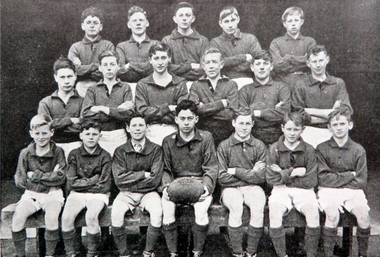
Booklet, Ballarat School of Mines Students' Magazine, 1948, 1948
... ...william h. wray...stanley...Story, Art Section, Escape from Nazi Europe, Short Story Competition, Senior Sport, Girls Sport, Commercial Notes, The Junior Techs, Junior Technical School Students' 1948, Students' doing Trade Apprenticeship Courses ballarat school of mines magazine h. tozer v. lancaster g. murdoch m. greenwood alan j. fenton c. rook b. bryan c. g. fairbank r. p. flower c. sanos eric e. marshman r. w. richards m. k. ashton w. k. l. murray g. ramm john c. collins f. g. procter dr. j. r. pound donald c. johnston neville d. gardner arthur c. burrow phillip e. richards john f. swain hester darby lewis huisman betty freeth j. williams m. treganowan gwenyth williams w. archibald maureen callahan margaret ryan t. downes dawn anderson m. rowbottom beverley letti l. greenbank valerie ritchie beryl hutchings p. reidy robert tantau willis brown wesley wilson donald durant geo m. hetherington john a. wilson maxwell f. murray ron cairns geoffrey j. edmonds john k. ballinger william n.. edwards r. rosser horace j. graham kevin k. treloar john h. boag francis l. veal hans fumberger john r. jopling william h. wray stanley j. dunstan john willis robert e. davis jeffrey m. coward william j. scala george r. searle norman w. ludbrook robert r. u'ren rex h. hollioake alan vinegrad h. mcwilliam james w.b. tippett james w. brokenshire frederick g. savage ronald t. spence john r. sawyer terence p. lannen e. lloyd d. brayshaw valerie daff betty hearn thelma halsall v. henderson netta pitcher moira baker betty whitford joan ellis pamela hay r. b. williams heather coad s. shillington b. duffer j. a. willsher m. mclean j. catherall c. beeston e. shaw n. silvey d. stevens k. adams t. hewitt i. lepp j. mccormack a. young l. george j. terrill k. spalding j. watts w. clarke g. hindson d. gilbert a. hewitt r. plover g. murrowood r. cochrane j. bethune j. walton r. ward j. blain r. gluyas r. luke j. daly k. ward i. mcconchie p. hewitt j. skilbeck e. jones c. hoffman w. mckenzie r. phillips g. allen h. saw c. mayne b. graham m. tweedale d. alexander w. rodgers r. norman m. horwood p. hains m. coleman g. hannah r. bawden r. simpson d. ditchfield albert bradley w. d. ditchfield Green cover with maroon and green lettering, soft covered magazine of 54 pages. ...School Council, Members of Staff, List of Full Course Students 1948, S.M.B. Magazine Committee, Editorial, Principal's Page, News and Notes, Editor's Notes, Obituary - S. H. Mayo, Farewells to Staff Members, Alterations in Staff, Science Section, The Literary Society, S.M.B. Yesterday and Today, The Ex-Servicemen, R.A.A.F. Story, Art Section, Escape from Nazi Europe, Short Story Competition, Senior Sport, Girls Sport, Commercial Notes, The Junior Techs, Junior Technical School Students' 1948, Students' doing Trade Apprenticeship Courses Green cover with maroon and green lettering, soft covered magazine of 54 pages. Artwork Mr Ramm - By Robert Tantau Borrick - By H. McWilliam Darb - By Robert Tantau Have a chip Will - By Robert Tantau Junior - By Robert Tantau Bruce - By Robert Tantau Pen and ink Ilustration (car) - By Ron Cairns Rosemary - By Robert Tantau Maurine - By Robert Tantau Howard - By H. Tozer Mick - By Robert Tantau Lorna - By Robert Tantau Sandy - By Robert Tantau Hughes - By Robert Tantau Bautovich - By Robert Tantau Bill and Banjo - By Robert Tantau Mac - By Robert Tantau Rowy - By John Willis ballarat school of mines, magazine, h. tozer, v. lancaster, g. murdoch, m. greenwood, alan j. fenton, c. rook, b. bryan, c. g. fairbank, r. p. flower, c. sanos, eric e. marshman, r. w. richards, m. k. ashton, w. k. l. murray, g. ramm, john c. collins, f. g. procter, dr. j. r. pound, donald c. johnston, neville d. gardner, arthur c. burrow, phillip e. richards, john f. swain, hester darby, lewis huisman, betty freeth, j. williams, m. treganowan, gwenyth williams, w. archibald, maureen callahan, margaret ryan, t. downes, dawn anderson, m. rowbottom, beverley letti, l. greenbank, valerie ritchie, beryl hutchings, p. reidy, robert tantau, willis brown, wesley wilson, donald durant, geo m. hetherington, john a. wilson, maxwell f. murray, ron cairns, geoffrey j. edmonds, john k. ballinger, william n.. edwards, r. rosser, horace j. graham, kevin k. treloar, john h. boag, francis l. veal, hans fumberger, john r. jopling, william h. wray, stanley j. dunstan, john willis, robert e. davis, jeffrey m. coward, william j. scala, george r. searle, norman w. ludbrook, robert r. u'ren, rex h. hollioake, alan vinegrad, h. mcwilliam, james w.b. tippett, james w. brokenshire, frederick g. savage, ronald t. spence, john r. sawyer, terence p. lannen, e. lloyd, d. brayshaw, valerie daff, betty hearn, thelma halsall, v. henderson, netta pitcher, moira baker, betty whitford, joan ellis, pamela hay, r. b. williams, heather coad, s. shillington, b. duffer, j. a. willsher, m. mclean, j. catherall, c. beeston, e. shaw, n. silvey, d. stevens, k. adams, t. hewitt, i. lepp, j. mccormack, a. young, l. george, j. terrill, k. spalding, j. watts, w. clarke, g. hindson, d. gilbert, a. hewitt, r. plover, g. murrowood, r. cochrane, j. bethune, j. walton, r. ward, j. blain, r. gluyas, r. luke, j. daly, k. ward, i. mcconchie, p. hewitt, j. skilbeck, e. jones, c. hoffman, w. mckenzie, r. phillips, g. allen, h. saw, c. mayne, b. graham, m. tweedale, d. alexander, w. rodgers, r. norman, m. horwood, p. hains, m. coleman, g. hannah, r. bawden, r. simpson, d. ditchfield, albert bradley, w. d. ditchfield -
 Flagstaff Hill Maritime Museum and Village
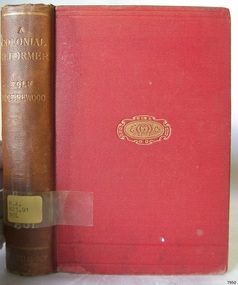
Book, A Colonial Reformer
... Label on spine cover with typed text RA 823.91 BOL Front loose endpaper has a stamp from Warrnambool Public Library The fly paper has the name "A. H. Stanley" handwritten in pencil. ...[This information has been taken from Wikipedia; Australian Authors-Perry Meddlemiss; Australian Dictionary of Biography, Browne, Thomas Alexander (1826-1915)] warrnambool shipwrecked-coast flagstaff-hill flagstaff-hill-maritime-museum maritime-museum shipwreck-coast flagstaff-hill-maritime-village shipwrecked-artefact great ocean road book warrnambool library warrnambool mechanics’ institute mechanics’ institute library victorian library board warrnambool books and records warrnambool children’s library warrnambool public library a colonial reformer rolf boldrewood Label on spine cover with typed text RA 823.91 BOL Front loose endpaper has a stamp from Warrnambool Public Library The fly paper has the name "A. H. Stanley" handwritten in pencil. A Colonial Reformer Author: Rolf Boldrewood Publisher: MacMillan & Co Date: 1891 A Colonial Reformer Book ...Rolf Boldrewood (1826-1915) ‘Rolf Boldrewood’ is the pen-name used by Thomas Alexander Browne as a writer. Browne was the eldest child of Captain Sylvester John Brown and Elizabeth Angell nee Alexander. He was born in London on 6th August 1826 and arrived in Australia with his parents and siblings when he was 5 years old and grew up in Sydney. In the 1860’s Browne added the ‘e’ to his surname. As a 17 year old Browne took up land in the Western District of Victoria between Portland and Port Fairy on a property named “Squattlesea Mere”. He remained there until 1858, enjoying the squatters’ life on his 32,000 acre property, growing potatoes and running cattle and horses. He sold in 1858 and purchased a sheep station on the Murray River near Swan Hill. He later sold this and bought another sheep station near Narrandera until bad seasons and severe droughts eventually caused him to change his career after 25 years as a squatter. Over the next 25 years Browne held the position of Police Magistrate and as a gold commissioner in various locations. His third career as an author lasted approximately 40 years. In 1865 he wrote two articles on pastoral life while he was recovering from a riding accident. In the 1870’s his writing was bringing in the income to support his family, changing his focus to the writing of novels. A series of these was written for the Australian market and published in The Sydney Mail and the Centennial Magazine. His later novels were aimed at the overseas markets. His best known novel “Robbery Under Arms” was written from 1882 to 1883 and has been serialised on radio in Australia and Britain. The novel was filmed in 1907, 1920 and 1957, and in 1985 it was made into a television series. It is now an Australian Classic. He also wrote short stories, several nonfiction graziers’ guides, and an autobiography named “Old Melbourne Memories” in 1884. [This information has been taken from Wikipedia; Australian Authors-Perry Meddlemiss; Australian Dictionary of Biography, Browne, Thomas Alexander (1826-1915)] A Colonial Reformer Author: Rolf Boldrewood Publisher: MacMillan & Co Date: 1891Label on spine cover with typed text RA 823.91 BOL Front loose endpaper has a stamp from Warrnambool Public Library The fly paper has the name "A. H. Stanley" handwritten in pencil. warrnambool, shipwrecked-coast, flagstaff-hill, flagstaff-hill-maritime-museum, maritime-museum, shipwreck-coast, flagstaff-hill-maritime-village, shipwrecked-artefact, great ocean road, book, warrnambool library, warrnambool mechanics’ institute, mechanics’ institute library, victorian library board, warrnambool books and records, warrnambool children’s library, warrnambool public library, a colonial reformer, rolf boldrewood -
 Federation University Historical Collection
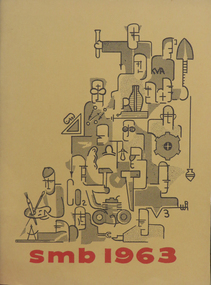
Booklet, Ballarat School of Mines Students' Magazine, 1963, 1963
... ...h. e. arblaster...stanley...Richards Medal, Diplomas Conferred, Personality Tests and the Individual, Poison to Poison - Students' Revue for 1963, Malaya, Income Tax, Rustling Rags, Where Mankind has Failed, Sports Awards 1963, Sports, School Council, Members of Staff, Roll Call ballarat school of mines students' magazine 1963 staff, sports tony brauer bob coutts paul pusari jeni milbourne kerry penna brian mclennan bob grub john davis netta walta kevin brady oscar rogers kuo yiew see h. e. arblaster stanley white quentin reynolds smyth l. p. coombes - chief superintendent aeronautical research laboratories melbourne graeme george redman robert skewes chookiat tanaksaranond alan james bethune lachlan stewart campbell graham william hall john rash alan kenneth webb peter agrums sr. mary chanel fitzsimmons david ewan clarke kirton william joseph lannen neil frances menz keith houston alexander john alexander pollock john peter russell francis william hunting chookiate sirivongse chong thung tay keith stanley waller bryan magson anne moorehouse stephen drew gerry liston gary roberts ray megee peter smith daila berzins don yates kelvin whitford greg hunter david bell michael moissinac neil mudge arthur patterson edward scull joseph heller g. roberts j. humphreys bobby ong alan cox p. l. day r. coutts wayne johnson prasert mahattanakul l. t. negri ooi kok hai photography Yellow soft cover with red inscriptions and black figures on front cover, 104 pages including advertisements. ...Ballarat School of Mines Students' Magazine, 1963. Editorial, Prominent Personalities, King Island - Vacation Wonderland, Look back in Wonder, The Sensible Enemy, Diploma Conferring Ceremony, R. W. Richards Medal, Diplomas Conferred, Personality Tests and the Individual, Poison to Poison - Students' Revue for 1963, Malaya, Income Tax, Rustling Rags, Where Mankind has Failed, Sports Awards 1963, Sports, School Council, Members of Staff, Roll Call Yellow soft cover with red inscriptions and black figures on front cover, 104 pages including advertisements.ballarat school of mines students' magazine 1963, staff, sports, tony brauer, bob coutts, paul pusari, jeni milbourne, kerry penna brian mclennan, bob grub, john davis, netta walta, kevin brady, oscar rogers, kuo yiew see, h. e. arblaster, stanley white, quentin reynolds smyth, l. p. coombes - chief superintendent aeronautical research laboratories melbourne, graeme george redman, robert skewes, chookiat tanaksaranond, alan james bethune, lachlan stewart campbell, graham william hall, john rash, alan kenneth webb, peter agrums, sr. mary chanel fitzsimmons, david ewan clarke kirton, william joseph lannen, neil frances menz, keith houston alexander, john alexander pollock, john peter russell, francis william hunting, chookiate sirivongse, chong thung tay, keith stanley waller, bryan magson, anne moorehouse, stephen drew, gerry liston, gary roberts, ray megee, peter smith, daila berzins, don yates, kelvin whitford, greg hunter, david bell, michael moissinac, neil mudge, arthur patterson, edward scull, joseph heller, g. roberts, j. humphreys, bobby ong, alan cox, p. l. day, r. coutts, wayne johnson, prasert mahattanakul, l. t. negri, ooi kok hai, photography -
Port Melbourne Historical & Preservation Society
Newspaper - Cutting, Tyro, Garden Fete at Port Melbourne, 4 Mar 1909
... The incumbent of Holy Trinity Church (Rev H Stanley HOLLOW), Mrs H.S. HOLLOW, The Mayor of Port Melbourne and Mrs A. ...The incumbent of Holy Trinity Church (Rev H Stanley HOLLOW), Mrs H.S. HOLLOW, The Mayor of Port Melbourne and Mrs A. ...Newspaper cutting dated March 4, 1909 - Caption reads "Garden Fete at Port Melbourne. The incumbent of Holy Trinity Church (Rev H Stanley HOLLOW), Mrs H.S. HOLLOW, The Mayor of Port Melbourne and Mrs A. ROGERS, Mrs J RENDALL, and committee and workers for the Garden Fete in aid of rebuilding Holy Trinity Church, Port Melbourne." Cutting has been pasted onto large red cardboard.Hand written above the caption is "Mrs Crockford, Mrs Howe, Mrs Rendall, Mrs Hollow, Mrs Rogers, Mrs George, Mrs Glen Knight"celebrations fetes and exhibitions, religion - anglican (holy trinity), herbert stanley hollow, mrs hollow, mayors, mrs rogers, jane rendall nee harrison, mrs crockford, mrs george, mrs glen knight, alexander rogers, mrs w howe -
 City of Moorabbin Historical Society (Operating the Box Cottage Museum)
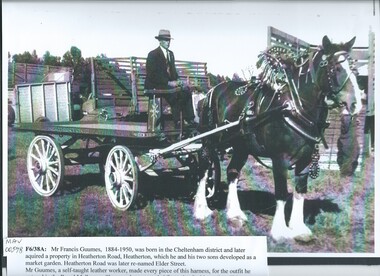
Photograph - Black & White, Mr F. Guumes 1884-1950 & Hand made Harness outfit c1947, c1947
... He entered this outfit in the Royal Melbourne Show c1947 and was awarded 1st Prize in his section. ( H. Stanley 2005)...He entered this outfit in the Royal Melbourne Show c1947 and was awarded 1st Prize in his section. ( H. Stanley 2005) Early settlers in Moorabbin Shire had to be resourceful and self sufficient as they developed market gardens and farms. ...Mr Francis Guumes1884-1950, was born in the Cheltenham district and later bought land in Heatherton Rd, Heatherton, where he and his two sons developed a market garden. Mr Guumes , a self taught leather worker, made every piece of this harness. He entered this outfit in the Royal Melbourne Show c1947 and was awarded 1st Prize in his section. ( H. Stanley 2005)Early settlers in Moorabbin Shire had to be resourceful and self sufficient as they developed market gardens and farms. The community learned to make, repair and invent tools and equipment that was needed on their properties. Black & White photograph, enlarged, showing Mr Francis Guumes, with the rig and leather work that he entered and won 1st prize in the Royal Melbourne Show c 1947guumes francis, royal melbourne show 1947, leatherwork, saddles, harness, draught horses, horse drawn carts, smith j l; smith mary ann, stanley helen, smith vic, , chaff cutter, horse drawn carts, toll gates brighton, motor cars 1900, steam engines, early settlers, bentleigh, mckinnon, parish of moorabbin, city of moorabbin, county of bourke, moorabbin roads board, shire of moorabbin, henry dendy's special survey 1841, were j.b.; bent thomas, o'shannassy john, king richard, charman stephen, highett william, ormond francis, maynard dennis, market gardeners, vineyards, orchards -
 City of Moorabbin Historical Society (Operating the Box Cottage Museum)
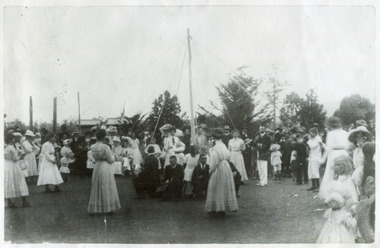
Photograph, Black & White Maypole Dance 1890, c1890
... It required precision 'drilling' with many rehearsals to prevent any mistakes in the routine. ( H. Stanley 2007 CMHS )...It required precision 'drilling' with many rehearsals to prevent any mistakes in the routine. ( H. Stanley 2007 CMHS ) Early settlers in Moorabbin Shire enjoyed coming together to celebrate various events by organising a Maypole dancing display and this reminded them of their homeland customs. ...Originally, May Day was a holiday of ancient tradition in England to celebrate the arrival of Spring. It was celebrated with joyous dancing around a garlanded pole , called a Maypole, from which streamers/ ribbons hung. Each dancer held the end of a streamer, and as they danced, the ribbons became entwined creating one of the several traditional and colourful patterns. In Australia, 19thC & early 20thC, Maypole dancing was incorporated in some School's curriculum. as it was deemed to be 'lady like' exercise for girls.The Maypole dance was spectacular when performed for special occasions. It required precision 'drilling' with many rehearsals to prevent any mistakes in the routine. ( H. Stanley 2007 CMHS )Early settlers in Moorabbin Shire enjoyed coming together to celebrate various events by organising a Maypole dancing display and this reminded them of their homeland customs.Black & White photograph of community Maypole dance c1890 -
 City of Moorabbin Historical Society (Operating the Box Cottage Museum)
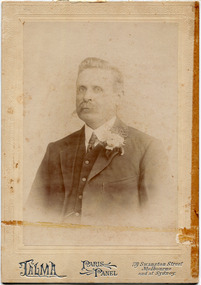
Photograph, Black & White, Harry Hale 1861-1937 and House, Cheltenham c1900, c1900
... \ The house was demolished 1962. ( "Moorabbin News" City of Moorabbin Centenary - May 1962, pg 47. T. Sheehy, H. Stanley ).... \ The house was demolished 1962. ( "Moorabbin News" City of Moorabbin Centenary - May 1962, pg 47. T. Sheehy, H. Stanley ) Harry Hale was a typical resourceful early settler who courageously worked with disability as he established his family in Cheltenham c1900 hale harry, st matthews church of england cheltenham, talma photographers melbourne, photography, horse drawn carts, toll gates brighton, motor cars 1900, steam engines, early settlers, bentleigh, mckinnon, parish of moorabbin, city of moorabbin, county of bourke, moorabbin roads board, shire of moorabbin, henry dendy's special survey 1841, were j.b.; bent thomas, o'shannassy john, king richard, charman stephen, highett william, ormond francis, maynard dennis, market gardeners, vineyards, orchards a) Handwritten information b) Mount ; TALMA, PARIS PANEL , 119 Swanston Street Melbourne and at Sydney a) Black & White photograph of the Harry Hale's House c 1930 North Cheltenham b) Sepia photograph c1906 of Harry Hale 1861 - 1937, Builder, Insurance Agent Cheltenham Photograph, Black & White, Harry Hale 1861-1937 and House, Cheltenham c1900 TALMA , ...Harry Hale 1861-1937, a silk spinner, builder, migrated from England c1890 and built his house using 2nd hand material from the old Mentone Baths, old Co-op Stores, and some windows from the old St Matthew's Church Cheltenham .Harry with wife Frances raised 9 children. Following an accident Harry lost his leg and dissatisfied with the artificial limb he found a 'peg- leg ' more comfortable. Harry built many houses in Cheltenham unhindered by his 'peg-leg' . Harry also worked as an Insurance Agent. \ The house was demolished 1962. ( "Moorabbin News" City of Moorabbin Centenary - May 1962, pg 47. T. Sheehy, H. Stanley )Harry Hale was a typical resourceful early settler who courageously worked with disability as he established his family in Cheltenham c1900a) Black & White photograph of the Harry Hale's House c 1930 North Cheltenham b) Sepia photograph c1906 of Harry Hale 1861 - 1937, Builder, Insurance Agent Cheltenham a) Handwritten information b) Mount ; TALMA, PARIS PANEL , 119 Swanston Street Melbourne and at Sydney hale harry, st matthews church of england cheltenham, talma photographers melbourne, photography, horse drawn carts, toll gates brighton, motor cars 1900, steam engines, early settlers, bentleigh, mckinnon, parish of moorabbin, city of moorabbin, county of bourke, moorabbin roads board, shire of moorabbin, henry dendy's special survey 1841, were j.b.; bent thomas, o'shannassy john, king richard, charman stephen, highett william, ormond francis, maynard dennis, market gardeners, vineyards, orchards -
Glenelg Shire Council Cultural Collection
Book - Book - H.M. Stanley, The African Explorer, n.d
... Illustration of H. M. Stanley, in gold, in gold oval, top left front cover. ...Illustration of H. M. Stanley, in gold, in gold oval, top left front cover. ...Brown coloured book, gold and black writing on front and spine, black leaves with entwined letters on back cover. Illustration of H. M. Stanley, in gold, in gold oval, top left front cover. Ilustration of ? Stanley and African men on top of cliff, front cover. Illustration African Villge on spine. 192 pages. Plus 16 page catalogue. -
 Federation University Historical Collection
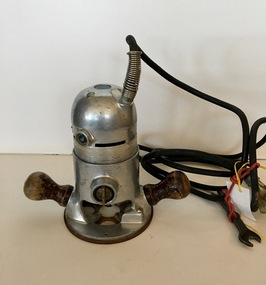
Electrical Instrument, Stanley Router, Estimated 1940s
... CT 4887 Lower Plate: STANLEY H-13-B; US Pat. - 2562143...CT 4887 Lower Plate: STANLEY H-13-B; US Pat. - 2562143 Steel cased electric motor, two wooden handles, power cord and spanner Stanley Router Electrical Instrument Stanley Electric Tools ...Used at Ballarat School of Mines Building Studies, Yuille Street, Ballarat. This probably in the 1960s. It was sourced from David Flintoff. Steel cased electric motor, two wooden handles, power cord and spannerUpper Plate: STANLEY ELECTRIC TOOLS; Type H39; Model B; Serial No. CT 4887 Lower Plate: STANLEY H-13-B; US Pat. - 2562143stanley router, electric router, ballarat school of mines, building studies, david flintoff -
 City of Moorabbin Historical Society (Operating the Box Cottage Museum)
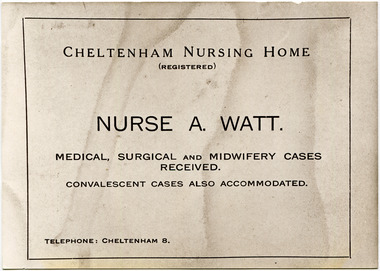
Document, Nurse A Watt , Cheltenham Nursing Home c1900, c1900
... Nurse Watt bequeathed her Estate to the Methodist Church. ( H. Stanley CMHS)...Nurse Watt bequeathed her Estate to the Methodist Church. ( H. Stanley CMHS) c1900 Nurse A Watt had an excellent reputation for her care and ability in the Cheltenham area where Medical, Surgical and Midwifery Cases were received at her Nursing Home in Charman Road. ...Nurse A. Watt was a registered Nurse who owned the Cheltenham Nursing Home, located up on the hill, at 200 Charman Road Cheltenham c1900. With Dr. Fleming Joyce, she brought many local identities into the world. Len Allnutt recalls that his brother, Ray, was born there in 1924. Nurse Watt had an excellent reputation for her care and ability in the local area. One recorded event was when in November 1910 Constable Edwards was shot by his son David, at his police house, after an episode of domestic violence involving Constable Edwards long suffering wife - the mother of David. Const. Edwards was first taken to the Police Station, but later taken by Shire ambulance to Nurse Watt's Cheltenham Nursing Home. At 8pm, Edwards was operated on by Dr. Joyce and Dr. Weigall. Despite the surgery, Edwards died the next day of haemorrhage and shock. David was convicted of manslaughter. Dr A Fleming Joyce was the Shire Medical Officer c1914 - 1930. Nurse Watt bequeathed her Estate to the Methodist Church. ( H. Stanley CMHS)c1900 Nurse A Watt had an excellent reputation for her care and ability in the Cheltenham area where Medical, Surgical and Midwifery Cases were received at her Nursing Home in Charman Road. She also accommodated convalescent cases. She worked with Dr A.Fleming Joyce and Dr Weigall.a) Advertisement / Leaflet for Nurse A.Watt c1900 b) Black & White photograph of the Cheltenham Nursing Home, 200 Charman Road Cheltenham c1900watts nurse a, joyce dr. a f., cheltenham nursing home c1910, charman road cheltenham, nursing, medicine, midwifery, victoria police force, smith j l; smith mary ann, stanley helen,, horse drawn carts, toll gates brighton, motor cars 1900, steam engines, early settlers, bentleigh, mckinnon, parish of moorabbin, city of moorabbin, county of bourke, moorabbin roads board, shire of moorabbin, henry dendy's special survey 1841, were j.b.; bent thomas, o'shannassy john, king richard, charman stephen, highett william, ormond francis, maynard dennis, market gardeners, vineyards, orchards -
 Bendigo Historical Society Inc.
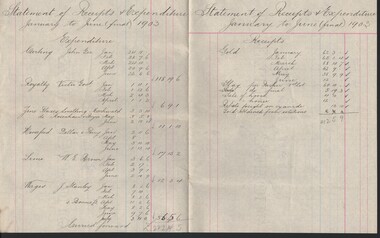
Document - GOLD MINE ACCOUNTS FOR 1903, 1903
... ... J Stanley... A H...Names mentioned include John Gee, Markwald, Rosenhain & Bryce, Dellar & Perry, W E Brown, J Stanley, A H Thomas, W. C.Co (Whipstick Cyanide Company.)...COTTAGE Miners Gold Mine Accounts for 1903 John Gee Markwald Rosenhain & Bryce Dellar & Perry W E Brown J Stanley A H Thomas W. C. Co. (Whipstick Cyanide Company.) ...Document. Gold Mine Accounts for 1903. Ledger page of accounts for an unknown gold company (appears to be the Marong Gold Company), dated Jan - Jun 1903. Names mentioned include John Gee, Markwald, Rosenhain & Bryce, Dellar & Perry, W E Brown, J Stanley, A H Thomas, W. C.Co (Whipstick Cyanide Company.)cottage, miners, gold mine accounts for 1903, john gee, markwald, rosenhain & bryce, dellar & perry, w e brown, j stanley, a h thomas, w. c. co. (whipstick cyanide company.) -
 City of Moorabbin Historical Society (Operating the Box Cottage Museum)
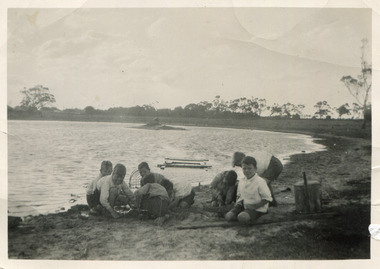
Photograph, Black & White, Boys fishing for Yabbies Methodist Childrens' Home Cheltenham 1935, 1935
... Marshall, KCC Local History , H. Stanley 2005) 1950's saw a new direction for the support of children and families in poor and difficult situations . ...Marshall, KCC Local History , H. Stanley 2005) 1950's saw a new direction for the support of children and families in poor and difficult situations . ...1892-1953 The Methodist Children's Home in Cheltenham was founded c1880 to provide housing for neglected children from the inner city. The Founders aimed to provide regular nourishment, a stable environment and integrate the children into the local community thereby improving their education and lives. However new settlers to Cheltenham area who were seeking a healthier and more respectable lifestyle for their families were not happy to share Church and School with the Home's Children. 1911 school parents committee moved to exclude the Home's Children but this was countered by the Home's Committee who defeated the motion 60 to 8. 1915 Dr Scantlebury was pressured by school parents into ordering the confinement/ isolation of all Homes Children if an infectious disease was contracted by a child. This resulted in the Homes Children missing school for months so an application was made to the Victorian Education Dept. for e School to be set up at the Home. However funds were short due to WW1. In 1917 John Livingston, former Homes child who had become successful, bequeathed his estate to the Home and the Vic.Education Dept agreed to a school at the Home. The Influenza epidemic 1919 saw the children quarantined for 4 months as a precaution at the Home. When Flu actually struck, a further 5 months isolation was ordered. July 1920 their own school was on site and continuity of education could proceed , however it reinforced the isolation of the institution contrary to the Founders vision of integration.. 1925 the Danks family funded a Domestic Economy Class for girls, but not until 1936 could the children attend the local High School so that they could pursue office work, apprenticeships, commercial college courses. 1947 a benefactor donated £5,000 to pay fees for school, university or apprenticeship in Arts & Cultural subjects. Some of the children were able to join the local society as Methodist minister, accountant, nurses, farmers, secretaries, trademen whilst others were unable to adjust as crime and misfortune ensued. 1939 some past residents began a group called Living Stones Union that they circulated to the others giving news and a sense of family connectedness among themselves. ( Rev. N. Marshall, KCC Local History , H. Stanley 2005) 1950's saw a new direction for the support of children and families in poor and difficult situations . The new Burwood Homes Facility opened in 1951 and children were transferred from Cheltenham in 1952. The land was sold to the St John of God, Catholic Order in1953 who maintained an orphanage until Myer Pty Ltd bought the site in 1967 and constructed the Southland Shopping Centre1892 -1953 The Methodist Children's Home Cheltenham was founded to provide safe accommodation and education for neglected children from the Melbourne inner city slums. Black & White photograph of boys fishing for yabbies from the lake behind the 'Methodist Homes for Children' Cheltenham pdf of Appeal for the establishment of an Infant Asylum 1877methodist childrens home cheltenham 1892- 1953, st john of god home cheltenham 1953-1967, scantlebury dr john city of moorabbin, county of bourke, moorabbin roads board, parish of moorabbin, shire of moorabbin, henry dendy's special survey 1841, were j.b.; bent thomas, o'shannassy john, king richard, charman stephen, highett william, ormond francis, maynard dennis, cheltenham state school no.84, methodist chapel cheltenham, methodist school cheltenham, beaumaris west state school, meeres frederick, meeres walter, education, early settlers, -
 Flagstaff Hill Maritime Museum and Village
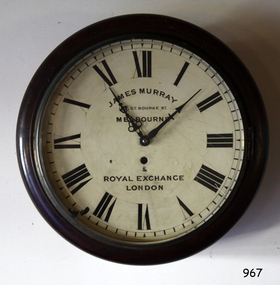
Instrument - Clock
... Staff at the Bank of Australasia in Warrnambool included the following men but others were also involved: Samuel Hannaford, Teller then Manager from 1855-1856; W H Palmer, Manager from January 1857 until November 1869 when the Teller Basil Spence was promoted to Manager; H B Chomley, Manager from April 1873 and still there in 1886; A Butt, Manager in 1895-1904; J R McCleary Accountant and Acting Manager for 12 months, until 1900; A Kirk, Manager 1904; J Moore, staff until his transfer to Bendigo in December 1908; J S Bath was Manager until 1915; C C Cox, Manager until April 1923; Richard C Stanley, Manager 1923 to April 1928. ...Staff at the Bank of Australasia in Warrnambool included the following men but others were also involved: Samuel Hannaford, Teller then Manager from 1855-1856; W H Palmer, Manager from January 1857 until November 1869 when the Teller Basil Spence was promoted to Manager; H B Chomley, Manager from April 1873 and still there in 1886; A Butt, Manager in 1895-1904; J R McCleary Accountant and Acting Manager for 12 months, until 1900; A Kirk, Manager 1904; J Moore, staff until his transfer to Bendigo in December 1908; J S Bath was Manager until 1915; C C Cox, Manager until April 1923; Richard C Stanley, Manager 1923 to April 1928. ...This wall clock originated from the Bank of Australasia. The label on the base matches other items from the same donor. It was spring powered by winding the key mechanism with the clock's key through the hole in the clock face. The hinged door on the base of the clock's case allows access to the clock's working mechanism. James Murray (son of James Murray 1780-1847) was a maker of clocks and chronometers. He worked at No. 1, Royal Exchange, London and from 1861 at 107 Great Bourke Street, Melbourne. In 1854 William Kerr ordered a clock from James Murray and erected it on the Albert Street frontage of the National Model & Training School in Spring Street Melbourne. It was Melbourne's first turret clock and remained there for 80 years before it was transferred to the Public Library in Melbourne in 1934 (now Museum Victoria). The Bank of Australasia was incorporated by Royal Charter of England in March 1834. It had its Australian beginning on 14th December 1835, opening in Sydney. The Acting Superintendent of the bank at that time was David Charters McArthur. He was Superintendent from 1867-to 1876. The Melbourne branch opened on 28th August 1838 in a two-roomed brick cottage on the north side of Little Collins Street, where two huge mastiff dogs were used at night to guard the bank. The government also provided an armed military sentinel. Due to the bank's rapid growth, a new building for the Melbourne branch was opened in 1840 at 75 Collins Street West. By 1879 the bank had been upgraded to a magnificent two-storey building on the corners of Collins and Queens Streets, with the entry on Collins Street. In 1951 the Bank of Australasia amalgamated with the Union Bank to form the Australia and New Zealand Bank, now known as the ANZ. Then in 1970, the ANZ merged with both the ES&A and the London Bank of Australia to form the ANZ Banking Group Limited. The ANZ Banking Group Ltd kindly donated a variety of historic items from the Bank of Australasia. BANK of AUSTRALASIA, WARRNAMBOOL – In 1854 Warrnambool had two banks, the Union Bank and the Bank of Australasia. Later, completely different bank businesses opened; in 1867 the National Bank of Australasia, then in 1875 the Colonial Bank of Australasia. The original Warrnambool branch of the Bank of Australasia was established in July 1854, and operated from a leased cottage on Merri Street, close to Liebig Street. The bank next bought a stone building previously erected by drapers Cramond & Dickson on the corner of Timor and Gibson Streets. Samuel Hannaford was a teller and then Manager at the Warrnambool branch from 1855 to 1856 and the Warrnambool Council chose that bank for its dealings during 1856-57. In 1859 Roberts & Co. was awarded the contract to build the new Bank of Australasia branch for the sum of £3,000. The land was on a sand hill on the northeast corner of Timor and Kepler Streets and had been bought in 1855 from investor James Cust. The new building opened on May 21, 1860. The bank continued to operate there until 1951 when it merged with the Union Bank to form the ANZ Bank, which continued operating from its Liebig Street building. Warrnambool City Council purchased the former Bank of Australasia building in 1971 and renovated it, then on 3rd December 1973 it was officially opened as the Art Gallery by Cr. Harold Stephenson and Gallery Director John Welsh. The Gallery transferred to the purpose-built building in Liebig Street in 1986 and the old bank building is now the Gallery club. Staff at the Bank of Australasia in Warrnambool included the following men but others were also involved: Samuel Hannaford, Teller then Manager from 1855-1856; W H Palmer, Manager from January 1857 until November 1869 when the Teller Basil Spence was promoted to Manager; H B Chomley, Manager from April 1873 and still there in 1886; A Butt, Manager in 1895-1904; J R McCleary Accountant and Acting Manager for 12 months, until 1900; A Kirk, Manager 1904; J Moore, staff until his transfer to Bendigo in December 1908; J S Bath was Manager until 1915; C C Cox, Manager until April 1923; Richard C Stanley, Manager 1923 to April 1928. The clock has significance through its association with the Bank of Australasia. The early Australian bank was established in 1834 by Royal Charter and opened in Sydney, Australia, in Sydney in 1835. The bank had many Australian offices in November 1877, particularly on the east and south coasts. Victoria had 45 percent of all Offices. The clock is significant for its connection with the quality clockmaker James Murray, originally from Royal Exchange London with a branch that opened in Melbourne in 1861. James Murray is renown for making the first turret clock to be installed in Melbourne. The clock is locally significant for its association with the Warrnambool Bank of Australasia, which was established in 1854. It was Warrnambool Council’s first bank. The bank continued to operate until the organisation's merger in 1951 when it became the ANZ Bank Group today. The Bank was an integral part of the growth of local commerce and the community.Wall clock with a round face behind glass in a wooden case. The painted brass face has Roman numerals, two decorative hands, divisions for minutes and a keyhole. The curved base of the case has a hinged access door with a keyhole and adhesive label. The back of the clock's case has metal mounting brackets. Inscriptions on the rectangular white label. Made by James Murray, Melbourne.Face: "JAMES MURRAY / - GT. BOURKE ST. / MELBOURNE / & / ROYAL EXCHANGE / LONEON" Label: "A M / 40"flagstaff hill, warrnambool, shipwrecked coast, flagstaff hill maritime museum, maritime museum, shipwreck coast, flagstaff hill maritime village, great ocean road, bank of australasia, boa, union bank, australia & new zealand bank, anz bank, james murray, clock, wall clock, great bourke street melbourne, royal exchange london, william kerr, turret clock, old model school, national model & training school, access door, winding key -
 Flagstaff Hill Maritime Museum and Village
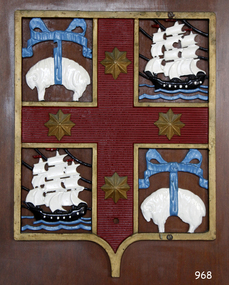
Plaque - Insignia, Bank of Australasia, 16-10-1980
... Staff at the Bank of Australasia in Warrnambool included the following men but others were also involved: Samuel Hannaford, Teller then Manager from 1855-1856; Hawkins, Manager in 1856, W H Palmer, Manager from January 1857 until November 1869 when the Teller Basil Spence was promoted to Manager; H B Chomley, Manager from April 1873 and still there in 1886; A Butt, Manager in 1895-1904; J R McCleary Accountant and Acting Manager for 12 months, until 1900; A Kirk, Manager 1904; J Moore, staff until his transfer to Bendigo in December 1908; J S Bath was Manager until 1915; C C Cox, Manager until April 1923; Richard C Stanley, Manager 1923 to April 1928. ...Staff at the Bank of Australasia in Warrnambool included the following men but others were also involved: Samuel Hannaford, Teller then Manager from 1855-1856; Hawkins, Manager in 1856, W H Palmer, Manager from January 1857 until November 1869 when the Teller Basil Spence was promoted to Manager; H B Chomley, Manager from April 1873 and still there in 1886; A Butt, Manager in 1895-1904; J R McCleary Accountant and Acting Manager for 12 months, until 1900; A Kirk, Manager 1904; J Moore, staff until his transfer to Bendigo in December 1908; J S Bath was Manager until 1915; C C Cox, Manager until April 1923; Richard C Stanley, Manager 1923 to April 1928. ...This plaque displays the Bank of Australia's Coat of Arms and is significant because is ts the symbol printed on the Bank Notes of the Bank of Australasia. The bank of Australasia was incorporated by Royal Charter of England in March 1834. It had its Australian beginning on 14th December 1835, opening in Sydney. The Acting Superintendent of the bank at that time was David Charters McArthur. He was Superintendent from 1867-to 1876. The Melbourne branch opened on 28th August 1838 in a two-roomed brick cottage on the north side of Little Collins Street, where two huge mastiff dogs were used at night to guard the bank. The government also provided an armed military sentinel. Due to the bank's rapid growth, a new building for the Melbourne branch was opened in 1840 at 75 Collins Street West. By 1879 the bank had been upgraded to a magnificent two-storey building on the corners of Collins and Queens Streets, with the entry on Collins Street. In 1951 the Bank of Australasia amalgamated with the Union Bank to form the Australia and New Zealand Bank, now known as the ANZ. Then in 1970, the ANZ merged with both the ES&A and the London Bank of Australia to form the ANZ Banking Group Limited. The ANZ Banking Group Ltd kindly donated a variety of historic items from the Bank of Australasia. BANK of AUSTRALASIA, WARRNAMBOOL – In 1854 Warrnambool had two banks, the Union Bank and the Bank of Australasia. Later, completely different bank businesses opened; in 1867 the National Bank of Australasia, then in 1875 the Colonial Bank of Australasia. The original Warrnambool branch of the Bank of Australasia was established in July 1854, and operated from a leased cottage on Merri Street, close to Liebig Street. The bank next bought a stone building previously erected by drapers Cramond & Dickson on the corner of Timor and Gibson Streets. Samuel Hannaford was a teller and then Manager at the Warrnambool branch from 1855 to 1856 and the Warrnambool Council chose that bank for its dealings during 1856-57. In 1859 Roberts & Co. was awarded the contract to build the new Bank of Australasia branch for the sum of £3,000; the firm built the Warrnambool Post Office in 1856 and purchased land in Timor Street in 1858. The land was on a sand hill on the northeast corner of Timor and Kepler Streets and had been bought in 1855 from investor James Cust. The new building opened on May 21, 1860. The bank continued to operate there until 1951 when it merged with the Union Bank to form the ANZ Bank, which continued operating from its Liebig Street building. Warrnambool City Council purchased the former Bank of Australasia building in 1971 and renovated it, then on 3rd December 1973 it was officially opened as the Art Gallery by Cr. Harold Stephenson and Gallery Director John Welsh. The Gallery transferred to the purpose-built building in Liebig Street in 1986 and the old bank building is now the Gallery club. Staff at the Bank of Australasia in Warrnambool included the following men but others were also involved: Samuel Hannaford, Teller then Manager from 1855-1856; Hawkins, Manager in 1856, W H Palmer, Manager from January 1857 until November 1869 when the Teller Basil Spence was promoted to Manager; H B Chomley, Manager from April 1873 and still there in 1886; A Butt, Manager in 1895-1904; J R McCleary Accountant and Acting Manager for 12 months, until 1900; A Kirk, Manager 1904; J Moore, staff until his transfer to Bendigo in December 1908; J S Bath was Manager until 1915; C C Cox, Manager until April 1923; Richard C Stanley, Manager 1923 to April 1928. The plaque with the insignia has significance through its association with the Bank of Australasia. The early Australian bank was established in 1834 by Royal Charter and opened in Sydney, Australia, in Sydney in 1835. The bank had many Australian offices in November 1877, particularly on the east and south coasts. Victoria had 45 per cent of all Offices. The plaque is locally significant for its association with the Warrnambool Bank of Australasia, which was established in 1854. It was Warrnambool Council’s first bank. The bank continued to operate until the organisation's merger in 1951 when it became the ANZ Bank Group today. The Bank was an integral part of the growth of local commerce and the community.Insignia of the Bank of Australasia. Cast metal coat of arms within a gold, shield-shaped border, painted gold and red, with blue, black and white details. Decals in each corner; upper left and lower right have a white sheep suspended by a blue ribbon, upper right and lower left have a 3-masted, square-rigged sailing ship with a black hull and red flags flying on each mast, sailing on waves with storm clouds in the sky. Between the emblems are gold stars.Decals; ships, sheep, starsflagstaff hill, warrnambool, shipwrecked coast, flagstaff hill maritime museum, maritime museum, shipwreck coast, flagstaff hill maritime village, great ocean road, bank of australasia, boa, union bank, australia & new zealand bank, anz bank, david charters mcarthur, d c mcarthur, currency, banknote, commerce, banking, heraldic shield, insignia, samuel hannaford -
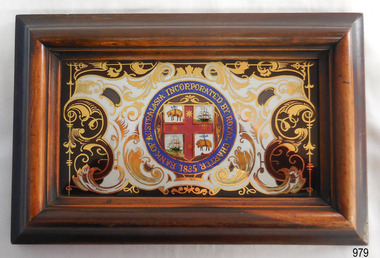 Flagstaff Hill Maritime Museum and Village
Plaque - Insignia, Bank of Australasia, 19th Century
... Staff at the Bank of Australasia in Warrnambool included the following men but others were also involved: Samuel Hannaford, Teller then Manager from 1855-1856; W H Palmer, Manager from January 1857 until November 1869 when the Teller Basil Spence was promoted to Manager; H B Chomley, Manager from April 1873 and still there in 1886; A Butt, Manager in 1895-1904; J R McCleary Accountant and Acting Manager for 12 months, until 1900; A Kirk, Manager 1904; J Moore, staff until his transfer to Bendigo in December 1908; J S Bath was Manager until 1915; C C Cox, Manager until April 1923; Richard C Stanley, Manager 1923 to April 1928. ...Staff at the Bank of Australasia in Warrnambool included the following men but others were also involved: Samuel Hannaford, Teller then Manager from 1855-1856; W H Palmer, Manager from January 1857 until November 1869 when the Teller Basil Spence was promoted to Manager; H B Chomley, Manager from April 1873 and still there in 1886; A Butt, Manager in 1895-1904; J R McCleary Accountant and Acting Manager for 12 months, until 1900; A Kirk, Manager 1904; J Moore, staff until his transfer to Bendigo in December 1908; J S Bath was Manager until 1915; C C Cox, Manager until April 1923; Richard C Stanley, Manager 1923 to April 1928. ...This decorative plaque displays the insignia of the Bank of Australasia, which was incorporated by the Royal Charter of England in March 1834. The bank began in Australia on 14th December 1835, opening in Sydney. The Acting Superintendent of the bank at that time was David Charters McArthur. He was Superintendent from 1867-to 1876. The Melbourne branch opened on 28th August 1838 in a two-roomed brick cottage on the north side of Little Collins Street, where two huge mastiff dogs were used at night to guard the bank. The government also provided an armed military sentinel. Due to the bank's rapid growth, a new building for the Melbourne branch was opened in 1840 at 75 Collins Street West. By 1879 the bank had been upgraded to a magnificent two-storey building on the corners of Collins and Queens Streets, with the entry on Collins Street. In 1951 the Bank of Australasia amalgamated with the Union Bank to form the Australia and New Zealand Bank, now known as the ANZ. Then in 1970, the ANZ merged with both the ES&A and the London Bank of Australia to form the ANZ Banking Group Limited. The ANZ Banking Group Ltd kindly donated a variety of historic items from the Bank of Australasia. BANK of AUSTRALASIA, WARRNAMBOOL – In 1854 Warrnambool had two banks, the Union Bank and the Bank of Australasia. Later, completely different bank businesses opened; in 1867 the National Bank of Australasia, then in 1875 the Colonial Bank of Australasia. The original Warrnambool branch of the Bank of Australasia was established in July 1854, and operated from a leased cottage on Merri Street, close to Liebig Street. The bank later bought a stone building previously erected by drapers Cramond & Dickson on the corner of Timor and Gibson Streets. Samuel Hannaford was a teller and then Manager at the Warrnambool branch from 1855 to 1856 and the Warrnambool Council chose that bank for its dealings during 1856-57. In 1859 Roberts & Co. was awarded the contract to build the new Bank of Australasia branch for the sum of £3,000. The land was on a sand hill on the northeast corner of Timor and Kepler Streets and had been bought in 1855 from investor James Cust. The new building opened on May 21, 1860. The bank continued to operate there until 1951 when it merged with the Union Bank to form the ANZ Bank, which continued operating from its Liebig Street building. Warrnambool City Council purchased the former Bank of Australasia building in 1971 and renovated it, then on 3rd December 1973 it was officially opened as the Art Gallery by Cr. Harold Stephenson and Gallery Director John Welsh. The Gallery transferred to the purpose-built building in Liebig Street in 1986 and the old bank building is now the Gallery club. Staff at the Bank of Australasia in Warrnambool included the following men but others were also involved: Samuel Hannaford, Teller then Manager from 1855-1856; W H Palmer, Manager from January 1857 until November 1869 when the Teller Basil Spence was promoted to Manager; H B Chomley, Manager from April 1873 and still there in 1886; A Butt, Manager in 1895-1904; J R McCleary Accountant and Acting Manager for 12 months, until 1900; A Kirk, Manager 1904; J Moore, staff until his transfer to Bendigo in December 1908; J S Bath was Manager until 1915; C C Cox, Manager until April 1923; Richard C Stanley, Manager 1923 to April 1928. The plaque has historical significance as it belonged to the Bank of Australasia which was established in Australia in 1835 by Royal Charter. The plaque is significant for its association with the Bank of Australasia in Warrnambool, the first bank in Warrnambool, established in 1854. The bank continued to operate until its merger in 1951 when it became the ANZ Bank, which is still in operation today. The Bank was an integral part of the establishment and growth of commerce in Colonial Warrnambool and throughout Australia.Plaque with insignia on glass in a rectangular varnished wooden frame. Insignia of the Bank of Australasia has been painted onto the glass in a mirror-like fashion. Insignia depicts a heraldic shield with sheep hung up by their waists and ships in full sail. Inscription on insignia. Stamp and handwritten inscription on the rectangular label with a blue border on the reverse.Insignia: "BANK OF AUSTRALASIA INCORPORATED BY ROYAL CHARTER 1835" Label's red oval stamp with "AUSTRALIA AND NEW ZEALAND BANK UNITED ARCHIVES" Label's handwritten black letters "AM1" flagstaff hill, warrnambool, shipwrecked coast, flagstaff hill maritime museum, maritime museum, shipwreck coast, flagstaff hill maritime village, great ocean road, commerce, banking, plaque, insignia, bank of australasia, insignia on glass, union bank, australia & new zealand bank, anz bank, david charters mcarthur, d c mcarthur, sydney, new south wales, currency, banknote, legal tender -
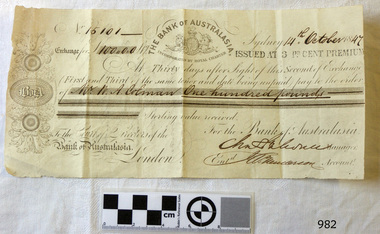 Flagstaff Hill Maritime Museum and Village
Currency - Bank exchange note, Perkins, Bacon and Perch, 14-10--1847
... Staff at the Bank of Australasia in Warrnambool included the following men but others were also involved: Samuel Hannaford, Teller then Manager from 1855-1856; W H Palmer, Manager from January 1857 until November 1869 when the Teller Basil Spence was promoted to Manager; H B Chomley, Manager from April 1873 and still there in 1886; A Butt, Manager in 1895-1904; J R McCleary Accountant and Acting Manager for 12 months, until 1900; A Kirk, Manager 1904; J Moore, staff until his transfer to Bendigo in December 1908; J S Bath was Manager until 1915; C C Cox, Manager until April 1923; Richard C Stanley, Manager 1923 to April 1928. ...Staff at the Bank of Australasia in Warrnambool included the following men but others were also involved: Samuel Hannaford, Teller then Manager from 1855-1856; W H Palmer, Manager from January 1857 until November 1869 when the Teller Basil Spence was promoted to Manager; H B Chomley, Manager from April 1873 and still there in 1886; A Butt, Manager in 1895-1904; J R McCleary Accountant and Acting Manager for 12 months, until 1900; A Kirk, Manager 1904; J Moore, staff until his transfer to Bendigo in December 1908; J S Bath was Manager until 1915; C C Cox, Manager until April 1923; Richard C Stanley, Manager 1923 to April 1928. ...This exchange note was issued by the Bank of Australasia to Mr N A Coleman for one hundred pounds paid n 14th October 1847 at the Sydney branch. The interest rate was three per cent. This exchange note displays the insignia of the Bank of Australasia, which was incorporated by Royal Charter of England in March 1834. The bank began in Australia on 14th December 1835, opening in Sydney. The Acting Superintendent of the bank at that time was David Charters McArthur. He was Superintendent from 1867-to 1876. The Melbourne branch opened on 28th August 1838 in a two-roomed brick cottage on the north side of Little Collins Street, where two huge mastiff dogs were used at night to guard the bank. The government also provided an armed military sentinel. Due to the bank's rapid growth, a new building for the Melbourne branch was opened in 1840 at 75 Collins Street West. By 1879 the bank had been upgraded to a magnificent two-storey building on the corners of Collins and Queens Streets, with the entry on Collins Street. In 1951 the Bank of Australasia amalgamated with the Union Bank to form the Australia and New Zealand Bank, now known as the ANZ. Then in 1970, the ANZ merged with both the ES&A and the London Bank of Australia to form the ANZ Banking Group Limited. The ANZ Banking Group Ltd kindly donated a variety of historic items from the Bank of Australasia. BANK of AUSTRALASIA, WARRNAMBOOL – In 1854 Warrnambool had two banks, the Union Bank and the Bank of Australasia. Later, completely different bank businesses opened; in 1867 the National Bank of Australasia, then in 1875 the Colonial Bank of Australasia. The original Warrnambool branch of the Bank of Australasia was established in July 1854, and operated from a leased cottage on Merri Street, close to Liebig Street. The bank next bought a stone building previously erected by drapers Cramond & Dickson on the corner of Timor and Gibson Streets. Samuel Hannaford was a teller and then Manager at the Warrnambool branch from 1855 to 1856 and the Warrnambool Council chose that bank for its dealings during 1856-57. In 1859 Roberts & Co. was awarded the contract to build the new Bank of Australasia branch for the sum of £3,000. The land was on a sand hill on the northeast corner of Timor and Kepler Streets and had been bought in 1855 from investor James Cust. The new building opened on May 21, 1860. The bank continued to operate there until 1951 when it merged with the Union Bank to form the ANZ Bank, which continued operating from its Liebig Street building. Warrnambool City Council purchased the former Bank of Australasia building in 1971 and renovated it, then on 3rd December 1973 it was officially opened as the Art Gallery by Cr. Harold Stephenson and Gallery Director John Welsh. The Gallery transferred to the purpose-built building in Liebig Street in 1986 and the old bank building is now the Gallery club. Staff at the Bank of Australasia in Warrnambool included the following men but others were also involved: Samuel Hannaford, Teller then Manager from 1855-1856; W H Palmer, Manager from January 1857 until November 1869 when the Teller Basil Spence was promoted to Manager; H B Chomley, Manager from April 1873 and still there in 1886; A Butt, Manager in 1895-1904; J R McCleary Accountant and Acting Manager for 12 months, until 1900; A Kirk, Manager 1904; J Moore, staff until his transfer to Bendigo in December 1908; J S Bath was Manager until 1915; C C Cox, Manager until April 1923; Richard C Stanley, Manager 1923 to April 1928. The bank exchange note has significance through its association with the Bank of Australasia. The early Australian bank was established in 1834 by Royal Charter and opened in Sydney, Australia, in Sydney in 1835. The bank had many Australian offices in November 1877, particularly on the east and south coasts. Victoria had 45 percent of all Offices. The object is locally significant for its association with the Warrnambool Bank of Australasia, which was established in 1854. It was Warrnambool Council’s first bank. The bank continued to operate until the organisation's merger in 1951 when it became the ANZ Bank Group today. The Bank was an integral part of the growth of local commerce and the community.Bank exchange note for the Bank of Australasia, Sydney, manufactured by Perkins, Bacon and Perch, printed in brown. Insignia depicts a heraldic shield with a lion and unicorn on either side and another insignia with "B of A". Exchange note paid on 14th October 1847. Issued for one hundred pounds and paid to Mr N A Coleman.. Inscriptions include the document number, the date, the amount paid, the receiving person, signatures and a stamp with the interest rate.Handwritten number "15101" "One hundred pounds" "14th October [18] 47" "Mr N A Coleman" Black stamp "ISSUED AT 3 PR CENT PREMIUM" Signatures of [Manager] and [Accountant].flagstaff hill, warrnambool, shipwrecked-coast, flagstaff-hill, flagstaff-hill-maritime-museum, maritime-museum, shipwreck-coast, flagstaff-hill-maritime-village, banknote, currency, exchange note, commerce, banking, finances, bank of australasia, n a coleman, 1847, shipwrecked coast, flagstaff hill maritime museum, maritime museum, shipwreck coast, flagstaff hill maritime village, great ocean road, boa, union bank, australia & new zealand bank, anz bank, david charters mcarthur, d c mcarthur, sydney, new south wales, legal tender -
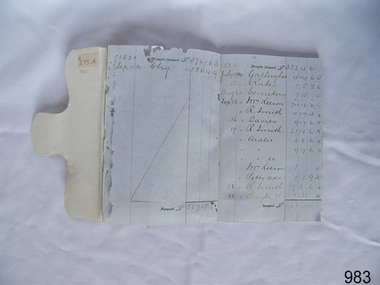 Flagstaff Hill Maritime Museum and Village
Financial record - Passbook, Bank of Australasia, 1880
... Staff at the Bank of Australasia in Warrnambool included the following men but others were also involved: Samuel Hannaford, Teller then Manager from 1855-1856; Hawkins, Manager in 1856, W H Palmer, Manager from January 1857 until November 1869 when the Teller Basil Spence was promoted to Manager; H B Chomley, Manager from April 1873 and still there in 1886; A Butt, Manager in 1895-1904; J R McCleary Accountant and Acting Manager for 12 months, until 1900; A Kirk, Manager 1904; J Moore, staff until his transfer to Bendigo in December 1908; J S Bath was Manager until 1915; C C Cox, Manager until April 1923; Richard C Stanley, Manager 1923 to April 1928. ...Staff at the Bank of Australasia in Warrnambool included the following men but others were also involved: Samuel Hannaford, Teller then Manager from 1855-1856; Hawkins, Manager in 1856, W H Palmer, Manager from January 1857 until November 1869 when the Teller Basil Spence was promoted to Manager; H B Chomley, Manager from April 1873 and still there in 1886; A Butt, Manager in 1895-1904; J R McCleary Accountant and Acting Manager for 12 months, until 1900; A Kirk, Manager 1904; J Moore, staff until his transfer to Bendigo in December 1908; J S Bath was Manager until 1915; C C Cox, Manager until April 1923; Richard C Stanley, Manager 1923 to April 1928. ...This bank passbook originated from the Warrnambool branch of the Bank of Australasia with handwritten entries dating from 1880. Names written in the passbook are likely to be people local to Warrnambool. The book belonged to Thomas Smith and was handed over to his Executors. Thomas Smith operated his Gas Printers Works from Koroit Street, Warrnambool, and was a member of the Odd Fellows. In 1878, his son, aged about 12 years old, was carried across a tightrope forward and backwards, on the shoulders of the "Australian Blondon" Mr. L' Estrange, at a performance in Warrnambool. Royal Charter of England incorporated the Bank of Australasia in March 1834. It had its Australian beginning on 14th December 1835, opening in Sydney. The Acting Superintendent of the bank at that time was David Charters McArthur. He was Superintendent from 1867 to 1876. The Melbourne branch opened on 28th August 1838 in a two-roomed brick cottage on the north side of Little Collins Street, where two huge mastiff dogs were used at night to guard the bank. The government also provided an armed military sentinel. Due to the bank's rapid growth, a new building for the Melbourne branch was opened in 1840 at 75 Collins Street West. By 1879, the bank had been upgraded to a magnificent two-storey building on the corners of Collins and Queens Streets, with the entry on Collins Street. In 1951, the Bank of Australasia amalgamated with the Union Bank to form the Australia and New Zealand Bank, now known as the ANZ. Then in 1970, the ANZ merged with both the ES&A and the London Bank of Australia to form the ANZ Banking Group Limited. The ANZ Banking Group Ltd kindly donated a variety of historic items from the Bank of Australasia. BANK of AUSTRALASIA, WARRNAMBOOL – In 1854, Warrnambool had two banks, the Union Bank and the Bank of Australasia. Later, completely different bank businesses opened; in 1867, the National Bank of Australasia, and then in 1875, the Colonial Bank of Australasia. The original Warrnambool branch of the Bank of Australasia was established in July 1854 and operated from a leased cottage on Merri Street, close to Liebig Street. The bank next bought a stone building previously erected by drapers Cramond & Dickson on the corner of Timor and Gibson Streets. Samuel Hannaford was a teller and then Manager at the Warrnambool branch from 1855 to 1856, and the Warrnambool Council chose that bank for its dealings during 1856-57. In 1859, Roberts & Co. was awarded the contract to build the new Bank of Australasia branch for the sum of £3,000; the firm built the Warrnambool Post Office in 1856 and purchased land in Timor Street in 1858. The land was on a sand hill on the northeast corner of Timor and Kepler Streets and had been bought in 1855 from investor James Cust. The new building opened on May 21, 1860. The bank continued to operate there until 1951, when it merged with the Union Bank to form the ANZ Bank, which continued operating from its Liebig Street building. Warrnambool City Council purchased the former Bank of Australasia building in 1971 and renovated it, then on 3rd December 1973, it was officially opened as the Art Gallery by Cr. Harold Stephenson and Gallery Director John Welsh. The Gallery transferred to the purpose-built building in Liebig Street in 1986, and the old bank building is now the Gallery club. Staff at the Bank of Australasia in Warrnambool included the following men but others were also involved: Samuel Hannaford, Teller then Manager from 1855-1856; Hawkins, Manager in 1856, W H Palmer, Manager from January 1857 until November 1869 when the Teller Basil Spence was promoted to Manager; H B Chomley, Manager from April 1873 and still there in 1886; A Butt, Manager in 1895-1904; J R McCleary Accountant and Acting Manager for 12 months, until 1900; A Kirk, Manager 1904; J Moore, staff until his transfer to Bendigo in December 1908; J S Bath was Manager until 1915; C C Cox, Manager until April 1923; Richard C Stanley, Manager 1923 to April 1928. The bank passbook has significance through its association with the Bank of Australasia. The early Australian bank was established in 1834 by Royal Charter and opened in Sydney, Australia, in Sydney in 1835. The bank had many Australian offices in November 1877, particularly on the east and south coasts. Victoria had 45 per cent of all Offices. The passbook is locally significant for its association with the Warrnambool Bank of Australasia, which was established in 1854. It was Warrnambool Council’s first bank. The bank continued to operate until the organisation's merger in 1951 when it became the ANZ Bank Group today. The Bank was an integral part of the growth of local commerce and the community. It has local significance for its association with commercial Warrnambool in 1880, belonging to Thomas Smith, a prominent businessman with a printing works whose son of about 12 years age crossed a tightrope with the 'Australian Blondin', L' Estrange. Bank passbook, Bank of Australasia, Warrnambool branch. Bound with waxed, cream-coloured cardboard cover and tab closure. Pages have blue horizontal lines and red vertical lines. Black ink handwritten entries, with Date, Name and amount. Inscription was written inside and on a sticker inside the front cover. Passbook is dated 1880 and belonged to Thomas Smith.Marked "The Executors of the late Thomas Smith" "Stamped inside "Bank of Australasia, Warrnambool" Handwritten on sticker " R. 273 A" Sample of handwritten entries include "1880" Callaghan" "Rates" A Linch" "Davies" Bottom of page, balance "529 10 21" [529 pounds 10 shillings 21 pence]flagstaff hill, warrnambool, shipwrecked coast, flagstaff hill maritime museum, maritime museum, shipwreck coast, flagstaff hill maritime village, great ocean road, bank of australasia, boa, union bank, australia & new zealand bank, anz bank, david charters mcarthur, d c mcarthur, bank book, pass book, financial record, commerce, thomas smith, thos. smith, gas printing works, australian blondin, thomas smith's son, tightrope walker, odd fellows, l' estrange, passbook, bank passbook -
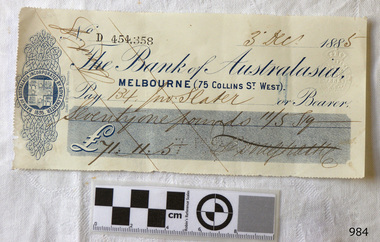 Flagstaff Hill Maritime Museum and Village
Currency - Bank cheque, Sands & McDougall Limited, 03-12-1885
... Staff at the Bank of Australasia in Warrnambool included the following men but others were also involved: Samuel Hannaford, Teller then Manager from 1855-1856; W H Palmer, Manager from January 1857 until November 1869 when the Teller Basil Spence was promoted to Manager; H B Chomley, Manager from April 1873 and still there in 1886; A Butt, Manager in 1895-1904; J R McCleary Accountant and Acting Manager for 12 months, until 1900; A Kirk, Manager 1904; J Moore, staff until his transfer to Bendigo in December 1908; J S Bath was Manager until 1915; C C Cox, Manager until April 1923; Richard C Stanley, Manager 1923 to April 1928. ...Staff at the Bank of Australasia in Warrnambool included the following men but others were also involved: Samuel Hannaford, Teller then Manager from 1855-1856; W H Palmer, Manager from January 1857 until November 1869 when the Teller Basil Spence was promoted to Manager; H B Chomley, Manager from April 1873 and still there in 1886; A Butt, Manager in 1895-1904; J R McCleary Accountant and Acting Manager for 12 months, until 1900; A Kirk, Manager 1904; J Moore, staff until his transfer to Bendigo in December 1908; J S Bath was Manager until 1915; C C Cox, Manager until April 1923; Richard C Stanley, Manager 1923 to April 1928. ...This bank cheque originated from the Bank of Australasia, Melbourne branch. It was issued on 3rd December 1885 to a person surnamed Slater for £71.11.5 (seventy-one pounds, eleven shillings and five pence). The parallel lines are called Cheque Crossed and mean that only Slater and no one else could receive the payment and that it would have been paid into Slater's bank account, not exchanged for cash. The embossed dots signify that the cheque amount was also paid to be the bearer of the cheque. Slater would have visited the bank to deposit the money into his or her own account. The cheque was printed by Sands & McDougall, a long-standing Melbourne printing and stationery company. It was then Stamped at the bank with its own unique number before it was issued to the customer. From its previously perforated edges, it is presumed that the cheque was part of a page of cheques, likely to be contained within a book of similar cheques ready for use. The Bank of Australia was incorporated by Royal Charter of England in March 1834. It had its Australian beginnings on 14th December 1835, opening in Sydney. The Acting Superintendent of the bank at that time was David Charters McArthur. He was Superintendent from 1867-to 1876. The Melbourne branch opened on 28th August 1838 in a two-roomed brick cottage on the north side of Little Collins Street, where two huge mastiff dogs were used at night to guard the bank. The government also provided an armed military sentinel. Due to the bank's rapid growth, a new building for the Melbourne branch was opened in 1840 at 75 Collins Street West. By 1879 the bank had been upgraded to a magnificent two-storey building on the corners of Collins and Queens Streets, with the entry on Collins Street. In 1951 the Bank of Australasia amalgamated with the Union Bank to form the Australia and New Zealand Bank, now known as the ANZ. Then in 1970, the ANZ merged with both the ES&A and the London Bank of Australia to form the ANZ Banking Group Limited. The ANZ Banking Group Ltd kindly donated a variety of historic items from the Bank of Australasia. BANK of AUSTRALASIA, WARRNAMBOOL – In 1854 Warrnambool had two banks, the Union Bank and the Bank of Australasia. Later, completely different bank businesses opened; in 1867 the National Bank of Australasia, then in 1875 the Colonial Bank of Australasia. The original Warrnambool branch of the Bank of Australasia was established in July 1854, and operated from a leased cottage on Merri Street, close to Liebig Street. The bank next bought a stone building previously erected by drapers Cramond & Dickson on the corner of Timor and Gibson Streets. Samuel Hannaford was a teller and then Manager at the Warrnambool branch from 1855 to 1856 and the Warrnambool Council chose that bank for its dealings during 1856-57. In 1859 Roberts & Co. was awarded the contract to build the new Bank of Australasia branch for the sum of £3,000. The land was on a sand hill on the northeast corner of Timor and Kepler Streets and had been bought in 1855 from investor James Cust. The new building opened on May 21, 1860. The bank continued to operate there until 1951 when it merged with the Union Bank to form the ANZ Bank, which continued operating from its Liebig Street building. Warrnambool City Council purchased the former Bank of Australasia building in 1971 and renovated it, then on 3rd December 1973 it was officially opened as the Art Gallery by Cr. Harold Stephenson and Gallery Director John Welsh. The Gallery transferred to the purpose-built building in Liebig Street in 1986 and the old bank building is now the Gallery club. Staff at the Bank of Australasia in Warrnambool included the following men but others were also involved: Samuel Hannaford, Teller then Manager from 1855-1856; W H Palmer, Manager from January 1857 until November 1869 when the Teller Basil Spence was promoted to Manager; H B Chomley, Manager from April 1873 and still there in 1886; A Butt, Manager in 1895-1904; J R McCleary Accountant and Acting Manager for 12 months, until 1900; A Kirk, Manager 1904; J Moore, staff until his transfer to Bendigo in December 1908; J S Bath was Manager until 1915; C C Cox, Manager until April 1923; Richard C Stanley, Manager 1923 to April 1928. The bank cheque has significance through its association with the Bank of Australasia. The early Australian bank was established in 1834 by Royal Charter and opened in Sydney, Australia, in Sydney in 1835. The bank had many Australian offices in November 1877, particularly on the east and south coasts. Victoria had 45 percent of all Offices. The bank cheque is significant as an early example of financial management of money and money exchange or transfer.Bank cheque of the Bank of Australasia, Melbourne branch. The rectangular paper has three sides that have been perforated. It is printed in blue with bank's Insignia of a heraldic shield of sheep hung by their waists and ships in full sail. Embossed Stamp Duty mark. Embossed dots. Handwritten black ink details Dated 3rd Dec 1885. Printed in Melbourne by Sands & McDougall. Diagonal parallel lines are across the cheque. Printed: "Bank of Australasia, MELBOURNE (75 COLLINS ST. WEST)." "454,358" "Sands & McDougall, Melbourne" Embossed stamp: Symbol of Crown above double oval lines " - STAMP DUTY" "ONE PENNY" Embossed dots forming test "7 PAID T2" Handwritten: "3rd Dec. [188] 5" "134 - Slater" "Seventy one pounds 11/S 5p" "£71.11.5" Signature: (undecipherable) flagstaff hill, warrnambool, shipwrecked-coast, flagstaff-hill, flagstaff-hill-maritime-museum, maritime-museum, shipwreck-coast, flagstaff-hill-maritime-village, bank cheque, shipwrecked coast, flagstaff hill maritime museum, maritime museum, shipwreck coast, flagstaff hill maritime village, great ocean road, bank of australasia, boa, union bank, australia & new zealand bank, anz bank, bank note, melbourne, slater, sands & mcdougall, chrssed cheque, embossed dots, paid cheque, banknote -
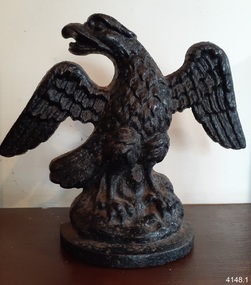 Flagstaff Hill Maritime Museum and Village
Decorative object - Bookends
... Staff at the Bank of Australasia in Warrnambool included the following men but others were also involved: Samuel Hannaford, Teller then Manager from 1855-1856; Hawkins, Manager in 1856, W H Palmer, Manager from January 1857 until November 1869 when the Teller Basil Spence was promoted to Manager; H B Chomley, Manager from April 1873 and still there in 1886; A Butt, Manager in 1895-1904; J R McCleary Accountant and Acting Manager for 12 months, until 1900; A Kirk, Manager 1904; J Moore, staff until his transfer to Bendigo in December 1908; J S Bath was Manager until 1915; C C Cox, Manager until April 1923; Richard C Stanley, Manager 1923 to April 1928. ...Staff at the Bank of Australasia in Warrnambool included the following men but others were also involved: Samuel Hannaford, Teller then Manager from 1855-1856; Hawkins, Manager in 1856, W H Palmer, Manager from January 1857 until November 1869 when the Teller Basil Spence was promoted to Manager; H B Chomley, Manager from April 1873 and still there in 1886; A Butt, Manager in 1895-1904; J R McCleary Accountant and Acting Manager for 12 months, until 1900; A Kirk, Manager 1904; J Moore, staff until his transfer to Bendigo in December 1908; J S Bath was Manager until 1915; C C Cox, Manager until April 1923; Richard C Stanley, Manager 1923 to April 1928. ...The individual eagles in this pair of Napoleonic Eagle bookends are made so that each eagle faces the opposite direction to the other, one left and one right. The Napoleonic Eagle is the name given to the eagle symbol used by Napoleon Bonaparte 1799-1815 and the French Regiments, mounted on a standard to represent the honour and pride of fighting French men. It is believed that the Napoleonic Eagle was chosen as a symbol for the Tamar Bank in Launceston, Tasmania, established in 1834. The bank was formed after the separation of one of the branches of the Bank of Van Diemen’s Land. The Managing Director in 1834 was Lewis Gilles, previously a naval officer. Other directors were T. Williams, M. Connolly, F. D. Wickham, and P. Oakden. The bank was dissolved in 1838 and became the basis of the Launceston branch of the British-founded Union Bank of Australia Limited, established in 1837 and had its own emblem. The Union Bank of Australia merged with the Bank of Australasia in 1951 and went on to eventually become part of the Australia and New Zealand (ANZ) Banking Group. The Bank of Australasia was incorporated by Royal Charter of England in March 1834. It had its Australian beginning on 14th December 1835, opening in Sydney. The Acting Superintendent of the bank at that time was David Charters McArthur. He was Superintendent from 1867 to 1876. The Melbourne branch opened on 28th August 1838 in a two-roomed brick cottage on the north side of Little Collins Street. By 1879 the bank had been upgraded to a magnificent two-storey building on the corners of Collins and Queens Streets, with the entry on Collins Street. In 1951 the Bank of Australasia amalgamated with the Union Bank to form the Australia and New Zealand Bank, now known as the ANZ. Then in 1970, the ANZ merged with the ES&A and the London Bank of Australia to form the ANZ Banking Group Limited. The ANZ Banking Group Ltd kindly donated to Flagstaff Hill various historic items from the Bank of Australasia. BANK of AUSTRALASIA, WARRNAMBOOL – In 1854 Warrnambool had two banks, the Union Bank and the Bank of Australasia. Later, completely different bank businesses opened; in 1867 the National Bank of Australasia, then in 1875 the Colonial Bank of Australasia. The original Warrnambool branch of the Bank of Australasia was established in July 1854, and operated from a leased cottage on Merri Street, close to Liebig Street. The bank next bought a stone building previously erected by drapers Cramond & Dickson on the corner of Timor and Gibson Streets. Samuel Hannaford was a teller and then Manager at the Warrnambool branch from 1855 to 1856 and the Warrnambool Council chose that bank for its dealings during 1856-57. In 1859 Roberts & Co. was awarded the contract to build the new Bank of Australasia branch for the sum of £3,000; the firm built the Warrnambool Post Office in 1856 and purchased land in Timor Street in 1858. The land was on a sand hill on the northeast corner of Timor and Kepler Streets and had been bought in 1855 by investor James Cust. The new building opened on May 21, 1860. The bank continued to operate there until 1951 when it merged with the Union Bank to form the ANZ Bank, which continued operating from its Liebig Street building. Warrnambool City Council purchased the former Bank of Australasia building in 1971 and renovated it, then on 3rd December 1973 it was officially opened as the Art Gallery by Cr. Harold Stephenson and Gallery Director John Welsh. The Gallery transferred to the purpose-built building on Liebig Street in 1986 and the old bank building is now the Gallery Club. Staff at the Bank of Australasia in Warrnambool included the following men but others were also involved: Samuel Hannaford, Teller then Manager from 1855-1856; Hawkins, Manager in 1856, W H Palmer, Manager from January 1857 until November 1869 when the Teller Basil Spence was promoted to Manager; H B Chomley, Manager from April 1873 and still there in 1886; A Butt, Manager in 1895-1904; J R McCleary Accountant and Acting Manager for 12 months, until 1900; A Kirk, Manager 1904; J Moore, staff until his transfer to Bendigo in December 1908; J S Bath was Manager until 1915; C C Cox, Manager until April 1923; Richard C Stanley, Manager 1923 to April 1928. This pair of Napoleonic Eagle bookends represents the type of ornaments appropriate for 19th and 20th-century business associated with finance and commerce. They symbolise strength, reliability and power. It is believed that the Napoleonic Eagle was the seal of the Tamar Bank, established in 1834 in Launceston, Tasmania. The Tamar bank was taken over by the Australia-wide Union Bank in 1838, which later merged with the Bank of Australasia, which had a branch in Warrnambool. In 1851 it became the Australia and New Zealand Bank, which is still active in Warrnambool in 2023. Bookends; two (2) black metal eagles, standing, beaks open, tail to the side, wings spread, claws open. The black figures are cast metal and the backs are hollow, with flat even edges. The front is textured and shiny. The eagles are facing opposite directions; one left, one right. The figures are commonly known as Napoleonic eagles.flagstaff hill maritime museum and village, warrnambool, great ocean road, shipwreck coast, bookends, eagle bookends, napoleonic eagles, tamar bank, launceston bank, bank of australasia, eagle symbol, 1834-1838, commerce, financial institution, colonial bank, lewis gilles, m. connolly, f. d. wickham, and p. oakden., t. williams, anz bank, australia and new zealand bank, union bank of australia -
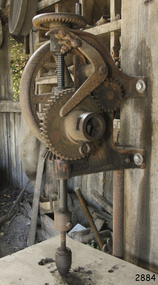 Flagstaff Hill Maritime Museum and Village
Drill Press, 1920s-1950s
... Stanley Works Pty. Ltd. In November 1998 Dawn became 100 per cent Australian owned. HENRY GOODALL & SONS Henry Goodall (1870-1936) was proprietor of garages as H. ...Stanley Works Pty. Ltd. In November 1998 Dawn became 100 per cent Australian owned. HENRY GOODALL & SONS Henry Goodall (1870-1936) was proprietor of garages as H. ...This drill once belonged to Goodall and Sons, who were blacksmiths in Terang. The smith was called upon to do a variety of work. In the early 1900s he was often the nearest person to be able to perform an engineer’s services for many miles around. The Dawn Ball-bearing Post Drill no. 611 is described in McPherson’s Catalogue as a “drilling machine with adjustable automatic feed, with improved Dawn coupler and ball-bearing thrust’. The heavy design of the flywheel enables it to maintain momentum” and is “fitted with pulleys for belt drive if desired” The hand crank drives an automatic feed to work off a cam-follow system opposite a large wheel. Made by Dawn Manufacturing Co. Australia 1920-1950. DAWN MANUFACTURING CO. Dawn Manufacturing Co. was founded in Coburg, Melbourne, in 1917 by the four Blake brothers, who were all engineers. After World War I Dawn was supplying drills Australia wide and the company was growing at a healthy rate. During the depression they remained busy, with employees working 60-80 hour weeks. Dawn was contracted to supply vices and clamps to the Australian Defence Department and munitions factory during the World War II. In 1959 the company was taken over by G.N. Raymond Group, then in 1973 the Siddons Ramset Limited acquired Dawn. In December 1991, Dawn became a unit of the United States owned Stanley Works Pty. Ltd. In November 1998 Dawn became 100 per cent Australian owned. HENRY GOODALL & SONS Henry Goodall (1870-1936) was proprietor of garages as H. Goodall & Sons Pty. Ltd., at both Terang (McKinnon and High Streets) and Mortlake (Dunlop Street). His business was in operation in at least in 1916 and perhaps well before, considering the date of the tyre bender and its use for wagons with wooden wheels. It was still in operation in 1953, chasing up debtors in Mount Gambier Court. Amongst the employees of H. Goodall & Sons Pty. Ltd. was Ernie Entwistle, a blacksmith (a soldier who died in 1916 ) and Alfred Hodgetts, radio expert (killed in a fatal accident in 1943, when he was in his early 30s ). Henry Goodall was involved in the community as a Justice of Peace, a deputy coroner, President of the Mortlake Hospital, trustee of the Soldiers’ Memorial Hall, and as a prominent Freemason. He and his wife had two sons (Charles and John) and one daughter (Mrs. Chas. Newton, of Skipton). The drill is locally significant as it was used by a local company in Terang and Mortlake in their blacksmith, wheelwright and garage business. It is an example of the tools of the blacksmiths’ trade in Victoria in the 1920s-1950s.Dawn Ball-bearing Post Drill no. 611, made by Dawn of Melbourne, model no 611. Hand operated drill press. Self-feeding blacksmiths’ drill-press. This drill once belonged to Harry Goodall & Sons, blacksmiths of Terang. Dated 1920s-1950s. Gear ratio 2:1 main drive, 6" diam, 3:1 reduction gear. "Dawn", "Melbourne"flagstaff hill, warrnambool, shipwrecked-coast, flagstaff-hill, flagstaff-hill-maritime-museum, maritime-museum, shipwreck-coast, flagstaff-hill-maritime-village, h. goodall & sons of terang, terang blacksmith, h. goodall & sons pty ltd, mortlake, ernie entwistle blacksmith, alfred hodgetts radio expert, charles goodall, john goodall, mrs. chas. newton nee goodall, terang 1900s, warrnambool district 1900s, post drill, blacksmith’s drill, dawn post drill, dawn ball-bearing post drill no. 611, blacksmiths, dawn of melbourne -
Federation University Historical Collection
Instrument - Scientific Instrument, W.F. Stanley & Co Ltd, Fuller Calculator, 1926
... W.F. Stanley & Co Ltd...Norman H...Fuller Calculator Instrument Scientific Instrument W.F. Stanley & Co Ltd Norman H. Seward ...This item was first owned by R.W. Richards, c1918. He presented this calculator to E.J. Barker in the early 1960s.A polished, hinged, timber box containing: 1. Fuller Calculator 2. instruction Manual 3. A "provenance" statement from E.J. Barker. There are a makers and a retailers label inside the lid.Serial Number 5721-26 on top end of brass scale. fuller calculator, richards, barker, stanley, seward
