
Showing 31 items matching "hair waving"
-
 Charlton Golden Grains Museum Inc
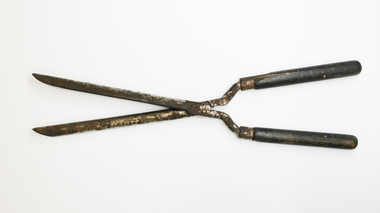
Domestic object - Hair Wavers, c 1920
... ...hair waving...Hair Grooming tongs personal care metal tongs hair waving Metal rod tongs with wooden handles. ...Metal rod tongs with wooden handles. Tongs would be heated, inserted in hair and pressed together.Metal rod tongs with wooden handles. The wooden handles have a black varnish. The metal is heavily rusted.hair grooming, tongs, personal care, metal tongs, hair waving -
 Flagstaff Hill Maritime Museum and Village
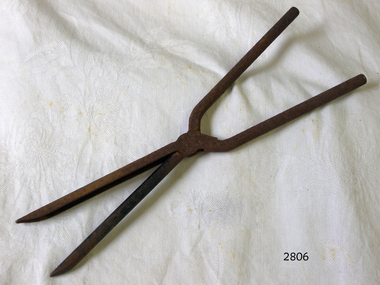
Domestic object - Hair Tongs, Marcel Grateau, 1900 +
... hair. Its appearance was similar to that of a finger wave but it is created using a different method. ...Marcel Tongs, metal, used to impart a hair wave by heating and crimping the hair...hair. Its appearance was similar to that of a finger wave but it is created using a different method. ...Marcelling is a hair styling technique in which hot curling tongs are used to induce a curl into the hair. Its appearance was similar to that of a finger wave but it is created using a different method. Marcelled hair was a popular style for women's hair in the 1920s and 30s often in conjunction with a bob cut. For those women who had long hair, it was common to tie the hair at the nape of the neck and pin it above the ear with a stylish hairpin or flower. Accounts vary about the invention of the style, but Marcel Grateau (1852–1936) is widely credited with inventing the hair styling technique in the 1870s. He started with a small salon in Montmartre, Paris where his clients were the poorer classes. As he developed the waving method that would later become the Marcel wave, using heated curling irons, The inventor and stylist emigrated to the United States and changed his name to François Marcel Woelfflé, sometimes reported as François Marcel. He was granted U.S. patents for implements for performing the technique; the first, U.S. patent 806386, entitled "Curling-Iron", was published in 1905, and the second, entitled "Hair-Waving Iron", for an electric version, under the name François Marcel, was published in 1918. His obituary appeared under the name Francois Marcel Grateau in 1936. Originally the irons had to be heated in the fire, but hair easily got burnt until 1924 when electric irons were invented and the temperature could be regulated. A significant item that gives us a snapshot not only into women's hairstyles of the 1920s and 1930s but a look into the social norms of that era. Therefore the item is of social interest in regards to the story it tells and the development of women's fashion in hair styling.Marcel Tongs, metal, used to impart a hair wave by heating and crimping the hairNoneflagstaff hill, warrnambool, shipwrecked coast, flagstaff hill maritime museum, maritime museum, shipwreck coast, flagstaff hill maritime village, great ocean road, tongs, curling tongs, hairdressing -
 Glenelg Shire Council Cultural Collection
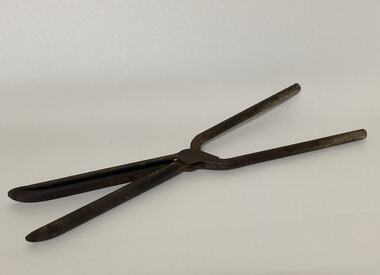
Domestic object - Hair Tongs, Marcel Grateau
... These hair tongs were used to impart a hair wave by heating and crimping the hair....These hair tongs were used to impart a hair wave by heating and crimping the hair. Marcelled hair was a popular style for women's hair in the 1920's Hair tongs Marcel 10 Marcel / 10 Marcel Tongs that operate in a scissor like motion, metal. ...These hair tongs were used to impart a hair wave by heating and crimping the hair.Marcelled hair was a popular style for women's hair in the 1920'sMarcel Tongs that operate in a scissor like motion, metal. Marcel / 10hair tongs, marcel 10 -
 Orbost & District Historical Society
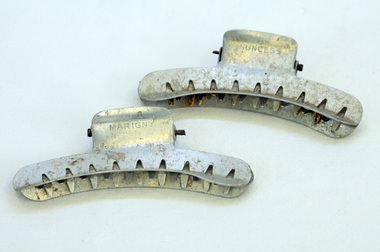
hair clips, 1930's
... Two metal butterfly clips for waving hair. They are spring hinged and probably made of aluminium....These items are examples of women's hair accessories commonly used in the mid 20th century. hair-accessories hair-clips Two metal butterfly clips for waving hair. They are spring hinged and probably made of aluminium. hair clips ...This clip was not made to be worn in the hair, it was made to create fingercurls, a style of hairdo very popular in the 1920's and 1930's. The 1920's and 30's saw new simple hairstyles. The hair was often short and cut into a bob shape and then curled or more commonly ornamented with fingerwaves. the children came in. These hairclips were used to hold the curl in place as the hair dried.These items are examples of women's hair accessories commonly used in the mid 20th century.Two metal butterfly clips for waving hair. They are spring hinged and probably made of aluminium.hair-accessories hair-clips -
 Mont De Lancey
Curling Irons, Circa 1890 - wooden handle curling irons
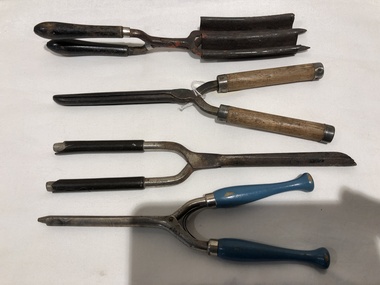
... These were heated and used for curing and waving hair....These were heated and used for curing and waving hair. Curling irons Assortment of 5 Curling Irons:- 3 with wooden handles (Circa 1890), and 1 with a black plastic handle and another with a metal handle. ...These were heated and used for curing and waving hair.Assortment of 5 Curling Irons:- 3 with wooden handles (Circa 1890), and 1 with a black plastic handle and another with a metal handle.curling irons -
 Wodonga & District Historical Society Inc
Functional object - Hair Curling Tongs
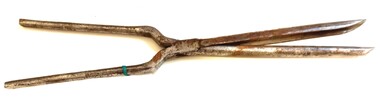
... It was at this time that using tongs became particularly fashionable, when women started wearing their hair waved on top of the head. Very few changes were made to this method of hair curling until the introduction of the electric hair curler in 1959....It was at this time that using tongs became particularly fashionable, when women started wearing their hair waved on top of the head. Very few changes were made to this method of hair curling until the introduction of the electric hair curler in 1959. ...Tongs were used by women and girls to wave or curl their hair. They were heated either on a wood stove or later over the flame from a burner and the applied to the hair. Curl papers were applied to the hair to stop it scorching. The use of tongs or iron rods to curl hair including men's beards dates back for centuries. French hair stylist is credited the invention of the curling iron in 1890. It was at this time that using tongs became particularly fashionable, when women started wearing their hair waved on top of the head. Very few changes were made to this method of hair curling until the introduction of the electric hair curler in 1959.This item is significant because it is representative of long-lasting trend in women's fashion, including in Wodonga and was donated by a local resident.Metal tongs with a double handle grip. One side of the tongs has a roller and the other has is hollow to fit over the strand of hair to be curled. women's accessories, household items -
 Warrnambool and District Historical Society Inc.
Functional object - Curling tongs, Hair Curlers, Early 20th century
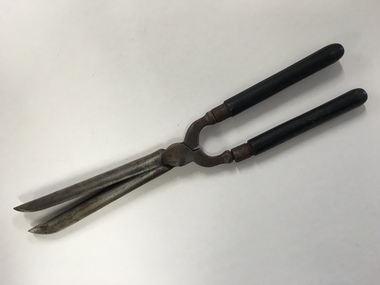
... These hair tongs were used to curl or wave hair. They have the name’ Marcel’ on them. ...The blades were heated over a stove and used manually to enclose part of a woman’s hair to produce waves or curls. The handles were originally polished black and are somewhat rubbed and the blades and other metal parts are a little rusty. ...These hair tongs were used to curl or wave hair. They have the name’ Marcel’ on them. ...These hair tongs were used to curl or wave hair. They have the name’ Marcel’ on them. In 1872 Francois Marcel Grateau invented a hairstyle called the ‘Marcel Wave’ where women’s hair styles had mostly deep waves rather than curls. The tongs that were held manually and heated and used at home to produce deep waves or curls become a commonplace item in a woman’s home in the late 19th and early 20th centuries. By the 1930s electric hair tongs were introduced but the non-electric ones continued to be used until the 1950s. These hair tongs belonged to a woman from England and would have been used in the 1930s or 40s. They are a good example of the type of household article used by women 70 or 80 years ago and will be useful for display.This is a scissors-like article with wooden handles and metal blades for waving or curling hair. One blade is heavily curved and the other is a solid round shape. The ends of the blades are tapered. The blades were heated over a stove and used manually to enclose part of a woman’s hair to produce waves or curls. The handles were originally polished black and are somewhat rubbed and the blades and other metal parts are a little rusty. ‘Marcel’ ‘12’ hair curling tongs, warrnambool -
 City of Moorabbin Historical Society (Operating the Box Cottage Museum)
Manufactured Object, Hair 'Butterfly clips' stainless steel, c1960
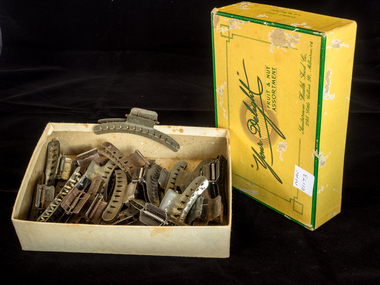
... These are stainless steel Hair styling Clips that are used for creating definite, non permanent Waves in a lady's hair c 1920 to 1960. ...Steel spring 'butterfly clips' used for crimping hair to form waves. Sanitarium Health Food Company Box c 1960 used for storage....These are stainless steel Hair styling Clips that are used for creating definite, non permanent Waves in a lady's hair c 1920 to 1960. ...These are stainless steel Hair styling Clips that are used for creating definite, non permanent Waves in a lady's hair c 1920 to 1960. Ladies usually went to the hairdresser for this styling but they could do it themselves at home Gladys Reed was a member of the Ormond Choral Society c 1950. who performed plays and musicals the City of Moorabbin Finger waves were very a fashionable Hairstyle 1920 - 1960. Gladys Reed, who was a member of the Ormond Choral Society c 1950.that performed plays and musicals the City of Moorabbin used these 'butterfly clips'Steel spring 'butterfly clips' used for crimping hair to form waves. Sanitarium Health Food Company Box c 1960 used for storage.hairdressing, finger wave hairstyle, steel, fashion, theatrical props, craftwork, sequins, beading, early settlers, moorabbin shire, mechanics institute cheltenham, ormond choral society, postworld war 11 settlers, housing estates moorabbin 1950, bentleigh, ormond, moorabbin, cheltenham, drama societies, musical society cheltenham, clark judy, reed gladys, reed george, hairdressing salons -
 City of Moorabbin Historical Society (Operating the Box Cottage Museum)
Manufactured Object, 'Crest' Home Hair Perm Kit in box, c1950
... hairdressers, hairdressing equipment, permanent wave, hair fashion, hair styling 1950, grooming, personal effects, early settlers, post world war 2 estates moorabbin, reed gladys. reed george, clark judy, bentleigh, moorabbin, highett, ormond....In the latter method, chemicals are applied to the hair, which is then wrapped around forms / rods to produce hairstyles with varying degrees of wave or curls. ...A cardboard box containing solution, equipment and instruction booklet for home treatment of hair to produce permanent waves....A cardboard box containing solution, equipment and instruction booklet for home treatment of hair to produce permanent waves. Manufactured Object, 'Crest' Home Hair Perm Kit in box CREST Pty Ltd ...A permanent hairstyle, commonly called a perm or "permanent" is a hairstyle consisting of styles set into the hair lasting a number of months using thermal or chemical means. In the latter method, chemicals are applied to the hair, which is then wrapped around forms / rods to produce hairstyles with varying degrees of wave or curls. Usually this styling is performed by Hairdressers, in Beauty Salons, however, manufacturers appealing to the 'thriftiness' of the post world war 2 women produced products that could be used at home. It became very popular for women in the new estates to gather with their neighbours to give each other this new 'Home perm' with some success and failure. Gladys Reed used this type of Home perm while a resident of City of Moorabbin c 1950Typical Home Hair Perming equipment used to style their own hair by women in City of Moorabbin c1950A cardboard box containing solution, equipment and instruction booklet for home treatment of hair to produce permanent waves.hairdressers, hairdressing equipment, permanent wave, hair fashion, hair styling 1950, grooming, personal effects, early settlers, post world war 2 estates moorabbin, reed gladys. reed george, clark judy, bentleigh, moorabbin, highett, ormond. -
 Bendigo Historical Society Inc.
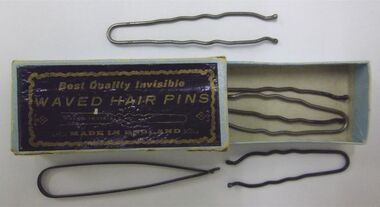
Accessory - BOX HAIR PINS
... Light Blue cardboard box with black label gold print containing Hair Pins / label reads ' Best quality invisible waved hair pins, Made in England....PERSONAL EFFECTS Hairdressing ' Best quality invisible waved hair pins made in England Light Blue cardboard box with black label gold print containing Hair Pins / label reads ' Best quality invisible waved hair pins, Made in England. ...Light Blue cardboard box with black label gold print containing Hair Pins / label reads ' Best quality invisible waved hair pins, Made in England.personal effects, hairdressing, ' best quality invisible waved hair pins , made in england -
 Linton and District Historical Society Inc
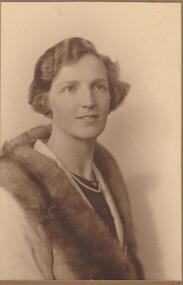
Photograph, Ilma Jennings
... Head and shoulders portrait photograph which shows a young woman with waved, bobbed hair. She is wearing a fur-trimmed jacket and a pearl necklace....Ilma Jennings Ilma Ferrier Head and shoulders portrait photograph which shows a young woman with waved, bobbed hair. She is wearing a fur-trimmed jacket and a pearl necklace. ...Ilma Jennings was a daughter of William Jonathan and Matilda Jennings (née Michell). She was born at Linton in 1909. She became a teacher (registered 1926) and married Noel Ferrier in 1945.Head and shoulders portrait photograph which shows a young woman with waved, bobbed hair. She is wearing a fur-trimmed jacket and a pearl necklace.ilma jennings, ilma ferrier -
 Linton and District Historical Society Inc
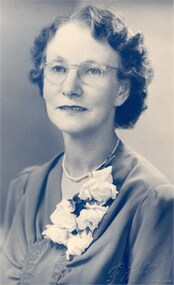
Photograph, Dorothy Commons, 1948
... Digital copy of original black and white photograph, a head and shoulders portrait a woman with waved hair, who is wearing glasses and a pearl necklace. ...Dorothy Commons née Tame Dorothy Tame Digital copy of original black and white photograph, a head and shoulders portrait a woman with waved hair, who is wearing glasses and a pearl necklace. ...Dorothy Commons, 1883-1970, was a daughter of John Burnham Tame and Sarah Tame, née Shields. She married Robert Ernest Commons in 1906.Digital copy of original black and white photograph, a head and shoulders portrait a woman with waved hair, who is wearing glasses and a pearl necklace. A small bouquet of flowers is pinned to the bodice of her dress. Dorothy Commons, née Tame, 1948.dorothy commons née tame, dorothy tame -
 Linton and District Historical Society Inc
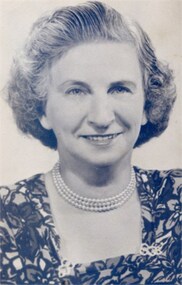
Photograph, Emily Winifred (Win) Smith
... The photograph is a head and shoulders portrait of a woman with waved hair, who is wearing a floral print dress with a square neckline, and a pearl necklace. ...The photograph is a head and shoulders portrait of a woman with waved hair, who is wearing a floral print dress with a square neckline, and a pearl necklace. ...Emily Winifred Smith, known as Win Smith, was a daughter of John Burnham Tame and his wife Sarah Tame, née Shields. She was born at Linton in 1895, and married Walter Smith in 1920.Digital copy of an original black and white photograph. The photograph is a head and shoulders portrait of a woman with waved hair, who is wearing a floral print dress with a square neckline, and a pearl necklace. Emily Winifred (Win) Smith, née Tame, undated.emily winifred smith née tame, win smith, win tame -
 Whitehorse Historical Society Inc.
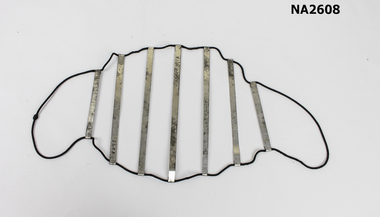
Accessory - Hairwave net, 1920-1930
... Designed to sit across the head pushing hair into series of waves held in place by loops of elastic under ears....Designed to sit across the head pushing hair into series of waves held in place by loops of elastic under ears. ...A device made up of a large loop of black elastic with seven steel strips. Designed to sit across the head pushing hair into series of waves held in place by loops of elastic under ears.costume accessories, hair accessories, personal effects-toilet requisites, hairdressing -
 Linton and District Historical Society Inc
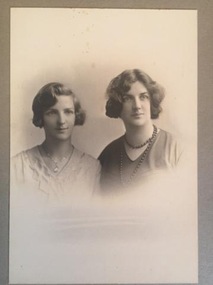
Photograph, Ilma and Dulcie Jennings
... Head and shoulders portrait photograph showing two young women, both with waved, bobbed hair. The woman on the left is wearing a light coloured dress and a pendant necklace, the woman on the right is wearing a darker dress and a long, looped bead necklace....Dulcie Jennings Dulcie Corbett Ilma Jennings Ilma Ferrier Head and shoulders portrait photograph showing two young women, both with waved, bobbed hair. The woman on the left is wearing a light coloured dress and a pendant necklace, the woman on the right is wearing a darker dress and a long, looped bead necklace. ...Ilma and Dulcie Jennings were daughters of William Jonathan and Matilda Jennings (née Michell). Ilma (wearing light-coloured dress, on lhs) was born in 1909 and Dulcie (darker dress, on rhs) was born in 1906. Dulcie married James Corbett in 1935, and Ilma married Noel Ferrier in 1945.Head and shoulders portrait photograph showing two young women, both with waved, bobbed hair. The woman on the left is wearing a light coloured dress and a pendant necklace, the woman on the right is wearing a darker dress and a long, looped bead necklace.dulcie jennings, dulcie corbett, ilma jennings, ilma ferrier -
 Orbost & District Historical Society
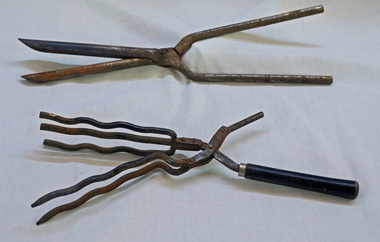
curling and crimping tongs, late 19th early 20th century
... Used by women and girls to wave or crimp their hair, for styling their hair, hairdressing. ...These have two wavy iron shaped metal pieces which clamp over a tress of hair to produce crimpy waves....These have two wavy iron shaped metal pieces which clamp over a tress of hair to produce crimpy waves. curling and crimping tongs ...Used by women and girls to wave or crimp their hair, for styling their hair, hairdressing. The irons are heated and then applied to the hair and wound to form curls. Pre-dates electrically heated curlers.One set of curling tongs made of iron/steel, rusted. The tongs are two shaped metal pieces which clamp together over a tress of hair. One set of crimping tongs. These have two wavy iron shaped metal pieces which clamp over a tress of hair to produce crimpy waves.hair-crimpers-curlers hairdressing heated-curlers -
 Bendigo Historical Society Inc.
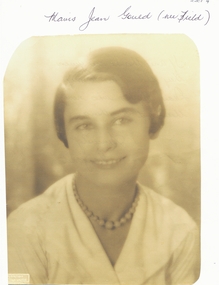
Photograph - MAVIS JEAN GOULD ( NEE FIELD ) DESCENDANT OF GEORGE LANSELL, 1931
... Woman dressed in light coloured top, with beads around neck, Hair pulled back and waved down side of face. Written on back in biro: 'if any thanks are given they should be to my dear Mother who never threw out anything, sincerely Margaret.'...Woman dressed in light coloured top, with beads around neck, Hair pulled back and waved down side of face. Written on back in biro: 'if any thanks are given they should be to my dear Mother who never threw out anything, sincerely Margaret.' ...Photo: photocopy of sepia photo of Mavis Jean Gould ( nee Field ) descendant of George Lansell. Photo taken in 1931. Woman dressed in light coloured top, with beads around neck, Hair pulled back and waved down side of face. Written on back in biro: 'if any thanks are given they should be to my dear Mother who never threw out anything, sincerely Margaret.'place, fortuna, family history, fortuna, lansell, bendigo -
 Royal District Nursing Service (now known as Bolton Clarke)
Photograph - Photograph, black and white, Barry Sutton, 12.07.1975
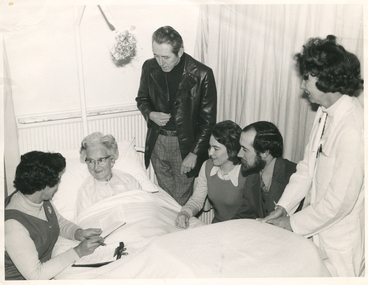
... On the right of the bed, and from its head down, L-R is:a man who is standing; he has short dark hair and is wearing a leather type jacket over a dark skivvie and plaid trousers. Next, sitting, is a lady who has short slightly waved dark hair; she is wearing a grey round neck sleeveless frock over a light coloured long sleeve blouse. ...On the right of the bed, and from its head down, L-R is:a man who is standing; he has short dark hair and is wearing a leather type jacket over a dark skivvie and plaid trousers. Next, sitting, is a lady who has short slightly waved dark hair; she is wearing a grey round neck sleeveless frock over a light coloured long sleeve blouse. ...This photograph is taken in a Hospital ward and shows a meeting between a patient, an RDNS Liaison Sister; and the Hospital staff, L-R, a Doctor, a Physiotherapist, a Social Worker and an Occupational Therapist. The group are discussing with the patient the ongoing care she will require when shes goes home. The Sister. has an RDNS information leaflet open in her hands which will be given to the lady. From those present, the Sister is ready to write, on the clipboard, any information required to be passed to the RDNS District Sister to carry out the nursing care needed when the lady goes home. The Sister is wearing the RDNS winter uniform of a light blue.grey skivvie under a darker blue/grey V neck tunic style dress made from herringbone winter material.Liaison had occurred between doctors and the Trained nurses (Nurses) of the Melbourne District Nursing Society (MDNS), from its inception in 1885. This increased when Midwifery was introduced in August 1893 with close liaising with the Women’s Hospital. As District nursing grew it was recognized closer liaising between many Public Hospitals would be beneficial, for not only the MDNS, later called Royal District Nursing Service (RDNS),Trained nurses (Sisters), but also for the patients and the hospitals. In August 1964 a Liaison Officer commenced at the Alfred Hospital. This soon increased to Liaison Officers working full time at several Public Hospitals. They facilitated the smooth transition from hospital to home for many patients who required ongoing nursing care. Liaison Sisters regularly attended discharge planning meetings, interviewed prospective patients, coordinated discharge, and booked the first visit by the visiting RDNS Sister. At the time of a patient’s discharge, the Liaison Sister forwarded information on their diagnosis and instructions regarding the care required at home to the appropriate RDNS Centre, and in turn the attending District Sister wrote a report of progress and any queries to the Hospital Doctor, via the Liaison Sister, at the time the patient was attending outpatients. Any new instructions were then sent back to the District Sister. Liaising also occurred between District Sisters and Doctors when patients were referred by General Practitioners and did not attend a hospital.On the left of this black and white photograph is a Royal District Nursing Service (RDNS) Sister who is seated and has her curly dark hair head, turned to her left looking at a lady who is resting in a hospital bed. The Sister, who is wearing a light grey skivvie under a darker V neck tunic style dress, is holding an open folded page with typed writing seen, in her hands; a pen is sitting between the fingers of her right hand and a clipboard is on the bed. The elderly lady, to her right, is sitting propped up against white pillows on her hospital bed and is looking, and smiling, at the Sister. She is wearing glasses; has curly grey hair; and is wearing a light coloured nightdress. The light coloured bedclothes cover most of her body. On the right of the bed, and from its head down, L-R is:a man who is standing; he has short dark hair and is wearing a leather type jacket over a dark skivvie and plaid trousers. Next, sitting, is a lady who has short slightly waved dark hair; she is wearing a grey round neck sleeveless frock over a light coloured long sleeve blouse. Next, seated, is a male who has short dark hair and a short dark beard.He is wearing a dark grey suit jacket over a light grey shirt and patterned tie. Next, on the far right, standing, is a lady who has curly dark hair and is wearing a hospital white coat over a light coloured skivvie. A Hydronic heater is attached to the lower part of the wall behind the bed and a monkey bar is attached to the centre of the bed. Some flowers are also seen behind the bed and a drawn curtain is behind the staff on the right hand side of the photograph.Barry Sutton LO12royal district nursing service, rdns uniform, rdns liaison -
Glenelg Shire Council Cultural Collection
Functional object - Comb, n.d
... Bakelite hair comb, black, 5 teeth, comb is wave shaped...toilette hair dressing personal care Bakelite hair comb, black, 5 teeth, comb is wave shaped Functional object Comb ...Bakelite hair comb, black, 5 teeth, comb is wave shapedtoilette, hair dressing, personal care -
Glenelg Shire Council Cultural Collection
Domestic object - Hair Comb, n.d
... Tortoiseshell hair com, translucent honey coloured, 3 teeth (one broken off) comb wave-shaped....Tortoiseshell hair com, translucent honey coloured, 3 teeth (one broken off) comb wave-shaped. ...Tortoiseshell hair com, translucent honey coloured, 3 teeth (one broken off) comb wave-shaped. -
 City of Moorabbin Historical Society (Operating the Box Cottage Museum)
Toiletries, hair curling tongs, 20thC
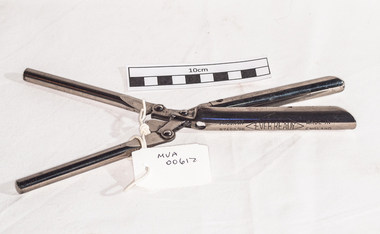
... Curling irons, also known as curling tongs, create waves or curls in the hair. Clipless wands have no clamp, and the user simply wraps hair around a rod and squeezes the two parts together. ...The metal curling irons were heated on the fire or the stove and then the hair could be clamped between these 2 rods to create a curl in the hair . toiletries hairdressing curling tongs moorabbin bentleigh cheltenham early settlers marcel waves market gardeners Eveready England A pair of steel, hair curling tongs Toiletries, hair curling tongs 'Eveready' Pty. ...Curling irons, also known as curling tongs, create waves or curls in the hair. Clipless wands have no clamp, and the user simply wraps hair around a rod and squeezes the two parts together. The metal curling irons were heated on the fire or the stove and then the hair could be clamped between these 2 rods to create a curl in the hair . A pair of steel, hair curling tongsEveready Englandtoiletries, hairdressing, curling tongs, moorabbin, bentleigh, cheltenham, early settlers, marcel waves, market gardeners -
 City of Moorabbin Historical Society (Operating the Box Cottage Museum)
Toiletries, steel, hair curling tongs, c1900
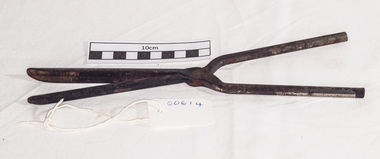
... If the tongs were overheated the hair was singed producing a lingering malodour. toiletries hairdressing early settlers market gardeners moorabbin bentleigh cheltenham marcel waves A pair of lady’s steel tongs, with no clamp, for hair curling. ...Hair curling tongs were used by women 1800 - 1950 to create appealing curls and ringlets in their hair. To achieve ringlets, the tongs were heated on a gas ring, stove top or flame and then thick weft of hair was wound around one side of the tongs. The tongs were then 'crimped' together and upon release a long ringlet of hair resulted . If the tongs were overheated the hair was singed producing a lingering malodour. A pair of lady’s steel tongs, with no clamp, for hair curling. toiletries, hairdressing, early settlers, market gardeners, moorabbin, bentleigh, cheltenham, marcel waves -
 City of Moorabbin Historical Society (Operating the Box Cottage Museum)
Personal Effects, hair pins Kirby-Beard, c1920
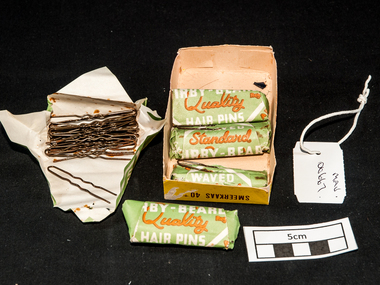
... waved,hairpins made by Kirby-Beard Pty Ltd. Packs are wrapped in green paper. These pins became known as 'french hairpins' commonly used for 'up styles' of long hair- chignons, french roll etc,...Women could either manage their hair style themselves or attend a Hairdresser at a Salon. moorabbin bentleigh cheltenham hairstyles combs hairpins early settlers hairdressing coiffure kirby-beard pty ltd Paper wrapper STANDARD / KIRBY- BEARD/ Reg / QUALITY / HAIR PINS Box : SMEERKAAS 40 A box of 5 packs of 50 waved,hairpins made by Kirby-Beard Pty Ltd. ...These hair pins were used to secure the fashionable hairstyles of the 20thC. Women could either manage their hair style themselves or attend a Hairdresser at a Salon.A box of 5 packs of 50 waved,hairpins made by Kirby-Beard Pty Ltd. Packs are wrapped in green paper. These pins became known as 'french hairpins' commonly used for 'up styles' of long hair- chignons, french roll etc,Paper wrapper STANDARD / KIRBY- BEARD/ Reg / QUALITY / HAIR PINS Box : SMEERKAAS 40 moorabbin, bentleigh, cheltenham, hairstyles, combs, hairpins, early settlers, hairdressing, coiffure, kirby-beard pty ltd -
 Orbost & District Historical Society
hair accessories, mid 20th century
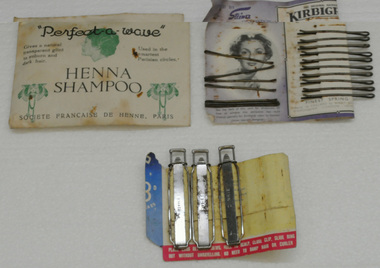
... Marjorie married in 1938 to a salesman who later became a mechanic in the R.A.F. during WW11 These items are examples of women's hair accessories commonly used in the mid 20th century. hair-accessories bobby-pins shampoo kirbigrips burton-marjorie 2483.51 - Kirbigrip 6d made in England Kirby Beard & Co 2483.52 - Made in England 2483.53 - Societe Francaise de Henne, Paris "Perfect -a -wave" Two packets of hair clips and one unused packet of henna shampoo. 2483.51 is a a set of 17 bobby pins on paper. ...A bobby pin (also known as a kirby grip or hair grip in the United Kingdom) is a type of hairpin, usually of metal or plastic, used in coiffure to hold hair in place. It is a small double-pronged hair pin or clip that slides into hair with the prongs open and then the flexible prongs close over the hair to hold it in place. They are typically plain and unobtrusively colored, but some are elaborately decorated or jeweled. Bobby pins became popular in the 1920s to hold the new bobbed hairstyles. (ref. Wikipedia). These items were owned by Marjorie Burton. Marjorie Burton ( nee Whiteman), born 12 June, in Birmingham, England came to Orbost in 1995. In England she did office work – typing, shorthand and secretarial work - in accountants’ offices and also trained as a comptometrist with Burroughs in London. She came from a middle-class, working, church-going family. Her mother was a milliner who mademost of Marjorie’s clothes, hats and outfits. Marjorie married in 1938 to a salesman who later became a mechanic in the R.A.F. during WW11 These items are examples of women's hair accessories commonly used in the mid 20th century.Two packets of hair clips and one unused packet of henna shampoo. 2483.51 is a a set of 17 bobby pins on paper. On the back of the card are directions for a Steiner hair style. 2483.52 is a pack of 3 Dinkie silver metal clips for hair styling on a card. 2483.53 is an unopened sachet of powdered Henna shampoo. It is white with black text and green pictures.2483.51 - Kirbigrip 6d made in England Kirby Beard & Co 2483.52 - Made in England 2483.53 - Societe Francaise de Henne, Paris "Perfect -a -wave"hair-accessories bobby-pins shampoo kirbigrips burton-marjorie -
 Royal Australian and New Zealand College of Obstetricians & Gynaecologists (RANZCOG)
Framed photograph of Professor Gilbert Strachan
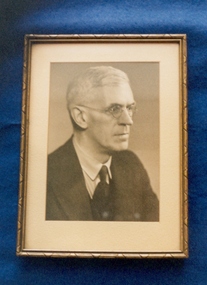
... haired man with steel-rimmed spectacles, a dark suit, and a white shirt. Label on back of frame reads 'Professor Gilbert I Strachan CBE LID'. Frame is made of gold coloured metal and carries a simple wave pattern. ...haired man with steel-rimmed spectacles, a dark suit, and a white shirt. Label on back of frame reads 'Professor Gilbert I Strachan CBE LID'. Frame is made of gold coloured metal and carries a simple wave pattern. ...Gilbert Innes Strachan (1888-1963) was educated in Glasgow and Bristol. He was a fluent lecturer and a stimulating and dogmatic teacher. Strachan was a founding member of RCOG (London) and served on its Council from 1929- 1955. He was one of the pioneers of the use of radium in treating uterine cancer, receiving a CBE in 1953 for his work in this area. Professor Strachan donated a coat of arms to the Australian RCOG during a visit (pre- 1963). Professor Strachan died at his home in Cathedral Road, London on December 9, 1963, following a short illness. He was 75.Framed black and white photograph. The photograph is a side-on portrait photograph of Professor Gilbert Strachan, a white haired man with steel-rimmed spectacles, a dark suit, and a white shirt. Label on back of frame reads 'Professor Gilbert I Strachan CBE LID'. Frame is made of gold coloured metal and carries a simple wave pattern. The back of the photo is secured by a piece of orange and cream patterned chipboard, held in place by eleven small photograph tacks.Professor Gilbert I Strachan CBE LIDrcog -
 Charlton Golden Grains Museum Inc
Domestic object - Hair Curling Tongs
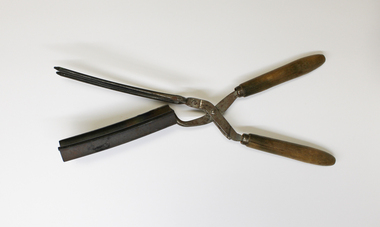
... Metal Instrument for Waving or Curling Hair Scissor action unit with wooden moulded Handles One side extends to two prongs of metal A second side extends to blackened corrugated metal - 2 indents into which 2 prongs are pressed when handles close ...Hair Hair Grooming tongs hair curling Metal Instrument for Waving or Curling Hair Scissor action unit with wooden moulded Handles One side extends to two prongs of metal A second side extends to blackened corrugated metal - 2 indents into which 2 prongs are pressed when handles close Hair Curling Tongs Domestic object Hair Curling Tongs ...Metal Instrument for Waving or Curling Hair Scissor action unit with wooden moulded Handles One side extends to two prongs of metal A second side extends to blackened corrugated metal - 2 indents into which 2 prongs are pressed when handles close hair, hair grooming, tongs, hair curling -
 Ruyton Girls' School
Photograph, Ruyton Girls' School, 1952
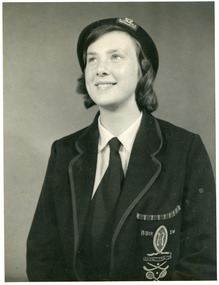
... In both photographs, Helen's hair is short and sits just above her shoulders with a slight wave. The photographs are excellent examples of the Ruyton uniform from the time period in which they were taken. ...In both photographs, Helen's hair is short and sits just above her shoulders with a slight wave. The photographs are excellent examples of the Ruyton uniform from the time period in which they were taken. ...Depicted are two formal school portraits of Helen Gordon (Cole) against a flat background. The first image depicts her from the waist up. She is dressed in the official Ruyton uniform, including a beret, light coloured collared shirt with a tie, and wool blazer embroidered on the pocket with Ruyton Girls' School's crest and Helen's student leadership positions. She is looking upwards and away from the camera to her right-hand side, and is smiling softly with teeth. The second photo is a more close-up image of Helen. She is still dressed in the same Ruyton uniform, although her blazer pocket embroidery is not visible. In this image, she is looking straight and away from the camera to her left-hand side, and has a closed smile. In both photographs, Helen's hair is short and sits just above her shoulders with a slight wave. The photographs are excellent examples of the Ruyton uniform from the time period in which they were taken. The official school uniform has naturally experienced different iterations since the School's founding in 1878. The most recent changes to the Ruyton uniform were made at the end of 2023, which include a move from brown to black school shoes, and a transition from pale yellow collared shirts to white.The record has strong historic significance as it depicts a former notable student, Helen Gordon (maiden name Cole). Helen started at Little Ruyton in Prep 1940 and finished Year 12 in 1952 as School Captain, Bromby Captain, Form Captain for Matric, Tennis Captain, Hockey Captain, Swimming Vice Captain, and an award for Best All-Round Girl. She also played baseball for Victoria. After finishing school, Helen went on to graduate from the University of Melbourne as a physiotherapist in 1956. Her first position at age 19 involved setting up clinics with the Victorian Health Department Poliomyelitis Rural division. Helen’s strong ties to Ruyton continued when she held the position of President of the Old Ruytonians’ Association from the start of 1966 to the end of 1967. In 2019, Helen received an Order of Australia Medal for service to community health as a physiotherapist. She was also the recipient of the 2022 Victorian Senior Achiever Award at Parliament House. Helen passed away in July 2023 at age 88. The record's significance is further enhanced by its strong provenance, having been produced by Ruyton Girls' School and donated to the Archives by a familial connection.Two black and white rectangular photographs printed on matte photographic paper.Reverse: RGS011/1952/0002.1 / Reverse: RGS011/1952/0002.2 /ruyton girls' school, kew, victoria, tennis, sport, women's sport, students, school, 1950s, uniform -
 Kew Historical Society Inc
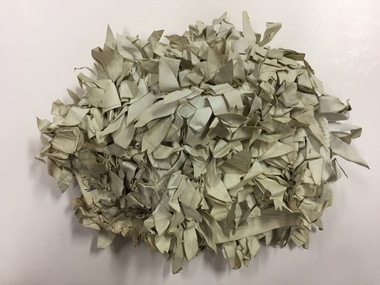
Clothing - Bathing Cap, Kleinertz, 1950s
... Printed on interior (see photo 2): "Kleinerz (sic) Sara-Wave in unique texture rubber gives you perfect comfort and no hair drag. ...costumes swimwear bathing caps Printed on interior (see photo 2): "Kleinerz (sic) Sara-Wave in unique texture rubber gives you perfect comfort and no hair drag. ...Medium size white rubber woman's bathing cap, the exterior covered in flaps of rubber simulating petals.Printed on interior (see photo 2): "Kleinerz (sic) Sara-Wave in unique texture rubber gives you perfect comfort and no hair drag. Be sure that the rim is turned up above your ears not over them. Medium. Made in Gt. Britain"costumes, swimwear, bathing caps -
 Lilydale RSL Sub Branch
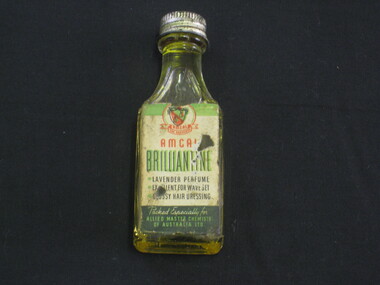
Bottle
... Amcal / Brilliantine/ Lavender perfume / Excellent for wave set/ Glossy hair dressing / Packed Especially for/ Allied Master Chemists of Australia Ltd...Amcal / Brilliantine/ Lavender perfume / Excellent for wave set/ Glossy hair dressing / Packed Especially for/ Allied Master Chemists of Australia Ltd Bottle of Brilliantine with partially used contents Bottle Allied Master Chemists of Australia Ltd Allied Master Chemists of Australia Ltd ...Bottle of Brilliantine with partially used contentsAmcal / Brilliantine/ Lavender perfume / Excellent for wave set/ Glossy hair dressing / Packed Especially for/ Allied Master Chemists of Australia Ltd -
 Whitehorse Historical Society Inc.
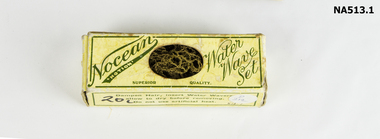
Accessory - Water Wave Set
... Water Wave Set comprising: 1 dish, 6 curved combs, 1 packet pins, 1 box containing hair net and 13 large hair pins. ...personal effects-toilet requisites hairdressing 'Nocean' Water Wave Set Water Wave Set comprising: 1 dish, 6 curved combs, 1 packet pins, 1 box containing hair net and 13 large hair pins. ...Water Wave Set comprising: 1 dish, 6 curved combs, 1 packet pins, 1 box containing hair net and 13 large hair pins. A total of 22 items.'Nocean' Water Wave Setpersonal effects-toilet requisites, hairdressing
