
Showing 7 items matching "hamilton drain"
-
 Eltham District Historical Society Inc
Document - Folder, Murray, John and Mary
... ...Hamilton Drain...John Wright Murray Mary Murray nee Sweeney Thomas Sweeney Diamond Creek Zig Zag Road Eltham Cemetery Johnnie Murray James Murray Eltham North Reserve Bridget Sweeney nee Coleman Bridget Cecilia Murray Michael (Mick) Dillon Hamilton Drain Mary Ellen Drain Thomas Drain John Murray Patrick Murray Thomas Murray William Murray Laurel Hill Farm Eltham Patrick Bernard Murray Elizabeth Josephine Tooher John Meyler Bagot Thomas Vincent Murray Margaret Gleeson William Louis Murray James Augustine Murray Julia Agnes Brennan William Johnston Isaac Rooks John R Sabine Murray's Bridge Wattletree Road Eltham Zig Zag Road Eltham Larry Brennan Evelyn Arms Hotel Eltham Newspaper clippings, A4 photocopies, etc Murray, John and Mary Document Folder ...John and Mary Murray settled in Eltham North in 1849 and his descendants lived in the area. Contents Letter: J N Murray to Eltham Historical Society, 16 August 1970. Requests information about the Murray family. Letter: J N Murray to B Wadeson [?Eltham Shire Council], 24 March 1974. Requests information about the Murray family. Letter: Brian R Smyth solicitor to Eltham Historical Society, 31 August 1993: Re estate of J E Murray and contents of buildings and site. Letter: Eltham Historical Society to Bryan Smyth, 7 September 1993: Re contents of buildings and site, in association of Shire of Diamond Valley. Newspaper article: "Back when the land was theirs", Diamond Valley News, 28 September 1992. Interview of James (Jim) Murray about his family and farm. Text: "A development philosophy for 'Murray's", Eltham North", by John R Sabine, September 1994 [history of family and Laurel Hill farm]. Photograph: Grave stone of John Murray, Mary Murray, Thomas Drain and Mary Ellen Drain. Text: "Murray" by A Sheehan, no date. History of Murray family. Text: John Wright Murray", no author, no date: History of John Wright Murray. Newspaper clippings, A4 photocopies, etcjohn wright murray, mary murray nee sweeney, thomas sweeney, diamond creek, zig zag road, eltham cemetery, johnnie murray, james murray, eltham north reserve, bridget sweeney nee coleman, bridget cecilia murray, michael (mick) dillon, hamilton drain, mary ellen drain, thomas drain, john murray, patrick murray, thomas murray, william murray, laurel hill farm eltham, patrick bernard murray, elizabeth josephine tooher, john meyler bagot, thomas vincent murray, margaret gleeson, william louis murray, james augustine murray, julia agnes brennan, william johnston, isaac rooks, john r sabine, murray's bridge, wattletree road eltham, zig zag road eltham, larry brennan, evelyn arms hotel eltham -
 Eltham District Historical Society Inc
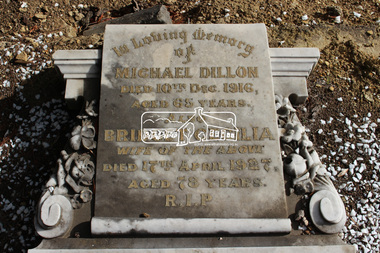
Photograph, Eltham Cemetery Trust, Grave of Michael and Bridget Cecilia Dillon, Eltham Cemetery, Victoria, 4 May 2016
... Bridget was the daughter of John Wright MURRAY(1816-1867) and Mary SWEENEY(1833-1909). She married Hamilton DRAIN(1847-1886) in 1884 and they had a daughter, Mary Ellen DRAIN(1886-1888). ...Following husband Hamilton Drain’s death in 1886, and her infant daughter Mary’s death in 1888, Bridget married Michael Dillon in 1894. ...Bridget was the daughter of John Wright MURRAY(1816-1867) and Mary SWEENEY(1833-1909). She married Hamilton DRAIN(1847-1886) in 1884 and they had a daughter, Mary Ellen DRAIN(1886-1888). Following husband Hamilton Drain’s death in 1886, and her infant daughter Mary’s death in 1888, Bridget married Michael Dillon in 1894. It appears that she and Michael had no children together. Electoral roll records indicate that Michael was a farmer and that he and Bridget lived in Research, Vic. Some damage has occurred to their monument and the Eltham Cemetery Trust would like to locate a next of kin or family member. Unfortunately, there was no purchase information recorded, only the following details; no next of kin. Deceased Location Date of Death Interment Date Michael Dillon Roman Catholic 205 10/12/1916 11/12/1916 Bridget Cecilia Dillon Roman Catholic 206 7/04/1927 19/04/1927 The photo of the headstone is dated 4 May 2016, which provides the best detail of the inscription.The headstone has deteriorated further in the last few years. In Loving Memory of Michael Dillon Died 10th Dec. 1916 Aged 65 years Also Bridget Cecilia Wife of the above Died 17th April 1927 Aged 78 years R.I.PBorn Digitaleltham cemetery, gravestones, michael dillon, bridget cecilia dillon (nee sweeeney) -
Glenelg Shire Council Cultural Collection
Programme - Programme - Wallacedale Racing Club Picnic, 1914, Hamilton Spectator, Apr-14
... Wallacedale is in western Victorian 28km sw of Hamilton. It was created by draining the Condah Swamp. After WWII the population declined and in the 1970s the school closed....Wallacedale is in western Victorian 28km sw of Hamilton. It was created by draining the Condah Swamp. After WWII the population declined and in the 1970s the school closed. ...Formerly from the Bower Bird Museum collection in Heywood. Wallacedale is in western Victorian 28km sw of Hamilton. It was created by draining the Condah Swamp. After WWII the population declined and in the 1970s the school closed.Four page cardboard programme for the Wallacedale Racing Club's Picnic Meeting on April 18, 1914. Printing in black. Pages held together with sellotape.wallacedale, condah, condah swamp -
 Warrnambool and District Historical Society Inc.
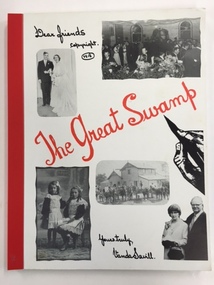
Book, The Great Swamp, 1980s
... Wallacedale is 28 kilometres south west of Hamilton and was created by the draining of the Condah Swamp. ...Wallacedale is 28 kilometres south west of Hamilton and was created by the draining of the Condah Swamp. ...This book has been written by Vanda Savill and is about the settlers in the Wallacedale area in Western Victoria. Wallacedale is 28 kilometres south west of Hamilton and was created by the draining of the Condah Swamp. Vanda Savill (1913-2005) and her husband ran a dairy farm and the Bower Birds Nest Museum and History Centre at Heywood. Vanda Savill was passionate about keeping alive the personal histories of local people and for 20 years she wrote and published many books about the areas in which she lived. This book is of interest because it tells the stories of settlers in the Wallacedale area of Western Victoria. It also has appeal because of the warm, conversational style of the author.This is a soft cover book of 216 pages. The cover has a white background with a black and white image of a hand holding a pen and, on the front cover, five black and white photographs and, on the back cover, nine black and white photographs. The title of the book is in red cursive writing. The information in the book is printed from the original handwriting of the author (Vanda Savill). The book also has many black and white photographs. The book is bound with red tape.wallacedale, history of western victoria, vanda savill, warrnambool -
![Equipment - Urinary receiver, Irving Urinary Receiver, [ca. 1930's]](/media/collectors/50187a8f023fd7201471f198/items/5a1c70a021ea670ba872884f/item-media/5a1c718d21ea670ba873490f/item-fit-380x285.jpg?cb=6) Alfred Hospital Nurses League - Nursing History Collection
Alfred Hospital Nurses League - Nursing History CollectionEquipment - Urinary receiver, Irving Urinary Receiver, [ca. 1930's]
... Hamilton Irving an English general surgeon in 1907. Supra pubic prostatectomy surgery was being performed more frequently due to improvements in procedures. There were issues post-operatively as dressings were saturated with urine and causing excoriation. The receiver was said to be easy to apply, comfortable to wear and effective in keeping the patient dry and able to move freely in bed. Post operative prostatectomy 1930s medical equipment Front of appliance has 'RAMSAY' inscribed as well as 'Wd 3' [Ward 3]. Supra pubic urinary drainage cover/receiver, metal with two drainage outlets to enable urine to drain ...This apparatus was devised by Hamilton Irving an English general surgeon in 1907. Supra pubic prostatectomy surgery was being performed more frequently due to improvements in procedures. There were issues post-operatively as dressings were saturated with urine and causing excoriation. The receiver was said to be easy to apply, comfortable to wear and effective in keeping the patient dry and able to move freely in bed. Supra pubic urinary drainage cover/receiver, metal with two drainage outlets to enable urine to drain via an abdominal drain tube following a supra pubic cystoscopy and prostatectomy, held in place by a leather belt, two rubber tubes were then attached other ends placed in a urinalFront of appliance has 'RAMSAY' inscribed as well as 'Wd 3' [Ward 3].post operative prostatectomy 1930s, medical equipment -
 Ballarat Heritage Services
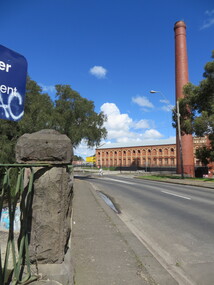
Photograph - Photograph - Colour, Sunnyside Mill Bridge over the Yarrowee, Hill Street, Ballarat, 2016, 17/09/2016
... drain which carried the drainage of the western plateau to the Yarrowee. He advised that strong pressure should be exerted, specially upon the Eastern Council, and then the work might be carried out. He thought that if the foot bridge was repaired, and large stones thrown into the creek, it would do until the bridge could be erected. The chairman then put the resolution, and it was unanimously carried. Mr Hamilton...drain which carried the drainage of the western plateau to the Yarrowee. He advised that strong pressure should be exerted, specially upon the Eastern Council, and then the work might be carried out. He thought that if the foot bridge was repaired, and large stones thrown into the creek, it would do until the bridge could be erected. The chairman then put the resolution, and it was unanimously carried. Mr Hamilton ..."A joint meeting of city and town ratepayers, convened by Messrs Francis Jago and Henry Johns, interested in the formation of a cart bridge in Hill street, over the Yarrowee Creek, was held on Saturday evening, in the Societies Hall, corner of Skipton and South streets, with the view of taking united action in the matter. Mr Morris was voted to the chair, : and about 60 persons were present. The chairman stated that the object of the meeting was that united influence should be brought to bear upon the City and Town Councils, so that a cartbridge should be erected. He said that Mount Pleasant would no doubt be thickly populated in a few years, and the bridge would prove a great boon to the inhabitants of the locality. By means of a cart bridge drays, would be enabled to save on their journeys to and fro between the mount and the batteries, at least a mile and a half each time. He hoped that the councillors for the south ward would assist them in this matter. Mr Jago, as one of the conveners of the meeting, said that united action on the part of both eastern and western ratepayers was requisite, so as to exert a strong pressure upon the City and Town Councils, in order that the work should be carried but. Mr Grainger moved the first resolution as follows;—“ That the construction of a cart bridge over the Yarrowee Creek at Sunnyside, to facilitate communication between the residents of the city and town, is urgently necessary, and that in the interests of both municipalities the two councils be asked to at once jointly carry out the work. In doing so he said that the necessity of a cart-bridge for the residents of Mount Pleasant would be apparent when the number of batteries, tanneries, and also the Woollen Mill, in the district were considered. The place was of growing import ance, and ready communication should at once be established. Another reason was that an immense saving in time would be effected. It was quite a common occurrence to see one, two, or three drays stuck in the bed of the creek which had gone that way to make a short cut. Now, what with the horses floundering about and breaking their harness, it seemed a wonder to him that life had not been destroyed before now, just through the want of a cartbridge. Mr Johns seconded the resolution. Mr Robert Calvert supported the resolution, and said that it was disgraceful action on the part of the representatives of the south ward that the work had not been executed long ago. They should come together like men and demand that the work should be done, and if not done they should not pay rates until it was. (A voice—“But they’ll make us.” Laughter.) The wooden footbridge across the creek was “only a wooden fabric, not fit for a Christian to walk across, and steps should be taken to remedy this also. Mr Blight, a resident of Mount Pleasant, said that, in common with others, he had been opposed to the erection of the bridge two years ago, but his views had since been altered. Cr. Morrison, who was present, said that the fault of the cartbridge not being erected over the Yarrowee at Hill street lay not with the City Council, but with their neighbors, who had always been opposed to its erection there. In 1874 a motion was carried at a meeting of ‘the City Council" by which the sum of £5OO had been voted to carry but the work. As the bridges over the Yarrowee were joint undertakings of the city and town, they had, by the provisions of an act of Parliament, called upon the Town Council to assist them in the erection of the bridge. In consequence, a conference of the two corporate bodies had taken place, when a motion was moved by Cr Howard, the representative of the south ward, and seconded by Cr Turpie, of Ballarat East—“ That the bridge should be erected at Hill street.” The motion was rejected, principally through the eastern representatives, who wanted the bridge lower down. Since then the two councils had often met to consider, the question of bridges over the Yarrowee Creek, but nothing had been done at the meetings, as the Eastern Council wanted the bridge in one place and the City Council in another. He had himself, when first elected to the council, given notice of motion affirming the desirability of a bridge, at the place now fixed upon. The Woollen Company was growing in importance, and a direct, road to its works would greatly advance its interests. For the working, expenses of each ward £400 was annually, appropriated; and this amount would not be sufficient carry out the work. They would have to obtain a special grant of about £900, as Hill street would require a culvert to be erected therein, as now it was virtually an open drain which carried the drainage of the western plateau to the Yarrowee. He advised that strong pressure should be exerted, specially upon the Eastern Council, and then the work might be carried out. He thought that if the foot bridge was repaired, and large stones thrown into the creek, it would do until the bridge could be erected. The chairman then put the resolution, and it was unanimously carried. Mr Hamilton moved the second resolution— “That Messrs Fern, Greenwood, Peirce, and Jago be deputed by the meeting to wait upon the City and Town Councils and present the first resolution; also that petitions in its favor be signed by all ratepayers interested.” Mr Haigh seconded the resolution, which was carried. Votes of thanks to Cr Morrison for his attendance, and to the chairman for presiding, were passed, and the proceedings terminated." (Ballarat Star, 9 August 1881, page 3) "WOOLLEN MILL BRIDGE YARROWEE IMPROVEMENTS Though brief the official ceremony of opening the bridge across the Yarrowee Creek, near the Sunnyside Woollen Mills, was of an interesting character. It took place at noon yesterday in the presence of the Mayors and councillors of the City and Town. Hon. F. Hagel thorn (Minister of Agriculture).Hon Brawn. M.L.C., Lt-Col Morton (Acting City Clerk). Mr J. Gent (Town Clerk of Ballarat East), Mr A. Farrer (City Engineer), Lt. L. Finch (who is about to leave for the Front, and who assisted Messrs A. Farrer and G. Maughan in carrying out the project, Mr W. Hurdsfield (Clerk of Works) and others. An apology was received from Mr J. McClelland, contractor for the work. Mayor Hill expressed pleasure in Introducing Mr Hagelthorn, who had at great personal sacrifice and inconvenience come from Melbourne to perform the opening ceremony of that beautiful bridge, which was of great improvements that had been effected.When Mr Hagelthorn was Minister of Pubic works he visited Ballarat specially to see the condition of the creek, which at that time was in a disgusting state from a sanitary standpoint. After viewing the position, and realising the justice of the claim. Mr Hagelthorn made strong representations to the Government of which the was a member with the result that it voted £17,000 for the work. That action had been the means of turning a plague spot into a thing of beauty. They therefore owed a deep debt of gratitude to Mr Hagelthorn and the Government of which he was a member, and they were particular grateful to Mr Hagelthorn for coming to Ballarat to perform the open ceremony. Mayor Levy said he could bear testimony to the good work Mr Hagelthorn had always done for Ballarat. In him Ballarat and district always had a good friend. He thought Mr Hagelthorn would feel amply gratified at seeing the good work that had been done. It would serve as some reward for the expenditure, on behalf of the residents of Bal larat, of the amount of money made available through Mr Hagelthorn's instrumentality for the two municipalities. Otherwise the City and Town councils would not have been able to carry out so necessary and so beneficial a work. There was a great amount of work yet to be done, and when the financial market became low stringent Mr Hagelthorn would no doubt be pleased to take the necessary steps to have money provided for further works which could not be undertaken at the present time. The adjacent woollen mill was a standing monument to what was being done in Ballarat, and what ever the City and Town Councils or the Government could do to encourage such manufacturing enterprise should be done, and he was glad to be able to say that was being done as far as finances would permit. He concluded by presenting Mr Hagelthorn with a gold mounted pocket-knife with which to cut the ribbon stretched across the centre of the structure as a bar to traffic. The Hon. F. Hagelthorn, who was greeted with applause said before him was a good work well done in the interests of the public. Real prosperity could only be achieved by a movement carried out by the people to increase natural productiveness. Most of them had been made aware, on account of the war par tiularly, that the people who were best equipped, the industries that were best organised, and the Governments that were most intelligently controlled would get the most of this world's goods and some of its luxuries that Would be denied other people less efficient. Any thing the Government could do to promote industry and to increase the reward of those engaged in it, both employer and employee, would be done. Most Governments would do but little in that regard. ... " (Ballarat Courier, 13 September 1916, page 4)Bluestone and iron bridge over the Yarrowee River at Hill Street, Ballarat.sunnyside mill, sunnyside woollen mill, ballarat woollen mill, bridge, yarrowee creek, francis jago, mount pleasant, yarrowee river, robert calvert -
Warrnambool and District Historical Society Inc.
Book - Language of the Aborigines of the Colony of Victoria and other Australian Districts, 1851
... Ingram Hamilton, 12 April, 1905. [.1]Title page: B Alexander to Reynell 16 02 59 [.2]Aboriginal Names of p....... of Condah Swamp, obtained from Black Tommy White and other Aboriginals, when surveying Condah Swamp Drains between the years 1883 & 1893 " Aly" Ingram 5.10.06 [.3] Copied from Australian 15 June 1907 Native Names (A.C. ...Ingram Hamilton, 12 April, 1905. [.1]Title page: B Alexander to Reynell 16 02 59 [.2]Aboriginal Names of p....... of Condah Swamp, obtained from Black Tommy White and other Aboriginals, when surveying Condah Swamp Drains between the years 1883 & 1893 " Aly" Ingram 5.10.06 [.3] Copied from Australian 15 June 1907 Native Names (A.C. ...This volume is a compilation by the author, botanist, Daniel Bunce of language of the Aborigines of the Colony of Victoria. It was prepared as a guide to Aboriginal protectors and others who were engaging with First Nations people of the time. The loose leaf documents found within the book contain handwritten lists of aboriginal words.This is a slender red covered volume with black print. There is a rectangle of white paper glued to the inside cover with a printed name. The inside cover has an inscription in black ink as does the frontice page. The front and rear covers have had paper tape applied to them. Inside the book were found two sheets of paper [.2 &.3] with handwritten notes in black ink. [.4] There is also a small white envelope with red postmarks, a typewritten address and blue printing in the bottom left hand corner which originally contained the smaller sheet of paper.non-fictionThis volume is a compilation by the author, botanist, Daniel Bunce of language of the Aborigines of the Colony of Victoria. It was prepared as a guide to Aboriginal protectors and others who were engaging with First Nations people of the time. The loose leaf documents found within the book contain handwritten lists of aboriginal words.daniel bunce, aboriginal language, first nation language, alexander ingram, reynell eveleigh johns
