
Showing 135 items matching "hand milking"
-
 Friends of Westgarthtown
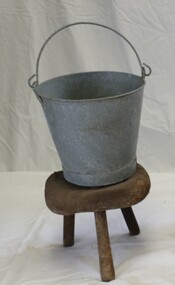
Functional object - Metal milking pale, c.1920
... ...hand milking...His recollections demonstrate the continued use of traditional hand-milking equipment at Westgarthtown well into the twentieth century. ...Metal milking bucket with a carrying handle, used for collecting fresh milk during the hand-milking of dairy cows. The bucket was designed to be positioned beneath the cow's udder, allowing milk to be collected directly during the milking process....Milking bucket hand milking dairy farming dairy equipment agricultural history milk production Westgarthtown Ziebell family. ...This metal milking bucket dates to approximately 1920–1930 and forms part of the Ziebell family collection associated with their farm at Westgarthtown, Thomastown, Victoria. Milking buckets were essential equipment on dairy farms before the widespread introduction of mechanical milking systems. Cows were milked by hand, with workers typically seated on low wooden stools beside the animals, collecting fresh milk directly into buckets before transferring it into larger milk cans for storage and transport. Henry Ziebell recalled that metal milking buckets were standard equipment on the family farm and remained in use until at least 1970, when the farm's clearing sale took place. His recollections demonstrate the continued use of traditional hand-milking equipment at Westgarthtown well into the twentieth century. The bucket provides a tangible connection to the dairy farming practices of the Ziebell family, reflecting the manual labour, daily routines and agricultural traditions maintained across generations at Westgarthtown. The bucket was donated to Ziebell's Farmhouse Museum by Lyn and James Ziebell.Metal milking bucket with a carrying handle, used for collecting fresh milk during the hand-milking of dairy cows. The bucket was designed to be positioned beneath the cow's udder, allowing milk to be collected directly during the milking process.milking bucket, hand milking, dairy farming, dairy equipment, agricultural history, milk production, westgarthtown, ziebell family. -
 Whitehorse Historical Society Inc.
Domestic object - Milk Jug Cover
... Fine cotton, hand crochet milk jug cover....handcrafts crocheting or crochet work domestic items food storage & preservation Fine cotton, hand crochet milk jug cover. Domestic object Milk Jug Cover ...Fine cotton, hand crochet milk jug cover.handcrafts, crocheting or crochet work, domestic items, food storage & preservation -
 Yarrawonga and Mulwala Pioneer Museum
Information pamphlet, The Alfa-Laval Homestead Milker
... Used in preference to slower hand milking practice after electricity was connected to the farm...Used in preference to slower hand milking practice after electricity was connected to the farm Milking machine Dairying See photos Paper pamphlet describing parts of the vacuum pump milker. ...Used in preference to slower hand milking practice after electricity was connected to the farmPaper pamphlet describing parts of the vacuum pump milker. Recommended for herds of ten cows or lessSee photosmilking machine, dairying -
 Friends of Westgarthtown
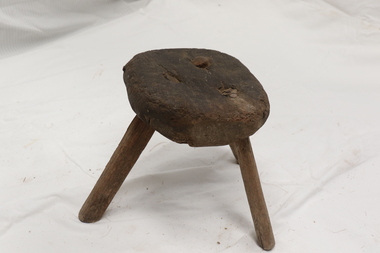
Furniture - Wooden milking stool, c. early 1900
... Small wooden milking stool dating to the early twentieth century, traditionally used during the hand-milking of dairy cows....Before the widespread introduction of mechanical milking equipment, cows were milked by hand, with workers seated on low wooden stools beside the animals. ...Small wooden milking stool dating to the early twentieth century, traditionally used during the hand-milking of dairy cows.This wooden milking stool is believed to have belonged to Henry Ziebell Senior and was used on the Ziebell family farm at Westgarthtown, Thomastown, Victoria, during the early twentieth century. Before the widespread introduction of mechanical milking equipment, cows were milked by hand, with workers seated on low wooden stools beside the animals. Each worker typically had their own stool, which formed part of their everyday working equipment. The stool provides a tangible connection to the agricultural practices and daily routines of the Ziebell family and reflects the labour-intensive nature of dairy farming at Westgarthtown during the early twentieth century. Uncle Henry Ziebell recalled that each person had their own milking stool, reflecting the everyday routines and working practices of the family farm. The stool was donated to Ziebell's Farmhouse Museum by Lyn and James Ziebell.Three legged wooden milking stool -
 Port Melbourne Historical & Preservation Society
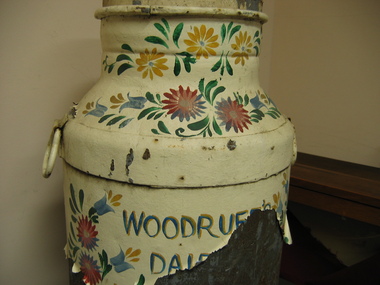
Photograph - Hand painted milk churn, Woodruff's Dairy, Port Melbourne, Julie Duncan, Jun 2006
... Hand painted milk churn, Woodruff's Dairy, Port Melbourne...Photographs of item 2146.01, hand painted milk can from Woodruff's dairyl...This photograph was taken because the can donated to the society is deteriorating rapidly, the paint peeling off the metal surface. business and traders - dairies woodruff's royal dairy stan woodruff stan Photographs of item 2146.01, hand painted milk can from Woodruff's dairyl Photograph Hand painted milk churn, Woodruff's Dairy, Port Melbourne Julie Duncan ...This photograph was taken because the can donated to the society is deteriorating rapidly, the paint peeling off the metal surface.Photographs of item 2146.01, hand painted milk can from Woodruff's dairylbusiness and traders - dairies, woodruff's royal dairy, stan woodruff, stan -
 Charlton Golden Grains Museum Inc
Domestic object - Milk Jug Cover, 1910c
... Hand crocheted milk jug cover in white and blue finished with blue beads...Hand crocheted milk jug cover in white and blue finished with blue beads Domestic object Milk Jug Cover ...Hand crocheted milk jug cover in white and blue finished with blue beads -
 Mont De Lancey
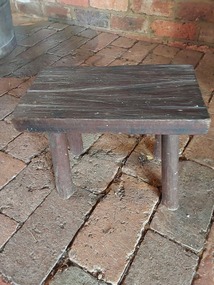
Functional object - Milking Stool, Unknown
... Three and four-legged milking stools were standard equipment in early dairies, where cows were milked by hand. Similar stools were used in the home for informal seating....A replica of a rough hand hewn rectangular hardwood milking stool with four round wooden legs glued into holes underneath the seat....Three and four-legged milking stools were standard equipment in early dairies, where cows were milked by hand. Similar stools were used in the home for informal seating. ...Three and four-legged milking stools were standard equipment in early dairies, where cows were milked by hand. Similar stools were used in the home for informal seating.A replica of a rough hand hewn rectangular hardwood milking stool with four round wooden legs glued into holes underneath the seat.dairy equipment, stools, furniture, seating furniture -
 Mont De Lancey
Functional object - Milking Stool, Unknown
... Three and four-legged milking stools were standard equipment in early dairies, where cows were milked by hand. Similar stools were used in the home for informal seating....A replica of a hand hewn wooden milking stool which is round with two flat sides with three round legs glued underneath the seat. ...Dairy equipment Stools Furniture Seating furniture A replica of a hand hewn wooden milking stool which is round with two flat sides with three round legs glued underneath the seat. ...Three and four-legged milking stools were standard equipment in early dairies, where cows were milked by hand. Similar stools were used in the home for informal seating.A replica of a hand hewn wooden milking stool which is round with two flat sides with three round legs glued underneath the seat. It has a large groove in the top which is part of the grain of the timber.dairy equipment, stools, furniture, seating furniture -
 Melbourne Royal
Photograph, Double Take
... This photograph shows a young boy hand-milking a cow in the Animal Nursery at the Royal Melbourne Show, unknown year. ...This photograph shows a young boy hand-milking a cow in the Animal Nursery at the Royal Melbourne Show, unknown year. ...This photograph shows a young boy hand-milking a cow in the Animal Nursery at the Royal Melbourne Show, unknown year. From the early 1990s, the Animal Nursery introduced programs where visitors could see more farm experiences, such as milking cows, sheering sheep, and an ewe birthing centre.Black and white photograph, landscape, printed on glossy paper.[annotations on reverse] Pg 27 67% / W.F.08 1.55 / 3 / DOUBLE TAKE / 18 CARLYLE ST. ASHWOOD / VICTORIA, 3147. 25 7635 / 0 1192-C29 / P. 11/ 33% /children, kids at show, farm experiences, cow, dairy cow, milking, animal nursery -
 Puffing Billy Railway
Carriage Sign - Milk Advertising, 1970's
... Carriage Sign - Milk Advertising Hand painted masonite sign. ...Historic - Puffing Billy Railway - Carriage Sign - Milk Advertising fitted to NBH carriages. nbh puffing billy milk advertising Drinka Pinta Milka day Milk's a marvellous drink Carriage Sign - Milk Advertising Hand painted masonite sign. Carriage Sign - Milk Advertising ...Advertising fitted to NBH carriages.Historic - Puffing Billy Railway - Carriage Sign - Milk Advertising fitted to NBH carriages.Carriage Sign - Milk Advertising Hand painted masonite sign. Drinka Pinta Milka day Milk's a marvellous drink nbh, puffing billy, milk, advertising -
 Puffing Billy Railway
Carriage Sign - Milk Advertising, 1970s
... Carriage Sign - Milk Advertising Hand painted masonite carriage sign....milk's a marvellous drink Drink plenty eveyday Carriage Sign - Milk Advertising Hand painted masonite carriage sign. ...Advertising fitted to NBH carriages.Historic - Puffing Billy Railway - Carriage Sign - Milk Advertising fitted to NBH carriages.Carriage Sign - Milk Advertising Hand painted masonite carriage sign.Hey Kids ! milk's a marvellous drink Drink plenty eveyday puffing billy, nbh, milk, advertising -
 Port Melbourne Historical & Preservation Society
Container - Hand painted milk can, Woodruff's Dairy, Port Melbourne, Shelley', 1920s
... Hand painted milk can, Woodruff's Dairy, Port Melbourne...Hand painted milk can from Woodruff's dairy, kept by the Woodruff family and decorated by artist 'Shelley' with floral motifs, dairy name etc.on a cream coloured, painted surface which now is peeling badly....Container Hand painted milk can, Woodruff's Dairy, Port Melbourne Shelley' ...Hand painted milk can from Woodruff's dairy, kept by the Woodruff family and decorated by artist 'Shelley' with floral motifs, dairy name etc.on a cream coloured, painted surface which now is peeling badly.business and traders - dairies, woodruff's royal dairy, stan woodruff, stan -
 Warrnambool and District Historical Society Inc.
Milk Stool, Early 20th century
... It was used in the days (first half of the 20th century) when cows were mostly milked by hand. It was most likely to have been used to milk a house cow, perhaps in Warrnambool or a nearby town. ...This is a hand-made wooden milking stool with a rectangular piece of wood for the seat and four rounded legs that taper slightly outwards. ...This stool is of considerable interest as an example of the stools used when cows were hand milked and when many households in the towns and outer areas had a house cow to supply milk for the household. ...This stool appears to have been home-made. It was used in the days (first half of the 20th century) when cows were mostly milked by hand. It was most likely to have been used to milk a house cow, perhaps in Warrnambool or a nearby town. The cow would have been kept during the day time on the town common and brought back to the home for milking and returned to the common the next day. The production of milk, cheese and butter has been an important industry in the Warrnambool district since the second half of the 19th century, with the Warrnambool Cheese and Butter Factory at Allansford being established in 1888. It is the oldest surviving dairy company in Australia. This stool is of considerable interest as an example of the stools used when cows were hand milked and when many households in the towns and outer areas had a house cow to supply milk for the household. This is a hand-made wooden milking stool with a rectangular piece of wood for the seat and four rounded legs that taper slightly outwards. The legs have been inserted into four holes on the top seating part. The seat has a small circular hole in the middle. The stool is well-worn. dairying in western victoria -
 Mont De Lancey
Functional object - Milking Stool, Unknown
... Three and four-legged milking stools were standard equipment in early dairies, where cows were milked by hand. Similar stools were used in the home for informal seating....Three and four-legged milking stools were standard equipment in early dairies, where cows were milked by hand. Similar stools were used in the home for informal seating. ...Three and four-legged milking stools were standard equipment in early dairies, where cows were milked by hand. Similar stools were used in the home for informal seating.A round brown painted wooden milking stool with four round wooden legs glued into holes underneath the seat.dairy equipment, stools, furniture, seating furniture -
 Kiewa Valley Historical Society
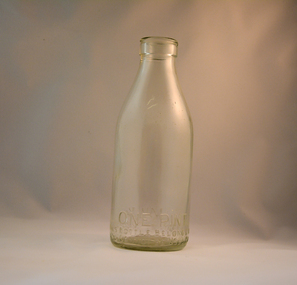
Bottle Milk, early 1900's
... Due to the volume of milk being processed and hand milking could not keep up with demand, dairy farms introduced milking machines in the late 1930's. ...Due to the volume of milk being processed and hand milking could not keep up with demand, dairy farms introduced milking machines in the late 1930's. ...This glass milk bottle was manufactured and used mid to late 1900's (1834 Victorian dairy industry was founded) up to the time that a cheaper container was invented(plastic bottles and polyethylene plastic lined cardboard cartons) and produced. In 1909 the supply of pure bottled milk was required for babies to overcome infant mortality due to unhygienic milk sources (unclean containers and unpasteurized milk). Due to the volume of milk being processed and hand milking could not keep up with demand, dairy farms introduced milking machines in the late 1930's. The great increases in dairy herds from the average of 18 cows per heard in 1950's to 142 cows per herd in 1996 required milk tankers to pick up the regions milk supply. This bottle was so constructed to be easily moved within the milk processing plants from the delivery vats/holding tanks to the final corking/sealing of the bottles for eventual distribution. From 1958 the milk bottle slowly became phased out of production. At this point in time Melbourne was drawing 160,000 bottles per week from the two major glass bottle works companies, e.g. Melbourne Glass Bottle Works Co. Victoria was the major state supplier of cows milk in the history of Australian milk production from the early 1800's. The Kiewa Valley and its region was a major contributor to meet that demand. Each bottle was "branded" during manufacturing to show the contents (pasteurized milk) and where it originated from (region and supplier). This method of recycling the bottles back to specific dairy farms was a good control method but an uneconomical "on cost" which was replaced by the "throw away" less costly plastic and cardboard containers. Kiewa Valley dairy herds had marked bottles bearing "90/9", "6/18", "6/33", "6/35" and "6/36" This heavy gauged glass milk bottle has a rim and a distinctive head at the top. This head has been manufactured to facilitate the movement of the bottled along the milk production line. The method of pouring milk into the bottle has been part of the "production line". This bottle has a one pint capacity and is made from "clear" glass. There are other milk bottles that have a "green" tint in them.Around the bottom side of the bottle and blown into the glass "ONE PINT" and on the opposite side "MILK". Below these markings is "This BOTTLE BELONGS TO MILK BOTTLES RECOVERY LTD" below this "AND CANNOT BE USED WITHOUT WRITTEN PERMISSION. On the base of the bottle is molded a big "M". An identification mark of "90" over "9" is beneath the "M". glass bottles, commercial milk containers, domestic milk bottles, pasteurized milk bottles, milk, dairy, farms, kiewa valley -
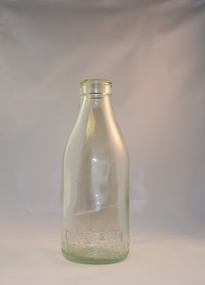 Kiewa Valley Historical Society
Bottle Milk, mid to late 1900's
... Due to the large volume of milk being processed and hand milking could not keep up with demand, dairy farms introduced milking machines in the late 1930's. ...Due to the large volume of milk being processed and hand milking could not keep up with demand, dairy farms introduced milking machines in the late 1930's. ...This glass milk bottle was manufactured and used mid 1800's (1834 Victorian dairy industry was founded) to the time that a cheaper container was invented(plastic bottles and polyethylene plastic lined cardboard cartons). In 1909 the supply of pure bottled milk was required for babies to overcome infant mortality due to unhygienic milk sources (unclean containers and unpasteurized milk). Due to the large volume of milk being processed and hand milking could not keep up with demand, dairy farms introduced milking machines in the late 1930's. The great increases in dairy herds from the average of 18 cows per heard in 1950's to 142 cows per herd in 1996 required milk tankers to pick up the regions milk supply. This bottle was so constructed to be easily moved within the milk processing plants from the delivery vats/holding tanks to the final corking/sealing of the bottles for eventual distribution. From 1958 the milk bottle slowly became phased out of production. At this point in time Melbourne was drawing 160,000 bottles per week from the two major glass bottle works companies, e.g. Melbourne Glass Bottle Works Co.Victoria was the major state supplier of cows milk in the history of Australian milk production from the early 1800's. The Kiewa Valley and its region was a major contributor to meet that demand. Each bottle was "branded" during manufacturing to show the contents (pasteurized milk) and where it originated from (region and supplier). This method of recycling the bottles back to specific dairy farms was a good control method but an uneconomical "on cost" which was replaced by the "throw away" less costly plastic and cardboard containers. Kiewa Valley dairy herds had marked bottles bearing "90/9", "6/18", "6/33", "6/35" and "6/36"This heavy gauged glass milk bottle has a rim and a distinctive head at the top. This head has been manufactured to facilitate the movement of the bottled along the milk production line. The method of pouring milk into the bottle has been part of the "production line". This bottle has a one pint capacity and is made from "light green" coloured glass(a protection against sunlight penetration). There are other milk bottles that do not have a "green" tint in them. This thick glass bottle to contain milk required its thickness because of the extensive handling before final consumption. Milk was delivered by the "milk man" direct to the homes of consumers. During this period delivery to homes in cities and towns was made initially by horse and cart and later by truck.On the bottom end of this bottle a circle within it 6/33 and next to this "ONE PINT" and under this "THIS BOTTLE BELONGS TO MILK BOTTLE RECOVERY LTD" and below this "AND CANNOT BE USED WITHOUT WRITTEN PERMISSION" on the base "M" underneath this "4"glass bottles, commercial milk containers, domestic milk bottles, pasteurized milk bottles -
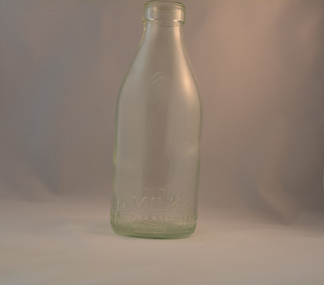 Kiewa Valley Historical Society
Bottle Milk, circa mid to late 1900's
... Due to the volume of milk being processed and hand milking could not keep up with demand, dairy farms introduced milking machines in the late 1930's. ...Due to the volume of milk being processed and hand milking could not keep up with demand, dairy farms introduced milking machines in the late 1930's. ...This glass milk bottle was manufactured and used mid to late 1900's (1834 Victorian dairy industry was founded) up to the time that a cheaper container was invented(plastic bottles and polyethylene plastic lined cardboard cartons). In 1909 the supply of pure bottled milk was required for babies to overcome infant mortality due to unhygienic milk sources (unclean containers and unpasteurized milk). Due to the volume of milk being processed and hand milking could not keep up with demand, dairy farms introduced milking machines in the late 1930's. The great increases in dairy herds from the average of 18 cows per heard in 1950's to 142 cows per herd in 1996 required milk tankers to pick up the regions milk supply. This bottle was so constructed to be easily moved within the milk processing plants from the delivery vats/holding tanks to the final corking/sealing of the bottles for eventual distribution. From 1958 the milk bottle slowly became phased out of production. At this point in time Melbourne was drawing 160,000 bottles per week from the two major glass bottle works companies, e.g. Melbourne Glass Bottle Works Co.Victoria was the major state supplier of cows milk in the history of Australian milk production from the early 1800's. The Kiewa Valley and its region was a major contributor to meet that demand. Each bottle was "branded" during manufacturing to show the contents (pasteurized milk) and where it originated from (region and supplier). This method of recycling the bottles back to specific dairy farms was a good control method but an uneconomical "on cost" which was replaced by the "throw away" less costly plastic and cardboard containers. Kiewa Valley dairy herds had marked bottles bearing "90/9", "6/18", "6/33", "6/35" and "6/36" Found under house at 1 Beauty Ave., Mt Beauty.This heavy gauged glass milk bottle has a rim and a distinctive head at the top. This head was manufactured to facilitate the movement of the bottled along the milk production line. The method of pouring milk into the bottle has been part of the "production line". This bottle has a one pint capacity and is made from "light green" coloured glass(a protection against light penetration). There are other milk bottles that do not have a "green" tint in them. This thick glass bottle which contained milk required its thickness because of the extensive handling before final consumption. Milk was delivered by the "milk man" direct to the homes of consumers. During this period delivery to homes in cities and towns was made initially by horse and cart and later by truck.On the bottom end of this bottle a circle within it "6/18" and next to this "MILK" and opposite "ONE PINT". Below this "THIS BOTTLE BELONGS TO MILK BOTTLE RECOVERY LTD" and below this "AND CANNOT BE USED WITHOUT WRITTEN PERMISSION" on the base "M" underneath this "3"glass bottles, commercial milk containers, domestic milk bottles, pasteurized milk bottles -
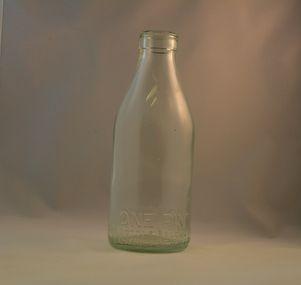 Kiewa Valley Historical Society
Bottle Milk, mid to late 1900's
... Due to the volume of milk being processed and hand milking could not keep up with demand, dairy farms introduced milking machines in the late 1930's. ...Due to the volume of milk being processed and hand milking could not keep up with demand, dairy farms introduced milking machines in the late 1930's. ...This glass milk bottle was manufactured and used mid to late 1900's (1834 Victorian dairy industry was founded) until the time that a cheaper container was invented(plastic bottles and polyethylene plastic lined cardboard cartons). In 1909 the supply of pure bottled milk was required for babies to overcome infant mortality due to unhygienic milk sources (unclean containers and unpasteurized milk). Due to the volume of milk being processed and hand milking could not keep up with demand, dairy farms introduced milking machines in the late 1930's. The great increases in dairy herds from the average of 18 cows per heard in 1950's to 142 cows per herd in 1996 required milk tankers to pick up the regions milk supply. This bottle was so constructed to be easily moved within the milk processing plants from the delivery vats/holding tanks to the final corking/sealing of the bottles for eventual distribution. From 1958 the milk bottle slowly became phased out of production. At this point in time Melbourne was drawing 160,000 bottles per week from the two major glass bottle works companies, e.g. Melbourne Glass Bottle Works Co.Victoria was the major state supplier of cows milk in the history of Australian milk production from the early 1800's. The Kiewa Valley and its region was a major contributor to meet that demand. Each bottle was "branded" during manufacturing to show the contents (pasteurized milk) and where it originated from (region and supplier). This method of recycling the bottles back to specific dairy farms was a good control method but an uneconomical "on cost" which was replaced by the "throw away" less costly plastic and cardboard containers. Kiewa Valley dairy herds had marked bottles bearing "90/9", "6/18", "6/33", "6/35" and "6/36" Found under house at 1 Beauty Ave., Mt Beauty.This heavy gauged glass milk bottle has a rim and a distinctive head at the top. This head has been manufactured to facilitate the movement of the bottle along the milk production line. The method of pouring milk into the bottle has been part of the "production line". This bottle has a one pint capacity and is made from "light green" coloured glass(a protection against light penetration). There are other milk bottles that do not have a "green" tint in them. This thick glass bottle to contain milk required its thickness because of the extensive handling before final consumption. Milk was delivered by the "milk man" direct to the homes of consumers. During this period delivery to homes in cities and towns was made initially by horse and cart and later by truck.On the bottom end of this bottle a circle within it "6/36" and next to this "MILK" and opposite "ONE PINT". Below this "THIS BOTTLE BELONGS TO MILK BOTTLE RECOVERY LTD" and below this "AND CANNOT BE USED WITHOUT WRITTEN PERMISSION" on the base "M" underneath this "15" glass bottles, commercial milk containers, domestic milk bottles, pasteurized milk bottles -
 Kiewa Valley Historical Society
Bottle Milk, mid to late 1900's
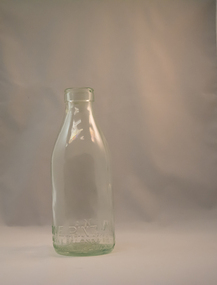
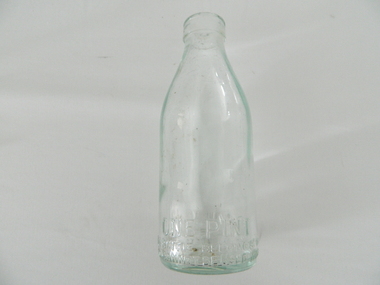
... Due to the volume of milk being processed and hand milking could not keep up with demand, dairy farms introduced milking machines in the late 1930's. ...Due to the volume of milk being processed and hand milking could not keep up with demand, dairy farms introduced milking machines in the late 1930's. ...This glass milk bottle was manufactured and used mid to late1900's (1834 Victorian dairy industry was founded) up until the time that a cheaper container was invented(plastic bottles and polyethylene plastic lined cardboard cartons). In 1909 the supply of pure bottled milk was required for babies to overcome infant mortality due to unhygienic milk sources (unclean containers and unpasteurized milk). Due to the volume of milk being processed and hand milking could not keep up with demand, dairy farms introduced milking machines in the late 1930's. The great increases in dairy herds from the average of 18 cows per heard in 1950's to 142 cows per herd in 1996 required milk tankers to pick up the regions milk supply. This bottle was so constructed to be easily moved within the milk processing plants from the delivery vats/holding tanks to the final corking/sealing of the bottles for eventual distribution. From 1958 the milk bottle slowly became phased out of production. At this point in time Melbourne was drawing 160,000 bottles per week from the two major glass bottle works companies, e.g. Melbourne Glass Bottle Works Co.Victoria was the major state supplier of cows milk in the history of Australian milk production from the early 1800's. The Kiewa Valley and its region was a major contributor to meet that demand. Each bottle was "branded" during manufacturing to show the contents (pasteurized milk) and where it originated from (region and supplier). This method of recycling the bottles back to specific dairy farms was a good control method but an uneconomical "on cost" which was replaced by the "throw away" less costly plastic and cardboard containers. Kiewa Valley dairy herds had marked bottles bearing "90/9", "6/18", "6/33", "6/35" and "6/36" Found under the house at 1 Beauty Ave., Mt BeautyThis heavy gauged glass milk bottle has a rim and a distinctive head at the top. This head has been manufactured to facilitate the movement of the bottled along the milk production line. The method of pouring milk into the bottle has been part of the "production line". This bottle has a one pint capacity and is made from "light green" coloured glass(a protection against light penetration). There are other milk bottles that do not have a "green" tint in them. This thick glass bottle to contain milk required its thickness because of the extensive handling before final consumption. Milk was delivered by the "milk man" direct to the homes of consumers. During this period delivery to homes in cities and towns was made initially by horse and cart and later by truck.On the bottom end of this bottle a circle within it "6/18" and next to this "MILK" and opposite "ONE PINT". Below this "THIS BOTTLE BELONGS TO MILK BOTTLE RECOVERY LTD" and below this "AND CANNOT BE USED WITHOUT WRITTEN PERMISSION" on the base "M" underneath this "4"glass bottles, commercial milk containers, domestic milk bottles, pasteurized milk bottles -
 Kiewa Valley Historical Society
Bottle Milk, mid to late 1900's
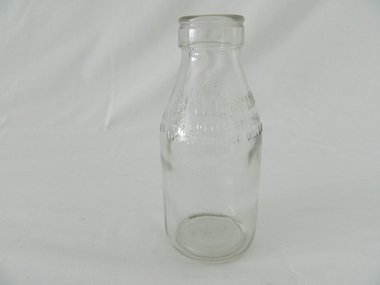
... Due to the volume of milk being processed and hand milking could not keep up with demand, dairy farms introduced milking machines in the late 1930's. ...Due to the volume of milk being processed and hand milking could not keep up with demand, dairy farms introduced milking machines in the late 1930's. ...This glass milk bottle was manufactured and used mid to late 1900's (1834 Victorian dairy industry was founded), until the time that cheaper containers were invented(plastic bottles and polyethylene plastic lined cardboard cartons). In 1909 the supply of pure bottled milk was required for babies to overcome infant mortality due to unhygienic milk sources (unclean containers and unpasteurized milk). Due to the volume of milk being processed and hand milking could not keep up with demand, dairy farms introduced milking machines in the late 1930's. The great increases in dairy herds from the average of 18 cows per heard in 1950's to 142 cows per herd in 1996 required milk tankers to pick up the regions milk supply. This bottle was so constructed to be easily moved within the milk processing plants from the delivery vats/holding tanks to the final corking/sealing of the bottles for eventual distribution. From 1958 the milk bottle slowly became phased out of production. At this point in time Melbourne was drawing 160,000 bottles per week from the two major glass bottle works companies, e.g. Melbourne Glass Bottle Works Co.Victoria was the major state supplier of cows milk in the history of Australian milk production from the early 1800's. The Kiewa Valley and its region was a major contributor to meet that demand. Each bottle was "branded" during manufacturing to show the contents (pasteurized milk) and where it originated from (region and supplier). This method of recycling the bottles back to specific dairy farms was a good control method but an uneconomical "on cost" which was replaced by the "throw away" less costly plastic and cardboard containers. Kiewa Valley dairy herds had marked bottles bearing "90/9", "6/18", "6/33", "6/35" and "6/36" Found under the house at 1 Beauty Ave., Mt BeautyThis heavy gauged glass milk bottle has a rim and a distinctive head at the top. This head has been manufactured to facilitate the movement of the bottled along the milk production line. The method of pouring milk into the bottle has been part of the "production line". This bottle has a one pint capacity and is made from "light green" coloured glass(a protection against light penetration). There are other milk bottles that do not have a "green" tint in them. This thick glass bottle, to contain milk, required its thickness because of the extensive handling (man and machine) before final consumption. Milk was delivered by the "milk man" direct to the homes of consumers. During this period delivery to homes in cities and towns was made initially by horse and cart and later by truck.On the bottom end of this bottle is a circle within it "6/35" and next to this "MILK" and opposite "ONE PINT". Below this "THIS BOTTLE BELONGS TO MILK BOTTLE RECOVERY LTD" and below this "AND CANNOT BE USED WITHOUT WRITTEN PERMISSION" on the base "M" underneath this "20"milk, dairy, glass bottle -
 Kiewa Valley Historical Society
Bottle Milk, mid to late 1900's
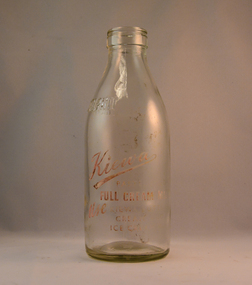
... Due to the volume of milk being processed and hand milking could not keep up with demand, dairy farms introduced milking machines in the late 1930's. ...Due to the volume of milk being processed and hand milking could not keep up with demand, dairy farms introduced milking machines in the late 1930's. ...This glass milk bottle was manufactured and used mid to late 1900's (1834 Victorian dairy industry was founded) up until the time that a cheaper container was invented(plastic bottles and polyethylene plastic lined cardboard cartons). In 1909 the supply of pure bottled milk was required for babies to overcome infant mortality due to unhygienic milk sources (unclean containers and unpasteurized milk). Due to the volume of milk being processed and hand milking could not keep up with demand, dairy farms introduced milking machines in the late 1930's. The great increases in dairy herds from the average of 18 cows per heard in 1950's to 142 cows per herd in 1996 required milk tankers to pick up the regions milk supply. This bottle was so constructed to be easily moved within the milk processing plants from the delivery vats/holding tanks to the final corking/sealing of the bottles for eventual distribution. From 1958 the milk bottle slowly became phased out of production. At this point in time Melbourne was drawing 160,000 bottles per week from the two major glass bottle works companies, e.g. Melbourne Glass Bottle Works Co.Victoria was the major state supplier of cows milk in the history of Australian milk production from the early 1800's. The Kiewa Valley and its region was a major contributor to meet that demand. Each bottle was "branded" during manufacturing to show the contents (pasteurized milk) and where it originated from (region and supplier). This method of recycling the bottles back to specific dairy farms was a good control method but an uneconomical "on cost" which was replaced by the "throw away" less costly plastic and cardboard containers. Kiewa Valley dairy herds had marked bottles bearing "90/9", "6/18", "6/33", "6/35" and "6/36" Found under the house at 1 Beauty Ave., Mt BeautyThis heavy gauged glass milk bottle has a rim and a distinctive head at the top. This head has been manufactured to facilitate the movement of the bottle along the milk production line. The method of pouring milk into the bottle has been part of the "production line". This bottle has a half pint capacity and is made from "clear" glass. There are other milk bottles that have a "green" tint in them and this tint was to protect the contents from sun damage. This thick glass bottle to contain milk required its thickness because of the extensive handling before final consumption. Milk was delivered by the "milk man" direct to the homes of consumers. During this period delivery to homes in cities and towns was made initially by horse and cart and later by truck.On the top half of this bottle is "MILK" and opposite "HALF PINT". Below this "THIS BOTTLE BELONGS TO MILK BOTTLE RECOVERY LTD" and below this "AND CANNOT BE USED WITHOUT WRITTEN PERMISSION" on the base is "2 M" underneath this "8/11" and underneath is "ISM -169"glass bottles, commercial milk containers, domestic milk bottles, pasteurized milk bottles -
 Kiewa Valley Historical Society
Bottle Milk, Circa mid to late 1900's
... Due to the volume of milk being processed and hand milking could not keep up with demand, dairy farms introduced milking machines in the late 1930's. ...Due to the volume of milk being processed and hand milking could not keep up with demand, dairy farms introduced milking machines in the late 1930's. ...This glass milk bottle was manufactured and used mid to late 1900's (1834 Victorian dairy industry was founded) up to the time that a cheaper container was invented(plastic bottles and polyethylene plastic lined cardboard cartons) and produced. In 1909 the supply of pure bottled milk was required for babies to overcome infant mortality due to unhygienic milk sources (unclean containers and unpasteurized milk). Due to the volume of milk being processed and hand milking could not keep up with demand, dairy farms introduced milking machines in the late 1930's. The great increases in dairy herds from the average of 18 cows per heard in 1950's to 142 cows per herd in 1996 required milk tankers to pick up the regions milk supply. This bottle was so constructed to be easily moved within the milk processing plants from the delivery vats/holding tanks to the final corking/sealing of the bottles for eventual distribution. From 1958 the milk bottle slowly became phased out of production. At this point in time Melbourne was drawing 160,000 bottles per week from the two major glass bottle works companies, e.g. Melbourne Glass Bottle Works Co. Victoria was the major state supplier of cows milk in the history of Australian milk production from the early 1800's. The Kiewa Valley and its region was a major contributor to meet that demand. Each bottle was "branded" during manufacturing to show the contents (pasteurized milk) and where it originated from (region and supplier). This method of recycling the bottles back to specific dairy farms was a good control method but an uneconomical "on cost" which was replaced by the "throw away" less costly plastic and cardboard containers. Kiewa Valley dairy herds had marked bottles bearing "90/9", "6/18", "6/33", "6/35" and "6/36" This particular one has "7/14".This heavy gauged glass milk bottle has a rim and a distinctive head at the top. This head has been manufactured to facilitate the movement of the bottled along the milk production line. The method of pouring milk into the bottle has been part of the "production line". This bottle has a one Imperial pint capacity and is made from "clear" glass. There are other milk bottles that have a "green" tint in them. Around the bottom side of the bottle and blown into the glass "ONE IMPERIAL PINT". Below these markings and stenciled is "KIEWA" (in freehand style and underlined) underneath is "PASTEURISED FULL CREAM MILK" underneath this ,in freehand stiyle is "USE" next to this in block style "KIEWA BUTTER, CREAM, AND ICE CREAM MIX" to the left of this ,and barely readable is stenciled "THIS BOTTLE ALWAYS REMAINS/ THE PROPERTY OF/ NORTH EASTERN DAIRY Co. Ltd". On the base of the bottle is molded a big "2". with a smaller "m". An identification mark of "7" over "14" is within a circled boundary. Below this is moulded "RM - 15". glass bottles, commercial milk containers, domestic milk bottles, pasteurized milk bottles -
 Flagstaff Hill Maritime Museum and Village
Separator
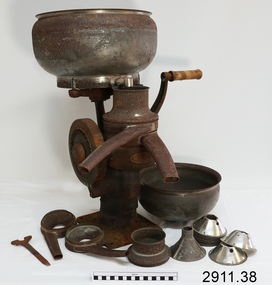
... Separator machine. Hand-crank operated milk separator, Crown Separator Co Pty Ltd. ...flagstaff hill warrnambool shipwrecked-coast flagstaff-hill flagstaff-hill-maritime-museum maritime-museum shipwreck-coast flagstaff-hill-maritime-village milk separator farm machinery dairy machinery dairy industry crown spearator co cream Manufacture's plate "MADE IN SWEDEN" , "CROWN SEPARATOR / HEAD OFFICE 547 FLINDERS ST MELBOURNE". ."42D022" stamped on 2x separator chutes. Separator machine. Hand ...Separator machine. Hand-crank operated milk separator, Crown Separator Co Pty Ltd. Multi-part separator stand with bowls (2) and attachments including a spanner small cone shaped objects on homemade stand. ."42D022" stamped on 2x separator chutes.Manufacture's plate "MADE IN SWEDEN" , "CROWN SEPARATOR / HEAD OFFICE 547 FLINDERS ST MELBOURNE". ."42D022" stamped on 2x separator chutes. flagstaff hill, warrnambool, shipwrecked-coast, flagstaff-hill, flagstaff-hill-maritime-museum, maritime-museum, shipwreck-coast, flagstaff-hill-maritime-village, milk separator, farm machinery, dairy machinery, dairy industry, crown spearator co, cream -
 Cheese World Museum
Photograph, Tooram Park homestead c1915, early 20th century
... Tooram was famous for the cheese from its large dairy herd. The herd was hand-milked. Palmer employed Indian labour to undertake this task. ...Tooram was famous for the cheese from its large dairy herd. The herd was hand-milked. Palmer employed Indian labour to undertake this task. ...The Percy Uebergang family lived at Tooram Park, Allansford from 1912 until 1992. Percy and Myrtle Uebergang's children were twins, Ray and Joyce born in 1926 who lived at Tooram Park until their deaths, Ray in 1986 and Joyce in 1992. Neither Ray nor Joyce married and following the death of her brother Joyce set up the Ray and Joyce Uebergang Foundation which supports the local community. This photograph is part of the collection of items given into the care of the Cheese World Museum. The Uebergang family purchased Tooram Park in 1912. It was part of the original Tooram run which was taken up in 1839/40 by John McMahon Allan. Allan held the property until 1860 after which it passed through several owners including John Orlebar, Thomas McLeod Palmer, Owen family. Tooram was famous for the cheese from its large dairy herd. The herd was hand-milked. Palmer employed Indian labour to undertake this task. In 1883 Palmer was charged with the manslaughter of an Indian worker but was acquitted. This case was extensively reported in the Warrnambool Standard. The Standard also featured a number of articles about Tooram [22 June 1882, 17 March 1883 to 15 May 1993, 30 October 1886, 22 October 1897, 11 May 1926, 8 June 1931]. The property remained in the Uebergang family until after Joyce's death in 1992. Tooram is significant as it was one of the earliest runs taken up in the Warrnambool area. It was divided up following its sale in 1897. Tooram cheese was renowned. This photograph is significant as it shows Tooram Park homestead in its earlier days with the prolific timber decoration which was later removed.Black & white photograph on a cardboard mount showing Tooram Park homestead. The house has a white picket fence. A drain is in the foreground and is serviced by a stone culvert is in the right foreground. Two cars are parked in front of the house. The house walls are painted a dark colour. The verandah roof is striped dark and white. The timber decoration on the verandah, barge board and gable is white.allansford, tooram, tooram park, uebergang, john orlebar, john mcmahon allan, thomas mcleod palmer, owen family, indian labour, court cases, dairying, dairying, warrnambool standard -
 Stratford and District Historical Society
Milking Stool
... Three and four-legged milking stools were standard equipment in early dairies, where cows were milked by hand. Similar stools were used in the home for informal seating. ...Three and four-legged milking stools were standard equipment in early dairies, where cows were milked by hand. Similar stools were used in the home for informal seating. ...Used by the Estoppey family, Swiss emigrants, at Briagolong. Three and four-legged milking stools were standard equipment in early dairies, where cows were milked by hand. Similar stools were used in the home for informal seating. Wooden milking stool with a square top of axe-dressed hardwood and four wooden legs that fit through holes in the seat. One leg is made from a branch of a tree.dairying, furniture -
 The Beechworth Burke Museum
Audio - Oral History, Jennifer Williams, Mr Albert (Bert) Nankervis, 15th March 2000
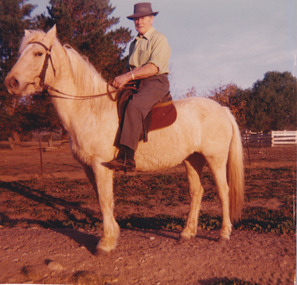
... They had 25 milk cows that were hand milked every morning in order to provide milk for approximately 100 customers in the town, with any extra going to the butter factory at Springhurst. ...They had 25 milk cows that were hand milked every morning in order to provide milk for approximately 100 customers in the town, with any extra going to the butter factory at Springhurst. ...Mr Albert (Bert) Nankervis was born at Thougla, in the Upper Murray, in 1903. He had a large family and was one of eight children, four boys and four girls. He and his family moved to a farm in Wooragee named ‘Wattle Grove’ in 1918 after his father returned from serving as a soldier in World War One. The family established ‘Wattle Grove’ as a dairy farm as Beechworth has a high demand for milk and little supply. They had 25 milk cows that were hand milked every morning in order to provide milk for approximately 100 customers in the town, with any extra going to the butter factory at Springhurst. Albert married Floré Lilias Hardy in 1930 and they had two sons, Phillip and Barry. In this oral history, Albert discusses his life as a farmer in Wooragee, including his role in getting electricity to Beechworth, as well as his participation in the Young Farmer’s Association Immigration Scheme, which provided work experience to migrants in order for them to learn how to farm. This oral history recording was part of a project conducted by Jennifer Williams in the year 2000 to capture the everyday life and struggles in Beechworth during the twentieth century. This project involved recording seventy oral histories on cassette tapes of local Beechworth residents which were then published in a book titled: Listen to what they say: voices of twentieth century Beechworth. These cassette tapes were digitised in July 2021 with funds made available by the Friends of the Burke. Mr Albert (Bert) Nankervis’s account of his life in Wooragee and the local area, including Beechworth, during the early 20th century is historically and socially significant to the cultural heritage of the region. He details his life as a farmer and milkman in the early 20th century, particularly the interwar period (1918-1939), but also discusses life after the Second World War, including employing young migrant men to train them as farmers through the Young Farmer’s Association. This oral history account is socially and historically significant as it is a part of a broader collection of interviews conducted by Jennifer Williams which were published in the book 'Listen to what they say: voices of twentieth-century Beechworth.' While the township of Beechworth is known for its history as a gold rush town, these accounts provide a unique insight into the day-to-day life of the town's residents during the 20th century, many of which will have now been lost if they had not been preserved. This is a digital copy of a recording that was originally captured on a cassette tape. The cassette tape is black with a horizontal white strip and is currently stored in a clear flat plastic rectangular container. It holds up 45 minutes of recordings on each side.Mr Albert (Bert) Nankervis / albert nankervis, bert nankervis, nankervis, wattle grove, wooragee, dairy farm beechworth, dairy farm, dairy factories beechworth, dairying, milkman, oral history, springhurst, butter factory, electricity, rural life, farming and agriculture, farm, farm work, cow, cattle, jersey cattle, interwar period, first world war, second world war, wwi, wwii, greatest generation, centenarian, nonagenarian, 1920s, 1930s beechworth, thougla, upper murray, murray, lucyvale, benalla -
 Flagstaff Hill Maritime Museum and Village
Separator
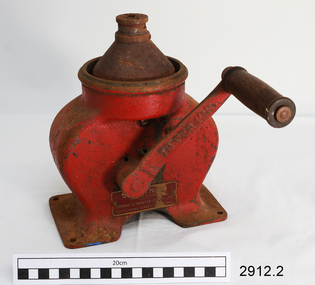
... Hand-cranked separating maching, made in Sweden for Melbourne Crown Separator Co. Pty Ltd. Machine is used for separating cream from milk, with the machine speed being 70 revs per minute....Separator machine. Hand-crank operated milk separator, small, painted red, Crown Separator Co Pty Ltd. ...Hand-crank operated milk separator, small, painted red, Crown Separator Co Pty Ltd. ...Hand-cranked separating maching, made in Sweden for Melbourne Crown Separator Co. Pty Ltd. Machine is used for separating cream from milk, with the machine speed being 70 revs per minute.Separator machine. Hand-crank operated milk separator, small, painted red, Crown Separator Co Pty Ltd. Base and spinning mechanism only (mechanism spins very rettly). Stamped on handle "70 per minute", Stamped on body "S7071", Manufacturer plate "SYLVIA NO. 19/ MADE IN SWEDEN / CROWN SEPARATOR CO PTY LTD / 547 FLINDERS ST, MELBOURNE" Stamped on handle "70 per minute", Stamped on body "S7071", Manufacturer plate "SYLVIA NO. 19/ MADE IN SWEDEN / CROWN SEPARATOR CO PTY LTD / 547 FLINDERS ST, MELBOURNE" flagstaff hill, warrnambool, shipwrecked-coast, flagstaff-hill, flagstaff-hill-maritime-museum, maritime-museum, shipwreck-coast, flagstaff-hill-maritime-village, milk separator, cream separator, dairy machinery, farming machinery, crown separator co pty ltd -
 Wodonga & District Historical Society Inc
Functional object - Hames from Horse Harness
... In Wodonga Michael Conway built a 2 bail dairy and milked up to 20 cows, separated the cream from the milk by hand and sold it to the local butter factory of Holdensen and Nielsen. ...In Wodonga Michael Conway built a 2 bail dairy and milked up to 20 cows, separated the cream from the milk by hand and sold it to the local butter factory of Holdensen and Nielsen. ...These hames are part of the harness used by the family of Michael Conway who established a dairy farm of 35 acres in Wodonga in 1940. He and his wife Catherine nee Carroll settled there and raised 5 children. Before coming to Wodonga Michael carried on a bakery business at Urana. The hames were part of the harness attached to the horse which pulled his bakery cart. In Wodonga Michael Conway built a 2 bail dairy and milked up to 20 cows, separated the cream from the milk by hand and sold it to the local butter factory of Holdensen and Nielsen. In later years only whole milk was sold. The farm was on the outskirts of East Wodonga. Michael Conway died on 6th January 1945. The farm was later sold for residential and industrial development and includes Conway Court.This item has a clear connection to the family of Michael Conway of Wodonga, Victoria2 metal sections shaped to fit around the exterior of a horse collar. They are joined at the lower end by a chain and upper end by a leather strap. Approximately halfway up each section a hinged hook is located to which chains are hooked and attached to the cart. Towards the upper end is attached a ring through which reins pass before being connected to the bit.michael conway wodonga, horse harnesses, dairy industry wodonga -
 Wodonga & District Historical Society Inc
Functional object - Leather Horse Collar
... In Wodonga Michael Conway built a 2 bail dairy and milked up to 20 cows, separated the cream from the milk by hand and sold it to the local butter factory of Holdensen and Nielsen. ...In Wodonga Michael Conway built a 2 bail dairy and milked up to 20 cows, separated the cream from the milk by hand and sold it to the local butter factory of Holdensen and Nielsen. ...This horse collar was made and used by the family of Michael Conway who established a dairy farm of 35 acres in Wodonga in 1940. He and his wife Catherine nee Carroll settled there and raised 5 children. Before coming to Wodonga Michael carried on a bakery business at Urana. This collar was used to attach the hames, harness and chains which pulled his bakery cart. In Wodonga Michael Conway built a 2 bail dairy and milked up to 20 cows, separated the cream from the milk by hand and sold it to the local butter factory of Holdensen and Nielsen. In later years only whole milk was sold. The farm was on the outskirts of East Wodonga. Michael Conway died on 6th January 1945. The farm was later sold for residential and industrial development and includes Conway Court.This item has a clear connection to the family of Michael Conway of Wodonga, VictoriaA handmade leather horse collar padded with straw and cloth. It has metal buckles secured by leather straps which are held in place with metal studs.michael conway wodonga, horse harnesses, dairy industry wodonga -
 Wodonga & District Historical Society Inc
Machine - Cream Separator
... Most farmers milked a few cows, usually by hand, and separated milk with a hand operated machine for domestic use. ...Most farmers milked a few cows, usually by hand, and separated milk with a hand operated machine for domestic use. ...A separator is a centrifugal device that separates milk into cream and skimmed milk. Separation was commonly performed on farms in the past. Most farmers milked a few cows, usually by hand, and separated milk with a hand operated machine for domestic use. The milk was poured into the bowl on the top and the handle had to then be turned fast enough to get the separator up to speed adequate to separate the cream and the milk. The milk would come out of one spigot and the cream out of the other. In general practice some of the skimmed milk was consumed by the family, while the rest may have been used to feed calves and pigs. Enough cream was saved to make butter, and the excess was sold. In many cases excess could be bartered or swapped with neighbours for other items of produce. ALFA-LAVAL SEPARATORS The principal works and head office of Aktiebolaget Separator was established by Gustaf de Laval in Stockholm. The first Laval milk separator was patented in1884. In Australia three old established firms commenced pioneering the Alfa Laval cream separators in about 1885. These were A. W. Sandford & Co. Ltd., in Adelaide, J. Bartram & Son, of Melbourne, who have ever since been the Victorian agents of Aktiebolaget Separator. In New South Wales and Queensland, the pioneering firm was Waugh & Josephson Ltd. J. Bartram & Son, the distributor of the separator in this collection, established their business in Melbourne in 1881. In 1892 Bartram & Son estimated that 1,130 of these machines were operating throughout Victoria. This item is significant as it is representative of domestic and dairying machinery used throughout rural areas of Australia in the early to mid 20th century.The separator is made in 3 sections. The base is made from cast iron. The cover and vat are made from silver painted tin. There are 2 outlet spouts. The detachable handle, made from cast iron and wood, is held in place by a screw. A name plate featuring the Victorian distributor, J Bartram & Son of Melbourne and a plate outlining patent information are attached to the base by screws.Around edge of wheel "Aktiebolaget Separator Stockholm/ 2236"dairying industry, dairy machinery, milk separators
