
Showing 164 items matching "hand warmers"
-
 Falls Creek Historical Society
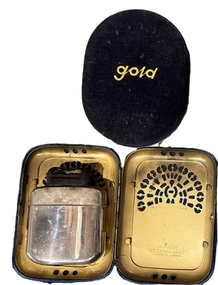
Functional object - Peacock Hand Warmers
... Peacock Hand Warmers... Peacock Hand Warmers...Hand warmers...These mid-1960s Peacock and Gold brand lighter fuel hand warmers were used in Falls Creek to keep out the cold. ...The warmer fits into a metal case which features a series of ventilation holes in the shape of a peacock's tail. Peacock Hand Warmers Functional object Peacock Hand Warmers ...These mid-1960s Peacock and Gold brand lighter fuel hand warmers were used in Falls Creek to keep out the cold. The concept behind the hand warmer is that through combustion (ignition) of lighter fluid (light petrol distillate) it becomes a catalytic heater, relying on a catalysed chemical reaction to break down molecules and create heat. The devices could get quite hot, not hot enough to set paper on fire, but hot enough to give a nasty burn if sustained contact against your skin occurred. The construction of the device is very simple. There is very fine rolled wire mesh which fits on top of the reservoir body. After you fill the reservoir with lighter fluid, vapor pressure builds up. The device ignites by heating the grill with a match or lighter until it glows red. There is no open flame. The hand warmer also had a velvet bag to place it in after igniting to prevent direct skin contact. They were able to generate heat for up to a whole day. The Japanese company Yamato Shokai Ltd was founded in 1923 in the city of Osaka. Destroyed during air raids in 1945, the factory was rebuilt in 1946. They manufactured the Peacock brand pocket-warmer and sold it internationally.These items are significant because they were commonly used at Falls Creek.The pocket warmer is a small, relatively flat device with a tank at the bottom and a burner mechanism a t the top. "PEACOCK/MADE IN JAPAN" is engraved near the burner. The warmer fits into a metal case which features a series of ventilation holes in the shape of a peacock's tail. JAPANESE PAT. 237413.483177 MADE IN JAPANhand warmers, ski equipment 1960s -
 Mont De Lancey
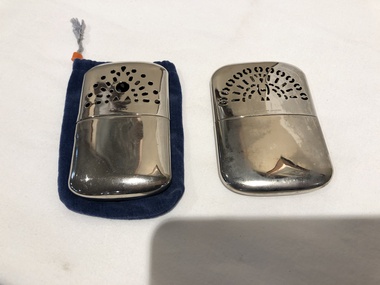
Hand Warmers, 1923
... Hand Warmers...Used for warming hands, the warmth would last for 24 hours. ...2 x Silver metal Hand warmers with ornamentation and one with a blue velvet pouch....Hand Warmers ...Used for warming hands, the warmth would last for 24 hours. They used methylated spirits or lighter fluid.2 x Silver metal Hand warmers with ornamentation and one with a blue velvet pouch.heating equipment -
 Kew Historical Society Inc
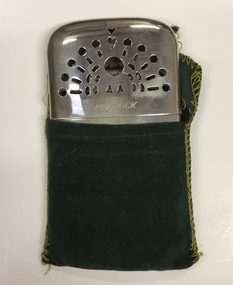
Functional object, Yamato Shokai Ltd, Refillable Metal Hand Warmer, 1946-1960
... ...hand warmers...Steel hand warmer in velvet pouch made in Japan for the export market....They manufactured the Peacock brand pocket-warmer and sold it internationally. pocket warmers hand warmers personal accessories peacock hand warmer PEACOCK Steel hand warmer in velvet pouch made in Japan for the export market. ...The Japanese company Yamato Shokai Ltd was founded in 1923 in the city of Osaka. Destroyed during air raids in 1945, the factory was rebuilt in 1946. They manufactured the Peacock brand pocket-warmer and sold it internationally. Steel hand warmer in velvet pouch made in Japan for the export market.PEACOCKpocket warmers, hand warmers, personal accessories, peacock hand warmer -
 Bendigo Military Museum
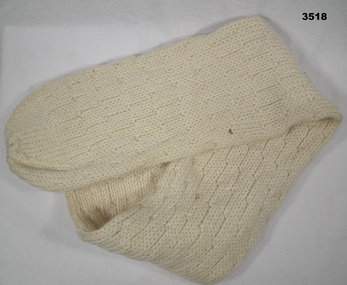
Accessory - LEG WARMER, c.WWII
... Cream, hand knitted, woolen leg warmer....Accessory military RAAF Cream, hand knitted, woolen leg warmer. Accessory LEG WARMER ...Item re Frederick Gardner DAVEY DFC No 410533 RAAF. Refer Reg No 3536P for his service details.Cream, hand knitted, woolen leg warmer.accessory, military, raaf -
 Bendigo Military Museum
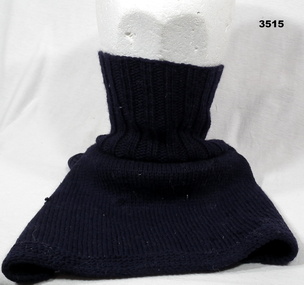
Accessory - NECK WARMER, c.WWII
... Navy, hand knitted, woolen, neck warmer with roll top....Refer Reg No 3536P for his service details. accessory uniform military Navy, hand knitted, woolen, neck warmer with roll top. Accessory NECK WARMER ...Item re Frederick Gardner DAVEY DFC No 410533 RAAF. Refer Reg No 3536P for his service details.Navy, hand knitted, woolen, neck warmer with roll top.accessory, uniform, military -
 Bendigo Historical Society Inc.
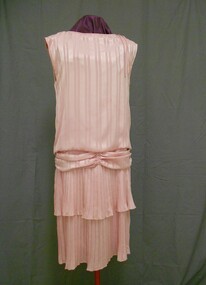
Clothing - BARBARA JOHNSON COLLECTION: PINK WEDDING DRESS, 26.1.1985
... Do not bleach. Do not wring. Warm hand wash. Warm rinse well. Dry in shade. ...Do not bleach. Do not wring. Warm hand wash. Warm rinse well. Dry in shade. ...Pink, self-stripe -2cm stripe with a woven floral motif, alternated with a 4cm triple stripe with 2cm spacing between each stripe. Boat shaped neckline, with a .5cm rouleau tie on left side. Sleeveless. Draped and ruched 7cm band at hip line. Two tier, knife pleated panels to the hemline. Dropped and bloused bodice. Handkerchief hem. Wedding dress worn at marriage of Barbara Johnson to her second husband John Johnson on 26.1.1985.Stitches Plus Gold Label 12 Care Instructions – Wash separately. Do not soak. Do not bleach. Do not wring. Warm hand wash. Warm rinse well. Dry in shade. Warm iron. Dry cleanable. Polyester.costume, female ceremonial, wedding dress -
 Mt Dandenong & District Historical Society Inc.
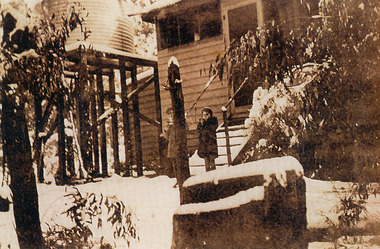
Photograph, Girls blowing on gloves - Snow at Kamanange
... Blowing on hands to keep warm. c1930....Blowing on hands to keep warm. c1930. Girls blowing on gloves - Snow at Kamanange Photograph ...Two girls standing in snow outside Kamanange, Robinson Family holiday house. Blowing on hands to keep warm. c1930.kamanange, kalorama, robinson, snow -
 Kew Historical Society Inc
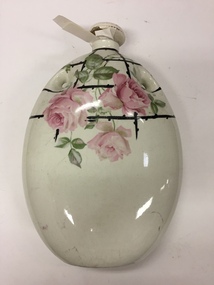
Functional object - The Mecca Foot Warmer, 1900-1914
... As well as filling hot water containers to warm your bed, you could buy earthenware bottles to use as foot warmers or hand warmers too. Earlier foot warmers used to hold hot coals, or glowing wood, not warm water. ...As well as filling hot water containers to warm your bed, you could buy earthenware bottles to use as foot warmers or hand warmers too. Earlier foot warmers used to hold hot coals, or glowing wood, not warm water. ...Ceramic hot water bottles were common in the 19th and early 20th centuries. As well as filling hot water containers to warm your bed, you could buy earthenware bottles to use as foot warmers or hand warmers too. Earlier foot warmers used to hold hot coals, or glowing wood, not warm water. In the same way, traditional bed warmers filled with embers were once more usual than hot water bottles.Ceramic foot warmer glazed in cream with a decoration of lattice and pink roses.Maker stamp on base: "The Mecca Foot Warmer / Made in finest English Ivory Ware / Reg. No. 571373 / No sharp corners / Warming Pan / Stone-Trent Englandfoot warmer, household item, bedroom item -
 Musculoskeletal Health Australia (now held by the Glen Eira Historical Society)
Photograph - Group photo, 1996
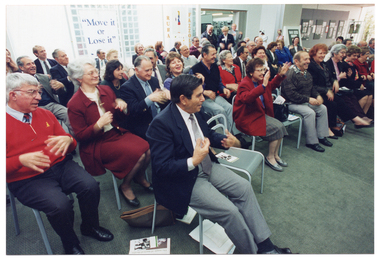
... They are shaking their hands as a warm-up exercise. There are some printed brochures on some chairs and on the floor. ...In this photo, the attendees is taking part in some simple chair-based warm-up exercises. arthritis foundation of victoria afv osteoporosis victoria ov culturally and linguistically diverse cald languages other than english lote migrant communities bilingual Italian move it or lose it brochures gentle exercise stretching exercises chair-based exercise 1996 COL photo of a large group of people, seated. They are shaking their hands ...This series of photos were taken in 1996 at the launch of the bilingual "Move it or Lose it" brochures for the Italian community. As a result of a commitment by the Arthritis Foundation of Victoria (AFV), incorporating Osteoporosis Victoria (OV), to better reach and serve the multicultural community, bilingual brochures were produced in several languages. In this photo, the attendees is taking part in some simple chair-based warm-up exercises.COL photo of a large group of people, seated. They are shaking their hands as a warm-up exercise. There are some printed brochures on some chairs and on the floor. In the background is a freestanding "Move It Or Lose It" banner beside an open doorway, through which some people are standing. Beside them are two people who appear to be in costume.arthritis foundation of victoria, afv, osteoporosis victoria, ov, culturally and linguistically diverse, cald, languages other than english, lote, migrant communities, bilingual, italian, move it or lose it, brochures, gentle exercise, stretching exercises, chair-based exercise, 1996 -
 Parks Victoria - Mount Buffalo Chalet
Tee shirt
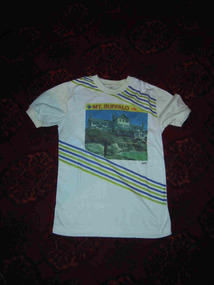
... On front of label:"AN / AUSTRALIAN / WILDLIFE / GARMENT / 85% POLYESTER / 35% COTTON / 14 HEIGHT 160CM " On back of label:"MADE IN AUSTRALIA / WARM HAND WASH / DO NOT BLEACH / WARM IRON" On front of shirt:" MT BUFFALO VIC" & "C N C Y"...On front of label:"AN / AUSTRALIAN / WILDLIFE / GARMENT / 85% POLYESTER / 35% COTTON / 14 HEIGHT 160CM " On back of label:"MADE IN AUSTRALIA / WARM HAND WASH / DO NOT BLEACH / WARM IRON" On front of shirt:" MT BUFFALO VIC" & "C N C Y" Cream polyester, cotton knit tee shirt with a printed photographic image of the chalet on the front. ...'Souvenirs in relation to the Chalet and Mount Buffalo were first mentioned in December 1912... A large range of souvenirs has since been associated with the Chalet and Mount Buffalo from crafted wooden items, silver spoons, cups etc... The collection includes a broad selection of products that have been sold throughout much of the Chalet's history, each representative of the transient fashions of their period.' (Pg 114. Historica)Listed in Draft Inventory of Significant Collection Items . Appendix A.3. Souvenirs. (Pg 168. Historica).Cream polyester, cotton knit tee shirt with a printed photographic image of the chalet on the front. "Mt Buffalo Vic" is printed above the image. There are blue and green diagonal stripes above and below the image. Short sleeves.On front of label:"AN / AUSTRALIAN / WILDLIFE / GARMENT / 85% POLYESTER / 35% COTTON / 14 HEIGHT 160CM " On back of label:"MADE IN AUSTRALIA / WARM HAND WASH / DO NOT BLEACH / WARM IRON" On front of shirt:" MT BUFFALO VIC" & "C N C Y" -
 National Wool Museum
Textile - Travel Rug, Onkaparinga Woollen Mill Company, 1960s
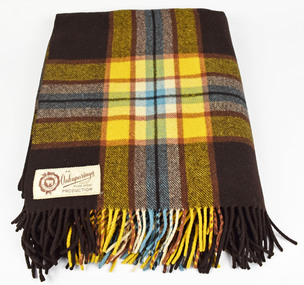
... Onkaparinga/washing instructions/use A.W.C. approved wool detergent/warm machine wash on short gentle cycle/or warm hand wash/DO NOT BLEACH/warm rinse well on gentle cycle/normal spin/DO NOT TUMBLE DRY/dry in shade - gently pull to shape/dry cleanable (A) - in emblems: The Woolmark pure new wool, Woven in Australia, F 472... machine wash on short gentle cycle/or warm hand wash/DO NOT BLEACH/warm rinse well on gentle cycle/normal spin/DO NOT TUMBLE DRY/dry in shade - gently pull to shape/dry cleanable (A) - in emblems: The Woolmark pure new wool, Woven in Australia, F 472 Fringed plaid travel rug, brown, yellow and blue Textile Travel Rug Australia South Australia Lobethal Onkaparinga Woollen Mill Company ...Collector says: I can still recall one of my earliest childhood memories, of my nana's bright aqua shoes against the checks of our family travel rug on summer picnics. Maybe that's when this collection planted its seed in me - 40 years later I start my first blanket collection after stumbling across old Onkaparinga travel rugs. I would go to a vintage market in Collingwood every month and almost always found a good one, amassing enough for the entire household. Everyone had their favourite, even the cat had his own – a small red tartan one just for him.Collector's note: "For more than 100 years blankets were made all over Australia in over 100 woollen mills. My aim, is to preserve 100 examples of these wonderful pieces of history. Ten years ago I started collecting the iconic Onkaparinga travel rugs, so that on movie nights at home there would be plenty to go around. Everyone had their favourite; even the cat had his own – a small red tartan one. Keeping an eye out for those travel rugs at op-shops and markets, collectable stores and bazaars, led to noticing vintage blankets. I'd never really thought about them before or paid much attention though of course I had grown up with them at my grandmother's. When I discovered my first Laconia cream blanket with blue stripes, my eyes just went gaga. Well that was it, I was hooked and since then over 500 blankets have passed through my hands. These common, everyday items, found in all households for so many decades, were traditional engagement gifts. Pairs were prized wedding presents turning into family heirlooms. They were fashionable dressers of beds, givers of warmth, bestowers of security and reliability. The comfort found in these objects resonates with almost all of us; we grew up with them ourselves or fondly recall them in a grandparent’s home. There is no modern replacement with the integrity of these old blankets, many of them now older than most of us. They are romantic, sensible, special, familiar, nostalgic and nothing else feels so appropriate in so many situations. No offense to the great Aussie doona, but from hippie to hipster, at a music festival, picnic, campsite or couch, a vintage blanket is something coveted by all. This industry that employed tens of thousands and must have been such a huge contributor to the economy is almost completely lost now. Blanket Fever is an ode to everything that came before: the land, the sheep, the shearers, the hands, the mills, the weavers, the designers, the distributors, the department stores. To the grandparents that gave them, the people that received them, the families that kept them; thank you. I’m passionate about my collection of Australian blankets manufactured in mostly Victoria, South Australia and Tasmania from the 1930s to the end of the 1960s. The collection has blankets from each of these four decades representing the styles and fashions of their time and includes dated advertisements which help determine the eras the blankets are from."Fringed plaid travel rug, brown, yellow and blue Onkaparinga/washing instructions/use A.W.C. approved wool detergent/warm machine wash on short gentle cycle/or warm hand wash/DO NOT BLEACH/warm rinse well on gentle cycle/normal spin/DO NOT TUMBLE DRY/dry in shade - gently pull to shape/dry cleanable (A) - in emblems: The Woolmark pure new wool, Woven in Australia, F 472wool, blanket, blanket fever, travel rug, onkaparinga -
 National Wool Museum
Textile - Travel Rug, Onkaparinga Woollen Mill Company
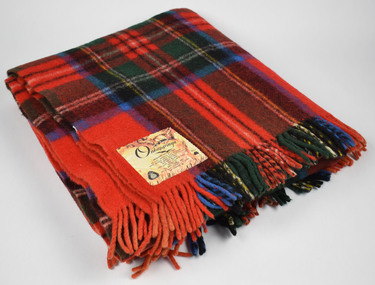
... Onkaparinga/washing instructions/use A.W.C. approved wool detergent/warm machine wash on short gentle cycle/or warm hand wash/DO NOT BLEACH/warm rinse well on gentle cycle/normal spin/DO NOT TUMBLE DRY/dry in shade - gently pull to shape/dry cleanable (A) - in emblems: The Woolmark pure new wool, Woven in Australia, F 472...hands, the mills, the weavers, the designers, the distributors, the department stores. To the grandparents that gave them, the people that received them, the families that kept them; thank you. I’m passionate about my collection of Australian blankets manufactured in mostly Victoria, South Australia and Tasmania from the 1930s to the end of the 1960s. The collection has blankets from each of these four decades representing the styles and fashions of their time and includes dated advertisements which help determine the eras the blankets are from. " Wool Blanket Blanket fever Travel Rug Onkaparinga Onkaparinga/washing instructions/use A.W.C. approved wool detergent/warm machine wash on short gentle cycle/or warm hand wash/DO NOT BLEACH/warm rinse well on gentle cycle/normal spin/DO NOT TUMBLE DRY/dry in shade - gently pull to shape/dry cleanable (A) - in emblems: The Woolmark pure new wool, Woven in Australia, F 472 Fringed travel rug, red, blue, green and black Textile Travel Rug Australia South Australia Lobethal Onkaparinga Woollen Mill Company ...Collector says: "I can still recall one of my earliest childhood memories, of my nana's bright aqua shoes against the checks of our family travel rug on summer picnics. Maybe that's when this collection planted its seed in me - 40 years later I start my first blanket collection after stumbling across old Onkaparinga travel rugs. I would go to a vintage market in Collingwood every month and almost always found a good one, amassing enough for the entire household. Everyone had their favourite, even the cat had his own – a small red tartan one just for him."Collector's note- "For more than 100 years blankets were made all over Australia in over 100 woollen mills. My aim, is to preserve 100 examples of these wonderful pieces of history. Ten years ago I started collecting the iconic Onkaparinga travel rugs, so that on movie nights at home there would be plenty to go around. Everyone had their favourite; even the cat had his own – a small red tartan one. Keeping an eye out for those travel rugs at op-shops and markets, collectable stores and bazaars, led to noticing vintage blankets. I'd never really thought about them before or paid much attention though of course I had grown up with them at my grandmother's. When I discovered my first Laconia cream blanket with blue stripes, my eyes just went gaga. Well that was it, I was hooked and since then over 500 blankets have passed through my hands. These common, everyday items, found in all households for so many decades, were traditional engagement gifts. Pairs were prized wedding presents turning into family heirlooms. They were fashionable dressers of beds, givers of warmth, bestowers of security and reliability. The comfort found in these objects resonates with almost all of us; we grew up with them ourselves or fondly recall them in a grandparent’s home. There is no modern replacement with the integrity of these old blankets, many of them now older than most of us. They are romantic, sensible, special, familiar, nostalgic and nothing else feels so appropriate in so many situations. No offense to the great Aussie doona, but from hippie to hipster, at a music festival, picnic, campsite or couch, a vintage blanket is something coveted by all. This industry that employed tens of thousands and must have been such a huge contributor to the economy is almost completely lost now. Blanket Fever is an ode to everything that came before: the land, the sheep, the shearers, the hands, the mills, the weavers, the designers, the distributors, the department stores. To the grandparents that gave them, the people that received them, the families that kept them; thank you. I’m passionate about my collection of Australian blankets manufactured in mostly Victoria, South Australia and Tasmania from the 1930s to the end of the 1960s. The collection has blankets from each of these four decades representing the styles and fashions of their time and includes dated advertisements which help determine the eras the blankets are from. "Fringed travel rug, red, blue, green and blackOnkaparinga/washing instructions/use A.W.C. approved wool detergent/warm machine wash on short gentle cycle/or warm hand wash/DO NOT BLEACH/warm rinse well on gentle cycle/normal spin/DO NOT TUMBLE DRY/dry in shade - gently pull to shape/dry cleanable (A) - in emblems: The Woolmark pure new wool, Woven in Australia, F 472wool, blanket, blanket fever, travel rug, onkaparinga -
 Bendigo Historical Society Inc.
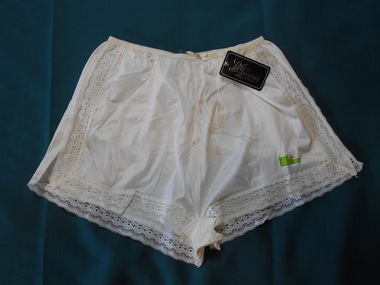
Clothing - FAVALORO COLLECTION: WOMAN'S CREAM COLOURED PANTIES, 1950's
... Made in Australia. Warm hand wash. Do not bleach. Do not hand wring. ...Made in Australia. Warm hand wash. Do not bleach. Do not hand wring. ...Clothing. Cream coloured woman's panties with gussett and straight legs trimmed with 4 cm lace. 7cm vents each side seam on lower leg. 4cm lace inserts on side seams. Elastic lace waistband with decorative bow (4cmX1cm) at centre front. Sticker on lower front left leg (green and yellow) ''THE DAISY COLLECTION''and a picture of a white daisy. Swing tag still attached.Tag inside back seam''LITTLE LUXURIES BY GLORIA'' Size 16 to fit bust 95 cm Hip 100cm, Bri Nylon . Made in Australia. Warm hand wash. Do not bleach. Do not hand wring. Drip dry in shade, warm iron. Swing tag Black And Gold, ''Little Luxuries by Gloria''. Reverse style 510931, size 16 Price--- Australian Made Boomerang Symbol.costume, female underwear, woman's cream coloured panties -
 Bendigo Military Museum
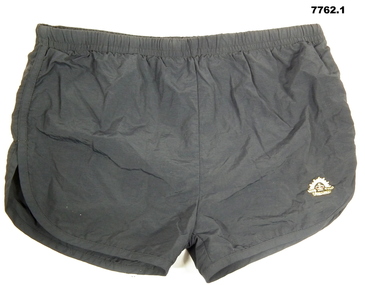
Uniform - PT SHORTS - ARMY, Australian Defence Industries, 2016
... CVC/ NSN; 8415-66-139-3924/ Apr. 2016/ Made in China/ Care Instructions/ Nylon Outer/Polyester Cotton Lining/ Warm hand wash/ Do Not Bleach/ Warm Rinse/ Drip Dry in Shade/ Warm Iron"....CVC/ NSN; 8415-66-139-3924/ Apr. 2016/ Made in China/ Care Instructions/ Nylon Outer/Polyester Cotton Lining/ Warm hand wash/ Do Not Bleach/ Warm Rinse/ Drip Dry in Shade/ Warm Iron". 1. & 2. ...1. & 2. Shorts, black coloured nylon fabric with black colour polyester cotton lining, inside fob pocket, elastic and draw cord waistband. Yellow, red and black embroidered "Rising Sun Badge" with lettering "THE AUSTRALIAN ARMY" on lower left leg. White colour cotton/polyester fabric manufacturers label - inside back waistband.Manufacturers information on label - black ink print. 1. & 2. "afw/afw pty ltd/ Size: XX Large/Nylon outer/ Polyester Cotton Lining/ CC? CVC/ NSN; 8415-66-139-3924/ Apr. 2016/ Made in China/ Care Instructions/ Nylon Outer/Polyester Cotton Lining/ Warm hand wash/ Do Not Bleach/ Warm Rinse/ Drip Dry in Shade/ Warm Iron".uniform, army, physical training shorts -
 Eltham District Historical Society Inc
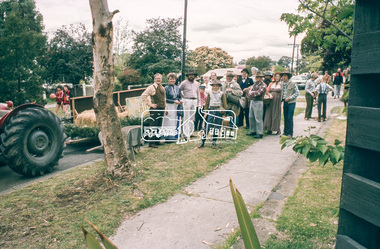
Photograph, Grand Parade, Eighth Eltham Community Festival, 3 Sep 1981
... The cold driving rain provided a special problem for Peter Bassett-Smith in driving his tractor home to Kangaroo Ground as he had to choose between standing up to warm his hands on the exhaust and having his tractor seat flooded. ...The cold driving rain provided a special problem for Peter Bassett-Smith in driving his tractor home to Kangaroo Ground as he had to choose between standing up to warm his hands on the exhaust and having his tractor seat flooded. ...The Eighth Eltham Community Festival was held 16-17 October 1982. Although the Society’s parade entry did not win a prize this year, it was considered highly successful from a participation point of view. Despite some uncertainty as to just who was coming, members and friends kept appearing at the assembly area. As in the past years, members from the Victorian Folk Music Club brought their instruments along and really added to the occasion. This year concentrated on a rural theme with a tractor/trailer combination. Peter Bassett-Smith supplied the tractor for towing the float designed and assembled by Joh Ebeli on Dennis McKay’s trailer. The closing stages of the parade were marred by heavy rain. The cold driving rain provided a special problem for Peter Bassett-Smith in driving his tractor home to Kangaroo Ground as he had to choose between standing up to warm his hands on the exhaust and having his tractor seat flooded. A Certificate, Festival Parade Award, Rotary Club of Eltham, Eighth Eltham Community Festival 1982 was presented to the Shire of Eltham Historical Society for the most effort by "locals".35mm colour positive transparency (1 of 28) Mount - Agfachrome Agfa CS System black 8 dotsSlide is date coded 09-82 - possibly rehousedeltham, eltham festival, parade, parade floats, cecil street -
 Eltham District Historical Society Inc
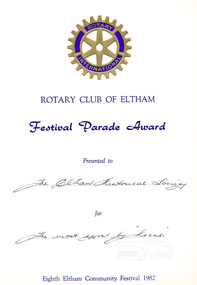
Certificate, Rotary Club of Eltham, Certificate, Festival Parade Award, Rotary Club of Eltham, Eighth Eltham Community Festival 1982, 1982
... Have you ever had to choose between standing up to warm your hands on the exhaust and having your tractor seat flooded? ...Have you ever had to choose between standing up to warm your hands on the exhaust and having your tractor seat flooded? ...Eltham Community Festival awards. Awarded to the Shire of Eltham Historical Society for the most effort by locals. Newsletter No. 27, November 1982 ELTHAM COMMUNITY FESTIVAL Although our parade entry did not win a prize this year, it was considered highly successful from a participation point of view. Despite some uncertainty as to just who was corning, members and friends kept appearing at the assembly area . As in the past years our friends from the Victorian Folk Music·Club brought their instruments along and really added to the occasion. This year we concentrated on a rural theme with a tractor/trailer combination. Thanks to Peter Bassett-Smith for the tractor, Joh Ebeli for the decorations and friendly trailer owner Dennis McKay. Unfortunately the closing stages of the parade were marred by heavy rain. We just finished as the rain started but members scattered very quickly. This has prompted the suggestion for future parades that we have a tent or other suitable venue for members to gather after the event. This is worth following up. The cold driving rain provided a special problem for Peter in driving his tractor home to Kangaroo Ground. Have you ever had to choose between standing up to warm your hands on the exhaust and having your tractor seat flooded? Paper certificate printed with handwritten award nomination and categoryawards, eltham festival, rotary club of eltham, shire of eltham historical society, joh ebeli, peter bassett-smith -
 Eltham District Historical Society Inc
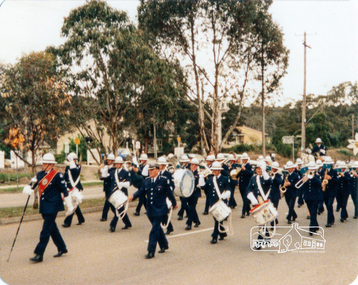
Photograph, Victorian Police Marching Band, Eltham Festival Parade, 16 October 1982, 16/10/1982
... Have you ever had to choose between standing up to warm your hands on the exhaust and having your tractor seat flooded? ...Have you ever had to choose between standing up to warm your hands on the exhaust and having your tractor seat flooded? ...[article in EDHS Newsletter No. 27, November 1982:] 1982: 16-17 October. “Pioneers of Eltham” and tractor (rain). Although our parade entry did not win a prize this year, it was considered highly successful from a participation point of view. Despite some uncertainty as to just who was coming, members and friends kept appearing at the assembly area. As in the past years our friends from the Victorian Folk Music Club brought their instruments along and really added to the occasion. This year we concentrated on a rural theme with a tractor/trailer combination. Thanks to Peter Bassett-Smith for the tractor, Joh Ebeli for the decorations and friendly trailer owner Dennis McKay. Unfortunately the closing stages of the parade were marred by heavy rain. We just finished as the rain started but members scattered very quickly. This has prompted the suggestion for future parades that we have a tent or other suitable venue for members to gather after the event. This is worth following up. The cold driving rain provided a special problem for Peter in driving his tractor home to Kangaroo Ground. Have you ever had to choose between standing up to warm your hands on the exhaust and having your tractor seat flooded? Certificate, Festival Parade Award, Rotary Club of Eltham, Eighth Eltham Community Festival 1982: Presented to the Shire of Eltham Historical Society for the most effort by "locals".Colour photographmain road, eltham festival, eltham, eltham parade, festivals, parade, parade floats, 1982, marching band, victorian police -
 Eltham District Historical Society Inc
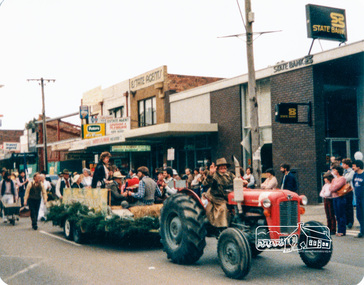
Photograph, Society member Peter Bassett-Smith towing the Shire of Eltham Historical Society float with his tractor in the Eltham Festival Parade along Main Road, 16 October 1982, 16/10/1982
... Have you ever had to choose between standing up to warm your hands on the exhaust and having your tractor seat flooded? ...Have you ever had to choose between standing up to warm your hands on the exhaust and having your tractor seat flooded? ...[article in EDHS Newsletter No. 27, November 1982:] 1982: 16-17 October. “Pioneers of Eltham” and tractor (rain). Although our parade entry did not win a prize this year, it was considered highly successful from a participation point of view. Despite some uncertainty as to just who was coming, members and friends kept appearing at the assembly area. As in the past years our friends from the Victorian Folk Music Club brought their instruments along and really added to the occasion. This year we concentrated on a rural theme with a tractor/trailer combination. Thanks to Peter Bassett-Smith for the tractor, Joh Ebeli for the decorations and friendly trailer owner Dennis McKay. Unfortunately the closing stages of the parade were marred by heavy rain. We just finished as the rain started but members scattered very quickly. This has prompted the suggestion for future parades that we have a tent or other suitable venue for members to gather after the event. This is worth following up. The cold driving rain provided a special problem for Peter in driving his tractor home to Kangaroo Ground. Have you ever had to choose between standing up to warm your hands on the exhaust and having your tractor seat flooded? Certificate, Festival Parade Award, Rotary Club of Eltham, Eighth Eltham Community Festival 1982: Presented to the Shire of Eltham Historical Society for the most effort by "locals".Colour photographmain road, eltham festival, eltham, eltham parade, festivals, parade, parade floats, 1982, eltham district historical society, peter bassett-smith, shire of eltham historical society -
 Eltham District Historical Society Inc
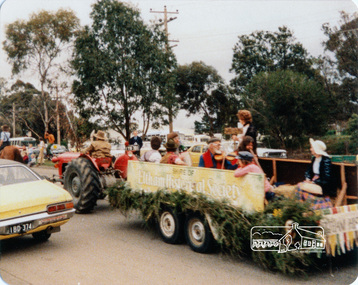
Photograph, Shire of Eltham Historical Society float, Eltham Festival Parade, 16 October 1982, 16/10/1982
... Have you ever had to choose between standing up to warm your hands on the exhaust and having your tractor seat flooded? ...Have you ever had to choose between standing up to warm your hands on the exhaust and having your tractor seat flooded? ...[article in EDHS Newsletter No. 27, November 1982:] 1982: 16-17 October. “Pioneers of Eltham” and tractor (rain). Although our parade entry did not win a prize this year, it was considered highly successful from a participation point of view. Despite some uncertainty as to just who was coming, members and friends kept appearing at the assembly area. As in the past years our friends from the Victorian Folk Music Club brought their instruments along and really added to the occasion. This year we concentrated on a rural theme with a tractor/trailer combination. Thanks to Peter Bassett-Smith for the tractor, Joh Ebeli for the decorations and friendly trailer owner Dennis McKay. Unfortunately the closing stages of the parade were marred by heavy rain. We just finished as the rain started but members scattered very quickly. This has prompted the suggestion for future parades that we have a tent or other suitable venue for members to gather after the event. This is worth following up. The cold driving rain provided a special problem for Peter in driving his tractor home to Kangaroo Ground. Have you ever had to choose between standing up to warm your hands on the exhaust and having your tractor seat flooded? Certificate, Festival Parade Award, Rotary Club of Eltham, Eighth Eltham Community Festival 1982: Presented to the Shire of Eltham Historical Society for the most effort by "locals".Colour photographmain road, eltham festival, eltham, eltham parade, festivals, parade, parade floats, 1982, eltham district historical society, shire of eltham historical society -
 Eltham District Historical Society Inc
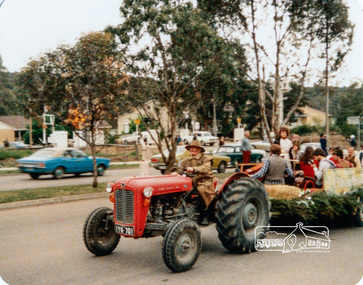
Photograph, Society member Peter Bassett-Smith towing the Shire of Eltham Historical Society float with his tractor in the Eltham Festival Parade along Main Road, 16 October 1982, 16/10/1982
... Have you ever had to choose between standing up to warm your hands on the exhaust and having your tractor seat flooded? ...Have you ever had to choose between standing up to warm your hands on the exhaust and having your tractor seat flooded? ...[article in EDHS Newsletter No. 27, November 1982:] 1982: 16-17 October. “Pioneers of Eltham” and tractor (rain). Although our parade entry did not win a prize this year, it was considered highly successful from a participation point of view. Despite some uncertainty as to just who was coming, members and friends kept appearing at the assembly area. As in the past years our friends from the Victorian Folk Music Club brought their instruments along and really added to the occasion. This year we concentrated on a rural theme with a tractor/trailer combination. Thanks to Peter Bassett-Smith for the tractor, Joh Ebeli for the decorations and friendly trailer owner Dennis McKay. Unfortunately the closing stages of the parade were marred by heavy rain. We just finished as the rain started but members scattered very quickly. This has prompted the suggestion for future parades that we have a tent or other suitable venue for members to gather after the event. This is worth following up. The cold driving rain provided a special problem for Peter in driving his tractor home to Kangaroo Ground. Have you ever had to choose between standing up to warm your hands on the exhaust and having your tractor seat flooded? Certificate, Festival Parade Award, Rotary Club of Eltham, Eighth Eltham Community Festival 1982: Presented to the Shire of Eltham Historical Society for the most effort by "locals".Colour photographmain road, eltham festival, eltham, eltham parade, festivals, parade, parade floats, 1982, eltham district historical society, shire of eltham historical society, peter bassett-smith -
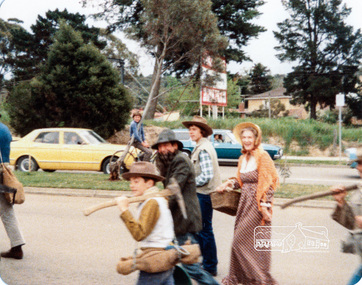 Eltham District Historical Society Inc
Photograph, Eltham Festival Parade, 16 October 1982, 16/10/1982
... Have you ever had to choose between standing up to warm your hands on the exhaust and having your tractor seat flooded? ...Have you ever had to choose between standing up to warm your hands on the exhaust and having your tractor seat flooded? ...[article in EDHS Newsletter No. 27, November 1982:] 1982: 16-17 October. “Pioneers of Eltham” and tractor (rain). Although our parade entry did not win a prize this year, it was considered highly successful from a participation point of view. Despite some uncertainty as to just who was coming, members and friends kept appearing at the assembly area. As in the past years our friends from the Victorian Folk Music Club brought their instruments along and really added to the occasion. This year we concentrated on a rural theme with a tractor/trailer combination. Thanks to Peter Bassett-Smith for the tractor, Joh Ebeli for the decorations and friendly trailer owner Dennis McKay. Unfortunately the closing stages of the parade were marred by heavy rain. We just finished as the rain started but members scattered very quickly. This has prompted the suggestion for future parades that we have a tent or other suitable venue for members to gather after the event. This is worth following up. The cold driving rain provided a special problem for Peter in driving his tractor home to Kangaroo Ground. Have you ever had to choose between standing up to warm your hands on the exhaust and having your tractor seat flooded? Certificate, Festival Parade Award, Rotary Club of Eltham, Eighth Eltham Community Festival 1982: Presented to the Shire of Eltham Historical Society for the most effort by "locals".Colour photographmain road, eltham festival, eltham, eltham parade, festivals, parade, parade floats, 1982 -
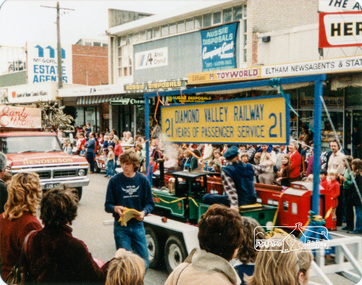 Eltham District Historical Society Inc
Photograph, Diamond Valley Railway, Eltham Festival Parade, 16 October 1982, 16/10/1982
... Have you ever had to choose between standing up to warm your hands on the exhaust and having your tractor seat flooded? ...Have you ever had to choose between standing up to warm your hands on the exhaust and having your tractor seat flooded? ...[article in EDHS Newsletter No. 27, November 1982:] 1982: 16-17 October. “Pioneers of Eltham” and tractor (rain). Although our parade entry did not win a prize this year, it was considered highly successful from a participation point of view. Despite some uncertainty as to just who was coming, members and friends kept appearing at the assembly area. As in the past years our friends from the Victorian Folk Music Club brought their instruments along and really added to the occasion. This year we concentrated on a rural theme with a tractor/trailer combination. Thanks to Peter Bassett-Smith for the tractor, Joh Ebeli for the decorations and friendly trailer owner Dennis McKay. Unfortunately the closing stages of the parade were marred by heavy rain. We just finished as the rain started but members scattered very quickly. This has prompted the suggestion for future parades that we have a tent or other suitable venue for members to gather after the event. This is worth following up. The cold driving rain provided a special problem for Peter in driving his tractor home to Kangaroo Ground. Have you ever had to choose between standing up to warm your hands on the exhaust and having your tractor seat flooded? Certificate, Festival Parade Award, Rotary Club of Eltham, Eighth Eltham Community Festival 1982: Presented to the Shire of Eltham Historical Society for the most effort by "locals".Colour photographmain road, eltham festival, eltham, eltham parade, festivals, parade, parade floats, 1982, diamond valley railway -
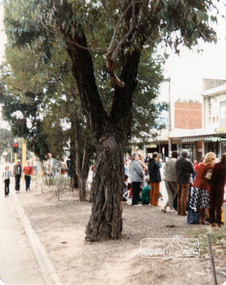 Eltham District Historical Society Inc
Photograph, Eltham Festival Parade, 16 October 1982, 16/10/1982
... Have you ever had to choose between standing up to warm your hands on the exhaust and having your tractor seat flooded? ...Have you ever had to choose between standing up to warm your hands on the exhaust and having your tractor seat flooded? ...[article in EDHS Newsletter No. 27, November 1982:] 1982: 16-17 October. “Pioneers of Eltham” and tractor (rain). Although our parade entry did not win a prize this year, it was considered highly successful from a participation point of view. Despite some uncertainty as to just who was coming, members and friends kept appearing at the assembly area. As in the past years our friends from the Victorian Folk Music Club brought their instruments along and really added to the occasion. This year we concentrated on a rural theme with a tractor/trailer combination. Thanks to Peter Bassett-Smith for the tractor, Joh Ebeli for the decorations and friendly trailer owner Dennis McKay. Unfortunately the closing stages of the parade were marred by heavy rain. We just finished as the rain started but members scattered very quickly. This has prompted the suggestion for future parades that we have a tent or other suitable venue for members to gather after the event. This is worth following up. The cold driving rain provided a special problem for Peter in driving his tractor home to Kangaroo Ground. Have you ever had to choose between standing up to warm your hands on the exhaust and having your tractor seat flooded? Certificate, Festival Parade Award, Rotary Club of Eltham, Eighth Eltham Community Festival 1982: Presented to the Shire of Eltham Historical Society for the most effort by "locals".Colour photographmain road, eltham festival, eltham, eltham parade, festivals, parade, parade floats, 1982 -
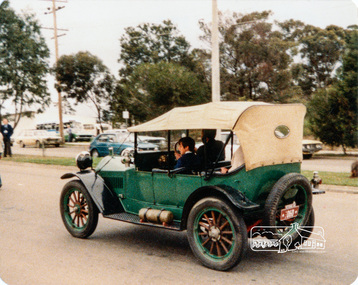 Eltham District Historical Society Inc
Photograph, Eltham Festival Parade, 16 October 1982, 16/10/1982
... Have you ever had to choose between standing up to warm your hands on the exhaust and having your tractor seat flooded? ...Have you ever had to choose between standing up to warm your hands on the exhaust and having your tractor seat flooded? ...[article in EDHS Newsletter No. 27, November 1982:] 1982: 16-17 October. “Pioneers of Eltham” and tractor (rain). Although our parade entry did not win a prize this year, it was considered highly successful from a participation point of view. Despite some uncertainty as to just who was coming, members and friends kept appearing at the assembly area. As in the past years our friends from the Victorian Folk Music Club brought their instruments along and really added to the occasion. This year we concentrated on a rural theme with a tractor/trailer combination. Thanks to Peter Bassett-Smith for the tractor, Joh Ebeli for the decorations and friendly trailer owner Dennis McKay. Unfortunately the closing stages of the parade were marred by heavy rain. We just finished as the rain started but members scattered very quickly. This has prompted the suggestion for future parades that we have a tent or other suitable venue for members to gather after the event. This is worth following up. The cold driving rain provided a special problem for Peter in driving his tractor home to Kangaroo Ground. Have you ever had to choose between standing up to warm your hands on the exhaust and having your tractor seat flooded? Certificate, Festival Parade Award, Rotary Club of Eltham, Eighth Eltham Community Festival 1982: Presented to the Shire of Eltham Historical Society for the most effort by "locals".Colour photographmain road, eltham festival, eltham, eltham parade, festivals, parade, parade floats, 1982 -
 Eltham District Historical Society Inc
Photograph, Eltham Festival Parade, 16 October 1982, 1982
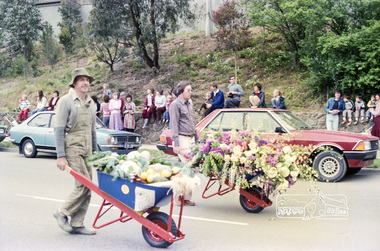
... Have you ever had to choose between standing up to warm your hands on the exhaust and having your tractor seat flooded? ...Have you ever had to choose between standing up to warm your hands on the exhaust and having your tractor seat flooded? ...Roll of negatives of the Eltham Festival Parade as it progresses along Main Road past the Catholic Church heading towards Bridge Street. Floats included the Tasmanian Wilderness Society with the Save the Franklin River campaign, and Diamond Valley Railway celebrating 21 years of passenger service as well as the Victorian Police Marching Band. A well known Eltham identity, Jock Read was asked to lead the Eltham Pony Club contingent that year and the roll includes several shots of Jock on his horse, Lofty who was approximately ten years of age, his colour was still classed as a steel grey at the time before he went "white" quite a few years later. 1982: 16-17 October. “Pioneers of Eltham” and tractor (rain) Neswletter No. 27, November 1982 Although our parade entry did not win a prize this year, it was considered highly successful from a participation point of view. Despite some uncertainty as to just who was coming, members and friends kept appearing at the assembly area. As in the past years our friends from the Victorian Folk Music Club brought their instruments along and really added to the occasion. This year we concentrated on a rural theme with a tractor/trailer combination. Thanks to Peter Bassett-Smith for the tractor, Joh Ebeli for the decorations and friendly trailer owner Dennis McKay. Unfortunately the closing stages of the parade were marred by heavy rain. We just finished as the rain started but members scattered very quickly. This has prompted the suggestion for future parades that we have a tent or other suitable venue for members to gather after the event. This is worth following up. The cold driving rain provided a special problem for Peter in driving his tractor home to Kangaroo Ground. Have you ever had to choose between standing up to warm your hands on the exhaust and having your tractor seat flooded? Certificate, Festival Parade Award, Rotary Club of Eltham, Eighth Eltham Community Festival 1982. Presented to the Shire of Eltham Historical Society for the most effort by "locals"Roll of 35mm colour negative film, 24 shotsKodak Safety Film 5035eltham festival, catholic church, diamond valley railway, eltham, eltham district historical society, eltham parade, festivals, eltham fire brigade, eltham horse and pony club, jock read, learning co-op primary school, eltham living and learning centre, lofty (horse), main road, marching band, montmorency scouts, parade, parade floats, peter bassett-smith, research pre-school, roller city, shire of eltham historical society, victorian police -
 National Wool Museum
Pamphlet - Mail Order Pamphlet, Kathryn Knitwear et al, 1972
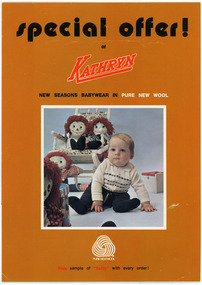
... hand powered machine in the late 1940s. The operation moved to Ascot Vale and Essendon, before eventually establishing a factory in Moonee Ponds in the early 1950s. The business continued to expand, necessitating a move to a new factory in Broadmeadows. By 1962, the Broadmeadows factory was producing an average of 20,000 garments per month, which increased to 24,000 by 1964. Robert Blake’s Son, Brendan recalls that “The Kathryn brand was famous around Australia, anywhere children needed to keep warm...Warm white; lemon; pink. Sizes 16” and 18” $1.60 629/F – Frock, hand embroidered. ...Warm white; lemon; pink. Sizes 16” and 18” $1.60 629/F – Frock, hand embroidered. ...Kathryn Knitwear, founded by Robert Blake, manufactured high quality children’s knitwear in Melbourne from the 1940s – 1980s. Robert Blake began manufacturing children’s knitwear in his bedroom in Strathmore using a hand powered machine in the late 1940s. The operation moved to Ascot Vale and Essendon, before eventually establishing a factory in Moonee Ponds in the early 1950s. The business continued to expand, necessitating a move to a new factory in Broadmeadows. By 1962, the Broadmeadows factory was producing an average of 20,000 garments per month, which increased to 24,000 by 1964. Robert Blake’s Son, Brendan recalls that “The Kathryn brand was famous around Australia, anywhere children needed to keep warm and dress smartly. It also won a number of wool fashion awards”, including the 1969 Wool Awards, which was held by the Australian Wool Bureau and published in Women’s Weekly. The Kathryn range was designed for durability, comfort and care, without sacrificing style. They used patterning techniques that increase stretchiness, comfort and fit, as well as integrating decorative elements into the fabric to prevent them from being bulky, uncomfortable or tight. Making longevity of style a priority, Brendan Blake remembers that “there was one particular garment that was in the range for at least thirty years”. He also recalls “In the past, when women have found out that I was associated with Kathryn Knitwear, they would often relate to me the story of a garment they had purchased or received as a gift and, when their child had grown out of it, they would hand it on to another child. Several ladies have told me of purchasing garments for their daughters’ glory box, or saving a particular garment after their daughter had grown out of it. Brendan Blake: “At the peak of their operation they employed approximately two hundred people, mainly women and girls. A family would often seek to send their daughter to work in this company because they knew they would be looked after and safe. One lady wrote to me telling me that working at the Moonee Ponds Factory prior to getting married was the happiest time of her life.” In 1963, workers at the Kathryn factory earned £13 per week, which was 8 shillings and 8 pence higher than the minimum weekly wage for female workers in the textile manufacturing industry (£12 11s 4d). By 1970, the Kathryn Knitwear brand expanded from children’s knitwear into womenswear under the brand name ‘Lady Kathryn’, and for boys and men under ‘Robert Blake’. Continuing to diversify their distribution, they also began exporting ‘Kathryn’ garments to New Zealand, the Pacific Islands, and Japan. They also established ‘Woolknit Distributors’, a mail-order service that sold ‘Kathryn’ quality garments at a lower price point. ‘Kathryn Knitwear’ was well-known for their early adoption of modern materials and techniques that had broad appeal to their customer base. This is shown in their early use of the acrylic fibre ‘Orlon’ in the 50s and 60s and ‘Superwash’ wool in the 1970s. Many of Kathryn Knitwear’s styles, particularly those that were long running staples of the brand, were available in both wool and Orlon to suit the consumer’s preference. Far from the humble origins of one man in his bedroom with a hand-cranked machine; at its closure in 1980, the Broadmeadows factory of ‘Kathryn’ housed more than 100 machines, including 53 sewing machines and 45 knitting machines. Robert Blake was “a passionate advocate for wool and Australian Made” throughout his whole life. A strong thread that ties through the lifespan of Robert Blake and Kathryn Knitwear is a balance between adopting new innovations without sacrificing the core values of durability, comfort, care and style that had made the brand so well known. Their legacy forms an integral part of both Australian social and manufacturing history.Advertising pamphlet for Kathryn Knitwear’s direct-to-consumer subsidiary ‘Woolknit Distributors’. Consists of four pages, printed in colour. Front cover is orange and features an image of a baby sitting up on the floor with a toy box and rocking chair behind. There are four rag dolls on the left hand side of the image; two sitting on the seat of the rocking chair, one at the base, and one in the foreground. Below the image is the woolmark logo. The internal pages are laid out as a double page spread, with the left hand side detailing instructions for ordering and a description of the offered garments, and the right hand side featuring drawings of babies wearing the garments available for purchase. The back page is a full-page advertisement for ‘Softly’ detergent, and features a blonde woman wearing a blue jumper with matching blue eyeshadow with a blonde baby wrapped in a white blanket. The bottom of the page has a coupon for 40c off a purchase of ‘Softly’.[obverse] special offer! of KATHRYN NEW SEASONS BABYWEAR IN PURE NEW WOOL (woolmark logo) PURE NEW WOOL Free sample of “Softly” with every order! [internal] 8 EXQUISITE STYLES AT PRICES YOU CAN’T AFFORD TO MISS … ! Woolknit distributors* brings you an exciting range of new seasons pure wool baby clothes made by leading children’s wear manufacturer “Kathryn” mailed direct to you at no extra cost. - STYLED IN A DELIGHTFUL RANGE OF COLOURS… - DESIGNED EXCLUSIVELY IN WOOL FOR SAFETY, WARMTH, COMFORT AND LONG LIFE… - ALL HAND WASHABLE FOR EASY CARE… - A MONEY BACK GUARANTEE FROM WOOLKNIT DISTRIBUTORS IF YOU ARE NOT COMPLETELY SATISFIED… Just select your style number from the list below: Fill in details of colour, size and quantity required on the enclosed card. Mail it in the reply paid envelope and print your name and address clearly. Send only cheque, postal order or money order. Do not enclose stamps, coins or bank notes. [left column] 15/MJ Matinee jacket with collar in Warm white; blue; lemon; pink. Size 16” only $3.50 16/MJ Pop your little bundle into this lacy matinee jacket. Warm white; blue; lemon; pink. Size 16” only $3.30 117/CSW All winter warmth in this com- bination suit with smart ‘fair- isle’ pattern and zip front. Red/ Warm white; Empire blue/Warm white; Sky blue/Warm white. Sizes 16” and 18”. $6.50 625/3 Beautifully styled pram set, keeps baby cosy from top to toe. Jacket, cap and breech- ettes. Warm white; blue; lemon; Pink. Sizes 16” and 18” and 20”. $9.30 681/CW Delightful baby cardigan in purl knit. Warm white; blue; lemon; pink. Sizes 18”, 20” and 22”. $4.30 [right column] 629/3 Three-piece pram set, including Frock, bonnet and breechettes. Warm white; lemon; pink. Sizes 16” and 18”. $10.00 Each item available individu- ally :- 629/B – Breechettes. Warm white; lemon; pink. Sizes 16” and 18” $3.00 629/C – Bonnet. Warm white; lemon; pink. Sizes 16” and 18” $1.60 629/F – Frock, hand embroidered. Warm white; lemon; pink. Sizes 16” and 18” $5.40 721/PW Cuddly pullover in purl knit keeps out winter winds. Warm white; blue; lemon; pink. Sizes 18”, 20” and 22”. $4.30 Shawl. Exquisitely knitted, super-fine shawl. Warm white only. $9.50 SIZE CHART Baby’s age / 0-6mths / 6mths. to 1 year / 1 to 2 years / 2 to 3 years Size of garment to order / 16 / 18 / 20 / 22 *WOOLKNIT DISTRIBUTORS PTY. LTD. 30 HALL STREET, MOONEE PONDS, VICTORIA, 3039 [reverse] Softly care keeps woollens soft as new Softly is safe for all kinds of woollens From the delicate things baby wears to the heavy winter blankets you wash in your machine. Softly gently cleans and protects. Leaving them soft as new. Try Softly yourself by taking advantage of the offer below. Do it now – for your woollens’ sake.business, business history, manufacturing, knitting machine, fashion textile production, business archives, manufacturing documents, textile industry - history wool marketing, wool marketing fashion textile industry, children's knitwear, children's clothing, knitwear marketing, mail order -
 Flagstaff Hill Maritime Museum and Village
Ceramic - Hot water bottle, late 19th - early 20th century
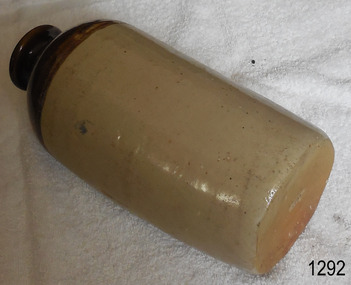
... This bottle is of historic significance, as an example of personal heating equipment used in the late 19th and early 20th centuries. flagstaff hill warrnambool shipwrecked-coast maritime-museum shipwreck-coast flagstaff-hill-maritime-village domestic item hot water bottle heating equipment ceramic bottle stoneware bottle potter earthenware personal item bed warmer foot warmer flat-sided hot water bottle household item stoneware clay ceramic Inscription hand written on base of bottle "Mrs K. ...This hot water bottle was designed to lay flat in a bed between the sheets. Its purpose was to warm the bed before use. The bottle was filled with hot water then a stopper was placed in the top to seal it, preventing the water from running out. The inscription on the attached label of this hot water bottle gives both the donor's details and the location of the bottle when it was first displayed at Flagstaff Hill Maritime Village. the "P.M.O." are the initials for the Port Medical Office. The donor's details are also written in pencil on the base of the bottle. In the 16th-century people warmed their beds with the 'bed warmer', which was a long-handled, metal pan filled with hot coals and embers and covered with a lid. The pan was placed between the bedsheets to warm the bed before the person retired to sleep for the night. In the early 19th-century earthenware bed warmers came began to be used for the same purpose. They would be filled with hot water and sealed then often wrapped in fabric. The ceramic material would hold the heat for quite some time, without being too hot for the person in bed to also warm their feet as they went off to sleep. Hot water bottles were later made from glass, copper, brass or tin. Some manufacturers made them into decorative pieces that still had practical use. In 1903 a patent was taken out for the first rubber hot water bottle, invented by Slavoljub Eduard Penkala, a Croatian engineer. This bottle is of historic significance, as an example of personal heating equipment used in the late 19th and early 20th centuries.Hot water bottle, earthenware, pale colour with brown glaze on top over the shoulder and mouth section and clear glaze on the remainder of the sides. The cylindrical bottle tapers to a slightly narrower base. One side of the bottle, about a sixth of the circumference, is flat. The base of the bottle has a handwritten inscription. An inscription was on the paper label originally attached to the bottle. Inscription hand written on base of bottle "Mrs K. Rob _ / Browns Rd / Offic / 3 _ _ 9" Inscription on paper label " "Mrs K Robinson Browns Rd Officer 3809 - Hot water bottle P.M.O." flagstaff hill, warrnambool, shipwrecked-coast, maritime-museum, shipwreck-coast, flagstaff-hill-maritime-village, domestic item, hot water bottle, heating equipment, ceramic bottle, stoneware bottle, potter, earthenware, personal item, bed warmer, foot warmer, flat-sided hot water bottle, household item, stoneware, clay, ceramic -
 Flagstaff Hill Maritime Museum and Village
Functional object - Needle Pin Case, 1860 to 1900
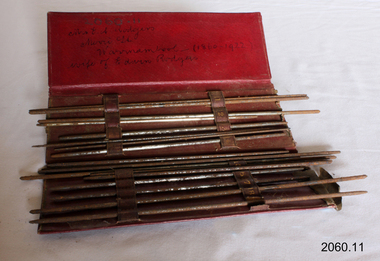
... hand knitters. Knitting by machine first appeared during this same period and with the spread of fashion of the silk stockings and the basic needs of people to keep warm helped to fuel the popularity of knitting. ...hand knitters. Knitting by machine first appeared during this same period and with the spread of fashion of the silk stockings and the basic needs of people to keep warm helped to fuel the popularity of knitting. ...Knitting, as a household task, has been traced back to 1100 AD where archaeologists in Egypt found remnants of socks. Evidently socks or stockings became a household necessity and creating them by knitting was the easiest way to get a good fit. The Tudors wore hand knit caps and King Henry the VIII made hand knit silk stockings, imported from Spain, a fashion staple. Meanwhile in Paris in 1525, men formed one of the first worker's unions for hand knitters. Knitting by machine first appeared during this same period and with the spread of fashion of the silk stockings and the basic needs of people to keep warm helped to fuel the popularity of knitting. By the 1850's, knitting machines were common place and apprenticing in such a factory, was considered honourable employment. But the main tool of knitting has always remained the needle, that is said to have it's origins in Arabia. The first needles were made of copper and looked more like hooks than needles. In other locations around the world, knitting needles have been found constructed from wood, ivory, bone, bamboo, amber and iron as well. They are also known as woods, skewers or wires depending where in the world they are found. Context: Edwin Rodgers was born in Lincolnshire England estimated at 1830-1832, records document that he was working as a Miller in Jan 1863 and that he resided in Warrnambool until his death in 1887. The knitting needle case is believed to belong to his wife Ellen Amelia (nee Heywood), daughter of George Heywood and Dinah Turton. She had married Mr Edwin Rodgers on 30 Jan 1863 in Warrnambool, and they had continued to resided in Warrnambool. Ellen Amelia Heywood was born Oct to Dec 1839 in Stockport, Cheshire England & christened on 5 Jul 1840 in St Thomas, Stockport, Cheshire. She died on 8 Dec 1922 in 284 Merri Street, Warrnambool, Victoria 10 and was buried on 11 Dec 1922 in the Warrnambool Cemetery.A significant item that belonged to one of the early families of Warrnambool and as such is regarded by the Warrnambool community as significant because it helps to document Warrnambool's development.Medium sized cardboard foldable maroon knitting pin case with numbered sections to fit relevant sized metal pins 10 in all case called the peacock knitting pin case.On lid of case written in italic Mrs E A Rodgers, Warrnambool 1860-1922, Wife of Edwin Rodgersflagstaff hill, warrnambool, shipwrecked-coast, flagstaff-hill, flagstaff-hill-maritime-museum, maritime-museum, shipwreck-coast, flagstaff-hill-maritime-village -
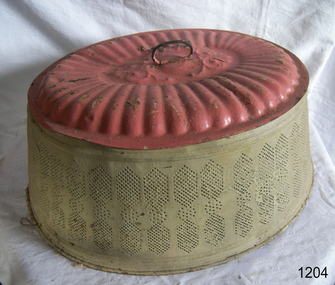 Flagstaff Hill Maritime Museum and Village
Domestic object - Cover
... hands of a butler in an English period drama. Not only does the word itself sound haughty (it comes from the French word for bell), it is a fundamentally theatrical object, existing to conceal and reveal food—or on occasion, a severed head. Why, if you’re not an old-timey aristocrat or movie villain, would you have use for a cloche? The answer is bugs. If you’ve ever had the pleasure of eating outside, you’re probably aware that bugs exist, and they often want some of what you’re having. Particularly during the summer and warm...hands of a butler in an English period drama. Not only does the word itself sound haughty (it comes from the French word for bell), it is a fundamentally theatrical object, existing to conceal and reveal food—or on occasion, a severed head. Why, if you’re not an old-timey aristocrat or movie villain, would you have use for a cloche? The answer is bugs. If you’ve ever had the pleasure of eating outside, you’re probably aware that bugs exist, and they often want some of what you’re having. Particularly during the summer and warm ...For most people, a cloche—the dome-shaped covering for a dish that’s removed before serving—is only ever encountered on-screen, likely in the hands of a butler in an English period drama. Not only does the word itself sound haughty (it comes from the French word for bell), it is a fundamentally theatrical object, existing to conceal and reveal food—or on occasion, a severed head. Why, if you’re not an old-timey aristocrat or movie villain, would you have use for a cloche? The answer is bugs. If you’ve ever had the pleasure of eating outside, you’re probably aware that bugs exist, and they often want some of what you’re having. Particularly during the summer and warm weather entices people into alfresco dining, the presence of bugs can be a nuisance for which there’s rarely an elegant solution. Did somebody say elegant? Let’s bring in the cloche. Specifically, let’s talk about a mesh cloche, which is different from the glinting silver semi-sphere discussed earlier. Dome-shaped but made of stiff wire mesh or cloth, this cloche is far from frivolous and is an excellent tool for any outside dining plans. First and foremost, it can keep insects out of your food, saving you from sitting and swatting your hand over the salad to keep flies away. Especially if you’re setting up a large buffet spread of dishes for a family-style meal outdoors, using mesh coverings takes a little bit of the pressure off when it comes to timing: just put the food out there, cloche it, and finish bringing everything else to the table. Also, there’s no harm in keeping them on during the meal, as it’s easy to pick up the lid, serve yourself more food, then plop it back down, in comparison with wrap, foil, or cloth, which can blow away in the wind, fall into the food, or require two hands for proper recovering. https://www.epicurious.com/expert-advice/covering-your-food-with-a-cloche-is-dramatic-and-useful-articleThe cloche or food cover was, and still is, the perfect way to prevent insects and other small vermin from interfering with and compromising the condition of food, both inside and outdoors.Metal oval food cover with decorative pressed tin lid and perforated holes around the side. Metal handle on top. Painted pink on top and green on the side.None.flagstaff hill, warrnambool, shipwrecked-coast, flagstaff-hill, flagstaff-hill-maritime-museum, maritime-museum, shipwreck-coast, flagstaff-hill-maritime-village, cloche, food, cover -
 Mission to Seafarers Victoria
Letter - Correspondence, 9/10/46
... warm the weather has been. These letters are of historical, social and interpretive significance as they provide information about the life of a seaman during the mid 20th century. mission to seafarers allan quinn letter montevideo 1946 Air Mail symbol in top left hand corner of paper Three page letter (0327.A1-A3) written in blue ink. ...Letter written from Allan Quinn to his mother in 1946 which depicts his time spent in Montevideo and discusses how warm the weather has been.These letters are of historical, social and interpretive significance as they provide information about the life of a seaman during the mid 20th century. Three page letter (0327.A1-A3) written in blue ink. Dated 09/10/46 written while at sea. Air Mail symbol in top left hand corner of papermission to seafarers, allan quinn, letter, montevideo, 1946
