
Showing 38 items matching "hand-painted porcelain"
-
 Nhill and District Historical Society Inc.
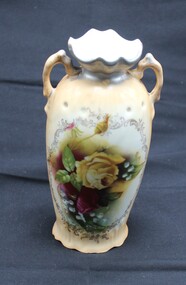
Ceramic - hand-painted porcelain vase, Erdmann Schlegelmilch, Porcelain made in Saxony, 1890s
... hand-painted porcelain vase...hand-painted porcelain...This finely made Saxon vase was preserved for generations by a Lutheran family in the Lowan Shire, symbolising the cultural continuity carried by German settlers into the Wimmera district. hand-painted porcelain made in Saxony vase Floral motif featuring roses green maker’s mark stamped in a shield‑like outline reading "PROV. ...Saxony‑made vase, cherished by a Lutheran family in the Lowan Shire. Crafted in Saxony and brought to Australia by early settlers, this vase became a valued possession within a Lutheran household in the Lowan Shire, reflecting both their heritage and the region’s migrant story.Vase from Saxony, treasured in a Lowan Shire Lutheran home. This finely made Saxon vase was preserved for generations by a Lutheran family in the Lowan Shire, symbolising the cultural continuity carried by German settlers into the Wimmera district.This is a decorative ceramic vase with an ornate, scalloped rim finished in a metallic silver tone. Two stylised handles rise from the shoulders, each shaped with soft curves that complement the vase’s overall elegance. The body is cream‑coloured with warm tan shading at the top and base, giving it a gentle gradient effect. The central decoration features a richly painted floral motif: yellow and deep red roses surrounded by green foliage and small white blossoms. Gold scrollwork frames the bouquet, adding a refined, almost Rococo touch. The underside shows wear consistent with age and use. It carries a green maker’s mark stamped in a shield‑like outline reading "PROV. SXE. E.S." indicating production by Erdmann Schlegelmilch, pottery factory in Provincial Saxony. This makers' mark was in use from 1920 to its close in 1937.green maker’s mark stamped in a shield‑like outline reading "PROV. SXE. E.S."hand-painted porcelain, made in saxony, vase, floral motif featuring roses -
 Lakes Entrance Historical Society
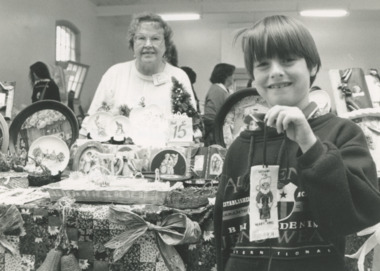
Photograph - Art and Craft Show Bruthen Victoria, Lakes Post Newspaper, 2/10/1994 12:00:00 AM
... Pearl Arvidsson at her Hand Painted Porcelain stall at Art and Craft Show Bruthen Victoria...Black and white photograph showing Pearl Arvidsson at her Hand Painted Porcelain stall at Art and Craft Show Bruthen Victoria...Pearl Arvidsson at her Hand Painted Porcelain stall at Art and Craft Show Bruthen Victoria Arts Exhibition Arts and crafts Black and white photograph showing Pearl Arvidsson at her Hand Painted Porcelain stall at Art and Craft Show Bruthen Victoria Photograph Art and Craft Show Bruthen Victoria Lakes Post Newspaper ...Pearl Arvidsson at her Hand Painted Porcelain stall at Art and Craft Show Bruthen VictoriaBlack and white photograph showing Pearl Arvidsson at her Hand Painted Porcelain stall at Art and Craft Show Bruthen Victoriaarts, exhibition, arts and crafts -
 St Kilda Historical Society
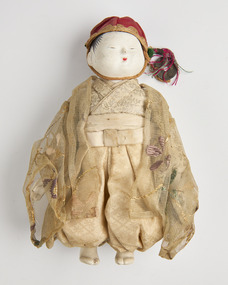
Decorative object - Dolls, Collection of dolls owned by Mirka Mora
... A collection of seven dolls with hand painted porcelain faces, hands and feet and traditional embroidered clothing....Mirka Mora A collection of seven dolls with hand painted porcelain faces, hands and feet and traditional embroidered clothing. ...Sold at an auction of the artist's personal effects in April 2019.A collection of seven dolls with hand painted porcelain faces, hands and feet and traditional embroidered clothing.mirka mora -
 Geelong Gallery
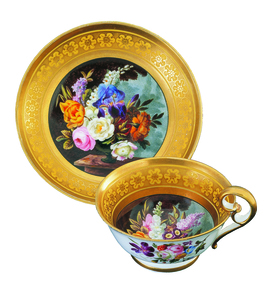
Decorative object - Cabinet cup and saucer, NATGARW, c1817-20
... Hand painted and gilded porcelain...Hand painted and gilded porcelain Decorative object Cabinet cup and saucer NATGARW ...Hand painted and gilded porcelain -
 Flagstaff Hill Maritime Museum and Village
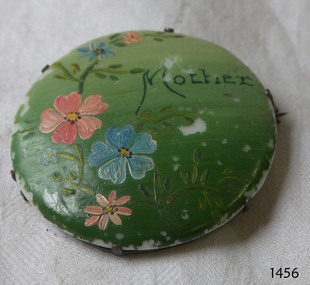
Brooch
... Brooch porcelain with hand painted decoration of flowers on a green background. ...flagstaff hill warrnambool shipwrecked-coast flagstaff-hill flagstaff-hill-maritime-museum maritime-museum shipwreck-coast flagstaff-hill-maritime-village brooch porcelain brooch The word 'Mother" is printed on the brooch Brooch porcelain with hand painted decoration of flowers on a green background. ...Brooch porcelain with hand painted decoration of flowers on a green background. Brass frame with pin attached to rear surface. Has the word "Mother" printed on it.The word 'Mother" is printed on the broochflagstaff hill, warrnambool, shipwrecked-coast, flagstaff-hill, flagstaff-hill-maritime-museum, maritime-museum, shipwreck-coast, flagstaff-hill-maritime-village, brooch, porcelain brooch -
 Flagstaff Hill Maritime Museum and Village
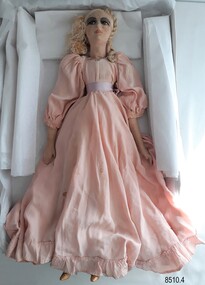
Leisure object - Boudoir Doll, c. early 1900s
... porcelain lower arms and legs. She has plaited blonde silk hair. Her painted face has brown eyes and her shoes are painted gold. The doll is dressed in a long pink puffed-sleeve dress with a gathered waist and a ruffle at the hem. A pink ribbon around her waist is tied at the back. There are small silver balls hand...porcelain lower arms and legs. She has plaited blonde silk hair. Her painted face has brown eyes and her shoes are painted gold. The doll is dressed in a long pink puffed-sleeve dress with a gathered waist and a ruffle at the hem. A pink ribbon around her waist is tied at the back. There are small silver balls hand ...The donor was given this doll about 50 years ago by her grandfather (in the late 1960s). He used to be a handyman at a high rise building in St Kilda, Melbourne. He had been doing some work for one of the old ladies and she gave him the doll to give to his granddaughter, who collected dolls. The doll has spent a few years at the Nagambie museum until it closed down and returned to the donor The origins or age of the doll are unknown. Originally it was thought to be a Fashion Doll dating from around the 1880s but the painted face together with the bisque legs and gold painted shoes are similar to those found on Boudoir Dolls (also known as Bed Dolls, Sofa Dolls, Flapper Dolls and French Dolls) of the early 20th century. Fashion dolls were sent from fashion houses to advertise the latest styles, fabrics, trims, hairstyles and accessories. Dressmakers would show these dolls to their customers. Ladies would then place their order and the dressmakers would make the dress to their size. The dressmakers would learn the construction techniques from examining the dolls. Boudoir Dolls dolls usually had no maker's marks and were primarily used as bedroom decorations for ladies rather than as children's toys. This doll appears to date at about the early part of the 20th century, but the petticoats are much older - possibly from a child's christening gown. At the time that the donor received the doll, it had a coloured lace over-gown that was badly torn so her mother removed it to replace with more lace but this never eventuated. The pink silk dress also appears to have been remodelled into a 19th century style with gathered sleeves and a gathered skirt. This fashion or boudoir doll is significant for being a rare example of a doll made in the late 19th or early 20th centuries. The doll is wearing clothing representing the fashion for young girls in that era. The doll is also significant as an item possibly used by fashion houses and dressmakers to advertise the latest fashions in clothing, trims, accessories and hairstyles. A doll such as this may have been found in a Victorian dressmaker's premises for use as a pattern and technique template and for a display to customers. It may also have been used as a decorative item in a lady's bedroom.Female boudoir doll with silk face and body, and porcelain lower arms and legs. She has plaited blonde silk hair. Her painted face has brown eyes and her shoes are painted gold. The doll is dressed in a long pink puffed-sleeve dress with a gathered waist and a ruffle at the hem. A pink ribbon around her waist is tied at the back. There are small silver balls hand-stitched around the neckline. She has a white, hand-embroidered lace petticoat and bloomers.warrnambool, flagstaff hill maritime museum, shipwreck coast, flagstaff hill maritime village, great ocean road, doll, boudoir doll, female doll, dressmaker's doll, display doll, late 1800s doll, fashion doll, antique doll, 19th century doll, children's fashion, girl's fashion, late 1800s children's fashion, early 20th century doll, composite doll, french doll -
 Flagstaff Hill Maritime Museum and Village
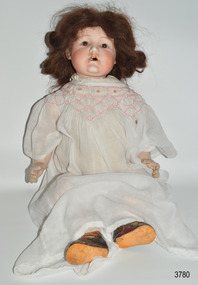
Leisure object - Porcelain Doll, 1920-1941
... Face has open mouth showing two porcelain front teeth, brown eyes of hand blown glass and hand painted features. ...Face has open mouth showing two porcelain front teeth, brown eyes of hand blown glass and hand painted features. ...Unable to determine a specific company that manufactured this doll many Japanese companies manufactured dolls of this type for export and these were only marked "Nippon" to show country of manufacture. These dolls marked this way were in production from around 1920 until 1941 when Japanese toy factories began to manufacturing items for war.Unable to be determined provenance relating to specific Japanese manufacturer. The doll is an example of a children's toy from the 1920s-1940s.Porcelain Doll in white fabric dress Doll, female, has porcelain face, composite body with swivel head and limbs. Head has long brown curly mohair wig attached into a hole in the pate; several doll-sized hairpins hold hair in place. Face has open mouth showing two porcelain front teeth, brown eyes of hand blown glass and hand painted features. Back of neck has two pressed holes above maker’s mark. Doll has removable white silk socks and brown shoes with tied ankle strap and hard soles. Doll is wearing old fashioned cream coloured knitted woollen singlet, cream flannel vest with draw-string cotton bodice and scalloped edge. The doll also has a more modern style white cotton dress with pink smocking. Inscription pressed into back of neck, shaded with pencil, "Nippon"Maker’s Mark “NIPPON” (See media section this document for a list of possible manufactures of doll)flagstaff hill, warrnambool, shipwrecked coast, flagstaff hill maritime museum, maritime museum, shipwreck coast, flagstaff hill maritime village, great ocean road, doll, nippon, nippon novelty company, porcelain, japanese doll manufacturer, porcelain doll, vintage doll -
 Orbost & District Historical Society
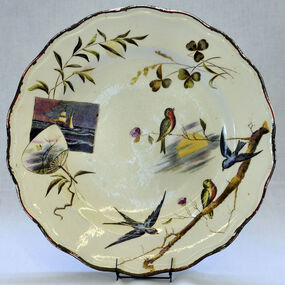
plate, Powell, Bishop & Stonier, December 6 1880
... This item is an example of late 19th century English porcelain. plate domestic crockery porcelain conway gilbert-mary Back - British coat of arms. 3 logos. Hand-painted Conway plate with illustrations of birds, sunsets, butterflies and sailing ships. ...Belonged to Mary Gilbert who was a passionate local historian. She was awarded a British Empire medal in recognition of her work for education and the community. Mary Isabelle Gilbert was born in 1905 in Orbost, Australia. She was born to John Gilbert and Annie Cameron Gilbert, and had seven sisters and one brother. Four siblings died at a young age. .She was a teacher historian loved and respected by her family and the wider community.This item is an example of late 19th century English porcelain.Hand-painted Conway plate with illustrations of birds, sunsets, butterflies and sailing ships. Cream background.Back - British coat of arms. 3 logos.plate domestic crockery porcelain conway gilbert-mary -
 City of Moorabbin Historical Society (Operating the Box Cottage Museum)
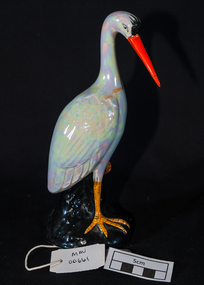
Ornaments, 'Carlton Ware' Heron / Egret, c1890 - c1930
... It reached its artistic high-point with superb hand-painted domestic pottery in high art deco styles during the 1920s and 1930. pottery porcelain craftwork carlton ware stoke on trent wiltshaw james frederick robinson william herbert robinson james alcock herron john bentleigh moorabbin ormond ornaments early settlers 'Carltonware' A china ornament representing a Heron or Egret Ornaments, 'Carlton Ware' Heron / Egret The Carlton Works Co. ...Carlton Ware was a famous Stoke-on-Trent based pottery manufacturer. The company was established in 1890 by James Frederick Wiltshaw, William Herbert Robinson and James Alcock Robinson trading under the name of Wiltshaw and Robinson. The trademark "Carlton Ware" was introduced in 1894, and the company's factory was renamed the Carlton Works. It reached its artistic high-point with superb hand-painted domestic pottery in high art deco styles during the 1920s and 1930.A china ornament representing a Heron or Egret'Carltonware'pottery, porcelain, craftwork, carlton ware, stoke on trent, wiltshaw james frederick, robinson william herbert, robinson james alcock, herron john, bentleigh, moorabbin, ormond, ornaments, early settlers -
 Seaworks Maritime Museum
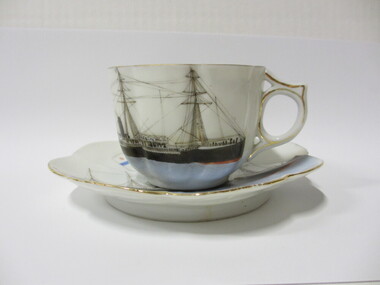
Cup and Saucer
... White porcelain saucer with matching ship and flag design to cup. Hand painted from early 1900s...White porcelain saucer with matching ship and flag design to cup. Hand painted from early 1900s Cup and Saucer ...White porcelain cup with gold rim, featuring ship and flag design with Japanese writing on underside. White porcelain saucer with matching ship and flag design to cup. Hand painted from early 1900sOn flag design: "OSNC" Japanese writing underneath cup -
 Flagstaff Hill Maritime Museum and Village
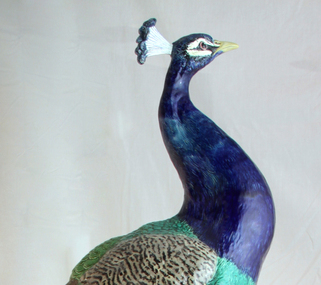
Decorative object - Peacock, Minton Majolica life-size model, Paul Comolera, artist, Designed: c. 1873; Made: c. 1875
... porcelain manufacturer. Comolera was a French artist and sculptor, renowned for dramatic naturalistic forms and life-size renditions of birds and animals that won him admiration in public and artistic circles. He was employed by Minton & Co. from 1873 to 1880, and the life-sized peacock became his best-known work. Comolera kept a live peacock loaned from the nearby Duke of Sutherland's Trentham Hall Estate in his studio to create a life-size model of fine buff earthenware model, which was then hand painted...porcelain manufacturer. Comolera was a French artist and sculptor, renowned for dramatic naturalistic forms and life-size renditions of birds and animals that won him admiration in public and artistic circles. He was employed by Minton & Co. from 1873 to 1880, and the life-sized peacock became his best-known work. Comolera kept a live peacock loaned from the nearby Duke of Sutherland's Trentham Hall Estate in his studio to create a life-size model of fine buff earthenware model, which was then hand painted ...This majestic peacock embodies the technical achievement, skill and ingenuity of artisans during the 19th century. It is now known as the 'Loch Ard Peacock' and was designed and modelled in 1873 by Paul Comolera (1818-1897) and fired in one piece at the Minton factory at Stoke-on-Trent in the United Kingdom in 1875. The peacock has been portrayed in symbolic motifs and has figured heavily in folktales and fables since antiquity, and many cultures around the world see it as a symbol of beauty, rebirth and power. Wealthy Victorians loved majolica, and the large peacock would have been the ultimate home accessory as a conservatory ornament – combining their desire for nature, the exotic and vibrant colours. The peacock model was listed in catalogues by Minton & Co. for a retail price of 35 guineas or sold as a pair for 90 guineas. Minton & Co. was founded in 1793 by Thomas Minton (1765–1836) and became a famous pottery and porcelain manufacturer. Comolera was a French artist and sculptor, renowned for dramatic naturalistic forms and life-size renditions of birds and animals that won him admiration in public and artistic circles. He was employed by Minton & Co. from 1873 to 1880, and the life-sized peacock became his best-known work. Comolera kept a live peacock loaned from the nearby Duke of Sutherland's Trentham Hall Estate in his studio to create a life-size model of fine buff earthenware model, which was then hand painted in brilliantly coloured green and blue glazes to mimic the peafowl’s dazzling plumage. There are no surviving production records, but according to documents in the Minton Archive, nine peacocks were made by Comolera. However, today, some historians now believe that twelve were fired at the Minton factory; research is ongoing. These peacocks were so admired that Minton & Co. used them as exhibition showpieces at International Exhibitions in London, Paris, and the United States of America, ensuring the company had a worldwide reputation. So, when Melbourne hosted an International Exposition in 1880, Minton & Co. sent out ceramics and tiles, and in particular, this peacock was intended to be part of their exhibit in the British Court in the Exhibition Building, built in the Carlton Gardens. The early dispatch date (1878) indicates that the company may have intended to exhibit their wares, including the peacock, at the 1879 Sydney International Exhibition, but the company did not take up this option. The ship that Minton & Co. used to bring the peacock and their other wares to the Australian colonies was the ill-fated Loch Ard, which sunk after striking Mutton Bird Island near Port Campbell, Victoria, in calm foggy weather in June 1878 on the final leg of the ship's journey to Melbourne. The loss of 52 lives made it one of Victoria’s worst shipwrecks. Therefore, this peacock never made it to the grand exposition in Melbourne, as Minton & Co. had planned. Charles McGillivray dragged this peacock, still in its original packing case, onto the beach in the gorge just two days after the Loch Ard went down. The peacock was rescued unscathed apart from a chip on its beak (only repaired in 1988). After a disagreement with a Melbourne Customs Officer, Joseph Daish, McGillivray stopped his salvage operations, leaving the peacock on the beach. The second salvagers were James Miller and Thomas Keys. Miller was a member of the firm Howarth, Miller and Matthews, Geelong, who had brought the salvage rights to the Loch Ard wreck on 10 June. When Miller and Keys arrived at the wreck site, a storm had washed many of the salvaged goods, including this peacoc,k back into the sea. The two men found the peacock in its case ‘bobbing along in the water’ and pulled it back to the beach. To ensure the peacock wasn't washed out to sea again, Miller and Keys hauled the packing case containing the peacock up the gorge's cliff face to the top, ready to be transported. In an interview in 1928, Keys claimed that at the time of the rescue, the head had broken from the body. This account was proven to be true in 1988, following the birds' display in Brisbane. This peacock began its life in Australia, not in the grandeur of an International Exhibition as intended, but in the hallway of a simple domestic house in Geelong. It appears Minton & Co. did not attempt to buy this peacock back. Florence Miller, daughter of James Miller (Loch Ard salvage rights holder), later remarked that the only item of real value rescued from the wreck had been the peacock and that this had been kept by her father in the family home at Malvern for many years and became a treasured family possession. As such, this 'Loch Ard peacock' was almost forgotten and mistaken with other Minton peacocks around the world. Miss Florence Miller tried to sell the peacock due to financial difficulties in the 1930s but was unsuccessful. While attempting to sell her Loch Ard relic, it was displayed in the window of the old Argus newspaper office, which was at 76 Collins Street, Melbourne; the Argus had relocated to the corner of Elizabeth and La Trobe Streets in 1926. Between 1935 and 1939, the old Argus building was occupied by the Joshua N. McClelland Print Room, which sold not only paintings and prints but also antiques and authentic replicas, as well as hosting exhibitions. Miss Florence Miller loaned her peacock for display at the Victorian Historical Exhibition held in the National Gallery on 1st June 1935, the 57th anniversary of the Loch Ard wreck. As a result, the peacock attracted public attention in books, newspapers and magazine articles that told the story of its survival from a shipwreck. Miss Florence Miller was keen to sell the peacock, even writing overseas to Captain Blain on November 30th, 1938, about the possibility of a sale, but this became no longer possible due to the outbreak of war. Recent information points to the Loch Ard peacock being owned by John S R Heath before its sale to Frank Ridley-Lee in May 1941. Research is ongoing, but it seems likely that John Samuel Robert Heath, a leading Melbourne dentist with a practice in Collins Street, and his wife, a dental mechanic, had purchased Miss Miller’s Loch Ard peacock before its sale in 1941. They were lovers of fine arts, music, wine and food. The peacock in the window of the old Argus building could have attracted their attention as they had already purchased the old stone Presbyterian Church on Warrigal Road, Oakleigh, in 1933 and had converted its interior. The home, renamed The Studio, even included Melbourne’s first all-electric kitchen. The peacock was perfect for display in the Studio’s entrance. A magazine article published after the conversion was completed included photographs of the interior. The picture of the ‘portico’ had a caption below that stated, “Some of her [Mrs Heath’s] finest pottery was salvaged from the Loch Ard Wreck”. In 2025, Heath’s two remaining sons remember running around in the entrance with the peacock standing there, oblivious to its value. Heath was an accomplished artist, studying under Max Meldrum. He painted and exhibited his works at The Studio and in a public exhibition, and he was a finalist eight times in the coveted Archibald Prize portrait competition, including the submission of his self-portrait that is now part of his grandson’s collection. The next owner of the Loch Ard Peacock was Frank Ridley-Lee. He displayed it at his home in Ivanhoe after buying it at an auction in May 1941. The peacock remained in the hands of the Ridley-Lee family until it was offered for sale by auction in 1975 as part of an art collection belonging to Mrs Ridley-Lee's estate. The peacock was not sold at this time, as the reserve price of $4500 was not met. This news was passed on to the board of the newly created Flagstaff Hill Maritime Village. Urgent efforts were made to collect the necessary money through fundraising by the Warrnambool City Council and public donations. The Fletcher Jones Company and the Victorian Government contributed half the cost. On 9 September 1975, the Loch Ard peacock was purchased by Flagstaff Hill Maritime Village, and it found a new home at the maritime museum. Since then, it has only left Warrnambool twice. Firstly, in 1980, at the centenary celebrations of the Royal Exhibition Building in Melbourne, and secondly, in 1988, the peacock was given pride of place at the entrance to the Victorian Pavilion at the Brisbane World Expo, acknowledging that this Minton Majolica peacock is the most significant shipwreck object in Australia. The Minton majolica peacock is considered of historical social and aesthetic significance to Victoria and is one of only a few 'objects' registered on the Victorian Heritage Register (H 2132), as it is a most notable and rare object associated with the Minton factory of the 1870s and works by the celebrated sculptor Paul Comolera along with the wreck of the Loch Ard on the Victorian coastline. This Minton peacock is historically significant for its rarity; it was one of only 9-12 known to exist. The shipwreck of the Loch Ard is also of significance for Victoria and is registered on the Victorian Heritage Register Ref (S 417). Flagstaff Hill has a varied collection of artefacts from Loch Ard and its collection is significant for being one of the largest accumulation of artefacts from this notable Victorian shipwreck. The collections object is to also give us a snapshot into history so we can interpret the story of this tragic event. The collection is also archaeologically significant as it represents aspects of Victoria's shipping history that allows us to interpret Victoria's early social and historical themes. The collection is historically significant is that it is associated, unfortunately with the worst and best-known shipwreck in Victoria's history. The peacock, resplendent in polychrome glaze, stands perched on a rocky plinth decorated with vines, leaves, flowers, blackberries and wild mushrooms. The peacock’s breast is cobalt blue; the wings and legs are in naturalistic colours. The tail is a mass of feathers coloured in green, ochre blue and brown — a fantastic display of artistry and Minton expertise. Inscribed at the base :P Comolera, and a Minton & Co. design number: 2045.flagstaff hill, warrnambool, maritime museum, shipwreck coast, loch ard, loch ard gorge, peacock, paul comolera, victorian heritage register, minton peacock, minton & co., stoke upon trent, bird figures, mintons, ceramics, international expositions, majolica, naturalistic, staffordshire, john samuel robert heath, peacock statue, loch ard peacock, majorca peacock -
 Flagstaff Hill Maritime Museum and Village
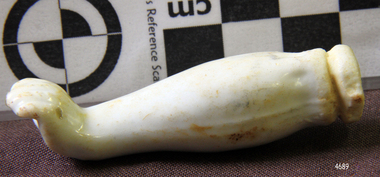
Doll's arm, Bisque dolls were being made from the 1860’s
... porcelain) is for a small doll. Its hand has the fingers touching each other with the thumb tucked into the palm. The white coloured arm is finished with glazed paint. ...porcelain) is for a small doll. Its hand has the fingers touching each other with the thumb tucked into the palm. The white coloured arm is finished with glazed paint. ...This doll’s arm was part of the cargo from the Fiji and was part of the articles salvaged from the wreck. The three-masted iron barque Fiji had been built in Belfast, Ireland, in 1875 by Harland and Wolfe for a Liverpool based shipping company. The ship departed Hamburg on 22nd May 1891 bound for Melbourne, under the command of Captain William Vickers with a crew of 25. The ship’s manifest shows that she was loaded with a cargo of 260 cases of dynamite, pig iron, steel goods, spirits (whisky, schnapps, gin, brandy), sailcloth, tobacco, coiled fencing wire, concrete, 400 German pianos (Sweet Hapsburg), concertinas and other musical instruments, artists supplies including brushes, porcelain, furniture, china, and general cargo including candles. There were also toys in anticipation for Christmas, including wooden rocking horses, miniature ships, dolls with china limbs and rubber balls. On September 5th, one hundred days out from Hamburg in squally and boisterous south west winds the Cape Otway light was sighted on a bearing differing from Captain Vickers’ calculation of his position. At about 2:30am, Sunday 6th September 1891 land was reported 4-5 miles off the port bow. The captain tried to put the ship on the other tack, but she would not respond. He then tried to turn her the other way but just as the manoeuvre was being completed the Fiji struck rock only 300 yards (274 metres) from shore. The place is known as Wreck Bay, Moonlight Head. Blue lights were burned and rockets fired whilst an effort was made to lower boats but all capsized or swamped and smashed to pieces. Two of the younger crewmen volunteered to swim for the shore, taking a line. One, a Russian named Daniel Carkland, drowned after he was swept away when the line broke. The other, 17 year old able seaman Julius Gebauhr, a German, reached shore safely on his second attempt but without the line, which he had cut lose with his sheath-knife when it become tangled in kelp. He rested on the beach a while then climbed the steep cliffs in search of help. At about 10am on the Sunday morning a party of land selectors - including F. J. Stansmore, Leslie Dickson (or Dixon) and Mott - found Gebauhr. They were near Ryans Den, on their travels on horseback from Princetown towards Moonlight Head, and about 5km from the wreck. Gebauhr was lying in the scrub in a poor state, bleeding and dressed only in singlet, socks and a belt with his sheath-knife, ready for all emergencies. At first they were concerned about his wild and shaggy looking state and what seemed to be gibberish speech, taking him to be an escaped lunatic. They were reassured after he threw his knife away and realised that he was speaking half-English, half-German. They gave him food and brandy and some clothing and were then able to gain information about the wreck. Some of the men took him to Rivernook, a nearby guest house owned by John Evans, where he was cared for. Stansmore and Dickson rode off to try and summon help. Others went down to the site of the wreck. Messages for rescuing the rest of the crew were sent both to Port Campbell for the rocket rescue crew and to Warrnambool for the lifeboat. The S.S. Casino sailed from Portland towards the scene. After travelling the 25 miles to the scene, half of the Port Campbell rocket crew and equipment arrived and set up the rocket tripod on the beach below the cliffs. By this time the crew of the Fiji had been clinging to the jib-boom for almost 15 hours, calling frantically for help. Mr Tregear from the Rocket Crew fired the line. The light line broke and the rocket was carried away. A second line was successfully fired across the ship and made fast. The anxious sailors then attempted to come ashore along the line but, with as many as five at a time, the line sagged considerably and some were washed off. Others, nearly exhausted, had to then make their way through masses of seaweed and were often smothered by waves. Only 14 of the 24 who had remained on the ship made it to shore. Many onlookers on the beach took it in turns to go into the surf and drag half-drowned seamen to safety. These rescuers included Bill (William James) Robe, Edwin Vinge, Hugh Cameron, Fenelon Mott, Arthur Wilkinson and Peter Carmody. (Peter Carmody was also involved in the rescue of men from the Newfield.) Arthur Wilkinson, a 29 year old land selector, swam out to the aid of one of the ship’s crewmen, a carpenter named John Plunken. Plunken was attempting to swim from the Fiji to the shore. Two or three times both men almost reached the shore but were washed back to the wreck. A line was thrown to them and they were both hauled aboard. It was thought that Wilkinson struck his head on the anchor before s they were brought up. He remained unconscious. The carpenter survived this ordeal but Wilkinson later died and his body was washed up the next day. It was 26 year old Bill Robe who hauled out the last man, the captain, who had become tangled in the kelp. The wreck of the Fiji was smashed apart within 20 minutes of the captain being brought ashore, and it settled in about 6m of water. Of the 26 men on the Fiji, 11 in total lost their lives. The remains of 7 bodies were washed onto the beach and their coffins were made from timbers from the wrecked Fiji. They were buried on the cliff top above the wreck. The survivors were warmed by fires on the beach then taken to Rivernook and cared for over the next few days. Funds were raised by local communities soon after the wreck in aid of the sufferers of the Fiji disaster. Captain Vickers was severely reprimanded for his mishandling of the ship. His Masters Certificate was suspended for 12 months. At the time there was also a great deal of public criticism at the slow and disorganised rescue attempt to save those on board. The important canvas ‘breech buoy’ or ‘bucket chair’ and the heavy line from the Rocket Rescue was in the half of the rocket outfit that didn’t make it in time for the rescue: they had been delayed at the Gellibrand River ferry. Communications to Warrnambool were down so the call for help didn’t get through on time and the two or three boats that had been notified of the wreck failed to reach it in time. Much looting occurred of the cargo that washed up on the shore, with nearly every visitor leaving the beach with bulky pockets. One looter was caught with a small load of red and white rubber balls, which were duly confiscated and he was ‘detained’ for 14 days. Essence of peppermint mysteriously turned up in many settlers homes. Sailcloth was salvaged and used for horse rugs and tent flies. Soon after the wreck “Fiji tobacco” was being advertised around Victoria. A Customs officer, trying to prevent some of the looting, was assaulted by looters and thrown over a steep cliff. He managed to cling to a bush lower down until rescued. In 1894 some coiled fencing wire was salvaged from the wreck. Hundreds of coils are still strewn over the site of the wreck, encrusted and solidified. The hull is broken but the vessel’s iron ribs can be seen along with some of the cargo of concrete and pig iron. Captain Vickers presented Bill Robe with his silver-cased pocket watch, the only possession that he still had, as a token for having saved his life and the lives of some of the crew. (The pocket watch came with 2 winding keys, one to wind it and one to change the hands.) Years later Bill passed the watch to his brother-in-law Gib (Gilbert) Hulands as payment of a debt and it has been passed down the family to Gilbert Hulands’ grandson, John Hulands. Seaman Julius Gebauhr later gave his knife, in its hand crafted leather sheath, to F. J. Stansmore for caring for him when he came ashore. The knife handle had a personal inscription on it. A marble headstone on the 200m high cliffs overlooking Wreck Beach, west of Moonlight Head, paying tribute to the men who lost their lives when Fiji ran aground. The scene of the wreck is marked by the anchor from the Fiji, erected by Warrnambool skin divers in 1967. Amongst the artefacts salvaged from the Fiji are bisque (or china) toys, (including miniature animals, limbs from small bisque dolls), rubber balls, a slate pencil, a glass bottle, sample of rope from the distress rocket and a candlestick holder. These items are now part of the Fiji collection at Flagstaff Hill Maritime Museum, along with Captain Vickers’ pocket watch and Julius Gebauhr’s sheath knife. Flagstaff Hill’s Fiji collection is of historical significance at a State level because of its association with the wreck Fiji, which is on the Victorian Heritage Register VHR S259. The Fiji is archaeologically significant as the wreck of a typical 19th century international sailing ship with cargo. It is educationally and recreationally significant as one of Victoria's most spectacular historic shipwreck dive sites with structural features and remains of the cargo evident. It also represents aspects of Victoria’s shipping history and its potential to interpret sub-theme 1.5 of Victoria’s Framework of Historical Themes (living with natural processes). The Fiji collection meets the following criteria for assessment: Criterion A: Importance to the course, or pattern, of Victoria’s cultural history. Criterion B: Possession of uncommon, rare or endangered aspects of Victoria’s cultural history Criterion C: Potential to yield information that will contribute to an understanding of Victoria’s cultural history. Doll’s arm salvaged from the wreck of the Fiji. This moulded arm, made of bisque (sometimes described as china or porcelain) is for a small doll. Its hand has the fingers touching each other with the thumb tucked into the palm. The white coloured arm is finished with glazed paint. The arm is discoloured in places with a tan colour. The arm is solid rather than jointed and goes from hand to upper arm. There is a groove around the top of the arm, which would enable the arm to be attached to the cloth body of a doll.1891, china, shipwrecked coast, flagstaff hill, flagstaff hill maritime museum, maritime museum, shipwrecked artefact, flagstaff hill maritime village, shipwreck coast, warrnambool, porcelain, doll, moonlight head, wreck bay, cargo, bisque, toys, doll's arm, doll's limb -
 Kiewa Valley Historical Society
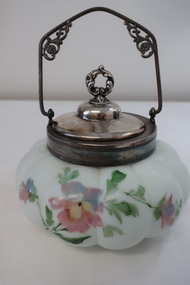
Ornamental Porcelain Container
... Round pale green 'pumpkin' shaped porcelain container decorated with 'hand painted?' red, blue, yellow flowers and green leaves. ...See KVHS 1282 Ron White' Collection Porcelain container Nil Round pale green 'pumpkin' shaped porcelain container decorated with 'hand painted?' red, blue, yellow flowers and green leaves. ...Ron White's Collection. Possibly a gift as this type of container was popular.Ron White. See KVHS 1282Round pale green 'pumpkin' shaped porcelain container decorated with 'hand painted?' red, blue, yellow flowers and green leaves. The lip & handle are steel. The lid is pewter with a decorated ring on top. The steel wire handle is vertical then bent to join at the centre. The bends have decoration on their inside.Nilron white' collection, porcelain container -
 Kiewa Valley Historical Society
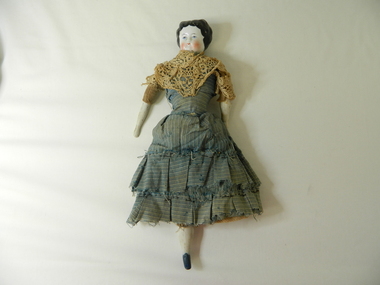
Doll Porcelain, circa 1920
... Porcelain/ceramic doll with painted face features. Half ceramic arms and legs. One leg missing.one arm loose Stitched dress with lace bodice hand made Body padded with cloth and fine wood shavings filler. ...This is clearly demonstrated by the painted face and home made repairs to the body and limbs doll porcelain toy lace girls' play Porcelain/ceramic doll with painted face features. Half ceramic arms and legs. One leg missing.one arm loose Stitched dress with lace bodice hand ...This doll was a highly treasured toy for a girl. The amount of wear and tear given to this doll indicates the great attachment to and comfort that its owner had with it. This doll could have been on a farm or cattle property in the Kiewa Valley rather than in the town.Due to the lack of social activities in the valley during the period, self amusement at home and limited interaction outside of the valley would have been this dolls prime role for its owner. The time between the two World Wars was one of recession and limited funds outside that required for survival. This is clearly demonstrated by the painted face and home made repairs to the body and limbs Porcelain/ceramic doll with painted face features. Half ceramic arms and legs. One leg missing.one arm loose Stitched dress with lace bodice hand made Body padded with cloth and fine wood shavings filler. Scarf lace weavedoll, porcelain, toy, lace, girls' play -
 Kiewa Valley Historical Society
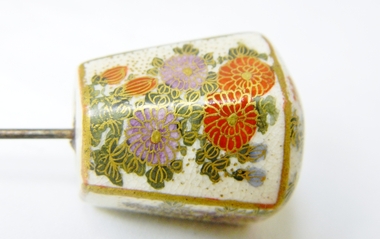
Hat Pin
... The fine hand painted pictures with gold boarders and porcelain body suggests the item was bought either in Europe or Britain and brought into Australia in the late 19 th to early 20 th century by a wealthy landed gentry...Head of pin is six sided, domed top made of porcelain. Two sides have hand painted pictures of grapes, two sides with flower arrangement , two sides detailing cypress tree tips of branch, top has flowers and leaves with hidden small birds...The fine hand painted pictures with gold boarders and porcelain body suggests the item was bought either in Europe or Britain and brought into Australia in the late 19 th to early 20 th century by a wealthy landed gentry This item is a reflection of both the fashion mode of the 1800s to mid 1900s when long hair needed to be controlled by hair pins rather than later manufactured hair sprays. ...Historically this item could be a valuable antique worn originally by a wealthy upper class woman. The fine hand painted pictures with gold boarders and porcelain body suggests the item was bought either in Europe or Britain and brought into Australia in the late 19 th to early 20 th century by a wealthy landed gentryThis item is a reflection of both the fashion mode of the 1800s to mid 1900s when long hair needed to be controlled by hair pins rather than later manufactured hair sprays. It is also an example of society's mores of tidiness and quasi religious beliefs of covering the hair and head when outdoorsHead of pin is six sided, domed top made of porcelain. Two sides have hand painted pictures of grapes, two sides with flower arrangement , two sides detailing cypress tree tips of branch, top has flowers and leaves with hidden small birdshat pin, porcelain hat accessory, millinery clothing -
 Geoffrey Kaye Museum of Anaesthetic History
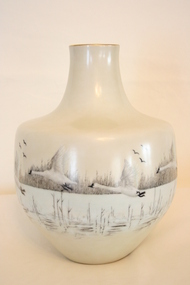
Decorative object - Vase, Bessie Biggs, 1981c
... hand painted by Dr Biggs mother, Bessie Biggs. The manufacturer of the vase, Furstenberg, is one of oldest and most renowned porcelain makers in Europe since 1747. ...Porcelain vase of bulbous form and narrow neck with gold trim on lip. Black and white hand painted scene of flying geese above a body of water surrounded by reeds....hand painted by Dr Biggs mother, Bessie Biggs. The manufacturer of the vase, Furstenberg, is one of oldest and most renowned porcelain makers in Europe since 1747. ...This vase was gifted to the Faculty by Dr Walter Wyndham Biggs upon his retirement from the Faculty Board in 1981. Dr Biggs was the first flying anaesthetist of the Flying Surgeon Service based at Longreach in central Queensland. The vase is hand painted by Dr Biggs mother, Bessie Biggs. The manufacturer of the vase, Furstenberg, is one of oldest and most renowned porcelain makers in Europe since 1747. Made in West Germany, the makers mark is found at the base of the vase marked with a blue under glaze symbol of a crown, script F and a number 9. Porcelain vase of bulbous form and narrow neck with gold trim on lip. Black and white hand painted scene of flying geese above a body of water surrounded by reeds.[hand written on base in black ink] Handpainted / by / Bessie Biggs / 1981 [embossed on base] 7405/30 [Blue under-glaze on base] symbol of crown / cursive script F / 9 / FURSTENBERG / SEIT 1747 / WEST GERMANY [Artist signature on painted surface] B BIGGSdr walter biggs, furstenberg, porcelain -
 Royal Australian and New Zealand College of Obstetricians & Gynaecologists (RANZCOG)
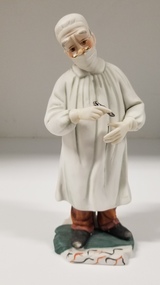
Sculpture - Bisque porcelain figurine of a doctor
... porcelain figurine of a male doctor holding a medical instrument. The doctor has grey hair and is in surgical attire, with white gown, gloves, surgical hat and mask. The cuffs of his brown trousers, and his black shoes, are visible below the gown. The doctor is wearing glasses on the end of his nose, and holds a surgical tool in his right hand. The figurine is standing on a base with a painted...porcelain figurine of a male doctor holding a medical instrument. The doctor has grey hair and is in surgical attire, with white gown, gloves, surgical hat and mask. The cuffs of his brown trousers, and his black shoes, are visible below the gown. The doctor is wearing glasses on the end of his nose, and holds a surgical tool in his right hand. The figurine is standing on a base with a painted ...Bisque porcelain figurine of a male doctor holding a medical instrument. The doctor has grey hair and is in surgical attire, with white gown, gloves, surgical hat and mask. The cuffs of his brown trousers, and his black shoes, are visible below the gown. The doctor is wearing glasses on the end of his nose, and holds a surgical tool in his right hand. The figurine is standing on a base with a painted green stripe across the centre, and is supported by a pillar at the back which is decorated with decorative orange and black squiggly lines. Orange and black squiggly lines also feature on the front of the base. Handwritten lettering on a sticker on underside of base reads 'FF'. -
 Royal Australian and New Zealand College of Obstetricians & Gynaecologists (RANZCOG)
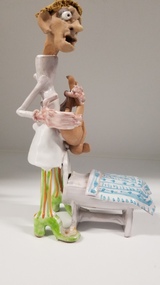
Sculpture - Porcelain figurine of a doctor holding a monkey
... porcelain figurine of a doctor holding a monkey. The doctorhas yellow hair and is wearing a white coat, with a white substance on their hands resembling gloves. They are wearing bright green and orange striped pants below the gown, and green high heeled shoes. The doctor is holding a monkey by its ankles in their left hand, and is holding the palm of his right hand on the monkey's bottom. The doctor is standing behind a small white crib, which is covered with a blue and white patterned blanket. The maker's name 'BESSI'(?) and the word 'ITALY' are hand painted...porcelain figurine of a doctor holding a monkey. The doctorhas yellow hair and is wearing a white coat, with a white substance on their hands resembling gloves. They are wearing bright green and orange striped pants below the gown, and green high heeled shoes. The doctor is holding a monkey by its ankles in their left hand, and is holding the palm of his right hand on the monkey's bottom. The doctor is standing behind a small white crib, which is covered with a blue and white patterned blanket. The maker's name 'BESSI'(?) and the word 'ITALY' are hand painted ...The writing is unclear, but the name of the artist for this piece may be Bessi.Colourful porcelain figurine of a doctor holding a monkey. The doctorhas yellow hair and is wearing a white coat, with a white substance on their hands resembling gloves. They are wearing bright green and orange striped pants below the gown, and green high heeled shoes. The doctor is holding a monkey by its ankles in their left hand, and is holding the palm of his right hand on the monkey's bottom. The doctor is standing behind a small white crib, which is covered with a blue and white patterned blanket. The maker's name 'BESSI'(?) and the word 'ITALY' are hand painted on the underside of the crib.obstetrics -
 Royal Australian and New Zealand College of Obstetricians & Gynaecologists (RANZCOG)
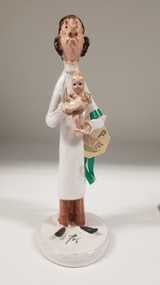
Sculpture - Porcelain figure of a doctor holding a baby
... hand. A small Certificate of Origin is attached to the figure's left arm by a short length of green ribbon. The certificate is signed by the artist and indicates the piece was made in Italy. The base of the statue, between the figure's feet, is painted with the inscription 'PoG'. Underside of base is painted with the inscription '72/17'1/ITALY'. Sculpture Porcelain ...Porcelain figurine of a doctor holding a baby. The figure is male in appearance, and is wearing a long white coat which is enclosed at the collar and extends below the knees. The figure is wearing brown trousers and black shoes, and is standing upright with legs together. The figure has black hair, an exaggerated protruding nose, and has a serious expression, looking slightly upwards. The figure is holding a baby by the waist in his right hand, supporting the baby's feet with his left hand. A small Certificate of Origin is attached to the figure's left arm by a short length of green ribbon. The certificate is signed by the artist and indicates the piece was made in Italy. The base of the statue, between the figure's feet, is painted with the inscription 'PoG'. Underside of base is painted with the inscription '72/17'1/ITALY'. -
 Bendigo Historical Society Inc.
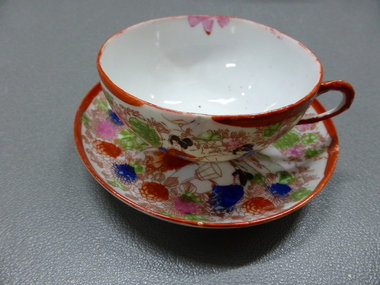
Domestic Object - JAPANESE CUP AND SAUCER
... Japanese porcelain tea cup and saucer hand painted with Geisha girls and flowers in tones of rust, blue, green....DOMESTIC EQUIPMENT Table setting cups Japanese porcelain tea cup and saucer hand painted with Geisha girls and flowers in tones of rust, blue, green. ...Japanese porcelain tea cup and saucer hand painted with Geisha girls and flowers in tones of rust, blue, green.domestic equipment, table setting, cups -
 Coal Creek Community Park & Museum
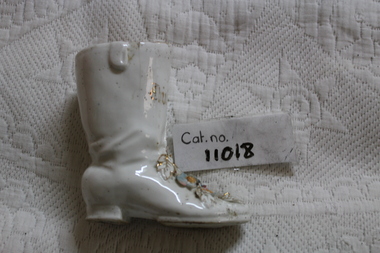
Porcelain 'boot' vase with flowers and 'think of me' motif, circa 1920s
... Porcelain 'boot' vase, circa 1920s. White gloss glaze, applied flowers of blue, pink, yellow and orange. Hand-painted...Porcelain 'boot' vase, circa 1920s. White gloss glaze, applied flowers of blue, pink, yellow and orange. Hand-painted ...Prior to the outbreak of WWII, Germany had an extensive porcelain export trade. Mass-produced and affordable, it was instrumental in developing home decor within the middle and lower classes. This particular example has a sentimental edge - gifting such trinkets as a token of affection was common in the late 19th and early 20th centuries. Porcelain 'boot' vase, circa 1920s. White gloss glaze, applied flowers of blue, pink, yellow and orange. Hand-painted gold details and a transferware motif 'think of me'. Stamped underneath 'Made In Germany'. Applied 'Think of Me' quote on front of boot cuff. -
 Coal Creek Community Park & Museum
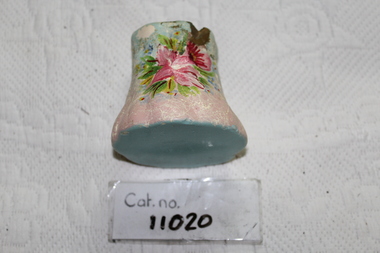
Souvenir - Sorrento Porcelain Vase
... Sorrento Small hand-painted vase, chipped but covered with gold paint. Colours: blue, pink, white, green, red, yellow, gold. Souvenir Sorrento Porcelain ...Small hand-painted vase, chipped but covered with gold paint. Colours: blue, pink, white, green, red, yellow, gold.Sorrento -
 Coal Creek Community Park & Museum
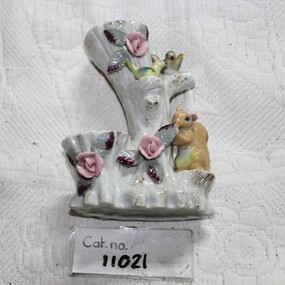
Domestic object - Porcelain 'tree trunk' vase with squirrel and flowers, c.1940s-1950s
... These items were designed to replicate German-made porcelain trinkets, export of which was halted due to the war's impact of people's perception of Germany as a country at that time. Commonalities are a white glossy surface, hand-painted details and gold highlights. ...Small porcelain 'tree trunk' vase, white gloss glaze with a figural squirrel and 2 birds. Flowers dotted about, hand-painted. ...These items were designed to replicate German-made porcelain trinkets, export of which was halted due to the war's impact of people's perception of Germany as a country at that time. Commonalities are a white glossy surface, hand-painted details and gold highlights. ...After WWII, Japan became an export centre for many items, mostly under heavy US investment. They provided the market with an extensive range of mass-produced and affordable pieces. Pieces are typically unmarked, or else simply say 'Japan' in a fine red ink. These items were designed to replicate German-made porcelain trinkets, export of which was halted due to the war's impact of people's perception of Germany as a country at that time. Commonalities are a white glossy surface, hand-painted details and gold highlights. The Japanese pieces differ in that their casting is not as crisp, and there is often roughly-textured decorative spots of applied grit or extrusions. Small porcelain 'tree trunk' vase, white gloss glaze with a figural squirrel and 2 birds. Flowers dotted about, hand-painted. Unmarked, likely made in Japan circa 1940s 1950s. Condition note: broken on back.none -
 Geelong Gallery
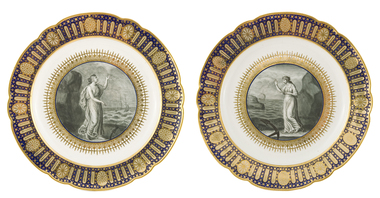
Decorative object - Pair of 'Hope and Patience' plates from the Duke of Clarence service, WORCESTER, 1790-92
... Hand painted (en grisaille) and gilded porcelain...Hand painted (en grisaille) and gilded porcelain Decorative object Pair of 'Hope and Patience' plates from the Duke of Clarence service WORCESTER ...Hand painted (en grisaille) and gilded porcelain -
 Yarrawonga and Mulwala Pioneer Museum
Biscuit Barrel
... porcelain biscuit barrel with a metal lid and handle. Cream in colour decorated with a hand painted flower design in red and green...biscuit, barrel, caddy, porcelain biscuit barrel with a metal lid and handle. Cream in colour decorated with a hand painted flower design in red and green Biscuit Barrel ...porcelain biscuit barrel with a metal lid and handle. Cream in colour decorated with a hand painted flower design in red and greenbiscuit, barrel, caddy, -
 Sunshine and District Historical Society Incorporated
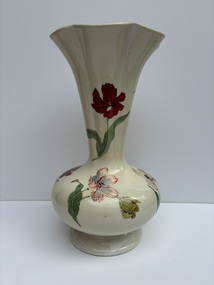
Decorative object - Porcelain Flower Vase
... Large off white porcelain vase with hand painted flowers on the surface...Household Large off white porcelain vase with hand painted flowers on the surface Decorative object Porcelain Flower Vase ...Large off white porcelain vase with hand painted flowers on the surfacehousehold -
 Whitehorse Historical Society Inc.
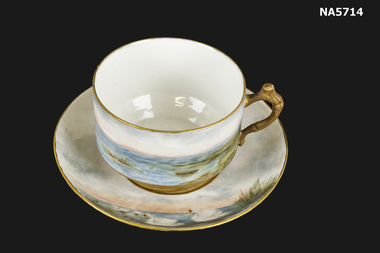
Domestic object - Limoges cup and saucer, Elite Limoges - Gertie Lewin
... Painted Limoges cup and saucer. Inscribed "To Father from Gertie. August 26th 00" Gold rim cup & saucer Decorated swans on water, flying birds on centre. Limoges Porcelain Cup and saucer Elite Limoges Inscription - "To Father from Gertie August 26th 00" Round cup with matching saucer Hand printed - swans- flying birds water and plants Coloured blue, white - sunset/sunrise Gold rim to cup and saucer Light brown centre to saucer Brown handle to cup Domestic object Limoges cup and saucer Elite Limoges - Gertie Lewin ...Painted Limoges cup and saucer. Inscribed "To Father from Gertie. August 26th 00" Gold rim cup & saucer Decorated swans on water, flying birds on centre.Round cup with matching saucer Hand printed - swans- flying birds water and plants Coloured blue, white - sunset/sunrise Gold rim to cup and saucer Light brown centre to saucer Brown handle to cupElite Limoges Inscription - "To Father from Gertie August 26th 00"limoges porcelain, cup and saucer -
 Whitehorse Historical Society Inc.
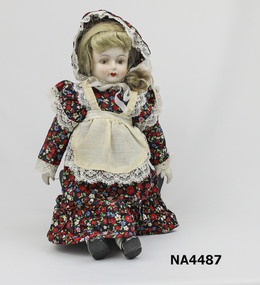
Decorative object - Doll
... Porcelain head, hands, & half leg. Doll, shoes & socks painted, also painted face.Cotton stuffed body to knees. ...She grew up at 31 Drummond Street, Blackburn, in 1946 THEATRE (use PERFORMING ARTS) TOYS Dolls Porcelain head, hands, & half leg. Doll, shoes & socks painted, also painted face.Cotton stuffed body to knees. ...Belonged to Margaret Ord. She grew up at 31 Drummond Street, Blackburn, in 1946Porcelain head, hands, & half leg. Doll, shoes & socks painted, also painted face.Cotton stuffed body to knees. Long nylon hair. Dressed in black floral cotton dress, lace trimmed with long sleeves. Matching bonnet & cream calico apron. Probably a copy of a much earlier doll.?theatre (use performing arts), toys, dolls -
 Friends of Westgarthtown
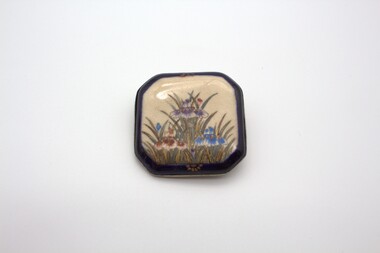
Accessory - Painted Porcelain Brooch
... Painted porcelain brooch featuring a hand-painted floral design set within a decorative metal mount. ...Painted porcelain brooch featuring a hand-painted floral design set within a decorative metal mount. ...Painted porcelain brooch featuring a hand-painted floral design set within a decorative metal mount. The brooch was passed down through generations of the Ziebell family before being donated to Ziebell's Farmhouse Museum by Janet Hubbard. While the original owner and date of manufacture are unknown, the brooch is believed to have belonged to Annie Ziebell (née Robertson). -
 Ballarat Diocesan Historical Commission
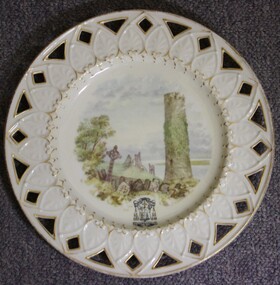
Porcelain plate, Handpainted Irish Belleek plate, c.1889
... Hand-painted Irish Belleek desert plate one of a set of six. 1st period black mark to underside with overglaze printed armorial for Bishop Moore of Ballarat on facing side. Handpainted Irish Belleek plate Porcelain ...Hand-painted Irish Belleek desert plate one of a set of six. 1st period black mark to underside with overglaze printed armorial for Bishop Moore of Ballarat on facing side.
