
Showing 23 items matching "harvesting tools"
-
 Sunshine and District Historical Society Incorporated
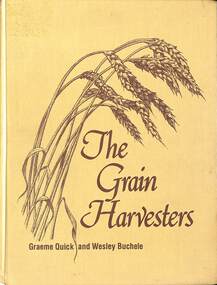
Book - The Grain Harvesters 1978, Graeme Quick & Wesley Buchel, 1978
... harvesting tools...A history of the tools, machines and systems used to harvest grain. This book also contains a chapter 'Meanwhile Down Under', specific to Australia's history and contribution to the subject....The book provides a history of the tools and machinery used to harvest grain throughout the ages....A history of the tools, machines and systems used to harvest grain. This book also contains a chapter 'Meanwhile Down Under', specific to Australia's history and contribution to the subject. harvesting tools harvesting machinery S.S Mc Kay The book provides a history of the tools and machinery used to harvest grain throughout the ages. ...A hardcover book titled The Grain Harvesters.non-fictionharvesting tools, harvesting machinery, s.s mc kay -
 Department of Energy, Environment and Climate Action
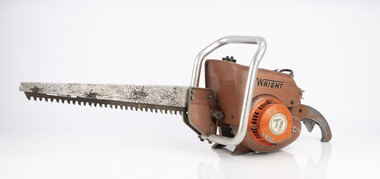
Wright Reciprocating Saw
... ...Forest Harvesting...Hand tools...Forests Commission Victoria (FCV) Forest Harvesting Hand tools Reciprocating Saw. Wright Reciprocating Saw. ...Continuous cutting chain was patented in 1905 by Samuel Bens of San Francisco, while the first portable chainsaw was developed and patented in 1918 by Canadian millwright James Shand. But the main advancements of modern petrol chainsaws occurred in Europe in the 1920s and 30s where Andreas Stihl is often hailed as the "father of the chainsaw" After the second world war lighter materials, metal alloys and improved engine designs revolutionised the logging and timber industry. This Wright Reciprocating Saw was made in Sheboygan, Wisconsin, between 1960 and 1962. Its a Rare GS-5020A model. It has a 7.06 cu. in. (115.7 cc), two-stroke motor, which weighed 25 lbs. (11.3 kg) complete. The blade doesn't stop reciprocating when the saw is running because it's attached directly to the crankshaft. There is no clutch system.Reciprocating Saw.forests commission victoria (fcv), forest harvesting, hand tools -
 Department of Energy, Environment and Climate Action
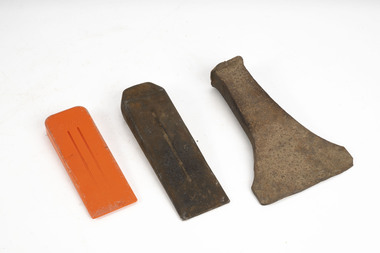
Cutting Wedges
... ...Forest Harvesting...Hand tools...Used to hammer into a saw cut when falling trees Forests Commission Victoria (FCV) Forest Harvesting Hand tools Three types of cutting wedges used when falling trees Cutting Wedges ...Used to hammer into a saw cut when falling treesThree types of cutting wedges used when falling treesforests commission victoria (fcv), forest harvesting, hand tools -
 Flagstaff Hill Maritime Museum and Village
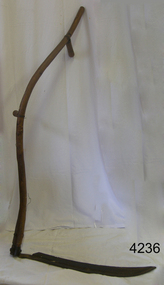
Tool - Scythe, 1930-1960
... tools, consisting of a curved blade fitted at an angle to a long, curved handle and used for cutting grain. In modern scythes the handle has a projecting peg that is grasped by one hand, facilitating control of the swinging motion by which grass and grain are cut. The exact origin of the scythe is unknown, but it was little used in the ancient world. It came into wide use only with agricultural developments of the Carolingian era (8th century AD) in Europe, when the harvesting...tools, consisting of a curved blade fitted at an angle to a long, curved handle and used for cutting grain. In modern scythes the handle has a projecting peg that is grasped by one hand, facilitating control of the swinging motion by which grass and grain are cut. The exact origin of the scythe is unknown, but it was little used in the ancient world. It came into wide use only with agricultural developments of the Carolingian era (8th century AD) in Europe, when the harvesting ...A Scythe was one of the most important of all agricultural hand tools, consisting of a curved blade fitted at an angle to a long, curved handle and used for cutting grain. In modern scythes the handle has a projecting peg that is grasped by one hand, facilitating control of the swinging motion by which grass and grain are cut. The exact origin of the scythe is unknown, but it was little used in the ancient world. It came into wide use only with agricultural developments of the Carolingian era (8th century AD) in Europe, when the harvesting and storing of hay became important to support livestock through winters. Scythes can still be found in use today by hobby farmers and permaculturists. ( producing food, by using ways that do not deplete the earth's natural resources) to cut grass in a more eco-friendly way as opposed to using a machine.A hand tool used for the cutting of crops and grain, modern versions are still being produced today in Europe. The subject item gives us a snapshot into agricultural practices in times past.Scythe with long wood Snath (curved handle) with 1 hand holding piece & curved blade. Noneflagstaff hill, warrnambool, shipwrecked-coast, flagstaff-hill, flagstaff-hill-maritime-museum, maritime-museum, shipwreck-coast, flagstaff-hill-maritime-village -
 Orbost & District Historical Society
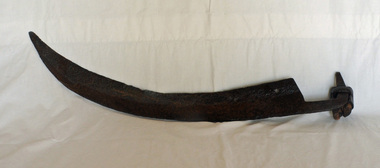
scythe blade, late 19th - early 20th century
... harvesting. They were still used for cutting awkward shaped small plots and for opening a path for the tractors. This item is an example of a tool used by the early settlers of the Orbost district. scythe tool agriculture rural "ROSE" An iron scythe blade, curved and tapered. ...Scythes were used to manually mow wheat or grass. Scythes were used with a long sweeping movement which made them much less tiring for labourers to use than reaping hooks or sickles though they still involved great physical labour and considerable skill to perfect. Both hands were in use and the operator did not have to bend his back to reach down to the crop. On farms scythes were sharpened on a sandstone wheel mounted on an axle with a crank handle on one side. This was hand powered and used with water. Scythes were not used as often on farms after the mechanisation of harvesting. They were still used for cutting awkward shaped small plots and for opening a path for the tractors. This item is an example of a tool used by the early settlers of the Orbost district. An iron scythe blade, curved and tapered. There is no handle and the blade is rusted and pitted."ROSE"scythe tool agriculture rural -
 Orbost & District Historical Society
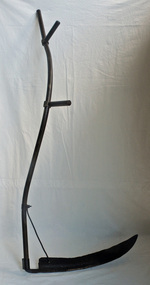
scythe, early -mid 20th century
... harvesting. They were still used for cutting awkward shaped small plots and for opening a path for the tractors. This item is an example of a tool used by the early settlers of the Orbost district. scythe agriculture tool A curved iron blade with one sharp edge. ...Scythes were used with a long sweeping movement which made them much less tiring for labourers to use than reaping hooks or sickles though they still involved great physical labour and considerable skill to perfect. Both hands were in use and the operator did not have to bend his back to reach down to the crop. Scythes were not used as often on farms after the mechanisation of harvesting. They were still used for cutting awkward shaped small plots and for opening a path for the tractors. This item is an example of a tool used by the early settlers of the Orbost district.A curved iron blade with one sharp edge. It is attached to a curved hollow handle with two extensions on one side where the scythe can be held by two hands.scythe agriculture tool -
 Orbost & District Historical Society
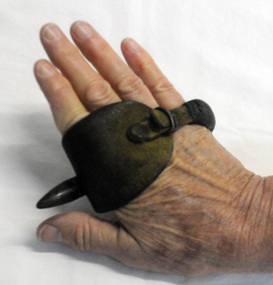
Tool - Maize tool
... This small hand-held tool was used in the maize industry in Murrungowar and Orbost district during 1900-1960s. Prior to machine harvesting coming about in the 1960s, each cob of maize had to picked by hand using this tool. ...This small hand-held tool was used in the maize industry in Murrungowar and Orbost district during 1900-1960s. Prior to machine harvesting coming about in the 1960s, each cob of maize had to picked by hand using this tool. ...This small hand-held tool was used in the maize industry in Murrungowar and Orbost district during 1900-1960s. Prior to machine harvesting coming about in the 1960s, each cob of maize had to picked by hand using this tool. Maize growing was a huge industry in the Orbost district and the job of picking the maize involved hand labour by many employees. This small hand-tool would have been common, but is now rare. This particular tool was owned and used by Nelson Northrope (from Orbost) in the early 20th Century and used at Murrungowar by Frances Eilman (nee Somerville). A highly significant small hand tool associated with the maize industry. This item is rare. A small hand-held metal and leather tool. A metal 'knife' has a curved shape and is attached to 2 leather straps which are connected by a small buckle. maize growing, agriculture, orbost district -
 Orbost & District Historical Society
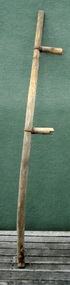
scythe handle, Early 20th century
... harvesting. They were still used for cutting awkward shaped small plots and for opening a path for the tractors. This item is an example of a tool used by the early settlers of the Orbost district. scythe agricultural tool farming A curved wooden scythe handle with two nailed grips attached with metal rings. ...Scythes were used with a long sweeping movement which made them much less tiring for labourers to use than reaping hooks or sickles though they still involved great physical labour and considerable skill to perfect. Both hands were in use and the operator did not have to bend his back to reach down to the crop. Scythes were not used as often on farms after the mechanisation of harvesting. They were still used for cutting awkward shaped small plots and for opening a path for the tractors. This item is an example of a tool used by the early settlers of the Orbost district. A curved wooden scythe handle with two nailed grips attached with metal rings. There is no blade. There is a metal hook at the bottom.scythe agricultural tool farming -
 Phillip Island and District Historical Society Inc.
Chicory Devil, 1870's approximate
... Hand forged Iron Tool for chicory harvesting by hand. 1050mm long with a blade 370mm x 50mm sharpened at the end. ...Chicory Devil made by Dinny Justice who was a Blacksmith on Phillip Island. local history rural industry horticulture chicory devil Hand forged Iron Tool for chicory harvesting by hand. 1050mm long with a blade 370mm x 50mm sharpened at the end. ...Chicory Devil made by Dinny Justice who was a Blacksmith on Phillip Island.Hand forged Iron Tool for chicory harvesting by hand. 1050mm long with a blade 370mm x 50mm sharpened at the end. Footrest protruding 90mm - 100mm each side of the shaft at the top of the blade. Handle loop at top of shaft 130mm x 77mm.local history, rural industry, horticulture, chicory devil -
 Orbost & District Historical Society
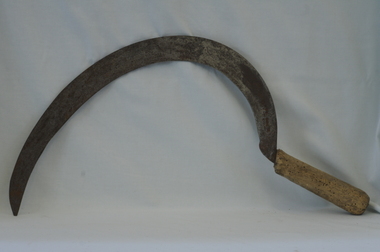
sickle, late 19th -early 20th century
... harvesting. They were still used for cutting awkward shaped small plots, for opening a path for the tractors and for clearing bracken. This item is an example of a tool ...A hand sickle is typically used for harvesting grain crops or cutting succulent forage chiefly for feeding livestock (either freshly cut or dried as hay). this one was used for cutting back bracken fern.Sickles were not used as often on farms after the mechanisation of harvesting. They were still used for cutting awkward shaped small plots, for opening a path for the tractors and for clearing bracken. This item is an example of a tool used by the early settlers of the Orbost district.A wooden handled sickle used for fern cutting. It has a steel curved blade.Stamped on blade - RY4 MADE IN ENGLANDtool farming-implement sickle -
 Kiewa Valley Historical Society
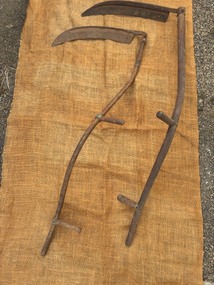
Farming Tools - 2 Scythes, 2 Fern Hooks, 2 Long Handled Sickles, Mattock, Pitch Fork, Pick Axe
... Scythe - Agricultural hand-tool for mowing grass or harvesting crops.Horse drawn machinery and tractors replaced the scythe. ...Scythe - Agricultural hand-tool for mowing grass or harvesting crops.Horse drawn machinery and tractors replaced the scythe. ...1. Scythe - Agricultural hand-tool for mowing grass or harvesting crops.Horse drawn machinery and tractors replaced the scythe. The scythe with the metal rod may have been fitted later, replacing a wooden rod. 2. Fern Hook - Used for slashing or reaping plants 3. Long handled sickle - A traditional single handed agricultural tool with a curved metal blade and handle. Used for harvesting. 4. Mattock - Heavy duty hand tool featuring a long handle and a stout dual-headed metal blade used in many ways eg. digging 5. Pitch Fork - An agricultural tool used to pitch loose material such as hay or leaves. 6. Pick Axe - A tool used to break and pry at the pointed end and the axe end for hoeing, skimming and chopping through roots.Douglas used these tools 70-80 years ago (1950s) mainly on his family's farm at Dandongadale near Buffalo River for harvesting as well as clearing land. Some may have been used on a family property at Whorouly as well and at the Dederang family properties from 1964. At Dederang the family had a tobacco farm and a dairy farm - (now 4 properties). Douglas Petzke had a soldier settlement farm in Dederang. Property was 'Woodside' about 1 km south east of the Dederang store. Douglad had 100 acres on each of the top and bottom sides. The bottom side was the dairy farm and the top side was beside House Creek. The farm totalled more than 200 acres. Douglas left Dederang c 2000 and now (2026) lives at Baranduda.1. Scythes x2 - Long wooden and one is metal curved rod with offset handles and a curved 600 mm long steel blade projecting from one end 2. Fern Hooks x2 - Wooden handle with curved steel blade attached at one end 3. Long-handled Sickles x2 - Both have wooden handles one of which is made from a branch of a 'tree' hence the curve. The blade is curved metal 4. Mattock - A long wooden handle with a dual-headed metal blade 5. Pitch Fork - A long wooden handle with three curved metal prongs attached at one end 6. Pick Axe - A wooden handle with a T-shaped metal attachment fixed perpendicularly to one end. The metal has a pointed end on one side of its head and a broad flat blade on the other side. Fern Hook - "116-319 1250 forge steel" Mattock - "783 4 1/2 (half) lbs" "oomatty". On the other side "LTD" and "AM"farm tools, deans family, douglas petzke, dederang -
 Kiewa Valley Historical Society
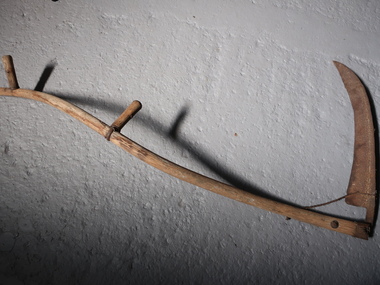
Scythe
... Used as an agricultural hand tool for mowing grass or harvesting crops. It is historically used to cut down or reap edible grains, before the process of threshing. ...Used by the early farmers in the Kiewa Valley. scythe hand tool mowing harvesting The steel blade is curved with a pointy end. ...Used as an agricultural hand tool for mowing grass or harvesting crops. It is historically used to cut down or reap edible grains, before the process of threshing. Replaced by horse drawn and then tractor machinery. Used by the early farmers in the Kiewa Valley.The steel blade is curved with a pointy end. It is attached to a long, slim wooden shaft with a slight S curve. It has 2 handles, one about half way along the shaft and another near the top both at right angles to the shaft. This results in the handles being on slightly different planes and makes it comfortable for the user when working. scythe, hand tool, mowing, harvesting -
 Kiewa Valley Historical Society
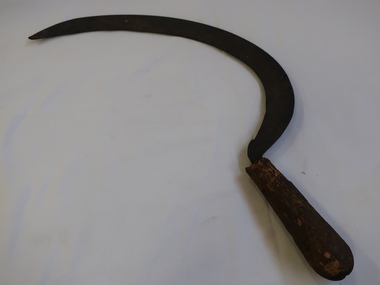
Tool - Sickle
... This sickle was used by a resident of the Kiewa Valley. sickle farm tool garden tool A curved steel edged blade fixed to a short wooden handle. It is used for harvesting the crops, grass and cutting other vegetative matters. ...The sickle was used to cut crops and grass and vegetable matter. It has been in use for a very long time but has probably been superceded by electric tools in developed countries.This sickle was used by a resident of the Kiewa Valley.A curved steel edged blade fixed to a short wooden handle. It is used for harvesting the crops, grass and cutting other vegetative matters. The previous KVHS committee referred to it as a '"Hand Craft Cutter".sickle, farm tool, garden tool -
 Sunshine and District Historical Society Incorporated
Archive - Jim Learmonth documents
... History of the Learmonth - Lermontov families Kirby's Theatre Sunshine 1935|About Sunshine People throughout the Commonwealth Metal Workers Union Letter when Jim Learmonth left Massey Ferguson after 36.5 years service Letter dated 13 September 1977 Letter to J Learmonth 16 May 1955 appointed as Safety Application Engineer and increase in salary to 949 pound per annum Letter to J Learmonth Scoutmaster 1st Sunshine Scout Troop in 1944 for recent appeal for food for Britain and Clothing for distressed persons in Europe from Shire of Braybrook Photocopy of photograph The team of No 11 Tool Room at HV McKay Sunshine Factory Newspaper article about Jim Learmonth Sunshine Harvest profile Letter to Jim Learmonth 10 November 2008 from National Museum of Australia Apprentice certificate 30 June 1914 for Alexander Learmonth awarded first class bonus Newspaper extract Profile Familys bountiful Jim Learmonth reflects on Sunshine's past with Anthony Loncaric Learmonth Family service to HV McKay Harvester Works Sunshine Letter to Mr Learmonth 7 April 1998 from The University of Melbourne thanking him for sharing memories of working at the Sunshine Harvester Works Letter to HJ Learmonth 27 January 1994 from Science Works Newspaper extract The Saturday Age 11 June 2011 A jolly good time in land of combine harvesters National Museum of Australia Audio on demand The Sunshine Harvester Leah Bartsch 10 March 2010 Certificate copy St John Ambulance Association James Learmonth 9 August 1949 Warrant from The Boy Scouts Association to Howard James Learmonth 1 December 1957 Photocopy of photographs Alexander Robert Learmonth Harold Lloyd Buckingham Russell Learmonth Alice Learmonth Wallet presented to Dad Learmonth from Sunshine Branch Fathers Association for Service Rendered 1949|Newspaper 10 July 2007 100 years of memories Note regarding Jim Learmonth donating to the S&DHS a wheelbarrow wheel, a Jewish Harp & a Spinning Top...Howard James "Jim" Learmonth History of the Learmonth - Lermontov families Kirby's Theatre Sunshine 1935|About Sunshine People throughout the Commonwealth Metal Workers Union Letter when Jim Learmonth left Massey Ferguson after 36.5 years service Letter dated 13 September 1977 Letter to J Learmonth 16 May 1955 appointed as Safety Application Engineer and increase in salary to 949 pound per annum Letter to J Learmonth Scoutmaster 1st Sunshine Scout Troop in 1944 for recent appeal for food for Britain and Clothing for distressed persons in Europe from Shire of Braybrook Photocopy of photograph The team of No 11 Tool Room at HV McKay Sunshine Factory Newspaper article about Jim Learmonth Sunshine Harvest profile Letter to Jim Learmonth 10 November 2008 from National Museum of Australia Apprentice certificate 30 June 1914 for Alexander Learmonth awarded first class bonus Newspaper extract Profile Familys bountiful Jim Learmonth reflects on Sunshine's past with Anthony Loncaric Learmonth Family service to HV McKay Harvester Works Sunshine Letter to Mr Learmonth 7 April 1998 from The University of Melbourne thanking him for sharing memories of working at the Sunshine Harvester Works Letter to HJ Learmonth 27 January 1994 from Science Works Newspaper extract The Saturday Age 11 June 2011 A jolly good time in land of combine harvesters National Museum of Australia Audio on demand The Sunshine Harvester Leah Bartsch 10 March 2010 Certificate copy St John Ambulance Association James Learmonth 9 August 1949 Warrant from The Boy Scouts Association to Howard James Learmonth 1 December 1957 Photocopy of photographs Alexander Robert Learmonth Harold Lloyd Buckingham Russell Learmonth Alice Learmonth Wallet presented to Dad Learmonth from Sunshine Branch Fathers Association for Service Rendered 1949|Newspaper 10 July 2007 100 years of memories Note regarding Jim Learmonth donating to the S&DHS a wheelbarrow wheel, a Jewish Harp & a Spinning Top Photocopies and notes from Jim Learmonth regarding his time at McKays Sunshine Harvester Works. ...History of the Learmonth - Lermontov families Kirby's Theatre Sunshine 1935|About Sunshine People throughout the Commonwealth Metal Workers Union Letter when Jim Learmonth left Massey Ferguson after 36.5 years service Letter dated 13 September 1977 Letter to J Learmonth 16 May 1955 appointed as Safety Application Engineer and increase in salary to 949 pound per annum Letter to J Learmonth Scoutmaster 1st Sunshine Scout Troop in 1944 for recent appeal for food for Britain and Clothing for distressed persons in Europe from Shire of Braybrook Photocopy of photograph The team of No 11 Tool Room at HV McKay Sunshine Factory Newspaper article about Jim Learmonth Sunshine Harvest profile Letter to Jim Learmonth 10 November 2008 from National Museum of Australia Apprentice certificate 30 June 1914 for Alexander Learmonth awarded first class bonus Newspaper extract Profile Familys bountiful Jim Learmonth reflects on Sunshine's past with Anthony Loncaric Learmonth Family service to HV McKay Harvester Works Sunshine Letter to Mr Learmonth 7 April 1998 from The University of Melbourne thanking him for sharing memories of working at the Sunshine Harvester Works Letter to HJ Learmonth 27 January 1994 from Science Works Newspaper extract The Saturday Age 11 June 2011 A jolly good time in land of combine harvesters National Museum of Australia Audio on demand The Sunshine Harvester Leah Bartsch 10 March 2010 Certificate copy St John Ambulance Association James Learmonth 9 August 1949 Warrant from The Boy Scouts Association to Howard James Learmonth 1 December 1957 Photocopy of photographs Alexander Robert Learmonth Harold Lloyd Buckingham Russell Learmonth Alice Learmonth Wallet presented to Dad Learmonth from Sunshine Branch Fathers Association for Service Rendered 1949|Newspaper 10 July 2007 100 years of memories Note regarding Jim Learmonth donating to the S&DHS a wheelbarrow wheel, a Jewish Harp & a Spinning Tophoward james "jim" learmonth -
 National Wool Museum
Tool - Sickle, Pre. 1988
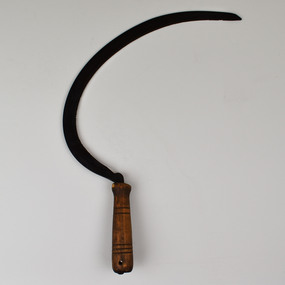
... harvested, these crops can be fed to sheep freshly cut or dried. This sickle has been on display for 30 years at the National Wool Museum. It was at the entrance to Gallery One in the “A New Europe” wood hut display case. It was taken off display in 2021 with the “On the Land” redevelopment of this gallery space. Tools ...Feed for sheep farming is crucially important. Whether growing a sheep for breeding, wool or meat, it is vital to ensure that all sheep at whatever stage of life are maintaining or growing in weight. Sheep are often pictured grazing in paddocks; however, the grass available in a paddock is often not enough to maintain a sheep’s weight. In addition, if a sheep eats grass too low in a paddock then corrosion can affect the soil preventing any grass from growing in this location. For these reasons, supplementary feed is introduced to sheep’s diets. In most occasions’ food high in protein such as Lupins is sought. In times such as drought or to makeup a sheep’s roughage; feed such as silage, hay and straw may be required in the feeding of sheep. This is where the sickle is introduced to sheep farming. Although modern-day machines are used to harvest cereals, in times past the sickle was used for harvesting these crops. Once harvested, these crops can be fed to sheep freshly cut or dried. This sickle has been on display for 30 years at the National Wool Museum. It was at the entrance to Gallery One in the “A New Europe” wood hut display case. It was taken off display in 2021 with the “On the Land” redevelopment of this gallery space.Curved Metal serrated blade extending from carved dark wooden handletools of the trade, sheep feed, sheep farming -
 Friends of Kurth Kiln
Chisel Tool,mid 1940
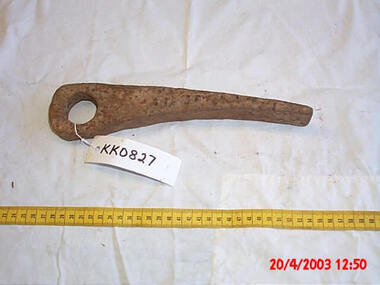
... found amongst the tools at Kurth Kiln Part of wood harvesting machinery Rural Industries Chisel shaped tool for a machine with a 3.5cm hole at one end. 3cm thick and 6cm wide at the thick end. ...found amongst the tools at Kurth Kiln Part of wood harvesting machineryChisel shaped tool for a machine with a 3.5cm hole at one end. 3cm thick and 6cm wide at the thick end. Could be part of a slasher or hammermillrural industries -
 Ararat Gallery TAMA
Mixed media, Inga Hunter, Nrat-tuan Net Leader's Robe, 1986-1989
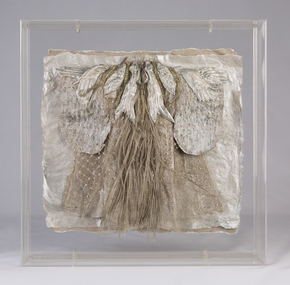
... harvests are unfailingly good. Contact with the humans of Irusag, when the Imperium was first founded, brought the technique of netting to Nrat-Tuan. The Netleader heads the Netter Guild, which does not limit itself to the merely traditional fishing net, but works with a complex and sophisticated membrane technology, which has, in recent years, revolutionised the whole netting industry. The Master controls the experimental membrane laboratories, which deal with the extraction of metals from sea water, as well as with tools...harvests are unfailingly good. Contact with the humans of Irusag, when the Imperium was first founded, brought the technique of netting to Nrat-Tuan. The Netleader heads the Netter Guild, which does not limit itself to the merely traditional fishing net, but works with a complex and sophisticated membrane technology, which has, in recent years, revolutionised the whole netting industry. The Master controls the experimental membrane laboratories, which deal with the extraction of metals from sea water, as well as with tools ...“A silver-grey robe, denoting a powerful official. The Netleader, or Netmaster, as he is sometimes called is head of one of the many craft guilds on Nrat-Tuan. Fishers Guilds are not only vital economic groups for Nrat-Tuan, but also for the whole Imperium, since the water planet is the major source of foodstuffs for Irusaqu, who cannot produce enough crops on what Is a relatively barren, planet. The various fishing crafts are most responsible occupations, entailing great care for the environment and the food chains. Fishing is carried out by means of either mirrors or nets, both being about equally popular. Mirror-faceted fabrics have always been used by Nrati-Tuan fishermen to dazzle and bemuse the creatures they are trying to catch, (the mirror may also have some predictive power). Research indicates that this odd technique is surprisingly effective. And the harvests are unfailingly good. Contact with the humans of Irusag, when the Imperium was first founded, brought the technique of netting to Nrat-Tuan. The Netleader heads the Netter Guild, which does not limit itself to the merely traditional fishing net, but works with a complex and sophisticated membrane technology, which has, in recent years, revolutionised the whole netting industry. The Master controls the experimental membrane laboratories, which deal with the extraction of metals from sea water, as well as with tools for the fishing industry.” -Inga Hunter -
 Whitehorse Historical Society Inc.
Photograph - Coloured Photograph, Sickle and Lavender
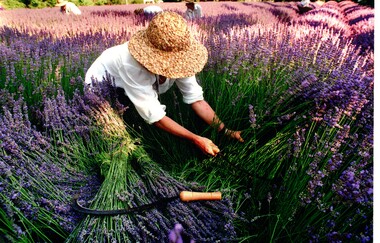
... Tools Farm Implement Lavender A coloured photograph showing a lady using a sickle to harvest lavender. ...A coloured photograph showing a lady using a sickle to harvest lavender.tools, farm implement, lavender -
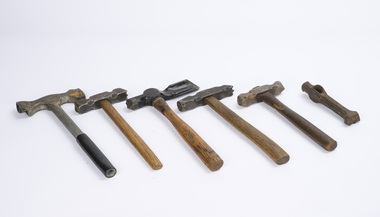 Department of Energy, Environment and Climate Action
Log Branding Hammers (various)
... tools...Forest Harvesting...Forests Commission Victoria (FCV) Hand tools Forest Harvesting Log Grading hammers Log Branding Hammers (various) ...Metal branding hammers were the most common way to control the sale and movement of hardwood timber produce like logs, railway sleepers, fence posts, and poles from Victorian State forests. Royalty was also paid on this basis. Hammers most commonly had a crown stamp on one end with a unique number in the middle which identified its owner, and a crows foot or broad arrow on the other. The broad arrow was a symbol traditionally used in Britain and its colonies to mark government property. Other local configurations were used by sawmillers, post cutters and pulpwood contactors. Forest regulations state that an authorised officer may use the crown mark to identify produce which has been sold and may be removed from the forest, whereas the broad arrow can be used to brand and mark trees which are not to be felled, or to indicate forest produce which has been seized. Hammers were traditionally only ever issued to forest officers and were an important, and closely guarded tool-of-trade. They were not transferred between staff and lending hammers was not permitted. But it was an onerous task for staff to hammer and tally hundreds of logs, or thousands of fence posts each week, so in about 1990 a system was introduced whereby hammers were allocated to logging contractors to grade logs and tally them instead. But there was still spot checking by authorised officers. A register was kept, and contractors paid a substantial deposit to make sure they didn't lose them, but they occasionally turn up by fossickers with metal detectors. While branding hammers are still used in some smaller locations, plastic tags and barcodes are now more common.Log Grading hammersforests commission victoria (fcv), hand tools, forest harvesting -
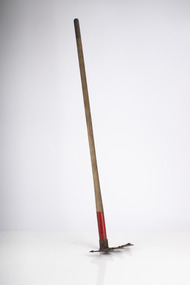 Department of Energy, Environment and Climate Action
Rakehoe (McLeod Tool)
... tools...Forest Harvesting...Forests Commission Victoria (FCV) Hand tools Forest Harvesting Bushfire Rakhoe Rakehoe (McLeod Tool) ...Bushfire perimeter rather than bushfire area is the main control problem for firefighters on the ground. A conundrum rapidly compounded by spot fires. A small 5 ha fire can be nearly 1 km around the perimeter. That's a long way to build a control line by hand in rough bush. Dry firefighting techniques by hand were mostly confined to “knocking down” or “beating out” the flames, as well as "digging out". Digging or raking a “mineral earth” trail down to bare dirt proved most effective in forest fuels which, unlike grass, tend to retain heat and smoulder. Early tools were whatever happened to be close at hand. They were simple and primitive and included shovels, slashers, axes, hoes, beaters and rakes. A cut branch to beat the flames was often the only thing available. Farming and logging tools, developed over centuries of manual labour, and readily available at local hardware stores came into use, but little thought was given to size, weight, and balance. For years foresters experimented with combination tools. In about 1952 fire beaters and other implements were being replaced with Rakuts. However, its believed the now common Rakehoe is an Australian variation of the American McLeod Tool which was developed in 1905 by forest ranger Malcolm McLeod of the Sierra National Forest. The late Athol Hodgson advised that predecessors, Reg Torbet who had been the Chief Fire Officer for the Forests Commission from 1948-1956, along with his QLD counterpart Clive Price, went in late 1951 as Australian delegates on a 10 week fire study tour of Nth America organised by the United Nations. They came back with a couple of McLeod tools from Canada. Cam MacLeod (different spelling) had been the Head of Fire Research for the Canadian Forest Service at the time and had supplied them. The tools were ideal for deciduous forests in the eastern provinces and Clive arranged to have them manufactured in QLD. The Rakho, as it was then spelled, was first issued to FCV crews 65 years ago in 1955-56. The American Pulaski had been trialled, but never found favour with Australian firefighters.Rakhoeforests commission victoria (fcv), hand tools, forest harvesting, bushfire -
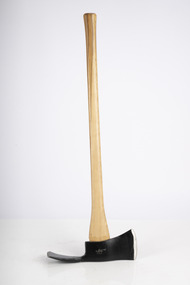 Department of Energy, Environment and Climate Action
Pulaski
... tools...Forest Harvesting...Forests Commission Victoria (FCV) Hand tools Forest Harvesting Bushfire Pulaski Fire Tool Combines an axe and a grubbing hoe. ...Bushfire perimeter rather than bushfire area is the main control problem for firefighters on the ground. A conundrum rapidly compounded by spot fires. A small 5 ha fire can be nearly 1 km around the perimeter. That's a long way to build a control line by hand in rough bush. Dry firefighting techniques by hand were mostly confined to “knocking down” or “beating out” the flames, as well as "digging out". Digging or raking a “mineral earth” trail down to bare dirt proved most effective in forest fuels which, unlike grass, tend to retain heat and smoulder. Early tools were whatever happened to be close at hand. They were simple and primitive and included shovels, slashers, axes, hoes, beaters and rakes. A cut branch to beat the flames was often the only thing available. Farming and logging tools, developed over centuries of manual labour, and readily available at local hardware stores came into use, but little thought was given to size, weight, and balance. For years foresters experimented with combination tools. In about 1952 fire beaters and other implements were being replaced with Rakuts. However, its believed the now common Rakehoe is an Australian variation of the American McLeod Tool which was developed in 1905 by forest ranger Malcolm McLeod of the Sierra National Forest. The late Athol Hodgson advised that predecessors, Reg Torbet who had been the Chief Fire Officer for the Forests Commission from 1948-1956, along with his QLD counterpart Clive Price, went in late 1951 as Australian delegates on a 10 week fire study tour of Nth America organised by the United Nations. They came back with a couple of McLeod tools from Canada. Cam MacLeod (different spelling) had been the Head of Fire Research for the Canadian Forest Service at the time and had supplied them. The tools were ideal for deciduous forests in the eastern provinces and Clive arranged to have them manufactured in QLD. The Rakho, as it was then spelled, was first issued to FCV crews 65 years ago in 1955-56. The American Pulaski had been trialled, but never found favour with Australian firefighters.Pulaski Fire Tool Combines an axe and a grubbing hoe. Digging end and cutting end with short wooden handleforests commission victoria (fcv), hand tools, forest harvesting, bushfire -
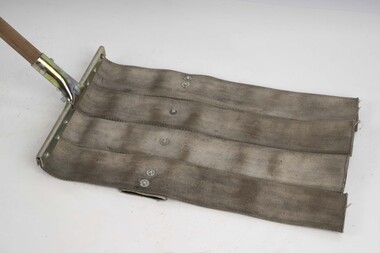 Department of Energy, Environment and Climate Action
Fire beater (canvas)
... tools...Forest Harvesting...Forests Commission Victoria (FCV) Hand tools Forest Harvesting Bushfire Fire Beater (canvas) 1930s design Fire beater (canvas) ...Bushfire perimeter rather than bushfire area is the main control problem for firefighters on the ground. A conundrum rapidly compounded by spot fires. A small 5 ha fire can be nearly 1 km around the perimeter. That's a long way to build a control line by hand in rough bush. Dry firefighting techniques by hand were mostly confined to “knocking down” or “beating out” the flames, as well as "digging out". Digging or raking a “mineral earth” trail down to bare dirt proved most effective in forest fuels which, unlike grass, tend to retain heat and smoulder. Early tools were whatever happened to be close at hand. They were simple and primitive and included shovels, slashers, axes, hoes, beaters and rakes. A cut branch to beat the flames was often the only thing available. Farming and logging tools, developed over centuries of manual labour, and readily available at local hardware stores came into use, but little thought was given to size, weight, and balance. For years foresters experimented with combination tools. In about 1952 fire beaters and other implements were being replaced with Rakuts. However, its believed the now common Rakehoe is an Australian variation of the American McLeod Tool which was developed in 1905 by forest ranger Malcolm McLeod of the Sierra National Forest. The late Athol Hodgson advised that predecessors, Reg Torbet who had been the Chief Fire Officer for the Forests Commission from 1948-1956, along with his QLD counterpart Clive Price, went in late 1951 as Australian delegates on a 10 week fire study tour of Nth America organised by the United Nations. They came back with a couple of McLeod tools from Canada. Cam MacLeod (different spelling) had been the Head of Fire Research for the Canadian Forest Service at the time and had supplied them. The tools were ideal for deciduous forests in the eastern provinces and Clive arranged to have them manufactured in QLD. The Rakho, as it was then spelled, was first issued to FCV crews 65 years ago in 1955-56. The American Pulaski had been trialled, but never found favour with Australian firefighters.Fire Beater (canvas) 1930s designforests commission victoria (fcv), hand tools, forest harvesting, bushfire -
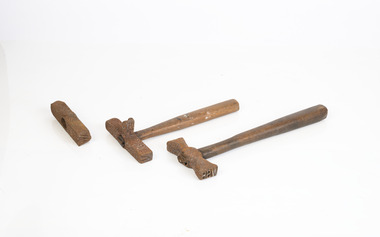 Department of Energy, Environment and Climate Action
Log Branding Hammer
... tools...Forest Harvesting...Forests Commission Victoria (FCV) Hand tools Forest Harvesting Log Grading hammers Log Branding Hammer ...Metal branding hammers were the most common way to control the sale and movement of hardwood timber produce like logs, railway sleepers, fence posts, and poles from Victorian State forests. Royalty was also paid on this basis. Hammers most commonly had a crown stamp on one end with a unique number in the middle which identified its owner, and a crows foot or broad arrow on the other. The broad arrow was a symbol traditionally used in Britain and its colonies to mark government property. Other local configurations were used by sawmillers, post cutters and pulpwood contactors. Forest regulations state that an authorised officer may use the crown mark to identify produce which has been sold and may be removed from the forest, whereas the broad arrow can be used to brand and mark trees which are not to be felled, or to indicate forest produce which has been seized. Hammers were traditionally only ever issued to forest officers and were an important, and closely guarded tool-of-trade. They were not transferred between staff and lending hammers was not permitted. But it was an onerous task for staff to hammer and tally hundreds of logs, or thousands of fence posts each week, so in about 1990 a system was introduced whereby hammers were allocated to logging contractors to grade logs and tally them instead. But there was still spot checking by authorised officers. A register was kept, and contractors paid a substantial deposit to make sure they didn't lose them, but they occasionally turn up by fossickers with metal detectors. While branding hammers are still used in some smaller locations, plastic tags and barcodes are now more common.Log Grading hammersforests commission victoria (fcv), hand tools, forest harvesting
