
Showing 10 items matching "hawker's wagon"
-
 Flagstaff Hill Maritime Museum and Village
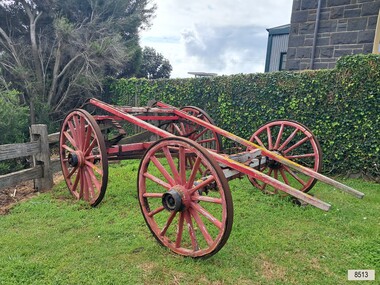
Vehicle - Wagon, Circa 1909
... ...hawker's wagon...hawkers. In September 1909, near Thowgla, he was thrown from his wagon while attempting to navigate a deep rut and was run over by one of its wheels. ...Wagon: a light delivery vehicle once used as a hawker's wagon. It is a four-wheel, horse-drawn vehicle with iron tyres, brakes, spoked wheels painted red with decorative yellow strips on the hubs, a timber shaft, and springs on the undercarriage. ...The late-19th to early-20th-century wagon was once owned by Pooran Singh, a local Indian hawker. Vehicle Wagon Pooran Singh John James Moore ...This wagon was used in towns across south-west Victoria during the first half of the twentieth century by Pooran Singh, an Indian-born immigrant. Singh arrived in Australia alone in 1899 at the age of 30. The following year, at the Colac Licensing Court in western Victoria, he was one of 78 hawkers granted a Hawker’s Licence. According to the Colac Herald, all but two of the applicants appeared to be Asian. While some hawkers registered horse-drawn carts, Singh was one of nineteen licensed to trade on foot, selling door to door. Applicants were encouraged to contribute to a collection for the Colac Hospital. Over time, Pooran Singh came to own his own wagon—a top-of-the-range light delivery vehicle—and a horse named Prince. His work often took him along rough country roads, and for a period, he worked in the Corryong district of north-eastern Victoria, an area popular with hawkers. In September 1909, near Thowgla, he was thrown from his wagon while attempting to navigate a deep rut and was run over by one of its wheels. Although he suffered bruising to his chest, his injuries were not serious. The following year, he was granted a Hawker’s Licence in Corryong. By 1916, Singh was living and working at Garvoc in western Victoria, where that year, he lost his paper licence on Cooramook Road, and he placed a notice in The Standard. In 1918, at the Warrnambool Petty Sessions Court, he was one of four applicants granted renewal of their hawkers’ licences, and each donated ten shillings to Warrnambool Hospital. Throughout these years, Singh became well known to farmers and their families as he travelled across Victoria’s Western District, living and working from his covered wagon. In his later years, Pooran Singh formed a close friendship with John Jandes Moore and his wife, Vera, of Russells Creek, Warrnambool. They offered him the use of their property as a base for his travels and cared for him during his final illness. John Moore was later appointed one of the two executors of Singh’s will. Pooran Singh died in Warrnambool on 8 June 1947, aged 77. His final wish was to be cremated and for his ashes to be returned to India for immersion in the Ganges. The cremation was arranged by Guyett’s Funerals in Warrnambool. Having never married, Singh left his estate to his four nephews, enabling them to buy land and build homes; one later installed a memorial plaque in his honour. In the late 1980s, Guyett’s Funerals placed his ashes in the niche wall at Warrnambool Cemetery as a memorial, while continuing to hope that family instructions might eventually arrive. Nearly 63 years after his death, renewed enquiries brought public attention to the long and respectful care given to his ashes. As a result, the renowned Indian cricketer Kapil Dev travelled to Warrnambool to collect them and escort them to India, helping to fulfil Singh’s final wish. He was joined by one of Singh’s grand-nephews, Harmel Uppal, who had travelled from England. At a formal ceremony on 25 July 2010 commemorating Singh’s life, the ashes were handed to Dev and Uppal, and local resident Avis Quarrell, who had known Singh as a child, read a poem she had written in his memory. She still owned a shell necklace that Singh had made for her mother. Some Warrnambool locals who had been closely involved also travelled to India, where they joined Uppal’s family from the village of Uppal Bhopa, near Jalandhar. On 31 July 2010, Pooran Singh’s ashes were immersed in the Ganges, fulfilling the wish he had expressed more than six decades earlier. After Pooran Singh’s death, his horse and wagon remained on John Moore’s property. When Prince died, he was buried on the beach at Warrnambool. The wagon remained with the Moore family and was occasionally used as a cubby house. In about 1997, John Moore, the son of John Jandes Moore, donated it to Flagstaff Hill. After restoration, the wagon became an attraction in the village, where volunteer Pat and his Clydesdale horse, Duke, offered visitors rides around Flagstaff Hill’s lake. This wagon is significant for its association with an Indian emigrant who used it to earn an income in Australia. It also reflects the vital role of hawkers, who travelled through rural and regional communities in the late nineteenth and early twentieth centuries, supplying food, goods and news. The wagon is also historically significant as a former Flagstaff Hill attraction, offering visitors the experience of horse-drawn rides around the lake.Wagon: a light delivery vehicle once used as a hawker's wagon. It is a four-wheel, horse-drawn vehicle with iron tyres, brakes, spoked wheels painted red with decorative yellow strips on the hubs, a timber shaft, and springs on the undercarriage. It was once a covered wagon, fitted with green, wooden sideboards, a front seat with leather-padded backrest and mounting steps. The late-19th to early-20th-century wagon was once owned by Pooran Singh, a local Indian hawker. flagstaff hill, warrnambool, maritime village, maritime museum, flagstaff hill maritime museum and village, shipwreck coast, great ocean road, southwest victoria, northwest victoria, western district, colac, colac hospital, colac licensing court, thowgla, corryong, garvoc, cooramook road, warrnambool petty sessions court, warrnambool hospital, russells creek road, ganges, warrnambool cemetery, uppal bhopa, jalandhar, hawker’s licence, covered wagon, wagon, hawker's wagon, horse-drawn cart, hawker's cart, light delivery vehicle, hawker, travelling salesman, travelling hawker, door-to-door sales, rural salesman, rural commerce, prince, duke, clydesdale horse, 1997, pooran singh, indian immigrant, pat, john james moore, vera moore, john and vera moore, john moore, guyatt’s funerals, kapil dev, harmel uppal, avis quarrell -
 Halls Gap & Grampians Historical Society
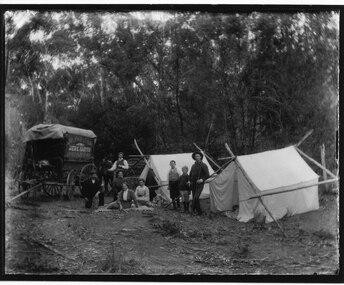
Photograph - B/W
... The photo shows a hawkers wagon and camp in the Wartook area....The photo shows a hawkers wagon and camp in the Wartook area. RECREATION Camping PEOPLE Hawkers The photo shows two tents, side by side, with a wagon to the left of them. ...The photo shows a hawkers wagon and camp in the Wartook area.The photo shows two tents, side by side, with a wagon to the left of them. There are three women sitting, a man kneeling and another standing in front of the left hand tent, and a man and two boys standing to the left of the right hand tent. There is bush in the background.recreation, camping, people, hawkers -
 Warrnambool and District Historical Society Inc.
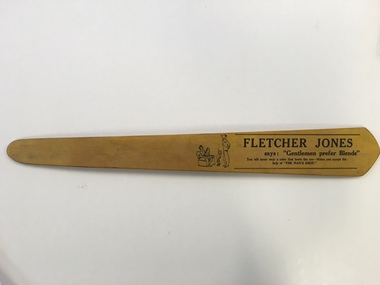
Artefact, Wood-Necktie shaper, Mid 20th century
... He served in World War 1 and returned in 1917 and with a war repatriation loan bought a hawkers wagon and commenced working a circuit around the Western District. ...He served in World War 1 and returned in 1917 and with a war repatriation loan bought a hawkers wagon and commenced working a circuit around the Western District. ...David Fletcher Jones was born in Bendigo in 1895. He served in World War 1 and returned in 1917 and with a war repatriation loan bought a hawkers wagon and commenced working a circuit around the Western District. In 1924 he bought a business in Warrnambool and after an initial shaky start he started to build his business. He was well regarded and involved in the town and the 1960-70’s saw the Fletcher Jones brand and factory expand to become one of the largest employers in the town. Ownership was based on a co-operative model with employees owning shares in the company. As well as manufacturing he had a number of retail stores across Australia. This item is likely to be a prop from one such store. A minor item which is linked to an important part of Warrnambool’s past.Piece of wood shaped like a necktie with advertising slogan and small diagram in black text.Fletcher Jones says “Gentlemen prefer Blends” You will never wear a colour that hurts your eyes_ When you accept the help of “The Man’s Shop”sir fletcher jones, david fletcher jones, fletcher jones warrnambool -
 Marysville & District Historical Society
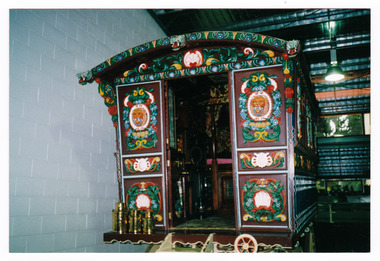
Document (Item) - Research document, Craig Robson's Fairground Follies, 1904 Romani Vardo Showman's/Gypsy Wagon, 05-09-2022
... The Romani Vardo wagon was housed in The Marysville Museum alongside a collection of horse-drawn vehicles, veteran, vintage, and classic vehicles, various machinery, and memorabilia. the marysville museum marysville victoria burton type wagon henry jones & son gypsy hawkers gypsies william spooner artist st george dragon peter ingram gypsy museum selbourne england colin king fred sawyer A research document on the 1904 Romani Vardo wagon from The Marysville Museum in Marysville in Victoria. 1904 Romani Vardo Showman's/Gypsy Wagon Document Research document Craig Robson's Fairground Follies ...A research document on the 1904 Romani Vardo wagon from The Marysville Museum in Marysville in Victoria.A research document on the 1904 Romani Vardo wagon from The Marysville Museum in Marysville in Victoria. Fred Sawyer was originally from London, but then later relocated to Sydney, Australia, and then to Marysville in Victoria where he established The Marysville Museum. The Romani Vardo wagon was housed in The Marysville Museum alongside a collection of horse-drawn vehicles, veteran, vintage, and classic vehicles, various machinery, and memorabilia.the marysville museum, marysville, victoria, burton type wagon, henry jones & son, gypsy, hawkers, gypsies, william spooner, artist, st george, dragon, peter ingram, gypsy museum, selbourne, england, colin king, fred sawyer -
 Marysville & District Historical Society
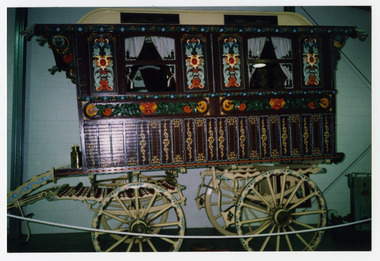
Photograph (Item) - Colour photograph, Unknown
... The Romani Vardo wagon was housed in The Marysville Museum alongside a collection of horse-drawn vehicles, veteran, vintage, and classic vehicles, various machinery, and memorabilia. the marysville museum marysville victoria burton type wagon henry jones & son gypsy hawkers gypsies william spooner artist st george dragon peter ingram gypsy museum selbourne england colin king fred sawyer A colour photograph of the Romany Vardo Gypsy wagon in The Marysville Museum in Marysville in Victoria. ...A colour photograph of the Romany Vardo Gypsy wagon in The Marysville Museum in Marysville in Victoria.A colour photograph of the Romany Vardo Gypsy wagon in The Marysville Museum in Marysville in Victoria. Fred Sawyer was originally from London, but then later relocated to Sydney, Australia, and then to Marysville in Victoria where he established The Marysville Museum. The Romani Vardo wagon was housed in The Marysville Museum alongside a collection of horse-drawn vehicles, veteran, vintage, and classic vehicles, various machinery, and memorabilia.the marysville museum, marysville, victoria, burton type wagon, henry jones & son, gypsy, hawkers, gypsies, william spooner, artist, st george, dragon, peter ingram, gypsy museum, selbourne, england, colin king, fred sawyer -
 Marysville & District Historical Society
Photograph (Item) - Colour photograph, Unknown
... The Romani Vardo wagon was housed in The Marysville Museum alongside a collection of horse-drawn vehicles, veteran, vintage, and classic vehicles, various machinery, and memorabilia. the marysville museum marysville victoria burton type wagon henry jones & son gypsy hawkers gypsies william spooner artist st george dragon peter ingram gypsy museum selbourne england colin king fred sawyer A colour photograph of the Romany Vardo Gypsy wagon in The Marysville Museum in Marysville in Victoria. ...A colour photograph of the Romany Vardo Gypsy wagon in The Marysville Museum in Marysville in Victoria.A colour photograph of the Romany Vardo Gypsy wagon in The Marysville Museum in Marysville in Victoria. Fred Sawyer was originally from London, but then later relocated to Sydney, Australia, and then to Marysville in Victoria where he established The Marysville Museum. The Romani Vardo wagon was housed in The Marysville Museum alongside a collection of horse-drawn vehicles, veteran, vintage, and classic vehicles, various machinery, and memorabilia.the marysville museum, marysville, victoria, burton type wagon, henry jones & son, gypsy, hawkers, gypsies, william spooner, artist, st george, dragon, peter ingram, gypsy museum, selbourne, england, colin king, fred sawyer -
 Glenelg Shire Council Cultural Collection
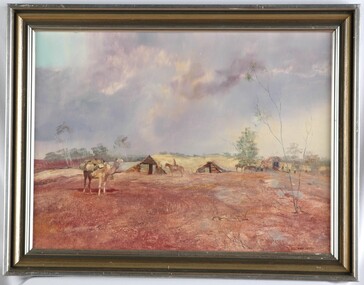
Painting, Hawker Transport, 1977
... wagon of far right. In background are trees and grassland. The top half of image is sky, with clouds painted in blue, grey and mauve with white highlights. Australian desert scene. Framed in silver and gold painted wooden frame. Hawker ...View of two tents and a wagon in a dry landscape. In foreground is a camel loaded with packaged goods. A man on a horse is in centre of image, to the right of one of the tents. Two more horses are tethered by the wagon of far right. In background are trees and grassland. The top half of image is sky, with clouds painted in blue, grey and mauve with white highlights. Australian desert scene. Framed in silver and gold painted wooden frame.Front: B. Malloch '77 (lower right) (sienna paint) Back: 8 (pencil, sticker, upper left)oil painting, camel, horses, transport -
 Wodonga & District Historical Society Inc
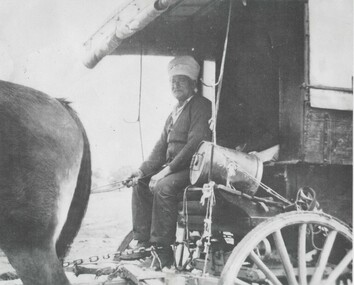
Photograph - Sikh Hawkers in Wodonga
... hawkers were a regular sight throughout the Wodonga and Upper Murray district in the early 20th century. The regular visitors to the area included Pola Singh and Gambil (Gamble) Singh. Gamble Singh often camped on McKoy’s Moorefield property in West Wodonga and several other places around the district. Gamble was also a horse breeder and had several draught horses to pull his wagon...hawkers were a regular sight throughout the Wodonga and Upper Murray district in the early 20th century. The regular visitors to the area included Pola Singh and Gambil (Gamble) Singh. Gamble Singh often camped on McKoy’s Moorefield property in West Wodonga and several other places around the district. Gamble was also a horse breeder and had several draught horses to pull his wagon ...Sikh hawkers were a regular sight throughout the Wodonga and Upper Murray district in the early 20th century. The regular visitors to the area included Pola Singh and Gambil (Gamble) Singh. Gamble Singh often camped on McKoy’s Moorefield property in West Wodonga and several other places around the district. Gamble was also a horse breeder and had several draught horses to pull his wagon. Like many of the hawkers he worked hard to send money back to support family in India. He apparently returned to India about 1950, but left some money in the Bank of NSW in Wodonga in case he returned. He allegedly died soon after and the money was eventually able to be claimed by his nephews in India. A small overlooked park in Wodonga is named the “Gamble Singh Park” in his memory. J. Flanagan who operated the Halfway Hotel commented on having as many as seven or eight bullock teams “yoked” overnight to the fence outside the hotel as well as 100 or more Indian hawkers – led by the fondly known Pola (Pollah) Singh. The hawkers returned to Wodonga annually to renew their hawkers’ license and camped on the flats, or also came to Wodonga to collect orders at the railway station to stock up their supplies. Pola Singh was often based at the Colac Colac reserve near Corryong and had on board his compatriot Isar Singh. He often acted as an intermediary between the individual hawkers and the authorities. Unfortunately, it was Pola’s habit to walk in front of his wagon at the start of each day. On the morning of 23 June 1923 his horses were restive and hard to control. They took flight and ran Pola down on the road near Cudgewa. He was rushed to the Corryong Hospital but died there a few days later, aged 65. Pola was cremated, with some of his ashes scattered in the Murray River and some returned to his homeland to be scattered in the Ganges River. His cremation was listed in the Obituary page of the Weekly Times, Melbourne on Saturday 14 July 1923. A small memorial to Pola Singh is located in the Corryong Cemetery.These images are significant because they help to document the history of the Sikh Hawkers who plied their services to Wodonga and throughout rural Australia in the late 19th and early 20th centuries.A collection of black and white images featuring Sikh Hawkers Gamble Singh and Pola Singh take in the Wodonga area.indian hawkers, sikh hawkers, gamble singh, pola singh -
 Bacchus Marsh & District Historical Society
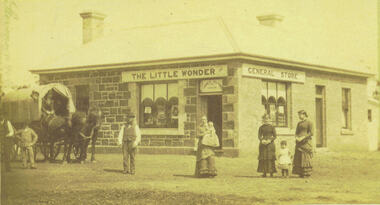
Photograph, Alford's Little Wonder Store Bacchus Marsh 1883
... The photo also shows the covered wagon of a travelling salesman, who were known as ‘hawkers’, who were significant in the supply of goods and news to outlying towns and districts before the development of road and rail networks. ...The photo also shows the covered wagon of a travelling salesman, who were known as ‘hawkers’, who were significant in the supply of goods and news to outlying towns and districts before the development of road and rail networks. ...The Little Wonder Store was built in 1883 from materials of the demolished Maddingley School. It was located on the corner of Grant Street and Labilliere Street. In 1886 James Alford obtained a licence to conduct the Railway Hotel and General Store there. A second storey was added later and the building continued to operate as the Railway Hotel. It was destroyed by fire in 1998. The photo also shows the covered wagon of a travelling salesman, who were known as ‘hawkers’, who were significant in the supply of goods and news to outlying towns and districts before the development of road and rail networks. Small sepia 'carte de viste' style unframed photograph on card with gold border framing photograph. Housed in the Jeremeas Family Album which contains photographs of Bacchus Marsh and District in 1883 by the photographers Stevenson and McNicoll. The photo shows a single-storey building of bluestone and brick with two signs on the front and side, the front sign reading “THE LITTLE WONDER” and the side sign “GENERAL STORE”. Above the door is a sign with the name ‘James Alford’. The windows display the merchandise of the store. Outside the store is a travelling salesman’s cart pulled by two horses. The salesman sits in the cart ready to drive off. Standing along the street outside the store are three men, three women and two young children.Printed On the front: Stevenson & McNicoll. Photo. 108 Elizabeth St. Melbourne. COPIES CAN BE OBTAINED AT ANY TIME. On the back: LIGHT & TRUTH inscribed on a banner surmounted by a representation of the rising sun. Copies of this Portrait can be had at any time by sending the Name and Post Office Money Order or Stamps for the amount of order to STEVENSON & McNICOLL LATE BENSON & STEVENSON, Photographers. 108 Elizabeth Street, MELBOURNE. stevenson and mcnicoll 1883 photographs of bacchus marsh and district, shops bacchus marsh, general stores bacchus marsh vic., hawkers, hotels bacchus marsh -
 Allan Doney Collection, Bendigo Historical Society Inc.
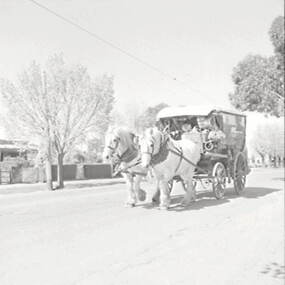
Negative - Hawkers Wagon, Allan Doney, 1950 -1970
... Although he travelled to many other places in Northern Victoria and beyond in search of subjects for his art, he seemed to always return to Bendigo for inspiration. Negative Hawkers Wagon Allan Doney ...In the years of Allan Doney’s photography, landmark buildings succumbed to fire, neglect and redevelopment. He photographed the grey sand hills from Bendigo’s mining past, the streetscapes, poppet heads, miners’ cottages, gracious homes with ornate verandahs, trams and much more. Above all, his photographs show how much of the city has survived from the 19th century – and how much has not. Through two decades of great change, Allan Doney was there to capture ways people interacted with it. Although he travelled to many other places in Northern Victoria and beyond in search of subjects for his art, he seemed to always return to Bendigo for inspiration.
