
Showing 97 items matching "health books"
-
 Mont De Lancey
Book, E.J. Stanley, Library of Health, 1916 (1926 edition)
... ...Health books... and medical equipment Health Health books Health - families Medical books A rare vintage home medical book, 1926 edition with 20 books in one volume. ...A rare vintage home medical book, 1926 edition with 20 books in one volume. It is fully illustrated with pop-ups and full details of prevention rather than cure for the layman and family use.A very thick vintage black leather bound textured forewoed Library of Health book with the title embossed in the middle of the front cover in gold letters with a cross above the title and a genie lamp below. There is a patterned embossed rectangular border as well. On the spine the title is embossed in gold letters with a tree design in black embossing along the the length of the spine. The end papers are an allover red and cream floral and leaf pattern. The marbled edges of the pages are red, green, and white flecked. Inside there is a Foreward with two quotes about life and death as well as one about the knowledge of prevention of disease, especially in the home. The next page has a statement stating that over a million copies of this book have been sold. The black and white frontispiece is a photograph of the editor B. Frank Scholl, Ph.G., M.D. The title page has the title, editor, and publication details. There is a 'Thanks...'page, a General Arrangement page, A Table of Contents for each of the 20 Books contained in the book, List of Illustrations, diagrams, charts, some coloured as well as many black and white photographs. Pp. 1712 B. The author in 1916 was E.J. Stanley Copyright 1916. There are tables, medicine doses, glossary and an Index at the back. Total Pp. 1774. Inside is a small white with blue lettering Instruction Booklet from the publisher for the use of the book to ensure it is not damaged because of it's size and and some guidance for some of the contents to assist the greatest benefit is received.A rare vintage home medical book, 1926 edition with 20 books in one volume. It is fully illustrated with pop-ups and full details of prevention rather than cure for the layman and family use.health and medical equipment, health, health books, health - families, medical books -
Marysville & District Historical Society
THE TRIANGLE NEWS-VOL 2 NO 7-MARCH 25 1977
... ...did you know health books...marysville victoria australia swimming pool closes fire brigade football red cross concert marysville kindergarten bowling club stevens art gallery annual library party meeting community care centre mobile library narbethong first aid group did you know health books lions have you noticed concrete slab golf visit of scottish country dance groups for sale floral carpet wanted to buy top gear oil heaters THE TRIANGLE NEWS-VOL 2 NO 7-MARCH 25 1977 ...marysville, victoria, australia, swimming pool closes, fire brigade, football, red cross concert, marysville kindergarten, bowling club, stevens art gallery, annual library party meeting, community care centre, mobile library, narbethong first aid group, did you know health books, lions, have you noticed concrete slab, golf, visit of scottish country dance groups, for sale floral carpet, wanted to buy, top gear oil heaters -
 Flagstaff Hill Maritime Museum and Village
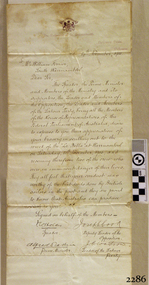
Letter - William Ferrier, 14th November 1905
... health and he died of a heart attack six months after the wreck; he was only thirty-seven. His body was buried in the Melbourne General Cemetery. The La Bella was “the best documented of all sailing ships owned in New Zealand”. Her record books...health and he died of a heart attack six months after the wreck; he was only thirty-seven. His body was buried in the Melbourne General Cemetery. The La Bella was “the best documented of all sailing ships owned in New Zealand”. Her record books ...The letter to William Ferrier of South Warrnambool from the Prime Minister and the Parliament of the Commonwealth recognised the significance of William’s brave and courageous lifesaving act to the people of Australia; “They all feel that your conduct was worthy of the best deeds done by British sailors in the past and they are proud to know that Australia can produce such as you.” The story of that brave rescue follows on below … The ship from which the sailors were rescued was the three-masted, iron and steel barquentine the La Bella, built in Norway in 1893. She was one of two iron and steel ships by Johan Smith, The company was one of the leading shipping families in Tvedestrand, Norway. She was significant to Norwegian shipping, being one of only 27 iron and steel ships ever built in Norway. She was registered in New Zealand and engaged from 1902 in inter-colonial trading of timber in the Pacific, between New Zealand and Australia and was often in Port Phillip Bay, Victoria. On 5th October 1905, the twelve-year-old La Bella left Lyttleton, New Zealand carrying a cargo of timber bound for Warrnambool, Australia. She was manned by a crew of twelve: the Master, (Captain Mylius, previously 1st Mate of La Bella, appointed Captain to La Bella on 6th February 1903) 2 Mates, Cook, six able seamen, one ordinary seaman and a boy. Bad weather en route caused her to shelter at Burnie on Tasmania's North West coast. On November 10th, the 37th day of her journey, La Bella approached Warrnambool. Captain Mylius steered her towards Lady Bay Channel in heavy south-west seas and evening mist. He ordered the helmsman to steer for the light. As the ship came round, a tremendous sea struck her on the port quarter, causing her to breach broadside in a north-westerly direction into breakers. The helm was brought round twice more, but each time heavy seas broke over her, the third time throwing the La Bella on to a submerged reef in Lady Bay now known as La Bella Reef (about 100 yards from the Warrnambool breakwater). The sea was so rough that it even wrenched a one-and-a-half ton anchor from its fastenings and into the sea. As Captain Mylius headed to the steel wheelhouse, intending to send up a rocket flare, a huge sea slammed the steel door into him (resulting in massive bruising front and back) Despite his injuries he still managed to set off a blue light, which he held up in his hands. La Bella’s lifeboats were filled with seawater and broke up on their chocks. The blue light was the first indication to people on the shore that there was a ship in distress. The Harbour Master, Captain Roe (who lived in the Harbour Master’s House opposite Flagstaff Hill), organised a group of volunteers to crew the lifeboat because the trained crew was unavailable; the crewmen were working on a steamer in Port Fairy at the time. He then poured oil onto the water to try and smooth the sea. At around 11 pm three of the crew took shelter in the steel forecastle but the sea crashed into it and broke it up. While the rest of the crew and onlookers watched helplessly in the moonlight the bodies were washed away into the sea, never to be seen again. Some of the crew lashed themselves to the weather rail to keep from being washed away. Watson, the ordinary seaman, became tangled in the rigging lines and was too weak to move, so the 2nd Mate, Robertson, put a line onto him so that he wouldn’t wash off. Around 11 pm three of the crew were unconscious from exhaustion. The situation on La Bella was becoming dangerous. The 2nd Mate moved to the ‘house’ and soon afterwards the ship slipped in the heavy sea. The lashings of the 1st Mate and the ‘boy’ Denham had kept them safe until about 2 am when they were washed overboard; no one was able to help. One by one, the exhausted crew were being washed overboard, too weak to hold on any longer. During the night the La Bella had broken into two and the deckhouse ran out towards the sea. Two more men drowned when trying to reach the lifeboat. By sunrise, the only survivors of the twelve were the Master, 2nd Mate and three seamen. Early in the morning, Captain Roe used the rocket apparatus on shore to try and shoot a line to the ship for a safer rescue but each attempt fell short of the target. Several attempts were made by the lifeboat to rescue the stricken sailors, but the rough conditions made this difficult for the boat to get close enough to the ship and the lifeboat had to return to shore. During a final attempt to reach the ship Captain Mylius ordered his men to jump into the sea. Leonard Robertson, 2nd mate, jumped and swam towards the lifeboat, taking hold of the boat hook offered to him. Oscar Rosenholme managed to reach the boat floating on a piece of timber from the ship’s load and a third survivor, Noake, also made the boat. Along with the lifeboat rescue crew, 25-year-old William Ferrier rowed his small dingy through the heavy seas and managed to rescue the Captain, whom he landed on the breakwater. Ferrier then returned to the ship to attempt a final rescue, losing his oars and rowlocks into the high sea. Using just a spare paddle he skulled towards the La Bella, reaching her stern in time to cut loose the lone surviving sailor, Payne, from the lashing that held him to the ship; the terrified sailor dropped from the ship and into the dingy. Shortly after the last man was rescued, the La Bella was lifted by a huge wave and crashed back down on the reef; she broke up and sank. The ordeal had lasted ten hours. The survivors were taken to the nearby Bay View Hotel and gratefully received warm food and clothing, medical attention and a place to sleep. In the following days, an unidentified body of a young person has washed ashore; it was either Watson or Denham. The body was buried in the Warrnambool cemetery with an appropriate gravestone and inscription. William Ferrier became a national hero as news of the daring rescue spread. In recognition of his bravery in the two daring rescues, he was awarded the Silver Medal for Bravery by the Royal Humane Society and was honoured in the letter from the Prime Minister and the Parliament of the Commonwealth, telegrams and a cheque for £20 from the Governor-General, over £150 subscribed by the public, including Warrnambool and district and readers of The Argus, and a gold medal from the Glenelg Dinghy Club of South Australia. Ferrier’s rescue efforts are one of the most heroic in Victoria’s shipwreck history. (William Ferrier’s son, Frank, received a similar award almost fifty years later when he helped rescue four members of the crew on the yacht Merlan after it ran on to a reef near the Point Lonsdale Lighthouse. ) The wreck of La Bella now lies on her port side in 13 metres of sheltered water inside the reef she struck. The bow section is relatively intact and part of the stern has drifted north-easterly towards the mouth of the Hopkins River. The reef the La Bella struck now bears its name. Those five rescued from the La Bella were Captain George Mylius, Leonard Robertson (2nd Mate, 21 years old), R. Payne, Oscar Rosenholme and Jack Noake. Those seven who lost their lives were Mr Coulson (1st mate), Charles Jackman (cook) Gustave Johnson, Pierre Johann and Robert Gent (all able seamen), Harry Watson (ordinary seaman) and Jack Denham (ship’s boy), Captain Mylius was found guilty of careless navigation; he had sailed into the bay without the services of a pilot. His Master Certificate was suspended for twelve months. Later he was also charged with the manslaughter of one of the crew who had died when the La Bella was wrecked but found not guilty. The event’s adverse publicity and damage to his career took a toll on his health and he died of a heart attack six months after the wreck; he was only thirty-seven. His body was buried in the Melbourne General Cemetery. The La Bella was “the best documented of all sailing ships owned in New Zealand”. Her record books, ship logs, correspondence and supporting papers are still available. At the time of the tragedy, she was owned by Messers David C.Turnbull and Co. of Timaru, New Zealand timber merchants and shipping agents, who had purchased her on 13th December 1901. A detailed account of the last journey of La Bella can be read in “Leonard Robertson, the Whangaroa & La Bella” written by Jack Churchouse, published in 1982 by Millwood Press Ltd, Wellington, NZ. As well as this letter, Flagstaff Hill’s La Bella Collection includes a photograph of the wrecked La Bella, a brass rail holder and a postcard of William Ferrier with four of the survivors. Some 15 – 17 ships are believed to have sunk in Lady Bay, but only two have been discovered on the seafloor; the “La Bella” and the “Edinburgh Castle”. Both wrecks are popular diving sites and are preserved as significant historical marine and marine archaeological sites. This original congratulatory letter sent to William Ferrier by the Prime Minister and Government of Australia demonstrates the importance attached to his efforts for Victoria and to Australia. The letter is part of the La Bella Collection and is significant at both a local and state level. Its connection to the La Bella shipwreck and the rescue of five survivors highlights the dangers of Victoria’s Shipwreck Coast. The letter to William Ferrier from the Australian Government acknowledges the bravery of ordinary Australians who risked their lives to save victims of shipwrecks along the coast. The letter is significant to the history of Warrnambool as it honours William Ferrier, a local fisherman whose descendants continue to live in the area. It highlights the way of life of people who lived in coastal towns in 19th century Victoria and the effects of shipwrecks upon them. The letter connects to the postcard of William Ferrier with four of the five rescued crew, the photograph of the wreck of the La Bella and the artefact from the wreck, the rail holder. This letter is significant because of its association with the sailing ship “La Bella”. The “La Bella” is of local and state and national significance. It is one of the only two shipwrecks discovered in Lady Bay, Warrnambool, out of the 15-17 shipwrecks in the bay. Letter to William Ferrier of South Warrnambool from the Prime Minister and Members of Parliament commending him on his bravery. The printed letterhead includes a coat of arms in the top centre and the official address. The letter is very neatly hand written in black pen and includes 4 signatures of Members of Parliament. The rectangular paper is cream coloured with some yellow/brown discolouring. It has the letterhead on the right hand side of it and the written letter begins below the letterhead. The paper has been folded so that the right side becomes the cover page of the letter. The writing is continued onto the inside right hand page of the folded paper and the writing ends here. There is more recent writing on the bottom right hand corner of the back page. The paper has been officially folded in half a total 3 times and there is heavy discolouration on the sections that form the front and back of the folded letter. There is a 4th fold line that is less pronounced that the other folds and would make the paper the size to fit into a pocket. At several fold creases the paper has worn through. The edges of the paper have minor tears. The printed coat of arms is that of the House of Representatives. Underneath is printed “The Parliament of the Commonwealth, / Parliament House / Melbourne”. The hand written, letter is dated “14th November, 1905” and addressed to “Mr. William Ferrier / South Warrnambool” The letter begins “The Speaker, the Prime Minister and Members of the Ministry and its supporters, the Leader and Members of the Opposition, the Leader and Members of the Labour Party, being all the Members of the House of Representatives of the Federal Parliament of Australia” … It continues “desire to express to you their appreciation of your bravery in skulling out to the wreck of the “La Bella” at Warrnambool on Saturday, 11th November, 1905, and recovering therefrom two of the crew who were in imminent danger of their lives. They all feel that your conduct was worthy of the best deeds done by British sailors in the past and they are proud to know that Australia can produce such as you.” The letter is “Signed on behalf of the Members – Speaker (Frederick Holder ), Deputy Leader of the Opposition (Joseph Cook ), Prime Minister (Alfred Deakin), Leader of the Labour Party ( J.C. Watson)” On the back of the letter is blue ink handwriting “OWNER / G. FERRIER / TO. BE. PHOTOGRAPHED / 27-4-76”la bella, william ferrier, bill ferrier, lady bay, 1905, 10th november 1905, 11th november 1905, parliament of the commonwealth, prime minister, australian government, new zealand, flagstaff hill, warrnambool, shipwrecked coast, flagstaff hill maritime museum, maritime museum, shipwreck coast, flagstaff hill maritime village -
 Flagstaff Hill Maritime Museum and Village
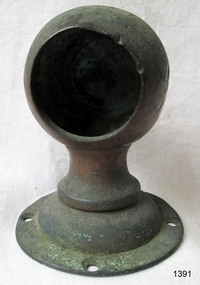
Functional object - Rail holder, About 1893, when the ship was made
... health and he died of a heart attack six months after the wreck; he was only thirty-seven. His body was buried in the Melbourne General Cemetery. The La Bella was “the best documented of all sailing ships owned in New Zealand”. Her record books...health and he died of a heart attack six months after the wreck; he was only thirty-seven. His body was buried in the Melbourne General Cemetery. The La Bella was “the best documented of all sailing ships owned in New Zealand”. Her record books ...This brass rail holder fixture would have been used to hold the end of a rail in place. There is no information as to where the fitting or rail would have been placed on the ship; sailing ships had many brass fittings. It was recovered from the wreck of the La Bella, which lies at the bottom of the Warrnambool Harbour. Some 15 ships are believed to have been wrecked in Lady Bay, but only two have been discovered on the sea floor; the La Bella and the Edinburgh Castle. Both wrecks are popular diving sites and are preserved as significant historical marine and marine archaeological sites. The story of the final voyage of the La Bella is summarised as follows … The ship from which the sailors were rescued was the three-masted, iron and steel barquentine the La Bella, built in Norway in 1893. She was one of two iron and steel ships by Johan Smith, the company being one of the leading shipping families in Tvedestrand, Norway. She was significant to Norwegian shipping, being one of only 27 iron and steel ships ever built in Norway. She was registered in New Zealand and engaged from 1902 in inter-colonial trading of timber in the pacific, between New Zealand and Australia and was often in Port Phillip Bay, Victoria. On 5th October, 1905, the twelve year old La Bella left Lyttleton, New Zealand carrying a cargo of timber bound for Warrnambool, Australia . She was manned by a crew of twelve: the Master, (Captain Mylius, previously 1st Mate of La Bella, appointed Captain to La Bella on 6th February 1903) 2 Mates, Cook, six able seamen, one ordinary seaman and a boy. . Bad weather en route caused her to shelter at Burnie on Tasmania's North West coast. On November 10th, the 37th day of her journey, La Bella approached Warrnambool. Captain Mylius steered her towards Lady Bay Channel in heavy south-west seas and evening mist. He ordered the helmsman to steer for the light. As the ship came round, a tremendous sea struck her on the port quarter, causing her to breach broadside in a north-westerly direction into breakers. The helm was brought round twice more, but each time heavy seas broke over her, the third time throwing the La Bella on to a submerged reef in Lady Bay now known as La Bella Reef (about 100 yards from the Warrnambool breakwater). The sea was so rough that it even wrenched a one-and-a-half ton anchor from its fastenings and into the sea. As Captain Mylius headed to the steel wheelhouse, intending to send up a rocket flare, a huge sea slammed the steel door into him (resulting in massive bruising front and back) Despite his injuries he still managed to set off a blue light, which he held up in his hands. La Bella’s lifeboats were filled with sea water and broke up on their chocks. The blue light was the first indication to people on shore that there was a ship in distress. The Harbour Master, Captain Roe (who lived in the Harbour Master’s House opposite Flagstaff Hill), organised a group of volunteers to crew the lifeboat because the trained crew was unavailable; the crewmen were working on a steamer in Port Fairy at the time. He then poured oil onto the water to try and smooth the sea. At around 11pm three of the crew took shelter in the steel forecastle but the sea crashed into it and broke it up. While the rest of the crew and onlookers watched helplessly in the moonlight the bodies were washed away into the sea, never to be seen again. Some of the crew lashed themselves to the weather rail to keep from being washed away. Watson, the ordinary seaman, became tangled in the rigging lines and was too weak to move, so the 2nd Mate, Robertson, put a line onto him so that he wouldn’t wash off. Around 11pm three of the crew were unconscious from exhaustion. The situation on La Bella was becoming dangerous. The 2nd Mate moved to the ‘house’ and soon afterwards the ship slipped in the heavy sea. The lashings of the 1st Mate and the ‘boy’ Denham had kept them safe until about 2am when they were washed overboard; no one was able to help. One by one, the exhausted crew were being washed overboard, too weak to hold on any longer. During the night the La Bella had broken into two and the deckhouse ran out towards the sea. Two more men drowned when trying to reach the lifeboat. By sunrise the only survivors of the twelve were the Master, 2nd Mate and three seamen. Early in the morning Captain Roe used the rocket apparatus on shore to try and shoot a line to the ship for a safer rescue but each attempt fell short of the target. Several attempts were made by the lifeboat to rescue the stricken sailors, but the rough conditions made this difficult for the boat to get close enough to the ship and the lifeboat had to return to shore. During a final attempt to reach the ship Captain Mylius ordered his men to jump into the sea. Leonard Robertson, 2nd mate, jumped and swam towards the lifeboat, taking hold of the boat hook offered to him. Oscar Rosenholme managed to reach the boat floating on a piece of timber from the ship’s load and a third survivor, Noake, also made the boat. Along with the lifeboat rescue crew, 25 year old William Ferrier rowed his small dingy through the heavy seas and managed to rescue the Captain, whom he landed on the breakwater. Ferrier then returned to the ship to attempt a final rescue, losing his oars and rowlocks into the high sea. Using just a spare paddle he skulled towards the La Bella, reaching her stern in time to cut loose the lone surviving sailor, Payne, from the lashing that held him to the ship; the terrified sailor dropped from the ship and into the dingy. Shortly after the last man was rescued, the La Bella was lifted by a huge wave and crashed back down on the reef; she broke up and sank. The ordeal had lasted ten hours. The survivors were taken to the nearby Bay View Hotel and gratefully received warm food and clothing, medical attention and a place to sleep. In the following days an unidentified body of a young person was washed ashore; it was either Watson or Denham. The body was buried in the Warrnambool cemetery with an appropriate gravestone and inscription. William Ferrier became a national hero as news of the daring rescue spread. In recognition of his bravery in the two daring rescues he was awarded the Silver Medal for Bravery by the Royal Humane Society and was honoured in the letter from the Prime Minister and the Parliament of the Commonwealth, telegrams and a cheque for £20 from the Governor General, over £150 subscribed by the public, including Warrnambool and district and readers of The Argus, and a gold medal from the Glenelg Dinghy Club of South Australia. Ferrier’s rescue efforts are one of the most heroic in Victoria’s shipwreck history. (William Ferrier’s son, Frank, received a similar award almost fifty years later, when he helped rescue four members of the crew on the yacht Merlan, after it ran on to a reef near the Point Lonsdale Lighthouse. ) The wreck of La Bella now lies on her port side in 13 metres of sheltered water inside the reef she struck. The bow section is relatively intact and part of the stern has drifted north-easterly towards the mouth of the Hopkins River. The reef the La Bella struck now bears its name. Those five rescued from the La Bella were Captain George Mylius, Leonard Robertson (2nd Mate, 21 years old), R. Payne, Oscar Rosenholme and Jack Noake. Those seven who lost their lives were Mr Coulson (1st mate), Charles Jackman (cook) Gustave Johnson, Pierre Johann and Robert Gent (all able seamen), Harry Watson (ordinary seaman) and Jack Denham (ship’s boy), Captain Mylius was found guilty of careless navigation; he had sailed into the bay without the services of a pilot. His Master Certificate was suspended for twelve months. Later he was also charged with manslaughter of one of the crew who had died when the La Bella was wrecked, but found not guilty. The event’s adverse publicity and damage to his career took a toll on his health and he died of a heart attack six months after the wreck; he was only thirty-seven. His body was buried in the Melbourne General Cemetery. The La Bella was “the best documented of all sailing ships owned in New Zealand”. Her record books, ship logs, correspondence and supporting papers are still available. At the time of the tragedy, she was owned by Messers David C.Turnbull and Co. of Timaru, New Zealand timber merchants and shipping agents, who had purchased her on 13th December 1901. A detailed account of the last journey of La Bella can be read in “Leonard Robertson, the Whangaroa & La Bella” written by Jack Churchouse, published in 1982 by Millwood Press Ltd, Wellington, NZ. Some 15 – 17 ships are believed to have sunk in Lady Bay, but only two have been discovered on the seafloor; the “La Bella” and the “Edinburgh Castle”. Both wrecks are popular diving sites and are preserved as significant historical marine and marine archaeological sites. As well as this letter, Flagstaff Hill’s La Bella Collection includes a photograph of the wrecked La Bella, a brass rail holder and a postcard of William Ferrier with four of the survivors. This original congratulatory letter sent to William Ferrier by the Prime Minister and Government of Australia demonstrates the importance attached to his efforts for Victoria and to Australia. The letter is part of the La Bella Collection and is significant at both a local and state level. Its connection to the La Bella shipwreck and the rescue of five survivors highlights the dangers of Victoria’s Shipwreck Coast. The letter to William Ferrier from the Australian Government acknowledges the bravery of ordinary Australians who risked their lives to save victims of shipwrecks along the coast. The letter is significant to the history of Warrnambool as it honours William Ferrier, a local fisherman whose descendants continue to live in the area. It highlights the way of life of people who lived in coastal towns in 19th century Victoria and the effects of shipwrecks upon them. The letter connects to the postcard of William Ferrier with four of the five rescued crew, the photograph of the wreck of the La Bella and the artefact from the wreck, the rail holder. This item is significant because of its association with the sailing ship “La Bella” . the “La Bella” is of local and state and national significance. It is one of the only two shipwrecks discovered in Lady Bay, Warrnambool, out of the 15-17 shipwrecks in the bay. Brass rail holder from the wreck "La Bella". This rail holder would have been used as a fitting for the end of a rail. It is made up of two parts and looks a little like a goblet in shape. The top is a hollow spherical shape with a circular hole cut out on one side, into which the end of a round rail would fit. There are two gouge marks close to each other on one side of the hole, about one centimetre apart, at 1 and 2 o’clock position. The sphere has a hollow pipe-like stem with a screw thread turned into the outside of the lower section and the bottom of the stem has been flared out after having the base fitted. The base is round and has a mound in the centre. The edge has four evenly spaced fixture holes around its edge. The metal shows signs of pitting and has mild encrustation. The fitting of the base is loose, allowing it to swivel in a complete circle. The top of the sphere is rough and has a dent in it. Underneath the base there is verdigris; some has flaked off and reveals a bright golden colour underneath. rail holder, brass rail holder, la bella, lady bay, norway, 1893, new zealand, captain mylius, william ferrier, flagstaff hill, warrnambool, shipwrecked coast, flagstaff hill maritime museum, maritime museum, shipwreck coast, flagstaff hill maritime village -
 Flagstaff Hill Maritime Museum and Village
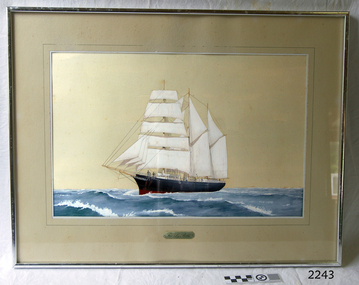
Painting - Maritime painting, The La Bella, 1980s
... health and he died of a heart attack six months after the wreck; he was only thirty-seven. His body was buried in the Melbourne General Cemetery. The La Bella was “the best documented of all sailing ships owned in New Zealand”. Her record books...health and he died of a heart attack six months after the wreck; he was only thirty-seven. His body was buried in the Melbourne General Cemetery. The La Bella was “the best documented of all sailing ships owned in New Zealand”. Her record books ...This painting of the “La Bella” is associated with Flagstaff Hill’s collection of artefacts from the wreck of the “La Bella”. It was painted around the 1980s by maritime artist Philip J. Gray. Some 15 – 17 ships are believed to have sunk in Lady Bay, but only two have been discovered on the seafloor; the “La Bella” and the “Edinburgh Castle”. Both wrecks are popular diving sites and are preserved as significant historical marine and marine archaeological sites. The Kosnar Picture Framing and Mirrors Shop identified the "GRAY 3135, Y04/111" as their job number for the framing and said that the label "ANOTHER KOSNAR FEATURE" was last used before about 1990. About artist Philip J. Gray “Philip is one of Australia’s leading maritime artists and his meticulous research and social commentary paintings of ships, such as, the Loch Ard and Schomberg form an important part of Warrnambool’s Flagstaff Hill Maritime Museum.” [Dr Marion Manifold, Artist and Art Historian, 2014] Philip James Gray was born in London but has lived most of his life in Australia. He graduated from a London school of art as an illustrator, specialising in technical and scientific illustration as well as other commercial and applied art. He was also a student for a time of Fyffe Christie - British figurative artist, mural painter and humanitarian – who had a great influence on his career. Philip has always worked as a professional artist and illustrator. Many publications on maritime history have featured his work. His paintings have been released and sold all over the world as limited edition prints. The State Library of Victoria’s ‘Latrobe Collection’ holds two of his paintings. His street painting of ‘The Ashes Contest’ decorates the brick wall of Old Bakery Laneway in Sunbury and a Sunbury café owner commissioned him to paint the ‘Sunbury Pop Festival’ as a remembrance of local history. Philip has been an active member of the Sunbury Art Society in Victoria for several years, serving on the committee for some of that time and being involved in exhibitions. He enjoys helping new artists and sharing his skills and experience. About the “La Bella” The wreck of the La Bella lies at the bottom of the Warrnambool Harbour in Lady Bay. Some 15 ships are believed to have been wrecked there but only two have been discovered on the sea floor; the La Bella and the Edinburgh Castle. Both wrecks are popular diving sites and are preserved as significant historical marine and marine archaeological sites. The story of the final voyage of the La Bella is summarised as follows … The ship from which the sailors were rescued was the three-masted, iron and steel barquentine the La Bella, built in Norway in 1893. She was one of two iron and steel ships by Johan Smith, the company being one of the leading shipping families in Tvedestrand, Norway. She was significant to Norwegian shipping, being one of only 27 iron and steel ships ever built in Norway. La Bella was registered in New Zealand and engaged from 1902 in inter-colonial trading of timber in the pacific, between New Zealand and Australia and was often in Port Phillip Bay, Victoria. On 5th October 1905 the twelve year old La Bella left Lyttleton, New Zealand carrying a cargo of timber bound for Warrnambool, Australia . She was manned by a crew of twelve: the Master, (Captain Mylius, previously 1st Mate of La Bella, appointed Captain to La Bella on 6th February 1903) 2 Mates, Cook, six able seamen, one ordinary seaman and a boy. Bad weather en-route caused her to shelter at Burnie on Tasmania's North West coast. On November 10th, the 37th day of her journey, La Bella approached Warrnambool. Captain Mylius steered her towards Lady Bay Channel in heavy south-west seas and evening mist. He ordered the helmsman to steer for the light. As the ship came round, a tremendous sea struck her on the port quarter, causing her to breach broadside in a north-westerly direction into breakers. The helm was brought round twice more, but each time heavy seas broke over her, the third time throwing the La Bella on to a submerged reef in Lady Bay now known as La Bella Reef (about 100 yards from the Warrnambool breakwater). The sea was so rough that it even wrenched a one-and-a-half ton anchor from its fastenings and into the sea. As Captain Mylius headed to the steel wheelhouse, intending to send up a rocket flare, a huge sea slammed the steel door into him (resulting in massive bruising front and back) Despite his injuries he still managed to set off a blue light, which he held up in his hands. La Bella’s lifeboats were filled with sea water and broke up on their chocks. The blue light was the first indication to people on shore that there was a ship in distress. The Harbour Master, Captain Roe (who lived in the Harbour Master’s House opposite Flagstaff Hill), organised a group of volunteers to crew the lifeboat because the trained crew was unavailable; the crewmen were working on a steamer in Port Fairy at the time. He then poured oil onto the water to try and smooth the sea. At around 11pm three of the crew took shelter in the steel forecastle but the sea crashed into it and broke it up. While the rest of the crew and onlookers watched helplessly in the moonlight the bodies were washed away into the sea, never to be seen again. Some of the crew lashed themselves to the weather rail to keep from being washed away. Watson, the ordinary seaman, became tangled in the rigging lines and was too weak to move, so the 2nd Mate, Robertson, put a line onto him so that he wouldn’t wash off. Around 11pm three of the crew were unconscious from exhaustion. The situation on La Bella was becoming dangerous. The 2nd Mate moved to the ‘house’ and soon afterwards the ship slipped in the heavy sea. The lashings of the 1st Mate and the ‘boy’ Denham had kept them safe until about 2am when they were washed overboard; no one was able to help. One by one, the exhausted crew were being washed overboard, too weak to hold on any longer. During the night the La Bella had broken into two and the deckhouse ran out towards the sea. Two more men drowned when trying to reach the lifeboat. By sunrise the only survivors of the twelve were the Master, 2nd Mate and three seamen. Early in the morning Captain Roe used the rocket apparatus on shore to try and shoot a line to the ship for a safer rescue but each attempt fell short of the target. Several attempts were made by the lifeboat to rescue the stricken sailors, but the rough conditions made this difficult for the boat to get close enough to the ship and the lifeboat had to return to shore. During a final attempt to reach the ship Captain Mylius ordered his men to jump into the sea. Leonard Robertson, 2nd mate, jumped and swam towards the lifeboat, taking hold of the boat hook offered to him. Oscar Rosenholme managed to reach the boat floating on a piece of timber from the ship’s load and a third survivor, Noake, also made the boat. Along with the lifeboat rescue crew, 25 year old William Ferrier rowed his small dingy through the heavy seas and managed to rescue the Captain, whom he landed on the breakwater. Ferrier then returned to the ship to attempt a final rescue, losing his oars and rowlocks into the high sea. Using just a spare paddle he skulled towards the La Bella, reaching her stern in time to cut loose the lone surviving sailor, Payne, from the lashing that held him to the ship; the terrified sailor dropped from the ship and into the dingy. Shortly after the last man was rescued, the La Bella was lifted by a huge wave and crashed back down on the reef; she broke up and sank. The ordeal had lasted ten hours. The survivors were taken to the nearby Bay View Hotel and gratefully received warm food and clothing, medical attention and a place to sleep. In the following days an unidentified body of a young person was washed ashore; it was either Watson or Denham. The body was buried in the Warrnambool cemetery with an appropriate gravestone and inscription. William Ferrier became a national hero as news of the daring rescue spread. In recognition of his bravery in the two daring rescues he was awarded the Silver Medal for Bravery by the Royal Humane Society and was honoured in the letter from the Prime Minister and the Parliament of the Commonwealth, telegrams and a cheque for £20 from the Governor General, over £150 subscribed by the public, including Warrnambool and district and readers of The Argus, and a gold medal from the Glenelg Dinghy Club of South Australia. Ferrier’s rescue efforts are one of the most heroic in Victoria’s shipwreck history. (William Ferrier’s son, Frank, received a similar award almost fifty years later, when he helped rescue four members of the crew on the yacht Merlan, after it ran on to a reef near the Point Lonsdale Lighthouse. ) The wreck of La Bella now lies on her port side in 13 metres of sheltered water inside the reef she struck. The bow section is relatively intact and part of the stern has drifted north-easterly towards the mouth of the Hopkins River. The reef the La Bella struck now bears its name. Those five rescued from the La Bella were Captain George Mylius, Leonard Robertson (2nd Mate, 21 years old), R. Payne, Oscar Rosenholme and Jack Noake. Those seven who lost their lives were Mr Coulson (1st mate), Charles Jackman (cook) Gustave Johnson, Pierre Johann and Robert Gent (all able seamen), Harry Watson (ordinary seaman) and Jack Denham (ship’s boy). Captain Mylius was found guilty of careless navigation; he had sailed into the bay without the services of a pilot. His Master Certificate was suspended for twelve months. Later he was also charged with manslaughter of one of the crew who had died when the La Bella was wrecked, but found not guilty. The event’s adverse publicity and damage to his career took a toll on his health and he died of a heart attack six months after the wreck; he was only thirty-seven. His body was buried in the Melbourne General Cemetery. The La Bella was “the best documented of all sailing ships owned in New Zealand”. Her record books, ship logs, correspondence and supporting papers are still available. At the time of the tragedy she was owned by Messers David C.Turnbull and Co. of Timaru, New Zealand timber merchants and shipping agents, who had purchased her on 13th December 1901. A detailed account of the last journey of La Bella can be read in “Leonard Robertson, the Whangaroa & La Bella” written by Jack Churchouse, published in 1982 by Millwood Press Ltd, Wellington, NZ.This painting of the La Bella by Philip J. Gray is part of the La Bella Collection and is significant at both a local and state level. Its connection to the La Bella shipwreck and the rescue of five survivors highlights the dangers of Victoria’s Shipwreck Coast. The painting connects with other objects and artefacts associated with the wreck of the La Bella. This painting is significant because of its association with the sailing ship “La Bella” . the “La Bella” is of local and state and national significance. It is one of the only two shipwrecks discovered in Lady Bay, Warrnambool, out of the 15-17 shipwrecks in the bay. Large framed painting of the three masted barquentine "La Bella" fully rigged. Painted by Phillip J Gray. A fine printed line squares off the painting. Beneath painting and line is a gold plate with black copper plate designating "La Bella" is encased in glass, surrounded by a silver-metal frame. Yellow and brown paper label is adhered to back of painting. Picture framed by Kosnar in Melbourne."The La Bella" on gold plaque Logo of "K" inside a brown square. "GRAY 3135, Y04/111", "ANOTHER KOSNAR FEATURE" flagstaff hill, warrnambool, shipwrecked-coast, flagstaff-hill, flagstaff-hill-maritime-museum, maritime-museum, shipwreck-coast, flagstaff-hill-maritime-village, painting, la bella, artist phillip j gray, maritime painting, lady bay warrnambool -
Federation University Historical Collection
Book, Patricia Smith, Exercise Books used by Teacher's College Student Patricia Smith, 1951
... Ballarat Teacher's College is a predecessor of Federation University ballarat teachers' college patricia smith Urqhart street primary school mathematics social studies literature and reading spelling and dictation grammar and composition music and speech health physical education nature study art and handcraft Patricia Smith written on front cover 2 x soft covered exercise books used by teaching student Patricia Smith for Observations and notes of lessons Exercise Books used by Teacher's College Student Patricia Smith Book Patricia Smith ...Ballarat Teacher's College is a predecessor of Federation University2 x soft covered exercise books used by teaching student Patricia Smith for Observations and notes of lessonsPatricia Smith written on front coverballarat teachers' college, patricia smith, urqhart street primary school, mathematics, social studies, literature and reading, spelling and dictation, grammar and composition, music and speech, health, physical education, nature study, art and handcraft -
 Federation University Historical Collection
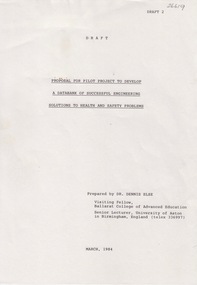
Document - Document - Draft Proposal, VIOSH: B.C.A.E.:Proposal for Pilot Program - Databank - Successful Engineering Solutions
... They have been responsible for the development of Australia's first tertiary course in Occupational Health and Safety and Occupational Hazard Management. viosh victorian institute of occupational safety and health ballarat college of advanced education dennis else databank engineering solutions draft proposal visiting fellow occupational hazard management occupational health and safety multidisciplinary team dulcie brooke max brooke gerald fernandez kathleen kent peter mccarthy tom norwood roy schrieve bill vermeend derek viner derek woolley Fifty-seven A4 pages - includes 27 pages of photocopied pages from reference books and 11 pages of Curriculum Vitae, Staff. ...Victorian Institute of Occupational Safety and Health (VIOSH) Australia is the Asia-Pacific centre for teaching and research in occupational health and safety (OHS) and is known as one of Australia's leaders on the field. VIOSH has a global reputation for its innovative approach within the field of OHS management. VIOSH had its first intake of students in 1979. At that time the Institution was known as the Ballarat College of Advanced Education. In 1990 it became known as Ballarat University College, then in 1994 as University of Ballarat. It was 2014 that it became Federation University. VIOSH Australia students are safety managers, senior advisors and experienced OHS professionals. They come from all over Australia and industry. Students are taught active research and enquiry; rather than textbook learning and a one-size fits all approach. VIOSH accepts people into the Graduate Diploma of Occupational Hazard Management who have no undergraduate degree - on the basis of extensive work experience and knowledge. Document is a Draft Proposal for a Pilot Project to Develop a Databank of Successful Engineering Solutions to Health and Safety Problems. It has been written by Dr Dennis Else, Visiting Fellow, Ballarat College of Advanced Education. Dennis is also a Senior Lecturer, University of Aston, Birmingham, England. The document outlines the need for a databank and often ""our failure to control health and safety problems is from our inability to apply existing knowledge rather than because the knowledge does not exist." The control solutions would need to be technically vetted to ensure feasibility of the solution. An experienced group of specialists in aspects of health and safety and from engineering branches would be required. Ballarat CAE already has this blend of expertise. They have been responsible for the development of Australia's first tertiary course in Occupational Health and Safety and Occupational Hazard Management.Fifty-seven A4 pages - includes 27 pages of photocopied pages from reference books and 11 pages of Curriculum Vitae, Staff.viosh, victorian institute of occupational safety and health, ballarat college of advanced education, dennis else, databank, engineering solutions, draft proposal, visiting fellow, occupational hazard management, occupational health and safety, multidisciplinary team, dulcie brooke, max brooke, gerald fernandez, kathleen kent, peter mccarthy, tom norwood, roy schrieve, bill vermeend, derek viner, derek woolley -
Federation University Historical Collection
Book - Book - Scrapbook, Ballarat College of Advanced Education: Scrapbook of newspaper cutting, Book 6; August 1979 to January 1980
... books on campus...education - buildings luxury image...what's in a name...sergeant family recital...reading skills depend on parental support...computer link a success...paddle your stone canoe...projects in tune with needs...voice training for the deaf turned into a game...career centre at work...rail link forum...bcar librarianship courses accredited...health...The cuttings cover the period from 10 August 1979 to 30 January 1980. . employment advertisements application for enrolment outline of courses bcae open day on sunday energy hysteria by lobby groups farmer and his fuel supply prof helen lyman outreach subjuects adult literacy migrant education a bush walk moorabool river energy and the farm miners have learned from past mistakes working holiday in america more mining activity ahead secondary students 'copping out' for 'soft options' national parks satisfy a need dr myron sutton dr ann sutton bcae guidance for secondary students peter blizzard sculptor $1200 award helping novice orienteers bishop hazlewood apologises to bcae 'verbal vandalism' says jack barker soil conservation - in designs stephen roberts judy ellis ballarat books on campus education - buildings luxury image what's in a name sergeant family recital reading skills depend on parental support computer link a success paddle your stone canoe projects in tune with needs voice training for the deaf turned into a game career centre at work rail link forum bcar librarianship courses accredited health and human relations education concrete canoe club wins trophy laa looking out for librarians future plans for bcae new policy on college entrance final year arts students forestry course health education course german safety expert visit expert in safety engineering physical education impotant in schools lack of reading and numeracy skills remedial neglect: who's to blame teachers not doing job? ...Newspaper cuttings relating to Ballarat College of Advanced Education. These are from various newspapers and include The Age, Ballarat Courier, The Australian, The Herald. The cuttings cover the period from 10 August 1979 to 30 January 1980. . Book with grey cover, front. Spiral bound.employment advertisements, application for enrolment, outline of courses, bcae open day on sunday, energy hysteria by lobby groups, farmer and his fuel supply, prof helen lyman, outreach subjuects, adult literacy, migrant education, a bush walk, moorabool river, energy and the farm, miners have learned from past mistakes, working holiday in america, more mining activity ahead, secondary students 'copping out' for 'soft options', national parks satisfy a need, dr myron sutton, dr ann sutton, bcae guidance for secondary students, peter blizzard sculptor, $1200 award, helping novice orienteers, bishop hazlewood apologises to bcae, 'verbal vandalism' says jack barker, soil conservation - in designs, stephen roberts, judy ellis, ballarat books on campus, education - buildings luxury image, what's in a name, sergeant family recital, reading skills depend on parental support, computer link a success, paddle your stone canoe, projects in tune with needs, voice training for the deaf turned into a game, career centre at work, rail link forum, bcar librarianship courses accredited, health and human relations education, concrete canoe club wins trophy, laa looking out for librarians, future plans for bcae, new policy on college entrance, final year arts students, forestry course, health education course, german safety expert visit, expert in safety engineering, physical education impotant in schools, lack of reading and numeracy skills, remedial neglect: who's to blame, teachers not doing job? not true, zig plavina retires, discussion on students reports, keith mcelroy asu's first coaching co-ordinator, great hall near completion -
 Federation University Historical Collection
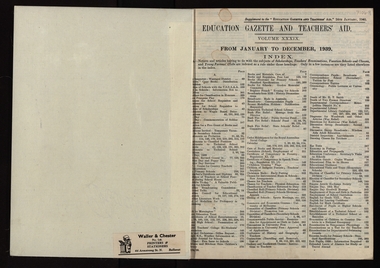
Book, Education Gazette, 1930s, 1930s
... The books contain the bound Victoria Education Gazettes for the 1930s. .4) Handwork in rural schools, Young Farmers' Clubs, Domestic Arts, Arbour Day, LEague of Youth of Australia. Health...The books contain the bound Victoria Education Gazettes for the 1930s. .4) Handwork in rural schools, Young Farmers' Clubs, Domestic Arts, Arbour Day, LEague of Youth of Australia. Health ...10 hard covered, black books with red spine. The books contain the bound Victoria Education Gazettes for the 1930s. .4) Handwork in rural schools, Young Farmers' Clubs, Domestic Arts, Arbour Day, LEague of Youth of Australia. Health Education, Metal Trades, Industrial Studies, HOrticulture, Hinkler Memoria Trees, Musical Appreciation, British Breeds of Sheep. Train Journey Through Germany, History Handwork - Roman Times, Claude Seareby (photo), Norsemen, Techncical Schools Exhibition, Knots, Balllarat Junior Technical School Terraced Gardenseducation gazette, ballarat junior technical school terrace gardens -
 Flagstaff Hill Maritime Museum and Village
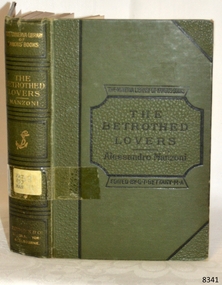
Book - A Fictional Love Story, Alessandro Manzoni, The Betrothed Lovers, 1889
... health crisis the panic, the scapegoating, the collapse of law, and the incredible acts of self-sacrifice by selfless individuals remains terrifyingly accurate and universally relatable today, making the work additionally historically significant. (For more information on the Pattison Collection see item 3678 Flagstaff Hill collections) https://victoriancollections.net.au/items/5580c7e72162f114d8b758db flagstaff hill warrnambool shipwrecked coast flagstaff hill maritime museum maritime museum shipwreck coast flagstaff hill maritime village great ocean road book pattison collection warrnambool library warrnambool mechanics’ institute ralph eric pattison corangamite regional library service warrnambool city librarian mechanics’ institute library victorian library board warrnambool books and records warrnambool children’s library The Betrothed Lovers Allessandro Manzoni G.T.Bettany The subject novel is regarded as a Victorian literary artifact of a masterpiece of European literature. ...The subject novel is regarded as a Victorian literary artifact of a masterpiece of European literature. The Betrothed Lovers is the English translation of I Promessi Sposi (originally published in 1827), widely considered the most famous and influential Italian novel ever written. Set in northern Italy in 1628 during the oppressive era of Spanish rule, the story follows two young silk weavers, Renzo and Lucia, who are deeply in love and wish to marry. Their plans are cruelly shattered by a tyrannical local baron, Don Rodrigo, who wants Lucia for himself and forces the couple to flee. The epic narrative follows their separate, perilous journeys through a landscape torn apart by war, political corruption, famine, and a devastating outbreak of the Bubonic Plague in Milan. This work is renowned for its deep psychological realism, social critique, and profound exploration of religious faith and divine providence.The Betrothed Lovers Author: Alessandro Manzoni Publisher: Ward Lock & Co Date: 1889 Further Information: Edited by G.T.BettanyfictionThe subject novel is regarded as a Victorian literary artifact of a masterpiece of European literature. The Betrothed Lovers is the English translation of I Promessi Sposi (originally published in 1827), widely considered the most famous and influential Italian novel ever written. Set in northern Italy in 1628 during the oppressive era of Spanish rule, the story follows two young silk weavers, Renzo and Lucia, who are deeply in love and wish to marry. Their plans are cruelly shattered by a tyrannical local baron, Don Rodrigo, who wants Lucia for himself and forces the couple to flee. The epic narrative follows their separate, perilous journeys through a landscape torn apart by war, political corruption, famine, and a devastating outbreak of the Bubonic Plague in Milan. This work is renowned for its deep psychological realism, social critique, and profound exploration of religious faith and divine providence.flagstaff hill, warrnambool, shipwrecked coast, flagstaff hill maritime museum, maritime museum, shipwreck coast, flagstaff hill maritime village, great ocean road, book, pattison collection, warrnambool library, warrnambool mechanics’ institute, ralph eric pattison, corangamite regional library service, warrnambool city librarian, mechanics’ institute library, victorian library board, warrnambool books and records, warrnambool children’s library, the betrothed lovers, allessandro manzoni, g.t.bettany -
 Flagstaff Hill Maritime Museum and Village
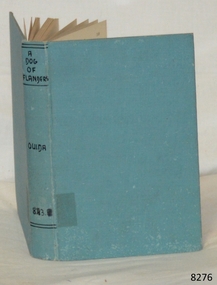
Book - A Fictional Story, Ouida (Maria Louise Ramé), A Dog of Flanders, 1873
... Because children’s books of this format were typically read to pieces, it is a highly collectible piece of colonial Australian printing history. flagstaff hill warrnambool shipwrecked coast flagstaff hill maritime museum maritime museum shipwreck coast flagstaff hill maritime village great ocean road book pattison collection warrnambool library warrnambool mechanics’ institute ralph eric pattison corangamite regional library service warrnambool city librarian mechanics’ institute library victorian library board warrnambool books and records warrnambool children’s library A Dog of Flanders Ouida Maria Louise Ramé Marie Louise de la Ramée A Dog of Flanders (originally published in 1872) is a deeply moving, bittersweet story set in Belgium. It follows Nello, an impoverished orphan boy with a passion for art, and Patrasche a loyal, cart-pulling, abandoned, and abused draft dog whom Nello and his gentle grandfather, Jehan Daas, rescue and nurse back to health. ...A Dog of Flanders (originally published in 1872) is a deeply moving, bittersweet story set in Belgium. It follows Nello, an impoverished orphan boy with a passion for art, and Patrasche a loyal, cart-pulling, abandoned, and abused draft dog whom Nello and his gentle grandfather, Jehan Daas, rescue and nurse back to health. The story focuses on the bond between Nello and Patrasche as they become inseparable, helping the aging Jehan pull a milk cart into Antwerp each day to earn a meagre living. Nello longs to become a great painter like the Baroque master Peter Paul Rubens. His only hope is to win a prestigious local drawing contest with a portrait he has laboured over. After a series of devastating setbacks his grandfather passes away, they are evicted, and Nello loses the drawing competition he and Patrasche his cart pulling dog seek shelter from a freezing Christmas Eve blizzard inside the Cathedral of Our Lady in Antwerp. There, Nello finally gazes upon Rubens’s shielded masterpieces, The Descent from the Cross and The Elevation of the Cross. The story ends sadly as, the next morning, the loyal dog and the young boy are found frozen to death, locked in a final embrace in front of the altar.Hard cover book, A Dog of Flanders Author: Ouida (Maria Louise Ramé) Publisher: George Robertson Date: 1873 Further Information: Blue cloth hardcover and spine with spine lettering in black texter. The spine has a Library label with inscription. fictionA Dog of Flanders (originally published in 1872) is a deeply moving, bittersweet story set in Belgium. It follows Nello, an impoverished orphan boy with a passion for art, and Patrasche a loyal, cart-pulling, abandoned, and abused draft dog whom Nello and his gentle grandfather, Jehan Daas, rescue and nurse back to health. The story focuses on the bond between Nello and Patrasche as they become inseparable, helping the aging Jehan pull a milk cart into Antwerp each day to earn a meagre living. Nello longs to become a great painter like the Baroque master Peter Paul Rubens. His only hope is to win a prestigious local drawing contest with a portrait he has laboured over. After a series of devastating setbacks his grandfather passes away, they are evicted, and Nello loses the drawing competition he and Patrasche his cart pulling dog seek shelter from a freezing Christmas Eve blizzard inside the Cathedral of Our Lady in Antwerp. There, Nello finally gazes upon Rubens’s shielded masterpieces, The Descent from the Cross and The Elevation of the Cross. The story ends sadly as, the next morning, the loyal dog and the young boy are found frozen to death, locked in a final embrace in front of the altar.flagstaff hill, warrnambool, shipwrecked coast, flagstaff hill maritime museum, maritime museum, shipwreck coast, flagstaff hill maritime village, great ocean road, book, pattison collection, warrnambool library, warrnambool mechanics’ institute, ralph eric pattison, corangamite regional library service, warrnambool city librarian, mechanics’ institute library, victorian library board, warrnambool books and records, warrnambool children’s library, a dog of flanders, ouida, maria louise ramé, marie louise de la ramée -
 Flagstaff Hill Maritime Museum and Village
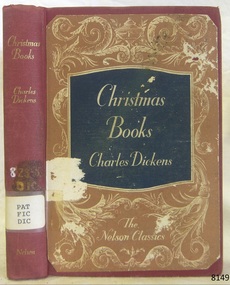
Book - A Fictional Story, Charles Dickens, Christmas Books, 1940's to 1959
... health, leading to his death at age 58 while writing “The Mystery of Edwin Drood”. Buried in Westminster Abbey, his vivid characters and social commentary remain influential. These stories are highly significant in literary history because Dickens’s Christmas books ...Charles Dickens (1812–1870) was one of the great English novelists of the Victorian era, famous for vivid characters, social criticism, and stories that were first published in serial form. He began as a journalist, rose to enormous popularity during his lifetime, and wrote major works such as Oliver Twist, David Copperfield, and Great Expectations. This volume gathers five separate Christmas stories rather than one continuous novel. The best known of them, “A Christmas Carol”, follows Ebenezer Scrooge’s moral transformation after visits from supernatural spirits, while the others mix ghostly, sentimental, and domestic themes around Christmas, memory, family, and social feeling. Together they show Dickens using Christmas as a setting for moral instruction, sympathy for the poor, and festive storytelling. This Nelson and Sons London Christmas Books volume is a collected edition of Dickens’s five Christmas novellas, “A Christmas Carol,” “The Chimes”, “The Cricket on the Hearth”, “The Battle of Life”, and “The Haunted Man”. It is not the original 1840's publication; the Nelson publication is a later reprint in the company’s “Nelson’s Classics series, with examples catalogued from 1941 to 1959.Christmas Books. Author: Charles Dickens. Publisher: Nelson & Sons, London. Date: 1940’s-1950’s. (See note section this document for more information on Edition). Red cloth hardcover with brown patterned paper stick on title to front cover. Spine has gold lettering. The spine has a Library label and no Volume information.fictionCharles Dickens (1812–1870) was one of the great English novelists of the Victorian era, famous for vivid characters, social criticism, and stories that were first published in serial form. He began as a journalist, rose to enormous popularity during his lifetime, and wrote major works such as Oliver Twist, David Copperfield, and Great Expectations. This volume gathers five separate Christmas stories rather than one continuous novel. The best known of them, “A Christmas Carol”, follows Ebenezer Scrooge’s moral transformation after visits from supernatural spirits, while the others mix ghostly, sentimental, and domestic themes around Christmas, memory, family, and social feeling. Together they show Dickens using Christmas as a setting for moral instruction, sympathy for the poor, and festive storytelling. This Nelson and Sons London Christmas Books volume is a collected edition of Dickens’s five Christmas novellas, “A Christmas Carol,” “The Chimes”, “The Cricket on the Hearth”, “The Battle of Life”, and “The Haunted Man”. It is not the original 1840's publication; the Nelson publication is a later reprint in the company’s “Nelson’s Classics series, with examples catalogued from 1941 to 1959.book, the old curiosity shop, charles dickens, shipwrecked-coast, flagstaff-hill, flagstaff-hill-maritime-museum, warrnambool, maritime-museum, flagstaff-hill-maritime-village, pattison collection, warrnambool library, warrnambool mechanics’ institute, ralph eric pattison, corangamite regional library service, warrnambool city librarian, mechanics’ institute library, victorian library board, warrnambool books and records, warrnambool children’s library, great ocean road -
 Flagstaff Hill Maritime Museum and Village
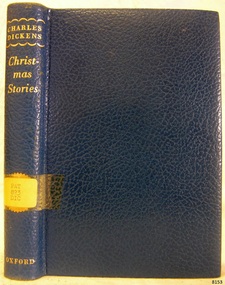
Book - A Fictional Story, Charles Dickens et al, Christmas Stories, 1956
... health, leading to his death at age 58 while writing “The Mystery of Edwin Drood”. Buried in Westminster Abbey, his vivid characters and social commentary remain influential. These stories are highly significant in literary history because Dickens’s Christmas books ...Charles Dickens (1812–1870) was one of the great English novelists of the Victorian era, famous for vivid characters, social criticism, and stories that were first published in serial form. He began as a journalist, rose to enormous popularity during his lifetime, and wrote major works such as Oliver Twist, David Copperfield, and Great Expectations. This volume gathers five separate Christmas stories rather than one continuous novel. The best known of them, “A Christmas Carol”, follows Ebenezer Scrooge’s moral transformation after visits from supernatural spirits, while the others mix ghostly, sentimental, and domestic themes around Christmas, memory, family, and social feeling. Together they show Dickens using Christmas as a setting for moral instruction, sympathy for the poor, and festive storytelling. This Oxford University Press London, Christmas Books volume is a collected edition of Dickens’s five Christmas novellas, “A Christmas Carol,” “The Chimes”, “The Cricket on the Hearth”, “The Battle of Life”, and “The Haunted Man”. It is not the original 1840s publication; the Oxford publication is a later reprint from 1956.Our Mutual Friend. Author: Charles Dickens. Publisher: Oxford University Press, London. Date: 1956 (See note section this document for more information on Edition). Blue leather hardcover, Spine has Author and Title in gold lettering. The spine has a Library label and no Volume information.fictionCharles Dickens (1812–1870) was one of the great English novelists of the Victorian era, famous for vivid characters, social criticism, and stories that were first published in serial form. He began as a journalist, rose to enormous popularity during his lifetime, and wrote major works such as Oliver Twist, David Copperfield, and Great Expectations. This volume gathers five separate Christmas stories rather than one continuous novel. The best known of them, “A Christmas Carol”, follows Ebenezer Scrooge’s moral transformation after visits from supernatural spirits, while the others mix ghostly, sentimental, and domestic themes around Christmas, memory, family, and social feeling. Together they show Dickens using Christmas as a setting for moral instruction, sympathy for the poor, and festive storytelling. This Oxford University Press London, Christmas Books volume is a collected edition of Dickens’s five Christmas novellas, “A Christmas Carol,” “The Chimes”, “The Cricket on the Hearth”, “The Battle of Life”, and “The Haunted Man”. It is not the original 1840s publication; the Oxford publication is a later reprint from 1956.book, the old curiosity shop, charles dickens, shipwrecked-coast, flagstaff-hill, flagstaff-hill-maritime-museum, warrnambool, maritime-museum, flagstaff-hill-maritime-village, pattison collection, warrnambool library, warrnambool mechanics’ institute, ralph eric pattison, corangamite regional library service, warrnambool city librarian, mechanics’ institute library, victorian library board, warrnambool books and records, warrnambool children’s library, great ocean road -
 Flagstaff Hill Maritime Museum and Village
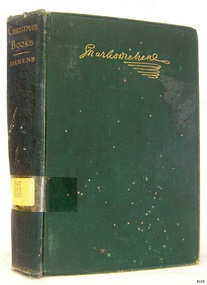
Book - A Fictional Story, Charles Dickens, Christmas Books, 1894
... health, leading to his death at age 58 while writing “The Mystery of Edwin Drood”. Buried in Westminster Abbey, his vivid characters and social commentary remain influential. These stories are highly significant in literary history because Dickens’s Christmas books ...Charles Dickens (1812–1870) was one of the great English novelists of the Victorian era, famous for vivid characters, social criticism, and stories that were first published in serial form. He began as a journalist, rose to enormous popularity during his lifetime, and wrote major works such as Oliver Twist, David Copperfield, and Great Expectations. This volume gathers five separate Christmas stories rather than one continuous novel. The best known of them, “A Christmas Carol”, follows Ebenezer Scrooge’s moral transformation after visits from supernatural spirits, while the others mix ghostly, sentimental, and domestic themes around Christmas, memory, family, and social feeling. Together they show Dickens using Christmas as a setting for moral instruction, sympathy for the poor, and festive storytelling. This Nelson and Sons London Christmas Books volume is a collected edition of Dickens’s five Christmas novellas, “A Christmas Carol,” “The Chimes”, “The Cricket on the Hearth”, “The Battle of Life”, and “The Haunted Man”. It is not the original 1840's publication; the Nelson publication is a later reprint in the company’s “Nelson’s Classics series, with examples catalogued from 1941 to 1959.Christmas Books. Author: Charles Dickens. Publisher: Chapman & Hall Ltd, London. Date: 1894. (See note section this document for more information on Edition). Green cloth hardcover with Authors name to front cover in gold. Spine has gold title lettering. The spine has a Library label.fictionCharles Dickens (1812–1870) was one of the great English novelists of the Victorian era, famous for vivid characters, social criticism, and stories that were first published in serial form. He began as a journalist, rose to enormous popularity during his lifetime, and wrote major works such as Oliver Twist, David Copperfield, and Great Expectations. This volume gathers five separate Christmas stories rather than one continuous novel. The best known of them, “A Christmas Carol”, follows Ebenezer Scrooge’s moral transformation after visits from supernatural spirits, while the others mix ghostly, sentimental, and domestic themes around Christmas, memory, family, and social feeling. Together they show Dickens using Christmas as a setting for moral instruction, sympathy for the poor, and festive storytelling. This Nelson and Sons London Christmas Books volume is a collected edition of Dickens’s five Christmas novellas, “A Christmas Carol,” “The Chimes”, “The Cricket on the Hearth”, “The Battle of Life”, and “The Haunted Man”. It is not the original 1840's publication; the Nelson publication is a later reprint in the company’s “Nelson’s Classics series, with examples catalogued from 1941 to 1959.book, the old curiosity shop, charles dickens, shipwrecked-coast, flagstaff-hill, flagstaff-hill-maritime-museum, warrnambool, maritime-museum, flagstaff-hill-maritime-village, pattison collection, warrnambool library, warrnambool mechanics’ institute, ralph eric pattison, corangamite regional library service, warrnambool city librarian, mechanics’ institute library, victorian library board, warrnambool books and records, warrnambool children’s library, great ocean road -
 Flagstaff Hill Maritime Museum and Village
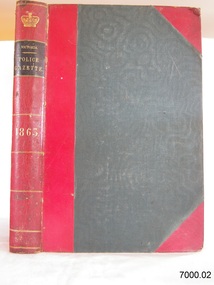
Administrative record - Reference Sociology/History, John Ferres, Government Printer, Victoria Police Gazettes for 1863, 1863
... Health Officers, and Electoral Inspectors were also recorded in later issues, showing its broader role as an administrative record. (For more information on the Pattison Collection see item 3678 Flagstaff Hill collections) https://victoriancollections.net.au/items/5580c7e72162f114d8b758db warrnambool shipwrecked-coast flagstaff-hill flagstaff-hill-maritime-museum maritime-museum shipwreck-coast flagstaff-hill-maritime-village shipwrecked-artefact book victoria police gazette 1862 victoria police gazette warrnambool books and records great ocean road The Victoria Police Gazette was a confidential, internal publication of the Victoria Police, issued to inform police officers, court and justice officials, and government departments about matters relevant to policing across the colony. ...The Victoria Police Gazette was a confidential, internal publication of the Victoria Police, issued to inform police officers, court and justice officials, and government departments about matters relevant to policing across the colony. It commenced in December 1853 and was initially published weekly by the Victoria Police. It was distributed each week to city and rural police stations and to government offices and newspaper publishers. Inclusions in this weekly publication were people wanted for questioning in relation to various crimes, prisoners discharged from city or country gaols, extracts from Police Gazettes in New South Wales, South Australia, Queensland, Tasmania, New Zealand, and occasionally overseas countries, as well as extracts from the Hobart Town Gazette listing escaped convicts and the person to whom they were assigned. There was also a "Missing Friends" section, where most people listed were not criminals but were sought by police so relatives, old friends, or government officials could renew contact with them. In addition, there was a record of deserted wives and children, listing the offender's name, birthplace, age, occupation, last known area of residence, likely future movements and known relatives. There was also a section on court lists, warrants issued, appointments and staffing changes within the police service, arrest and discharge records with physical descriptions, and lists of pastoralists with descriptions of their livestock brands.Hard Bound Volume. Victorian Police Gazettes for 1863 Author: Institutional Government Publication Publisher: John Ferres, Melbourne Date: 1863 Further Information: Compilation of Weekly Victorian Police Gazettes for 1863 in a hard bound volume with red spine and red corner reinforcing. Front panel grey coloured lettering in gilt with gilt banding to spine. Inside is twelve issues of the Police Gazettes for 1863.non-fictionThe Victoria Police Gazette was a confidential, internal publication of the Victoria Police, issued to inform police officers, court and justice officials, and government departments about matters relevant to policing across the colony. It commenced in December 1853 and was initially published weekly by the Victoria Police. It was distributed each week to city and rural police stations and to government offices and newspaper publishers. Inclusions in this weekly publication were people wanted for questioning in relation to various crimes, prisoners discharged from city or country gaols, extracts from Police Gazettes in New South Wales, South Australia, Queensland, Tasmania, New Zealand, and occasionally overseas countries, as well as extracts from the Hobart Town Gazette listing escaped convicts and the person to whom they were assigned. There was also a "Missing Friends" section, where most people listed were not criminals but were sought by police so relatives, old friends, or government officials could renew contact with them. In addition, there was a record of deserted wives and children, listing the offender's name, birthplace, age, occupation, last known area of residence, likely future movements and known relatives. There was also a section on court lists, warrants issued, appointments and staffing changes within the police service, arrest and discharge records with physical descriptions, and lists of pastoralists with descriptions of their livestock brands.warrnambool, shipwrecked-coast, flagstaff-hill, flagstaff-hill-maritime-museum, maritime-museum, shipwreck-coast, flagstaff-hill-maritime-village, shipwrecked-artefact, book, victoria police gazette 1862, victoria police gazette, warrnambool books and records, great ocean road -
 Flagstaff Hill Maritime Museum and Village
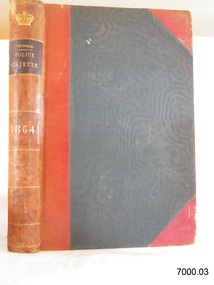
Administrative record - Reference Sociology/History, John Ferres, Government Printer, Victoria Police Gazettes for 1864, 1864
... Health Officers, and Electoral Inspectors were also recorded in later issues, showing its broader role as an administrative record. (For more information on the Pattison Collection see item 3678 Flagstaff Hill collections) https://victoriancollections.net.au/items/5580c7e72162f114d8b758db warrnambool shipwrecked-coast flagstaff-hill flagstaff-hill-maritime-museum maritime-museum shipwreck-coast flagstaff-hill-maritime-village shipwrecked-artefact book victoria police gazette 1862 victoria police gazette warrnambool books and records great ocean road The Victoria Police Gazette was a confidential, internal publication of the Victoria Police, issued to inform police officers, court and justice officials, and government departments about matters relevant to policing across the colony. ...The Victoria Police Gazette was a confidential, internal publication of the Victoria Police, issued to inform police officers, court and justice officials, and government departments about matters relevant to policing across the colony. It commenced in December 1853 and was initially published weekly by the Victoria Police. It was distributed each week to city and rural police stations and to government offices and newspaper publishers. Inclusions in this weekly publication were people wanted for questioning in relation to various crimes, prisoners discharged from city or country gaols, extracts from Police Gazettes in New South Wales, South Australia, Queensland, Tasmania, New Zealand, and occasionally overseas countries, as well as extracts from the Hobart Town Gazette listing escaped convicts and the person to whom they were assigned. There was also a "Missing Friends" section, where most people listed were not criminals but were sought by police so relatives, old friends, or government officials could renew contact with them. In addition, there was a record of deserted wives and children, listing the offender's name, birthplace, age, occupation, last known area of residence, likely future movements and known relatives. There was also a section on court lists, warrants issued, appointments and staffing changes within the police service, arrest and discharge records with physical descriptions, and lists of pastoralists with descriptions of their livestock brands.Hard Bound Volume. Victorian Police Gazettes for 1864 Author: Institutional Government Publication Publisher: John Ferres, Melbourne Date: 1864 Further Information: Compilation of Weekly Victorian Police Gazettes for 1864 in a hard bound volume with red spine and red corner reinforcing. Front panel grey coloured lettering in gilt with gilt banding to spine. Inside is twelve issues of the Police Gazettes for 1864.non-fictionThe Victoria Police Gazette was a confidential, internal publication of the Victoria Police, issued to inform police officers, court and justice officials, and government departments about matters relevant to policing across the colony. It commenced in December 1853 and was initially published weekly by the Victoria Police. It was distributed each week to city and rural police stations and to government offices and newspaper publishers. Inclusions in this weekly publication were people wanted for questioning in relation to various crimes, prisoners discharged from city or country gaols, extracts from Police Gazettes in New South Wales, South Australia, Queensland, Tasmania, New Zealand, and occasionally overseas countries, as well as extracts from the Hobart Town Gazette listing escaped convicts and the person to whom they were assigned. There was also a "Missing Friends" section, where most people listed were not criminals but were sought by police so relatives, old friends, or government officials could renew contact with them. In addition, there was a record of deserted wives and children, listing the offender's name, birthplace, age, occupation, last known area of residence, likely future movements and known relatives. There was also a section on court lists, warrants issued, appointments and staffing changes within the police service, arrest and discharge records with physical descriptions, and lists of pastoralists with descriptions of their livestock brands.warrnambool, shipwrecked-coast, flagstaff-hill, flagstaff-hill-maritime-museum, maritime-museum, shipwreck-coast, flagstaff-hill-maritime-village, shipwrecked-artefact, book, victoria police gazette 1862, victoria police gazette, warrnambool books and records, great ocean road -
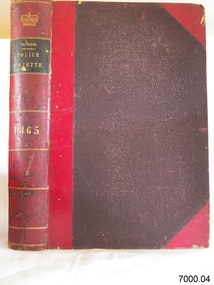 Flagstaff Hill Maritime Museum and Village
Administrative record - Reference Sociology/History, John Ferres, Government Printer, Victoria Police Gazettes for 1865, 1865
... Health Officers, and Electoral Inspectors were also recorded in later issues, showing its broader role as an administrative record. (For more information on the Pattison Collection see item 3678 Flagstaff Hill collections) https://victoriancollections.net.au/items/5580c7e72162f114d8b758db warrnambool shipwrecked-coast flagstaff-hill flagstaff-hill-maritime-museum maritime-museum shipwreck-coast flagstaff-hill-maritime-village shipwrecked-artefact book victoria police gazette 1862 victoria police gazette warrnambool books and records great ocean road The Victoria Police Gazette was a confidential, internal publication of the Victoria Police, issued to inform police officers, court and justice officials, and government departments about matters relevant to policing across the colony. ...The Victoria Police Gazette was a confidential, internal publication of the Victoria Police, issued to inform police officers, court and justice officials, and government departments about matters relevant to policing across the colony. It commenced in December 1853 and was initially published weekly by the Victoria Police. It was distributed each week to city and rural police stations and to government offices and newspaper publishers. Inclusions in this weekly publication were people wanted for questioning in relation to various crimes, prisoners discharged from city or country gaols, extracts from Police Gazettes in New South Wales, South Australia, Queensland, Tasmania, New Zealand, and occasionally overseas countries, as well as extracts from the Hobart Town Gazette listing escaped convicts and the person to whom they were assigned. There was also a "Missing Friends" section, where most people listed were not criminals but were sought by police so relatives, old friends, or government officials could renew contact with them. In addition, there was a record of deserted wives and children, listing the offender's name, birthplace, age, occupation, last known area of residence, likely future movements and known relatives. There was also a section on court lists, warrants issued, appointments and staffing changes within the police service, arrest and discharge records with physical descriptions, and lists of pastoralists with descriptions of their livestock brands.Hard Bound Volume. Victorian Police Gazettes for 1865 Author: Institutional Government Publication Publisher: John Ferres, Melbourne Date: 1865 Further Information: Compilation of Weekly Victorian Police Gazettes for 1865 in a hard bound volume with red spine and red corner reinforcing. Front panel grey coloured lettering in gilt with gilt banding to spine. Inside is twelve issues of the Police Gazettes for 1865.non-fictionThe Victoria Police Gazette was a confidential, internal publication of the Victoria Police, issued to inform police officers, court and justice officials, and government departments about matters relevant to policing across the colony. It commenced in December 1853 and was initially published weekly by the Victoria Police. It was distributed each week to city and rural police stations and to government offices and newspaper publishers. Inclusions in this weekly publication were people wanted for questioning in relation to various crimes, prisoners discharged from city or country gaols, extracts from Police Gazettes in New South Wales, South Australia, Queensland, Tasmania, New Zealand, and occasionally overseas countries, as well as extracts from the Hobart Town Gazette listing escaped convicts and the person to whom they were assigned. There was also a "Missing Friends" section, where most people listed were not criminals but were sought by police so relatives, old friends, or government officials could renew contact with them. In addition, there was a record of deserted wives and children, listing the offender's name, birthplace, age, occupation, last known area of residence, likely future movements and known relatives. There was also a section on court lists, warrants issued, appointments and staffing changes within the police service, arrest and discharge records with physical descriptions, and lists of pastoralists with descriptions of their livestock brands.warrnambool, shipwrecked-coast, flagstaff-hill, flagstaff-hill-maritime-museum, maritime-museum, shipwreck-coast, flagstaff-hill-maritime-village, shipwrecked-artefact, book, victoria police gazette 1862, victoria police gazette, warrnambool books and records, great ocean road -
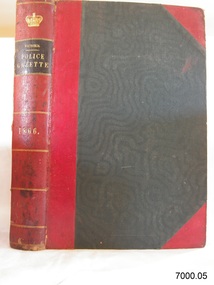 Flagstaff Hill Maritime Museum and Village
Administrative record - Reference Sociology/History, John Ferres, Government Printer, Victoria Police Gazettes for 1866, 1866
... Health Officers, and Electoral Inspectors were also recorded in later issues, showing its broader role as an administrative record. (For more information on the Pattison Collection see item 3678 Flagstaff Hill collections) https://victoriancollections.net.au/items/5580c7e72162f114d8b758db warrnambool shipwrecked-coast flagstaff-hill flagstaff-hill-maritime-museum maritime-museum shipwreck-coast flagstaff-hill-maritime-village shipwrecked-artefact book victoria police gazette 1862 victoria police gazette warrnambool books and records great ocean road The Victoria Police Gazette was a confidential, internal publication of the Victoria Police, issued to inform police officers, court and justice officials, and government departments about matters relevant to policing across the colony. ...The Victoria Police Gazette was a confidential, internal publication of the Victoria Police, issued to inform police officers, court and justice officials, and government departments about matters relevant to policing across the colony. It commenced in December 1853 and was initially published weekly by the Victoria Police. It was distributed each week to city and rural police stations and to government offices and newspaper publishers. Inclusions in this weekly publication were people wanted for questioning in relation to various crimes, prisoners discharged from city or country gaols, extracts from Police Gazettes in New South Wales, South Australia, Queensland, Tasmania, New Zealand, and occasionally overseas countries, as well as extracts from the Hobart Town Gazette listing escaped convicts and the person to whom they were assigned. There was also a "Missing Friends" section, where most people listed were not criminals but were sought by police so relatives, old friends, or government officials could renew contact with them. In addition, there was a record of deserted wives and children, listing the offender's name, birthplace, age, occupation, last known area of residence, likely future movements and known relatives. There was also a section on court lists, warrants issued, appointments and staffing changes within the police service, arrest and discharge records with physical descriptions, and lists of pastoralists with descriptions of their livestock brands.Hard Bound Volume. Victorian Police Gazettes for 1866 Author: Institutional Government Publication Publisher: John Ferres, Melbourne Date: 1866 Further Information: Compilation of Weekly Victorian Police Gazettes for 1866 in a hard bound volume with red spine and red corner reinforcing. Front panel grey coloured lettering in gilt with gilt banding to spine. Inside is twelve issues of the Police Gazettes for 1866.non-fictionThe Victoria Police Gazette was a confidential, internal publication of the Victoria Police, issued to inform police officers, court and justice officials, and government departments about matters relevant to policing across the colony. It commenced in December 1853 and was initially published weekly by the Victoria Police. It was distributed each week to city and rural police stations and to government offices and newspaper publishers. Inclusions in this weekly publication were people wanted for questioning in relation to various crimes, prisoners discharged from city or country gaols, extracts from Police Gazettes in New South Wales, South Australia, Queensland, Tasmania, New Zealand, and occasionally overseas countries, as well as extracts from the Hobart Town Gazette listing escaped convicts and the person to whom they were assigned. There was also a "Missing Friends" section, where most people listed were not criminals but were sought by police so relatives, old friends, or government officials could renew contact with them. In addition, there was a record of deserted wives and children, listing the offender's name, birthplace, age, occupation, last known area of residence, likely future movements and known relatives. There was also a section on court lists, warrants issued, appointments and staffing changes within the police service, arrest and discharge records with physical descriptions, and lists of pastoralists with descriptions of their livestock brands.warrnambool, shipwrecked-coast, flagstaff-hill, flagstaff-hill-maritime-museum, maritime-museum, shipwreck-coast, flagstaff-hill-maritime-village, shipwrecked-artefact, book, victoria police gazette 1862, victoria police gazette, warrnambool books and records, great ocean road -
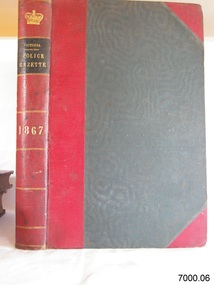 Flagstaff Hill Maritime Museum and Village
Administrative record - Reference Sociology/History, John Ferres, Government Printer, Victoria Police Gazettes for 1867, 1867
... Health Officers, and Electoral Inspectors were also recorded in later issues, showing its broader role as an administrative record. (For more information on the Pattison Collection see item 3678 Flagstaff Hill collections) https://victoriancollections.net.au/items/5580c7e72162f114d8b758db warrnambool shipwrecked-coast flagstaff-hill flagstaff-hill-maritime-museum maritime-museum shipwreck-coast flagstaff-hill-maritime-village shipwrecked-artefact book victoria police gazette 1862 victoria police gazette warrnambool books and records great ocean road The Victoria Police Gazette was a confidential, internal publication of the Victoria Police, issued to inform police officers, court and justice officials, and government departments about matters relevant to policing across the colony. ...The Victoria Police Gazette was a confidential, internal publication of the Victoria Police, issued to inform police officers, court and justice officials, and government departments about matters relevant to policing across the colony. It commenced in December 1853 and was initially published weekly by the Victoria Police. It was distributed each week to city and rural police stations and to government offices and newspaper publishers. Inclusions in this weekly publication were people wanted for questioning in relation to various crimes, prisoners discharged from city or country gaols, extracts from Police Gazettes in New South Wales, South Australia, Queensland, Tasmania, New Zealand, and occasionally overseas countries, as well as extracts from the Hobart Town Gazette listing escaped convicts and the person to whom they were assigned. There was also a "Missing Friends" section, where most people listed were not criminals but were sought by police so relatives, old friends, or government officials could renew contact with them. In addition, there was a record of deserted wives and children, listing the offender's name, birthplace, age, occupation, last known area of residence, likely future movements and known relatives. There was also a section on court lists, warrants issued, appointments and staffing changes within the police service, arrest and discharge records with physical descriptions, and lists of pastoralists with descriptions of their livestock brands.Hard Bound Volume. Victorian Police Gazettes for 1867 Author: Institutional Government Publication Publisher: John Ferres, Melbourne Date: 1867 Further Information: Compilation of Weekly Victorian Police Gazettes for 1867 in a hard bound volume with red spine and red corner reinforcing. Front panel grey coloured lettering in gilt with gilt banding to spine. Inside is twelve issues of the Police Gazettes for 1867.non-fictionThe Victoria Police Gazette was a confidential, internal publication of the Victoria Police, issued to inform police officers, court and justice officials, and government departments about matters relevant to policing across the colony. It commenced in December 1853 and was initially published weekly by the Victoria Police. It was distributed each week to city and rural police stations and to government offices and newspaper publishers. Inclusions in this weekly publication were people wanted for questioning in relation to various crimes, prisoners discharged from city or country gaols, extracts from Police Gazettes in New South Wales, South Australia, Queensland, Tasmania, New Zealand, and occasionally overseas countries, as well as extracts from the Hobart Town Gazette listing escaped convicts and the person to whom they were assigned. There was also a "Missing Friends" section, where most people listed were not criminals but were sought by police so relatives, old friends, or government officials could renew contact with them. In addition, there was a record of deserted wives and children, listing the offender's name, birthplace, age, occupation, last known area of residence, likely future movements and known relatives. There was also a section on court lists, warrants issued, appointments and staffing changes within the police service, arrest and discharge records with physical descriptions, and lists of pastoralists with descriptions of their livestock brands.warrnambool, shipwrecked-coast, flagstaff-hill, flagstaff-hill-maritime-museum, maritime-museum, shipwreck-coast, flagstaff-hill-maritime-village, shipwrecked-artefact, book, victoria police gazette 1862, victoria police gazette, warrnambool books and records, great ocean road -
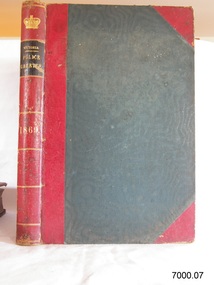 Flagstaff Hill Maritime Museum and Village
Administrative record - Reference Sociology/History, John Ferres, Government Printer, Victoria Police Gazettes for 1869, 1869
... Health Officers, and Electoral Inspectors were also recorded in later issues, showing its broader role as an administrative record. (For more information on the Pattison Collection see item 3678 Flagstaff Hill collections) https://victoriancollections.net.au/items/5580c7e72162f114d8b758db warrnambool shipwrecked-coast flagstaff-hill flagstaff-hill-maritime-museum maritime-museum shipwreck-coast flagstaff-hill-maritime-village shipwrecked-artefact book victoria police gazette 1862 victoria police gazette warrnambool books and records great ocean road The Victoria Police Gazette was a confidential, internal publication of the Victoria Police, issued to inform police officers, court and justice officials, and government departments about matters relevant to policing across the colony. ...The Victoria Police Gazette was a confidential, internal publication of the Victoria Police, issued to inform police officers, court and justice officials, and government departments about matters relevant to policing across the colony. It commenced in December 1853 and was initially published weekly by the Victoria Police. It was distributed each week to city and rural police stations and to government offices and newspaper publishers. Inclusions in this weekly publication were people wanted for questioning in relation to various crimes, prisoners discharged from city or country gaols, extracts from Police Gazettes in New South Wales, South Australia, Queensland, Tasmania, New Zealand, and occasionally overseas countries, as well as extracts from the Hobart Town Gazette listing escaped convicts and the person to whom they were assigned. There was also a "Missing Friends" section, where most people listed were not criminals but were sought by police so relatives, old friends, or government officials could renew contact with them. In addition, there was a record of deserted wives and children, listing the offender's name, birthplace, age, occupation, last known area of residence, likely future movements and known relatives. There was also a section on court lists, warrants issued, appointments and staffing changes within the police service, arrest and discharge records with physical descriptions, and lists of pastoralists with descriptions of their livestock brands.Hard Bound Volume. Victorian Police Gazettes for 1869 Author: Institutional Government Publication Publisher: John Ferres, Melbourne Date: 1869 Further Information: Compilation of Weekly Victorian Police Gazettes for 1869 in a hard bound volume with red spine and red corner reinforcing. Front panel grey coloured lettering in gilt with gilt banding to spine. Inside is twelve issues of the Police Gazettes for 1869.non-fictionThe Victoria Police Gazette was a confidential, internal publication of the Victoria Police, issued to inform police officers, court and justice officials, and government departments about matters relevant to policing across the colony. It commenced in December 1853 and was initially published weekly by the Victoria Police. It was distributed each week to city and rural police stations and to government offices and newspaper publishers. Inclusions in this weekly publication were people wanted for questioning in relation to various crimes, prisoners discharged from city or country gaols, extracts from Police Gazettes in New South Wales, South Australia, Queensland, Tasmania, New Zealand, and occasionally overseas countries, as well as extracts from the Hobart Town Gazette listing escaped convicts and the person to whom they were assigned. There was also a "Missing Friends" section, where most people listed were not criminals but were sought by police so relatives, old friends, or government officials could renew contact with them. In addition, there was a record of deserted wives and children, listing the offender's name, birthplace, age, occupation, last known area of residence, likely future movements and known relatives. There was also a section on court lists, warrants issued, appointments and staffing changes within the police service, arrest and discharge records with physical descriptions, and lists of pastoralists with descriptions of their livestock brands.warrnambool, shipwrecked-coast, flagstaff-hill, flagstaff-hill-maritime-museum, maritime-museum, shipwreck-coast, flagstaff-hill-maritime-village, shipwrecked-artefact, book, victoria police gazette 1862, victoria police gazette, warrnambool books and records, great ocean road -
Connecting Home
book, Deadly Design, Bewteen Two Worlds, 2008
... Historic Significance, this is one of Victoria's first books published that helps to explain the thought & feelings of Stolen Generation people, that has been developed to address recommendations from the Bringing Them Home Report. Social Significance, The information recorded from stolen generation participants explains to non-aboriginal health & human service professionals about the social impact of the politically incorrect times that state & national laws and policies had been introduced to forcibly remove aboriginal & toerres strait islander children form family, land and culture. ...As a result of the recommendations arising from the Stolen Generations Taskforce Report 2003. The taskforce identified the need for an independant, community controlled organisation in Victoria to be established to meet the needs of the stolen generation in this state. Connecting Home seeks to undertalke activities that will assist members of the stolen generation and engage in publc awareness and education. Historic Significance, this is one of Victoria's first books published that helps to explain the thought & feelings of Stolen Generation people, that has been developed to address recommendations from the Bringing Them Home Report. Social Significance, The information recorded from stolen generation participants explains to non-aboriginal health & human service professionals about the social impact of the politically incorrect times that state & national laws and policies had been introduced to forcibly remove aboriginal & toerres strait islander children form family, land and culture. Research Significance, Soft cover book, with 43 pages. Picture of aboriginal girl, crying, holding teddy bear on front cover. Content is a guide aimed at understanding the Stolen Generations for Health & Human Service Professionals. book, stolen, generations, victoria, victorian, human, resources, syd, jackson, roseann, hepbruns haines, aiatsis, missions, rererves, aboriginal, legal, service, child, care, agency, health, education, consultative, group, housing, cooperative, bringing, them, home, counsellor, program, link, up, koori, heritage, trust -
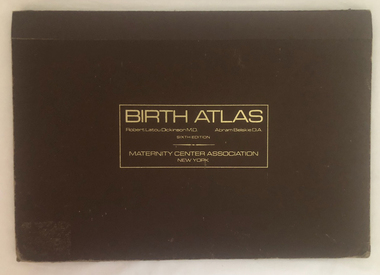 Orbost & District Historical Society
Archive - Maternal & Child Health Service, Orbost, Helen McCarthy, 2024
... All items are from the Maternal & Child Health Service, Orbost, and were used by this service. Items are books, photos, record cards, bottles. 3367.1 Framed b/w photo of a Dodge vehicle, children, women, logs, dog. 3367.2 Group of 19 laminated photos of buildings, vehicles, children, women. 3367.3 Brown covered, spiral bound album of 19 pages. 3367.4 Clear glass bottle with markings along the side. 3367.5 Cardboard box, bluish colour. ...All items are from the Maternal & Child Health Service, Orbost, and were used by this service. Items are books, photos, record cards, bottles. 3367.1 Framed b/w photo of a Dodge vehicle, children, women, logs, dog. 3367.2 Group of 19 laminated photos of buildings, vehicles, children, women. 3367.3 Brown covered, spiral bound album of 19 pages. 3367.4 Clear glass bottle with markings along the side. 3367.5 Cardboard box, bluish colour. ...Services for Mothers and Children in East Gippsland were upgraded and formalised from the 1940s onwards. While these services were centred in Orbost, there was considerable outreach throughout East Gippsland. In 2024, this service was discontinued and the service was then provided on a part-time basis by a visiting service from Lakes Entrance. This collection was compiled in 2024 when the Orbost-based service was discontinued.This collection is significant because it relates to the history and functioning of the Maternal and Child Health Service in Orbost from 1940s-2024. A collection of items in a storage box. All items are from the Maternal & Child Health Service, Orbost, and were used by this service. Items are books, photos, record cards, bottles. 3367.1 Framed b/w photo of a Dodge vehicle, children, women, logs, dog. 3367.2 Group of 19 laminated photos of buildings, vehicles, children, women. 3367.3 Brown covered, spiral bound album of 19 pages. 3367.4 Clear glass bottle with markings along the side. 3367.5 Cardboard box, bluish colour. Inside is a implement with a flexible top and a pyrex/glass bottom which is open. 3367.6 Small book with printed pages 3367.7 Black covered book with blue binding, ruled pages inside. Inside are clippings, articles. 3367.8 Book with blue cover & photo of a child sitting. 173 pages 3367.9 Small booklet with white cover, blue print & image of a baby on the front cover. 65 pages 3367.10 Book with yellow & pink cover, white lettering. 96 pages 3367.11 Spiral bound booklet with a plastic cover, b/w image of a nurse on the verandah of a building. 3367.12 Plastic covered book with blue edging. 3367.13 Spiral bound book, a burgundy plastic folder. 3367.14 Spiral bound book, white cover. Contents are photos, clippings 3367.15 Small blue covered book with black binding. Contents are for midwives, mothers, breastfeeding. 3367.16 Manilla folder 3367.17 Manilla folder containing an article. Also a small layette. 3367.18 Manilla folder containing articles about history & general information, mixed topics 3367.19 Collection of 5 CDs + one tape casette. 3367.20 a round metal badge, blue colour, red heart in centre. 3367.1 Titled 'Arrival of Infant Welfare Sister, Orbost circuit c.1940s. 3367.2 Captions re. Swifts Ck, Marlo, Nowa Nowa, Ensay 3367.3 Birth Atlas. Ed. 1940 6th Ed.1978. BIRTH ATLAS. Robert Latou Dickinson M.D., Abram Belskie D.A. Sixth ed. Maternal Center Assocn., New York 3367.4 Agee pyrex feeder No. 12. Has 80z. markings along the side. 3367.5 Surgi Pack Breast Pump. Code no. 6260 3367.6 Child's Personal Health Record bk. Contains Immunization chart & Baby's Weight Record cards 3367.7 belonged to Ruth Ritchie, Brodribb, via Orbost 3367.8 CHILD CARE, Dept. of Health, Victoria 3367.9 Dept. of Health, Victoria. Maternal & Child Hygiene Branch, PRE NATAL BOOKLET. A practical guide for every expectant mother. 3367.10 All the Little Children. The Story of Victoria's Baby Health Centres. By Heather Sheard 3007. 3367.11 ORBOST HOSPITAL NURSES MEMOIRS. Compiled by Helen McCarthy & Yvonne Knight, October 2000. 3367.12 Far East Gippsland Health and Support Service. Compiled by Yvonne Knight & Helen McCarthy. 29 June 2000 3367.13 Clippings 1972-1998 Nurses, Orbost 3367.14 100 Years of the Maternal and Child Health Services. 3367.15 A practical guide by Wendy L Nicholson, Nursing Mothers Association of Australia 3367.16 Exercises for the Expectant Mother 3367.17 Diet for Mother and Baby; a small layette for a baby 3367.18 History and General Information 3367.19 5 CDs. + one tape casette 3367.20 International Nurses' Day 2001 health, maternal and child health, orbost, east gippsland -
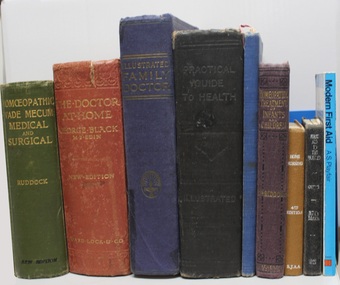 Ringwood and District Historical Society
Book, Collection of nine medical books 1900-1935 belonging to Nurse Maggs and descendants (1973), of Ringwood, Victoria
... books from 1909 to 1935 1 . Homeopathic Vade Mecum Medical and Surgical by E.H.Ruddock M.D. Xmas gift from G Smith to Nurse Maggs 1909 2. The Doctor at Home Ed. by George Black Presented from friend to Mrs. A Maggs 12-12-1909 3. Illustrated Family Doctor 1935 4.The Practical Guide to Health...books from 1909 to 1935 1 . Homeopathic Vade Mecum Medical and Surgical by E.H.Ruddock M.D. Xmas gift from G Smith to Nurse Maggs 1909 2. The Doctor at Home Ed. by George Black Presented from friend to Mrs. A Maggs 12-12-1909 3. Illustrated Family Doctor 1935 4.The Practical Guide to Health ...Nurse Marianne Maggs undertook medical care and midwifery from 1900 - 1926 and delivered more than 500 babies. She was presented with a "wireless" in 1926 in appreciation for her services to the community. She sold her Ringwood house and moved to Mitcham. 10 medical books from 1909 to 1935 1 . Homeopathic Vade Mecum Medical and Surgical by E.H.Ruddock M.D. Xmas gift from G Smith to Nurse Maggs 1909 2. The Doctor at Home Ed. by George Black Presented from friend to Mrs. A Maggs 12-12-1909 3. Illustrated Family Doctor 1935 4.The Practical Guide to Health Frederick Rossiter 5. Johnson and Johnson's First Aid Manual 1909, including booklet - Accidents in the Home 6. Diseases of Infants and Children and their Homeopathic Treatment Dr. Ruddock 1910, including lock of (child's?) hair. 7. Home Nursing St. John's Ambulance 1939 8. First Aid to the Injured 1921 (2 copies) 9. Modern First Aid A.S. PLayfair 1973 -
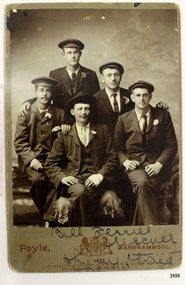 Flagstaff Hill Maritime Museum and Village
Postcard - People, Bill Ferrier - rescuer, 11th November, 1905
... health and he died of a heart attack six months after the wreck; he was only thirty-seven. His body was buried in the Melbourne General Cemetery. The La Bella was “the best documented of all sailing ships owned in New Zealand”. Her record books...health and he died of a heart attack six months after the wreck; he was only thirty-seven. His body was buried in the Melbourne General Cemetery. The La Bella was “the best documented of all sailing ships owned in New Zealand”. Her record books ...The postcard shows a photograph of William Ferrier, the 25-year-old Warrnambool fisherman from South Warrnambool whose rescue of two sailors from the wrecked La Bella made him an overnight National hero, quoted as “one of the most heroic rescues in Victoria’s shipwreck history”. The La Bella was wrecked on 10th November 1905 and the photograph was taken on the next day. In the photograph, William Ferrier is seated in the centre, with four of the five survivors beside him: (from left to right) Leonard Robertson, R. Payne, Oscar Rosenholme and Jack Noake. The photograph was taken by Foyle Photography Studio in Warrnambool, originally owned by James Charles Foyle. He previously had a photographic studio in Melbourne 1882 1887, then opened “Foyle’s Photo Card Studios” in Liebig St, Warrnambool. James Foyle died on 13th July 1905 and his son and daughter, Charles and Lilian Foyle continued on with the business until 1945. This photograph was most likely taken by either Charles or Lilian Foyle. The story of William Ferrier’s brave act follows on below … The ship from which the sailors were rescued was the three-masted, iron and steel barquentine the La Bella, built in Norway in 1893. She was one of two iron and steel ships by Johan Smith, the company was one of the leading shipping families in Tvedestrand, Norway. She was significant to Norwegian shipping, being one of only 27 iron and steel ships ever built in Norway. She was registered in New Zealand and engaged from 1902 in inter-colonial trading of timber in the Pacific, between New Zealand and Australia and was often in Port Phillip Bay, Victoria. On 5th October 1905, the twelve-year-old La Bella left Lyttleton, New Zealand carrying a cargo of timber bound for Warrnambool, Australia. She was manned by a crew of twelve: the Master, (Captain Mylius, previously 1st Mate of La Bella, appointed Captain to La Bella on 6th February 1903) 2 Mates, Cook, six able seamen, one ordinary seaman and a boy. Bad weather en route caused her to shelter at Burnie on Tasmania's North West coast. On November 10th, the 37th day of her journey, La Bella approached Warrnambool. Captain Mylius steered her towards Lady Bay Channel in heavy south-west seas and evening mist. He ordered the helmsman to steer for the light. As the ship came round, a tremendous sea struck her on the port quarter, causing her to breach broadside in a northwesterly direction into breakers. The helm was brought round twice more, but each time heavy seas broke over her, the third time throwing the La Bella on to a submerged reef in Lady Bay now known as La Bella Reef (about 100 yards from the Warrnambool breakwater). The sea was so rough that it even wrenched a one-and-a-half ton anchor from its fastenings and into the sea. As Captain Mylius headed to the steel wheelhouse, intending to send up a rocket flare, a huge sea slammed the steel door into him (resulting in massive bruising front and back) Despite his injuries he still managed to set off a blue light, which he held up in his hands. La Bella’s lifeboats were filled with seawater and broke up on their chocks. The blue light was the first indication to people on the shore that there was a ship in distress. The Harbour Master, Captain Roe (who lived in the Harbour Master’s House opposite Flagstaff Hill), organised a group of volunteers to crew the lifeboat because the trained crew was unavailable; the crewmen were working on a steamer in Port Fairy at the time. He then poured oil onto the water to try and smooth the sea. At around 11 pm three of the crew took shelter in the steel forecastle but the sea crashed into it and broke it up. While the rest of the crew and onlookers watched helplessly in the moonlight the bodies were washed away into the sea, never to be seen again. Some of the crew lashed themselves to the weather rail to keep from being washed away. Watson, the ordinary seaman, became tangled in the rigging lines and was too weak to move, so the 2nd Mate, Robertson, put a line onto him so that he wouldn’t wash off. Around 11 pm three of the crew were unconscious from exhaustion. The situation on La Bella was becoming dangerous. The 2nd Mate moved to the ‘house’ and soon afterwards the ship slipped in the heavy sea. The lashings of the 1st Mate and the ‘boy’ Denham had kept them safe until about 2 am when they were washed overboard; no one was able to help. One by one, the exhausted crew were being washed overboard, too weak to hold on any longer. During the night the La Bella had broken into two and the deckhouse ran out towards the sea. Two more men drowned when trying to reach the lifeboat. By sunrise, the only survivors of the twelve were the Master, 2nd Mate and three seamen. Early in the morning, Captain Roe used the rocket apparatus on shore to try and shoot a line to the ship for a safer rescue but each attempt fell short of the target. Several attempts were made by the lifeboat to rescue the stricken sailors, but the rough conditions made this difficult for the boat to get close enough to the ship and the lifeboat had to return to shore. During a final attempt to reach the ship Captain Mylius ordered his men to jump into the sea. Leonard Robertson, 2nd mate, jumped and swam towards the lifeboat, taking hold of the boat hook offered to him. Oscar Rosenholme managed to reach the boat floating on a piece of timber from the ship’s load and a third survivor, Noake, also made the boat. Along with the lifeboat rescue crew, 25-year-old William Ferrier rowed his small dingy through the heavy seas and managed to rescue the Captain, whom he landed on the breakwater. Ferrier then returned to the ship to attempt a final rescue, losing his oars and rowlocks into the high sea. Using just a spare paddle he skulled towards the La Bella, reaching her stern in time to cut loose the lone surviving sailor, Payne, from the lashing that held him to the ship; the terrified sailor dropped from the ship and into the dingy. Shortly after the last man was rescued, the La Bella was lifted by a huge wave and crashed back down on the reef; she broke up and sank. The ordeal had lasted ten hours. The survivors were taken to the nearby Bay View Hotel and gratefully received warm food and clothing, medical attention and a place to sleep. In the following days, an unidentified body of a young person had washed ashore; it was either Watson or Denham. The body was buried in the Warrnambool cemetery with an appropriate gravestone and inscription. William Ferrier became a national hero as news of the daring rescue spread. In recognition of his bravery in the two daring rescues, he was awarded the Silver Medal for Bravery by the Royal Humane Society and was honoured in the letter from the Prime Minister and the Parliament of the Commonwealth, telegrams and a cheque for £20 from the Governor-General, over £150 subscribed by the public, including Warrnambool and district and readers of The Argus, and a gold medal from the Glenelg Dinghy Club of South Australia. Ferrier’s rescue efforts are one of the most heroic in Victoria’s shipwreck history. (William Ferrier’s son, Frank, received a similar award almost fifty years later when he helped rescue four members of the crew on the yacht Merlan after it ran on to a reef near the Point Lonsdale Lighthouse. ) The wreck of La Bella now lies on her port side in 13 metres of sheltered water inside the reef she struck. The bow section is relatively intact and part of the stern has drifted north-easterly towards the mouth of the Hopkins River. The reef the La Bella struck now bears its name. Those five rescued from the La Bella were Captain George Mylius, Leonard Robertson (2nd Mate, 21 years old), R. Payne, Oscar Rosenholme and Jack Noake. Those seven who lost their lives were Mr Coulson (1st mate), Charles Jackman (cook) Gustave Johnson, Pierre Johann and Robert Gent (all able seamen), Harry Watson (ordinary seaman) and Jack Denham (ship’s boy), Captain Mylius was found guilty of careless navigation; he had sailed into the bay without the services of a pilot. His Master Certificate was suspended for twelve months. Later he was also charged with manslaughter of one of the crew who had died when the La Bella was wrecked but found not guilty. The event’s adverse publicity and damage to his career took a toll on his health and he died of a heart attack six months after the wreck; he was only thirty-seven. His body was buried in the Melbourne General Cemetery. The La Bella was “the best documented of all sailing ships owned in New Zealand”. Her record books, ship logs, correspondence and supporting papers are still available. At the time of the tragedy, she was owned by Messers David C.Turnbull and Co. of Timaru, New Zealand timber merchants and shipping agents, who had purchased her on 13th December 1901. A detailed account of the last journey of La Bella can be read in “Leonard Robertson, the Whangaroa & La Bella” written by Jack Churchouse, published in 1982 by Millwood Press Ltd, Wellington, NZ. As well as this postcard, Flagstaff Hill’s La Bella Collection includes a photograph of the wrecked La Bella, a brass rail holder and the letter from the Prime Minister and other Members of Parliament that was sent to William Ferrier to commend him for his bravery. Some 15 – 17 ships are believed to have sunk in Lady Bay, but only two have been discovered on the seafloor; the “La Bella” and the “Edinburgh Castle”. Both wrecks are popular diving sites and are preserved as significant historical marine and marine archaeological sites. This postcard is part of the La Bella Collection and is significant at both a local and state level. Its connection to the La Bella shipwreck and the rescue of five survivors highlights the dangers of Victoria’s Shipwreck Coast. The photograph of William Ferrier and four of the five survivors demonstrates the bravery of ordinary Australians who risked their lives to save victims of shipwrecks along the coast. The postcard is significant to the history of Warrnambool as it portrays William Ferrier, a local fisherman whose descendants continue to live in the area. It highlights the way of life of people who lived in coastal towns in 19th century Victoria and the effects of shipwrecks upon them. The postcard connects to the congratulatory letter which was sent to William Ferrier by the Prime Minister and Government of Australia and demonstrates the importance they attached to his efforts for Victoria and to Australia. The postcard is also an example of the photography of Foyle Photographers who were in the town of Warrnambool from the late 1800’s. Charles and Lillian Foyle took over the business when their father James died in 1905. Lillian Foyle is significant as the first woman photographer in Warrnambool. It is not known whether Charles of Lillian took this photograph. This postcard is significant because of its association with the sailing ship “La Bella”. The “La Bella” is of local and state and national significance. It is one of the only two shipwrecks discovered in Lady Bay, Warrnambool, out of the 15-17 shipwrecks in the bay. Sepia photograph of William (Bill) Ferrier (seated in the middle), heroic rescuer of two crew members of the La Bella, wrecked at Warrnambool. The photograph is a postcard and shows five men dressed formally in suits and hats. Printed below the photograph are the name and place of the photographer, a royal crest and the details of two patrons of the photographer. Also below the photograph are some handwritten words in black pen. On the back of the postcard is a handwritten message in the same writing as the front.Printed on the front of the card is “Foyle, WARRNAMBOOL” “PATRONS: / HIS ROYAL HIGHNESS THE DUKE OF CORNWALL & YORK. / HIS EXCELLENCY LORD BRAS_ EY, R.O.B.” Handwritten on the front of the card is “Bill Ferrier / rescuer / Oh my hero _ _ _ “ Handwritten on the back of the card is a message. “La Bella” Wrecked off W.Bool Breakwater Nov. 1906 (_ _ _ _ show night) Payne Noake Rosenholme Robertson and Capt Mylius (saved) (moonlight bright) Watson (_ _ _ _ boy) Richwoud [possibly Richmond] drowned” and signed “Desdewoua [possibly Desdemona] Slogos”la bella, foyle, william ferrier, bill ferrier, lady bay, 1905, 10th november 1905, 11th november 1905, parliament of the commonwealth, royal humane society medal, flagstaff hill, warrnambool, shipwrecked coast, flagstaff hill maritime museum, maritime museum, shipwreck coast, flagstaff hill maritime village -
 Greensborough Historical Society
Book, Our Royal Guests, 1952_
... None of these books were sold or distributed as the visit was cancelled due to King's ill health and passing. ...None of these books were sold or distributed as the visit was cancelled due to King's ill health and passing. ...Published in 1952, before the death of King George this book tells the family story of the Windsors in anticipation of the first Royal Visit of Princess Elizabeth and the Duke of Edinburgh to Australia. An added note from a member of the public: "Bit of information on the book “Our Royal Guests” 1952. None of these books were sold or distributed as the visit was cancelled due to King's ill health and passing. My father printed them and they were instructed to have them picked up and destroyed. The only ones in circulation would be from workers during this process."Due to the King's death, the anticipated Royal Visit was postponed until 1954.Hard cover, Illus. (some colour).queen elizabeth 2, house of windsor, duke of edinburgh, royal tour of australia 1954 -
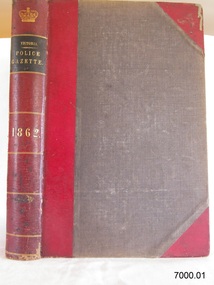 Flagstaff Hill Maritime Museum and Village
Administrative record - Reference Sociology/History, John Ferres, Government Printer, Victoria Police Gazettes for 1862, 1862
... Health Officers, and Electoral Inspectors were also recorded in later issues, showing its broader role as an administrative record. (For more information on the Pattison Collection see item 3678 Flagstaff Hill collections) https://victoriancollections.net.au/items/5580c7e72162f114d8b758db warrnambool shipwrecked-coast flagstaff-hill flagstaff-hill-maritime-museum maritime-museum shipwreck-coast flagstaff-hill-maritime-village shipwrecked-artefact book victoria police gazette 1862 victoria police gazette warrnambool books and records great ocean road The Victoria Police Gazette was a confidential, internal publication of the Victoria Police, issued to inform police officers, court and justice officials, and government departments about matters relevant to policing across the colony. ...The Victoria Police Gazette was a confidential, internal publication of the Victoria Police, issued to inform police officers, court and justice officials, and government departments about matters relevant to policing across the colony. It commenced in December 1853 and was initially published weekly by the Victoria Police. It was distributed each week to city and rural police stations and to government offices and newspaper publishers. Inclusions in this weekly publication were people wanted for questioning in relation to various crimes, prisoners discharged from city or country gaols, extracts from Police Gazettes in New South Wales, South Australia, Queensland, Tasmania, New Zealand, and occasionally overseas countries, as well as extracts from the Hobart Town Gazette listing escaped convicts and the person to whom they were assigned. There was also a "Missing Friends" section, where most people listed were not criminals but were sought by police so relatives, old friends, or government officials could renew contact with them. In addition, there was a record of deserted wives and children, listing the offender's name, birthplace, age, occupation, last known area of residence, likely future movements and known relatives. There was also a section on court lists, warrants issued, appointments and staffing changes within the police service, arrest and discharge records with physical descriptions, and lists of pastoralists with descriptions of their livestock brands.Hard Bound Volume. Victorian Police Gazettes for 1862 Author: Institutional Government Publication Publisher: John Ferres, Melbourne Date: 1862 Further Information: Compilation of Weekly Victorian Police Gazettes for 1862 in a hard bound volume with red spine and red corner reinforcing. Front panel grey coloured lettering in gilt with gilt banding to spine. Inside is twelve issues of the Police Gazettes for 1862.non-fictionThe Victoria Police Gazette was a confidential, internal publication of the Victoria Police, issued to inform police officers, court and justice officials, and government departments about matters relevant to policing across the colony. It commenced in December 1853 and was initially published weekly by the Victoria Police. It was distributed each week to city and rural police stations and to government offices and newspaper publishers. Inclusions in this weekly publication were people wanted for questioning in relation to various crimes, prisoners discharged from city or country gaols, extracts from Police Gazettes in New South Wales, South Australia, Queensland, Tasmania, New Zealand, and occasionally overseas countries, as well as extracts from the Hobart Town Gazette listing escaped convicts and the person to whom they were assigned. There was also a "Missing Friends" section, where most people listed were not criminals but were sought by police so relatives, old friends, or government officials could renew contact with them. In addition, there was a record of deserted wives and children, listing the offender's name, birthplace, age, occupation, last known area of residence, likely future movements and known relatives. There was also a section on court lists, warrants issued, appointments and staffing changes within the police service, arrest and discharge records with physical descriptions, and lists of pastoralists with descriptions of their livestock brands.warrnambool, shipwrecked-coast, flagstaff-hill, flagstaff-hill-maritime-museum, maritime-museum, shipwreck-coast, flagstaff-hill-maritime-village, shipwrecked-artefact, book, victoria police gazette 1862, victoria police gazette, warrnambool books and records, great ocean road -
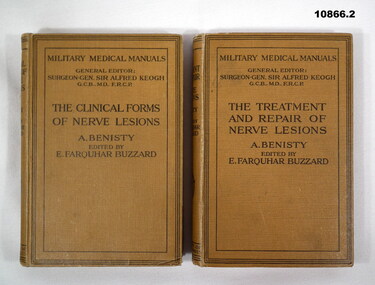 Bendigo Military Museum
Book - MILITARY MEDICAL MANUAL, A. BENISTY, "THE TREATMENT AND REPAIR OF NERVE LESIONS". and "THE CLINICAL FORMS OF NERVE LESIONS", 1918
... books. Cover cardboard with id brown buckram. Black ink print on front and spine. 181 pages, cut, plain, white paper. These are medical manuals with many black and white health themed illustrations. 1. ...books. Cover cardboard with id brown buckram. Black ink print on front and spine. 181 pages, cut, plain, white paper. These are medical manuals with many black and white health themed illustrations. 1. ...1. & 2. Hardcover books. Cover cardboard with id brown buckram. Black ink print on front and spine. 181 pages, cut, plain, white paper. These are medical manuals with many black and white health themed illustrations. 1. Front end papers - two adhesive labels. 2. Front end papers - one adhesive label and owner's signature.Label information. 1. Top - gold print on black background "EX LIBRIS/ SIR SYDNEY SUNDERLAND" Bottom - black print on white background “ANGUS & ROBERTSON/ New & Second-hand Booksellers/ Publishers to University/ 89 Castlereagh St. Sydney" 2. Label per "Top", Handwritten - black ink pen "Sydney Sunderland" and grey lead pencil "RR".publications, books, manual, medical -
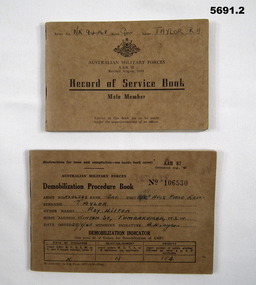 Bendigo Military Museum
Administrative record - RECORD of SERVICE & DEMOBILISATION BOOKS WW2, Aust Govt
... health details and personnel records. 2. Brown cover booklet with 31 pages inside, white paper containing information relating to discharge - stapled. Administrative record RECORD of SERVICE & DEMOBILISATION BOOKS ...1. Record of Service book gives details on Serviceman on enlistment, description and instructions to soldiers. 2. Demobilisation Procedure book outlining details of demobilisation issued to each soldier upon demob. Refer No.5687 for details on NX94268 Roy Taylor.1. Brown cover booklet with 40 internal pages in green, containing details of enlistment, physical description, education and health details and personnel records. 2. Brown cover booklet with 31 pages inside, white paper containing information relating to discharge - stapled.1. On front "NX94268", "Gnr", "Taylor R.H." . 2. On front - name and address of Roy Hilton Taylor.record of service, demobilisations, ww2 -
 Eltham District Historical Society Inc
Photograph - Digital Photograph, Marguerite Marshall, Eltham Library, Panther Place, Eltham, 18 April 2008
... In 1952 the books were relocated to a room in the newly opened Baby Health Centre on Main Road. ...In 1952 the books were relocated to a room in the newly opened Baby Health Centre on Main Road. ...Rear view of Eltham Library showing loading dock and ramp to the front of the building. Designed by multi-award winning architect, Gregory Burgess, for which he won the 1995 Royal Australian Insitute of architects (Vic.) Merit Award in the New Institutional category. Covered under Heritage Overlay, Nillumbik Planning Scheme. Published: Nillumbik Now and Then / Marguerite Marshall 2008; photographs Alan King with Marguerite Marshall.; p183 Award-winning Eltham Library, with its earthy tones blending into the nearby parklands, celebrates some of the best of Eltham’s spirit. Designed by multi-award winning architect, Gregory Burgess, the library at Panther Place, won him the 1995 Royal Australian Institute of Architects (Vic) Merit Award in the New Institutional category.1 The design is typical of Burgess’ work, emphasising natural materials and forms, and the integration of building and site.2 In its distinctive architectural character, Burgess celebrated the spirit of Eltham’s artist/architect Justus Jörgenson and mud-brick builder Alistair Knox. However this library, which opened in 1994, follows decades of efforts to acquire a suitable library for local residents. It was only in 1971 that Eltham acquired its first purpose-built library. In the 1930s books were borrowed from a mobile library run by Mr Foster of Bible Street. From the 1930s to the early 1950s, adults borrowed books from the newsagency and general store in Main Road (still a newsagency) near Arthur Street. As late as the 1950s, adults borrowed books in the shire office foyer, then in Main Road near the corner of Arthur Street.3 In the early 1950s the ratepayers voted for lower rates rather than a library, in a referendum to build a public library financed by higher rates. Children depended on volunteers for their library service until 1966. In 1946 the inaugural meeting of the Eltham War Memorial Trust’s Women’s Auxiliary, decided to support the Trust by raising funds to buy land and build a Children’s Library, Baby Health Centre and other facilities. The auxiliary formed the Children’s Library Committee, which included Mrs Morrison, Mrs Bow and Mrs Currie. They ran a library service in the stage area of the Eltham Hall, at the corner of Arthur Street and Main Road. In 1952 the books were relocated to a room in the newly opened Baby Health Centre on Main Road. Then in 1961, the Children’s Library received its own hall beside the Eltham Pre-School Centre on Main Road. From there, each month, volunteers delivered books to every school in the shire. In 1966 the Children’s Library closed after 17 years of service, following the transfer of the Trust land and buildings to the Shire of Eltham. The books were donated to nine schools in the shire and to Community Aid Abroad. An important boost to the library service came in 1965, when the Heidelberg Regional Library Service was formed by the City of Heidelberg with the Shires of Eltham and Diamond Valley. Its first library service for Eltham Shire was a bookmobile van. Books for children and adults were finally housed in one building in 1966, when the shire converted the Brinkkotter house in Dudley Street, into a library. At last in 1971, the Eltham Library moved to new premises attached to the shire offices near Panther Place. However these were demolished in 1996, by State Government appointed commissioners during council amalgamations. Meanwhile the Heidelberg Regional Library Service was disbanded in 1985 and the Yarra Plenty Regional Library Service was established. The burgeoning population brought pressure for a bigger library. Eltham was one of several municipalities in the 1970s and 1980s, battling with the State Government for adequate funding for public libraries. Funds were so tight, that in 1987 Eltham councillors threatened to close the library. However public petitions persuaded them to set aside funds to replace the cramped library facilities. In 1992 the Federal Government gave $887,496 towards the $3 million cost of the 1560 square metre library.4 The result is a light and spacious building with surrounding verandas, made of sustainable natural materials including earth and recycled and radially sawn timbers. It includes a gallery and function areas. In 2004 Mr Burgess won Australian architecture’s highest accolade: the Royal Australian Institute of Architects Gold Medal. He has received more than forty professional and community awards.This collection of almost 130 photos about places and people within the Shire of Nillumbik, an urban and rural municipality in Melbourne's north, contributes to an understanding of the history of the Shire. Published in 2008 immediately prior to the Black Saturday bushfires of February 7, 2009, it documents sites that were impacted, and in some cases destroyed by the fires. It includes photographs taken especially for the publication, creating a unique time capsule representing the Shire in the early 21st century. It remains the most recent comprehenesive publication devoted to the Shire's history connecting local residents to the past. nillumbik now and then (marshall-king) collection, eltham, eltham library, panther place -
 Heytesbury District Historical Society Inc.
Book, And We Who Followed: A history of the Heytesbury 1921-1987 by Jack S. Fletcher
... books SIGNIFICANT in the local history of the area and the events and people that formed this history. 648 pages. Index to surnames of people referred to in this history. Some black and white photographs. With reference to Cobden, Simpson, Simpson, Port Campbell, Industry, Health...books SIGNIFICANT in the local history of the area and the events and people that formed this history. 648 pages. Index to surnames of people referred to in this history. Some black and white photographs. With reference to Cobden, Simpson, Simpson, Port Campbell, Industry, Health ...This is the second volume of the history of the Shire of Heytesbury, written by Jack Fletcher. It covers the years 1921 to 1988. Hard cover book with dust cover, Photograph of bulldozer and ball and chain in Simpson Heytesbury Historical Park on front cover. Second book of 2 written by author of History of Heytebury District. First book is The Infiltrators, 1840-1920. See 44, 45. Both books SIGNIFICANT in the local history of the area and the events and people that formed this history. 648 pages. Index to surnames of people referred to in this history. Some black and white photographs. With reference to Cobden, Simpson, Simpson, Port Campbell, Industry, Health, Education, Sport, Churches. A hardcover tan leather book with gold lettering on the cover. Dustcover with photograph of Heytesbury Project Historical Park, Simpson. Contents and Index pages, black and white photographs, map of Heytesbury shire inside front cover. 648 pages.heytesbury shire - history, local government
