
Showing 171 items matching "health week"
-
 Federation University Historical Collection
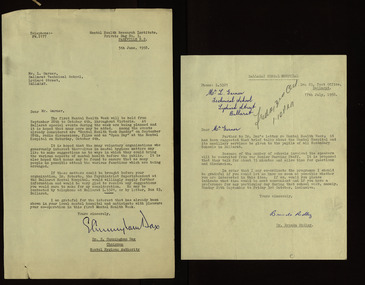
Letter - Correspondence, E. Cunningham Dax, Letters relating to the Inaugural Mental Health Week, 1958, 1958
... Letters relating to the Inaugural Mental Health Week, 1958......mental health week...Garner, Principal of the Ballarat Junior Technical School, regarding the inaugural Mental Health Week. .2) Dr Brenda Riley of the Ballarat Mental Hospital writes to L. ...mental health ballarat mental hospital mental health week l. garner brenda riley e. cunningham dax mental health research institute mental hygiene Department of Mental Hygiene L.C. ...Two letters relating to mental health. .1) Dr E. Cunningham Dux of the Mental Hygiene Authority writes to L. Garner, Principal of the Ballarat Junior Technical School, regarding the inaugural Mental Health Week. .2) Dr Brenda Riley of the Ballarat Mental Hospital writes to L. Garner, Principal of the Ballarat Junior Technical School, regarding brief talks about the Ballarat Mental Hospital and its ancillary services. .4) Typed letter on Department of Mental Hygiene (Ballarat Mental Hospital) Letterhead.signed 'E. Cunningham Dax'mental health, ballarat mental hospital, mental health week, l. garner, brenda riley, e. cunningham dax, mental health research institute, mental hygiene, department of mental hygiene, l.c. garner, brenda ridley -
 Lakes Entrance Historical Society
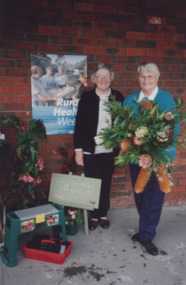
Photograph - Garden club at Rural Health Week. Lakes Entrance 1998, Lakes Post Newspaper
... Garden club at Rural Health Week. Lakes Entrance 1998...Colour photograph Barbara Gray and Thelma Barr of Garden Club volunteering at street stall, display promoted by Home Hardware for Rural Health Week. Lakes Entrance Victoria...number in album 03550.02 Clubs Function Colour photograph Barbara Gray and Thelma Barr of Garden Club volunteering at street stall, display promoted by Home Hardware for Rural Health Week. Lakes Entrance Victoria Photograph Garden club at Rural Health Week. ...number in album 03550.02Colour photograph Barbara Gray and Thelma Barr of Garden Club volunteering at street stall, display promoted by Home Hardware for Rural Health Week. Lakes Entrance Victoriaclubs, function -
 Musculoskeletal Health Australia (now held by the Glen Eira Historical Society)
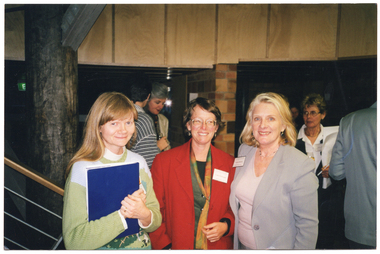
Photograph - Group photo, 1999
... ... rural health week conference...It is captioned: "L-R Fiona Gardiner Latrobe University Bendigo, Cathy Penderfast, East Gippsland Rural Project Worker and Marian Sharkey, Manager Rural Access Project at the Rural Health Week Conference."...WORER [sic] E, GIPPSLAND & MARION SHARKEY, MANAGER AV RURAL ACCESS PILOT PROJECT RURAL HEALTH WEEK CONFERENCE BENDIGO. 1999...In 1999, during the final phase of the project, a Rural Health Week Conference was held in Bendigo. This photo appears on page 20 of the Vol 12 Issue 4, Summer 1999 edition of the Arthritis Foundation of Victoria's quarterly magazine, Arthritis Update. ...In the late 1990s, Arthritis Victoria undertook a Rural Access Pilot Project over a period of two years. In 1999, during the final phase of the project, a Rural Health Week Conference was held in Bendigo. This photo appears on page 20 of the Vol 12 Issue 4, Summer 1999 edition of the Arthritis Foundation of Victoria's quarterly magazine, Arthritis Update. It is captioned: "L-R Fiona Gardiner Latrobe University Bendigo, Cathy Penderfast, East Gippsland Rural Project Worker and Marian Sharkey, Manager Rural Access Project at the Rural Health Week Conference."COL photo of three women standing close to one another in the lobby of a building. They are all wearing name tags on their jumpers or jackets. One of them is holding a blue folder close to her chest. There is a set of stairs to the left of the frame. In the background, there are several other people also in the lobby.[Handwritten in blue ink] FIONA GARDINER LA TROBE UNI, BENDIGO. S/W DEPT [Handwritten in black ink] RESP. FOR EVALUATION OF PROJECT \ [Handwritten in blue ink] CATHY PENDERFAST RURAL ACCESS PROJ. WORER [sic] E, GIPPSLAND & MARION SHARKEY, MANAGER AV RURAL ACCESS PILOT PROJECT RURAL HEALTH WEEK CONFERENCE BENDIGO. 1999arthritis foundation of victoria, afv, osteoporosis victoria, ov, arthritis victoria, av, rural health week conference, outreach, fiona gardiner, latrobe university bendigo, cathy penderfast, east gippsland rural project worker, marian sharkey, afv rural access project manager, bendigo, 1999 -
 Musculoskeletal Health Australia (now held by the Glen Eira Historical Society)
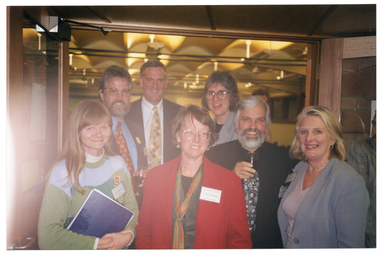
Photograph - Group photo, 1999
... ... rural health week conference...In 1999, during the final phase of the project, a Rural Health Week Conference was held in Bendigo. In this photo, a small group of people pose for a photo at the event. ...[Handwritten in blue ink] FRONT FROM L -> R FIONA GARDINER CATHY PENDERFAST RON LABONTE [somewhat illegible] MARION SHARKEY REAR GRAEME ALLADICE [somewhat illegible], ROB MOODY RURAL HEALTH WEEK CONF. BENDIGO 1999....In 1999, during the final phase of the project, a Rural Health Week Conference was held in Bendigo. In this photo, a small group of people pose for a photo at the event. ...In the late 1990s, Arthritis Victoria undertook a Rural Access Pilot Project over a period of two years. In 1999, during the final phase of the project, a Rural Health Week Conference was held in Bendigo. In this photo, a small group of people pose for a photo at the event. In the front row (from left to right) are Fiona Gardiner, Cathy Penderfast, Ron Labonte, and Marion Sharkey (AFV's Rural Access Project Manager). In the back row, (from left to right) are Graeme Alladice, Rob Moody, and an unidentified woman.COL photo of a small group of people standing close together in two rows in the lobby of a building. There are four people in the front row, and three people in the back row. There are one or two other people (partially obscured) standing behind or beside them. In the background, inside the main hall of the venue, an ornate but modern decoratively lit ceiling is evident through a wide double doorway.[Handwritten in blue ink] FRONT FROM L -> R FIONA GARDINER CATHY PENDERFAST RON LABONTE [somewhat illegible] MARION SHARKEY REAR GRAEME ALLADICE [somewhat illegible], ROB MOODY RURAL HEALTH WEEK CONF. BENDIGO 1999.arthritis foundation of victoria, afv, osteoporosis victoria, ov, arthritis victoria, av, rural health week conference, outreach, fiona gardiner, latrobe university bendigo, cathy penderfast, east gippsland rural project worker, ron labonte, marian sharkey, afv rural access project manager, graeme alladice, rob moody, bendigo, 1999 -
 Melbourne Legacy
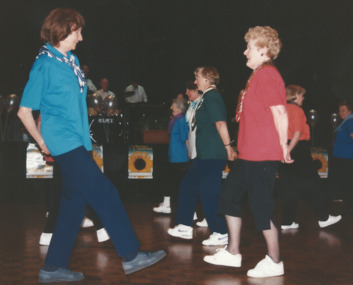
Photograph - Photo, Widows activities, 1996
... These photos were saved with a label saying "Veterans Health week '96" which is an awareness campaign from the Department of Veterans Affairs. ...Colour photo x 2 of widows line dancing in Veterans Health Week....These photos were saved with a label saying "Veterans Health week '96" which is an awareness campaign from the Department of Veterans Affairs. ...These photos were saved with a label saying "Veterans Health week '96" which is an awareness campaign from the Department of Veterans Affairs. From an article in The Answer in December 1996, the motto of the week was "Enjoying Life" and over 80 events were held in Victoria. these photos are from "the annual Veterans' Health Week Afternoon Tea Dance. Three hundred people danced in style to the music of the Mellow Tones, filling the dance floor every dance. During a delicious afternoon tea, Melbourne Legacy Line Dancers demonstrated their fun style of dancing and encouraged everyone to join them."A record of an event for widows and a way of keeping them active and of the relationship with the Department of Veterans' Affairs.Colour photo x 2 of widows line dancing in Veterans Health Week.Handwritten on the back '2' in red pen.widows, activities, answer -
 Melbourne Legacy
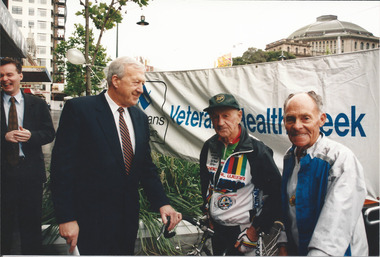
Photograph - Photo, 1996
... From an article in The Answer newsletter December 1996 these veteran cyclists were part of Veterans' Health week which is an awareness campaign from the Department of Veterans' Affairs. ...Colour photo of veteran cyclists in Veterans' Health Week...Colour photo of veteran cyclists in Veterans' Health Week Photograph Photo ...From an article in The Answer newsletter December 1996 these veteran cyclists were part of Veterans' Health week which is an awareness campaign from the Department of Veterans' Affairs. The cyclists were Jack Griffin (72) and Eric Doherty (76), who had recently completed their round Australia cycling expedition. The article says: "Reception at Legacy House for Veteran Cyclists There was a big media roll up at Legacy House Melbourne recently to cover the finish of a marathon bike ride around Australia by two very fit veterans. Legatee President Ray Ward and Veterans' Affairs Deputy Commissioner Brian Flynn were on hand to congratulate them." Photos from the Department of Veterans' Affairs.A record of a special event for Veteran health Week in 1996.Colour photo of veteran cyclists in Veterans' Health WeekHandwritten on the back '3' in red pen.legacy promotion, answer -
 Musculoskeletal Health Australia (now held by the Glen Eira Historical Society)
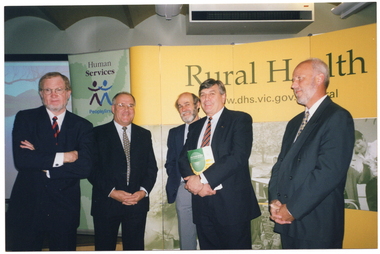
Photograph - Group photo, Circa 1999
... ... rural health week...This photo depicts the Honourable Rob Knowles, the Minister for Health, Victoria, with others at an unidentified event during Rural Health Week, circa 1999....This photo depicts the Honourable Rob Knowles, the Minister for Health, Victoria, with others at an unidentified event during Rural Health Week, circa 1999. arthritis foundation of victoria afv osteoporosis victoria ov arthritis victoria av rural health week outreach rob knowles minister for health victoria C1999 COL photo of five men posing for a photo in front of a large backdrop and banner. ...This photo depicts the Honourable Rob Knowles, the Minister for Health, Victoria, with others at an unidentified event during Rural Health Week, circa 1999.COL photo of five men posing for a photo in front of a large backdrop and banner. One of the men is holding a large booklet. On the left hand side of the backdrop is a pale green vertical freestanding banner. It is titled, "Human Services", with the subtitle 'People First' and a logo of two stick-type figures. The adjoining the backdrop is yellow and contains some large black and white Photographs. It is titled, 'Rural Health', with a Victorian government website address below the title. The website address (partially obscured) is "www.dhs.vic.gov. ...al".arthritis foundation of victoria, afv, osteoporosis victoria, ov, arthritis victoria, av, rural health week, outreach, rob knowles, minister for health victoria, c1999 -
 Bendigo Historical Society Inc.
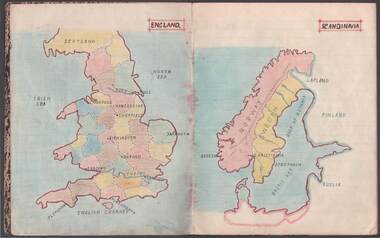
Book - SCHOOL BOOK
... ...health week...Handwritten child entries include brief histories of Australian States. Health Week Stamp pasted on inside cover is dated October 5th-13th 1925. ...VICTORIA History health week Black cover Primary school exercise book un-named. ...Black cover Primary school exercise book un-named. Handwritten child entries include brief histories of Australian States. Health Week Stamp pasted on inside cover is dated October 5th-13th 1925. Coloured pencil drawings enclosed of Italy, England, Scandinavia, Ireland, British Isles as well as Phases of the Moon. Handwritten school account located middle pages features names of 'Gibson of Coburg' and Miss Phelan.victoria, history, health week -
 Musculoskeletal Health Australia (now held by the Glen Eira Historical Society)
Photograph - Group photo, 1999
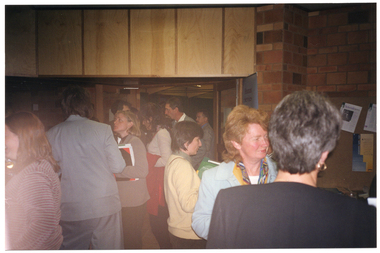
... ... rural health week conference...In 1999, during the final phase of the project, a Rural Health Week Conference was held in Bendigo. This photo depicts conference attendees chatting in the lobby after the conference....In 1999, during the final phase of the project, a Rural Health Week Conference was held in Bendigo. This photo depicts conference attendees chatting in the lobby after the conference. arthritis foundation of victoria afv osteoporosis victoria ov arthritis victoria av rural health week conference outreach bendigo 1999 COL photo of a group of people standing in the lobby of a building. ...In the late 1990s, Arthritis Victoria undertook a Rural Access Pilot Project over a period of two years. In 1999, during the final phase of the project, a Rural Health Week Conference was held in Bendigo. This photo depicts conference attendees chatting in the lobby after the conference.COL photo of a group of people standing in the lobby of a building. Some of them are chatting to one another. A few people are walking through a doorway from the main hall into the lobby.arthritis foundation of victoria, afv, osteoporosis victoria, ov, arthritis victoria, av, rural health week conference, outreach, bendigo, 1999 -
 Musculoskeletal Health Australia (now held by the Glen Eira Historical Society)
Photograph - Group photo, 1999
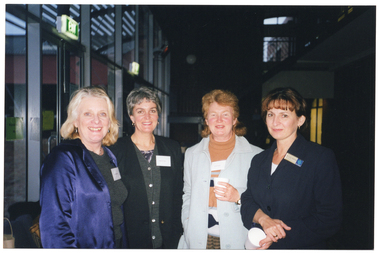
... ... rural health week conference...In 1999, a Rural Health Week Conference was held in Adelaide. This photo depicts Arthritis Victoria's Manager of the Rural Health Access Project, Marion Sharkey, with Department of Human Services (DHS) Health Promotion Officers for Gippsland, Debbie Mitchell and Kay Hoffman, and one unidentified woman....In 1999, a Rural Health Week Conference was held in Adelaide. This photo depicts Arthritis Victoria's Manager of the Rural Health Access Project, Marion Sharkey, with Department of Human Services (DHS) Health Promotion Officers for Gippsland, Debbie Mitchell and Kay Hoffman, and one unidentified woman. arthritis victoria av rural health week conference marian sharkey afv rural access project manager department of human services dhs health promotion officers gippsland debbie mitchell kay hoffman adelaide 1999 [Handwritten in blue ink] NATIONAL RURAL HEALTH CONF ADELAIDE 1999 L TO R MARION SHARKEY DEBBIE MITCHELL & KAY HOFFMAN HEALTH PROM. ...In 1999, a Rural Health Week Conference was held in Adelaide. This photo depicts Arthritis Victoria's Manager of the Rural Health Access Project, Marion Sharkey, with Department of Human Services (DHS) Health Promotion Officers for Gippsland, Debbie Mitchell and Kay Hoffman, and one unidentified woman.COL photo of four women posing for a photo outside a building at night. The building has tall floor to ceiling glass wall panels, and there is an "EXIT" sign above a double glass door.[Handwritten in blue ink] NATIONAL RURAL HEALTH CONF ADELAIDE 1999 L TO R MARION SHARKEY DEBBIE MITCHELL & KAY HOFFMAN HEALTH PROM. OFFICERS DHS GIPPSLANDarthritis victoria, av, rural health week conference, marian sharkey, afv rural access project manager, department of human services, dhs, health promotion officers gippsland, debbie mitchell, kay hoffman, adelaide, 1999 -
 Marysville & District Historical Society
THE TRIANGLE NEWS-VOL 4 NO 5-MARCH 9 1979
... week...health check...marysville victoria australia lions convention marysville girl guide association footy club notes senior citizens red cross kinder roster toddlers group thanks billie jo andrews uniting church marysville primary school mothers club wanted kitchen hand for sale modern supper dance marysville hotel annual meeting wirreanda crossways restaurant thought of the week health check farewell dinner associates golf vale mrs cuzens marysville football club social committee fun run sponsorship lions club marysville cricket club rally community care centre THE TRIANGLE NEWS-VOL 4 NO 5-MARCH 9 1979 ...marysville, victoria, australia, lions convention, marysville girl guide association, footy club notes, senior citizens, red cross, kinder roster, toddlers group, thanks billie jo andrews, uniting church, marysville primary school mothers club, wanted kitchen hand, for sale, modern supper dance marysville hotel, annual meeting wirreanda, crossways restaurant, thought of the week, health check, farewell dinner, associates golf, vale mrs cuzens, marysville football club social committee, fun run, sponsorship lions club, marysville cricket club, rally, community care centre -
Federation University Historical Collection
Book - Book - Scrapbook, Ballarat School of MInes: Scrapbook of Newspaper Cuttings, Book 18, June 1983 to October 1983
... ...health and fitness week...The papers concerned are The Courier, Ballarat, The Australian, The Age over the period of 12 February 1983 to 4 June 1983. courses available teaching positions advertised tracie marks top secretarial student ray pond new cooking instructor bronze bust of mica smith royal melbourne institute of technology presentation of bust of dick richards greenhaigh sculptor ballarat craftsmen elite group smb win inter-school chess competition bcae host seminar gmh donates car for apprentices three faces of liz gurrie growing education industry new programs at smb training the best tutors needed to help with literacy courses bella guerin gaol governor's daughter bcae open day philip tjerstra leaves for austria skill olympics relay raises funds for fitness smb has trained 350+ in computer method hints for buyers rex hoolioake - shire engineer patrick mcardle of smb ensemble health and fitness week dick richards - antarctic hero smb design banner for air show in texas resi award winners smb farm courses Book with white cover, front, spiral bound. ...Collection of newspaper articles related to Ballarat School Of Mines.They cover activities and advertisements for staff. The papers concerned are The Courier, Ballarat, The Australian, The Age over the period of 12 February 1983 to 4 June 1983.Book with white cover, front, spiral bound. courses available, teaching positions advertised, tracie marks top secretarial student, ray pond new cooking instructor, bronze bust of mica smith, royal melbourne institute of technology, presentation of bust of dick richards, greenhaigh sculptor, ballarat craftsmen elite group, smb win inter-school chess competition, bcae host seminar, gmh donates car for apprentices, three faces of liz gurrie, growing education industry, new programs at smb, training the best, tutors needed to help with literacy courses, bella guerin, gaol governor's daughter, bcae open day, philip tjerstra leaves for austria, skill olympics, relay raises funds for fitness, smb has trained 350+ in computer method, hints for buyers, rex hoolioake - shire engineer, patrick mcardle of smb ensemble, health and fitness week, dick richards - antarctic hero, smb design banner for air show in texas, resi award winners, smb farm courses -
 Musculoskeletal Health Australia (now held by the Glen Eira Historical Society)
Photograph - Solo photo, Circa March 1984-1985
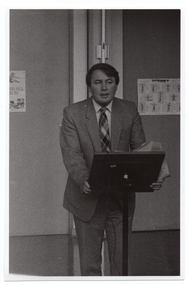
... health... national arthritis week...In March, circa 1984-1985, the Victorian Minister for Health, Tom Roper, officially opened the Royal Talbot Rehabilitation Hospital's new spinal injury rehabilitation wing during National Arthritis Week....In March, circa 1984-1985, the Victorian Minister for Health, Tom Roper, officially opened the Royal Talbot Rehabilitation Hospital's new spinal injury rehabilitation wing during National Arthritis Week. royal talbot rehabilitation hospital royal talbot rehabilitation centre spinal injury wing official opening tom roper victorian minister for health national arthritis week naw 1984 [Handwritten in black ink] ROPER, Tom Opening of Rehabilitation Wing, Royal Talbot Hospital, March, 1985. ...In March, circa 1984-1985, the Victorian Minister for Health, Tom Roper, officially opened the Royal Talbot Rehabilitation Hospital's new spinal injury rehabilitation wing during National Arthritis Week.B&W photo of a man standing at a lectern. He has both hands on the lectern, with some papers also in one hand. There are some posters on the wall behind him.[Handwritten in black ink] ROPER, Tom Opening of Rehabilitation Wing, Royal Talbot Hospital, March, 1985. NAW 84royal talbot rehabilitation hospital, royal talbot rehabilitation centre, spinal injury wing, official opening, tom roper, victorian minister for health, national arthritis week, naw, 1984 -
 Alfred Hospital Nurses League - Nursing History Collection
Booklet - Illustrated Booklet, Ruth Fincher, Maternal and Child Health Nurses memories of their experience during the 1986/1987 Victorian Nurses' Strike, 2025
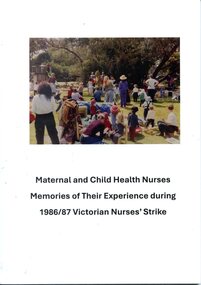
... On the front cover is a coloured photograph of children and parents at Frankston Maternal & Child Health Childrens Week 'picnic in the park' ar George Pentland Gardens, 1991...On the front cover is a coloured photograph of children and parents at Frankston Maternal & Child Health Childrens Week 'picnic in the park' ar George Pentland Gardens, 1991 Maternal and Child Health Nurses memories of their experience during the 1986/1987 Victorian Nurses' Strike Booklet Illustrated Booklet Ruth Fincher Victorian Association of Maternal and Child Health Nurses ...This document was based on a meeting held in 2004, where 10 former Matenal and Child Health (MCH) Nurses shared their experiences of the 1986 Victorian nurses strikeIllustrared document with white cover and black print. On the front cover is a coloured photograph of children and parents at Frankston Maternal & Child Health Childrens Week 'picnic in the park' ar George Pentland Gardens, 1991non-fictionThis document was based on a meeting held in 2004, where 10 former Matenal and Child Health (MCH) Nurses shared their experiences of the 1986 Victorian nurses strikeindustrial action victoria, 1986 victorian nurses strike, industrial action nurses, maternal and child health nurses, infant welfare sisters -
Vision Australia
Audio (item) - Sound recording, Royal Victorian Institute for the Blind, Around the Institute: May 23, 2000
... May 23: NILS – Jane Evans, Rural Health week – Julie Johnson. ...May 23: NILS – Jane Evans, Rural Health week – Julie Johnson. Royal Victorian Institute for the Blind Radio shows 1 digital sound file in WAV format Around the Institute: May 23, 2000 Audio Sound recording Royal Victorian Institute for the Blind ...Around the Institute was a weekly program designed to keep clients and staff informed of events, activities and thoughts relating to low vision and blindness. It consisted of interviews undertaken by Jo Matthews, with sound engineer Ed Gamble, designed to inform, educate and explore on a variety of topics. May 23: NILS – Jane Evans, Rural Health week – Julie Johnson. royal victorian institute for the blind, radio shows -
 Sunshine and District Historical Society Incorporated
Flyer - Brimbank City Council Men's Health Project 2026 Flyer Front, Brimbank City Council, 2026
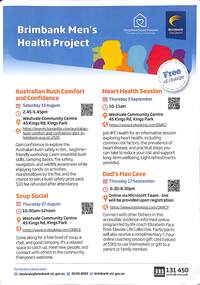
... The project also hosts an annual Men’s Health Week program, featuring events, guest speakers, health checks, and activities designed to reduce stigma and encourage men to seek support. ...The project also hosts an annual Men’s Health Week program, featuring events, guest speakers, health checks, and activities designed to reduce stigma and encourage men to seek support. ...The Brimbank Men’s Health Project is a year‑round initiative focused on improving men’s physical, mental, and emotional wellbeing across the municipality. It delivers workshops, social activities, health education, and community connection opportunities. The project also hosts an annual Men’s Health Week program, featuring events, guest speakers, health checks, and activities designed to reduce stigma and encourage men to seek support. The emphasis on men’s health arises from long‑standing patterns in health outcomes and behaviour. Across Australia, and reflected locally in Brimbank, men are more likely to experience preventable illness, less likely to seek support early, and more likely to become socially isolated. Men’s health initiatives aim to address these gaps through education, connection, and accessible community programs.Brimbank Men's Health Project Australian Bush Comfort and Confidence Westvale Community Centre 45 Kings Road, Kings Park Soup Social Westvale Community Centre 45 Kings Road, Kings Park Hearth Health Session Westvale Community Centre 45 Kings Road, Kings Park Dad's Man Cave On-line Ezee Tennis (Adults) West Sunshine Community Centre 5 Kermeen Street, West Sunshine Table Tennis Time (Adults) Delahey Community Centre 80 Copperfield Drive, Delahey Gluten Free Baking (Adults) West Sunshine Community Centre 5 Kermeen Street, West Sunshine Pizza Meet-Up Westvale Community Centre 45 Kings Road, Kings Park -
 Musculoskeletal Health Australia (now held by the Glen Eira Historical Society)
Photograph - Group photo, 05/08/2003
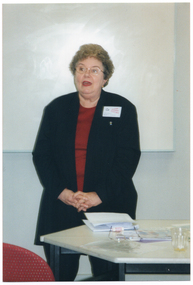
... This photo was taken during National Health Bones Week 2003....This photo was taken during National Health Bones Week 2003. arthritis foundation of victoria afv osteoporosis victoria ov national healthy bones week nhbw beryl logie president melbourne osteoporosis support group 2003 COL photo of a woman, standing in front of a projector screen, speaking. ...Beryl Logie, President of the Melbourne Osteoporosis Support Group, is speaking at an event at Arthritis Victoria's offices. This photo was taken during National Health Bones Week 2003.COL photo of a woman, standing in front of a projector screen, speaking. She is wearing a name badge with the text, "MELBOURNE OSTEOPOROSIS SUPPORT GROUP" and "PRESIDENT, BERYL LOGIE".arthritis foundation of victoria, afv, osteoporosis victoria, ov, national healthy bones week, nhbw, beryl logie, president, melbourne osteoporosis support group, 2003 -
 Musculoskeletal Health Australia (now held by the Glen Eira Historical Society)
Photograph - Group photo, 05/08/2003
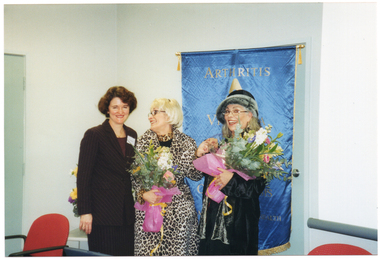
... This photo was taken at Arthritis Victoria's offices during National Health Bones Week 2003....This photo was taken at Arthritis Victoria's offices during National Health Bones Week 2003. arthritis foundation of victoria afv osteoporosis victoria ov national healthy bones week nhbw gifts presentation flowers floral bouquet liz bongetti staff 2003 COL photo of three women posing for a photo in front of a large blue and gold freestanding vertical banner. ...Two unidentified women, each holding a floral bouquet, pose for a photo with AFV staff member, Liz Bongetti, in front of a blue and gold Arthritis Victoria/Osteoporosis Victoria banner. This photo was taken at Arthritis Victoria's offices during National Health Bones Week 2003.COL photo of three women posing for a photo in front of a large blue and gold freestanding vertical banner. Two of the women are each holding a bouquet of flowers. On the banner, there is the text "ARTHRITIS", with the remaining text obscured.arthritis foundation of victoria, afv, osteoporosis victoria, ov, national healthy bones week, nhbw, gifts, presentation, flowers, floral bouquet, liz bongetti, staff, 2003 -
 Uniting Church Archives - Synod of Victoria
B&W photo of another photo or newspaper photograph of Pastor Sir Douglas Nicholls, Undated
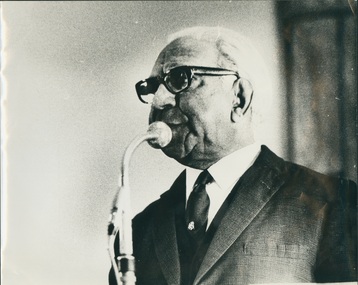
... On 1 December 1976 Sir Douglas was appointed Governor of South Australia, but his health deteriorated within weeks, making it difficult for him to perform his official duties. ...On 1 December 1976 Sir Douglas was appointed Governor of South Australia, but his health deteriorated within weeks, making it difficult for him to perform his official duties. ...Sir Douglas Ralph Nicholls (1906-1988), footballer, pastor, activist and governor, was born on 9 December 1906 at Cummeragunja Aboriginal mission, New South Wales, fifth child of Herbert Nicholls, seasonal worker, and his wife Florence, née Atkinson. Doug grew up at Cummeragunja, on the Murray River near Barmah, in its golden years of Aboriginal autonomy. Thomas Shadrach James gave him and other Yorta Yorta children a sound primary education, reinforcing the pride and self-assurance gained from their parents. As Doug grew, so too did the powers of the State’s Aboriginal Protection Board. Doug’s elder sister Hilda was removed about 1915. When Doug reached 14, he was moved off under the Aborigines Protection Act (1909) to find work. He took a job with dredging teams constructing levees on the Murray. Like other youths in the region Nicholls played Australian rules football, emulating kinsmen who had won local premierships since the 1890s. Doug and his brother Herbert (‘Dowie’) played with Tongala in the mid-1920s. Melbourne football beckoned, Doug trying out unsuccessfully for Carlton in 1927. He signed with the Northcote Victorian Football Association team, despite his nervousness about his Aboriginality, and was given a job with Northcote City Council. ‘Dowie’ joined him for a season. Doug was short at 5 ft 2 ins (158 cm), but muscular and lightning fast. He competed regularly during a boom in professional running, winning many heat and place prizes. In 1929 he won the Nyah and Warracknabeal gifts, earning a sash and £100 in each, together with a case of cutlery in the latter. Using his speed on the wing for Northcote, he produced great spring and agility from his compact body. The Sporting Globe reported in 1929 that ‘he flashes through packs of big men, whisks around small men . . . and attempts marks at the back of any six-footer’. In front-on clashes he was flattened only to rise again. The sole Aborigine in the VFA, he was known affectionately as the ‘flying Abo’ but called worse by his opponents’ barrackers. He competed for five seasons, being named ‘best and fairest’ twice, appearing in three association grand finals and winning in 1929. Keen to earn more than a seasonal wage, in 1931 Nicholls accepted a three-year contract with Jimmy Sharman’s travelling boxing show. The bouts matched opposites, local against tent boxer, white against black, and sometimes men of different sizes. He faced stiff competition from those who wanted to best the noted Melbourne black footballer, the crowd adding racial abuse. A far better footballer than boxer, he copped some punishment. Fighting in the Melbourne Stadium in December 1931, he was described by Truth as ‘slow and awkward’, but packing a ‘good wallop’. In 1932 Sharman, who treated his boxers fairly, released Nicholls to join the Fitzroy Victorian Football League team, which agreed to employ him as its groundsman. He played fifty-four games for Fitzroy over six seasons until knee trouble forced him out in 1937. Winning cups in 1934 and 1935, he played alongside Haydn Bunton and Wilfred (‘Chicken’) Smallhorn. Grand finals eluded him but he represented Victoria twice. Following his mother’s death, Nicholls revisited the Church of Christ chapel in Northcote, where they had worshipped together. On 17 July 1932 he experienced a conversion. He was soon baptised and witnessed openly, leading his fellow footballers to occasional church parades. Nicholls exhibited leadership qualities. William Cooper, founder of the Australian Aborigines’ League and Nicholls’ Yorta Yorta kinsman and fellow Christian, encouraged the young footballer. In February 1935 Cooper, Nicholls and others lobbied Thomas Paterson, the Commonwealth minister for the interior, over the need for Federal control of Aboriginal affairs. Nicholls attended the Day of Mourning protest for Aborigines held in Sydney on 26 January 1938, declaring: ‘after 150 years our people are still influenced and bossed by white people. I know we can proudly hold our own with others if given the chance’. When Cooper retired in November 1940 Nicholls became secretary of the AAL. On 2 June 1941 Nicholls enlisted in the Citizen Military Forces. He trained at Seymour and Bonegilla before being posted to the 29th Battalion. As Major Frank Corr’s batman, he was popular with other soldiers who tolerated his preaching and Bible reading. His army service was brief, however, and he was discharged in Melbourne on compassionate grounds on 22 January 1942. His biographer claimed that the Fitzroy police requested his return to mediate in the racial tensions developing between servicemen and the mostly respectable Aboriginal families living in crowded and dilapidated Fitzroy housing; Aboriginal people maintain that they requested his release. Nicholls began welfare work and religious services from an Aboriginal home in Gertrude Street, Fitzroy. In April 1942, ‘Dowie’ died of road accident trauma, leaving his wife, Gladys, née Bux, and three children. On 26 December 1942 at Moama Methodist Church, New South Wales, Nicholls married her, a caring gesture which developed into a loving partnership. In January 1943 he initiated ‘Aboriginal Sunday’, featuring a gum leaf orchestra and choir. By 1955 this service had moved to July and later evolved into National Aborigines and Islanders Day Observance Committee (NAIDOC) week. Ordained a Churches of Christ pastor in 1945, Nicholls conducted a vigorous ministry from a chapel in Gore Street, Fitzroy. His work survived on donations, a small honorarium, and his employment as team coach (1947) and curator at the Northcote Football Ground. In the 1950s Gladys established grocery and opportunity shops to earn income and provide services. Their house soon overflowed with people in need or visitors to Melbourne. Nicholls also hosted inspiring African American visitors such as the pianist Winifred Attwell and the singer Harry Belafonte. His ministry extended to Aboriginal country communities. Gladys taught Sunday school, undertook endless fund-raising and welfare work beside her husband, and became his greatest supporter and financial manager. They formed an Aboriginal Girls’ Hostel in 1956, for which they acted as house parents, and bought holiday units for Aborigines at Queenscliff. Persistently advocating Aboriginal rights, Nicholls protested about the impact of the Woomera rocket range on the people of the Warburton Ranges, co-ordinated the production of a concert, Out of the Dark, scripted by Jean Campbell, to rectify the omission of Aborigines from Victoria’s Commonwealth jubilee celebrations, and criticised the Victorian Aboriginal Protection Board. In 1957 when the board was transformed into the Aborigines’ Welfare Board, he and Harold Blair were appointed as Aboriginal representatives. Maintaining the stance of a political moderate, he did not bear grudges and sought to build bridges between black and white. He co-operated with any group that aided the cause, including the Council of Aboriginal Rights, whose executive were members of the Communist Party of Australia. This association attracted the attention of the Australian Security Intelligence Organization, which in 1957 began to keep a file on Nicholls. In May 1957 Nicholls formed the Victorian Aborigines Advancement League with Doris Blackburn and Gordon Bryant, a Federal parliamentarian. As its paid field officer and spokesman, Nicholls contested assimilation policies and used film to raise awareness of issues. When the Welfare Board attempted to close Lake Tyers reserve, Gippsland, he resigned in disgust and led a protest march on parliament in May 1963. The AAL also petitioned the United Nations on land rights in June, perhaps the first indigenous body to do so. He argued for new premises at 58 Cunningham Street, Northcote, opened in 1966 as the ‘Doug Nicholls Centre’. In 1958 Nicholls was a foundation member of the Federal Council for Aboriginal Advancement (Federal Council for the Advancement of Aboriginal and Torres Strait Islanders after 1964), which he served as national field officer (1961) and Victorian secretary (1962-63). While an innovator in tactics, he was alarmed by the influence of confrontational ‘black power’ politics in the AAL and resigned as a director amid turmoil on this issue in 1969, claiming the concept was a ‘bitter word’, not needed in Australia. Similar tensions in FCAATSI led him to join with Kath Walker (Oodgeroo Noonuccal) in establishing the short-lived National Tribal Council as an alternative forum. As the AAL leadership moderated their stance, he returned as president (1969-74) of the new all-Aboriginal organisation. He was also a keen patron of the National Aboriginal Sports Foundation, founded in 1969. Many honours were conferred on Nicholls: he was appointed MBE (1957) and OBE (1968) and knighted (1972). In 1962 he was named Victorian ‘Father of the Year’ and the State’s second Aboriginal justice of the peace. Crowned Melbourne’s 1973 King of Moomba, he was declared Bapu Mamus (a Torres Strait term for ‘headman’) by the NTC. On 1 December 1976 Sir Douglas was appointed Governor of South Australia, but his health deteriorated within weeks, making it difficult for him to perform his official duties. In March 1977 he hosted Queen Elizabeth during her royal tour and was appointed KCVO. He relinquished his governorship on 30 April 1977 following a stroke. Ill health continued to dog him during retirement, but he played his Nelson Eddy records, enjoyed his expanding family, and when able, ministered to the Aboriginal Church at the League’s premises. Sir Douglas Nicholls died on 4 June 1988 at Mooroopna, predeceased (1981) by his wife and survived by his five children. He was given a state funeral and buried in tribal ground at Cummeragunja cemetery. Among the many tributes to him are an oval at Northcote, handed to the AAL in 1982, a Canberra suburb gazetted in 1991, and a fellowship for Indigenous leadership established in 2003, all in his name, and a statue of Sir Doug and Lady Nicholls by Louis Laumen, unveiled in 2007 in Parliament Gardens, Melbourne. Sir Douglas Nicholls is shown speaking at a microphone; head and shoulders; dressed in a suit.Pastor Douglas Nicholls -
 Federation University Historical Collection
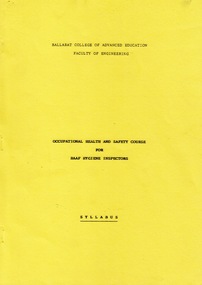
Document - Document - Booklet: Course Outline, VIOSH: BCAE Faculty of Engineering; OH&S Course for RAAF Hygiene Inspectors - Syllabus. June/July 1985
... health and safety." The conceptual framework is set out in Figure 1. The detailed syllabus is set out in behavioural objectives. The course goes over five weeks...health and safety." The conceptual framework is set out in Figure 1. The detailed syllabus is set out in behavioural objectives. The course goes over five weeks ...Victorian Institute of Occupational Safety and Health (VIOSH) Australia is the Asia-Pacific centre for teaching and research in occupational health and safety (OHS) and is known as one of Australia's leaders on the field. VIOSH has a global reputation for its innovative approach within the field of OHS management. VIOSH had its first intake of students in 1979. At that time the Institution was known as the Ballarat College of Advanced Education. In 1990 it became known as Ballarat University College, then in 1994 as University of Ballarat. It was 2014 that it became Federation University. VIOSH Australia students are safety managers, senior advisors and experienced OHS professionals. They come from all over Australia and industry. Students are taught active research and enquiry; rather than textbook learning and a one-size fits all approach. VIOSH accepts people into the Graduate Diploma of Occupational Hazard Management who have no undergraduate degree - on the basis of extensive work experience and knowledge. This is an Occupational Health and Safety Course for RAAF Hygiene Inspectors developed by the Faculty of Engineering at Ballarat College of Advanced Education. "The overall objective of the course is to provide delegates with the basic knowledge and approaches to enable them to diagnose and solve problems in health and safety." The conceptual framework is set out in Figure 1. The detailed syllabus is set out in behavioural objectives. The course goes over five weeks with detailed timetable provided.A4 size booklet with yellow cover. (Staples removed from left edge). 19 pages, timetable pages yellow.viosh, victorian institute of occupational safety and health, raaf hygiene inspectors, ballarat college of advanced education, faculty of engineering, occupational health and safety, diagnose and solve problems -
Federation University Historical Collection
Document - Reports, Ballarat Junior Technical School Council Reports, 1961-1966, 1961-1966
... Morgan Bevan John was the President of the Ballarat Junior Technical School. tuberculosis ballarat junior technical school father ridesdale m.b. john reverand bampton caplain principal's reports health 62 typed Council Reports from the Ballarat Junior Technical School. .1) March 1965 discuses prefects, christian education, sport, vaccination against T.B .2) 1965 discuses Intermediate results .3) February 1966 discuses Enrolment, Staffing, Scholarship results, sport .4) March 1966 discuses Equipment, Cricket carnival, swimming .5) April 1966 discuses students, general .6) May 1966 discuses student activities .7) June 1966 discuses Staff, parent notices .8.) July 1966 discuses Staff, sport, choir, canteen, buildings and equipment, visits, social service .9) August 1966 discuses Staff, activities. sport, choir .10) September 1966 discuses Education week ...Morgan Bevan John was the President of the Ballarat Junior Technical School.62 typed Council Reports from the Ballarat Junior Technical School. .1) March 1965 discuses prefects, christian education, sport, vaccination against T.B .2) 1965 discuses Intermediate results .3) February 1966 discuses Enrolment, Staffing, Scholarship results, sport .4) March 1966 discuses Equipment, Cricket carnival, swimming .5) April 1966 discuses students, general .6) May 1966 discuses student activities .7) June 1966 discuses Staff, parent notices .8.) July 1966 discuses Staff, sport, choir, canteen, buildings and equipment, visits, social service .9) August 1966 discuses Staff, activities. sport, choir .10) September 1966 discuses Education week .11) October 1966 discuses sport, mothers' club .12) November discuses enrolment, social service, christian education .13) December 1966 report .14) February 1965 discuses enrolment, accommodation, staff, scholarships, sport .15) March 1965 discuses staff, sport .16) April 1965 discuses staff, sport, extra-curricular activities .17) May 1965 report .18) June 1965 discuses general, extra-curricular activities, social service, parents meeting .19) July 1965 reporttuberculosis, ballarat junior technical school, father ridesdale, m.b. john, reverand bampton, caplain, principal's reports, health -
 Federation University Historical Collection
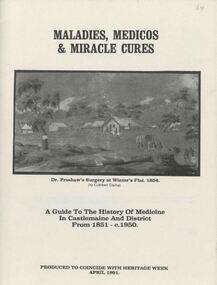
Booklet, Lauretta Zilles, Maladies, Medicos & Miracle Cures: A Guide to the History of Medicine in Castlemaine and District from 1851-c1950, 04/1991
... This is a catalogue supporting an exhibition held at the Castlemaine Art Gallery and Historical Museum. doctors castlemaine hospital pharmacists herbalists dentists veterinary surgeons opticians nurses midwives chiropody benevolent asylum private hospitals homelea herb farm castlemaine infant welfare centre richard bunce william fisher preshaw john cheyne henry barraclough daniel o. preshaw ching chin raymond francis duggan enpo hong l. goon shee shok algernon cyril yandell augustus courts yandell myrtle lucinda yandel daniel cohen max pincus s. aaron mrs foletti vaughan mary ann passalaqua guildford mary an martinoja beatrice thurlby elizabeth spencer lenna hopkins rebecca baxter avonsleigh ballara jonathan chapple alice kenyon health Grey soft covered booklet printed to accompany am exhibiton held at Castlemaine and Historical Museum during Heritage Week. ...This is a catalogue supporting an exhibition held at the Castlemaine Art Gallery and Historical Museum.Grey soft covered booklet printed to accompany am exhibiton held at Castlemaine and Historical Museum during Heritage Week. The book lists information on Castlemaine and district doctors, Castlemaine Hospital, Pharmacists, Herbalists, Dentists, Veterinary Surgeons, Opticians, Nurses, Midwives, Chiropody, Benevolent Asylum, Private Hospitals, Caslemaine Infant Welfare Centre, Homelea Herb Farmdoctors, castlemaine hospital, pharmacists, herbalists, dentists, veterinary surgeons, opticians, nurses, midwives, chiropody, benevolent asylum, private hospitals, homelea herb farm, castlemaine infant welfare centre, richard bunce, william fisher preshaw, john cheyne, henry barraclough, daniel o. preshaw, ching chin, raymond francis duggan, enpo hong, l. goon, shee shok, algernon cyril yandell, augustus courts yandell, myrtle lucinda yandel, daniel cohen, max pincus, s. aaron, mrs foletti, vaughan, mary ann passalaqua, guildford, mary an martinoja, beatrice thurlby, elizabeth spencer, lenna hopkins, rebecca baxter, avonsleigh, ballara, jonathan chapple, alice kenyon, health -
Marysville & District Historical Society
THE TRIANGLE NEWS-VOL 22 NO 11-17 MARCH 1995
... health services...fishing competition...emergency fire telephone numbers...triangle news helpers thank you...buxton primary school...happy birthday...lions mints...rates reduced...shire of murrindindi...marysville ladies' bowling club...press release...flowerdale hall...hire of plant...church news...arthritis week...marysville victoria australia senior citizens for sale or rent designer kidz & ladies wear the danish coffee garden oregon woodgrain timber community health services fishing competition emergency fire telephone numbers triangle news helpers thank you buxton primary school happy birthday lions mints rates reduced shire of murrindindi marysville ladies' bowling club press release flowerdale hall hire of plant church news arthritis week reflections on history marysville & district historical society health care card & pension card holders dental discount garage sale golf news triangle tid bits lions club award marysville video competition word puzzle marysville newsagency & general store THE TRIANGLE NEWS-VOL 22 NO 11-17 MARCH 1995 ...marysville, victoria, australia, senior citizens, for sale or rent, designer kidz & ladies wear, the danish coffee garden, oregon woodgrain timber, community health services, fishing competition, emergency fire telephone numbers, triangle news helpers thank you, buxton primary school, happy birthday, lions mints, rates reduced, shire of murrindindi, marysville ladies' bowling club, press release, flowerdale hall, hire of plant, church news, arthritis week, reflections on history, marysville & district historical society, health care card & pension card holders, dental discount, garage sale, golf news, triangle tid bits, lions club award, marysville video competition, word puzzle, marysville newsagency & general store -
Marysville & District Historical Society
THE TRIANGLE NEWS-VOL 36 NO 13-APRIL 17 2009
... health at yea hospital...highwood's day spa program...marysville football club...marysville community facility...bushfire legal help...youth week...marysville victoria australia marysville welcomes visitors over easter an easter monday thank you advertisements child care available anzac day 2009 community support group bushfire authority & murrindindi shire create partnership agreement learn to fish at eildon pondage councillor comment climate change mayor's chair welcome back flags marysville fire brigade royal children's hospital good friday appeal church notices trauma counselling creative triangle buxton progress assocn meet & greet marysville visitors foundation for young australians 2009 young social pioneers alexandra community health in buxton temporary relocation the berry street story making voices heard at royal commission marysville & district lions club the great shed shindig marysville community golf & bowls club triangle community sausage sizzle funding for bushfire affected communities health & wellbeing managing grief community health at yea hospital highwood's day spa program marysville football club marysville community facility bushfire legal help youth week environment THE TRIANGLE NEWS-VOL 36 NO 13-APRIL 17 2009 ...marysville, victoria, australia, marysville welcomes visitors over easter, an easter monday thank you, advertisements, child care available, anzac day 2009, community support group, bushfire authority & murrindindi shire create partnership agreement, learn to fish at eildon pondage, councillor comment, climate change, mayor's chair, welcome back flags, marysville fire brigade, royal children's hospital good friday appeal, church notices, trauma counselling, creative triangle, buxton progress assocn, meet & greet marysville visitors, foundation for young australians, 2009 young social pioneers, alexandra community health in buxton temporary relocation, the berry street story, making voices heard at royal commission, marysville & district lions club, the great shed shindig, marysville community golf & bowls club, triangle community sausage sizzle, funding for bushfire affected communities, health & wellbeing, managing grief, community health at yea hospital, highwood's day spa program, marysville football club, marysville community facility, bushfire legal help, youth week environment -
Federation University Historical Collection
Document - Documents, Australian Government Covid-19 Vaccination Booster Dose information, 19/08/2020
... On 16 March, Premier Dan Andrews and Minister for Health Jenny Mikakos declared a state of emergency for Victoria for at least four weeks. ...On 16 March, Premier Dan Andrews and Minister for Health Jenny Mikakos declared a state of emergency for Victoria for at least four weeks. ...On 12 January, the World Health Organization (WHO) confirmed that a novel coronavirus was the cause of a respiratory illness in a cluster of people in Wuhan City, Hubei Province, China, who had initially come to the attention of the WHO on 31 December 2019. On 3 March, the Reserve Bank of Australia became the first central bank to cut interest rates in response to the outbreak. Official interest rates were cut by 0.25% (25 base points) to a record low of 0.5%. On 12 March, the Federal Government announced a A$17.6 billion stimulus package, the first since the 2008 GFC. he package consists of multiple parts, a one-off A$750 payment to around 6.5 million welfare recipients as early as 31 March 2020, small business assistance with 700,000 grants up to $25,000 and a 50% wage subsidy for 120,000 apprenticies or trainees for up to 9 months, 1 billion to support economically impacted sectors, regions and communities, and $700 million to increase tax write off and $3.2 billion to support short-term small and medium-sized business investment. On 16 March, Premier Dan Andrews and Minister for Health Jenny Mikakos declared a state of emergency for Victoria for at least four weeks. On 19 March, the Reserve Bank again cut interest rates by a further 0.25% to 0.25%, the lowest in Australian history. On 22 March, the government announced a second stimulus package of A$66bn, increasing the amount of total financial package offered to A$89bn. This included several new measures like doubling income support for individuals on Jobseeker's allowance, granting A$100,000 to small and medium-sized businesses and A$715 million to Australian airports and airlines. It also allowed individuals affected by the outbreak to access up to A$10,000 of their superannuation during 2019–2020 and also being able to take an additional same amount for the next year. on the same day Victorian Premier Daniel Andrews announced on 22 March that the state will bring the school holiday forwards to 24 March from 27 March. On 30 March, the Australian Federal Government announced a $130 billion "JobKeeper" wage subsidy program offering to pay employers up to $1500 a fortnight per full-time, part-time or casual employee that has worked for that business for over a year. For a business to be eligible, they must have lost 30% of turnover after 1 March of annual revenue up to and including $1 billion. For businesses with a revenue of over $1 billion, turnover must have decreased by 50%. Businesses are then required by law to pay the subsidy to their staff, in lieu of their usual wages. This response came after the enormous job losses seen just a week prior when an estimated 1 million Australians lost their jobs. This massive loss in jobs caused the myGov website to crash and lines out of Centrelink offices to run hundreds of metres long.The program was backdated to 1 March, to aim at reemploying the many people who had just lost their jobs in the weeks before. Businesses would receive the JobKeeper subsidy for six months. On 2 April, the number of cases in Victoria exceeded 1,000, including over 100 healthcare workers. On 5 April, New South Wales Police launched a criminal investigation into whether the operator of Ruby Princess, Carnival Australia, broke the Biosecurity Act 2015 (Cwth) and New South Wales state laws, by deliberately concealing COVID-19 cases. On 6 April, the Department of Health revealed that 2,432 people recovered from the infection as the federal government started reporting recovery statistics. This is more than a third from the official number reported so far, Deputy Chief Medical Officer Professor Paul Kelly stating, "I think it is important. Firstly it really reinforces that message, which is a true one, that most people who get this disease do recover”. The day before, at 3pm, it was announced that 2,315 of the 5,687 confirmed coronavirus cases had recovered. May 2020 - An outbreak in Victoria at a meatworks that was later revealed to be Cedar Meats was announced on 02 May with eight cases. By 8 May, the cluster of cases linked to Cedar Meats in Victoria was 71, consisting of at least 57 workers and 13 close contacts, including a nurse, aged care worker and high school student. The number had increased to 75 by 9 May, 88 by 13 May, and 90 by 14 May. On 9 May, two Victorian cases were announced to be related to McDonald's Fawkner. By 18 May, this had increased to 12 cases, and on that day it was revealed that a delivery driver had tested positive, prompting the closing for cleaning of 12 more McDonald's locations: Melton East, Laverton North, Yallambie, Taylors Lakes, Campbellfield, Sunbury, Hoppers Crossing, Riverdale Village, Sandown, Calder Highway Northbound/Outbound, Calder Highway Southbound/Inbound, and BP Rockbank Service Centre Outbound. On 15 May, South Australia became the second jurisdiction, after the ACT, to be free of any active cases, however on 26 May, a woman returning from overseas who was granted exemption into South Australia from her hotel quarantine in Victoria tested positive for COVID-19. This was the first new case in 19 days for the state.[101] On 4 June, it was announced that the woman had recovered and the state was free of any active cases once again.[102] On 17 May, Victoria announced two further business sites had been shut down due to a suspected case at each. Domino's Pizza in Fairfield has been shut for two weeks, and mattress manufacturer The Comfort Group in Deer Park was closed from Friday 15 May to at least Wednesday 20 May. On 6 June, both New South Wales and Victoria reported no new cases for the previous 24 hours, with only Queensland and Western Australia reporting one new case each, the lowest national total since February. Western Australia also announced two old cases. However, the new case in Queensland was linked to the Rydges on Swanston cluster in Melbourne when a man who travelled from Melbourne to Brisbane on Virgin flight VA313 on 1 June tested positive.An A4 printed document persented to those who received a Covid19 Vaccination boostercovid-19, corona virus, pandemic, social distancing, lock down, vaccine, vaccine booster -
Federation University Historical Collection
Notebook, Work Programme 1967, 1967
... week's classes. The first section is divided into the schedule for each term of the school year. They are "Term 1", "Term 2", "Term 3" and "Term 4". These terms are further divided into columns with the headings "Grade 1'", "Grade 2", "Grade 4", "Grade 5", and "Grade 6".The Rows are titled "Speech", "Reading", "English", "Poetry", "Spelling & Dictation", "Writing", "Maths", "Social Studies", "Nature", "Creative Activities", "Music", and "Health & Phys. ...Health & Phys. Ed". along with comments regarding the events of the week's classes. ...This is a syllabus programme prepared for the education of students by a teacher for the year 1967, along with his comments regarding the itinerary for each week's classes. The first section is divided into the schedule for each term of the school year. They are "Term 1", "Term 2", "Term 3" and "Term 4". These terms are further divided into columns with the headings "Grade 1'", "Grade 2", "Grade 4", "Grade 5", and "Grade 6".The Rows are titled "Speech", "Reading", "English", "Poetry", "Spelling & Dictation", "Writing", "Maths", "Social Studies", "Nature", "Creative Activities", "Music", and "Health & Phys. Ed". along with comments regarding the events of the week's classes. What follows is the class plan for each grade level with an index detailing each aspect of that grades education for the 1967 school year. They are "Infant Syllabus Grades 1 & 2" with the sections "Reading", "Word Study", "Number", "Spoken Expression", "Written Expression", "Writing", "Social Studies", "Nature Study", "Health", "Physical Education", "Literature", "Creative Activities", "Music", and "Character Training". The "Primary Syllabus Grades 4, 5 & 6" features the section "Mathematics", "Grammar", "Reading", "Oral Expression", "Written Expression", "Spelling", "Speech", "Poetry", "Social Studies", "Health", "Physical Education", "Music", "Creative Activities", and "Nature Study". A inset has been included within the notebook titled "Psychological Research Group:Grade VI. Grouped Spelling List." which was kept in a homemade paper pocket.Included throughout the notebook are various images taken from various sources, cut out and stuck to the front page of each section. The registration no. "11932" is included on the front page in pencil.alex ball, 1967, work programme, syllabus, grade 1, grade 2, grade 4, grade 5, grade 6, mathematics, grammar, reading, oral expression, written expression, spelling, speech, poetry, social studies, health, physical education, music, creative activities, nature study, notebook, english, spelling & dictation, writing, nature, health & phys. ed -
 Federation University Historical Collection
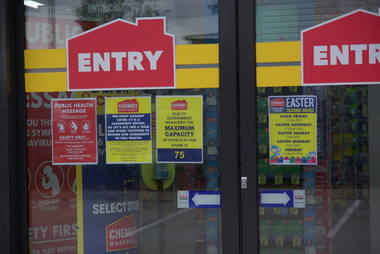
Photograph - Photograph - Colour, Social Distancing Signs during the Covid-19 Pandemic, 2020, 06/04/2020
... On 16 March, Premier Dan Andrews and Minister for Health Jenny Mikakos declared a state of emergency for Victoria for at least four weeks. ...On 16 March, Premier Dan Andrews and Minister for Health Jenny Mikakos declared a state of emergency for Victoria for at least four weeks. ...On 12 January, the World Health Organization (WHO) confirmed that a novel coronavirus was the cause of a respiratory illness in a cluster of people in Wuhan City, Hubei Province, China, who had initially come to the attention of the WHO on 31 December 2019. On 3 March, the Reserve Bank of Australia became the first central bank to cut interest rates in response to the outbreak. Official interest rates were cut by 0.25% (25 base points) to a record low of 0.5%. On 12 March, the Federal Government announced a A$17.6 billion stimulus package, the first since the 2008 GFC. he package consists of multiple parts, a one-off A$750 payment to around 6.5 million welfare recipients as early as 31 March 2020, small business assistance with 700,000 grants up to $25,000 and a 50% wage subsidy for 120,000 apprenticies or trainees for up to 9 months, 1 billion to support economically impacted sectors, regions and communities, and $700 million to increase tax write off and $3.2 billion to support short-term small and medium-sized business investment. On 16 March, Premier Dan Andrews and Minister for Health Jenny Mikakos declared a state of emergency for Victoria for at least four weeks. On 19 March, the Reserve Bank again cut interest rates by a further 0.25% to 0.25%, the lowest in Australian history. On 22 March, the government announced a second stimulus package of A$66bn, increasing the amount of total financial package offered to A$89bn. This included several new measures like doubling income support for individuals on Jobseeker's allowance, granting A$100,000 to small and medium-sized businesses and A$715 million to Australian airports and airlines. It also allowed individuals affected by the outbreak to access up to A$10,000 of their superannuation during 2019–2020 and also being able to take an additional same amount for the next year. on the same day Victorian Premier Daniel Andrews announced on 22 March that the state will bring the school holiday forwards to 24 March from 27 March. On 30 March, the Australian Federal Government announced a $130 billion "JobKeeper" wage subsidy program offering to pay employers up to $1500 a fortnight per full-time, part-time or casual employee that has worked for that business for over a year. For a business to be eligible, they must have lost 30% of turnover after 1 March of annual revenue up to and including $1 billion. For businesses with a revenue of over $1 billion, turnover must have decreased by 50%. Businesses are then required by law to pay the subsidy to their staff, in lieu of their usual wages. This response came after the enormous job losses seen just a week prior when an estimated 1 million Australians lost their jobs. This massive loss in jobs caused the myGov website to crash and lines out of Centrelink offices to run hundreds of metres long.The program was backdated to 1 March, to aim at reemploying the many people who had just lost their jobs in the weeks before. Businesses would receive the JobKeeper subsidy for six months. Victoria's "Second Wave" from Ballarat Courier, 05 August 2020 Wednesday, August 5: 725 cases, 15 deaths. A record figure reached yet again. Tuesday, August 4: 439 cases, 11 deaths. New fines introduced for COVID-infected people who aren't home. Monday, August 3: 429 cases, 13 deaths. Premier details mass industry shutdowns in Melbourne. Sunday, August 2: 671 cases, seven deaths as harsh new statewide lockdowns are announced Saturday, August 1: 397 new cases, three deaths Friday, July 31: 627 new cases, eight deaths. Premier says one in four Covid cases not home when checked. Thursday July 30: 723 cases, 13 deaths. Just when it was looking promising, alarming new record set. Wednesday July 29: 295 new cases, nine deaths as new cases drop below 300 for first time in nine days Tuesday July 28: 380 new cases, six deaths as aged care outbreaks continue to climb Monday July 27: 532 new cases as daily cases hits 500 for first time, six deaths Sunday July 26: 459 new cases as double-digit death toll is recorded for first time with 10 deaths Saturday July 25: 357 new cases, five new deaths Friday July 24: 300 cases, six deaths, ADF role expanded to help with contact tracing. Thursday July 23 - 403 cases, five deaths, worst day for fatalities in any state, masks now mandatory Wednesday July 22 - 484 cases, two deaths Tuesday July 21 - 374 cases, three deaths Monday July 20 - 275 cases, one death Sunday July 19 - 363 cases, three deaths, notice that masks will become mandatory in lockdown areas Saturday July 18 - 217 cases, three deaths, final Melbourne public housing tower released from hard lockdown Friday July 17 - 428 cases, three deaths Thursday July 16 - 317 cases, two deaths Wednesday July 15 - 238 cases, one death Tuesday July 14 - 270 cases, two deaths Monday July 13 - 177 cases Sunday July 12 - 273 cases, one death Saturday July 11 - 216 cases, one death Friday July 10 - 288 cases, a national daily record at the time Thursday July 9 - 165 cases, eight of nine Melbourne public housing towers released from hard lockdown Wednesday July 8 - 134 cases, new stage-three restrictions announced for metropolitan Melbourne and Mitchell Shire Tuesday July 7 - 191 cases Monday July 6 - 127 cases, two deaths, NSW border closed Sunday July 5 - 74 cases Saturday July 4 - 108 cases, immediate hard lockdown of nine Melbourne public housing towers Friday July 3 - 66 cases Thursday July 2 - 77 cases Wednesday July 1 - 73 casesColour photographs of social distancing signs during the Covid-19 Pandemic, on Chemist Warehouse in Sebastopol. On 06 April 2020 a maximum of 75 people were allowed in the chemist at one time, and those with syptoms of Covid-19 (fever, cough, shortness of breath) were asked to not enter without phone contact. Upon entering customers were directed to use hand sanitizer, and 1.5 metre markings were placed on the floor to enable legal social distancing.covid-19, corona virus, pandemic, chemist's warehouse, sebastopol, social distancing -
 Federation University Historical Collection
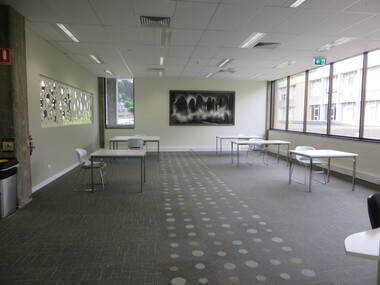
Photograph - Photograph - Colour, E.J. Barker Library Social Distancing During the Covid19 Pandemic, 2020, 06/04/2020
... On 16 March, Premier Dan Andrews and Minister for Health Jenny Mikakos declared a state of emergency for Victoria for at least four weeks. ...On 16 March, Premier Dan Andrews and Minister for Health Jenny Mikakos declared a state of emergency for Victoria for at least four weeks. ...On 12 January, the World Health Organization (WHO) confirmed that a novel coronavirus was the cause of a respiratory illness in a cluster of people in Wuhan City, Hubei Province, China, who had initially come to the attention of the WHO on 31 December 2019. On 3 March, the Reserve Bank of Australia became the first central bank to cut interest rates in response to the outbreak. Official interest rates were cut by 0.25% (25 base points) to a record low of 0.5%. On 12 March, the Federal Government announced a A$17.6 billion stimulus package, the first since the 2008 GFC. he package consists of multiple parts, a one-off A$750 payment to around 6.5 million welfare recipients as early as 31 March 2020, small business assistance with 700,000 grants up to $25,000 and a 50% wage subsidy for 120,000 apprenticies or trainees for up to 9 months, 1 billion to support economically impacted sectors, regions and communities, and $700 million to increase tax write off and $3.2 billion to support short-term small and medium-sized business investment. On 16 March, Premier Dan Andrews and Minister for Health Jenny Mikakos declared a state of emergency for Victoria for at least four weeks. On 19 March, the Reserve Bank again cut interest rates by a further 0.25% to 0.25%, the lowest in Australian history. On 22 March, the government announced a second stimulus package of A$66bn, increasing the amount of total financial package offered to A$89bn. This included several new measures like doubling income support for individuals on Jobseeker's allowance, granting A$100,000 to small and medium-sized businesses and A$715 million to Australian airports and airlines. It also allowed individuals affected by the outbreak to access up to A$10,000 of their superannuation during 2019–2020 and also being able to take an additional same amount for the next year. on the same day Victorian Premier Daniel Andrews announced on 22 March that the state will bring the school holiday forwards to 24 March from 27 March. On 30 March, the Australian Federal Government announced a $130 billion "JobKeeper" wage subsidy program offering to pay employers up to $1500 a fortnight per full-time, part-time or casual employee that has worked for that business for over a year. For a business to be eligible, they must have lost 30% of turnover after 1 March of annual revenue up to and including $1 billion. For businesses with a revenue of over $1 billion, turnover must have decreased by 50%. Businesses are then required by law to pay the subsidy to their staff, in lieu of their usual wages. This response came after the enormous job losses seen just a week prior when an estimated 1 million Australians lost their jobs. This massive loss in jobs caused the myGov website to crash and lines out of Centrelink offices to run hundreds of metres long.The program was backdated to 1 March, to aim at reemploying the many people who had just lost their jobs in the weeks before. Businesses would receive the JobKeeper subsidy for six months.Colour photographs of furniture placed for social distancing in the Federation University E.J Barker Library during the Covid-19 Pandemic. The next day the library was closed all except staff.covid-19, corona virus, pandemic, library, e.j. barker library, mt helen library -
 Federation University Historical Collection
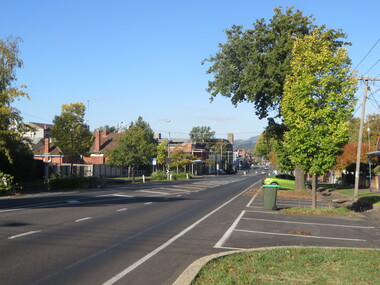
Photograph, Dana Street, Ballarat During Covid-19 State of Emergency, 13/04/2020
... On 16 March, Premier Dan Andrews and Minister for Health Jenny Mikakos declared a state of emergency for Victoria for at least four weeks. ...On 16 March, Premier Dan Andrews and Minister for Health Jenny Mikakos declared a state of emergency for Victoria for at least four weeks. ...On 12 January, the World Health Organization (WHO) confirmed that a novel coronavirus was the cause of a respiratory illness in a cluster of people in Wuhan City, Hubei Province, China, who had initially come to the attention of the WHO on 31 December 2019. On 3 March, the Reserve Bank of Australia became the first central bank to cut interest rates in response to the outbreak. Official interest rates were cut by 0.25% (25 base points) to a record low of 0.5%. On 12 March, the Federal Government announced a A$17.6 billion stimulus package, the first since the 2008 GFC. he package consists of multiple parts, a one-off A$750 payment to around 6.5 million welfare recipients as early as 31 March 2020, small business assistance with 700,000 grants up to $25,000 and a 50% wage subsidy for 120,000 apprenticies or trainees for up to 9 months, 1 billion to support economically impacted sectors, regions and communities, and $700 million to increase tax write off and $3.2 billion to support short-term small and medium-sized business investment. On 16 March, Premier Dan Andrews and Minister for Health Jenny Mikakos declared a state of emergency for Victoria for at least four weeks. On 19 March, the Reserve Bank again cut interest rates by a further 0.25% to 0.25%, the lowest in Australian history. On 22 March, the government announced a second stimulus package of A$66bn, increasing the amount of total financial package offered to A$89bn. This included several new measures like doubling income support for individuals on Jobseeker's allowance, granting A$100,000 to small and medium-sized businesses and A$715 million to Australian airports and airlines. It also allowed individuals affected by the outbreak to access up to A$10,000 of their superannuation during 2019–2020 and also being able to take an additional same amount for the next year. on the same day Victorian Premier Daniel Andrews announced on 22 March that the state will bring the school holiday forwards to 24 March from 27 March. On 30 March, the Australian Federal Government announced a $130 billion "JobKeeper" wage subsidy program offering to pay employers up to $1500 a fortnight per full-time, part-time or casual employee that has worked for that business for over a year. For a business to be eligible, they must have lost 30% of turnover after 1 March of annual revenue up to and including $1 billion. For businesses with a revenue of over $1 billion, turnover must have decreased by 50%. Businesses are then required by law to pay the subsidy to their staff, in lieu of their usual wages. This response came after the enormous job losses seen just a week prior when an estimated 1 million Australians lost their jobs. This massive loss in jobs caused the myGov website to crash and lines out of Centrelink offices to run hundreds of metres long.The program was backdated to 1 March, to aim at reemploying the many people who had just lost their jobs in the weeks before. Businesses would receive the JobKeeper subsidy for six months. * On 12 April 2020 Victorian Premier Daniel Andrews Extended the State of Emergency until midnight on May 11. On this day the world has 1,604,900 cases of coronavirus, with 95,738 deaths. America has 468,887 cases of covid19, with 1,900 Americans dying in the last 24 hours. The UK has 65,077 cases. 881 people died in the last 24 hours. Australia has 6,292 cases. 58 people have died to date.Colour photographs of Ballarat's usually very busy Dana Street during Covid-19 Social Isoliation. The photographs were taken at 4.00pm. dana street, ballarat, covid19, corona virus, pandemic, state of emergency -
 Federation University Historical Collection
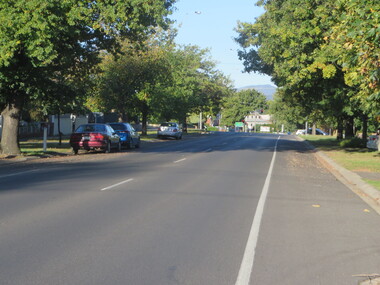
Photograph - Photograph - Colour, Eyre Street, Ballarat During Covid-19 State of Emergency, 13/04/2020
... On 16 March, Premier Dan Andrews and Minister for Health Jenny Mikakos declared a state of emergency for Victoria for at least four weeks. ...On 16 March, Premier Dan Andrews and Minister for Health Jenny Mikakos declared a state of emergency for Victoria for at least four weeks. ...On 12 January, the World Health Organization (WHO) confirmed that a novel coronavirus was the cause of a respiratory illness in a cluster of people in Wuhan City, Hubei Province, China, who had initially come to the attention of the WHO on 31 December 2019. On 3 March, the Reserve Bank of Australia became the first central bank to cut interest rates in response to the outbreak. Official interest rates were cut by 0.25% (25 base points) to a record low of 0.5%. On 12 March, the Federal Government announced a A$17.6 billion stimulus package, the first since the 2008 GFC. he package consists of multiple parts, a one-off A$750 payment to around 6.5 million welfare recipients as early as 31 March 2020, small business assistance with 700,000 grants up to $25,000 and a 50% wage subsidy for 120,000 apprenticies or trainees for up to 9 months, 1 billion to support economically impacted sectors, regions and communities, and $700 million to increase tax write off and $3.2 billion to support short-term small and medium-sized business investment. On 16 March, Premier Dan Andrews and Minister for Health Jenny Mikakos declared a state of emergency for Victoria for at least four weeks. On 19 March, the Reserve Bank again cut interest rates by a further 0.25% to 0.25%, the lowest in Australian history. On 22 March, the government announced a second stimulus package of A$66bn, increasing the amount of total financial package offered to A$89bn. This included several new measures like doubling income support for individuals on Jobseeker's allowance, granting A$100,000 to small and medium-sized businesses and A$715 million to Australian airports and airlines. It also allowed individuals affected by the outbreak to access up to A$10,000 of their superannuation during 2019–2020 and also being able to take an additional same amount for the next year. on the same day Victorian Premier Daniel Andrews announced on 22 March that the state will bring the school holiday forwards to 24 March from 27 March. On 30 March, the Australian Federal Government announced a $130 billion "JobKeeper" wage subsidy program offering to pay employers up to $1500 a fortnight per full-time, part-time or casual employee that has worked for that business for over a year. For a business to be eligible, they must have lost 30% of turnover after 1 March of annual revenue up to and including $1 billion. For businesses with a revenue of over $1 billion, turnover must have decreased by 50%. Businesses are then required by law to pay the subsidy to their staff, in lieu of their usual wages. This response came after the enormous job losses seen just a week prior when an estimated 1 million Australians lost their jobs. This massive loss in jobs caused the myGov website to crash and lines out of Centrelink offices to run hundreds of metres long.The program was backdated to 1 March, to aim at reemploying the many people who had just lost their jobs in the weeks before. Businesses would receive the JobKeeper subsidy for six months. * On 12 April 2020 Victorian Premier Daniel Andrews Extended the State of Emergency until midnight on May 11. On this day the world has 1,604,900 cases of coronavirus, with 95,738 deaths. America has 468,887 cases of covid19, with 1,900 Americans dying in the last 24 hours. The UK has 65,077 cases. 881 people died in the last 24 hours. Australia has 6,292 cases. 58 people have died to date.Colour photographs of Ballarat's usually very busy Eyre Street during Covid-19 Social Isoliation. The photographs were taken at 4.00pm. ballarat, covid19, corona virus, pandemic, state of emergency, eyre street
