
Showing 10 items matching "heidelberg repatriation hospital - melbourne"
-
 Returned Nurses RSL Sub-branch
Programme - Printed programme, Fiftieth anniversary of the Heidelberg Repatriation Hospital, 1991
... Heidelberg Repatriation Hospital...Heidelberg Repatriation Hospital - Melbourne...Printed programme for the service celebrating the fiftieth anniversary of the Heidelberg Repatriation Hospital, Melbourne (1941-1991), held on Wednesday 13th March, 1991....Printed programme for the service celebrating the fiftieth anniversary of the Heidelberg Repatriation Hospital, Melbourne (1941-1991), held on Wednesday 13th March, 1991. ...Printed programme for the service celebrating the fiftieth anniversary of the Heidelberg Repatriation Hospital, Melbourne (1941-1991), held on Wednesday 13th March, 1991.Single-fold paper programme with black typed print and a hand-drawn illustration of a hospital building on the lower front page.'M39' [handwritten in blue ink in the top right corner of the front page]heidelberg repatriation hospital, heidelberg repatriation hospital - melbourne, military hospitals -- victoria -- heidelberg -- history -
 Returned Nurses RSL Sub-branch
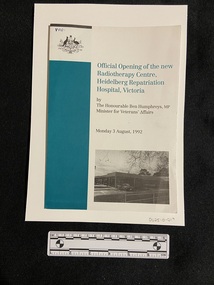
Document - Printed programme, Australian Department of Veteran Affairs, Official opening of the new radiotherapy centre, Heidelberg Reaptriation Hospital, Victoria, 1992
... Heidelberg Repatriation Hospital - Melbourne...Commemorative programme for the opening of a radiotherapy centre at the Heidelberg Repatriation Hospital in Melbourne in 1992....Commemorative programme for the opening of a radiotherapy centre at the Heidelberg Repatriation Hospital in Melbourne in 1992. Heidelberg Repatriation Hospital - Melbourne Veteran Affairs Minister returned soldiers medical acre Department of Veterans Affairs 'VA8' [handwritten in blue ink in the top left corner] Single fold booklet on card. ...Commemorative programme for the opening of a radiotherapy centre at the Heidelberg Repatriation Hospital in Melbourne in 1992.Single fold booklet on card. Front cover shows a deep green panel running down the left side with a white square at the top displaying the Australian coat of arms in black ink. The right side of the cover has the event information printed in green and black text and at the bottom is a black and white photograph of a hospital building.'VA8' [handwritten in blue ink in the top left corner]heidelberg repatriation hospital - melbourne, veteran affairs minister, returned soldiers medical acre, department of veterans affairs -
 Returned Nurses RSL Sub-branch
Document - Printed document, Programme for rededication ceremony : Thursday, 18th September 1986, [1986]
... Heidelberg Military Hospital...Heidelberg Repatriation Hospital - Melbourne...Heidelberg Repatriation Hospital] grounds. Programme includes brief background, order of service and dedication. Australian Army Nursing Service AANS WW2 WWII World War Two Australian hospital ship Centaur Heidelberg Military Hospital Heidelberg Repatriation Hospital - Melbourne Wilma Elizabeth Forster Oram Wilma Elizabeth Forster Young 'M39' [handwritten in blue ink top right corner of first page] A printed document in blue ink on white paper, single fold with four pages. ...Programme for rededication ceremony of the Memorial Rose Garden from two previous locations on the hospital [Heidelberg Repatriation Hospital] grounds. Programme includes brief background, order of service and dedication.A printed document in blue ink on white paper, single fold with four pages. Front page has drawing of landscape with flagpole and all other pages are textual.'M39' [handwritten in blue ink top right corner of first page]australian army nursing service, aans, ww2, wwii, world war two, australian hospital ship centaur, heidelberg military hospital, heidelberg repatriation hospital - melbourne, wilma elizabeth forster oram, wilma elizabeth forster young -
 Returned Nurses RSL Sub-branch
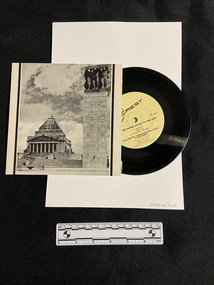
Audio - Vinyl record in slipcase, Crest, "At the going down of the sun" with the Services Commemoration Choir of Melbourne, 1961
... Heidelberg Repatriation Hospital - Melbourne...Track list: Side A - Lest we forget Last post They shall grow not old Reveille National anthem Side B - Last post Reveille National anthem Heidelberg Repatriation Hospital - Melbourne Veteran Affairs Minister returned soldiers medical acre Department of Veterans Affairs 'M40' [handwritten in blue ink in the top left corner of the back cover] 7 inch (45 rpm) vinyl record inside a slip cover. ..."These four tracks are excerpts from a ceremony of remembrance performed in the Canterbury Memorial Hall on 11th November, 1961" (taken from slip cover). Track list: Side A - Lest we forget Last post They shall grow not old Reveille National anthem Side B - Last post Reveille National anthem 7 inch (45 rpm) vinyl record inside a slip cover. The cover has a black and white photo of the Shrine of Remembrance (Melbourne) on the front and record details printed in black text on the back.'M40' [handwritten in blue ink in the top left corner of the back cover]heidelberg repatriation hospital - melbourne, veteran affairs minister, returned soldiers medical acre, department of veterans affairs -
 National Vietnam Veterans Museum (NVVM)
Artwork, other - Commemorative Medallions
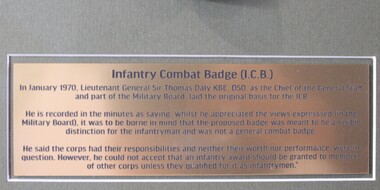
... While an inmate of the Coral-Balmoral Building at the Heidelberg Repatriation Hospital in Melbourne, 2025, he met with the President of the Vietnam Veterans Association (Vic) and explained to him that during his early Army career, he had been deeply influenced by Vietnam veterans, who had taught him life-skills and given him a sense of direction lacking in his upbringing. ...While an inmate of the Coral-Balmoral Building at the Heidelberg Repatriation Hospital in Melbourne, 2025, he met with the President of the Vietnam Veterans Association (Vic) and explained to him that during his early Army career, he had been deeply influenced by Vietnam veterans, who had taught him life-skills and given him a sense of direction lacking in his upbringing. ...This collection was compiled and donated by a veteran who saw overseas active service in a post-Vietnam conflict. While an inmate of the Coral-Balmoral Building at the Heidelberg Repatriation Hospital in Melbourne, 2025, he met with the President of the Vietnam Veterans Association (Vic) and explained to him that during his early Army career, he had been deeply influenced by Vietnam veterans, who had taught him life-skills and given him a sense of direction lacking in his upbringing. He created this piece to honour those Vietnam Veterans. The donor wishes to remain anonymous.Large black frame with khaki matt board. A black bayonet in the centre is set over a gold wreath reflective of the Royal Australian Regiment emblem. Set in a circle around that are 17 circular medallions. Beneath that is line of 5 more medallions. Three rectangular plaques are engraved with information explaining the significance of the medallions.See images in media sectioncommemoration, vietnam, medallions, vietnam war -
 Ringwood and District Historical Society
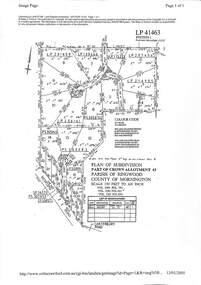
Document, Property Research Notes - Reaghill, Ringwood East, Victoria. Appendix 4 - Plan of Subdivision No. 41463 and history notes by Ian and Margaret McKellar - 1996
... After this war Geoffrey returned to Melbourne and worked as a pathologist at the. Heidelberg Repatriation Hospital while living for part of the time at "Reaghill". ...After this war Geoffrey returned to Melbourne and worked as a pathologist at the. Heidelberg Repatriation Hospital while living for part of the time at "Reaghill". ...Plan of Subdivision LP41463 - Part of Crown Allotment 43, Parish of Ringwood, County of Mornington. Map includes Bedford Road, Homebush Court, Vista Avenue and Vista Court, Heathmont. Allotments include LP201659, LP139446, LP115253, LP207494, LP216905, PS335874, LP206161, PS305345, PS300083, LP92899."Reaghill”; a 30 acre property in Bedford Road, Heathmont was bought from the Blood family about 1910 by Mr Seymour Davies as a weekend retreat from his busy life as a manager with the Glenferrie (or Hawthorn) branch of the English, Scottish and Australian (ES&A) Bank. He and his family came by train to Ringwood and then drove a pony cart up Bedford Road to a gateway at about number 139 and then a long drive, which wound up to the top of the hill. There was a wonderful view of Mount Dandenong which later became obliterated by tall eucalyptus trees. The land which became “Reaghill” was part of an 80 acre crown land sale to Mr Robert Blood on 12 March 1872. More information on the Blood family involvement with the area is given on pages 13-17 of the original 1974 edition of Hugh Anderson, Ringwood, Place of Many Eagles. Another section of this land was bought by Mr Frank L Walker and subsequently became "Wombalano Park". There is a quarry on the property from which stone was used for the long driveway. The garden was mainly left natural although we have two large Liquidamber trees which were planted by his wife Dora Davies (nee Hall). Surely these were some of the first to be planted in Melbourne gardens. A small weatherboard, galvanised iron roofed cottage was built on the top of the hill. At the time the house was built there was a strike of plasterers - as a result it was lined with timber, an unusual combination at that time. The Davies had a daughter and two sons - Dora (born 1897), Geoffrey (1900), John (1902). All studied medicine at Melbourne and practised, Geoffrey in Sydney, John in general practice Melbourne while Dora went to England in the 1930s and never returned. John and Dora married in 1933 and 1938 respectively and had families. Soon after the beginning of the 1939-45 war Geoffrey enlisted in the AIF as a Medical Officer and was in Singapore when it fell to the Japanese. He spent the remaining war years in various POW camps, including Changi and others in Malaya and Thailand. While there he earned the gratitude of his fellows by his innovative use of available plants to treat tropical diseases. After this war Geoffrey returned to Melbourne and worked as a pathologist at the. Heidelberg Repatriation Hospital while living for part of the time at "Reaghill". Seymour Davies died in October 19-35 and his wife, Dora, in February 1945. Of their children, John died in 1976, Dora in 1985 and Geoffrey in 1986. In July 1968 Geoffrey moved to East Ringwood and the two acre house block* and an adjacent one were sold to Dr James Hamilton Kelly, then of New York State, USA (Title Vol 8740 folio 991). As far as is known he never lived there. The house was let to a Mr and Mrs Ingamels for some years. The relatively fertile lower slopes on the south side of the land were cleared and farmed by descendants of the Blood family. At the time of the 1957 subdivision there were clear signs of the ploughed area. It was said that they used to grow strawberries in those paddocks. In about 1955 Dr Geoff Davies decided to sub-divide the property, he was unmarried and found it too large to maintain. Initially five of the seven normal house sized blocks fronting Bedford Road were sold and in about 1957 the remainder, was divided into 15 blocks (averaging nearly two acres) and put on the market. These were sold for £1000 ($2000) per acre. Homebush Court and Vista Court were formed to give access to- these blocks. The Homebush Court blocks have close access to Heathmont and the others to East Ringwood although all are lumped into East Ringwood by the municipal and postal authorities. The name "Reaghill" possibly comes from the Davies family's Irish origins. Homebush Court was named by Geoff Davies from the Sydney suburb of that name where he had lived in the 1930s. It was originally the name of a property owned by one of the early NSW Governors. Vista was a reminder to Geoff Davies of the once-grand views he remembered seeing from the hilltop. The earlier history in this article was recounted by my mother, a niece of Mr Seymour Davies, who remembered coming on a great outing to "Reaghill" as a child. Other recollections are from our own conversations with Geoff Davies. Ian and Margaret McKellar. 16 January, 1996 -
 Alfred Hospital Nurses League - Nursing History Collection
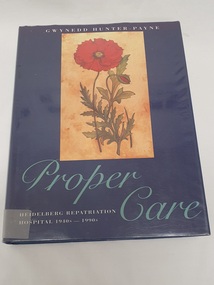
Book - Illustrated book, Gwynedd Hunter Payne, Proper Care: Heidelberg Repatriation Hospital 1940s-1990s, 1994
... hospital. Repatriation General Hospital (Heidelberg-Victoria) Veterans Hospitals History of the Heidelberg Repatriation Hospital in Melbourne from its creation, when it took over the 115th (Heidelberg) military Hospital in 1947 up to 1994. ...History of the Heidelberg Repatriation Hospital in Melbourne from its creation, when it took over the 115th (Heidelberg) military Hospital in 1947 up to 1994.Illustrated hard cover book with dustjacket. Book bound in dark blue canvas with title, authors name and publishers name in gold on spine. Dust jacket has dark blue background with the title and authors name on front and spine. Also on front cover is image of painting of a poppy by Des Norman. On the back cover there is an image of a 1947 hand coloured map of the Repat hospital.non-fictionHistory of the Heidelberg Repatriation Hospital in Melbourne from its creation, when it took over the 115th (Heidelberg) military Hospital in 1947 up to 1994.repatriation general hospital (heidelberg-victoria), veterans hospitals -
 Surrey Hills Historical Society Collection
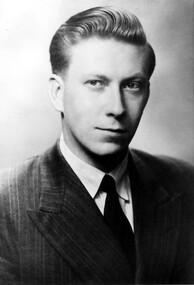
Photograph, Dr John Willmott Bennett
... Melbourne on 23 October 1924 and attended Scotch College for his early education. The family moved to England shortly before WW2 and he completed his schooling at Mill Hill in Uxbridge (and at St Bees School in Cumberland to which Mill Hill was evacuated). He entered St Bartholomew's Hospital Medical College in 1946. He married Christina Hudson in Cambridge in 1946 and they followed the rest of the family back to Australia in 1948. John was Resident Medical Officer at the Repatriation Hospital in Heidelberg...Melbourne on 23 October 1924 and attended Scotch College for his early education. The family moved to England shortly before WW2 and he completed his schooling at Mill Hill in Uxbridge (and at St Bees School in Cumberland to which Mill Hill was evacuated). He entered St Bartholomew's Hospital Medical College in 1946. He married Christina Hudson in Cambridge in 1946 and they followed the rest of the family back to Australia in 1948. John was Resident Medical Officer at the Repatriation Hospital in Heidelberg ...John was the eldest son of Dr Jack (Frederick John) and Mrs Doris Bennett (nee Willmott). His paternal grandfather, John Henry Bennett, was also a doctor who practiced in St Arnaud and Hawthorn. John was born in Melbourne on 23 October 1924 and attended Scotch College for his early education. The family moved to England shortly before WW2 and he completed his schooling at Mill Hill in Uxbridge (and at St Bees School in Cumberland to which Mill Hill was evacuated). He entered St Bartholomew's Hospital Medical College in 1946. He married Christina Hudson in Cambridge in 1946 and they followed the rest of the family back to Australia in 1948. John was Resident Medical Officer at the Repatriation Hospital in Heidelberg from 1948-1953. He was an Honorary Clinical Assistant at the Royal Melbourne Hospital from 1950-1965 and became a member of the Royal Australasian College of Physicians in 1953. He joined Drs W Langley Carrington, William (Bill) Vorath and Norman Rose at the Surrey Hills Medical Centre in 1953. He lived in Camberwell and had 2 sons and 1 daughter; one son also qualified as a doctor, working in Hobart. His brother Robert, a radiologist, lived in Mont Albert and one of his 4 daughters, Dr Penny Bennett, also worked at Surrey Hills Medical Centre at a later period. Ref: Article in Chiron - Medical Genes: The Bennett Family written by Dr WRC (Robert) Bennett, 1989. The donor was a niece of John Bennett.The Surrey Hills Medical Centre was one of the first, if not the first, general practice to include specialists as partners soon after WW2. Black and white formal head and shoulders photo of Dr John Willmott Bennett who was a general practitioner in the 1950s and 1960s at the Surrey Hills Medical Centre. doctors, surrey hills medical centre, dr john willmott bennett -
 Melbourne Legacy
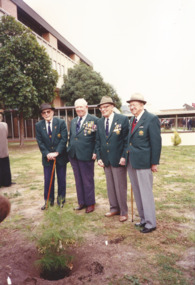
Photograph - Tree Planting, Legacy Lone Pines, 1991
... hospital to widows and dependents of veterans. Special guests included WW1 Gallipoli veterans who had revisited Gallipoli for its 75th Anniversary. White paper labels say: "Gallipoli 'Lone Pine' Lives on. Two lone pine trees, propagated from Gallipoli Lone Pines, were presented on behalf of Melbourne Legacy to the Heidelberg Repatriation Hospital by the President, Legatee John Sullivan. ...hospital to widows and dependents of veterans. Special guests included WW1 Gallipoli veterans who had revisited Gallipoli for its 75th Anniversary. White paper labels say: "Gallipoli 'Lone Pine' Lives on. Two lone pine trees, propagated from Gallipoli Lone Pines, were presented on behalf of Melbourne Legacy to the Heidelberg Repatriation Hospital by the President, Legatee John Sullivan. ...A planting of a pine tree at Heidelberg Repatriation Hospital on 17 April 1991. Legacy had a programme of donating trees grown from seeds from Lone Pine in Gallipoli. One photo shows 4 Gallipoli veterans standing by the newly planted pine tree. One shows President John Sullivan with the shovel. Also with representatives of John Allison / Monkhouse who provided the plaques for the tree. A different photo was used in the July 1991 issue of the Widows' Newsletter (later called The Answer) and explained two small Lone Pine trees were donated in appreciation of the care extended by the hospital to widows and dependents of veterans. Special guests included WW1 Gallipoli veterans who had revisited Gallipoli for its 75th Anniversary. White paper labels say: "Gallipoli 'Lone Pine' Lives on. Two lone pine trees, propagated from Gallipoli Lone Pines, were presented on behalf of Melbourne Legacy to the Heidelberg Repatriation Hospital by the President, Legatee John Sullivan. The trees were presented in appreciation of the care extended by the Hospital to widows and dependants of veterans." "Commemorative plaques. Managing Director of John Allison / Monkhouse, Mr Clive Allison and Legatee Rob Allison presented bronze commemorative plaques which will be installed by the trees." "Gallipoli veterans were special guests at the presentation." The Heidelberg Repatriation Hospital has a proud history of caring for Veterans and War Widows. From the early 1970s Legacy had a commemorative programme of providing trees grown from seeds from Gallipoli to various towns throughout Australia. This may be part of that project (see the Lone Pine brochure at 00593) or subsequent propagation undertaken by Legacy. Melbourne Legacy’s Commemoration Committee was responsible for the collection, propagation, presentation and dedication of Lone Pines from the 24th Battalion tree at the Shrine of Remembrance. On the 14th September 1989 further seedlings were collected with the hope to raise 1,000 trees from the seeds. Thus, Legacy is helping to keep the memory of the Gallipoli 'Lone Pine' alive – its spirit living on today. Presentations are made to schools, ex-service organisations and interested bodies by Legacy Clubs in the hope that they will be cherished as a symbol of nationhood and of its just pride, devotion, courage, selflessness and sense of service to others. Photos were taken by the publicity officer Susie Howard.A record of a tree planting of a Lone Pine tree.Colour photo x 6 of a tree planting at Heidelberg Repatriation Hospital.On the back 'Lone Pine Heidelberg Repat.', handwritten in black ink. White paper labels with black type captioned group of photos.tree planting, answer, lone pine -
 Returned Nurses RSL Sub-branch
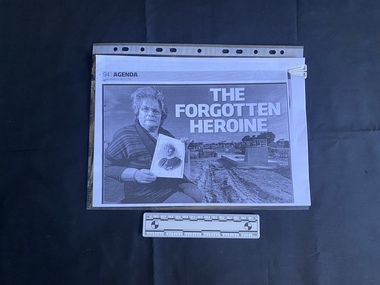
Document - Photocopy of newspaper clipping and related documents, Sunday Herald, The forgotten heroine, 5 December 1914 - May 20 2012
... Melbourne would not know that a highly decorated and dedicated nurse was buried there. Her grave is unmarked, there is no reference to her achievements or selfless dedication. Estelle Lee Archer died in 1960, at the Repatriation General Hospital, Heidelberg...Melbourne would not know that a highly decorated and dedicated nurse was buried there. Her grave is unmarked, there is no reference to her achievements or selfless dedication. Estelle Lee Archer died in 1960, at the Repatriation General Hospital, Heidelberg ...Newspaper - 'The forgotten heroine' Visitors to New Cheltenham Cemetery in Melbourne would not know that a highly decorated and dedicated nurse was buried there. Her grave is unmarked, there is no reference to her achievements or selfless dedication. Estelle Lee Archer died in 1960, at the Repatriation General Hospital, Heidelberg, age 78 from a perforated ulcer. Margaret Leyden wants the Office of Australian War Graves to recognise that her great-aunt died from war-related injuries and to restore and maintain her grave. Margaret, who never met her aunt, has pieced together her history, including that Estelle's medals, including the prestigious Royal Red Cross 2nd Class for services in support of our ANZACs have ended up in the MAryborough Military & Colonial Museum after they were bought at a second hand shop. Estelle served in seven army units and was in the Middle East, England and France for the duration of World War 1. After the war she continued to dedicate her life to the care of soldiers. Document 1 - digitised copy of 'First Wold War Embarkation Roll' for Estelle Frances Lee-Archer Document 2 - photocopy of 'Austraalian Imperial Force - Nominal Roll' page 7 (Lee-Archer, Estelle Frances listed) Document 3 - photocopy of unknown document (Sis. Lee-Archer, Estelle (RRC) listed) Five photocopied pages held together with a plastic paperclip. Two pages are of a newspaper story, the first showing a full page black and white photo of a seated older woman holding a photo of a woman in nurse's uniform. The second page of the newspaper story has four columns of text with a photo of a war medal and a photo of a standing woman in nurse's uniform beside them. The final three pages are war-time documents.dr collopy, kildonian castle, london, caulfield, tasmania, john lee archer, mary anne lyons, joseph lyons, parlianment house, hobart, ross bridge, alfred hospital, kyarra, 1st australian general hospital, swanage, dorset, gallipoli, 2nd australian general hospital, 3rd australian general hospital, 25th australian general hospital, 47th australian casualty clearing station, 3rd australian casualty clearing station, 7th australian general hospital, john saddington
