
Showing 6 items matching "henry kemmis"
-
 Warrnambool and District Historical Society Inc.
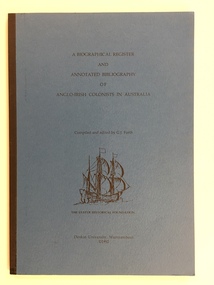
Booklet, Gordon Forth, Anglo-Irish Colonists in Australia, 1992
... ...henry kemmis...This research has been undertaken by a Warrnambool historian and author, Gordon Forth and includes information on six men with strong links to early Warrnambool. gordon forth anglo-irish colonists john singleton william rutledge henry kemmis thomas fleetwood michael fenton peter teulon beamish A biographical register and annotated bibliography of Anglo-Irish Colonists in Australia A soft cover book of 98 pages. ...A biographical register and annotated bibliography of Anglo-Irish Colonists in AustraliaA soft cover book of 98 pages. The covers are blue. The front cover has black printing and a line drawing of a three masted ship tall ship. Inside the front cover is a note handwritten in black pen on white paper listing the Warrnambool connections found in the book. non-fictionA biographical register and annotated bibliography of Anglo-Irish Colonists in Australiagordon forth, anglo-irish colonists, john singleton, william rutledge, henry kemmis, thomas fleetwood, michael fenton, peter teulon beamish -
 Warrnambool and District Historical Society Inc.
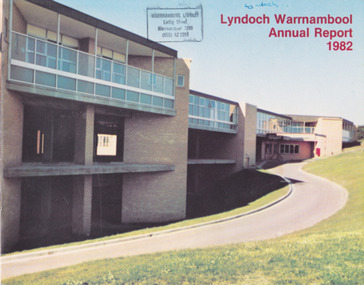
Document - Lyndoch Warrnambool 1982 Annual Report
... The original Lyndoch property near the mouth of the Hopkins River was owned by a Melbourne tea merchant, George Rolfe, who bought the land when there were on the site only a couple of cottages and a larger building which had been a school, Warrnambool Grammar, run by Henry Kemmis. Rolfe acquired the land in the 1870s and named the property Lyndoch after the town in the Barossa Valley where he had lived. ...The original Lyndoch property near the mouth of the Hopkins River was owned by a Melbourne tea merchant, George Rolfe, who bought the land when there were on the site only a couple of cottages and a larger building which had been a school, Warrnambool Grammar, run by Henry Kemmis. Rolfe acquired the land in the 1870s and named the property Lyndoch after the town in the Barossa Valley where he had lived. ...This is the 1982 Annual Report for Lyndoch Home and Hospital for the Aged, Warrnambool. It contains lists of Board Members, a President’s Report, Lyndoch’s Aims, financial reports, photographs and a list of Life Governors. Lyndoch Home for the Aged was established in 1952 and has developed with a wide range of facilities for the aged since that date. The original Lyndoch property near the mouth of the Hopkins River was owned by a Melbourne tea merchant, George Rolfe, who bought the land when there were on the site only a couple of cottages and a larger building which had been a school, Warrnambool Grammar, run by Henry Kemmis. Rolfe acquired the land in the 1870s and named the property Lyndoch after the town in the Barossa Valley where he had lived. He owned Lyndoch for 44 years and it was his stepdaughter, Florence Lake who built in the 1920s the bungalow known as Lyndoch which forms the original building of the Lyndoch Home for the Aged, Today the facility is called Lyndoch Living. This 1982 report is kept for the benefit of researchers wanting details of the history of Lyndoch over the past 30 or 40 years. This is a booklet with a plasticized cover with a white back and a multi-coloured front cover. The front cover has a photograph of a Lyndoch building. There are six double-sided pages with printed material and photographs on white paper and a yellow and orange strip across the top of the pages. The pages are stapled.On front cover: Lyndoch Warrnambool Annual Report 1982 Stamp of Warrnambool Library On back cover: A red circle with the words ‘Lyndoch, Comfort and Security for Aged Folk’ lyndoch aged care facility, warrnambool, lyndoch warrnambool -
 Warrnambool and District Historical Society Inc.
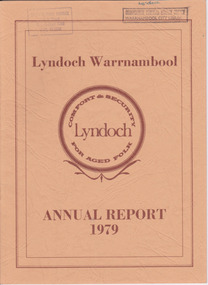
Document - Lyndoch Warrnambool 1979 Annual Report, 1979
... The original Lyndoch property near the mouth of the river Hopkins was owned by a Melbourne tea merchant, George Rolfe, who bought the land when there were only on the site a couple of cottages and a larger building which had been a school, Warrnambool Grammar, run by Henry Kemmis. Rolfe acquired the land in the 1870s and named the property Lyndoch after the town in the Barossa Valley where he had lived. ...The original Lyndoch property near the mouth of the river Hopkins was owned by a Melbourne tea merchant, George Rolfe, who bought the land when there were only on the site a couple of cottages and a larger building which had been a school, Warrnambool Grammar, run by Henry Kemmis. Rolfe acquired the land in the 1870s and named the property Lyndoch after the town in the Barossa Valley where he had lived. ...This is the 1979 Annual Report for Lyndoch Home and Hospital for the Aged, Warrnambool. It contains lists of Board Members, a President’s Report, a sketch of a proposed new building, financial reports, photographs and a list of Life Governors. Lyndoch Home for the Aged was established in 1952 and has developed with a wide range of facilities for the aged since that date. The original Lyndoch property near the mouth of the river Hopkins was owned by a Melbourne tea merchant, George Rolfe, who bought the land when there were only on the site a couple of cottages and a larger building which had been a school, Warrnambool Grammar, run by Henry Kemmis. Rolfe acquired the land in the 1870s and named the property Lyndoch after the town in the Barossa Valley where he had lived. He owned Lyndoch for 44 years and it was his stepdaughter, Florence Lake who built in the 1920s the bungalow known as Lyndoch which forms the original building of the Lyndoch Home for the Aged. Today the facility is called Lyndoch Living.This report is kept for the benefit of researchers wanting details of the history of Lyndoch over the past thirty or forty years.This is a booklet with a cardboard buff-coloured cover. There are six double-sided pages with printed material on white paper with a yellow and orange stripe across the top of the pages.On front cover: Lyndoch Warrnambool, Annual Report 1979 In brown circle on front cover: Lyndoch, Comfort and Security for Aged Folk Two library stamps on front cover (Warrnambool Library) lyndoch, aged care facility, warrnambool, hopkins, warrnambool grammar -
 Warrnambool and District Historical Society Inc.
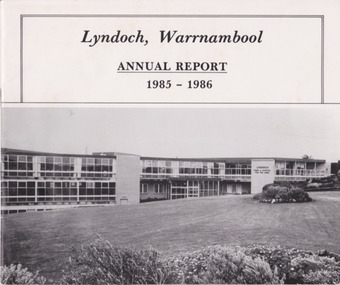
Document - Lyndoch Warrnambool Annual Report 1985-86, 1986
... The original Lyndoch property near the mouth of the River Hopkins was owned by a Melbourne tea merchant, George Rolfe, who bought the land when there were on the site only a couple of cottages and a larger building which had been a school, Warrnambool Grammar, run by Henry Kemmis. Rolfe acquired the land in the 1870s and named the property Lyndoch after the town in the Barossa Valley where he had lived. ...The original Lyndoch property near the mouth of the River Hopkins was owned by a Melbourne tea merchant, George Rolfe, who bought the land when there were on the site only a couple of cottages and a larger building which had been a school, Warrnambool Grammar, run by Henry Kemmis. Rolfe acquired the land in the 1870s and named the property Lyndoch after the town in the Barossa Valley where he had lived. ...This is the 1985-6 Annual Report for Lyndoch Home and Hospital for the Aged, Warrnambool. It contains lists of Board Members, a President’s Report, photographs, Lyndoch’s Aims, financial reports and a list of Life Governors. Lyndoch Home for the Aged was established in 1952 and has developed with a wide range of facilities for the aged since that date. The original Lyndoch property near the mouth of the River Hopkins was owned by a Melbourne tea merchant, George Rolfe, who bought the land when there were on the site only a couple of cottages and a larger building which had been a school, Warrnambool Grammar, run by Henry Kemmis. Rolfe acquired the land in the 1870s and named the property Lyndoch after the town in the Barossa Valley where he had lived. He owned Lyndoch for 44 years ad it was his stepdaughter Florence Lake who built in the 1920s the bungalow known as Lyndoch which forms the original building of Lyndoch Home for the Aged. Today the facility is called Lyndoch Living. This 1985-6 report is kept for the benefit of researchers wanting details of the history of Lyndoch over the past 30 or 40 years.This is a booklet with a plasticized white cover with a black and white photograph of a Lyndoch building on the front cover. There are eight double-sided pages with printed material and photographs. The pages are stapled.On front cover: ‘Lyndoch, Warrnambool, Annual Report, 1985-1986 On back cover: A black circle with the words: ‘Lyndoch, Comfort and Security for Aged Folk’. lyndoch aged care facility, warrnambool -
 Federation University Historical Collection
Newspaper - newsletter, On Campus, 1996-1997
... university of ballarat newsletter Ferdinand krause Krause medal Henry Award Twenty-nine newsletters. .1) 03 December 1996 Construction of Univeristy Drive, China Scholarships (Andrew Kuiler, Bronwyn Gibson, Marita Pierce, Veronica Malesic), Ballarat Gooldfields, Rosemary Chang, calligraphy, Pivot naming right, William Pryor, Donald Norris, John Nicholson, Bernie Whitaker, Shakespeare by the Sea, Thomas Woodrow Award, Jean Goh, Sheri Dyson, GPS, Claire Robinson, Daniel Smith, Jenny Trustum, retirement of Patrick Hope, Frank Hurley and Bon Morrell. .2) 14 November 1996 Philip Candy, Stephen Kemmis, ARC grants (Alex Rubinove, Ray Over, Dennis Arne, V. ...Twenty-nine newsletters. .1) 03 December 1996 Construction of Univeristy Drive, China Scholarships (Andrew Kuiler, Bronwyn Gibson, Marita Pierce, Veronica Malesic), Ballarat Gooldfields, Rosemary Chang, calligraphy, Pivot naming right, William Pryor, Donald Norris, John Nicholson, Bernie Whitaker, Shakespeare by the Sea, Thomas Woodrow Award, Jean Goh, Sheri Dyson, GPS, Claire Robinson, Daniel Smith, Jenny Trustum, retirement of Patrick Hope, Frank Hurley and Bon Morrell. .2) 14 November 1996 Philip Candy, Stephen Kemmis, ARC grants (Alex Rubinove, Ray Over, Dennis Arne, V. Murthy,) Paul Mensch, Chinese speaking competition, Richard Hutchinson, Mning Week, Lachlan Cameron, Roy Taylor. .3) 3 September 1996 David James, Jack Barker, Gerry Anderson, Maureen Scott, Michael Redden, Dennis Arne, Benjamin Tiley, Kerrie Powell, Stafford McKnight, Susan Stacpole, Ross Ramsay, Annette Chappell-Lawrence, Helen Vendy-Kinloch, Leena McKenzie, Janet Leversha, Elizabeth Hartmann, Marion Grationnon-fictionuniversity of ballarat, newsletter, ferdinand krause, krause medal, henry award -
 Warrnambool and District Historical Society Inc.
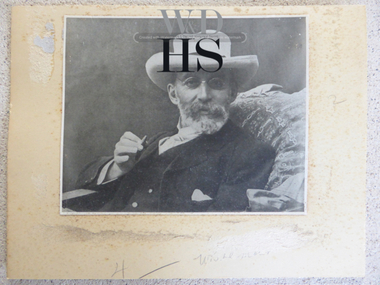
Photograph - J. F Archibald, Original photograph – c.1910
... It is kept because John Archibald, a national figure in Australian History of some importance, spent his school years in Warrnambool in the 1860s and 70s where his father was a local policeman. He went to Henry Kemmis’ Warrnambool Grammar School and wrote about his time here in later years, He also commenced his career as a journalist with the Warrnambool Examiner newspaper and later the Warrnambool Standard newspaper before going to Melbourne. warrnambool archibald family j f archibald john archibald john feltham archibald The typed card reads: ‘J.F.Archibald, A Native of Warrnambool District. ...This photograph was donated by the Bread and Cheese Club, Melbourne but it is not know to what group or institution it was originally given. It is a copy of a well-known photograph of John Feltham Archibald, taken about 1910 when he was obsessed with all things French and was known at the time as Jules Francois Archibald. John Archibald (1856-1919) was born at Kildare near Geelong (so is not a native of the Warrnambool district) but he lived for some time in Warrnambool with his family. He began his working life with the Warrnambool Examiner newspaper and its successor, the Warrnambool Standard before going to Melbourne. In N.S.W. in 1880, he established with John Haynes, the Sydney Bulletin , a journal that became the most influential one of its day, promoting nationalism and fostering Australian writers and poets. He left legacies to establish the Archibald Prize for artists and the Archibald Fountain in Sydney. This photograph of John Archibald is of some interest though it is a widely-known one and is not original. It is kept because John Archibald, a national figure in Australian History of some importance, spent his school years in Warrnambool in the 1860s and 70s where his father was a local policeman. He went to Henry Kemmis’ Warrnambool Grammar School and wrote about his time here in later years, He also commenced his career as a journalist with the Warrnambool Examiner newspaper and later the Warrnambool Standard newspaper before going to Melbourne. This is a black and white photograph of John Archibald, mounted on cardboard. It has been taken out of its original frame and the typed card with the original frame has been removed and attached to the back of the photograph.The typed card reads: ‘J.F.Archibald, A Native of Warrnambool District. Founder of the ‘Bulletin’ School of Australian Literature, Presented by the Bread and Cheese Club, Melbourne’ (note that this contains inaccurate information in that John Archibald was not a native of the Warrnambool district)warrnambool, archibald family, j f archibald, john archibald, john feltham archibald
