
Showing 4 items matching "henry langlands"
-
 Flagstaff Hill Maritime Museum and Village
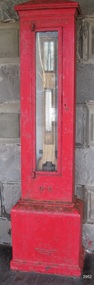
Instrument - Barometer, 1867
... ...henry langlands...The business was known as the 'Langlands Foundry Co'. Henry Langlands (1794-1863), left Scotland in 1846 with his wife Christian, née Thoms, and five surviving children to join his brother Robert. ...The business was known as the 'Langlands Foundry Co'. Henry Langlands (1794-1863), left Scotland in 1846 with his wife Christian, née Thoms, and five surviving children to join his brother Robert. ...Langlands Company History: Langlands foundry was Melbourne's first foundry and iron shipbuilder established in 1842, only 8 years after the founding of the Victorian colony by two Scottish immigrants, Robert Langlands and Thomas Fulton, who had formed a partnership before emigrating (1813–1859). The business was known as the 'Langlands Foundry Co'. Henry Langlands (1794-1863), left Scotland in 1846 with his wife Christian, née Thoms, and five surviving children to join his brother Robert. By the time he arrived in early January of 1847 the partnership of Robert Langlands and Fulton had dissolved as Fulton had gone off to establish his own works. It was at this time that the two brothers took over ownership of Langlands foundry. Several years later Robert retired and Henry became sole the proprietor. The foundry was originally located on Flinders Lane between King and Spencer streets. Their sole machine tool, when they commenced as a business, was a small slide rest lathe turned by foot. In about 1865 they moved to the south side of the Yarra River, to the Yarra bank near the Spencer Street Bridge and then in about 1886 they moved to Grant Street, South Melbourne. The works employed as many as 350 workers manufacturing a wide range of marine, mining, civil engineering, railway and general manufacturing components including engines and boilers. The foundry prospered despite high wages and the lack of raw materials. It became known for high-quality products that competed successfully with any imported articles. By the time Henry retired, the foundry was one of the largest employers in Victoria and was responsible for casting the first bell and lamp-posts in the colony. The business was carried on by his sons after Henry's death. The company was responsible for fabricating the boiler for the first railway locomotive to operate in Australia, built-in 1854 by Robertson, Martin & Smith for the Melbourne and Hobson's Bay Railway Company. Also in the 1860s, they commenced manufacture of cast iron pipes for the Board of Works, which was then laying the first reticulated water supply system in Melbourne. Langlands was well known for its gold mining equipment, being the first company in Victoria to take up the manufacture of mining machinery, and it played an important role in equipping Victoria's and Australia's first mineral boom in the 1850s and 1860s. Langlands Foundry was an incubator for several engineers including Herbert Austin (1866–1941) who worked as a fitter at Langlands and went on to work on the Wolesely Shearing machine. He also founded the Austin Motor Company in 1905. Around the 1890s Langlands Foundry Co. declined and was bought up by the Austral Otis Co. in about 1893. History for Grimoldi: John Baptist Grimoldi was born in London UK. His Father was Domeneck Grimoldi, who was born in Amsterdam with an Italian Father and Dutch mother. Domeneck was also a scientific instrument maker. John B Grimoldi had served his apprenticeship to his older brother Henry Grimoldi in Brooke Street, Holburn, London and had emigrated from England to Australia to start his own meteorological and scientific instrument makers business at 81 Queens St Melbourne. He operated his business in 1862 until 1883 when it was brought by William Samuel and Charles Frederick, also well known scientific instrument makers who had emigrated to Melbourne in 1875. John Grimoldi became successful and made a number of high quality measuring instruments for the Meteorological Observatory in Melbourne. The barometer was installed at Warrnambool's old jetty and then the Breakwater as part of the Victorian Government's insistence that barometers be placed at all major Victorian ports. This coastal barometer is representative of barometers that were installed through this government scheme that began in 1866. The collecting of meteorological data was an important aspect of the Melbourne Observatory's work from its inception. Just as astronomy had an important practical role to play in navigation, timekeeping and surveying, so the meteorological service provided up to date weather information and forecasts that were essential for shipping and agriculture. As a result, instruments made by the early instrument makers of Australia was of significant importance to the development and safe trading of companies operating during the Victorian colonies early days. The provenance of this artefact is well documented and demonstrates, in particular, the importance of the barometer to the local fishermen and mariners of Warrnambool. This barometer is historically significant for its association with Langlands’ Foundry which pioneered technology in the developing colony by establishing the first ironworks in Melbourne founded in 1842. Also, it is significant for its connection to John B Grimoldi who made the barometer and thermometer housed in the cast iron case. Grimoldi, a successful meteorological and scientific instrument maker, arrived in the colony from England and established his business in 1862 becoming an instrument maker to the Melbourne Observatory. Additional significance is its completeness and for its rarity, as it is believed to be one of only two extant barometers of this type and in 1986 it was moved to Flagstaff Hill Maritime Village as part of its museum collection. Coast Barometer No. 8 is a tall, red painted cast iron pillar containing a vertical combined barometer and thermometer. Half way down in the cast iron framed glass door is a keyhole. Inside is a wooden case containing a mercury barometer at the top with a thermometer attached underneath, each with a separate glass window and a silver coloured metal backing plate. Just below the barometer, on the right-hand side, is a brass disc with a hole for a gauge key in the centre. The barometer has a silvered tin backing plate with a scale, in inches, of "27 to 31" on the right side and includes a Vernier with finer markings, which is set by turning the gauge key. The thermometer has a silvered tin backing plate with a scale on the left side of "30 to 140". Each of the scales has markings showing the units between the numbers.Inscription at the top front of the pillar reads "COAST BAROMETER" Inscribed on the bottom of the pillar is "No 8". and "LANGLANDS BROS & CO ENGINEERS MELBOURNE " The barometer backing plate is inscribed "COAST BAROMETER NO. 8, VICTORIA" and printed on the left of the scale, has "J GRIMOLDI" on the top and left of the scale, inscribed "Maker, MELBOURNE". There is an inscription on the bottom right-hand side of the thermometer scale, just above the 30 mark "FREEZING" Etched into the timber inside the case are the Roman numerals "VIII" (the number 8)flagstaff hill, warrnambool, maritime village, maritime museum, flagstaff hill maritime museum & village, shipwreck coast, great ocean road, warrnambool breakwater, coast barometer, coastal barometer, barometer, weather warning, ports and harbours, fishery barometer, sea coast barometer, austral otis co, coast barometer no. 8, henry grimoldi, henry langlands, john baptist grimoldi, langlands foundry co, meteorological instrument maker, robert langlands, scientific instrument maker, thermometer, thomas fulton -
 Melbourne Athenaeum Archives
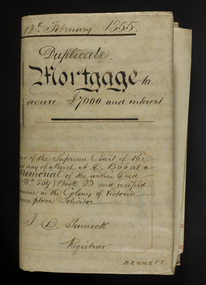
Legal record, Early copy, "Mortgage to secure 7000 pounds and interest.", 1855
... Agreement signed and sealed by Thomas Black (committee member), John Greenlaw Foxton trustee and Henry Langlands trustee with William Daniel Collyer lender. ...Messrs Thomas Black John Greenlaw Foxton & Henry Langlands to William Daniel Collyer Esq Duplicate. ...Messrs Thomas Black John Greenlaw Foxton & Henry Langlands to William Daniel Collyer Esq Duplicate. ...Document written on parchment paper titled "Mortgage to secure 7000 pounds and interest." Labelled as duplicate of original mortgage. Agreement signed and sealed by Thomas Black (committee member), John Greenlaw Foxton trustee and Henry Langlands trustee with William Daniel Collyer lender. Solicitor Bennett, Clerk Julius Hand. Land and building Allotment No 3 in section No 11 Collins Street identified as property mortgage taken out against. Parchment, folded. Following conservation work carried out by Guy Morel, 2009 with assistance of a Victorian Heritage grant, the document was cleaned and separately boxed.Black handwritten text, on cream coloured parchment paper, folded. The exposed page contains the following text: "Dated 12th February 1855. Messrs Thomas Black John Greenlaw Foxton & Henry Langlands to William Daniel Collyer Esq Duplicate. Mortgage to secure £7000 and interest Received into the Office of the Register of the Supreme Court of the / Colony of Victoria at Melbourne this Second day of March A. D. 1855 at a / quarter to one o'Clock in the afternoon a memorial of the within Deed / numbered Eight hundred and fifty nine (No. 859) Book 23 and verified / by Julius Hamel of Collins Street Melbourne in the Colony of Victoria / Clark to John Barter Bennett of the same place Solicitor. J. D. Pinnock Registrar." Slightly under this text, in a different hand is written "BENNETT." -
 National Vietnam Veterans Museum (NVVM)
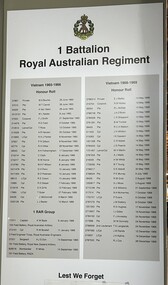
Poster - Information Board - 1 Battalion Royal Australian Regiment (Honour Roll), 1RAR
... 1st Battalion Royal Australian Regiment Killed in Action Pte Michael Alwyn Bourke 37867 Royal Australian Infantry Corps Pte William Thomas Carroll 37010 Pte Arie Van Valen 54320 Pte William Lynn Nalder 2412151 Cpl Francis John Smith 37003 Cpl (Temp) Francis John Smith Pte Ronald Eric Field 214479 Pte Thomas Ross 212612 L/Cpl Thomas Ross Pte Allan Robert Hansen 214329 L/Cpl Richard Harold John Parker L/Cpl Richard Harold Heath (other name) 213963 Pte Peter Raymond Gillson 37857 Cpl Reginald Hedley Hillier 42774 Mention in Dispatches Cpl Alexander Henry Fotheringham 36543 Pte Christopher Clark 215214 Pte Neville Wayne Horne 215217 Pte Mervyn Arthur Frederick Wilson 213780 Pte Desmond Hugh Penn 5411479 Pte Bror Ola Petersen 5411305 L/Cpl Ronald Edward Coxon 38012 Cpl Raymond Douglas Seipel 15985 Pte Edward Anthony Grills 215418 L/Cpl Thomas Suter 17665 Cpl Leslie Charles McDonnell 54026 Pte Lionel James Baxter 1200128 Capt Kenneth Wilfred Bade 17071 Royal Regiment of Australian Artillery 105th Field Battery Cpl Robert Walter Bowtell 213151 Royal Australian Engineers 3 Field Troop Sgt Alastair John Sherwood Don 37221 RNZA 161 FD Battery RNZA Bombardier Robert White 928518 Pte Errol John Bailey 2786313 Australian National Serviceman Cpl Robert Bernard Hickey 215745 Pte Robert Leo McNab 39354 Pte John Alfred O'Brien 2786748 Pte Lawrence Rodney Sheppard 3790506 7th Battalion Pte Bevan Maxwell Trimble 3791291 Pte Richard Christopher Allan Watson 39403 Cpl John Hunter Whitton 311532 Cpl Ian Kenneth Dawson 215063 Pte Christopher Robert Nisbet 1201338 Cpl John Gregory Stinson Pearce 2784043 L/Cpl William Henry Martin 1731467 Pte Alan John Wallis 2787255 Pte Harry Winston White 216009 Pte Brian Thomas Young 1733095 Pte Peter Eris Murray 2788524 Pte Robert Maxwell Grist 39426 Pte Graeme John Moss 1200817 Pte Archibald Stanley Williams 5715189 Pte Neil Anthony McInerney 217514 Pte Paul Evans 1732701 Pte John Michael Slattery 2787079 Pte Rodney Donald Hughes 1201350 Pte Ian James Gibbs 5715657 Cpl (Temp) Frederick John Annesley 2784162 Pte William Wayne Donnelly 2Lt Terrance Edward Langlands 2786939 L/Cpl John Milton Rands 2787069 L/Cpl John Henry Kalma 215637 Pte Raymond John Cox 2787020 1st Battalion, Royal Australian Regiment Vietnam. ...1st Battalion, Royal Australian Regiment Vietnam. Honour Roll from Vietnam 1965 - 1966 and Vietnam 1968 - 1969. At the bottom of the Board reads Lest We Forget1st battalion, royal australian regiment, killed in action, pte michael alwyn bourke, 37867, royal australian infantry corps, pte william thomas carroll, 37010, pte arie van valen, 54320, pte william lynn nalder, 2412151, cpl francis john smith, 37003, cpl (temp) francis john smith, pte ronald eric field, 214479, pte thomas ross, 212612, l/cpl thomas ross, pte allan robert hansen, 214329, l/cpl richard harold john parker, l/cpl richard harold heath (other name), 213963, pte peter raymond gillson, 37857, cpl reginald hedley hillier, 42774, mention in dispatches, cpl alexander henry fotheringham, 36543, pte christopher clark, 215214, pte neville wayne horne, 215217, pte mervyn arthur frederick wilson, 213780, pte desmond hugh penn, 5411479, pte bror ola petersen, 5411305, l/cpl ronald edward coxon, 38012, cpl raymond douglas seipel, 15985, pte edward anthony grills, 215418, l/cpl thomas suter, 17665, cpl leslie charles mcdonnell, 54026, pte lionel james baxter, 1200128, capt kenneth wilfred bade, 17071, royal regiment of australian artillery, 105th field battery, cpl robert walter bowtell, 213151, royal australian engineers, 3 field troop, sgt alastair john sherwood don, 37221, rnza, 161 fd battery rnza, bombardier robert white, 928518, pte errol john bailey, 2786313, australian national serviceman, cpl robert bernard hickey, 215745, pte robert leo mcnab, 39354, pte john alfred o'brien, 2786748, pte lawrence rodney sheppard, 3790506, 7th battalion, pte bevan maxwell trimble, 3791291, pte richard christopher allan watson, 39403, cpl john hunter whitton, 311532, cpl ian kenneth dawson, 215063, pte christopher robert nisbet, 1201338, cpl john gregory stinson pearce, 2784043, l/cpl william henry martin, 1731467, pte alan john wallis, 2787255, pte harry winston white, 216009, pte brian thomas young, 1733095, pte peter eris murray, 2788524, pte robert maxwell grist, 39426, pte graeme john moss, 1200817, pte archibald stanley williams, 5715189, pte neil anthony mcinerney, 217514, pte paul evans, 1732701, pte john michael slattery, 2787079, pte rodney donald hughes, 1201350, pte ian james gibbs, 5715657, cpl (temp) frederick john annesley, 2784162, pte william wayne donnelly, 2lt terrance edward langlands, 2786939, l/cpl john milton rands, 2787069, l/cpl john henry kalma, 215637, pte raymond john cox, 2787020 -
 Puffing Billy Railway
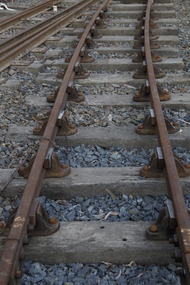
Double Headed Rail, circa 1872 - 1883
... Henry Barkly. A great banquet was held for 800 guests and this was followed by a grand ball. The extension of the line to Echuca was a relatively simple matter as that part of the line was across plain country without any significant engineering challenges. Tenders were called for the work in 1863 and the work was completed in 1864 by contractors Collier and Barry Apart from the line contractors, other firms directly involved were J Shire law and Co (sleepers), R Fulton, Langlands Brothers and Co, William Crossley (water supply), B Moreland, Langlands Brothers and Co (platelayers lorries), E Chambers (iron pins, traversers), Miller and McQuinstan (luggage vans and steam engines) and various contractors for building works. ...Henry Barkly. A great banquet was held for 800 guests and this was followed by a grand ball. The extension of the line to Echuca was a relatively simple matter as that part of the line was across plain country without any significant engineering challenges. Tenders were called for the work in 1863 and the work was completed in 1864 by contractors Collier and Barry Apart from the line contractors, other firms directly involved were J Shire law and Co (sleepers), R Fulton, Langlands Brothers and Co, William Crossley (water supply), B Moreland, Langlands Brothers and Co (platelayers lorries), E Chambers (iron pins, traversers), Miller and McQuinstan (luggage vans and steam engines) and various contractors for building works. ...Double Headed Rail from Ravenswood Station Siding which was dismantled circa 1987 the two rails were stored for a time at Maldon before being donated to Puffing Billy Museum Bearing makers marks of Wilson & Cammell - Dronfield- Steel works Wilson & Cammell made Steel rails at their Dronfield Steel Works, in Dronfield, North East Derbyshire, England from 1872 - 1883 Double-headed rail In late 1830s Britain, railway lines had a vast range of different patterns. One of the earliest lines to use double-headed rail was the London and Birmingham Railway, which had offered a prize for the best design. This rail was supported by chairs and the head and foot of the rail had the same profile. The supposed advantage was that, when the head became worn, the rail could be turned over and re-used. In practice, this form of recycling was not very successful as the chair caused dents in the lower surface, and double-headed rail evolved into bullhead rail in which the head was more substantial than the foot. Info from Wikipedia - Rail Profile https://en.wikipedia.org/wiki/Rail_profile The first records of double headed rail being used In Victoria by Victorian Railways was in 1859, the rails, chairs, oak and trenails were imported from UK. After the 1870’s the Victorian Railways went over to using flat bottom rails, but they still needed replacement double headed rail for lines already laid and this continued up to at least 1883 Wilson & Cammell - Dronfield- Steel works Wilson & Cammell made Steel rails at their Dronfield Steel Works, in Dronfield England from 1872 - 1883 Mount Alexander & Murray River Railway The Melbourne, Mount Alexander & Murray River Railway Company received parliamentary assent in February 1853 to build Victoria's first inland railway from Melbourne to Williamstown, and Melbourne to Bendigo and Echuca. Construction commenced in January 1854 with work on a pier at Williamstown but lack of funds slowed progress, eventually prompting the company to sell out to the government. The 100-mile (162 km) section to Bendigo opened in October 1862. Its cost of £35,000 per mile made it the most expensive railway ever built in Australia. In 1864, the line was extended to Echuca, tapping into the booming Murray-Darling paddlesteamer trade. info from Museums Victoria - Victorian Railways https://museumsvictoria.com.au/railways/theme.aspx?lvl=3&IRN=450&gall=456 1863 Ravenswood Station open on the 1st Feb 1863 Victorian Railways - purchased and imported the Rail and Chairs from Raleigh, Dalgleish, White and Co. London Importation of railway plant : abstract of a return to an order of the Legislative Assembly dated 27th June 1860 for - Copies of the advertisements calling for tenders, the names of the tenderers and the accounts and correspondence with Mr Brunel relating thereto GP V 1859/60 no. C 15 http://www.parliament.vic.gov.au/papers/govpub/VPARL1859-60NoC15.pdf Report from the Select Committee upon the Importation of Railway Plant : together with proceedings of the Committee, minutes of evidence and appendix GP V 1859/60 no. D 38 (2.9 MB) http://www.parliament.vic.gov.au/papers/govpub/VPARL1859-60NoD38.pdf Ravenswood Siding When the Victorian Railways were established in 1856 they adopted one of the popular British permanent way standards - heavy 80lb (36.3kg) double-headed rail held up right in cast iron chairs attached to transverse timber sleepers by wooden pegs called trenails. The Ravenswood Railway siding was constructed in 1862 with 12 feet wrought iron double-head rail held in cast iron chairs with Ransom and May patent compressed keys. Trenails held the chairs to the sleepers and the joints were secured in joint chairs. Joints were subsequently joined using fish plates. It formed part of the Melbourne to Echuca rail line, initially known as the Melbourne, Mt Alexander and Murray River Railway. George Christian Derbyshire, the first Engineer-in-Chair of the Victorian Railways was responsible for the design and construction of the works. No new lines were built in Victoria using double-headed rail after 1870. The siding was disconnected from the main line in 1988. The Ravenswood Railway Siding demonstrates the original 1856 philosophy of the Victorian Railways to adopt British permanent way technology. The siding demonstrates significant aspects in the development of permanent way technology in England and Victoria over the period from the 1830's to the 1880's. The chairs in the Ravenswood siding are physical evidence of early railway technology rendered obsolete 120 years ago, namely joint chairs at rail joints and trenails to secure the chairs to the sleepers. The double-headed rail demonstrates an important stage in the evolution of British rail technology in the 1830s. The old fish plates, square headed bolts and square nuts demonstrate the success of fishing the rail joins. The Ravenswood siding demonstrates the earliest form of rail joint technology developed in England, and existing in Australia, the joint chair. In part of the siding the sequence of joint and intermediate chairs is consistent with the 1856 specifications, that sequence is rare with the joints secured in joint chairs. The survival of chairs in this sequence is rare and almost certainly demonstrates that they remained in continuous use at the same location from 1862 to 1988. This remnant of the Ravenswood siding has survived 126 years. The siding has proved to be the most significant of extant remnant double-headed sidings in Victoria, containing a rare combination of early permanent way technologies. Construction dates 1862, Info from Ravenswood Railway Siding Victorian Heritage Database Report http://vhd.heritagecouncil.vic.gov.au/places/4693/download-report The remaining section of this siding is significant at the State and National levels in that it demonstrates the use of chaired rail by the Victorian Railways Department for the Trunk Lines and, more particularly, the following stages in the evolution of this long obsolete method of permanent way construction: a) The use of joint chairs and intermediate chairs at regular intervals inferring that the original wrought iron rail lengths were 12 feet, as is known through documentary sources to have been the case. The survival of chairs in this sequence is unique and almost certainly demonstrates that they have remained in continuous use at the same location and in the same sequence from 1862 to 1988 . b) The use of joint chairs and intermediate chairs designed for use with trenails. c) The use of later intermediate chairs designed for use with steel pins and the use of fished joints with steel double head chaired rail, representing a second method of constructing the permanent way using chaired rail technology. info from Ravenswood Siding - Melbourne/Echuca Railway Line - Victorian Heritage Database Report http://vhd.heritagecouncil.vic.gov.au/places/70103/download-report Addition to Citation for Melbourne to EchucaRailway Line 1/10/1990 Double Head Rail The surviving lengths of double head rail with chairs on this railway compare with one surviving similar remnant on the Geelong to Ballarat railway and are representative of permanent way construction techniques applied exclusively to the two trunk railways of the 1860's. In this respect they are rare survivors and may be unique at the national level and of technical importance at the international level to the extent that they enhance contemporary understanding of early railway building technology. Surviving lengths of chaired double head rail survive at Kyneton, Ravenswood and Bendigo on this railway and include a number of different types of cast iron intermediate and joint chairs with hardwood keys and metal pins. The Ravenswood siding is of special significance for the diversity of chair types and for the sequence of chairs recalling rail lengths known to be associated with construction of the line in 1862. Construction of the Railway Tenders closed on 24 March 1858 with no less than 133 tenders being received. A contract was let to Cornish and Bruce for £3,356,937 to commence work on 1 June 1858 and complete the line by 31 July 1861. Cornish and Bruce made quick early progress with the Melbourne to Sunbury section being officially opened on 13 January 1859. The line was officially opened to Bendigo (Sandhurst) on 20 October 1862 by the Governor of Victoria, Sir Henry Barkly. A great banquet was held for 800 guests and this was followed by a grand ball. The extension of the line to Echuca was a relatively simple matter as that part of the line was across plain country without any significant engineering challenges. Tenders were called for the work in 1863 and the work was completed in 1864 by contractors Collier and Barry Apart from the line contractors, other firms directly involved were J Shire law and Co (sleepers), R Fulton, Langlands Brothers and Co, William Crossley (water supply), B Moreland, Langlands Brothers and Co (platelayers lorries), E Chambers (iron pins, traversers), Miller and McQuinstan (luggage vans and steam engines) and various contractors for building works. Info from Engineers Australia Engineering Heritage Victoria Nomination for Recognition under the Engineering Heritage Australia Heritage Recognition Program for the Goldfields Railways - Melbourne , Bendigo & Echuca Railway Page 25 - .2.9.2 Statement from National Trust of Australia (Victoria) Listing number B5323 for Mt Alexander/Murray Valley Rail Line: Page 69 - Theme 3 https://www.engineersaustralia.org.au/portal/system/files/engineering-heritage-australia/nomination-title/Melbourne_%20Bendigo_Echuca%20Railway%20Nomination.pdf The Melbourne, Mount Alexander and Murray River Railway Company was a railway company in Victoria, Australia. It was established on 8 February 1853 to build a railway from Melbourne to Echuca on the Victorian-NSW border and a branch railway to Williamstown. The company struggled to make any progress and on 23 May 1856, the colonial Government took over the Company and it became part of the newly established Department of Railways, part of the Board of Land and Works. The Department of Railways became Victorian Railways in 1859. Construction of the Bendigo line commenced in 1858, but this private consortium also met with financial difficulties when it was unable to raise sufficient funds, and was bought out by the Victorian colonial government. The design work was then taken over by Captain Andrew Clarke, R. E., Surveyor-General of Victoria, with bridge designs completed by Bryson and O'Hara The contract for the first stage of the line from Footscray to Sandhurst (now Bendigo), was let to Cornish and Bruce for £3,356,937.2s.2d ($6.714 million) with work commencing on 1 June 1858. Completion of the permanent way was to be by 31 July 1861 https://en.wikipedia.org/wiki/Melbourne,_Mount_Alexander_and_Murray_River_Railway_Company Victorian Railways - purchased and imported the Rail and Chairs from Raleigh, Dalgleish, White and Co. London Importation of railway plant : abstract of a return to an order of the Legislative Assembly dated 27th June 1860 for - Copies of the advertisements calling for tenders, the names of the tenderers and the accounts and correspondence with Mr Brunel relating thereto GP V 1859/60 no. C 15 http://www.parliament.vic.gov.au/papers/govpub/VPARL1859-60NoC15.pdf Report from the Select Committee upon the Importation of Railway Plant : together with proceedings of the Committee, minutes of evidence and appendix GP V 1859/60 no. D 38 (2.9 MB) http://www.parliament.vic.gov.au/papers/govpub/VPARL1859-60NoD38.pdf Victorian Railways : report of the Board of Land and Works November 1862 GP V 1862/63 no. 21 (2.8 MB) https://www.parliament.vic.gov.au/papers/govpub/VPARL1862-63No21.pdfHistoric - Victorian Railways - Double Headed rail Ravenswood Railway Station and Siding Victorian Heritage Database Reports Victorian Heritage Register VHR H1100 Victorian Heritage Register VHR H1786 National Trust VHR H1100 Mount Alexander and Murray River Rail way Line National Trust2 rail lengths of Double Headed Rail made of Iron makers marks : Wilson & Cammell - Dronfield - Steel and 20 joint chairs with metal rail pins Makers mark Wilson & Cammell - Dronfield - Steel (possible date 187? very hard to read ) puffing billy, double headed rail, wilson & cammell - dronfield - steel works, ravenswood station siding, melbourne to echuca rail line, initially known as the melbourne, mt alexander and murray river railway.
