
Showing 4 items matching "high fire risk"
-
 Greensborough Historical Society
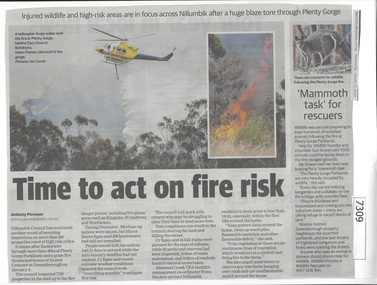
Article - Newspaper Clipping, Diamond valley Leader, Time to act on fire risk, 15/01/2020
... ...high fire risk...Nillumbik Council has conducted another round of sweeping inspections on more than 200 properties rated at high risk of fire. This follows a grass fire in Greensborough and a bushfire at Plenty Gorge Parklands....Nillumbik Council has conducted another round of sweeping inspections on more than 200 properties rated at high risk of fire. This follows a grass fire in Greensborough and a bushfire at Plenty Gorge Parklands. nillumbik council high fire risk symon crescent greensborough plenty gorge park News article 1 page, black text. ...Nillumbik Council has conducted another round of sweeping inspections on more than 200 properties rated at high risk of fire. This follows a grass fire in Greensborough and a bushfire at Plenty Gorge Parklands.News article 1 page, black text.nillumbik council, high fire risk, symon crescent greensborough, plenty gorge park -
 Flagstaff Hill Maritime Museum and Village
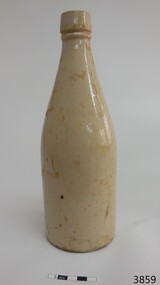
Ceramic - Stoneware Bottle, Henry Kennedy Pottery, Late 1800s to early 1900s
... fire clays. Pottery production reaches a high scale which presented a high risk of fire and Barrowfield was no exception. ...fire clays. Pottery production reaches a high scale which presented a high risk of fire and Barrowfield was no exception. ...This bottle was made in Scotland and recovered decades later from a shipwreck along the coast of Victoria. It may have been amongst the ship's cargo, its provisions or amongst a passenger's personal luggage. It is now part of the John Chance collection. Stoneware bottles similar to this one were in common use during the mid-to-late 19th century. They were used to store and transport. The bottles were handmade using either a potter's wheel or in moulds such as a plaster mould, which gave the bottles uniformity in size and shape. The bottle would then be fired and glazed in a hot kiln. Makers often identified their bottles with the impression of a small symbol or adding a colour to the mouth. The manufacturer usually stamped their bottles with their name and logo, and sometimes a message that the bottle remained their property and should be returned to them. The bottles could then be cleaned and refilled. The Barrowfield pottery was founded in 1866 by Henry Kennedy, an Irish native, in the Camlachie district east of Glasgow, close to the Campbellfield and Mount Blue potteries. It is believed that Kennedy started with just one kiln but by 1871 was employing forty men and six boys and such was the success of the enterprise that by 1880, no less than eight kilns were in operation and a year later one hundred and the pottery was employing eighteen people. Stoneware bottle production was a mainstay of the pottery and over “1500 dozen” were being turned out daily along with other wares, including 30-gallon ironstone containers. With so many kilns in operation, six hundred saggars were required every week but, unlike some potteries, these were made on the premises from Garnkirk and Glenboig fire clays. Pottery production reaches a high scale which presented a high risk of fire and Barrowfield was no exception. In April 1884 heat from a kiln set fire to the roof resulting in significant structural damage, the loss of unfinished wares alone amounting to £10,000 a very substantial sum in 1884. The pottery recovered from this reverse but then Henry Kennedy died in July 1890. The terms of his will indicated that he and his sons John and Joseph were partners and this was reflected in a change of title in the 1891-92 Post Office Directory to Henry Kennedy & Sons. Despite the growth of the business there was still space enough, however, to allow china, earthenware and glass retailers Daniel and John McDougall to commence production of their Nautilus wares there in 1894, the success of which allowed them to soon move to permanent quarters at the empty Saracen Pottery, Possil. In around 1900 John Kennedy left to resurrect the liquidated Cleland Pottery and although Barrowfield remained listed as Henry Kennedy & Sons, brother Joseph was in control. In 1911 Henry Kennedy & Sons Ltd was formed, with two of the four directors being the Kennedy brothers. The pottery’s growth to this point was reflected in the eighteen kilns the largest pottery kilns then recorded in Scotland. However, the disruption of the First World War and the combined effects of subsequent economic depression, US prohibition, hygiene regulations and competition from alternative materials posed severe challenges for stoneware potteries in the post-war years as they competed with each other for diminishing markets. Competitors such as Eagle and Caledonian Potteries fell by the wayside and finally, Barrowfield closed in 1929. This stoneware bottle is historically significant for its manufacture and use in the late 19th to the early 20th century. The bottle is also significant as it was recovered by John Chance, a diver, from a wreck on the coast of Victoria in the 1960s-70s. Items that come from several wrecks along Victoria's coast have since been donated to the Flagstaff Hill Maritime Village’s museum collection by his family, illustrating this item’s level of historical value. Stoneware was produced at Barrowfield pottery for the domestic and export markets, with South America being a large market. Barrowfield stoneware can be found throughout the world. Its longevity and abundant production makes the subject item a significant addition to the Flagstaff Hill Maritime Museum collection.Bottle, salt glazed stoneware, beige, some discolouration above base. Chip on base and on neck. Inscriptions stamped near base.Makers lozenge stamped, H Kennedy Barrowfield Pottery GLASGOW at base.flagstaff hill, warrnambool, flagstaff hill maritime museum, maritime museum, shipwreck coast, flagstaff hill maritime village, great ocean road, john chance, h kennedy pottery, stoneware, ironstone, pottery, barrowfield glasgow -
 Bendigo Historical Society Inc.
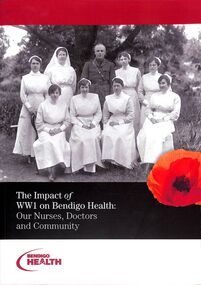
Book - "The Impact of WW1 on Bendigo Health: Our nurses, Doctors and Community.", 1914
... During their service, many of the 331,781 AIF troops and medical staff were injured more than once: over 50% were hit by shell fragments or shrapnel bullets from artillery fire 40% were hit by high-velocity bullets from rifles or machine guns 12% were affected by chlorine or mustard gas 2% were hit by bombs or grenades only 0.3% suffered bayonet wounds Many health risks also developed into large-scale problems on the front. ...During their service, many of the 331,781 AIF troops and medical staff were injured more than once: over 50% were hit by shell fragments or shrapnel bullets from artillery fire 40% were hit by high-velocity bullets from rifles or machine guns 12% were affected by chlorine or mustard gas 2% were hit by bombs or grenades only 0.3% suffered bayonet wounds Many health risks also developed into large-scale problems on the front. ...Over 4000 Bendigo residents enlisted to serve in W.W. 1. Much is known about their contributions to the war effort, but less is known about the contributions made by the medical staff who provided care at the front lines or otherwise supported care. People enlisted for many reasons - patriotism, duty and adventure being just a few. Over 416,000 persons enlisted to serve in World War One out of a population of 5 million. The Australian Government recorded 215,585 casualties during the war. Over 80% of those casualties occurred on the Western Front, in Belgium and France. The weapons used in trench warfare created horrendous injuries for both sides in the war. In the Australian Imperial Force (AIF), for example, most wounds were the result of flying metal. During their service, many of the 331,781 AIF troops and medical staff were injured more than once: over 50% were hit by shell fragments or shrapnel bullets from artillery fire 40% were hit by high-velocity bullets from rifles or machine guns 12% were affected by chlorine or mustard gas 2% were hit by bombs or grenades only 0.3% suffered bayonet wounds Many health risks also developed into large-scale problems on the front. Those who served lived and work in crowded spaces, which helped to spread bacterial, viral and parasitic infections. Unhealthy living conditions for soldiers (and sailors) included: poor diet lack of sleep exposure to cold contact with mice, rats, fleas, lice and other parasites. Soft cover. 41pp. Black and white image of nurses on front cover, along with red poppy. Tile written in white to bottom third of front cover on black background. Bendigo Health logo to bottom of front cover. Back cover has image of signage for the 'Old Mortuary' of Bendigo Hospital, with burgundy, black and white stipes above and below image. Contains black and white and color images. soldiers, world war one, british empire, doctors, nurses, bendigo hospital -
 Wodonga & District Historical Society Inc
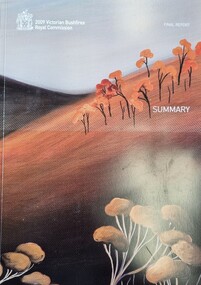
Document - Victorian Bushfires Royal Commission Report, 2009 Victorian Bushfires Royal Commission, 2009
... fires and another 414 were recorded as injured. More than 2,000 homes and a total of 3,500 buildings were destroyed. The Royal Commission immediately called for by Victorian Premier Mr John Brumby issued 67 recommendations which changed building codes in high-risk zones, warning systems, and Country Fire Authority (CFA) safety policies. 2009 Bushfires Royal Commission Final Report consisting of a cardboard folder with a colour illustration of a bushfire scene; final report summary booklet with extensive black printed text and the same cover illustration as the folder; and an electronic version consisting a CD in a cardboard cover. ...The Black Saturday bushfires were a series of devastating bushfires that swept across Victoria beginning on 7 February 2009. They continued to ravage the State of Victoria until declared under control on 14th March 2009. Over 450,000 hectares of land were burned, impacting 78 communities and 51 townships. Tragically 173 people died in the fires and another 414 were recorded as injured. More than 2,000 homes and a total of 3,500 buildings were destroyed. The Royal Commission immediately called for by Victorian Premier Mr John Brumby issued 67 recommendations which changed building codes in high-risk zones, warning systems, and Country Fire Authority (CFA) safety policies.2009 Bushfires Royal Commission Final Report consisting of a cardboard folder with a colour illustration of a bushfire scene; final report summary booklet with extensive black printed text and the same cover illustration as the folder; and an electronic version consisting a CD in a cardboard cover.The Black Saturday bushfires were a series of devastating bushfires that swept across Victoria beginning on 7 February 2009. They continued to ravage the State of Victoria until declared under control on 14th March 2009. Over 450,000 hectares of land were burned, impacting 78 communities and 51 townships. Tragically 173 people died in the fires and another 414 were recorded as injured. More than 2,000 homes and a total of 3,500 buildings were destroyed. The Royal Commission immediately called for by Victorian Premier Mr John Brumby issued 67 recommendations which changed building codes in high-risk zones, warning systems, and Country Fire Authority (CFA) safety policies.victorian bushfires 2009, natural disasters victoria
