

Historical information
Over 4000 Bendigo residents enlisted to serve in W.W. 1. Much is known about their contributions to the war effort, but less is known about the contributions made by the medical staff who provided care at the front lines or otherwise supported care. People enlisted for many reasons - patriotism, duty and adventure being just a few.
Over 416,000 persons enlisted to serve in World War One out of a population of 5 million.
The Australian Government recorded 215,585 casualties during the war. Over 80% of those casualties occurred on the Western Front, in Belgium and France.
The weapons used in trench warfare created horrendous injuries for both sides in the war. In the Australian Imperial Force (AIF), for example, most wounds were the result of flying metal.
During their service, many of the 331,781 AIF troops and medical staff were injured more than once:
over 50% were hit by shell fragments or shrapnel bullets from artillery fire
40% were hit by high-velocity bullets from rifles or machine guns
12% were affected by chlorine or mustard gas
2% were hit by bombs or grenades
only 0.3% suffered bayonet wounds
Many health risks also developed into large-scale problems on the front.
Those who served lived and work in crowded spaces, which helped to spread bacterial, viral and parasitic infections. Unhealthy living conditions for soldiers (and sailors) included:
poor diet
lack of sleep
exposure to cold
contact with mice, rats, fleas, lice and other parasites.
Physical description
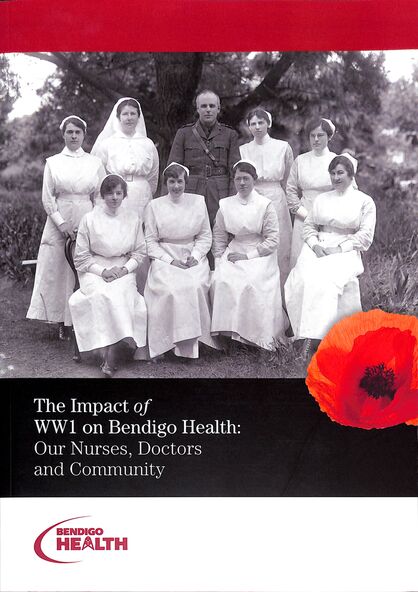
Soft cover. 41pp. Black and white image of nurses on front cover, along with red poppy. Tile written in white to bottom third of front cover on black background. Bendigo Health logo to bottom of front cover. Back cover has image of signage for the 'Old Mortuary' of Bendigo Hospital, with burgundy, black and white stipes above and below image. Contains black and white and color images.
