
Showing 84 items matching "his master’s voice"
-
 Greensborough Historical Society
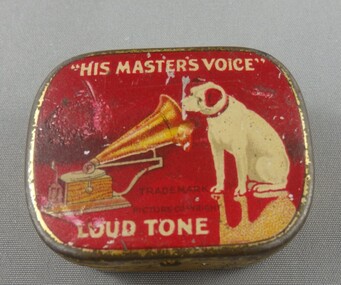
Gramophone Needles, His master's voice, His Master's Voice Gramophone needles in tin, 1950c
... His Master's Voice Gramophone needles in tin....Tin has the His Masters Voice dog on lid...."His Master's Voice" Loud tone English gramophone needles, manufactured for the Gramophone Company Limited, Sydney N. ...His master's voice...Tin has the His Masters Voice dog on lid. his masters voice styluses (audio) gramophone needles "His Master's Voice" Loud tone English gramophone needles, manufactured for the Gramophone Company Limited, Sydney N. ...Gramophone needles (stylus) used in gramophones which played 78 rpm shellac records. Tin has the His Masters Voice dog on lid.Metal box containing brass gramophone needles"His Master's Voice" Loud tone English gramophone needles, manufactured for the Gramophone Company Limited, Sydney N. S. W.his masters voice, styluses (audio), gramophone needles -
 Clunes Museum
Leisure object - GRAMAPHONE RECORDS, Columbia
... GRAMAPHONE RECORDS 78RPM HIS MASTER'S VOICE .1 ONE SIDED CLOSE-PROPS SUNG BY HARRY DEARTH .2 VALENCIA - THE SUTDENT PRINCE, BEIGE PAPER COVER WITH BROWN WRITING "HIS MASTER'S VOICE" PHILIPS' .3 LET'S HAVE A PARTY......HIS MASTER'S VOICE...GRAMAPHONE GRAMAPHONE RECORDS .1 STAMP WITH RED B & C PRINTED ON IT & , BLACK 3 3/4 - d .2 WHITE STAMP PRINTED WITH GRAMAPHONE S A E PADILE GRAMAPHONE RECORDS 78RPM HIS MASTER'S VOICE .1 ONE SIDED CLOSE-PROPS SUNG BY HARRY DEARTH .2 VALENCIA - THE SUTDENT PRINCE, BEIGE PAPER COVER WITH BROWN WRITING "HIS MASTER'S VOICE" PHILIPS' .3 LET'S HAVE A PARTY Leisure object GRAMAPHONE RECORDS Columbia HIS MASTER'S VOICE REGAL RECORDS PHILIP'S ...GRAMAPHONE RECORDS 78RPM HIS MASTER'S VOICE .1 ONE SIDED CLOSE-PROPS SUNG BY HARRY DEARTH .2 VALENCIA - THE SUTDENT PRINCE, BEIGE PAPER COVER WITH BROWN WRITING "HIS MASTER'S VOICE" PHILIPS' .3 LET'S HAVE A PARTY.1 STAMP WITH RED B & C PRINTED ON IT & , BLACK 3 3/4 - d .2 WHITE STAMP PRINTED WITH GRAMAPHONE S A E PADILEgramaphone, gramaphone records -
 Royal Australian and New Zealand College of Obstetricians & Gynaecologists (RANZCOG)
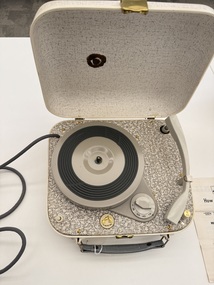
Domestic object - "His Master's Voice" Minigram 4 Speed Record Player
... "His Master's Voice" Minigram 4 Speed Record Player ...The brand that created the record player is 'His Master's Voice'. The record player has a labelled monogram on the handle which is portable. ...Domestic object "His Master's Voice" Minigram 4 Speed Record Player ...Used as a teaching resource. Record player for playing EPs. The brand that created the record player is 'His Master's Voice'. The record player has a labelled monogram on the handle which is portable. With original cardboard box [486.1] and original instruction pamphlet [486.2]. Working order, but stylus missing. Made in 1950-60s. Labelled monogram on handle. -
 Orbost & District Historical Society
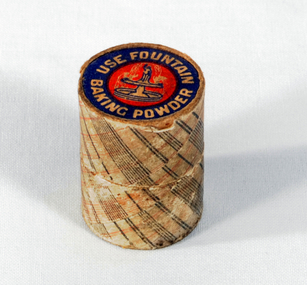
gramophone needles
... gramophone-needles audio his-master's-voice...One small "His Master's Voice" tin of gramophone needles. One small round baking powder box of gramophone needles....Tin lid - His Masters voice Loud Tone Round lid - Use Fountain Baking Powder...gramophone-needles audio his-master's-voice Tin lid - His Masters voice Loud Tone Round lid - Use Fountain Baking Powder One small "His Master's Voice" tin of gramophone needles. ...One small "His Master's Voice" tin of gramophone needles. One small round baking powder box of gramophone needles.Tin lid - His Masters voice Loud Tone Round lid - Use Fountain Baking Powdergramophone-needles audio his-master's-voice -
 Warrnambool and District Historical Society Inc.
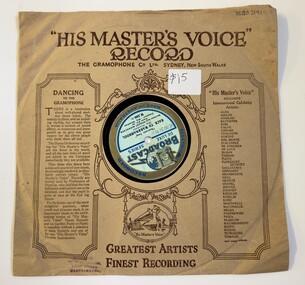
Functional object - Musical recording, Back to Warrnambool, C 1930
... Label Mrs Rowan Music House, 143 Liebig ST Warrnambool Phone 634. Cover:"His Masters Voice." Record.The Gramophone Co Ltd Sydney New South Wales. ...His Master's Voice Products...Functional object Musical recording His Master's Voice Products ...Back to Warrnambool celebrations were an important event on the social calendar and were run over a number of years in the town. Some of the events held over the week included processions, sports Carnivals, concerts, card playing, Church services and local tourist events.Reginald Stoneham the composer of the song , "Back to Warrnambool,"was born in 1879 and died March 1942. He was a popular accompanist and recording artist in the early part of the 20th century. Other songs which he wrote include All for Australia, The drover, Bendigo for the weekly Times, Mildura and Home to Ballaraat.He also penned music under the name Alberto Algrati which were his middle names.This recording is a valuable piece of Warrnambool's history as it provides an original version of the song as it was sung at the time and also as a piece of Reg Stonehams work. The "Back to Warrnambool" celebrations were a major event on the social calendar of the town for a number of years.This is a 78rpm record in a brown paper sleeve with a circle cut out in the centre revealing the titleof the songs on each side of the record.On recording: Broadcast De Luxe Series Back to Warrnambool ( Reg Stoneham) Baritone Solo, Robert Nicholson. Side 2.A Hymn of Home. Male Quartet The Premier Four. Label Mrs Rowan Music House, 143 Liebig ST Warrnambool Phone 634. Cover:"His Masters Voice." Record.The Gramophone Co Ltd Sydney New South Wales. back to warrnambool, 78 recording, reg stoneham, mrs rowan music house, warrnambool history, 1930 warrnambool -
 Robin Boyd Foundation
Audio - Recording, His Master's Voice
... His Master's Voice...Audio Recording His Master's Voice ...The Boyds purchased their record player and sound system from Thomas’s in Melbourne. Patricia Boyd (later Davies) was very interested in opera and was later appointed to the Board of the Australian Opera.J.S. Bach Brandenburg Concertos. LP 33RPM Vinyl, Catalogue Number: ASD 327, Cardboard packaging, paper sleeve, Cover notes, no author listed, 1 Vinyl disc, made and printed in Great Britain (part of a set of 2). Perofrmed by Yehudi Menuhin with Elaine Shaffer and George Malcol, and the Bath Festival Chamber Orchestra.lp, sound recording -
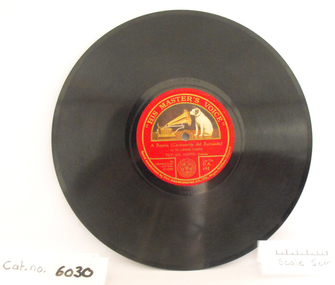 Coal Creek Community Park & Museum
Audio - Phonograph record, The Gramophone Record Co. Ltd, Magari (Canzonetta Veneziana), A Rosina (Canzonetta Del Barcaiolo)
... Black Shellac phonograph record with red His Master's Voice label. Artist: Toti Dal Monte - Soprano..."His Masters Voice" Cat. No. DA 698..."His Masters Voice" Cat. No. DA 698 Black Shellac phonograph record with red His Master's Voice label. ...Black Shellac phonograph record with red His Master's Voice label. Artist: Toti Dal Monte - Soprano"His Masters Voice" Cat. No. DA 698 -
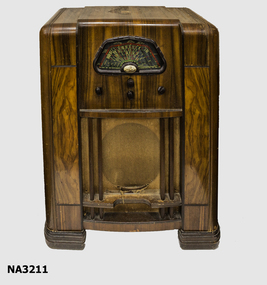 Whitehorse Historical Society Inc.
Audio - Radio & Radio Valves, c1940
... Radio - His Masters Voice - 5 valve superhetrodyne for local and short wave radio reception - electric. ...His Masters Voice...Wireless had a beautiful sound, but needed a long aerial. communication radio His Masters Voice Radio - His Masters Voice - 5 valve superhetrodyne for local and short wave radio reception - electric. ...Used by uncle of donor, Colin Lawrie, 10 Ruskin Ave Glen Iris - house where donor was born- parents home. Wireless had a beautiful sound, but needed a long aerial.Radio - His Masters Voice - 5 valve superhetrodyne for local and short wave radio reception - electric. Polished veneer cabinet - 4 switches/knobs - tuning; Volume on/off; Local/Short wave; tone. 12inch Rola speaker. |Has been modified with an additional switch at rear to switch on +off. Also include is a box of 14 radio valves. His Masters Voicecommunication, radio -
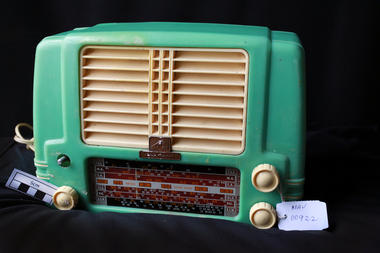 City of Moorabbin Historical Society (Operating the Box Cottage Museum)
Communication Devices, Radio, 'HMV', c1930
... ...his master's voice radio...HMV stands for His Master's Voice, the title of a painting by Francis Barraud of the dog Nipper listening to a cylinder phonograph, which was bought by the Gramophone Company in 1899. ...Communication Devices, Radio, 'HMV' His Masters Voice Pty Ltd ...The first HMV branded store was opened by the Gramophone Company on Oxford Street in 1921, and the HMV name was also used for television and radio sets manufactured from the 1930s onwards. HMV stands for His Master's Voice, the title of a painting by Francis Barraud of the dog Nipper listening to a cylinder phonograph, which was bought by the Gramophone Company in 1899. For advertising purposes this was changed to a wind-up gramophone, and eventually used simply as a silhouette.A green mantel Radio set, 'HMV' , 'Little Nipper' c1930. The 4 tuning knobs are white, - one is missing - , the grill is white and the flex and plug are complete. Front ; HMV 'trade mark' ( dog with a cylinder phonograph' ) / " Little Nipper" hmv, his master's voice radio, gramaphones, radio broadcasts, early settlers, pioneers, market gardeners, moorabbin, cheltenham, bentleigh, london england, little nipper painting, mr biehl, barraud francis -
 Bendigo Historical Society Inc.
Document - CELEBRITY CONCERT SERIES, CAPITAL THEATRE, c28 October, 1963
... Advertisements: Philips. His Master's Voice. Benson and Hedges....Advertisements: Philips. His Master's Voice, Caprice Stereophonic Radiogram. ...Advertisements: Philips. His Master's Voice, Caprice Stereophonic Radiogram. ...Celebrity Concert Series, Direction A.B.C. Capital Theatre, Bendigo. Monday 28th October, at 8 p.m. The Australian Broadcasting Commission presents the Victorian Symphony Orchestra Conducted by Thomas Matthews. Soloist: Brian Hansford (Baritone). Programme: One shilling and sixpence. Articles with photos on: Thomas Matthews & Brian Hansford. Programme. Analytical Notes. Australian Broadcasting Commission: Dr. J R Darling, C.M.G., O.B.E., M.A., D.C.L., Chairman. E R Dawes, C.M.G., Vice-Chairman. Miss Rhonda Felgate, M.B.E. H B Halvorsen, F.C.A., F.C.I.S. A G Lowndes, M.SC. Alderman. Dorothy Edwards, O.B.E., B.A. J T Reid. Sir Charles Moses, C.B.E., General Manager. E A Whiteley, C.B.E., D.F.C., Manager for Victoria. Charles Buttrose, Director of Publicity and Concerts. J Post, Acting Director of Music. Ray Humphrey, Concert Manager for Victoria. Advertisements: Philips. His Master's Voice, Caprice Stereophonic Radiogram. Benson and Hedges.program, music, australian symphonic orchestra, celebrity concert series, direction a.b.c. capital theatre, bendigo. monday 28th october, at 8 p.m. the australian broadcasting commission presents the victorian symphony orchestra conducted by thomas matthews. soloist: brian hansford (baritone). articles with photos on: thomas matthews & brian hansford. programme. analytical notes. a.b.c.: dr. j r darling, c.m.g., o.b.e., m.a., d.c.l., chairman. e r dawes, c.m.g., vice-chairman. miss rhonda felgate, m.b.e. h b halvorsen, f.c.a., f.c.i.s. a g lowndes, m.sc. alderman. dorothy edwards, o.b.e., b.a. j t reid. sir charles moses, c.b.e., general manager. e a whiteley, c.b.e., d.f.c., manager for victoria. charles buttrose, director of publicity and concerts. j post, acting director of music. ray humphrey, concert manager for victoria. advertisements: philips. his master's voice. benson and hedges. -
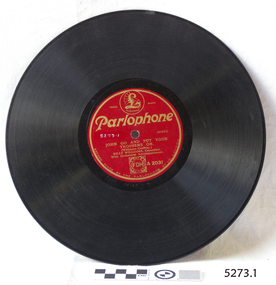 Flagstaff Hill Maritime Museum and Village
Audio - Gramophone Record, Parlophone Co. Ltd, John Go And Put Your Trousers On, Early-to-mid 20th century
... ...His Master’s Voice...The label's logo, a dog looking into a gramophone horn, looking for his master’s voice, was based on a painting by English artist Francis Barraud, which featured a terrier called Nipper beside a gramophone. ...The label's logo, a dog looking into a gramophone horn, looking for his master’s voice, was based on a painting by English artist Francis Barraud, which featured a terrier called Nipper beside a gramophone. ...Thomas Edison (1847–1931), an American, invented the phonograph in 1877, making it possible to record sound waves vertically and reproduce them on a wax cylinder so they could be heard again. Later, the German American, Emile Berliner (1851-1929), improved on Edison’s principles, greatly increasing the quality of the reproduced sounds with his invention of the gramophone in 1887, which recorded the sound waves laterally onto a flat shellac disc, or ‘record’. Records could be mass-produced in a factory where audio recordings were converted to a physical copy of that recording on a plate-sized disc. A gramophone machine reproduced the sound by spinning the record on a turntable at a specified number of rotations per minute (RPM) and using a stylus or needle to transfer the vibration via a membrane to a speaker, which amplified the sound. Berliner helped set up affiliated businesses overseas. One of his representatives was William Barry Owen (1860–1914), who, on 23 February 1889, partnered with Edmund Trevor Lloyd Williams (1859–1946) in England to register The Gramophone Company. His Master’s Voice (HMV) soon became the company’s major recording label, popular worldwide. The label's logo, a dog looking into a gramophone horn, looking for his master’s voice, was based on a painting by English artist Francis Barraud, which featured a terrier called Nipper beside a gramophone. Early gramophone records were mostly made from a material referred to as shellac, a natural ingredient combined with slate powder, and a filler of manilla copal, wood resin, carnauba wax, and carbon black. Although Bakelite seemed a useful, synthetic product, it was unsuccessful as a product for records. Around the time of World War II, lightweight, flexible synthetic vinyl records began replacing shellac records. Common diameters of records: 7 inch, 10 inch, 12 inch and 16 inch Revolutions Per Minute include: 33 1/3, 45, 78 Minutes per side of record: 3, 5.5, 7, 8, 9, 12, 15 and 22 Labels, in minutes per side: Single Play 3-5 min, Extended Play (EP) 7-12 min, Long Play (LP) 12-22 min This gramophone represents a step in the evolution of recording sound. In the 19th century, the human voice was first recorded on wax cylinders and replayed. It was the beginning of a new era in sound. Then, in the 1880s, voice could be recorded onto flat discs like this record, reliably reproduced and replayed many times, even on portable devices. Later, in the mid-20th century the following generation of electronic audio recording began, and later that century, digital recording gave even better reproduction. The record represents a popular means of entertainment for personal and social activities, as well as in some businesses. Shellac gramophone record, red label. Title: John Go And Put Your Trousers On Artist: Billy Williams Publisher: Parlophone Co Ltd, London Number: 41413 Size: 10 inch"A2031"flagstaff hill, warrnambool, maritime village, maritime museum, flagstaff hill maritime museum and village, shipwreck coast, great ocean road, gramophone, phonograph, sound waves, record, reproduction, audio record, music, sound, thomas edison, emile berliner, 1887, shellac, rpm, william barry owen, edmund trevor lloyd williams, the gramophone company, his master’s voice, hmv, francis barraud, nipper, 10 inch, parlophone co ltd, london, john go and put your trousers on, billy williams -
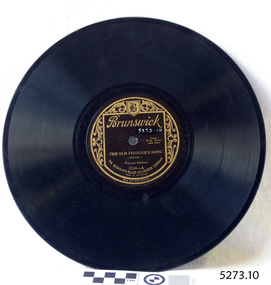 Flagstaff Hill Maritime Museum and Village
Audio - Gramophone Record, Brunswick Records, The Old Fiddlers Song, Early-to-mid 20th century
... ...His Master’s Voice...One of his representatives was William Barry Owen (1860–1914), who, on 23 February 1889, partnered with Edmund Trevor Lloyd Williams (1859–1946) in England to register The Gramophone Company. His Master’s Voice (HMV) soon became the company’s major recording label, popular worldwide. ...One of his representatives was William Barry Owen (1860–1914), who, on 23 February 1889, partnered with Edmund Trevor Lloyd Williams (1859–1946) in England to register The Gramophone Company. His Master’s Voice (HMV) soon became the company’s major recording label, popular worldwide. ...Thomas Edison (1847–1931), an American, invented the phonograph in 1877, making it possible to record sound waves vertically and reproduce them on a wax cylinder so they could be heard again. Later, the German American, Emile Berliner (1851-1929), improved on Edison’s principles, greatly increasing the quality of the reproduced sounds with his invention of the gramophone in 1887, which recorded the sound waves laterally onto a flat shellac disc, or ‘record’. Records could be mass-produced in a factory where audio recordings were converted to a physical copy of that recording on a plate-sized disc. A gramophone machine reproduced the sound by spinning the record on a turntable at a specified number of rotations per minute (RPM) and using a stylus or needle to transfer the vibration via a membrane to a speaker, which amplified the sound. Berliner helped set up affiliated businesses overseas. One of his representatives was William Barry Owen (1860–1914), who, on 23 February 1889, partnered with Edmund Trevor Lloyd Williams (1859–1946) in England to register The Gramophone Company. His Master’s Voice (HMV) soon became the company’s major recording label, popular worldwide. The business based the label's logo of a dog looking into a gramophone horn for ‘his master’s voice’ was based on a painting by English artist Francis Barraud, which featured a terrier called Nipper beside a gramophone. Early gramophone records were mostly made from a material referred to as shellac, a natural ingredient combined with slate powder, and a filler of manilla copal, wood resin, carnauba wax, and carbon black. Although Bakelite seemed a useful, synthetic product, it was unsuccessful as a product for records. Around the time of World War II, lightweight, flexible synthetic vinyl records began replacing shellac records. Common diameters of records: 7 inch, 10 inch, 12 inch and 16 inch Revolutions Per Minute include: 33 1/3, 45, 78 Minutes per side of record: 3, 5.5, 7, 8, 9, 12, 15 and 22 Labels, in minutes per side: Single Play 3-5 min, Extended Play (EP) 7-12 min, Long Play (LP) 12-22 min This gramophone represents a step in the evolution of recording sound. In the 19th century, the human voice was first recorded on wax cylinders and replayed. It was the beginning of a new era in sound. Then, in the 1880s, voice could be recorded onto flat discs like this record, reliably reproduced and replayed many times, even on portable devices. Later, in the mid-20th century the following generation of electronic audio recording began, and later that century, digital recording gave even better reproduction. The record represents a popular means of entertainment for personal and social activities, as well as in some businesses. Shellac gramophone record with a black and gold label. Title: The Old Fiddlers Song Artist: Vernon Delhart, tenor Publisher: Brunswick Number:3234-A Size: 10 inchflagstaff hill, warrnambool, maritime village, maritime museum, flagstaff hill maritime museum and village, shipwreck coast, great ocean road, gramophone, phonograph, sound waves, record, reproduction, audio record, music, sound, thomas edison, emile berliner, 1887, shellac, rpm, william barry owen, edmund trevor lloyd williams, the gramophone company, his master’s voice, hmv, francis barraud, nipper, 10 inch, brunswick records, 3234-a, the old fiddlers song, vernon delhart (tenor) -
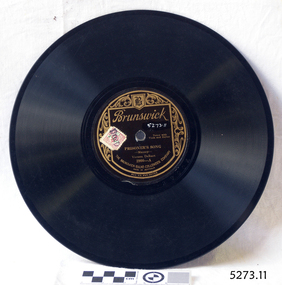 Flagstaff Hill Maritime Museum and Village
Audio - Gramophone Record, Brunswick Records, Prisoner's Song, Early-to-mid 20th century
... ...His Master’s Voice...One of his representatives was William Barry Owen (1860–1914), who, on 23 February 1889, partnered with Edmund Trevor Lloyd Williams (1859–1946) in England to register The Gramophone Company. His Master’s Voice (HMV) soon became the company’s major recording label, popular worldwide. ...One of his representatives was William Barry Owen (1860–1914), who, on 23 February 1889, partnered with Edmund Trevor Lloyd Williams (1859–1946) in England to register The Gramophone Company. His Master’s Voice (HMV) soon became the company’s major recording label, popular worldwide. ...Thomas Edison (1847–1931), an American, invented the phonograph in 1877, making it possible to record sound waves vertically and reproduce them on a wax cylinder so they could be heard again. Later, the German American, Emile Berliner (1851-1929), improved on Edison’s principles, greatly increasing the quality of the reproduced sounds with his invention of the gramophone in 1887, which recorded the sound waves laterally onto a flat shellac disc, or ‘record’. Records could be mass-produced in a factory where audio recordings were converted to a physical copy of that recording on a plate-sized disc. A gramophone machine reproduced the sound by spinning the record on a turntable at a specified number of rotations per minute (RPM) and using a stylus or needle to transfer the vibration via a membrane to a speaker, which amplified the sound. Berliner helped set up affiliated businesses overseas. One of his representatives was William Barry Owen (1860–1914), who, on 23 February 1889, partnered with Edmund Trevor Lloyd Williams (1859–1946) in England to register The Gramophone Company. His Master’s Voice (HMV) soon became the company’s major recording label, popular worldwide. The business based the label's logo of a dog looking into a gramophone horn for ‘his master’s voice’ was based on a painting by English artist Francis Barraud, which featured a terrier called Nipper beside a gramophone. Early gramophone records were mostly made from a material referred to as shellac, a natural ingredient combined with slate powder, and a filler of manilla copal, wood resin, carnauba wax, and carbon black. Although Bakelite seemed a useful, synthetic product, it was unsuccessful as a product for records. Around the time of World War II, lightweight, flexible synthetic vinyl records began replacing shellac records. Common diameters of records: 7 inch, 10 inch, 12 inch and 16 inch Revolutions Per Minute include: 33 1/3, 45, 78 Minutes per side of record: 3, 5.5, 7, 8, 9, 12, 15 and 22 Labels, in minutes per side: Single Play 3-5 min, Extended Play (EP) 7-12 min, Long Play (LP) 12-22 min This gramophone represents a step in the evolution of recording sound. In the 19th century, the human voice was first recorded on wax cylinders and replayed. It was the beginning of a new era in sound. Then, in the 1880s, voice could be recorded onto flat discs like this record, reliably reproduced and replayed many times, even on portable devices. Later, in the mid-20th century the following generation of electronic audio recording began, and later that century, digital recording gave even better reproduction. The record represents a popular means of entertainment for personal and social activities, as well as in some businesses. Shellac gramophone record with a black and gold label. Title: Prisoner's Song Artist: Vernon Dalhart, tenor Publisher: Brunswick Records Number: A-2900 Size: 10 inchOn label, white sticker with red printflagstaff hill, warrnambool, maritime village, maritime museum, flagstaff hill maritime museum and village, shipwreck coast, great ocean road, gramophone, phonograph, sound waves, record, reproduction, audio record, music, sound, thomas edison, emile berliner, 1887, shellac, rpm, william barry owen, edmund trevor lloyd williams, the gramophone company, his master’s voice, hmv, francis barraud, nipper, 10 inch, brunswick records, a-2900, prisoner's song, vernon dalhart (tenor) -
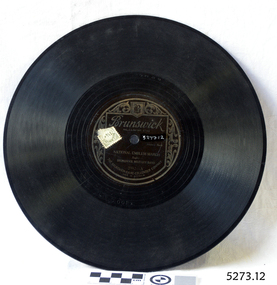 Flagstaff Hill Maritime Museum and Village
Audio - Gramophone Record, Brunswick Records, National Emblem March, Early-to-mid 20th century
... ...His Master’s Voice...One of his representatives was William Barry Owen (1860–1914), who, on 23 February 1889, partnered with Edmund Trevor Lloyd Williams (1859–1946) in England to register The Gramophone Company. His Master’s Voice (HMV) soon became the company’s major recording label, popular worldwide. ...One of his representatives was William Barry Owen (1860–1914), who, on 23 February 1889, partnered with Edmund Trevor Lloyd Williams (1859–1946) in England to register The Gramophone Company. His Master’s Voice (HMV) soon became the company’s major recording label, popular worldwide. ...Thomas Edison (1847–1931), an American, invented the phonograph in 1877, making it possible to record sound waves vertically and reproduce them on a wax cylinder so they could be heard again. Later, the German American, Emile Berliner (1851-1929), improved on Edison’s principles, greatly increasing the quality of the reproduced sounds with his invention of the gramophone in 1887, which recorded the sound waves laterally onto a flat shellac disc, or ‘record’. Records could be mass-produced in a factory where audio recordings were converted to a physical copy of that recording on a plate-sized disc. A gramophone machine reproduced the sound by spinning the record on a turntable at a specified number of rotations per minute (RPM) and using a stylus or needle to transfer the vibration via a membrane to a speaker, which amplified the sound. Berliner helped set up affiliated businesses overseas. One of his representatives was William Barry Owen (1860–1914), who, on 23 February 1889, partnered with Edmund Trevor Lloyd Williams (1859–1946) in England to register The Gramophone Company. His Master’s Voice (HMV) soon became the company’s major recording label, popular worldwide. The business based the label's logo of a dog looking into a gramophone horn for ‘his master’s voice’ was based on a painting by English artist Francis Barraud, which featured a terrier called Nipper beside a gramophone. Early gramophone records were mostly made from a material referred to as shellac, a natural ingredient combined with slate powder, and a filler of manilla copal, wood resin, carnauba wax, and carbon black. Although Bakelite seemed a useful, synthetic product, it was unsuccessful as a product for records. Around the time of World War II, lightweight, flexible synthetic vinyl records began replacing shellac records. Common diameters of records: 7 inch, 10 inch, 12 inch and 16 inch Revolutions Per Minute include: 33 1/3, 45, 78 Minutes per side of record: 3, 5.5, 7, 8, 9, 12, 15 and 22 Labels, in minutes per side: Single Play 3-5 min, Extended Play (EP) 7-12 min, Long Play (LP) 12-22 min This gramophone represents a step in the evolution of recording sound. In the 19th century, the human voice was first recorded on wax cylinders and replayed. It was the beginning of a new era in sound. Then, in the 1880s, voice could be recorded onto flat discs like this record, reliably reproduced and replayed many times, even on portable devices. Later, in the mid-20th century the following generation of electronic audio recording began, and later that century, digital recording gave even better reproduction. The record represents a popular means of entertainment for personal and social activities, as well as in some businesses. Shellac gramophone record with a black and gold label. Title: National Emblem March Artist: Brunswick Military Band Publisher: Brunswick Number: A2002 Size: 10 inchOn the label is a cream coloured stamp with printed detailsflagstaff hill, warrnambool, maritime village, maritime museum, flagstaff hill maritime museum and village, shipwreck coast, great ocean road, gramophone, phonograph, sound waves, record, reproduction, audio record, music, sound, thomas edison, emile berliner, 1887, shellac, rpm, william barry owen, edmund trevor lloyd williams, the gramophone company, his master’s voice, hmv, francis barraud, nipper, 10 inch, brunswick records, a2002, national emblem march, brunswick military band -
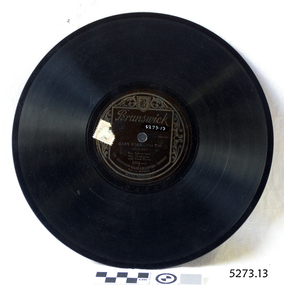 Flagstaff Hill Maritime Museum and Village
Audio - Gramophone Record, Brunswick Records, Baby Face
... ...His Master’s Voice...One of his representatives was William Barry Owen (1860–1914), who, on 23 February 1889, partnered with Edmund Trevor Lloyd Williams (1859–1946) in England to register The Gramophone Company. His Master’s Voice (HMV) soon became the company’s major recording label, popular worldwide. ...One of his representatives was William Barry Owen (1860–1914), who, on 23 February 1889, partnered with Edmund Trevor Lloyd Williams (1859–1946) in England to register The Gramophone Company. His Master’s Voice (HMV) soon became the company’s major recording label, popular worldwide. ...Thomas Edison (1847–1931), an American, invented the phonograph in 1877, making it possible to record sound waves vertically and reproduce them on a wax cylinder so they could be heard again. Later, the German American, Emile Berliner (1851-1929), improved on Edison’s principles, greatly increasing the quality of the reproduced sounds with his invention of the gramophone in 1887, which recorded the sound waves laterally onto a flat shellac disc, or ‘record’. Records could be mass-produced in a factory where audio recordings were converted to a physical copy of that recording on a plate-sized disc. A gramophone machine reproduced the sound by spinning the record on a turntable at a specified number of rotations per minute (RPM) and using a stylus or needle to transfer the vibration via a membrane to a speaker, which amplified the sound. Berliner helped set up affiliated businesses overseas. One of his representatives was William Barry Owen (1860–1914), who, on 23 February 1889, partnered with Edmund Trevor Lloyd Williams (1859–1946) in England to register The Gramophone Company. His Master’s Voice (HMV) soon became the company’s major recording label, popular worldwide. The business based the label's logo of a dog looking into a gramophone horn for ‘his master’s voice’ was based on a painting by English artist Francis Barraud, which featured a terrier called Nipper beside a gramophone. Early gramophone records were mostly made from a material referred to as shellac, a natural ingredient combined with slate powder, and a filler of manilla copal, wood resin, carnauba wax, and carbon black. Although Bakelite seemed a useful, synthetic product, it was unsuccessful as a product for records. Around the time of World War II, lightweight, flexible synthetic vinyl records began replacing shellac records. Common diameters of records: 7 inch, 10 inch, 12 inch and 16 inch Revolutions Per Minute include: 33 1/3, 45, 78 Minutes per side of record: 3, 5.5, 7, 8, 9, 12, 15 and 22 Labels, in minutes per side: Single Play 3-5 min, Extended Play (EP) 7-12 min, Long Play (LP) 12-22 min Shellac gramophone record with a black and gold label. Title: Baby Face Artist: Foxtrot by Ben Selvin and his Orchestra Publisher: Brunswick Number: A-3253 Size: 10 inchWhite sticker on the labelflagstaff hill, warrnambool, maritime village, maritime museum, flagstaff hill maritime museum and village, shipwreck coast, great ocean road, gramophone, phonograph, sound waves, record, reproduction, audio record, music, sound, thomas edison, emile berliner, 1887, shellac, rpm, william barry owen, edmund trevor lloyd williams, the gramophone company, his master’s voice, hmv, francis barraud, nipper, 10 inch, brunswick records, a-3253, baby face, foxtrot, ben selvin and his orchestra -
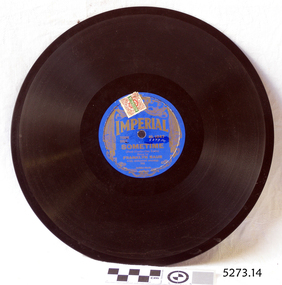 Flagstaff Hill Maritime Museum and Village
Audio - Gramophone Record, Imperial Records, Sometime, Early-to-mid 20th century
... ...His Master’s Voice...One of his representatives was William Barry Owen (1860–1914), who, on 23 February 1889, partnered with Edmund Trevor Lloyd Williams (1859–1946) in England to register The Gramophone Company. His Master’s Voice (HMV) soon became the company’s major recording label, popular worldwide. ...One of his representatives was William Barry Owen (1860–1914), who, on 23 February 1889, partnered with Edmund Trevor Lloyd Williams (1859–1946) in England to register The Gramophone Company. His Master’s Voice (HMV) soon became the company’s major recording label, popular worldwide. ...Thomas Edison (1847–1931), an American, invented the phonograph in 1877, making it possible to record sound waves vertically and reproduce them on a wax cylinder so they could be heard again. Later, the German American, Emile Berliner (1851-1929), improved on Edison’s principles, greatly increasing the quality of the reproduced sounds with his invention of the gramophone in 1887, which recorded the sound waves laterally onto a flat shellac disc, or ‘record’. Records could be mass-produced in a factory where audio recordings were converted to a physical copy of that recording on a plate-sized disc. A gramophone machine reproduced the sound by spinning the record on a turntable at a specified number of rotations per minute (RPM) and using a stylus or needle to transfer the vibration via a membrane to a speaker, which amplified the sound. Berliner helped set up affiliated businesses overseas. One of his representatives was William Barry Owen (1860–1914), who, on 23 February 1889, partnered with Edmund Trevor Lloyd Williams (1859–1946) in England to register The Gramophone Company. His Master’s Voice (HMV) soon became the company’s major recording label, popular worldwide. The business based the label's logo of a dog looking into a gramophone horn for ‘his master’s voice’ was based on a painting by English artist Francis Barraud, which featured a terrier called Nipper beside a gramophone. Early gramophone records were mostly made from a material referred to as shellac, a natural ingredient combined with slate powder, and a filler of manilla copal, wood resin, carnauba wax, and carbon black. Although Bakelite seemed a useful, synthetic product, it was unsuccessful as a product for records. Around the time of World War II, lightweight, flexible synthetic vinyl records began replacing shellac records. Common diameters of records: 7 inch, 10 inch, 12 inch and 16 inch Revolutions Per Minute include: 33 1/3, 45, 78 Minutes per side of record: 3, 5.5, 7, 8, 9, 12, 15 and 22 Labels, in minutes per side: Single Play 3-5 min, Extended Play (EP) 7-12 min, Long Play (LP) 12-22 min This gramophone represents a step in the evolution of recording sound. In the 19th century, the human voice was first recorded on wax cylinders and replayed. It was the beginning of a new era in sound. Then, in the 1880s, voice could be recorded onto flat discs like this record, reliably reproduced and replayed many times, even on portable devices. Later, in the mid-20th century the following generation of electronic audio recording began, and later that century, digital recording gave even better reproduction. The record represents a popular means of entertainment for personal and social activities, as well as in some businesses. Shellac gramophone record with a blue and gold label. Title: Sometime Artist: Franklyn Baur, tenor, solo Publisher: Imperial Records Number:1547 Size: 14 inchWhite paper stamp with gold, red and green printflagstaff hill, warrnambool, maritime village, maritime museum, flagstaff hill maritime museum and village, shipwreck coast, great ocean road, gramophone, phonograph, sound waves, record, reproduction, audio record, music, sound, thomas edison, emile berliner, 1887, shellac, rpm, william barry owen, edmund trevor lloyd williams, the gramophone company, his master’s voice, hmv, francis barraud, nipper, imperial record, 1547, sometime, tenor solo, franklyn baur, 14 inch -
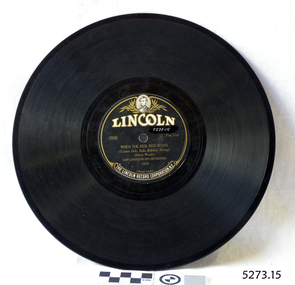 Flagstaff Hill Maritime Museum and Village
Audio - Gramophone Record, Lincoln Record Corporation, When The Red, Red Robin, Early-to-mid 20th century
... ...His Master’s Voice...One of his representatives was William Barry Owen (1860–1914), who, on 23 February 1889, partnered with Edmund Trevor Lloyd Williams (1859–1946) in England to register The Gramophone Company. His Master’s Voice (HMV) soon became the company’s major recording label, popular worldwide. ...One of his representatives was William Barry Owen (1860–1914), who, on 23 February 1889, partnered with Edmund Trevor Lloyd Williams (1859–1946) in England to register The Gramophone Company. His Master’s Voice (HMV) soon became the company’s major recording label, popular worldwide. ...Thomas Edison (1847–1931), an American, invented the phonograph in 1877, making it possible to record sound waves vertically and reproduce them on a wax cylinder so they could be heard again. Later, the German American, Emile Berliner (1851-1929), improved on Edison’s principles, greatly increasing the quality of the reproduced sounds with his invention of the gramophone in 1887, which recorded the sound waves laterally onto a flat shellac disc, or ‘record’. Records could be mass-produced in a factory where audio recordings were converted to a physical copy of that recording on a plate-sized disc. A gramophone machine reproduced the sound by spinning the record on a turntable at a specified number of rotations per minute (RPM) and using a stylus or needle to transfer the vibration via a membrane to a speaker, which amplified the sound. Berliner helped set up affiliated businesses overseas. One of his representatives was William Barry Owen (1860–1914), who, on 23 February 1889, partnered with Edmund Trevor Lloyd Williams (1859–1946) in England to register The Gramophone Company. His Master’s Voice (HMV) soon became the company’s major recording label, popular worldwide. The business based the label's logo of a dog looking into a gramophone horn for ‘his master’s voice’ was based on a painting by English artist Francis Barraud, which featured a terrier called Nipper beside a gramophone. Early gramophone records were mostly made from a material referred to as shellac, a natural ingredient combined with slate powder, and a filler of manilla copal, wood resin, carnauba wax, and carbon black. Although Bakelite seemed a useful, synthetic product, it was unsuccessful as a product for records. Around the time of World War II, lightweight, flexible synthetic vinyl records began replacing shellac records. Common diameters of records: 7 inch, 10 inch, 12 inch and 16 inch Revolutions Per Minute include: 33 1/3, 45, 78 Minutes per side of record: 3, 5.5, 7, 8, 9, 12, 15 and 22 Labels, in minutes per side: Single Play 3-5 min, Extended Play (EP) 7-12 min, Long Play (LP) 12-22 min This gramophone represents a step in the evolution of recording sound. In the 19th century, the human voice was first recorded on wax cylinders and replayed. It was the beginning of a new era in sound. Then, in the 1880s, voice could be recorded onto flat discs like this record, reliably reproduced and replayed many times, even on portable devices. Later, in the mid-20th century the following generation of electronic audio recording began, and later that century, digital recording gave even better reproduction. The record represents a popular means of entertainment for personal and social activities, as well as in some businesses. Shellac gramophone record with a black and gold label. Title: When The Red, Red Robin Artist: Sammy Lanin and his Orchestra Publisher: Lincoln Record Corporation, N.Y. Number:2528 Size: 10 inchflagstaff hill, warrnambool, maritime village, maritime museum, flagstaff hill maritime museum and village, shipwreck coast, great ocean road, gramophone, phonograph, sound waves, record, reproduction, audio record, music, sound, thomas edison, emile berliner, 1887, shellac, rpm, william barry owen, edmund trevor lloyd williams, the gramophone company, his master’s voice, hmv, francis barraud, nipper, lincoln record corporation, new york, 2528, when the red red robin, sammy lanin and his orchestra, 10 inch -
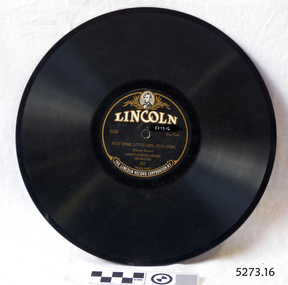 Flagstaff Hill Maritime Museum and Village
Audio - Gramophone Record, Lincoln Record Corporation, Stay Home Little Girl, Stay Home, Early-to-mid 20th century
... ...His Master’s Voice...One of his representatives was William Barry Owen (1860–1914), who, on 23 February 1889, partnered with Edmund Trevor Lloyd Williams (1859–1946) in England to register The Gramophone Company. His Master’s Voice (HMV) soon became the company’s major recording label, popular worldwide. ...One of his representatives was William Barry Owen (1860–1914), who, on 23 February 1889, partnered with Edmund Trevor Lloyd Williams (1859–1946) in England to register The Gramophone Company. His Master’s Voice (HMV) soon became the company’s major recording label, popular worldwide. ...Thomas Edison (1847–1931), an American, invented the phonograph in 1877, making it possible to record sound waves vertically and reproduce them on a wax cylinder so they could be heard again. Later, the German American, Emile Berliner (1851-1929), improved on Edison’s principles, greatly increasing the quality of the reproduced sounds with his invention of the gramophone in 1887, which recorded the sound waves laterally onto a flat shellac disc, or ‘record’. Records could be mass-produced in a factory where audio recordings were converted to a physical copy of that recording on a plate-sized disc. A gramophone machine reproduced the sound by spinning the record on a turntable at a specified number of rotations per minute (RPM) and using a stylus or needle to transfer the vibration via a membrane to a speaker, which amplified the sound. Berliner helped set up affiliated businesses overseas. One of his representatives was William Barry Owen (1860–1914), who, on 23 February 1889, partnered with Edmund Trevor Lloyd Williams (1859–1946) in England to register The Gramophone Company. His Master’s Voice (HMV) soon became the company’s major recording label, popular worldwide. The business based the label's logo of a dog looking into a gramophone horn for ‘his master’s voice’ was based on a painting by English artist Francis Barraud, which featured a terrier called Nipper beside a gramophone. Early gramophone records were mostly made from a material referred to as shellac, a natural ingredient combined with slate powder, and a filler of manilla copal, wood resin, carnauba wax, and carbon black. Although Bakelite seemed a useful, synthetic product, it was unsuccessful as a product for records. Around the time of World War II, lightweight, flexible synthetic vinyl records began replacing shellac records. Common diameters of records: 7 inch, 10 inch, 12 inch and 16 inch Revolutions Per Minute include: 33 1/3, 45, 78 Minutes per side of record: 3, 5.5, 7, 8, 9, 12, 15 and 22 Labels, in minutes per side: Single Play 3-5 min, Extended Play (EP) 7-12 min, Long Play (LP) 12-22 min This gramophone represents a step in the evolution of recording sound. In the 19th century, the human voice was first recorded on wax cylinders and replayed. It was the beginning of a new era in sound. Then, in the 1880s, voice could be recorded onto flat discs like this record, reliably reproduced and replayed many times, even on portable devices. Later, in the mid-20th century the following generation of electronic audio recording began, and later that century, digital recording gave even better reproduction. The record represents a popular means of entertainment for personal and social activities, as well as in some businesses. Shellac gramophone record with a coloured label. Title: Stay Home Little Girl, Stay Home Artist: Johnny Johnson and his Orchestra. Publisher: The Lincoln Record Corporation, N.Y. 2516 Number:797 Size: 10 inchflagstaff hill, warrnambool, maritime village, maritime museum, flagstaff hill maritime museum and village, shipwreck coast, great ocean road, gramophone, phonograph, sound waves, record, reproduction, audio record, music, sound, thomas edison, emile berliner, 1887, shellac, rpm, william barry owen, edmund trevor lloyd williams, the gramophone company, his master’s voice, hmv, francis barraud, nipper, lincoln record corporation n.y. 2516, stay home little girl stay home, johnny johnson and his orchestra, 797, 10 inch -
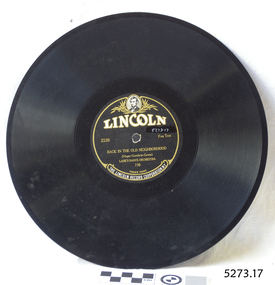 Flagstaff Hill Maritime Museum and Village
Audio - Gramophone Record, Lincoln Record Corporation, Back In The Old Neighborhood, Early-to-mid 20th century
... ...His Master’s Voice...One of his representatives was William Barry Owen (1860–1914), who, on 23 February 1889, partnered with Edmund Trevor Lloyd Williams (1859–1946) in England to register The Gramophone Company. His Master’s Voice (HMV) soon became the company’s major recording label, popular worldwide. ...One of his representatives was William Barry Owen (1860–1914), who, on 23 February 1889, partnered with Edmund Trevor Lloyd Williams (1859–1946) in England to register The Gramophone Company. His Master’s Voice (HMV) soon became the company’s major recording label, popular worldwide. ...Thomas Edison (1847–1931), an American, invented the phonograph in 1877, making it possible to record sound waves vertically and reproduce them on a wax cylinder so they could be heard again. Later, the German American, Emile Berliner (1851-1929), improved on Edison’s principles, greatly increasing the quality of the reproduced sounds with his invention of the gramophone in 1887, which recorded the sound waves laterally onto a flat shellac disc, or ‘record’. Records could be mass-produced in a factory where audio recordings were converted to a physical copy of that recording on a plate-sized disc. A gramophone machine reproduced the sound by spinning the record on a turntable at a specified number of rotations per minute (RPM) and using a stylus or needle to transfer the vibration via a membrane to a speaker, which amplified the sound. Berliner helped set up affiliated businesses overseas. One of his representatives was William Barry Owen (1860–1914), who, on 23 February 1889, partnered with Edmund Trevor Lloyd Williams (1859–1946) in England to register The Gramophone Company. His Master’s Voice (HMV) soon became the company’s major recording label, popular worldwide. The business based the label's logo of a dog looking into a gramophone horn for ‘his master’s voice’ was based on a painting by English artist Francis Barraud, which featured a terrier called Nipper beside a gramophone. Early gramophone records were mostly made from a material referred to as shellac, a natural ingredient combined with slate powder, and a filler of manilla copal, wood resin, carnauba wax, and carbon black. Although Bakelite seemed a useful, synthetic product, it was unsuccessful as a product for records. Around the time of World War II, lightweight, flexible synthetic vinyl records began replacing shellac records. Common diameters of records: 7 inch, 10 inch, 12 inch and 16 inch Revolutions Per Minute include: 33 1/3, 45, 78 Minutes per side of record: 3, 5.5, 7, 8, 9, 12, 15 and 22 Labels, in minutes per side: Single Play 3-5 min, Extended Play (EP) 7-12 min, Long Play (LP) 12-22 min This gramophone represents a step in the evolution of recording sound. In the 19th century, the human voice was first recorded on wax cylinders and replayed. It was the beginning of a new era in sound. Then, in the 1880s, voice could be recorded onto flat discs like this record, reliably reproduced and replayed many times, even on portable devices. Later, in the mid-20th century the following generation of electronic audio recording began, and later that century, digital recording gave even better reproduction. The record represents a popular means of entertainment for personal and social activities, as well as in some businesses. Shellac gramophone record with a black and gold label. Title: Back In The Old Neighbourhood Artist: Lane's Dance Orchestra. Publisher: The Lincoln Record Corporation, N.Y. 2138 Number:738 Size: 10 inchflagstaff hill, warrnambool, maritime village, maritime museum, flagstaff hill maritime museum and village, shipwreck coast, great ocean road, gramophone, phonograph, sound waves, record, reproduction, audio record, music, sound, thomas edison, emile berliner, 1887, shellac, rpm, william barry owen, edmund trevor lloyd williams, the gramophone company, his master’s voice, hmv, francis barraud, nipper, the lincoln record corporation n.y. 2138, back in the old neighbourhood, lane's dance orchestra, 738 -
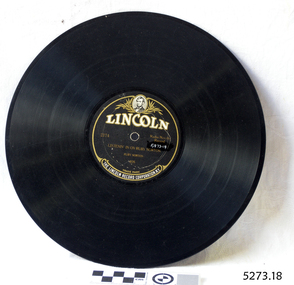 Flagstaff Hill Maritime Museum and Village
Audio - Gramophone Record, Lincoln Record Corporation, Listenin In On Ruby Norton, Early-to-mid 20th century
... ...His Master’s Voice...One of his representatives was William Barry Owen (1860–1914), who, on 23 February 1889, partnered with Edmund Trevor Lloyd Williams (1859–1946) in England to register The Gramophone Company. His Master’s Voice (HMV) soon became the company’s major recording label, popular worldwide. ...One of his representatives was William Barry Owen (1860–1914), who, on 23 February 1889, partnered with Edmund Trevor Lloyd Williams (1859–1946) in England to register The Gramophone Company. His Master’s Voice (HMV) soon became the company’s major recording label, popular worldwide. ...Thomas Edison (1847–1931), an American, invented the phonograph in 1877, making it possible to record sound waves vertically and reproduce them on a wax cylinder so they could be heard again. Later, the German American, Emile Berliner (1851-1929), improved on Edison’s principles, greatly increasing the quality of the reproduced sounds with his invention of the gramophone in 1887, which recorded the sound waves laterally onto a flat shellac disc, or ‘record’. Records could be mass-produced in a factory where audio recordings were converted to a physical copy of that recording on a plate-sized disc. A gramophone machine reproduced the sound by spinning the record on a turntable at a specified number of rotations per minute (RPM) and using a stylus or needle to transfer the vibration via a membrane to a speaker, which amplified the sound. Berliner helped set up affiliated businesses overseas. One of his representatives was William Barry Owen (1860–1914), who, on 23 February 1889, partnered with Edmund Trevor Lloyd Williams (1859–1946) in England to register The Gramophone Company. His Master’s Voice (HMV) soon became the company’s major recording label, popular worldwide. The business based the label's logo of a dog looking into a gramophone horn for ‘his master’s voice’ was based on a painting by English artist Francis Barraud, which featured a terrier called Nipper beside a gramophone. Early gramophone records were mostly made from a material referred to as shellac, a natural ingredient combined with slate powder, and a filler of manilla copal, wood resin, carnauba wax, and carbon black. Although Bakelite seemed a useful, synthetic product, it was unsuccessful as a product for records. Around the time of World War II, lightweight, flexible synthetic vinyl records began replacing shellac records. Common diameters of records: 7 inch, 10 inch, 12 inch and 16 inch Revolutions Per Minute include: 33 1/3, 45, 78 Minutes per side of record: 3, 5.5, 7, 8, 9, 12, 15 and 22 Labels, in minutes per side: Single Play 3-5 min, Extended Play (EP) 7-12 min, Long Play (LP) 12-22 min This gramophone represents a step in the evolution of recording sound. In the 19th century, the human voice was first recorded on wax cylinders and replayed. It was the beginning of a new era in sound. Then, in the 1880s, voice could be recorded onto flat discs like this record, reliably reproduced and replayed many times, even on portable devices. Later, in the mid-20th century the following generation of electronic audio recording began, and later that century, digital recording gave even better reproduction. The record represents a popular means of entertainment for personal and social activities, as well as in some businesses. Shellac gramophone record with a black and gold label. Title: Listenin" In On Ruby Norton Artist: Ruby Norton. Publisher: The Lincoln Record Corporation N.Y. Number:2174 835 Size: 10 inchflagstaff hill, warrnambool, maritime village, maritime museum, flagstaff hill maritime museum and village, shipwreck coast, great ocean road, gramophone, phonograph, sound waves, record, reproduction, audio record, music, sound, thomas edison, emile berliner, 1887, shellac, rpm, william barry owen, edmund trevor lloyd williams, the gramophone company, his master’s voice, hmv, francis barraud, nipper, the lincoln record corporation n.y. 2174, listenin in on ruby norton, ruby norton, 835, 10 inch -
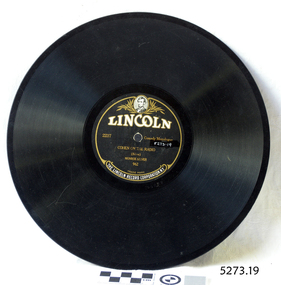 Flagstaff Hill Maritime Museum and Village
Audio - Gramophone Record, Lincoln Record Corporation, Cohen On The Radio, Early-to-mid 20th century
... ...His Master’s Voice...One of his representatives was William Barry Owen (1860–1914), who, on 23 February 1889, partnered with Edmund Trevor Lloyd Williams (1859–1946) in England to register The Gramophone Company. His Master’s Voice (HMV) soon became the company’s major recording label, popular worldwide. ...One of his representatives was William Barry Owen (1860–1914), who, on 23 February 1889, partnered with Edmund Trevor Lloyd Williams (1859–1946) in England to register The Gramophone Company. His Master’s Voice (HMV) soon became the company’s major recording label, popular worldwide. ...Thomas Edison (1847–1931), an American, invented the phonograph in 1877, making it possible to record sound waves vertically and reproduce them on a wax cylinder so they could be heard again. Later, the German American, Emile Berliner (1851-1929), improved on Edison’s principles, greatly increasing the quality of the reproduced sounds with his invention of the gramophone in 1887, which recorded the sound waves laterally onto a flat shellac disc, or ‘record’. Records could be mass-produced in a factory where audio recordings were converted to a physical copy of that recording on a plate-sized disc. A gramophone machine reproduced the sound by spinning the record on a turntable at a specified number of rotations per minute (RPM) and using a stylus or needle to transfer the vibration via a membrane to a speaker, which amplified the sound. Berliner helped set up affiliated businesses overseas. One of his representatives was William Barry Owen (1860–1914), who, on 23 February 1889, partnered with Edmund Trevor Lloyd Williams (1859–1946) in England to register The Gramophone Company. His Master’s Voice (HMV) soon became the company’s major recording label, popular worldwide. The business based the label's logo of a dog looking into a gramophone horn for ‘his master’s voice’ was based on a painting by English artist Francis Barraud, which featured a terrier called Nipper beside a gramophone. Early gramophone records were mostly made from a material referred to as shellac, a natural ingredient combined with slate powder, and a filler of manilla copal, wood resin, carnauba wax, and carbon black. Although Bakelite seemed a useful, synthetic product, it was unsuccessful as a product for records. Around the time of World War II, lightweight, flexible synthetic vinyl records began replacing shellac records. Common diameters of records: 7 inch, 10 inch, 12 inch and 16 inch Revolutions Per Minute include: 33 1/3, 45, 78 Minutes per side of record: 3, 5.5, 7, 8, 9, 12, 15 and 22 Labels, in minutes per side: Single Play 3-5 min, Extended Play (EP) 7-12 min, Long Play (LP) 12-22 min This gramophone represents a step in the evolution of recording sound. In the 19th century, the human voice was first recorded on wax cylinders and replayed. It was the beginning of a new era in sound. Then, in the 1880s, voice could be recorded onto flat discs like this record, reliably reproduced and replayed many times, even on portable devices. Later, in the mid-20th century the following generation of electronic audio recording began, and later that century, digital recording gave even better reproduction. The record represents a popular means of entertainment for personal and social activities, as well as in some businesses. Shellac gramophone record with a black and gold label. Title: Cohen On The Radio Artist: Monroe Silver Publisher: The Lincoln Record Corporation N.Y. 2237 Number:962 Size: 10 inchflagstaff hill, warrnambool, maritime village, maritime museum, flagstaff hill maritime museum and village, shipwreck coast, great ocean road, gramophone, phonograph, sound waves, record, reproduction, audio record, music, sound, thomas edison, emile berliner, 1887, shellac, rpm, william barry owen, edmund trevor lloyd williams, the gramophone company, his master’s voice, hmv, francis barraud, nipper, the lincoln record corporation n.y. 2237, cohen on the radio, monroe silver, no 962, 10 inch -
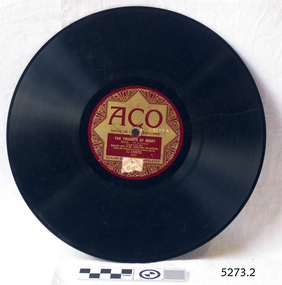 Flagstaff Hill Maritime Museum and Village
Audio - Gramophone Record, ACO, The Triumph of Right, Early-to-mid 20th century
... ...His Master’s Voice...One of his representatives was William Barry Owen (1860–1914), who, on 23 February 1889, partnered with Edmund Trevor Lloyd Williams (1859–1946) in England to register The Gramophone Company. His Master’s Voice (HMV) soon became the company’s major recording label, popular worldwide. ...One of his representatives was William Barry Owen (1860–1914), who, on 23 February 1889, partnered with Edmund Trevor Lloyd Williams (1859–1946) in England to register The Gramophone Company. His Master’s Voice (HMV) soon became the company’s major recording label, popular worldwide. ...Thomas Edison (1847–1931), an American, invented the phonograph in 1877, making it possible to record sound waves vertically and reproduce them on a wax cylinder so they could be heard again. Later, the German American, Emile Berliner (1851-1929), improved on Edison’s principles, greatly increasing the quality of the reproduced sounds with his invention of the gramophone in 1887, which recorded the sound waves laterally onto a flat shellac disc, or ‘record’. Records could be mass-produced in a factory where audio recordings were converted to a physical copy of that recording on a plate-sized disc. A gramophone machine reproduced the sound by spinning the record on a turntable at a specified number of rotations per minute (RPM) and using a stylus or needle to transfer the vibration via a membrane to a speaker, which amplified the sound. Berliner helped set up affiliated businesses overseas. One of his representatives was William Barry Owen (1860–1914), who, on 23 February 1889, partnered with Edmund Trevor Lloyd Williams (1859–1946) in England to register The Gramophone Company. His Master’s Voice (HMV) soon became the company’s major recording label, popular worldwide. The business based the label's logo of a dog looking into a gramophone horn for ‘his master’s voice’ was based on a painting by English artist Francis Barraud, which featured a terrier called Nipper beside a gramophone. Early gramophone records were mostly made from a material referred to as shellac, a natural ingredient combined with slate powder, and a filler of manilla copal, wood resin, carnauba wax, and carbon black. Although Bakelite seemed a useful, synthetic product, it was unsuccessful as a product for records. Around the time of World War II, lightweight, flexible synthetic vinyl records began replacing shellac records. Common diameters of records: 7 inch, 10 inch, 12 inch and 16 inch Revolutions Per Minute include: 33 1/3, 45, 78 Minutes per side of record: 3, 5.5, 7, 8, 9, 12, 15 and 22 Labels, in minutes per side: Single Play 3-5 min, Extended Play (EP) 7-12 min, Long Play (LP) 12-22 min This gramophone represents a step in the evolution of recording sound. In the 19th century, the human voice was first recorded on wax cylinders and replayed. It was the beginning of a new era in sound. Then, in the 1880s, voice could be recorded onto flat discs like this record, reliably reproduced and replayed many times, even on portable devices. Later, in the mid-20th century the following generation of electronic audio recording began, and later that century, digital recording gave even better reproduction. The record represents a popular means of entertainment for personal and social activities, as well as in some businesses. Shellac gramophone record with a crimson and gold label. Title: The Triumph of Right Artist: H.M. Welsh Guards Publisher: ACO England Number: G15875 Size: 10 inchflagstaff hill, warrnambool, maritime village, maritime museum, flagstaff hill maritime museum and village, shipwreck coast, great ocean road, gramophone, phonograph, sound waves, record, reproduction, audio record, music, sound, thomas edison, emile berliner, 1887, shellac, rpm, william barry owen, edmund trevor lloyd williams, the gramophone company, his master’s voice, hmv, francis barraud, nipper, 10 inch, the triumph of right, h.m. welsh guards, aco england -
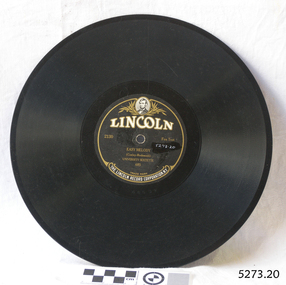 Flagstaff Hill Maritime Museum and Village
Audio - Gramophone Record, Lincoln Record Corporation, Easy Melody, Early-to-mid 20th century
... ...His Master’s Voice...One of his representatives was William Barry Owen (1860–1914), who, on 23 February 1889, partnered with Edmund Trevor Lloyd Williams (1859–1946) in England to register The Gramophone Company. His Master’s Voice (HMV) soon became the company’s major recording label, popular worldwide. ...One of his representatives was William Barry Owen (1860–1914), who, on 23 February 1889, partnered with Edmund Trevor Lloyd Williams (1859–1946) in England to register The Gramophone Company. His Master’s Voice (HMV) soon became the company’s major recording label, popular worldwide. ...Thomas Edison (1847–1931), an American, invented the phonograph in 1877, making it possible to record sound waves vertically and reproduce them on a wax cylinder so they could be heard again. Later, the German American, Emile Berliner (1851-1929), improved on Edison’s principles, greatly increasing the quality of the reproduced sounds with his invention of the gramophone in 1887, which recorded the sound waves laterally onto a flat shellac disc, or ‘record’. Records could be mass-produced in a factory where audio recordings were converted to a physical copy of that recording on a plate-sized disc. A gramophone machine reproduced the sound by spinning the record on a turntable at a specified number of rotations per minute (RPM) and using a stylus or needle to transfer the vibration via a membrane to a speaker, which amplified the sound. Berliner helped set up affiliated businesses overseas. One of his representatives was William Barry Owen (1860–1914), who, on 23 February 1889, partnered with Edmund Trevor Lloyd Williams (1859–1946) in England to register The Gramophone Company. His Master’s Voice (HMV) soon became the company’s major recording label, popular worldwide. The business based the label's logo of a dog looking into a gramophone horn for ‘his master’s voice’ was based on a painting by English artist Francis Barraud, which featured a terrier called Nipper beside a gramophone. Early gramophone records were mostly made from a material referred to as shellac, a natural ingredient combined with slate powder, and a filler of manilla copal, wood resin, carnauba wax, and carbon black. Although Bakelite seemed a useful, synthetic product, it was unsuccessful as a product for records. Around the time of World War II, lightweight, flexible synthetic vinyl records began replacing shellac records. Common diameters of records: 7 inch, 10 inch, 12 inch and 16 inch Revolutions Per Minute include: 33 1/3, 45, 78 Minutes per side of record: 3, 5.5, 7, 8, 9, 12, 15 and 22 Labels, in minutes per side: Single Play 3-5 min, Extended Play (EP) 7-12 min, Long Play (LP) 12-22 min This gramophone represents a step in the evolution of recording sound. In the 19th century, the human voice was first recorded on wax cylinders and replayed. It was the beginning of a new era in sound. Then, in the 1880s, voice could be recorded onto flat discs like this record, reliably reproduced and replayed many times, even on portable devices. Later, in the mid-20th century the following generation of electronic audio recording began, and later that century, digital recording gave even better reproduction. The record represents a popular means of entertainment for personal and social activities, as well as in some businesses. Shellac gramophone record with a black and gold label. Title: Easy Melody Artist: University Sextette Publisher: The Lincoln Record Corporation N.Y. Number:2130 685 Size: 10 inchflagstaff hill, warrnambool, maritime village, maritime museum, flagstaff hill maritime museum and village, shipwreck coast, great ocean road, gramophone, phonograph, sound waves, record, reproduction, audio record, music, sound, thomas edison, emile berliner, 1887, shellac, rpm, william barry owen, edmund trevor lloyd williams, the gramophone company, his master’s voice, hmv, francis barraud, nipper, the lincoln record corporation n.y., 2130, easy melody, university sextette, 685 -
 Flagstaff Hill Maritime Museum and Village
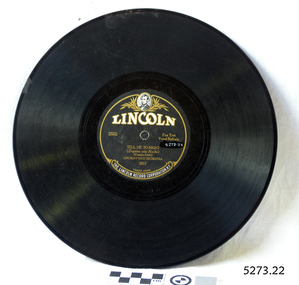
Audio - Gramophone Record, Lincoln Record Corporation, Tell Me To-Night, Early-to-mid 20th century
... ...His Master’s Voice...One of his representatives was William Barry Owen (1860–1914), who, on 23 February 1889, partnered with Edmund Trevor Lloyd Williams (1859–1946) in England to register The Gramophone Company. His Master’s Voice (HMV) soon became the company’s major recording label, popular worldwide. ...One of his representatives was William Barry Owen (1860–1914), who, on 23 February 1889, partnered with Edmund Trevor Lloyd Williams (1859–1946) in England to register The Gramophone Company. His Master’s Voice (HMV) soon became the company’s major recording label, popular worldwide. ...Thomas Edison (1847–1931), an American, invented the phonograph in 1877, making it possible to record sound waves vertically and reproduce them on a wax cylinder so they could be heard again. Later, the German American, Emile Berliner (1851-1929), improved on Edison’s principles, greatly increasing the quality of the reproduced sounds with his invention of the gramophone in 1887, which recorded the sound waves laterally onto a flat shellac disc, or ‘record’. Records could be mass-produced in a factory where audio recordings were converted to a physical copy of that recording on a plate-sized disc. A gramophone machine reproduced the sound by spinning the record on a turntable at a specified number of rotations per minute (RPM) and using a stylus or needle to transfer the vibration via a membrane to a speaker, which amplified the sound. Berliner helped set up affiliated businesses overseas. One of his representatives was William Barry Owen (1860–1914), who, on 23 February 1889, partnered with Edmund Trevor Lloyd Williams (1859–1946) in England to register The Gramophone Company. His Master’s Voice (HMV) soon became the company’s major recording label, popular worldwide. The business based the label's logo of a dog looking into a gramophone horn for ‘his master’s voice’ was based on a painting by English artist Francis Barraud, which featured a terrier called Nipper beside a gramophone. Early gramophone records were mostly made from a material referred to as shellac, a natural ingredient combined with slate powder, and a filler of manilla copal, wood resin, carnauba wax, and carbon black. Although Bakelite seemed a useful, synthetic product, it was unsuccessful as a product for records. Around the time of World War II, lightweight, flexible synthetic vinyl records began replacing shellac records. Common diameters of records: 7 inch, 10 inch, 12 inch and 16 inch Revolutions Per Minute include: 33 1/3, 45, 78 Minutes per side of record: 3, 5.5, 7, 8, 9, 12, 15 and 22 Labels, in minutes per side: Single Play 3-5 min, Extended Play (EP) 7-12 min, Long Play (LP) 12-22 min This gramophone represents a step in the evolution of recording sound. In the 19th century, the human voice was first recorded on wax cylinders and replayed. It was the beginning of a new era in sound. Then, in the 1880s, voice could be recorded onto flat discs like this record, reliably reproduced and replayed many times, even on portable devices. Later, in the mid-20th century the following generation of electronic audio recording began, and later that century, digital recording gave even better reproduction. The record represents a popular means of entertainment for personal and social activities, as well as in some businesses. Shellac gramophone record with a black and gold label. Title: Tell Me To-Night Artist: Lincoln Dance Orchestra. Publisher: The Lincoln Record Corporation N.Y. 2552 Number:2057 Size: 10 inchflagstaff hill, warrnambool, maritime village, maritime museum, flagstaff hill maritime museum and village, shipwreck coast, great ocean road, gramophone, phonograph, sound waves, record, reproduction, audio record, music, sound, thomas edison, emile berliner, 1887, shellac, rpm, william barry owen, edmund trevor lloyd williams, the gramophone company, his master’s voice, hmv, francis barraud, nipper, the lincoln record corporation n.y. 2552, tell me to-night, lincoln dance orchestra, 2057 -
 Flagstaff Hill Maritime Museum and Village
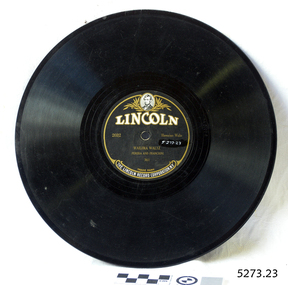
Audio - Gramophone Record, Lincoln Record Corporation, Wailima Waltz, Early-to-mid 20th century
... ...His Master’s Voice...One of his representatives was William Barry Owen (1860–1914), who, on 23 February 1889, partnered with Edmund Trevor Lloyd Williams (1859–1946) in England to register The Gramophone Company. His Master’s Voice (HMV) soon became the company’s major recording label, popular worldwide. ...One of his representatives was William Barry Owen (1860–1914), who, on 23 February 1889, partnered with Edmund Trevor Lloyd Williams (1859–1946) in England to register The Gramophone Company. His Master’s Voice (HMV) soon became the company’s major recording label, popular worldwide. ...Thomas Edison (1847–1931), an American, invented the phonograph in 1877, making it possible to record sound waves vertically and reproduce them on a wax cylinder so they could be heard again. Later, the German American, Emile Berliner (1851-1929), improved on Edison’s principles, greatly increasing the quality of the reproduced sounds with his invention of the gramophone in 1887, which recorded the sound waves laterally onto a flat shellac disc, or ‘record’. Records could be mass-produced in a factory where audio recordings were converted to a physical copy of that recording on a plate-sized disc. A gramophone machine reproduced the sound by spinning the record on a turntable at a specified number of rotations per minute (RPM) and using a stylus or needle to transfer the vibration via a membrane to a speaker, which amplified the sound. Berliner helped set up affiliated businesses overseas. One of his representatives was William Barry Owen (1860–1914), who, on 23 February 1889, partnered with Edmund Trevor Lloyd Williams (1859–1946) in England to register The Gramophone Company. His Master’s Voice (HMV) soon became the company’s major recording label, popular worldwide. The business based the label's logo of a dog looking into a gramophone horn for ‘his master’s voice’ was based on a painting by English artist Francis Barraud, which featured a terrier called Nipper beside a gramophone. Early gramophone records were mostly made from a material referred to as shellac, a natural ingredient combined with slate powder, and a filler of manilla copal, wood resin, carnauba wax, and carbon black. Although Bakelite seemed a useful, synthetic product, it was unsuccessful as a product for records. Around the time of World War II, lightweight, flexible synthetic vinyl records began replacing shellac records. Common diameters of records: 7 inch, 10 inch, 12 inch and 16 inch Revolutions Per Minute include: 33 1/3, 45, 78 Minutes per side of record: 3, 5.5, 7, 8, 9, 12, 15 and 22 Labels, in minutes per side: Single Play 3-5 min, Extended Play (EP) 7-12 min, Long Play (LP) 12-22 min This gramophone represents a step in the evolution of recording sound. In the 19th century, the human voice was first recorded on wax cylinders and replayed. It was the beginning of a new era in sound. Then, in the 1880s, voice could be recorded onto flat discs like this record, reliably reproduced and replayed many times, even on portable devices. Later, in the mid-20th century the following generation of electronic audio recording began, and later that century, digital recording gave even better reproduction. The record represents a popular means of entertainment for personal and social activities, as well as in some businesses. Shellac gramophone record with a black and gold label. Title: Wailima Waltz Artist: Ferera and Franchini Publisher: The Lincoln Record Corporation N.Y. 2032 Number:361 Size: 10 inchflagstaff hill, warrnambool, maritime village, maritime museum, flagstaff hill maritime museum and village, shipwreck coast, great ocean road, gramophone, phonograph, sound waves, record, reproduction, audio record, music, sound, thomas edison, emile berliner, 1887, shellac, rpm, william barry owen, edmund trevor lloyd williams, the gramophone company, his master’s voice, hmv, francis barraud, nipper, the lincoln record corporation n.y. 2032, wailima waltz, ferera and franchin, 361 -
 Flagstaff Hill Maritime Museum and Village
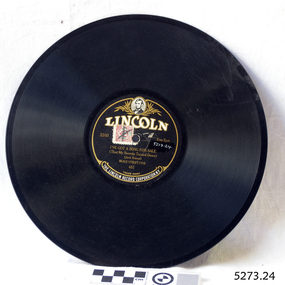
Audio - Gramophone Record, Lincoln Record Corporation, I've Got A Song For Sale, Early-to-mid 20th century
... ...His Master’s Voice...One of his representatives was William Barry Owen (1860–1914), who, on 23 February 1889, partnered with Edmund Trevor Lloyd Williams (1859–1946) in England to register The Gramophone Company. His Master’s Voice (HMV) soon became the company’s major recording label, popular worldwide. ...One of his representatives was William Barry Owen (1860–1914), who, on 23 February 1889, partnered with Edmund Trevor Lloyd Williams (1859–1946) in England to register The Gramophone Company. His Master’s Voice (HMV) soon became the company’s major recording label, popular worldwide. ...Thomas Edison (1847–1931), an American, invented the phonograph in 1877, making it possible to record sound waves vertically and reproduce them on a wax cylinder so they could be heard again. Later, the German American, Emile Berliner (1851-1929), improved on Edison’s principles, greatly increasing the quality of the reproduced sounds with his invention of the gramophone in 1887, which recorded the sound waves laterally onto a flat shellac disc, or ‘record’. Records could be mass-produced in a factory where audio recordings were converted to a physical copy of that recording on a plate-sized disc. A gramophone machine reproduced the sound by spinning the record on a turntable at a specified number of rotations per minute (RPM) and using a stylus or needle to transfer the vibration via a membrane to a speaker, which amplified the sound. Berliner helped set up affiliated businesses overseas. One of his representatives was William Barry Owen (1860–1914), who, on 23 February 1889, partnered with Edmund Trevor Lloyd Williams (1859–1946) in England to register The Gramophone Company. His Master’s Voice (HMV) soon became the company’s major recording label, popular worldwide. The business based the label's logo of a dog looking into a gramophone horn for ‘his master’s voice’ was based on a painting by English artist Francis Barraud, which featured a terrier called Nipper beside a gramophone. Early gramophone records were mostly made from a material referred to as shellac, a natural ingredient combined with slate powder, and a filler of manilla copal, wood resin, carnauba wax, and carbon black. Although Bakelite seemed a useful, synthetic product, it was unsuccessful as a product for records. Around the time of World War II, lightweight, flexible synthetic vinyl records began replacing shellac records. Common diameters of records: 7 inch, 10 inch, 12 inch and 16 inch Revolutions Per Minute include: 33 1/3, 45, 78 Minutes per side of record: 3, 5.5, 7, 8, 9, 12, 15 and 22 Labels, in minutes per side: Single Play 3-5 min, Extended Play (EP) 7-12 min, Long Play (LP) 12-22 min This gramophone represents a step in the evolution of recording sound. In the 19th century, the human voice was first recorded on wax cylinders and replayed. It was the beginning of a new era in sound. Then, in the 1880s, voice could be recorded onto flat discs like this record, reliably reproduced and replayed many times, even on portable devices. Later, in the mid-20th century the following generation of electronic audio recording began, and later that century, digital recording gave even better reproduction. The record represents a popular means of entertainment for personal and social activities, as well as in some businesses. Shellac gramophone record with a black and gold label. Title: I've Got A Song For Sale Artist: Beale Street Five Publisher: The Lincoln Record Corporation N.Y. 2103 Number:652 Size: 10 inchflagstaff hill, warrnambool, maritime village, maritime museum, flagstaff hill maritime museum and village, shipwreck coast, great ocean road, gramophone, phonograph, sound waves, record, reproduction, audio record, music, sound, thomas edison, emile berliner, 1887, shellac, rpm, william barry owen, edmund trevor lloyd williams, the gramophone company, his master’s voice, hmv, francis barraud, nipper, the lincoln record corporation n.y. 2103, i've got a song for sale, beale street five, 652 -
 Flagstaff Hill Maritime Museum and Village
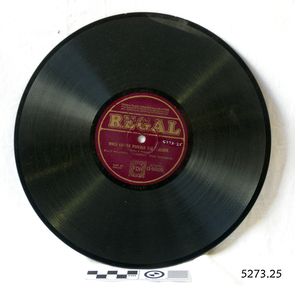
Audio - Gramophone Record, Regal Records, When Father Papered The Parlour, Early-to-mid 20th century
... ...His Master’s Voice...One of his representatives was William Barry Owen (1860–1914), who, on 23 February 1889, partnered with Edmund Trevor Lloyd Williams (1859–1946) in England to register The Gramophone Company. His Master’s Voice (HMV) soon became the company’s major recording label, popular worldwide. ...One of his representatives was William Barry Owen (1860–1914), who, on 23 February 1889, partnered with Edmund Trevor Lloyd Williams (1859–1946) in England to register The Gramophone Company. His Master’s Voice (HMV) soon became the company’s major recording label, popular worldwide. ...Thomas Edison (1847–1931), an American, invented the phonograph in 1877, making it possible to record sound waves vertically and reproduce them on a wax cylinder so they could be heard again. Later, the German American, Emile Berliner (1851-1929), improved on Edison’s principles, greatly increasing the quality of the reproduced sounds with his invention of the gramophone in 1887, which recorded the sound waves laterally onto a flat shellac disc, or ‘record’. Records could be mass-produced in a factory where audio recordings were converted to a physical copy of that recording on a plate-sized disc. A gramophone machine reproduced the sound by spinning the record on a turntable at a specified number of rotations per minute (RPM) and using a stylus or needle to transfer the vibration via a membrane to a speaker, which amplified the sound. Berliner helped set up affiliated businesses overseas. One of his representatives was William Barry Owen (1860–1914), who, on 23 February 1889, partnered with Edmund Trevor Lloyd Williams (1859–1946) in England to register The Gramophone Company. His Master’s Voice (HMV) soon became the company’s major recording label, popular worldwide. The business based the label's logo of a dog looking into a gramophone horn for ‘his master’s voice’ was based on a painting by English artist Francis Barraud, which featured a terrier called Nipper beside a gramophone. Early gramophone records were mostly made from a material referred to as shellac, a natural ingredient combined with slate powder, and a filler of manilla copal, wood resin, carnauba wax, and carbon black. Although Bakelite seemed a useful, synthetic product, it was unsuccessful as a product for records. Around the time of World War II, lightweight, flexible synthetic vinyl records began replacing shellac records. Common diameters of records: 7 inch, 10 inch, 12 inch and 16 inch Revolutions Per Minute include: 33 1/3, 45, 78 Minutes per side of record: 3, 5.5, 7, 8, 9, 12, 15 and 22 Labels, in minutes per side: Single Play 3-5 min, Extended Play (EP) 7-12 min, Long Play (LP) 12-22 min This gramophone represents a step in the evolution of recording sound. In the 19th century, the human voice was first recorded on wax cylinders and replayed. It was the beginning of a new era in sound. Then, in the 1880s, voice could be recorded onto flat discs like this record, reliably reproduced and replayed many times, even on portable devices. Later, in the mid-20th century the following generation of electronic audio recording began, and later that century, digital recording gave even better reproduction. The record represents a popular means of entertainment for personal and social activities, as well as in some businesses. Shellac gramophone record with a red and gold label. Title: When Father Papered The Parlour Artist: Billy Williams Publisher: Regal Number: G6000 27407 Size: 10 inchflagstaff hill, warrnambool, maritime village, maritime museum, flagstaff hill maritime museum and village, shipwreck coast, great ocean road, gramophone, phonograph, sound waves, record, reproduction, audio record, music, sound, thomas edison, emile berliner, 1887, shellac, rpm, william barry owen, edmund trevor lloyd williams, the gramophone company, his master’s voice, hmv, francis barraud, nipper, regal, 27407, when father papered the parlour, billy williams, g6000 -
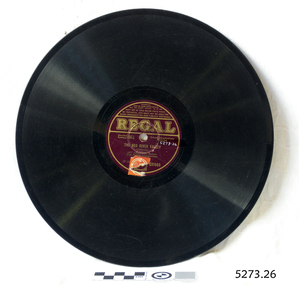 Flagstaff Hill Maritime Museum and Village
Audio - Gramophone Record, Regal Records, The Red River Valley, Early-to-mid 20th century
... ...His Master’s Voice...One of his representatives was William Barry Owen (1860–1914), who, on 23 February 1889, partnered with Edmund Trevor Lloyd Williams (1859–1946) in England to register The Gramophone Company. His Master’s Voice (HMV) soon became the company’s major recording label, popular worldwide. ...One of his representatives was William Barry Owen (1860–1914), who, on 23 February 1889, partnered with Edmund Trevor Lloyd Williams (1859–1946) in England to register The Gramophone Company. His Master’s Voice (HMV) soon became the company’s major recording label, popular worldwide. ...Thomas Edison (1847–1931), an American, invented the phonograph in 1877, making it possible to record sound waves vertically and reproduce them on a wax cylinder so they could be heard again. Later, the German American, Emile Berliner (1851-1929), improved on Edison’s principles, greatly increasing the quality of the reproduced sounds with his invention of the gramophone in 1887, which recorded the sound waves laterally onto a flat shellac disc, or ‘record’. Records could be mass-produced in a factory where audio recordings were converted to a physical copy of that recording on a plate-sized disc. A gramophone machine reproduced the sound by spinning the record on a turntable at a specified number of rotations per minute (RPM) and using a stylus or needle to transfer the vibration via a membrane to a speaker, which amplified the sound. Berliner helped set up affiliated businesses overseas. One of his representatives was William Barry Owen (1860–1914), who, on 23 February 1889, partnered with Edmund Trevor Lloyd Williams (1859–1946) in England to register The Gramophone Company. His Master’s Voice (HMV) soon became the company’s major recording label, popular worldwide. The business based the label's logo of a dog looking into a gramophone horn for ‘his master’s voice’ was based on a painting by English artist Francis Barraud, which featured a terrier called Nipper beside a gramophone. Early gramophone records were mostly made from a material referred to as shellac, a natural ingredient combined with slate powder, and a filler of manilla copal, wood resin, carnauba wax, and carbon black. Although Bakelite seemed a useful, synthetic product, it was unsuccessful as a product for records. Around the time of World War II, lightweight, flexible synthetic vinyl records began replacing shellac records. Common diameters of records: 7 inch, 10 inch, 12 inch and 16 inch Revolutions Per Minute include: 33 1/3, 45, 78 Minutes per side of record: 3, 5.5, 7, 8, 9, 12, 15 and 22 Labels, in minutes per side: Single Play 3-5 min, Extended Play (EP) 7-12 min, Long Play (LP) 12-22 min This gramophone represents a step in the evolution of recording sound. In the 19th century, the human voice was first recorded on wax cylinders and replayed. It was the beginning of a new era in sound. Then, in the 1880s, voice could be recorded onto flat discs like this record, reliably reproduced and replayed many times, even on portable devices. Later, in the mid-20th century the following generation of electronic audio recording began, and later that century, digital recording gave even better reproduction. The record represents a popular means of entertainment for personal and social activities, as well as in some businesses. Shellac gramophone record with a burgundy and gold label. Title: The Red River Valley Artist: Art Leonard, baritone Publisher: Regal Number: T1232 G21555 Size: 10 inchflagstaff hill, warrnambool, maritime village, maritime museum, flagstaff hill maritime museum and village, shipwreck coast, great ocean road, gramophone, phonograph, sound waves, record, reproduction, audio record, music, sound, thomas edison, emile berliner, 1887, shellac, rpm, william barry owen, edmund trevor lloyd williams, the gramophone company, his master’s voice, hmv, francis barraud, nipper, regal, t1232, the red river valley, art leonard, g21555 -
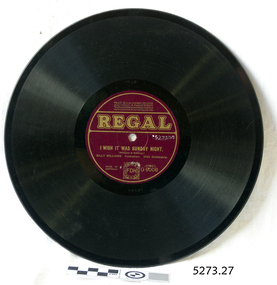 Flagstaff Hill Maritime Museum and Village
Audio - Gramophone Record, Regal Records, I Wish It Was Sunday Night, Early-to-mid 20th century
... ...His Master’s Voice...One of his representatives was William Barry Owen (1860–1914), who, on 23 February 1889, partnered with Edmund Trevor Lloyd Williams (1859–1946) in England to register The Gramophone Company. His Master’s Voice (HMV) soon became the company’s major recording label, popular worldwide. ...One of his representatives was William Barry Owen (1860–1914), who, on 23 February 1889, partnered with Edmund Trevor Lloyd Williams (1859–1946) in England to register The Gramophone Company. His Master’s Voice (HMV) soon became the company’s major recording label, popular worldwide. ...Thomas Edison (1847–1931), an American, invented the phonograph in 1877, making it possible to record sound waves vertically and reproduce them on a wax cylinder so they could be heard again. Later, the German American, Emile Berliner (1851-1929), improved on Edison’s principles, greatly increasing the quality of the reproduced sounds with his invention of the gramophone in 1887, which recorded the sound waves laterally onto a flat shellac disc, or ‘record’. Records could be mass-produced in a factory where audio recordings were converted to a physical copy of that recording on a plate-sized disc. A gramophone machine reproduced the sound by spinning the record on a turntable at a specified number of rotations per minute (RPM) and using a stylus or needle to transfer the vibration via a membrane to a speaker, which amplified the sound. Berliner helped set up affiliated businesses overseas. One of his representatives was William Barry Owen (1860–1914), who, on 23 February 1889, partnered with Edmund Trevor Lloyd Williams (1859–1946) in England to register The Gramophone Company. His Master’s Voice (HMV) soon became the company’s major recording label, popular worldwide. The business based the label's logo of a dog looking into a gramophone horn for ‘his master’s voice’ was based on a painting by English artist Francis Barraud, which featured a terrier called Nipper beside a gramophone. Early gramophone records were mostly made from a material referred to as shellac, a natural ingredient combined with slate powder, and a filler of manilla copal, wood resin, carnauba wax, and carbon black. Although Bakelite seemed a useful, synthetic product, it was unsuccessful as a product for records. Around the time of World War II, lightweight, flexible synthetic vinyl records began replacing shellac records. Common diameters of records: 7 inch, 10 inch, 12 inch and 16 inch Revolutions Per Minute include: 33 1/3, 45, 78 Minutes per side of record: 3, 5.5, 7, 8, 9, 12, 15 and 22 Labels, in minutes per side: Single Play 3-5 min, Extended Play (EP) 7-12 min, Long Play (LP) 12-22 min This gramophone represents a step in the evolution of recording sound. In the 19th century, the human voice was first recorded on wax cylinders and replayed. It was the beginning of a new era in sound. Then, in the 1880s, voice could be recorded onto flat discs like this record, reliably reproduced and replayed many times, even on portable devices. Later, in the mid-20th century the following generation of electronic audio recording began, and later that century, digital recording gave even better reproduction. The record represents a popular means of entertainment for personal and social activities, as well as in some businesses. Shellac gramophone record with a burgundy and gold label. Title: I Wish It Was Sunday Night Artist: Billy Williams Publisher: Regal Number: 27921 G6006 Size: 10 inchflagstaff hill, warrnambool, maritime village, maritime museum, flagstaff hill maritime museum and village, shipwreck coast, great ocean road, gramophone, phonograph, sound waves, record, reproduction, audio record, music, sound, thomas edison, emile berliner, 1887, shellac, rpm, william barry owen, edmund trevor lloyd williams, the gramophone company, his master’s voice, hmv, francis barraud, nipper, regal, 27921, i wish it was sunday night, billy williams, g6006 -
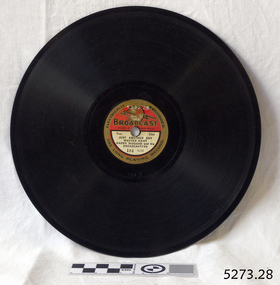 Flagstaff Hill Maritime Museum and Village
Audio - Gramophone Record, Vocalion Gramophone Co. Ltd (Broadcast records), Just Another Day Wasted Away, late 1920s to early 1930s
... ...His Master’s Voice...One of his representatives was William Barry Owen (1860–1914), who, on 23 February 1889, partnered with Edmund Trevor Lloyd Williams (1859–1946) in England to register The Gramophone Company. His Master’s Voice (HMV) soon became the company’s major recording label, popular worldwide. ...One of his representatives was William Barry Owen (1860–1914), who, on 23 February 1889, partnered with Edmund Trevor Lloyd Williams (1859–1946) in England to register The Gramophone Company. His Master’s Voice (HMV) soon became the company’s major recording label, popular worldwide. ...Thomas Edison (1847–1931), an American, invented the phonograph in 1877, making it possible to record sound waves vertically and reproduce them on a wax cylinder so they could be heard again. Later, the German American, Emile Berliner (1851-1929), improved on Edison’s principles, greatly increasing the quality of the reproduced sounds with his invention of the gramophone in 1887, which recorded the sound waves laterally onto a flat shellac disc, or ‘record’. Records could be mass-produced in a factory where audio recordings were converted to a physical copy of that recording on a plate-sized disc. A gramophone machine reproduced the sound by spinning the record on a turntable at a specified number of rotations per minute (RPM) and using a stylus or needle to transfer the vibration via a membrane to a speaker, which amplified the sound. Berliner helped set up affiliated businesses overseas. One of his representatives was William Barry Owen (1860–1914), who, on 23 February 1889, partnered with Edmund Trevor Lloyd Williams (1859–1946) in England to register The Gramophone Company. His Master’s Voice (HMV) soon became the company’s major recording label, popular worldwide. The business based the label's logo of a dog looking into a gramophone horn for ‘his master’s voice’ was based on a painting by English artist Francis Barraud, which featured a terrier called Nipper beside a gramophone. Early gramophone records were mostly made from a material referred to as shellac, a natural ingredient combined with slate powder, and a filler of manilla copal, wood resin, carnauba wax, and carbon black. Although Bakelite seemed a useful, synthetic product, it was unsuccessful as a product for records. Around the time of World War II, lightweight, flexible synthetic vinyl records began replacing shellac records. Common diameters of records: 7 inch, 10 inch, 12 inch and 16 inch Revolutions Per Minute include: 33 1/3, 45, 78 Minutes per side of record: 3, 5.5, 7, 8, 9, 12, 15 and 22 Labels, in minutes per side: Single Play 3-5 min, Extended Play (EP) 7-12 min, Long Play (LP) 12-22 min This gramophone represents a step in the evolution of recording sound. In the 19th century, the human voice was first recorded on wax cylinders and replayed. It was the beginning of a new era in sound. Then, in the 1880s, voice could be recorded onto flat discs like this record, reliably reproduced and replayed many times, even on portable devices. Later, in the mid-20th century the following generation of electronic audio recording began, and later that century, digital recording gave even better reproduction. The record represents a popular means of entertainment for personal and social activities, as well as in some businesses. Shellac gramophone record with a red, cream and gold label. Title: Just Another Day Wasted Away Artist: Harry Bidgood and his Broadcasters Publisher: Broadcast, British Vocalion Number: A184 Size: 8 inch This small record was electronically recorded. It was promoted as Broadcast, The Long Playing Record.flagstaff hill, warrnambool, maritime village, maritime museum, flagstaff hill maritime museum and village, shipwreck coast, great ocean road, gramophone, phonograph, sound waves, record, reproduction, audio record, music, sound, thomas edison, emile berliner, 1887, shellac, rpm, william barry owen, edmund trevor lloyd williams, the gramophone company, his master’s voice, hmv, francis barraud, nipper, electrically recorded, the long playing record, broadcast, british vocalion, middlesex, a184, just another day wasted away, harry bidgood and his broadcasters, 8 inch
