
Showing 8 items matching "historic jug"
-
 Flagstaff Hill Maritime Museum and Village
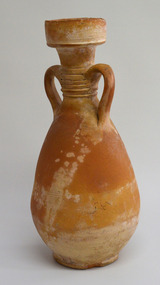
Ceramic - Amphora, mid-to-late 19th century
... ...historic jug...Flagstaff Hill Maritime Museum and Village Warrnambool Great Ocean Road Shipwreck Coast amphora jug Mahogany ship ancient wreck Joe O'Keefe Duncan Thermoluminescence North Africa Levy Point pottery storage jar Flagstaff Hill Maritime Museum Maritime Village shipwreck artefact relic Shipwreck Museum pottery jar ancient jar Egyptian water pot Greek jar ceramic jar mystery exotic jar mystery antique historic jug 1934 Joe O’Keefe Marshall Duncan Port Fairy 1935 1985 Marshall McKenzie Duncan Mac Duncan Duncan family 1981 Dan Madden scientific investigation scientific analysis scientific dating North African origin mid-late 19th century Marram grass Levy’s Point Pinhole patterns: [3 holes above 3 holes] opposite [3 holes above 3 holes], 1 hole] [ 1 hole above 2 holes] Amphora or jug; earthenware, orange clay with areas of cream. ...This amphora or jug has a silhouette shaped like a woman with her hands on her hips, wearing a long, flared-out skirt. The design was used in ancient Greece for pottery storage jars, the neck being narrower than the body. According to reports, this amphora was discovered in 1934 by Joe O'Keeffe, in a sand blowout, or sand hummocks, west of Levy's Point, west of Warrnambool, while he was planting marram grass for Mr Duncan. An article in the Warrnambool Standard newspaper of December 21, 1985, states that the amphora may be linked to the wooden sailing ship called the Mahogany Ship (also called the Ancient Wreck). Thermoluminescence testing indicates the relic was made in the mid-to-late 19th century, and experts suggest it was of North African origin. The presence of the amphora in the dunes, and the amphora itself, is still a mystery. The amphora was donated to Flagstaff Hill on a long-term loan by the Duncan family and displayed to the public for the first time on December 21, 1985. The exhibition continued until February 2023, when the objects on display in the Assistant Lighthouse Keepers Cottage (Shipwreck Museum) were returned to storage to rest, and the redevelopment of the Cottage began. A search for members of the Duncan Family was undertaken by Flagstaff Hill and stakeholders to resolve the loan term, but the family at that time was unknown. As such, to properly care for the amphora, it has been registered until ownership can be determined. The amphora is currently on display in the Great Circle Gallery, where members of the Duncan family recognised it and have since made contact with the museum. The amphora's presence in the hummocks remains an intriguing and tantalising mystery, yet to be solved!The amphora is significant for the mystery it holds. Its origin and connection with the local area have led to local speculation since it was discovered in 1934. Amphora or jug; earthenware, orange clay with areas of cream. The vessel has a wide mouth, a deep lip, two opposing handles between the neck and shoulder, and a bulbous body. The curved handles have a design of six bands between them. There are three rings of small dots encircling the body. The underside has concentric circles in the clay, an uneven edge and pinhole markings. The amphora is kindly on loan from the Duncan family.Pinhole patterns: [3 holes above 3 holes] opposite [3 holes above 3 holes], 1 hole] [ 1 hole above 2 holes] flagstaff hill maritime museum and village, warrnambool, great ocean road, shipwreck coast, amphora, jug, mahogany ship, ancient wreck, joe o'keefe, duncan, thermoluminescence, north africa, levy point, pottery, storage jar, flagstaff hill, maritime museum, maritime village, shipwreck artefact, relic, shipwreck museum, pottery jar, ancient jar, egyptian water pot, greek jar, ceramic jar, mystery, exotic jar, mystery antique, historic jug, 1934, joe o’keefe, marshall duncan, port fairy, 1935, 1985, marshall mckenzie duncan, mac duncan, duncan family, 1981, dan madden, scientific investigation, scientific analysis, scientific dating, north african origin, mid-late 19th century, marram grass, levy’s point -
 Flagstaff Hill Maritime Museum and Village
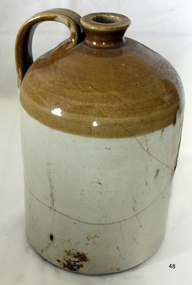
Ceramic - Jug, 1900 - 1940
... historic event, or manufacturer. Its significance lies with its use as a domestic object giving today a view into our social past. flagstaff hill warrnambool shipwrecked coast flagstaff hill maritime museum maritime museum shipwreck coast flagstaff hill maritime village great ocean road jug stoneware jug earthenware jug kitchen storage None Stoneware jug badly cracked and repaired with handle and short neck Ceramic Jug ...Stoneware is a rather broad term for pottery or other ceramics that is fired at a relatively high temperature. A modern technical definition is a vitreous or semi-vitreous ceramic made primarily from stoneware clay or non-refractory fire clay. Whether vitrified or not, it is non-porous, it may or may not be glazed. Historically, across the world, it has been developed after earthenware and before porcelain and has often been used for high-quality as well as utilitarian wares. As a rough guide, modern earthen wares are normally fired in a kiln at temperatures in the range of about 1,000°C (1,830 °F) to 1,200 °C (2,190 °F); stoneware's at between about 1,100 °C (2,010 °F) to 1,300 °C (2,370 °F); and porcelains at between about 1,200 °C (2,190 °F) to 1,400 °C (2,550 °F). Historically, reaching high temperatures was a long-lasting challenge, and temperatures somewhat below these were used for a long time. Earthenware can be fired effectively as low as 600°C, achievable in primitive pit firing, but 800 °C was more typical. Stoneware also needs certain types of clays, more specific than those able to make earthenware, but can be made from a much wider range than porcelain. A domestic item used to store food products as glazing makes the container non-porous, often used for pickling. Or larger containers for kitchen flour. Items age is difficult to determine given the same techniques for making stoneware are in use today. Stoneware containers were made by many potteries in Australia and England. They were in common domestic use before plastics were invented around 1940 to store goods so this subject item is probably from around 1900 to the 1940s.Item's significance and origin of manufacture is difficult to determine given it is not associated with a place, person, historic event, or manufacturer. Its significance lies with its use as a domestic object giving today a view into our social past. Stoneware jug badly cracked and repaired with handle and short neckNoneflagstaff hill, warrnambool, shipwrecked coast, flagstaff hill maritime museum, maritime museum, shipwreck coast, flagstaff hill maritime village, great ocean road, jug, stoneware jug, earthenware jug, kitchen storage -
 Flagstaff Hill Maritime Museum and Village
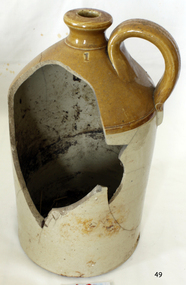
Ceramic - Jug, 1920-1940
... historic event, or manufacturer. Its significance lies with its use as a domestic object giving today a view into our social past. flagstaff hill warrnambool shipwrecked coast flagstaff hill maritime museum shipwreck coast flagstaff hill maritime village great ocean road jug stoneware jug Salt Glaze The number "1" under neck Brown Stoneware jug with short neck Ceramic Jug ...Stoneware is a rather broad term for pottery or other ceramics that is fired at a relatively high temperature. A modern technical definition is a vitreous or semi-vitreous ceramic made primarily from stoneware clay or non-refractory fire clay. Whether vitrified or not, it is non-porous, it may or may not be glazed. Historically, across the world, it has been developed after earthenware and before porcelain and has often been used for high-quality as well as utilitarian wares. As a rough guide, modern earthenwares are normally fired in a kiln at temperatures in the range of about 1,000°C (1,830 °F) to 1,200 °C (2,190 °F); stoneware's at between about 1,100 °C (2,010 °F) to 1,300 °C (2,370 °F); and porcelains at between about 1,200 °C (2,190 °F) to 1,400 °C (2,550 °F). Historically, reaching high temperatures was a long-lasting challenge, and temperatures somewhat below these were used for a long time. Earthenware can be fired effectively as low as 600°C, achievable in primitive pit firing, but 800 °C was more typical. Stoneware also needs certain types of clays, more specific than those able to make earthenware, but can be made from a much wider range than porcelain. A domestic item used to store food products as glazing makes the container non-porous, often used for pickling. Or larger containers for kitchen flour. Items age is difficult to determine given the same techniques for making stoneware are in use today. Stoneware containers were made by many potteries in Australia and England. They were in common domestic use before plastics were invented around 1940 to store goods so this subject item is probably from around 1900 to the 1940s. Item's significance is difficult to determine given it is not associated with a place, person, historic event, or manufacturer. Its significance lies with its use as a domestic object giving today a view into our social past.Brown Stoneware jug with short neckThe number "1" under neck flagstaff hill, warrnambool, shipwrecked coast, flagstaff hill maritime museum, shipwreck coast, flagstaff hill maritime village, great ocean road, jug, stoneware jug, salt glaze -
 Melbourne Water
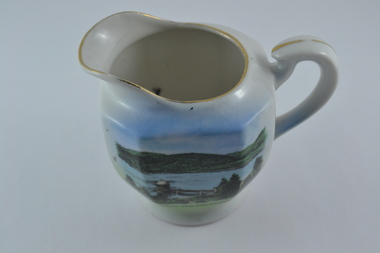
Souvenir Porcelain Milk Jug, 1910-1930
... These water supply sites continue to enhance Melbourne’s charm and liveability and are now recognised as places of cultural and historic significance. This souvenir milk jug has been curated by Melbourne Water as it represents an important historical aspect of the organisation by demonstrating the popularity of its water asset sites as recreational places and tourist attractions, and although these sites are functional parts of the water supply system, they were also designed to be enjoyed by the public both aesthetically and recreationally. ...The Maroondah System was first and foremost developed as a functional component of Melbourne's Water Supply System. In addition to functionality, the Melbourne and Metropolitan Board of Works (MMBW) envisioned the Maroondah Reserve to be enjoyed aesthetically and recreationally by the public. This souvenir illustrates the realisation of the Maroondah System as a local recreational and tourist attraction in the early 20th century. The Maroondah Reserve gardens were landscaped with English-style ornamental stonework, exotic trees, flower beds and rose gardens. All features of the water supply system became widely celebrated as beauty spots that continue to be very popular to this day with tourists and locals alike. This souvenir is a product of that flourishing tourist trade. These water supply sites continue to enhance Melbourne’s charm and liveability and are now recognised as places of cultural and historic significance.This souvenir milk jug has been curated by Melbourne Water as it represents an important historical aspect of the organisation by demonstrating the popularity of its water asset sites as recreational places and tourist attractions, and although these sites are functional parts of the water supply system, they were also designed to be enjoyed by the public both aesthetically and recreationally. Additionally, this item is aesthetically significant as it represents the style and design of the early 1900s.This souvenir white-glazed porcelain milk jug features gold trim and an illustration of the Maroondah Outlet in the centre, with the transfer “Maroondah Dam, Healesville, Vic”. -
 Wodonga & District Historical Society Inc
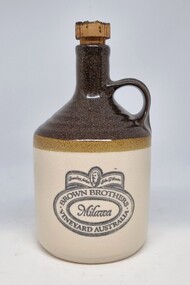
Functional object - Earthenware Bottle - Brown Brothers Milawa, 1970s - 1980s
... This jug is representative of an historic and continuing leading Australian Winemaker located in Northeast Victoria. ...In 1885 John Francis Brown first planted 10 acres of vines in Milawa, Victoria. Brown Brothers was founded in 1889 when the vines were ready to produce their first crop, as John hoped his brothers would join him in this new and promising venture. This did not happen but the name remained. Since 1899 Brown Brothers has grown into one of Australia’s largest family-owned wine businesses and now operates several vineyards in Victoria and Tasmania. These ceramic jars were used by Brown Brothers in the 1970s and 1980s to package Port, Muscat and Tokay. Fortified wines packaged in this manner would maintain their quality for decades as long as the wax seal was unbroken. Elischer Pottery was started in Sandringham, Melbourne Victoria in 1947 by well-known sculptor John (Johann Wolfgang) Elischer (1891-1966) and his son, also named John, (known as Wolly). John (Snr) was born in Vienna and trained at the Academy of Vienna from 1908 to 1911 and was an Associate of the Royal Academy Vienna. John (Senior) died in 1966 and the business was continued by his son John (Wolly), until 1987 when it was sold. Prior to that, at some time, he started making pieces the brand NCP. The business continues today as “Unique Ceramics” in Highett, Victoria. They continue to use the “Elischer” brand on some of their products.This jug is representative of an historic and continuing leading Australian Winemaker located in Northeast Victoria.An earthenware wine jug created for Brown Brothers Milawa Vineyard manufactured by John Elischer Pottery. The jug has a tradition loop handle. The bottom half of the jug is a traditional beige colour with a darker brown top section. The logo is imprinted in black and is covered in a clear glaze. The cork stopper is still intact although before being opened would have been sealed with wax.Company logo on one side: at top a central male image between the text "Founding Father /John F Brown. In a central oval around the name "Milawa", BROWN BROTHERS/ VINEYARD AUSTRALIA" On base: "97"brown brothers milawa, elischer pottery, northeast victorian wineries -
 Wodonga & District Historical Society Inc
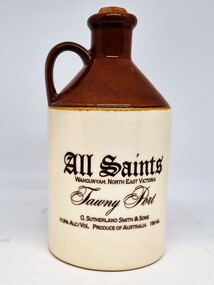
Functional object - Earthenware Bottle - All Saints Estate early 1980s
... This jug is representative of an historic and continuing leading Australian Winemaker located in Northeast Victoria. ...All Saints Estate is a family-owned winery established in 1864 and located on the banks of the Murray River in Wahgunyah, Northeast Victoria. Original owners George Sutherland Smith, and John Banks, arrived from Caithness, Scotland in 1852. After being involved in a range of enterprises, they established the vineyard, including a castle based on the design of The Castle of Mey in Scotland, which was built in 1864. In 1873 in London, Sutherland Smith became the first Australian winemaker to win an award at an overseas wine show. Banks died in 1876 and All Saints remained in the hands of G. Sutherland Smith and his family, until after some variable fortunes in the late 1980s, it fell into the hands of a syndicate in 1989. After being passed in at a receiver’s auction in 1991, All Saints was acquired by Brown Brothers of Milawa in 1992. It is now owned and operated by the children of Peter R. Brown. During the early 1980s, All Saints took bulk orders for different corporations such as Ansett Air Freight, packaging them in jugs as this for special occasions or functions.This jug is representative of an historic and continuing leading Australian Winemaker located in Northeast Victoria.A pottery wine jug of tradition colours featuring a lower half of natural earthenware colour and a brown glazed top section. It has a loop handle and a cork closure. Originally it also had a wax seal closure. Company information and logos are featured on each side.On side 1: "All Saints / WAHGUNYAH, NORTH EAST VICTORIA/ Tawny Port / G. SUTHERLAND SMITH & SONS / 17.5% ALC/VOL. PRODUCE OF AUSTRALIA 750 ML" On reverse side: Below an image of an Ansett Airfreight Aeroplane: "We offer to you our warmest, / best wishes for the Christmas Season/ and a year of continued/ peace and prosperity. / Merry Christmas, / from Ansett Air Freight." Underneath the jug: " Elischer / AUSTRALIA" all saints estate, australian wine industry, north east victoria wineries, viticulture australia -
 Wodonga & District Historical Society Inc
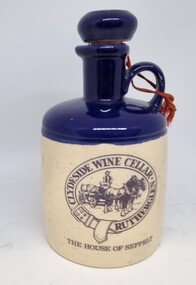
Functional object - Earthenware Bottle - Clydeside Wine Cellar Rutherglen, c1970
... This jug is representative of an historic and Australian Winemaker located in Northeast Victoria. ...Clydeside Cellar was established by David G. Hamilton, a Scotsman who migrated to the Rutherglen district in 1861. He established a large business including a general store and vineyards. The Hamilton Clydeside brick cellars were built beginning in 1886 and completed in 1892. In August 1914, Messrs B. Seppelt and Sons Ltd. purchased Clydeside Cellars from the Mr. Hamilton’s estate. Due to changing conditions the vineyards were sold in the 1980s and all stock taken back to their property at Seppeltsfield in South Australia. From 1984 until the present the former Clydeside Cellar had several operators including Jolimont Cellars (Doug Shears), Tony Lamb and the 2 different Asian owned conglomerates operating as Rutherglen Estates. In 2018 Rutherglen Estate was purchased by De Bortoli Family Winemakers of Griffiths, NSW.This jug is representative of an historic and Australian Winemaker located in Northeast Victoria.An earthenware wine jug produced the House of Seppelt Clydeside Cellar at Rutherglen, VIctoria. The jug has a tradition loop handle and cork stopper.The bottom half of the jug is a traditional beige colour with a blue section. There are images in black on both sides of the jug. Originally it would have had a wax seal over the stopper to preserve effective closure to protect the contents from any chance of seepage.On front: "THE HOUSE OF SEPPELT" beneath an image of a Clydesdale drawn beer cart and driver. The image is surrounded by a representation of a horse harness containing the text "CLYDESIDE WINE CELLAR/ RUTHERGLEN" On reverse: an image of horse-drawn beer wagons and workers in front of buildings. Across the front of the building "CLYDESIDE CELLARS RUTHERGLEN / B. SEPPELT & SONS LTD."northeast victorian wineries, clydeside cellar, b. seppelt & son -
 Wodonga & District Historical Society Inc
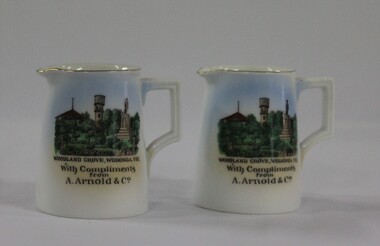
Memorabilia - China Souvenir Jugs Woodland Grove Wodonga, c. 1940
... jugs were made in Czechoslovakia and displayed the war memorial, water tower and bandstand from Woodland Grove, Wodonga. The Arnolds continued to trade until they finally closed their store in 1950. Wilhelm Arnold was a brother of J G Arnold, whose business ultimately became the present-day Arnold’s Fruit Market, Wodonga. This item has local historic ...A wide range of small china pieces carrying scenic views of holiday destinations or key locations were a popular kind of souvenir during much of the 20th century. Several different pieces were used to depict Wodonga during this period, primarily focusing on the Woodland Grove and the Soldier Memorial. In 1924, Arthur Arnold and his father Wilhelm Arnold had established a general store in High Street, near the water tower, but in 1931–32 they moved to new premises in High Street on the corner of what is now known as Elgin Boulevard. In 1933-34 they widened the frontage of the shop and added new premises at the rear for the sale of produce. As customer debt mounted during the depression, it became difficult for Arthur and Wilhelm to re-stock the shop, so they enticed customers into paying their accounts by rewarding them with a small individual cream or milk jug upon payment. The jugs were made in Czechoslovakia and displayed the war memorial, water tower and bandstand from Woodland Grove, Wodonga. The Arnolds continued to trade until they finally closed their store in 1950. Wilhelm Arnold was a brother of J G Arnold, whose business ultimately became the present-day Arnold’s Fruit Market, Wodonga. This item has local historic and social significance as it depicts which features of the city the community valued in the past. It has artistic significance as an example of the kinds of souvenirs used widely across Australia to represent communities and the landscape.A pair of miniature white jugs with a gold rim and handle detailing. A hand-coloured transfer image fills the front side depicts Woodland Grove Wodonga, including the Soldiers' Memorial, Water Tower and RotundaBeneath the image : "WOODLAND GROVE, VIC. / With Compliments/ from/ A. Arnold & Co."wodonga, souvenirs, woodland grove, ceramics, arnolds wodonga
