
Showing 6 items matching "hmat aeneas"
-
 Bendigo Military Museum
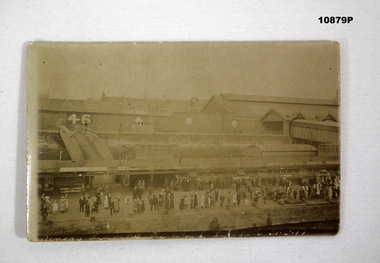
Photograph - PHOTOGRAPHIC POSTCARD, WHARF, WW1, 1919
... ...HMAT AENEAS...Photograph taken by a passenger on HMAT A60 "Aeneas" as it left the dock in Liverpool, 1919. ...Photograph taken by a passenger on HMAT A60 "Aeneas" as it left the dock in Liverpool, 1919. ...Photograph taken by a passenger on HMAT A60 "Aeneas" as it left the dock in Liverpool, 1919. Part of the Meade Collection. See Cat No. 10785P for details of service for "Ernest James Meade" (No. 2112).Sepia toned photograph. Copy of an original. Photograph features a crowd of spectators lining a wharf. Port related buidings in background. Partial caption in white lettering across bottom of photograph. Blank postcard format on back.Inscribed in white lettering across bottom of photograph: "Aeneas" leaving the Wharf, Liverpool 31. ?. 19".meade collection, ernest james meade, hmat aeneas, liverpool, wwi -
 St Kilda Historical Society
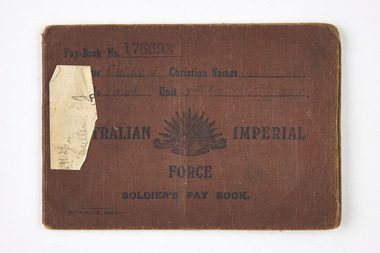
Administrative record - Pay book, Soldier's pay book, 1917
... After recovering, Jack undertook permanent guard duties at Broadmeadows Training Camp until October 1916, when he went to England with the 118th Howitzer Battery on the HMAT Aeneas. He again returned to Australia on health grounds, this time suffering a bronchial condition, and was discharged on 14 June 1918....After recovering, Jack undertook permanent guard duties at Broadmeadows Training Camp until October 1916, when he went to England with the 118th Howitzer Battery on the HMAT Aeneas. He again returned to Australia on health grounds, this time suffering a bronchial condition, and was discharged on 14 June 1918. ...John (Jack) Dudley Cullen was the first person from St Kilda to enlist in World War I. He lived at 23 Argyle Street (now Waterloo Crescent), St Kilda. An electrician with three years service with the militia behind him, Jack enlisted on 18 August 1914 at the age of 21. By 20 October that year he was sailing to Egypt on the HMAT Shropshire as a member of the 5th Battery, 2nd Field Artillery Brigade. He served in the Middle East for a short time before being hospitalised with enteric fever and returning home to Australia. After recovering, Jack undertook permanent guard duties at Broadmeadows Training Camp until October 1916, when he went to England with the 118th Howitzer Battery on the HMAT Aeneas. He again returned to Australia on health grounds, this time suffering a bronchial condition, and was discharged on 14 June 1918.Maroon coloured pay book with white pages printed in black, with handwritten and stamped entries.On front cover Pay-Book No. 17663 First name Cullen Christina Names John Dunlop No 1026 Unit 5th BTY. 2ND [illegible] A.I.F. AUSTRALIAN IMPERIAL FORCE SOLDIER'S PAY BOOK Rising sun motif Internal pages show name and contact details, notations of amounts and dates paid from 8 February 1917 to 10 May 1918, and a will. Each page overstamped in blue: DISCHARGEDjohn dudley cullen, jack cullen, wwi -
 St Kilda Historical Society
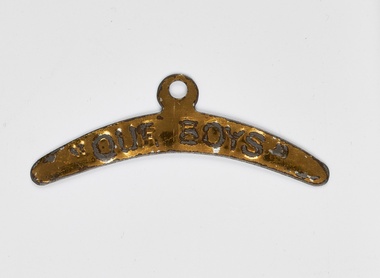
Badge - WWI souvenir, Boomerang badge, 1914-1918
... After recovering, Jack undertook permanent guard duties at Broadmeadows Training Camp until October 1916, when he went to England with the 118th Howitzer Battery on the HMAT Aeneas. He again returned to Australia on health grounds, this time suffering a bronchial condition, and was discharged in June 1918. ...After recovering, Jack undertook permanent guard duties at Broadmeadows Training Camp until October 1916, when he went to England with the 118th Howitzer Battery on the HMAT Aeneas. He again returned to Australia on health grounds, this time suffering a bronchial condition, and was discharged in June 1918. ...During World War I, "boomerang badges" were popular sweetheart brooches and fundraising pins. The boomerang motif was chosen to symbolize the solder's safe return from the war, much like a thrown boomerang comes back. This badge was donated to the St Kilda Society by the wife of John (Jack) Dudley Cullen, who was the first person from St Kilda to enlist in World War I. He lived at 23 Argyle Street (now Waterloo Crescent), St Kilda. An electrician with three years service with the militia behind him, Jack enlisted on 18 August 1914 at the age of 21. By 20 October that year he was sailing to Egypt on the HMAT Shropshire as a member of the 5th Battery, 2nd Field Artillery Brigade. He served in the Middle East for a short time before being hospitalised with enteric fever and returning home to Australia. After recovering, Jack undertook permanent guard duties at Broadmeadows Training Camp until October 1916, when he went to England with the 118th Howitzer Battery on the HMAT Aeneas. He again returned to Australia on health grounds, this time suffering a bronchial condition, and was discharged in June 1918. In February 1918, while still in England, Jack married Miss Daisy Dawes of Durrington, near Salisbury. They settled for a short while in Australia but returned to England to live in 1921.Gold coloured metal boomerang with eyelet for attachment."Our Boys"wwi memorabilia, john dudley cullen, jack cullen -
 St Kilda Historical Society
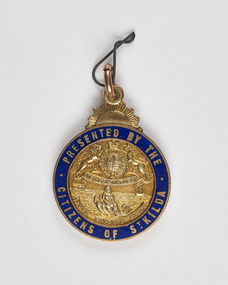
Memorabilia - Medallion, St Kilda tribute medallion, 1918
... After recovering, Jack undertook permanent guard duties at Broadmeadows Training Camp until October 1916, when he went to England with the 118th Howitzer Battery on the HMAT Aeneas. He again returned to Australia on health grounds, this time suffering a bronchial condition, and was discharged in June 1918. ...After recovering, Jack undertook permanent guard duties at Broadmeadows Training Camp until October 1916, when he went to England with the 118th Howitzer Battery on the HMAT Aeneas. He again returned to Australia on health grounds, this time suffering a bronchial condition, and was discharged in June 1918. ...Tribute medallions were presented to all 1914 enlistees from St Kilda by the citizens of St Kilda. Two presentations were held, one in November 1918 (98 recipients) and one in May 1919 (90 recipients). Both were organised by the St Kilda Patriotic Committee and held at the St Kilda Town Hall. Gunner J.D. Cullen attended the May 1919 function. John (Jack) Dudley Cullen was the first person from St Kilda to enlist in World War I. He lived at 23 Argyle Street (now Waterloo Crescent), St Kilda. An electrician with three years service with the militia behind him, Jack enlisted on 18 August 1914 at the age of 21. By 20 October that year he was sailing to Egypt on the HMAT Shropshire as a member of the 5th Battery, 2nd Field Artillery Brigade. He served in the Middle East for a short time before being hospitalised with enteric fever and returning home to Australia. After recovering, Jack undertook permanent guard duties at Broadmeadows Training Camp until October 1916, when he went to England with the 118th Howitzer Battery on the HMAT Aeneas. He again returned to Australia on health grounds, this time suffering a bronchial condition, and was discharged in June 1918. In February 1918, while still in England, Jack married Miss Daisy Dawes of Durrington, near Salisbury. They settled for a short while in Australia but returned to live in England in 1921.Round medal, 9 carat gold and dark blue enamel. Eyelet attachedFront: The City of St Kilda coat of arms within a dark blue enamel band bearing gold lettering 'PRESENTED BY THE CITIZENS OF ST. KILDA' Back: Engraved with the inscription 'GNR J.D. CULLEN' and raised lettering 'ENLISTED AND EMBARKED IN 1914 THE GREAT EUROPEAN WAR 1914-18'john dudley cullen, jack cullen, wwi recognition of service, citizens welcome to anzacs, st kilda patriotic committee, wwi -
 St Kilda Historical Society
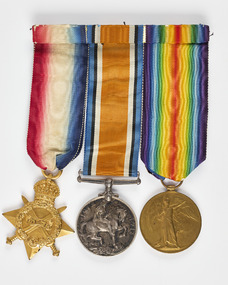
Medal - Military medals, Campaign Star, British War Medal and Victory Medal: Gunner John Dudley Cullen, 1919
... After recovering, Jack undertook permanent guard duties at Broadmeadows Training Camp until October 1916, when he went to England with the 118th Howitzer Battery on the HMAT Aeneas. He again returned to Australia on health grounds, this time suffering a bronchial condition, and was discharged in June 1918. ...After recovering, Jack undertook permanent guard duties at Broadmeadows Training Camp until October 1916, when he went to England with the 118th Howitzer Battery on the HMAT Aeneas. He again returned to Australia on health grounds, this time suffering a bronchial condition, and was discharged in June 1918. ...Most British and Commonwealth soldiers who served in World War I were awarded these three medals. The 1914-15 Star was awarded for service on the establishment of a unit in a theatre of war. It was never issued singly; recipients also received the British War Medal and the Victory Medal. The British War Medal was awarded to those who had entered a theatre of war on duty, or served overseas between 5 August 1914 and 11 November 1918. The Victory Medal commemorated the victory of the Allied Forces. Each nation designed their own medal but used the same ribbon. Australians received the medal issued by Great Britain. The combination of the 1914-15 Star, British War Medal and Victory Medal were popularly dubbed 'Pip, Sqeak and Wilfred' after cartoon characters of the time. John (Jack) Dudley Cullen was the first person from St Kilda to enlist in World War I. He lived at 23 Argyle Street (now Waterloo Crescent), St Kilda. An electrician with three years service with the militia behind him, Jack enlisted on 18 August 1914 at the age of 21. By 20 October that year he was sailing to Egypt on the HMAT Shropshire as a member of the 5th Battery, 2nd Field Artillery Brigade. He served in the Middle East for a short time before being hospitalised with enteric fever and returning home to Australia. After recovering, Jack undertook permanent guard duties at Broadmeadows Training Camp until October 1916, when he went to England with the 118th Howitzer Battery on the HMAT Aeneas. He again returned to Australia on health grounds, this time suffering a bronchial condition, and was discharged in June 1918. The inscription '2/F.A. BDE A.I.F.' refers to the '2nd Field Artillery Brigade Australian Imperial Forces'.A gold coloured star medal (1914-15 Star), a round silver medal (British War Medal), and a round bronze medal (Victory Medal), joined by different multi-coloured ribbons to a bar.1914-15 Star: The medal is a four-point star in bright bronze with a crown at the top. On the front are two crossed swords overlaid with a wreath and a scroll inscribed '1914-15'. The back is inscribed '1023 GNR J. Cullen, 2/F.A. BDE A.I.F'. The ribbon has a white band in the middle with a red band on one side and a blue band on the other. British War Medal: The front shows a mounted horse. The back shows the head of King George V in profile. The ribbon has a wide orange centre stripe and narrow blue, black and white stripes on each side. Victory Medal: The front has a winged figure of Victory. On the back are the words 'The Great War for Civilisation 1914-1919' surrounded by a laurel wreath. The ribbon design colours are of two rainbows.john dudley cullen, jack cullen, wwi recognition of service -
 Surrey Hills Historical Society Collection
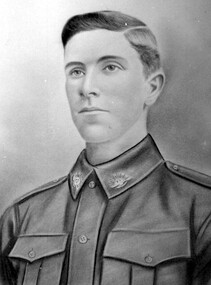
Photograph, Robert Gray, grandson of Robert Beckett
... He embarked from Melbourne on board HMAT A60 Aeneas on 3 October 1916. His AIF papers list his mother as his next of kin, both resident in Suffolk Road, Surrey Hills. ...He embarked from Melbourne on board HMAT A60 Aeneas on 3 October 1916. His AIF papers list his mother as his next of kin, both resident in Suffolk Road, Surrey Hills. ...The pencil sketch from which this photo was taken had been hidden from view from 1919 - 1996 when it was located behind a framed photo retrieved from the Surrey Hills Bowling Club at the time of its closure. The sketch had been used as backing when photo framed in 1919. Jocelyn Hall gave the original to great nephew, [name TBC], who was a pharmacist at the Mont Albert tram terminus at the time. Initially the subject's identity was not known. A scribbled name 'Walduck' on a different photo finally resulted in the identification as John Robert Gray, who died 1917. He was engaged at the time of enlistment and after his death his fiancee did not marry. He attended Surrey Hills Primary School and was a salesman at the time of enlistment on 9 May 1916. He embarked from Melbourne on board HMAT A60 Aeneas on 3 October 1916. His AIF papers list his mother as his next of kin, both resident in Suffolk Road, Surrey Hills. He was a gunner in the Howitzer Brigade 120. He was Killed in Action on 21 June 1917 and was buried at Bapaume Australian Cemetery (Row C, Grave NO. 5), France. It is believed that the sketch was made prior to him going overseas to France. John Robert Gray was the eldest son of Emma (nee Beckett) and John Gray. His father John Gray was "actively associated with all movements for the benefit of neighbours and fellow citizens". [Quote from the official tribute on his death in 1909.] He was very active in the Surrey Hills Progress Association in the early 1900's. The rotunda built in the Surrey Gardens by the Progress Association in 1912 was dedicated to him. He married Emma Beckett in 1888 at 'Guildford Villa' in Essex Road, the Beckett home. They are listed in both the 1903 and 1906 electoral rolls in Arundel Crescent; his occupation is given as bootmaker. The Alan Holt property register identifies this as 24 Arundel Crescent, known as 'Tumberumba'. John and Emma had a large family: (Gunner) John Robert Gray (1888, Surrey Hills - 21 June 1917, France) Benjamin Walter Gray (1890, Surrey Hills - 1949, Heidelberg) Herbert Harry Gray (1892, Surrey Hills - 1959, Queensland) William Beckett Gray (1897, Surrey Hills - 1899, Surrey Hills) Norman Douglas Gray (1901, Surrey Hills - 1947, Sydney) Evelyn Lizzie Gray (1906, Surrey Hills - 1983) Evelyn married Reginald Roberts and donated a number of photos to the collection. Both the Beckett and the Gray families were important in the early history of Surrey Hills. This is the only known image of John Robert Gray in WW1 uniform.A black and white photo of a hand-drawn image of a young man in uniform.world war, 1914-1918, (mrs) emma gray, (miss) emma beckett, (mr) john gray, walduck family, (mr) john robert gray, (mr) robert gray, world war, 1914-1919, surrey hills bowling club, bapaume australian cemetery, france
