


Historical information
Most British and Commonwealth soldiers who served in World War I were awarded these three medals. The 1914-15 Star was awarded for service on the establishment of a unit in a theatre of war. It was never issued singly; recipients also received the British War Medal and the Victory Medal. The British War Medal was awarded to those who had entered a theatre of war on duty, or served overseas between 5 August 1914 and 11 November 1918. The Victory Medal commemorated the victory of the Allied Forces. Each nation designed their own medal but used the same ribbon. Australians received the medal issued by Great Britain.
The combination of the 1914-15 Star, British War Medal and Victory Medal were popularly dubbed 'Pip, Sqeak and Wilfred' after cartoon characters of the time.
John (Jack) Dudley Cullen was the first person from St Kilda to enlist in World War I. He lived at 23 Argyle Street (now Waterloo Crescent), St Kilda. An electrician with three years service with the militia behind him, Jack enlisted on 18 August 1914 at the age of 21. By 20 October that year he was sailing to Egypt on the HMAT Shropshire as a member of the 5th Battery, 2nd Field Artillery Brigade. He served in the Middle East for a short time before being hospitalised with enteric fever and returning home to Australia.
After recovering, Jack undertook permanent guard duties at Broadmeadows Training Camp until October 1916, when he went to England with the 118th Howitzer Battery on the HMAT Aeneas. He again returned to Australia on health grounds, this time suffering a bronchial condition, and was discharged in June 1918.
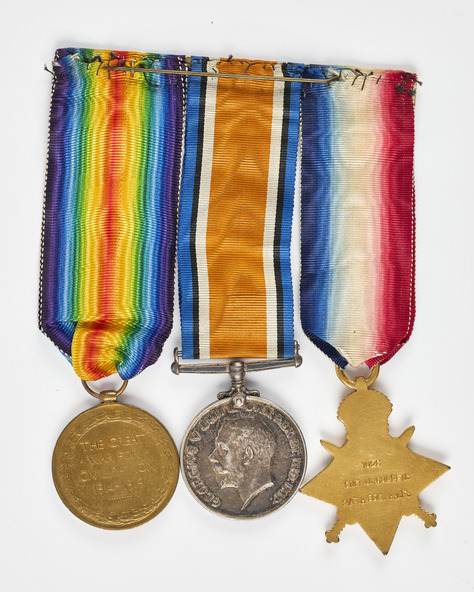
The inscription '2/F.A. BDE A.I.F.' refers to the '2nd Field Artillery Brigade Australian Imperial Forces'.
Physical description
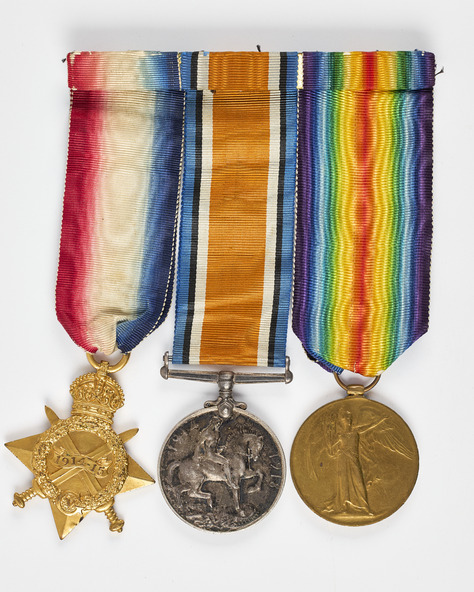
A gold coloured star medal (1914-15 Star), a round silver medal (British War Medal), and a round bronze medal (Victory Medal), joined by different multi-coloured ribbons to a bar.
Inscriptions & markings
1914-15 Star: The medal is a four-point star in bright bronze with a crown at the top. On the front are two crossed swords overlaid with a wreath and a scroll inscribed '1914-15'. The back is inscribed '1023 GNR J. Cullen, 2/F.A. BDE A.I.F'. The ribbon has a white band in the middle with a red band on one side and a blue band on the other.
British War Medal: The front shows a mounted horse. The back shows the head of King George V in profile. The ribbon has a wide orange centre stripe and narrow blue, black and white stripes on each side.
Victory Medal: The front has a winged figure of Victory. On the back are the words 'The Great War for Civilisation 1914-1919' surrounded by a laurel wreath. The ribbon design colours are of two rainbows.
