
Showing 185 items matching "home craft"
-
 Clunes Museum
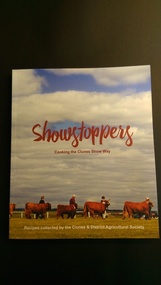
Book, CLUNES AND DISTRICT AGRICULTURAL SOCIETY, SHOWSTOPPERS: COOKING THE CLUNES SHOW WAY, 2015
... Cookbook produced by CDAS home crafts committee to celebrate 50 years od service....CLUNES AND DISTRICT AGRICULTURAL SHOW DOMESTIC COOKERY A COLLECTION OF LOCAL RECIPES GATHERED FROM THE CLUNES SHOWS OVER THE YEARS ON INSIDE COVER IN BLACK INK: CLUNES MUSEUM LIBRARY Cookbook produced by CDAS home crafts committee to celebrate 50 years od service. ...A COLLECTION OF LOCAL RECIPES GATHERED FROM THE CLUNES SHOWS OVER THE YEARSCookbook produced by CDAS home crafts committee to celebrate 50 years od service.non-fictionA COLLECTION OF LOCAL RECIPES GATHERED FROM THE CLUNES SHOWS OVER THE YEARSclunes and district agricultural show, domestic cookery -
 Flagstaff Hill Maritime Museum and Village
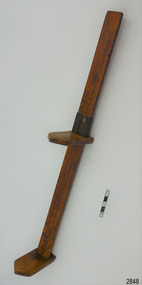
Tool - Hem marker stand, 1900s
... ...home craft...The hem marker would be used by professional dressmakers, seamstresses, and tailors as well as by crafts people at home. The hem marker was made in Birmingham....Flagstaff Hill Warrnambool Maritime Village Maritime Museum Shipwreck coast Great Ocean Road hem marker dressmaker dressmaking alterations tailor dressmaker's tool sewing marker sewing gauge seamstress domestic use dress fitting curtain hemming Birmingham freestanding chalk hem marker stand home craft "- - - - / - - - - - / -BIRMINGHAM" On end of arm "2*4' Ham marking stand with a wooden ruler, stand and a sliding adjustable arm on a brass sleeve. ...This hem marker stand is a measuring tool for gauging the height of a hem, such as on a dress or curtain. The adjustable arm slides along the ruler and its snug fit ensures that it stays at the right height. The end of the arm has a metal pin inserted into it to hold a piece of chalk, which would be used to mark the fabric. The hem marker would be used by professional dressmakers, seamstresses, and tailors as well as by crafts people at home. The hem marker was made in Birmingham.The hem marking stand is an example of tools used during the 1900s in the garments and furnishings trades as well as for domestic purposes. Since that time the tool has evolved into a more efficient design that makes home sewing easier.Ham marking stand with a wooden ruler, stand and a sliding adjustable arm on a brass sleeve. The arm has a metal pin on the end. Measurements are marked on both sides, inches on one side and centimetres on the other. Inscriptions are stamped into the wood. Made in Birmingham."- - - - / - - - - - / -BIRMINGHAM" On end of arm "2*4'flagstaff hill, warrnambool, maritime village, maritime museum, shipwreck coast, great ocean road, hem marker, dressmaker, dressmaking, alterations, tailor, dressmaker's tool, sewing marker, sewing gauge, seamstress, domestic use, dress fitting, curtain hemming, birmingham, freestanding, chalk hem marker, stand, home craft -
 Whitehorse Historical Society Inc.
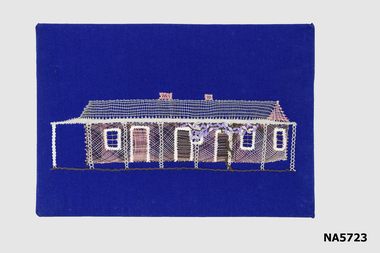
Craft - Embroidery - Schwerkolt Cottage, Vicki Jones-Evans, 2005
... home...Craft...Historic Home, Mitcham Royal blue cotton background Black stiffened paper backings Schwerkolt Cottage Historic home Craft Embroidered wall hanging Colours - brown, pink, mauve. lilac, white Royal blue Cotton background Black stiffened paper backing Craft Embroidery - Schwerkolt Cottage Vicki Jones-Evans ...Embroidered by Vicki Evans-Jones Hand embroidered wall hanging Schwerkolt Cottage. Historic Home, Mitcham Royal blue cotton background Black stiffened paper backings Embroidered wall hanging Colours - brown, pink, mauve. lilac, white Royal blue Cotton background Black stiffened paper backingschwerkolt cottage, historic home, craft -
 City of Moorabbin Historical Society (Operating the Box Cottage Museum)
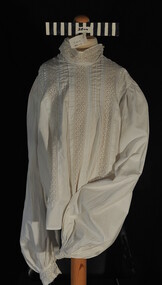
Clothing - Clothing, lady's blouse, c1900
... ...home dressmaker...craft...This white, cotton Lady's blouse with pin-tucked front and back is and example of the dressmaking skills of the women of the families of the pioneer settlers and market gardeners in the Moorabbin Shire. clothing brighton moorabbin pioneers dendy henry market gardeners home dressmaker craft work Ladies long-sleeved white cotton blouse with high collar. ...The pioneer settlers and market gardeners of Moorabbin Shire had to be self reliant and made their own clothing and utensils. This is one of many items that exhibit the skill and craftsmanship of the women in these families. This white, cotton Lady's blouse with pin-tucked front and back is and example of the dressmaking skills of the women of the families of the pioneer settlers and market gardeners in the Moorabbin Shire. Ladies long-sleeved white cotton blouse with high collar. Pin-tucking to front and back, guipure lace inserts on front of bodice. Significant tear at lower edge of the garment.clothing, brighton, moorabbin, pioneers, dendy henry, market gardeners, home dressmaker, craft work -
 National Wool Museum
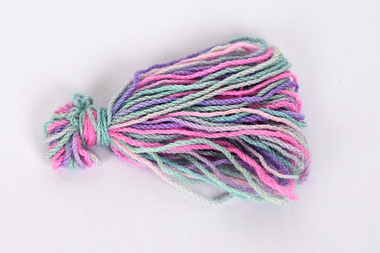
Textile - Dyed Wool Sample, Robin Walker, 1999
... ...Home Dyed...Craft...This sample is one of five donated by Mrs Walker who dyed her own yarns to knit into hats which she felted herself (in a washing machine) to sell at craft shops. She ran workshops and also taught home dyeing. She used a Landscape and Earth Palette and also used food colouring, jelly and cake decorating colours....Handicrafts Robin Walker Textiles Felting Wool Yarn Home Dyed Craft Small hank of home dyed woollen yarn. ...This sample is one of five donated by Mrs Walker who dyed her own yarns to knit into hats which she felted herself (in a washing machine) to sell at craft shops. She ran workshops and also taught home dyeing. She used a Landscape and Earth Palette and also used food colouring, jelly and cake decorating colours.Small hank of home dyed woollen yarn. In light shades of pink, mauve, blue and green.handicrafts, robin walker, textiles, felting, wool, yarn, home dyed, craft -
 Kew Historical Society Inc
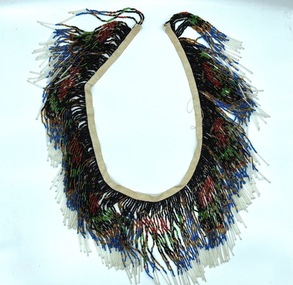
Decorative object - Beaded fringe, 1960s
... This is an example of a home craft object, designed for the user to decorate various objects....This is an example of a home craft object, designed for the user to decorate various objects. fringes glass beads homecraft Nil Multi-coloured beaded fringe used to decorate an object such as a lampshade. ...This is an example of a home craft object, designed for the user to decorate various objects.Multi-coloured beaded fringe used to decorate an object such as a lampshade.Nilfringes, glass beads, homecraft -
 Kew Historical Society Inc
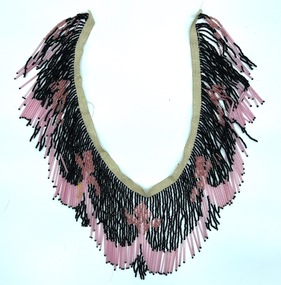
Decorative object - Beaded fringe, 1960s
... This is an example of a home craft object, designed for the user to decorate various objects....This is an example of a home craft object, designed for the user to decorate various objects. fringes glass beads homecraft Nil Multi-coloured beaded fringe used to decorate an object such as a lampshade. ...This is an example of a home craft object, designed for the user to decorate various objects.Multi-coloured beaded fringe used to decorate an object such as a lampshade.Nilfringes, glass beads, homecraft -
 Hymettus Cottage & Garden Ballarat
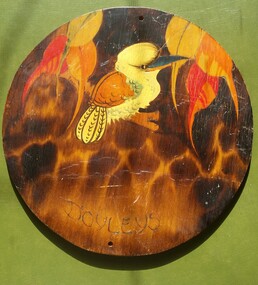
Doyley Cover, Pokerwork Doyley Cover, circa 1930s
... Pokerwork was a popular home craft in the 1930s. This small domestic piece using plywood is typical of objects made at home or school in that period....Pokerwork was a popular home craft in the 1930s. This small domestic piece using plywood is typical of objects made at home or school in that period. ...Pokerwork was a popular home craft in the 1930s. This small domestic piece using plywood is typical of objects made at home or school in that period.One of two matching circular pieces of ply, Incised, painted and lacquered with holes top and bottom for ties with image of Kookaburra and leaves. Incised to lower centre of cover 'd'oyleys'.painted and lacquered with image of Kookaburra and leaves and Incised to lower centre of cover 'd'oyleys'.mary burke, donald, taffe, ballarat, pokerwork, craft, kookaburra -
 Hymettus Cottage & Garden Ballarat
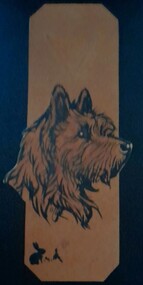
Functional object - Bookmark, Scotty dog crafted bookmark
... One of a group being an example of home art-craft work in the form of a bookmark popular in 1935, with Christmas Greetings inscribed on the reverse. ...One of a group being an example of home art-craft work in the form of a bookmark popular in 1935, with Christmas Greetings inscribed on the reverse. ...One of a group being an example of home art-craft work in the form of a bookmark popular in 1935, with Christmas Greetings inscribed on the reverse. Seasons Greetings written on the reverse with names, Melbourne address and the date of 1935.art board, craft, bookmark -
 Flagstaff Hill Maritime Museum and Village
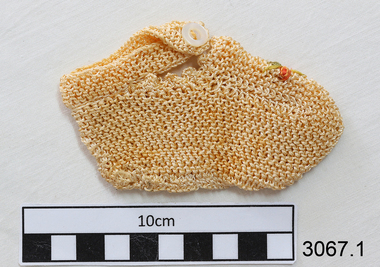
Clothing - Baby Clothes, c. early 1900's
... These handmade baby clothes are a fine example of home crafts, showing attention to detail. The original owner and maker of these handmade silk baby clothes is unknown. ...These handmade baby clothes are a fine example of home crafts, showing attention to detail. The original owner and maker of these handmade silk baby clothes is unknown. ...These handmade baby clothes are a fine example of home crafts, showing attention to detail. The original owner and maker of these handmade silk baby clothes is unknown. They were previously owned by the mother of the donor. Her name was Mary Patricia (Pat) Mulready 21.4.1934 – 4.2.2007 who was born, died and died Warrnambool. The clothes were possibly purchased from an opportunity shop as clothing for her daughter Eileen Mulready, 3.10.1968 - Jan 1991.Baby clothes, hand crocheted fine, fawn coloured silk thread. Set comprises booties (2) with button and small floral embroidery, round bib and round cap with chin tie.flagstaff hill, warrnambool, shipwrecked coast, flagstaff hill maritime museum, maritime museum, shipwreck coast, flagstaff hill maritime village, great ocean road, handcraft, baby clothes, crocheted baby clothes, home crafts, pat mulready -
 Rutherglen Historical Society
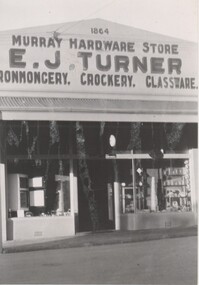
Image, c1950
... Shop is currently (2019) the home of the Rutherglen Craft Shop....Shop is currently (2019) the home of the Rutherglen Craft Shop. murray hardware store e j turner turners hardware shops main street Sign on front of store: "1868 | Murray Hardware Store | E.J. ...Shop is currently (2019) the home of the Rutherglen Craft Shop.Black and white photograph of the front of a store.Sign on front of store: "1868 | Murray Hardware Store | E.J. Turner | Ironmongery, Crockery, Glassware"murray hardware store, e j turner, turners hardware, shops, main street -
 Orbost & District Historical Society
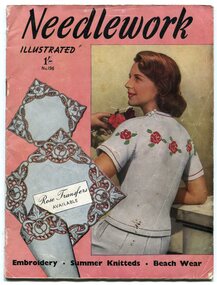
magazines, Needlework Illustrated; Australian Home Journal, September 1949; May 1963
... Therefore women’s magazines centered mostly home crafts. Articles as well as advertisements presented information on keeping the family healthy with guidelines for thrifty shopping and advice on how to look good through it all. ...Therefore women’s magazines centered mostly home crafts. Articles as well as advertisements presented information on keeping the family healthy with guidelines for thrifty shopping and advice on how to look good through it all. ...Needlework Illustrated is issue 196 and cost 1/-. it was published quarterly. Australian Home Journal is the May 1963 issue. Women’s magazines just after WWII played a “reflecting role,” including topics of readers’ interests as well as containing news items. Women’s employment rate had grown during WWII. However, even though the number of women working outside the home grew rapidly most of them were still engaged entirely in homemaking. Therefore women’s magazines centered mostly home crafts. Articles as well as advertisements presented information on keeping the family healthy with guidelines for thrifty shopping and advice on how to look good through it all. Patterns and instructions were provided for women to create home articles and clothing. The main sources for kntting and needlework designs available to women were in journals, magazines and pattern books. Embroidery was an affordable way to personalise and add aesthetic value to domestic linen and examples of embroidered and crocheted pieces could be found in most Australian homes. These are examples of women's magazines. They give practical advice on needlework / knitting and evidences the widespread interest in contemporary fashion. In doing so it shows what were the fashionable, but broadly affordable, women's and children's clothing styles of their day. These magazines also reflect women's interests --------------------------------------------------------------------------------------------------------------------------------------------------------- Two magazines. 3097.1 contains patterns, instructions, advertisements and photographs. It has a coloured cover - a pink background, black print an drawings of a woman wearing a top embroidered with roses and examples of needlework. 3097.2 contains patterns, advertisements, correspondence, and stories. It has a coloured cover with a photograph of a woman wearing a knitted jumper and three sewing patterns.magazine- needlework-illustrated magazine-australian-home-journal -
 Southern Sherbrooke Historical Society Inc.
Craft - Helen Gibson collection-books, articles and newspaper cuttings on handicrafts
... . - Decorative Transfers- Beautify Your Home. - Country Crafts (1st August 1947). - The Arbee Guide- Handicraft. - Arbee- Mad Lampshades (Rafina and Nylon Ribbon). - A lesson In Smocking. - Raffia Work. - Jester Slippers. - Our Winter Slippers. - Glamour Gifts From A Lace Scarf. - A Colourful Country Bunch. .... - Decorative Transfers- Beautify Your Home. - Country Crafts (1st August 1947). - The Arbee Guide- Handicraft. - Arbee- Mad Lampshades (Rafina and Nylon Ribbon). - A lesson In Smocking. - Raffia Work. - Jester Slippers. - Our Winter Slippers. - Glamour Gifts From A Lace Scarf. - A Colourful Country Bunch. ...Collection of handicraft text materials. Includes: - Table Mats (From paper cut out). - The Art of Hooked Work (Henrietta C. Walker). - Bark and Reed Work (Henrietta C. Walker). - Decorative Transfers- Beautify Your Home. - Country Crafts (1st August 1947). - The Arbee Guide- Handicraft. - Arbee- Mad Lampshades (Rafina and Nylon Ribbon). - A lesson In Smocking. - Raffia Work. - Jester Slippers. - Our Winter Slippers. - Glamour Gifts From A Lace Scarf. - A Colourful Country Bunch. Embroidery Designs Flowers. -
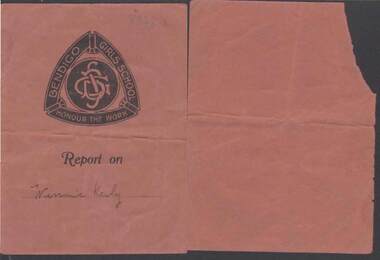 Bendigo Historical Society Inc.
Document - WINIFRED JEAN KEILY COLLECTION: SCHOOL REPORT, 1937
... Document,cream coloured paper Report card,Brown detached cover with school emblem - Winnie Keily,-subjects taken include English , Arithmetic , History, Science , Geography, Drawing, Needlework, Cookery and First Aid - Winnie was awarded a Certificate of Proficiency in Home Arts and Crafts....Document,cream coloured paper Report card,Brown detached cover with school emblem - Winnie Keily,-subjects taken include English , Arithmetic , History, Science , Geography, Drawing, Needlework, Cookery and First Aid - Winnie was awarded a Certificate of Proficiency in Home Arts and Crafts. Document WINIFRED JEAN KEILY COLLECTION: SCHOOL REPORT ...Document, Report card, Winnie Keily, Term 1 , 11 & term 111, 1937 @ Bendigo Girls School. Document,cream coloured paper Report card,Brown detached cover with school emblem - Winnie Keily,-subjects taken include English , Arithmetic , History, Science , Geography, Drawing, Needlework, Cookery and First Aid - Winnie was awarded a Certificate of Proficiency in Home Arts and Crafts.document, bendigo girls school -
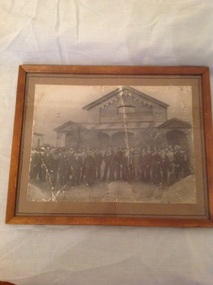 Wycheproof & District Historical Society Inc.
Framed photograph, 1890
... The building became the home of the Wycheproof Craft Group and then the Wycheproof And District Historical Society. ...The building became the home of the Wycheproof Craft Group and then the Wycheproof And District Historical Society. ...The Wycheproof Court House Opened 24-9-1890.The Law Department Closed the Court House during the 1980s. The building became the home of the Wycheproof Craft Group and then the Wycheproof And District Historical Society. Financial support from Heritage Victoria enabled interior renovations to be completed in 2007.This is the only known photo of the Opening of the Wycheproof Court House. It is fragile and precious.Early days photo of large group of men standing proudly in front of the just constructed Wycheproof Court House in 1890.wycheproof, court-house -
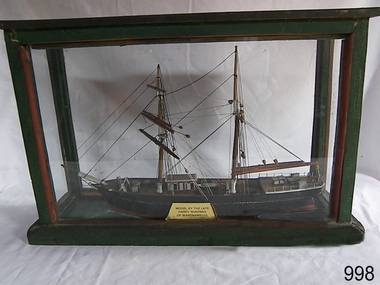 Flagstaff Hill Maritime Museum and Village
Craft - Ship Model, Mary Campbell, circa 1940
... The model is also significant for its association with the brigantine MARY CAMPBELL, a trading vessel that brought railway girders to the Melbourne Harbour Trust. flagstaff hill warrnambool shipwrecked coast flagstaff hill maritime museum maritime museum shipwreck coast flagstaff hill maritime village great ocean road marine artwork model making captain james arthur robilliard j.a. robilliard vessel mary campbell ship mary campbell melbourne sailors home vessels harry mckenna Mary Campbell Painted on the bow in white “MARY CAMPBELL” Gold label with black print attached to display case “MODEL BY THE LATE HARRY McKENNA OF WARRNAMBOOL” Ship model "Mary Campbell": a two-masted vessel with black hull, brown masts and black rigging, displayed in a glass case with a timber frame painted green. Made by Harry McKenna. Mary Campbell Craft ...This ship model is of the sailing brigantine MARY CAMPBELL, which once belonged to Captain James Arthur Robilliard. The model was made by Harry McKenna, a well-known ship model maker and Warrnambool resident. CAPTAIN ROBILLIARD James Arthur Robilliard, sea captain and tent maker, was born in 19th April 1843 in St. Helier, Jersey, Channel Islands. He trained there in his father’s sail loft as a sailmaker. He later became a skipper. His first job was as a sailor in Liverpool, England. In 1875, James Robilliard migrated to Australia as a mate on the “E.M. Young”. Captain Robilliard and his family were amongst the early settlers along the Curdies River in the Heytesbury district. In 1877, he became a Captain. On 14th November 1879, Captain Robilliard married Helen Beckett. James and Helen had ten children: James Arthur (Jnr), Henry William, Nellie Jessie, Alfred Albert, Rubena Nellie, De Jersy Norman, Clifford Beckett, Olive Ida, Frances Ridley Havergal and Nellie Elvie, all born in Victoria. THE MARY CAMPBELL The ship “Mary Campbell” was built by Alexander Newton Jr. She was carvel-planked, of iron bark and blue gum timber. The family shipyard was at Pelican, on the Manning River, NSW, and “Mary Campbell” was first launched by her builder in 1869 as “The Son”. Three months later, she was renamed “Mary Campbell’ by her purchaser J. Campbell in Sydney. She was used to carry equipment for the Sydney Sugar Refinery’s Mill in Southgate, NSW. She then traded for the next 20 years between Australian ports and rivers along the east coast, as well as regular ports in New Zealand. She was “recognised as one of the best carrying little vessels in the timber trade” (Sydney Morning Herald). She had several owners over this time, the last one being Captain James A. Robilliard. On 29th April 1889, “Mary Campbell”, in the charge of her owner, Captain James A Robilliard, was on her way from Clarence River, NSW to Melbourne, Victoria with a cargo of railway girders for the Melbourne Harbour Trust. Captain Robilliard encountered a storm off Port Macquarie. He sailed the vessel south to 25 miles (about 40km) east of Cape Hawke, near Tuncurry and Forster. At 7 pm, he discovered that the cargo had shifted during the stormy seas and the heavy girders had damaged the hull, causing a leak. The pumps were inadequate to stem the fast-flowing leak, and over a meter of water filled the hull during the next 2 hours. Some of the crew began throwing the cargo overboard to lighten the vessel, hoping to keep it afloat until daylight. When the water reached over 2 meters in the hull, they realised their efforts were in vain. At 1:30 am on 30th April 1889, the crew left the vessel. They stood by in the lifeboat until 3 am. The ship was sinking fast, so they left for the shore, looking for a safe place to beach their boat. While still miles off Cape Hawke, all 7 crew members, including the Captain, were rescued by the Government Tug “Rhea” and taken to Port Macquarie hospital, then returned to Sydney in the “Wellington”. Captain Robilliard managed to rescue his ship’s compass, but no cargo was saved from the vessel. It had been under-insured, only covered for half its value, due to a lack of funds. Many years later, in 1976, an anchor was caught up in the net of a trawler south of Forster and thought to be from the “Mary Campbell”. It was donated and installed in the Great Lakes Museum, Tuncurry, NSW. (The same museum also has a half-model of the hull of “Mary Campbell”.) The name of the last ship Captain Robilliard sailed is currently unknown; however, he sailed that ship from the port of Marlborough, Queensland, carting steel railway girders for the Geelong-to-Camperdown line. On one trip, it hit a storm, the cargo shifted, and the ship was wrecked along the NSW coast. After this, Captain Robilliard exchanged sea life for farming in Peterborough. In about 1897, verging on retirement, Capt. Robiilliard superintended the Melbourne Sailors’ Home in Spencer Street, Melbourne, before being asked to leave this position in 1902 for trying to shut down the local hotel! At this time, the Melbourne Sailors’ Home was about to change its location. On 6th May 191,7, Captain James Arthur Robilliard J.P. died at Blackwood Park, in the Cobden district of Brucknell, which is now considered the first official Robilliard family homestead in Australia. He was buried in the Melbourne General Cemetery, Victoria. His wife, Helen, passed away in 1947. The Becket and Robilliard family names continue to be well known in the Western District. Flagstaff Hill Maritime Village also has a ship’s compass in the collection that was owned by Capt. J. Robilliard and used on the ship Mary Campbell.This ship model of the MARY CAMPBELL is of local significance for its association with well well-known Warrnambool resident and ship model maker. The model is also significant for its association with the brigantine MARY CAMPBELL, a trading vessel that brought railway girders to the Melbourne Harbour Trust.Ship model "Mary Campbell": a two-masted vessel with black hull, brown masts and black rigging, displayed in a glass case with a timber frame painted green. Made by Harry McKenna.Painted on the bow in white “MARY CAMPBELL” Gold label with black print attached to display case “MODEL BY THE LATE HARRY McKENNA OF WARRNAMBOOL”flagstaff hill, warrnambool, shipwrecked coast, flagstaff hill maritime museum, maritime museum, shipwreck coast, flagstaff hill maritime village, great ocean road, marine artwork, model making, captain james arthur robilliard, j.a. robilliard, vessel mary campbell, ship mary campbell, melbourne sailors home, vessels, harry mckenna, mary campbell -
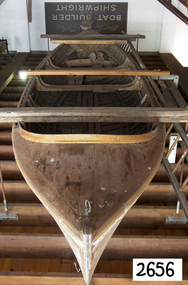 Flagstaff Hill Maritime Museum and Village
Vehicle - Vessel, Surf Boat, 1949
... craft have won events at state and national surf championships. They were renowned Boat Builders producing a much lighter and faster running boat than anything previously made, with a buoyant type bow design giving it the lift necessary to get out and through heavy surf. while its sleek lines from amidships aft provided very fast running qualities. Either side of its bows, it bore the bright silver aircraft transfer of the Aeroplane Jellies Company. After a surf competition at Narrabeen NSW, the competing Warrnambool surf lifesaving team returned home...craft have won events at state and national surf championships. They were renowned Boat Builders producing a much lighter and faster running boat than anything previously made, with a buoyant type bow design giving it the lift necessary to get out and through heavy surf. while its sleek lines from amidships aft provided very fast running qualities. Either side of its bows, it bore the bright silver aircraft transfer of the Aeroplane Jellies Company. After a surf competition at Narrabeen NSW, the competing Warrnambool surf lifesaving team returned home ...In 1952 the subject surf boat crewed by Geoff Scott, Ron Blackney, Wes McLaren, Jim Tibb, and Stan Stephens, won the Victorian Surf Boat Championships. When the club had finished with the boat Mr. Harold Stephenson paid one shilling and it eventually found its way into a garage where it remained for over 20 years before being donated to Flagstaff Hill. This boat is regarded as a unique example of craftsmanship, closely resembling Bay whaleboats used around the Warrnambool area in the 1800s. This timber caravel surf boat was named “Aeroplane Jelly” and was built by N & E Towns a Newcastle boat builder in 1949 Aeroplane Jellies and David Jones as sponsors of the Sydney Surf Carnival of 1950/1951 donated jointly the vessel. George Towns started his boat-building business in 1869 on Dempsey Island on the Hunter River, NSW. George's sons took over the business as N & E Towns (Norman and Eldrid) and continued until the early 1950s. The business made a variety of small craft including fishing boats, launches, and flood boats. In 1928 they built their first surf boat it took about six weeks to build with cedar planks and hardwood frames. After World War II surf boats became their main focus and they became well known for the lighter and faster designs. Many “Towns built” craft have won events at state and national surf championships. They were renowned Boat Builders producing a much lighter and faster running boat than anything previously made, with a buoyant type bow design giving it the lift necessary to get out and through heavy surf. while its sleek lines from amidships aft provided very fast running qualities. Either side of its bows, it bore the bright silver aircraft transfer of the Aeroplane Jellies Company. After a surf competition at Narrabeen NSW, the competing Warrnambool surf lifesaving team returned home to Warrnambool their club committee decided to purchase the "Aeroplane Jellies" Surf boat if and when it became available as the team had been so impressed with the boat. On 30 October 1951 a cheque for £207-2/6' was raised, £180 for the boat, balance for oars. Transport was arranged and the boat was delivered in November 1951. When the "Aeroplane Jellies" competition days were over in the early 1960's due largely to changing surf boat design, Warrnambool Club's Secretary, Mr. Harold Stephenson, sought permission from the Committee to purchase the boat for the nominal sum of one shilling thus preserving the vessel for posterity. The boat had been stored for many years at the Nullawarre Bakery where it remained until Mr. Stephenson died in 1985. After Mr. Stephenson's passing his family donated the vessel to Flagstaff Hill Maritime Museum in 1986.A very rare example of a surf lifesaving boat that for its time was a unique creation that revolutionised small vessel design in Australia. It was made by a renowned maker that today unfortunately many of his examples of boats he made, especially surf life-saving boats no longer exist making the Flagstaff Hill boat very significant to not only surf lifesaving history but to the part it played in our social life for all those who went to the beaches in 1960s Australia.Surf boat named "Aeroplane Jellies". Timber, double ender carvel, built in 1949 by N & E Towns, Newcastle, NSW. Only a few are in existence. She was a trophy prize at Sydney Surf Carnival 1950/1951, donated by Aeroplane Jellies and David Jones Dept. Store, Sydney. The boat was won by South Narrabeen Surf Club. Warrnambool Surf Club purchased her on 30/10/1951 for £207-2/6, and she was sold to Harold Stephenson in early 1960's for 1 shilling. Donated to Flagstaff Hill by the family of Harold Stephenson around 1985-1986. The name Aeroplane Jellies was lettered in gold across the boat's coaming and there is a remnant of some of the gold lettering still there.warrnambool, flagstaff hillflagstaff hill maritime museum, great ocean road, ememgency, historic boat, surf boat, n & e towns, carvel, vintage boat, double ender boat, lifesaving boat, geoff scott, south narrabeen surf club, warrnambool surf life saving club, lifeboat -
 Federation University Historical Collection
Photograph - Photograph - Colour, Churchill Service Memorial, 2015, 2015
... One side of the sculpture is colourful and optimistic; its theme is home, family, community and the future. These themes are crafted by flow lines which are connected to the other side of the sculpture through the round hole and the Crosspiece. ...One side of the sculpture is colourful and optimistic; its theme is home, family, community and the future. These themes are crafted by flow lines which are connected to the other side of the sculpture through the round hole and the Crosspiece. ...In recognition of its fallen soldiers and Churchill's 50th birthday a service memorial was erected on a concrete plinth at the Churchill town plaza and used for the first time to mark the ANZAC centenary on Anzac Day 2015. Churchill never had a war memorial and received a grant from the Department of Veterans' Affairs six years ago to commission a sculpture with Latrobe City Council's support. It was decided the sculpture needed to recognise more than just the war effort, but service and volunteerism, considering Churchill was only founded in 1965. (http://www.latrobevalleyexpress.com.au/story/2816903/churchills-new-memorial/, accessed 01 may 2015) Sculptor Paul Jesse discussed the work in Churchill and District Community news, 18 December 2014: Some time ago CDCA commissioned a sculpture to be used as a Service Memorial to commemorate the fallen that have died in service of our community and country. Traditional memorials usually commemorate Armed Services personnel, but CDCA was of the opinion that a more inclusive view which included Emergency Services personnel, such as CFA, SES and Police, could be incorporated into the Churchill Memorial. Boolarra artist, Paul Jesse, who is accomplished in Ferro-Cement sculpture techniques, was commissioned to create a memorial that would cause people to reflect on the meaning of ‘service’ and ‘sacrifice’. The following is a description of the Churchill Service Memorial Sculpture written by the sculptor, Paul Jesse. “My sculpture is different from most War Memorial sculptures because it uses as its basis the reasons why people go into service or to war. One side of the sculpture is colourful and optimistic; its theme is home, family, community and the future. These themes are crafted by flow lines which are connected to the other side of the sculpture through the round hole and the Crosspiece. These lines can be seen as a multi-layered connection between the sides. On the “dark” side of the sculpture, the lines begin with a spiral of coloured mosaics. This spiral is representative of our service people. Its beginning can be seen on one level as their soul. The spiralling mosaics of them flow to the other side of the sculpture where they create the landscape and figures. These lines can also be seen as a range of connectors between the two sides, representing a flow of thoughts, love, fear, concern and dreams. They also represent physical communication such as letters and phone calls.” This ‘Service Memorial’ is located in the Churchill Plaza (adjacent to the Town Hall), along with four flagpoles, seating and garden beds. The Churchill Service Memorial has deliberately been designed as a thought-provoking public art work. It will complement the Art and Culture Pathway which links Switchback Gallery at the Federation University Campus to the Town Centre. We hope Churchill citizens will pause to view the Memorial, ponder its meaning, reflect on the service of others and commemorate the fallen. Colour photograph on an abstract Australia-shaped sculpture by Boolarra artist Paul Jesse. The abstract Australia-shaped sculpture is in stark contrast to the bronze-cast "fallen mate" or concrete cenotaph seen in many country towns. The photograph includes wreaths from the ANZAC centenary service on ANZAC Day 2015. churchill, churchill war memorial, paul jessie, anzac centenary, federation university, gippsland, art and culture pathway, world war -
 Flagstaff Hill Maritime Museum and Village
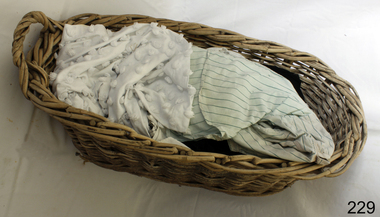
Domestic object - Wicker Basket, Late 20th century
... Containers like this handmade and varnished cane or wicker basket have been used in homes for decades for carrying wet or dry laundry items. The basket is an example of late 20th century cane ware. The craft ...Containers like this handmade and varnished cane or wicker basket have been used in homes for decades for carrying wet or dry laundry items. The basket is an example of late 20th century cane ware. The craft has been used over the centuries to produce similar items for domestic use. This basket is currently not associated with a historical event, person or place at this time and is being used to augment Flagstaff's village display.Cane or wicker laundry basket with one handle, handmade and varnished. Basket is oval shaped., flagstaff hill, warrnambool, shipwrecked coast, flagstaff hill maritime museum, maritime museum, shipwreck coast, flagstaff hill maritime village, great ocean road, basket, cane basket, laundry, laundry basket, washing basket, domestic item -
Federation University Historical Collection
Book, Ballarat School of Mines Tertiary Orientation Programs, 1980, 1980
... The courses offered were TOP Biology, Chemistry, Computer Science, Workshop Practice and Drawing, Home Economics, Applied MAthematics, General Mathematics (Computing Option), Pure Mathematics, Physical Education, Physics, Craft, Ceramics and Sculpture, Garment Construction, Graphic Communication, Graphic Design (including Design Studies and Printmaking), History of Art, Painting and Drawing, Drawing, Photography, Accounting, Advanced Typewriting, Economics, Legal Studies, Secretarial Studies, 19th Century Australian History, 20th Century Australian History, Australian Media, Behavioural Studies, Drama, English Expression, Field Studies, Film Studies, Introduction to Psychology, Literature, Music, Political Studies and Sociology. ...The courses offered were TOP Biology, Chemistry, Computer Science, Workshop Practice and Drawing, Home Economics, Applied MAthematics, General Mathematics (Computing Option), Pure Mathematics, Physical Education, Physics, Craft, Ceramics and Sculpture, Garment Construction, Graphic Communication, Graphic Design (including Design Studies and Printmaking), History of Art, Painting and Drawing, Drawing, Photography, Accounting, Advanced Typewriting, Economics, Legal Studies, Secretarial Studies, 19th Century Australian History, 20th Century Australian History, Australian Media, Behavioural Studies, Drama, English Expression, Field Studies, Film Studies, Introduction to Psychology, Literature, Music, Political Studies and Sociology. ...148 page yellow covered book outlining the Tertiary Orientation Programs offered by the Ballarat School of Mines in 1980. The courses offered were TOP Biology, Chemistry, Computer Science, Workshop Practice and Drawing, Home Economics, Applied MAthematics, General Mathematics (Computing Option), Pure Mathematics, Physical Education, Physics, Craft, Ceramics and Sculpture, Garment Construction, Graphic Communication, Graphic Design (including Design Studies and Printmaking), History of Art, Painting and Drawing, Drawing, Photography, Accounting, Advanced Typewriting, Economics, Legal Studies, Secretarial Studies, 19th Century Australian History, 20th Century Australian History, Australian Media, Behavioural Studies, Drama, English Expression, Field Studies, Film Studies, Introduction to Psychology, Literature, Music, Political Studies and Sociology. Programs were offered in Applied Science, Nursing, Physical Education, Home Economics, Engineering, Computer Science, Accounting, Secretarial, Humanities and Social Sciences, Art & Design and Fashion and Design.ballarat school of mines, tertiary orientation program, top, courses -
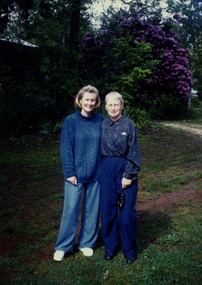 Marysville & District Historical Society
Photograph (Item) - Colour photograph, Unknown
... Crafts Centre for two years from 1975. The building was then purchased by Norman and Rosemary Fiske in 1977 and converted into a restaurant called The Pumpernickel. This building, along with most of the town, was destroyed in the 2009 Black Saturday bushfires. The Wallaces departed Marysville in 1980 for a new life in Ringwood, Victoria. marysville theatre marysville victoria harold cuzens jim wallace darmody family norman fiske rosemary fiske the pumpernickel 2009 black saturday bushfires marj wallace marie wallace jill wallace barton brothers clarrie smith Marie + Jill Standing/ in front of our old home. ...A colour photograph of Marie and Jill Wallace in Marysville in Victoria.A colour photograph of Marie and Jill Wallace in Marysville in Victoria. Jim Wallace was born in Dumfries in Scotland and emigrated to Australia with his family at age 6. He arrived and settled in Marysville in 1922 and ended up working for the Barton Brothers looking after their touring cars and their garage. He met Marj in 1928 and they married in 1930. Jim and another well-known local, Clarrie Smith, had spoken about showing the 'talkies' in the local hall and then subsequently had local builder, Harold Cuzens, build the Marysville Theatre in 1932. The Marysville Theatre was located on Murchison Street. The solid concrete building was used as a Theatre from 1932 to 1970. The building was then purchased by The Darmody Family and was used as an Arts and Crafts Centre for two years from 1975. The building was then purchased by Norman and Rosemary Fiske in 1977 and converted into a restaurant called The Pumpernickel. This building, along with most of the town, was destroyed in the 2009 Black Saturday bushfires. The Wallaces departed Marysville in 1980 for a new life in Ringwood, Victoria.Marie + Jill Standing/ in front of our old home.marysville theatre, marysville, victoria, harold cuzens, jim wallace, darmody family, norman fiske, rosemary fiske, the pumpernickel, 2009 black saturday bushfires, marj wallace, marie wallace, jill wallace, barton brothers, clarrie smith -
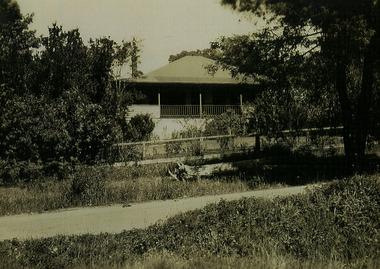 Marysville & District Historical Society
Photograph (Item) - Black and white photograph, Unknown
... Crafts Centre for two years from 1975. The building was then purchased by Norman and Rosemary Fiske in 1977 and converted into a restaurant called The Pumpernickel. This building, along with most of the town, was destroyed in the 2009 Black Saturday bushfires. The Wallaces departed Marysville in 1980 for a new life in Ringwood, Victoria. marysville theatre marysville victoria harold cuzens jim wallace darmody family norman fiske rosemary fiske the pumpernickel 2009 black saturday bushfires marj wallace marie wallace jill wallace barton brothers clarrie smith Wallace Home A black and white photograph of the Wallace Family home in Marysville in Victoria. ...A black and white photograph of the Wallace Family home in Marysville in Victoria.A black and white photograph of the Wallace Family home in Marysville in Victoria. Jim Wallace was born in Dumfries in Scotland and emigrated to Australia with his family at age 6. He arrived and settled in Marysville in 1922 and ended up working for the Barton Brothers looking after their touring cars and their garage. He met Marj in 1928 and they married in 1930. Jim and another well-known local, Clarrie Smith, had spoken about showing the 'talkies' in the local hall and then subsequently had local builder, Harold Cuzens, build the Marysville Theatre in 1932. The Marysville Theatre was located on Murchison Street. The solid concrete building was used as a Theatre from 1932 to 1970. The building was then purchased by The Darmody Family and was used as an Arts and Crafts Centre for two years from 1975. The building was then purchased by Norman and Rosemary Fiske in 1977 and converted into a restaurant called The Pumpernickel. This building, along with most of the town, was destroyed in the 2009 Black Saturday bushfires. The Wallaces departed Marysville in 1980 for a new life in Ringwood, Victoria.Wallace Homemarysville theatre, marysville, victoria, harold cuzens, jim wallace, darmody family, norman fiske, rosemary fiske, the pumpernickel, 2009 black saturday bushfires, marj wallace, marie wallace, jill wallace, barton brothers, clarrie smith -
Federation University Historical Collection
Document - Document - Letter, Ballarat Junior Technical School: Reference letter for Kyra Sandra Trotter for her new school, 1958
... craft...decorative needlework...dressmaking...home...Subjects covered in her first year of secondary school and courses available in the girl's section of the Junior Technical School outlined. ballarat junior technical school head master l garner kyra sandra trotter character highly regarded ability excellent first year english social studies arithmetic science art craft decorative needlework dressmaking home management music Cream page, typed. ...Letter from Mr Garner outlining the character and academic ability of Kyra Sandra Trotter. This provided for school she would be attending when the family move to the West. Subjects covered in her first year of secondary school and courses available in the girl's section of the Junior Technical School outlined. Cream page, typed. ballarat junior technical school, head master, l garner, kyra sandra trotter, character highly regarded, ability excellent, first year, english, social studies, arithmetic, science, art, craft, decorative needlework, dressmaking, home management, music -
Marysville & District Historical Society
THE TRIANGLE NEWS-VOL 40 NO 8-MARCH 8 2013
... marysville victoria australia australia steel band festival coming remembering elsie jowett what's on when in march the committee of management of the gallipoli park precinct buxton progress assocn community notice marysville primary school parents club agm marysville community market creative triangle autumn domestic firewood collection murrindindi shire council buxton motor home event madrats reunion maryton beer & platter garden community happy hour marysville community golf & bowls club mayor's chair freeza is back program world's greatest shave trevor harrow oval advertisements marysville & district kindergarten assocn preschool centre marsysville pattiserie & cottages looking for staff adventurous cooks visitor information services officer wanted mystic mountains tourism changes to administration services at marysville rac world's longest lunch marysville marysville netball notice of agm and call for teams stephanie alexander-cook marysville primary school fundraiser for dunalley primary school tasmania experienced cook wanted camp marysville attention crafters y water centre at yea wetlands real estate bakers lane work revised ceaca agm construction of visitors information & interpretive centre yea wetlands buxton progress assocn open hall allendale road bridgeworks strath creek tenders st john's anglican church arts crafts & produce festival THE TRIANGLE NEWS-VOL 40 NO 8-MARCH 8 2013 ...marysville, victoria, australia, australia steel band festival coming, remembering elsie jowett, what's on when in march, the committee of management of the gallipoli park precinct, buxton progress assocn community notice, marysville primary school parents club agm, marysville community market, creative triangle, autumn domestic firewood collection, murrindindi shire council, buxton motor home event, madrats reunion, maryton beer & platter garden, community happy hour, marysville community golf & bowls club, mayor's chair, freeza is back program, world's greatest shave, trevor harrow oval, advertisements, marysville & district kindergarten assocn, preschool centre, marsysville pattiserie & cottages looking for staff, adventurous cooks, visitor information services officer wanted, mystic mountains tourism, changes to administration services at marysville rac, world's longest lunch marysville, marysville netball notice of agm and call for teams, stephanie alexander-cook, marysville primary school fundraiser for dunalley primary school tasmania, experienced cook wanted, camp marysville, attention crafters, y water centre at yea wetlands, real estate, bakers lane work revised, ceaca agm, construction of visitors information & interpretive centre yea wetlands, buxton progress assocn open hall, allendale road bridgeworks, strath creek tenders, st john's anglican church arts crafts & produce festival -
Marysville & District Historical Society
THE TRIANGLE NEWS-VOL 41 NO 32-AUGUST 22 2014
... marysville victoria australia community projects to deliver for taggerty little river reserve the project reference group victorian bushfire appeal fund murrindindi shire council what's on when in august the committee of management of the gallipoli park precinct marysville community market creative triangle gallipoli park precinct agm triangle community dinner el kanah village church notices marysville golf report gallipoli park mayor's chair by cr margaret rae councillor comment cr john kennedy cheviot ward advertisments concert bus the country touch bus residential & rural real estate marysville triangle real estate murrindindi shire residents urged to detox their homes marysville community golf & bowls club marysville villains best & fairest dinner narbethong community hall dinner & show intrepid triangle bushwalkers retail opportunities marysville preschool centre long day care & kindergarten council concerned about unlawful firewood collection alexandra pastoral & agricultural assocn show secretary position fooball & netball live at gallipoli park buxton recreational reserve committee agm craft market & indoor garage sale buxton hall marysville & district cricket club ugln practical advice for landholders with properties trevor harrow oval clean up THE TRIANGLE NEWS-VOL 41 NO 32-AUGUST 22 2014 ...marysville, victoria, australia, community projects to deliver for taggerty, little river reserve, the project reference group, victorian bushfire appeal fund, murrindindi shire council, what's on when in august, the committee of management of the gallipoli park precinct, marysville community market, creative triangle, gallipoli park precinct agm, triangle community dinner, el kanah village, church notices, marysville golf report, gallipoli park, mayor's chair by cr margaret rae, councillor comment cr john kennedy cheviot ward, advertisments, concert bus, the country touch bus, residential & rural real estate, marysville triangle real estate, murrindindi shire residents urged to detox their homes, marysville community golf & bowls club, marysville villains best & fairest dinner, narbethong community hall dinner & show, intrepid triangle bushwalkers, retail opportunities, marysville preschool centre, long day care & kindergarten, council concerned about unlawful firewood collection, alexandra pastoral & agricultural assocn, show secretary position, fooball & netball live at gallipoli park, buxton recreational reserve committee agm, craft market & indoor garage sale, buxton hall, marysville & district cricket club, ugln, practical advice for landholders with properties, trevor harrow oval clean up -
Marysville & District Historical Society
THE TRIANGLE NEWS-VOL 5 NO 27-AUGUST 22 1980
... home improvements centre...wirrianda appaloosa stud...football club...community care centre...wanted to buy...under 17 football...guides...happy birthday...wirreanda craft...marysville victoria australia photographer for sale pumpernickel dine & dance debutante ball attention junior youth club mountain views home improvements centre wirrianda appaloosa stud football club community care centre wanted to buy under 17 football guides happy birthday wirreanda craft fair lost cat christ church ladies' guild think it over indoor bowls birth kinder roster historical society meeting senior citizens uniting church marysville newsagency buxton red cross THE TRIANGLE NEWS-VOL 5 NO 27-AUGUST 22 1980 ...marysville, victoria, australia, photographer, for sale, pumpernickel dine & dance, debutante ball, attention junior youth club, mountain views home improvements centre, wirrianda appaloosa stud, football club, community care centre, wanted to buy, under 17 football, guides, happy birthday, wirreanda craft fair, lost cat, christ church ladies' guild, think it over, indoor bowls, birth, kinder roster, historical society meeting, senior citizens, uniting church, marysville newsagency, buxton red cross -
Marysville & District Historical Society
THE TRIANGLE NEWS-VOL 36 NO 31-AUGUST 21 2009
... home on old site...advertisements...councillor comment...sp ausnet manages bushfire affected trees...safe power network...mops...goal posts for trevor harrow oval...church notices...position vacant murrindindi council...appreciation notice to taggerty hall...buxton community hall...football training at marysville...murrindindi library service present on the couch...crossways inn...victorian bushfire relief fund...murrindindi craft...marysville victoria australia jo and sharon bourke new home on old site advertisements councillor comment sp ausnet manages bushfire affected trees safe power network mops goal posts for trevor harrow oval church notices position vacant murrindindi council appreciation notice to taggerty hall buxton community hall football training at marysville murrindindi library service present on the couch crossways inn victorian bushfire relief fund murrindindi craft gathering holmesglen tafe marysville country club welcome strangers alexandra cinema mayors chair marysville art show your health and wellbeing creative triangle meeting steavenson falls bus tours working bees at marysville golf club THE TRIANGLE NEWS-VOL 36 NO 31-AUGUST 21 2009 ...marysville, victoria, australia, jo and sharon bourke, new home on old site, advertisements, councillor comment, sp ausnet manages bushfire affected trees, safe power network, mops, goal posts for trevor harrow oval, church notices, position vacant murrindindi council, appreciation notice to taggerty hall, buxton community hall, football training at marysville, murrindindi library service present on the couch, crossways inn, victorian bushfire relief fund, murrindindi craft gathering, holmesglen tafe, marysville country club, welcome strangers, alexandra cinema, mayors chair, marysville art show, your health and wellbeing, creative triangle meeting, steavenson falls bus tours, working bees at marysville golf club -
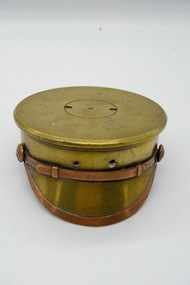 Lara RSL Sub Branch
18 Pounder shell ashtray, Souvenir, 1927
... homes. Such objects were embodied with personal experiences of war, later to become objects textured with memory, remembrance, and longing – attributes that clearly go beyond an object’s form and function. The head-stamp of these particular shells displays the British broad arrow and the initials ‘EOC’ indicates that they were made at the Elswick Ordnance Company, England; the initials ‘CF’ signal that the charge was loaded with cordite, a standard propellant. Spent shells were illicitly scavenged from massive mounds by both soldiers and civilians alike to become personal souvenirs or to swap or sell. Spent artillery shells were crafted ...Artillery shells were designed to be recycled and spent shells were returned to the munitions factory for re-filling, a mark engraved upon the head-stamp at each re-filling. Millions upon millions of shells were recycled and re-fired. Relationships with ‘objects’ were forged as recycled objects of conflict were welcomed into people’s homes. Such objects were embodied with personal experiences of war, later to become objects textured with memory, remembrance, and longing – attributes that clearly go beyond an object’s form and function. 18-Pounder Artillery Shells: The Great War Recycled and Re-Circulated Categories :Material Culture Machine Subscribe Share on facebook Share on twitter The intention of war is to kill, to maim and to destroy using, for example, the agency of 18-pounder artillery shells (so-called because they weighed 18 pounds). The shells were loaded in to the 18-pounder field guns used by the Royal Artillery and targeted to destroy German batteries and trenches as well as to shoot down aeroplanes. Horse-drawn field gun, Canal du Nord, France. Taken by First World War photographer David McLellan. Available via the National Library of Scotland as CC BY-NC-SA Horse-drawn field gun, Canal du Nord, France. Taken by First World War photographer David McLellan. Available via the National Library of Scotland as CC BY-NC-SA In Under Fire, Henri Barbusse recounts how the incessant and diabolical din of war constantly bombarded the soldier body with the unendurable noise of bursting shells that caused pain to the ears (Barbusse 2010 [1933]: 207). The noise was so ‘monstrously resounding’ that one felt ‘annihilated by the mere sound of the downpour of thunder’ (Barbusse 2010 [1933]: 206). Artillery shells were designed to be recycled and spent shells were returned to the munitions factory for re-filling, a mark engraved upon the head-stamp at each re-filling. Millions upon millions of shells were recycled and re-fired. A mound of spent shell cases, Nord, Nord-pas-de-Calais, France. Taken by war photographer, Tom Aitken, 1918. Available via the National Library of Scotland as CC BY-NC-SA. A mound of spent shell cases, Nord, Nord-pas-de-Calais, France. Taken by war photographer, Tom Aitken, 1918. Available via the National Library of Scotland as CC BY-NC-SA. People’s experience of the First World War did not end with the armistice. Whilst the noise of the artillery had ceased, the noise of war was remembered. Harry Patch on arriving home injured recalled being ‘jumpy for a while’ with the least noise prompting him to dive for cover (2009: 114). Something else materialised. Relationships with ‘objects’ were forged as recycled objects of conflict were welcomed into people’s homes. Such objects were embodied with personal experiences of war, later to become objects textured with memory, remembrance, and longing – attributes that clearly go beyond an object’s form and function. The head-stamp of these particular shells displays the British broad arrow and the initials ‘EOC’ indicates that they were made at the Elswick Ordnance Company, England; the initials ‘CF’ signal that the charge was loaded with cordite, a standard propellant. Spent shells were illicitly scavenged from massive mounds by both soldiers and civilians alike to become personal souvenirs or to swap or sell. Spent artillery shells were crafted, often using a hammer and a bent nail. The crafting of trench art reflects the construction of an identity that offers momentary relief from the hell experienced in the trenches. The lid of an 18Pounder shell which has been adapted for use as an ash tray.Lot 27 1927, 18Pr, III, EOC, C/F, Defence broad arrow, -
 Ballarat Clarendon College
Book, The watches of the trails
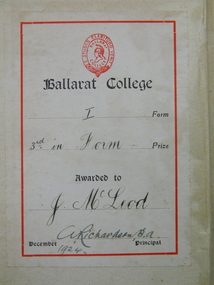
... He had good crafting skills and built a series of steam driven boats for his four children that used to be sailed at home on Lake Wendouree, Lake Learmonth and on the sheltered waters of the Barwon River. ...He had good crafting skills and built a series of steam driven boats for his four children that used to be sailed at home on Lake Wendouree, Lake Learmonth and on the sheltered waters of the Barwon River. ...John Anning MacLeod John was born in Ballarat as the second generation of Ballarat MacLeod’s, with his grandfather arriving in Geelong on the Hornet in 1857 as an 11 year old child with his 60 year old father John and mother Mary aged 37 years and 5 brothers and one sister. He grew up on the corner of Drummond Street and Mair Streets, opposite what became St John of God hospital, at his parents house of Dunvegan. John entered Ballarat College as a junior student in 1923. He received 3rd in Form prizes in both 1924 and 1925. His sister Margaret, attended Clarendon Ladies College. The household employed a chauffeur, a cook, a gardener and a ladies maid to care for them. In the 1930’s his father lost his fortune in the collapse of the jute future’s market so the staff were dismissed and he left Ballarat to go to Geelong College as a boarder. He was an officer in the Geelong College cadet corps and joined the Army as a private and rose to the permanent rank of Major after meritorious performance in the intelligence area of operations. He served in North Africa, in Palestine, Egypt, Moratai, the Philippines, Java and New Guinea. He was awarded his Military MBE by King George VI for exceptional devotion to duty and for brilliant coordination work amongst the allied intelligence team. During the war he met Mary Monica Carrol Bateman, a lietenant in the 2/4th Army General Hospital at a dinner party in Brisbane. The couple had four children, Hamish John Torquil born in 1945, Rory Hugh Alexander born in 1947 and twins Ian Donald and Katriona Margaret born in 1948. After the Second World War he worked for Lumley’s Insurance Brokers in London for a couple of years to follow up his accountancy training and then returned to Ballarat due to his father’s failing health and took over the management of John MacLeod and Co, Wholesale grocers and Merchants in Lydiard Street, Ballarat. The business had been started by his great grandfather and they produced the famous Sirdar brand of products and a special tea blend called Afternoon Cup. There was a spice mill in nearby Market Street and there they roasted peanuts, coffee and ground spices for packaging and distribution to the small corner shops who were the mainstay of commercial grocery. In the 1950’s John MacLeod and Co merged with James McKay and Sons to form McKay MacLeod Pty Ltd., wholesale tobacco, wine and spirits and grocery merchants who also manufactured the Sunny South brand of sweet mustard pickles, brewed vinegar and tomato sauce. He introduced the semi-automated system for extensions and financial records on the Bradma plates that saved staff the problems of sorting out the calculations for sales tax, miscellaneous charges etc. that greatly sped up the transactions at the checkout points. A new warehouse and office complex was built in Mair Street east up near Humffray Street, with the manufacturing factory on the opposite side of the street. They had a shop in St Arnaud and one in Geelong which was the local wholesaler for supplying to the corner shops of the greater Geelong area. With the development of supermarkets the demise of the corner store began and so the sales profiles began to diminish. He unsuccessfully stood for Liberal Party pre-selection for the seat of Ballarat in 1948 and served on the Liberal state finance and executive team for many years before resigning over the issue of conscripts being sent to Vietnam. He was instrumental in leading a group of Ballarat academics in opposition to the Vietnam war and publicly resigned from the Liberal Party over their foreign policy. John MacLeod saw the writing on the wall of the business in the early 1970’s and suggested that the firm restructured with focusing on tobacco, wine and spirits. His partners did not agree and so he sold out and retired to Barwon Heads. After a few years of golfing and surfing he became frustrated and joined SCORE, the Service Corp of Retired Executives. In this role he worked for ten years in the Geelong area solving accounting problems for Geelong small businesses and so helped Beaumont’s bakery back onto its feet. He worked gentlemen’s hours of 10 am to 3 pm which allowed him to have time for a round of 9 holes on the golf course at the end of the day and to have a surf before breakfast. He fully retired at the age of 65 and had ten years of voluminous reading of local library books before dying of burns at the age of 75. His war record has been documented in other archives at the College. He was a member of the Naval and Military Club and of the Barwon Heads Golf Club. He had good crafting skills and built a series of steam driven boats for his four children that used to be sailed at home on Lake Wendouree, Lake Learmonth and on the sheltered waters of the Barwon River. The boats are now being restored to operational order to be sailed by his great grandson Grayson Girardi. Red cloth bound book with title printed in gold lettering on spine, embossed publisher's mark centre of front cover and school crest in gold relief on front cover; book plate inside front cover. Book plate inside front cover: School crest / Ballarat College / I form / 3rd in form Prize / Awarded to / J MacLeod / December 1924 A Richardson B A Principaljohn-macleod, ballarat-college, book-prize, 1924 -
 Ballarat Clarendon College
Book, The school across the road
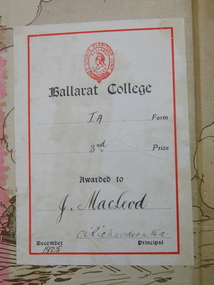
... He had good crafting skills and built a series of steam driven boats for his four children that used to be sailed at home on Lake Wendouree, Lake Learmonth and on the sheltered waters of the Barwon River. ...He had good crafting skills and built a series of steam driven boats for his four children that used to be sailed at home on Lake Wendouree, Lake Learmonth and on the sheltered waters of the Barwon River. ...John Anning MacLeod John was born in Ballarat as the second generation of Ballarat MacLeod’s, with his grandfather arriving in Geelong on the Hornet in 1857 as an 11 year old child with his 60 year old father John and mother Mary aged 37 years and 5 brothers and one sister. He grew up on the corner of Drummond Street and Mair Streets, opposite what became St John of God hospital, at his parents house of Dunvegan. John entered Ballarat College as a junior student in 1923. He received 3rd in Form prizes in both 1924 and 1925. His sister Margaret, attended Clarendon Ladies College. The household employed a chauffeur, a cook, a gardener and a ladies maid to care for them. In the 1930’s his father lost his fortune in the collapse of the jute future’s market so the staff were dismissed and he left Ballarat to go to Geelong College as a boarder. He was an officer in the Geelong College cadet corps and joined the Army as a private and rose to the permanent rank of Major after meritorious performance in the intelligence area of operations. He served in North Africa, in Palestine, Egypt, Moratai, the Philippines, Java and New Guinea. He was awarded his Military MBE by King George VI for exceptional devotion to duty and for brilliant coordination work amongst the allied intelligence team. During the war he met Mary Monica Carrol Bateman, a lietenant in the 2/4th Army General Hospital at a dinner party in Brisbane. The couple had four children, Hamish John Torquil born in 1945, Rory Hugh Alexander born in 1947 and twins Ian Donald and Katriona Margaret born in 1948. After the Second World War he worked for Lumley’s Insurance Brokers in London for a couple of years to follow up his accountancy training and then returned to Ballarat due to his father’s failing health and took over the management of John MacLeod and Co, Wholesale grocers and Merchants in Lydiard Street, Ballarat. The business had been started by his great grandfather and they produced the famous Sirdar brand of products and a special tea blend called Afternoon Cup. There was a spice mill in nearby Market Street and there they roasted peanuts, coffee and ground spices for packaging and distribution to the small corner shops who were the mainstay of commercial grocery. In the 1950’s John MacLeod and Co merged with James McKay and Sons to form McKay MacLeod Pty Ltd., wholesale tobacco, wine and spirits and grocery merchants who also manufactured the Sunny South brand of sweet mustard pickles, brewed vinegar and tomato sauce. He introduced the semi-automated system for extensions and financial records on the Bradma plates that saved staff the problems of sorting out the calculations for sales tax, miscellaneous charges etc. that greatly sped up the transactions at the checkout points. A new warehouse and office complex was built in Mair Street east up near Humffray Street, with the manufacturing factory on the opposite side of the street. They had a shop in St Arnaud and one in Geelong which was the local wholesaler for supplying to the corner shops of the greater Geelong area. With the development of supermarkets the demise of the corner store began and so the sales profiles began to diminish. He unsuccessfully stood for Liberal Party pre-selection for the seat of Ballarat in 1948 and served on the Liberal state finance and executive team for many years before resigning over the issue of conscripts being sent to Vietnam. He was instrumental in leading a group of Ballarat academics in opposition to the Vietnam war and publicly resigned from the Liberal Party over their foreign policy. John MacLeod saw the writing on the wall of the business in the early 1970’s and suggested that the firm restructured with focusing on tobacco, wine and spirits. His partners did not agree and so he sold out and retired to Barwon Heads. After a few years of golfing and surfing he became frustrated and joined SCORE, the Service Corp of Retired Executives. In this role he worked for ten years in the Geelong area solving accounting problems for Geelong small businesses and so helped Beaumont’s bakery back onto its feet. He worked gentlemen’s hours of 10 am to 3 pm which allowed him to have time for a round of 9 holes on the golf course at the end of the day and to have a surf before breakfast. He fully retired at the age of 65 and had ten years of voluminous reading of local library books before dying of burns at the age of 75. His war record has been documented in other archives at the College. He was a member of the Naval and Military Club and of the Barwon Heads Golf Club. He had good crafting skills and built a series of steam driven boats for his four children that used to be sailed at home on Lake Wendouree, Lake Learmonth and on the sheltered waters of the Barwon River. The boats are now being restored to operational order to be sailed by his great grandson Grayson Girardi. john-macleod, ballarat-college, 1925, book-prize
