
Showing 50 items matching "home gardening"
-
 University of Melbourne, Burnley Campus Archives
Book - Reference Book, A. G. Kennelly, The Home Vegetable Garden, 1958
... ...home gardening...vegetables vegetable growing new zealand home gardening Book with light cardboard cover. ...Book with light cardboard cover. Bulletin No. 342 New Zealand Department of Agriculture 1958 by A. G. Kennelly, Vegetable Instructor, Department of Agriculture, Dunedin. Contains general information about vegetable growing and vegetables are listed alphabetically.vegetables, vegetable growing, new zealand, home gardening -
University of Melbourne, Burnley Campus Archives
Book, Royal Horticultural Society, The Vegetable Garden Displayed, 1959
... ...home gardening...vegetables vegetable growing home gardening royal horticultural society allotments wisley Book with light cardboard cover. ...Book with light cardboard cover. Produced by the Royal Horticultural Society, London. Eleventh Impression 365th thousand, 1949. Very detailed descriptions of how to plant out gardens or allotments. Individual vegetables described. Photographs from Wisley, Surrey.vegetables, vegetable growing, home gardening, royal horticultural society, allotments, wisley -
 Bendigo Historical Society Inc.
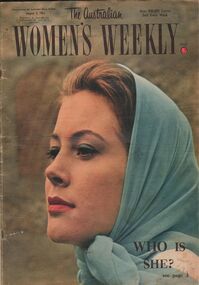
Magazine - AILEEN AND JOHN ELLISON COLLECTION: AUSTRALIAN WOMEN'S WEEKLY AUGUST 2, 1961
... Contents: Maternity fashions - spring diet recipes and calorie counter - it seems to me - Letter box - clever bird contest results - Your bookshelf - Crossword - Stars - 2,000 pounds canned fruits recipe contest - At home - Gardening - Home plans - Prize recipe - There's always tomorrow - Where the cloud breaks - The incredible journey - A whisper, a kiss - Television parade - Fashion frocks - Fashion patterns....Contents: Maternity fashions - spring diet recipes and calorie counter - it seems to me - Letter box - clever bird contest results - Your bookshelf - Crossword - Stars - 2,000 pounds canned fruits recipe contest - At home - Gardening - Home plans - Prize recipe - There's always tomorrow - Where the cloud breaks - The incredible journey - A whisper, a kiss - Television parade - Fashion frocks - Fashion patterns. ...The Australian Women's Weekly from August 2, 1961 On the cover, Australian model Heather Johns showing a remarkable similarity to Grace Kelly. Contents: Maternity fashions - spring diet recipes and calorie counter - it seems to me - Letter box - clever bird contest results - Your bookshelf - Crossword - Stars - 2,000 pounds canned fruits recipe contest - At home - Gardening - Home plans - Prize recipe - There's always tomorrow - Where the cloud breaks - The incredible journey - A whisper, a kiss - Television parade - Fashion frocks - Fashion patterns.books, magazines, women's magazine -
 Whitehorse Historical Society Inc.
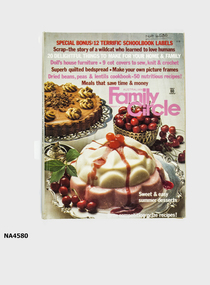
Magazine, 24/02/1978 12:00:00 AM
... Family Circle Magazine, special cooking features, craft, sewing, needlework, health and beauty, gardening, home companion and family health....books magazines Family Circle Family Circle Magazine, special cooking features, craft, sewing, needlework, health and beauty, gardening, home companion and family health. Magazine Magazine ...Family Circle Magazine, special cooking features, craft, sewing, needlework, health and beauty, gardening, home companion and family health.Family Circlebooks, magazines -
 Bendigo Historical Society Inc.
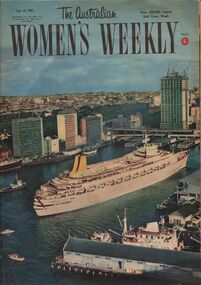
Magazine - AILEEN AND JOHN ELLISON COLLECTION: AUSTRALIAN WOMEN'S WEEKLY JULY 19 1961
... Content: Woollen handbag to make - The Jacky Kennedy story - Tropical fish - Home dressmaking - You have a right to be unhappy - At home - Cookery - Cookery course - Bedjacket to knit - Collectors corner - Prize recipes - Home plans - Gardening - Television - Films - Learning about husbands - That fickle feeling - Edge of the sea - The case of the duplicate daughters - Dress sense - Fashion frocks - Fashion patterns - it seems to me - Worth reporting - Your bookshelf - Letter box - Australian nature - Crosswords - Stars....Content: Woollen handbag to make - The Jacky Kennedy story - Tropical fish - Home dressmaking - You have a right to be unhappy - At home - Cookery - Cookery course - Bedjacket to knit - Collectors corner - Prize recipes - Home plans - Gardening - Television - Films - Learning about husbands - That fickle feeling - Edge of the sea - The case of the duplicate daughters - Dress sense - Fashion frocks - Fashion patterns - it seems to me - Worth reporting - Your bookshelf - Letter box - Australian nature - Crosswords - Stars. ...The Australian Women's Weekly from July 19, 1961. On the cover a picture of the P&O liner Canberra berthing at the new terminal at Circular Quay after her maiden voyage from Southampton. Content: Woollen handbag to make - The Jacky Kennedy story - Tropical fish - Home dressmaking - You have a right to be unhappy - At home - Cookery - Cookery course - Bedjacket to knit - Collectors corner - Prize recipes - Home plans - Gardening - Television - Films - Learning about husbands - That fickle feeling - Edge of the sea - The case of the duplicate daughters - Dress sense - Fashion frocks - Fashion patterns - it seems to me - Worth reporting - Your bookshelf - Letter box - Australian nature - Crosswords - Stars.books, magazines, women's magazine -
 Eltham District Historical Society Inc
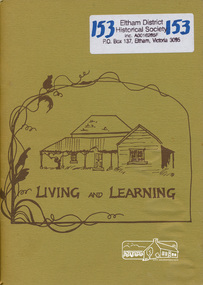
Book, Clipper Press, Living and Learning, 1977
... Subjects include enrolment day, bee keeping, Bridge Club,Carpentry and woodcarving, looking and sharing, creative dancing, crochet, dressmaking, film making, Friends of the Creek, Diamond Creek, accessibility, hair cutting, herb gardening, home handyman skills, homestead cooking, living with goats, native plants, North Riding Project, gardening, painting, playhouse, play reading, puppetry, sculpture, spinning, weaving, winemaking and yoga. ...Subjects include enrolment day, bee keeping, Bridge Club,Carpentry and woodcarving, looking and sharing, creative dancing, crochet, dressmaking, film making, Friends of the Creek, Diamond Creek, accessibility, hair cutting, herb gardening, home handyman skills, homestead cooking, living with goats, native plants, North Riding Project, gardening, painting, playhouse, play reading, puppetry, sculpture, spinning, weaving, winemaking and yoga. ...Shire of Eltham Living and Learning Centre is located at 739 Main Road, Eltham. The purpose of the Centre is: To provide an opportunity to come together individually and in groups in an atmosphere of equality, sharing their skills and experiences in order to improve the quality of their living. Tutors are not paid and fees are not charges on the understanding that the idea of sharing and co-operating spreads and everyone enjoys the results. This book was compiled by volunteers involved at the centre recording feelings, views of their experiences within the groups at the centre. It includes recipes, poems, stories and sketches, some of local scenes. It also includes an early history of the Centre compiled by the first Co-ordinator. Subjects include enrolment day, bee keeping, Bridge Club,Carpentry and woodcarving, looking and sharing, creative dancing, crochet, dressmaking, film making, Friends of the Creek, Diamond Creek, accessibility, hair cutting, herb gardening, home handyman skills, homestead cooking, living with goats, native plants, North Riding Project, gardening, painting, playhouse, play reading, puppetry, sculpture, spinning, weaving, winemaking and yoga. This book is significant in documenting the early history of the Eltham Living and Learning centre including the concepts of community co-operation and life-long learning for adults. It connects the current users of the Centre and the wider community with this local history which is part of the character represented in the twentieth century history of the Eltham area. Softcover [64] p.eltham living and learning centre, co-operative, education -
 City of Melbourne Libraries
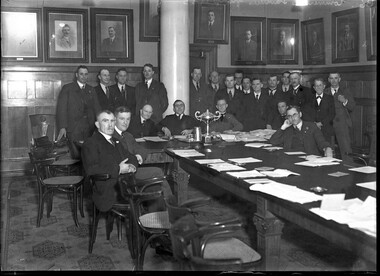
Photograph, Bull, Hugh Jones, 1897-1993, Commercial Travellers' Association, Victoria, Board Room
... And in case we forget that members had a home away from their CTA home, gardening tips with “The C.T. as Gardener”column. ...And in case we forget that members had a home away from their CTA home, gardening tips with “The C.T. as Gardener”column. ...Seven seated and fifteen standing men dressed in suits around a long table in a panelled room hung with formal portraits of men. A trophy sits on the long table amongst loose paper sheets. Research by project volunteer, Fiona Collyer: The Commercial Travellers’ Association of Victoria (CTA) was formed at a meeting of 40 commercial travellers held at the Duke of Rothesay Hotel, 24 Elizabeth Street on 1 December 1880. Their charter was to advocate for better working conditions for commercial travelling salesmen, including improved accommodation at discounted rates and travel concession fares. At first by locomotive, horse and buggy, steamers and horseback, later also by motor car and motorcycle, “The Man on the Road” went into the back-blocks of the country to extend the interests of commerce to the stores and households of Australian regional towns and isolated settlements. Affiliated organisations existed in all states and New Zealand and in 1895 they integrated to form the United Commercial Travellers’ Association of Australasia (UCTAA). By the turn of the 20th century, the Victorian branch of the CTA had 421 Association Members and 520 Club members. The CTA continued to hold meetings in leased rooms in hotels and offices until 1898 when they commissioned purpose-built premises at 190-192 Flinders Street (extant, now the Macstore, next to former Metropolitan Gas Company Buildings). Designed by leading architectural firm of brothers H.W. & F.B.Tompkins (Dimmey’s Model Store, Swan Street, London Stores, Herald and Weekly Times, Myer building, Diamond House, Centreway Arcade, Manton’s Store) in the Queen Anne Revival style at the cost of £20,000, the four storey building had a facade of red Northcote bricks and an entrance of Pyrmont stone. It was very modern for the time, featuring elevators, offices, bars, kitchen, dining, card and billiard rooms and 31 bedrooms with shared bathrooms for the footsore travellers. However, despite adding two storeys in 1901, and another storey and a basement in 1905, they soon outgrew their premises, and in 1912 the CTA commissioned a new building at 328 Flinders Street. At this time, buildings in Melbourne were constrained by the city height limit of 132 feet (40 metres)- the maximum height of firefighting ladders. The new CTA building was the tallest building in Melbourne until 1932 when regulations changed allowing the Manchester Unity Building to be built. The new CTA headquarters was the epitome of comfort and luxury with cutting edge facilities to ease the fatigued salesman and prepare him for another stint on the road. General Secretary, James Davies travelled to Britain and America to acquire the very best and latest innovations. After visiting the new premises, Punch magazine 11 June 1914 reported “furnishings, appliances, and labour-saving conveniences which were more than up to date- they were up to-morrow.” The Edwardian Baroque style building was again designed by architects H.W. & F.B. Tompkins at the cost of £100,000 and built by contractors F.E. Shillabeer and Sons (Nicholas Building, Kellow-Falkiner Pty Ltd car showroom). The nine storey plus basement building is of steel frame construction with concrete floors. The ground floor facade is of grey granite and above that it is faced with cream glazed bricks chosen to combat discolouration from the pollution emitted by Flinders Street Station trains across the road. The facade is decorated with mascarons, gum leaf trim and balconies with classical style balustrade. The club was entered through revolving doors into a two storey high, circular, domed lobby with white columns, American oak panelled walls and intricate mosaic flooring. The ceiling is festooned with plaster gum leaf and gum nut detail, a theme that is repeated throughout the building. The basement kitchen had modern, labour saving appliances that would be the envy of any Edwardian housewife, including an electric toaster, a potato peeling machine, heated dumb waiter, dishwashing machine and electric refrigeration and cooking. It serviced the commodious second floor dining room which seated 200 people and the cafe/breakfast room, 80 people. Members were permitted to entertain their lady friends there for afternoon tea between the hours of 3 and 5 pm every day, except Sunday. The members’ facilities included a barbershop, clothes pressing machine, boot cleaning chair, pipe and cigar stall with electric humidor, public telephones, lockers and safe deposit. The building was serviced with five elevators, a built in vacuum cleaning plant, hot water radiators and linen and postal chutes. The first floor was devoted to business and relaxing, containing the Board, Writing, Reading and four Business Rooms. The board room had Queensland maple panelling with huge blackwood tables topped with blue morocco and golden tortoise-shell trim and cane bottomed chairs. Large framed photographs of past presidents since 1884 lined the walls. The Reading Room ran the whole width of the building. Arthur Streeton’s painting “Between the Lights, Princes Bridge 1888” and Frederick McCubbin’s “Looking North from Mount Macedon” were hung there, as well as paintings by renowned Australian artists Hans Heysen, Walter Withers, John Mather, Jan Hendrik Scheltema. The Argus 30 May 1914 quipped “Around the walls hang evidences that the commercial traveller's soul has not been killed in his pursuit of commerce”. The blackwood panelled room was furnished with Queen Anne style tables and chairs and green leather armchairs with inviting rocker foot rests allowing weary travellers to relax after traversing the railways and dusty roads of Victoria while planning their next sales trip. “The Australasia Traveller” Volume 10, Number 2, April 1914 page 35 noted “An attendant will be constantly employed on this floor to take care of the stationary supply, to tidy up newspapers, and generally study the convenience of members.” The third floor was for amusements with billiards, a bar and four rooms for playing cards, dominoes and chess. The huge billiard room had seven Alcock billiard tables including a table in a partitioned match-room for tournaments, exhibitions and matches. The walls were lined with members’ cues and for spectators, comfortable lounges with marble topped tables and electric bell pushes for drinks service. There were 150 bedrooms over five floors, each with their own telephone and wash basin and five suites with a private sitting room attached. There were four bathrooms per bedroom floor and capacious, well-lighted shaving rooms. Top rate club tariff for bed and breakfast - 6 shillings, if called for a country train leaving Melbourne before 8am - 4 shillings, suite and breakfast- 9 shillings, sixpence. “The Australasia Traveller” Volume 10, Number 2, April 1914 page 35 reported “All “early calls” will be made from the Club Office to Bedrooms by means of the Telephone, so that instead of waking everybody else up on the corridor, only the member concerned will know that it is his unpleasant duty to get up.” The new CTA premises was widely regarded as the finest club in the Southern Hemisphere. The CTA also built the adjacent six storey Commerce House with 52 sample rooms for travellers to display their wares with the remainder rented to retail businesses and a post and telegraph office. After the CTA moved into their new, larger premises in 1914, neighbouring department store Ball & Welch expanded into the former CTA. The CTA saw themselves in a nation building role and were an influential lobby group to the Government. They advocated for inter city trunk telephone lines, standard gauge railway lines between NSW and Victoria, improved roads and highways, the Murray River water scheme and maintaining the White Australia Policy. They were very active in fund raising for the war efforts. The CTA offered its members support in other ways with benevolent funds for widows and orphans, mortuary, accident, sickness and an annuities fund for members over 65 years. There were scholarships for members’ children and home purchase scheme to assist with home ownership. A secondary membership scheme provided access to non commercial travellers (men only) to its exclusive club premises. They also organised social events and activities such as billiard tourneys, golf tournaments, dances and an annual “Smoke Social” which was a social event where men gathered for a formal dinner, community singing, lectures, speeches and of course, to smoke! Daylesford born James Davies OBE, (1865-1931) worked at the CTA for 50 years, starting as an office boy and working his way up to General Secretary and editor of the monthly trade journal for UCTAA members, “The Traveller” (1890-1905, later “The Australasian Traveller” 1905-1924 and then “The Australian Traveller” 1925-1976) and the annual colour supplement magazine “Australia To-Day” (1904-1973). “The Australasia Traveller” featured commentary on the issues of the day like wars, tariffs and trade, articles on new products and hotel recommendations and their rates and lots of advertising, especially alcohol, tobacco and accommodation in regional hotels. There were regular columns, each illustrated with a line drawing and these included “Our Immigration Record” a state by state summary of arrivals of “desirable immigrants” to Australia, while bemoaning the declining (white) birth rate. The column followed the arrival of British boys sent to Australia as agricultural apprentices to work on rural properties which were short of labour. Between 1913-1928, 1750 “Barwell Boys”, some as young as 14 years of age arrived in South Australia to work. NSW had a similar program known as the Dreadnaught Boys Scheme where 5595 boys immigrated between 1911-1939. The boys were considered of “good British stock”. There was a “Home Page For The Ladies” showcasing the latest fashions in women’s clothing, millinery and hairstyles and tips and trends in home furnishings.“Children’s Corner for Dear Little Folks” which featured puzzles, jokes and stories and members could send in photographs of their children. “Road Echoes” devoted to “The Man On The Road” and his doings. “Face Massage, Smiling is the Best Face Massage”, the humour page full of jokes and funny stories. “Railway Rumbles” news of innovations, timetables, tickets and grumbles about lavatories, food and drinking water on trains and at railway stations. And in case we forget that members had a home away from their CTA home, gardening tips with “The C.T. as Gardener”column. The annual magazine “Australia To-Day” was a vehicle to promote Australia here and overseas as a modern, prosperous country with abundant opportunities and pleasant climate. It sought to showcase its manufacturing, agriculture and tourism and encourage British immigration to Australia. The magazine featured articles about recently arrived migrants at work, quirky native flora and fauna, beach culture, recreation and the Australian way of life in the settler nation. Many of the articles were written by politicians of the day, including Robert Menzies. The UCTAA commissioned original artwork for the front covers and feature articles of “Australia To-day” from leading Australian artists. These included Norman Lindsay, Frederick McCubbin, Napier Waller, Lionel Lindsay, Hans Heysen, C Dudley Wood, Louis McCubbin, Penleigh Boyd, Louis Buvelot, Christian Waller and Ellis Rowan and her Australian wildflowers. Some of the photographs in “Australia To-Day” were provided by state and federal government departments as well as manufacturers, newspapers and mining companies. Amongst of the credited photographers was Helmut Newton who later earned world acclaim as a fashion photographer and architectural and industrial photographer Wolfgang Sievers (unfortunately their photographs remain in copyright and aren’t available online). Also featured was Richard C. Strangman, a professional photographer from Canberra, William Howieson of Melbourne, who has 22 photographs in the collection of NGV, Tasmanian wilderness photographer Frederick Smithies, Athol Shmith, portrait photographer and educator from Melbourne, Gordon de Lisle, a Melbourne commercial, industrial, aerial and society portrait photographer. (One of Gordon’s assignments was as the stills photographer for the 1959 movie “On The Beach” filmed in Melbourne). Photographs taken by acclaimed Antarctic and official war photographer Captain Frank Hurley OBE for Adelaide’s Centenary were also featured. The Australian Government was keenly aware of the influence and quality of the UCTAA publications. On 1 June 1914 The Age reported that to advertise Australia in Great Britain and elsewhere, the Department of External Affairs purchased 6500 copies of “Australia To-Day” magazine for £515 to distribute free to “places where they are most likely to come under the notice of a desirable class of immigrants.” In 1950, the office of Prime Minister Robert Menzies ordered 2550 copies of that year’s issue of “Australia To-Day” for the Department of Commerce and Information to distribute. The CTA donated their archives to University of Melbourne Archives which includes original artworks and photos used in “Australia To-Day” (Melbourne University has digitised 1114 photos) and sundry items including trophies, ashtrays, commemorative souvenirs, menus, a rare “Safechek” sovereign changer, a bust of James Davies and even a CTA embossed wash bowl and chamber pot. After the death of General Secretary James Davies in 1931, the CTA held the annual “James Davies Memorial Cup” golf tournament at various Melbourne golf courses, the winner receiving a splendid silver cup. “Table Talk” magazine photographs from 29 June 1933 depict the travellers beautifully (and I would say correctly) attired in tweedy plus fours, Fair Isle knitwear, flat caps and of course fringed brogues. I have been unable to ascertain whether the trophy in our photo is for golf or another CTA social activity. The CTA Victoria membership peaked in 1951 with 4,672 Aassociation members and 3,693 Club members. In 1959, Hollywood came to Melbourne when film stars Gregory Peck, Ava Gardner, Anthony Perkins and Fred Astaire descended to film ‘On the Beach,’ directed by Stanley Kramer. The film is based on the bestselling Neville Shute novel about the aftermath of World War Three, a nuclear war that has obliterated most of the Northern Hemisphere. Radioactive dust is heading toward Australia and everyone is preparing for death. Scenes with Anthony Perkins were filmed in the CTA billiards room as the exclusive Pastoral Club. Anthony Perkins’ character, Lieutenant Commander Peter Holmes of RAN tells Gregory Peck’s character, Commander Dwight Lionel, that The Pastoral Club is…”A mahogany and polished brass sort of place-some people claim it was the stuffiest club in the Commonwealth” before assuring him that despite shortages, the club is likely to have some Scotch left. In a scene at the Pastoral Club two, old (probably red faced) codgers discuss the challenge of drinking all of the 400 bottles of Gould Campbell vintage port in the club wine cellar before they succumb to radiation sickness in five months time. The NGV has 12 photographs in their collection of wardrobe stills of Ava Gardner modelling costumes designed by the Fontana Sisters of Rome for “On The Beach”, taken by Italian photographer G.B.Poletto. During the filming, Gregory Peck and his family stayed at “Kurneh” 206 Domain Road, South Yarra, the former home of three times Grand Slam winner Norman Brookes. Through the decades, Australian society was changing and in order to stay relevant, the CTA had to change too. In 1971, two women were elected for club membership, although they were only granted limited access to the club’s facilities and in 1972, women were invited for the first time to participate in the previously men only annual “Smoke Social”. In 1975, dwindling membership forced the closure of The Commercial Travellers’ Association building and in 1977, the building was sold, with the CTA ceasing to operate in 2014. It was the end of the road for the “Knights of the Road”. In 1992, the CTA building at 328 Flinders Street was placed on the Victorian Heritage Register in recognition of its architectural and cultural significance. The building has been meticulously restored with many of the original fittings, decorative plasterwork, mosaic flooring, stained glass windows, columns, chandeliers and the panelling made from Australian timbers retained. After renovations the building became first the Euro Asia Hotel, then the Duxton Hotel and in 2005 The Rendezvous Hotel, Melbourne. In tribute to the history of the building and the film “On The Beach”, the Rendezvous Hotel has the Ms Ava Bar, Perkins room, Mr Tompkins restaurant, Commerce Room and the Davies Room. References: COMMERCIAL TRAVELLERS' ASSOCIATION OF VICTORIA. (1899, May 27). The Australasian (Melbourne, Vic. : 1864 - 1946), p. 25. Retrieved February 21, 2025, from http://nla.gov.au/nla.news-article138615498 COMMERCIAL TRAVELLERS. (1914, May 30). The Argus (Melbourne, Vic. : 1848 - 1957), p. 8. Retrieved February 13, 2025, from http://nla.gov.au/nla.news-article7272511 NEWS OF THE DAY. (1914, June 1). The Age (Melbourne, Vic. : 1854 - 1954), p. 8. Retrieved February 19, 2025, from http://nla.gov.au/nla.news-article189414314 COMMERCIAL TRAVELLERS' "AT HOME." (1914, June 11). Punch (Melbourne, Vic. : 1900 - 1918; 1925), p. 32. Retrieved March 19, 2025, from http://nla.gov.au/nla.news-article129699692 https://archives.library.unimelb.edu.au/nodes/view/69669 https://vhd.heritagecouncil.vic.gov.au/places/757 http://www.pikitiapress.com/blog/2015/1/26/australia-today Commercial Travellers at Yarra Yarra (1933, June 29). Table Talk (Melbourne, Vic. : 1885 - 1939), p. 6. Retrieved February 28, 2025, from http://nla.gov.au/nla.news-article149547845 https://archives.library.unimelb.edu.au/nodes/view/537460 https://viewer.slv.vic.gov.au/?entity=IE7420895&file=FL19171568&mode=browse https://www.history.sa.gov.au/wp-content/uploads/2021/03/Barwell_Boys_Catalogue-compressed-compressed-compressed.pdf Australia Today," 1927 (1926, December 11). Weekly Times (Melbourne, Vic. : 1869 - 1954), p. 15. Retrieved March 17, 2025, from http://nla.gov.au/nla.news-article223844810 https://blogs.unimelb.edu.au/librarycollections/2020/12/19/an-inhabited-space-helmut-newtons-lovers/ https://www.ngv.vic.gov.au/explore/collection/artist/2075/ https://www.ngv.vic.gov.au/?s=Poletto+&type=collection https://rendezvousmelbourne.com.au/digital-history-tour/Photographer notations on slide: "Commercial Travellers Group B6".clubs, department stores, 1930-1939, commerce, manufacturing, federation/edwardian style architecture, railways, tourism, games, agriculture -
 The Beechworth Burke Museum
Audio - Oral History, Jennifer Williams, Evelyn Jensen, 13th April 2000
... home for a bath. On wash day, they washed their clothes in the creek too. Miss Jensen never married but continued to provide for her family. She spent her days gardening...home for a bath. On wash day, they washed their clothes in the creek too. Miss Jensen never married but continued to provide for her family. She spent her days gardening ...Miss Evelyn Jensen was born in 1908 near Mytleford Road in Beechworth. Miss Jensen was a twin but she also had twelve brothers and sisters. Miss Jensen went to school when she was nine years old but did not enjoy it. Her father was a nozzleman and had a role in finding and collecting gold. More specifically, a nozzleman operated a steel barrel with an interchangeable brass nozzle that sprayed high pressure water onto rock and similar surfaces. This broke down the surface for gold to be found. Unfortunately, when he began most of the gold was already gone. Miss Jensen's mother died when Miss Jensen was sixteen. As a result, Miss Jensen had to take care of the children and run the house. This included looking after a few months old baby. Her father was away at work most days so all of the responsibility fell on her. Her grandmother was present but she was too old to help Miss Jensen. Miss Jensen and her family lived a very long way from the main town and often had to carry kerosene tins full of water half a mile to their house. This was because they have no access to water at their home. This lack of water also meant they had to either bathe in the creek or carry the water back home for a bath. On wash day, they washed their clothes in the creek too. Miss Jensen never married but continued to provide for her family. She spent her days gardening and cooking. They did not have much money so gardening was a way that they provided food for themselves. This oral history recording was part of a project conducted by Jennifer Williams in the year 2000 to capture the everyday life and struggles in Beechworth during the twentieth century. This project involved recording seventy oral histories on cassette tapes of local Beechworth residents which were then published in a book titled: Listen to what they say: voices of twentieth century Beechworth. These cassette tapes were digitised in July 2021 with funds made available by the Friends of the Burke.Miss Jensen's oral history is significant because it demonstrates the struggles of living remotely during this early part of the twentieth century. When Miss Jensen's mother died, she had to take on a lot of responsibility and did not have much support. This history sheds light on these struggles of being a young caregiver but it also gives details on how large families lived in isolated places. An example of this is the way that Miss Jensen often had to do the washing in the creek because that was the only place there was running water. In addition, Miss Jensen's story is significant because her father was a nozzleman. It indicates one of the processes was used to find gold. This oral history account is socially and historically significant as it is a part of a broader collection of interviews conducted by Jennifer Williams which were published in the book 'Listen to what they say: voices of twentieth-century Beechworth.' While the township of Beechworth is known for its history as a gold rush town, these accounts provide a unique insight into the day-to-day life of the town's residents during the 20th century, many of which will have now been lost if they had not been preserved.This is a digital copy of a recording that was originally captured on a cassette tape. The cassette tape is black with a horizontal white strip and is currently stored in a clear flat plastic rectangular container. It holds up 40 minutes of recordings on each sideEvelyn Jensen /mytleford road, beechworth, three mile creek, three mile beechworth, twin, nozzleman, goldrush, gold rush, work, mother, young mother, children, siblings, baby, grandmother, father, isolation, bush, water, watertanks, kerosene tins, wash day, bath day, creek, gardening, provide, poor, money, oral history, twentieth century, recording, story -
City of Moorabbin Historical Society (Operating the Box Cottage Museum)
Newsletter - CMHS Moorabbin Mirror Vol 6 April 2016, Moorabbin Mirror Vol 6 April 2016, April 2016
... home including a photo of WW1 Mordialloc Memorial and the 2016 Local Commemorative Services. Valma Sharp CMHS President 'officially opened' the new WC and thanked GECC for this amenity. Members and Guests then shared light refreshments before welcoming visitors to the BCM Extra Open Day. Unfortunately Lorna Thatcher was unable to attend due to a sudden illness and Committee and members sent Get Well wishes via Frank. The Diary informs members of the Extra Open Days, upcoming publicity events , Meetings and Community Group visits to BCM, Local interest items include Lees Nursery, Market Gardening...home including a photo of WW1 Mordialloc Memorial and the 2016 Local Commemorative Services. Valma Sharp CMHS President 'officially opened' the new WC and thanked GECC for this amenity. Members and Guests then shared light refreshments before welcoming visitors to the BCM Extra Open Day. Unfortunately Lorna Thatcher was unable to attend due to a sudden illness and Committee and members sent Get Well wishes via Frank. The Diary informs members of the Extra Open Days, upcoming publicity events , Meetings and Community Group visits to BCM, Local interest items include Lees Nursery, Market Gardening ...This is Vol. 6 of the Moorabbin Mirror produced by CMHS members Fran & Holger Bader , Valma Sharp April 2016 The Moorabbin Mirror reflects the history and heritage of the former City of Moorabbin — derived from Mooroobin, ‘a resting place’ in the Bunurrung spoken language. In 1994, the City of Moorabbin was integrated into the Cities of Bayside, Glen Eira, Kingston and Monash. This issue of the Moorabbin Mirror is dedicated to all the young, and not so young, men and women from the former City of Moorabbin who served ‘King and Country’ during the Great War. Especially those who never came home including a photo of WW1 Mordialloc Memorial and the 2016 Local Commemorative Services. Valma Sharp CMHS President 'officially opened' the new WC and thanked GECC for this amenity. Members and Guests then shared light refreshments before welcoming visitors to the BCM Extra Open Day. Unfortunately Lorna Thatcher was unable to attend due to a sudden illness and Committee and members sent Get Well wishes via Frank. The Diary informs members of the Extra Open Days, upcoming publicity events , Meetings and Community Group visits to BCM, Local interest items include Lees Nursery, Market Gardening Heritage, Westall UFO, Joyce Park Playground Solar System., Moorabbin Ten Pin Bowl and the School Amateur Radio Special Event. The Committee is very grateful for the help provided by David Hardham GEHS to set up our new CMHS website. An informative article re the 2012 GESAC that replaced the 1964 Olympic Pool. Information is requested for the Roving Curator August Rietman display 2017.This is Vol. 6 of the Moorabbin Mirror, Newsletter of CMHS April 2016A4 x 3 paper folded to A5 x 6pp with colour photographs. Moorabbin / Mirror / April 2016 Vol 6moorabbin mirror, bader fran, bader holger, sharp valma, hardham david, thatcher lorna, anzac memorial mordialloc, anzac, lees nursery thomas st brighton east, gesac, moorabbin ten pin bowling, joyce park playground ormond, bentleigh, moorabbin, mckinnon, roving curator program mav, westall ufo, -
![Photograph - Colour Print, Harry Gilham [Attrib.], Living and Learning Centre, Main Road, Eltham, Aug 1988](/media/collectors/4f729f7b97f83e03086018a5/items/6a1ccb54e43e4200865b4676/item-media/6a1ccbd3e43e4200865b58ed/item-fit-380x285.jpg?cb=6) Eltham District Historical Society Inc
Eltham District Historical Society IncPhotograph - Colour Print, Harry Gilham [Attrib.], Living and Learning Centre, Main Road, Eltham, Aug 1988
... The activities were planned to cover "practical skills for living" and included cooking, preserving, gardening, animal husbandry, home economics, electronics, carpentry, hairdressing, making children's clothes and car maintenance. ...The activities were planned to cover "practical skills for living" and included cooking, preserving, gardening, animal husbandry, home economics, electronics, carpentry, hairdressing, making children's clothes and car maintenance. ...North face of house viewed from the current (1990) pottery area (now pathed) The kitchen was separate from the house as a safety measure in the late 1800s. A detailed history of the site and early development of the Eltham Living and Learning Centre can be found in EDHS_04870 - Folder, Shire of Eltham Living and Learning Centre, 1996 The original property was part of Josiah Holloways subdivision of Little Eltham. It had a 70 foot frontage to Maria Street and stretched down to the Diamond Creek. John Perason, a Tanner, purchased the property in 1857 for £100 and he built a solid brick house which over the years was modified significantly by various owners and which is the basis of the present-day Living and Learning Centre. Claire Fitzpatrick and her husband Alfred, a retired chemical engineer, bought it in the early 1950's. Claire's interest in farming and animal husbandry and breeding saw her modify and establish buildings on the property to house goats and poultry with a horse stable and storage sheds for the animal food. She also built the coach house with its horse box and tack room and built an adjoining garage for their car. Structural alterations to the house were also carried out during the period of their ownership. Their house renovations removed the four fireplaces and chimneys and added a wider verandah, a fibro cement extension on the north wall requiring a doorway to be made in the brick wall for access. Part of a passage wall was removed to join the northwest room, now the "sitting room". A new jarrah floor was put in as the old one was rotten with borer. The verandahs, front and back, were re-organised in design and the front door had its leadlighting panels removed to allow more light into the house. During this period the water catchment well was filled in. This well had a concrete slab fitted onto a collar around its top. The well is 12 feet deep and 8 feet in diameter. Septic sewerage was installed and an internal toilet fitted in the house. The former northeast room was divided into bathroom/toilet and passageway with cupboards to access the extension. Kitchen stove and sink was removed (they fell apart) and a slow-combustion stove with hot water heater installed. Basins and hot water were connected to the new bathroom. In the early 1970s Eltham Shire Council, Councillors Frank Maas and Don Maling, were proposing an extended communities activities program be set up and the Commonwealth Grants Commission was approached for financial assistance to such a scheme. During 1974 a $50,000 Commonwealth Government grant was received by the Shire Council to acquire the Fitzpatrick property as part of the Shire's planning to establish an "extended community activities program". Council's Committee recommended an annual budget of $26,950 for the program and the project was named the Living and Learning Centre and in charge of the program was the first co-ordinator, Carina Hack. The activities were planned to cover "practical skills for living" and included cooking, preserving, gardening, animal husbandry, home economics, electronics, carpentry, hairdressing, making children's clothes and car maintenance. Hobbies and arts and crafts that would include amongst other future items, winemaking, music spinning and weaving and painting. 739 main road eltham, eltham living and learning centre, living and learning centre, living and learning nillumbik (eltham), main road eltham -
 Eltham District Historical Society Inc
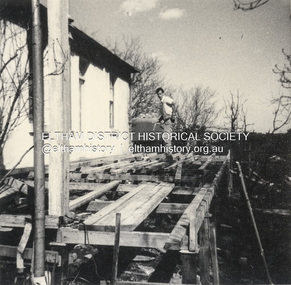
Photograph - Black and White Print, Widening of the verandah of 'Rosebank,' now Living and Learning Centre, Main Road, Eltham, c.1965
... The activities were planned to cover "practical skills for living" and included cooking, preserving, gardening, animal husbandry, home economics, electronics, carpentry, hairdressing, making children's clothes and car maintenance. ...The activities were planned to cover "practical skills for living" and included cooking, preserving, gardening, animal husbandry, home economics, electronics, carpentry, hairdressing, making children's clothes and car maintenance. ...Restructure of the front verandah of 'Rosebank' by widening, c.1965. It was glassed in at a later date. The west facing front verandah was widened and enclosed for additional class room use by the Living and Learning Centre. A detailed history of the site and early development of the Eltham Living and Learning Centre can be found in EDHS_04870 - Folder, Shire of Eltham Living and Learning Centre, 1996 The original property was part of Josiah Holloways subdivision of Little Eltham. It had a 70 foot frontage to Maria Street and stretched down to the Diamond Creek. John Perason, a Tanner, purchased the property in 1857 for £100 and he built a solid brick house which over the years was modified significantly by various owners and which is the basis of the present-day Living and Learning Centre. Claire Fitzpatrick and her husband Alfred, a retired chemical engineer, bought it in the early 1950's. Claire's interest in farming and animal husbandry and breeding saw her modify and establish buildings on the property to house goats and poultry with a horse stable and storage sheds for the animal food. She also built the coach house with its horse box and tack room and built an adjoining garage for their car. Structural alterations to the house were also carried out during the period of their ownership. Their house renovations removed the four fireplaces and chimneys and added a wider verandah, a fibro cement extension on the north wall requiring a doorway to be made in the brick wall for access. Part of a passage wall was removed to join the northwest room, now the "sitting room". A new jarrah floor was put in as the old one was rotten with borer. The verandahs, front and back, were re-organised in design and the front door had its leadlighting panels removed to allow more light into the house. During this period the water catchment well was filled in. This well had a concrete slab fitted onto a collar around its top. The well is 12 feet deep and 8 feet in diameter. Septic sewerage was installed and an internal toilet fitted in the house. The former northeast room was divided into bathroom/toilet and passageway with cupboards to access the extension. Kitchen stove and sink was removed (they fell apart) and a slow-combustion stove with hot water heater installed. Basins and hot water were connected to the new bathroom. In the early 1970s Eltham Shire Council, Councillors Frank Maas and Don Maling, were proposing an extended communities activities program be set up and the Commonwealth Grants Commission was approached for financial assistance to such a scheme. During 1974 a $50,000 Commonwealth Government grant was received by the Shire Council to acquire the Fitzpatrick property as part of the Shire's planning to establish an "extended community activities program". Council's Committee recommended an annual budget of $26,950 for the program and the project was named the Living and Learning Centre and in charge of the program was the first co-ordinator, Carina Hack. The activities were planned to cover "practical skills for living" and included cooking, preserving, gardening, animal husbandry, home economics, electronics, carpentry, hairdressing, making children's clothes and car maintenance. Hobbies and arts and crafts that would include amongst other future items, winemaking, music spinning and weaving and painting. 739 main road eltham, eltham living and learning centre, living and learning centre, living and learning nillumbik (eltham), main road eltham -
![Photograph - Colour Print, Harry Gilham [Attrib.], Living and Learning Centre, Main Road, Eltham, c.1988](/media/collectors/4f729f7b97f83e03086018a5/items/6a1cdaf8e43e4200865c849d/item-media/6a1cdb13e43e4200865c85b6/item-fit-380x285.jpg?cb=6) Eltham District Historical Society Inc
Eltham District Historical Society IncPhotograph - Colour Print, Harry Gilham [Attrib.], Living and Learning Centre, Main Road, Eltham, c.1988
... The activities were planned to cover "practical skills for living" and included cooking, preserving, gardening, animal husbandry, home economics, electronics, carpentry, hairdressing, making children's clothes and car maintenance. ...The activities were planned to cover "practical skills for living" and included cooking, preserving, gardening, animal husbandry, home economics, electronics, carpentry, hairdressing, making children's clothes and car maintenance. ...The 'back door' which faced the Main Road entrance to the office, Eltham Living and Learning Centre, herb garden at its peak, late 1980s A detailed history of the site and early development of the Eltham Living and Learning Centre can be found in EDHS_04870 - Folder, Shire of Eltham Living and Learning Centre, 1996 The original property was part of Josiah Holloways subdivision of Little Eltham. It had a 70 foot frontage to Maria Street and stretched down to the Diamond Creek. John Perason, a Tanner, purchased the property in 1857 for £100 and he built a solid brick house which over the years was modified significantly by various owners and which is the basis of the present-day Living and Learning Centre. Claire Fitzpatrick and her husband Alfred, a retired chemical engineer, bought it in the early 1950's. Claire's interest in farming and animal husbandry and breeding saw her modify and establish buildings on the property to house goats and poultry with a horse stable and storage sheds for the animal food. She also built the coach house with its horse box and tack room and built an adjoining garage for their car. Structural alterations to the house were also carried out during the period of their ownership. Their house renovations removed the four fireplaces and chimneys and added a wider verandah, a fibro cement extension on the north wall requiring a doorway to be made in the brick wall for access. Part of a passage wall was removed to join the northwest room, now the "sitting room". A new jarrah floor was put in as the old one was rotten with borer. The verandahs, front and back, were re-organised in design and the front door had its leadlighting panels removed to allow more light into the house. During this period the water catchment well was filled in. This well had a concrete slab fitted onto a collar around its top. The well is 12 feet deep and 8 feet in diameter. Septic sewerage was installed and an internal toilet fitted in the house. The former northeast room was divided into bathroom/toilet and passageway with cupboards to access the extension. Kitchen stove and sink was removed (they fell apart) and a slow-combustion stove with hot water heater installed. Basins and hot water were connected to the new bathroom. In the early 1970s Eltham Shire Council, Councillors Frank Maas and Don Maling, were proposing an extended communities activities program be set up and the Commonwealth Grants Commission was approached for financial assistance to such a scheme. During 1974 a $50,000 Commonwealth Government grant was received by the Shire Council to acquire the Fitzpatrick property as part of the Shire's planning to establish an "extended community activities program". Council's Committee recommended an annual budget of $26,950 for the program and the project was named the Living and Learning Centre and in charge of the program was the first co-ordinator, Carina Hack. The activities were planned to cover "practical skills for living" and included cooking, preserving, gardening, animal husbandry, home economics, electronics, carpentry, hairdressing, making children's clothes and car maintenance. Hobbies and arts and crafts that would include amongst other future items, winemaking, music spinning and weaving and painting. 739 main road eltham, eltham living and learning centre, living and learning centre, living and learning nillumbik (eltham), main road eltham -
![Photograph - Black and White Print, Harry Gilham [Attrib.], Living and Learning Centre, Main Road, Eltham, 1990](/media/collectors/4f729f7b97f83e03086018a5/items/6a1cdbffe43e4200865c95df/item-media/6a1cdc19e43e4200865c975d/item-fit-380x285.jpg?cb=6) Eltham District Historical Society Inc
Eltham District Historical Society IncPhotograph - Black and White Print, Harry Gilham [Attrib.], Living and Learning Centre, Main Road, Eltham, 1990
... The activities were planned to cover "practical skills for living" and included cooking, preserving, gardening, animal husbandry, home economics, electronics, carpentry, hairdressing, making children's clothes and car maintenance. ...The activities were planned to cover "practical skills for living" and included cooking, preserving, gardening, animal husbandry, home economics, electronics, carpentry, hairdressing, making children's clothes and car maintenance. ...The 'back door' which faced the Main Road entrance to the office, Eltham Living and Learning Centre - Shows original sandstone blocks in back verandah floor A detailed history of the site and early development of the Eltham Living and Learning Centre can be found in EDHS_04870 - Folder, Shire of Eltham Living and Learning Centre, 1996 The original property was part of Josiah Holloways subdivision of Little Eltham. It had a 70 foot frontage to Maria Street and stretched down to the Diamond Creek. John Perason, a Tanner, purchased the property in 1857 for £100 and he built a solid brick house which over the years was modified significantly by various owners and which is the basis of the present-day Living and Learning Centre. Claire Fitzpatrick and her husband Alfred, a retired chemical engineer, bought it in the early 1950's. Claire's interest in farming and animal husbandry and breeding saw her modify and establish buildings on the property to house goats and poultry with a horse stable and storage sheds for the animal food. She also built the coach house with its horse box and tack room and built an adjoining garage for their car. Structural alterations to the house were also carried out during the period of their ownership. Their house renovations removed the four fireplaces and chimneys and added a wider verandah, a fibro cement extension on the north wall requiring a doorway to be made in the brick wall for access. Part of a passage wall was removed to join the northwest room, now the "sitting room". A new jarrah floor was put in as the old one was rotten with borer. The verandahs, front and back, were re-organised in design and the front door had its leadlighting panels removed to allow more light into the house. During this period the water catchment well was filled in. This well had a concrete slab fitted onto a collar around its top. The well is 12 feet deep and 8 feet in diameter. Septic sewerage was installed and an internal toilet fitted in the house. The former northeast room was divided into bathroom/toilet and passageway with cupboards to access the extension. Kitchen stove and sink was removed (they fell apart) and a slow-combustion stove with hot water heater installed. Basins and hot water were connected to the new bathroom. In the early 1970s Eltham Shire Council, Councillors Frank Maas and Don Maling, were proposing an extended communities activities program be set up and the Commonwealth Grants Commission was approached for financial assistance to such a scheme. During 1974 a $50,000 Commonwealth Government grant was received by the Shire Council to acquire the Fitzpatrick property as part of the Shire's planning to establish an "extended community activities program". Council's Committee recommended an annual budget of $26,950 for the program and the project was named the Living and Learning Centre and in charge of the program was the first co-ordinator, Carina Hack. The activities were planned to cover "practical skills for living" and included cooking, preserving, gardening, animal husbandry, home economics, electronics, carpentry, hairdressing, making children's clothes and car maintenance. Hobbies and arts and crafts that would include amongst other future items, winemaking, music spinning and weaving and painting. 739 main road eltham, eltham living and learning centre, living and learning centre, living and learning nillumbik (eltham), main road eltham -
![Photograph - Black and White Print, Harry Gilham [Attrib.], Living and Learning Centre, Main Road, Eltham, c.1990](/media/collectors/4f729f7b97f83e03086018a5/items/6a1cddabe43e4200865cee41/item-media/6a1cddbbe43e4200865cf696/item-fit-380x285.jpg?cb=6) Eltham District Historical Society Inc
Eltham District Historical Society IncPhotograph - Black and White Print, Harry Gilham [Attrib.], Living and Learning Centre, Main Road, Eltham, c.1990
... The activities were planned to cover "practical skills for living" and included cooking, preserving, gardening, animal husbandry, home economics, electronics, carpentry, hairdressing, making children's clothes and car maintenance. ...The activities were planned to cover "practical skills for living" and included cooking, preserving, gardening, animal husbandry, home economics, electronics, carpentry, hairdressing, making children's clothes and car maintenance. ...Brick storage shed, south wall entry. This cool room, half set down in the soil still standing at time but with a more modern galvanised tin roof. A detailed history of the site and early development of the Eltham Living and Learning Centre can be found in EDHS_04870 - Folder, Shire of Eltham Living and Learning Centre, 1996 The original property was part of Josiah Holloways subdivision of Little Eltham. It had a 70 foot frontage to Maria Street and stretched down to the Diamond Creek. John Perason, a Tanner, purchased the property in 1857 for £100 and he built a solid brick house which over the years was modified significantly by various owners and which is the basis of the present-day Living and Learning Centre. Claire Fitzpatrick and her husband Alfred, a retired chemical engineer, bought it in the early 1950's. Claire's interest in farming and animal husbandry and breeding saw her modify and establish buildings on the property to house goats and poultry with a horse stable and storage sheds for the animal food. She also built the coach house with its horse box and tack room and built an adjoining garage for their car. Structural alterations to the house were also carried out during the period of their ownership. Their house renovations removed the four fireplaces and chimneys and added a wider verandah, a fibro cement extension on the north wall requiring a doorway to be made in the brick wall for access. Part of a passage wall was removed to join the northwest room, now the "sitting room". A new jarrah floor was put in as the old one was rotten with borer. The verandahs, front and back, were re-organised in design and the front door had its leadlighting panels removed to allow more light into the house. During this period the water catchment well was filled in. This well had a concrete slab fitted onto a collar around its top. The well is 12 feet deep and 8 feet in diameter. Septic sewerage was installed and an internal toilet fitted in the house. The former northeast room was divided into bathroom/toilet and passageway with cupboards to access the extension. Kitchen stove and sink was removed (they fell apart) and a slow-combustion stove with hot water heater installed. Basins and hot water were connected to the new bathroom. In the early 1970s Eltham Shire Council, Councillors Frank Maas and Don Maling, were proposing an extended communities activities program be set up and the Commonwealth Grants Commission was approached for financial assistance to such a scheme. During 1974 a $50,000 Commonwealth Government grant was received by the Shire Council to acquire the Fitzpatrick property as part of the Shire's planning to establish an "extended community activities program". Council's Committee recommended an annual budget of $26,950 for the program and the project was named the Living and Learning Centre and in charge of the program was the first co-ordinator, Carina Hack. The activities were planned to cover "practical skills for living" and included cooking, preserving, gardening, animal husbandry, home economics, electronics, carpentry, hairdressing, making children's clothes and car maintenance. Hobbies and arts and crafts that would include amongst other future items, winemaking, music spinning and weaving and painting. 739 main road eltham, eltham living and learning centre, living and learning centre, living and learning nillumbik (eltham), main road eltham -
![Photograph - Colour Print, Harry Gilham [Attrib.], Living and Learning Centre, Main Road, Eltham, 1995](/media/collectors/4f729f7b97f83e03086018a5/items/6a1cde5de43e4200865d0c81/item-media/6a1cde8be43e4200865d1127/item-fit-380x285.jpg?cb=6) Eltham District Historical Society Inc
Eltham District Historical Society IncPhotograph - Colour Print, Harry Gilham [Attrib.], Living and Learning Centre, Main Road, Eltham, 1995
... The activities were planned to cover "practical skills for living" and included cooking, preserving, gardening, animal husbandry, home economics, electronics, carpentry, hairdressing, making children's clothes and car maintenance. ...The activities were planned to cover "practical skills for living" and included cooking, preserving, gardening, animal husbandry, home economics, electronics, carpentry, hairdressing, making children's clothes and car maintenance. ...New Pavilion at left has plants appearing. Grass area needs a mow - verandah with repainted stool/forms - early spring 1995 A detailed history of the site and early development of the Eltham Living and Learning Centre can be found in EDHS_04870 - Folder, Shire of Eltham Living and Learning Centre, 1996 The original property was part of Josiah Holloways subdivision of Little Eltham. It had a 70 foot frontage to Maria Street and stretched down to the Diamond Creek. John Perason, a Tanner, purchased the property in 1857 for £100 and he built a solid brick house which over the years was modified significantly by various owners and which is the basis of the present-day Living and Learning Centre. Claire Fitzpatrick and her husband Alfred, a retired chemical engineer, bought it in the early 1950's. Claire's interest in farming and animal husbandry and breeding saw her modify and establish buildings on the property to house goats and poultry with a horse stable and storage sheds for the animal food. She also built the coach house with its horse box and tack room and built an adjoining garage for their car. Structural alterations to the house were also carried out during the period of their ownership. Their house renovations removed the four fireplaces and chimneys and added a wider verandah, a fibro cement extension on the north wall requiring a doorway to be made in the brick wall for access. Part of a passage wall was removed to join the northwest room, now the "sitting room". A new jarrah floor was put in as the old one was rotten with borer. The verandahs, front and back, were re-organised in design and the front door had its leadlighting panels removed to allow more light into the house. During this period the water catchment well was filled in. This well had a concrete slab fitted onto a collar around its top. The well is 12 feet deep and 8 feet in diameter. Septic sewerage was installed and an internal toilet fitted in the house. The former northeast room was divided into bathroom/toilet and passageway with cupboards to access the extension. Kitchen stove and sink was removed (they fell apart) and a slow-combustion stove with hot water heater installed. Basins and hot water were connected to the new bathroom. In the early 1970s Eltham Shire Council, Councillors Frank Maas and Don Maling, were proposing an extended communities activities program be set up and the Commonwealth Grants Commission was approached for financial assistance to such a scheme. During 1974 a $50,000 Commonwealth Government grant was received by the Shire Council to acquire the Fitzpatrick property as part of the Shire's planning to establish an "extended community activities program". Council's Committee recommended an annual budget of $26,950 for the program and the project was named the Living and Learning Centre and in charge of the program was the first co-ordinator, Carina Hack. The activities were planned to cover "practical skills for living" and included cooking, preserving, gardening, animal husbandry, home economics, electronics, carpentry, hairdressing, making children's clothes and car maintenance. Hobbies and arts and crafts that would include amongst other future items, winemaking, music spinning and weaving and painting. 739 main road eltham, eltham living and learning centre, living and learning centre, living and learning nillumbik (eltham), main road eltham -
![Photograph - Colour Print, Harry Gilham [Attrib.], Living and Learning Centre, Main Road, Eltham, 1995](/media/collectors/4f729f7b97f83e03086018a5/items/6a1cdf36e43e4200865d43d6/item-media/6a1cdf50e43e4200865d4778/item-fit-380x285.jpg?cb=6) Eltham District Historical Society Inc
Eltham District Historical Society IncPhotograph - Colour Print, Harry Gilham [Attrib.], Living and Learning Centre, Main Road, Eltham, 1995
... The activities were planned to cover "practical skills for living" and included cooking, preserving, gardening, animal husbandry, home economics, electronics, carpentry, hairdressing, making children's clothes and car maintenance. ...The activities were planned to cover "practical skills for living" and included cooking, preserving, gardening, animal husbandry, home economics, electronics, carpentry, hairdressing, making children's clothes and car maintenance. ...New verandah Eltham Living and Learning Centre on the western face looking down over the Tannery site and Diamond Creek. Pavilion in place (LH Side). The verandah with its upgrade of curtains 1995. Originally 4 feet 6 inches wide. A detailed history of the site and early development of the Eltham Living and Learning Centre can be found in EDHS_04870 - Folder, Shire of Eltham Living and Learning Centre, 1996 The original property was part of Josiah Holloways subdivision of Little Eltham. It had a 70 foot frontage to Maria Street and stretched down to the Diamond Creek. John Perason, a Tanner, purchased the property in 1857 for £100 and he built a solid brick house which over the years was modified significantly by various owners and which is the basis of the present-day Living and Learning Centre. Claire Fitzpatrick and her husband Alfred, a retired chemical engineer, bought it in the early 1950's. Claire's interest in farming and animal husbandry and breeding saw her modify and establish buildings on the property to house goats and poultry with a horse stable and storage sheds for the animal food. She also built the coach house with its horse box and tack room and built an adjoining garage for their car. Structural alterations to the house were also carried out during the period of their ownership. Their house renovations removed the four fireplaces and chimneys and added a wider verandah, a fibro cement extension on the north wall requiring a doorway to be made in the brick wall for access. Part of a passage wall was removed to join the northwest room, now the "sitting room". A new jarrah floor was put in as the old one was rotten with borer. The verandahs, front and back, were re-organised in design and the front door had its leadlighting panels removed to allow more light into the house. During this period the water catchment well was filled in. This well had a concrete slab fitted onto a collar around its top. The well is 12 feet deep and 8 feet in diameter. Septic sewerage was installed and an internal toilet fitted in the house. The former northeast room was divided into bathroom/toilet and passageway with cupboards to access the extension. Kitchen stove and sink was removed (they fell apart) and a slow-combustion stove with hot water heater installed. Basins and hot water were connected to the new bathroom. In the early 1970s Eltham Shire Council, Councillors Frank Maas and Don Maling, were proposing an extended communities activities program be set up and the Commonwealth Grants Commission was approached for financial assistance to such a scheme. During 1974 a $50,000 Commonwealth Government grant was received by the Shire Council to acquire the Fitzpatrick property as part of the Shire's planning to establish an "extended community activities program". Council's Committee recommended an annual budget of $26,950 for the program and the project was named the Living and Learning Centre and in charge of the program was the first co-ordinator, Carina Hack. The activities were planned to cover "practical skills for living" and included cooking, preserving, gardening, animal husbandry, home economics, electronics, carpentry, hairdressing, making children's clothes and car maintenance. Hobbies and arts and crafts that would include amongst other future items, winemaking, music spinning and weaving and painting. 739 main road eltham, eltham living and learning centre, living and learning centre, living and learning nillumbik (eltham), main road eltham -
 Kiewa Valley Historical Society
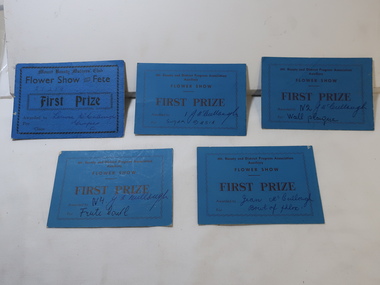
Cards - Gardening First Prize
... The town was built on a paddock so gardening was popular amongst the population. The residents of Mt Beauty created gardens for their new homes and were encouraged to enter competitions for the best flowers etc.. ...Mt Beauty township was created in the late 1940s when the SECV built houses, roads, amenities etc. for their workers working on the Kiewa Hydro Electric Scheme. The town was built on a paddock so gardening was popular amongst the population.The residents of Mt Beauty created gardens for their new homes and were encouraged to enter competitions for the best flowers etc.. This was an enjoyable social occasion for them. 5 blue cardboard cards won for First Prize in 'Flower Show and Fete' presented by the Mt Beauty and District Progress Association Auxilary and the Mt Beauty Mothers Club.Name of winner written on each - won by members of the McCullough familygardening, flower show, mccullough family, mt beauty progress association -
 Kiewa Valley Historical Society
Rake - Tea Tree, mid to late 1900's
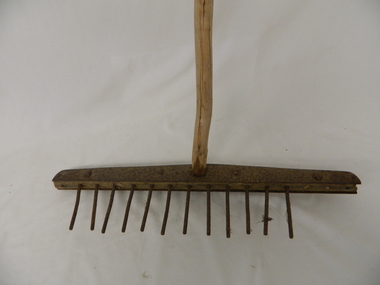
... The availability of gardening implements to the residences within the Kiewa Valley was scarce to non existence. with the upgrading of roads into the valley and the boost to the Valley's population (S.E.C. Kiewa Valley Hydro Electricity Scheme) transport into the valley, firstly via commercial Hawkers in their mobile caravans and later by commercial trucks. This "home ...This "homemade rake" is constructed from a branch of a tea tree. This item demonstrates that in the mid to late 1800's the isolation of the Kiewa Valley was more pronounced than during the early 1900's. The availability of gardening implements to the residences within the Kiewa Valley was scarce to non existence. with the upgrading of roads into the valley and the boost to the Valley's population (S.E.C. Kiewa Valley Hydro Electricity Scheme) transport into the valley, firstly via commercial Hawkers in their mobile caravans and later by commercial trucks. This "home made" rake is very significant because it highlights the ingenuity of local farmers and graziers in overcoming the semi isolation of the Kiewa Valley and its regions from the commercial availability of gardening implements enjoyed by gardeners in the towns and cities of the 1800's and the early 1900's. This "home made" garden rake highlights the ingenuity of the "Australian" character per se. A slice of this ingenuity can be seen by the amount of inventions, per capita, produced within Australia throughout its history.Handle is a long, stripped branch of tea tree. The head of the rake is a 2.3 cm. wide piece of wood, compressed between two 0.5 cm. pieces of metal joined with bolts, nuts and rivets. The holes drilled into the wood hold metal tines 10.5 cms. high. There should be 16 tines but 4 are missing. This type of rake is/ was used in dairiestimber, dairy, farm, rural, implement -
 Eltham District Historical Society Inc
Book, Neil Douglas et al, A far cry / Neil Douglas spinning yarns with Abbie Heathcote, 1979
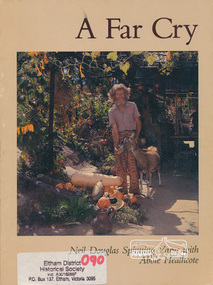
... Kangaroo Island stories, living naturally, bumbling through the Depression, Robinson Crusoe gardening, trials of a conservationist, health and home, artist friends, aninal friends. ...Kangaroo Island stories, living naturally, bumbling through the Depression, Robinson Crusoe gardening, trials of a conservationist, health and home, artist friends, aninal friends. ...Reminiscences of environmental artist Neil Douglas as told to Abbie Heathcote. Kangaroo Island stories, living naturally, bumbling through the Depression, Robinson Crusoe gardening, trials of a conservationist, health and home, artist friends, aninal friends. Illustrated by Neil Douglas and incudes photographs of his home and garden at Bend of Islands.1. Paperback; 140 p. : ill. ; 25 cm. 2. Hardback (missing dust jacket); 140 p. : ill. ; 25 cm.ISBN 095950950xstories, social customs, alternative lifestyles, kangaroo ground, gardening, reminiscences, bend of islands, conservation, neil douglas, abbie heathcote, environment, -
 Kiewa Valley Historical Society
Book - Gardening, Australian Home Gardener by Leslie H. Brunning
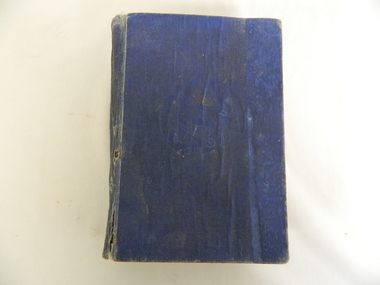
... Australian Home Gardener by Leslie H. Brunning Book - Gardening Hazell, Watson & Viney Ltd. ..."The only comprehensive Australian Gardening Book ever compiled."Used by a resident of the Kiewa Valley.Blue hard covered book - title, author are not on the front or back cover. The Title is 'in gold' on the spine and at the base of the spine is ''Home Library" also 'in gold'. The book has black and white plates illustrating the text.gardening, plants, australian horticulture -
 Bendigo Historical Society Inc.
Slide - DIGGERS & MINING. LIFE OF THE SELECTORS, c1882
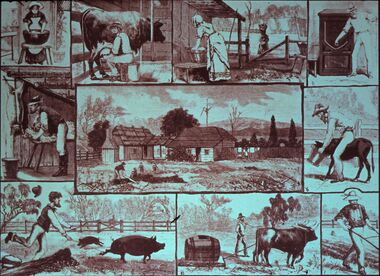
... gardening. Markings: Life Of The Selectors. Set 432 No. 7. The Free Selector at Home ''Illustrated Australian News,'' June 10, 1882. ...gardening. Markings: Life Of The Selectors. Set 432 No. 7. The Free Selector at Home ''Illustrated Australian News,'' June 10, 1882. ...BHS CollectionDiggers & mining. Life Of The Selectors. Show some of the every day activities of a Selectors family; washing dishes, milking the cow, washing clothes, storage, shearing, chasing the pigs, carting water, ploughing, feeding the calf, gardening. Markings: Life Of The Selectors. Set 432 No. 7. The Free Selector at Home ''Illustrated Australian News,'' June 10, 1882. Used as a teaching aid.Visual Education Centreeducation, tertiary, goldfields -
 Eltham District Historical Society Inc
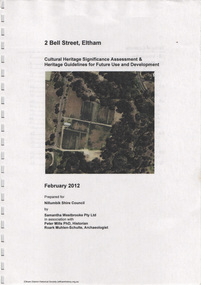
Document, Samantha Westbrooke Pty Ltd et al, 2 Bell Street, Eltham: Cultural Heritage Significance Assessment & Heritage Guidelines for Future Use & Development, 2012
... home in situ. The Fabbro family farmed the property. In 1993/4 Eltham Council acquired the creek-side market garden blocks to the south of 2 Bell Street which was recconceived in 1998 as the Barak Bushland Reserve. The Fabbro house was demolished shortly after and the lots were sold to a developer in 1994. The large steel shed now present on the 2 Bell Street property dates from soon after this sale. cultural heritage significance assessment peter mills samantha westbrooke pty ltd shire of nillumbik 2 Bell Street Eltham Market Gardening West Family Fabbro Family Land Use Barak Bushland Reserve Heritage Assessment 26 A4 pages color print 2 Bell Street, Eltham: Cultural Heritage Significance Assessment & Heritage Guidelines for Future Use & Development Document Document Samantha Westbrooke Pty Ltd Peter Mills Roark Muhlen-Schulte ...Prepared for Nillumbik Shire Council by Samantha Westbrooke Pty Ltd in association with Peter Mills PhD, Architectural Historian and Roark Muhlen-Schilte, Archaeologist. Covers history of early market gardening in Eltham with the commencement of European settlement in the late 1830s. The site for the village of Eltham was surveyed in 1851 and the Township Plan shows that the property is made up of Lots 7 and 8 which were sold at auction in June 1852 to M. O'Shea. The history of the Bell Street property is closely tied to the West family from the 1860s to 1930s; the earliest rate books for Eltham show William West farming in El;tham in 1864. In the aerly 1930s ownership of the creek side was transferred from the west family to the Fabbro family who shortly afterwards were impaced by the 1934 Diamond Creek flooding. Guido Fabbro relocated the original West home further up the hill and built a new Italianate style modern home in situ. The Fabbro family farmed the property. In 1993/4 Eltham Council acquired the creek-side market garden blocks to the south of 2 Bell Street which was recconceived in 1998 as the Barak Bushland Reserve. The Fabbro house was demolished shortly after and the lots were sold to a developer in 1994. The large steel shed now present on the 2 Bell Street property dates from soon after this sale.26 A4 pages color printcultural heritage significance assessment, peter mills, samantha westbrooke pty ltd, shire of nillumbik, 2 bell street, eltham, market gardening, west family, fabbro family, land use, barak bushland reserve, heritage assessment -
 Bendigo Historical Society Inc.
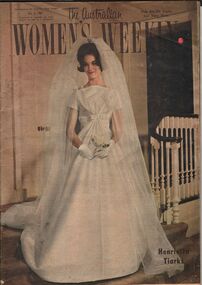
Magazine - AILEEN AND JOHN ELLISON COLLECTION: THE AUSTRALIAN WOMEN'S WEEKLY JULY 5 1961
... Contents: The little nothing dress - Princess Grace of Ireland - New look in hair - it was lovely, we dance twice - The case of the duplicate daughter - miss Friday's day - The way back - It seems to me - Australian nature - Worth reporting - Letter box - Your bookshelf - Stars - Jackys' diary - Dress sense - Fashion frocks - television parade - mills family - old Vic revisits Australia - The men in Audrey Hepburn's life - Woman doctor says: - At home - Home plans, prize recipes - Cookery, cooked on a skewer - Cookery course - Gardening. ...Contents: The little nothing dress - Princess Grace of Ireland - New look in hair - it was lovely, we dance twice - The case of the duplicate daughter - miss Friday's day - The way back - It seems to me - Australian nature - Worth reporting - Letter box - Your bookshelf - Stars - Jackys' diary - Dress sense - Fashion frocks - television parade - mills family - old Vic revisits Australia - The men in Audrey Hepburn's life - Woman doctor says: - At home - Home plans, prize recipes - Cookery, cooked on a skewer - Cookery course - Gardening. ...The Australian women's Weekly from July 5, 1961. Price 1 shilling. On the cover Henrietta Tiarks on a wedding dress. Contents: The little nothing dress - Princess Grace of Ireland - New look in hair - it was lovely, we dance twice - The case of the duplicate daughter - miss Friday's day - The way back - It seems to me - Australian nature - Worth reporting - Letter box - Your bookshelf - Stars - Jackys' diary - Dress sense - Fashion frocks - television parade - mills family - old Vic revisits Australia - The men in Audrey Hepburn's life - Woman doctor says: - At home - Home plans, prize recipes - Cookery, cooked on a skewer - Cookery course - Gardening. The magazine has 63 pages.books, magazines, women's magazine -
 Bendigo Historical Society Inc.
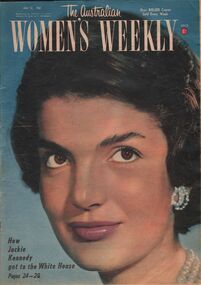
Magazine - AILEEN AND JOHN ELLISON COLLECTION: THE AUSTRALIAN WOMEN'S WEEKLY JULY 12 1961
... Contents: Jacqueline Kennedy story - 2,000 pounds canned fruit recipe contest - the end of the beginning - Little boy lonely - The case of the duplicate daughter - The fifth candle - It seems to me - Australia nature - Worth reporting - Social - Letter box - Your bookshelf - Crosswords - Stars - Dress sense - Fashion frocks - Film - Television parade - TV colour - Cookery course - Cookery - At home - Home and family - Home plans, prize recipes - House that has everything - Gardening....Contents: Jacqueline Kennedy story - 2,000 pounds canned fruit recipe contest - the end of the beginning - Little boy lonely - The case of the duplicate daughter - The fifth candle - It seems to me - Australia nature - Worth reporting - Social - Letter box - Your bookshelf - Crosswords - Stars - Dress sense - Fashion frocks - Film - Television parade - TV colour - Cookery course - Cookery - At home - Home and family - Home plans, prize recipes - House that has everything - Gardening. Magazine AILEEN AND JOHN ELLISON COLLECTION: THE AUSTRALIAN WOMEN'S WEEKLY JULY 12 1961 ...The Australian women's weekly from July 12, 1961. Price 1 shilling, the magazine has 64 pages. On the cover a picture of Jackie Kennedy and the words: How Jackie Kennedy got to the White House, pages 24-28. Contents: Jacqueline Kennedy story - 2,000 pounds canned fruit recipe contest - the end of the beginning - Little boy lonely - The case of the duplicate daughter - The fifth candle - It seems to me - Australia nature - Worth reporting - Social - Letter box - Your bookshelf - Crosswords - Stars - Dress sense - Fashion frocks - Film - Television parade - TV colour - Cookery course - Cookery - At home - Home and family - Home plans, prize recipes - House that has everything - Gardening.books, magazines, women's magazine -
 National Wool Museum
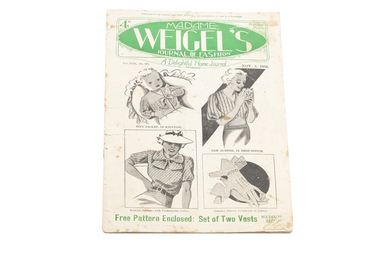
Journal, Madame Weigel's Journal of Fashion, Nov. 2, 1936
... Home Journal / Vol. LVII, No. 681. / NOV. 2, 1936. / TINY JACKET, IN KNITTING. / Fashion and craft magazine, paper cover printed in green and black with four drawings of jumpers/jackets and gloves being modelled. Contents include patterns for sewn, knitted and crocheted clothes, articles re: cooking, gardening ...This book and a number of others like it were owned by the mother and aunts of the donor, Mrs Dorothy Boyle. They were prolific producers of hand knitted and hand made items of clothing and also knitted and sewed for the armed forces during the Second World War. This book is one of five issues of "Madame Weigel's Journal of Fashion" owned by Mrs Boyle's family.Fashion and craft magazine, paper cover printed in green and black with four drawings of jumpers/jackets and gloves being modelled. Contents include patterns for sewn, knitted and crocheted clothes, articles re: cooking, gardening, fashion and general interest, and a loose pattern in four pieces made from tissue paper.Registered at the General Post Office Melbourne, for transmission by post as a Newspaper. / 4D / Published / Monthly. / MADAME / WEIGEL'S / JOURNAL OF FASHION / A Delightful Home Journal / Vol. LVII, No. 681. / NOV. 2, 1936. / TINY JACKET, IN KNITTING. /knitting handicrafts - history crochet fashion, madame weigel pty ltd, knitting, handicrafts - history, crochet, fashion -
 Anglesea and District Historical Society
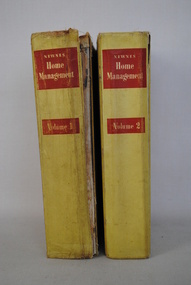
Books - 2 Volumes, George Newnes Limited, Newnes Home Management. Volumes 1 and 2, Estimated 1950's
... Volume 1: contents include: recipes, cookery, weights and measures, kitchen improvements, equipment, setting table, mother and baby section, toys, pottery, gardening, dressmaking, sewing, marriage. Volume 2: contents include: what makes a home, rooms, decorating, furniture, soft furnishings, flower arrangements, plants, etiquette, cookery and more....Home management Newnes Volume 1: contents include: recipes, cookery, weights and measures, kitchen improvements, equipment, setting table, mother and baby section, toys, pottery, gardening, dressmaking, sewing, marriage. ...Volume 1: contents include: recipes, cookery, weights and measures, kitchen improvements, equipment, setting table, mother and baby section, toys, pottery, gardening, dressmaking, sewing, marriage. Volume 2: contents include: what makes a home, rooms, decorating, furniture, soft furnishings, flower arrangements, plants, etiquette, cookery and more.home management, newnes -
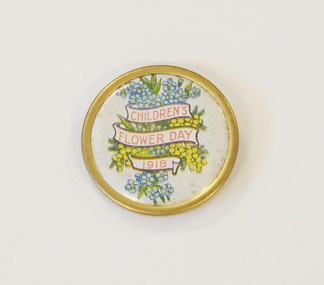 Parliament of Victoria
Children's Flower Day 1918 badge, 1918
... gardening with humanitarian aid. In 1915, Isaac helped to establish the Young Gardeners’ League, whereby young garden enthusiasts could join for a penny and cultivate plots in their own backyards. These home...gardening with humanitarian aid. In 1915, Isaac helped to establish the Young Gardeners’ League, whereby young garden enthusiasts could join for a penny and cultivate plots in their own backyards. These home ...Cyril Everett Isaac (1884-1865) (MLC for South Eastern 1940-52) was a progressive educator, horticulturist and conservationist. A pioneer of school gardening, Isaac believed in the enlightening, spiritual values of working with the land, and founded the State Schools Horticulture Society in 1910. Following the outbreak of the Great War, Isaac recognised the potential to combine school gardening with humanitarian aid. In 1915, Isaac helped to establish the Young Gardeners’ League, whereby young garden enthusiasts could join for a penny and cultivate plots in their own backyards. These home-grown flowers and vegetables were then sold for the going market rates, and the proceeds went towards supporting the Education Department officers serving in the war and their families. This project culminated in a state-wide flower day show held at Melbourne’s Town Hall on 3 November 1916, known as Children’s Flower Day. Isaac hoped that this special day would encourage children to feel that by ‘growing the flowers they are doing something to help our brave soldiers.’ Originally aiming to raise £10,000, the inaugural Flower Day raised over £32,309 (including revenue from home produce), and was donated to the War Relief Fund. On 9 November, the Dandenong Advertiser reported: “This is a splendid record for the boys and girls of our State Schools, who are so well tutored, and ready and willing to help the British Empire against the enemy.” One month after Flower Day, Isaac enlisted in 58th Battalion of Australian Infantry Forces, and departed for Europe in May 1917. Subsequent Children’s Flower Days were held in 1917 and 1918 in Isaac’s absence, and accounted for 25 per cent of the £445,000 raised by the Education Department’s War Relief Fund. A badge created as a fundraiser for Children's Flower Day in 1918. These badges were sold in public places in order to raise funds for war relief. Round metal badge with celluloid insert that has a printed motif of flowers (wattle and forget-me-not) and three banners with red text.Printed recto: "CHILDREN'S/ FLOWER DAY/ 1918"isaac, cyril everett (1884-1865), children's flower day, world war 1, charity -
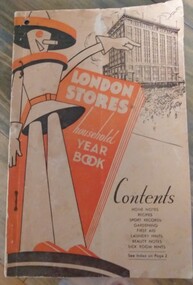 Tatura Irrigation & Wartime Camps Museum
Book - Bookmark, London Stores Household Year Book
... A book put out by London Stores Ltd., which contains advertisements for their products, home notes, recipes, sport records, gardening, first aid and laundry hints, beauty notes and sick room hints....A book put out by London Stores Ltd., which contains advertisements for their products, home notes, recipes, sport records, gardening, first aid and laundry hints, beauty notes and sick room hints. london stores ltd household year book household hints gardening hints beauty notes sick room hints laundry hints first aid hints recipes 1940's as above Small soft covered tan book with drawing of a large department store, a book and a cartoon person pointing at the store. ...A book put out by London Stores Ltd., which contains advertisements for their products, home notes, recipes, sport records, gardening, first aid and laundry hints, beauty notes and sick room hints.Small soft covered tan book with drawing of a large department store, a book and a cartoon person pointing at the store. Also Contents at right bottom corner. All done in black and orange. Back cover has advertisement for men's hats "Tailsworth".as abovelondon stores ltd, household year book, household hints, gardening hints, beauty notes, sick room hints, laundry hints, first aid hints, recipes, 1940's -
 Lakes Entrance Historical Society
Photograph - Garden club, Lakes Post Newspaper, 2000
... Colour photograph Lakes Organic Gardening Society members Adele Greenbeau, Bob Hodgson, at Carol McDonalds home with platter of organically grown produce. ...number in album 03554.02 Clubs Function Colour photograph Lakes Organic Gardening Society members Adele Greenbeau, Bob Hodgson, at Carol McDonalds home with platter of organically grown produce. ...number in album 03554.02Colour photograph Lakes Organic Gardening Society members Adele Greenbeau, Bob Hodgson, at Carol McDonalds home with platter of organically grown produce. Lakes Entrance Victoriaclubs, function -
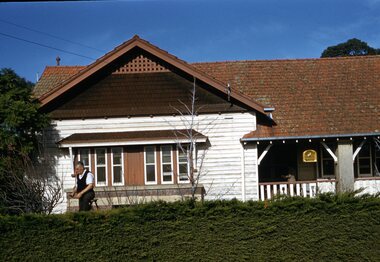 Surrey Hills Historical Society Collection
Photograph - Digital photograph, George L Coop, 688 Whitehorse Road, Mont Albert 1958, 1958
... home was the Spanish Mission style flats at 346 Whitehorse Road, opposite Brenbeal Street, Balwyn. When his grandparents died, the family moved to 688 Whitehorse Road and he then attended Mont Albert Central School. Alison being younger did not go to Chatham Primary. george l coop whitehorse road mont albert californian bungalow cypress hedge gardening george burton coop A digital copy of a colour photo showing detail of the front view of 688 Whitehorse Road. ...The gentleman in the photo is George Burton Coop, an architect / draughtsman. The donor, his son George Lister Coop was about 21 years of age when he took this photo in 1958 of his family home. His parents were: George Burton Coop (b c1906 Williamstown; died aged 54 years at Mont Albert) and Winsome Alice (MS: Trewartha) who married in 1936. They are first listed at this address in the electoral roll in 1937. They had 2 children: George Lister Coop - born St Georges Hospital, 8/10/1937 and Alison - born c1945. However the donor informed that he initially attended Chatham State School because his first home was the Spanish Mission style flats at 346 Whitehorse Road, opposite Brenbeal Street, Balwyn. When his grandparents died, the family moved to 688 Whitehorse Road and he then attended Mont Albert Central School. Alison being younger did not go to Chatham Primary. A digital copy of a colour photo showing detail of the front view of 688 Whitehorse Road. The house is white weatherboard in a Californian bungalow style with a tiled roof and shingles detail in a dark brown stain. The balustrades and finials of the veranda are simple with occasional feature planks with a tulip detail. A bird cage hangs from the veranda. The veranda is supported by rough-cast sturdy pillars. The house sits behind a cypress hedge. The photo was taken in winter as deciduous shrubs are bare. A gentleman astride a ladder is pruning the hedge. george l coop, whitehorse road, mont albert, californian bungalow, cypress hedge, gardening, george burton coop
