
Showing 4 items matching "home show video"
-
 Port Melbourne Historical & Preservation Society
Photograph - Home Show Video (formerly J E Earl Hardware), Bay Street, Port Melbourne, David Thompson, 1996
... Home Show Video (formerly J E Earl Hardware), Bay Street, Port Melbourne......Home Show Video...Earl Photograph Home Show Video (formerly J E Earl Hardware), Bay Street, Port Melbourne David Thompson ...J.E. Earl closed in the 1990s and was used as a video shop for several years before being rebuilt as shops and flats.One of five colour photographs of Port Melbourne streets: Homeshow Video, Bay Street - formerly J.E. Earlbay street, built environment - commercial, j e earl pty ltd, home show video -
Australian National Surfing Museum
Video Clip, Torquay Surf Beach Family Movies, Circa 1947
... show surfing at Torquay and in Victoria. It also features very early images of the Torquay Surf Life Saving Club which is the oldest in Victoria. surfing torquay surf life saving club 1947 torquay surf beach hollow plywood surfboard Museum logo at the start of the video clip. Black and white 8mm home ...This home movie features people enjoying summer by the beach. It was filmed at Torquay Surf Beach, Torquay, Victoria circa 1947. The last shots of the film show a surfer riding a hollow wooden plywood surfboard to the beach and stepping off onto the sand.Torquay Surf Beach was a macca for surfers in post-war Victoria. This is one of the earliest movies to show surfing at Torquay and in Victoria. It also features very early images of the Torquay Surf Life Saving Club which is the oldest in Victoria.Black and white 8mm home movie transferred to VHS and digitised to AVI file. Duration - 1 minute and 16 seconds.Museum logo at the start of the video clip.surfing, torquay surf life saving club, 1947, torquay surf beach, hollow plywood surfboard -
 Royal District Nursing Service (now known as Bolton Clarke)
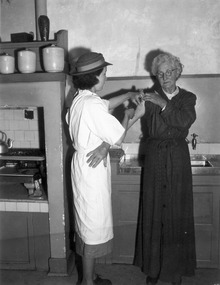
Photograph - Photograph, black and white:, 1952
... home of the lady and shows MDNS Sister J. Faust giving an injection, using a glass syringe, into the right upper arm of the lady. This type of syringe was re sterilized. These syringes remained in use until the mid 1960s when disposable plastic syringes took their place. This photograph was used in a video...home of the lady and shows MDNS Sister J. Faust giving an injection, using a glass syringe, into the right upper arm of the lady. This type of syringe was re sterilized. These syringes remained in use until the mid 1960s when disposable plastic syringes took their place. This photograph was used in a video ...This photograph is taken in the home of the lady and shows MDNS Sister J. Faust giving an injection, using a glass syringe, into the right upper arm of the lady. This type of syringe was re sterilized. These syringes remained in use until the mid 1960s when disposable plastic syringes took their place. This photograph was used in a video on the history of RDNS which is held by the organization. It is a record of the type of care given by Melbourne District Nursing Society (MDNS) Trained nurses in a patient's home.The Trained nurses of the Melbourne District Nursing Society (MDNS), later known as Royal District Nursing Service (RDNS), visited patients in their home and gave best practice care in many fields of nursing, and to people of many cultures, throughout its 130 years of expansion. Initial visits not only assessed the specific nursing situation but the situation as a whole. Their patients ranged in age from babes, children, adults to the elderly and referrals were taken from Hospitals, General Practitioners and allied Health facilities. Some of the care the Sisters provided is as follows: – Post-Natal care given to mother and babe, Wound Care following various types of surgery, accidents, burns, cancer, leg ulcers etc. Supervising and teaching Diabetic Care, including teaching and supervising people with Diabetes to administer their own Insulin, and administering Insulin to those unable to give their own injections. Administering other injections and setting up weekly medication boxes. The Sisters performed Catheterizations on adults suffering from conditions such as Quadriplegia, Paraplegia, Multiple Sclerosis (MS), Motor Neurone Disease (MND) and Guillan-Barre Syndrome, and when required at school on children for e.g. those with Spina Bifida. The Sisters visited those requiring Cystic Fibrosis support and care; those requiring Haemo-Oncology care, including visiting children at school; those requiring Home Enteral Feeding care, and those requiring IV therapy at home and home Dialysis. Palliative Care was given including pain relief with the use of syringe drivers, personal care as needed, and advice and support to both patient and family. The Sisters provided Stoma management to those needing Urostomy, Ileostomy and Colostomy care and those requiring Continence care. HIV/AIDS nursing care was provided; visits to Homeless Persons were made. Personal care was given to patients ranging in age and with varying mobility problems, such as those with MS, MND, Guillan-Barre Syndrome, Quadriplegia, Paraplegia, Acquired Brain Injury, to those following a Cerebrovascular Accident (Stroke), those with severe Arthritis and those with a form of Dementia. When necessary the elderly were assisted with personal care and advice given on safety factors with the use of hand rails, bath or shower seats, and hand showers. Rehabilitation with an aim towards independence remained at the forefront of the Sister’s minds and when possible using aids and instruction on safe techniques enabled the person to become fully independent. All care included giving advice and support to the patient and their Carers. The Sisters liaised with the persons Doctor, Hospital and allied Health personal when necessary.Black and white photograph of Melbourne District Nursing Society (MDNS), Sister J. Faust who is wearing her grey brimmed uniform hat over her dark curled hair and is wearing a white gown over her grey uniform which is seen below her gown. In her right hand, she is holding a syringe, with needle against the lady's skin, and her left hand is on the upper right arm of the lady above the needle site. The lady, who has light coloured curled hair and is wearing a dark coloured long frock, is standing to the right of the Sister and is holding the right sleeve of her dress up with her left hand. A metal sink with cupboards below is behind the lady. To the left is fireplace which is now tiled at the rear and has a gas stove with kettle on a jet in the space. A row of three pale coloured kitchen canisters in decreasing size sit on the mantle piece. On a shelf above these sit a dark coloured box and a tall thin vase. Staff members name is written on the back of the photograph.melbourne district nursing society, nursing care, royal district nursing service, rdns, mdns, nursing care - medications, mdns uniforms, j. faust -
 Bendigo Military Museum
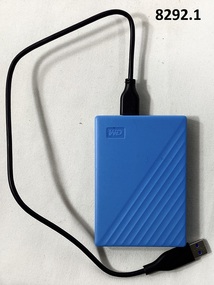
Mixed media - HARD DRIVE, DVD
... show with text added 2019 - current (ongoing). 3. Video, 7.30 report 23 April 2009 re the discovery of the Somme photographs, the Grinton collection. 4. 38th Bn AIF brief history 9 pages follows the movements of the Battalion by page No & date from "Eric Fairey's History of the 38th Bn", from inception on 1.3 1916 to when the 1st Draft leaves for home on 17.2.1919. ...show with text added 2019 - current (ongoing). 3. Video, 7.30 report 23 April 2009 re the discovery of the Somme photographs, the Grinton collection. 4. 38th Bn AIF brief history 9 pages follows the movements of the Battalion by page No & date from "Eric Fairey's History of the 38th Bn", from inception on 1.3 1916 to when the 1st Draft leaves for home on 17.2.1919. ....1) Hard Drive, the following items are stored on this device. 1. BRSL/SMIMM/BMM Museum History photographs, 885 images as a slide show with text added 1998 - 2018. 2. BRSL/SMIMM/BMM Museum History photographs, 241 images as a slide show with text added 2019 - current (ongoing). 3. Video, 7.30 report 23 April 2009 re the discovery of the Somme photographs, the Grinton collection. 4. 38th Bn AIF brief history 9 pages follows the movements of the Battalion by page No & date from "Eric Fairey's History of the 38th Bn", from inception on 1.3 1916 to when the 1st Draft leaves for home on 17.2.1919. (Hard copy, Cat No 9717) 5. The Anzac day Rum & Coffee story Bendigo RSL Dawn Service from 1996 to 2024. Follows the changes that began with the Museum expanding, 4 pages with photos, 33 other images as well taken over time. 6. BRSL/SMIMM/BMM Brief History in two folder sections 1993 to current (Ongoing) a. Text with images attached. b. Photographs, scans, drawings, sketch's, newsletters used in the publication. (Hard copy, Cat No 8274.2) 7. Photographs. (a) Photographs B & W, 403 as a slide show with text added. Covers 9 collections re WW2. (b) Photographs B & W, 473 as a slide show with text added. Covers 3 collections re WW2 & 1 by Korea. (c) Photographs B & W, 887 as a slide show with text added, covers 1 collection "Grinton". (d) Photographs B & W, 196 as a slide show with text added, covers 8 collections re WW1. (e) Photographs B & W, 443 as a slide show with text added, covers 8 collections re WW2. (g) Photographs colour, 648 as a slide show with text added, covers 1 collection re Vietnam. (h) Photographs colour, 831 as a slide show with text added, covers 2 collections combing (g & h) re Vietnam. 8.Museum Muster stories. Contains 18 stories relating to the Museum collection and the RSL history in the building. Many of these stories were published in the Museum Muster Newsletters. Others were ready to use but in 2020 Covid struck and the Newsletter came to an end and there were no more Newsletters after that. 9. Diary. Transcribed from the original. Arthur George Holley No PM13556 RAN. Joined the RAN age 15 in 1922 and goes through to 1945. 10. Diary. Transcribed from the original. Colin (Snowy) Odlum VX45898 2/23rd Bn 2nd AIF. Begins when he sailed from Melbourne on Nov 16th 1940 to July 10th 1942, he was KIA at El Alamein on 12.7.1942. (These are the only two left in digital form, others that were done on a Museum Computer or transferred to were lost on the Museum computers) 11. Museum Musters. There were a total of 84 "Musters" produced from 2003 to beginning 2020 just before Covid. Vol's No 39, 45 - 76 are the only remaining in digital format. The rest were lost on Computer. (Vol's 1 - 84 are in Hard Copy) 12. Born Bendigo, enlisted Bendigo WW1. A listing of approx 6,000 names. This information was supplied by Denis Connor, Paul Dalgleish and Staff of the National Archives Canberra to the Museum. (A printed copy is in the Museum Library) 13. Diary. Jack Grinton No 1043 C Coy 38th BN WW1. Transcribed from his note book. Begins on 1.3.1916 on enlistment to 16.11.1916 prior to movement to France. Also photographs, research notes, documents, list of items donated to the Museum, time lines. (Diary, a hard copy is in the Museum Library) (The above items were compiled by Peter Ball in his capacity as either Curator, Chairman Museum Sub Committee, Sub Committee member, Cataloguing Co Ordinator from 1998 to current. All were done on home computer, items listed as missing were at some point transferred to a Museum Computer and subsequently lost at a later date during Covid) 14. Video. Channel 9. The launch of the Soldiers Memorial Institute Digital Honour roll in 2017. The filming took place in the Vietnam Veterans shed at the Bendigo District RSL Havilah Road. The work relates to the 2,972 names on the Honour Roll of the building and the 499 identified who did not come back. The research and putting together was done by Bendigo RSL Historian Murray Poustie, interviews on the video are with Murray and Museum Volunteer Peter. The Boer War, WW2, Korea and Vietnam was added in 2019. .2) DVD in paper cover. 7.30 Report 23.4.2009, The discovery of the Some photographs. (Grinton collection) Collection re Peter Ball, refer Cat No 4704 for service details & RSL service. .1) My Passport Hard drive 2 TB, Blue colour one side, black the other, USB cord attached, contains 13 items re, a video, photos, stories, diaries, slide shows. .2) DVD in its paper cover with details on the DVD..2) "Discovery of the Somme photographs - The 7.30 Report - 23 April 2009".brsl, smirsl, 7.30, mixed media, somme, museum
