
Showing 547 items matching "hong"
-
 National Vietnam Veterans Museum (NVVM)
Film - Film, DVD, Photos from the Vietnam War by Ron Hong, 5 RAR (Copy 1)
... Photos from the Vietnam War by Ron Hong, 5 RAR (Copy 1)......Hong...Record of the service of Pte Ronald Joseph Hong, Service No: 217815, Australian Army Catering Corps, 5th Battalion, The Royal Australian Regiment, Vietnam, 28 Jan 1969-18 Feb 1970...Hong, Ronald...Record of the service of Pte Ronald Joseph Hong, Service No: 217815, Australian Army Catering Corps, 5th Battalion, The Royal Australian Regiment, Vietnam, 28 Jan 1969-18 Feb 1970 Vietnam War 5 RAR Ron Hong Hong Catering Corps RJ Hong Coloured photos for Film, DVD and PC Photos from the Vietnam War by Ron Hong, 5 RAR (Copy 1) Film Film, DVD Hong, Ronald ...Record of the service of Pte Ronald Joseph Hong, Service No: 217815, Australian Army Catering Corps, 5th Battalion, The Royal Australian Regiment, Vietnam, 28 Jan 1969-18 Feb 1970Coloured photos for Film, DVD and PCvietnam war, 5 rar, ron hong, hong, catering corps, rj hong -
 Federation University Historical Collection
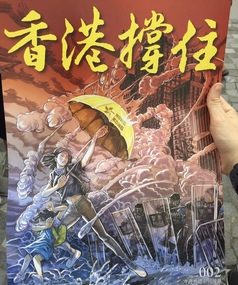
Photograph - Colour, Jarrod Watt, Hong Kong Street Flyer by an unknown artist, 2019, 06/2019
... Hong Kong Street Flyer by an unknown artist, 2019...Carrie Lam, Hong Kong’s chief executive, had plenty of political support in the territory’s pro-Beijing legislature to pass a bill that would allow extraditions to mainland China. ...Photograph of a street art poster taken on the streets of Hong Kong during the protests against legislation to allow Hong Kong suspects to be extradited to mainland Chinese ...Hong Kong...Carrie Lam, Hong Kong’s chief executive, had plenty of political support in the territory’s pro-Beijing legislature to pass a bill that would allow extraditions to mainland China. ...Carrie Lam, Hong Kong’s chief executive, had plenty of political support in the territory’s pro-Beijing legislature to pass a bill that would allow extraditions to mainland China. The legislators were set to begin discussing the bill in early June, and intended to vote on it just weeks later. A series of protests took place, and after a June 16 protest saw the largest turnout yet, Ms. Lam made a major concession: She postponed the bill, at least temporarily. It was an undeniable victory for the protesters — but it did little to quell the unrest. Since the bill could later be reintroduced, protesters felt they remained in danger. The police tactics to break up the demonstrations on June 12, including the use of more than 150 tear gas canisters to push protesters far away from the government office, created a new set of demands from the protesters. Now, instead of just calling for the withdrawal of the bill and Ms. Lam’s resignation, they said they wouldn’t be content unless there was an independent investigation of officers’ conduct. They also wanted the release of protesters arrested on June 12, and for the government to rescind its description of the demonstrations as a “riot,” a designation that carries legal significance. None of that has happened. Many analysts say Ms. Lam is unlikely to step down, nor would Beijing accept her resignation if she offered it. She has more wiggle room on the other demands, but has not indicated any willingness to budge. The Hong Kong Protests are a leaderless, digital movement.There is no single leader or group deciding on or steering the strategy, tactics and goals of the movement. Instead, protesters have used forums and messaging apps to decide next steps. Anyone can suggest a course of action, and others then vote on whether they support it. The most popular ideas rise to the top, and then people rally to make them happen. At its best, this structure has empowered many people to participate and have their voices heard. Protesters say it keeps them all safe by not allowing the government to target specific leaders. Their success in halting the extradition bill, which was shelved by the territory’s chief executive, speaks to the movement’s power. Despite the lack of a clear leader, protesters have shown extensive coordination at the demonstrations, having planned the specifics online beforehand. Supply stations are set up to distribute water, snacks, gloves, umbrellas and shields made of cardboard. Volunteer first aid workers wear brightly colored vests. People form assembly lines to pass supplies across long distances, with protesters communicating what they need through a series of predetermined hand signals. Anyone walking in dangerous areas without a helmet or a mask is quickly offered one. No individual can speak on behalf of the protesters, which makes negotiations difficult, if not impossible. (https://www.nytimes.com/2019/07/02/world/asia/hong-kong-protest-explained.html, accessed 07/07/2019) Hong Kong’s amended extradition law would allow the extradition of suspects to mainland China for the first time. Supporters say the amendments are key to ensuring the city does not become a criminal refuge, but critics worry Beijing will use the law to extradite political opponents and others to China where their legal protections cannot be guaranteed. The government claims the push to change the law, which would also apply to Taiwan and Macau, stems from the killing last year of a Hong Kong woman while she was in Taiwan with her boyfriend. Authorities in Taiwan suspect the woman’s boyfriend, who remains in Hong Kong, but cannot try him because no extradition agreement is in place. Under the amended law, those accused of offences punishable by seven years or more in prison could be extradited. The new legislation would give Hong Kong’s leader, known as the chief executive, authority to approve extradition requests, after review by the courts. Hong Kong’s legislature, the legislative council, would not have any oversight over the extradition process. Many Hong Kongers fear the proposed extradition law will be used by authorities to target political enemies. They worry the new legislation spells the end of the “one country, two systems” policy, eroding the civil rights enjoyed by Hong Kong residents since the handover of sovereignty from the UK to China in 1997. Many attending the protests on Sunday said they could not trust China as it had often used non-political crimes to target government critics, and said they also feared Hong Kong officials would not be able to reject Beijing’s requests. Legal professionals have also expressed concern over the rights of those sent across the border to be tried. The conviction rate in Chinese courts is as high as 99%. Arbitrary detentions, torture and denial of legal representation of one’s choosing are also common. Many in the protests on Sunday 09 June 2019 said they felt overwhelmed by a sense of helplessness in the face of mainland China’s increasing political, economic and cultural influence in Hong Kong. Hong Kong’s top political leader is not elected by ordinary voters but by a 1,200-strong election committee accountable to Beijing. Half of its legislature are chosen through indirect electoral systems that favour pro-Beijing figures. Many Hong Kongers also cited the jailing of leaders and activists from the 2014 Occupy Central movement– a 79-day mass civil disobedience movement – as well as the disqualification of young localist lawmakers as signs of the erosion of civil freedoms. Resentment towards China has been intensified by soaring property prices – with increasing numbers of mainland Chinese buying properties in the city – as well as the government’s “patriotic education” drive, and the large numbers of mainland tourists who flock to Hong Kong. Many Hong Kongers are also concerned about China’s growing control over the city’s news media, as they increasingly self-censor and follow Beijing’s tacit orders. https://www.theguardian.com/world/2019/jun/10/what-are-the-hong-kong-protests-about-explainerPhotograph of a street art poster taken on the streets of Hong Kong during the protests against legislation to allow Hong Kong suspects to be extradited to mainland Chinese carrie lam, hong kong protests, extraditions, poster art, posters -
 Federation University Historical Collection
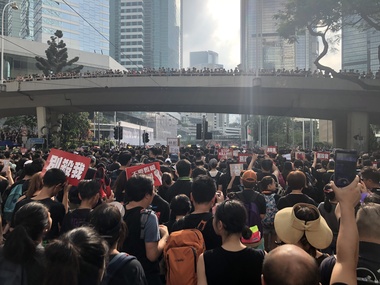
Photograph - Colour, Jarrod Watt, Street Protests in Hong Kong against proposed extradition laws, 2019, 17/06/2019
... Street Protests in Hong Kong against proposed extradition laws, 2019...Carrie Lam, Hong Kong’s chief executive, had plenty of political support in the territory’s pro-Beijing legislature to pass a bill that would allow extraditions to mainland China. ...Photograph of a crowd on the streets of Hong Kong to protest against proposed extradition laws, heading towards Admiralty. ...Causeway Bay, Hong Kong...Carrie Lam, Hong Kong’s chief executive, had plenty of political support in the territory’s pro-Beijing legislature to pass a bill that would allow extraditions to mainland China. ...Carrie Lam, Hong Kong’s chief executive, had plenty of political support in the territory’s pro-Beijing legislature to pass a bill that would allow extraditions to mainland China. The legislators were set to begin discussing the bill in early June, and intended to vote on it just weeks later. A series of protests took place, and after a June 16 protest saw the largest turnout yet, Ms. Lam made a major concession: She postponed the bill, at least temporarily. It was an undeniable victory for the protesters — but it did little to quell the unrest. Since the bill could later be reintroduced, protesters felt they remained in danger. The police tactics to break up the demonstrations on June 12, including the use of more than 150 tear gas canisters to push protesters far away from the government office, created a new set of demands from the protesters. Now, instead of just calling for the withdrawal of the bill and Ms. Lam’s resignation, they said they wouldn’t be content unless there was an independent investigation of officers’ conduct. They also wanted the release of protesters arrested on June 12, and for the government to rescind its description of the demonstrations as a “riot,” a designation that carries legal significance. None of that has happened. Many analysts say Ms. Lam is unlikely to step down, nor would Beijing accept her resignation if she offered it. She has more wiggle room on the other demands, but has not indicated any willingness to budge. The Hong Kong Protests are a leaderless, digital movement.There is no single leader or group deciding on or steering the strategy, tactics and goals of the movement. Instead, protesters have used forums and messaging apps to decide next steps. Anyone can suggest a course of action, and others then vote on whether they support it. The most popular ideas rise to the top, and then people rally to make them happen. At its best, this structure has empowered many people to participate and have their voices heard. Protesters say it keeps them all safe by not allowing the government to target specific leaders. Their success in halting the extradition bill, which was shelved by the territory’s chief executive, speaks to the movement’s power. Despite the lack of a clear leader, protesters have shown extensive coordination at the demonstrations, having planned the specifics online beforehand. Supply stations are set up to distribute water, snacks, gloves, umbrellas and shields made of cardboard. Volunteer first aid workers wear brightly colored vests. People form assembly lines to pass supplies across long distances, with protesters communicating what they need through a series of predetermined hand signals. Anyone walking in dangerous areas without a helmet or a mask is quickly offered one. No individual can speak on behalf of the protesters, which makes negotiations difficult, if not impossible. (https://www.nytimes.com/2019/07/02/world/asia/hong-kong-protest-explained.html, accessed 07/07/2019) Hong Kong’s amended extradition law would allow the extradition of suspects to mainland China for the first time. Supporters say the amendments are key to ensuring the city does not become a criminal refuge, but critics worry Beijing will use the law to extradite political opponents and others to China where their legal protections cannot be guaranteed. The government claims the push to change the law, which would also apply to Taiwan and Macau, stems from the killing last year of a Hong Kong woman while she was in Taiwan with her boyfriend. Authorities in Taiwan suspect the woman’s boyfriend, who remains in Hong Kong, but cannot try him because no extradition agreement is in place. Under the amended law, those accused of offences punishable by seven years or more in prison could be extradited. The new legislation would give Hong Kong’s leader, known as the chief executive, authority to approve extradition requests, after review by the courts. Hong Kong’s legislature, the legislative council, would not have any oversight over the extradition process. Many Hong Kongers fear the proposed extradition law will be used by authorities to target political enemies. They worry the new legislation spells the end of the “one country, two systems” policy, eroding the civil rights enjoyed by Hong Kong residents since the handover of sovereignty from the UK to China in 1997. Many attending the protests on Sunday said they could not trust China as it had often used non-political crimes to target government critics, and said they also feared Hong Kong officials would not be able to reject Beijing’s requests. Legal professionals have also expressed concern over the rights of those sent across the border to be tried. The conviction rate in Chinese courts is as high as 99%. Arbitrary detentions, torture and denial of legal representation of one’s choosing are also common. Many in the protests on Sunday 09 June 2019 said they felt overwhelmed by a sense of helplessness in the face of mainland China’s increasing political, economic and cultural influence in Hong Kong. Hong Kong’s top political leader is not elected by ordinary voters but by a 1,200-strong election committee accountable to Beijing. Half of its legislature are chosen through indirect electoral systems that favour pro-Beijing figures. Many Hong Kongers also cited the jailing of leaders and activists from the 2014 Occupy Central movement– a 79-day mass civil disobedience movement – as well as the disqualification of young localist lawmakers as signs of the erosion of civil freedoms. Resentment towards China has been intensified by soaring property prices – with increasing numbers of mainland Chinese buying properties in the city – as well as the government’s “patriotic education” drive, and the large numbers of mainland tourists who flock to Hong Kong. Many Hong Kongers are also concerned about China’s growing control over the city’s news media, as they increasingly self-censor and follow Beijing’s tacit orders. https://www.theguardian.com/world/2019/jun/10/what-are-the-hong-kong-protests-about-explainerPhotograph of a crowd on the streets of Hong Kong to protest against proposed extradition laws, heading towards Admiralty. carrie lam, hong kong protests, extraditions, protest, protestors, admiralty -
 Federation University Historical Collection
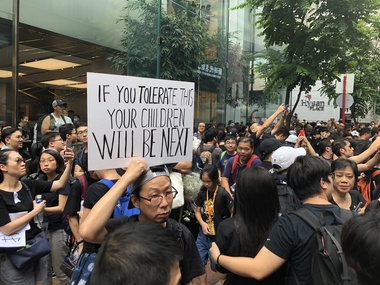
Photograph - Photograph - Colour, Jarrod Watt, Street Protests in Hong Kong against proposed extradition laws, 2019, 17/06/2019
... Street Protests in Hong Kong against proposed extradition laws, 2019...Carrie Lam, Hong Kong’s chief executive, had plenty of political support in the territory’s pro-Beijing legislature to pass a bill that would allow extraditions to mainland China. ...Photograph of a crowd or protestors against proposed extradition laws gathering on the streets of Causeway Bay, Hong Kong, leading down to the gathering area. ...Causeway Bay, Hong Kong...Carrie Lam, Hong Kong’s chief executive, had plenty of political support in the territory’s pro-Beijing legislature to pass a bill that would allow extraditions to mainland China. ...Carrie Lam, Hong Kong’s chief executive, had plenty of political support in the territory’s pro-Beijing legislature to pass a bill that would allow extraditions to mainland China. The legislators were set to begin discussing the bill in early June, and intended to vote on it just weeks later. A series of protests took place, and after a June 16 protest saw the largest turnout yet, Ms. Lam made a major concession: She postponed the bill, at least temporarily. It was an undeniable victory for the protesters — but it did little to quell the unrest. Since the bill could later be reintroduced, protesters felt they remained in danger. The police tactics to break up the demonstrations on June 12, including the use of more than 150 tear gas canisters to push protesters far away from the government office, created a new set of demands from the protesters. Now, instead of just calling for the withdrawal of the bill and Ms. Lam’s resignation, they said they wouldn’t be content unless there was an independent investigation of officers’ conduct. They also wanted the release of protesters arrested on June 12, and for the government to rescind its description of the demonstrations as a “riot,” a designation that carries legal significance. None of that has happened. Many analysts say Ms. Lam is unlikely to step down, nor would Beijing accept her resignation if she offered it. She has more wiggle room on the other demands, but has not indicated any willingness to budge. The Hong Kong Protests are a leaderless, digital movement.There is no single leader or group deciding on or steering the strategy, tactics and goals of the movement. Instead, protesters have used forums and messaging apps to decide next steps. Anyone can suggest a course of action, and others then vote on whether they support it. The most popular ideas rise to the top, and then people rally to make them happen. At its best, this structure has empowered many people to participate and have their voices heard. Protesters say it keeps them all safe by not allowing the government to target specific leaders. Their success in halting the extradition bill, which was shelved by the territory’s chief executive, speaks to the movement’s power. Despite the lack of a clear leader, protesters have shown extensive coordination at the demonstrations, having planned the specifics online beforehand. Supply stations are set up to distribute water, snacks, gloves, umbrellas and shields made of cardboard. Volunteer first aid workers wear brightly colored vests. People form assembly lines to pass supplies across long distances, with protesters communicating what they need through a series of predetermined hand signals. Anyone walking in dangerous areas without a helmet or a mask is quickly offered one. No individual can speak on behalf of the protesters, which makes negotiations difficult, if not impossible. (https://www.nytimes.com/2019/07/02/world/asia/hong-kong-protest-explained.html, accessed 07/07/2019) Hong Kong’s amended extradition law would allow the extradition of suspects to mainland China for the first time. Supporters say the amendments are key to ensuring the city does not become a criminal refuge, but critics worry Beijing will use the law to extradite political opponents and others to China where their legal protections cannot be guaranteed. The government claims the push to change the law, which would also apply to Taiwan and Macau, stems from the killing last year of a Hong Kong woman while she was in Taiwan with her boyfriend. Authorities in Taiwan suspect the woman’s boyfriend, who remains in Hong Kong, but cannot try him because no extradition agreement is in place. Under the amended law, those accused of offences punishable by seven years or more in prison could be extradited. The new legislation would give Hong Kong’s leader, known as the chief executive, authority to approve extradition requests, after review by the courts. Hong Kong’s legislature, the legislative council, would not have any oversight over the extradition process. Many Hong Kongers fear the proposed extradition law will be used by authorities to target political enemies. They worry the new legislation spells the end of the “one country, two systems” policy, eroding the civil rights enjoyed by Hong Kong residents since the handover of sovereignty from the UK to China in 1997. Many attending the protests on Sunday said they could not trust China as it had often used non-political crimes to target government critics, and said they also feared Hong Kong officials would not be able to reject Beijing’s requests. Legal professionals have also expressed concern over the rights of those sent across the border to be tried. The conviction rate in Chinese courts is as high as 99%. Arbitrary detentions, torture and denial of legal representation of one’s choosing are also common. Many in the protests on Sunday 09 June 2019 said they felt overwhelmed by a sense of helplessness in the face of mainland China’s increasing political, economic and cultural influence in Hong Kong. Hong Kong’s top political leader is not elected by ordinary voters but by a 1,200-strong election committee accountable to Beijing. Half of its legislature are chosen through indirect electoral systems that favour pro-Beijing figures. Many Hong Kongers also cited the jailing of leaders and activists from the 2014 Occupy Central movement– a 79-day mass civil disobedience movement – as well as the disqualification of young localist lawmakers as signs of the erosion of civil freedoms. Resentment towards China has been intensified by soaring property prices – with increasing numbers of mainland Chinese buying properties in the city – as well as the government’s “patriotic education” drive, and the large numbers of mainland tourists who flock to Hong Kong. Many Hong Kongers are also concerned about China’s growing control over the city’s news media, as they increasingly self-censor and follow Beijing’s tacit orders. https://www.theguardian.com/world/2019/jun/10/what-are-the-hong-kong-protests-about-explainerPhotograph of a crowd or protestors against proposed extradition laws gathering on the streets of Causeway Bay, Hong Kong, leading down to the gathering area. carrie lam, hong kong protests, extraditions, protest, protestors -
 Federation University Historical Collection
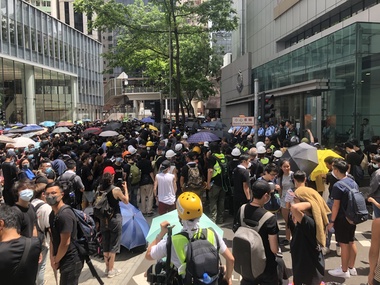
Photograph - Photograph - Colour, Jarrod Watt, Seven police officers stand guard in front of Hong Kong's main police headquarters on Arsenal Street in Wan Chai, 2019, 21/06/2019
... Seven police officers stand guard in front of Hong Kong's main police headquarters on Arsenal Street in Wan Chai, 2019...Carrie Lam, Hong Kong’s chief executive, had plenty of political support in the territory’s pro-Beijing legislature to pass a bill that would allow extraditions to mainland China. ...Seven police officers stand guard in front of Hong Kong's main police headquarters on Arsenal Street in Wan Chai as an estimated one thousand protestors surround on 26 June 2019. ...Wan Chai, Hong Kong...Carrie Lam, Hong Kong’s chief executive, had plenty of political support in the territory’s pro-Beijing legislature to pass a bill that would allow extraditions to mainland China. ...Carrie Lam, Hong Kong’s chief executive, had plenty of political support in the territory’s pro-Beijing legislature to pass a bill that would allow extraditions to mainland China. The legislators were set to begin discussing the bill in early June, and intended to vote on it just weeks later. A series of protests took place, and after a June 16 protest saw the largest turnout yet, Ms. Lam made a major concession: She postponed the bill, at least temporarily. It was an undeniable victory for the protesters — but it did little to quell the unrest. Since the bill could later be reintroduced, protesters felt they remained in danger. The police tactics to break up the demonstrations on June 12, including the use of more than 150 tear gas canisters to push protesters far away from the government office, created a new set of demands from the protesters. Now, instead of just calling for the withdrawal of the bill and Ms. Lam’s resignation, they said they wouldn’t be content unless there was an independent investigation of officers’ conduct. They also wanted the release of protesters arrested on June 12, and for the government to rescind its description of the demonstrations as a “riot,” a designation that carries legal significance. None of that has happened. Many analysts say Ms. Lam is unlikely to step down, nor would Beijing accept her resignation if she offered it. She has more wiggle room on the other demands, but has not indicated any willingness to budge. The Hong Kong Protests are a leaderless, digital movement.There is no single leader or group deciding on or steering the strategy, tactics and goals of the movement. Instead, protesters have used forums and messaging apps to decide next steps. Anyone can suggest a course of action, and others then vote on whether they support it. The most popular ideas rise to the top, and then people rally to make them happen. At its best, this structure has empowered many people to participate and have their voices heard. Protesters say it keeps them all safe by not allowing the government to target specific leaders. Their success in halting the extradition bill, which was shelved by the territory’s chief executive, speaks to the movement’s power. Despite the lack of a clear leader, protesters have shown extensive coordination at the demonstrations, having planned the specifics online beforehand. Supply stations are set up to distribute water, snacks, gloves, umbrellas and shields made of cardboard. Volunteer first aid workers wear brightly colored vests. People form assembly lines to pass supplies across long distances, with protesters communicating what they need through a series of predetermined hand signals. Anyone walking in dangerous areas without a helmet or a mask is quickly offered one. No individual can speak on behalf of the protesters, which makes negotiations difficult, if not impossible. (https://www.nytimes.com/2019/07/02/world/asia/hong-kong-protest-explained.html, accessed 07/07/2019) Hong Kong’s amended extradition law would allow the extradition of suspects to mainland China for the first time. Supporters say the amendments are key to ensuring the city does not become a criminal refuge, but critics worry Beijing will use the law to extradite political opponents and others to China where their legal protections cannot be guaranteed. The government claims the push to change the law, which would also apply to Taiwan and Macau, stems from the killing last year of a Hong Kong woman while she was in Taiwan with her boyfriend. Authorities in Taiwan suspect the woman’s boyfriend, who remains in Hong Kong, but cannot try him because no extradition agreement is in place. Under the amended law, those accused of offences punishable by seven years or more in prison could be extradited. The new legislation would give Hong Kong’s leader, known as the chief executive, authority to approve extradition requests, after review by the courts. Hong Kong’s legislature, the legislative council, would not have any oversight over the extradition process. Many Hong Kongers fear the proposed extradition law will be used by authorities to target political enemies. They worry the new legislation spells the end of the “one country, two systems” policy, eroding the civil rights enjoyed by Hong Kong residents since the handover of sovereignty from the UK to China in 1997. Many attending the protests on Sunday said they could not trust China as it had often used non-political crimes to target government critics, and said they also feared Hong Kong officials would not be able to reject Beijing’s requests. Legal professionals have also expressed concern over the rights of those sent across the border to be tried. The conviction rate in Chinese courts is as high as 99%. Arbitrary detentions, torture and denial of legal representation of one’s choosing are also common. Many in the protests on Sunday 09 June 2019 said they felt overwhelmed by a sense of helplessness in the face of mainland China’s increasing political, economic and cultural influence in Hong Kong. Hong Kong’s top political leader is not elected by ordinary voters but by a 1,200-strong election committee accountable to Beijing. Half of its legislature are chosen through indirect electoral systems that favour pro-Beijing figures. Many Hong Kongers also cited the jailing of leaders and activists from the 2014 Occupy Central movement– a 79-day mass civil disobedience movement – as well as the disqualification of young localist lawmakers as signs of the erosion of civil freedoms. Resentment towards China has been intensified by soaring property prices – with increasing numbers of mainland Chinese buying properties in the city – as well as the government’s “patriotic education” drive, and the large numbers of mainland tourists who flock to Hong Kong. Many Hong Kongers are also concerned about China’s growing control over the city’s news media, as they increasingly self-censor and follow Beijing’s tacit orders. https://www.theguardian.com/world/2019/jun/10/what-are-the-hong-kong-protests-about-explainerSeven police officers stand guard in front of Hong Kong's main police headquarters on Arsenal Street in Wan Chai as an estimated one thousand protestors surround on 26 June 2019. Protestors take turns to step up and hurl abuse at the officers, in a protest lasting 6 hours before peacefully dispersing. The protesters chanted 'Release the martyrs' and 'Stop police violence' in reference to violent clashes with police in the days previous. ( https://www.scmp.com/news/hong-kong/politics/article/3016238/hong-kong-police-under-siege-again-protesters-surround)carrie lam, hong kong protests, extraditions, protest, protestors, police, wan chai -
 Federation University Historical Collection
Photograph - Colour, Jarrod Watt, A thousand protestors surround Hong Kong's main police headquarters on Arsenal Street in Wan Chai on June 26th 2019, 21/06/2019
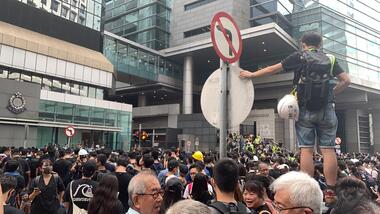
... A thousand protestors surround Hong Kong's main police headquarters on Arsenal Street in Wan Chai on June 26th 2019...Carrie Lam, Hong Kong’s chief executive, had plenty of political support in the territory’s pro-Beijing legislature to pass a bill that would allow extraditions to mainland China. ...(https://www.scmp.com/news/hong-kong/politics/article/3016238/hong-kong-police-under-siege-again-protesters-surround )...Hong Kong...Carrie Lam, Hong Kong’s chief executive, had plenty of political support in the territory’s pro-Beijing legislature to pass a bill that would allow extraditions to mainland China. ...Carrie Lam, Hong Kong’s chief executive, had plenty of political support in the territory’s pro-Beijing legislature to pass a bill that would allow extraditions to mainland China. The legislators were set to begin discussing the bill in early June, and intended to vote on it just weeks later. A series of protests took place, and after a June 16 protest saw the largest turnout yet, Ms. Lam made a major concession: She postponed the bill, at least temporarily. It was an undeniable victory for the protesters — but it did little to quell the unrest. Since the bill could later be reintroduced, protesters felt they remained in danger. The police tactics to break up the demonstrations on June 12, including the use of more than 150 tear gas canisters to push protesters far away from the government office, created a new set of demands from the protesters. Now, instead of just calling for the withdrawal of the bill and Ms. Lam’s resignation, they said they wouldn’t be content unless there was an independent investigation of officers’ conduct. They also wanted the release of protesters arrested on June 12, and for the government to rescind its description of the demonstrations as a “riot,” a designation that carries legal significance. None of that has happened. Many analysts say Ms. Lam is unlikely to step down, nor would Beijing accept her resignation if she offered it. She has more wiggle room on the other demands, but has not indicated any willingness to budge. The Hong Kong Protests are a leaderless, digital movement.There is no single leader or group deciding on or steering the strategy, tactics and goals of the movement. Instead, protesters have used forums and messaging apps to decide next steps. Anyone can suggest a course of action, and others then vote on whether they support it. The most popular ideas rise to the top, and then people rally to make them happen. At its best, this structure has empowered many people to participate and have their voices heard. Protesters say it keeps them all safe by not allowing the government to target specific leaders. Their success in halting the extradition bill, which was shelved by the territory’s chief executive, speaks to the movement’s power. Despite the lack of a clear leader, protesters have shown extensive coordination at the demonstrations, having planned the specifics online beforehand. Supply stations are set up to distribute water, snacks, gloves, umbrellas and shields made of cardboard. Volunteer first aid workers wear brightly colored vests. People form assembly lines to pass supplies across long distances, with protesters communicating what they need through a series of predetermined hand signals. Anyone walking in dangerous areas without a helmet or a mask is quickly offered one. No individual can speak on behalf of the protesters, which makes negotiations difficult, if not impossible. (https://www.nytimes.com/2019/07/02/world/asia/hong-kong-protest-explained.html, accessed 07/07/2019) Hong Kong’s amended extradition law would allow the extradition of suspects to mainland China for the first time. Supporters say the amendments are key to ensuring the city does not become a criminal refuge, but critics worry Beijing will use the law to extradite political opponents and others to China where their legal protections cannot be guaranteed. The government claims the push to change the law, which would also apply to Taiwan and Macau, stems from the killing last year of a Hong Kong woman while she was in Taiwan with her boyfriend. Authorities in Taiwan suspect the woman’s boyfriend, who remains in Hong Kong, but cannot try him because no extradition agreement is in place. Under the amended law, those accused of offences punishable by seven years or more in prison could be extradited. The new legislation would give Hong Kong’s leader, known as the chief executive, authority to approve extradition requests, after review by the courts. Hong Kong’s legislature, the legislative council, would not have any oversight over the extradition process. Many Hong Kongers fear the proposed extradition law will be used by authorities to target political enemies. They worry the new legislation spells the end of the “one country, two systems” policy, eroding the civil rights enjoyed by Hong Kong residents since the handover of sovereignty from the UK to China in 1997. Many attending the protests on Sunday said they could not trust China as it had often used non-political crimes to target government critics, and said they also feared Hong Kong officials would not be able to reject Beijing’s requests. Legal professionals have also expressed concern over the rights of those sent across the border to be tried. The conviction rate in Chinese courts is as high as 99%. Arbitrary detentions, torture and denial of legal representation of one’s choosing are also common. Many in the protests on Sunday 09 June 2019 said they felt overwhelmed by a sense of helplessness in the face of mainland China’s increasing political, economic and cultural influence in Hong Kong. Hong Kong’s top political leader is not elected by ordinary voters but by a 1,200-strong election committee accountable to Beijing. Half of its legislature are chosen through indirect electoral systems that favour pro-Beijing figures. Many Hong Kongers also cited the jailing of leaders and activists from the 2014 Occupy Central movement– a 79-day mass civil disobedience movement – as well as the disqualification of young localist lawmakers as signs of the erosion of civil freedoms. Resentment towards China has been intensified by soaring property prices – with increasing numbers of mainland Chinese buying properties in the city – as well as the government’s “patriotic education” drive, and the large numbers of mainland tourists who flock to Hong Kong. Many Hong Kongers are also concerned about China’s growing control over the city’s news media, as they increasingly self-censor and follow Beijing’s tacit orders. https://www.theguardian.com/world/2019/jun/10/what-are-the-hong-kong-protests-about-explainerMore than a thousand protestors surround Hong Kong's main police headquarters on Arsenal Street in Wan Chai on June 26th following a peaceful rally at Edinburgh Place in Central. Doors to the complex were barricaded by protestors, who left after a six hour siege in protest at police violence at a prtest held earlier on 12 June 2019. Protesters ended a six-hour siege of Hong Kong’s police headquarters – their second in a week over the now-suspended extradition bill – early on Thursday morning. More than 1,000 were involved at the height of the protest, which began after 10pm on Wednesday. Around 100 were left at the end and dispersed without a fight when officers with riot shields emerged from the building in Wan Chai at 4am on Thursday. After a peaceful rally attended by thousands earlier at Edinburgh Place in the Central business district, hundreds descended on Arsenal Street, blocking the junction with Lockhart Road to all traffic and sealing the entrances to the police base. (https://www.scmp.com/news/hong-kong/politics/article/3016238/hong-kong-police-under-siege-again-protesters-surround )carrie lam, hong kong protests, extraditions, protest, protestors -
 Federation University Historical Collection
Photograph - Colour Photograph, Street Protests in Hong Kong against proposed extradition laws, 2019, 17/06/2019
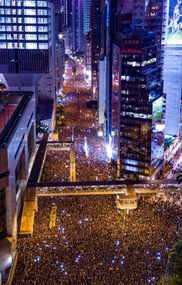
... Street Protests in Hong Kong against proposed extradition laws, 2019...Carrie Lam, Hong Kong’s chief executive, had plenty of political support in the territory’s pro-Beijing legislature to pass a bill that would allow extraditions to mainland China. ...Crowds mass on Queens Way in Hong Kong as an estimated 2 million people march in protest at the government's refusal to withdraw a controverisal law allowing people to be extradited to mainland China. ...Causeway Bay, Hong Kong...Carrie Lam, Hong Kong’s chief executive, had plenty of political support in the territory’s pro-Beijing legislature to pass a bill that would allow extraditions to mainland China. ...Carrie Lam, Hong Kong’s chief executive, had plenty of political support in the territory’s pro-Beijing legislature to pass a bill that would allow extraditions to mainland China. The legislators were set to begin discussing the bill in early June, and intended to vote on it just weeks later. A series of protests took place, and after a June 16 protest saw the largest turnout yet, Ms. Lam made a major concession: She postponed the bill, at least temporarily. It was an undeniable victory for the protesters — but it did little to quell the unrest. Since the bill could later be reintroduced, protesters felt they remained in danger. The police tactics to break up the demonstrations on June 12, including the use of more than 150 tear gas canisters to push protesters far away from the government office, created a new set of demands from the protesters. Now, instead of just calling for the withdrawal of the bill and Ms. Lam’s resignation, they said they wouldn’t be content unless there was an independent investigation of officers’ conduct. They also wanted the release of protesters arrested on June 12, and for the government to rescind its description of the demonstrations as a “riot,” a designation that carries legal significance. None of that has happened. Many analysts say Ms. Lam is unlikely to step down, nor would Beijing accept her resignation if she offered it. She has more wiggle room on the other demands, but has not indicated any willingness to budge. The Hong Kong Protests are a leaderless, digital movement.There is no single leader or group deciding on or steering the strategy, tactics and goals of the movement. Instead, protesters have used forums and messaging apps to decide next steps. Anyone can suggest a course of action, and others then vote on whether they support it. The most popular ideas rise to the top, and then people rally to make them happen. At its best, this structure has empowered many people to participate and have their voices heard. Protesters say it keeps them all safe by not allowing the government to target specific leaders. Their success in halting the extradition bill, which was shelved by the territory’s chief executive, speaks to the movement’s power. Despite the lack of a clear leader, protesters have shown extensive coordination at the demonstrations, having planned the specifics online beforehand. Supply stations are set up to distribute water, snacks, gloves, umbrellas and shields made of cardboard. Volunteer first aid workers wear brightly colored vests. People form assembly lines to pass supplies across long distances, with protesters communicating what they need through a series of predetermined hand signals. Anyone walking in dangerous areas without a helmet or a mask is quickly offered one. No individual can speak on behalf of the protesters, which makes negotiations difficult, if not impossible. (https://www.nytimes.com/2019/07/02/world/asia/hong-kong-protest-explained.html, accessed 07/07/2019) Hong Kong’s amended extradition law would allow the extradition of suspects to mainland China for the first time. Supporters say the amendments are key to ensuring the city does not become a criminal refuge, but critics worry Beijing will use the law to extradite political opponents and others to China where their legal protections cannot be guaranteed. The government claims the push to change the law, which would also apply to Taiwan and Macau, stems from the killing last year of a Hong Kong woman while she was in Taiwan with her boyfriend. Authorities in Taiwan suspect the woman’s boyfriend, who remains in Hong Kong, but cannot try him because no extradition agreement is in place. Under the amended law, those accused of offences punishable by seven years or more in prison could be extradited. The new legislation would give Hong Kong’s leader, known as the chief executive, authority to approve extradition requests, after review by the courts. Hong Kong’s legislature, the legislative council, would not have any oversight over the extradition process. Many Hong Kongers fear the proposed extradition law will be used by authorities to target political enemies. They worry the new legislation spells the end of the “one country, two systems” policy, eroding the civil rights enjoyed by Hong Kong residents since the handover of sovereignty from the UK to China in 1997. Many attending the protests on Sunday said they could not trust China as it had often used non-political crimes to target government critics, and said they also feared Hong Kong officials would not be able to reject Beijing’s requests. Legal professionals have also expressed concern over the rights of those sent across the border to be tried. The conviction rate in Chinese courts is as high as 99%. Arbitrary detentions, torture and denial of legal representation of one’s choosing are also common. Many in the protests on Sunday 09 June 2019 said they felt overwhelmed by a sense of helplessness in the face of mainland China’s increasing political, economic and cultural influence in Hong Kong. Hong Kong’s top political leader is not elected by ordinary voters but by a 1,200-strong election committee accountable to Beijing. Half of its legislature are chosen through indirect electoral systems that favour pro-Beijing figures. Many Hong Kongers also cited the jailing of leaders and activists from the 2014 Occupy Central movement– a 79-day mass civil disobedience movement – as well as the disqualification of young localist lawmakers as signs of the erosion of civil freedoms. Resentment towards China has been intensified by soaring property prices – with increasing numbers of mainland Chinese buying properties in the city – as well as the government’s “patriotic education” drive, and the large numbers of mainland tourists who flock to Hong Kong. Many Hong Kongers are also concerned about China’s growing control over the city’s news media, as they increasingly self-censor and follow Beijing’s tacit orders. https://www.theguardian.com/world/2019/jun/10/what-are-the-hong-kong-protests-about-explainerCrowds mass on Queens Way in Hong Kong as an estimated 2 million people march in protest at the government's refusal to withdraw a controverisal law allowing people to be extradited to mainland China. Chants demanded the chief executive apologise and the legislation be withdrawn, while many held signs protesting police violence. Nearly 2 million protesters flooded the streets of Hong Kong on Sunday, organisers claimed, delivering a stunning repudiation of Chief Executive Carrie Lam Cheng Yuet-ngor’s governance and forcing a public apology out of the city’s leader over her campaign to bulldoze a controversial extradition bill through the legislature. A day after Lam suspended her push for the bill, expecting it to defuse a crisis that has seen violent clashes between mostly young protesters and police, the centre of Hong Kong was brought to a complete standstill as the masses marched to chastise her for refusing to withdraw the bill or apologise when first asked to, and declaring that nothing short of her resignation would satisfy them now. (https://www.scmp.com/news/hong-kong/politics/article/3014737/nearly-2-million-people-take-streets-forcing-public-apology ) carrie lam, hong kong protests, extraditions, protest, protestors, admiralty -
 Ballarat Heritage Services
Poster - Event Calendar, 2014 Event Calendar, Hong Kong, 2014
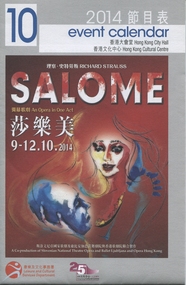
... 2014 Event Calendar, Hong Kong...Jacqueline Dark, mezzo soprano from Ballarat Victoria, principal artist with Opera Australia, was a leading singer in the production of Salome in Hong Kong in 2014....Fold out events calendar 2014 for Hong Kong City Hall and Hong Kong Cultural Centre...Jacqueline Dark, mezzo soprano from Ballarat Victoria, principal artist with Opera Australia, was a leading singer in the production of Salome in Hong Kong in 2014. jacqueline Dark Salome Richard Strauss SALOME An Opera in One Act Fold out events calendar 2014 for Hong Kong City Hall and Hong Kong Cultural Centre 2014 Event Calendar, Hong Kong Poster Event Calendar ...Jacqueline Dark, mezzo soprano from Ballarat Victoria, principal artist with Opera Australia, was a leading singer in the production of Salome in Hong Kong in 2014.Fold out events calendar 2014 for Hong Kong City Hall and Hong Kong Cultural CentreRichard Strauss SALOME An Opera in One Actjacqueline dark, salome -
 Waverley RSL Sub Branch
Plaque Royal Hong Kong Police, Royal Hong Kong Police
... Royal Hong Kong Police ...The Hong Kong Police Force (香港警務處, HKPF; HKP), also known as the Hong Kong Police, is the largest disciplined service under the Security Bureau of Hong Kong. ...Royal Hong Kong Police ...The Hong Kong Police Force (香港警務處, HKPF; HKP), also known as the Hong Kong Police, is the largest disciplined service under the Security Bureau of Hong Kong. ...The Hong Kong Police Force (香港警務處, HKPF; HKP), also known as the Hong Kong Police, is the largest disciplined service under the Security Bureau of Hong Kong. It is the world's second, and Asia's first, police agency to operate with a modern policing system. It was formed on 1 May 1844, with a strength of 32 officers. Queen Elizabeth II granted the Royal Charter to the Hong Kong Police Force in 1969 for their handling of the Hong Kong 1967 riots—renaming them: the Royal Hong Kong Police Force. Following the transfer of sovereignty, the Force is once again named the Hong Kong Police Force.[1] The current Commissioner of Police is Andy Tsang Wai-hung.[2] Including the Hong Kong Auxiliary Police Force and civil servants, the force consists of about 40,000 personnel; which gives Hong Kong the second largest citizen–police officer ratio in the world. In addition, the Marine Region with about 3,000 officers and a fleet of 143 vessels, is the largest of any civil police force.Wooden Plaque 15cm x x13cmRoyal Hong Kong Police -
 Mission to Seafarers Victoria
photograph - Photograph, Black and white, Hong Kong Mission
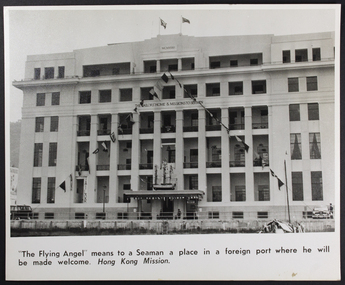
... Hong Kong Mission...large b & w photograph of Hong Kong Seafarers Mission with caption incorporated below photo...Front caption: "The Flying Angel" means to a Seaman a place in a foreign port where he will / be made welcome. Hong Kong Mission [italics]....honk kong overseas missions asia Front caption: "The Flying Angel" means to a Seaman a place in a foreign port where he will / be made welcome. Hong Kong Mission [italics]. large b & w photograph of Hong Kong Seafarers Mission with caption incorporated below photo Hong Kong Mission photograph Photograph, Black and white ...large b & w photograph of Hong Kong Seafarers Mission with caption incorporated below photoFront caption: "The Flying Angel" means to a Seaman a place in a foreign port where he will / be made welcome. Hong Kong Mission [italics].honk kong, overseas missions, asia -
 National Wool Museum
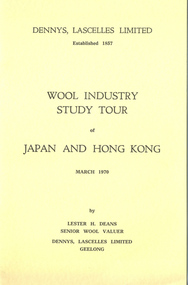
Report, Dennys, Lascelles Limited : Wool Industry Study Tour of Japan and Hong Kong, March 1970, 1970
... Dennys, Lascelles Limited : Wool Industry Study Tour of Japan and Hong Kong, March 1970...Dennys, Lascelles Limited: Wool Industry Study Tour of Japan and Hong Kong, March 1970. Part of the NWM Woolbroker's Office exhibit until late 1990's....Dennys, Lascelles Limited : Wool Industry Study Tour of Japan and Hong Kong, March 1970...Dennys, Lascelles Limited: Wool Industry Study Tour of Japan and Hong Kong, March 1970. Part of the NWM Woolbroker's Office exhibit until late 1990's. wool stores wool marketing dennys lascelles limited wool stores wool marketing Dennys, Lascelles Limited : Wool Industry Study Tour of Japan and Hong Kong, March 1970 Three copies. ...Dennys, Lascelles Limited: Wool Industry Study Tour of Japan and Hong Kong, March 1970. Part of the NWM Woolbroker's Office exhibit until late 1990's.Three copies. Report, 15pp: Small booklet, cream, soft textured cover with title and date in black ink. Stapled twice at left. Dennys, Lascelles Limited : Wool Industry Study Tour of Japan and Hong Kong, March 1970wool stores wool marketing, dennys, lascelles limited, wool stores, wool marketing -
 Flagstaff Hill Maritime Museum and Village
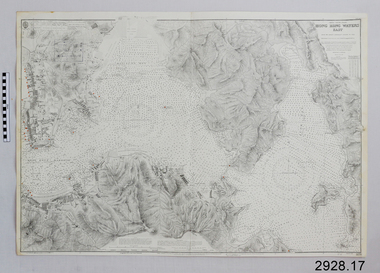
Document - Navigation Chart, Hong Kong - Waters East
... Hong Kong - Waters East...British Admiralty Navigation Chart - Hong Kong - Waters East...Warrnambool Shipwrecked-coast Flagstaff-Hill Flagstaff-Hill-Maritime-Museum Maritime-Museum Shipwreck-coast Flagstaff-Hill-Maritime-Village Shipwrecked-artefact Navigation Chart British Admiralty Navigation Chart Hong Kong - Waters East Hong Kong British Admiralty Navigation Chart - Hong Kong - Waters East Hong Kong - Waters East Document Navigation Chart ...British Admiralty Navigation Chart - Hong Kong - Waters Eastwarrnambool, shipwrecked-coast, flagstaff-hill, flagstaff-hill-maritime-museum, maritime-museum, shipwreck-coast, flagstaff-hill-maritime-village, shipwrecked-artefact, navigation chart, british admiralty navigation chart, hong kong - waters east, hong kong -
 Flagstaff Hill Maritime Museum and Village
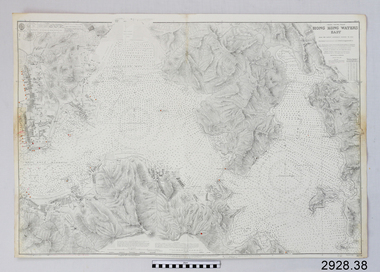
Document - Navigation Chart, Hong Kong, Water East
... Hong Kong, Water East...British Admiralty Navigation Chart - Hong Kong, Water East...Warrnambool Shipwrecked-coast Flagstaff-Hill Flagstaff-Hill-Maritime-Museum Maritime-Museum Shipwreck-coast Flagstaff-Hill-Maritime-Village Shipwrecked-artefact Navigation Chart British Admiralty Navigation Chart British Admiralty Hong Kong British Admiralty Navigation Chart - Hong Kong, Water East Hong Kong, Water East Document Navigation Chart ...British Admiralty Navigation Chart - Hong Kong, Water Eastwarrnambool, shipwrecked-coast, flagstaff-hill, flagstaff-hill-maritime-museum, maritime-museum, shipwreck-coast, flagstaff-hill-maritime-village, shipwrecked-artefact, navigation chart, british admiralty navigation chart, british admiralty, hong kong -
 Federation University Historical Collection
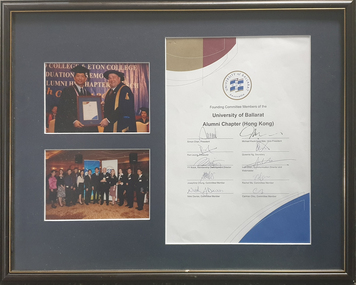
Photograph, University of Ballarat Hong Kong Alumni Chapter founding members
... University of Ballarat Hong Kong Alumni Chapter founding members...Framed signatures wit two photographs relating to the founding of the Hong Kong alumni chapter. ...University of Ballarat is a predecessor institution of Federation University Australia university of ballarat alumni founding chapter hong kong hong kong chapter david battersby simon chan ran leung yy kwok nikki davies michael kwok-fung mak queenie ng ivan chan rachel ma carman chiu international students Framed signatures wit two photographs relating to the founding of the Hong Kong alumni chapter. ...University of Ballarat is a predecessor institution of Federation University AustraliaFramed signatures wit two photographs relating to the founding of the Hong Kong alumni chapter. university of ballarat, alumni, founding chapter, hong kong, hong kong chapter, david battersby, simon chan, ran leung, yy kwok, nikki davies, michael kwok-fung mak, queenie ng, ivan chan, rachel ma, carman chiu, international students -
 Melbourne Tram Museum
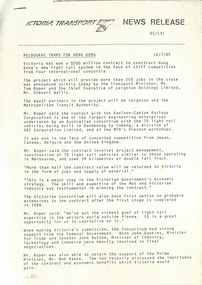
Document - Press Release, Minister of Transport, "Melbourne Trams for Hong Kong", 16/07/1985 12:00:00 AM
... "Melbourne Trams for Hong Kong"...Press Release - News - two A4 pages, stapled, titled "Melbourne Trams for Hong Kong", about the awarding of a $200m contract for a new light rail system in Hong Kong, Quotes the Transport Minister Tom Roper. ...Trams tramways Hong Kong Light Railway MTA Contracts Press Release - News - two A4 pages, stapled, titled "Melbourne Trams for Hong Kong", about the awarding of a $200m contract for a new light rail system in Hong Kong, Quotes the Transport Minister Tom Roper. ...Press Release - News - two A4 pages, stapled, titled "Melbourne Trams for Hong Kong", about the awarding of a $200m contract for a new light rail system in Hong Kong, Quotes the Transport Minister Tom Roper. Notes the number of competitors to the contract and the involvement of the MTA. Dated 16/7/1985.trams, tramways, hong kong, light railway, mta, contracts -
 Melbourne Tram Museum
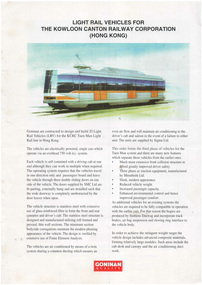
Pamphlet, Goninan & Co, "Light Rail Vehicles for the Kowloon Canton Railway Corporation (Hong Kong)", c1997
... "Light Rail Vehicles for the Kowloon Canton Railway Corporation (Hong Kong)"...Pamphlet - A4, full colour two sided titled "Light Rail Vehicles for the Kowloon Canton Railway Corporation (Hong Kong)", giving details including dimensions and a side elevation of the 20 vehicles built for the KCRC Tuen Mun Light Rail line in Hong Kong. ...Trams tramways Hong Kong New Trams Goninan & Co. Specification Pamphlet - A4, full colour two sided titled "Light Rail Vehicles for the Kowloon Canton Railway Corporation (Hong Kong)", giving details including dimensions and a side elevation of the 20 vehicles built for the KCRC Tuen Mun Light Rail line in Hong Kong. ...Pamphlet - A4, full colour two sided titled "Light Rail Vehicles for the Kowloon Canton Railway Corporation (Hong Kong)", giving details including dimensions and a side elevation of the 20 vehicles built for the KCRC Tuen Mun Light Rail line in Hong Kong. Published by Goninan, built in Newcastle, Hamiltontrams, tramways, hong kong, new trams, goninan & co., specification -
 Whitehorse Historical Society Inc.
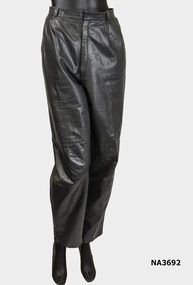
Clothing - Leather Trousers, circa 1980
... These trousers were made in Hong Kong to go with Versace shirt, NA3685...Made for Robert Smith in Hong Kong...Hong Kong...Made for Robert Smith in Hong Kong Clothing Leather Trousers ...These trousers were made in Hong Kong to go with Versace shirt, NA3685Trousers are a good example of 1980s fashion. Worn by Robert Smith.Grey leather trousers. Made for Robert Smith in Hong Kongcostume, male -
 Bendigo Military Museum
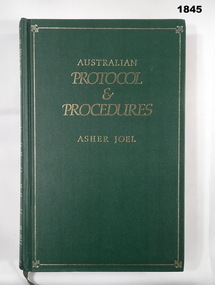
Book - BOOK - PROTOCOL & PROCEDURES, JOEL Asher, Australian Protocol & Procedures, 1982
... ...Hong Kong......Hong Kong...Australian Protocol & Procedures Book BOOK - PROTOCOL & PROCEDURES JOEL Asher Angus & Robertson Hong Kong ...Hard Cover book. Hard cover - cardboard, green buckram with gold print on front and spine. Gold decorative edge on front and spine. 371 pages, cut, plain, off white paper. Illustrated in colour - photographs of National and State Symbols, The Order of Australia, Australian Bravery Decorations, Personal Arms. Handwritten inscription, reverse side of front end paper. Front and back end papers in green and gold coloured designs. books, australia, symbols, decorations -
 Mont De Lancey
Accessory - Cream vinyl handbag with handles
... 'Gold Crest' brand made in Hong Kong....Tag reading 'styled by Gold Crest made in Hong Kong -vinyl'...Hong Kong...Tag reading 'styled by Gold Crest made in Hong Kong -vinyl' Cream vinyl handbag with 2 short handles. ...Cream vinyl handbag with 2 short handles. Gold clasp closure and studs on base ,beige lining and 1 zipped pocket. 'Gold Crest' brand made in Hong Kong.Tag reading 'styled by Gold Crest made in Hong Kong -vinyl' -
 Disability Sport & Recreation Victoria
Lapel pin, Hong Kong Football Association pin
... Hong Kong Football Association pin...Hong Kong Football Association Limited around the edge. ...Hong Kong Football Association Limited around the edge. ...Small round shaped badge with long pinHong Kong Football Association Limited around the edge. Inset, gold coloured dragon and Chinese text. -
 Orbost & District Historical Society
coin purse, mid 20th century
... "Made in Hong Kong" means only that the item was made some time after 1891....Inside : "Rayon ; Made in Hong Kong"...Hong Kong, China..."Made in Hong Kong" means only that the item was made some time after 1891. accessories purse-coin tapestry Inside : "Rayon ; Made in Hong Kong" A small floral tapestry coin purse. ..."Made in Hong Kong" means only that the item was made some time after 1891.A small floral tapestry coin purse. It is lined with a black cloth and closes with a silver metal clasp. Inside : "Rayon ; Made in Hong Kong"accessories purse-coin tapestry -
 Orbost & District Historical Society
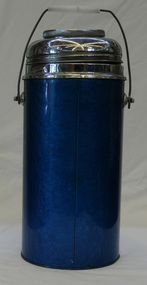
flask, Hong Kong Bottle Company
... On base-Made in Hong Kong Freezenhot Bottle Co....Hong Kong Bottle Company...It has a thin metal handle with a black plug in the base. flask Hong Kong Bottle Company ...This food flask belonged to P C Toby and Grace Nixon of "Macclesfield", Jarrahmond. It was used for carrying food for bean and maize pickers and maize threshing crews during the period 1945-1950.The Orbost area was once a large bean growing area as the fertile snowy River flats produced good quality beans. Maize is still grown in the area.A large blue metal food flask. It has a screw off lid and a red vacuum seal top. It has a thin metal handle with a black plug in the base.On base-Made in Hong Kong Freezenhot Bottle Co.flask food-preservation macclesfield nixon-toby agriculture -
 Melbourne Tram Museum
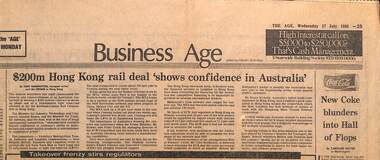
Newspaper, The Age, "$200m Hong Kong rail deal shows confidence in Australia", 17/07/1985 12:00:00 AM
... "$200m Hong Kong rail deal shows confidence in Australia"...Newspaper clipping from The Age 17/7/1988 titled "$200m Hong Kong rail deal shows confidence in Australia". ...Trams tramways Hong Kong The Met Comeng Construction Newspaper clipping from The Age 17/7/1988 titled "$200m Hong Kong rail deal shows confidence in Australia". ...Newspaper clipping from The Age 17/7/1988 titled "$200m Hong Kong rail deal shows confidence in Australia". Written by Tom Harrington Age Transport reporter and Ali Cromie in Hong Kong. Reports on the project consortium The Met and Leighton - gives details of the financing arrangement, The Met's involvement after Comeng pulled out, timing. Has comments from John Halfpenny of the AMWU, Tom Roper, Minister for Transport and other people.trams, tramways, hong kong, the met, comeng, construction -
 National Vietnam Veterans Museum (NVVM)
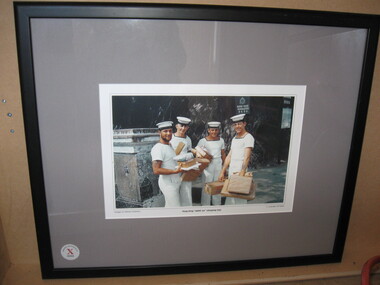
Photograph, Hong Kong "rabbit run' (shopping trip)
... Hong Kong "rabbit run' (shopping trip)...In a black frame there is a coloured photograph of four sailors in uniform carrying items of goodies on their shopping trip in Hong Kong. Bottom left hand under the photograph reads Voyagers To Vietnam Collection. ...Bottom right side under the photograph reads Copyright Cliff Raatz Hong Kong "rabbit run' (shopping trip) Photograph Photograph ...In a black frame there is a coloured photograph of four sailors in uniform carrying items of goodies on their shopping trip in Hong Kong. Bottom left hand under the photograph reads Voyagers To Vietnam Collection. Bottom right side under the photograph reads Copyright Cliff RaatzVoyagers To Vietnam Collection. Copyright Cliff Raatzphotograph, cerberus collection, voyages to vietnam collection -
 Melbourne Tram Museum
Document - Report, Metropolitan Transit Authority (MTA), "Hong Kong Light Rail System", c1990
... "Hong Kong Light Rail System"...Report - 20 A4 pages stapled in the top left hand corner - titled "Hong Kong Light Rail System" with a table of contents, explaining the joint venture between the MTA and Leighton Asia and other major sub-contractors including Comeng, with diagrams, project roles, the vehicles...."Hong Kong Light Rail System" Document Report Metropolitan Transit Authority (MTA) ...Report - 20 A4 pages stapled in the top left hand corner - titled "Hong Kong Light Rail System" with a table of contents, explaining the joint venture between the MTA and Leighton Asia and other major sub-contractors including Comeng, with diagrams, project roles, the vehicles.trams, tramways, light rail, hong kong, comeng, the met, mta -
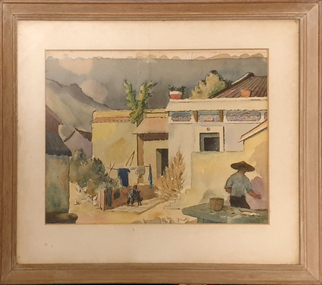 Ballarat Heritage Services
Painting - Artwork - Painting, Hong Kong Faimhouse by Arthur Lindsay, c1950
... Hong Kong Faimhouse by Arthur Lindsay...In 1939, he left Australia to tour Japan, but stayed on, accepting a position with a publishing company in Hong Kong. He served with the Hong Kong Medical Corp during World War Two and was interned at Pootung Camp, Shanghai, from 1941 – 45. ...In 1939, he left Australia to tour Japan, but stayed on, accepting a position with a publishing company in Hong Kong. He served with the Hong Kong Medical Corp during World War Two and was interned at Pootung Camp, Shanghai, from 1941 – 45. ...Arthur LINDSAY (1912-1990) Born Melbourne Arthur Lindsay studied informally under Rupert Bunny, and John Munro in 1933, and held his first Exhibition in 1938, with Peter Cox, at Riddell Galleries. In 1939, he left Australia to tour Japan, but stayed on, accepting a position with a publishing company in Hong Kong. He served with the Hong Kong Medical Corp during World War Two and was interned at Pootung Camp, Shanghai, from 1941 – 45. He held an exhibition of his internment paintings in Melbourne in 1946. Lindsay returned to Hong Kong after the War, and supervised an Advertising Agency in Singapore, Kuala Lumpar, and Bangkok. In the 1950’s he travelled to Europe, United Kingdom, Spain and France. Returning to Australia Lindsay moved to Castlemaine in 1969. A Retrospective of his Art was held at Castlemaine Art Gallery in 1991.Framed watercolour of a number of builidings, and a person in the foreground.arthur lindsay, watercolour, painting, townscape -
 Bendigo Military Museum
Award - MEDAL, CHINA, Unknown
... Medal replaced British Civil Defence Long Service Medal after China took over Hong Kong....Medal with ribbon attached, unmounted. Hong Kong Civil Aid Service, Long Service Metal with ribbon on a pin....Inscription on front and back in Chinese and English - one side "Hong Kong", other "Civil Air Service"....Medal replaced British Civil Defence Long Service Medal after China took over Hong Kong. Ron Mills Collection Medal Inscription on front and back in Chinese and English - one side "Hong Kong", other "Civil Air Service". ...Medal issued to people for 10 years service. i.e. Quakes and Civil problems and called out when required by Police on Fire Service. Medal replaced British Civil Defence Long Service Medal after China took over Hong Kong.Medal with ribbon attached, unmounted. Hong Kong Civil Aid Service, Long Service Metal with ribbon on a pin.Inscription on front and back in Chinese and English - one side "Hong Kong", other "Civil Air Service".ron mills collection, medal -
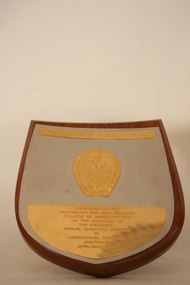 Geoffrey Kaye Museum of Anaesthetic History
Plaque, Choi Hon San Co
... Dr Ronald Lo, President of the Hong Kong College of Anaesthesiologists presented Dr Peter Roessler, on behalf of ANZCA, with a plaque commemorating the Inaugural Annual Scientific Meeting in 1994....On Front: THE HONG KONG COLLEGE OF ANAESTHESIOLOGISTS / HONG KONG COLLEGE OF ANESTHESIOLOGISTS HKCA / PRESENTED TO THE / AUSTRALIAN AND NEW ZEALAND / COLLEGE OF ANAESTHETISTS / ON THE OCCASION OF / THE INAUGURAL / ANNUAL SCIENTIFIC MEETING / IN / LAUNCESTON, TASMANIA, AUSTRALIA / APRIL/MAY 1994 On reverse, manufacturer label: Chinese characters / CHOI HON SAN CO. / TEL: 3809459 / FAX : 3977519...Hong Kong, China...Dr Ronald Lo, President of the Hong Kong College of Anaesthesiologists presented Dr Peter Roessler, on behalf of ANZCA, with a plaque commemorating the Inaugural Annual Scientific Meeting in 1994. lo, ronald annual scientific meeting hong kong college of anaesthesiologists On Front: THE HONG KONG COLLEGE OF ANAESTHESIOLOGISTS / HONG KONG COLLEGE OF ANESTHESIOLOGISTS HKCA / PRESENTED TO THE / AUSTRALIAN AND NEW ZEALAND / COLLEGE OF ANAESTHETISTS / ON THE OCCASION OF / THE INAUGURAL / ANNUAL SCIENTIFIC MEETING / IN / LAUNCESTON, TASMANIA, AUSTRALIA / APRIL/MAY 1994 On reverse, manufacturer label: Chinese characters / CHOI HON SAN CO. / TEL: 3809459 / FAX : 3977519 Plaque with inscription engraved on gold plated relief on silver, attached to a wooden base. ...Dr Ronald Lo, President of the Hong Kong College of Anaesthesiologists presented Dr Peter Roessler, on behalf of ANZCA, with a plaque commemorating the Inaugural Annual Scientific Meeting in 1994.Plaque with inscription engraved on gold plated relief on silver, attached to a wooden base. An image of an engraved Chinese dragon wrapped around a rose on centre panel.On Front: THE HONG KONG COLLEGE OF ANAESTHESIOLOGISTS / HONG KONG COLLEGE OF ANESTHESIOLOGISTS HKCA / PRESENTED TO THE / AUSTRALIAN AND NEW ZEALAND / COLLEGE OF ANAESTHETISTS / ON THE OCCASION OF / THE INAUGURAL / ANNUAL SCIENTIFIC MEETING / IN / LAUNCESTON, TASMANIA, AUSTRALIA / APRIL/MAY 1994 On reverse, manufacturer label: Chinese characters / CHOI HON SAN CO. / TEL: 3809459 / FAX : 3977519lo, ronald, annual scientific meeting, hong kong college of anaesthesiologists -
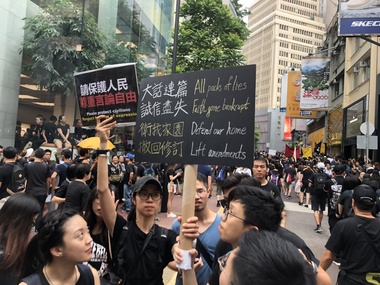 Federation University Historical Collection
Photograph - Colour, Jarrod Watt, Crowds Gather on June 16 on the Streets of Causeway Bay, 2019, 17/06/2019
... Carrie Lam, Hong Kong’s chief executive, had plenty of political support in the territory’s pro-Beijing legislature to pass a bill that would allow extraditions to mainland China. ...(https://www.scmp.com/news/hong-kong/politics/article/3014737/nearly-2-million-people-take-streets-forcing-public-apology )...Hong Kong...Carrie Lam, Hong Kong’s chief executive, had plenty of political support in the territory’s pro-Beijing legislature to pass a bill that would allow extraditions to mainland China. ...Carrie Lam, Hong Kong’s chief executive, had plenty of political support in the territory’s pro-Beijing legislature to pass a bill that would allow extraditions to mainland China. The legislators were set to begin discussing the bill in early June, and intended to vote on it just weeks later. A series of protests took place, and after a June 16 protest saw the largest turnout yet, Ms. Lam made a major concession: She postponed the bill, at least temporarily. It was an undeniable victory for the protesters — but it did little to quell the unrest. Since the bill could later be reintroduced, protesters felt they remained in danger. The police tactics to break up the demonstrations on June 12, including the use of more than 150 tear gas canisters to push protesters far away from the government office, created a new set of demands from the protesters. Now, instead of just calling for the withdrawal of the bill and Ms. Lam’s resignation, they said they wouldn’t be content unless there was an independent investigation of officers’ conduct. They also wanted the release of protesters arrested on June 12, and for the government to rescind its description of the demonstrations as a “riot,” a designation that carries legal significance. None of that has happened. Many analysts say Ms. Lam is unlikely to step down, nor would Beijing accept her resignation if she offered it. She has more wiggle room on the other demands, but has not indicated any willingness to budge. The Hong Kong Protests are a leaderless, digital movement.There is no single leader or group deciding on or steering the strategy, tactics and goals of the movement. Instead, protesters have used forums and messaging apps to decide next steps. Anyone can suggest a course of action, and others then vote on whether they support it. The most popular ideas rise to the top, and then people rally to make them happen. At its best, this structure has empowered many people to participate and have their voices heard. Protesters say it keeps them all safe by not allowing the government to target specific leaders. Their success in halting the extradition bill, which was shelved by the territory’s chief executive, speaks to the movement’s power. Despite the lack of a clear leader, protesters have shown extensive coordination at the demonstrations, having planned the specifics online beforehand. Supply stations are set up to distribute water, snacks, gloves, umbrellas and shields made of cardboard. Volunteer first aid workers wear brightly colored vests. People form assembly lines to pass supplies across long distances, with protesters communicating what they need through a series of predetermined hand signals. Anyone walking in dangerous areas without a helmet or a mask is quickly offered one. No individual can speak on behalf of the protesters, which makes negotiations difficult, if not impossible. (https://www.nytimes.com/2019/07/02/world/asia/hong-kong-protest-explained.html, accessed 07/07/2019) Hong Kong’s amended extradition law would allow the extradition of suspects to mainland China for the first time. Supporters say the amendments are key to ensuring the city does not become a criminal refuge, but critics worry Beijing will use the law to extradite political opponents and others to China where their legal protections cannot be guaranteed. The government claims the push to change the law, which would also apply to Taiwan and Macau, stems from the killing last year of a Hong Kong woman while she was in Taiwan with her boyfriend. Authorities in Taiwan suspect the woman’s boyfriend, who remains in Hong Kong, but cannot try him because no extradition agreement is in place. Under the amended law, those accused of offences punishable by seven years or more in prison could be extradited. The new legislation would give Hong Kong’s leader, known as the chief executive, authority to approve extradition requests, after review by the courts. Hong Kong’s legislature, the legislative council, would not have any oversight over the extradition process. Many Hong Kongers fear the proposed extradition law will be used by authorities to target political enemies. They worry the new legislation spells the end of the “one country, two systems” policy, eroding the civil rights enjoyed by Hong Kong residents since the handover of sovereignty from the UK to China in 1997. Many attending the protests on Sunday said they could not trust China as it had often used non-political crimes to target government critics, and said they also feared Hong Kong officials would not be able to reject Beijing’s requests. Legal professionals have also expressed concern over the rights of those sent across the border to be tried. The conviction rate in Chinese courts is as high as 99%. Arbitrary detentions, torture and denial of legal representation of one’s choosing are also common. Many in the protests on Sunday 09 June 2019 said they felt overwhelmed by a sense of helplessness in the face of mainland China’s increasing political, economic and cultural influence in Hong Kong. Hong Kong’s top political leader is not elected by ordinary voters but by a 1,200-strong election committee accountable to Beijing. Half of its legislature are chosen through indirect electoral systems that favour pro-Beijing figures. Many Hong Kongers also cited the jailing of leaders and activists from the 2014 Occupy Central movement– a 79-day mass civil disobedience movement – as well as the disqualification of young localist lawmakers as signs of the erosion of civil freedoms. Resentment towards China has been intensified by soaring property prices – with increasing numbers of mainland Chinese buying properties in the city – as well as the government’s “patriotic education” drive, and the large numbers of mainland tourists who flock to Hong Kong. Many Hong Kongers are also concerned about China’s growing control over the city’s news media, as they increasingly self-censor and follow Beijing’s tacit orders. https://www.theguardian.com/world/2019/jun/10/what-are-the-hong-kong-protests-about-explainerPhotograph crowds gathering on June 16 on the streets of Causeway Bay before an estimated 2 million people take part in march protesting the government's push for extradition laws to China and demanding an apology from the chief executrive Carrie Lam. Nearly 2 million’ people take to streets, forcing public apology from Hong Kong leader Carrie Lam as suspension of controversial extradition bill fails to appease protesters. (https://www.scmp.com/news/hong-kong/politics/article/3014737/nearly-2-million-people-take-streets-forcing-public-apology )carrie lam, hong kong protests, extraditions, protest, protestors -
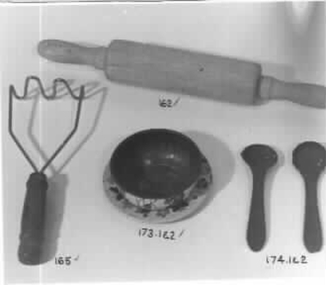 Whitehorse Historical Society Inc.
Leisure object - Toy Tea Cup and Saucer
... Made in Hong Kong....Hong Kong...toys general Made in Hong Kong. Yellow enamelled child's tea cup and saucer with motifs of butterflies, flowers, birds, etc. ...Yellow enamelled child's tea cup and saucer with motifs of butterflies, flowers, birds, etc.Made in Hong Kong.toys, general
