
Showing 41 items matching "hose names"
-
 Surrey Hills Historical Society Collection
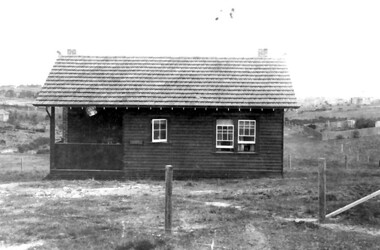
Photograph - Mrs Long's house, Delta Street area, Surrey Hills
... ...hose names...This is one of relatively few photos which record the transformation of rural land into the suburb that became Surrey Hills. delta road back creek south surrey park wetward ho pembroke the oaks hose names miss agnes may hay murray mrs agnes may hay long mrs mary hay long miss mary hay long james murray long carson's law A simple dark-stained timber house with a veranda and tiled roof. ...The property is in the area that later became Delta Street, on the north side of Back Creek. Once roads were made and streets numbered, this became 1 Delta Road, Surrey Hills. Part of the undeveloped land would become part of South Surrey Park. According to Alan Holt's property register the house was built in c1920 and was demolished after having been neglected in 1991. He records it having had various names: 'Westward Ho', 'Pembroke' and 'The Oaks'. The first owner from 1920 was Eric Rowland Handyside Long who married Agnes May Hay Murray in March 1920. They had one son James Murray Long, born in September 1921. They divorced in 1937 and thereafter the property is listed in the name of Mrs Mary Hay Long, James M Long or Miss Mary Hay Long. According to Alan Holt, the house featured in the television series 'Carson's Law' in c1984.This is one of relatively few photos which record the transformation of rural land into the suburb that became Surrey Hills.A simple dark-stained timber house with a veranda and tiled roof. It is simply fenced with posts and wire mess. There are other houses in the background but part of the area remains as open space.delta road, back creek, south surrey park, wetward ho, pembroke, the oaks, hose names, miss agnes may hay murray, mrs agnes may hay long, mrs mary hay long, miss mary hay long, james murray long, carson's law -
 Melbourne Tram Museum
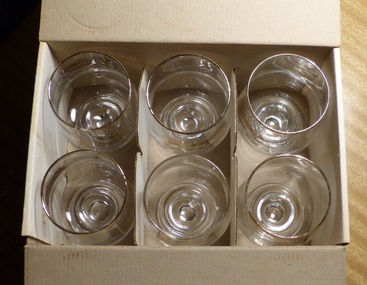
Domestic object - Box of Glassware, C. R. Hose Glassware Pty Ltd, 1990's?
... Glasses done are: Horse Tram Cable Tram Four Wheel tram W2 tram SW6 tram Z Tram Box has address of C. R. Hose and their name....Glasses done are: Horse Tram Cable Tram Four Wheel tram W2 tram SW6 tram Z Tram Box has address of C. R. Hose and their name. Domestic object Box of Glassware C. ...Set of six decorated drinking glasses of Melbourne trams by CR Hose in a cardboard packing. Produced for the TMSV Melbourne, c1990's?. Each glass has a image of the tram on one side with a description of the tram of the glass. Image and printing done with gold printing. Has a gold rim on the top of the glass. Glasses done are: Horse Tram Cable Tram Four Wheel tram W2 tram SW6 tram Z Tram Box has address of C. R. Hose and their name.In black felt pen on the top of the box "Paid" and "Jean Stewart Vic"trams, tramways, tmsv, glassware, melbourne -
 Williamstown Historical Society Inc
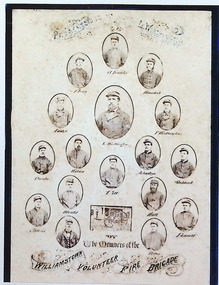
Photograph - Group portrait of the Williamstown Volunteer Fire Brigade
... The composite image features individual oval portraits of the brigade's active volunteer members at that time, framed around a central image of their manual hose reel cart. Names of Fireman shown include: Dandie, Pitt, Wilson, Mould, Bennett, Hall, Sheldrick, Johnstone, T. ...The composite image features individual oval portraits of the brigade's active volunteer members at that time, framed around a central image of their manual hose reel cart. Names of Fireman shown include: Dandie, Pitt, Wilson, Mould, Bennett, Hall, Sheldrick, Johnstone, T. ...The Williamstown Volunteer Fire Brigade which was inaugurated on the 28th February 1851. This presentation photo collage was produced in 1887 by the members of the Williamstown Volunteer Fire Brigade to honor their leader, Superintendent Lawrence Worthington (shown in the large center oval), as a farewell gift before his departure for England in 1887. Lawrence Worthington served as a Captain of the Williamstown Volunteer Fire Brigade before being elevated to the higher rank of Superintendent. The composite image features individual oval portraits of the brigade's active volunteer members at that time, framed around a central image of their manual hose reel cart. Names of Fireman shown include: Dandie, Pitt, Wilson, Mould, Bennett, Hall, Sheldrick, Johnstone, T. Worthington, L. Worthington, A. Knowles, J.E. Murdoch, Elsum, Lester, Lieutenant N.R. Wilson, J. Johnstone, Wallace williamstown volunteer fire brigade -
 Federation University Historical Collection
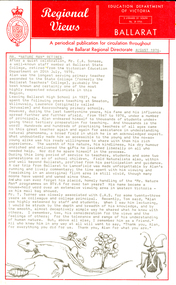
Document, Retirement of Alan Sonsee, 1976, 08/1976
... And who can ever forget his palcid, home;y handling of "Mr nature Man" programmes on BTV 6 for over ten years? his name became a hose-hold word over an existence viewing area in Western Victoria - as his mail bag showed. ...And who can ever forget his palcid, home;y handling of "Mr nature Man" programmes on BTV 6 for over ten years? his name became a hose-hold word over an existence viewing area in Western Victoria - as his mail bag showed. ...Born in 1911, Cecil Alan Sonsee lived at Springmount near Creswick, and taught natural history at the Ballarat Teachers' College for 30 years. His teaching career stretched over a 48 year period. He spent six years as a student teacher before reaching the position of first class teacher. He had the distinction of never attending a teachers' college, but spending half his teaching career training students to become teachers. At the time of his retirement Mr Sonsee said during his years at the college, "the training had changed from a one year course to a two year course, followed by a three year course, and now a four year course was offered." He recalled "in the early days all country schools had eight grades and a child finished with a merit certificate. Today [1976], children went to high schools from sixth grade and most of the country schools had disappeared.' Alan Sonsee spent 10 years on a television program on BTV6 answering questions sent by viewers regarding aspects of plant and animal live. Mr Sonsee was a life member of both Creswick and Ballarat Field naturalists Clubs. Alan Sonsee died in 1985.1) Foolscap Department of Victoria Ballarat newsletter titled Education 'Regional Views'. The newsletter depicts an image of Alan Sonsee and outlines his career at the time of his retirement on 20 July 1976. The author of the newsletter is unknown. .2) newspaper article on the retirement of Alan Sonsee dated 25 August 1976 (probably from the Ballarat Courier).1) Mr "Nature Man" Retires After a quiet celebration, Mr C.A. Sonsee, a well-known staff member at Ballarat State College, retired from the Victorian Education Department on 20th July, 1976. Alan was the longest serving primary teacher seconded to the State College (Formerly the Ballarat teachers' College), probably the best known and certainly one of the most highly respected educationalists in this region. Leaving Ballarat high School in 1927, he spent the following years teaching at Smeaton, Willowvale, Lawrence (originally called Jerusalem) and Kooroocheang primary schools. However, during the last twenty-nine years, his fame and his influence spread further and further afield. From 1947 to 1976, under a number of principals, Alan endeared himself to thousands of students undergoing their tertiary preparation for teaching. And thousands is the word! Hundreds and hundreds of practising teachers of all ages came to this great teacher again and again for assistance in understanding natural phenomena, a broad field in which he is an acknowledged expert. What undoubtedly made him so accessible to the young and the no-so-young alike was his ready willingness to share with them is rich experience. The warmth of his nature, his kindliness, his dry humour enriched and enlivened the gifts he lavished liberally on all who needed help. Nor did he spare himself in the process. During his ling period of service to teachers, students and some two generations or so of school children, Field Naturalists also, within and well beyond Ballarat, profited from his participation and guidance. A car trip from Ballarat to Lancefield was made unforgettable by Alan's running and lively commentary; the time spent with him viewing and fossicking in an aboriginal flint area is still vivid, thouhg many moons have waxed and waned since then. And who can ever forget his palcid, home;y handling of "Mr nature Man" programmes on BTV 6 for over ten years? his name became a hose-hold word over an existence viewing area in Western Victoria - as his mail bag showed. Mr T. Turner was closely associated with C.A.S. for some twenty-three years as colleague and college principal. Recently tome said, "Alan was highly esteemed by staff and students, When I saw him lecturing I would be struck by the depth and breadth of his knowledge, and by the smooth, almost deceptively simple way he shared what he knew with others. I remember, too, his consideration for the views and the feelings of others; for the tolerance and range of his understanding of human nature. But, above all else, I remember him as a friend." All who know him in any way at all will want to say, "Thanks you, Alan, for everything you did for us. Thank you, Alan for what you are."alan sonsee, ballarat teachers' college, ballarat state college, education, teaching, ballarat field naturalists, creswick field naturalists, aborigines, lancefield flint, smeaton primary school, willowvale primary school, lawrence primary school, jerusalum primary school, kooroocheang primary school, nature studies, mr nature man -
 Ballarat Fire Brigade
Trophy, prior to May 1888
... name is set into the band. Shield was presented to the brigade in Sydney in May 1888 for first prize in the hose & ladder event as part of the centenial demonstration. ...Hose & Ladder / First Prize Won By / W.Trahar, P.Cockburn / W.Smith, R.Young / W.Perkins, R.Johnstone / A.Reynolds, J.Coward / Captn W.Trotman, Apparatus Off W.Dark. (on gold plaque) Presented by the / Australian Mutual Fire / Insurance Society / Walter Church, Manager / Won by Large silver shield with highly detailed casting & hand engraving of a scene from the garden of eden. Shield is approximatley 630mm W x 850mm H surrounded by a 70mm wide mauve velvet material band. A gold curved rectangular plate withthe donor and winner name ...Large silver shield with highly detailed casting & hand engraving of a scene from the garden of eden. Shield is approximatley 630mm W x 850mm H surrounded by a 70mm wide mauve velvet material band. A gold curved rectangular plate withthe donor and winner name is set into the band. Shield was presented to the brigade in Sydney in May 1888 for first prize in the hose & ladder event as part of the centenial demonstration. Trophy was donated by the Australian Mutual Fire Insurance Society and presented by Walter Church, Manager.Centennial Demonstration / Sydney May 1888 / Hose & Ladder / First Prize Won By / W.Trahar, P.Cockburn / W.Smith, R.Young / W.Perkins, R.Johnstone / A.Reynolds, J.Coward / Captn W.Trotman, Apparatus Off W.Dark. (on gold plaque) Presented by the / Australian Mutual Fire / Insurance Society / Walter Church, Manager / Won bysydney, centennial-demonstration, sydney-may-1888, may-1888, hose-and-ladder, first-prize, w-trahar, w-smith, w-perkins, a-reynolds, p-cockburn, r-young, r-johnstone, j-coward, captain-w-trotman, apparatus-officer-w-dark, australian-mutual-fire-insurance-society, walter-church -
 City of Moorabbin Historical Society (Operating the Box Cottage Museum)
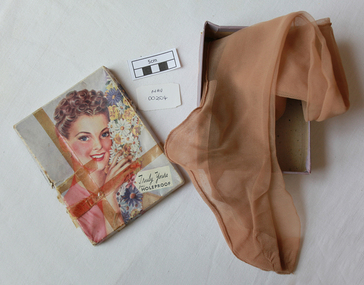
Clothing - Clothing, lady's stockings "Holeproof', mid 20thC
... name became recognized worldwide. The business produced men's and women's hosiery, underwear, lingerie, and men's pyjamas. Holeproof Hosiery began making nylon hosiery in January 1940, starting production on 8 of its 230 machines. The hose...name became recognized worldwide. The business produced men's and women's hosiery, underwear, lingerie, and men's pyjamas. Holeproof Hosiery began making nylon hosiery in January 1940, starting production on 8 of its 230 machines. The hose ...Holeproof Hosiery was a Milwaukee, Wisconsin textile firm that was founded in 1901.With extensive advertising the brand name became recognized worldwide. The business produced men's and women's hosiery, underwear, lingerie, and men's pyjamas. Holeproof Hosiery began making nylon hosiery in January 1940, starting production on 8 of its 230 machines. The hose were made of a synthetic yarn composed of derivatives of coal and iron manufactured by Du Pont. In the late 1920s, a successful hosiery manufacturer, Staley & Staley Ltd, started making ladies hosiery under licence from the Holeproof Hosiery Company in Milwaukee, USA. The company went public in 1929 and opened the first Holeproof mill at Brunswick, Victoria in 1930, becoming the first manufacturer to produce and market Australian-made self-supporting socks. During the 1930s, Holeproof revolutionised the Australian market by promoting their products as a sought-after fashion accessory. The Australian company is still in business today, owned by Pacific Brands. A unused pair of lady's silk stockings in original box. 'Holeproof' 'Truly Yours' Candlelight, size 10Box Cover: Truly Yours / by / Holeproof Side Holeproof 'Candlelight' Size 10clothing, stockings, nylons, holeproof hosiery pty ltd, lingerie, melbourne, bentleigh, cheltenham moorabbin, brunswick milwaukee usa, wisconsin -
 City of Moorabbin Historical Society (Operating the Box Cottage Museum)
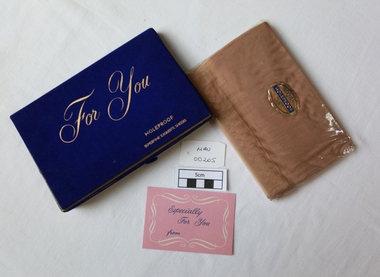
Clothing - Clothing, lady's stockings 'Holeproof', c1950
... name became recognized worldwide. The business produced men's and women's hosiery, underwear, lingerie, and men's pyjamas. Holeproof Hosiery began making nylon hosiery in January 1940, starting production on 8 of its 230 machines. The hose...name became recognized worldwide. The business produced men's and women's hosiery, underwear, lingerie, and men's pyjamas. Holeproof Hosiery began making nylon hosiery in January 1940, starting production on 8 of its 230 machines. The hose ...Holeproof Hosiery was a Milwaukee, Wisconsin textile firm that was founded in 1901.With extensive advertising the brand name became recognized worldwide. The business produced men's and women's hosiery, underwear, lingerie, and men's pyjamas. Holeproof Hosiery began making nylon hosiery in January 1940, starting production on 8 of its 230 machines. The hose were made of a synthetic yarn composed of derivatives of coal and iron manufactured by Du Pont. In the late 1920s, a successful hosiery manufacturer, Staley & Staley Ltd, started making ladies hosiery under licence from the Holeproof Hosiery Company in Milwaukee, USA. The company went public in 1929 and opened the first Holeproof mill at Brunswick, Victoria in 1930, becoming the first manufacturer to produce and market Australian-made self-supporting socks. During the 1930s, Holeproof revolutionised the Australian market by promoting their products as a sought-after fashion accessory. The Australian company is still in business today, owned by Pacific Brands. An unused pair of lady's nylon stockings in original box. 'Holeproof' 'For you', 'Precious' size 91/2Box Cover : For You / HOLEPROOF/ SUPERFINE EXQUISITE SHEERS Side : Precious 9 1/2 Package : 60 GUAGE / SHEER NYLON / BY / HOLEPROOF / 9 1/2 Card : Especially / For You / fromclothing, stockings, nylons, holeproof pty ltd, milwaukee usa, hosiery, fashion, melbourne, bentleigh, cheltenham moorabbin, brunswick, lingerie -
 City of Moorabbin Historical Society (Operating the Box Cottage Museum)
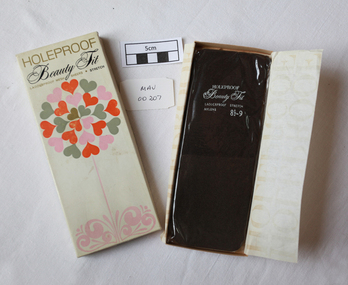
Clothing - Clothing, lady's stockings 'Holeproof', c1950
... name became recognized worldwide. The business produced men's and women's hosiery, underwear, lingerie, and men's pyjamas. Holeproof Hosiery began making nylon hosiery in January 1940, starting production on 8 of its 230 machines. The hose...name became recognized worldwide. The business produced men's and women's hosiery, underwear, lingerie, and men's pyjamas. Holeproof Hosiery began making nylon hosiery in January 1940, starting production on 8 of its 230 machines. The hose ...Holeproof Hosiery was a Milwaukee, Wisconsin textile firm that was founded in 1901.With extensive advertising the brand name became recognized worldwide. The business produced men's and women's hosiery, underwear, lingerie, and men's pyjamas. Holeproof Hosiery began making nylon hosiery in January 1940, starting production on 8 of its 230 machines. The hose were made of a synthetic yarn composed of derivatives of coal and iron manufactured by Du Pont. In the late 1920s, a successful hosiery manufacturer, Staley & Staley Ltd, started making ladies hosiery under licence from the Holeproof Hosiery Company in Milwaukee, USA. The company went public in 1929 and opened the first Holeproof mill at Brunswick, Victoria in 1930, becoming the first manufacturer to produce and market Australian-made self-supporting socks. During the 1930s, Holeproof revolutionised the Australian market by promoting their products as a sought-after fashion accessory. The Australian company is still in business today, owned by Pacific BrandsAn unused pair of lady's stockings, in original box, 'Holeproof', 'Beauty Fit', ' Nocturn' Size 81/2 - 9 Box Cover : HOLEPROOF / Beauty Fit / LADDERPROOF MESH SHEERS STRETCH Inside Wrapper ; HOLEPROOF / Beauty Fit / LADDERPROOF STRETCH NYLONS 8 1/2 - 9clothing, stockings, nylons, hosiery, melbourne, bentleigh, cheltenham moorabbin, brunswick, holeproof pty ltd, lingerie, fashion -
 Ringwood and District Historical Society
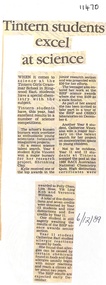
Article, Tintern CEGS Ringwood East - Newspaper Clipping 6/12/1989 - Tintern students excel at science
... Student names mentioned are Kylie Vincent (junior research bursary award), Catherine Viney (major bursary), RACI High Distinction awards to Polly Chan, Lisa Hose, Yik Ling Koh and Veronica Williams. ...Student names mentioned are Kylie Vincent (junior research bursary award), Catherine Viney (major bursary), RACI High Distinction awards to Polly Chan, Lisa Hose, Yik Ling Koh and Veronica Williams. ...Article. Student names mentioned are Kylie Vincent (junior research bursary award), Catherine Viney (major bursary), RACI High Distinction awards to Polly Chan, Lisa Hose, Yik Ling Koh and Veronica Williams. Catherine Earl - BHP Science finalist. See VC 11469 for photo of Catherine Earl and Kylie Vincent. Tintern students excel at science...excellent results in a number of science competitions. -
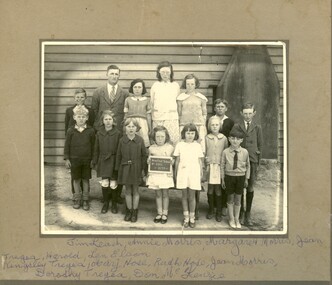 Heytesbury District Historical Society Inc.
Photograph - Newfield School class 1933
... Newfield School Education Jim Leach, Annie Morris, Margaret Morris, Jean Tregea, Harold, Len Elson, Kingsley Tregea, Marj Hose, Jean Morris, Dorothy Tregea, Don McKenzie Sepia Photograph with names written at bottom Photograph Newfield School class 1933 ...Newfield State School 2991, class group with teacher in 1933.Sepia Photograph with names written at bottomJim Leach, Annie Morris, Margaret Morris, Jean Tregea, Harold, Len Elson, Kingsley Tregea, Marj Hose, Jean Morris, Dorothy Tregea, Don McKenzienewfield, school, education -
Bendigo Historical Society Inc.
Document - Gair's Melbourne Canvas Goods Catalogue, October 1933
... The business continued trading under the name J H Abbott & Co. history bendigo abbott collection gair's melbourne canvas manufacturers Price List from Gair's Melbourne Canvas Goods Manufacturers 36 Pages: All types of canvas bags and buckets; saddle bags; tents and flys; grass catchers; umbrellas; dust covers; blinds, curtains and awnings; wagon and lorry covers; tennis nets; capenters' aprons; hoses; hammocks; swings; chairs; quoits; sleeping bags; pennants; flags; etc. ...Joseph Henry Abbott founded the business in 1853 with a store that supplied everyday essential items to those seeking their fortune on the goldfields. The timing and choice of store ensured that he would become a prominent part of the Bendigo business scene. Abbott's next venture was to establish the New Times Boot Market & Factory in Pall Mall, Sandhurst. In 1867, his wife took over running the shop which was located next to the Bendigo Arcade near Williamson Street. In 1876, the leather business of T Baulderstone was purchased, and operations were further expanded later by the acquisition of the Edinburgh Tannery at Sheepwash Creek, and The Edinburgh Leather & Grindery warehouse in Bull Street, Sandhurst. In 1889, Joseph Abbott passed all interests in the business to his son, who shared the same name, in partnership with an adopted son, Richard Hartley Smith Abbott. The business continued trading under the name J H Abbott & Co.Price List from Gair's Melbourne Canvas Goods Manufacturers 36 Pages: All types of canvas bags and buckets; saddle bags; tents and flys; grass catchers; umbrellas; dust covers; blinds, curtains and awnings; wagon and lorry covers; tennis nets; capenters' aprons; hoses; hammocks; swings; chairs; quoits; sleeping bags; pennants; flags; etc.history, bendigo, abbott collection, gair's melbourne canvas manufacturers -
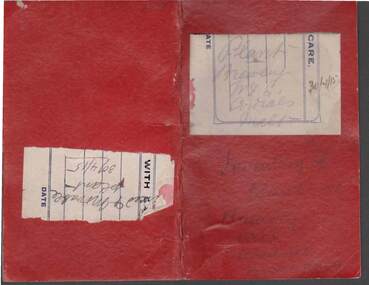 Bendigo Historical Society Inc.
Book - COHN BROTHERS COLLECTION: INVENTORY OF PLANT BOOK
... Two pages headed 'Cooper Shed', single page headed 'Carpenter Shed', two pages 'Malt House' two pages 'New Chilling Plant, two pages 'Stable' single page 'Blacksmith', Fire Brigade Hose & Connection' ,and finally under 'Motor Cars' heading a Clement Bayard and a Talbot are named with a value respectively of 150 pounds and 500 pounds each....Two pages headed 'Cooper Shed', single page headed 'Carpenter Shed', two pages 'Malt House' two pages 'New Chilling Plant, two pages 'Stable' single page 'Blacksmith', Fire Brigade Hose & Connection' ,and finally under 'Motor Cars' heading a Clement Bayard and a Talbot are named with a value respectively of 150 pounds and 500 pounds each. ...Red cover note book dated 30/4/(19)15 with pencilled handwritten heading, Inventory of Plant , Brewery, W & S, [Wine & Spirits] Cordials, Malt House . Inside page is headed 'Top Room' and lists in handwriting numerous items which equipped a brewing operation. Three following pages are headed 'Wine & Spirit Store' and lists various related items. Two following pages are headed 'Brewery Cellar' and list various related items. A page and a half headed 'O W Ice Works' also lists various related items. A page headed 'Changing Room' lists various items. 'Beer Cooler & Store' page has a list of items as well as does five pages headed 'Factory'. Two pages headed 'Cooper Shed', single page headed 'Carpenter Shed', two pages 'Malt House' two pages 'New Chilling Plant, two pages 'Stable' single page 'Blacksmith', Fire Brigade Hose & Connection' ,and finally under 'Motor Cars' heading a Clement Bayard and a Talbot are named with a value respectively of 150 pounds and 500 pounds each.bendigo, industry, cohn bros brewery -
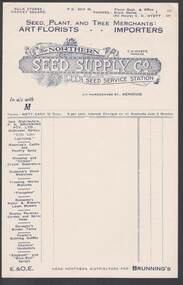 Bendigo Historical Society Inc.
Document - CAMBRIDGE PRESS COLLECTION: ACCOUNT - NORTHERN SEED SUPPLY COMPANY
... name of the companies they are distributors for. They are: F H Brunning Pty Ltd, Destruxol Sprays, Manning's Cattle and Poultry Spice, Wolseley and 'Climax' Cream Separators, Ruddock's Stock Medicines, Freezing Works Manures, Floraphos, Ransome's Motor & Electric Lawn Mowers, Dunlop Perdriau Garden and Spray Hose, Donaghy's Binder Twine, Fowler's Bottling Outfits, Charters' Incubators, Elephant and Blue-Bell Sprays, and Brunnings....name of the companies they are distributors for. They are: F H Brunning Pty Ltd, Destruxol Sprays, Manning's Cattle and Poultry Spice, Wolseley and 'Climax' Cream Separators, Ruddock's Stock Medicines, Freezing Works Manures, Floraphos, Ransome's Motor & Electric Lawn Mowers, Dunlop Perdriau Garden and Spray Hose, Donaghy's Binder Twine, Fowler's Bottling Outfits, Charters' Incubators, Elephant and Blue-Bell Sprays, and Brunnings. ...Account page from the Northern Seed Supply Co., 315 Hargreaves St., Bendigo. Printed in dark blue with decoration around the name. On the left side are the name of the companies they are distributors for. They are: F H Brunning Pty Ltd, Destruxol Sprays, Manning's Cattle and Poultry Spice, Wolseley and 'Climax' Cream Separators, Ruddock's Stock Medicines, Freezing Works Manures, Floraphos, Ransome's Motor & Electric Lawn Mowers, Dunlop Perdriau Garden and Spray Hose, Donaghy's Binder Twine, Fowler's Bottling Outfits, Charters' Incubators, Elephant and Blue-Bell Sprays, and Brunnings.business, printers, cambridge press, cambridge press collection, the northern seed supply co, c k hyett, f h brunning pty ltd, destruxol sprays, manning's cattle and poultry spice, wolseley and 'climax' cream separators, ruddock's stock medicines, freezing works manures, floraphos, ransome's motor & electric lawn mowers, dunlop perdriau garden and spray hose, donaghy's binder twine, fowler's bottling outfits, charters' incubators, elephant and blue-bell sprays, brunnings -
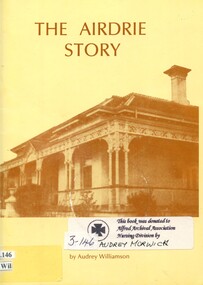 Alfred Hospital Nurses League - Nursing History Collection
Booklet - Illustrated booklet, Audrey Williamson, The Airdrie Story 1931-1991, 1991
... published as a tribute to all members of the Committee of Management of the Society for the Care of Aged or Incapacitated Nurses (Victoria) through its name changes to the present day Airdrie Hose Society Incorporated....published as a tribute to all members of the Committee of Management of the Society for the Care of Aged or Incapacitated Nurses (Victoria) through its name changes to the present day Airdrie Hose Society Incorporated. ...Airdrie House in Canterbury, Victoria, was established in 1931 by the Society for the Care of Aged or Incapacitated Nurses, and later became known as the Airdrie House Society Incorporated. The book "The Airdrie Story" details the history of the house and the society, from its founding until 1991. Airdrie House was not just a house, but a place dedicated to supporting the needs of nurses, reflecting the community's recognition of their vital role.Illustrated booklet with cream cover and abbreviated title and author's name in brown print on front cover along with sepia photo of a single story Victorian style house with verandah and chimney (Airdrie House).non-fictionAirdrie House in Canterbury, Victoria, was established in 1931 by the Society for the Care of Aged or Incapacitated Nurses, and later became known as the Airdrie House Society Incorporated. The book "The Airdrie Story" details the history of the house and the society, from its founding until 1991. Airdrie House was not just a house, but a place dedicated to supporting the needs of nurses, reflecting the community's recognition of their vital role. airdie house, aged care, nurses, canterbury -
 Warrnambool and District Historical Society Inc.
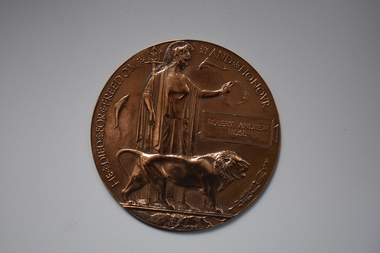
Medallion, Dead Man's Penny Robert Andrew Hose, 1920s
... Robert Hose was born in Warrnambool and this medallion is a treasured object in our collection. robert andrew hose world war one memorial plaque history of warrnambool He Died For Freedom and Honour Robert Andrew Hose This is a round bronze medallion with raised images of Britannia holding a laurel wreath over an inscribed name, a lion, dolphins, an oak branch, a lion cub and an eagle. ...This medallion, called a Memorial Plaque and popularly known as a Dead Man’s Penny, was one of those given to the family of an Australian soldier who died on active service in World War One. Memorial Plaques, such as this one, were given out in the early 1920s. This medallion was presented to the family of Robert Andrew Hose. Born in Warrnambool in 1892 to George and Janet Hose, Robert Hose was a regular soldier when he enlisted in World War One in August 1914. He served on Gallipoli at Cape Helles where he was wounded but returned to his post and was promoted to corporal. In Egypt he was promoted to Sergeant and then served in France where he was awarded the Military Medal for showing courage, resourcefulness and a fine example to his men in an encounter with the enemy near Beaumetz les Cambrai. In that incident he sustained severe wounds from which he died in May 1917. He is buried in France. As well as the Military Medal he was awarded the 1914-15 Star, the British War Medal and the Victory MedalThis item is of great importance as a significant memento of World War One that was given to the family of Robert Andrew Hose following his death on active service in World War One. Robert Hose was born in Warrnambool and this medallion is a treasured object in our collection.This is a round bronze medallion with raised images of Britannia holding a laurel wreath over an inscribed name, a lion, dolphins, an oak branch, a lion cub and an eagle. The medal is inscribed around the left and top edges.He Died For Freedom and Honour Robert Andrew Hose robert andrew hose, world war one memorial plaque, history of warrnambool -
Warrnambool and District Historical Society Inc.
Document (collection) - Legal papers 1885-1951 from William Ardlie and John Ardlie, Legal Documents Ardlie
... The collection contains invoices, wills, mortgage and assignment notices from 1888 until 1950 as well as handwritten letters regarding matters related to the division of land and assets.Among them are names of many well known Warrnambool families and early pioneers such as Cassady, Bowman,Beattie Murfitt, Carroll, McPhee, McGinness, O'Brien, Carey , Hunt, Cole Parker, Hetherington, McKenna, Clifford,Hocking, Begley, These papers are valuable for research in family history as well as property and social connections.They have strong provenance and are a valuable primary source of historical information. cassady hurst bower kearns molan ardlie briggs drought russell hose melican dallimore kerr fogarty harwood foley bowman beattie o'keeffe keys baudinette brennan clifford mcphee degraff carroll mcginness johnson murfitt carey o'brien walsh cole hunt parker hetherington dumsney whitton paech ernest ardlie hocking young There are a large number of signatories to the various letters and documents. ...John ArdlieTo record legal matters between clients , government departments and family entities.Legal paperscassady, hurst, bower, kearns, molan, ardlie, briggs, drought, russell, hose, melican, dallimore, kerr, fogarty, harwood, foley, bowman, beattie, o'keeffe, keys, baudinette, brennan, clifford, mcphee, degraff, carroll, mcginness, johnson, murfitt, carey, o'brien, walsh, cole, hunt, parker, hetherington, dumsney, whitton, paech, ernest ardlie, hocking, youngcassady, hurst, bower, kearns, molan, ardlie, briggs, drought, russell, hose, melican, dallimore, kerr, fogarty, harwood, foley, bowman, beattie, o'keeffe, keys, baudinette, brennan, clifford, mcphee, degraff, carroll, mcginness, johnson, murfitt, carey, o'brien, walsh, cole, hunt, parker, hetherington, dumsney, whitton, paech, ernest ardlie, hocking, young -
 Bendigo Historical Society Inc.
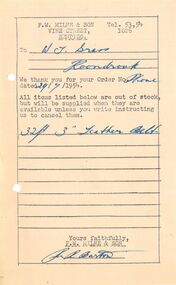
Financial record - INVOICE COLLECTION: F.W. Milne and son
... name, it lists the company's: Address - Vine Street, Bendigo Contact Info - Phone 53 and 54 Handwritten in blue ink on a black typed template. For the purchase of leather belts. 10934.30b - Letter notification of altered discount. Receipt dated: 25th Sep 1953. large, cream, rectangular paper with a printed header in green and black ink. The receipt header reads "F.W. Milne & Son" in capital letters. Milne and Son were merchants and engineers. They sold Iron and steel, galvanised and steam piping and fittings, pumps, pulleys, transmission belting, bearings, shafting, air hoses...name, it lists the company's: Address - Vine Street, Bendigo Contact Info - Phone 53 and 54 Handwritten in blue ink on a black typed template. For the purchase of leather belts. 10934.30b - Letter notification of altered discount. Receipt dated: 25th Sep 1953. large, cream, rectangular paper with a printed header in green and black ink. The receipt header reads "F.W. Milne & Son" in capital letters. Milne and Son were merchants and engineers. They sold Iron and steel, galvanised and steam piping and fittings, pumps, pulleys, transmission belting, bearings, shafting, air hoses ...10934.30a - Notification of out-of-stock items. Receipt dated: 29 July 1954. pink cream, rectangular paper The receipt header reads "F.W. Milne & Son" in capital letters. Milne and Son were merchants and engineers. below the company name, it lists the company's: Address - Vine Street, Bendigo Contact Info - Phone 53 and 54 Handwritten in blue ink on a black typed template. For the purchase of leather belts. 10934.30b - Letter notification of altered discount. Receipt dated: 25th Sep 1953. large, cream, rectangular paper with a printed header in green and black ink. The receipt header reads "F.W. Milne & Son" in capital letters. Milne and Son were merchants and engineers. They sold Iron and steel, galvanised and steam piping and fittings, pumps, pulleys, transmission belting, bearings, shafting, air hoses, packings etc. below the company name, it lists the company's: Address - 52-60 Vine Street, Bendigo Contact Info - Phone 53, 54 and 1026 Typed blue ink on printed header. signed by the secretary in blue pen ink. 10934.30c and 10934.30d - business card Receipt dated: 1-2nd Sep 1954. tan - rectangular paper printed with business header in black ink. The Card reads: (10934.30c) F.W. Milne & Son. Merchants and Engineers. Vine Street, Bendigo. Distributors of: - Bearing Service Co. of Aust. PTY. and Stewarts & Lloyds PTY. LTD. Welding electrodes and welding equipment. Belting. Vee belts and Pulleys. Steel. Pipes and Pipe fittings. Steam valves and packings. British tube mills products. Electric motors. die cast and aluminium vee pulleys and motor pulleys. centrifugal pumps and pumping equipment. Petter diesel engines. Roseberry engines. Jap petrol engines. (10934.30d) Vine Street, Bendigo. Dear Sir, we wish to advise that our representative Mr. H.W. McMaster, will have the pleasure of calling on you on or about the 1-2 Sep 1954. Any orders entrusted to him will receive our careful prompt attention. bendigo, morton's stores, fw milne and son -
Clunes Museum
Photograph, 1997
... CFNC Australian Rules Football 1997 Back Row: Jamie Baird, Ben Auchett, David Young, Scott Adam, Will Casey, Phillip Morrish Third Row: Matthew Bayles, Eden Thomas, Jamie Andrews, Michael Bourke, Jason Ingram, Ben Coon, John Bedwell Second Row: Rod Elliot (Sec), Peter Hill (Runner), Nick McIntosh, Heath Leishman, Craig Tucker, Michael Tranter, Brendan Sheehan, John Ingram (Trainer), Leah McArthur (Trainer), Lindsay Tucker (Chairman of Selectors), Shane Young (Joint Coach) Chris McLennan (Cap) Shawn Slater (Joint C) Jason Hill, Mark Andrews, Henk Van Doldren (Head Trainers ) Absent: Justin Sanders, David Collins, Nigel Oswin, Steve Kemp, John O Neill, Scott Hose, Jason Haymes, Jody Smith, Jimmy Taylor Photocopy of a photograph of football team with names atached - Clunes Football Club - 1st Premiers SHFL 1997 Photograph PHOTOGRAPH ...Photocopy of a photograph of football team with names atached - Clunes Football Club - 1st Premiers SHFL 1997 Back Row: Jamie Baird, Ben Auchett, David Young, Scott Adam, Will Casey, Phillip Morrish Third Row: Matthew Bayles, Eden Thomas, Jamie Andrews, Michael Bourke, Jason Ingram, Ben Coon, John Bedwell Second Row: Rod Elliot (Sec), Peter Hill (Runner), Nick McIntosh, Heath Leishman, Craig Tucker, Michael Tranter, Brendan Sheehan, John Ingram (Trainer), Leah McArthur (Trainer), Lindsay Tucker (Chairman of Selectors), Shane Young (Joint Coach) Chris McLennan (Cap) Shawn Slater (Joint C) Jason Hill, Mark Andrews, Henk Van Doldren (Head Trainers ) Absent: Justin Sanders, David Collins, Nigel Oswin, Steve Kemp, John O Neill, Scott Hose, Jason Haymes, Jody Smith, Jimmy Taylorcfnc, australian rules football, 1997 -
 Clunes Museum
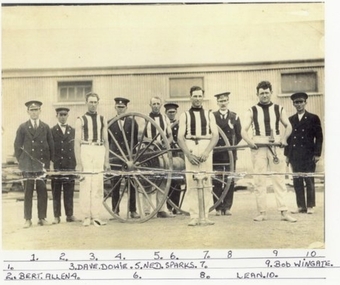
Photograph, 1930 - 1935
... BOB WINGATE. local history photography photographs fire brigade SOME MEN NAMED BELOW PHOTO COPY OF SEPIA PHOTOGRAPH MOUNTED ON CARDBOARD OF CLUNES FIRE BRIGADE C 1935. TEN MEMBERS WITH HOSE AND REEL. ...PHOTOGRAPH OF CLUNES FIRE BRIGADE COMPETITION TEAM CIRCA 1935 - 2. BERT ALLEN - 3. DAVE DOWIE - 5. NED SPARKS - 6. JACK ALLEN - 8. ARTHUR LEAN - 9. BOB WINGATE.COPY OF SEPIA PHOTOGRAPH MOUNTED ON CARDBOARD OF CLUNES FIRE BRIGADE C 1935. TEN MEMBERS WITH HOSE AND REEL.SOME MEN NAMED BELOW PHOTOlocal history, photography, photographs, fire brigade -
 Kew Historical Society Inc
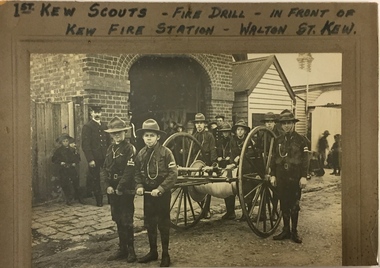
Photograph, 1st Kew Scouts Fire Drill, 1911, 1911
... hose and coupling it on to the hydrant. We have gained four recruits during the last week, and are expecting two more next week." This is a fine, original photograph, probably taken by a commercial photographer, showing the 1st Kew Scouts in front of the old Kew Fire Brigade building in Walton Street in 1911. The building, constructed in 1893 was later demolished in 1941. This is a rare historic photograph of the Station. Unfortunately the name ...A Volunteer Fire Brigade was established in Kew in 1879 and a fire station established in Walton Street, Kew. The Brigade was formally disbanded by the Fire Brigade Act of 1890 and the volunteers replaced by a unit of the Metropolitan Fire Brigade in 1891. The building shown in this rare photograph was constructed in 1893. In the background can be seen a house on the corner of Walton and Peel Streets, one of two, built in 1893 for firemen of the Brigade. An article in The Weekly Times (1 April 1911) records that: "Kew Troop - A,S.M. Williams reports:- The troop under S.M. Kellett. marched to the Kew Fire Brigade station, to receive instruction in fire drill from Mr Gross, the officer in charge, but as he was unexpectedly called away, the S.M. S and A.S.M had to instruct the Troop. Every boy was taught how to sink the hydrant, and how to couple and uncouple the hose. The hose reel was then brought into action, and the boys were divided into sets of six, each division taking its turn in pulling the reel up a hill to the water plug, where the hydrant was quickly sunk by one Scout, two more uncoupling the hose and coupling it on to the hydrant. We have gained four recruits during the last week, and are expecting two more next week."This is a fine, original photograph, probably taken by a commercial photographer, showing the 1st Kew Scouts in front of the old Kew Fire Brigade building in Walton Street in 1911. The building, constructed in 1893 was later demolished in 1941. This is a rare historic photograph of the Station. Unfortunately the name of the photographer is unrecorded.1st Kew Scouts undertaking a fire drill in front of the old Kew Fire Station in Walton Street, Kew. The reverse details the names and addresses of the Scouts featured in the photograph. An integral part of the Scout program is service to others and working with the fire brigade would have been just one of many such training activities enthusiastically undertaken by the Scouts. The Kew Fire Brigade had hand-drawn fire appliances up until 1919 when a motorised vehicle was purchased. The fire station was replaced by the Belford Road station in 1941 and subsequently demolished. Front: "First Kew Scouts - Fire Drill - In front of Kew Fire Station - Walton St. Kew" Reverse: "Walton St Kew / Kew Fire Station / Mr Gross o/c Fire Station / Bert Gundy Clark, part-time fireman / Allan Sewell Gellibrand St. / Clappy Williams Hawthorn ? / Allan Barrett Cobden St / Allan Woollard High St"kew fire brigade - walton street, scout groups --- kew (vic), 1st kew boy scouts -
 Kew Historical Society Inc
Award, Kew Fire Brigade / Best Average Time, 16 points / U.F.B.D. Sandhurst, 1886
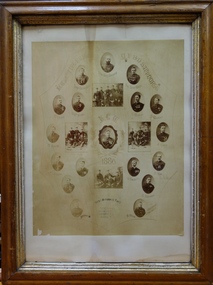
... names. About 40 complied with the invitation and met at the Town-hall to choose 12 of their number to form the brigade. The 12 elected then chose their officers as follows :— Councillor Gray, captain ; Mr. Thomas Greenhill, foreman ; and Mr. H. Loxton, secretary. The brigade decided to apply to the council for uniforms and a bell; and after adopting rules for their guidance the meeting separated. The brigade now possesses a reel and 500ft. of hose...names. About 40 complied with the invitation and met at the Town-hall to choose 12 of their number to form the brigade. The 12 elected then chose their officers as follows :— Councillor Gray, captain ; Mr. Thomas Greenhill, foreman ; and Mr. H. Loxton, secretary. The brigade decided to apply to the council for uniforms and a bell; and after adopting rules for their guidance the meeting separated. The brigade now possesses a reel and 500ft. of hose ...1879 - The Argus, Friday 11 July 1879, page 4. The Kew Borough Council having decided to initiate a fire brigade, invited volunteers to send in their names. About 40 complied with the invitation and met at the Town-hall to choose 12 of their number to form the brigade. The 12 elected then chose their officers as follows :— Councillor Gray, captain ; Mr. Thomas Greenhill, foreman ; and Mr. H. Loxton, secretary. The brigade decided to apply to the council for uniforms and a bell; and after adopting rules for their guidance the meeting separated. The brigade now possesses a reel and 500ft. of hose, and a shed is being erected in Little Walpole-street for a station. The council have applied for six additional fireplugs in the Main-road, so that the brigade may now be considered fairly established. 1886 - Globe (Sydney), Tuesday 16 March 1886, page 8 The Kew Fire Brigade, which obtained the pride of place at the recent fire brigades' demonstration, at Sandhurst, was met on their return at Spencer-street Railway Station by the Mayor and Councillors of that suburb, and were subsequently entertained at the Greyhound Hotel. 1886 - South Bourke and Mornington Journal, Wednesday 17 March 1886, page 2 It may be, deemed remarkable, but nevertheless a fact, 'that the Kew Fire Brigade, comparatively a new one, has gained premier place at the recent contest of brigades held at Ballarat, winning two first prizes and two second. On returning they were met at the station and escorted to Kew, preceded by the Borough banner. Certificate awarded to the Kew Volunteer Fire Brigade as an award for winning 'the best average time' in competition at Sandhurst. Surrounding the team's photo are a series of individual oval named portraits of the team. This framed version of the certificate, (there are two in the collection) is less faded than the framed version.The photograph without the mount (2016.0097a) has been digitally enhanced. Inscription: "Kew Fire Brigade U.F.B.D. Sandhurst. Kew 1886: Best Average Time, 16 points"kew volunteer fire brigade -
 Whitehorse Historical Society Inc.
Tool - Bee Smoker
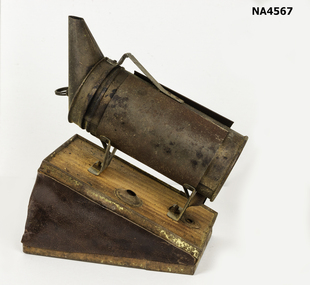
... name changed to Pender Beekeeping. The business moved to Rutherford New South Wales. The business was sold and changed to Pender Beegoods around 1989. In late 2002 it changed hands again to Pender Beekeeping Supplies and moved to Cardiff, Lake Macquarie New South Wales. Bee Keeping Pender Bros Ltd West Maitland (New South Wales) Metal cylinder with hinged lid with spout on top. Cylinder for containing smoking medium connected by hose ...Pender Bros began in 1892 in Maitland New South Wales who supplied beekeeping supplies to the local beekeepers and later to beekeepers Australia wide. In the early 1970s was the largest factory in the southern hemisphere. In the late 1970s Pender Bros sold the beekeeping business in the late 1970s to the workers of Pender Bros and the name changed to Pender Beekeeping. The business moved to Rutherford New South Wales. The business was sold and changed to Pender Beegoods around 1989. In late 2002 it changed hands again to Pender Beekeeping Supplies and moved to Cardiff, Lake Macquarie New South Wales.Metal cylinder with hinged lid with spout on top. Cylinder for containing smoking medium connected by hose (missing) to small bellows on base. Marked on base with Pender Bros Ltd Makers West MaitlandPender Bros Ltd West Maitland (New South Wales)bee keeping -
Rutherglen Historical Society
School Records - Individuals, Higher Elementary School, Rutherglen, Begg, James Hose, 1921
... name of a parent and the occupation. All sheets are indexed on a spreadsheet at the Common School Museum. pupils students Rutherglen Higher Elementary School school reports Individual school records of the pupils of the Higher Elementary School, Rutherglen. Begg, James Hose ...From School records, some more complete than others. Reports should contain information on the pupil's school work and give details of what they did when they left school. They should also show the name of a parent and the occupation. All sheets are indexed on a spreadsheet at the Common School Museum.Individual school records of the pupils of the Higher Elementary School, Rutherglen.pupils, students, rutherglen higher elementary school, school reports -
Rutherglen Historical Society
School Records - Individuals, Higher Elementary School, Rutherglen, Hose, Allen William, 1916
... name of a parent and the occupation. All sheets are indexed on a spreadsheet at the Common School Museum. pupils students Rutherglen Higher Elementary School school reports Individual school records of the pupils of the Higher Elementary School, Rutherglen. Hose ...From School records, some more complete than others. Reports should contain information on the pupil's school work and give details of what they did when they left school. They should also show the name of a parent and the occupation. All sheets are indexed on a spreadsheet at the Common School Museum.Individual school records of the pupils of the Higher Elementary School, Rutherglen.pupils, students, rutherglen higher elementary school, school reports -
 City of Greater Geelong
Photograph - Black and White Photograph, Cyclists, End of 33 Mile Race, 1928
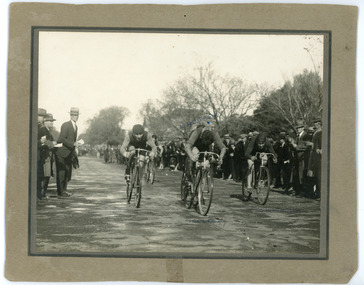
... Hose 1st, R. Holliday 2nd, C. Barh 3rd, F. Williams 4th (crossed out) L. Hooper 4, F. Williams 5' Black and white photograph mounted on cardboard. Four riders can be seen with lines of spectators either side, men dressed in suits. The photograph has been written on in blue pen. The riders names ...Geelong Amateur Cycling Club. Geelong Wast Cycling Club.Black and white photograph mounted on cardboard. Four riders can be seen with lines of spectators either side, men dressed in suits. The photograph has been written on in blue pen. The riders names are below the first three. An arrow is pointing to the fourth and it is written above.Written in blue pen on photograph - 'C. Bhaer, R. Holliday, F. Williams, L. Hooper'. On back in mix of pencil and black pen is - 'F. Hose 1st, R. Holliday 2nd, C. Barh 3rd, F. Williams 4th (crossed out) L. Hooper 4, F. Williams 5' -
 Maryborough Midlands Historical Society operating the Worsley Cottage Museum
Drinking glass, circa 2000
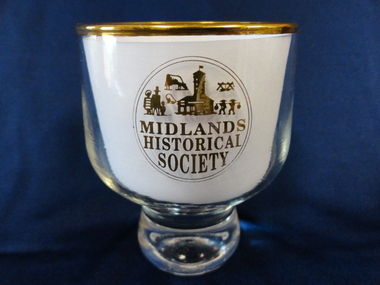
... Hose Glassware P/L) were sold to raise money for the Maryborough Midlands Historical Society. Note the society's name change since the glasses were produced....Hose Glassware P/L) were sold to raise money for the Maryborough Midlands Historical Society. Note the society's name change since the glasses were produced. ...These souvenir glasses (marketed by C.R. Hose Glassware P/L) were sold to raise money for the Maryborough Midlands Historical Society. Note the society's name change since the glasses were produced.The glass marks a step in the history of the M.M.H.S.Small souvenir drinking glass with gold rim.Worsley Cottage Midlands Historical Society Illustration of Worsley Cottagemaryborough maryborough midlands historical society -
 Port Fairy Historical Society Museum and Archives
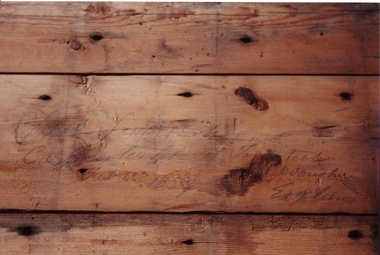
Photograph, 1859 Named Wooden Doors
... Signed by the town builders Thomas Southcombe & Alex Ingram carpentry hoses construction The door is signed by the builders Thomas Southcombe and Alex Ingram Coloured photograph 1859 Named Wooden Doors Photograph Photograph ...Signed by the town builders Thomas Southcombe & Alex IngramColoured photographThe door is signed by the builders Thomas Southcombe and Alex Ingramcarpentry, hoses construction -
Linton and District Historical Society Inc
Certificate, Certificate awarded to Linton Fire Brigade, 1893
... Certificate won by Linton Fire Brigade, second prize, engine practice for 4 men. Names of team - Robert Cornish, hose, James Chung - hose, Neil Wishart - hose, Daniel McMillan - suction"....Certificate won by Linton Fire Brigade, second prize, engine practice for 4 men. Names of team - Robert Cornish, hose, James Chung - hose, Neil Wishart - hose, Daniel McMillan - suction". ...Won by Linton Fire Brigade at Country Fire Brigades Demonstration day at Geelong in March 1893. Team members Robert Cornish, James Chung, Neil Wishart and Daniel McMillan. Displayed in fire brigade hall, then stored by Eugene Grigg.Large coloured print, mounted on cardboard, showing various aspects of fire brigade work in the 1890s."The Country Fire Brigade's demonstration Geelong March 7, 8 and 9 1893. Certificate won by Linton Fire Brigade, second prize, engine practice for 4 men. Names of team - Robert Cornish, hose, James Chung - hose, Neil Wishart - hose, Daniel McMillan - suction".linton fire brigade, robert cornish, james chung, neil wishart, daniel mcmillan -
 Wodonga & District Historical Society Inc
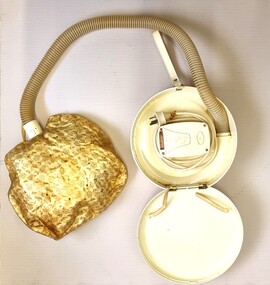
Domestic object - Lady Sunbeam Home Hair Dryer, Sunbeam Corporation Australia, c1960
... name to Newell Australia. This item is representative of a range of domestic appliances used across Australia in the 1960s to make home life simpler and more convenient. Sunbeam Australia domestic appliances Hair dryers On lid: Lady Sunbeam / HAIR DRYER Underneath unit: MODEL AHD-7 220-250V 50CYC 300W.AC. ONLY/ PATENT PENDING RD.NO.42.338 MADE IN AUSTRALIA / Sunbeam CORPORATION LIMITED Hair dryer in portable round plastic hinged case with motor fitted within the base. Plastic wire coiled hose ...Sunbeam produced a wide range of hair dryers in a variety of sizes and shapes throughout the 1960s. Lady Sunbeam was promoted as providing unequalled efficiency as well as extra convenience and comfort. Whilst you dried your hair, you were able to sit and relax, read a book, write letters, knit or apply your nail enamel. The added convenient shoulder strap enabled you to complete other small household chores such as ironing - as long as they could be carried out within the distance of the power cord. Sunbeam History The Sunbeam Corporation began in Australia in 1902 as a small branch of the American group, Chicago Flexible Shaft Company.In 1946, this company changed its name to Sunbeam Corporation and developed the slogan "Best Electric Appliances Made". The company became publicly traded in 1952 and came into Australian ownership in 1987. In 1948 the company launched the Sunbeam Mixmaster®, the first small electrical appliance to be manufactured in Australia. In 2020, the company changed its name to Newell Australia.This item is representative of a range of domestic appliances used across Australia in the 1960s to make home life simpler and more convenient.Hair dryer in portable round plastic hinged case with motor fitted within the base. Plastic wire coiled hose is attached to the motor. A plastic hood edged with elastic and lace adjustment is fitted to the end of the hose. The hood has a pattern of gold embossed flowers. The motor has settings off, cool, warm, med, hot. An electric cord and plug are attached to the motor. The lid closes with a sprung knob and has a plastic carry handle. The "Lady Sunbeam" Logo is embossed on the lid.On lid: Lady Sunbeam / HAIR DRYER Underneath unit: MODEL AHD-7 220-250V 50CYC 300W.AC. ONLY/ PATENT PENDING RD.NO.42.338 MADE IN AUSTRALIA / Sunbeam CORPORATION LIMITEDsunbeam australia, domestic appliances, hair dryers -
 Kew Historical Society Inc
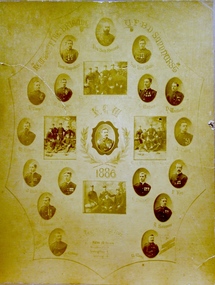
Award, Kew Fire Brigade: Best Average Time, 16 points, U.F.B.D. Sandhurst, 1886
... names. About 40 complied with the invitation and met at the Town-hall to choose 12 of their number to form the brigade. The 12 elected then chose their officers as follows :— Councillor Gray, captain ; Mr. Thomas Greenhill, foreman ; and Mr. H. Loxton, secretary. The brigade decided to apply to the council for uniforms and a bell; and after adopting rules for their guidance the meeting separated. The brigade now possesses a reel and 500ft. of hose...names. About 40 complied with the invitation and met at the Town-hall to choose 12 of their number to form the brigade. The 12 elected then chose their officers as follows :— Councillor Gray, captain ; Mr. Thomas Greenhill, foreman ; and Mr. H. Loxton, secretary. The brigade decided to apply to the council for uniforms and a bell; and after adopting rules for their guidance the meeting separated. The brigade now possesses a reel and 500ft. of hose ...1879 - The Argus, Friday 11 July 1879, page 4. The Kew Borough Council having decided to initiate a fire brigade, invited volunteers to send in their names. About 40 complied with the invitation and met at the Town-hall to choose 12 of their number to form the brigade. The 12 elected then chose their officers as follows :— Councillor Gray, captain ; Mr. Thomas Greenhill, foreman ; and Mr. H. Loxton, secretary. The brigade decided to apply to the council for uniforms and a bell; and after adopting rules for their guidance the meeting separated. The brigade now possesses a reel and 500ft. of hose, and a shed is being erected in Little Walpole-street for a station. The council have applied for six additional fireplugs in the Main-road, so that the brigade may now be considered fairly established. 1886 - Globe (Sydney), Tuesday 16 March 1886, page 8 The Kew Fire Brigade, which obtained the pride of place at the recent fire brigades' demonstration, at Sandhurst, was met on their return at Spencer-street Railway Station by the Mayor and Councillors of that suburb, and were subsequently entertained at the Greyhound Hotel. 1886 - South Bourke and Mornington Journal, Wednesday 17 March 1886, page 2 It may be, deemed remarkable, but nevertheless a fact, 'that the Kew Fire Brigade, comparatively a new one, has gained premier place at the recent contest of brigades held at Ballarat, winning two first prizes and two second. On returning they were met at the station and escorted to Kew, preceded by the Borough banner. Certificate awarded to the Kew Volunteer Fire Brigade as an award for winning 'the best average time' in competition at Sandhurst. Surrounding the team's photo are a series of individual oval named portraits of the team. This version of the certificate, (there is two in the collection) is unframed and has a badly torn mount. It is also more faded than the framed version.The photograph without the mount (2016.0097a) has been digitally enhanced. Inscription: "Kew Fire Brigade U.F.B.D. Sandhurst. Kew 1886: Best Average Time, 16 points"kew volunteer fire brigade
