
Showing 21 items matching "hospital infections"
-
 Alfred Hospital Nurses League - Nursing History Collection
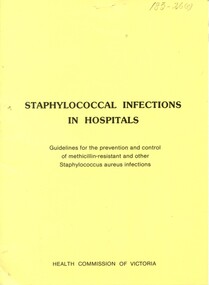
Booklet, Health Commission of Victoria, Staphylococcal infections in hospitals - guidelines for the prevention and control of methicillin-resistant and othe staphylococcus aureus infections, 1980
... ...hospital infections...Historic document, 1980 guidelines for the prevention and control of methicillin-resistant and othe staphylococcus aureus infections Insight into hospital infection control in 1980 MRSA Methicillin resistant staphylococcus aureus hospital infections infection control previous catalogue number at top right of front cover [pencil] Stapled booklet with yellow cover. ...Historic document, 1980 guidelines for the prevention and control of methicillin-resistant and othe staphylococcus aureus infectionsInsight into hospital infection control in 1980Stapled booklet with yellow cover. Front cover has black print detailing title and publisherprevious catalogue number at top right of front cover [pencil]mrsa, methicillin resistant staphylococcus aureus, hospital infections, infection control -
 Federation University Historical Collection
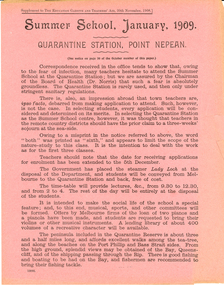
Document, Point Nepean Information, 1909, 1909
... It is now a community of hospitals, disinfecting complex, morgue, cemetery and other defunct buildings comprised an infectious disease facility which processed newly arrived humans and livestock alike. quarantine station port nepean quarantine station summer school lady loch Education Department education port nepean A pink document provided with the Education Gazette outlining a summer school for teachers in 1909. It starts with "..owing to the fear of infection ...The Port Napean Quarantine Station was established in 1852. It is now a community of hospitals, disinfecting complex, morgue, cemetery and other defunct buildings comprised an infectious disease facility which processed newly arrived humans and livestock alike. A pink document provided with the Education Gazette outlining a summer school for teachers in 1909. It starts with "..owing to the fear of infection, many teachers hesitate to attend the Summer School at the Quarantine Station; but we are assured by the Chairman of the Board of Health (Mr Norris) that such fear is absolutely groundless. The Quarantine Station is rarely used, and then only under the stringest sanitary regulations. ..."quarantine station, port nepean quarantine station, summer school, lady loch, education department, education, port nepean -
 Flagstaff Hill Maritime Museum and Village
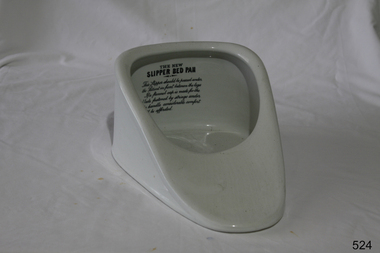
Equipment - Bed Pan
... As a result, Nightingale proposed several methods to improve the sanitary conditions in both military and civilian hospitals, including the addition of bedpans in order to reduce infection exposure from urine or faeces. ...As a result, Nightingale proposed several methods to improve the sanitary conditions in both military and civilian hospitals, including the addition of bedpans in order to reduce infection exposure from urine or faeces. ...The Bedpan Toilet device is a special tool designed for people who are unable to get out of bed to use the bathroom. It helps them go to the toilet comfortably and conveniently without having to leave their bed. The device is placed under the person's bottom, and it has a container that collects urine or stool. It is easy to clean and can be emptied into a toilet or sink. The Bedpan Toilet device allows individuals who are confined to bed due to illness or injury to maintain their dignity and independence by providing them with a practical solution for using the bathroom while staying in bed. The word bedpan was first seen in the literature of John Higgins in 1572, and one of the oldest known bedpans is on display in the Science Museum of London. It is a green, glazed earthenware bedpan that has been dated to the 16th or 17th century. At that time, bedpans were made from materials including pewter, brass, pottery, glass, and porcelain. Bedpans were not a commonplace item in hospitals until the late 1800s. Florence Nightingale, who worked as a nurse in the United Kingdom from the mid to late 1800s, recorded death rates and causes for soldiers in military hospitals during the Crimean War and then correlated them to corresponding sanitisation procedures. As a result, Nightingale proposed several methods to improve the sanitary conditions in both military and civilian hospitals, including the addition of bedpans in order to reduce infection exposure from urine or faeces. https://www.wikiwand.com/en/Bedpan The use of bedpans is significant, as it allows a patient who cannot move much, to remain in bed and perform toilet functions.Bed pan ceramic white glaze with handle. Labelled "The New Slipper Bed Pan". Has specific instructions for use under the maker's label.‘THE NEW SLIPPER BED PAN. This slipper should be passed under the patient in front between the legs. If a flannel cap is made for the blade fastened by strings under the handle considerable comfort will be afforded.’ flagstaff hill, warrnambool, shipwrecked-coast, flagstaff-hill, flagstaff-hill-maritime-museum, maritime-museum, shipwreck-coast, flagstaff-hill-maritime-village, nursing, bedpans, hygiene -
 Flagstaff Hill Maritime Museum and Village
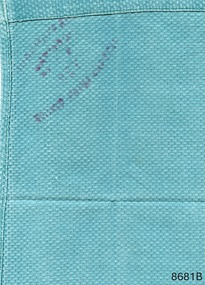
Textile - Surgical Cloth, Green Surgical Cloth
... infection; however modern fabrics have superseded the use of cotton. The green colour was an innovation that reduced fatigue from previously used white cloth that promoted glare. ABOUT THE “W.R.ANGUS COLLECTION” Doctor William Roy Angus M.B., B.S., Adel., 1923, F.R.C.S. Edin.,1928 (also known as Dr Roy Angus) was born in Murrumbeena, Victoria in 1901 and lived until 1970. He qualified as a doctor in 1923 at University of Adelaide, was Resident Medical Officer at the Royal Adelaide Hospital...infection; however modern fabrics have superseded the use of cotton. The green colour was an innovation that reduced fatigue from previously used white cloth that promoted glare. ABOUT THE “W.R.ANGUS COLLECTION” Doctor William Roy Angus M.B., B.S., Adel., 1923, F.R.C.S. Edin.,1928 (also known as Dr Roy Angus) was born in Murrumbeena, Victoria in 1901 and lived until 1970. He qualified as a doctor in 1923 at University of Adelaide, was Resident Medical Officer at the Royal Adelaide Hospital ...This surgical cloth is part of the “W.R. Angus Collection” that includes historical medical equipment, surgical instruments and material once belonging to Dr Edward Ryan and Dr Thomas Francis Ryan, (both of Nhill, Victoria) as well as Dr Angus’ own belongings. Dr. Angus throughout his extensive career would have used many of these cloths either in his surgery or other medical institutions; the 1940s saw drapes adopted in medical practice. The use of cloths gave limited assistance to aseptic techniques to reduce the risk of infection; however modern fabrics have superseded the use of cotton. The green colour was an innovation that reduced fatigue from previously used white cloth that promoted glare. ABOUT THE “W.R.ANGUS COLLECTION” Doctor William Roy Angus M.B., B.S., Adel., 1923, F.R.C.S. Edin.,1928 (also known as Dr Roy Angus) was born in Murrumbeena, Victoria in 1901 and lived until 1970. He qualified as a doctor in 1923 at University of Adelaide, was Resident Medical Officer at the Royal Adelaide Hospital in 1924 and for a period was house surgeon to Sir (then Mr.) Henry Simpson Newland. Dr Angus was briefly an Assistant to Dr Riddell of Kapunda, then commenced private practice at Curramulka, Yorke Peninsula, SA, where he was physician, surgeon and chemist. In 1926, he was appointed as new Medical Assistant to Dr Thomas Francis Ryan (T.F. Ryan, or Tom), in Nhill, Victoria, where his experiences included radiology and pharmacy. In 1927 he was Acting House Surgeon in Dr Tom Ryan’s absence. Dr Angus had become engaged to Gladys Forsyth and they decided he would take time to further his studies overseas in the UK in 1927. He studied at London University College Hospital and at Edinburgh Royal Infirmary and in 1928, was awarded FRCS (Fellow from the Royal College of Surgeons), Edinburgh. He worked his passage back to Australia as a Ship’s Surgeon on the on the Australian Commonwealth Line’s T.S.S. Largs Bay. Dr Angus married Gladys in 1929, in Ballarat. (They went on to have one son (Graham 1932, born in SA) and two daughters (Helen (died 12/07/1996) and Berenice (Berry), both born at Mira, Nhill ) Dr Angus was a ‘flying doctor’ for the A.I.M. (Australian Inland Ministry) Aerial Medical Service in 1928 . The organisation began in South Australia through the Presbyterian Church in that year, with its first station being in the remote town of Oodnadatta, where Dr Angus was stationed. He was locum tenens there on North-South Railway at 21 Mile Camp. He took up this ‘flying doctor’ position in response to a call from Dr John Flynn; the organisation was later known as the Flying Doctor Service, then the Royal Flying Doctor Service. A lot of his work during this time involved dental surgery also. Between 1928-1932 he was surgeon at the Curramulka Hospital, Yorke Peninsula, South Australia. In 1933 Dr Angus returned to Nhill where he’d previously worked as Medical Assistant and purchased a share of the Nelson Street practice and Mira hospital from Dr Les Middleton one of the Middleton Brothers, the current owners of what was once Dr Tom Ryan’s practice. Dr L Middleton was House Surgeon to the Nhill Hospital 1926-1933, when he resigned. [Dr Tom Ryan’s practice had originally belonged to his older brother Dr Edward Ryan, who came to Nhill in 1885. Dr Edward saw patients at his rooms, firstly in Victoria Street and in 1886 in Nelson Street, until 1901. The Nelson Street practice also had a 2 bed ward, called Mira Private Hospital ). Dr Edward Ryan was House Surgeon at the Nhill Hospital 1884-1902 . He also had occasions where he successfully performed veterinary surgery for the local farmers too. Dr Tom Ryan then purchased the practice from his brother in 1901. Both Dr Edward and Dr Tom Ryan work as surgeons included eye surgery. Dr Tom Ryan performed many of his operations in the Mira private hospital on his premises. He too was House Surgeon at the Nhill Hospital 1902-1926. Dr Tom Ryan had one of the only two pieces of radiology equipment in Victoria during his practicing years – The Royal Melbourne Hospital had the other one. Over the years Dr Tom Ryan gradually set up what was effectively a training school for country general-practitioner-surgeons. Each patient was carefully examined, including using the X-ray machine, and any surgery was discussed and planned with Dr Ryan’s assistants several days in advance. Dr Angus gained experience in using the X-ray machine there during his time as assistant to Dr Ryan. Dr Tom Ryan moved from Nhill in 1926. He became a Fellow of the Royal Australasian College of Surgeons in 1927, soon after its formation, a rare accolade for a doctor outside any of the major cities. He remained a bachelor and died suddenly on 7th Dec 1955, aged 91, at his home in Ararat. Scholarships and prizes are still awarded to medical students in the honour of Dr T.F. Ryan and his father, Dr Michael Ryan, and brother, John Patrick Ryan. ] When Dr Angus bought into the Nelson Street premises in Nhill he was also appointed as the Nhill Hospital’s Honorary House Surgeon 1933-1938. His practitioner’s plate from his Nhill surgery states “HOURS Daily, except Tuesdays, Fridays and Saturday afternoons, 9-10am, 2-4pm, 7-8pm. Sundays by appointment”. This plate is now mounted on the doorway to the Port Medical Office at Flagstaff Hill Maritime Village, Warrnambool. Dr Edward Ryan and Dr Tom Ryan had an extensive collection of historical medical equipment and materials spanning 1884-1926 and when Dr Angus took up practice in their old premises he obtained this collection, a large part of which is now on display at the Port Medical Office at Flagstaff Hill Maritime Village in Warrnambool. During his time in Nhill Dr Angus was involved in the merging of the Mira Hospital and Nhill Public Hospital into one public hospital and the property titles passed on to Nhill Hospital in 1939. In 1939 Dr Angus and his family moved to Warrnambool where he purchased “Birchwood,” the 1852 home and medical practice of Dr John Hunter Henderson, at 214 Koroit Street. (This property was sold in1965 to the State Government and is now the site of the Warrnambool Police Station. ). The Angus family was able to afford gardeners, cooks and maids; their home was a popular place for visiting dignitaries to stay whilst visiting Warrnambool. Dr Angus had his own silk worm farm at home in a Mulberry tree. His young daughter used his centrifuge for spinning the silk. Dr Angus was appointed on a part-time basis as Port Medical Officer (Health Officer) in Warrnambool and held this position until the 1940’s when the government no longer required the service of a Port Medical Officer in Warrnambool; he was thus Warrnambool’s last serving Port Medical Officer. (The duties of a Port Medical Officer were outlined by the Colonial Secretary on 21st June, 1839 under the terms of the Quarantine Act. Masters of immigrant ships arriving in port reported incidents of diseases, illness and death and the Port Medical Officer made a decision on whether the ship required Quarantine and for how long, in this way preventing contagious illness from spreading from new immigrants to the residents already in the colony.) Dr Angus was a member of the Australian Medical Association, for 35 years and surgeon at the Warrnambool Base Hospital 1939-1942, He served as a Surgeon Captain during WWII 1941-45, in Ballarat, Victoria, and in Bonegilla, N.S.W., completing his service just before the end of the war due to suffering from a heart attack. During his convalescence he carved an intricate and ‘most artistic’ chess set from the material that dentures were made from. He then studied ophthalmology at the Royal Melbourne Eye and Ear Hospital and created cosmetically superior artificial eyes by pioneering using the intrascleral cartilage. Angus received accolades from the Ophthalmological Society of Australasia for this work. He returned to Warrnambool to commence practice as an ophthalmologist, pioneering in artificial eye improvements. He was Honorary Consultant Ophthalmologist to Warrnambool Base Hospital for 31 years. He made monthly visits to Portland as a visiting surgeon, to perform eye surgery. He represented the Victorian South-West subdivision of the Australian Medical Association as its secretary between 1949 and 1956 and as chairman from 1956 to 1958. In 1968 Dr Angus was elected member of Spain’s Barraquer Institute of Barcelona after his research work in Intrasclearal cartilage grafting, becoming one of the few Australian ophthalmologists to receive this honour, and in the following year presented his final paper on Living Intrasclearal Cartilage Implants at the Inaugural Meeting of the Australian College of Ophthalmologists in Melbourne In his personal life Dr Angus was a Presbyterian and treated Sunday as a Sabbath, a day of rest. He would visit 3 or 4 country patients on a Sunday, taking his children along ‘for the ride’ and to visit with him. Sunday evenings he would play the pianola and sing Scottish songs to his family. One of Dr Angus’ patients was Margaret MacKenzie, author of a book on local shipwrecks that she’d seen as an eye witness from the late 1880’s in Peterborough, Victoria. In the early 1950’s Dr Angus, painted a picture of a shipwreck for the cover jacket of Margaret’s book, Shipwrecks and More Shipwrecks. She was blind in later life and her daughter wrote the actual book for her. Dr Angus and his wife Gladys were very involved in Warrnambool’s society with a strong interest in civic affairs. Their interests included organisations such as Red Cross, Rostrum, Warrnambool and District Historical Society (founding members), Wine and Food Society, Steering Committee for Tertiary Education in Warrnambool, Local National Trust, Good Neighbour Council, Housing Commission Advisory Board, United Services Institute, Legion of Ex-Servicemen, Olympic Pool Committee, Food for Britain Organisation, Warrnambool Hospital, Anti-Cancer Council, Boys’ Club, Charitable Council, National Fitness Council and Air Raid Precautions Group. He was also a member of the Steam Preservation Society and derived much pleasure from a steam traction engine on his farm. He had an interest in people and the community He and his wife Gladys were both involved in the creation of Flagstaff Hill, including the layout of the gardens. After his death (28th March 1970) his family requested his practitioner’s plate, medical instruments and some personal belongings be displayed in the Port Medical Office surgery at Flagstaff Hill Maritime Village, and be called the “W. R. Angus Collection”. The W.R. Angus Collection is significant for still being located at the site it is connected with, Doctor Angus being the last Port Medical Officer in Warrnambool. The collection of medical instruments and other equipment is culturally significant, being an historical example of medicine from late 19th to mid-20th century. Dr Angus assisted Dr Tom Ryan, a pioneer in the use of X-rays and in ocular surgery.This is an oblong surgical cloth of woven cotton in the colour green. It shows signs of use due to the faded colour, particular to the hems. The top stitching looks cream and the underneath machine stitching is green. There are two very small rust spots. WARRNAMBOOL/HOSPITAL/? ? ??/Y28/CENTRAL LINEN SERVICEflagstaff hill, warrnambool, shipwrecked coast, flagstaff hill maritime museum, maritime museum, shipwreck coast, flagstaff hill maritime village, great ocean road, surgical cloth, warrnambool & district hospital base hospital, nurses graduation warrnambool, dr. w. r. angus, port medical officer, roy angus, ophthalmology, surgery, aseptic technique, warrnambool hospital linen service -
 City of Moorabbin Historical Society (Operating the Box Cottage Museum)
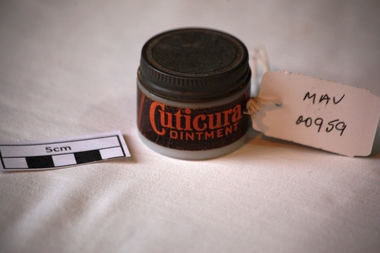
Manufactured Glass, jar of 'Cuticura' ointment, mid 20thC
... The Cuticura Ointment contains Phenol which is a healing compound to heal irritated skin, and fight infections. pharmacy medicines cuticura ointment cuticura chemical company hospitals nursing containers moorabbin bentleigh cheltenham melbourne Front ; CUTICURA / OINTMENT Left side ; MADEIN AUSTRALIA BY / CUTICURA Pty LIMITED./ SYDNEY Right side FOR THE SKIN / AND SCALP / 3/4 OZ NETT An opaque glass jar with a metal screw lid for 'Cuticura ' ointment Manufactured Glass, jar of 'Cuticura' ointment Cuticura Pty. ...Cuticura soap, manufactured by the Potter Drug and Chemical Company, USA is an antibacterial medicated soap that has been in use and is relatively unchanged since 1865. The Cuticura Ointment contains Phenol which is a healing compound to heal irritated skin, and fight infections.An opaque glass jar with a metal screw lid for 'Cuticura ' ointmentFront ; CUTICURA / OINTMENT Left side ; MADEIN AUSTRALIA BY / CUTICURA Pty LIMITED./ SYDNEY Right side FOR THE SKIN / AND SCALP / 3/4 OZ NETT pharmacy, medicines, cuticura ointment, cuticura chemical company, hospitals, nursing, containers, moorabbin, bentleigh, cheltenham, melbourne -
 Orbost & District Historical Society
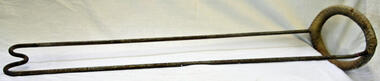
Thomas splint
... infection. This item was used for a child with a broken thigh bone. This item is an example of an early piece of medical equipment. splint-thomas orbost-hospital medicine-nursing Thomas splint is a leg splint consisting of two rigid rods attached to an ovoid padded ring that fits around the thigh. ...The Thomas splint is still used in war zones today. It was invented in the late 19th Century by pioneering surgeon Hugh Owen Thomas, often described as the father of British orthopaedics, born in Anglesey to a family of "bone setters". He created the so-called 'Thomas Splint', which would stabilise a fractured femur and prevent infection. This item was used for a child with a broken thigh bone.This item is an example of an early piece of medical equipment.Thomas splint is a leg splint consisting of two rigid rods attached to an ovoid padded ring that fits around the thigh.splint-thomas orbost-hospital medicine-nursing -
 Bendigo Military Museum
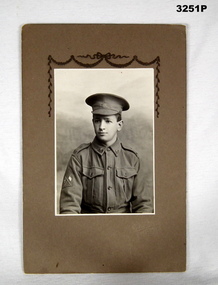
Photograph - PHOTOGRAPH WW1, 1) & .2) 1915; .3) post 19.8.1916
... Enlisted for WW1 on 22.4.1915 age 18 years 6 months in the 7th reinforcements 5th BN, embarked for Eygpt 16.7.1915, embark for Gallipoli18.10.1915, disembark in Eygpt on 7.1.1916, transfer to the 57th Bn, hospital with Diarrhea 12.4.1916, rejoin unit 20.4.1916, embark for France 17.6.1916, hospital with Diarrhea 17.10.1916 then classed Paratyphoid (infection due to Salmonella) transferred to hospital England with, retraining in England then attends a Signals course, rejoin unit 12.12.1917, discharged from the AIF 7.5.1919....Enlisted for WW1 on 22.4.1915 age 18 years 6 months in the 7th reinforcements 5th BN, embarked for Eygpt 16.7.1915, embark for Gallipoli18.10.1915, disembark in Eygpt on 7.1.1916, transfer to the 57th Bn, hospital with Diarrhea 12.4.1916, rejoin unit 20.4.1916, embark for France 17.6.1916, hospital with Diarrhea 17.10.1916 then classed Paratyphoid (infection due to Salmonella) transferred to hospital England with, retraining in England then attends a Signals course, rejoin unit 12.12.1917, discharged from the AIF 7.5.1919. photographs 57th graves "Kalma Pall Mall Bendigo" Photo, original, brown cardboard backing with sepia photo inset re "G R FREEMAN" in uniform. ...George Ross FREEMAN No 2485. George had pre WW1 service in the local Bendigo 67th Bn Militia. Enlisted for WW1 on 22.4.1915 age 18 years 6 months in the 7th reinforcements 5th BN, embarked for Eygpt 16.7.1915, embark for Gallipoli18.10.1915, disembark in Eygpt on 7.1.1916, transfer to the 57th Bn, hospital with Diarrhea 12.4.1916, rejoin unit 20.4.1916, embark for France 17.6.1916, hospital with Diarrhea 17.10.1916 then classed Paratyphoid (infection due to Salmonella) transferred to hospital England with, retraining in England then attends a Signals course, rejoin unit 12.12.1917, discharged from the AIF 7.5.1919. Photo, original, brown cardboard backing with sepia photo inset re "G R FREEMAN" in uniform. "Kalma Pall Mall Bendigo" photographs, 57th, graves -
 Bendigo Military Museum
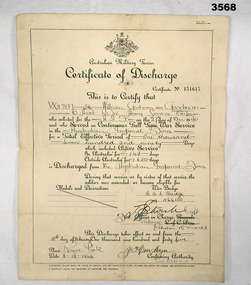
Administrative record - CERTIFICATE OF DISCHARGE WW2, 8.12.1944
... infection. Rejoined unit 16.6.1940. 27.7.1940 transferred to 6th Division ASC. From here he served in Ammunition and Composite Coy’s in 6th Div ASC and graded Group 2 Mechanic MT. 24.3.1941 embarked for Greece. 5.6.1941 reported as missing. 15.12.1941 officially reported as POW in Stalag V111B. 17.5.1944 as part of a POW exchange he embarked from Barcelona to Algiers then Alexandria arriving on 2.6.1944. He is admitted to No 5 NZ GH with Dyspepsia and discharged on 9.6.1944. 28.8.1944 embarked for Australia as a medical casualty. 29.9.1944 arrived Sydney. Hospital...infection. Rejoined unit 16.6.1940. 27.7.1940 transferred to 6th Division ASC. From here he served in Ammunition and Composite Coy’s in 6th Div ASC and graded Group 2 Mechanic MT. 24.3.1941 embarked for Greece. 5.6.1941 reported as missing. 15.12.1941 officially reported as POW in Stalag V111B. 17.5.1944 as part of a POW exchange he embarked from Barcelona to Algiers then Alexandria arriving on 2.6.1944. He is admitted to No 5 NZ GH with Dyspepsia and discharged on 9.6.1944. 28.8.1944 embarked for Australia as a medical casualty. 29.9.1944 arrived Sydney. Hospital ...William Graham GOODMAN VX11397 enlisted in the 2nd AIF on 27.3.1940 age 33 years 2 months. 8.4.1940 posted to 2/5th Batt. 14.4.1940 embarked for the Middle East. 22.5.1940 hospitalised with Otitis Media (ear infection). Rejoined unit 27.5 1940. 14.6.1940 hospitalised with a throat infection. Rejoined unit 16.6.1940. 27.7.1940 transferred to 6th Division ASC. From here he served in Ammunition and Composite Coy’s in 6th Div ASC and graded Group 2 Mechanic MT. 24.3.1941 embarked for Greece. 5.6.1941 reported as missing. 15.12.1941 officially reported as POW in Stalag V111B. 17.5.1944 as part of a POW exchange he embarked from Barcelona to Algiers then Alexandria arriving on 2.6.1944. He is admitted to No 5 NZ GH with Dyspepsia and discharged on 9.6.1944. 28.8.1944 embarked for Australia as a medical casualty. 29.9.1944 arrived Sydney. Hospital again with Dysentry and is medically down graded to D. 6.12.1944 marched out to GDD for discharge. 18.2.1945 discharged from the Army. A document in his records that he supplied details states his POW No 24198. He was captured on 1.6.1941 on Crete and they were on rear guard action at their post when the Island capitulated. It also details living conditions, clothing issue, food, sanitary, treatment, parcels etc. Ref Reg No's 3768, 3569, 3570, 3571, 3572, 3573. A4 certificate, yellowed, folded 8 times. Certificate of Discharge for VX11397 William Graham GOODMAN, Certificate No 151615. AIF Royal Park 8.12.1944.certificate, discharge, aif -
 Warrnambool and District Historical Society Inc.
Document - Typescript, Spanish 'flu epidemic 1919, Originally written in 1995
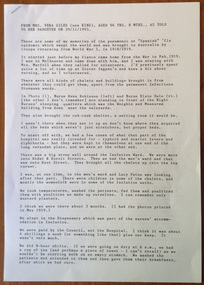
... infection control in Warrnambool. This article is significant because it is a first- hand record and gives a local perspective to a world- wide event. warrnambool spanish flu mrs vera giles warrnambool base hospital 1919 spanish flu dr holmes Covering letter from Mrs Giles’ daughter, Aurelin, dated January 22, 2015 Three pages of typed details about the Spanish flu in Warrnambool as recorded by volunteer Nurse Mrs Vera Giles (nee King). ...The 1918 Spanish 'flu was a deadly pandemic which infected 500 million people worldwide and killed millions. There is still discussion as to where the disease originated but the movement of troops at the end of WW1 contributed to the spread of the disease. This article deals with methods of disease and infection control in Warrnambool. This article is significant because it is a first- hand record and gives a local perspective to a world- wide event.Three pages of typed details about the Spanish flu in Warrnambool as recorded by volunteer Nurse Mrs Vera Giles (nee King). There are also photographs included and Victorian BDM records as well as general information on the 1918 Flu pandemic.Covering letter from Mrs Giles’ daughter, Aurelin, dated January 22, 2015 warrnambool, spanish flu, mrs vera giles, warrnambool base hospital, 1919 spanish flu, dr holmes -
 Royal Australian and New Zealand College of Obstetricians & Gynaecologists (RANZCOG)
Print - Colour print, Charles Webb, Original design of the Alfred Hospital, c. 1870
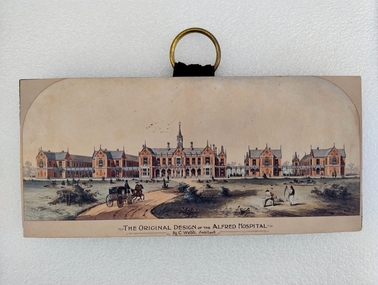
... Hospital by Charles Webb. This design was designed in 'accordance with the principles laid down by Florence Nightingale to maximise ventilation and so minimise infection' (Victorian Heritage Database). ...Hospital by Charles Webb. This design was designed in 'accordance with the principles laid down by Florence Nightingale to maximise ventilation and so minimise infection' (Victorian Heritage Database). ...This 1870 print displays the original design of The Alfred Hospital by Charles Webb. This design was designed in 'accordance with the principles laid down by Florence Nightingale to maximise ventilation and so minimise infection' (Victorian Heritage Database). The Alfred Hospital was founded in 1869 as a result of the work of various Melbourne doctors who fought a long and internecine battle for an additional general hospital. The Alfred Hospital treated their first patient in 1871. Prahran Council donated a parcel of low-lying land for the provision of a hospital. In 1870, the Melbourne architect, Charles Webb, won the competition to design The Alfred Hospital with his revolutionary design. Webb incorporated the "Nightingale" design - principles by designing large light filled pavilions as wards connected by covered corridors or walkways." (Alfred Health)This print includes small colour print mounted on a wood block. The print depicts a series of five red brick buildings at centre, with a dirt road snaking up from the left foreground to the front of the central building. A man is driving a two-horse buggy along the dirt road towards the buildings. The landscape on either side of the road consists of grassland and low vegetation, as well as four shallow circular pits (two on either side) which contain vegetation. There are two figures in the right foreground cutting grass with scythes. A flock of birds is visible in the sky in the central background, above the main hospital building. There is text printed below the image which reads 'THE ORIGINAL DESIGN OF THE ALFRED HOSPITAL/By C.Webb, Arckitect (sic)'. The back of the wooden block to which the print is affixes is painted black, and a circular hook has been attached to the centre back of the block for hanging of the artwork. The hook is gold coloured and attached using two gold-coloured pins and a small strap. There is handwriting at bottom right of the back of the object reads 'ANN TAVELL'.There is text printed below the image which reads 'THE ORIGINAL DESIGN OF THE ALFRED HOSPITAL/By C.Webb, Arckitect (sic)'. There is handwriting at bottom right of the back of the object reads 'ANN TAVELL'. -
 Alfred Hospital Nurses League - Nursing History Collection
Document - Internal memorandum, E June Allen, Uniforms for Registered Nurses, Alfred Hospital, 1993, 19930924
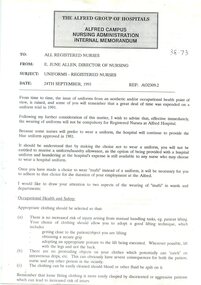
... Hospital effective immendiately (24th September, 1993). This followed on from a uniform trial and survey held in 1991. Choice of non-uniform should take into consideration occupational health and safety, and infection control. ...Hospital effective immendiately (24th September, 1993). This followed on from a uniform trial and survey held in 1991. Choice of non-uniform should take into consideration occupational health and safety, and infection control. ...Memorandum stating that the wearing of uniforms by registered nurses will no longer be compulsory at the Alfred Hospital effective immendiately (24th September, 1993). This followed on from a uniform trial and survey held in 1991. Choice of non-uniform should take into consideration occupational health and safety, and infection control. Guidence was also provided re clothing choices. It was also noted that Identification badges should be worn above the waist, so staff could be easily distiguished. Unoforms would still be provided and laundered by the Alfred Hospital for those who chose to continue wering them.The memorandum was signed by E June Alllen, Director of NursingProvides information of when the wearing of uniforms by registed nurses at the Alfred Hospital was no longer compulsorary.Single sheet of white paper with black print on both sidesPrevious catalogue number handwritten [black ink] at top right of first page. The memorandum is signed on the second page by E June Allenalfred hospital nurses uniform, nurses uniform, nurses clothing -
 Alfred Hospital Nurses League - Nursing History Collection
Document - Internal memorandum, E June Allen, Uniforms for Registered Nurses, Alfred Hospital, 1993, 19930924
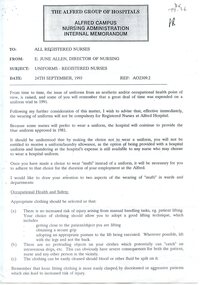
... Hospital effective immendiately (24th September, 1993). This followed on from a uniform trial and survey held in 1991. Choice of non-uniform should take into consideration occupational health and safety, and infection control. ...Hospital effective immendiately (24th September, 1993). This followed on from a uniform trial and survey held in 1991. Choice of non-uniform should take into consideration occupational health and safety, and infection control. ...Memorandum stating that the wearing of uniforms by registered nurses will no longer be compulsory at the Alfred Hospital effective immendiately (24th September, 1993). This followed on from a uniform trial and survey held in 1991. Choice of non-uniform should take into consideration occupational health and safety, and infection control. Guidence was also provided re clothing choices. It was also noted that Identification badges should be worn above the waist, so staff could be easily distiguished. Unoforms would still be provided and laundered by the Alfred Hospital for those who chose to continue wering them.The memorandum was signed by E June Alllen, Director of NursingProvides information of when the wearing of uniforms by registed nurses at the Alfred Hospital was no longer compulsorary.Two sheets of white paper with black print Previous catalogue number handwritten [black ink] at top right of first page. The memorandum is signed on the second page by E June Allenalfred hospital nurses uniform, nurses uniform, nurses clothing -
 National Vietnam Veterans Museum (NVVM)
Photograph, Gibbons, Denis, Ear Infection
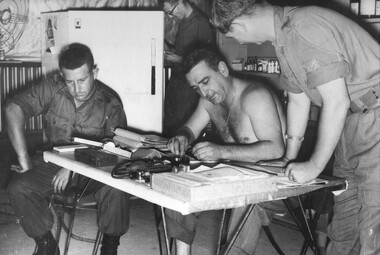
... Hospital...1st Australian Task Force...Commanding Officer...Ear Infection...A black and white photograph of the Commanding Officer and resident Medical Officer at the 2 Field Ambulance Hospital at the 1st Australian Task Fforce, Nui Dat, Phuoc Tuy Province,gives the Sgt Medic instructions as to the medication for a Cpl digger with an ear infection...Photograph Nui Dat Gibbons Collection Catalogue Digger Phuoc Tuy Province Medic 2 Field Ambulance Hospital 1st Australian Task Force Commanding Officer Ear Infection Denis Gibbons A black and white photograph of the Commanding Officer and resident Medical Officer at the 2 Field Ambulance Hospital at the 1st Australian Task Fforce, Nui Dat, Phuoc Tuy Province,gives the Sgt Medic instructions as to the medication for a Cpl digger with an ear infection Ear Infection Photograph Gibbons, Denis ...Denis Gibbons (1937 – 2011) Trained with the Australian Army, before travelling to Vietnam in January 1966, Denis stayed with the 1st Australian Task Force in Nui Dat working as a photographer. For almost five years Gibbons toured with nine Australian infantry battalions, posting compelling war images from within many combat zones before being flown out in late November 1970 after sustaining injuries. The images held within the National Vietnam Veterans Museum make up the Gibbons Collection. A black and white photograph of the Commanding Officer and resident Medical Officer at the 2 Field Ambulance Hospital at the 1st Australian Task Fforce, Nui Dat, Phuoc Tuy Province,gives the Sgt Medic instructions as to the medication for a Cpl digger with an ear infectionphotograph, nui dat, gibbons collection catalogue, digger, phuoc tuy province, medic, 2 field ambulance hospital, 1st australian task force, commanding officer, ear infection, denis gibbons -
 St Vincent's Hospital Melbourne Archives
Journal - Notebook of lecture notes of St Vincent's Melbourne nurse, circa 1903
... Hospital Melbourne nurses. The subjects range from Operation of Lithotomy instrument requirements to Infection Control including nursing management of Diptheria and Smallpox, diseases now controlled with vaccines. ...Hospital Melbourne nurses. The subjects range from Operation of Lithotomy instrument requirements to Infection Control including nursing management of Diptheria and Smallpox, diseases now controlled with vaccines. ...kathleen o'brien, margaret scudds, nurse training, st vincent's hospital melbourne -
 National Vietnam Veterans Museum (NVVM)
Photograph, Gibbons, Denis, Opearting Theatre Cleaning
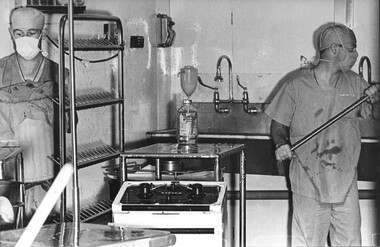
... Medic Tony Thomas is assisted by another medic as they clean and sterilize the hospital operating theatre following surgery. Medics were meticulous in carry out this task to stop infection....Medic Tony Thomas is assisted by another medic as they clean and sterilize the hospital operating theatre following surgery. Medics were meticulous in carry out this task to stop infection. ...Denis Gibbons (1937 – 2011) Trained with the Australian Army, before travelling to Vietnam in January 1966, Denis stayed with the 1st Australian Task Force in Nui Dat working as a photographer. For almost five years Gibbons toured with nine Australian infantry battalions, posting compelling war images from within many combat zones before being flown out in late November 1970 after sustaining injuries. The images held within the National Vietnam Veterans Museum make up the Gibbons Collection. A black and white photograph at the 1st Australian Field Hospital, Vung Tau, South Vietnam. Medic Tony Thomas is assisted by another medic as they clean and sterilize the hospital operating theatre following surgery. Medics were meticulous in carry out this task to stop infection.photograph, 1st australian field hospital, tony thomas (medic), vung tau, hospital cleaning, gibbons collection catalogue, denis gibbons, photographer, vietnam war, medics, operating theatre -
 Tatura Irrigation & Wartime Camps Museum
Book, F M Burnett, Background of Infectious Diseases in Man, 1945
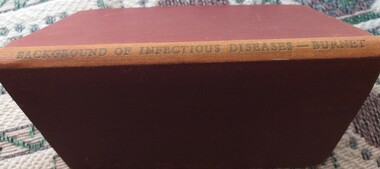
... contains lectures delivered in 1945 under the auspices of the Melbourne Permanent Postgraduate Committee and the New South Wales Postgraduate Committee in Medicine (University of Sydney). infectious diseases f m burnet respiratory virus infections Belonged to L H Wilson, 28 Camp Hospital Tatura. Background of Infectious Diseases - Burnet (on spine); inside - L H Wilson 28 Camp Hospital Tatura Nov 14 46 Small burgundy linen hardcovered book with gold writing on spine. 109 pages. ...Belonged to L H Wilson, 28 Camp Hospital Tatura.Small burgundy linen hardcovered book with gold writing on spine. 109 pages.non-fictionBelonged to L H Wilson, 28 Camp Hospital Tatura.infectious diseases, f m burnet, respiratory virus infections -
Northern District School of Nursing. Managed by Bendigo Historical Society Inc.
Tool - Northern District School of Nursing Graduates Association - Combistik Urine Test strips, 1950s
... hospital urinalysis and large-scale screening, even by non-specialists due to its simplicity. Helps optimize laboratory workflow by allowing ancillary staff to perform basic tests, freeing technologists for more complex tasks. Useful for diagnosing and managing urinary tract infections...hospital urinalysis and large-scale screening, even by non-specialists due to its simplicity. Helps optimize laboratory workflow by allowing ancillary staff to perform basic tests, freeing technologists for more complex tasks. Useful for diagnosing and managing urinary tract infections ...The Northern District School of Nursing in Victoria, Australia Graduates Association: History of the School Managed by a committee including hospital administrators, medical professionals, and nursing leaders from several regional hospitals. Associated with major hospitals in the Northern District, including Bendigo Base, Mildura Base, Castlemaine, Echuca, Swan Hill, St. Arnaud, and Kyneton District Hospitals. Provide high-quality theoretical and practical nursing training. Raise the standard of nursing education in the region. Maintain the highest principles of nursing practice. Applicants must be at least 17 years old and hold a Proficiency Certificate or higher educational qualification. Application involves submitting forms, certificates, an interview, an aptitude test, and a medical examination. A three-month probationary period follows initial acceptance. Preliminary Training School: Four-week introductory course covering basic nursing, anatomy, hygiene, and practical skills. Practical experience in various hospital departments, guided by senior staff. Study Block Plan: Includes several blocks of theoretical and practical instruction throughout the three-year program. Regular school exams and two state exams (First Professional and Final State) are required for progression and graduation. Nurses work a 40-hour week with at least one or two days off per week and three weeks of annual leave. Accommodation is provided in comfortable hostels with good facilities. Uniforms are supplied free; nurses provide their own shoes and stockings. Salaries and allowances are regulated, with deductions for board and free medical care. Additional Information Post-Graduate Opportunities. Senior positions require further experience and additional certificates (e.g., Midwifery, Infant Welfare).Diploma courses available in administration, teaching, and specialized nursing fields. Bursaries are available for advanced study.Career Prospects: Graduates can pursue roles in administration, teaching, ward and departmental leadership, district and visiting nursing, industrial and school nursing, and more. Opportunities existed both within hospitals and in community or specialized settings.FAQs and Practical Details. Minimal training costs (mainly exam fees and personal items).Living out allowances and travel expenses are covered. Four training intakes per year; waiting periods are short if qualifications are met.Northern District School of Nursing Graduates Association - Combistik Urine Test strips - instruction booklet - 4 pages by the Ames Compant 65 Queens Road Melbourne This item contains the following document: 3792.11a Northern District School of Nursing Graduates Association - Combistik Urine Test strips - coloured instruction booklet Here are the key points from the document on Combistix urine test strips: Clinical Importance of UrinalysisUrinalysis is often underestimated but provides valuable diagnostic information.Simple to perform, yet highly informative for detecting urinary and metabolic conditions.Combistix is a combination test strip that rapidly screens for glucose, protein, and pH in urine. The test requires only one dip and 10 seconds to deliver three results, with no need for urine pre-treatment. Suitable for routine hospital urinalysis and large-scale screening, even by non-specialists due to its simplicity. Helps optimize laboratory workflow by allowing ancillary staff to perform basic tests, freeing technologists for more complex tasks. Useful for diagnosing and managing urinary tract infections, metabolic conditions, and monitoring therapy (e.g., sulphonamide therapy, chemotherapy for genito-urinary infections). Glucose: Essential for diabetes screening and management; Combistix is specific for glucose and does not react to lactose, making it reliable during pregnancy. Proteinuria is a key indicator of renal abnormalities, vascular disease, or pre-eclampsia. Its absence is reassuring. The test is sensitive and can be performed accurately by inexperienced users. The strip has three color-coded, reagent-impregnated areas separated by barriers for clear results.Simple procedure: dip, wait 10 seconds, and compare colors to a chart. Packaged in air-tight bottles of 100 strips, available through standard medical supply channels. Combistix offers a fast, reliable, and easy-to-use method for routine urine screening, supporting both clinical diagnosis and efficient laboratory operations.nurse training, lister house, ames company, combistix -
 Northern District School of Nursing. Managed by Bendigo Historical Society Inc.
Education kit - Sisters of Charity Miniature Doll, Nursing Through the Ages
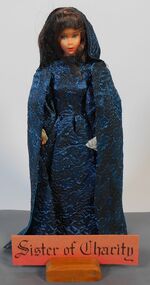
... hospital and battlefield. Their duties were arduous no pain relief was known and they were exposed to infection. ...hospital and battlefield. Their duties were arduous no pain relief was known and they were exposed to infection. ...Sisters of Charity St Vincent de Paul. In 1638 St Vincents de Paul and Mademoiselle de Gras taught simple nursing procedure to young peasant women. They worked in the home hospital and battlefield. Their duties were arduous no pain relief was known and they were exposed to infection. In the 20 century the sisters of St Vincents De Paul are working worldwide nursing teaching caring for orphans the aged lepers. They shared in advances in medical science.30cm Miniature Doll dressed in bright blue shimmering dress with matching capeName tag Sisters of Charitynursing history, nursing uniforms, northern district school of nursing, miniature dolls -
 Bendigo Historical Society Inc.
Book - "The Impact of WW1 on Bendigo Health: Our nurses, Doctors and Community.", 1914
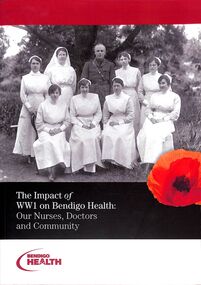
... infections. Unhealthy living conditions for soldiers (and sailors) included: poor diet lack of sleep exposure to cold contact with mice, rats, fleas, lice and other parasites. Soldiers World War One British Empire Doctors Nurses Bendigo Hospital ...Over 4000 Bendigo residents enlisted to serve in W.W. 1. Much is known about their contributions to the war effort, but less is known about the contributions made by the medical staff who provided care at the front lines or otherwise supported care. People enlisted for many reasons - patriotism, duty and adventure being just a few. Over 416,000 persons enlisted to serve in World War One out of a population of 5 million. The Australian Government recorded 215,585 casualties during the war. Over 80% of those casualties occurred on the Western Front, in Belgium and France. The weapons used in trench warfare created horrendous injuries for both sides in the war. In the Australian Imperial Force (AIF), for example, most wounds were the result of flying metal. During their service, many of the 331,781 AIF troops and medical staff were injured more than once: over 50% were hit by shell fragments or shrapnel bullets from artillery fire 40% were hit by high-velocity bullets from rifles or machine guns 12% were affected by chlorine or mustard gas 2% were hit by bombs or grenades only 0.3% suffered bayonet wounds Many health risks also developed into large-scale problems on the front. Those who served lived and work in crowded spaces, which helped to spread bacterial, viral and parasitic infections. Unhealthy living conditions for soldiers (and sailors) included: poor diet lack of sleep exposure to cold contact with mice, rats, fleas, lice and other parasites. Soft cover. 41pp. Black and white image of nurses on front cover, along with red poppy. Tile written in white to bottom third of front cover on black background. Bendigo Health logo to bottom of front cover. Back cover has image of signage for the 'Old Mortuary' of Bendigo Hospital, with burgundy, black and white stipes above and below image. Contains black and white and color images. soldiers, world war one, british empire, doctors, nurses, bendigo hospital -
![A [newspaper] clipping featuring a large black and white photo and four columns of text](/media/collectors/64a5077bc83bd7b7b94f4211/items/6989434a1108f30a79f5915b/item-media/698943f41108f30a79f59675/item-fit-380x285.jpg?cb=6) Returned Nurses RSL Sub-branch
Returned Nurses RSL Sub-branchNewspaper - Newspaper clipping, John Lamb, Nurse who saw horrors of war looks to life's brighter side, Tuesday 28 February 1989
... Stationed at a hospital near Port Moresby Muriel saw many casualties who, due to the length of time it took for them to arrive at hospitals, had not just terrible wounds, but infection in them. Muriel will admit to having felt bitter towards the Japanese during the war, particularly in a moment she was tasked with giving a Japanese soldier a needle while wishing it was a big screw. ...Stationed at a hospital near Port Moresby Muriel saw many casualties who, due to the length of time it took for them to arrive at hospitals, had not just terrible wounds, but infection in them. Muriel will admit to having felt bitter towards the Japanese during the war, particularly in a moment she was tasked with giving a Japanese soldier a needle while wishing it was a big screw. ...Mrs Muriel Andrews, 77, has spent the past nine months in hospital, but she has not lost her vitality. Muriel was called up as a nurse in 1942 after the bombing of Pearl Harbour. Stationed at a hospital near Port Moresby Muriel saw many casualties who, due to the length of time it took for them to arrive at hospitals, had not just terrible wounds, but infection in them. Muriel will admit to having felt bitter towards the Japanese during the war, particularly in a moment she was tasked with giving a Japanese soldier a needle while wishing it was a big screw. Muriel now has the attitude of forgive and forget towards the Japanese but will never forget her friends who were killed at their hands.A [newspaper] clipping featuring four columns of text underneath a large black and white photo of a seated older woman laughing with two younger women in nurse's uniforms.'Muriel (Stacey) Andrews' [blue ink, top right] 'NC010'[graphite pencil, mid right, reverse of page]world war 2, wwii, ww2, world war ii, heidelberg repatriation hospital, new south wales, papua new guinea -
 Alfred Hospital Nurses League - Nursing History Collection
Equipment - Portable electric suction machine, Clements Suction and Pressure Pump
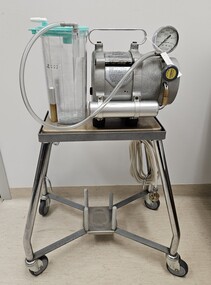
... Infection Prevention. Hubert Ingham Clements (1886-1969) was an Australian engineer who established his own engineering business in NSW in 1908 manufacturing combustion engines. He became interested in anaesthesia equipment and from the 1920s Clements worked on improving ether apparatus and manufacturing portable suction machines for use in hospital operating theatres. ...Infection Prevention. Hubert Ingham Clements (1886-1969) was an Australian engineer who established his own engineering business in NSW in 1908 manufacturing combustion engines. He became interested in anaesthesia equipment and from the 1920s Clements worked on improving ether apparatus and manufacturing portable suction machines for use in hospital operating theatres. ...This equipment was located in the outpatients department (Philip Block) until September 2021 when it was deemed obsolete by Infection Prevention. Hubert Ingham Clements (1886-1969) was an Australian engineer who established his own engineering business in NSW in 1908 manufacturing combustion engines. He became interested in anaesthesia equipment and from the 1920s Clements worked on improving ether apparatus and manufacturing portable suction machines for use in hospital operating theatres. The latter machines were to earn an unrivalled reputation for reliability; many remained in service over thirty years after their date of production. The business became H. I. Clements & Son when his son William joined the company. (https://adb.anu.edu.au/biography/clements-hubert-ingham-12846)Item is an example of equipment from its time period and is of historic significance.Portable Clements Suction & Pressure Pump built by H I Clements & Son Ltd Consists of motor with attached carry handle, attached pressure regulator, attached disposable drainage cannister with tubing and power cable mounted on a trolley with castors.H I Clements & Son Pty. Ltd. Metal Manufacturing label with: Serial Number 1725FS and SAA Certificate Number BCG/4S/60194 on motor (front side) Ward 11 engraved on motor handle AH Biomedical Engineering orange test due sticker and AH Biomedical blue test sticker (reverse side)suction, clements, portable suction, respiratory, pressure pump, surgical drainage
