
Showing 14 items matching "hospital open days"
-
 Alfred Hospital Nurses League - Nursing History Collection
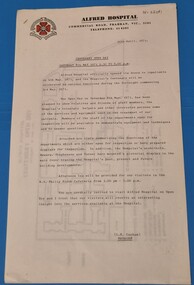
Document - Open Day Information, Alfred Hospital, Centenary Open Day, Alfred Hospital, Saturday 8th May, 1971, 1971
... ...Hospital open days...hospital held an open day on the afternoon of Saturday 8th May, 1971. Various hospital departments were open to the general public. This document provides information bout those various departments ( Haematology, Metabolic Unit, Speech Therapy & Audiology, Bacteriology, Biochemistry, Cardivascular Diagnostic Service, Diagnostic Radiology, Nuclear medicine, Monash medical school) Importan milestone for the Alfred Hospital. Provides insight into medical diagnostic services and allied health available in 1971 Alfred Hospital Hospital open days ...To celbrate the centenary of the opening of the Alfred Hospital in 1871, the hospital held an open day on the afternoon of Saturday 8th May, 1971. Various hospital departments were open to the general public. This document provides information bout those various departments ( Haematology, Metabolic Unit, Speech Therapy & Audiology, Bacteriology, Biochemistry, Cardivascular Diagnostic Service, Diagnostic Radiology, Nuclear medicine, Monash medical school)Importan milestone for the Alfred Hospital. Provides insight into medical diagnostic services and allied health available in 1971Black print on four sheets of white paper. First two sheets are printed on one side only, third and fourth sheets are printed on both sides . First sheet has the contemporary [1971] letterhead of the Alfred Hospital. Second page has a map of the Alfred. Signed by hospital manager, G B CanhamHoles and rustmark at top left where a astaple has been removed. Previous catalogue number handwritten [black ink] at top rightalfred hospital, hospital open days -
 Alfred Hospital Nurses League - Nursing History Collection
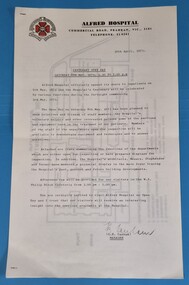
Document - Open Day Information, Alfred Hospital, Centenary Open Day, Alfred Hospital, Saturday 8th May, 1971, 1971
... ...Hospital open days...hospital held an open day on the afternoon of Saturday 8th May, 1971. Various hospital departments were open to the general public. This document provides information bout those various departments ( Haematology, Metabolic Unit, Speech Therapy & Audiology, Bacteriology, Biochemistry, Cardivascular Diagnostic Service, Diagnostic Radiology, Nuclear medicine, Monash medical school) Importan milestone for the Alfred Hospital. Provides insight into medical diagnostic services and allied health available in 1971 Alfred Hospital Hospital open days ...To celbrate the centenary of the opening of the Alfred Hospital in 1871, the hospital held an open day on the afternoon of Saturday 8th May, 1971. Various hospital departments were open to the general public. This document provides information bout those various departments ( Haematology, Metabolic Unit, Speech Therapy & Audiology, Bacteriology, Biochemistry, Cardivascular Diagnostic Service, Diagnostic Radiology, Nuclear medicine, Monash medical school)Importan milestone for the Alfred Hospital. Provides insight into medical diagnostic services and allied health available in 1971Black print on four sheets of white paper. First two sheets are printed on one side only, third and fourth sheets are printed on both sides . First sheet has the contemporary [1971] letterhead of the Alfred Hospital. Second page has a map of the Alfred. Signed by hospital manager, G B Canhamalfred hospital, hospital open days -
 Federation University Historical Collection
Booklet, Report on the Viability of Establishing a Post Secondary Education Facility Located at the Aradale Traininf Centre, Ararat, Victoria, 1993, 12/1993
... hospitals and whorkhouse design soon came to be seen as the most appropriate. The largest 19th century asylum in England was built at Colney Hatch. Kew, Beechworth and Ararat Asylums closely followed the Colney Hatch model. In victoria the population rose due to the gold rushes resulting in severe housing shortages, and additional pressure on asylums. The first asylum in Melbourne was established at Y arra Bend. In 1862 a new asylum was established at Kew. Ararat Asylum and Beechworth Asylum were designed in 1864. Ararat was opened on 19 October 1867, with Beechworth Asylum opening five days...hospitals and whorkhouse design soon came to be seen as the most appropriate. The largest 19th century asylum in England was built at Colney Hatch. Kew, Beechworth and Ararat Asylums closely followed the Colney Hatch model. In victoria the population rose due to the gold rushes resulting in severe housing shortages, and additional pressure on asylums. The first asylum in Melbourne was established at Y arra Bend. In 1862 a new asylum was established at Kew. Ararat Asylum and Beechworth Asylum were designed in 1864. Ararat was opened on 19 October 1867, with Beechworth Asylum opening five days ...Aradale is located 3 km from the centre of Ararat and covers approximately 101 hectares. It consistes of an impresive group of mainly heritage buildings of national significance surrounded by open farmland. Aradale was designed in 1864 in the Victorian Italianate style by John James Clark of the Public Works Department, Victoria. A three storey nurses quarters was built in the 1930s and the Forensic Psychaitry Centre was established in the 1980s. The design of asylums as a specific building type orginated in England in the mddle of the 19th century when it was decided that 'pauper lunatics' would be better cared for in a separate institution rather than being house within the workhouses. Some of the early purpose built asylums were based on the radiating principle of prisons but the arrangement of separat wings at right angles used in hospitals and whorkhouse design soon came to be seen as the most appropriate. The largest 19th century asylum in England was built at Colney Hatch. Kew, Beechworth and Ararat Asylums closely followed the Colney Hatch model. In victoria the population rose due to the gold rushes resulting in severe housing shortages, and additional pressure on asylums. The first asylum in Melbourne was established at Y arra Bend. In 1862 a new asylum was established at Kew. Ararat Asylum and Beechworth Asylum were designed in 1864. Ararat was opened on 19 October 1867, with Beechworth Asylum opening five days later. Soft covered bookletararat regional development board inc., aradale training centre, aradale, grano street ararat, alfred st ararat, ivar nelson, john christie, jon duggan, wes matthews, peter helfer, michael burke, john grant, asylum, lunatic asylum, colney hatch asylum, ararat asylum, fever tents, sunbury asylum, kew asylum, beechworth asylum, wine industry training -
 Federation University Historical Collection
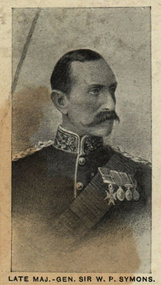
Photograph (black & White), Major General, Sir William Penn Symons - South Africa
... open ground. Symons rode up to the wood to find out why the attack had halted. He ordered the men to proceed, rode through the wood then walked through the gap in the wall. After a few moments he returned and was helped to remount his horse. He rode back from the front lines until he was out of sight of his troops before he asked for assistance from the Indian stretcher bearers. He had been shot in the stomach. Symons was taken to the field hospital at Dundee. After a few wasted days...open ground. Symons rode up to the wood to find out why the attack had halted. He ordered the men to proceed, rode through the wood then walked through the gap in the wall. After a few moments he returned and was helped to remount his horse. He rode back from the front lines until he was out of sight of his troops before he asked for assistance from the Indian stretcher bearers. He had been shot in the stomach. Symons was taken to the field hospital at Dundee. After a few wasted days ...William Penn Symons' first combat experience was in South Africa during the Ninth Xhosa War, 1877-78. In 1879 he took part in the Zulu war. He then served during the Burma Expedition (1885-89). In 1889 he received the Companion of the Order of the Bath. In 1898, following other campaigns, he was awarded the Knight Commander of the Order of the Bath. In 1899, Symons was given the staff rank of brigadier general and was to be General Officer Commanding of Natal. He was asked by the War Office to advise on the number of troops required to safely garrison the Natal from the threat of invasion from the Boer Republics of the Transvaal and Orange Free states. Cabinet decided to send ten thousand extra troop abut they also appointed Lieutenant General Sir George White to supersede Symons as Generat Officer Commanding in Natal. Penn Symons, on his own authority deployed one of his brigades to Dundee, a town north of Ladysmith. The position of Ladysmith anad Dundee was precarious as they stand in a triangle of Natal, Orange Free State and Transvaal. White wanted to recall the Dundee garrison to Ladysmith but because of political pressure from Sit Walter Hely-Harrison, the Governor of Natal, he agreed to leave them there. The Boers declared war on 11 October and began crossing the Natal borders the following day. On 20 October 1899 Boer troops on the nearby Talana Hill proceeded to open fire on the town. The British guns moved to return fire as the general surveyed the Boer positions and gave orders to his commanding officers. Symons believed in old fashioned military tactics of close order but these formations were not designed to be used against lonf range bolt action rifles and Symons' brigades would be the first of manyin this war to pay the heavy cost ofthe mistake, as many generals would repeat it. The infantry battalions set off from the east of the town. The first part of the advance went well and they reached a small wood at the foot of the hill where they found shelter. Beyond the wood was a wall and then open ground. Symons rode up to the wood to find out why the attack had halted. He ordered the men to proceed, rode through the wood then walked through the gap in the wall. After a few moments he returned and was helped to remount his horse. He rode back from the front lines until he was out of sight of his troops before he asked for assistance from the Indian stretcher bearers. He had been shot in the stomach. Symons was taken to the field hospital at Dundee. After a few wasted days Symons' replacement, Brigadier General Yule, decided to abandon the town and the worst-wounded to the Boers and steal away at night to Ladysmith. Symons became a prisoner of war along with many others. He felt betrayed by Yule and just before he died he implored the medical officer, Major Donegal, to "tell everyone I died facing the enemy". Individual image from photographed poster of tobacco and cigarette cards.william penn symons, south africa, ninth xhosa war, companion of the order of the bath, knigt commander of the order of the bath, general officer commanding in natal, dundee, ladysmith, orange free state, transvaal, sir walter hely-harrison, governor of natal, boers, brigadier general yule -
 Flagstaff Hill Maritime Museum and Village
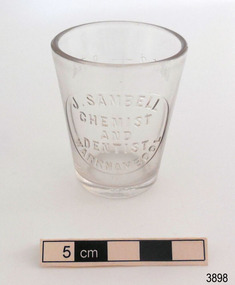
Container - Medicine Glass, W T & Co. (Whitall Tatum), late 1880's
... days later their second child, William Jnr., was born. Warrnambool’s population was around 2,000 in 1859 when Sibilla and Johann (known as “William”) settled here. William was employed as a tailor by Cramond & Dickson. In 1859 the couple bought George Fergusson’s bakery in Timor Street and opened it as “W. Kucks Baker”. Along with fancy breads and biscuits, he advertised baked dinners to order. William supplied bread to the Warrnambool Hospital...days later their second child, William Jnr., was born. Warrnambool’s population was around 2,000 in 1859 when Sibilla and Johann (known as “William”) settled here. William was employed as a tailor by Cramond & Dickson. In 1859 the couple bought George Fergusson’s bakery in Timor Street and opened it as “W. Kucks Baker”. Along with fancy breads and biscuits, he advertised baked dinners to order. William supplied bread to the Warrnambool Hospital ...This medicine glass was previously owned by Sybilla Margaret Kucks (1904-1978), daughter of Henry and Julia Kucks, and granddaughter of William and Sibilia Kucks. Sibilla was born in Warrnambool and lived there until 1917 when she moved to Armadale, Victoria, with her family. The medicine glass was among her effects left to her nephew William when she passed away and has been looked after by his wife Eva and treasured as a memento of their Warrnambool heritage. Mrs Sibilla Kucks sold sweets and fancy cakes in her Liebig Street shop from 1873 until the 1880s. She operated one of Warrnambool’s earliest dedicated confectionery shops at a time when sweets were more commonly found in a fruiterer’s shop. Her window display would have been full of brightly coloured sweets in shiny glass jars tempting passers-by. Sibilla (née Leyendecker) married Johann Wilhelm Kucks in New York, USA in 1856. Both were originally from Prussia. They sailed to Australia on the Ocean Rover and arrived in Melbourne June 10th, 1858. Seventeen days later their second child, William Jnr., was born. Warrnambool’s population was around 2,000 in 1859 when Sibilla and Johann (known as “William”) settled here. William was employed as a tailor by Cramond & Dickson. In 1859 the couple bought George Fergusson’s bakery in Timor Street and opened it as “W. Kucks Baker”. Along with fancy breads and biscuits, he advertised baked dinners to order. William supplied bread to the Warrnambool Hospital until the 1880s. In 1873 William built a row of four shops at 140-146 Liebig Street, one of which became Sibilla’s confectionery shop, and another was the new home to W. Kucks Baker. In 1877 William constructed a building in Liebig Street for the Warrnambool Steam Packet Company, which has since been incorporated into the Warrnambool Art Gallery. Its western wall shows to older construction and design. William and Sibilla had five other children. By 1896 their sons William Jnr. and Henry operated the business as “Messrs Kucks Bros., Bakers & Confectioners”. They employed six staff and used three carts for deliveries over a thirty-mile radius. They catered for clubs and functions including the Exhibitors’ Picnic Luncheon for the Warrnambool Industrial and Arts Exhibition (1896-7). In 1907 Messrs Kucks Bros. baked a monster Pyramid Cake for a local bazaar. It contained coins of various sizes and weighed 84lbs (38kg). Everyone buying a slice hoped to be lucky enough to end up with a coin! William Kucks Jnr. also became licensee of Terang’s ”Wheatsheaf Hotel”, its name and logo connecting it to the family’s bakery in Warrnambool. William (1825-1911) and Sibilla (1833-1910) Kucks and three of their seven children are buried at the Warrnambool Cemetery in a family grave. John Sambell migrated from England and established his chemist and dentist business in Warrnambool around 1890 in his premises in Fairy Street. The business later included his son Herbert. The maker, Whitall Tatum & Co, is clearly marked on the base of the bottle. The company was a a well known maker of prescription bottles. He used the brand "W. T. & Co. from Mid-1870's until the late 1880's, moulded into his glassware. This medicine glass is significant as one of very few remaining items from the history of John Sambell, chemist and dentist, Warrnambool. It is also significant as an example of medical equipment that has a design still used today. It is also significant for its association with William and Sibilla Kucks, a colonial family in Warrnambool that was greatly involved in the community and commerce of early days in Warrnambool.Medicine glass, (measuring glass or dose cup), clear glass, round. The antique chemist measuring glass is wide at the top and tapers to a narrow base. The glass has side seams and an uneven base. The glass has imperfections ans bubbles. The base is uneven. The measuring scale lines have been scored into the glass and the measurements and other inscriptions have been moulded into the glass. Glass is from J. Sambell, chemist and dentist in Warrnambool. On the back there is a measuring scale in tablespoons and teaspoons. There is also an inscription of the maker on the base. The glass was made in the late 1880's by Whitall Tatum & Co., America.Embossed within a round border "J. SAMBELL / CHEMIST / AND / DENTIST / WARRNAMBOOL" The scale on the back has "TABLE" "1" and "2", and "TEA" "8", "4", "2" and "1" The base has "W.T. & CO." around the edge.flagstaff hill, warrnambool, shipwrecked coast, flagstaff hill maritime museum, maritime museum, shipwreck coast, flagstaff hill maritime village, great ocean road, medicine glass, measuring glass, dose cup, medicine dispensing, medicine measurement, sambell pharmacy warrnambool, sambell chemist and dentist, warrnambool chemist, history of warrnambool, early 20th century chemist, john sambell, medical equipment, warrnambool medical services, kucks family in warrnambool, william and sibilla kucks descendant, mrs kucks' confectionery, william kucks baker, warrnambool dentist, herbert sambell, whitall tatum & co, w. t. & co., warrnambool steam packet, warrnambool art gallery -
 Orbost & District Historical Society
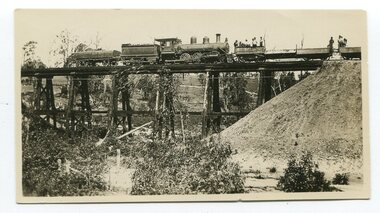
black and white photographs, 20th century
... Hospital Creek and 3162.3 possibly Burn Road Newmerella. The Orbost-Bairnsdale railway initially played a crucial role in developing agricultural industries in Gippsland as well as tourism. It opened in 1916 and operated until 1987, principally carrying timber and farming produce. In the early days...Hospital Creek and 3162.3 possibly Burn Road Newmerella. The Orbost-Bairnsdale railway initially played a crucial role in developing agricultural industries in Gippsland as well as tourism. It opened in 1916 and operated until 1987, principally carrying timber and farming produce. In the early days ...These photographs are probably of bridges on the East Gippsland railway line. 3162.2 is possibly Hospital Creek and 3162.3 possibly Burn Road Newmerella. The Orbost-Bairnsdale railway initially played a crucial role in developing agricultural industries in Gippsland as well as tourism. It opened in 1916 and operated until 1987, principally carrying timber and farming produce. In the early days of the railway's operation dedicated passenger trains ran but these ceased by the 1930s. The line was completely closed to freightage in 1987.The track infrastructure was dismantled in 1994 and has been redeveloped as the East Gippsland Rail Trail.These photographs are associated with the history of the Orbost-Bairnsdale railway line and therefore reflects the role that the rail line played in the social and economic history of Orbost. Three black / white photographs of railway bridges. 3162.1 has a steam train on the bridge. 3162.3 shows three men on the right working at clearing vegetation. 3162.3 has been taken from a height.orbost-bairnsdale-railway east-gippsland-railway bridges-railway -
 Eltham District Historical Society Inc
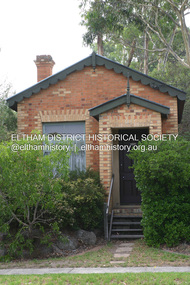
Photograph - Digital Photograph, Alan King, Former CBA bank, Main Road, Eltham, 26 January 2008
... opened on Child Endowment Days to help the needy, but later for years, it opened twice a week. In 1962 it donated clothing and shoes to the Eltham Bushfire Appeal. By 1963 the chaplaincy scheme ceased. So the £450 raised was then donated to the Council for Christian Education and to the participating churches. Funds were also donated to local charities including the Eltham and Research Fire Brigades, the Austin Hospital...opened on Child Endowment Days to help the needy, but later for years, it opened twice a week. In 1962 it donated clothing and shoes to the Eltham Bushfire Appeal. By 1963 the chaplaincy scheme ceased. So the £450 raised was then donated to the Council for Christian Education and to the participating churches. Funds were also donated to local charities including the Eltham and Research Fire Brigades, the Austin Hospital ...This tiny picturesque building near the corner of John Street has served the community since 1878. At that time it served as an agency of the Heidelberg branch of the Commonwelath Bank of Australia. It has a small space inside measuring about 3.6 metres by 4.5 metres. It was built by George Stebbing who was also responsible for other heritage buildings nearby in Eltham. Covered under Heritage Overlay, Nillumbik Planning Scheme. Published: Nillumbik Now and Then / Marguerite Marshall 2008; photographs Alan King with Marguerite Marshall.; p93 The tiny picturesque building on Main Road, Eltham, near the corner of John Street, has served the community since 1878. At that time the building, which inside measures only about 3.6m by 4.5m served as an agency of the Heidelberg branch of the Commercial Bank of Australia. The yellow and orange Victorian brick structure was built by Mr George Stebbing.1 Mr Stebbing, who also built the Anglican and former Methodist churches and the Shillinglaw Cottage, had come from England and lived in Pitt Street. The bank is a fine example of a once common but now rare building style – the single room bank. It compares with another in the municipality, also a former Commercial Bank of Australia branch, the timber Little Bank Building in Hurstbridge, built around the early 1900s.2 The Eltham bank, which was said to store gold from the Eltham - Research mining areas, has had exciting moments. A bullet hole still visible in a cedar bench testifies to the drama in 1949 when a youth held up the bank. After the 19-year-old opened an account as John Henderson, he walked to the door and then turned pointing a pistol. But it was shots fired by the clerk, Lindsay Spear, that saved the day, frightening the youth, who drove off empty-handed in a grey sports car. He was later apprehended and given a two-year sentence. Soon afterwards the agency was upgraded to a branch. However by 1954 the bank no longer needed the branch and the adjoining Methodist Church bought the building. It proved useful for the Church’s young people who furnished it and used it for their meetings. A youth club developed, led by young adult member, Ross Gangell. The building was also used as a Sunday School, which with junior membership numbered 27.3 Around 1960, Mrs Alma Bell, of the Methodist Church Women’s Guild, suggested using the building as an opportunity shop to raise funds for a chaplain at the Eltham High School. The women later asked the nearby St Margaret’s Anglican Church to help them in the shop. In 1960 the Eltham Combined Churches Opportunity Shop was established and staffed by Methodist and Anglican parishioners, notably Methodist Mrs Gwen Miller. The shop originally opened on Child Endowment Days to help the needy, but later for years, it opened twice a week. In 1962 it donated clothing and shoes to the Eltham Bushfire Appeal. By 1963 the chaplaincy scheme ceased. So the £450 raised was then donated to the Council for Christian Education and to the participating churches. Funds were also donated to local charities including the Eltham and Research Fire Brigades, the Austin Hospital Auxiliary, the Benevolent Society, the Red Cross and the Diamond Valley Hospital.4 In 2008 the Opportunity Shop volunteers continue to work together to help the local community. Although crammed with second-hand goods, the simple, almost stark interior, is still evident and is relieved only by a front rectangular window and an unused fireplace. Outside, the chimney, the corrugated iron peaked roof, and the surrounding varied plants, add to the charm of this sound building which continues to serve the community well.This collection of almost 130 photos about places and people within the Shire of Nillumbik, an urban and rural municipality in Melbourne's north, contributes to an understanding of the history of the Shire. Published in 2008 immediately prior to the Black Saturday bushfires of February 7, 2009, it documents sites that were impacted, and in some cases destroyed by the fires. It includes photographs taken especially for the publication, creating a unique time capsule representing the Shire in the early 21st century. It remains the most recent comprehenesive publication devoted to the Shire's history connecting local residents to the past. nillumbik now and then (marshall-king) collection, cba bank -
 Kiewa Valley Historical Society
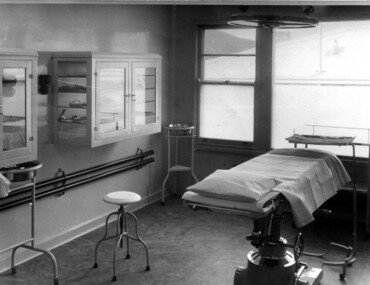
Photograph Tawonga District Hospital, Theatre at Tawonga District Hospital, 1949/50
... Hospital. It started with 12 beds and eventually increased to a total of 35 beds. "Add ons" provided theatre, offices, stores and Nurses Home. It was officially opened on 24th September, 1949. Up until this time, any person requiring hospitalisation had to travel to Yackandandah. This photograph is of the theatre and there was no anaesthetic or recovery rooms. While rather primitive by todays standard, it met the demands of the construction days...Hospital. It started with 12 beds and eventually increased to a total of 35 beds. "Add ons" provided theatre, offices, stores and Nurses Home. It was officially opened on 24th September, 1949. Up until this time, any person requiring hospitalisation had to travel to Yackandandah. This photograph is of the theatre and there was no anaesthetic or recovery rooms. While rather primitive by todays standard, it met the demands of the construction days ...The original Tawonga District Hospital was situated at the corner of Ryder's Lane and Kiewa Valley Highway. The construction was initiated by the Hospital and Charities Commission with considerable assistance from the State Electricity Commission.The building was transported from Bonegilla where it was originally a part of the Bonegilla Military Hospital. It started with 12 beds and eventually increased to a total of 35 beds. "Add ons" provided theatre, offices, stores and Nurses Home. It was officially opened on 24th September, 1949. Up until this time, any person requiring hospitalisation had to travel to Yackandandah. This photograph is of the theatre and there was no anaesthetic or recovery rooms. While rather primitive by todays standard, it met the demands of the construction days as well as that of the Kiewa Valley community. Shows the rather spartan conditions and equipment of the theatre in the original Tawonga District Hospital compared to the present day hospital. Black and white photograph of the operating theatre in the original Tawonga District Hospitalhospital, operating theatre, tawonga -
 Eltham District Historical Society Inc
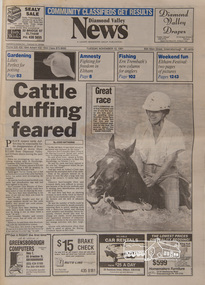
Newspaper, Diamond Valley News, 12 Nov 1991, 12 Nov 1991
... opened – mud brick construction , designed by Alistair Knox. Loyola College science students Latest births at Diamond Valley hospital Sunday Community Walks program HEIDELBERG 150 FEATURE General history article Add with history for the Old England Hotel, Heidelberg Janefield Special School Real Estate add with photos of Rosehill Estate, Lower Plenty to be sold. Large real Estate section: Eltham South Historic Mulberry Cottage c 1890 “Arnleigh” Bannons Lane, Yarrambat ca 1889 Early Knox home, 17 York Street, Eltham Briar Hill builder recalls early days...opened – mud brick construction , designed by Alistair Knox. Loyola College science students Latest births at Diamond Valley hospital Sunday Community Walks program HEIDELBERG 150 FEATURE General history article Add with history for the Old England Hotel, Heidelberg Janefield Special School Real Estate add with photos of Rosehill Estate, Lower Plenty to be sold. Large real Estate section: Eltham South Historic Mulberry Cottage c 1890 “Arnleigh” Bannons Lane, Yarrambat ca 1889 Early Knox home, 17 York Street, Eltham Briar Hill builder recalls early days ...Cattle Duffing Feared – missing cattle in Hurstbridge, Christmas Hills, Watsons Creek. Riders vie for “Cup of the Mountains” – horse riding Main Road, Research property no longer attractive to buyers due to rezoning to open space. Work at Churinga, Greensborough praised. Crime rates increase Shire of Diamond Valley to ban incinerators – Shire of Eltham to follow Greensborough Secondary College students enjoy Oaks Day Shire of DV President Barbara Smith attends international conference Tea Party at Panorama Heights Pre-School 14 sheep killed at Panton Hill hobby farm Water discolouration to water supply in Eltham and Diamond Valley Amnesty Comments in Letters section on Council draft Conservation and Heritage Strategy Andre Haermeyer selected as ALP candidate for Yan Yean – a newly created seat. Bill Willis of St Andrews pre-selected by Liberal Party for the above Spring Clean campaign 1991 Photos and report on the Eltham Festival Watsonia Neighbourhood Open House Construction of 24 lot housing commission estate in Kemptson St Greensborough and associated traffic plan to be built. Speed humps not a solution Lower Plenty and Hurstbridge Schools Pen Pal scheme Road Safety education at four local schools Wycliffe Bible Centre opened – mud brick construction , designed by Alistair Knox. Loyola College science students Latest births at Diamond Valley hospital Sunday Community Walks program HEIDELBERG 150 FEATURE General history article Add with history for the Old England Hotel, Heidelberg Janefield Special School Real Estate add with photos of Rosehill Estate, Lower Plenty to be sold. Large real Estate section: Eltham South Historic Mulberry Cottage c 1890 “Arnleigh” Bannons Lane, Yarrambat ca 1889 Early Knox home, 17 York Street, Eltham Briar Hill builder recalls early days – Fred Squire p. 77 Kangaroo Ground Sculpture Awards – Peter Burns, Andrew Smith p. 77 Olive Grove and plaque at Simpsons Barracks Signals headquarters p. 77 Lower Plenty Neighbourhood Watch – p. 79 Feature article on weddings at Eltham Gateway Hotel with photos – p. 84 and more… Local newspaper (complete); 104 pagesnewspaper, local newspapers, diamond valley news -
 Warrnambool and District Historical Society Inc.
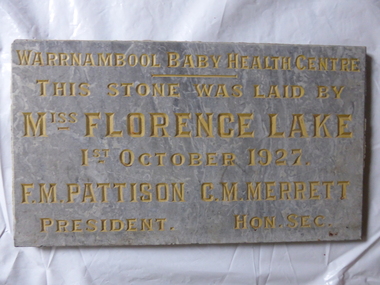
Plaque- Warrnambool Baby Health Centre, Miss Florence Lake 1927, 1927
... The healthcare facilites were much better and the hospital was well run and was further improved by the opening of the baby health centre which was opened in October 1921. The centre was situated in Liebig street at the Town Hall and was open three days a week to offer advice to mothers regarding their babies. and Sister Riley was in charge. ...The healthcare facilites were much better and the hospital was well run and was further improved by the opening of the baby health centre which was opened in October 1921. The centre was situated in Liebig street at the Town Hall and was open three days a week to offer advice to mothers regarding their babies. and Sister Riley was in charge. ...in the early part of the 20th century, Warrnambool's residents had their share of health problems.according to the Annual report by Dr H I Holmes in 1921. Diphtheria, typhoid fever, tuberculosis, polimyelitis and scarlet fever were common afflictions. The sanitary system or lack thereof was the primary source of much of this illness. The healthcare facilites were much better and the hospital was well run and was further improved by the opening of the baby health centre which was opened in October 1921. The centre was situated in Liebig street at the Town Hall and was open three days a week to offer advice to mothers regarding their babies. and Sister Riley was in charge. Miss Florence Lake who opened the centre was a well known resident of the town and generous benefactor of the Warrnambool base hospital.. Florence along with her sister inherited the Lyndoch estate from George and Annie rolfe in 1920. She was well known around the district for her good nature and humour. As her sister married and moved to Italy, she continued to run Lyndoch as it had always been. She died in November 1946 This plaque has historical and social significance as it notes the time in the history of Warrnambool when health came to the fore of public interest and importance. It also commemorates one of Warrnambool's better known citizens and the beginnings of the maternal health system in the cityThis heavy stone plaque grey in colour, with polished surface, is rectangular, with lettering cut and coloured in gold. all the lettering is in capitals. It is possibly graniteWarrnambool Baby Health Centre. This stone was laid by Miss Florence Lake 1st October 1927. F M Pattison President, C M Merrett Hon Sec.warrnambool, warrnambool baby health centre, sister riley, florence lake -
Ballarat Heritage Services
Administrative record - Database, Database Creswick Hospital In-Patients Register 1863-1883, 1998
... Creswick Hospital was opened in 1863 so that before this time most injured or sick people from around that location had to travel to Ballarat Hospital which was opened in 1856. This often took days...Creswick Hospital was opened in 1863 so that before this time most injured or sick people from around that location had to travel to Ballarat Hospital which was opened in 1856. This often took days ...Creswick Hospital was opened in 1863 so that before this time most injured or sick people from around that location had to travel to Ballarat Hospital which was opened in 1856. This often took days by which time the patient needing treatment was sicker or had died.Digital copy All data transcribed from In-Patients' Register 186f3-1883 Creswick Hospital. 4331 entries, 18 fieldscreswick, creswick hospital, records, medical -
Kew Historical Society Inc
Journal, Kewriosity : March 1992
... Open Day / p6. Youth Leadership Course / p7. Caritas Christi Hospice Awareness Week / p7. Kew Youth Arts Festival [programme of events] / pp8-9. Diary Dates for March [1992] / p10. Kew Festival Concert at Holy Trinity / p10. Direct Line 2 [Kew Cottages] / p11. Kew Recreation Centre 383-407 High Street, Kew / p11. Healthy fun activities / p11. Free bike identification / p12. Feet feature / p12. New courses at Kew Community House / p13. Kew Junction Commercial Centre / p14. Fundraisers extraordinaire [St. George’s Hospital Kew Ladies’ Auxiliary] / p14. Vale - John Hogan Gervasoni J.P. 1929-1992 / p15. Draft Gaming Machine Policy / p15. Revealing Villa Alba - Open Days ...Kew Festival Special Edition [16pp] / p1. Looking for deregulation in North America / Janet Dore p2&3. Mayor's Comment / Cr Daryl Oldaker p3. New Parking signs / p4. Disabled parking permits / p5. Long term parking p5. Girl Guides & Brownie Guides of Kew / p5. Anyone for tennis? [East Kew Uniting Church] / p5. Football in Kew / p5. New Principal at Hew High School [Alan Taylor] / p6. Trinity Grammar Open Day / p6. Youth Leadership Course / p7. Caritas Christi Hospice Awareness Week / p7. Kew Youth Arts Festival [programme of events] / pp8-9. Diary Dates for March [1992] / p10. Kew Festival Concert at Holy Trinity / p10. Direct Line 2 [Kew Cottages] / p11. Kew Recreation Centre 383-407 High Street, Kew / p11. Healthy fun activities / p11. Free bike identification / p12. Feet feature / p12. New courses at Kew Community House / p13. Kew Junction Commercial Centre / p14. Fundraisers extraordinaire [St. George’s Hospital Kew Ladies’ Auxiliary] / p14. Vale - John Hogan Gervasoni J.P. 1929-1992 / p15. Draft Gaming Machine Policy / p15. Revealing Villa Alba - Open Days / p16.Kewriosity was a local newsletter combining Kew Council and community news. It was published between November 1983 and June 1994, replacing an earlier Kewriosity [broad] Sheet (1979-84). In producing Kewriosity, Council aimed to provide a range of interesting and informative articles covering its deliberations and decision making, together with items of general interest and importance to the Kew community and information not generally available through daily media outlets.non-fictionKew Festival Special Edition [16pp] / p1. Looking for deregulation in North America / Janet Dore p2&3. Mayor's Comment / Cr Daryl Oldaker p3. New Parking signs / p4. Disabled parking permits / p5. Long term parking p5. Girl Guides & Brownie Guides of Kew / p5. Anyone for tennis? [East Kew Uniting Church] / p5. Football in Kew / p5. New Principal at Hew High School [Alan Taylor] / p6. Trinity Grammar Open Day / p6. Youth Leadership Course / p7. Caritas Christi Hospice Awareness Week / p7. Kew Youth Arts Festival [programme of events] / pp8-9. Diary Dates for March [1992] / p10. Kew Festival Concert at Holy Trinity / p10. Direct Line 2 [Kew Cottages] / p11. Kew Recreation Centre 383-407 High Street, Kew / p11. Healthy fun activities / p11. Free bike identification / p12. Feet feature / p12. New courses at Kew Community House / p13. Kew Junction Commercial Centre / p14. Fundraisers extraordinaire [St. George’s Hospital Kew Ladies’ Auxiliary] / p14. Vale - John Hogan Gervasoni J.P. 1929-1992 / p15. Draft Gaming Machine Policy / p15. Revealing Villa Alba - Open Days / p16.publications -- city of kew (vic.), kewriosity, council newsletters, community newsletters -
Kew Historical Society Inc
Journal, Kewriosity : September 1991
... open days [Kew Preschool Association] / p4. Kew Festival [Kewmunity Living 1992] / p4. VicRoads competition / p4. Medical careers [St George's Hospital; Inner Eastern Geriatric Service] / p4. ...Is Kew a healthy community - have your say and win prizes / p1. Arthritis/Do you suffer / p1. Have a heart [National Heart Foundation Doorknock Appeal] / p1. Diary dates for September / p2. Swimming for older people [Kew Recreation Centre] / p2. Kew Bowling Club Invitation / p2. Commentary [Obituary for Cr Alfred Stevens; 120 Litre Mobile Bin Recycling Trial / Cr Daryl Oldaker p3. Chief Executive's Column [How Councils raise revenue] / Malcolm Hutchinson p3. Diary dates for October / p4. Kindergarten open days [Kew Preschool Association] / p4. Kew Festival [Kewmunity Living 1992] / p4. VicRoads competition / p4. Medical careers [St George's Hospital; Inner Eastern Geriatric Service] / p4. Kew Colts American Football Club / p4. Introducing Councillor John Vincent Murray [Studley Park Ward] / p5. Big print [books at Kew Library] / p5. So long, farewell [Tony Douglas Clerk of Works] / p5. Empress in Melbourne - 6th April 1938 [book] / p5. Spare time [Volunteering at Bodalla Hospital] / p5. Kew Scout Award [Queens Scout Duncan White] p6. Trinity Grammar prize winning students [Jerry Chiang] / p6. Young Women's Group / Sonia Lloyd p6. Advising Centre for women / p6. Carey Junior School / p7. 'How can you be boss of the bladder' [book] / p7. Swimming for intellectually disabled women [at Kew recreation Centre] / p7. Kew wins at golf [Studley Park Golf Course] / p7. The Mighty Lions of Kew [Lions Club of Kew] / p8. 'The Fabulous Nobody's Return' ['Godspell' at Kew High School Community Theatre] / p8. 'Dragon Girl' [at Kew High School Community Theatre] / p8. If not W.H.E.N.? [Worldwide Home Environmentalists Network] / p8.Kewriosity was a local newsletter combining Kew Council and community news. It was published between November 1983 and June 1994, replacing an earlier Kewriosity [broad] Sheet (1979-84). In producing Kewriosity, Council aimed to provide a range of interesting and informative articles covering its deliberations and decision making, together with items of general interest and importance to the Kew community and information not generally available through daily media outlets.non-fictionIs Kew a healthy community - have your say and win prizes / p1. Arthritis/Do you suffer / p1. Have a heart [National Heart Foundation Doorknock Appeal] / p1. Diary dates for September / p2. Swimming for older people [Kew Recreation Centre] / p2. Kew Bowling Club Invitation / p2. Commentary [Obituary for Cr Alfred Stevens; 120 Litre Mobile Bin Recycling Trial / Cr Daryl Oldaker p3. Chief Executive's Column [How Councils raise revenue] / Malcolm Hutchinson p3. Diary dates for October / p4. Kindergarten open days [Kew Preschool Association] / p4. Kew Festival [Kewmunity Living 1992] / p4. VicRoads competition / p4. Medical careers [St George's Hospital; Inner Eastern Geriatric Service] / p4. Kew Colts American Football Club / p4. Introducing Councillor John Vincent Murray [Studley Park Ward] / p5. Big print [books at Kew Library] / p5. So long, farewell [Tony Douglas Clerk of Works] / p5. Empress in Melbourne - 6th April 1938 [book] / p5. Spare time [Volunteering at Bodalla Hospital] / p5. Kew Scout Award [Queens Scout Duncan White] p6. Trinity Grammar prize winning students [Jerry Chiang] / p6. Young Women's Group / Sonia Lloyd p6. Advising Centre for women / p6. Carey Junior School / p7. 'How can you be boss of the bladder' [book] / p7. Swimming for intellectually disabled women [at Kew recreation Centre] / p7. Kew wins at golf [Studley Park Golf Course] / p7. The Mighty Lions of Kew [Lions Club of Kew] / p8. 'The Fabulous Nobody's Return' ['Godspell' at Kew High School Community Theatre] / p8. 'Dragon Girl' [at Kew High School Community Theatre] / p8. If not W.H.E.N.? [Worldwide Home Environmentalists Network] / p8.publications -- city of kew (vic.), kewriosity, council newsletters, community newsletters -
 Royal District Nursing Service (now known as Bolton Clarke)
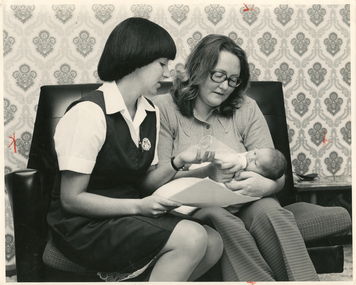
Photograph - Photograph, black and white, Barry Sutton, 23.02.1978
... Hospital and if a complication arose before or after birth the patient was transferred to their care. Following birth, the Midwife gave Post-Natal care to both the mother and babe commencing with visits twice a days. In 1898 the service ceased due to lack of funds but recommenced in 1906, and in the August 1925 Annual Report the number of MDNS home births was recorded at 478. MDNS built the After-Care Home and an Anti-Natal Clinic was opened ...General and Midwifery trained RDNS Sister Kaye Pilmore is supervising a Mother feeding her new born infant in their home. Sister Pilmore is wearing her RDNS summer uniform, which was a royal blue V neck tunic style dress, with the RDNS badge emblazoned on the upper left, worn over a short sleeve white blouse. In August 1893 Melbourne District Nursing Society (MDNS), commenced a Midwifery Service with Nurse Fowler, who was trained in General nursing and Midwifery nursing, being the first Midwife employed. Mothers were assessed for suitability of a home birth or if they required delivery at the Women’s Hospital. The Midwife worked in conjunction with the Doctors at the Women’s Hospital and if a complication arose before or after birth the patient was transferred to their care. Following birth, the Midwife gave Post-Natal care to both the mother and babe commencing with visits twice a days. In 1898 the service ceased due to lack of funds but recommenced in 1906, and in the August 1925 Annual Report the number of MDNS home births was recorded at 478. MDNS built the After-Care Home and an Anti-Natal Clinic was opened in 1930. The last Ante-Natal clinic was held there in December 1951 and the MDNS Midwifery service ceased in February 1952. In 1964 MDNS commenced a Post-Natal service with general and midwifery trained MDNS Sisters working from a room on the ground floor in the Footscray Hospital Nurses quarters, and visiting early discharged Footscray Hospital maternity cases at home. Later, as Royal District Nursing Service (RDNS), this service was extended and renamed as the Domiciliary Infant and Maternal Care, (DIMC) service operating from most Centres and visiting early discharged, often 24 hours after birth, maternity cases from hospitals to give Post-natal care to the mother and babe. Many of the RDNS Sisters who worked in the DIMC section also had their Triple Certificate in Infant Welfare, though double certificate Midwifery trained nurses also made DIMC visits. Black and white photograph showing a Royal District Nursing Service (RDNS), Sister sitting to the left of a mother who is holding her babe whilst she feeds her with a bottle. The Sister has short straight dark hair and is wearing her RDNS uniform of a dark V neck tunic style dress, with the RDNS badge emblazoned on the upper left, over a short sleeve white blouse. She is turned towards the babe and mother and is holding a sheet of white paper in her right hand and her left hand is supporting the end of the glass feeding bottle. The mother, who has long dark hair and is wearing glasses, and a grey long sleeve top and darker coloured slacks, has her baby across her knees with her left arm bent at the elbow and her arm and hand supporting her baby's head and neck. She is holding the feeding bottle with her right hand and the teat of the bottle is in the baby's mouth. The babe has sparse dark hair and is wrapped in a white bunny rug. They are sitting on a dark coloured couch with check cushions on the seat. A small low table is to the right of the couch against the wall. Patterned wallpaper can be seen on the wall behind the couch and table.Photographer stamp.Quote No. EA 35melbourne district nursing society, mdns, royal district nursing service, rdns, mdns midwifery, dimc, mdns post-natal care, rdns dimc, sister kaye pilmore
