
Showing 314 items matching "houses - kew - kew east"
-
 Kew Historical Society Inc
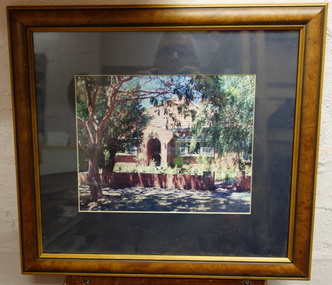
Photograph - Framed Photograph, Red Brick House
... houses - kew - kew east...Framed and glazed small photograph of a red brick house in Kew or Kew East...KHS welcomes viewers to identify the location houses - kew - kew east Nil Framed and glazed small photograph of a red brick house in Kew or Kew East Red Brick House Photograph Framed Photograph ...Unidentified house. KHS welcomes viewers to identify the locationFramed and glazed small photograph of a red brick house in Kew or Kew EastNilhouses - kew - kew east -
 Ruyton Girls' School
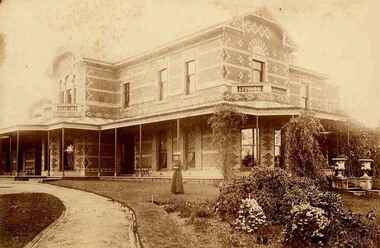
Photograph, [Miss Beatrice Henty in the Garden of Tarring], 1904
... Kew) in 1920. ‘Tarring’ was renamed ‘Henty House’ by Ruyton Girls' School in honour of its original owners. Ruyton Girls' School was founded in 1878, Miss Beatrice Henty attended the School before 1888. The photograph is dated c.1904. ruyton girls' school kew beatrice henty henry henty marion henty tarring henty house selbourne road beatrice blandy Kew (Vic) 1900s 1904 Sepia toned photograph Miss Beatrice Henty in the garden of her family home Tarring, Selbourne Road, Kew. The north east ...Beatrice Charlotte Henty was born 25 December 1867, married Graham Frederick Blandy in 1927 and died on 5 March 1950 in Toorak. She did not have any children. Miss Beatrice Henty was the daughter of Henry and Marion Henty. Mr Henry Henty and his wife Mrs Marion Anne Henty (nee McKellar) had ‘Tarring’, Kew built for their family in 1872, and resided there until the death of Marion Henty in 1919. ‘Tarring’ was then sold to Ruyton Girls’ School, and the School moved to the site, (now 12 Selbourne Rd, Kew) in 1920. ‘Tarring’ was renamed ‘Henty House’ by Ruyton Girls' School in honour of its original owners. Ruyton Girls' School was founded in 1878, Miss Beatrice Henty attended the School before 1888. The photograph is dated c.1904. Sepia toned photograph Miss Beatrice Henty in the garden of her family home Tarring, Selbourne Road, Kew. The north east and south facades of the two story brick house are visible in the photo. Beatrice Henty is standing in the garden wearing a long gown and a large hat. A gravel path curves across the lower left corner of the photograph. The photograph is mounted on card.ruyton girls' school, kew, beatrice henty, henry henty, marion henty, tarring, henty house, selbourne road, beatrice blandy, kew (vic), 1900s, 1904 -
 Kew Historical Society Inc
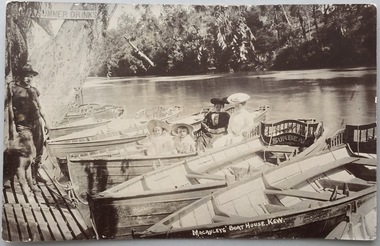
Postcard, Macauleys' Boat House, Kew, c.1900
... Kew Historical Society's Pictures Collection is comprised of photographs, postcards and original works of art. The postcards include original (mainly) images dating from the 1900s to the present. A number of postcards, some of which have numerous variants, were published as parts of series. Others are original images customised as postcards. Many of the postcards in the collection depict places within the suburbs of Kew and Kew East. Others depict locations in Victoria or internationally. postcards recreation - yarra river - kew (vic) yarra river - kew (vic) Macauley's boat house ...The Kew Historical Society's Pictures Collection is comprised of photographs, postcards and original works of art. The postcards include original (mainly) images dating from the 1900s to the present. A number of postcards, some of which have numerous variants, were published as parts of series. Others are original images customised as postcards. Many of the postcards in the collection depict places within the suburbs of Kew and Kew East. Others depict locations in Victoria or internationally.View of two women and two children in a canoe at Macauleys' Boat Shed at the end of Molesworth Street, Kew. At the left of the image stands a man and his dog, presumably the manager of the boat shed. On the bak of the seat of one of the canoes is its name - sunbeam. Another item in the collection includes one of these name boards."Lower Molesworth Street, 1900. Home restored still standing 1980."postcards, recreation - yarra river - kew (vic), yarra river - kew (vic), macauley's boat house -- boat shed -
 Kew Historical Society Inc
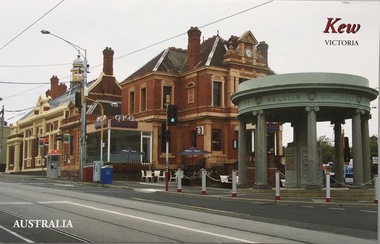
Postcard, Margie McKenzie Photography, Kew Victoria, Australia, c.2010
... The Kew Historical Society's postcard collection includes views of Kew, Melbourne and Greater Melbourne as well as those including overseas scenes sent or received from Europe or the Middle East. They date from the 1890s to the 2000s. These postcards may or may not include the name of the publisher or printer. A number of the cards were published as parts of popular series. qpo restaurant, kew post office, kew court house ...The Kew Historical Society's postcard collection includes views of Kew, Melbourne and Greater Melbourne as well as those including overseas scenes sent or received from Europe or the Middle East. They date from the 1890s to the 2000s. These postcards may or may not include the name of the publisher or printer. A number of the cards were published as parts of popular series. Modern photographic postcard of the QPO Restaurant and the former Kew Court House. At the front of the restaurant is the Kew War Memorial, the drum of which at this stage was incorrectly painted a shade of green, which the Council later changed after representations from the Kew Historical Society and a heritage report.QPO Bar, Restuarant & Function Centre/ Cnr High Street & Cotham Rd. Mel Ref 45 C6 MacKenzie photography / Copyright margiesphotos.com.auqpo restaurant, kew post office, kew court house, kew war memorial, postcards -- kew (vic.) -
 Kew Historical Society Inc
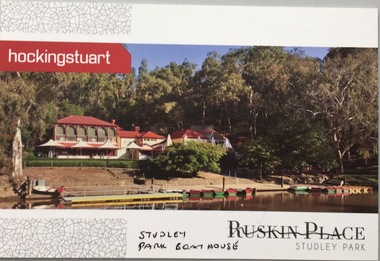
Postcard, Ruskin Place, Studley Park, c.2010
... The Kew Historical Society's postcard collection includes views of Kew, Melbourne and Greater Melbourne as well as those including overseas scenes sent or received from Europe or the Middle East. They date from the 1890s to the 2000s. ruskin place - kew, 75 princess street - kew, studley park boat house ...The Kew Historical Society's postcard collection includes views of Kew, Melbourne and Greater Melbourne as well as those including overseas scenes sent or received from Europe or the Middle East. They date from the 1890s to the 2000s.Commercial postcard produced by Hocking Stuart to advertise Ruskin Place, 75 Princess Street, Kew, but instead showing the Studley Park Boat House.The reverse includes advertising copy relating to the company and to Ruskin Place, 75 Princess Street, Kew.ruskin place - kew, 75 princess street - kew, studley park boat house -
 Kew Historical Society Inc
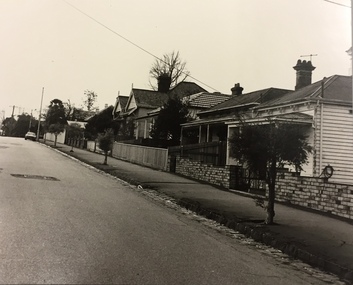
Photograph, City of Kew, Houses, Edgevale Road, Kew, c.1980
... Enlarged photograph of houses on the east side of Edgevale Road between Wellington Street and Cotham Road in Kew, mounted on board, and donated to the Kew Historical Society by the City of Kew on 10 April 1991....Kew of notable locations. The photos represent a snapshot in time. edgevale road - kew city of kew From Kew City C'cil 10 April 1991 Enlarged photograph of houses on the east side of Edgevale Road between Wellington Street and Cotham Road in Kew, mounted on board, and donated to the Kew Historical Society by the City of Kew on 10 April 1991. ...One of a series of photos created for an exhibition by the City of Kew of notable locations. The photos represent a snapshot in time.Enlarged photograph of houses on the east side of Edgevale Road between Wellington Street and Cotham Road in Kew, mounted on board, and donated to the Kew Historical Society by the City of Kew on 10 April 1991.From Kew City C'cil 10 April 1991edgevale road - kew, city of kew -
 Kew Historical Society Inc
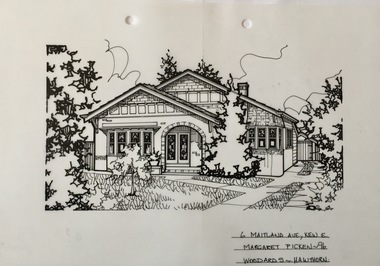
Drawing - Property Illustration, Margaret Picken, 6 Maitland Avenue, Kew, 1996
... The year in which the work was created is also a valuable record for house historians, as a number of the properties depicted have either been altered since that date or demolished. artist -- margaret picken 1950- property illustrations — buildings — kew (vic.) 6 maitland avenue - kew (vic) 6 MAITLAND AVE., KEW E. / MARGARET PICKEN ~96 / WOODARDS ~ HAWTHORN Pen and ink drawing on drafting film of 6 Maitland Avenue, Kew East, by Margaret Picken. 6 Maitland Avenue, Kew Drawing Property Illustration Margaret Picken Woodards (Hawthorn) ...After training as a Cartographic Draftsman within the mining industry, I worked as a property illustrator for real estate firms in the eastern suburbs of Melbourne for 23 years from 1983. I initially photographed houses with a Polaroid camera and made a 'thumbnail' sketch while there. The photos were used to scale off a sketch in pencil and then that sketch was overlaid with drafting film and the 'pen and ink' completed. The pens I used were the Rotring ‘Rapidigraph’ drafting pens. The ink was also made by Rotring (German).The film was ‘Rapidraw’, polyester drafting film, double matte. It takes a very fine line and doesn’t bleed. As well as house sketches, there were often floor plans and site plans ordered. Aerial sketches were ordered when the property needed an overall view. (Margaret Picken, 2020)This drawing is one of a series created by Margaret Picken for real estate agents in Melbourne between 1983 and 2006. Each work is signed and dated by the artist.Gift of Margaret Picken, 2020Pen and ink drawing on drafting film of 6 Maitland Avenue, Kew East, by Margaret Picken.6 MAITLAND AVE., KEW E. / MARGARET PICKEN ~96 / WOODARDS ~ HAWTHORNartist -- margaret picken 1950-, property illustrations — buildings — kew (vic.), 6 maitland avenue - kew (vic) -
 Kew Historical Society Inc
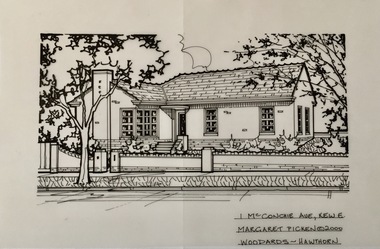
Drawing - Property Illustration, Margaret Picken, 1 McConchie Avenue, Kew East, 2000
... The year in which the work was created is also a valuable record for house historians, as a number of the properties depicted have either been altered since that date or demolished. artist -- margaret picken 1950- property illustrations — buildings — kew east (vic.) 1 mcconchie avenue - kew east (vic) 1 McCONCHIE AVE., KEW E. / MARGARET PICKEN ©2000 / WOODARDS ~ HAWTHORN Pen and ink drawing on drafting film of 1 McConchie Avenue, Kew East by Margaret Picken. 1 McConchie Avenue, Kew East Drawing Property Illustration Margaret Picken Woodards (Hawthorn) ...After training as a Cartographic Draftsman within the mining industry, I worked as a property illustrator for real estate firms in the eastern suburbs of Melbourne for 23 years from 1983. I initially photographed houses with a Polaroid camera and made a 'thumbnail' sketch while there. The photos were used to scale off a sketch in pencil and then that sketch was overlaid with drafting film and the 'pen and ink' completed. The pens I used were the Rotring ‘Rapidigraph’ drafting pens. The ink was also made by Rotring (German).The film was ‘Rapidraw’, polyester drafting film, double matte. It takes a very fine line and doesn’t bleed. As well as house sketches, there were often floor plans and site plans ordered. Aerial sketches were ordered when the property needed an overall view. (Margaret Picken, 2020)This drawing is one of a series created by Margaret Picken for real estate agents in Melbourne between 1983 and 2006. Each work is signed and dated by the artist.Gift of Margaret Picken, 2020Pen and ink drawing on drafting film of 1 McConchie Avenue, Kew East by Margaret Picken.1 McCONCHIE AVE., KEW E. / MARGARET PICKEN ©2000 / WOODARDS ~ HAWTHORNartist -- margaret picken 1950-, property illustrations — buildings — kew east (vic.), 1 mcconchie avenue - kew east (vic) -
 Kew Historical Society Inc
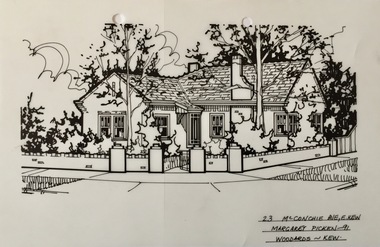
Drawing - Property Illustration, Margaret Picken, 23 McConchie Avenue, Kew East, 1991
... The year in which the work was created is also a valuable record for house historians, as a number of the properties depicted have either been altered since that date or demolished. artist -- margaret picken 1950- property illustrations — buildings — kew east (vic.) 23 mcconchie avenue - kew east (vic) 23 McCONCHIE AVE.,E. ...After training as a Cartographic Draftsman within the mining industry, I worked as a property illustrator for real estate firms in the eastern suburbs of Melbourne for 23 years from 1983. I initially photographed houses with a Polaroid camera and made a 'thumbnail' sketch while there. The photos were used to scale off a sketch in pencil and then that sketch was overlaid with drafting film and the 'pen and ink' completed. The pens I used were the Rotring ‘Rapidigraph’ drafting pens. The ink was also made by Rotring (German).The film was ‘Rapidraw’, polyester drafting film, double matte. It takes a very fine line and doesn’t bleed. As well as house sketches, there were often floor plans and site plans ordered. Aerial sketches were ordered when the property needed an overall view. (Margaret Picken, 2020)This drawing is one of a series created by Margaret Picken for real estate agents in Melbourne between 1983 and 2006. Each work is signed and dated by the artist.Gift of Margaret Picken, 2020Pen and ink drawing on drafting film of 23 McConchie Avenue, Kew East by Margaret Picken.23 McCONCHIE AVE.,E. KEW / MARGARET PICKEN ~91 / WOODARDS ~ KEWartist -- margaret picken 1950-, property illustrations — buildings — kew east (vic.), 23 mcconchie avenue - kew east (vic) -
 Kew Historical Society Inc
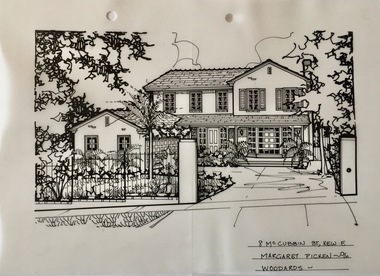
Drawing - Property Illustration, Margaret Picken, 8 McCubbin Street, Kew East, 1996
... The year in which the work was created is also a valuable record for house historians, as a number of the properties depicted have either been altered since that date or demolished. artist -- margaret picken 1950- property illustrations — buildings — kew east (vic.) 8 mccubbin street - kew east (vic) 8 McCUBBIN ST., KEW E. / MARGARET PICKEN ~96 / WOODARDS ~ Pen and ink drawing on drafting film of 8 McCubbin Street, Kew East by Margaret Picken. 8 McCubbin Street, Kew East Drawing Property Illustration Margaret Picken Woodards ...After training as a Cartographic Draftsman within the mining industry, I worked as a property illustrator for real estate firms in the eastern suburbs of Melbourne for 23 years from 1983. I initially photographed houses with a Polaroid camera and made a 'thumbnail' sketch while there. The photos were used to scale off a sketch in pencil and then that sketch was overlaid with drafting film and the 'pen and ink' completed. The pens I used were the Rotring ‘Rapidigraph’ drafting pens. The ink was also made by Rotring (German).The film was ‘Rapidraw’, polyester drafting film, double matte. It takes a very fine line and doesn’t bleed. As well as house sketches, there were often floor plans and site plans ordered. Aerial sketches were ordered when the property needed an overall view. (Margaret Picken, 2020)This drawing is one of a series created by Margaret Picken for real estate agents in Melbourne between 1983 and 2006. Each work is signed and dated by the artist.Gift of Margaret Picken, 2020Pen and ink drawing on drafting film of 8 McCubbin Street, Kew East by Margaret Picken.8 McCUBBIN ST., KEW E. / MARGARET PICKEN ~96 / WOODARDS ~ artist -- margaret picken 1950-, property illustrations — buildings — kew east (vic.), 8 mccubbin street - kew east (vic) -
 Kew Historical Society Inc
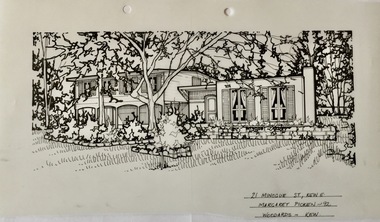
Drawing - Property Illustration, Margaret Picken, 21 Minogue Street, Kew East, 1992
... The year in which the work was created is also a valuable record for house historians, as a number of the properties depicted have either been altered since that date or demolished. artist -- margaret picken 1950- property illustrations — buildings — kew east (vic.) 21 minogue street - kew east (vic) 21 MINOGUE ST., KEW E. / MARGARET PICKEN ~92 / WOODARDS ~ KEW Pen and ink drawing on drafting film of 21 Minogue Street, Kew East by Margaret Picken. 21 Minogue Street, Kew East Drawing Property Illustration Margaret Picken Woodards (Kew) ...After training as a Cartographic Draftsman within the mining industry, I worked as a property illustrator for real estate firms in the eastern suburbs of Melbourne for 23 years from 1983. I initially photographed houses with a Polaroid camera and made a 'thumbnail' sketch while there. The photos were used to scale off a sketch in pencil and then that sketch was overlaid with drafting film and the 'pen and ink' completed. The pens I used were the Rotring ‘Rapidigraph’ drafting pens. The ink was also made by Rotring (German).The film was ‘Rapidraw’, polyester drafting film, double matte. It takes a very fine line and doesn’t bleed. As well as house sketches, there were often floor plans and site plans ordered. Aerial sketches were ordered when the property needed an overall view. (Margaret Picken, 2020)This drawing is one of a series created by Margaret Picken for real estate agents in Melbourne between 1983 and 2006. Each work is signed and dated by the artist.Gift of Margaret Picken, 2020Pen and ink drawing on drafting film of 21 Minogue Street, Kew East by Margaret Picken.21 MINOGUE ST., KEW E. / MARGARET PICKEN ~92 / WOODARDS ~ KEWartist -- margaret picken 1950-, property illustrations — buildings — kew east (vic.), 21 minogue street - kew east (vic) -
 Kew Historical Society Inc
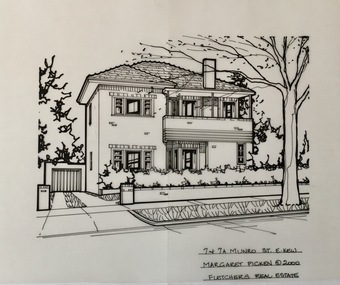
Drawing - Property Illustration, Margaret Picken, 7 & 7A Munro Street, Kew East, 2000
... The year in which the work was created is also a valuable record for house historians, as a number of the properties depicted have either been altered since that date or demolished. artist -- margaret picken 1950- property illustrations — buildings — kew east (vic.) 7 + 7a munro street - kew east (vic) 7 + 7A MUNRO ST., E. ...After training as a Cartographic Draftsman within the mining industry, I worked as a property illustrator for real estate firms in the eastern suburbs of Melbourne for 23 years from 1983. I initially photographed houses with a Polaroid camera and made a 'thumbnail' sketch while there. The photos were used to scale off a sketch in pencil and then that sketch was overlaid with drafting film and the 'pen and ink' completed. The pens I used were the Rotring ‘Rapidigraph’ drafting pens. The ink was also made by Rotring (German).The film was ‘Rapidraw’, polyester drafting film, double matte. It takes a very fine line and doesn’t bleed. As well as house sketches, there were often floor plans and site plans ordered. Aerial sketches were ordered when the property needed an overall view. (Margaret Picken, 2020)This drawing is one of a series created by Margaret Picken for real estate agents in Melbourne between 1983 and 2006. Each work is signed and dated by the artist.Gift of Margaret Picken, 2020Pen and ink drawing on drafting film of 7 & 7A Munro Street, Kew East by Margaret Picken.7 + 7A MUNRO ST., E. KEW / MARGARET PICKEN ©2000 / FLETCHERS REAL ESTATEartist -- margaret picken 1950-, property illustrations — buildings — kew east (vic.), 7 + 7a munro street - kew east (vic) -
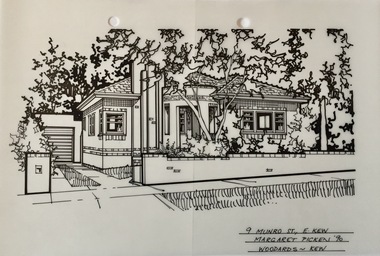 Kew Historical Society Inc
Drawing - Property Illustration, Margaret Picken, 9 Munro Street, Kew East, 1990
... The year in which the work was created is also a valuable record for house historians, as a number of the properties depicted have either been altered since that date or demolished. artist -- margaret picken 1950- property illustrations — buildings — kew east (vic.) 9 munro street - kew east (vic) 9 MUNRO ST., E. ...After training as a Cartographic Draftsman within the mining industry, I worked as a property illustrator for real estate firms in the eastern suburbs of Melbourne for 23 years from 1983. I initially photographed houses with a Polaroid camera and made a 'thumbnail' sketch while there. The photos were used to scale off a sketch in pencil and then that sketch was overlaid with drafting film and the 'pen and ink' completed. The pens I used were the Rotring ‘Rapidigraph’ drafting pens. The ink was also made by Rotring (German).The film was ‘Rapidraw’, polyester drafting film, double matte. It takes a very fine line and doesn’t bleed. As well as house sketches, there were often floor plans and site plans ordered. Aerial sketches were ordered when the property needed an overall view. (Margaret Picken, 2020)This drawing is one of a series created by Margaret Picken for real estate agents in Melbourne between 1983 and 2006. Each work is signed and dated by the artist.Gift of Margaret Picken, 2020Pen and ink drawing on drafting film of 9 Munro Street, Kew East, by Margaret Picken.9 MUNRO ST., E. KEW / MARGARET PICKEN '90 / WOODARDS ~ KEWartist -- margaret picken 1950-, property illustrations — buildings — kew east (vic.), 9 munro street - kew east (vic) -
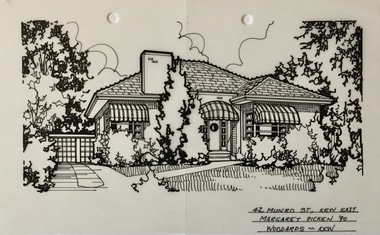 Kew Historical Society Inc
Drawing - Property Illustration, Margaret Picken, 42 Munro Street, Kew East, 1990
... The year in which the work was created is also a valuable record for house historians, as a number of the properties depicted have either been altered since that date or demolished. artist -- margaret picken 1950- property illustrations — buildings — kew east (vic.) 42 munro street - kew east (vic) 42 MUNRO ST., KEW EAST / MARGARET PICKEN '90 / WOODARDS ~ KEW Pen and ink drawing on drafting film of 42 Munro Street, Kew East by Margaret Picken. 42 Munro Street, Kew East Drawing Property Illustration Margaret Picken Woodards (Kew) ...After training as a Cartographic Draftsman within the mining industry, I worked as a property illustrator for real estate firms in the eastern suburbs of Melbourne for 23 years from 1983. I initially photographed houses with a Polaroid camera and made a 'thumbnail' sketch while there. The photos were used to scale off a sketch in pencil and then that sketch was overlaid with drafting film and the 'pen and ink' completed. The pens I used were the Rotring ‘Rapidigraph’ drafting pens. The ink was also made by Rotring (German).The film was ‘Rapidraw’, polyester drafting film, double matte. It takes a very fine line and doesn’t bleed. As well as house sketches, there were often floor plans and site plans ordered. Aerial sketches were ordered when the property needed an overall view. (Margaret Picken, 2020)This drawing is one of a series created by Margaret Picken for real estate agents in Melbourne between 1983 and 2006. Each work is signed and dated by the artist.Gift of Margaret Picken, 2020Pen and ink drawing on drafting film of 42 Munro Street, Kew East by Margaret Picken.42 MUNRO ST., KEW EAST / MARGARET PICKEN '90 / WOODARDS ~ KEWartist -- margaret picken 1950-, property illustrations — buildings — kew east (vic.), 42 munro street - kew east (vic) -
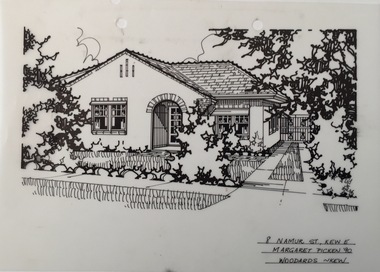 Kew Historical Society Inc
Drawing - Property Illustration, Margaret Picken, 8 Namur Street, Kew East, 1990
... The year in which the work was created is also a valuable record for house historians, as a number of the properties depicted have either been altered since that date or demolished. artist -- margaret picken 1950- property illustrations — buildings — kew east (vic.) 8 namur street - kew east (vic) 8 NAMUR ST., KEW E. / MARGARET PICKEN '90 / WOODARDS ~ KEW Pen and ink drawing on drafting film of 8 Namur Street, Kew East by Margaret Picken. 8 Namur Street, Kew East Drawing Property Illustration Margaret Picken Woodards (Kew) ...After training as a Cartographic Draftsman within the mining industry, I worked as a property illustrator for real estate firms in the eastern suburbs of Melbourne for 23 years from 1983. I initially photographed houses with a Polaroid camera and made a 'thumbnail' sketch while there. The photos were used to scale off a sketch in pencil and then that sketch was overlaid with drafting film and the 'pen and ink' completed. The pens I used were the Rotring ‘Rapidigraph’ drafting pens. The ink was also made by Rotring (German).The film was ‘Rapidraw’, polyester drafting film, double matte. It takes a very fine line and doesn’t bleed. As well as house sketches, there were often floor plans and site plans ordered. Aerial sketches were ordered when the property needed an overall view. (Margaret Picken, 2020)This drawing is one of a series created by Margaret Picken for real estate agents in Melbourne between 1983 and 2006. Each work is signed and dated by the artist.Gift of Margaret Picken, 2020Pen and ink drawing on drafting film of 8 Namur Street, Kew East by Margaret Picken.8 NAMUR ST., KEW E. / MARGARET PICKEN '90 / WOODARDS ~ KEWartist -- margaret picken 1950-, property illustrations — buildings — kew east (vic.), 8 namur street - kew east (vic) -
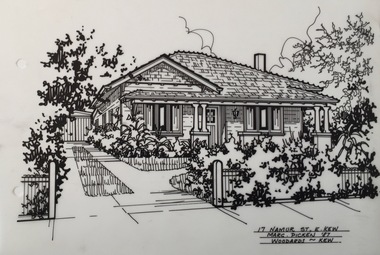 Kew Historical Society Inc
Drawing - Property Illustration, Margaret Picken, 17 Namur Street, Kew East, 1987
... The year in which the work was created is also a valuable record for house historians, as a number of the properties depicted have either been altered since that date or demolished. artist -- margaret picken 1950- property illustrations — buildings — kew east (vic.) 17 namur street - kew east (vic) 17 NAMUR ST., E. ...After training as a Cartographic Draftsman within the mining industry, I worked as a property illustrator for real estate firms in the eastern suburbs of Melbourne for 23 years from 1983. I initially photographed houses with a Polaroid camera and made a 'thumbnail' sketch while there. The photos were used to scale off a sketch in pencil and then that sketch was overlaid with drafting film and the 'pen and ink' completed. The pens I used were the Rotring ‘Rapidigraph’ drafting pens. The ink was also made by Rotring (German).The film was ‘Rapidraw’, polyester drafting film, double matte. It takes a very fine line and doesn’t bleed. As well as house sketches, there were often floor plans and site plans ordered. Aerial sketches were ordered when the property needed an overall view. (Margaret Picken, 2020)This drawing is one of a series created by Margaret Picken for real estate agents in Melbourne between 1983 and 2006. Each work is signed and dated by the artist.Gift of Margaret Picken, 2020Pen and ink drawing on drafting film of 17 Namur Street, Kew East by Margaret Picken.17 NAMUR ST., E. KEW / MARG. PICKEN '87 / WOODARDS ~ KEWartist -- margaret picken 1950-, property illustrations — buildings — kew east (vic.), 17 namur street - kew east (vic) -
 Kew Historical Society Inc
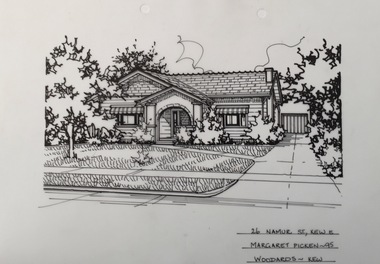
Drawing - Property Illustration, Margaret Picken, 26 Namur Street, Kew East, 1995
... The year in which the work was created is also a valuable record for house historians, as a number of the properties depicted have either been altered since that date or demolished. artist -- margaret picken 1950- property illustrations — buildings — kew east (vic.) 26 namur street - kew east (vic) 26 NAMUR ST., KEW E. / MARGARET PICKEN ~95 / WOODARDS ~ KEW Pen and ink drawing on drafting film of 26 Namur Street, Kew East by Margaret Picken. 26 Namur Street, Kew East Drawing Property Illustration Margaret Picken Woodards (Kew) ...After training as a Cartographic Draftsman within the mining industry, I worked as a property illustrator for real estate firms in the eastern suburbs of Melbourne for 23 years from 1983. I initially photographed houses with a Polaroid camera and made a 'thumbnail' sketch while there. The photos were used to scale off a sketch in pencil and then that sketch was overlaid with drafting film and the 'pen and ink' completed. The pens I used were the Rotring ‘Rapidigraph’ drafting pens. The ink was also made by Rotring (German).The film was ‘Rapidraw’, polyester drafting film, double matte. It takes a very fine line and doesn’t bleed. As well as house sketches, there were often floor plans and site plans ordered. Aerial sketches were ordered when the property needed an overall view. (Margaret Picken, 2020)This drawing is one of a series created by Margaret Picken for real estate agents in Melbourne between 1983 and 2006. Each work is signed and dated by the artist.Gift of Margaret Picken, 2020Pen and ink drawing on drafting film of 26 Namur Street, Kew East by Margaret Picken.26 NAMUR ST., KEW E. / MARGARET PICKEN ~95 / WOODARDS ~ KEWartist -- margaret picken 1950-, property illustrations — buildings — kew east (vic.), 26 namur street - kew east (vic) -
 Kew Historical Society Inc
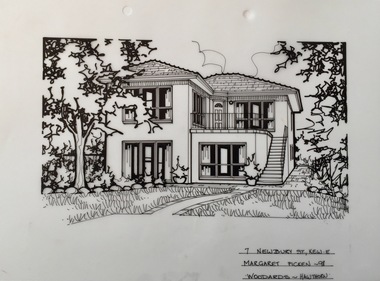
Drawing - Property Illustration, Margaret Picken, 7 Newbury Street, Kew East, 1998
... The year in which the work was created is also a valuable record for house historians, as a number of the properties depicted have either been altered since that date or demolished. artist -- margaret picken 1950- property illustrations — buildings — kew east (vic.) 7 newbury street - kew east (vic) 7 NEWBURY ST., KEW E. / MARGARET PICKEN ~98 / WOODARDS ~ HAWTHORN Pen and ink drawing on drafting film of 7 Newbury Street, Kew East by Margaret Picken. 7 Newbury Street, Kew East Drawing Property Illustration Margaret Picken Woodards (Hawthorn) ...After training as a Cartographic Draftsman within the mining industry, I worked as a property illustrator for real estate firms in the eastern suburbs of Melbourne for 23 years from 1983. I initially photographed houses with a Polaroid camera and made a 'thumbnail' sketch while there. The photos were used to scale off a sketch in pencil and then that sketch was overlaid with drafting film and the 'pen and ink' completed. The pens I used were the Rotring ‘Rapidigraph’ drafting pens. The ink was also made by Rotring (German).The film was ‘Rapidraw’, polyester drafting film, double matte. It takes a very fine line and doesn’t bleed. As well as house sketches, there were often floor plans and site plans ordered. Aerial sketches were ordered when the property needed an overall view. (Margaret Picken, 2020)This drawing is one of a series created by Margaret Picken for real estate agents in Melbourne between 1983 and 2006. Each work is signed and dated by the artist.Gift of Margaret Picken, 2020Pen and ink drawing on drafting film of 7 Newbury Street, Kew East by Margaret Picken.7 NEWBURY ST., KEW E. / MARGARET PICKEN ~98 / WOODARDS ~ HAWTHORNartist -- margaret picken 1950-, property illustrations — buildings — kew east (vic.), 7 newbury street - kew east (vic) -
 Kew Historical Society Inc
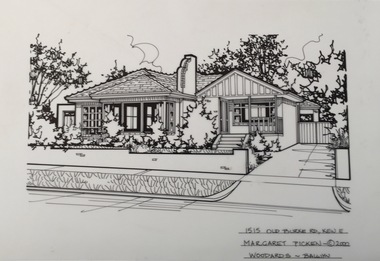
Drawing - Property Illustration, Margaret Picken, 1515 Old Burke Road, Kew East, 2000
... The year in which the work was created is also a valuable record for house historians, as a number of the properties depicted have either been altered since that date or demolished. artist -- margaret picken 1950- property illustrations — buildings — kew east (vic.) 1515 old burke road - kew east (vic) 1515 OLD BURKE RD., KEW E. / MARGARET PICKEN ©2000 / WOODARDS ~ BALWYN Pen and ink drawing on drafting film of 1515 Old Burke Road, Kew East by Margaret Picken. 1515 Old Burke Road, Kew East Drawing Property Illustration Margaret Picken Woodards (Balwyn) ...After training as a Cartographic Draftsman within the mining industry, I worked as a property illustrator for real estate firms in the eastern suburbs of Melbourne for 23 years from 1983. I initially photographed houses with a Polaroid camera and made a 'thumbnail' sketch while there. The photos were used to scale off a sketch in pencil and then that sketch was overlaid with drafting film and the 'pen and ink' completed. The pens I used were the Rotring ‘Rapidigraph’ drafting pens. The ink was also made by Rotring (German).The film was ‘Rapidraw’, polyester drafting film, double matte. It takes a very fine line and doesn’t bleed. As well as house sketches, there were often floor plans and site plans ordered. Aerial sketches were ordered when the property needed an overall view. (Margaret Picken, 2020)This drawing is one of a series created by Margaret Picken for real estate agents in Melbourne between 1983 and 2006. Each work is signed and dated by the artist.Gift of Margaret Picken, 2020Pen and ink drawing on drafting film of 1515 Old Burke Road, Kew East by Margaret Picken.1515 OLD BURKE RD., KEW E. / MARGARET PICKEN ©2000 / WOODARDS ~ BALWYNartist -- margaret picken 1950-, property illustrations — buildings — kew east (vic.), 1515 old burke road - kew east (vic) -
 Kew Historical Society Inc
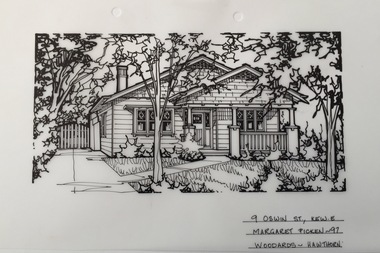
Drawing - Property Illustration, Margaret Picken, 9 Oswin Street, Kew East, 1997
... The year in which the work was created is also a valuable record for house historians, as a number of the properties depicted have either been altered since that date or demolished. artist -- margaret picken 1950- property illustrations — buildings — kew east (vic.) 9 Oswin street -- Kew East (vic.) 9 OSWIN ST., KEW E. / MARGARET PICKEN ~97 / WOODARDS ~ HAWTHORN Pen and ink drawing on drafting film of 9 Oswin Street, Kew East by Margaret Picken. 9 Oswin Street, Kew East Drawing Property Illustration Margaret Picken Woodards (Hawthorn) ...After training as a Cartographic Draftsman within the mining industry, I worked as a property illustrator for real estate firms in the eastern suburbs of Melbourne for 23 years from 1983. I initially photographed houses with a Polaroid camera and made a 'thumbnail' sketch while there. The photos were used to scale off a sketch in pencil and then that sketch was overlaid with drafting film and the 'pen and ink' completed. The pens I used were the Rotring ‘Rapidigraph’ drafting pens. The ink was also made by Rotring (German).The film was ‘Rapidraw’, polyester drafting film, double matte. It takes a very fine line and doesn’t bleed. As well as house sketches, there were often floor plans and site plans ordered. Aerial sketches were ordered when the property needed an overall view. (Margaret Picken, 2020)This drawing is one of a series created by Margaret Picken for real estate agents in Melbourne between 1983 and 2006. Each work is signed and dated by the artist.Gift of Margaret Picken, 2020Pen and ink drawing on drafting film of 9 Oswin Street, Kew East by Margaret Picken.9 OSWIN ST., KEW E. / MARGARET PICKEN ~97 / WOODARDS ~ HAWTHORNartist -- margaret picken 1950-, property illustrations — buildings — kew east (vic.), 9 oswin street -- kew east (vic.) -
 Kew Historical Society Inc
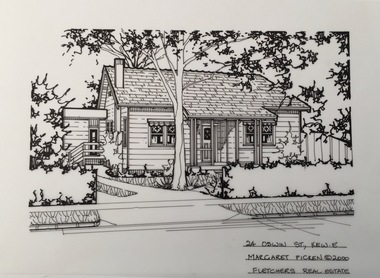
Drawing - Property Illustration, Margaret Picken, 24 Oswin Street, Kew East, 2000
... The year in which the work was created is also a valuable record for house historians, as a number of the properties depicted have either been altered since that date or demolished. artist -- margaret picken 1950- property illustrations — buildings — kew east (vic.) 24 oswin street - kew east (vic) 24 OSWIN ST., KEW E. / MARGARET PICKEN ©2000 / FLETCHERS REAL ESTATE Pen and ink drawing on drafting film of 24 Oswin Street, Kew East by Margaret Picken. 24 Oswin Street, Kew East Drawing Property Illustration Margaret Picken Fletchers Real Estate ...After training as a Cartographic Draftsman within the mining industry, I worked as a property illustrator for real estate firms in the eastern suburbs of Melbourne for 23 years from 1983. I initially photographed houses with a Polaroid camera and made a 'thumbnail' sketch while there. The photos were used to scale off a sketch in pencil and then that sketch was overlaid with drafting film and the 'pen and ink' completed. The pens I used were the Rotring ‘Rapidigraph’ drafting pens. The ink was also made by Rotring (German).The film was ‘Rapidraw’, polyester drafting film, double matte. It takes a very fine line and doesn’t bleed. As well as house sketches, there were often floor plans and site plans ordered. Aerial sketches were ordered when the property needed an overall view. (Margaret Picken, 2020)This drawing is one of a series created by Margaret Picken for real estate agents in Melbourne between 1983 and 2006. Each work is signed and dated by the artist.Gift of Margaret Picken, 2020Pen and ink drawing on drafting film of 24 Oswin Street, Kew East by Margaret Picken.24 OSWIN ST., KEW E. / MARGARET PICKEN ©2000 / FLETCHERS REAL ESTATEartist -- margaret picken 1950-, property illustrations — buildings — kew east (vic.), 24 oswin street - kew east (vic) -
 Kew Historical Society Inc
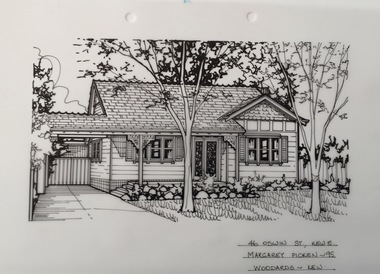
Drawing - Property Illustration, Margaret Picken, 46 Oswin Street, Kew East, 1995
... The year in which the work was created is also a valuable record for house historians, as a number of the properties depicted have either been altered since that date or demolished. property illustrations — buildings — kew east (vic.) 46 oswin street - kew east (vic) 46 OSWIN ST., KEW E. / MARGARET PICKEN ~95 / WOODARDS ~ KEW Pen and ink drawing on drafting film of 46 Oswin Street, Kew East by Margaret Picken. 46 Oswin Street, Kew East Drawing Property Illustration Margaret Picken Woodards (Kew) ...After training as a Cartographic Draftsman within the mining industry, I worked as a property illustrator for real estate firms in the eastern suburbs of Melbourne for 23 years from 1983. I initially photographed houses with a Polaroid camera and made a 'thumbnail' sketch while there. The photos were used to scale off a sketch in pencil and then that sketch was overlaid with drafting film and the 'pen and ink' completed. The pens I used were the Rotring ‘Rapidigraph’ drafting pens. The ink was also made by Rotring (German).The film was ‘Rapidraw’, polyester drafting film, double matte. It takes a very fine line and doesn’t bleed. As well as house sketches, there were often floor plans and site plans ordered. Aerial sketches were ordered when the property needed an overall view. (Margaret Picken, 2020)This drawing is one of a series created by Margaret Picken for real estate agents in Melbourne between 1983 and 2006. Each work is signed and dated by the artist.Gift of Margaret Picken, 2020Pen and ink drawing on drafting film of 46 Oswin Street, Kew East by Margaret Picken.46 OSWIN ST., KEW E. / MARGARET PICKEN ~95 / WOODARDS ~ KEWproperty illustrations — buildings — kew east (vic.), 46 oswin street - kew east (vic) -
 Kew Historical Society Inc
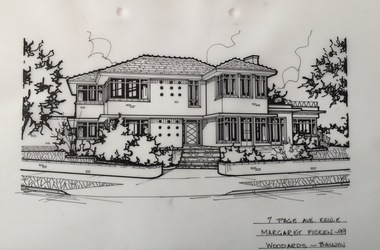
Drawing - Property Illustration, Margaret Picken, 7 Page Avenue, Kew East, 1999
... The year in which the work was created is also a valuable record for house historians, as a number of the properties depicted have either been altered since that date or demolished. artist -- margaret picken 1950- property illustrations — buildings — kew east (vic.) 7 page avenue - kew east (vic) 7 PAGE AVE., KEW E. / MARGARET PICKEN ~99 / WOODARDS ~ BALWYN Pen and ink drawing on drafting film of 7 Page Avenue, Kew East by Margaret Picken. 7 Page Avenue, Kew East Drawing Property Illustration Margaret Picken Woodards (Balwyn) ...After training as a Cartographic Draftsman within the mining industry, I worked as a property illustrator for real estate firms in the eastern suburbs of Melbourne for 23 years from 1983. I initially photographed houses with a Polaroid camera and made a 'thumbnail' sketch while there. The photos were used to scale off a sketch in pencil and then that sketch was overlaid with drafting film and the 'pen and ink' completed. The pens I used were the Rotring ‘Rapidigraph’ drafting pens. The ink was also made by Rotring (German).The film was ‘Rapidraw’, polyester drafting film, double matte. It takes a very fine line and doesn’t bleed. As well as house sketches, there were often floor plans and site plans ordered. Aerial sketches were ordered when the property needed an overall view. (Margaret Picken, 2020)This drawing is one of a series created by Margaret Picken for real estate agents in Melbourne between 1983 and 2006. Each work is signed and dated by the artist.Gift of Margaret Picken, 2020Pen and ink drawing on drafting film of 7 Page Avenue, Kew East by Margaret Picken.7 PAGE AVE., KEW E. / MARGARET PICKEN ~99 / WOODARDS ~ BALWYNartist -- margaret picken 1950-, property illustrations — buildings — kew east (vic.), 7 page avenue - kew east (vic) -
 Kew Historical Society Inc
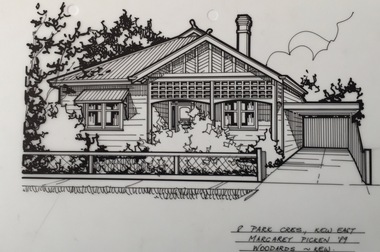
Drawing - Property Illustration, Margaret Picken, 8 Park Crescent, Kew, 1989
... The year in which the work was created is also a valuable record for house historians, as a number of the properties depicted have either been altered since that date or demolished. artist -- margaret picken 1950- property illustrations — buildings — kew (vic.) 8 park crescent - kew (vic) 8 PARK CRES., KEW EAST / MARGARET PICKEN '89 / WOODARDS ~ KEW Pen and ink drawing on drafting film of 8 Park Crescent, Kew by Margaret Picken. 8 Park Crescent, Kew Drawing Property Illustration Margaret Picken Woodards (Kew) ...After training as a Cartographic Draftsman within the mining industry, I worked as a property illustrator for real estate firms in the eastern suburbs of Melbourne for 23 years from 1983. I initially photographed houses with a Polaroid camera and made a 'thumbnail' sketch while there. The photos were used to scale off a sketch in pencil and then that sketch was overlaid with drafting film and the 'pen and ink' completed. The pens I used were the Rotring ‘Rapidigraph’ drafting pens. The ink was also made by Rotring (German).The film was ‘Rapidraw’, polyester drafting film, double matte. It takes a very fine line and doesn’t bleed. As well as house sketches, there were often floor plans and site plans ordered. Aerial sketches were ordered when the property needed an overall view. (Margaret Picken, 2020)This drawing is one of a series created by Margaret Picken for real estate agents in Melbourne between 1983 and 2006. Each work is signed and dated by the artist.Gift of Margaret Picken, 2020Pen and ink drawing on drafting film of 8 Park Crescent, Kew by Margaret Picken.8 PARK CRES., KEW EAST / MARGARET PICKEN '89 / WOODARDS ~ KEWartist -- margaret picken 1950-, property illustrations — buildings — kew (vic.), 8 park crescent - kew (vic) -
 Kew Historical Society Inc
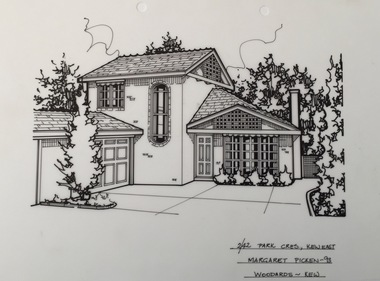
Drawing - Property Illustration, Margaret Picken, 2/42 Park Crescent, Kew, 1993
... The year in which the work was created is also a valuable record for house historians, as a number of the properties depicted have either been altered since that date or demolished. artist -- margaret picken 1950- property illustrations — buildings — kew (vic.) 2/42 park crescent - kew (vic) 2/42 PARK CRES., KEW EAST / MARGARET PICKEN ~93 / WOODARDS ~ KEW Pen and ink drawing on drafting film of 2/42 Park Crescent, Kew, by Margaret Picken. 2/42 Park Crescent, Kew Drawing Property Illustration Margaret Picken Woodards (Kew) ...After training as a Cartographic Draftsman within the mining industry, I worked as a property illustrator for real estate firms in the eastern suburbs of Melbourne for 23 years from 1983. I initially photographed houses with a Polaroid camera and made a 'thumbnail' sketch while there. The photos were used to scale off a sketch in pencil and then that sketch was overlaid with drafting film and the 'pen and ink' completed. The pens I used were the Rotring ‘Rapidigraph’ drafting pens. The ink was also made by Rotring (German).The film was ‘Rapidraw’, polyester drafting film, double matte. It takes a very fine line and doesn’t bleed. As well as house sketches, there were often floor plans and site plans ordered. Aerial sketches were ordered when the property needed an overall view. (Margaret Picken, 2020)This drawing is one of a series created by Margaret Picken for real estate agents in Melbourne between 1983 and 2006. Each work is signed and dated by the artist.Gift of Margaret Picken, 2020Pen and ink drawing on drafting film of 2/42 Park Crescent, Kew, by Margaret Picken.2/42 PARK CRES., KEW EAST / MARGARET PICKEN ~93 / WOODARDS ~ KEWartist -- margaret picken 1950-, property illustrations — buildings — kew (vic.), 2/42 park crescent - kew (vic) -
 Kew Historical Society Inc
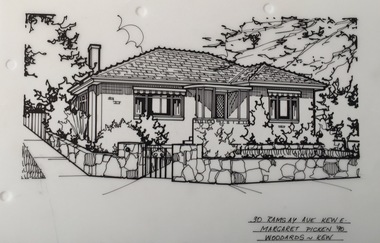
Drawing - Property Illustration, Margaret Picken, 30 Ramsay Avenue, Kew East, 1990
... The year in which the work was created is also a valuable record for house historians, as a number of the properties depicted have either been altered since that date or demolished. artist -- margaret picken 1950- property illustrations — buildings — kew east (vic.) 30 Ramsay Avenue -- Kew East (vic.) 30 RAMSAY AVE., KEW E / MARGARET PICKEN '90 / WOODARDS ~ KEW Pen and ink drawing on drafting film of 30 Ramsay Avenue, Kew East, by Margaret Picken. 30 Ramsay Avenue, Kew East Drawing Property Illustration Margaret Picken Woodards (Kew) ...After training as a Cartographic Draftsman within the mining industry, I worked as a property illustrator for real estate firms in the eastern suburbs of Melbourne for 23 years from 1983. I initially photographed houses with a Polaroid camera and made a 'thumbnail' sketch while there. The photos were used to scale off a sketch in pencil and then that sketch was overlaid with drafting film and the 'pen and ink' completed. The pens I used were the Rotring ‘Rapidigraph’ drafting pens. The ink was also made by Rotring (German).The film was ‘Rapidraw’, polyester drafting film, double matte. It takes a very fine line and doesn’t bleed. As well as house sketches, there were often floor plans and site plans ordered. Aerial sketches were ordered when the property needed an overall view. (Margaret Picken, 2020)This drawing is one of a series created by Margaret Picken for real estate agents in Melbourne between 1983 and 2006. Each work is signed and dated by the artist.Gift of Margaret Picken, 2020Pen and ink drawing on drafting film of 30 Ramsay Avenue, Kew East, by Margaret Picken.30 RAMSAY AVE., KEW E / MARGARET PICKEN '90 / WOODARDS ~ KEWartist -- margaret picken 1950-, property illustrations — buildings — kew east (vic.), 30 ramsay avenue -- kew east (vic.) -
 Kew Historical Society Inc
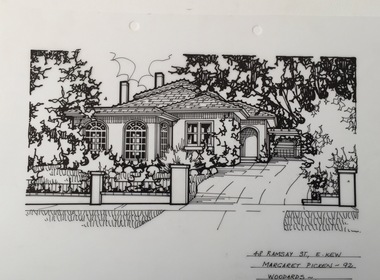
Drawing - Property Illustration, Margaret Picken, 48 Ramsay Avenue, Kew East, 1992
... The year in which the work was created is also a valuable record for house historians, as a number of the properties depicted have either been altered since that date or demolished. artist -- margaret picken 1950- property illustrations — buildings — kew east (vic.) 48 Ramsay Avenue -- Kew East (vic.) 48 RAMSAY AVE., E KEW / MARGARET PICKEN ~ 92 / WOODARDS ~ Pen and ink drawing on drafting film of 48 Ramsay Avenue, Kew East, by Margaret Picken. 48 Ramsay Avenue, Kew East Drawing Property Illustration Margaret Picken Woodards ...After training as a Cartographic Draftsman within the mining industry, I worked as a property illustrator for real estate firms in the eastern suburbs of Melbourne for 23 years from 1983. I initially photographed houses with a Polaroid camera and made a 'thumbnail' sketch while there. The photos were used to scale off a sketch in pencil and then that sketch was overlaid with drafting film and the 'pen and ink' completed. The pens I used were the Rotring ‘Rapidigraph’ drafting pens. The ink was also made by Rotring (German).The film was ‘Rapidraw’, polyester drafting film, double matte. It takes a very fine line and doesn’t bleed. As well as house sketches, there were often floor plans and site plans ordered. Aerial sketches were ordered when the property needed an overall view. (Margaret Picken, 2020)This drawing is one of a series created by Margaret Picken for real estate agents in Melbourne between 1983 and 2006. Each work is signed and dated by the artist.Gift of Margaret Picken, 2020Pen and ink drawing on drafting film of 48 Ramsay Avenue, Kew East, by Margaret Picken.48 RAMSAY AVE., E KEW / MARGARET PICKEN ~ 92 / WOODARDS ~artist -- margaret picken 1950-, property illustrations — buildings — kew east (vic.), 48 ramsay avenue -- kew east (vic.) -
 Kew Historical Society Inc
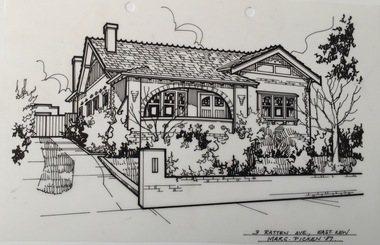
Drawing - Property Illustration, Margaret Picken, 3 Ratten Avenue, Kew East, 1987
... The year in which the work was created is also a valuable record for house historians, as a number of the properties depicted have either been altered since that date or demolished. artist -- margaret picken 1950- property illustrations — buildings — kew east (vic.) 3 ratten avenue -- Kew East (vic.) 3 RATTEN AVE., EAST KEW / MARGARET PICKEN '87 Pen and ink drawing on drafting film of 3 Ratten Avenue, Kew East, by Margaret Picken. 3 Ratten Avenue, Kew East Drawing Property Illustration Margaret Picken ...After training as a Cartographic Draftsman within the mining industry, I worked as a property illustrator for real estate firms in the eastern suburbs of Melbourne for 23 years from 1983. I initially photographed houses with a Polaroid camera and made a 'thumbnail' sketch while there. The photos were used to scale off a sketch in pencil and then that sketch was overlaid with drafting film and the 'pen and ink' completed. The pens I used were the Rotring ‘Rapidigraph’ drafting pens. The ink was also made by Rotring (German).The film was ‘Rapidraw’, polyester drafting film, double matte. It takes a very fine line and doesn’t bleed. As well as house sketches, there were often floor plans and site plans ordered. Aerial sketches were ordered when the property needed an overall view. (Margaret Picken, 2020)This drawing is one of a series created by Margaret Picken for real estate agents in Melbourne between 1983 and 2006. Each work is signed and dated by the artist.Gift of Margaret Picken, 2020Pen and ink drawing on drafting film of 3 Ratten Avenue, Kew East, by Margaret Picken.3 RATTEN AVE., EAST KEW / MARGARET PICKEN '87 artist -- margaret picken 1950-, property illustrations — buildings — kew east (vic.), 3 ratten avenue -- kew east (vic.) -
 Kew Historical Society Inc
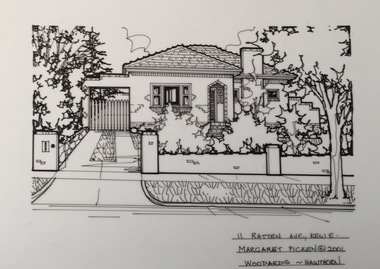
Drawing - Property Illustration, Margaret Picken, 11 Ratten Avenue, Kew East, 2001
... The year in which the work was created is also a valuable record for house historians, as a number of the properties depicted have either been altered since that date or demolished. artist -- margaret picken 1950- property illustrations — buildings — kew east (vic.) 11 ratten avenue - Kew East (vic.) 11 RATTEN AVE., KEW E / MARGARET PICKEN (c) 2001 / WOODARDS ~ HAWTHORN Pen and ink drawing on drafting film of 11 Ratten Avenue, Kew East, by Margaret Picken. 11 Ratten Avenue, Kew East Drawing Property Illustration Margaret Picken Woodards (Hawthorn) ...After training as a Cartographic Draftsman within the mining industry, I worked as a property illustrator for real estate firms in the eastern suburbs of Melbourne for 23 years from 1983. I initially photographed houses with a Polaroid camera and made a 'thumbnail' sketch while there. The photos were used to scale off a sketch in pencil and then that sketch was overlaid with drafting film and the 'pen and ink' completed. The pens I used were the Rotring ‘Rapidigraph’ drafting pens. The ink was also made by Rotring (German).The film was ‘Rapidraw’, polyester drafting film, double matte. It takes a very fine line and doesn’t bleed. As well as house sketches, there were often floor plans and site plans ordered. Aerial sketches were ordered when the property needed an overall view. (Margaret Picken, 2020)This drawing is one of a series created by Margaret Picken for real estate agents in Melbourne between 1983 and 2006. Each work is signed and dated by the artist.Gift of Margaret Picken, 2020Pen and ink drawing on drafting film of 11 Ratten Avenue, Kew East, by Margaret Picken.11 RATTEN AVE., KEW E / MARGARET PICKEN (c) 2001 / WOODARDS ~ HAWTHORNartist -- margaret picken 1950-, property illustrations — buildings — kew east (vic.), 11 ratten avenue - kew east (vic.) -
 Kew Historical Society Inc
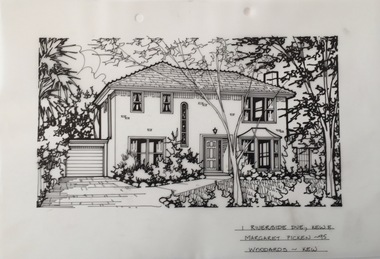
Drawing - Property Illustration, Margaret Picken, 1 Riverside Drive, Kew East, 1995
... The year in which the work was created is also a valuable record for house historians, as a number of the properties depicted have either been altered since that date or demolished. artist -- margaret picken 1950- property illustrations — buildings — kew east (vic.) 1 riverside drive -- kew east (vic.) 1 RIVERSIDE DVE., KEW E / MARGARET PICKEN ~95 / WOODARDS ~ KEW Pen and ink drawing on drafting film of 1 Riverside Drive, Kew East by Margaret Picken. 1 Riverside Drive, Kew East Drawing Property Illustration Margaret Picken Woodards (Kew) ...After training as a Cartographic Draftsman within the mining industry, I worked as a property illustrator for real estate firms in the eastern suburbs of Melbourne for 23 years from 1983. I initially photographed houses with a Polaroid camera and made a 'thumbnail' sketch while there. The photos were used to scale off a sketch in pencil and then that sketch was overlaid with drafting film and the 'pen and ink' completed. The pens I used were the Rotring ‘Rapidigraph’ drafting pens. The ink was also made by Rotring (German).The film was ‘Rapidraw’, polyester drafting film, double matte. It takes a very fine line and doesn’t bleed. As well as house sketches, there were often floor plans and site plans ordered. Aerial sketches were ordered when the property needed an overall view. (Margaret Picken, 2020)This drawing is one of a series created by Margaret Picken for real estate agents in Melbourne between 1983 and 2006. Each work is signed and dated by the artist.Gift of Margaret Picken, 2020Pen and ink drawing on drafting film of 1 Riverside Drive, Kew East by Margaret Picken.1 RIVERSIDE DVE., KEW E / MARGARET PICKEN ~95 / WOODARDS ~ KEWartist -- margaret picken 1950-, property illustrations — buildings — kew east (vic.), 1 riverside drive -- kew east (vic.)
