
Showing 39 items matching "hrh prince of wales"
-
 City of Ballarat Libraries
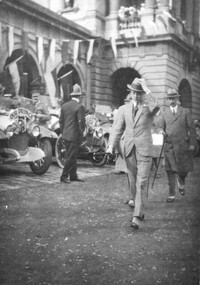
Photograph - Card Box Photographs, HRH Prince of Wales at the Ballarat Train Station, 1920
... HRH Prince of Wales at the Ballarat Train Station, 1920....HRH Prince of Wales...The visit to Ballarat was on 2nd June 1920 to open the Arch of Victory. HRH Prince of Wales Royalty Ballarat Railway Station Building Vehicle Persons Costume HRH Prince of Wales at the Ballarat Train Station, 1920. ...The visit to Ballarat was on 2nd June 1920 to open the Arch of Victory.hrh prince of wales, royalty, ballarat railway station, building, vehicle, persons, costume -
 City of Ballarat Libraries
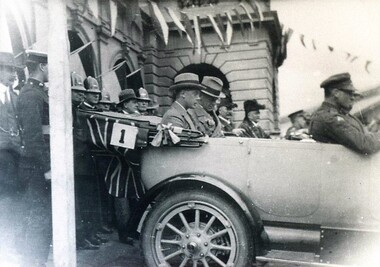
Photograph - Card Box Photographs, HRH Prince of Wales at the Ballarat Train Station, 1920
... HRH Prince of Wales at the Ballarat Train Station, 1920....HRH Prince of Wales...The visit to Ballarat was for the opening of the Arch of Victory on 2nd June 1920. HRH Prince of Wales Royalty Ballarat Railway Station Persons Public Vehicle Costume HRH Prince of Wales at the Ballarat Train Station, 1920. ...The visit to Ballarat was for the opening of the Arch of Victory on 2nd June 1920.hrh prince of wales, royalty, ballarat railway station, persons, public, vehicle, costume -
 Glen Eira Historical Society
Document - HRH Prince of Wales Visit to Caulfield 31/05/1920
... HRH Prince of Wales Visit to Caulfield 31/05/1920...This file contains four items about the visit of HRH Prince of Wales Edward (later Edward VIII) to Australia in 1920 and specifically a visit to Caulfield on 31/05/1920. 1/A souvenir program ‘HRH Prince of Wales’ visit to Caulfield 31/05/1920: it appears to contain copies of the pages of a book, which it is noted was embossed by a patient at a Rest House in Caulfield, signaller Don Ende, a soldier of World War I. ...This file contains four items about the visit of HRH Prince of Wales Edward (later Edward VIII) to Australia in 1920 and specifically a visit to Caulfield on 31/05/1920. 1/A souvenir program ‘HRH Prince of Wales’ visit to Caulfield 31/05/1920: it appears to contain copies of the pages of a book, which it is noted was embossed by a patient at a Rest House in Caulfield, signaller Don Ende, a soldier of World War I. ...This file contains four items about the visit of HRH Prince of Wales Edward (later Edward VIII) to Australia in 1920 and specifically a visit to Caulfield on 31/05/1920. 1/A souvenir program ‘HRH Prince of Wales’ visit to Caulfield 31/05/1920: it appears to contain copies of the pages of a book, which it is noted was embossed by a patient at a Rest House in Caulfield, signaller Don Ende, a soldier of World War I. Included is a letter from the Caulfield Mayor W. A. Wharington and Town Clerk F. Jowett to Edward, as well as a typed reply from Edward to the mayor. Also included is a record of Caulfield’s contribution to the war effort during World War I, including numbers who enlisted and served, the number who died, and the amount of money raised from the Red Cross, Comforts Fund and other ‘Patriotic efforts’ by Caulfield residents. 2/Original letter by Edward to ‘Girls and Boys of Australia’, written in Sydney or 16/08/1920, thanking Australia for its contribution to the war effort and loyalty to the empire. 3/Three copies of the same letter by Edward to ‘Girls and Boys of Australia’. 4/A research note by Amy MacKintosh briefly describing the circumstance of Edward’s visit.royal visits, caulfields, wharington w. a., jowett f., edward prince of wales, edward viii, george v, red cross, comforts funds, caulfield military hospital, ende don, soldiers, rest house caulfield, world war 1914-1918, voluntary workers, charitable organisations, military hospitals -
 Bendigo Historical Society Inc.
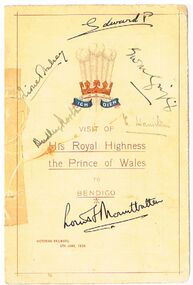
Document - AUTOGRAPHED PAGE - VISIT OF HRH THE PRINCE OF WALES TO BENDIGO 1920, 04/06/1920
... AUTOGRAPHED PAGE - VISIT OF HRH THE PRINCE OF WALES TO BENDIGO 1920... Visit of HRH the Prince of Wales to Bendigo...EVENT Official royal visit Document Visit of HRH the Prince of Wales to Bendigo Victorian Railways Lor? ...Copy of a page for the Visit of His Royal Highness the Prince of Wales to Bendigo, 4th June 1920. Page is pale yellow with a red border 0.6 cm from the edge. Near the top is a crown with three feathery plumes behind it and 'Ich Dien' below. Page is autographed by Louis Mountbatten, C Hamilton, Edward V . Victorian Railways printed on the page.event, official, royal visit, document, visit of hrh the prince of wales to bendigo, victorian railways, lor? mountbatten, edward p, c hamilton -
 Bendigo Historical Society Inc.
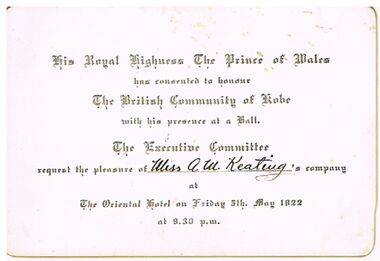
Document - DOCUMENT - HRH PRINCE OF WALES INVITATION TO A. KEATING
... DOCUMENT - HRH PRINCE OF WALES INVITATION TO A. KEATING...Keating His Royal Highness The Prince of Wales the British of Kobe Miss A M Keating Heavy white invitation card with rounded corners and gold edge inviting Miss Keating to a ball to honour The British Community of Kobe at The Oriental Hotel on Friday 5th, May 1922. His Royal Highness The Prince of Wales was also attending. Printing is black and the name is handwritten in black. Document DOCUMENT - HRH ...Heavy white invitation card with rounded corners and gold edge inviting Miss Keating to a ball to honour The British Community of Kobe at The Oriental Hotel on Friday 5th, May 1922. His Royal Highness The Prince of Wales was also attending. Printing is black and the name is handwritten in black.document, invitations, official celebrations, document, invitation to a ball for a. keating, his royal highness the prince of wales, the british of kobe, miss a m keating -
 Melbourne Tram Museum
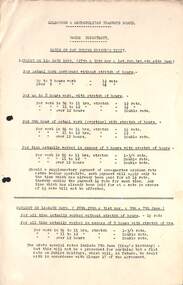
Document - Memorandum, Melbourne & Metropolitan Tramways Board (MMTB), "Visit of HRH the Prince of Wales", 5 and 6/1920
... "Visit of HRH the Prince of Wales"...Series of notices issued for the "Visit of HRH the Prince of Wales" to Melbourne 26 May and 7 June 1920. ..."Visit of HRH the Prince of Wales" Document Memorandum Melbourne & Metropolitan Tramways Board (MMTB) ...Series of notices issued for the "Visit of HRH the Prince of Wales" to Melbourne 26 May and 7 June 1920. All Gestener duplicated .1 - Foolscap - 1 sheet - memo to/from Wages Department setting on the various mechanisms for the payment during this visit. Two copies held. .2 - Foolscap - 1 sheet, machine signature of W. O. Strangward, setting out the dates and for the various additional pay rates and records. See .5 for more detail. Dated 27/5/2020. .3 - half foolscap - 1 sheet - Notice to Gripman Conductors - dated 20/5/1920 to all car houses, depots, advising that free travel is to be provided to Officers and Men of the HMS Renown and Australian War ships in uniform. .4 - half quarto - 1 sheet - Notice to Gripman Conductors - dated 4/6/1920, to "Electric Systems" that the free travel was to be extended to the 14th of June. .5 - Foolscap - 2 sheets pinned together, giving the rates of pay for those staff under agreements, the various days, methods of recording, including Juniors, cable car repair shop, other employees and Official and Clerical staff. Dated 26/5/1920. Two copies held.trams, tramways, wages, cable trams, royal visit, agreements, free tram -
 Bendigo Historical Society Inc.
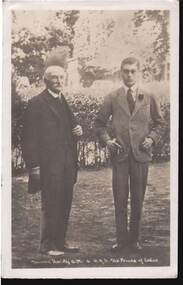
Postcard - THOMAS HARDY OM AND HRH THE PRINCE OF WALES
... THOMAS HARDY OM AND HRH THE PRINCE OF WALES...ROYALTY British prince of wales and thomas hardy royalty Prince of Wales Thomas Hardy Postcard: image shows grey haired man - (Thomas Hardy O.M. ), three piece suit, standing alongside Prince of Wales, who has a cigar in his right hand. On rear' in pencil ' bought this at Dorchester near Hardy's home. 15.Vlll.25. Longman stationer, Dorchester. Postcard THOMAS HARDY OM AND HRH ...Postcard: image shows grey haired man - (Thomas Hardy O.M. ), three piece suit, standing alongside Prince of Wales, who has a cigar in his right hand. On rear' in pencil ' bought this at Dorchester near Hardy's home. 15.Vlll.25. Longman stationer, Dorchester.royalty, british, prince of wales and thomas hardy, royalty, prince of wales, thomas hardy -
 St Kilda Historical Society
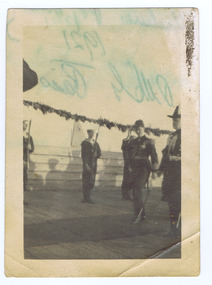
Photograph, St Kilda Pier, c. 1921
... St Kilda Pier at the time of visit of HRH Prince Edward of Wales 1921...On back: St Kilda Pier at the time of visit of HRH Prince Edward of Wales 1921. Presented by C Kelly 14-2-82...St Kilda Pier at the time of visit of HRH Prince Edward of Wales 1921 On back: St Kilda Pier at the time of visit of HRH Prince Edward of Wales 1921. ...St Kilda Pier at the time of visit of HRH Prince Edward of Wales 1921black and white photograph, unmounted, original, poor conditionOn back: St Kilda Pier at the time of visit of HRH Prince Edward of Wales 1921. Presented by C Kelly 14-2-82 -
 Flagstaff Hill Maritime Museum and Village
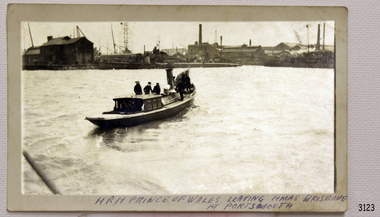
Photograph
... Black and white Photograph of HRH Prince of Wales leaving HMAS Brisbane at Portsmouth. 114mm x 69mm. ...flagstaff hill warrnambool shipwrecked-coast flagstaff-hill flagstaff-hill-maritime-museum maritime-museum shipwreck-coast flagstaff-hill-maritime-village black and white photograph Black and white Photograph of HRH Prince of Wales leaving HMAS Brisbane at Portsmouth. 114mm x 69mm. ...Black and white Photograph of HRH Prince of Wales leaving HMAS Brisbane at Portsmouth. 114mm x 69mm. SH 030 Ships A - B.flagstaff hill, warrnambool, shipwrecked-coast, flagstaff-hill, flagstaff-hill-maritime-museum, maritime-museum, shipwreck-coast, flagstaff-hill-maritime-village, black and white photograph -
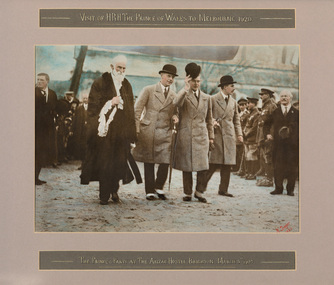 Bayside Gallery - Bayside City Council Art & Heritage Collection
Photograph - hand tinted gelatin silver photograph, H. Singer, The Prince and party at The Anzac Hostel, Brighton, 1920
... prince of wales...his royal highness...hrh...HRH Prince of Wales to City of Brighton on 5 June 1920 where he visited soldiers at Anzac Hostel. ...Thomas Wilson, Mayor of Brighton, in ceremonial robes on the left , HRH the Prince of Wales raises his hat to the crowd. ...In 1920 the Prince of Wales embarked on a journey to Australia on behalf of his father, King George V. While the visit was intended to strengthen the relationship between Australia and the Empire, the main objective was to offer thanks to the Australian men and women for the sacrifices and contributions that they had made during World War I. The Royal Tour began in April 1920 and covered 110 cities and towns across the country. The Prince spent eleven days in New South Wales, nine days in Victoria, four days in Tasmania, eleven days in Western Australia, six days in South Australia and eight days in Queensland. On Saturday 5 June 1920, following a morning at the races in Flemington, the Prince spent the afternoon at ANZAC Hostel in Brighton, where he chatted to wounded soldiers and, according to the newspaper reports at the time, "won the hearts of all present."prince of wales, his royal highness, hrh, royal tour, anzac hostel, brighton, mayor, cr. thomas wilson, soldiers, diggers, crowd, north road, kamesborough, bayside -
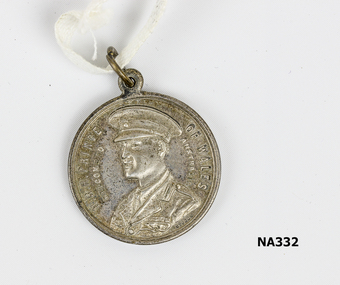 Whitehorse Historical Society Inc.
Award - Medal, 1920
... Prince of Wales Welcome to Australia with bust of H. R. H. Back: To Commemorate the visit of HRH Prince of Wales to Australia 1920...Prince of Wales Welcome to Australia with bust of H. R. H. Back: To Commemorate the visit of HRH Prince of Wales to Australia 1920 Silver plated embossed medal of 1920. ...Silver plated embossed medal of 1920.Front: H.R.H. Prince of Wales Welcome to Australia with bust of H. R. H. Back: To Commemorate the visit of HRH Prince of Wales to Australia 1920numismatics, medals - commemorative -
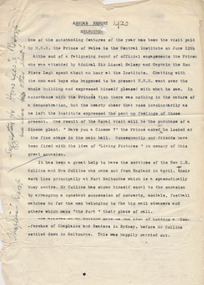 Mission to Seafarers Victoria
Document - Draft, 1920
... Draft for the 1920 Annual Report: Visit of HRH Prince of Wales on 12 June 1920...Draft for the 1920 Annual Report: Visit of HRH Prince of Wales on 12 June 1920 prince of wales cinema reverend alfred gurney goldsmith 4 printed and handwritten additions raft of the annual report for 1920 Document Draft ...Draft for the 1920 Annual Report: Visit of HRH Prince of Wales on 12 June 19204 printed and handwritten additions raft of the annual report for 1920 prince of wales, cinema, reverend alfred gurney goldsmith -
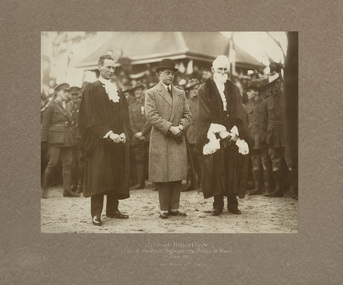 Bayside Gallery - Bayside City Council Art & Heritage Collection
Photograph - gelatin silver photograph, Visit of His Royal Highness the Prince of Wales to Brighton, 1920
... prince of wales...his royal highness...hrh...His Royal Highness the Prince of Wales came to the City of Brighton on 5 June 1920 where he visited soldiers at Anzac Hostel. Mr J.H. Taylor, Town Clerk on the left, HRH Prince of Wales in the centre, and Cr. ...Taylor, Town Clerk on the left, HRH Prince of Wales in the centre, and Cr. Thomas Wilson, Mayor of Brighton, in ceremonial robes on the right. ...In 1920 the Prince of Wales embarked on a journey to Australia on behalf of his father, King George V. While the visit was intended to strengthen the relationship between Australia and the Empire, the main objective was to offer thanks to the Australian men and women for the sacrifices and contributions that they had made during World War I. The Royal Tour began in April 1920 and covered 110 cities and towns across the country. The Prince spent eleven days in New South Wales, nine days in Victoria, four days in Tasmania, eleven days in Western Australia, six days in South Australia and eight days in Queensland. On Saturday 5 June 1920, following a morning at the races in Flemington, the Prince spent the afternoon at ANZAC Hostel in Brighton, where he chatted to wounded soldiers and, according to the newspaper reports at the time, "won the hearts of all present."prince of wales, his royal highness, hrh, royal tour, anzac hostel, brighton, mayor, cr. thomas wilson, j.h. taylor, town clerk, soldiers, diggers, crowd, north road, kamesborough, bayside -
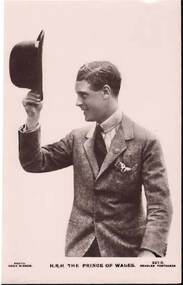 Bendigo Historical Society Inc.
Postcard - PRINCE OF WALES
... .postcard: HRH the Prince of Wales. Holding hat in hand, dressed in suit. ...ROYALTY British prince of wales royalty Prince of Wales .postcard: HRH the Prince of Wales. ....postcard: HRH the Prince of Wales. Holding hat in hand, dressed in suit. Beagles Postcard No. 327B On back in pencil, from MHS. 1927royalty, british, prince of wales, royalty, prince of wales -
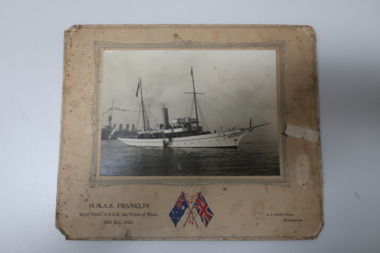 Williamstown Historical Society Inc
Photograph - Steam Yacht HMAS Franklin, A.C. Green, HMAS Franklin, 1920
... Franklin/Royal Yacht to HRH the Prince of Wales/28th May, 1920" "A.C. Green, Photo, Williamstown"...It was acquired by the Royal Australian Navy in 1915 and served as a temporary Royal Yacht for the Prince of Wales (later King Edward V11) during his tour of Australia in 1920, for day trips on Port Phillip Bay. Royal yacht on Port Phillip Bay King Edward HMS Franklin "H.M.A,S. Franklin/Royal Yacht to HRH ...The yacht HMAS Franklin was built in Leith, Scotland. It was acquired by the Royal Australian Navy in 1915 and served as a temporary Royal Yacht for the Prince of Wales (later King Edward V11) during his tour of Australia in 1920, for day trips on Port Phillip Bay.Royal yacht on Port Phillip BayCardboard framed black and white photograph of HMAS Franklin, most probably on Port Phillip Bay. Franklin was a steam yacht with one funnel and two masts. Yacht is under steam. Coloured image of crossed flags of Australia and Britain (symbol of friendship and cooperation) displayed at bottom of frame."H.M.A,S. Franklin/Royal Yacht to HRH the Prince of Wales/28th May, 1920" "A.C. Green, Photo, Williamstown"king edward, hms franklin -
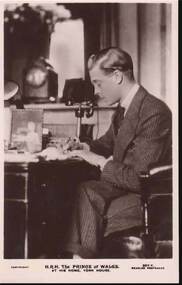 Bendigo Historical Society Inc.
Postcard - PRINCE OF WALES
... Postcard: Prince of Wales, sitting at desk, writing. On bottom, HRH the Prince of Wales, at the home. ...ROYALTY British prince of wales Prince of Wales royalty / Kellogg "Microphone" telephone Postcard: Prince of Wales, sitting at desk, writing. On bottom, HRH ...Postcard: Prince of Wales, sitting at desk, writing. On bottom, HRH the Prince of Wales, at the home. On back in pencil, from MHS. Beagles Post Cards.a Kellogg "Microphone" telephone is shown in the photoroyalty, british, prince of wales, prince of wales, royalty / kellogg "microphone" telephone -
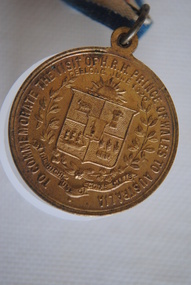 Anglesea and District Historical Society
Medal, Prince of Wales, 1920, 1920
... Obverse: 3/4 left bust of Prince in uniform wearing cap; around in 2 lines, HRH PRINCE OF WALES/ WELCOME TO AUSTRALIA; in small letters below bust, STOKES. ...royal visits wars and conflicts white australia policy wine ww1 1914 to 1918 prince of wales visit to australia - commemorative medal Obverse: 3/4 left bust of Prince in uniform wearing cap; around in 2 lines, HRH PRINCE OF WALES/ WELCOME TO AUSTRALIA; in small letters below bust, STOKES. ...Gilt bronze Australian Commemorative Medal with red, white and blue ribbon. In 1920 the Prince of Wales visited Australia to extend official thanks for its support during WW1 and to strengthen links to the Empire.Obverse: 3/4 left bust of Prince in uniform wearing cap; around in 2 lines, HRH PRINCE OF WALES/ WELCOME TO AUSTRALIA; in small letters below bust, STOKES. Reverse: Shield of Geelong featuring kangaroo on central shield surrounded by sheep, sailing ship and grapes 1/2 wine barrel. Above: GEELONG JUNE 1920. Below : ribbon with motto - "BY THE RIGHT USE OF GOD'S GIFTS".royal visits, wars and conflicts, white australia policy, wine, ww1 1914 to 1918, prince of wales visit to australia - commemorative medal -
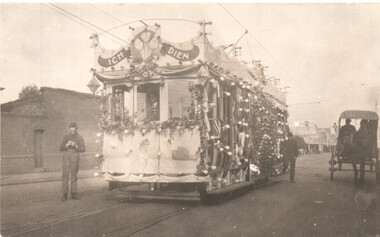 Melbourne Tram Museum
Photograph - Decorated tram - Prince of Wales Visit - set of 2, 5/1920
... Photos of a K class tram decorated for the Visit of HRH the Prince of Wales to Melbourne May and June 1920. ...Photos of a K class tram decorated for the Visit of HRH the Prince of Wales to Melbourne May and June 1920. ...Photos of a K class tram decorated for the Visit of HRH the Prince of Wales to Melbourne May and June 1920. See reference, and item 3941 for some of the MMTB documentation for the visit.Yields information about the tram decorated for the visit of the Prince of Wales in 1920.Black and white print with notes on the rear and a digital image.On rear in ink "Tram decorated by Lenel Walter, Mr Walter, Corlesstramways, mmtb, royal visit, k class, trams, decorated trams -
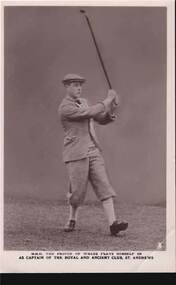 Bendigo Historical Society Inc.
Postcard - PRINCE OF WALES
... postcard: image shows Prince of Wales swinging a golf club , dressed in plus fours. On bottom : HRH the Prince of Wales plays himself in as Captain of the royal and ancient club, St. ...ROYALTY British prince of wales royalty Prince of Wales golf postcard: image shows Prince of Wales swinging a golf club , dressed in plus fours. On bottom : HRH ...postcard: image shows Prince of Wales swinging a golf club , dressed in plus fours. On bottom : HRH the Prince of Wales plays himself in as Captain of the royal and ancient club, St. Andrews.(sic) On rear: Tuck's Post Card 3676royalty, british, prince of wales, royalty, prince of wales, golf -
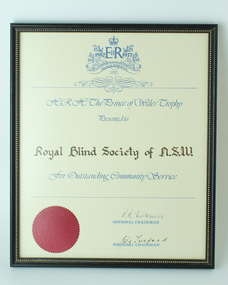 Vision Australia
Certificate - Text, H.R.H. The Prince of Wales Trophy to Royal Blind Society of N.S.W, 1977
... In 1977 the Royal Blind Society of New South Wales was awarded the HRH The Prince of Wales trophy for outstanding community service. ...In 1977 the Royal Blind Society of New South Wales was awarded the HRH The Prince of Wales trophy for outstanding community service. ...In 1977 the Royal Blind Society of New South Wales was awarded the HRH The Prince of Wales trophy for outstanding community service. The certificate was signed by P.R. Mitchell (National Chairman) and Reg Lusford (Regional Chairman).1 cream page with seal of Queens Silver Jubilee TrustAt the head of the page: the Royal crown then below a spray of flowers sit either side of the initials "ER II" and the dates "1952" and "1977" amongst the flowers. Beneath that reads "The Queens Elizabeth Silver Jubilee Trust for Young Australians". All text and illustrations are in blue.royal blind society of nsw, awards -
Dandenong/Cranbourne RSL Sub Branch
Memorabilia - Wooden Plaque with Photograph
... A set of Australian Flying Corps wings is carved underneath a photograph of HRH Edward, the Prince of Wales....A set of Australian Flying Corps wings is carved underneath a photograph of HRH Edward, the Prince of Wales. Memorabilia Wooden Plaque with Photograph ...Wooden plaque which appears to be part of an aircraft propeller. A set of Australian Flying Corps wings is carved underneath a photograph of HRH Edward, the Prince of Wales.AFC Wings -
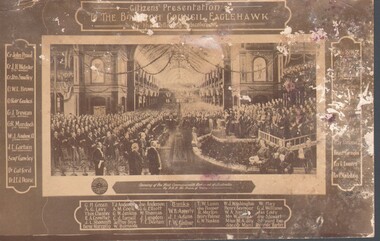 Bendigo Historical Society Inc.
Postcard - WES HARRY COLLECTION: OPENING OF THE FIRST PARLIAMENT, 1902
... Postcard depicting the opening of the first parliament of the Commonwealth of Australia in the Exhibition Building Melbourne by HRH The Prince of Wales. Printed along the top of the card is ' Citizen's presentation to the Borough Council Eaglehawk. ...POSTCARD Opening of the first Parliament Exhibition Buildings Borough Council Eaglehawk Postcard depicting the opening of the first parliament of the Commonwealth of Australia in the Exhibition Building Melbourne by HRH The Prince of Wales. Printed along the top of the card is ' Citizen's presentation to the Borough Council Eaglehawk. ...Postcard depicting the opening of the first parliament of the Commonwealth of Australia in the Exhibition Building Melbourne by HRH The Prince of Wales. Printed along the top of the card is ' Citizen's presentation to the Borough Council Eaglehawk. Down the sides and across the bottom is a list of about 60 names of citizens in Eaglehawk.postcard, opening of the first parliament, exhibition buildings, borough council eaglehawk -
 Bayside Gallery - Bayside City Council Art & Heritage Collection
Photograph - gelatin silver photograph, Visit of His Royal Highness the Prince of Wales to the Municipality of Brighton, 1920
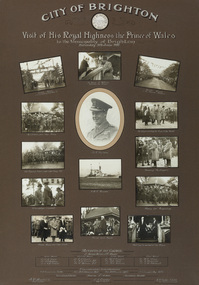
... prince of wales...his royal highness...hrh...Compilation of 14 gelatin silver photographs relating to the visit of HRH Prince of Wales to City of Brighton on 5 June 1920. 13 photographs are rectangular and one portrait is oval, each with handwritten inscription below. ...Prince spent eleven days in New South Wales, nine days in Victoria, four days in Tasmania, eleven days in Western Australia, six days in South Australia and eight days in Queensland. On Saturday 5 June 1920, following a morning at the races in Flemington, the Prince spent the afternoon at ANZAC Hostel in Brighton, where he chatted to wounded soldiers and, according to the newspaper reports at the time, "won the hearts of all present." prince of wales his royal highness hrh royal tour anzac hostel brighton mayor cr. thomas wilson j.h. taylor town clerk soldiers diggers crowd guard of honour captain grieve h.m.s. renown north road kamesborough bayside Compilation of 14 gelatin silver photographs relating to the visit of HRH Prince of Wales to City of Brighton on 5 June 1920. 13 photographs are rectangular and one portrait is oval, each with handwritten inscription below. ...In 1920 the Prince of Wales embarked on a journey to Australia on behalf of his father, King George V. While the visit was intended to strengthen the relationship between Australia and the Empire, the main objective was to offer thanks to the Australian men and women for the sacrifices and contributions that they had made during World War I. The Royal Tour began in April 1920 and covered 110 cities and towns across the country. The Prince spent eleven days in New South Wales, nine days in Victoria, four days in Tasmania, eleven days in Western Australia, six days in South Australia and eight days in Queensland. On Saturday 5 June 1920, following a morning at the races in Flemington, the Prince spent the afternoon at ANZAC Hostel in Brighton, where he chatted to wounded soldiers and, according to the newspaper reports at the time, "won the hearts of all present."prince of wales, his royal highness, hrh, royal tour, anzac hostel, brighton, mayor, cr. thomas wilson, j.h. taylor, town clerk, soldiers, diggers, crowd, guard of honour, captain grieve, h.m.s. renown, north road, kamesborough, bayside -
 Glen Eira City Council History and Heritage Collection
Booklet, "Souvenir of H.R.H. Prince of Wales' Visit to Caulfield 31ST MAY, 1920", c. 1920
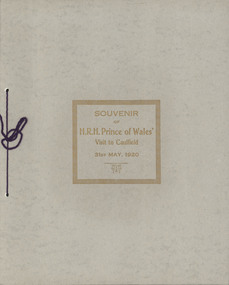
... The booklet contains 5 pages with black and white facsimile copy of cover and pages from a book possibly presented to HRH Prince Edward of Wales on the occasion of his visit. ...Prince of Wales' to Australia in 1920. Grey paper cover with gold printed text bound with purple wool thread. The booklet contains 5 pages with black and white facsimile copy of cover and pages from a book possibly presented to HRH Prince Edward of Wales on the occasion of his visit. ...Booklet created by Caulfield City Council on the occasion of the visit of H. R. H. Prince of Wales' to Australia in 1920.Grey paper cover with gold printed text bound with purple wool thread. The booklet contains 5 pages with black and white facsimile copy of cover and pages from a book possibly presented to HRH Prince Edward of Wales on the occasion of his visit. Final page is a copy of a letter from H.R.H to the City of Caulfield. -
 Bendigo Historical Society Inc.
Document - BASIL WATSON COLLECTION: 'THE ROSS SMITH FLIGHT FROM ENGLAND TO AUSTRALIA' - TRAVELOGUE PROMOTION, c. 1920
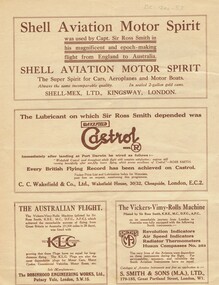
... On cover ' Under the patronage of HRH The Prince of Wales, The Ross Smith Flight from England to Australia' Includes short story of the flight by Capt. ...On cover ' Under the patronage of HRH The Prince of Wales, The Ross Smith Flight from England to Australia' Includes short story of the flight by Capt. ...Booklet: 'The Ross Smith Flight from England to Australia' - 4 page Travelogue booklet promotion for the Lowell Thomas Travelogues series, Re flight from England to Australia. On cover ' Under the patronage of HRH The Prince of Wales, The Ross Smith Flight from England to Australia' Includes short story of the flight by Capt. Sir Ross Smith, KB, MC, DFC, AFC. , map of flight and photos of Ross and Keith Smith. List of pictures shown in the travelogue. Original signatures of Ross and Keith Smith on the front cover.person, individual, ross smith -
 Mission to Seafarers Victoria
Administrative record (item) - Visitor logbook, Visitors, 1907 - 1951
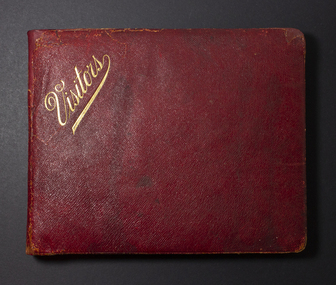
... - the signature of HRH Edward, then Prince of Wales, and a newspaper clipping, detailing his visit, during has Australian tour in 1920... - the signature of HRH Edward, then Prince of Wales, and a newspaper clipping, detailing his visit, during has Australian tour in 1920 ...The book was used as a visitors book for the early Mission to Seafarers. The first date in the book is the 13th of December, 1907, although there are almost six pages of signatures before this. The last signature is dated the 28th of June, 1951. The book documents some of the most significant moments of the Central Institute: - the Opening Ceremony of the "new" Mission to Seafarers building in September 1917. - the signature of HRH Edward, then Prince of Wales, and a newspaper clipping, detailing his visit, during has Australian tour in 1920. - the visit by the Governors General including HRH the Duke and Duchess of Gloucester in 1945. Also registered: the Australian Chaplains conference attendees of both 1936 and 1949. Many supporters, ladies from the Guild and seafarers signed the book.The book is a significant record of VIP visitors to the Mission to Seafarers 1907 to 1951. It records respective Opening Ceremonies for Mission Buildings of both 1907 and 1917 and attendees. The book also documents a visit from Edward, Prince of Wales in 1920, travelling on the H.M.S "Renown". Significant national and international visitors throughout the first half of the 20th Century range from the royal, Vice regal and political through to international Members of the Mission to Seafarers, participants in diocesan conferences and AGMs.Printed in gold on the front cover: VISITORS; First name registered and handwritten: "Northcote" in black ink ; Last name entered "Paul Morra"signatures, handwriting, 1907-1951, h.m.s-renown, duke of gloucester, chaplain conferences, catherine florence aviss nee frampton, martin frampton, elizabeth frampton, herbert aviss, prince of wales, duchess of gloucester, seafarers, sailors, seamen, prince edward, opening ceremony, edward northcote (1854-1926) -
Bendigo Historical Society Inc.
Booklet - Fortuna Villa Tour Guide, abt 2013
... George Lansell’s historic talisman has hosted some iconic characters itself, including leaders and diplomats, Dame Nellie Melba and even HRH the Prince of Wales and the Duke of Edinburgh....George Lansell’s historic talisman has hosted some iconic characters itself, including leaders and diplomats, Dame Nellie Melba and even HRH the Prince of Wales and the Duke of Edinburgh. history bendigo fortuna George Lansell Fortuna Villa Tour Guide, seven pages - Photos, History and guide with description for each room or aspect. ...In 1871, the Villa and the associated ‘180 Mine’ on the New Chum Reef was bought by George Lansell who had become successful in his gold mining interests and investments. With his continuing success in deep mining, Lansell undertook major extensions to his home, and in fact continued this expansion and decoration of Fortuna until his death almost 40 years later. Fortuna Villa remains remarkably intact as a house even though it has served as a busy workplace for 65 years. Stained glass, elaborate ceilings, grand cedar and blackwood staircase, solid marble baths, extensive acid-etched glasswork (conservatory) are some of the architectural features that contribute to the outstanding ‘feel’ of the structure. The Fortuna grounds cover some 7.57 ha. and feature an ornamental lake, garden, a ‘Roman-Bath’ and the ‘Pompeii Fountain’. The original quartz-crushing battery building, stables and coach house remain close to the main villa. The magnificent villa itself is the aspirational centerpiece to this remarkable property. It is set in botanic-style gardens featuring established trees. George Lansell’s historic talisman has hosted some iconic characters itself, including leaders and diplomats, Dame Nellie Melba and even HRH the Prince of Wales and the Duke of Edinburgh.Fortuna Villa Tour Guide, seven pages - Photos, History and guide with description for each room or aspect. Chronology on back cover.history, bendigo, fortuna, george lansell -
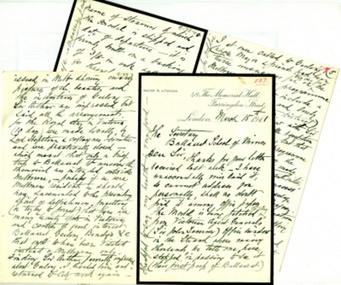 Federation University Historical Collection
Letter - Correspondence, Walter M. Hitchcock, Letters from Walter M. Hitchcock concerning a model of a Ballarat tent (and more), 1911, 1911 (exact)
... All the tools, mining appliances, cradle, windlass, &c will be separately packed enclosed – which you can easily place in respective positions. HRH Prince of Wales has graciously accepted a photo of it – and in my letter to him when sending it for his acceptance I said – as he would probably ere long visit Australia as did his grandfather and father, which ought to (and certainly will) include at least a day or two in seeing your beautiful City, and also something of your mines &c instead of the hurried visit of his father (2 hours) when he, as Duke of York, unveiled a statue to the memory of those slain in the sad Boer War, which now is admitted by almost everybody to have been a big political mistake, - though in the future with England’s present wise policy towards that country it will prove for Africa’s welfare. ...All the tools, mining appliances, cradle, windlass, &c will be separately packed enclosed – which you can easily place in respective positions. HRH Prince of Wales has graciously accepted a photo of it – and in my letter to him when sending it for his acceptance I said – as he would probably ere long visit Australia as did his grandfather and father, which ought to (and certainly will) include at least a day or two in seeing your beautiful City, and also something of your mines &c instead of the hurried visit of his father (2 hours) when he, as Duke of York, unveiled a statue to the memory of those slain in the sad Boer War, which now is admitted by almost everybody to have been a big political mistake, - though in the future with England’s present wise policy towards that country it will prove for Africa’s welfare. ...The tent model mentioned in the letters was displayed in the Ballarat School of Mines Museum. During the 1960s it was transferred to the Ballarat Historical Society. Two handwritten letters on paper with black mourning edge written by Walter M. Hitchcock to the Ballarat School of Mines, and another written by Walter's brother George M. Hitchcock.Letter transcription follow: Letter from Walter M. Hitchcock regarding the death of James Oddie and early gold mining at Ballarat, 1910 and 1911 48 The Memorial Hall Farringdon St London Dec1/10 The Secretary Ballarat Museum Dear Sir, I am just now sending you this line, i anticipation of further correspondence later on, simply to forward you a Post Card of the 1st mining tent erected 1851 on the site of he then newly proclaimed Township of Ballarat, which, as the sole survivor of the party who built the original, I have had the pleasure in making, and have decided to present it to your museum, Sir Jno Lasenor out Agent General for Victoria came to a Bazaar recently held in London. where I had it on view in the museum from 3 days, - and desired I would allow its [ ? ] exhibited in the first large window of the beautiful new building of the Victoria Agency situate in the Strand. It is there for the past few days and he may wish it to remain a week or two longer, I know of no other exhibition of it to delay it being packed and shipped to my relatives in Geelong (Mr [?] Bright of Hitchock's Firm) who may wish to show it in one of their windows before forwarding it to your museum - I have had an itemised pane glass case made for it with drop down end and [?} it stands on a plateau of moss, to represent grass 32 x 13 x 13 high and chimney 14 1/2 - the case is made 34 x 26 x 20 high inside - I shall have it very carefully packed - tent emptied tools, beds, &c &c in separate packing and insured for 50 pounds - I will send you full details later on. I hope and believe your President will accept it in due time Meantime believe me to be very truly Cat Walter Hitchcock G.F.B. 48 The Memorial Hall Farringdon St London March 15th 1911 The Secretary Ballarat School of Mines Dear Sir, Thanks for your letter received last week – I have unaccountably mislaid it, so cannot address you personally, shall no doubt find it among office papers. The model is being fetched today from Victorian Agent General’s (Sir John [Lavernor?] office window in the Strand where many thousands, he tells me, have stopped in passing to see it (their first peep of Ballaarat). It will be on view at Blackheath (Kent) for a week, then packed and shipped without further delay. I shall enclose in the glass case (which is 26 x 34 x 16 in high) some spare minced moss and gas (smoke) in case in transit the plateau suffers by shaking (though it is well glued down). All the tools, mining appliances, cradle, windlass, &c will be separately packed enclosed – which you can easily place in respective positions. HRH Prince of Wales has graciously accepted a photo of it – and in my letter to him when sending it for his acceptance I said – as he would probably ere long visit Australia as did his grandfather and father, which ought to (and certainly will) include at least a day or two in seeing your beautiful City, and also something of your mines &c instead of the hurried visit of his father (2 hours) when he, as Duke of York, unveiled a statue to the memory of those slain in the sad Boer War, which now is admitted by almost everybody to have been a big political mistake, - though in the future with England’s present wise policy towards that country it will prove for Africa’s welfare. It may interest you to know that when I ascertained that Geelong was not to be visited by the Royal Pair – I went up to St James’s Palace by appointed time the Duke’s private Secy Sir Arthur Bigge – taking with me a specially illustrated paper issued in Melb. showing many pictures of the beauties and industries of Geelong – Sir Arthur was impressed but said all the arrangements for the Royal stay in Victoria (10 days) were made locally, by Lord Hopetoun and collegues and committee, and were practically closed – which meant that only a brief trip to Ballarat to uncover the memorial was intended outside Melbourne. Perhaps if we were Melbourne residents we should have succumbed to the prevailing spirit of selfishness – forgetting (or trying to forget) that there are many beauty spots in Victoria and centres of great interest - Ballarat, Geelong, Bendigo, &c that ought to have been visited instead of Melbourne only. Finding Sir Arthur favorably impressed about Geelong I thanked him and returned to City work again. I at once called to Geelong whose mayor and friends had been twice unsuccessful in trying for the Melbourne functions programme being altered to include a visit to Geelong and lovely spots in the Western District, reporting my interview with Sir A B and his favourable reception of my representations, but that any alteration to the programme of engagements during the Royal visit must be made locally and by the local authorities. This had the desired success for on receipt of my message the Geelong mayor and colleagues again reopened the question and went to Melbourne, resulting in a concession (but what an altogether inadequate one) and they graciously ? consented to the train, on its way with the Duke and Duchess to your city, to stop at the Geelong stn (15 minutes) and so it came about that by a hasty local effort, 3,000 school children, and not a few of the leading people including the Mayor &c were gathered to welcome them in Geelong. The National anthem being sung, an Address read and presented and kindly replied to. Now Ballarat should doubtless has influence. See to it when our P. Of Wales visits Victoria – an unselfish ¬ programme is fixed up – and HRH afforded ample opportunity of visiting leisurely your city, Geelong, Bendigo and other centres of beauty and importance. The Prince himself will be the gainer by such an equitable and enlightened programme, - and come back with all the more favourable views of the marvellous development ever since our family first settled in Geelong in 1850. A far preferable result of such a visit than night after night having Melbourne Banquets and the visiting of its undoubted attractions - whilst all the rest of the State remained unvisited. Such an official mistake must not be made again. I will write you again, stating name of steamer of which the model is shipped and date of departure – it is firmly built on a backing of 3/8 in oak tall uprights so through the 7/8 in plateau and am entrusting the packing be very careful. I expressed firm – so that except possibly any breakage in glass case – it should reach you in due time all right. The top of case will be screwed so that it can be readily removed temporarily to enable my [ ? ] firm to show it in one of their windows. Believe me Yours very truly Captn Walter M. Hitchcock My brother will deliver it on my a/c – all carriage paid. Mt very kind regards to my friend since 1850 Jas Oddie. University of Ballarat Historical Collection Cat. No. 8133.3 & .4 Letter from Walter M. Hitchcock regarding the death of James Oddie and early gold mining at Ballarat, 1911 48 The Memorial Hall Farringdon St London April 20th 1911 My Dear Sir, It is with no ordinary feeling of regret that I received the tidings of the death of my good friend, your fellow citizen for many years, Mr James Oddie. Living at Geelong from March 1850 I came to know him there as carrying on a foundry business in Ashby. With the discovery of gold at Ballarat started off almost of the working people, as well as of all other classes of the male population. Mr Oddie arrived in Ballarat I believe on or about September 1st 1851. My three comrades and I arrived October 1st 1851 – among the many thousands soon gathered within a mile or so of Golden Point – my friend Oddie and I often met. I returning to Geelong after a year mining – my friend on the other hand remaining at Ballarat ever since – a marvellous record, and I am sure his life has been one of unique value to your City in many ways, - his age (87) naturally prepared me for his call home – and only two mails before the news came I received from him on of his kindly chatty letters in which amongst other things – he referred with pleasure to having received from me two 10 x 12 photos – one being of my model and that he was arranging to have it placed in a shop window in your city. I am interested in the fact of your having known each of my three comrades of 1851/52. It was J.M. Garrett and I who got permission to conduct public Sunday morning service in their large Marquee – used all the week for issue of Licenses in the absence of any church buildings, and it being on wet Sundays impossible to have services as usual under the trees – Ballarat then was more like a Gentleman’s Park – than bush country – but the axe soon did its work – and all were felled for our cooking, and hencewith to make our kindling etc. Shafting of holes not being at first done because too shallow – our deepest (at Eureka) was only 115 ft. Bendigo I hear had now mines of 4,000 ft in depth (deeper than our tin or coal mines here). I fortunately have, in excellent state of preservation, my last of 12 licenses dated October 1 1852 and have recently purchased here a Miner’s Right dated 1864, to that when explaining on matters re Gold Licensing I can show sample of each. With kind regards Believe me Yours sincerely Walter M. Hitchcock Geelong June 20/11 Dear Sir, By rail to day through Messrs Bannister I send the model of miner’s tent packed in a case 50 donated by my brother Captain Walter M. Hitchcock of London. This model was made by my brother and represents the tent he worked in on the Ballarat Gold Fields in the year 1851 or 2. In a separate parcel a few extras omitted from the case. Please send me receipts in duplicate, one for my brother, the other for the Customs, Geelong, as being donated to your institution, after some little correspondence it was admitted [??] any payment for duty. You probably have my brother’s address and would like to acknowledge its arrival, direct. I hope it is in good order. I did not open it for show in Geelong, as there would be less risk of breakage on repacking. With kind remembrances. I am Yours Faithfully Geo. M. Hitchcock. A Mr G. F. B. Sharick who is living near my home called in to see my model – he said he knew FM [Fred Martell] and was lately at Ballaratballarat school of mines, frederick martell, fred martell, james oddie, walter m hitchcock, walter hitchcock, f m garratt, george hitchcock, hitchcock, golden point, gold discovery, j m garrett, gold license, j.m. garrett, t.m. hall, george m. hitchcock, f.m. garratt, walter m. hitchcock -
 City of Melbourne Libraries
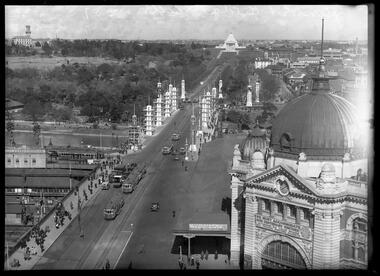
Photograph, Bull, Hugh Jones, 1897-1993, Princes Bridge Centenary pylons under construction
... The second bridge was stone (completed 1850), and named Prince’s Bridge after the HRH Prince of Wales, later Edward VII. It was designed with an elliptical single arc and an exceedingly small rise in proportion to the span. ...The second bridge was stone (completed 1850), and named Prince’s Bridge after the HRH Prince of Wales, later Edward VII. It was designed with an elliptical single arc and an exceedingly small rise in proportion to the span. ...Princes Bridge Centenary pylons under construction Possibly taken from Young and Jacksons Hotel (formerly Princes Bridge Hotel) on the corner of Flinders and Swanston streets, Flinders Street Station’s clocks and main entrance dominate, along with its distinctive copper dome and decorative façade. The time on the main clock is 1.40pm, and the sign underneath, reflecting Melbourne’s upcoming Centenary reads, “We must accommodate our Centenary visitors! Citizens! Do your share by taking paying guests.” At left is the original Princes Bridge Station, today the site of Federation Square. The riverside tram terminus advertises a Café/Tobacconist/Refreshment Room selling cigars & cigarettes, fountain drinks & confectionery, and in smaller text: “Leave your boot repairs here”. Nearly everyone is dressed in dark suits, coats and hats. The footpaths are wide and there are no traffic lights. The roadway stretches towards the Shrine of Remembrance, not yet dedicated but very dominant on the skyline. Government House is clearly visible across the wide parkland that would come to be known as Kings Domain and that is an area of deep importance to the people of the Eastern Kulin. Originally, Birrarung was part of a network of swamps and lagoons linked to the course of the river. From 1896, Public Works Department engineer Carlo Catani, oversaw a new channel to straighten the river and the swamps and lagoons were filled with spoil from the channel works. From the same vantage point today, only the top of the tower of Government House would be visible. The photo captures the pylons along Princes Bridge, mid-construction and being installed to mark Melbourne’s Centenary. The pylons were not without controversy. Both The Argus and The Age bemoaned them for being “made almost entirely of imported softwood timber”, denying work to native hardwood timber workers and sawmillers, and leading visitors to think Australia did not have its own exceptional native hardwoods. The pylons were also variously described in their incomplete state, as unimaginative and resembling an oilfield. Published: The Age 5 September 1934 Featured in "Newsworthy: Melbourne in photographs 1933-1936" exhibition at East Melbourne Library, October to December 2023. Exhibition caption by project volunteer, Louise McKenzie Photographer notations on slide: "Pylons + St Kilda Rd C57" Published: Age (Melbourne, Vic. : 1854 - 1954), Wednesday 5 September 1934, page 11 Published title: DECORATIONS -- THEN AND NOW. Published caption: "Although not completed yet, some impression of the effect of the decorations on Princes-bridge may be obtained from the first picture which shows the majestic sweep of St Kilda road with the Shrine of Remembrance and Government House dominating the horizon. The area to the left of St. Kilda-road and in front of Government House is portion of the area which it is proposed to call the King's Domain, which extends to Domain-road and Anderson-street..." Description: East-facing, elevated view of Flinders Street Station and Princes Bridge, featuring partially completed pylons erected for Melbourne's Centenary celebrations. The Shrine of Remembrance and Government House can be seen in the distance. In the foreground are trams, cars and trucks, pedestrians, Batman Avenue tram terminus and refreshment rooms. Signage on Flinders Street Station encourages citizens to accommodate Centenary visitors. The Melbourne Centenary was held 1934-35 in celebration John Batman's proclamation that Melbourne "the place for a village". Centenary events included a visit by Prince Henry, Duke of Gloucester. A Centenary Cake measuring 50 feet in height and ten tons in weight was cut into 250,000 pieces and sold at 1 shilling per piece for charity. Spectacular floodlighting of city landmarks, the creation of the Pioneer Women's Memorial Garden, and the MacRobertson Air Race from London, were other notable activities. Research by project volunteer, Louise McKenzie: The photo in The Age collage of 5 September 1934 has a slightly cropped foreground. The original photo has been taken from an elevated vantage point, most probably the roof of the Nicholas Building on the corner of Flinders and Swanston streets. The right foreground is dominated by the main “clocks” entrance to Flinders Street Station, showing its distinctive copper dome and decorative façade. The time on the main clock is 1.40 pm. The main sign on the front of the Station reads, "We Must Accommodate our Centenary Visitors! Citizens! Do your share by taking paying guests. Write to The Official Centenary Accommodation Bureau, 436 Collins St. City. Tel M 4671”. Another sign at eye level at the main entrance says: “Cheap Trips on Sundays”. The sign on the end of the roof along the eastern side of the station reads, “The Babies Need Your Help! Support Broadmeadows Foundling Hospital Appeal. July and August”. Run by the Sisters of St Joseph of the Sacred Heart, St Joseph’s Foundling Hospital was a purpose built infants’ home for up to 300 babies, plus accommodation for expectant mothers, mainly single women. In the early 1930s, the department (Victorian Children’s Welfare Department) contracted St Joseph’s Foundling Hospital to care for an additional 60 infant state wards, and up to 175 non wards at any given time. In 1931 it also operated a mothercraft training school. The centre foreground shows the commencement of Princes Bridge. Beneath the left side of the bridge was the site of the original Princes Bridge Station, by this time incorporated into Flinders Street Station, and today the area is the site of Federation Square. It was linked to Flinders Street station by the railway tracks that ran underneath the northern approach to the bridge. This photo shows a tram terminus which has a Café/Tobacconist/Refreshment Room, selling cigars & cigarettes, fountain drinks & confectionary, and a sign: Leave your boot repairs here. In the foreground is a wide roadway running south/north, comprising two vehicle lanes each heading north/south, and a central section containing two sets of tram tracks. There are cars, buses and delivery vans on the roadway. The trams visible are Glen Iris (Route No. 6; tram no. 448), Toorak (Route No. 8, tram no. 333), ? (No. 7), ? (No. 1), and ? (No. 2A). The footpaths are extremely wide. There is a square newspaper/magazine stand on the eastern side footpath. And also a “Ferry” sign. There are no traffic lights, but a policeman is visible on the roadway. There are pedestrians – men, women, children, a porter with trolley, women with prams. Clothing comprises dark suits, coats and hats for nearly everyone. There are double headed “Collins Street” lights along the side of the roadway, and along the northern riverbank. The roadway in the foreground is an extension of Swanston Street, which becomes Princes Bridge, then St Kilda Road, stretching towards the Shrine of Remembrance, and diverting past it. The Shrine had not yet been officially dedicated, and looks very white and dominant on the skyline. On the LHS of St Kilda Road, Government House is clearly visible across the wide parkland to be known as Kings Domain. The Kings Domain area is important to the people of the Eastern Kulin nation, and also has historical importance for its association with the early settlement of Melbourne and the foundation of British colonial administration in Victoria. On the southern side of the Yarra River (Birrarung) an historic rowing boathouse is visible, located adjacent to the Alexandra Gardens. Originally Birrarung was part of a network of swamps and lagoons linked to the course of the river. From 1896, under the guidance of engineer Carlo Catani* a new channel to straighten the river was created and the swamps and lagoons were filled with spoil from the channel works. The gardens were then created and completed in time for a Royal visit by the Duke of York in May 1901. The gardens are named after Alexandra of Denmark, the wife of King Edward VII. Both these areas, plus the Royal Botanic Gardens Victoria, Shrine of Remembrance Reserve, Sidney Myer Music Bowl, Government House, and the Queen Victoria Gardens together form the Domain Parklands. The extent of the subsequent plantings is evident today, where from the same vantage point only the top of the tower of Government House would be visible. *Catani was born in Florence in 1852, but after arriving in Melbourne worked as a civil engineer for the Victorian Government. His last major project was the reclamation of the foreshore of St Kilda, envisaged in the style of a European resort, complete with a split level esplanade, bathing pavilions, dance halls, amusements and a French-Italian style of landscape complete with palms. The gardens at the end of Fitzroy Street, St Kilda, now bear his name. The historic boathouse visible across the Yarra is another glimpse into Melbourne’s past. “Boathouse Row” comprises 7 amateur rowing clubs, the first established in 1859 (Melbourne University Boat Club). Other Clubs were Richmond, Melbourne, Banks, Melbourne Grammar School, Yarra Yarra and Mercantile. South of the river and west of the bridge is an area today developed into the Melbourne arts precinct of Hamer Hall and the Arts Centre. But at this time it was the home of Wirths Olympia Circus, which comprised Wirths Pleasure Park (an amusement park), a 5,000 seat auditorium – Hippodrome, a roller skating rink, a glaciarium, a cinema, and the Green Mill Dance Hall. Dog shows were also held at Olympia. The Green Mill Dance Hall closed in 1950, and the remainder of the Wirth buildings on site were destroyed by fire in December 1953. The feature of the photo is the pylons erected along Princes Bridge to mark Melbourne’s Centenary in 1934. The sixteen plastered pylons were designed by Roy Prentice, the second person to qualify as an architect at The University of Melbourne’s Bachelor of Architecture degree, in 1933, aged 27. Simon Reeves in his article marking the 100th birthday of Roy Prentice on 20 June 2006 reports that the State Electricity Commission sponsored this work, and the Argus reported that “… the pylons were “illuminated from within to give the effect of soft radiance”. Australia Home Beautiful 1 Oct 1934 reports in a very detailed and comprehensive article: The 10 taller pylons, including flagpole, were 48 ft, with a base of 8 ft. Timber-framed and faced with fibrous plaster and galvanised sheet iron, each structure was securely bolted to a concrete foundation three feet in depth. Panels of glass let into the shaft of each pylon were indirectly lit by 40, 100 watt lamps, and the upper bank of internal lamps were dyed so as to flood the panels with a deep red light. The decorative painted shields and flagpoles/pennants were illuminated by three 200 watt projectors concealed in the roof of each pylon, and were part of an electric night light decoration scheme involving 28 miles of wire to supply more than 20,000 lights. An article in the Argus on 18 October 1934 provided minute detail of the lighting erected in Melbourne for the Centenary, converting it “… into a coloured fairyland by night.” The estimated cost of 10 pounds per hour the lights were on. The display included 800 standard light poles 30 feet high which were tiered with electric bulbs concealed in inverted cones, 138 specially designed “Venetian poles” draped in flags trophies and streamers. The streets included in the electric night light decoration scheme were Bourke Street from Spring to William, the entire length of Collins Street, Flinders Street from Elizabeth to Spring, Lonsdale Street from Elizabeth to Swanston, Swanston and Elizabeth Streets from Flinders to Lonsdale, and parts of Springs and Spencer Streets. Together with the Princes Bridge pylons, approximately 28 miles of wire was required to supply power to the more than 20,000 lights. And that is just in the city of Melbourne. It was estimated the same amount of lighting was duplicated among other local councils. The pylons were not without controversy. The Argus on 28 August 1934 in an article headed “Imported Timber in Pylons” reported that the Princes Bridge pylons are “made almost entirely of imported softwood timber”, and have therefore denied work to native hardwood timber workers and sawmillers. The same day the Melbourne Age ran a similar story, bemoaning the fact that foreign oregon had been used which may lead tourists to think Australia did not have its own exceptional native hardwoods. A Camberwell City Councillor described the pylons as unimaginative, and the Herald reported that skeletons of pylons for the Centenary decorations in their present form led the area to resemble an oilfield! The Yarra River and Princes Bridge have long been a focal point of Melbourne life. In the early days of European settlement in Melbourne a rope-hauled punt carried people across the Yarra River. A surge in population and increased shipping traffic created a need for a bridge. There was difficulty in agreeing on a suitable site for the bridge (options were crossing at Elizabeth, Swanston, Queen or Market Streets), but the NSW Government favoured Swanston Street and the Melbourne Town Council decided on a temporary bridge across the Yarra spanning from the foot of Swanston Street. This first bridge was a single span timber toll bridge designed by Scottish born bridge designer David Lennox, and completed in 1845. It was 120 feet long, had a roadway of 17 feet wide, and a footpath on one side of 4 feet. It was leased to the Melbourne Bridge Company in the name of Robert A Balbirnie. The tollhouse was on the north side of the river and the toll keeper, Patrick Doherty, was credited with saving nine lives during the four years he was in charge of the toll station. The second bridge was stone (completed 1850), and named Prince’s Bridge after the HRH Prince of Wales, later Edward VII. It was designed with an elliptical single arc and an exceedingly small rise in proportion to the span. However, this design created an obstacle for flood waters, and together with Melbourne’s increasing population it was quickly apparent that a new bridge was required. At its opening on 15 November 1850 coincided with the imminent declaration of Victoria as a separate colony, it provided a moment of great celebration for Melbournians and “The opening ceremony was described as the grandest processional display witnessed in the colony.” (ToMelbourne.com.au) Princes Bridge in its present form, as depicted in this photograph, was designed by Jenkins, D’Ebro and Grainger, and constructed in 1886-88 by David Munro. John Grainger (father of Australian composer Percy Grainger) did the majority of the design work for the bridge. The structure was to have three arches each 96 feet wide measured across the river, and the banks on both sides were raised to allow more space for floodwater to flow. St Kilda Road was originally many feet below the current level. The bridge is of architectural significance for its substantial size, giant half columns, extensive use of wrought and cast iron, decorative elements (cast-iron lamps) and the skilled stonemasonry in the construction of the abutments and piers. Its main design features are similar to those of Blackfriars Bridge in London (1870). The bluestones were quarried from Footscray, the Malmsbury stones were from quarries at Kyneton, and the granite from Harcourt. The cost was met by the State of Victoria, City of Melbourne, and six out of seven of its municipalities, and their coats of arms feature on the bridge. The building of the bridge reflected the boom period of Melbourne, including the Victorian gold rush 1851- late 1860s, and its contractor, David Munro, was also responsible for the construction of Queens Bridge and Sandridge Railway Bridge. The Centenary pylons are no longer in place, but today this intersection still plays a major part in Melbourne’s daily life: people still meet “under the clocks” at Flinders Street station, and the route in and out of the city along St Kilda Road is often a feature of parades such as Moomba, the Grand Final Parade, and of course the Anzac Day Parade which commences at the Princes Bridge intersection and finishes at the Shrine of Remembrance. There are many tram routes, which cross the Bridge, and it directs pedestrians towards the Arts Precinct, the various components of Domain Park, plus the Southbank restaurant and rowing precincts. Even though this is a street scene, it feels very intimate; the viewer is instantly immersed in the activity of a Melbourne afternoon, looking down St Kilda Road from a viewpoint near today’s Federation Square. References: DECORATIONS -- THEN AND NOW. (1934, September 5). The Age (Melbourne, Vic. : 1854 - 1954), p. 11. Retrieved September 21, 2023, from http://nla.gov.au/nla.news-article205880269 'Flinders Street railway station', Wikipedia, https://en.wikipedia.org/wiki/Flinders_Street_railway_station 'St Joseph’s Foundling Hospital (1901-75)', Finding Records, Department of Health and Human Services, State of Victoria, https://www.findingrecords.dhhs.vic.gov.au/collectionresultspage/St-JosephsFoundling-Hospital-Babies-Home#departmental-administration 'Alexandra Gardens', City of Melbourne, https://www.melbourne.vic.gov.au/community/parks-open-spaces/major-parks-gardens/Pages/alexandra-gardens.aspx 'Wirths Circus', Wikipedia, https://en.wikipedia.org/wiki/Wirth's_Circus 'Roy Prentice: Centenary Architect', Built Heritage Pty Ltd, Simon Reeves, https://www.builtheritage.com.au/downloads/prentice.pdf 'Princes Bridge', Heritage Council Victoria, https://vhd.heritagecouncil.vic.gov.au/places/817 PORT PHILLIP. (1846, April 1). The Sydney Morning Herald (NSW : 1842 - 1954), p. 3. Retrieved September 21, 2023, from http://nla.gov.au/nla.news-article12886251 'Edward VII', Wikipedia, https://en.wikipedia.org/wiki/Edward_VII 'Princes Bridge', ToMelbourne.com, https://tomelbourne.com.au/princes-bridge/ 'Princes Bridge', eMelbourne, https://www.emelbourne.net.au/biogs/EM01189b.htm 'Princes Bridge', Australia for everyone, http://australiaforeveryone.com.au/files/melbourne/princes-bridge.html 'Victorian gold rush', Wikipedia, https://en.wikipedia.org/wiki/Victorian_gold_rush IMPORTED TIMBER IN PYLONS (1934, August 28). The Argus (Melbourne, Vic. : 1848 - 1957), p. 9. Retrieved September 21, 2023, from http://nla.gov.au/nla.news-article10952507 Princes-Bridge Pylons. (1934, August 28). The Age (Melbourne, Vic. : 1854 - 1954), p. 7. Retrieved September 21, 2023, from http://nla.gov.au/nla.news-article205532235 Pylons Appear Near Princes Bridge (1934, August 18). The Herald (Melbourne, Vic. : 1861 - 1954), p. 1. Retrieved September 21, 2023, from http://nla.gov.au/nla.news-article243104375 PRINCES-BRIDGE PYLONS. (1934, September 20). The Age (Melbourne, Vic. : 1854 - 1954), p. 10. Retrieved September 21, 2023, from http://nla.gov.au/nla.news-article205873535 28 Miles of Wire (1934, October 18). The Argus (Melbourne, Vic. : 1848 - 1957), p. 1 (The Junior Argus). Retrieved September 21, 2023, from http://nla.gov.au/nla.news-article10977836 'Historical references for Boathouse Row, Melbourne', http://boathouserowmelbourne.com.au/history/ 'ITALIAN DELEGATION TO HONOUR CARLO CATANI, DESIGNER OF THE ST KILDA FORESHORE, St Kilda Historical Society, 2001, https://web.archive.org/web/20070928061938/http://www.skhs.org.au/~SKHSarticles/articles/Carlo_Catani.html# HISTORY IN LIGHTS (1934, July 12). The Herald (Melbourne, Vic. : 1861 - 1954), p. 16. Retrieved September 21, 2023, from http://nla.gov.au/nla.news-article243172436 'Dressing Melbourne for the Duke', The Australian home beautiful: a journal for the home builder. Vol 12 No. 10 (1 October 1934), page 21, 58. Retrieved September 14, 2023, from http://nla.gov.au/nla.obj-2950922209Photographer notations on slide: "Pylons + St Kilda Rd C57".centenaries, bridges, lighting, flinders street railway station -
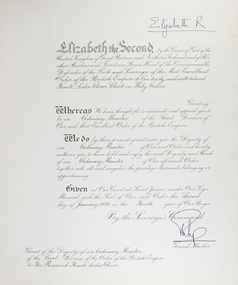 Mission to Seafarers Victoria
Letter - Letter with envelope, January 1956
... Indicative of the recognition of long service at the Mission and reflects early vice regal support for the Mission and services, ongoing Royal patronage by the Princess Royal, and previous interest with visits by HRH Prince of Wales in 1920 and the Governor of Australia Duke and Duchess of Gloucester circa 1945. padre oliver order of the british empire queen elizabeth ii obe padre frank leslie oliver see image Sheet of paper with calligraphic dedication and statement in heavy paper folder. ...The Reverend Frank Leslie Oliver, Senior Chaplain at the Mission to seamen from 1930-1960, was awarded an OBE in 1956.Indicative of the recognition of long service at the Mission and reflects early vice regal support for the Mission and services, ongoing Royal patronage by the Princess Royal, and previous interest with visits by HRH Prince of Wales in 1920 and the Governor of Australia Duke and Duchess of Gloucester circa 1945. Sheet of paper with calligraphic dedication and statement in heavy paper folder.see imagepadre oliver, order of the british empire, queen elizabeth ii, obe, padre frank leslie oliver
