
Showing 98 items matching "human development"
-
 Federation University Historical Collection
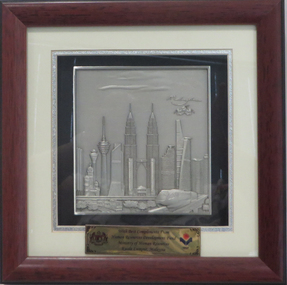
Object - Framed Plaque, Framed Pewter plaque from Malaysian Ministry of Human Services
... ...human resources development fund...With Best Compliments From Human Resources Development Fund Ministry of Human Resources Kuala Lumpur, Malaysia...pewter plaque kuala lumpur ministry of human resources malaysia human resources development fund kl pewter souvenir With Best Compliments From Human Resources Development Fund Ministry of Human Resources Kuala Lumpur, Malaysia Rectangular pewter plaque framed in wood with plaque on the front bottom. ...Rectangular pewter plaque framed in wood with plaque on the front bottom.With Best Compliments From Human Resources Development Fund Ministry of Human Resources Kuala Lumpur, Malaysiapewter plaque, kuala lumpur, ministry of human resources, malaysia, human resources development fund, kl pewter, souvenir -
 Alfred Hospital Nurses League - Nursing History Collection
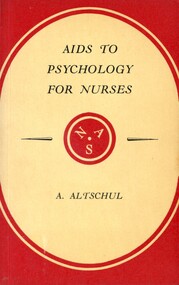
Book - Textbook, A Altschul 1919-2001, Aids to psychology for nurses, 1962
... ...human development...Author was a pioneerng figure in British psychiatric nursing.her work shifted the role of psychiatric nursing from simple 'doctor's assistant' to a therapeutic partnership with the patient Insight into psychology in the 1960's nursing study and teaching human development personality psychiatric nursing psychological reaction to illness motivation This vintage book was designed to cover psychological principles necessary for nurses in their training and work for effective patient communication and care At the base of the front endpage is a printed black and white donation sticker: black Maltese cross in circle, 'This book was donated to Alfred Archival Association Nursing Division by' Marjorie Connor [handwritten black ink]. previous catalogue number is also written on this label [black ink] Book with red and cream cover. ...This vintage book was designed to cover psychological principles necessary for nurses in their training and work for effective patient communication and careBook with red and cream cover. Front cover has a large cream oval in the centre of which is a red circle with crean margin and the lettter N A S also in cream. Above this circle is the title [black print] and below is the author's name. The oval is superimposed on a red background. Title [black ink] and N A S [white print on individual red circles] are printed on spinenon-fictionThis vintage book was designed to cover psychological principles necessary for nurses in their training and work for effective patient communication and carenursing study and teaching, human development, personality, psychiatric nursing, psychological reaction to illness, motivation -
 University of Melbourne, Burnley Campus Archives
Booklet, The University of Melbourne, Development Opportunities for University Staff, 2003
... Produced by the Staff Development Unit, Human Resources. Professional development services and options, The University of Melbourne......Staff Development Unit, Human Resources...professional development stsaff university of melbourne services options Produced by the Staff Development Unit, Human Resources. Professional development services and options, The University of Melbourne Development Opportunities for University Staff Booklet The University of Melbourne Staff Development Unit, Human Resources ...professional development, stsaff, university of melbourne, services, options -
Mission to Seafarers Victoria
Document - Thesis, Liam Brooks, The 1928 Waterfront Strike and the Fall of the Victorian Government, 2008
... Liam Brooks School of Social Sciences 26 November 2008 Fourth Year Honours Thesis Faculty of Arts, Education, and Human Development Victoria University, Footscray Park, Australia...Liam Brooks School of Social Sciences 26 November 2008 Fourth Year Honours Thesis Faculty of Arts, Education, and Human Development Victoria University, Footscray Park, Australia australian coal strike strikes 1928 allan whittaker port melbourne stevedores depression Digital version of the 2008 thesis by Liam Brooks The 1928 Waterfront Strike and the Fall of the Victorian Government. ...Liam Brooks School of Social Sciences 26 November 2008 Fourth Year Honours Thesis Faculty of Arts, Education, and Human Development Victoria University, Footscray Park, AustraliaDigital version of the 2008 thesis by Liam Brooksaustralian coal strike, strikes, 1928, allan whittaker, port melbourne, stevedores, depression -
 Sunshine and District Historical Society Incorporated
Archive - Gwen Goedecke Collection - Victorian Local Government Association (VLGA) Women's Participation in Local Government Coalition
... Victorian Local Government Association (VLGA) Bulletins (1994-2004) not complete years Newsletters on Gambling Research not complete years (2000-2002) Mailouts (1997 to 2002) not complete years - containing agendas, minutes General correspondence, planning days, notifications of events and the Mission Statement PUBLICATIONS: Newspaper - ' Local Government Focus' special feature (Oct 1986) VLGA review 2000 and 2003 VLGA - Resource Book ' - What Price Citizenship' (Feb 2002) Local Government of Engineers Association of Victoria - Symposium re 'The Minicipal Administration of Town Planning Schemes (1972) 'The Restructure of Local Government in Victoria - Northern and Western Melbourne Segment -Options Paper' - (1986) by the Local Government Commission Brimbank Council - 2003/04 Community Grants Program, Guidelines and Information VLGA/Stegley Foundation 'Building Partnerships between Councils and their Communities' (2000) VLGA - Resource Book - 'It takes a Village to Raise a Child' (2003) Department of Local Government and Administration Services - 'Developments in Local Government - Community Development, Human Services and Local Government' (1986) Women's Participation in Local Government |Local Government Conference ' 21st Annual Conference' programme - October 1986, by the Australian Local Government Women's Association, Victorian Branch Victorian Local Government Women's Charter ' Call for Submissions' - Women's Planning Network (Melbourne) - October 1997 |Women's Participation in Local Government Coalition - Candidates Information Pack, Council Elections, March 2003|Bulletin - Strengthening Communities through Women's Participation Project, Update December 2003 by the Women's Participation in Local Government Coalition RE: the Women's Charter|'Moving On' Women and Retiremnt from Victorian Local Government - Women's Participation in Local Government Coalition (203)|VLGA Bulletin - February 2004, 'Women's Charter Launched'...Women Victorian Local Government Association (VLGA) Bulletins (1994-2004) not complete years Newsletters on Gambling Research not complete years (2000-2002) Mailouts (1997 to 2002) not complete years - containing agendas, minutes General correspondence, planning days, notifications of events and the Mission Statement PUBLICATIONS: Newspaper - ' Local Government Focus' special feature (Oct 1986) VLGA review 2000 and 2003 VLGA - Resource Book ' - What Price Citizenship' (Feb 2002) Local Government of Engineers Association of Victoria - Symposium re 'The Minicipal Administration of Town Planning Schemes (1972) 'The Restructure of Local Government in Victoria - Northern and Western Melbourne Segment -Options Paper' - (1986) by the Local Government Commission Brimbank Council - 2003/04 Community Grants Program, Guidelines and Information VLGA/Stegley Foundation 'Building Partnerships between Councils and their Communities' (2000) VLGA - Resource Book - 'It takes a Village to Raise a Child' (2003) Department of Local Government and Administration Services - 'Developments in Local Government - Community Development, Human Services and Local Government' (1986) Women's Participation in Local Government |Local Government Conference ' 21st Annual Conference' programme - October 1986, by the Australian Local Government Women's Association, Victorian Branch Victorian Local Government Women's Charter ' Call for Submissions' - Women's Planning Network (Melbourne) - October 1997 |Women's Participation in Local Government Coalition - Candidates Information Pack, Council Elections, March 2003|Bulletin - Strengthening Communities through Women's Participation Project, Update December 2003 by the Women's Participation in Local Government Coalition RE: the Women's Charter|'Moving On' Women and Retiremnt from Victorian Local Government - Women's Participation in Local Government Coalition (203)|VLGA Bulletin - February 2004, 'Women's Charter Launched' Bulletins, newsletters, mailouts, general correspondence, publications 1994 - 2000's Archive Gwen Goedecke Collection - Victorian Local Government Association (VLGA) Women's Participation in Local Government Coalition ...Victorian Local Government Association (VLGA) Bulletins (1994-2004) not complete years Newsletters on Gambling Research not complete years (2000-2002) Mailouts (1997 to 2002) not complete years - containing agendas, minutes General correspondence, planning days, notifications of events and the Mission Statement PUBLICATIONS: Newspaper - ' Local Government Focus' special feature (Oct 1986) VLGA review 2000 and 2003 VLGA - Resource Book ' - What Price Citizenship' (Feb 2002) Local Government of Engineers Association of Victoria - Symposium re 'The Minicipal Administration of Town Planning Schemes (1972) 'The Restructure of Local Government in Victoria - Northern and Western Melbourne Segment -Options Paper' - (1986) by the Local Government Commission Brimbank Council - 2003/04 Community Grants Program, Guidelines and Information VLGA/Stegley Foundation 'Building Partnerships between Councils and their Communities' (2000) VLGA - Resource Book - 'It takes a Village to Raise a Child' (2003) Department of Local Government and Administration Services - 'Developments in Local Government - Community Development, Human Services and Local Government' (1986) Women's Participation in Local Government |Local Government Conference ' 21st Annual Conference' programme - October 1986, by the Australian Local Government Women's Association, Victorian Branch Victorian Local Government Women's Charter ' Call for Submissions' - Women's Planning Network (Melbourne) - October 1997 |Women's Participation in Local Government Coalition - Candidates Information Pack, Council Elections, March 2003|Bulletin - Strengthening Communities through Women's Participation Project, Update December 2003 by the Women's Participation in Local Government Coalition RE: the Women's Charter|'Moving On' Women and Retiremnt from Victorian Local Government - Women's Participation in Local Government Coalition (203)|VLGA Bulletin - February 2004, 'Women's Charter Launched'women -
 Flagstaff Hill Maritime Museum and Village
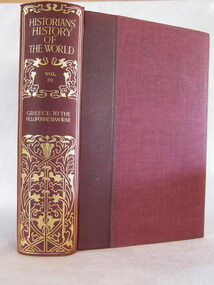
Book - Reference Book/History, Henry Smith Williams, The Historians History of the World Vol 3 set 1 - Edited by Henry Smith Williams L.L.D. Published by “The Times” 1908, 1908
... It details the rise of the city-states (poleis), the development of early Greek democracy in Athens, the rigid military social structure of Sparta, and the heroic resistance against the Persian Empire (Marathon, Thermopylae, and Salamis). This edition was part of a major marketing push to bring "the best of human...It details the rise of the city-states (poleis), the development of early Greek democracy in Athens, the rigid military social structure of Sparta, and the heroic resistance against the Persian Empire (Marathon, Thermopylae, and Salamis). This edition was part of a major marketing push to bring "the best of human ...The 1908 edition of The Historians' History of the World is a monumental work of Edwardian scholarship, representing a specific era of "universal history" where the goal was to synthesise all human knowledge into a single narrative. Volume 3 is a pivotal installment in the series, shifting the narrative from the "stagnant" (as viewed by 1904 scholars) empires of the East to the dynamic birth of Western civilisation.Book is part of a 25 volume set with red cloth bindings and gold filigree design to rib.non-fictionThe 1908 edition of The Historians' History of the World is a monumental work of Edwardian scholarship, representing a specific era of "universal history" where the goal was to synthesise all human knowledge into a single narrative. Volume 3 is a pivotal installment in the series, shifting the narrative from the "stagnant" (as viewed by 1904 scholars) empires of the East to the dynamic birth of Western civilisation.flagstaff hill, warrnambool, shipwrecked-coast, flagstaff-hill, flagstaff-hill-maritime-museum, maritime-museum, shipwreck-coast, flagstaff-hill-maritime-village, book, the historians history of the world vol 3 set 1 -
 Flagstaff Hill Maritime Museum and Village
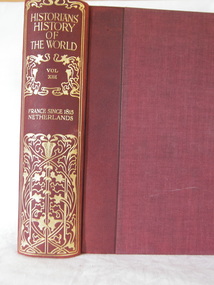
Book - Reference Book/History, Henry Smith Williams, The Historians History of the World Vol 13 set 1 - Edited by Henry Smith Williams L.L.D. Published by “The Times” 1908, 1908
... development of nations" are interconnected through war, diplomacy, and trade. this edition was marketed as a high-authority reference, using a "mosaic" method piecing together primary accounts from over 2,000 historians to create a comprehensive narrative. (For more information on the Pattison Collection and the Mechanics Institute visit) https://victoriancollections.net.au/items/5580c7e72162f114d8b758db flagstaff hill warrnambool shipwrecked-coast flagstaff-hill flagstaff-hill-maritime-museum maritime-museum shipwreck-coast flagstaff-hill-maritime-village book the historians history of the world vol 13 set 1 Henry Smith Williams’ “The Historians' History of the World” is a chronological and geographical "tapestry" of human events, these twenty five volumes occupy a very specific and prestigious place in historical research. ...Henry Smith Williams’ “The Historians' History of the World” is a chronological and geographical "tapestry" of human events, these twenty five volumes occupy a very specific and prestigious place in historical research. Volume 13 focuses primarily on the modern history of France and the Netherlands. It specifically covers, France (1815–1904.) This section picks up immediately after the fall of Napoleon l following the 1815 Battle of Waterloo.The Book is part of a 25 volume set with red cloth bindings and gold filigree design to rib.non-fictionHenry Smith Williams’ “The Historians' History of the World” is a chronological and geographical "tapestry" of human events, these twenty five volumes occupy a very specific and prestigious place in historical research. Volume 13 focuses primarily on the modern history of France and the Netherlands. It specifically covers, France (1815–1904.) This section picks up immediately after the fall of Napoleon l following the 1815 Battle of Waterloo.flagstaff hill, warrnambool, shipwrecked-coast, flagstaff-hill, flagstaff-hill-maritime-museum, maritime-museum, shipwreck-coast, flagstaff-hill-maritime-village, book, the historians history of the world vol 13 set 1 -
 Flagstaff Hill Maritime Museum and Village
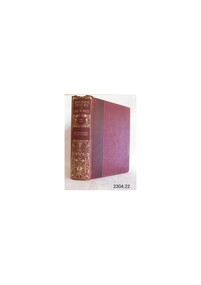
Book - Reference Book/History, Henry Smith Williams, The Historians History of the World Vol 22 set 1 - Edited by Henry Smith Williams L.L.D. Published by “The Times” 1908, 1908
... development. (For more information on the Pattison Collection and the Mechanics Institute visit) https://victoriancollections.net.au/items/5580c7e72162f114d8b758db flagstaff hill warrnambool shipwrecked-coast flagstaff-hill flagstaff-hill-maritime-museum maritime-museum shipwreck-coast flagstaff-hill-maritime-village book the historians history of the world vol 22 set 1 Henry Smith Williams’ “The Historians' History of the World” is a chronological and geographical "tapestry" of human events, these twenty five volumes occupy a very specific and prestigious place in historical research. ...Henry Smith Williams’ “The Historians' History of the World” is a chronological and geographical "tapestry" of human events, these twenty five volumes occupy a very specific and prestigious place in historical research. Volume 22 represents a critical pivot point in the series, shifting the focus away from the concentrated histories of Europe and the British Empire toward the "New World" and the rising power of the West.The Book is part of a 25 volume set with red cloth bindings and gold filigree design to rib.non-fictionHenry Smith Williams’ “The Historians' History of the World” is a chronological and geographical "tapestry" of human events, these twenty five volumes occupy a very specific and prestigious place in historical research. Volume 22 represents a critical pivot point in the series, shifting the focus away from the concentrated histories of Europe and the British Empire toward the "New World" and the rising power of the West.flagstaff hill, warrnambool, shipwrecked-coast, flagstaff-hill, flagstaff-hill-maritime-museum, maritime-museum, shipwreck-coast, flagstaff-hill-maritime-village, book, the historians history of the world vol 22 set 1 -
 Flagstaff Hill Maritime Museum and Village
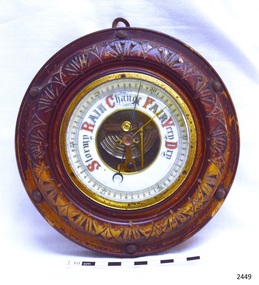
Instrument - Barometer, Early 20th century
... The barometer is significant as an aid to human social, material and scientific development. flagstaff hill warrnambool shipwrecked coast flagstaff hill maritime museum maritime museum shipwreck coast flagstaff hill maritime village great ocean road barometer scientific instrument weather forcasting instrument weather gauge Barometer, round, brass housing inset into carved wooden casing (lacquer mostly worn off). ...A barometer is an instrument used for measuring atmosphere pressure thus determining weather changes.The first apparatus generally accepted as a barometer was that set up in Florence in 1644 by Evangelista Torricelli (1608–1647), a mathematician and physicist. Torricelli filled a glass tube with mercury, sealed it at one end, and inverted it with its open end in a dish of mercury. The level always fell a short way down the tube, then settled at a height of about thirty inches. He concluded correctly that the mercury column was sustained by the weight of the air pressing on the open surface of mercury, and further experiments convinced him that the space above the mercury in the tube was a vacuum. He noted that the level rose and fell with changing temperature, but he was unable to use his apparatus to measure variations in the weight of the atmosphere because he had not foreseen that temperature would affect the level of the mercury. News of this experiment circulated quickly among European scientists, who hastened to replicate the experiment. Torricelli's conclusions were not universally accepted because some disputed whether the air had weight, while both Aristotle and the Catholic Church denied the possibility of a vacuum. In France, the philosopher René Descartes (1596–1650) seems to have been the first person, probably in 1647, to attach a graduated scale to the tube so that he could record any changes attributable to the weather. At around this time Duke Ferdinand II of Tuscany organized the first short-lived meteorological network among scientists in other Italian cities, gathering observations of pressure, temperature, humidity, wind direction, and state of the sky.Theis barometer is an example of a household item from the early 20th century, used to determine the day's weather. The barometer is significant as an aid to human social, material and scientific development.Barometer, round, brass housing inset into carved wooden casing (lacquer mostly worn off). Decorative lettering for weather conditions "Stormy, Rain, Change, Fair, Very Dry". Workings are visible through opening in centre of dial. Indicator needle and another adjustable needle . Hook screwed into back of case.flagstaff hill, warrnambool, shipwrecked coast, flagstaff hill maritime museum, maritime museum, shipwreck coast, flagstaff hill maritime village, great ocean road, barometer, scientific instrument, weather forcasting instrument, weather gauge -
 Flagstaff Hill Maritime Museum and Village
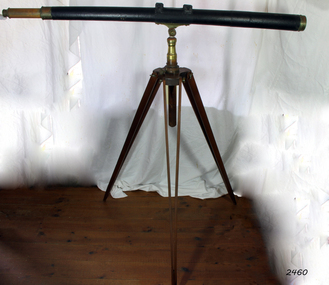
Instrument - Telescope, Mid-18th Century
... Telescopes are optical instruments that make distant objects appear larger and closer, thereby extending the range of what the human eye can observe. The development of the telescope was gradual, shaped by a series of important advances in optical science. ...Telescopes are optical instruments that make distant objects appear larger and closer, thereby extending the range of what the human eye can observe. The development of the telescope was gradual, shaped by a series of important advances in optical science. ...This Day or Night telescope, made by John Dollond, was designed for use in a range of lighting conditions, as its name suggests. Telescopes are optical instruments that make distant objects appear larger and closer, thereby extending the range of what the human eye can observe. The development of the telescope was gradual, shaped by a series of important advances in optical science. In 1608, the Dutch spectacle-maker Hans Lippershey discovered that when two lenses were held apart in a particular way, distant objects appeared closer. He applied for a patent for this invention, creating the first documented telescope. In 1668, Isaac Newton produced the first successful reflecting telescope, using a two-inch concave spherical mirror. This marked a major step forward, demonstrating that mirrors could overcome some of the limitations of lenses and greatly improve magnification. Further progress followed in the eighteenth century. In 1729, Chester Moor Hall developed the achromatic lens by combining two types of glass with different refractive properties. This reduced colour distortion and produced a sharper image, although some edge distortion remained. That same year, the Scottish instrument maker James Short developed parabolic and elliptical mirrors that were better suited to reflecting telescopes because they reduced optical distortion. Building on these advances, John Dollond improved the achromatic objective lens by placing a concave flint-glass lens between two convex crown-glass lenses, considerably enhancing image quality. Maker’s information. John Dollond (1707–1761), of London, was a maker of optical, scientific and astronomical instruments best known for developing the achromatic refracting telescope. He also introduced a practical heliometer, a telescope fitted with a divided lens that could be used to measure the Sun’s diameter and the angular distance between celestial bodies. The son of Huguenot refugees, Dollond first learned the family trade of silk weaving before turning his attention to optics and astronomy, in which he became highly skilled. In 1753, Dollond patented his improved lenses, the same year he had introduced the heliometer. In 1761, John Dollond was appointed as optician to George III and the Duke of York. He was also elected a Fellow of the Royal Society in May 1761, but died suddenly later that year in November. His share of the patent then passed to his eldest son, Peter. In later disputes between Peter Dollond and rival London opticians who challenged the patent, Peter consistently argued that, whatever earlier precedents may have existed, his father had independently developed a practical method for producing achromatic lenses through his command of Newtonian optics. By successfully defending the patent, the Dollond firm became one of the leading manufacturers of optical instruments. During the eighteenth and nineteenth centuries, the name ‘Dollond’ was at times used almost generically to mean ‘telescope,’ reflecting the firm’s reputation. Genuine Dollond telescopes were regarded as among the finest available. Peter Dollond (1731–1820) was the driving force behind the family business. He had founded a small optical business in 1750 on Vine Street, Halton Garden, with his father's guidance. The success of the business led to his father joining him in partnership in 1752. In 1959, J Dollond and Son opened a shop on The Strand, London. Dollonds appear to have produced both reflecting and refracting telescopes, and they possessed the technical skill to manufacture significant numbers of lenses largely free from chromatic aberration. In 1766, Peter went into partnership with his younger brother, John, and they traded under the name P and J Dollond. They supplied optical instruments for Captain Cook and George Hadley, an English lawyer and Meteorologist. In 1769, Captain Cook travelled with a Dollond telescope on the voyage to observe the Transit of Venus. Other notable customers included Thomas Jefferson and Admiral Lord Nelson. In 1781, Peter Dollond made bifocal spectacles. In 1804, young John Dollond passed away. The following year, Peter Dollond went into partnership with his nephew, George Huggins, and Huggins legally changed his surname to Dollond, and the firm remained P and J Dollond. In the early 20th century, the company sold film cameras. The firm remained in the hands of Dollond family members until 1927, when Dollond & Co. merged with James Aitchison & Co. to form Dollond & Aitchison, the well-known high street chain of opticians, which continued making and selling prescription spectacles. Now fully part of Boots Opticians, the company no longer manufactures instruments and operates exclusively as a retail business. The telescope in the collection is an excellent example of one of Dollond’s early library telescopes. Its association with one of eighteenth-century England’s leading innovators in optical development gives it considerable historical significance and makes it an important object within the collection. John Dollond’s experiments in optics advanced the understanding of the divergent properties of lenses and made a lasting contribution to the development of practical optical science. His work helped lay the foundation for major improvements in the design and performance of optical instruments. In his own time, Dollond was celebrated as the “Father of practical optics” and received widespread recognition for his achievements in the field. Dollond telescopes were associated with the renowned mariners, Captain James Cook and Admiral Lord Nelson Telescope: Dollond's Telescope, Day or Night model navigational instrument. Telescope is mounted on wooden tripod stand that has folding legs. Brass telescope with leather sheath over barrel, adjustable angle fitting with brass wing nuts that join the legs to the top frame, which is then joined to the telescope pole by an adjustable screw fitting. Manufactured by Dollond, London. Inscription reads "Dollond London, Day or Night" and "DOLLOND LONDON"flagstaff hill maritime museum and village, maritime museum, maritime village, great ocean road, warrnambool, optical instrument, achromatic telescope, heliometer, light refraction, instrument maker, lens, transit of venus, astronomical telescope, concave lens, scientific instrument, navigation, navigational instrument, astronomy, dollond, dollond london, john dollond, peter dollond, dollond telescope, day or night telescope, floor-standing telescope, library telescope, hans lippershey, isaac newton, chester moor hall, james short, captain cook, thomas jefferson, admiral lord nelson, dollond & co, aitchison & co, dollond & aitchison, boots opticians, george iii, duke of york, george huggins, george dollond, p and j dollond, j dollond and son, spectacles, cameras -
 Federation University Historical Collection
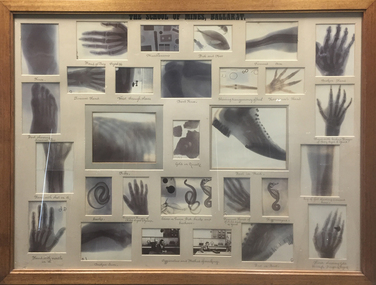
Photograph - X-Rays - Radiographs, Pioneer X-Rays conducted at the Ballarat School of Mines, 1896, 1896
... development of the application for x-rays to medicine.' John M. Sutherland conducted most of the experiments with induction coils giving 6 inch, 12 inch and 16 inch sparks respectively. x-ray john m. sutherland ballarat school of mines John McKenzie Sutherland xray pioneer xrays Photograph of a timber frame with 27 original X-Rays conducted by John Sutherland at the Ballarat School of Mines. X-Rays include human ...According to 'Salute to the X-Ray Pioneers of Australia' the X-Rays experiments conducted at the Ballarat School of Mines 'played a conspicuous part in the development of the application for x-rays to medicine.' John M. Sutherland conducted most of the experiments with induction coils giving 6 inch, 12 inch and 16 inch sparks respectively. Photograph of a timber frame with 27 original X-Rays conducted by John Sutherland at the Ballarat School of Mines. X-Rays include human bones, kangaroo hand, steel, bent knee, gold in quartz, snake, and others.x-ray, john m. sutherland, ballarat school of mines, john mckenzie sutherland, xray, pioneer xrays -
 Federation University Historical Collection
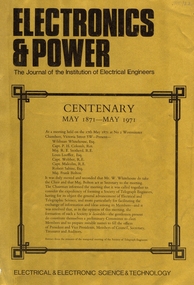
Magazine, Institution of Electrical Engineers, Electronics & Power: The Journal of the Institution of Electrical Engineers (Centenary Edition), April/May 1971
... Articles of this centenary edition include: A Human Entity (Lord Nelson of Stafford), Yesterday's Men - providing for tomorrow ((A.G. Woodruff), A century of Development in the Supply Industry (Stanley Brown), British Broadcasting and the IEE (J. ...Articles of this centenary edition include: A Human Entity (Lord Nelson of Stafford), Yesterday's Men - providing for tomorrow ((A.G. Woodruff), A century of Development in the Supply Industry (Stanley Brown), British Broadcasting and the IEE (J. ...The Institution of Electrical Engineers (IEE) was established on 17 May 1871. The first meeting took place at 2 Westminster Chambers, Victoria Street SW. Those present were Wildman Whitehouse, Capt P.H. Colomb, Maj. R.E. Stotherd, Louis Loeffler, Capt Weber, Capt Malcolm, Robert Sabine, Frank Bolton. Gold paper covered magazine with black print. 239 pages including numerous advertisements. Articles of this centenary edition include: A Human Entity (Lord Nelson of Stafford), Yesterday's Men - providing for tomorrow ((A.G. Woodruff), A century of Development in the Supply Industry (Stanley Brown), British Broadcasting and the IEE (J. Redmond), Telecommunications - the grassroots of the IEE (R.J. Halsey), Engineers, physicists and mathematicians (J.A. Ratcliffe), The IEE Wiring regulations (E.E. Hutchings). The IEE and education (John Brown), Electrical Engineering today and tomorrow. Images include Oliver Lodge, James Maxwell, Crookes shadow tube, Deptford Power Station, John Hopkinson, Marconi, William Thomson, Oliver Heaviside, experimental 3-phase, Belling Modernette, Savoy Hill, power lines, Brighton Power Station, BBC Television Centre London, mobile telegraph office.generators, institution of electrical engineers, iee, wildman whitehouse, ph colomb, re stotherd, louis loeffler, robert sabine, frank bolton, multimeter, power units, oscilloscope, bell and howell -
Federation University Historical Collection
Book, University of Ballarat Research + Innovation Digest
... Contents include: * Case studies in keeping food safe, Benu Adhikari * technologies that combat climate change - Alberto Boretti *Learning t lead- leading to learn, Neil Trivett * Depression, diabities and motivation, Mirella Di Benedetto * Valuing Lake Wendouree, Julian Lowe * What's in a name, Laura Kostanski * Optimizing Regional & International Research, John Yearwood * Sport, physical activity and health research, Warren Payne * Climate secrets in the sediments, Peter Gell * Injury prevention and saftey promotion research theme, UB Sports injury centre, Caroline Finch, Men's Sheds & other learning places, Barry Golding * New economy, new work, new qualifications, Erica Smith * Cross-cultural communication in a shrinking world, Georgina Tsolidis * Child Protection & family services reform, Angela Murphy * making a difference for older Victorians, Sally Wellard * Making good (and goodly) profits, jackie tuck * Not too much 'ordinary' about Teh Ordinry, Lorraine Sim * Gaming Machines & regional gamblers * Toe nail clippings revel their secrets, Kim Dowling * Magnificently preserved megafaunal trackways in the Victorian volcanic plans, Stephen Carey * A stuttering start for a stunning outcome, Grant Meridith * Supporting patients & their careres, Anthony Love * Out of Africa and beyond, James O'Meara * Taking a hard look to avoid hard knocks, Caroline Finch and Dara Twomey * Skilling people for business success, Andy Smith * Promoting risk awareness in industry, David Borys * researching China's Rise & Rise, Mike Willis *Sex hormones link to heart disease, Fadi Charchar * Human factors in computer security, Paul watters * Are our rivers up the creek, Peter Gell * Women as managers7 entrepreneurs, Glenice Wood * Revisoning values and norms, Jane Mummery * 'Wimmera" - an epic Poem, Homer Rieth * Recycling, consumerism, climate change and art peactice, marie Purtill * Investing in ecologically sustainable development, Jerry Coursisanos * Indigenous peoples of the goldfields, Fred Cahir * Artists install images of sustainability, Jill Orr * addresing disadvantage& inequality with passion, John Smyth * Breaking up insulin haxamers, Mark Myers...Contents include: * Case studies in keeping food safe, Benu Adhikari * technologies that combat climate change - Alberto Boretti *Learning t lead- leading to learn, Neil Trivett * Depression, diabities and motivation, Mirella Di Benedetto * Valuing Lake Wendouree, Julian Lowe * What's in a name, Laura Kostanski * Optimizing Regional & International Research, John Yearwood * Sport, physical activity and health research, Warren Payne * Climate secrets in the sediments, Peter Gell * Injury prevention and saftey promotion research theme, UB Sports injury centre, Caroline Finch, Men's Sheds & other learning places, Barry Golding * New economy, new work, new qualifications, Erica Smith * Cross-cultural communication in a shrinking world, Georgina Tsolidis * Child Protection & family services reform, Angela Murphy * making a difference for older Victorians, Sally Wellard * Making good (and goodly) profits, jackie tuck * Not too much 'ordinary' about Teh Ordinry, Lorraine Sim * Gaming Machines & regional gamblers * Toe nail clippings revel their secrets, Kim Dowling * Magnificently preserved megafaunal trackways in the Victorian volcanic plans, Stephen Carey * A stuttering start for a stunning outcome, Grant Meridith * Supporting patients & their careres, Anthony Love * Out of Africa and beyond, James O'Meara * Taking a hard look to avoid hard knocks, Caroline Finch and Dara Twomey * Skilling people for business success, Andy Smith * Promoting risk awareness in industry, David Borys * researching China's Rise & Rise, Mike Willis *Sex hormones link to heart disease, Fadi Charchar * Human factors in computer security, Paul watters * Are our rivers up the creek, Peter Gell * Women as managers7 entrepreneurs, Glenice Wood * Revisoning values and norms, Jane Mummery * 'Wimmera" - an epic Poem, Homer Rieth * Recycling, consumerism, climate change and art peactice, marie Purtill * Investing in ecologically sustainable development, Jerry Coursisanos * Indigenous peoples of the goldfields, Fred Cahir * Artists install images of sustainability, Jill Orr * addresing disadvantage& inequality with passion, John Smyth * Breaking up insulin haxamers, Mark Myers University of Ballarat Research + Innovation Digest Book Book ...Black, soft covered book of 48 pages outlining research at the University of Ballarat. Contents include: * Case studies in keeping food safe, Benu Adhikari * technologies that combat climate change - Alberto Boretti *Learning t lead- leading to learn, Neil Trivett * Depression, diabities and motivation, Mirella Di Benedetto * Valuing Lake Wendouree, Julian Lowe * What's in a name, Laura Kostanski * Optimizing Regional & International Research, John Yearwood * Sport, physical activity and health research, Warren Payne * Climate secrets in the sediments, Peter Gell * Injury prevention and saftey promotion research theme, UB Sports injury centre, Caroline Finch, Men's Sheds & other learning places, Barry Golding * New economy, new work, new qualifications, Erica Smith * Cross-cultural communication in a shrinking world, Georgina Tsolidis * Child Protection & family services reform, Angela Murphy * making a difference for older Victorians, Sally Wellard * Making good (and goodly) profits, jackie tuck * Not too much 'ordinary' about Teh Ordinry, Lorraine Sim * Gaming Machines & regional gamblers * Toe nail clippings revel their secrets, Kim Dowling * Magnificently preserved megafaunal trackways in the Victorian volcanic plans, Stephen Carey * A stuttering start for a stunning outcome, Grant Meridith * Supporting patients & their careres, Anthony Love * Out of Africa and beyond, James O'Meara * Taking a hard look to avoid hard knocks, Caroline Finch and Dara Twomey * Skilling people for business success, Andy Smith * Promoting risk awareness in industry, David Borys * researching China's Rise & Rise, Mike Willis *Sex hormones link to heart disease, Fadi Charchar * Human factors in computer security, Paul watters * Are our rivers up the creek, Peter Gell * Women as managers7 entrepreneurs, Glenice Wood * Revisoning values and norms, Jane Mummery * 'Wimmera" - an epic Poem, Homer Rieth * Recycling, consumerism, climate change and art peactice, marie Purtill * Investing in ecologically sustainable development, Jerry Coursisanos * Indigenous peoples of the goldfields, Fred Cahir * Artists install images of sustainability, Jill Orr * addresing disadvantage& inequality with passion, John Smyth * Breaking up insulin haxamers, Mark Myersaborigines, mens shed, wimmera, gambling, megafauna, gell, golding, carey, cahir, purtill -
 The Beechworth Burke Museum
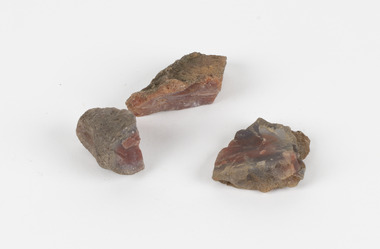
Geological specimen - Unknown, possible Carnelian Agate or Chalcedony
... The specimens are significant as examples of surveying activity undertaken to assess and direct the development of the mineral resource industries in Victoria and Australia, as well as the movement to expand human knowledge of earth sciences such as mineralogy and geology in the nineteenth century. ...Although it is not known where these specimens were collected, Victoria and other regions of Australia were surveyed for sites of potential mineral wealth throughout the 19th Century. The identification of sites containing valuable commodities such as gold, iron ore and gemstones in a locality had the potential to shape the development and history of communities and industries in the area. The discovery of gold in Victoria, for instance, had a significant influence on the development of the area now known as 'the goldfields', including Beechworth; the city of Melbourne and Victoria as a whole. Agate occurs when amygdales (gas pockets) form in the upper levels of basaltic lava flows. If these pockets or bubbles are iniltrated by water bearing silica in solution, the fluid dries and hardens in layers, forming round or egg shaped nodules or geodes within the rocky matrix. Agate is formed of a silica mineral chalcedony similar to quartz. The term carnelian primarily refers to the reddish shading of the stone; whether the stone is termed an agate or chalcedony type is often influenced by the degree of colour banding the specimen shows. The specimens are significant as examples of surveying activity undertaken to assess and direct the development of the mineral resource industries in Victoria and Australia, as well as the movement to expand human knowledge of earth sciences such as mineralogy and geology in the nineteenth century.Three small geological specimens that appear visually consistent with images of rough or unpolished Carnelian Agate or Chalcedony. geological specimen, geology, geology collection, burke museum, beechworth, indigo shire, north-east victoria, gemstones, agate, carnelian -
 The Beechworth Burke Museum
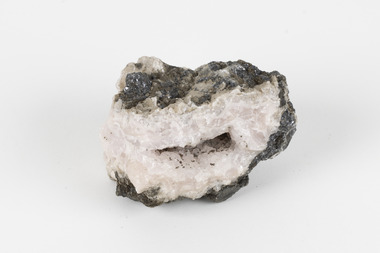
Geological specimen - Dolomite
... The specimen is significant as an example of surveying activity undertaken to assess and direct the development of the mineral resource industries in Victoria and Australia, as well as the movement to expand human knowledge of earth sciences such as mineralogy and geology in the nineteenth century. ...Dolomite is a mineral, calcium magnesium carbonate, with the chemical formula CaMg(CO3)2. It is a principle component of various rock types sometimes also referred to as dolomite, including dolostone, dolomitic marble and dolomitic limestone (according to the composition of each type). Dolomite rock is found in sedimentary basins throughout the world, comprising approximately 2% of the Earth's crust. It is formed when lime mud or limestone encounters groundwater containing magnesium. Dolomite can contain elements such as lead, zinc and copper. Dolomite and limestone are used in various construction, landscaping and agricultural processes. This specimen was donated to the Burke Museum in 1868 by Alfred Selwyn as part of the Geological Survey of Victoria. It was donated to the Museum in 1868. Victoria and other regions of Australia were surveyed for sites of potential mineral wealth throughout the 19th Century. The identification of sites containing valuable commodities such as gold, iron ore and gemstones in a locality had the potential to shape the development and history of communities and industries in the area. The discovery of gold in Victoria, for instance, had a significant influence on the development of the area now known as 'the goldfields', including Beechworth; the city of Melbourne and Victoria as a whole. Dolomite and limestone are mined at several locations in Victoria, including sites in the North-East of the state in Bindi and Limestone Creek. There are notable dolomite deposits in most Australian states. The dolomitised form of the mineral tends to come from older limestone deposits, formed during the palaeozoic era in marine settings, so this specimen may have come from a deposit located along a coastline in Victoria or another state. The specimen is significant as an example of surveying activity undertaken to assess and direct the development of the mineral resource industries in Victoria and Australia, as well as the movement to expand human knowledge of earth sciences such as mineralogy and geology in the nineteenth century. This specimen is part of a larger collection of geological and mineral specimens collected from around Australia (and some parts of the world) and donated to the Burke Museum between 1868-1880. A large percentage of these specimens were collected in Victoria as part of the Geological Survey of Victoria that begun in 1852 (in response to the Gold Rush) to study and map the geology of Victoria. Collecting geological specimens was an important part of mapping and understanding the scientific makeup of the earth. Many of these specimens were sent to research and collecting organisations across Australia, including the Burke Museum, to educate and encourage further study.Hand-sized piece of pale pink dolomite (calcium magnesium carbonate) with dark grey rim and hollowed centre. geological specimen, geology, geology collection, burke museum, beechworth, dolomite, mineralogy, geological survey, alfred selwyn, limestone, calcium magnesium carbonate -
 The Beechworth Burke Museum
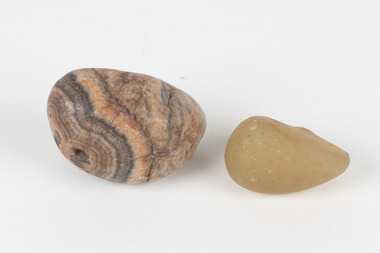
Geological specimen - Agate and Quartz pebbles
... The specimens are significant as examples of surveying activity undertaken to assess and direct the development of the mineral resource industries in Victoria and Australia, as well as the movement to expand human knowledge of earth sciences such as mineralogy and geology in the nineteenth century. ...Agate occurs when amygdales (gas pockets) form in the upper levels of basaltic lava flows. If these pockets or bubbles are iniltrated by water bearing silica in solution, the fluid dries and hardens in layers, forming round or egg shaped nodules or geodes within the rocky matrix. Agate is formed of a silica mineral chalcedony similar to quartz. Although relatively common and semi-precious, agate has been prized since at least 1450 BC - an intricately carved agate seal was found in the 2015 excavation of a grave belonging to a Mycenaeum priest or warrior near Pylos in Greece. Agate is also used in jewellery and other decorative or ritual purposes due to its often striking appearance. Quartz is found all over Australia, including Beechworth in Victoria. It is formed in deep-seated igneous rocks and crystallized through hot aqueous solutions. It can have two forms; Microcrystalline quartz or Crystalline quartz. Microcrystalline quartz is a fine grain quartz where crystalline quartz is often a large crystal. The colour of quartz can vary. These specimens were collected in Victoria in the vicinity of the Burke Museum. Victoria and other regions of Australia were surveyed for sites of potential mineral wealth throughout the 19th Century. The identification of sites containing valuable commodities such as gold, iron ore and gemstones in a locality had the potential to shape the development and history of communities and industries in the area. The discovery of gold in Victoria, for instance, had a significant influence on the development of the area now known as 'the goldfields', including Beechworth; the city of Melbourne and Victoria as a whole.The specimens are significant as examples of surveying activity undertaken to assess and direct the development of the mineral resource industries in Victoria and Australia, as well as the movement to expand human knowledge of earth sciences such as mineralogy and geology in the nineteenth century.Geological specimens of Agate and Quartz respectively; the fist-sized piece of Agate has peach/coral colouring with grey concentric patterning and the smaller piece of quartz is a uniform yellow/orange shade. Existing label: Local pebbles / (agate and / quartz / (yellowish) / egg-shaped). / BB geological specimen, geology, geology collection, burke museum, beechworth, agate, quartz, north-east victoria, indigo shire, geological surveys -
 The Beechworth Burke Museum
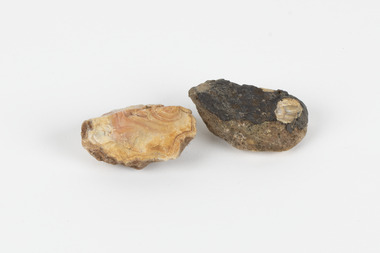
Geological specimen - North Queensland Agates, Unknown
... The specimens are significant as examples of surveying activity undertaken to assess and direct the development of the mineral resource industries in Victoria and Australia, as well as the movement to expand human knowledge of earth sciences such as mineralogy and geology in the nineteenth century. ...Agate occurs when amygdales (gas pockets) form in the upper levels of basaltic lava flows. If these pockets or bubbles are iniltrated by water bearing silica in solution, the fluid dries and hardens in layers, forming round or egg shaped nodules or geodes within the rocky matrix. Agate is formed of a silica mineral chalcedony similar to quartz. Although relatively common and semi-precious, agate has been prized since at least 1450 BC - an intricately carved agate seal was found in the 2015 excavation of a grave belonging to a Mycenaeum priest or warrior near Pylos in Greece. Agate is also used in jewellery and other decorative or ritual purposes due to its often striking appearance. These specimens originated in North Queensland, which contains noted agate-fossicking regions such as in the area surrounding Forsayth. They were collected in approximately 1852 as an adjunct to the Geological Survey of Victoria. It was donated to the Museum in 1868. Victoria and other regions of Australia were surveyed for sites of potential mineral wealth throughout the 19th Century. The identification of sites containing valuable commodities such as gold, iron ore and gemstones in a locality had the potential to shape the development and history of communities and industries in the area. The discovery of gold in Victoria, for instance, had a significant influence on the development of the area now known as 'the goldfields', including Beechworth; the city of Melbourne and Victoria as a whole. The specimens are significant as examples of surveying activity undertaken to assess and direct the development of the mineral resource industries in Victoria and Australia, as well as the movement to expand human knowledge of earth sciences such as mineralogy and geology in the nineteenth century. Two solid egg-sized pieces of peach/orange toned agate (a common semi-precious chalcedony, similar to quartz) with a striped pattern, embedded in a light and dark brown matrix. geological specimen, geology, geology collection, burke museum, beechworth, agate, north queensland agate, 1852 geological survey of victoria, l. hufer - donor, mineralogy, agate specimen, indigo shire -
 The Beechworth Burke Museum
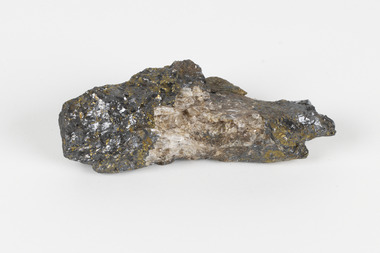
Geological specimen - Sphalerite, Unknown
... The specimen is significant as an examples of surveying activity undertaken to assess and direct the development of the mineral resource industries in Victoria and Australia, as well as the movement to expand human knowledge of earth sciences such as mineralogy and geology in the nineteenth century. ...Sphalerite or sphaelerite is named from the Greek word for 'treacherous' or 'deceiver' as specimens can vary widely in appearance, making them hard to visually identify. It is a zinc sulfide with the chemical composition (Zn,Fe)S, the most important ore of zinc. Specimens of sphalerite can contain iron as a substitute for up to 25% of the usual zinc present, as well as trace elements of gallium, cadmium, geranium and indium. Small amounts of arsenic and manganese may also be detected. Sphalerite is found in igneous, sedimentary and metamorphic rocks. It forms when carbonate rock encounters acidic, zinc-bearing fluid. It often forms in veins or in fissures of the existing rock, with colours and crystal shapes dependent on the composition of the the combining elements. It forms isometric crystal shapes including cubes, tetrahedrons, octahedrons, dodecahedrons. This specimen was collected in approximately 1852, in Broken Hill, NSW, as an adjunct to the Geological Survey of Victoria. It was donated to the Museum in 1868. Victoria and other regions of Australia were surveyed for sites of potential mineral wealth throughout the 19th Century. The identification of sites containing valuable commodities such as gold, iron ore and gemstones in a locality had the potential to shape the development and history of communities and industries in the area. The discovery of gold in Victoria, for instance, had a significant influence on the development of the area now known as 'the goldfields', including Beechworth; the city of Melbourne and Victoria as a whole.The specimen is significant as an examples of surveying activity undertaken to assess and direct the development of the mineral resource industries in Victoria and Australia, as well as the movement to expand human knowledge of earth sciences such as mineralogy and geology in the nineteenth century.A pipe-shaped specimen of sulfide-mineral zinc ore displaying patches of black, brown, beige and gold colouring. The main item has associated broken pieces. geological specimen, geology, geology collection, burke museum, beechworth, mineralogy, indigo shire, geological survey, sphalerite, sphaelerite, zinc ore, broken hill, nsw, victoria, galena, fluorite, chalcopyrite, lead, cadmium, gallium, germanium, indium, iron -
 The Beechworth Burke Museum
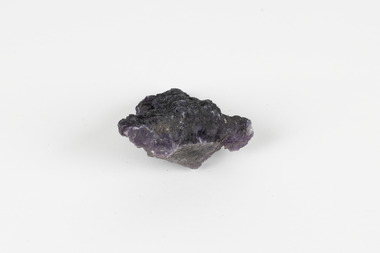
Geological specimen - Fluorite (purple)
... The specimens are significant as examples of surveying activity undertaken to assess and direct the development of the mineral resource industries, as well as the movement to expand human knowledge of earth sciences such as mineralogy and geology in the nineteenth century. burke museum beechworth geological geological specimen fluorite flourite calcium fluoride hydrofluoric acid jewellery indigo shire north-east victoria mining illinois USA United States fluorine gemstones purple stones Existing label: Flourite / (purple) / probably / USA / BB / The specimen is a piece of purple shaded fluorite (also known as fluorspar), the mineral form of calcium fluoride. ...Fluorite comes in a variety of natural colours and crystal formations and glows under ultraviolet light (the word 'fluorescence' comes from the same etymological source). In its pure form, calcium fluoride, it is a colourless combination of the elements calcium and fluorine, but gains its colour from trace elements that infiltrate or replace calcium within its crystal structure during its formation. Although fluorite crystals polish well and can achieve a high level of lustre, the mineral is very soft (4 on MOHS hardness scale) so it is unsuitable for use in rings and must be handled and stored carefully if used in other forms of jewellery. Most crystals of the mineral are too coarse for decorative purposes but have been mined under the name fluorspar for a variety of commercial and industrial purposes. These include the production of hydrofluoric acid, smelting metal alloys, producing glazes and ceramic finishes and use in medical and dental products. An existing label for this specimen indicates that its origin or collection-point was 'probably USA.' Fluorspar, the form of fluorite used commercially and industrially, was mined in significant quantities in the counties of Hardin and Pope in South-Eastern Illinois throughout the Nineteenth and Twentieth Centuries. Fluorite was made Illinois' state mineral in recognition of its contribution to the state's identity and economy. The specimens are significant as examples of surveying activity undertaken to assess and direct the development of the mineral resource industries, as well as the movement to expand human knowledge of earth sciences such as mineralogy and geology in the nineteenth century.The specimen is a piece of purple shaded fluorite (also known as fluorspar), the mineral form of calcium fluoride. The unpolished specimen presents a dark purple interior with a substantial dark grey crust representing the matrix from which the specimen was obtained. Existing label: Flourite / (purple) / probably / USA / BB /burke museum, beechworth, geological, geological specimen, fluorite, flourite, calcium fluoride, hydrofluoric acid, jewellery, indigo shire, north-east victoria, mining, illinois, usa, united states, fluorine, gemstones, purple stones -
 Federation University Historical Collection
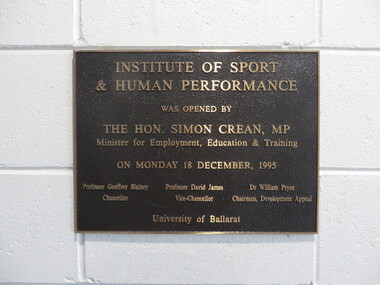
Photograph, Clare Gervasoni, Institute of Sport & Human Performance Plaque, 1995
... Human Performance was opened by the Hon. Simon Crean, MP Minister for Employment, Education & Training on MOnday 18 December, 1995 Professor Geoffrey Blainey Chancellor Professor David James Vice Chancellor Dr William Pryer Chairman, Development Appeal UNiversity of Ballarat ...Human Performance was opened by the Hon. Simon Crean, MP Minister for Employment, Education & Training on MOnday 18 December, 1995 Professor Geoffrey Blainey Chancellor Professor David James Vice Chancellor Dr William Pryer Chairman, Development Appeal UNiversity of Ballarat Plaque in the Federation University (Formerly University of Ballarat) Human Movement Building launching the Institute of Sport & Human Performance by Simon Creen. ...Plaque in the Federation University (Formerly University of Ballarat) Human Movement Building launching the Institute of Sport & Human Performance by Simon Creen.Institute of Sport & Human Performance was opened by the Hon. Simon Crean, MP Minister for Employment, Education & Training on MOnday 18 December, 1995 Professor Geoffrey Blainey Chancellor Professor David James Vice Chancellor Dr William Pryer Chairman, Development Appeal UNiversity of Ballarat human movement, institute of sport and human performance, geoffrey blainey, david james, william prior, simon crean, plaque -
 Blacksmith's Cottage and Forge
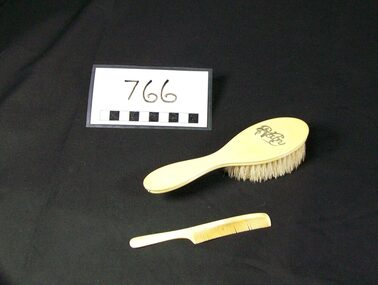
Brush and Comb. Baby
... Like the rest of the human body, (example, teeth), hair has different stages of development spanning the full lifetime from birth to death. ...Like the rest of the human body, (example, teeth), hair has different stages of development spanning the full lifetime from birth to death. ...Baby brush and comb sets were often given as Christening presents. The pure bristles were especially soft for use on infant's hair. Children's hair is often a problem because it is supremely fine and may be difficult to care for because of its nearly downy softness and fluffiness. Up until the age of 7-10, this fine hair will remain about the head. Children’s hair is different from adult hair in texture, density, and likely also colour, body and so on. Hair's traits change over time as humans physically develop, and even age. Like the rest of the human body, (example, teeth), hair has different stages of development spanning the full lifetime from birth to death. Source: www.wikipedia.org Infants' brush made of cream bakelite and pure bristle. Comb made of cream bakelite . Inscription in silver "Baby".Written in silver script, the word "Baby". Indentations on comb.child, and, nursery, bakelite, infant, grooming, brush, comb, pure, bristles, soft, mother, toiletries -
 Federation University Historical Collection
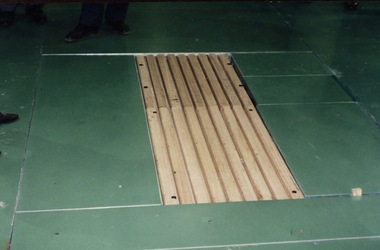
Photograph - Photograph - Colour, VIOSH: Reducing Back Injuries and Energy Costs of Shearing through the Development of Practical Modifications to Shed Layout, 1995-1997
... A project titled "Reducing Back Injuries and Energy Costs of Shearing Through the Development of Practical Modifications to Shed Layout" was funded by Worksafe Australia. The budget was $101,170. VIOSH Australia collaborated with the School of Human Movement and Sports Science to look for ways to reduce muscle injuries associated with shearing. ...A project titled "Reducing Back Injuries and Energy Costs of Shearing Through the Development of Practical Modifications to Shed Layout" was funded by Worksafe Australia. The budget was $101,170. VIOSH Australia collaborated with the School of Human Movement and Sports Science to look for ways to reduce muscle injuries associated with shearing. ...Victorian Institute of Occupational Safety and Health (VIOSH) Australia is the Asia-Pacific centre for teaching and research in occupational health and safety (OHS) and is known as one of Australia's leaders in the field. VIOSH has a global reputation for its innovative approach within the field of OHS management. VIOSH had its first intake of students in 1979. At that time the Institution was known as the Ballarat College of Advanced Education. In 1990 it became known as Ballarat University College, then in 1994 as University of Ballarat. It was 2014 that it became Federation University. VIOSH Australia students are safety managers, senior advisors and experienced OHS professionals. They come from all over Australia and industry. Students are taught active research and enquiry; rather than textbook learning and a one-size fits all approach. VIOSH accepts people into the Graduate Diploma of Occupational Hazard Management who have no undergraduate degree - on the basis of extensive work experience and knowledge. A project titled "Reducing Back Injuries and Energy Costs of Shearing Through the Development of Practical Modifications to Shed Layout" was funded by Worksafe Australia. The budget was $101,170. VIOSH Australia collaborated with the School of Human Movement and Sports Science to look for ways to reduce muscle injuries associated with shearing. The study set up a number of focus groups in the Ballarat area, New South Wales and Western Australia to gather different inputs and perspectives on causes of injuries. Groups represented were shearers, doctors, farmers and shearing shed designers. Shed design was a principal factor with the emphasis on minimising body twisting associated with catching and releasing sheep, removal of floor obstructions along path between pen and release, battens oriented along direction of drag and slope in pens.Colour photographs - postcard and A5 - relating to reducing back injuries and Energy Costs of Shearing.viosh, victorian institute of occupational safety and health, worksafe australia, back injuries, shearing sheds, shearers, school of human movement and sports science, ballarat, new south wales, western australia, doctors, farmers, shed designers -
 Federation University Historical Collection
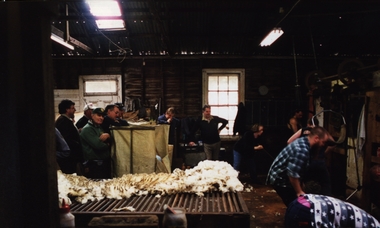
Photograph - Photograph - Colour, VIOSH: Shearing Shed Demonstrations - Collaboration with School of Human Movement and Sports Science; ways to reduce muscle injuries - 1994-1997
... A project titled "Reducing Back Injuries and Energy Costs of Shearing Through the Development of Practical Modifications to Shed Layout" was funded by Worksafe Australia. The budget was $101,170. VIOSH Australia collaborated with the School of Human Movement and Sports Science to look for ways to reduce muscle injuries associated with shearing. ...A project titled "Reducing Back Injuries and Energy Costs of Shearing Through the Development of Practical Modifications to Shed Layout" was funded by Worksafe Australia. The budget was $101,170. VIOSH Australia collaborated with the School of Human Movement and Sports Science to look for ways to reduce muscle injuries associated with shearing. ....Victorian Institute of Occupational Safety and Health (VIOSH) Australia is the Asia-Pacific centre for teaching and research in occupational health and safety (OHS) and is known as one of Australia's leaders in the field. VIOSH has a global reputation for its innovative approach within the field of OHS management. VIOSH had its first intake of students in 1979. At that time the Institution was known as the Ballarat College of Advanced Education. In 1990 it became known as Ballarat University College, then in 1994 as University of Ballarat. It was 2014 that it became Federation University. VIOSH Australia students are safety managers, senior advisors and experienced OHS professionals. They come from all over Australia and industry. Students are taught active research and enquiry; rather than textbook learning and a one-size fits all approach. VIOSH accepts people into the Graduate Diploma of Occupational Hazard Management who have no undergraduate degree - on the basis of extensive work experience and knowledge. A project titled "Reducing Back Injuries and Energy Costs of Shearing Through the Development of Practical Modifications to Shed Layout" was funded by Worksafe Australia. The budget was $101,170. VIOSH Australia collaborated with the School of Human Movement and Sports Science to look for ways to reduce muscle injuries associated with shearing. The study set up a number of focus groups in the Ballarat area, New South Wales and Western Australia to gather different inputs and perspectives on causes of injuries. Groups represented were shearers, doctors, farmers and shearing shed designers. Shed design was a principal factor with the emphasis on minimising body twisting associated with catching and releasing sheep, removal of floor obstructions along path between pen and release, battens oriented along direction of drag and slope in pens.Thirty-one colour photographs on inside a shearing shedviosh, victorian institute of occupational safety and health, 1995-1997, shearing shed layout, worksafe australia, school of human movement and sports science, shearers, doctors, farmers, muscle injuries, university of ballarat, student activity -
 Federation University Historical Collection
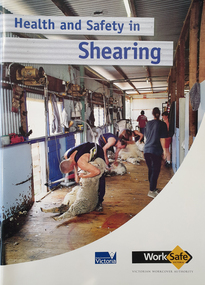
Booklet - Booklet - Safety, Worksafe Victoria, VIOSH: Victorian Workcover Authority; "Health and Safety In Shearing, 2001", 2001
... A project titled "Reducing Back Injuries and Energy Costs of Shearing Through the Development of Practical Modifications to Shed Layout" was funded by Worksafe Australia. The budget was $101,170. VIOSH Australia collaborated with the School of Human Movement and Sports Science to look for ways to reduce muscle injuries associated with shearing. ...A project titled "Reducing Back Injuries and Energy Costs of Shearing Through the Development of Practical Modifications to Shed Layout" was funded by Worksafe Australia. The budget was $101,170. VIOSH Australia collaborated with the School of Human Movement and Sports Science to look for ways to reduce muscle injuries associated with shearing. ...Victorian Institute of Occupational Safety and Health (VIOSH) Australia is the Asia-Pacific centre for teaching and research in occupational health and safety (OHS) and is known as one of Australia's leaders on the field. VIOSH has a global reputation for its innovative approach within the field of OHS management. VIOSH had its first intake of students in 1979. At that time the Institution was known as the Ballarat College of Advanced Education. In 1990 it became known as Ballarat University College, then in 1994 as University of Ballarat. It was 2014 that it became Federation University. VIOSH Australia students are safety managers, senior advisors and experienced OHS professionals. They come from all over Australia and industry. Students are taught active research and enquiry; rather than textbook learning and a one-size fits all approach. VIOSH accepts people into the Graduate Diploma of Occupational Hazard Management who have no undergraduate degree - on the basis of extensive work experience and knowledge. A project titled "Reducing Back Injuries and Energy Costs of Shearing Through the Development of Practical Modifications to Shed Layout" was funded by Worksafe Australia. The budget was $101,170. VIOSH Australia collaborated with the School of Human Movement and Sports Science to look for ways to reduce muscle injuries associated with shearing. The study set up a number of focus groups in the Ballarat area, New South Wales and Western Australia to gather different inputs and perspectives on causes of injuries. Groups represented were shearers, doctors, farmers and shearing shed designers. Shed design was a principal factor with the emphasis on minimising body twisting associated with catching and releasing sheep, removal of floor obstructions along path between pen and release, battens oriented along direction of drag and slope in pens. A full set of photographs relating to the is Item 26841.Soft covered booklet featuring the coloured image of a stand of shearers. viosh, viosh australia, occupational health & safety, shearing, workcover, shearing sheds, bob cameron, minister for workcover, 2001, back injury, item 26841, shearers, farmers, doctors, floor obstructions -
 Federation University Historical Collection
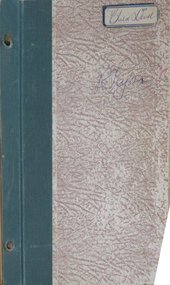
Book, Ballarat Teachers' College Notes on Child Development, 1949
... Appointed to dean of the Faculty of Human Studies at Ballarat College of Advanced Education in 1980, and Department Director of Ballarat College of Advanced Education in 1987, He retired in 1989. ballarat teachers college peter fryar physical education ballarat college of advanced education state college of victoria state college of victoria ballarat carnival Handwritten notes on foolscap paper bound in cardboard with a green taped spine. Ballarat Teachers' College Notes on Child Development ...Peter Fryar became a staff member at the Mt Helen. He served on the staff at Ballarat Teachers' College, The State College of Victoria at Ballarat, Then Ballarat College of Advanced Education. Appointed to dean of the Faculty of Human Studies at Ballarat College of Advanced Education in 1980, and Department Director of Ballarat College of Advanced Education in 1987, He retired in 1989.Handwritten notes on foolscap paper bound in cardboard with a green taped spine.ballarat teachers college, peter fryar, physical education, ballarat college of advanced education, state college of victoria, state college of victoria ballarat, carnival -
 Federation University Historical Collection
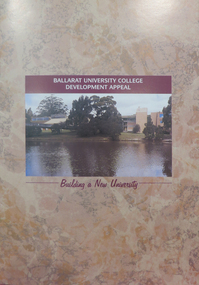
Booklet, Ballarat University College Development Appeal: Building A New University, c1994, c1994
... human performance...kathy watt...food crop development...Ballarat University College is a predecessor institution of Federation University Australia. ballarat university college university of ballarat establishment w.j. pryor bill pryor john sharpham food technology centre ballarat institute for sports and human performance kathy watt food crop development centre donations appeal development appeal ballarat university college development appeal Ballarat University College Development Appeal: Building A New University, c1994 Booklet Booklet ...Ballarat University College is a predecessor institution of Federation University Australia.ballarat university college, university of ballarat establishment, w.j. pryor, bill pryor, john sharpham, food technology centre, ballarat institute for sports and human performance, kathy watt, food crop development centre, donations, appeal, development appeal, ballarat university college development appeal -
Federation University Historical Collection
Book, University of Ballarat Research + Innovation Digest
... Contents include: * Technologies that combat climate change by Alberto Boretti * Case Studies in keeping food safe by Benu Adhikari * Learning to lead - leading to learn by Neil Trivett * Depression, diabetes and motivation by Mirella di Benedetto * Valueing Lake Wendouree by Julian Lowe * What's in a Name by Laura Kostanski * Optimizing regional and international research by John Yerwood * Sport, physical activity and health research by Warren paynbe * Climate secrets in sediments by Peter Gell * UB Sports Injuty Centre supported by IOC * Men's Sheds and other learning places by Barry Golding * New economy, new work, new qualificatins by Erica Smith * Cross-Cultural communications in a shrinking world by Georgina Tsoldis * Child Protection and family services reform by Angela Murphy * Making a difference for older Victorians by Sally Wellard * Making good (and goodly) profits by Jackie Tuck * Not too much 'ordinary' about The Ordinary by Lorraine Sim * Gaming machines and regional gamblers by John McDonald * Toe nail clippings reveal their secrets by Kim Dowling * Magnificently preserves magafauna trackways in the Victorian volcanic plains * A stuttering start for a stunning outcome * Supporting patients and theor carers * Out od Africa and beyond * Taking a hard lok to avaid hard knocks * Skilling people for business success by Andy Smith * Promoting risk awareness in industry by David Borys * Researching China's rise and ris by Mike Willis * Sex hormones link to heart disease by Fadi Charchar * Human Factors in computer security * Are our rivers up the creek by Peter Gell * Wmen as managers and entrepreneurs by Glenice Wood * Revisioning values and norms by Jane Mummery * 'Wimmera' - an Epic Poem by Homer Rieth * Recycling, consumerism, climate change and art practice by Marie Purtill * Investing in ecologically sustainable development by jerry Courvisanos * Indigenous peoples of the goldfields * Astists install images of sustanability by Jill Orr "Addressing disadvantage and nequality with passion by John Smyth * Breaking up insulin hexamers by Mark Myers ...Contents include: * Technologies that combat climate change by Alberto Boretti * Case Studies in keeping food safe by Benu Adhikari * Learning to lead - leading to learn by Neil Trivett * Depression, diabetes and motivation by Mirella di Benedetto * Valueing Lake Wendouree by Julian Lowe * What's in a Name by Laura Kostanski * Optimizing regional and international research by John Yerwood * Sport, physical activity and health research by Warren paynbe * Climate secrets in sediments by Peter Gell * UB Sports Injuty Centre supported by IOC * Men's Sheds and other learning places by Barry Golding * New economy, new work, new qualificatins by Erica Smith * Cross-Cultural communications in a shrinking world by Georgina Tsoldis * Child Protection and family services reform by Angela Murphy * Making a difference for older Victorians by Sally Wellard * Making good (and goodly) profits by Jackie Tuck * Not too much 'ordinary' about The Ordinary by Lorraine Sim * Gaming machines and regional gamblers by John McDonald * Toe nail clippings reveal their secrets by Kim Dowling * Magnificently preserves magafauna trackways in the Victorian volcanic plains * A stuttering start for a stunning outcome * Supporting patients and theor carers * Out od Africa and beyond * Taking a hard lok to avaid hard knocks * Skilling people for business success by Andy Smith * Promoting risk awareness in industry by David Borys * Researching China's rise and ris by Mike Willis * Sex hormones link to heart disease by Fadi Charchar * Human Factors in computer security * Are our rivers up the creek by Peter Gell * Wmen as managers and entrepreneurs by Glenice Wood * Revisioning values and norms by Jane Mummery * 'Wimmera' - an Epic Poem by Homer Rieth * Recycling, consumerism, climate change and art practice by Marie Purtill * Investing in ecologically sustainable development by jerry Courvisanos * Indigenous peoples of the goldfields * Astists install images of sustanability by Jill Orr "Addressing disadvantage and nequality with passion by John Smyth * Breaking up insulin hexamers by Mark Myers University of Ballarat Research + Innovation Digest Book Book ...Black soft covered book of 48 pages. Contents include: * Technologies that combat climate change by Alberto Boretti * Case Studies in keeping food safe by Benu Adhikari * Learning to lead - leading to learn by Neil Trivett * Depression, diabetes and motivation by Mirella di Benedetto * Valueing Lake Wendouree by Julian Lowe * What's in a Name by Laura Kostanski * Optimizing regional and international research by John Yerwood * Sport, physical activity and health research by Warren paynbe * Climate secrets in sediments by Peter Gell * UB Sports Injuty Centre supported by IOC * Men's Sheds and other learning places by Barry Golding * New economy, new work, new qualificatins by Erica Smith * Cross-Cultural communications in a shrinking world by Georgina Tsoldis * Child Protection and family services reform by Angela Murphy * Making a difference for older Victorians by Sally Wellard * Making good (and goodly) profits by Jackie Tuck * Not too much 'ordinary' about The Ordinary by Lorraine Sim * Gaming machines and regional gamblers by John McDonald * Toe nail clippings reveal their secrets by Kim Dowling * Magnificently preserves magafauna trackways in the Victorian volcanic plains * A stuttering start for a stunning outcome * Supporting patients and theor carers * Out od Africa and beyond * Taking a hard lok to avaid hard knocks * Skilling people for business success by Andy Smith * Promoting risk awareness in industry by David Borys * Researching China's rise and ris by Mike Willis * Sex hormones link to heart disease by Fadi Charchar * Human Factors in computer security * Are our rivers up the creek by Peter Gell * Wmen as managers and entrepreneurs by Glenice Wood * Revisioning values and norms by Jane Mummery * 'Wimmera' - an Epic Poem by Homer Rieth * Recycling, consumerism, climate change and art practice by Marie Purtill * Investing in ecologically sustainable development by jerry Courvisanos * Indigenous peoples of the goldfields * Astists install images of sustanability by Jill Orr "Addressing disadvantage and nequality with passion by John Smyth * Breaking up insulin hexamers by Mark Myers david battersby, research, frank stagnitti, jill orr, john smyth, fred cahir, peter gell, andy smith, grant meredith, stuttering, kim dowling, stephen carey, megafauna, john mcdonaldgaming machines, men's sheds, barry golding -
 Flagstaff Hill Maritime Museum and Village
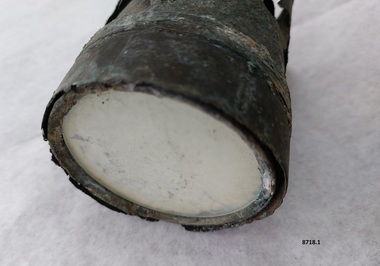
Instrument - Telescope lens, circa 1870's
... Telescopes are optical instruments that make distant objects appear larger and closer, thereby extending the range of what the human eye can observe. The development of the telescope was gradual, shaped by a series of important advances in optical science. ...Telescopes are optical instruments that make distant objects appear larger and closer, thereby extending the range of what the human eye can observe. The development of the telescope was gradual, shaped by a series of important advances in optical science. ...Telescopes are optical instruments that make distant objects appear larger and closer, thereby extending the range of what the human eye can observe. The development of the telescope was gradual, shaped by a series of important advances in optical science. In 1608, the Dutch spectacle-maker Hans Lippershey discovered that when two lenses were held apart in a particular way, distant objects appeared closer. He applied for a patent for this invention, creating the first documented telescope. In 1668, Isaac Newton produced the first successful reflecting telescope, using a two-inch concave spherical mirror. This marked a major step forward, demonstrating that mirrors could overcome some of the limitations of lenses and greatly improve magnification. Further progress followed in the eighteenth century. In 1729, Chester Moor Hall developed the achromatic lens by combining two types of glass with different refractive properties. This reduced colour distortion and produced a sharper image, although some edge distortion remained. That same year, the Scottish instrument maker James Short developed parabolic and elliptical mirrors that were better suited to reflecting telescopes because they reduced optical distortion. Building on these advances, John Dollond improved the achromatic objective lens by placing a concave flint-glass lens between two convex crown-glass lenses, considerably enhancing image quality. Telescopes were used by astronomers to observe planets and stars however they were also used for military and nautical purposes. Telescopes from the mid 1700 onwards consisted of anywhere between two and five brass sections, one sliding inside another to make the instrument's size more manageable when not in use. The brass tubes were called "draws" because they were drawn out of the main barrel. Our two artefacts appear to be two different sized "draws". It is not possible to say if they belonged to the same telescope or were from different instruments and nor is it possible to identify a maker. Both telescopic "draws" were recovered from the wreck of the Loch Ard, on the southwest coast of Victoria and donated by a friend of the diver. The ship Loch Ard was built on the River Clyde in Scotland in 1873 for the prestigious Loch Line of colonial clipper ships, designed for the Australian run. It sailed from England on 1st March 1878 carrying 37 crew, 17 passengers and a load of cargo. The general cargo reflected the affluence of Melbourne at the time. On board were straw hats, umbrellas, perfumes, clay pipes, pianos, clocks, confectionary, linen and candles, as well as a heavier load of railway irons, cement, lead and copper. There were items included that were intended for display in the Melbourne International Exhibition in 1880 - a diverse general cargo ranging from luxury items to bulk railway iron. On 1 June 1878, emerging from fog and hearing too late the sound of breakers against the tall limestone cliffs, the vessel struck the southern foot of Mutton Bird Island and sank in 23 metres of water. Of the fifty-four people on board only two survived, one young male crewman, Tom Pearce, and one young female passenger, Eva Carmichael. Ten days after the Loch Ard tragedy, salvage rights to the wreck were sold at auction for £2,120. Cargo valued at £3,000 was salvaged and placed on the beach, but most washed back into the sea when another storm developed. The wreck of Loch Ard still lies at the base of Mutton Bird Island. Much of the cargo has now been salvaged and some was washed up into what is now known as Loch Ard Gorge. Cargo and artefacts have also been illegally salvaged over many years before protective legislation was introduced. One of the most unlikely pieces of cargo to have survived the shipwreck was a Minton porcelain peacock - one of only seven in the world. The peacock was destined for the Melbourne International Exhibition in 1880. It had been well packed, which gave it adequate protection during the violent storm. Today, the Minton peacock can be seen at the Flagstaff Hill Maritime Museum in Warrnambool. From Australia's most dramatic shipwreck it has now become Australia's most valuable shipwreck artefact and is one of very few 'objects' on the Victorian State Heritage Register.Flagstaff Hill’s collection of artefacts from LOCH ARD is significant for being one of the largest collections of artefacts from this shipwreck in Victoria. It is significant for its association with the shipwreck, which is on the Victorian Heritage Register (VHR S417). The collection is significant because of the relationship between the objects, as together they have a high potential to interpret the story of the LOCH ARD. The LOCH ARD collection is archaeologically significant as the remains of a large international passenger and cargo ship. The LOCH ARD collection is historically significant for representing aspects of Victoria’s shipping history and its potential to interpret sub-theme 1.5 of Victoria’s Framework of Historical Themes (living with natural processes). The collection is also historically significant for its association with the LOCH ARD, which was one of the worst and best known shipwrecks in Victoria’s history.Two metal (possibly brass) cylinders that appear to be parts of a telescope salvaged from the wreck of the Loch Ard. The larger cylinder 8718.1 has a smaller cylinder sitting inside the larger outer cylinder with a circular piece of opaque glass in one end. The metal on both inner and outer cylinders are very thin, fragile and brittle. The outside has verdigris oxidation. One end has a thin track of fine threads where another part would have been screwed on. The smaller cylinder, 8718.2, is in better condition. It appears to be a brass cylinder with a circular opening (one small and one larger) at each end. Inside the cylinder (about halfway down) is a pane of opaque glass. One end of the cylinder had a slightly flared cap screwed into it. An indistinct "8" appears to be printed in the casing."8"flagstaff hill maritime museum and village, warrnambool, great ocean road, loch ard, wreck of the loch ard, loch ard salvage, telescope, loch ard artefact, telescopic draw -
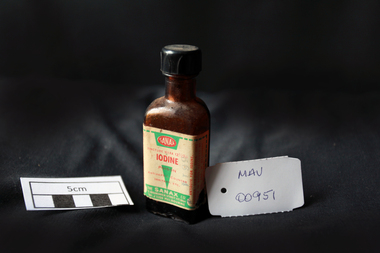 City of Moorabbin Historical Society (Operating the Box Cottage Museum)
Manufactured Glass, brown bottle 'Iodine', 20thC
... The thyroid hormones are essential to proper development and differentiation of all cells of the human body. These hormones also regulate protein, fat, and carbohydrate metabolism, affecting how human cells use energetic compounds. ...The thyroid hormones are essential to proper development and differentiation of all cells of the human body. These hormones also regulate protein, fat, and carbohydrate metabolism, affecting how human cells use energetic compounds. ...Iodine is an essential trace element for life, the heaviest element commonly needed by living organisms. In medicine, potassium iodide is usually used to treat acute thyrotoxicosis. Hyperthyroidism, an overactive thyroid, is a condition in which the thyroid gland produces and secretes excessive amounts of the free (not protein bound, and circulating in the blood) thyroid hormones, This is the opposite of hypothyroidism ('sluggish thyroid'), which is their reduced production and secretion. Graves' disease is the most common cause of hyperthyroidism. Iodine's main role in animal biology is as a constituent of the thyroid hormones thyroxine If there is a deficiency of dietary iodine, the thyroid will not be able to make thyroid hormone. The lack of thyroid hormone will lead to decreased negative feedback on the pituitary, leading to increased production of thyroid-stimulating hormone, which causes the thyroid to enlarge (the resulting medical condition is called endemic colloid goitre This has the effect of increasing the thyroid's ability to trap more iodide, compensating for the iodine deficiency and allowing it to produce adequate amounts of thyroid hormone. The thyroid hormones are essential to proper development and differentiation of all cells of the human body. These hormones also regulate protein, fat, and carbohydrate metabolism, affecting how human cells use energetic compounds. They also stimulate vitamin metabolism. Natural sources of iodine include sea life, such as kelp and certain seafood, as well as plants grown on iodine-rich soil. Iodized salt is fortified with iodine. Elemental iodine is used as a disinfectant in various forms. It is a wound cleaner and Iodine also acts as an expectorant of mucous from the common cold and other respiratory ailments. Iodine is a common aid for skin conditions, such as acne, ..A brown glass triangular shaped bottle with a plastic screw top lid that contained IodineFront Label : SANA / TINCTURE WEAK (2 1/2 % ) / IODINE / POISON / ANTISEPTIC COUNTER / IRRITANT ETC. / THE SANAX CO. / 5 BRUNSWICK STREET FITZROY / TEL. J 3208 MELBOURNE. on side : ANTIDOTE FOR IODINE / DIRECTIONS.........pharmacy, medicines, iodine, athritis, glassware, bottles, moorabbin, bentleigh, cheltenham, thyroxin, goitre, iodised salt, gravves' disease -
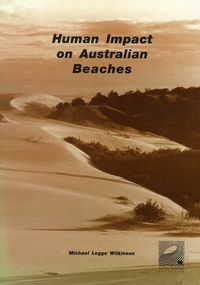 Australian National Surfing Museum
Document, Human Impact on Australian Beaches (Results from SOS95 Beach Survey), 1/5/1996 (estimated)
... human impacts on beaches...sos95...michael legge wilkinson...coastal development...The report generated national and international media interest with the BBC London reporting on its findings in the week after its launch. beach surfrider foundation australia human impacts on beaches sos95 michael legge wilkinson coastal development beach pollution Sepia cover, Surfrider Foundation logo on report cover Beach Environmental Report. 168 page report which examines the health of 1612 beach areas around Australia. ...Human Impacts on Australian Beaches was a landmark environmental study which provided a 'snapshot' of the health of 1612 beach areas around Australia. This nationwide study (which built on the success of the 1994 State of Our Surf Report) was put together by the Surfrider Foundation Australia with the support of more then 340 individuals and 70 organisations around Australia. The report was authored by surfer/environmentalist/artist Michael Legge-Wilkinson from Newcastle, New South Wales. Human Impacts was launched officially by Peter Garrett, leader of Australian rock band Midnight Oil at the Bondi Pavilion, Bondi Beach in May 1996.Human Impacts built on the success of the 1994 State Of Our Surf Report, released by the Surfrider Foundation Australia in 1994. Human Impacts was the first major report to specifically examine the environmental health of 1612 of Australia's beaches. A limited 500 copies of this report were produced, the majority of which went to education institutions, libraries, community groups and government departments. The report generated national and international media interest with the BBC London reporting on its findings in the week after its launch.Beach Environmental Report. 168 page report which examines the health of 1612 beach areas around Australia. Sepia cover featuring a photograph of endangered sanddunes at Stockton Bight, north of Newcastle. 168 pagesSepia cover, Surfrider Foundation logo on report coverbeach, surfrider foundation australia, human impacts on beaches, sos95, michael legge wilkinson, coastal development, beach pollution
