
Showing 15 items matching "huntingfield hall"
-
 Port Melbourne Historical & Preservation Society
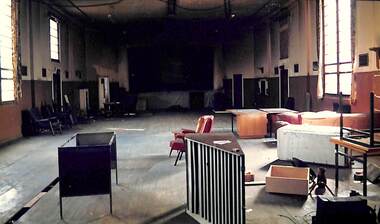
Photograph - Huntingfield Hall, Missions to Seamen, Port Melbourne, Alison Kelly, 1988
... Huntingfield Hall, Missions to Seamen, Port Melbourne......Huntingfield hall... Port Melbourne Missions to Seamen building, Huntingfield Hall, looking toward stage; used as workroom at this period of the Mission Arts Centre 1988. ...Photographed by Alison Kelly while she was joint caretaker of the building during the Mission Arts Centre days 1987 to 1991 missions to seamen built environment Huntingfield hall Port Melbourne Missions to Seamen building, Huntingfield Hall, looking toward stage; used as workroom at this period of the Mission Arts Centre 1988. ...Photographed by Alison Kelly while she was joint caretaker of the building during the Mission Arts Centre days 1987 to 1991 Port Melbourne Missions to Seamen building, Huntingfield Hall, looking toward stage; used as workroom at this period of the Mission Arts Centre 1988. From album of photos mostly by Alison Kelly:missions to seamen, built environment, huntingfield hall -
 Port Melbourne Historical & Preservation Society
Equipment - Projector, from Huntingfield Hall, Missions to Seamen Building. Port Melbourne, 1930s
... Projector, from Huntingfield Hall, Missions to Seamen Building. Port Melbourne...An occasional cinema night was held in Huntingfield Hall at the Mission to Seamen building where dances and concert entertainments for the crews of ships also took place....A slide projector from bio-box projector room above Huntingfield Hall, in the Missions to Seamen building. ...An occasional cinema night was held in Huntingfield Hall at the Mission to Seamen building where dances and concert entertainments for the crews of ships also took place. arts and entertainment - film/cinema missions to seamen A slide projector from bio-box projector room above Huntingfield Hall, in the Missions to Seamen building. ...An occasional cinema night was held in Huntingfield Hall at the Mission to Seamen building where dances and concert entertainments for the crews of ships also took place.A slide projector from bio-box projector room above Huntingfield Hall, in the Missions to Seamen building. (Ref 1613)arts and entertainment - film/cinema, missions to seamen -
 Mission to Seafarers Victoria
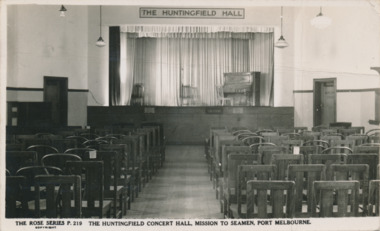
Postcard, Rose Stereograph, The Huntingfield Concert Hall, Mission to Seamen, Port melbourne, c. 1937
... The Huntingfield Concert Hall, Mission to Seamen, Port melbourne......huntingfield hall...Black and white postcard showing interior the chairs in front of the stage in the Huntingfield Hall of the Port Melbourne Mission...Black and white postcard showing interior the chairs in front of the stage in the Huntingfield Hall of the Port Melbourne Mission The Huntingfield Concert Hall, Mission to Seamen, Port melbourne Postcard Rose Stereograph ...Black and white postcard showing interior the chairs in front of the stage in the Huntingfield Hall of the Port Melbourne MissionInscription handwritten in blue ink. stage, piano, chairs, events, concerts, lhlg, george v memorial institute, port melbourne, seamen's mission, huntingfield hall, curtains, woodfloor, harry a. norris, art deco -
Port Melbourne Historical & Preservation Society
Decorative object - Air vent cover, Huntingfield Hall, Missions to Seamen, Port Melbourne, Harry Norris, Architect, 1936
... Air vent cover, Huntingfield Hall, Missions to Seamen, Port Melbourne...Casted air vent cover from Huntingfield Hall, Missions to Seamen building, Port Melbourne...Missions to Seamen Harry A NORRIS Built Environment - Civic Art Deco Casted air vent cover from Huntingfield Hall, Missions to Seamen building, Port Melbourne Decorative object Air vent cover, Huntingfield Hall, Missions to Seamen, Port Melbourne Harry Norris, Architect ...Casted air vent cover from Huntingfield Hall, Missions to Seamen building, Port Melbournemissions to seamen, harry a norris, built environment - civic, art deco -
Port Melbourne Historical & Preservation Society
Equipment - Projector, from Huntingfield Hall, Missions to Seamen Building. Port Melbourne, Power's Cameragraph 6B, 1920s
... Projector, from Huntingfield Hall, Missions to Seamen Building. Port Melbourne...Slide projector from the bio-box projector room above Huntingfield Hall in the Missions to Seamen building. ...Equipment Projector, from Huntingfield Hall, Missions to Seamen Building. Port Melbourne Power's Cameragraph 6B ...An occasional cinema night was held in Hungtingfield Hall at the Missions to Seamen building, where dances and concert entertainments for the crews of visiting ships also took place.Slide projector from the bio-box projector room above Huntingfield Hall in the Missions to Seamen building. Shell only, repainted in black some time ago. See also 1615.missions to seamen, arts and entertainment - film/cinema -
 Mission to Seafarers Victoria
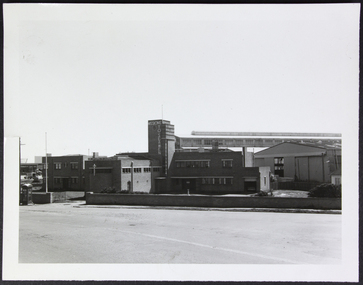
Photograph - Photograph, Black and white, Bill Doyle (Reverend C.J. Eldridge-Doyle), 1948-1954
... ...huntingfield hall...mission port melbourne art deco harry a. norris alfred m. nicholas brick beach street huntingfield hall king george v memorial building seamen mission mission to seamen mission to seafarers 1937 phone booth phone box bill doyle Small b & w photograph depicting 1930's Mission to Seafarers building at Port Melbourne Photograph Photograph, Black and white Bill Doyle (Reverend C.J. ...Small b & w photograph depicting 1930's Mission to Seafarers building at Port Melbournemission, port melbourne, art deco, harry a. norris, alfred m. nicholas, brick, beach street, huntingfield hall, king george v memorial building, seamen mission, mission to seamen, mission to seafarers, 1937, phone booth, phone box, bill doyle -
 Port Melbourne Historical & Preservation Society
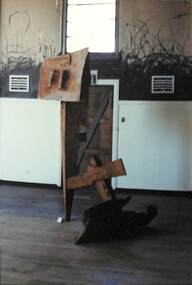
Photograph - Missions to Seamen, Port Melbourne. Interior, Alison Kelly, 1990
... Port Melbourne Missions to Seamen building, colour view of sculpture in Huntingfield Hall, showing wave motif on ventilators, mural by Brian Couldrey 1987. ...Photographed by Alison Kelly while she was joint caretaker of the building during the Mission Arts Centre days 1987 to 1991 missions to seamen built environment Port Melbourne Missions to Seamen building, colour view of sculpture in Huntingfield Hall, showing wave motif on ventilators, mural by Brian Couldrey 1987. ...Photographed by Alison Kelly while she was joint caretaker of the building during the Mission Arts Centre days 1987 to 1991 Port Melbourne Missions to Seamen building, colour view of sculpture in Huntingfield Hall, showing wave motif on ventilators, mural by Brian Couldrey 1987. From album of photos mostly by Alison Kelly:missions to seamen, built environment -
 Bendigo Historical Society Inc.
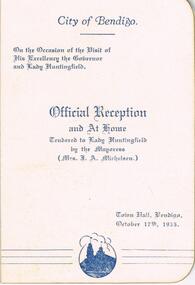
Document - BUSH COLLECTION: PROGRAMME, OFFICIAL RECEPTION - BENDIGO, 1935
... Tendered to Lady Huntingfield by the Mayoress (Mrs H A Michelsen) on the occasion of the visit of His Excellency the Governor and Lady Huntingfield, Town Hall. Issued to Miss M Bush??. Card opens to give programme of entertainment and entertainers....Tendered to Lady Huntingfield by the Mayoress (Mrs H A Michelsen) on the occasion of the visit of His Excellency the Governor and Lady Huntingfield, Town Hall. Issued to Miss M Bush??. Card opens to give programme of entertainment and entertainers. ...Programme, 'Official Reception and At Home' - Bendigo,Oct 17th 1935. Tendered to Lady Huntingfield by the Mayoress (Mrs H A Michelsen) on the occasion of the visit of His Excellency the Governor and Lady Huntingfield, Town Hall. Issued to Miss M Bush??. Card opens to give programme of entertainment and entertainers.person, individual, bush collection - personal, bendigo, bush collection, collection, programme, program, reception, organisation, organization, civic momentoes, event -
 Mission to Seafarers Victoria
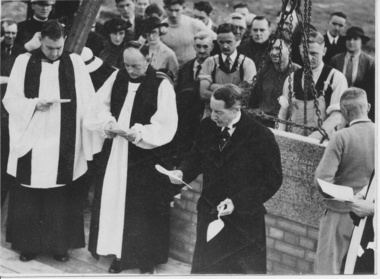
Photograph - Photograph, Black and white, Herald Sun, 18 May 1937
... The Mission was given the name: George V Memorial Institute, and the concert hall was given the name Huntingfield Hall. port melbourne beach road lord huntingfield art deco alfred nicholas foundation stone trowel harry a. norris george v memorial institute port melbourne mission 1937 Back of photograph stamped, "Herald Feature Service Melbourne". ...On 18 May 1937, Lord Huntingfield, Governor of Victoria (14 May 1934 – 4 April 1939) layed the foundation stone of the last of the missions built in Melbourne. The Mission to Seamen, Port Melbourne opened in December 1937, superceded the original 19th C building and service point in Port.Demolished in the late 20th C by developers the building was of architectural significance and funded originally by Alfred Nicholas who gifted 18,000 pounds. An indicator of the importance of shipping and seafarer welfare as regarded by Industry and business during the interwar years of the 1930s. This photograph is a record of the founding of the building. The stone is now part of the bluestone wall on Beach Road, Port Melbourne. The Mission was given the name: George V Memorial Institute, and the concert hall was given the name Huntingfield Hall.A black and white photograph depicting the laying of a foundation stone. Photograph of two clergymen standing to one side of the Governor of Victoria (1934-1939), Lord Huntingfield, who is holding a trowel in his left hand. A foundation stone, resting on a low brick wall is thought to be the granite foundation stone of the Port Melbourne Mission. A small crowd of approximately 21 people are gathered behind the wall. Back of photograph stamped, "Herald Feature Service Melbourne".port melbourne, beach road, lord huntingfield, art deco, alfred nicholas, foundation stone, trowel, harry a. norris, george v memorial institute, port melbourne mission, 1937 -
 Bendigo Historical Society Inc.
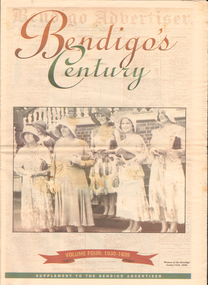
Newspaper - LONG GULLY HISTORY GROUP COLLECTION: BENDIGO'S CENTURY VOLUME FOUR: 1930 - 1939
... Hall... Lord and Lady Huntingfield...BENDIGO History long gully history group The Long Gully History Group - Bendigo's Century - Volume Four: 1930 - 1939 Eaglehawk Cricket Club Ernst Mueller The Bendigo Stock ExchangeL L Dungey T Williams M P Kelly C Mueller E Hommoloff R Kelly T H Busst T Hall R Tremabath E A Woodcock C Burridge Charshalton Mine Edith and G V Lansell Laboratory St Andrew's Church RSL Memorial Hall Mr Gordon Carter Sir John Monash State Electricity Commission Cr R Watson Colonel GT V Lansell Empire Press Congress Bendigo Advertiser Mr E J Hogan Eppalock Weir Lyric Theatre Bendigo Red Cross Mrs George Mackay St Andrew's Presbyterian Church Mrs William Hunter Right Rev John Douse Langley Monsignor Rooney Bendigo Art Gallery The Ironbark Mine Coliban Water Mr W Wright Station 3BO Amalgamated Wireless of Australia Ltd Advance Bendigo Group The North League St Aidan's Orphanage Bendigo Freezing Works Mr W Wright Bendigo Advertiser Mr W J Stephens Advance Bendigo Group North League Garden Gully United Gold Mining Company Bendigo Football League Sir John Quick John Quick Snr Ironbark Foundry Bendigo Evening News Bendigo Independent Bendigo Advertiser Deakin Governmnet Sir Charles Kingsford Smith Southern Cross Eppalock Weir Bendigo Art Gallery The Hercules Mine Gillies Aids & Appliance Shop Anne Caudle Centre Bill Woodfull Harold Larwood Dr John McCarthy The Hercules Douglas Jardine Don Bradman Sacred Heart Cathedral Joseph Stapleton John Lynch Bert McConchie New Red White and Blue Mine Royal Humane Society William James Vernon Shaw South New Moon Mine Bendigo Hospital Bendigo Base Hospital Duke of Gloucester RSL Memorial Hall Electricity Commission Eaglehawk Borough Council The Plaza Backhaus Estate Amalgamated Freezing Company Fortuna Villa Mrs Edith Lansell Colonel Lansell The Hercules Mine Toni Riley Pharmacy Boardwalk Barkly Hyett The Big Blue Consolidated Company The Bendigo Hospital Eaglehawk Football Team Kurmala Wing of the Bendigo Base Hospital Sir Isaac Isaacs Lyric Theatre Sir John Quick Hanro Knitting Mills St Luke's Toddlers Home St Aidan's Orphanage RSL Memorial Hall Lord and Lady Huntingfield Cr Michelsen Bendigo Art Gallery Bendigo Agricultural Show New Blue Mine Joseph Stapleton Bendigo Law Association Bendigo Hospital Committee of Management Bendigo Rotary Club Mr J McRae Education Department Andrew Sunstan Sir Stanley Argyle Bendigo Football League North Blue Mining Company Cr Staples King George V King Edward VIII Cr J A Michelsen Andrew McLay Bendigo Advertiser Cohn Bros Mrs Wallis Simpson King George VI Capping Mine Shafts 1936 Bendigo Art Gallery Madge Freemen William John Leslie Cross Judge Wasley The Myer Emporium The Baptist Church Salvation Army Ron Masters The Central Nell Gwyn Sir John Quick Leanne McDonnell Windermere Hotel Rev Donald Baker John Rumbold Central Nell Gwynne The Beehive Building The Beehive Store James Buick and Co Thomas Hope Henderson Buick Henderson & Co Mr Goodison Mr R O Henderson Lt-Col Henderson Angus Mackay Bendigo Sewerage Authority Mr S Gordon Moore Commercial Bank of Sydney Bendigo Advertiser Edward Alan Morcom Polio DR Gardner Kerr The Right Rev Conald Baker Ridley Theological College Newspaper supplement titled Bendigo's Century Volume Four: 1930 - 1939. ...Newspaper supplement titled Bendigo's Century Volume Four: 1930 - 1939. Front page is titled Bendigo's Century and has a photo of some women at the Bendigo Jockey Club, 1930s. Each year has heading of Who's Who, Weather, Sport and Business. First years are 1930 - 1939 titled A look back when. The page has photos of the Eaglehawk Cricket Club's first A Grade cricket premier ship team (1932 - 1933)., The monument to the late Bendigo mining magnate Ernst Mueller in Rosalind Park, The Bendigo Stock Exchange in the early 1930's - pictured are L L Dungey, T Williams, M P Kelly, C Mueller, E Hommoloff, R Kelly, T H Busst, T Hall, R Trembath, E A Woolcock, and C Burridge, the Carshalton mine in 1936 and The Edith and G V Lansell Laboratory at the Bendigo Hospital. 1930 - a photo of St Andrew's Church, the sundial outside the RSL Memorial Hall, The late Monsignor Rooney and The late John Douse Langley. The Ironbark Mine was the top gold producer. 1931 - Radio station goes on air, 1932 - Sir John dies, 1933 Bodyline men come to town, 1934 - Heroic rescues, 1935 - Hospital's new wing opened, 1936 - King mourned, 1937 - Beehive store towers above, 1938 - Mining shows mixed results and 1939 - Outbreak of war sobering.bendigo, history, long gully history group, the long gully history group - bendigo's century - volume four: 1930 - 1939, eaglehawk cricket club, ernst mueller, the bendigo stock exchangel l dungey, t williams, m p kelly, c mueller e hommoloff, r kelly, t h busst, t hall, r tremabath, e a woodcock, c burridge, charshalton mine, edith and g v lansell laboratory, st andrew's church, rsl memorial hall, mr gordon carter, sir john monash, state electricity commission, cr r watson, colonel gt v lansell, empire press congress, bendigo advertiser, mr e j hogan, eppalock weir, lyric theatre, bendigo red cross, mrs george mackay, st andrew's presbyterian church, mrs william hunter, right rev john douse langley, monsignor rooney, bendigo art gallery, the ironbark mine, coliban water, mr w wright, station 3bo, amalgamated wireless of australia ltd, advance bendigo group, the north league, st aidan's orphanage, bendigo freezing works, mr w wright, bendigo advertiser, mr w j stephens, advance bendigo group, north league, garden gully united gold mining company, bendigo football league, sir john quick, john quick snr, ironbark foundry, bendigo evening news, bendigo independent, bendigo advertiser, deakin governmnet, sir charles kingsford smith, southern cross, eppalock weir, bendigo art gallery, the hercules mine, gillies, aids & appliance shop, anne caudle centre, bill woodfull, harold larwood, dr john mccarthy, the hercules, douglas jardine, don bradman, sacred heart cathedral, joseph stapleton, john lynch, bert mcconchie, new red white and blue mine, royal humane society, william james, vernon shaw, south new moon mine, bendigo hospital, bendigo base hospital, duke of gloucester, rsl memorial hall, electricity commission, eaglehawk borough council, the plaza, backhaus estate, amalgamated freezing company, fortuna villa, mrs edith lansell, colonel lansell, the hercules mine, toni riley pharmacy, boardwalk, barkly hyett, the big blue consolidated company, the bendigo hospital, eaglehawk football team, kurmala wing of the bendigo base hospital, sir isaac isaacs, lyric theatre, sir john quick, hanro knitting mills, st luke's toddlers home, st aidan's orphanage, rsl memorial hall, lord and lady huntingfield, cr michelsen, bendigo art gallery, bendigo agricultural show, new blue mine, joseph stapleton, bendigo law association, bendigo hospital committee of management, bendigo rotary club, mr j mcrae, education department, andrew sunstan, sir stanley argyle, bendigo football league, north blue mining company, cr staples, king george v, king edward viii, cr j a michelsen, andrew mclay, bendigo advertiser, cohn bros, mrs wallis simpson, king george vi, capping mine shafts 1936, bendigo art gallery, madge freemen, william john leslie cross, judge wasley, the myer emporium, the baptist church, salvation army, ron masters, the central nell gwyn, sir john quick, leanne mcdonnell, windermere hotel, rev donald baker, john rumbold, central nell gwynne, the beehive building, the beehive store, james buick and co, thomas hope henderson, buick henderson & co, mr goodison, mr r o henderson, lt-col henderson, angus mackay, bendigo sewerage authority, mr s gordon moore, commercial bank of sydney, bendigo advertiser, edward alan morcom, polio, dr gardner kerr, the right rev conald baker, ridley theological college -
Glen Eira Historical Society
Article - St Mary The Virgin, Kooyong Road, South Caulfield
... Halls Hawthorn Road Church Tennis Courts Foundation Stones Kindergartens Cricket Clubs Blake E. B Rev McGregor F. R. Price C Pearson A Mahaffy J. B Hollyock E Blake Mrs Aveling Mrs Cripps Mrs Veitch Mrs Sharp W Sprunt B Hillier H. R. Hillier Mrs (Cousins) Dulcie Cousins Rowley St Mary The Virgin Watson(Lund) Amy Millar Joan Kenafick Iris Governors Huntingfield ...Brief history of the Kooyong Road Church; taken from A Coming Together by Gwenda Mann and Gordon Gray, (a short account of some of the highlights of the first Fifty years of the Kooyong Road Methodist Church, Caulfield, Victoria), date unknown and photocopied. The article details the commencement of the Methodist churches circuit. Includes some history of the churches, early parishioners, the Trust Organ Fund, the removal from the Elsternwick to the new Caulfield circuit. The silver Jubilee celebrations. Article by Iris Kenatick being a local preacher in the circuit, and list of Pastors and Ministers from 1917 – 1989.kooyong road church, ontario street, catterall j. m rev., caulfield south, caulfield methodist circuit, elsternwick, hawthorn road, bambra road, eddy j. h., mclelcan mr., bundeera road, clarence street, hunt w. h., foy and gibson, balaclava, north road, penny e. r., field a. b, sunday schools, eddy mrs., field mrs., hunt mrs., leach a. g, leach mrs, levens miss, levens mr., spargo mr, spargo mrs, taylor mrs, watson mrs., festivals and celebrations, clemens v. miss, sprunt miss, bishop miss, king miss (2), cox mr, choirs, church furniture, venus street, watson amy, dodds p., oliver f. mrs, campbell h., truscott a, truscott mrs., mcgregor f. mrs, jupiter street, organs, halls, hawthorn road church, tennis courts, foundation stones, kindergartens, cricket clubs, blake e. b rev, mcgregor f. r., price c, pearson a, mahaffy j. b, hollyock e, blake mrs, aveling mrs, cripps mrs, veitch mrs, sharp w, sprunt b, hillier h. r., hillier mrs, (cousins) dulcie, cousins rowley, st mary the virgin, watson(lund) amy, millar joan, kenafick iris, governors, huntingfield lord, festivals and celebrations, clergy, church services, church festivals -
Box Hill Historical Society
Photograph - Group including Governor of Victoria, Lord Huntingfield at opening of Box Hill Town Hall, 15/04/1935
... Group including Governor of Victoria, Lord Huntingfield at opening of Box Hill Town Hall... Group taken at the opening of the Town Hall, including the Governor of Victoria, his Excellency Lord Huntingfield K.C.M.G., the Mayor (Cr. ...Typed notes on back of photo: "Photograph taken on 15th April, 1935 at the opening of the Town Hall by the Governor of Victoria, His Excellency Lord Huntingfield, K.C.M.G....Group taken at the opening of the Town Hall, including the Governor of Victoria, his Excellency Lord Huntingfield K.C.M.G., the Mayor (Cr. ...Group taken at the opening of the Town Hall, including the Governor of Victoria, his Excellency Lord Huntingfield K.C.M.G., the Mayor (Cr. Boyland), Mayoress and the Town ClerkBlack and white photographTyped notes on back of photo: "Photograph taken on 15th April, 1935 at the opening of the Town Hall by the Governor of Victoria, His Excellency Lord Huntingfield, K.C.M.G./Left to right:/The Mayor (Cr. W. J. Boyland), Lord Huntingfield, Lady Huntingfield, the Mayoress (Mrs. Boyland), the Town Clerk (Mr. H.J. Cole)."opening ceremonies, town halls, box hill town hall, governors, mayors, mayoresses, town clerks, boyland> w.j. (cr.), boyland> - (mrs.), cole> h.j.r. -
 Whitehorse Historical Society Inc.
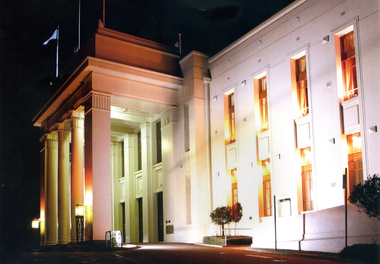
Photograph, Box Hill Town Hall
... This Box Hill Town Hall was officially opened in April 1935 by the then governor of Victoria, Lord Huntingfield. ...This Box Hill Town Hall was officially opened in April 1935 by the then governor of Victoria, Lord Huntingfield. ...This Box Hill Town Hall was officially opened in April 1935 by the then governor of Victoria, Lord Huntingfield. An administrative wing was added in 1982. Following the proclamation of the City of Whitehorse in 1994, the administrative functions were transferred to the Civic Centre in Nunawading. The Box Hill Town Hall, which is a National Trust building now houses the Art Centre and community rooms for use by historical societies and volunteer groups.Coloured photograph of the front of Box Hill Town Hall taken in November 2006 on the re-opening after refurbishmentbox hill town hall, city of whitehorse -
Friends of Ballarat Botanical Gardens History Group
Work on paper - Gordon Cottage Officially Opened, The Ballarat Courier 16 August 1934, 16/8/1934
... The official opening of the Gordon Cottage was a significant event in 1934 Ballarat This article covers not only the Vice-Regal Visit to Ballarat but the Reception at City Hall, the Unveiling of the Gordon Plaque at Craig's Hotel and the Official opening of the Adam Lindsay Cottage. John Garner Doctor John Garner Collection Friends of Ballarat Botanical Gardens Craft Cottage Lord and Lady Huntingfield Governor of Victoria Adam Lindsay Gordon Cottage Adam Lindsay Gordon Plaque Craig's Hotel Ballarat Courier Gordon Committee Gardens Ballarat Top righthand corner is written in blue biro, 16 August, 1934. p.1. 2 pages of newspaper print in columns The Ballarat Courier 16 August 1934 Work on paper Gordon Cottage Officially Opened ...The official opening of the Gordon Cottage was a significant event in 1934 BallaratThis article covers not only the Vice-Regal Visit to Ballarat but the Reception at City Hall, the Unveiling of the Gordon Plaque at Craig's Hotel and the Official opening of the Adam Lindsay Cottage.2 pages of newspaper print in columnsTop righthand corner is written in blue biro, 16 August, 1934. p.1.john garner, doctor, john garner collection, friends of ballarat botanical gardens, craft cottage, lord and lady huntingfield, governor of victoria, adam lindsay gordon cottage, adam lindsay gordon plaque, craig's hotel, ballarat courier, gordon committee, gardens, ballarat -
 City of Melbourne Libraries
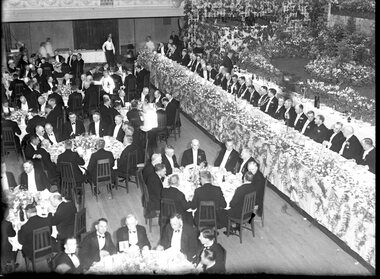
Photograph, Bull, Hugh Jones, 1897-1993, Lord Mayor's Dinner, Melbourne Town Hall
... Huntingfield were present, while Rear-Admiral and Mrs. Lane Poole and officers from the visiting squadron were among the special guests. The balconies all round the hall...Huntingfield were present, while Rear-Admiral and Mrs. Lane Poole and officers from the visiting squadron were among the special guests. The balconies all round the hall ...Photographer notations on slide: "General View Of Lord Mayor's Dinner At Town Hall Nov 1936 B112" Published: The Age, Tuesday 10 November 1936, page 13 Published title: LORD MAYOR'S BANQUET Published caption: The brilliant scene inside the Melbourne Town Hall last night during the Lord Mayor’s banquet. Trove article identifier: http://nla.gov.au/nla.news-article205939431 Description: 700 guests (all men) are seated around numerous tables in the Melbourne Town Hall for the Lord Mayor's dinner in November 1936. Before the stage is a top table of 35 men, all dressed smartly in black dinner suits, with either a black or white bow tie. Many are wearing their medals. The Lord Mayor has on his Mayoral chains, and to his right is the Governor of Victoria, Lord Huntingfield. The stage is heavily decorated with fresh flowers. Research by project volunteer, Louise McKenzie: This image takes up one quarter of the photographic space on page 13 of The Age on 10 November 1936, reflecting the importance of the event and also the sheer dramatics of the image: 700 guests (all men), a top table of 35, and all dressed smartly in black dinner suits, with either a black or white bow tie. Many are wearing their medals. The Lord Mayor has on his Mayoral chains, and to his right is the Governor of Victoria, Lord Huntingfield. Further to his right is a man with an impressive sash across his chest. It is a very animated, and rather informal, moment. Banks of fresh flowers smother the stage, which is decorated in the manner of a terrace at an English stately home. Tables are laden with food, drink and decorations, and the wait staff (men and women) are also formally dressed, in the manner of Downton Abbey. It is spectacular, dramatic, and luxurious, and perpetuates the proud descriptor of “Marvellous Melbourne” as conferred by London Journalist George Augustus Sala when he visited the city in 1885. During its 1880s boom, Melbourne was the second-largest city in the British Empire, after London, and reputedly the richest city in the world. At times the expression was used with some irony, but "...in Victoria’s centenary year, 1934, with the city mired in another depression, a publisher bravely entitled a book of souvenir photographs Marvellous Melbourne, claiming that the subject ‘still finds apt expression in the happy one-time sobriquet’.” This photo seems to reflect an ongoing pride in Melbourne and a desire for it to live up to its descriptor and celebrate its post-centenary era in style. So it is no surprise to find that on page 11 of The Age on the same day, a second photo is to be found – a cropped view of one table – along with a very detailed description of the night, its purpose, and a surprise announcement. But, who was the Lord Mayor in whose honour the dinner was held? In 1934, the Lord Mayor of Melbourne was Cr. Alexander George Wales, (born Richmond, 11 October 1885, died Elsterwick, 31 May 1962). His father was a contractor and quarry-owner, but was blinded in an industrial accident in 1899. Consequently Alexander, then aged 14, left Brunswick State School to become a railway labourer working at a quarry, and in 1903 joined the Commonwealth public service as a clerk and began studying at night school, determined to improve himself. In 1907 he was appointed secretary of the Albion Quarrying Co. (in which the family had an interest), then its managing director and chairman. As the Australian Dictionary of Biography notes, he was instrumental in expanding the company’s interests, "...becoming director of the Hardware Co. of Australia Pty Ltd, the Twentieth Century Building and Investment Society, the Albion Sand Co. and the Geelong Brick Co.”. His public career began in 1914 when he was elected to the Brunswick council. He was mayor 1917-18, and in 1925 progressed to the Melbourne City Council where he remained for 29 years, being a member of most council committees. He served three successive terms as lord mayor (1934-37), was Chairman of the council’s decorations committee for Melbourne’s centenary, president of the Metropolitan Fire Brigades Board (1936), and Chairman of the Public Works Committee (1937-39). In 1936 he was elected to the Legislative Council with United Australia Party support, but later resigned over possible State government contract tender irregularities. Wales received "the customary reward” of a knighthood and was invested at Buckingham Palace by King George VI whose coronation he attended in 1937. He was an early director of what is now Ampol, and helped the development of the petroleum industry in Australia after visiting the USA in 1943 and 1946. He was impressed by that country’s wartime shipbuilding efforts and supported closer ties with the USA. “While president (1947-48) of the Melbourne Chamber of Commerce, Wales was a vocal critic of the Federal Labor Government, ...a staunch anti-socialist ... and a focus for conservative opposition to the Curtin and Chifley governments...” He is described as “a natural leader in business and civic politics,... a powerful force in the Melbourne City Council... opposing democratic reforms such as the creation of a Greater Melbourne Council and the abolition of plural voting, but advocat[ing] the redevelopment of city-owned property like the Eastern and Western markets...” So, this Lord Mayor’s dinner marks the third successive term in office for Governor Cr. A G Wales. The room is filled with powerful and influential men, and provided a platform for the Premier of Victoria, Albert Dunstan (1882-1950, United Country party) to announce that if the City Council would bear half the cost the State Government would build a bridge at Punt Road “at once”. He announced that the Government proposed to have the bridge built by the Country Roads Board, and allow the City Council to pay its share on convenient terms, and further, it would investigate the shared provision of more Yarra bridges. The proposal for the Punt Road Bridge was met with applause as the Yarra River constituted a serious traffic barrier. On 12 November 1936, two days after the Lord Mayor’s dinner, The Age published an article, “Building without a Plan”. It questions the appropriateness of the next Yarra bridge being the one at Punt Road, and encourages a “proper procedure” to look at the provision of additional Yarra bridges as a whole. But in fact this topic had been canvassed back in August when Melbourne City Council’s public works committee had recommended the replacement of the footbridge at Punt Road with a bridge, and if the Country Roads Board would declare this portion of Punt Road, including the river crossing, a State Highway, this could give the Board authority to construct the bridge and allocate the cost. Hence the reference at the dinner to a shared expense. Still an integral part of traffic management today, the Hoddle Bridge carries Punt Road over the Yarra River between Richmond and South Yarra in Melbourne. It is a five-lane road bridge with narrow footpaths on either side. It is of continuous reinforced concrete T-beam construction with five segmental arched spans, supported on transverse piers, and linked by concrete cross-beams. “The piers terminate in a series of tapered concrete pillars with Art Deco-styled steamlined decoration. Each pillar supports a Victorian-style lamp. The infill railings are geometric-patterned painted metal. Construction began in late 1937, and it was opened by Premier Albert Dunstan on 22 December 1938. It replaced an earlier footbridge, which in turn had replaced a punt service. The bridge (originally referred to as Punt Road Bridge) was named after Robert Hoddle, who planned central Melbourne’s Hoddle Grid, the grid of streets which form Melbourne’s central business district. Hoddle arrived in Australia from the UK in 1823 and went on to carry out surveys in NSW and Queensland before arriving in Melbourne in 1837. He designed layouts for both Melbourne and Williamstown, and later Geelong and other Victorian country areas. He was keen that major streets be at least 30 metres wide. ”With remarkable foresight he provided for wide boulevards from the city to the suburbs, but the subdivisions of early speculators in inner suburbs created the bottle-necks of today. After the separation of the colony in 1851, he became Victoria’s first surveyor-general... and advocated the provision of three-chain (60 m) roads and the widening of all existing main roads from one (20 m) to three chains." However, he was met with constant opposition and in 1853, was eased out of office. As a small and interesting aside: Hoddle was appointed auctioneer for the first sale of crown land in Melbourne on 1 June 1837. His commission was 57 pounds 12s 7d. and he bought two allotments for himself at a cost of 54 pounds. After he died his second wife married Richard Buckhurst Buxton, a member of the family which in 1860s Melbourne established the Australian property dynasty of Buxton Real Estate, Becton, MAB Corporation etc. Returning to the dinner and The Age article of 10 November 1836: Another topic of the after-dinner speeches was a reference to the upcoming Armistice Day. “The Minister of Customs (Mr White) said the proximity of Armistice day reminded us that eighteen years ago we had high hopes of prolonged peace.” The term “Armistice Day” was coined after WWI: “At 11 am on 11 November 1918, the guns on the Western Front fell silent after more than four years of continuous warfare. The Germans called for an armistice (suspension of fighting) in order to secure a peace settlement. They accepted the allied terms on unconditional surrender. Therefore on the 11th hour of the 11th day of the 11th month, a minute’s silence is observed and dedicated to those soldiers who died fighting to protect the nation. Originally known as Armistice Day, it was renamed Remembrance Day after World War Two to commemorate those who were killed in both World Wars. Today it refers to the loss of Australian lives from all wars and conflicts, accompanied by the words, "We will remember them, Lest we forget"." There was comment at the dinner about the need to remain firm in supporting the “democratic government in the British Empire to avoid a “plunge into savagery”. There was a grave responsibility on the British people to keep democracy alive, and that could not be done without adequate defence forces... Many weak governments in non-British countries had been swept aside by strong-fisted dictators, who now were the real threat to peace”. With the benefit of hindsight these were very pertinent comments and tragically prophetic. The Melbourne Shrine of Remembrance had only been dedicated two years earlier, at a ceremony attended by the Duke of Gloucester, son of King George V. Over 300,000 citizens attended: one third of the population of Melbourne. It became the location for the Anzac Day Dawn Service. Originally the march travelled from the Shrine into the city, however, in 1936, this was reversed, and the Shrine became the termination point for Anzac Day Marches. Also significant in 1936, was the installation of a statue in the west forecourt of the Shrine: “The Man with the Donkey” (aka 'Private John Simpson and his Little Donkey'). The work is said to represent the “valour and compassion of the Australian soldier”. Its full citation, according to the City of Melbourne City Collection is: West Side of Base: "The / Man with his Donkey / Gallipoli, April 25 to May 19 / in Commemoration / of the valour and compassion / of the Australian Soldier" AFTER LANDING AT GALLIPOLI, SIMPSON, WITH HIS LITTLE DONKEY, WORKED ALONE, DAY AND NIGHT TAKING WATER TO THE FRONT LINE AND CARRYING THE WOUNDED BACK TO THE DRESSING STATIONS. HE AND HIS DONKEY WERE KILLED BY A SHRAPNEL SHELL ON THE 19TH MAY, 1915. SIMPSON WAS MENTIONED IN DISPATCHES BY SIR IAN HAMILTON, COMMANDER-IN-CHIEF OF THE MEDITERRANEAN EXPEDITIONARY FORCE. / Erected by Public Subscription under auspices of the / Red Cross Society. East Side of Base: Private John Simpson." Their summary in background states: "A bronze figure of Simpson and his donkey with a wounded man on the donkey's back on a granite pedestal. Private John Simpson Kirkpatrick’s intrepid and short-lived exploits during the Gallipoli campaign have made him a popular figure of World War One. He has been mythologised to represent the lauded values of the digger, and he symbolises all those who went into battle unarmed. Born in England in 1892, he came to Australia in 1910. He enlisted to make his way back to England, but as a member of the 3rd Field Ambulance AIA was sent to Gallipoli. After just three weeks of bearing wounded soldiers across Shrapnel Gully on the back of his donkey, Simpson was killed by shrapnel fire. Simpson’s story became a powerful propaganda tool for enlistment in Australia, but following the war he was quickly forgotten. With the Shrine of Remembrance nearing completion in 1933, the memory of Simpson was rekindled to commemorate all who gave their lives to help others during the war. One plaque reads: ‘The / Man with his donkey / Gallipoli … / In commemoration / of the valour and compassion / of the Australian soldier’. In 1935, Wallace Anderson’s design for the memorial was selected though a competition organised by the Australian Red Cross. Anderson had served during the war and worked at the Australian War Memorial after his return. His Man with the Donkey was cast in Italy, and after some debate was sited near the shrine. Unveiled 20th June, 1936." The sculptor, Victorian-born William Wallace Anderson (1888-1975), served in France during WWI and afterwards produced a number of bronze war memorials and memorial portraits, predominantly in Victoria. “His most famous work is that of Simpson and his Donkey (1935), which he completed after winning a competition conducted by the Victorian Division of the Australian Red Cross. Anderson’s fee was 350 pounds; the cast, made by the Chiurazzi Foundry, Naples, Italy, cost 40 pounds. The work... has become well known as a symbol of the Anzac tradition.” A debate as to the siting of the statue arose from a strong view expressed by General Sir John Monash that no representation of individual members of the Australian Defence Force be located on the Shrine itself. Hence its location off to the northwest of the forecourt, in a garden of rosemary. And finally we return to the photo of the grand Lord Mayor’s dinner! An article in The Argus of 4 November 1936 refers to “Brilliant Scene at Lord Mayor’s Ball – Hall Becomes a Garden”. So now it becomes clear why the Town Hall, location of the Lord Mayor’s Dinner on 10 November 1934, only 6 days later, is so lavishly decorated. The floral decorations from the Ball are still in place - an early example of “recycling”, which is gratifying to note at a time of Depression. The reporter has captured the scene with enthusiasm: “Hundreds of tiny rose lights, hidden among pink roses, transformed the Melbourne Town Hall into a magical garden last night, when the Lord Mayor and Lady Mayoress (Councillor A. C. Wales, M.L.C., and Mrs. Wales) entertained about 3,500 guests at a ball. His Excellency the Governor (Lord Huntingfield) and Lady Huntingfield were present, while Rear-Admiral and Mrs. Lane Poole and officers from the visiting squadron were among the special guests. The balconies all round the hall were hidden by a white trellis, covered with pink blossoms and greenery. Rosy flowers were issued up every pillar, and great golden lamps, hanging from the door, were seated in greenery and trails of sweet peas. The organ gallery was converted into a terrace garden with stone steps leading to banks of pink azaleas, pink pelargoniums, masses of calceolarias, and the lovely deep mauve and blue of cinerarias. Slender Japanese maples and poplar trees grew from the higher slopes amid thickets of hostas, while a fascinating illusion was created by the lofty conservatory windows, which formed the background, and which were tinted cerulean blue to simulate the sky seen through glass. Large fern baskets hung from the conservatory roof, and the whole scene was enclosed in trellises of blossom. In the entrance palm green shrubs stood like sentinels round the passed floor, and flowers bloomed in misty golds. The long corridor upstairs leading to the council chamber was lined with an avenue of poplar trees in tubs. In the Lower Town Hall great banks of calceolarias and azaleas decked the upper dais, and each supper table was adorned with a different coloured flower with sprays of roses and Japanese maple laid on the snowy cloths. The adjoining supper-rooms were fragrant with the scent of huge bowls of stock in mauve, purple, and pink, while the white walls were covered with palm leaves and flowers. The roof garden below the clock tower was enclosed as a buffet with rose wreathed walls, and flowers were arranged attractively in the Lady Mayoress's rooms." References: LORD MAYOR'S BANQUET. CENTURY MAKERS AT THE M.C.G. BEFORE THE CHANGE. (1936, November 10). The Age (Melbourne, Vic. : 1854 - 1954), p. 13. Retrieved September 4, 2024, from http://nla.gov.au/nla.news-article205939431 'Portrait of Sir George Wales (Lord Mayor 1934-1937)', City Collection, City of Melbourne, https://citycollection.melbourne.vic.gov.au/portrait-of-sir-george-wales-lord-mayor-1934-37/ Graeme Davison, 'Marvellous Melbourne', eMelbourne, https://www.emelbourne.net.au/biogs/EM00906b.htm THE LORD MAYOR'S BANQUET. (1936, November 10). The Age (Melbourne, Vic. : 1854 - 1954), p. 11. Retrieved September 26, 2024, from http://nla.gov.au/nla.news-article205939643 BRILLIANT SCENE AT LORD MAYOR'S BALL Hall Becomes a Garden (1936, November 4). The Argus (Melbourne, Vic. : 1848 - 1957), p. 14. Retrieved September 26, 2024, from http://nla.gov.au/nla.news-article11932746 'Hoddle Bridge', Wikipedia, https://en.wikipedia.org/wiki/Hoddle_Bridge 'Hoddle Bridge', Victorian Heritage Database Report, Victorian Heritage Council, https://vhd.heritagecouncil.vic.gov.au/places/195689/download-report David Dunstan, 'Wales, Sir Alexander George (1885–1962)', Australian Dictionary of Biography, National Centre of Biography, Australian National University, https://adb.anu.edu.au/biography/wales-sir-alexander-george-8951/text15737, published first in hardcopy 1990, accessed online 26 September 2024. Marjorie J. Tipping, 'Hoddle, Robert (1794–1881)', Australian Dictionary of Biography, National Centre of Biography, Australian National University, https://adb.anu.edu.au/biography/hoddle-robert-2190/text2823, published first in hardcopy 1966, accessed online 26 September 2024. BUILDING WITHOUT A PLAN. (1936, November 12). The Age (Melbourne, Vic. : 1854 - 1954), p. 8. Retrieved September 26, 2024, from http://nla.gov.au/nla.news-article205949762 NEW BRIDGE AT PUNT ROAD (1936, August 12). The Argus (Melbourne, Vic. : 1848 - 1957), p. 10. Retrieved September 26, 2024, from http://nla.gov.au/nla.news-article11902131 'The Shrine of Remembrance', Beaconsfield’s Soldiers: https://beaconsfield.org.au/digitalmemorial/shrine-introduction/ 'Shrine of Remembrance', Wikipedia, https://en.wikipedia.org/wiki/Shrine_of_Remembrance Ken Scarlett, 'Anderson, William Wallace (1888–1975)', Australian Dictionary of Biography, National Centre of Biography, Australian National University, https://adb.anu.edu.au/biography/anderson-william-wallace-9362/text16441, published first in hardcopy 1993, accessed online 26 September 2024. 'Man with the Donkey', City Collection, City of Melbourne, https://citycollection.melbourne.vic.gov.au/man-with-the-donkey-aka-private-john-simpson-and-his-little-donkey/ 'Remembrance Day', Australian Army, https://www.army.gov.au/about-us/history-and-research/traditions/remembrance-day Photographer notations on slide: "General View Of Lord Mayor's Dinner At Town Hall Nov 1936 B112".melbourne town hall, mayors, lord mayors, centenaries, bridges, dinners, clothing and dress, festive decorations, dances and balls, eating and drinking, shrine of remembrance, governors, monuments and memorials, 1930-1939, plants
