
Showing 19 items matching "ice cream container"
-
 Charlton Golden Grains Museum Inc
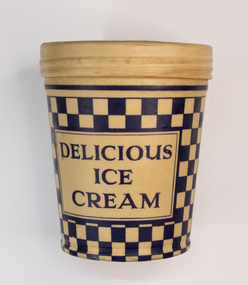
Domestic object - Ice Cream Container
... Ice Cream Container...ice cream container...Used for 'take away' ice cream ice cream container Mr & Mrs Black On sides DELICIOUS ICE CREAM Illegible manufacturer's name on base, Lidded waxed icecream container (paper/cardboard). ...Used for 'take away' ice creamLidded waxed icecream container (paper/cardboard). Beige colouredbackground with darl blue chequered pattern and wording On sides DELICIOUS ICE CREAM Illegible manufacturer's name on base,ice cream container, mr & mrs black -
 Southern Sherbrooke Historical Society Inc.
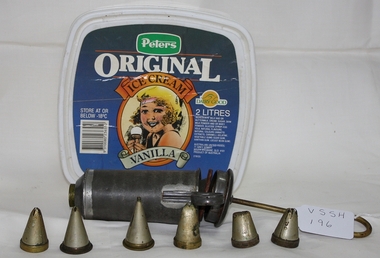
Ice cream container and icing set, Ice cream container - before 1992. Icing set - unknown
... Ice cream container and icing set...Ice cream container - before 1992. Icing set - unknown....Ice Cream tub. Inside is an icing set consisting of a metal icing gun, a metal plunger, and 5 metal nozzles. Ice cream container ...Peters Ice Cream tub. Inside is an icing set consisting of a metal icing gun, a metal plunger, and 5 metal nozzles.Use by Date sticker says "Best before 19 SEP 92" -
 Whitehorse Historical Society Inc.
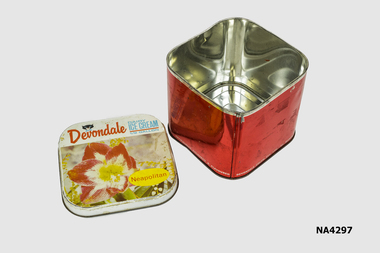
Container, c.1960
... 1960s Ice Cream container. Belonged to donor's mother...Square Tin Container for ice cream. Decorated lid, with flowers, also describing flavour of contents and weight. ...1960s Ice Cream container. Belonged to donor's mother DOMESTIC ITEMS Food Storage & Preservation Devondale Dairy Ice Cream 1/2 Gallon Square Tin Container for ice cream. ...1960s Ice Cream container. Belonged to donor's motherSquare Tin Container for ice cream. Decorated lid, with flowers, also describing flavour of contents and weight. Half gallon Devondale Ice Cream. Product of Australia, Reg No. 268. Half gallon Ice Cream, artificially coloured and flavoured.Devondale Dairy Ice Cream 1/2 Gallondomestic items, food storage & preservation -
 Musculoskeletal Health Australia (now held by the Glen Eira Historical Society)
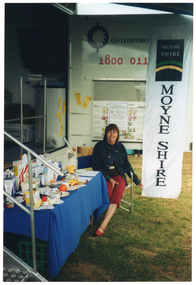
Photograph - Solo photo
... On it, there is a range of healthy food items such as cereals, various types of milk, cheeses, yoghurt, a plastic ice cream container, some canned food, and some fresh fruit. ...On it, there is a range of healthy food items such as cereals, various types of milk, cheeses, yoghurt, a plastic ice cream container, some canned food, and some fresh fruit. ...ACME Field Days are an expo event where exhibitors, particularly from the agricultural sector, can display and promote their products. In the early 2000s, Arthritis Victoria (AV) brought its Healthy Bones Bus to some of these events in Timboon to spread the 'strong bones, healthy joints' message to south west Victoria. This initiative was made possible through a partnership with the Moyne Shire Council. This photo depicts an Arthritis Victoria representative staffing AV's Healthy Bones Bus information stall at an ACME Field Day at Timboon, in south west Victoria.COL photo of a woman sitting on a deck chair in front of a large van. The van has a large door open on the side, displaying the text, "Osteoporosis Victoria 1800 011 041" (partially obscured). Below the text, there is a display board with some posters on it. Hanging from the edge of the van door is a long vertical banner with the text and logo for the Moyne Shire. In front of the side of the van (beside the woman), there is a rectangular table covered with a blue tablecloth. On it, there is a range of healthy food items such as cereals, various types of milk, cheeses, yoghurt, a plastic ice cream container, some canned food, and some fresh fruit. In the foreground, to the left of the frame, there are some metal steps with a ballustrade.arthritis foundation of victoria, afv, osteoporosis victoria, ov, arthritis victoria, av, acme field day, healthy bones bus, outreach, education, information stall, healthy food, heathy diet, calcium, bone health, strong bones, timboon, moyne shire, sponsorship, partnership, c2000s -
 Musculoskeletal Health Australia (now held by the Glen Eira Historical Society)
Photograph - Objects
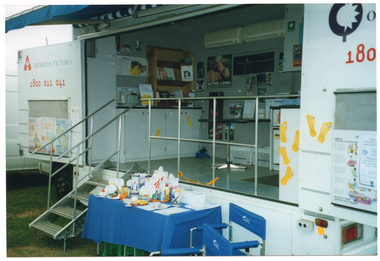
... On it, there is a range of healthy food items such as cereals, various types of milk, cheeses, a plastic ice cream container, some canned food, and some fresh fruit. ...On it, there is a range of healthy food items such as cereals, various types of milk, cheeses, a plastic ice cream container, some canned food, and some fresh fruit. ...ACME Field Day is an expo event where exhibitors, particularly from the agricultural sector, can display and promote their products. In the early 2000s, Arthritis Victoria brought its Healthy Bones Bus to an Acme Field Day event in Timboon to spread the 'strong bones, healthy joints' message to south west Victoria. This initiative was made possible through a partnership with the Moyne Shire Council. This photo depicts the Healthy Bones Bus set up at an ACME Field Day at Timboon.COL photo of a large van parked on the grass. Wide double doors on the side of the van are open, displaying the text "Arthritis Victoria 1800 011 041" on one door, and "Osteoporosis Victoria 1800 011 041" (partially obscured) on the other door. Inside the van, there are built-in cupboards, shelves displaying brochures and fact sheets, a small table, and two air conditioning units up high on one wall. In front of the van, next to the retractable metal steps, there is a small table covered with a bright blue tablecloth. On it, there is a range of healthy food items such as cereals, various types of milk, cheeses, a plastic ice cream container, some canned food, and some fresh fruit. Next to the table, there is a bright blue fabric deck chair.[On a yellow sticky note, handwritten in black ink] ACME Field Day - Timboonarthritis foundation of victoria, afv, osteoporosis victoria, ov, arthritis victoria, av, acme field day, healthy bones bus, outreach, education, information stall, healthy food, heathy diet, calcium, bone health, strong bones, timboon, moyne shire, sponsorship, partnership, c2000s -
 Musculoskeletal Health Australia (now held by the Glen Eira Historical Society)
Photograph - Solo photo
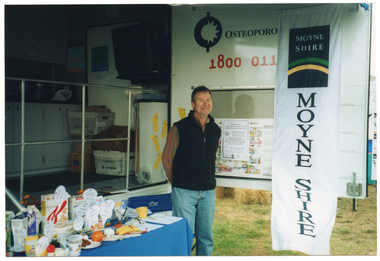
... On it, there is a range of healthy food items such as cereals, various types of milk, cheeses, yoghurt, a plastic ice cream container, some canned food, and some fresh fruit. ...On it, there is a range of healthy food items such as cereals, various types of milk, cheeses, yoghurt, a plastic ice cream container, some canned food, and some fresh fruit. ...ACME Field Days are an expo event where exhibitors, particularly from the agricultural sector, can display and promote their products. In the early 2000s, Arthritis Victoria (AV) brought its Healthy Bones Bus to some of these events in Timboon to spread the 'strong bones, healthy joints' message to south west Victoria. This initiative was made possible through a partnership with the Moyne Shire Council. This photo depicts an unidentified man staffing AV's Healthy Bones Bus information stall at an ACME Field Day at Timboon, in south west Victoria.COL photo of a man standing next to a rectangular table and a deck chair, which have been set up in front of a large van. The van has a large door open on the side, displaying the text, "Osteoporosis Victoria 1800 011 041" (partially obscured). Below the text, there is a display board with some posters on it. Hanging from the edge of the van door is a long vertical banner with the text and logo for the Moyne Shire. The table is covered with a blue tablecloth. On it, there is a range of healthy food items such as cereals, various types of milk, cheeses, yoghurt, a plastic ice cream container, some canned food, and some fresh fruit. In the background, built-in cupboards, boxes and crates, and a television set affixed to the wall are evident inside the van.arthritis foundation of victoria, afv, osteoporosis victoria, ov, arthritis victoria, av, acme field day, healthy bones bus, outreach, education, information stall, healthy food, heathy diet, calcium, bone health, strong bones, timboon, moyne shire, sponsorship, partnership, c2000s -
 Musculoskeletal Health Australia (now held by the Glen Eira Historical Society)
Photograph - Group photo
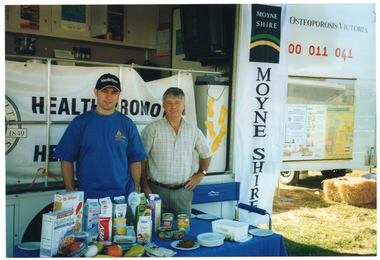
... On it, there is a range of healthy food items such as cereals, various types of milk, cheeses, yoghurt, a plastic ice cream container, some canned food, and some fresh fruit. ...On it, there is a range of healthy food items such as cereals, various types of milk, cheeses, yoghurt, a plastic ice cream container, some canned food, and some fresh fruit. ...ACME Field Days are an expo event where exhibitors, particularly from the agricultural sector, can display and promote their products. In the early 2000s, Arthritis Victoria (AV) brought its Healthy Bones Bus to south west Victoria to spread the 'strong bones, healthy joints' message to regional areas. This initiative was made possible through a partnership with the Moyne Shire Council and Moyne Health Services. This photo depicts an Arthritis Victoria representative and an unidentified man staffing AV's Healthy Bones Bus information stall at an ACME Field Day.COL photo of two men standing behind a rectangular table in front of a large van. On it, there is a range of healthy food items such as cereals, various types of milk, cheeses, yoghurt, a plastic ice cream container, some canned food, and some fresh fruit. The van has a large door open on the side, displaying the text, "Osteoporosis Victoria 1800 011 041". Below the text, there is a display board with some posters on it. Hanging from the inside edge of the van door is a long vertical banner with the text and logo for the Moyne Shire. Behind the men, there is a large "Moyne Health Services" banner (partially obscured) attached to the ballustrade on the side of the van. In the background, there is a bale of hay on the grass, and two vehicle or trailer wheels are evident behind it.arthritis foundation of victoria, afv, osteoporosis victoria, ov, arthritis victoria, av, acme field day, healthy bones bus, outreach, education, information stall, healthy food, heathy diet, calcium, bone health, strong bones, south west victoria, moyne shire, moyne health services, sponsorship, partnership, c2000s -
 Musculoskeletal Health Australia (now held by the Glen Eira Historical Society)
Photograph - Solo photo
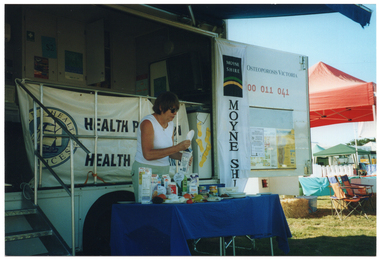
... On it, there is a range of healthy food items such as cereals, various types of milk, cheeses, yoghurt, a plastic ice cream container, some canned food, and some fresh fruit. ...On it, there is a range of healthy food items such as cereals, various types of milk, cheeses, yoghurt, a plastic ice cream container, some canned food, and some fresh fruit. ...ACME Field Days are an expo event where exhibitors, particularly from the agricultural sector, can display and promote their products. In the early 2000s, Arthritis Victoria (AV) brought its Healthy Bones Bus to south west Victoria to spread the 'strong bones, healthy joints' message to regional areas. This initiative was made possible through a partnership with the Moyne Shire Council and Moyne Health Services. This photo depicts an unidentified woman staffing AV's Healthy Bones Bus information stall at an ACME Field Day.COL photo of a woman standing behind a rectangular table in front of a large van. On it, there is a range of healthy food items such as cereals, various types of milk, cheeses, yoghurt, a plastic ice cream container, some canned food, and some fresh fruit. The woman is affixing a display label to the top of a milk carton. The van has a large door open on the side, displaying the text, "Osteoporosis Victoria 1800 011 041" (partially obscured). Below the text, there is a display board with some posters on it. Hanging from the inside edge of the van door is a long vertical banner with the text and logo for the Moyne Shire. Behind the woman, there is a large "Moyne Health Services" banner attached to the ballustrade on the side of the van. In the foreground, to the left of the frame, there are some metal steps with a ballustrade. In the background, some market stall tents and marquees are evident, with tables and deck chairs underneath them.arthritis foundation of victoria, afv, osteoporosis victoria, ov, arthritis victoria, av, acme field day, healthy bones bus, outreach, education, information stall, healthy food, heathy diet, calcium, bone health, strong bones, south west victoria, moyne shire, moyne health services, sponsorship, partnership, c2000s -
 The Beechworth Burke Museum
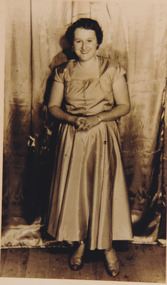
Audio - Oral History, Jennifer Williams, Nola (Nettie) Maher, 27 April 2000
... Beechworth Nola Maher Nettie Maher Listen to what they say Jennifer Williams oral history hospital private hospital birth miner’s cottage kerosine eucalyptus rabbit laundry dressmaking dressing certificate dry cleaners hotel shoe leather shoe factory uppers Pittman Ford Street Charlie King union wages New Years Eve dance memorial hall married women flexible hours ice cream milk bar Nola Maher / This is a digital copy of a recording that was originally captured on a cassette tape. The cassette tape is black with a horizontal white strip and is currently stored in a clear flat plastic rectangular container. ...Nola (Nettie) Maher was born in Beechworth on 31st December, 1935. Her father returned from World War One and purchased a miner’s cottage in 1919 where Nettie lived in for the majority of her life. Nettie worked for ten years at the Pittman’s Shoe Factory, once located on Ford Street, which was in operation from 1 July 1947 to 28 August 1961. She fondly recalls the camaraderie amongst the staff and certain managers, and details the factory processes, union activities and the work she continued to do once she was married and had children. This oral history recording was part of a project conducted by Jennifer Williams in the year 2000 to capture the everyday life and struggles in Beechworth during the twentieth century. This project involved recording seventy oral histories on cassette tapes of local Beechworth residents which were then published in a book titled: Listen to what they say: voices of twentieth century Beechworth. These cassette tapes were digitised in July 2021 with funds made available by the Friends of the Burke. Nola Nettie Maher’s account of her personal and working life in Beechworth and the local area during the 20th century is historically and socially significant to the cultural heritage of the region. She details important details about life and working in the region post World War Two, including insights into women’s working roles, as well as the social aspects of town life. This oral history account is socially and historically significant as it is part of a broader collection of interviews conducted by Jennifer Williams which were published in the book ‘Listen to what they say: voices of twentieth-century Beechworth.’ While the township of Beechworth is known for its history as a gold rush town, these accounts provide a unique insight into the day-to-day life of the town’s residents during the 20th century, many of which would have been lost had they not been preserved. This is a digital copy of a recording that was originally captured on a cassette tape. The cassette tape is black with a horizontal white strip and is currently stored in a clear flat plastic rectangular container. It holds up 40 minutes of recordings on each side.Nola Maher /beechworth, nola maher, nettie maher, listen to what they say, jennifer williams, oral history, hospital, private hospital, birth, miner’s cottage, kerosine, eucalyptus, rabbit, laundry, dressmaking, dressing certificate, dry cleaners, hotel, shoe, leather, shoe factory, uppers, pittman, ford street, charlie king, union, wages, new years eve, dance, memorial hall, married women, flexible hours, ice cream, milk bar -
 Cheese World Museum
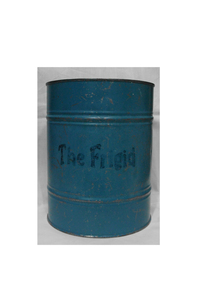
Freezer, icecream, The Frigid, 1930s
... ice-cream freezer was used by Ruth Gore's mother to make ice-cream for the ---- family. Ice-cream mixture was beaten and placed in the inner cylinder; ice and salt were placed in the surrounding outer cylinder. When the ice-cream was partially frozen it was removed from the container...ice-cream freezer was used by Ruth Gore's mother to make ice-cream for the ---- family. Ice-cream mixture was beaten and placed in the inner cylinder; ice and salt were placed in the surrounding outer cylinder. When the ice-cream was partially frozen it was removed from the container ...This ice-cream freezer was used by Ruth Gore's mother to make ice-cream for the ---- family. Ice-cream mixture was beaten and placed in the inner cylinder; ice and salt were placed in the surrounding outer cylinder. When the ice-cream was partially frozen it was removed from the container and beaten a second time before being replaced in the container to set. (other info -check with Ruth -where lived, mother's name, when used, how often, etc)Ice-cream a rarity in 1930s? Ice chests, fridges not common until post WWII?Tin-plated double-walled iron barrel painted blue with item name stencilled in dark blue on the outside. The barrel is open top and bottom with a tinned lid on the base; the top lid is missing. The space between the wall and inner cylinder is for ice, the tinned inner cylinder for ice-creamThe Frigidfreezer, icecream, icecream maker, the frigid, gore, ruth, dairy products -
 Kiewa Valley Historical Society
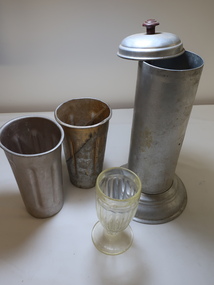
Milkshake Containers
... ice-cream. Mt Beauty had a cafe at the Mt Beauty shopping centre and there was a general store at Mt Beauty North. milk shakes milk bar drink cafe This milkshake set includes 2 metal mugs and 1 glass, mug size and 1 straw dispenser with lift up lid. Milkshake Containers ...Milk Bars made flavoured milk shakes for customers. The drink included milk, flavouring and ice-cream.Mt Beauty had a cafe at the Mt Beauty shopping centre and there was a general store at Mt Beauty North.This milkshake set includes 2 metal mugs and 1 glass, mug size and 1 straw dispenser with lift up lid.milk shakes, milk bar, drink, cafe -
 Kiewa Valley Historical Society
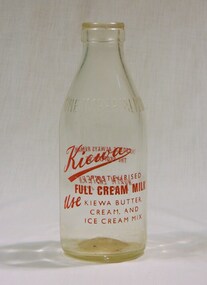
Bottle - Milk, 1959
... Therefore has good interpretive capacity. bottle milk drink container dairy farm kiewa cow Glass molded inscription of ONE IMPERIAL PINT. In red text on front Kiewa, (in script) / PASTUERISED / FULL CREAM MILK/ USE KIEWA BUTTER/ CREAM / AND ICE CREAM MIX . ...This is a milk bottle from the local dairy in Kiewa. It is an old style bottle in imperial measure(ended 1974). This has good historical value, as milk is no longer made in bottles and we do not use imperial measurements anymore. This item is significance for historic reasons, shows local dairy items used. There are not many bottles from this local dairy from this period, and is it is in good condition. . Social significance, shows what items local families used. Research significance. These bottles are not in use anymore as we do not have imperial measurement, so good for research that explains this topic. Therefore has good interpretive capacity.Glass milk bottle. One imperial pint.Glass molded inscription of ONE IMPERIAL PINT. In red text on front Kiewa, (in script) / PASTUERISED / FULL CREAM MILK/ USE KIEWA BUTTER/ CREAM / AND ICE CREAM MIX . In red text on back THIS BOTTLE ALWAYS REMAINS/THE PROPERTY OF/NORTH EASTERN/DAIRY CO. LTD. On bottom of bottle, molded AGM 2 x M F1959 in the middle of botton 5 / 48 bottle, milk, drink, container, dairy, farm, kiewa, cow -
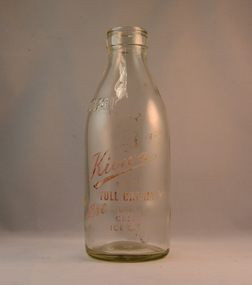 Kiewa Valley Historical Society
Bottle Milk, Circa mid to late 1900's
... containers domestic milk bottles pasteurized milk bottles Around the bottom side of the bottle and blown into the glass "ONE IMPERIAL PINT". Below these markings and stenciled is "KIEWA" (in freehand style and underlined) underneath is "PASTEURISED FULL CREAM MILK" underneath this ,in freehand stiyle is "USE" next to this in block style "KIEWA BUTTER, CREAM, AND ICE CREAM MIX" to the left of this ,and barely readable is stenciled "THIS BOTTLE ALWAYS REMAINS/ THE PROPERTY OF/ NORTH EASTERN DAIRY Co. ...This glass milk bottle was manufactured and used mid to late 1900's (1834 Victorian dairy industry was founded) up to the time that a cheaper container was invented(plastic bottles and polyethylene plastic lined cardboard cartons) and produced. In 1909 the supply of pure bottled milk was required for babies to overcome infant mortality due to unhygienic milk sources (unclean containers and unpasteurized milk). Due to the volume of milk being processed and hand milking could not keep up with demand, dairy farms introduced milking machines in the late 1930's. The great increases in dairy herds from the average of 18 cows per heard in 1950's to 142 cows per herd in 1996 required milk tankers to pick up the regions milk supply. This bottle was so constructed to be easily moved within the milk processing plants from the delivery vats/holding tanks to the final corking/sealing of the bottles for eventual distribution. From 1958 the milk bottle slowly became phased out of production. At this point in time Melbourne was drawing 160,000 bottles per week from the two major glass bottle works companies, e.g. Melbourne Glass Bottle Works Co. Victoria was the major state supplier of cows milk in the history of Australian milk production from the early 1800's. The Kiewa Valley and its region was a major contributor to meet that demand. Each bottle was "branded" during manufacturing to show the contents (pasteurized milk) and where it originated from (region and supplier). This method of recycling the bottles back to specific dairy farms was a good control method but an uneconomical "on cost" which was replaced by the "throw away" less costly plastic and cardboard containers. Kiewa Valley dairy herds had marked bottles bearing "90/9", "6/18", "6/33", "6/35" and "6/36" This particular one has "7/14".This heavy gauged glass milk bottle has a rim and a distinctive head at the top. This head has been manufactured to facilitate the movement of the bottled along the milk production line. The method of pouring milk into the bottle has been part of the "production line". This bottle has a one Imperial pint capacity and is made from "clear" glass. There are other milk bottles that have a "green" tint in them. Around the bottom side of the bottle and blown into the glass "ONE IMPERIAL PINT". Below these markings and stenciled is "KIEWA" (in freehand style and underlined) underneath is "PASTEURISED FULL CREAM MILK" underneath this ,in freehand stiyle is "USE" next to this in block style "KIEWA BUTTER, CREAM, AND ICE CREAM MIX" to the left of this ,and barely readable is stenciled "THIS BOTTLE ALWAYS REMAINS/ THE PROPERTY OF/ NORTH EASTERN DAIRY Co. Ltd". On the base of the bottle is molded a big "2". with a smaller "m". An identification mark of "7" over "14" is within a circled boundary. Below this is moulded "RM - 15". glass bottles, commercial milk containers, domestic milk bottles, pasteurized milk bottles -
 Kiewa Valley Historical Society
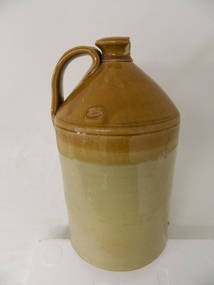
Jar/ Demi John Stone Ware, Circa 1860
... These were times when household refrigeration, if available, would be from the "block ice" coolers or "cool" storage nooks and crannies within farmhouse locations. household liquid jar container 1800's food storage kiln fired glazed pottery manufacturer's seal "GEORGE SKEY WILNECOTE TAMWORTH" This large "stone ware" glazed Demi John, alias Carboy has a capacity of over 20 litres. It has a conical smooth lipped neck top with a wide, flat(three to four finger) carry and poring handle. The top third portion of the jug is caramel in colour and the bottom a darker cream ...This kiln glazed container for liquid's, was the type used in the 1700's to mid 1900's to contain fluids mainly for human consumption which needed to retain liquid that could be affected by sunlight and or required to be maintained at a cooler temperatures. Ginger beer and other "brews" for human consumption were the prime target. The ability to refill these vessels were of the utmost importance to the consumer. Over time these containers were reduced in size and produced for "special" liquids e.g. alcoholic Port. This Demi John stone ware was manufactured in Tamworth (England) and imported into Australia during a period when the majority of "quality" domestic items were sourced from "the Mother Country" and the ties between the still "colonial" outpost were very strong. This bondage remained longer in rural communities than in the cities. The "multi-culturalism of the post World War II era resulted in the lessening of the earlier ties. The growing of nationalism, the Aussie evolution, was brought about by the increased social and business/commercial interactions between Australia and the United States of America, post World War II.This container(jug) is very significant to the Kiewa Valley, a rural region that required these type of liquid storage vessels, especially in the late 1800's to the mid 1900's. These were times when household refrigeration, if available, would be from the "block ice" coolers or "cool" storage nooks and crannies within farmhouse locations.This large "stone ware" glazed Demi John, alias Carboy has a capacity of over 20 litres. It has a conical smooth lipped neck top with a wide, flat(three to four finger) carry and poring handle. The top third portion of the jug is caramel in colour and the bottom a darker cream. It has a manufacturer's seal stamped into the surface before glazing. This item would have been corked and then sealed (air tight) with wax.manufacturer's seal "GEORGE SKEY WILNECOTE TAMWORTH"household liquid jar container, 1800's food storage, kiln fired glazed pottery -
 Bendigo Historical Society Inc.
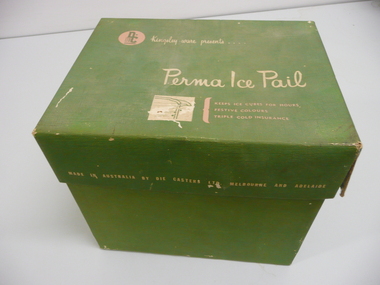
Container - FAVALORO COLLECTION: ICE PAIL
... Green cardboard box with lid, marked Kingsley - ware, presents Perma Ice Pail, keeps ice cubes for hours, made in Australia by Die Casters Ltd Melbourne and Adelaide. Plastic container charcoal coloured outer with lid that has a cream coloured knob with copper coloured insert, inner liner cream in colour....Containers ice Kingsley ware Die Casters ltd. Green cardboard box with lid, marked Kingsley - ware, presents Perma Ice Pail, keeps ice cubes for hours, made in Australia by Die Casters Ltd Melbourne and Adelaide. Plastic container charcoal coloured outer with lid that has a cream ...Green cardboard box with lid, marked Kingsley - ware, presents Perma Ice Pail, keeps ice cubes for hours, made in Australia by Die Casters Ltd Melbourne and Adelaide. Plastic container charcoal coloured outer with lid that has a cream coloured knob with copper coloured insert, inner liner cream in colour.Kingsley ware Die Casters ltd.domestic equipment, containers, ice -
 Williamstown Historical Society Inc
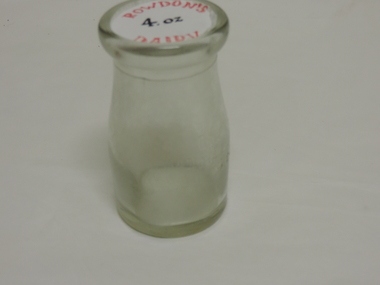
Container - Rowden's dairy cream bottle, 1960s
... ice to local residents for over 60 years. This business had a large dairy farm in Altona. The site of this old dairy in now a residential complex adjacent to the Williamstown High School Pasco Street campus. Markings on cardboard cap of Bottle: "Rowden's Dairy 4 OZ". Inscriptions on bottle are faded but read as follows: "Contents not less than 4ozs." Inscriptions on bottom of bottle: "045 M.535 M." Clear glass 4oz cream bottle embossed front and back. Container ...Rowdons Dairy operated in Verdon Street, Williamstown and home delivered milk products and ice to local residents for over 60 years. This business had a large dairy farm in Altona. The site of this old dairy in now a residential complex adjacent to the Williamstown High School Pasco Street campus. Clear glass 4oz cream bottle embossed front and back.Markings on cardboard cap of Bottle: "Rowden's Dairy 4 OZ". Inscriptions on bottle are faded but read as follows: "Contents not less than 4ozs." Inscriptions on bottom of bottle: "045 M.535 M." -
 Whitehorse Historical Society Inc.
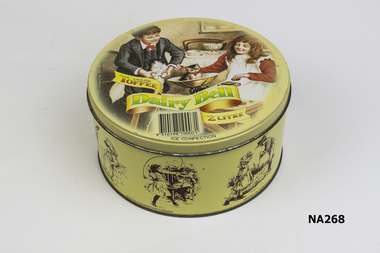
Container - Ice Cream Tin, after 1979
... domestic items food storage & preservation English Toffee/Dairy Bell/Two litres/Ice Confection Ice Cream tin with two children playing with cats on lid. Scenes of children playing around sides of tin Container Ice Cream Tin ...Ice Cream tin with two children playing with cats on lid. Scenes of children playing around sides of tinEnglish Toffee/Dairy Bell/Two litres/Ice Confectiondomestic items, food storage & preservation -
 Merbein District Historical Society
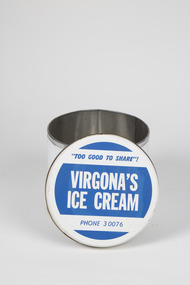
Container - Tin, Ice cream
... Early ice cream made in the district virgona ice cream virgongas ice cream phone 30076 too good to share A circular white tin with blue markings and white writing on lid Container Tin, Ice cream ...Early ice cream made in the district A circular white tin with blue markings and white writing on lid virgongas ice cream phone 30076 too good to share virgona, ice cream -
 Emerald Museum & Nobelius Heritage Park
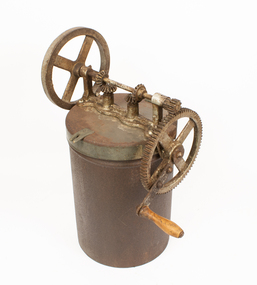
Functional object - Butter(?) Churn, c. Late 19th-Early 20th Century
... ice-cream maker (though ice-cream makers also tend to use paddles). Another suggestion has been a cheese maker. There are no visible corporate logos or manufacturer's marks, limiting our ability to determine its true origins. This is a unique example of food production tools in the late 19th and early 20th centuries. Tools Agriculture Domestic Life N/A This item is in two parts, both made with metal heavily rusted on the outside and mostly clean on the inside. The larger section is the empty cylindrical container ...This item was brought to Australia by an Italian family in the 1920s who settled in Avonsleigh. It resembles historical hand-crank butter churns; however, it does have the notable difference of using a whisk-like structure rather than a paddle-based churn. (The whisks may have been a modification of the original machine.) It is possible it was used for another similar application requiring faster spinning, such as whipping cream, and it has been suggested it could be an ice-cream maker (though ice-cream makers also tend to use paddles). Another suggestion has been a cheese maker. There are no visible corporate logos or manufacturer's marks, limiting our ability to determine its true origins.This is a unique example of food production tools in the late 19th and early 20th centuries.This item is in two parts, both made with metal heavily rusted on the outside and mostly clean on the inside. The larger section is the empty cylindrical container. The smaller section is both the lid to the container and a whisk for the butter churn; it has a whisk section which protrudes into the cream in the container, which is turned by the hand-crank and gears.N/Atools, agriculture, domestic life
