
Showing 71 items matching "imperial weight"
-
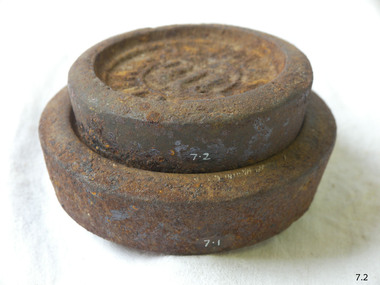 Flagstaff Hill Maritime Museum and Village
Equipment - Weight
... ...imperial standard weight...weights and measurements. This ensured that uniform measurements would be used for trade throughout the Empire. Towns and districts would have an official set of Imperial Standard Weights and Measures. ...Imperial Standard weights; set of two disc-shaped weights designed to stack one upon the other. ..."IMPERIAL STANDARD 1LB" [weight 1], "IMPERIAL STANDARD 2LB" [weight 2]... to metric units of measurement in Australia took place from 1970 and was completed in 1988 when metric units became the only legal unit of measurement. warrnambool shipwrecked-coast flagstaff-hill flagstaff-hill-maritime-museum maritime-museum shipwreck-coast flagstaff-hill-maritime-village shipwrecked-artefact wieght weights and measures imperial standard weight "IMPERIAL STANDARD 1LB" [weight 1], "IMPERIAL STANDARD 2LB" [weight 2] Imperial Standard weights; set of two disc-shaped weights designed to stack one upon the other. ...The disc-shaped design of these 1LB and 2 LB metal weights enables them to be stacked one on top of the other. The weights are used with a balance scale to accurately weigh the mass of items such as grain, sugar, meat or potatoes. They could have been used in retail or wholesale businesses like a general store or a grain merchant’s premises. The user would place either one or both of these weights on one side of a balance scale. Goods would then be placed onto the other side of the scale until the beam between both sides of the scale was level, showing that the weight of the goods was as heavy as the weight or weights on the other side. These two weights are marked in Imperial units. An Imperial Standard 1LB is equal to 453.592grams. The British Weights and Measures Act of 1824 defined official standards for weights and measurements. This ensured that uniform measurements would be used for trade throughout the Empire. Towns and districts would have an official set of Imperial Standard Weights and Measures. Inspectors periodically used this official set to check the accuracy of traders’ own weights and measures. There would be penalties such as fines or imprisonment for people who broke these laws. The State of Victoria had its own Weight and Measures Act in 1862 and a decade later the inspectors in local councils used their local set of weights and measures to test the local businesses measuring equipment. In the nineteenth century the Victorian Customs Department carried out this role but this was handed over to the Melbourne Observatory at the beginning of the twentieth century. The Measures Branch then followed on with this task from the 1940s until 1995. Australia began converting to the metric system in the 1960s, beginning with its money. The conversion from imperial to metric units of measurement in Australia took place from 1970 and was completed in 1988 when metric units became the only legal unit of measurement. Imperial Standard weights; set of two disc-shaped weights designed to stack one upon the other. Inscriptions are marked in relief. "IMPERIAL STANDARD 1LB" [weight 1], "IMPERIAL STANDARD 2LB" [weight 2]warrnambool, shipwrecked-coast, flagstaff-hill, flagstaff-hill-maritime-museum, maritime-museum, shipwreck-coast, flagstaff-hill-maritime-village, shipwrecked-artefact, wieght, weights and measures, imperial standard weight -
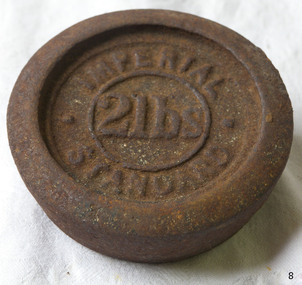 Flagstaff Hill Maritime Museum and Village
Equipment - Weight
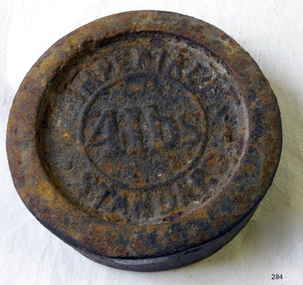
... weight...imperial standard weight...weights and measurements. This ensured that uniform measurements would be used for trade throughout the Empire. Towns and districts would have an official set of Imperial Standard Weights and Measures. ...Weight; 2 lbs. Metal disc designed for stacking. Inscription marked in relief. Imperial Standard weight, 2 pounds weight.... to metric units of measurement in Australia took place from 1970 and was completed in 1988 when metric units became the only legal unit of measurement. flagstaff hill warrnambool shipwrecked coast flagstaff hill maritime museum maritime museum shipwreck coast flagstaff hill maritime village great ocean road standard measure imperial standard weight 2lb weight imperial standard weight "IMPERIAL STANDARD", "2lbs" Weight; 2 lbs. ...The disc-shaped design of this 2 LB metal weight enables it to be stacked on top of another similarly shaped weight. The weight is used with a balance scale to accurately weigh the mass of items such as grain, sugar, meat or potatoes. It could have been used in retail or wholesale businesses like a general store or a grain merchant’s premises. The user would place the weight on one side of a balance scale. Goods would then be placed onto the other side of the scale until the beam between both sides of the scale was level, showing that the weight of the goods was as heavy as the weight on the other side. This weight is marked in Imperial units. An Imperial Standard 1LB, or one pound, is equal to 453.592grams. The British Weights and Measures Act of 1824 defined official standards for weights and measurements. This ensured that uniform measurements would be used for trade throughout the Empire. Towns and districts would have an official set of Imperial Standard Weights and Measures. Inspectors periodically used this official set to check the accuracy of traders’ own weights and measures. There would be penalties such as fines or imprisonment for people who broke these laws. The State of Victoria had its own Weight and Measures Act in 1862 and a decade later the inspectors in local councils used their local set of weights and measures to test the local businesses measuring equipment. In the nineteenth century the Victorian Customs Department carried out this role but this was handed over to the Melbourne Observatory at the beginning of the twentieth century. The Measures Branch then followed on with this task from the 1940s until 1995. Australia began converting to the metric system in the 1960s, beginning with its money. The conversion from imperial to metric units of measurement in Australia took place from 1970 and was completed in 1988 when metric units became the only legal unit of measurement.Weight; 2 lbs. Metal disc designed for stacking. Inscription marked in relief. Imperial Standard weight, 2 pounds weight."IMPERIAL STANDARD", "2lbs"flagstaff hill, warrnambool, shipwrecked coast, flagstaff hill maritime museum, maritime museum, shipwreck coast, flagstaff hill maritime village, great ocean road, standard measure, imperial standard, weight, 2lb weight, imperial standard weight -
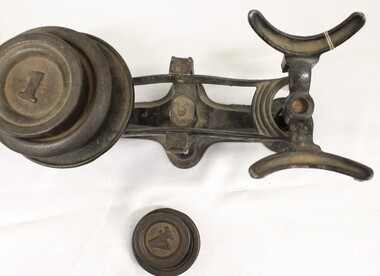 Wodonga & District Historical Society Inc
Functional object - Metal balance scales with weights, C. 1900
... Metal table scales with imperial weights ...Weights and measures Australia Table scales Domestic appliances Metal table scales with imperial weights Metal balance scales with weights Functional object Metal balance scales with weights ...Sets of scales similar to these were very common in households throughout Australia. Between 1960 and 1988 Australia gradually adopted the SI units (Standard International) or metric units. In 1970 the Australian parliament passed the metric conversion act, and the Australian building trades made it the standard in 1974. This information helps to date the set of weights to before the1970s.Domestic scales such as these were common throughout Australian homes. They are now primarily superceded by plastic items, often electronic. Metal table scales with imperial weights weights and measures australia, table scales, domestic appliances -
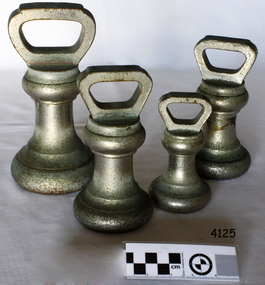 Flagstaff Hill Maritime Museum and Village
Functional object - Standard avoirdupois weights, Avery Ltd, 1950s
... ...imperial weight...This item gives an insight into social history of the time. flagstaff hill warrnambool shipwrecked-coast flagstaff-hill flagstaff-hill-maritime-museum maritime-museum shipwreck-coast flagstaff-hill-maritime-village weight imperial weight imperial standard weights and measures imperial standard weight None Weights, metal, silver electroplated, 1 x 2lb, 2 x 4lb, 1 x 7lb. (4) all government stamped, made by Avery Ltd. ...A weight made in England by W&T Avery a British manufacturer of weights and weighing machines. The company was founded in the early 18th century and took the name W & T Avery in 1818. The undocumented origin of the company goes back to 1730 when James Ford established the business in the town of Digbeth. On Joseph Balden, the then company’s owner’s death in 1813 William and Thomas Avery took over his scale making business and in 1818 renamed it W & T Avery. The business rapidly expanded and in 1885 they owned three factories: the Atlas Works in West Bromwich, the Mill Lane Works in Birmingham and the Moat Lane Works in Digbeth. In 1891 the business became a limited company with a board of directors and in 1894 the shares were quoted on the London Stock Exchange. In 1895 the company bought the legendary Soho Foundry in Smethwick, a former steam engine factory owned by James Watt & Co. In 1897 the move was complete and the steam engine business was gradually converted to pure manufacture of weighing machines. The turn of the century was marked by managing director William Hipkins who was determined to broadening the renown of the Avery brand and transforming the business into specialist manufacture of weighing machines. By 1914 the company occupied an area of 32,000m² and had some 3000 employees. In the inter-war period, the growth continued with the addition of specialized shops for cast parts, enamel paints and weighbridge assembly and the product range diversified into counting machines, testing machines, automatic packing machines and petrol pumps. During the second world war, the company also produced various types of heavy guns. At that time the site underwent severe damage from parachute mines and incendiary bombs. Then from 1931 to 1973, the company occupied the 18th-century Middlesex Sessions House in Clerkenwell as its headquarters. Changes in weighing machine technology after World War II led to the closure of the foundry, the introduction of electronic weighing with the simultaneous gradual disappearance of purely mechanical devices. The continued expansion was partly achieved through a series of acquisitions of other companies. After almost a century of national and international expansion, the company was taken over by GEC in 1979. Keith Hodgkinson, managing director at the time, completed the turn-around from mechanical to electronic weighing with a complete overhaul of the product range of retail sales of industrial platform scales. In 1993 GEC took over the Dutch-based company Berkel and the Avery-Berkel name was introduced. In 2000 the business was in turn acquired by the US-American company Weigh-Tronix, who already owned Salter, and is today operating as Avery Weigh-Tronix. An item used used by grocers and merchants to weigh store bought goods around the 1950s. This item gives an insight into social history of the time.Weights, metal, silver electroplated, 1 x 2lb, 2 x 4lb, 1 x 7lb. (4) all government stamped, made by Avery Ltd.Noneflagstaff hill, warrnambool, shipwrecked-coast, flagstaff-hill, flagstaff-hill-maritime-museum, maritime-museum, shipwreck-coast, flagstaff-hill-maritime-village, weight, imperial weight, imperial standard weights and measures, imperial standard weight -
 Wodonga & District Historical Society Inc
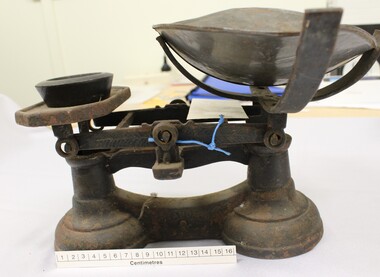
Functional object - Metal table balance scales, W & T Avery Ltd, 1900
... Metal balance table scales and a set of imperial weights...Weights and measures Australia Domestic scales On weights "AVERY/ B'HAM" Metal balance table scales and a set of imperial weights Metal table balance scales Functional object Metal table balance scales England Birmingham W & T Avery Ltd ...Sets of scales similar to these were very common in households throughout Australia in the 19th and 20th centuries. Avery of Birmingham were a British manufacturer of weighing machines. The company was founded in the early 18th century and took the name W & T Avery in 1818. The company produced a wide range of scales ranging from industrial scales and weighbriges to small scales for domestic use, such as these scales. At the time of the death of the last Avery family member in 1918, it employed over 3,000 people and had businesses all over the world. Today it has evolved to become part of the conglomerate, Avery Weigh-Tronix.Domestic scales such as these were common throughout Australian homes. They are now primarily superceded by plastic items, often electronic.Metal balance table scales and a set of imperial weightsOn weights "AVERY/ B'HAM"weights and measures australia, domestic scales -
 Federation University Historical Collection
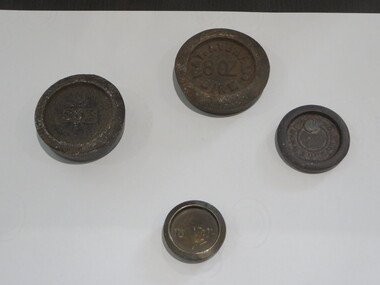
Weights and measures, Various Measuring Weights - Imperial
... ...imperial weight...Made from differing metals. troy weight imperial weight grave foundry w t avery ltd birmingham Weight on each item "W & T AVERY LTD BIRM" on 8 oz 'GRAVE FOUNDRY Co" on 2 oz 8 x weights of various size - 2lb (pound) to 1/10 of a pound Various Measuring Weights - Imperial Weights and measures W & T Avery Grave Foundry Co W & T Avery ...Box of assorted weights.They range from 1/10 of a pound to 2 pounds. Made from differing metals.8 x weights of various size - 2lb (pound) to 1/10 of a poundWeight on each item "W & T AVERY LTD BIRM" on 8 oz 'GRAVE FOUNDRY Co" on 2 oztroy weight, imperial weight, grave foundry, w t avery ltd, birmingham -
 Flagstaff Hill Maritime Museum and Village
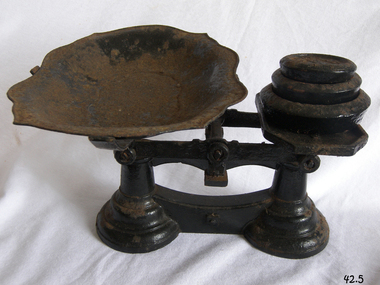
Instrument - Balance Scale, Henry Crane (Crane Foundry), 1870-1900
... ...imperial weight...The scale gives a snapshot into the commercial life not only of England by Australian colonial life before Federation. flagstaff hill warrnambool flagstaff hill maritime museum shipwreck coast flagstaff hill maritime village great ocean road scale beam scale pounds and ounces imperial weight grocers scale domestic scale henry crane crane foundry Marked on 2lb weight "Wolverhampton Crane Foundry" Beam scale with three weights (4lb, 2lb, 1lb), metal tray, corroded Instrument Balance Scale Henry Crane (Crane Foundry) ...The Crane foundry opened some time before 1827 and was known as Atherton’s Foundry, run by James Atherton and Henry Crane. Initially it was a brass foundry, but by 1827 iron castings were also produced on the site. The main products were castings for the building industry, ironmongery and brassware. In the 1830s castings for the hand tool and lock industries were added to the product range and by 1836 Henry Crane had taken control of the business. The company became known as the Crane Foundry in 1847 with its own registered trademark. By the 1850s iron weights were produced, and a design was registered in 1872 with roundels decorating the edge. Brass weights were also produced, mainly after the regulation of 1890 that required weights of 2oz. or less to be made of brass. In the early 1900s the foundry began to produce castings for electric motors and continued to do so throughout its life. The Crane family continued to control the company until 1917 when William Cyril Parkes of lock makers Josiah Parkes & Sons Limited, Willenhall became a majority shareholder. Things were going well until the company’s liabilities spiraled out of control with the rise in electricity and gas prices along with the loss of two of the company’s largest customers. The factory went into liquidation and then closed in 2006 an end to one of Wolverhampton’s oldest companies.An item made by one of England's foundry’s based in Wolverhampton that exported items all over the world for many years. The scale gives a snapshot into the commercial life not only of England by Australian colonial life before Federation.Beam scale with three weights (4lb, 2lb, 1lb), metal tray, corrodedMarked on 2lb weight "Wolverhampton Crane Foundry" flagstaff hill, warrnambool, flagstaff hill maritime museum, shipwreck coast, flagstaff hill maritime village, great ocean road, scale, beam scale, pounds and ounces, imperial weight, grocers scale, domestic scale, henry crane, crane foundry -
 Tatura Irrigation & Wartime Camps Museum
Kitchen scales, Crane Foundry Co
... Kitchen scales with imperial weights. 2 lb, 1 lb, and 1/2 lb. Large dish. ...Pre decimal. kitchen scales imperial weights size of weights as above. Crane Foundry Co. ...Made in England, exported to Australia. Used in early Victorian kitchens. Pre decimal.Kitchen scales with imperial weights. 2 lb, 1 lb, and 1/2 lb. Large dish. size of weights as above. Crane Foundry Co. Wolverhamptonkitchen scales, imperial weights -
 City of Moorabbin Historical Society (Operating the Box Cottage Museum)
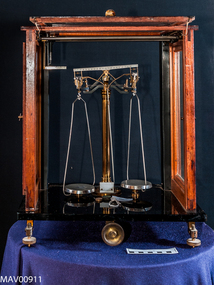
Scales, Gold, Apothecary, Analytical in Glass Case c1880, c1880
... ...imperial measure...troy weight...weights. Gottingen made fine precision scientific scales for use by assayers, jewellers, chemists, gold buyers rtc. scales balance precision measures gold pharmacy precious metals jewellery gottingen germany sartorious f moorabin bentleigh cheltenham early settlers gold miners pioneers market gardeners ballarat bendigo imperial measure troy weight D.R.PATENT / GOTTINGER PRAZISIONSWAGENFABRIK G.m.b.H. / GOTTINGEN On upright V over GPW A 2 pan analytical, scientific or pharmaceutical beam balance scale made in Gottingen Germany c 1880. ...A pair of scales or dishes in which objects to be weighed and the weights / masses against which to weigh them are placed is an "Apparatus for weighing. The pan, or each of the pans, of a balance." Its parts include a fulcrum, a beam that balances on it, two pans at the ends of the beam to hold the materials to be weighed, and counter-balancing weights. Gottingen made fine precision scientific scales for use by assayers, jewellers, chemists, gold buyers rtc. A 2 pan analytical, scientific or pharmaceutical beam balance scale made in Gottingen Germany c 1880. These scales are encased in a mahogany framed glass cabinet and Graded 0 -9 9-0D.R.PATENT / GOTTINGER PRAZISIONSWAGENFABRIK G.m.b.H. / GOTTINGEN On upright V over GPW scales, balance, precision measures, gold, pharmacy, precious metals, jewellery, gottingen germany, sartorious f, moorabin, bentleigh, cheltenham, early settlers, gold miners, pioneers, market gardeners, ballarat, bendigo, imperial measure, troy weight -
 Flagstaff Hill Maritime Museum and Village
Weapon - Cannon Ball, Victorian era
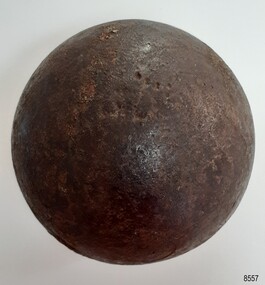
... The cannon ball is a four-pounder ball. Imperial weight is 71 oz (201.3 gms or 4.44 pounds)....The cannon ball is a four-pounder ball. Imperial weight is 71 oz (201.3 gms or 4.44 pounds). ...This small cannon ball was found by the donor around 1975 to 1977 when he was digging a trench to install underground cables at the Warrnambool Surfside Caravan Park' Its location is just below both Cannon Hill and the 19th century Fortifications at Flagstaff Hill Maritime Museum and Village. The ball is made of iron. Cannon balls were used as ammunition for a cannon gun and fired at a target. This cannon ball is only 8 cm round, or 4.15 inches, and is likely to have been called a 4-pounder (4-pdr). The ball was made from molten iron was poured into the small opening of a two-piece mould. The seam between the moulds sometimes left a raised ring mark on the ball, as can be seen on this ball. The ridge would have been filed to make the join smooth, sometimes leaving a slightly flat area. Six 4-powder cannons were recovered from Endeavour Reef, Queensland, in 1969. They were from Captain Cook's HMS Endeavour, thrown overboard when the ship struck a reef there in 1770. They are likely to have been mounted on deck cannon carriages on the ship. Similar 4-pounder cannons were mounted on gun carriages and used as field guns. Cannons with cannon balls as ammunition were installed at Warrnambool for protection from possible invasion in the mid-to-late 19th century and early 20th century.Cannon ball, iron, black with a pitted shiny surface. It has three flat areas and evidence of a seam around the circumference. There are remnants of a possible inscription stamped into the iron. The cannon ball is a four-pounder ball. Imperial weight is 71 oz (201.3 gms or 4.44 pounds).Remnants of an indecipherable stamp and / or red text.flagstaff hill, flagstaff hill maritime museum and village, warrnambool, maritime museum, maritime village, great ocean road, shipwreck coast, cannon ball, ammunition, cannon, fortifications, military equipment, firearm, weapon, two-piece mould, seam line, four-pounder, 4-pounder, field gun, field ammunition, gun carriage, cast cannon ball -
 Wodonga & District Historical Society Inc
Functional object - Imperial Postal Weights used in the Post Office in Wodonga
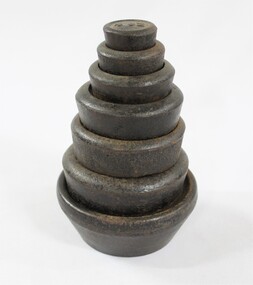
... The set of seven imperial weights were used in the Post Office in Wodonga. ...Set of seven cast iron and lead weights with imperial measurements '4 oz, 8oz, 1 lb, 2 lb, 3 lb, 4 lb, and 7 lb' The exterior circular black painted cast iron encases the heavy inner grey lead component, which is visible from the underside. ...The set of seven imperial weights were used in the Post Office in Wodonga. ...The set of seven imperial weights were used in the Post Office in Wodonga. The first Post Office in Wodonga opened on the 6th June 1856, and a second Post Office was built in 1874 on the corner of Sydney Road which became High St. and South St. In 1878 there were three staff at the Wodonga Post Office, including the Postmaster/Telegraph Manager and two Office-Keepers/Messengers. The mail service in 1878 included delivery four times a day from the Railway Station to the Post Office in Wodonga, and to and from the Wodonga Post Office to Albury twice a day.The set of seven imperial weights has local and state significance as it was used in the Wodonga Post Office in North East Victoria before decimal currency was introduced in Australia in 1966. The weights also have national significance as examples of the equipment used in post offices in Australia pre 1966.Set of seven cast iron and lead weights with imperial measurements '4 oz, 8oz, 1 lb, 2 lb, 3 lb, 4 lb, and 7 lb' The exterior circular black painted cast iron encases the heavy inner grey lead component, which is visible from the underside. "4 oz.", "8 / oz.", 1 lb.", "1 lb.", "2 lb.", "3 lb.", 4 lb.", MERCURY / 7 LB." on the top of the weights in raised numbers and letters.wodonga post office, post office, victoria post offices, wodonga, north eastern victoria post offices, victorian mail service -
 Stawell Historical Society Inc
Book, Shire of Stawell, A Brief History of Imperial Weights & Measures Equipment of Wimmera Weights and Measures Union – Previously Cat No 3631, 1991
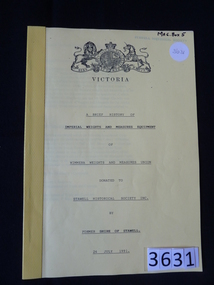
... Victoria Coat of Arms VICTORIA The rest is undelined: A Brief History of Imperial Weights and Measures Equipment of Wimmera weights and Measures Union Donated to Stawell Historical Society Inc. by Former Shire of Stawell 26 July 1991...A Brief History of Imperial Weights & Measures Equipment of Wimmera Weights and Measures Union – Previously Cat No 3631 Book Shire of Stawell Joy & Bill Atrill ...History of the Weights and Measures in Stawell from 1863 to 1991. The Physical Weights are on display in the MuseumLight Yellow paper cover with Victorian coat of arms and black print. with yellow tape on the spine.Victoria Coat of Arms VICTORIA The rest is undelined: A Brief History of Imperial Weights and Measures Equipment of Wimmera weights and Measures Union Donated to Stawell Historical Society Inc. by Former Shire of Stawell 26 July 1991stawell -
 City of Moorabbin Historical Society (Operating the Box Cottage Museum)
Scales, Domestic Imperial, ‘Fairway Melbourne’, c1930
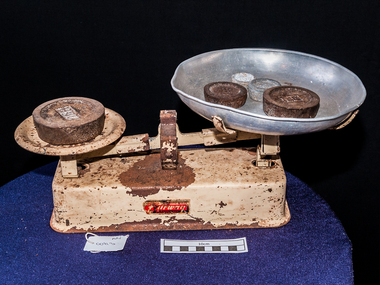
... Painted cream steel with 1 metal bowl / pan and Imperial measure weights 2LB, 1LB, 4OZ, 2OZ, 1OZ...Weights ; 2LB, 1LB, 4OZ, 2OZ, 1OZ A set of domestic scales made by ‘Fairway’ Melbourne c1930. Painted cream steel with 1 metal bowl / pan and Imperial measure weights 2LB, 1LB, 4OZ, 2OZ, 1OZ Scales, Domestic Imperial, ‘Fairway Melbourne’ Fairway Domestic Scales Company ...Fairway Company Melbourne manufactured this pair of domestic scales with a dish / pan in which objects to be weighed and the weights / masses against which to weigh them are placed. These common kitchen / dairy scales would be used by the householder to weigh flour, sugar, cereal, vegetables, fruit, meats, butter, cheese etc. prior to cooking or storing . Its parts include a fulcrum, a beam that balances on it, two pans at the ends of the beam to hold the materials to be weighed, and counter-balancing weights. A set of domestic scales made by ‘Fairway’ Melbourne c1930. Painted cream steel with 1 metal bowl / pan and Imperial measure weights 2LB, 1LB, 4OZ, 2OZ, 1OZScales ; MADE BY / DOMESTIC SCALES / FAIRWAY / MELBOURNE AUST. Weights ; 2LB, 1LB, 4OZ, 2OZ, 1OZ market gardeners, early settlers, fruit vegetables, farmers, cooking, recipes, scales, weights, measures, brass, balance beam, moorabbin, cheltenham, bentleigh, kitchen scales, dairy products, cereals, wheat flour -
 Mont De Lancey
Weights
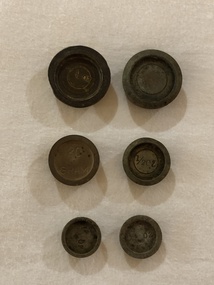
... Set of 6 cast iron, Imperial and Decimal measurement weights. ...Weights Set of 6 cast iron, Imperial and Decimal measurement weights. ...Set of 6 cast iron, Imperial and Decimal measurement weights. weights -
 Whitehorse Historical Society Inc.
Domestic object - Scales
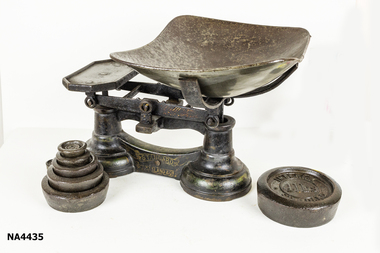
... weights. Black in colour. Tray to place items to be weighed. Imperial standard weights complete set from 4lb to 1oz. ...weights. Black in colour. Tray to place items to be weighed. Imperial standard weights complete set from 4lb to 1oz. ...Set of scales and weights. Black in colour. Tray to place items to be weighed. Imperial standard weights complete set from 4lb to 1oz. DE-ACCESSED 14/12/2011 - 4LB WEIGHT. 8 pieces without de-accessed weight.STANDARD GARLAND & CO.domestic items, weighing -
 Flagstaff Hill Maritime Museum and Village
Weapon - Carronade
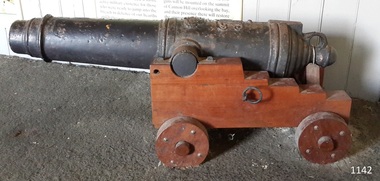
... Additional notes: Cannon cast in England, Wales and Scotland had their imperial weight chiselled or engraved in the format of 4-2-0 on the bottom of the cascabel, indicating the weight of the cannon as 4 hundredweight, 2 quarters and 0 pounds. ...Additional notes: Cannon cast in England, Wales and Scotland had their imperial weight chiselled or engraved in the format of 4-2-0 on the bottom of the cascabel, indicating the weight of the cannon as 4 hundredweight, 2 quarters and 0 pounds. ...This deck cannon is believed to be a replica Carronade as it has no foundry mark, year of manufacture, proof marks or weight of carronade on it. However, its design matches the design of Carronades used in the early to mid 19th century. History: The carronade was designed as a short-range naval weapon with a low muzzle velocity for merchant ships, but it also found a niche role on warships. It was produced by the Carron iron works and was at first sold as a complete system with the gun, mounting, and shot altogether. Carronades initially became popular on British merchant ships during the American Revolutionary War. A lightweight gun that needed only a small gun crew and was devastating at short range was well suited to defending merchant ships against French and American privateers. Its invention is variously attributed to Lieutenant General Robert Melville in 1759, or to Charles Gascoigne, manager of the Carron Company from 1769 to 1779. In its early years, the weapon was sometimes called a "mellvinade" or a "gasconade". The carronade can be seen as the culmination of a development of naval guns reducing the barrel length and thereby the gunpowder charge. The Carron Company was already selling a "new light-constructed" gun, two-thirds of the weight of the standard naval gun and charged with one-sixth of the weight of the ball in powder before it introduced the carronade, which further halved the gunpowder charge. The theory of its design was to use less powder and had other advantages that were advertised in the company's sales pamphlet of the time, state. The smaller gunpowder charge reduced the barrel heating in action, also reduced the recoil. The mounting, attached to the side of the ship on a pivot, took the recoil on a slider, without altering the alignment of the gun. The pamphlet advocated the use of woolen cartridges, which eliminated the need for wadding and worming, although they were more expensive. Carronades also simplified gunnery for comparatively untrained merchant seamen in both aiming and reloading that was part of the rationale for adopting the gun. Other advantages promoted by the company were. The replacement of trunnions by a bolt underneath, to connect the gun to the mounting, reduced the width of the carriage that enhanced the wide angle of fire. A merchant ship would almost always be running away from an enemy, so a wide-angle of fire was much more important than on a warship. A carronade weighed a quarter as much as a standard cannon and used a quarter to a third of the gunpowder charge. This reduced charge allowed Carronades to have a shorter length and much lighter weight than long guns. Increasing the size of the bore and ball reduces the required length of the barrel. The force acting on the ball is proportional to the square of the diameter, while the mass of the ball rises by the cube, so acceleration is slower; thus, the barrel can be shorter and therefore lighter. Long guns were also much heavier than Carronades because they were over-specified to be capable of being double-shotted,(to load cannons with twice the shot, for increased damage at the expense of range). Whereas it was dangerous to do this in a carronade. A ship could carry more carronades, or carronades of a larger caliber, than long guns, and carronades could be mounted on the upper decks, where heavy long guns could cause the ship to be top-heavy and unstable. Carronades also required a smaller gun crew, which was very important for merchant ships, and they were faster to reload. Additional notes: Cannon cast in England, Wales and Scotland had their imperial weight chiselled or engraved in the format of 4-2-0 on the bottom of the cascabel, indicating the weight of the cannon as 4 hundredweight, 2 quarters and 0 pounds. Since a hundredweight equals 112 pounds and a quarter weight is 28 pounds the total weight is 504 pounds or about 228 kilograms. The small bore replica carronade and carriage is part of a collection of nineteenth Century Flagstaff Hill Guns and cannons, and is a representation of carronades used from the early 18th up to the 1850s on merchant and military ships particularly the British Royal Navy until 1850. This example is not significant in the historic sense but demonstrates the type of artillery used aboard vessels of the time for protection & offensive military actions. Cannon, cast iron, small smooth bore cannon on the stepped wooden carriage with wooden wheels. It appears to fire a 12-pound cannonball. The Cannon barrel can have its elevation adjusted via a sliding sloped block at the rear of the cannon. Gun carriage has loops for locating and holding the carriage in position with the use of ropes. It is believed this carronade is a replica of a mid-to-late 19th-century Carronade cannon.Cast into metal; [Royal emblem of Queen Victoria (VR "Victoria Regina")]warrnambool, flagstaff-hill, flagstaff-hill-maritime-museum, maritime-museum, shipwreck-coast, flagstaff-hill-maritime-village, cannon, naval cannon, cannon on carriage, 19th century cannon, fortifications, smooth bore cannon, 12 pounder, carronade, artillery, replica, deck cannon, cannon in carriage, ship cannon -
 Flagstaff Hill Maritime Museum and Village
Functional object - Standard Measure, James McEwan & Co, 1860s-1900s
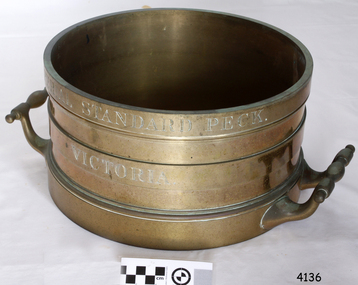
... An Imperial Peck equals a quarter of a Bushel, or 9.09 litres Standards for weights and measures began in Victoria when the Melbourne Observatory received primary sets of Imperial Standard Weights and Measures from Britain. ...An Imperial Peck equals a quarter of a Bushel, or 9.09 litres Standards for weights and measures began in Victoria when the Melbourne Observatory received primary sets of Imperial Standard Weights and Measures from Britain. ...This container is a pre-Decimal, Imperial Standard Peck, part of a three-piece set of Standard measures used in Victoria from around 1900 to 1940. The measures were made in Melbourne by J. McEwan & Co. These three measures were likely used by the local Melbourne authority that monitored weights and measures in the mid to late 19th century. . An Imperial Bushel was equal to 8 gallons, or 36.36872 litres . An Imperial Peck equals a quarter of a Bushel, or 9.09 litres Standards for weights and measures began in Victoria when the Melbourne Observatory received primary sets of Imperial Standard Weights and Measures from Britain. These were tested against the then British Imperial Standards to measure length, weight and currency. Administrative bodies in the Colony of Australia could then compare their weights and measures against these British Primary Standards and adjust their Measures accordingly, to maintain the Standards. The Weights and Measures Act of 1862 was passed in Victoria, and local inspectors were established throughout the colony. By the 1870s, local councils and shires in Victoria held a set of Standards used to test scales, weights, and measures used by manufacturers, wholesalers, and retailers. Every ten years, the councils’ Standards needed to be rechecked against the Victorian Standards. In the 19th Century, the Victorian Customs Department inspected and maintained the Standards. In 1901, the Customs Department was transferred to the Federal Government, but the Weights and Measures authority remained with the Victorian Government and relocated to the Melbourne Observatory. In 1904, the Standard weights and measures, and testing equipment, were installed in the room of a new building erected at the south end of the Great Melbourne Telescope House. The room became known as the Whirling Room, due to its large whirling apparatus that tested air meters. When the Melbourne Observatory closed in 1944, the Weights and Measures Branch was formed to continue maintaining the Standards. On February 14th, 1966, Australia began its conversion to metric measures and currency, and a new set of Standard Measures was introduced; the conversion took place in stages. The Weights and Measures Branch remained at the Observatory site until 1995. James McEwan & Co.: - The maker of this set of Standard Measures was James McEwan. His Melbourne business was established in 1852 and sold retail furniture and wholesale ironmongery. The firm’s warehouses were situated at the intersection of 81-83 Elizabeth and Little Collins Streets. Shortly afterwards, the firm partnered with William Kerr Thomson and Samuel Renwick. When McEwan died in 1868, his partners carried on and expanded the business under his name, J McEwan. The business was expanded to provide a retail shop, counting-house and private offices. Wholesale warehouses adjoined these premises at 4, 6 and 10 Little Collins Street, West. This company provided and sold a large and varied amount of imported goods into the colony; agricultural equipment, building materials, mining items, steam engines, tools of all types and marble fireplaces. The company grew to employ over 150 people in Melbourne and opened offices at 27 Lombard St, London, as well as in New Zealand and Fiji. It also serviced the Mauritius islands and the Pacific area with its steamship, the Suva, and a brig, the Shannon. The set of Imperial Standard Measures is an example of a bronze measure container made specifically for J. McEwan & Co. Today, it helps us to understand how imperial weights and measures were used, and how a standard of measurement for merchants was developed in the Australian colonies based on the Imperial British measurement system. The container has social significance as an item retailed by J McEwan, and used by Victoria’s authorities legally responsible for ensuring that dry goods sold in Victoria by wholesalers and retailers are correct. Imperial Standard Measure: a container to measure the volume of a Peck. It is part of a set of three precision measures - a Peck, a Half Bushel and a Bushel – used by government authorities in Victoria. The cast brass cylinder has straight sides and a flat base, and two handles are attached near the base by two posts on each handle. The wall inside is straight, and outside has grooves and horizontal bands. Inscriptions are engraved on the outside. The Measures were made for the retailer, J. McEwan & Co., London and Melbourne. Engraved on side: "IMPERIAL STANDARD PECK. / VICTORIA."flagstaff hill, flagstaff hill maritime museum and village, warrnambool, maritime museum, maritime village, great ocean road, shipwreck coast, weights and measurements, science, james mcewan & co., precision instrument, technology, melbourne observatory, british imperial standards, standard weights & measures, volume measure, dry measure, customs, commerce, victorian standard measure, pre-decimal measure, imperial standard, imperial bushel, imperial half bushel, imperial peck, peck measure, bronze container, brass container, cast container -
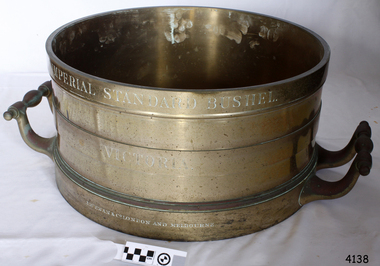 Flagstaff Hill Maritime Museum and Village
Functional object - Standard Measure, James McEwan & Co, 1860s-1900s
... An Imperial Peck equals a quarter of a Bushel, or 9.09 litres Standards for weights and measures began in Victoria when the Melbourne Observatory received primary sets of Imperial Standard Weights and Measures from Britain. ...An Imperial Peck equals a quarter of a Bushel, or 9.09 litres Standards for weights and measures began in Victoria when the Melbourne Observatory received primary sets of Imperial Standard Weights and Measures from Britain. ...This container is a pre-Decimal, Imperial Standard Bushel, part of a three-piece set of Standard measures used in Victoria from around 1900 to 1940. The measures were made in Melbourne by J. McEwan & Co. These three measures were likely used by the local Melbourne authority that monitored weights and measures in the mid to late 19th century. . An Imperial Bushel was equal to 8 gallons, or 36.36872 litres . An Imperial Peck equals a quarter of a Bushel, or 9.09 litres Standards for weights and measures began in Victoria when the Melbourne Observatory received primary sets of Imperial Standard Weights and Measures from Britain. These were tested against the then British Imperial Standards to measure length, weight and currency. Administrative bodies in the Colony of Australia could then compare their weights and measures against these British Primary Standards and adjust their Measures accordingly, to maintain the Standards. The Weights and Measures Act of 1862 was passed in Victoria, and local inspectors were established throughout the colony. By the 1870s, local councils and shires in Victoria held a set of Standards used to test scales, weights, and measures used by manufacturers, wholesalers, and retailers. Every ten years, the councils’ Standards needed to be rechecked against the Victorian Standards. In the 19th Century, the Victorian Customs Department inspected and maintained the Standards. In 1901, the Customs Department was transferred to the Federal Government, but the Weights and Measures authority remained with the Victorian Government and relocated to the Melbourne Observatory. In 1904, the Standard weights and measures, and testing equipment, were installed in the room of a new building erected at the south end of the Great Melbourne Telescope House. The room became known as the Whirling Room, due to its large whirling apparatus that tested air meters. When the Melbourne Observatory closed in 1944, the Weights and Measures Branch was formed to continue maintaining the Standards. On February 14th, 1966, Australia began its conversion to metric measures and currency, and a new set of Standard Measures was introduced; the conversion took place in stages. The Weights and Measures Branch remained at the Observatory site until 1995. James McEwan & Co.: - The maker of this set of Standard Measures was James McEwan. His Melbourne business was established in 1852 and sold retail furniture and wholesale ironmongery. The firm’s warehouses were situated at the intersection of 81-83 Elizabeth and Little Collins Streets. Shortly afterwards, the firm partnered with William Kerr Thomson and Samuel Renwick. When McEwan died in 1868, his partners carried on and expanded the business under his name, J McEwan. The business was expanded to provide a retail shop, counting-house and private offices. Wholesale warehouses adjoined these premises at 4, 6 and 10 Little Collins Street, West. This company provided and sold a large and varied amount of imported goods into the colony; agricultural equipment, building materials, mining items, steam engines, tools of all types and marble fireplaces. The company grew to employ over 150 people in Melbourne and opened offices at 27 Lombard St, London, as well as in New Zealand and Fiji. It also serviced the Mauritius islands and the Pacific area with its steamship, the Suva, and a brig, the ShannonThe set of Imperial Standard Measures is an example of a bronze measure container made specifically for J. McEwan & Co. Today, it helps us to understand how imperial weights and measures were used, and how a standard of measurement for merchants was developed in the Australian colonies based on the Imperial British measurement system. The container has social significance as an item retailed by J McEwan, and used by Victoria’s authorities legally responsible for ensuring that dry goods sold in Victoria by wholesalers and retailers are correct.Imperial Standard Measure: a container to measure the volume of a Busel. It is part of a set of three precision measures - a Peck, a Half Bushel and a Bushel – used by government authorities in Victoria. The cast brass cylinder has straight sides and a flat base, and two handles are attached near the base by two posts on each handle. The wall inside is straight, and outside has grooves and horizontal bands. Inscriptions are engraved on the outside. The Measures were made for the retailer, J. McEwan & Co., London and Melbourne.Engraved on side: "IMPERIAL STANDARD BUSHEL. / VICTORIA ./ J. MCEWAN & CO. LONDON AND MELBOURNE."flagstaff hill, flagstaff hill maritime museum and village, warrnambool, maritime museum, maritime village, great ocean road, shipwreck coast, weights and measurements, science, james mcewan & co., precision instrument, technology, melbourne observatory, british imperial standards, standard weights & measures, volume measure, dry measure, customs, commerce, victorian standard measure, pre-decimal measure, imperial standard, imperial bushel, peck measure, bronze container, brass container, cast container -
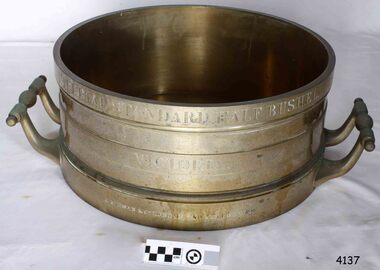 Flagstaff Hill Maritime Museum and Village
Equipment - Standard Measure, James McEwan & Co, 1860s-1900s
... An Imperial Peck equals a quarter of a Bushel, or 9.09 litres Standards for weights and measures began in Victoria when the Melbourne Observatory received primary sets of Imperial Standard Weights and Measures from Britain. ...An Imperial Peck equals a quarter of a Bushel, or 9.09 litres Standards for weights and measures began in Victoria when the Melbourne Observatory received primary sets of Imperial Standard Weights and Measures from Britain. ...This container is a pre-Decimal, Imperial Standard Half Bushel, part of a three-piece set of Standard measures used in Victoria from around 1900 to 1940. The measures were made in Melbourne by J. McEwan & Co. These three measures were likely used by the local Melbourne authority that monitored weights and measures in the mid to late 19th century. . An Imperial Bushel was equal to 8 gallons, or 36.36872 litres . An Imperial Peck equals a quarter of a Bushel, or 9.09 litres Standards for weights and measures began in Victoria when the Melbourne Observatory received primary sets of Imperial Standard Weights and Measures from Britain. These were tested against the then British Imperial Standards to measure length, weight and currency. Administrative bodies in the Colony of Australia could then compare their weights and measures against these British Primary Standards and adjust their Measures accordingly, to maintain the Standards. The Weights and Measures Act of 1862 was passed in Victoria, and local inspectors were established throughout the colony. By the 1870s, local councils and shires in Victoria held a set of Standards used to test scales, weights, and measures used by manufacturers, wholesalers, and retailers. Every ten years, the councils’ Standards needed to be rechecked against the Victorian Standards. In the 19th Century, the Victorian Customs Department inspected and maintained the Standards. In 1901, the Customs Department was transferred to the Federal Government, but the Weights and Measures authority remained with the Victorian Government and relocated to the Melbourne Observatory. In 1904, the Standard weights and measures, and testing equipment, were installed in the room of a new building erected at the south end of the Great Melbourne Telescope House. The room became known as the Whirling Room, due to its large whirling apparatus that tested air meters. When the Melbourne Observatory closed in 1944, the Weights and Measures Branch was formed to continue maintaining the Standards. On February 14th, 1966, Australia began its conversion to metric measures and currency, and a new set of Standard Measures was introduced; the conversion took place in stages. The Weights and Measures Branch remained at the Observatory site until 1995. James McEwan & Co.: - The maker of this set of Standard Measures was James McEwan. His Melbourne business was established in 1852 and sold retail furniture and wholesale ironmongery. The firm’s warehouses were situated at the intersection of 81-83 Elizabeth and Little Collins Streets. Shortly afterwards, the firm partnered with William Kerr Thomson and Samuel Renwick. When McEwan died in 1868, his partners carried on and expanded the business under his name, J McEwan. The business was expanded to provide a retail shop, counting-house and private offices. Wholesale warehouses adjoined these premises at 4, 6 and 10 Little Collins Street, West. This company provided and sold a large and varied amount of imported goods into the colony; agricultural equipment, building materials, mining items, steam engines, tools of all types and marble fireplaces. The company grew to employ over 150 people in Melbourne and opened offices at 27 Lombard St, London, as well as in New Zealand and Fiji. It also serviced the Mauritius islands and the Pacific area with its steamship, the Suva, and a brig, the Shannon.The set of Imperial Standard Measures is an example of a bronze measure container made specifically for J. McEwan & Co. Today, it helps us to understand how imperial weights and measures were used, and how a standard of measurement for merchants was developed in the Australian colonies based on the Imperial British measurement system. The container has social significance as an item retailed by J McEwan, and used by Victoria’s authorities legally responsible for ensuring that dry goods sold in Victoria by wholesalers and retailers are correct.Imperial Standard Measure: a container to measure the volume of a Half Bushel. It is part of a set of three precision measures - a Peck, a Half Bushel and a Bushel – used by government authorities in Victoria. The cast brass cylinder has straight sides and a flat base, and two handles are attached near the base by two posts on each handle. The wall inside is straight, and outside has grooves and horizontal bands. Inscriptions are engraved on the outside. The Measures were made for the retailer, J. McEwan & Co., London and Melbourne. Engraved test: "IMPERIAL STANDARD HALF BUSHEL. / VICTORIA / J. MCEWAN & O. LONDON AND MELBOURNE."flagstaff hill, flagstaff hill maritime museum and village, warrnambool, maritime museum, maritime village, great ocean road, shipwreck coast, weights and measurements, science, james mcewan & co., precision instrument, technology, melbourne observatory, british imperial standards, standard weights & measures, volume measure, dry measure, customs, commerce, victorian standard measure, pre-decimal measure, imperial standard, imperial half bushel, bronze container, brass container, cast container -
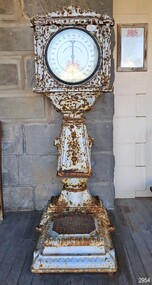 Flagstaff Hill Maritime Museum and Village
Instrument - Scale, Weighing Machine, G. Salter & Co, 1884-1909
... The scale’s weight measurements were in Imperial stones and pounds up to 20 stone (127 kg). ...The size of the coin slot fitted a penny coin, and the weight measurements on the face were in Imperial stones and pounds. ...The scale’s weight measurements were in Imperial stones and pounds up to 20 stone (127 kg). ...This ornate, Victorian-era automatic weighing machine was made in England around 1884-1909, by George Salter and Co. of West Bromwich, UK, makers of scales since 1760. It is protected by Queen Victoria’s Royal Letters Patent, signed in 1900. The scale stood outside the Warrnambool Post Office in Timor Street from around 1909 to 1966, as shown on postcards and photographs held at the State Library of Victoria. The scale is identified by the Serial Number '665', and was installed by the distributors, the Australasian Automatic Weighing Machine Co. Ltd.. The scale’s weight measurements were in Imperial stones and pounds up to 20 stone (127 kg). The scale’s face included charts of average weights, for men, women, boys and girls, by various heights, in feet and inches. The coin slot and its face were converted to metric measurements by the Eastern Scale Company Pty. Ltd; that firm was registered on October 2, 1974. The Australasian Automatic Weighing Machine Co. Ltd was a large supplier of weighing scales in Australia and held the Royal Letters patent for their machines, distributing them in prominent locations. In 1902, the firm was listed under the Import Entries Passed at His Majesty’s Customs, importing into Sydney, NSW, eight cases of scales. In 1911, the company asked permission from the Port Pirie Corporation to install a machine in Alexander Street. In 1913, the company applied to the City of Sydney to install machines around the city, including at the tram depot. One application mentions “… three machines in three places for three pounds per year”. In 1923, the firm tendered for the right to place Automatic Weighing Machines on railway and tram premises throughout New South Wales, subsequently for five-year terms, in return for a fixed payment per machine and a portion of the revenue to the NSW Government. In 1928, the Sydney Harbour Trust gave the firm the right to place the weighing machines on various ferry jetties. The firm was still operating in 1941, advertising for two boys aged 14-16 for the workshop and messages, at the Rialto building, 497 Collins St., Melbourne. On December 21, 1946, the Commonwealth government invited offers to tender for the right to place automatic weighing machines on postal premises throughout the six states; the successful company then made arrangements with the federal Postmaster General's Department to place machines outside post offices across the country. A few years later, on September 11, 1950, the firm's Adelaide branch ceased trading. From 11th July 1950, the Australian and Eastern Engineering Company Pty. Ltd took over at the same premises, at 179 Pirie Street, Adelaide. The Perth branch ceased business in WA on July 6th, 1950. Percival Everitt invented and patented the automatic, coin-operated personal scale design. Everitt was a Norfolk-born engineer and regarded as the father of the coin-operated industry. As a young man in 1877, he invented a hay and corn pitcher, a turnip thinner in 1878 and an Automatic Travelling Anchor in 1880. But his fame came in 1883 with the first postcard-vending machine, over a hundred of which he distributed around London. In 1884, he patented one of his many inventions, the coin-operated scales for use in public places; for many people, it was their first exposure to coin-operated machines. His success prompted the formation of the Weighing Machine Company in 1885. Further inventions followed: a blow tester in 1887, the machine for testing a person's grip in 1888, and in 1889, the dispensing machine for hiring out opera glasses, and a device for shutting down the coin entry slot if the machine was empty. In 1890, he invented a fortune-telling machine. Everitt sadly did not make his fortune; he died suddenly in February 1893, in his late forties, with £71 to his name. George Salter & Co., West Bromwich, England, produced automatic weighing scale machines from Everitt’s patented design, and advertised them as suitable for hotels, pleasure gardens, theatres, exhibition halls, clubs, baths and places of public resort. The company was established in 1760 by brothers Richard and William Salter, and manufactured springs and pocket steelyards (spring balances). After several generations, the company was taken over in 1855 by a nephew, George, and renamed George Salter & Co. In 1884, Salter registered the trademark of a Staffordshire knot pierced by an arrow. The company's expanded range of products included the first coin-operated public weighing machines in the 1880s and, in 1895, the first English-made typewriter. In 1915, Salter became a limited company, Geo. Salter & Co. Ltd. When the last George Salter died in 1917, the company passed into the hands of other relatives, but continued to grow before being bought out by Staveley Industries in 1973. Despite several subsequent mergers, the Salter name continues to be seen on household products such as digital scales. This patented, coin-operated weight machine is significant for its association with Percival Everitt, the inventor of the world’s first slot machine, with the renowned maker of scales, G. Salter & Co., which began operating in 1760, and also with the Australasian Automatic Weighing Scale Co., which imported and widely distributed the scales throughout Australia from the early-to-mid 20th century. It is a rare example of an early vending machine used in public places from the late 19th through to the mid-20th century. These machines were the early step in the evolution of coin-in-the-slot machines, which are still used today. The scales give a glimpse into our history; they became quickly popular with the public, which, until then, had little access to weight scales apart from those at medical services. They also provided inexpensive entertainment for families, especially while waiting for trains or visiting the post office. The machines were also attractive and lucrative to the distributors; once installed, they required very little maintenance, and their low cost to customers kept the money coming in. This automatic weighing machine is also significant for its decades of service to the local and regional community of Warrnambool, for personal and commercial purposes. A public coin-operated weighing scale, also called a penny scale. It is a large, silver-painted cast metal stand with a square top on a pedestal that flares outwards to join a rectangular platform base with posts on the side and corners that may have had fitted wheels. The round, white face on top has red and black measurements and inscriptions. A slim indicator with a point at one end and an arc at the other is attached to the face’s centre. The coin slot is above the face, on the left, and the scale’s identification number is engraved on an oval plate on the right. Moulded motifs decorate the pedestal’s front and are repeated on its sides; they depict a tall, narrow urn with a bowl on top and fancy scrolls on either side. There is a decorative panel across the front top of the stand. The top of the pedestal has a small keyhole. The size of the coin slot fitted a penny coin, and the weight measurements on the face were in Imperial stones and pounds. Quite some time after 1966, when Australia introduced new decimal weights, measurements and currency, the scale was updated; the coin slot size was changed, and a new face with metric measurements was installed. The scale now accepts a $1 coin (one dollar) and the scale measures weight in kilograms and grams, from 0 to 125 kg.. The rear of the scale has a small, rectangular metal plate with printed text. The scale was made by G Salter & Co. of West Bromwich, UK, distributed by the Australasian Automatic Weighing Platform Co., and updated to metric measurements by Eastern Scale Co. Pty Ltd. It was previously installed at the Warrnambool Post Office. Engraved on an oval plate on the right: "665" Top centre of the face, in red: "$1 coin" Top of face: "EASTERN SCALE CO. PTY LTD" Base of face, in red: "[Royal Coat of Arms of Britain]" with words, below in red: "BY ROYAL LETTERS PATENT" Around the face, in black: "[numbers 0 to 125, in increments 5, and makes between the numbers for each 500g]" "kg" Below the face, moulded letters within a shield: "AUSTRALASIAN AUTOMATIC WEIGHING MACHINES CO. LTD." At the back of the weighing platform: "G SALTER & CO. / WEST BROMWICH", remnants of logo “[Staffordshire knot pierced by an arrow]” Plate on rear: THIS SCALE REMAINS THE PROPERTY OF EASTERN SCALE CO. PTY. LTD., 8 GEORGE COURT, GREENSBOROUGH, VIC, 3088. PHONE (03 ) _ 34 _ _ 33” (434 9333 ?_flagstaff hill, warrnambool, maritime village, maritime museum, flagstaff hill maritime museum and village, shipwreck coast, great ocean road, scale, weighing scale, salter, australasian, 1 dollar, $1 coin, 1p, 1 penny coin, penny scale, coin in slot scale, eastern scale co. pty. ltd., british royal coat of arms, royal letters patent, letters patent, health, ending machine, coin-operated machine, percival everett, weighing machine co., george salter & co., g salter & co, west bromwich, vending machine, weights & balances, measurements, slot machine, coin operated machine, penny-in-the-slot, coin fed, coin op scale, weights & measures, australasian automatic weighing machine co. ltd., warrnambool post office, machine 665, no. 665, blalnce technology, scales and weights, weights and measures, penny weight scales, vintage, weighing machine, coin in the slot, coin operated, public scale, public weighing machine, penny-weighing machines, penny weighing machines, penny scales, coin operated weighing machine, scale weighing machine -
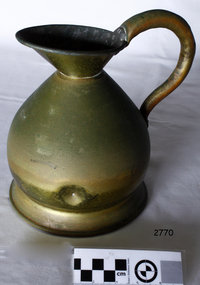 Flagstaff Hill Maritime Museum and Village
Functional object - Jug, Between 1910 -1936
... The beginning of standardised weights and measures began In Victoria when the Melbourne Observatory received sets of standard weights and measures, which had been tested in Britain against the then British Imperial standards. ...The probability is that this artefact was made sometime between George V reign (1910-1936) and gives us today a snapshot of how imperial weights and measures were checked by Government departments prior to decimalisation and how a standard for the various types of measurement was developed in Australian based on the Imperial British measurement system. ...The beginning of standardised weights and measures began In Victoria when the Melbourne Observatory received sets of standard weights and measures, which had been tested in Britain against the then British Imperial standards. These included the primary standard yard and pound for the Colony of Victoria. Other standards of weights and measure held by shires and the administrative body's within the colony could then be compared to these primary standards. A Weights and Measures Act was passed in Victoria in 1862, establishing local inspectors throughout the colony. By the 1870s each local council and shire in Victoria held a set of standards that were used to test scales, weights and dry measures used by wholesalers, factories and shops. Every ten years the councils’ standards would themselves need to be rechecked against the Victorian Standards. The checking was done by the Victorian Customs Department in the 19th century, but with the transfer of responsibility for customs to the Federal Government in 1901, weights and measures function was retained by the Victorian Government and was shifted to the Melbourne Observatory. In 1904, a new building was erected at the south end of the Great Melbourne Telescope House, where the standard weights and measures and testing equipment was installed. This room had a large whirling apparatus for testing air meters and became known as the Whirling Room. When the Melbourne Observatory closed in 1944, the Weights and Measures Branch was formed to continue and this branch remained at the Observatory site unit until 1995.An example of a brass measuring jug made specifically to maintain government standard liquid measurements that were sold to the public. The probability is that this artefact was made sometime between George V reign (1910-1936) and gives us today a snapshot of how imperial weights and measures were checked by Government departments prior to decimalisation and how a standard for the various types of measurement was developed in Australian based on the Imperial British measurement system. The container has social significance as an item used in Victoria as a legal standard measure to ensure that goods sold in Victoria were correct. Jug brass haystack form with a deep lip and pouring spout, small neck and broad base. It displays a curved pistol handle. Inscription at base of handle top of jug stamped 61 GVR SM. These marks signify that the measure complied with the Victorian Government capacity liquid standard measurement. Item made during the reign of George V (1910-1936 (GVR).Other marks indicate model number (61) & SM possible could be either small measure, the maker, or Standards Melbourne.flagstaff hill, warrnambool, shipwrecked-coast, flagstaff-hill, flagstaff-hill-maritime-museum, maritime-museum, shipwreck-coast, flagstaff-hill-maritime-village -
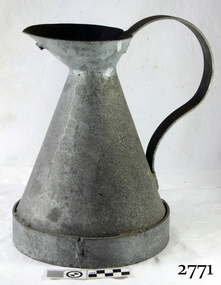 Flagstaff Hill Maritime Museum and Village
Equipment - Galvanised Jug, 1930s
... The beginning of standardised weights and measures began In Victoria when the Melbourne Observatory received sets of standard weights and measures, which had been tested in Britain against the then British Imperial standards. ...The probability is that this artifact was made around the first quarter of the 20th century and gives us today a snapshot of how imperial weights and measures were used before decimalisation and how a standard of measurement for merchants was developed in Australian based on the Imperial British measurement system. ...The beginning of standardised weights and measures began In Victoria when the Melbourne Observatory received sets of standard weights and measures, which had been tested in Britain against the then British Imperial standards. These included the primary standard yard and pound for the Colony of Victoria. Other standards of weights and measure held by shires and the administrative body's within the colony could then be compared to these primary standards. A Weights and Measures Act was passed in Victoria in 1862, establishing local inspectors throughout the colony. By the 1870s each local council and shire in Victoria held a set of standards that were used to test scales, weights and dry measures used by wholesalers, factories and shops. Every ten years the councils’ standards would themselves need to be rechecked against the Victorian Standards. The checking was done by the Victorian Customs Department in the 19th century, but with the transfer of responsibility for customs to the Federal Government in 1901, weights and measures function was retained by the Victorian Government and was shifted to the Melbourne Observatory. In 1904, a new building was erected at the south end of the Great Melbourne Telescope House, where the standard weights and measures and testing equipment was installed. This room had a large whirling apparatus for testing air meters and became known as the Whirling Room. When the Melbourne Observatory closed in 1944, the Weights and Measures Branch was formed to continue and this branch remained at the Observatory site unit until 1995.An example of a galvanised measuring jug made specifically to maintain government standard liquid measurements that were sold to the public. The probability is that this artifact was made around the first quarter of the 20th century and gives us today a snapshot of how imperial weights and measures were used before decimalisation and how a standard of measurement for merchants was developed in Australian based on the Imperial British measurement system. The container has social significance as an item used in Victoria as a legal standard measure to ensure that goods sold in Victoria were correct given the item is galvanised it was probability used for kerosene or petrol etc not for liquids used for human consumption. Jug conical shaped with rounded top coming to a very slight point wide handle at back. VIB.L.66 1/2 Gall capacity unsure of the markings 66 could mean the model number capacity is 1/2 an imperial gallon VIB.L markings not known possibly a company or Victorian Department that the jug was made for and no longer active.flagstaff hill, warrnambool, shipwrecked-coast, flagstaff-hill, flagstaff-hill-maritime-museum, maritime-museum, shipwreck-coast, flagstaff-hill-maritime-village -
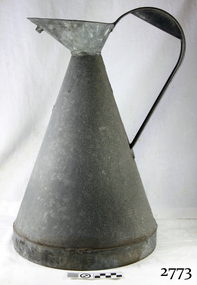 Flagstaff Hill Maritime Museum and Village
Galvanised Jug
... The beginning of standardised weights and measures began In Victoria when the Melbourne Observatory received sets of standard weights and measures, which had been tested in Britain against the then British Imperial standards. ...The probability is that this artifact was made around the first quarter of the 20th century and gives us today a snapshot of how imperial weights and measures were used before decimalisation and how a standard of measurement for merchants was developed in Australian based on the Imperial British measurement system. ...The beginning of standardised weights and measures began In Victoria when the Melbourne Observatory received sets of standard weights and measures, which had been tested in Britain against the then British Imperial standards. These included the primary standard yard and pound for the Colony of Victoria. Other standards of weights and measure held by shires and the administrative body's within the colony could then be compared to these primary standards. A Weights and Measures Act was passed in Victoria in 1862, establishing local inspectors throughout the colony. By the 1870s each local council and shire in Victoria held a set of standards that were used to test scales, weights and dry measures used by wholesalers, factories and shops. Every ten years the councils’ standards would themselves need to be rechecked against the Victorian Standards. The checking was done by the Victorian Customs Department in the 19th century, but with the transfer of responsibility for customs to the Federal Government in 1901, weights and measures function was retained by the Victorian Government and was shifted to the Melbourne Observatory. In 1904, a new building was erected at the south end of the Great Melbourne Telescope House, where the standard weights and measures and testing equipment was installed. This room had a large whirling apparatus for testing air meters and became known as the Whirling Room. When the Melbourne Observatory closed in 1944, the Weights and Measures Branch was formed to continue and this branch remained at the Observatory site unit until 1995. An example of a galvanised measuring jug made specifically to maintain government standard liquid measurements that were sold to the public. The probability is that this artifact was made around the first quarter of the 20th century and gives us today a snapshot of how imperial weights and measures were used before decimalisation and how a standard of measurement for merchants was developed in Australian based on the Imperial British measurement system. The container has social significance as an item used in Victoria as a legal standard measure to ensure that goods sold in Victoria were correct given the item is galvanised it was probability used for kerosene or petrol etc not for liquids used for human consumption. Galvanised Iron jug with rounded top, Inscription on handle at back. 2 gallon GV.35flagstaff hill, warrnambool, shipwrecked-coast, flagstaff-hill, flagstaff-hill-maritime-museum, maritime-museum, shipwreck-coast, flagstaff-hill-maritime-village -
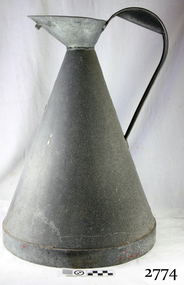 Flagstaff Hill Maritime Museum and Village
Functional object - Galvanised Jug
... The beginning of standardised weights and measures began In Victoria when the Melbourne Observatory received sets of standard weights and measures, which had been tested in Britain against the then British Imperial standards. ...The probability is that this artifact was made around the first quarter of the 20th century and gives us today a snapshot of how imperial weights and measures were used before decimalisation and how a standard of measurement for merchants was developed in Australian based on the Imperial British measurement system. ...The beginning of standardised weights and measures began In Victoria when the Melbourne Observatory received sets of standard weights and measures, which had been tested in Britain against the then British Imperial standards. These included the primary standard yard and pound for the Colony of Victoria. Other standards of weights and measure held by shires and the administrative body's within the colony could then be compared to these primary standards. A Weights and Measures Act was passed in Victoria in 1862, establishing local inspectors throughout the colony. By the 1870s each local council and shire in Victoria held a set of standards that were used to test scales, weights and dry measures used by wholesalers, factories and shops. Every ten years the councils’ standards would themselves need to be rechecked against the Victorian Standards. The checking was done by the Victorian Customs Department in the 19th century, but with the transfer of responsibility for customs to the Federal Government in 1901, weights and measures function was retained by the Victorian Government and was shifted to the Melbourne Observatory. In 1904, a new building was erected at the south end of the Great Melbourne Telescope House, where the standard weights and measures and testing equipment was installed. This room had a large whirling apparatus for testing air meters and became known as the Whirling Room. When the Melbourne Observatory closed in 1944, the Weights and Measures Branch was formed to continue and this branch remained at the Observatory site unit until 1995.An example of a galvanised measuring jug made specifically to maintain government standard liquid measurements that were sold to the public. The probability is that this artifact was made around the first quarter of the 20th century and gives us today a snapshot of how imperial weights and measures were used before decimalisation and how a standard of measurement for merchants was developed in Australian based on the Imperial British measurement system. The container has social significance as an item used in Victoria as a legal standard measure to ensure that goods sold in Victoria were correct given the item is galvanised it was probability used for kerosene or petrol etc not for liquids used for human consumption. Jug galvanised conical shaped with rounded top, handle at back. 3 gallon GV.27flagstaff hill, warrnambool, shipwrecked-coast, flagstaff-hill, flagstaff-hill-maritime-museum, maritime-museum, shipwreck-coast, flagstaff-hill-maritime-village -
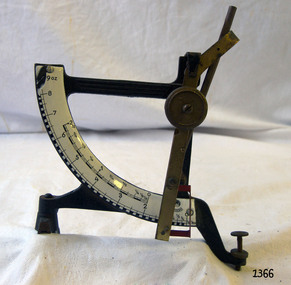 Flagstaff Hill Maritime Museum and Village
Instrument - Letter Scale, Philip Jakob, Maul, 1930s
... It is significant as it is a snapshot into the past and how everyday vintage items were used and interacted within society in the 1930s. flagstaff hill warrnambool shipwrecked-coast flagstaff-hill flagstaff-hill-maritime-museum maritime-museum shipwreck-coast flagstaff-hill-maritime-village scale quadrant scale postal weight 9 oz philip jakob, maul scale manufacturer german industry weighing instrument inclination scale The balance is marked "CONCAV" and graduated in imperial ounces to 9 oz Antique German Jacob Maul "Concav" brass postal or letter scale, quadrant type, with pendulum, measuring up to 9ozs. ...Jakob Maul (1866-1953) founded a metal works factory in 1912 at Zell in Odenwald not far from Frankfurt. He was born the son of a winegrower from the Rheinhessen region of Germany that lies on the left bank of the river Rhine. At the age of 45, he started a metal works factory to produce various types of scales but during the second world war the factory was bombed and production ended. Production for the manufacture of scales resumed in 1948. In 1953 at his death Jakobs son Fritz Scharmann an engineer who had been working with his father since 1923 took over the management of the Maul companies. In 1970 the production responsibilities for Philip J Maul was taken over by Porti Office Equipment who was based in Hamburg. The company has undergone several integrations with subsidiary companies. Today the company has diversified into different areas one of which is manufacturing solar scales. An original postal scale made in Germany before the Second World War and regarded today as a collector's item. It is significant as it is a snapshot into the past and how everyday vintage items were used and interacted within society in the 1930s.Antique German Jacob Maul "Concav" brass postal or letter scale, quadrant type, with pendulum, measuring up to 9ozs. The scale has a level-adjusting screw.The balance is marked "CONCAV" and graduated in imperial ounces to 9 ozflagstaff hill, warrnambool, shipwrecked-coast, flagstaff-hill, flagstaff-hill-maritime-museum, maritime-museum, shipwreck-coast, flagstaff-hill-maritime-village, scale, quadrant scale, postal weight, 9 oz, philip jakob, maul, scale manufacturer, german industry, weighing instrument, inclination scale -
 Flagstaff Hill Maritime Museum and Village
Functional object - Standard Measure, Late 18th to early 19th century (before the standardised measurement was introduced in England in 1824)
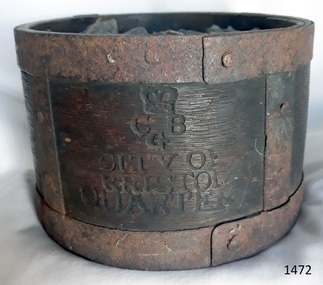
... Establishment of the System: The Weights and Measures Act of 1824 and the Act of 1878 established the British Imperial System based on precise definitions of selected existing units. ...An early example of a dry measuring container giving a snapshot of how imperial weights and measures developed in England to evolve the British measurement system into the metric arrangement that most countries have adopted today including Australia. ...The peck has been in use since the early 14th century when it was introduced as a measure for flour. The term referred to varying quantities until the modern units of measurement were defined in the 19th century. Cities in England used to have official standard weights and measures for that city or area. These containers were marked with the city's name and emblem, merchant’s weights and measures would then be checked against this to make sure they weren't trying to cheat their customers. The item in the collection is a standard measure approved by Bristol City and used by that City’s grocers to measure dry goods such as peas, beans, sugar, flour, meal etc., and its metal banding ensures that the measure cannot be reduced in size to cheat customers. Additional Information: The British Imperial System evolved from the thousands of Roman, Celtic, Anglo-Saxon, and customary local units employed in the middle Ages. Traditional names such as pound, foot, and gallon were widely used, but the values so designated varied with time, place, trade, product specifications, and dozens of other requirements. Early royal standards were established to enforce uniformity took the name Winchester, after the ancient tenth century capital of Britain. King Henry VII reaffirmed the customary Winchester standards for capacity and length and distributed royal standards throughout the realm. This process was repeated about a century later in the reign of Queen Elizabeth I. In the 16th century, the rod (5.5 yards, or 16.5 feet) was defined (once again as a learning device and not as a standard) defined by the length of the left feet of 16 men lined up heel to toe as they emerged from the church. By the 17th century usage and legal statute had established the acre, rod, and furlong at their present values together with other historic units such as the peck. Establishment of the System: The Weights and Measures Act of 1824 and the Act of 1878 established the British Imperial System based on precise definitions of selected existing units. The 1824 act sanctioned a single imperial gallon to replace the wine, ale, and corn (wheat) gallons that were in general use. The new gallon was defined as equal in volume to 10 pounds avoirdupois of distilled water weighed at 62°F with the barometer at 30 inches, or 277.274 cubic inches (later corrected to 277.421 cubic inches). The two new basic standard units were the imperial standard yard and the troy pound, which was later restricted to weighing drugs, precious metals, and jewels. In 1963 an act of parliament abolished archaic measures as the rod and chaldron and a metric system was adopted. An early example of a dry measuring container giving a snapshot of how imperial weights and measures developed in England to evolve the British measurement system into the metric arrangement that most countries have adopted today including Australia. It has social significance as an item that was in everyday use by grocers and other merchants to measure dry goods in the late 18th to early 19th centuries and used specifically in the Bristol region of England as an officially recognised measurement.Standard Measure; Half Peck dry measure. Wooden measurement container with iron banding and hand made rivets container is a Quarter Peck official measurement container. Inscriptions are impressed into the sides of the wooden body. The container has the official crown and emblem of the City of Bristol, indicating this item was the Bristol City standard quarter peck measurement.Impressed into the timber on the front, a crown emblem over "C B G / CITY OF BRISTOL / QUARTER", on one side "HALF" , another side "PECK". Handwritten in white chalk on the base is "1458"flagstaff hill, warrnambool, shipwrecked-coast, flagstaff-hill-maritime-museum, flagstaff-hill-maritime-village, weights and measures, quarter peck, measurement container, dry grocery measure, bristol city measurement standard, city of bristol, british weights and measures, 18th and 19th centure standard measures -
 Flagstaff Hill Maritime Museum and Village
Equipment - Weight
... Weight metal disc 4lbs imperial standard. Has indentation in top for stacking and relief print....Flagstaff Hill Warrnambool Shipwrecked-coast Flagstaff-Hill Flagstaff-Hill-Maritime-Museum Maritime-Museum Shipwreck-coast Flagstaff-Hill-Maritime-Village Weight metal disc 4lbs imperial standard. Has indentation in top for stacking and relief print. ...Weight metal disc 4lbs imperial standard. Has indentation in top for stacking and relief print.flagstaff hill, warrnambool, shipwrecked-coast, flagstaff-hill, flagstaff-hill-maritime-museum, maritime-museum, shipwreck-coast, flagstaff-hill-maritime-village -
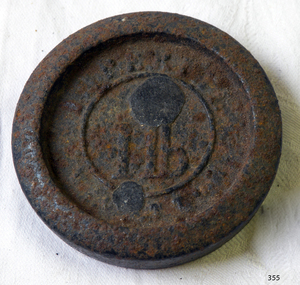 Flagstaff Hill Maritime Museum and Village
Decorative object - Weight, 19th to mid-20th centuries
... weight...Weights and Measures...Measurement...Scale...Imperial...Weight; one pound imperial measure with inscription around perimete....Flagstaff Hill Warrnambool Shipwrecked-coast Flagstaff-Hill Flagstaff-Hill-Maritime-Museum Maritime-Museum Shipwreck-coast Flagstaff-Hill-Maritime-Village weight Pound Pound weight Weights and Measures Measurement Scale Imperial measure "1 lb" (Other marks are Indecipherable) Weight; one pound imperial measure with inscription around perimete. ...W3ights such as this one were used to measure goods sold or purchased. They were used in Australia in homes and stores, and government organisations, until the mid 1960s when the Nation converted to metric measures. Weight; one pound imperial measure with inscription around perimete."1 lb" (Other marks are Indecipherable)flagstaff hill, warrnambool, shipwrecked-coast, flagstaff-hill, flagstaff-hill-maritime-museum, maritime-museum, shipwreck-coast, flagstaff-hill-maritime-village, weight, pound, pound weight, weights and measures, measurement, scale, imperial measure -
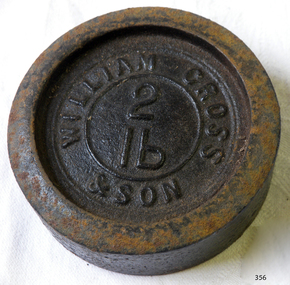 Flagstaff Hill Maritime Museum and Village
Weight
... Weight two pound imperial inscribed William Cross and Sons...Flagstaff Hill Warrnambool Shipwrecked-coast Flagstaff-Hill Flagstaff-Hill-Maritime-Museum Maritime-Museum Shipwreck-coast Flagstaff-Hill-Maritime-Village Weight two pound imperial inscribed William Cross and Sons Weight ...Weight two pound imperial inscribed William Cross and Sonsflagstaff hill, warrnambool, shipwrecked-coast, flagstaff-hill, flagstaff-hill-maritime-museum, maritime-museum, shipwreck-coast, flagstaff-hill-maritime-village -
Bright & District Historical Society operating the Bright Museum
Weights for scales, Whitehouse Imperial Tipton 416
... Weights kitchen scales culinary utensils balance Whitehouse Imperial Tipton 416 Weights for scales, 2lb weight Iron weight used for kitchen scales Weights for scales Whitehouse Imperial Tipton 416 ...Weights for scales, 2lb weight Iron weight used for kitchen scalesWhitehouse Imperial Tipton 416weights, kitchen, scales, culinary, utensils, balance
