
Showing 561 items matching "infantry soldiers"
-
 National Vietnam Veterans Museum (NVVM)
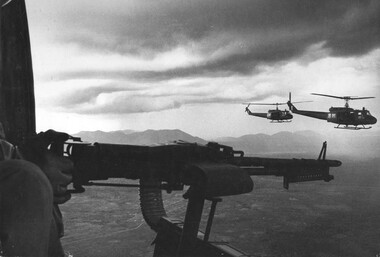
Photograph, Gibbons, Denis, Heliborn Assault 1
... ...Infantry Soldiers...A black and white photograph of Huey 'slick' Helicopters from 9 Squadron, Royal Australian Air Force, loaded with seven fully equiped infantry soldiers plus the four RAAF crew, heading for a landing zone in Phuoc Tuy Province at the start of another Australian search and destroy mission....Photograph Huey Helicopter RAAF 9 Squadron Phuoc Tuy Province Infantry Soldiers Gibbons Collection Catalogue Denis Gibbons Photographer Vietnam War RAAF Crew Search and Destroy Mission A black and white photograph of Huey 'slick' Helicopters from 9 Squadron, Royal Australian Air Force, loaded with seven fully equiped infantry soldiers plus the four RAAF crew, heading for a landing zone in Phuoc Tuy Province at the start of another Australian search and destroy mission. ...Denis Gibbons (1937 – 2011) Trained with the Australian Army, before travelling to Vietnam in January 1966, Denis stayed with the 1st Australian Task Force in Nui Dat working as a photographer. For almost five years Gibbons toured with nine Australian infantry battalions, posting compelling war images from within many combat zones before being flown out in late November 1970 after sustaining injuries. The images held within the National Vietnam Veterans Museum make up the Gibbons Collection.A black and white photograph of Huey 'slick' Helicopters from 9 Squadron, Royal Australian Air Force, loaded with seven fully equiped infantry soldiers plus the four RAAF crew, heading for a landing zone in Phuoc Tuy Province at the start of another Australian search and destroy mission.photograph, huey helicopter, raaf, 9 squadron, phuoc tuy province, infantry soldiers, gibbons collection catalogue, denis gibbons, photographer, vietnam war, raaf crew, search and destroy mission -
 Dandenong/Cranbourne RSL Sub Branch
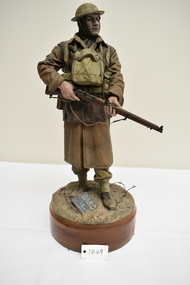
Memorabilia - Model of WW 2 Infantry Soldier
... Model of WW 2 Infantry Soldier...WW 2 Infantry Soldier model in full military outfit. ...Small plaque inscribed BARD 19 km. WW 2 Infantry Soldier model in full military outfit. Memorabilia Model of WW 2 Infantry Soldier ...WW 2 Infantry Soldier model in full military outfit. Small plaque inscribed BARD 19 km. -
 Diamond Valley Vietnam Veterans Sub-Branch
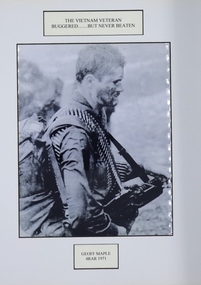
Photograph - Vietnam Veteran, c2002
... Monochrome picture of a side profile view of a typical infantry soldier in Vietnam and patrol ready....Photo - "The Vietnam Veteran - Buggered but Never Beaten"- Geoff Maple, 4RAR, 1971 Depiction of the infantry soldiers' struggle in Vietnam. vietnam vietnam war diamond valley vietnam veterans sub branch 4rar "The Vietnam Veteran - Buggered but Never Beaten"- Geoff Maple, 4RAR, 1971 Monochrome picture of a side profile view of a typical infantry soldier in Vietnam and patrol ready. ...Photo - "The Vietnam Veteran - Buggered but Never Beaten"- Geoff Maple, 4RAR, 1971Depiction of the infantry soldiers' struggle in Vietnam.Monochrome picture of a side profile view of a typical infantry soldier in Vietnam and patrol ready."The Vietnam Veteran - Buggered but Never Beaten"- Geoff Maple, 4RAR, 1971vietnam, vietnam war, diamond valley vietnam veterans sub branch, 4rar -
 The 5th/6th Battalion Royal Victoria Regiment Historical Collection
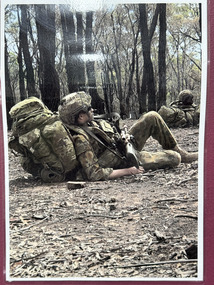
Photograph - Photo of a soldier, Photo of the Soldier resting on Exercise
... Photo of an infantry soldier resting on exercise. The soldier is in marching order and also carrying a radio...Photo of an infantry soldier resting on exercise. The soldier is in marching order and also carrying a radio Photo of the Soldier resting on Exercise Photograph Photo of a soldier ...Photo of an infantry soldier resting on exercise. The soldier is in marching order and also carrying a radio -
 8th/13th Victorian Mounted Rifles Regimental Collection
Photograph
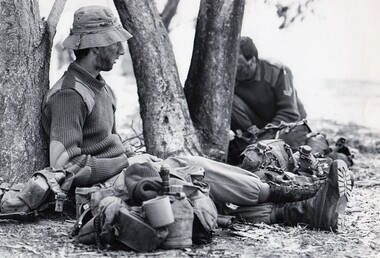
... Black and white photograph of infantry soldier, Private Dale, during Exercise " Fiery Cauldron " Puckapunyal...The training focussed on armoured/infantry cooperation, in particular the use of armoured personnel carriers. " Private Dale takes a rest. " Black and white photograph of infantry soldier, Private Dale, during Exercise " Fiery Cauldron " Puckapunyal Photograph ...In the period 5-20 March 1988, ‘A’ Squadron 8th/13th Victorian Mounted Rifles participated in an exercise conducted at Puckapunyal by 4th Infantry Brigade (Reserve) codenamed ‘Fiery Cauldron’. Other units participating included 5th/6th Battalion and 8th/7th Battalion Royal Victorian Regiment, 4th/19th Prince of Wales’s Light Horse Regiment and 1st Armoured Regiment. The training focussed on armoured/infantry cooperation, in particular the use of armoured personnel carriers. Black and white photograph of infantry soldier, Private Dale, during Exercise " Fiery Cauldron " Puckapunyal" Private Dale takes a rest. " -
 8th/13th Victorian Mounted Rifles Regimental Collection
Photograph
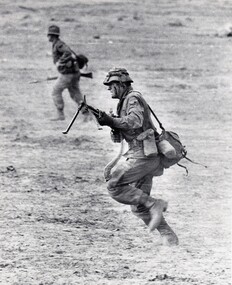
... Black and white photograph of two infantry soldiers doubling forward during Exercise " Fiery Cauldron " Puckapunyal...The training focussed on armoured/infantry cooperation, in particular the use of armoured personnel carriers. " Infantry on the move " Black and white photograph of two infantry soldiers doubling forward during Exercise " Fiery Cauldron " Puckapunyal Photograph ...In the period 5-20 March 1988, ‘A’ Squadron 8th/13th Victorian Mounted Rifles participated in an exercise conducted at Puckapunyal by 4th Infantry Brigade (Reserve) codenamed ‘Fiery Cauldron’. Other units participating included 5th/6th Battalion and 8th/7th Battalion Royal Victorian Regiment, 4th/19th Prince of Wales’s Light Horse Regiment and 1st Armoured Regiment. The training focussed on armoured/infantry cooperation, in particular the use of armoured personnel carriers. Black and white photograph of two infantry soldiers doubling forward during Exercise " Fiery Cauldron " Puckapunyal" Infantry on the move " -
 National Vietnam Veterans Museum (NVVM)
Photograph, Gibbons, Denis, Quick Nap
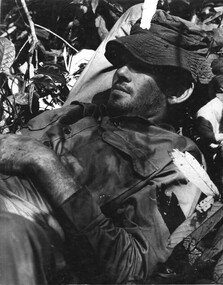
... ...Infantry Soldiers...Photograph Digger Gibbons Collection Catalogue Dark Green Long Green Infantry Soldiers Denis Gibbons A black and white photograph of a digger takes a quick nap as a halt is called while patrolling in the close country of the 'Dark Green' or sometimes called the 'Long Green' of the heavy, thick tropical rainforest. ...Denis Gibbons (1937 – 2011) Trained with the Australian Army, before travelling to Vietnam in January 1966, Denis stayed with the 1st Australian Task Force in Nui Dat working as a photographer. For almost five years Gibbons toured with nine Australian infantry battalions, posting compelling war images from within many combat zones before being flown out in late November 1970 after sustaining injuries. The images held within the National Vietnam Veterans Museum make up the Gibbons Collection. A black and white photograph of a digger takes a quick nap as a halt is called while patrolling in the close country of the 'Dark Green' or sometimes called the 'Long Green' of the heavy, thick tropical rainforest. The relief of getting a heavy wet pack of the back was a blessing to the infantryman.photograph, digger, gibbons collection catalogue, dark green, long green, infantry soldiers, denis gibbons -
 National Vietnam Veterans Museum (NVVM)
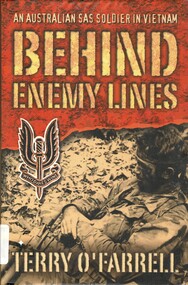
Book, O'Farrell, Terry, Behind Enemy Lines: An Australian SAS Soldier in Vietnam (Copy 1)
... Soldier...Infantry Soldiers...Special Air Service Regiment SAS Soldier Infantry Soldiers Behind Enemy Lines is an honest, personal account of one man's career as an SAS soldier. ...Behind Enemy Lines is an honest, personal account of one man's career as an SAS soldier.Behind Enemy Lines is an honest, personal account of one man's career as an SAS soldier.australia. army. special air service - biography, soldiers - australia - biography, australia. army. special air service regiment, sas soldier, infantry soldiers -
 National Vietnam Veterans Museum (NVVM)
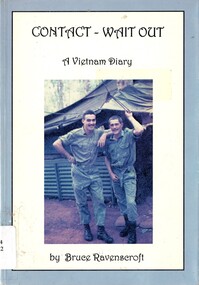
Book, Ravenscroft, Bruce, Contact - Wait Out: a Vietnam Diary
... ...Infantry Soldiers...Vietnam War 1961-1975 - Personal narratives Australian Pte Bruce Ravenscroft Infantry Soldiers Digger 5 Section 5 Platoon Bravo Company 7th Battalion RAR Forward Scout This is the story of an ordinary Digger who served in South Vietnam whose main role was a Forward Scout . ...This is the story of an ordinary Digger who served in South Vietnam whose main role was a Forward Scout .This is the story of an ordinary Digger who served in South Vietnam whose main role was a Forward Scout .vietnam war, 1961-1975 - personal narratives, australian, pte bruce ravenscroft, infantry soldiers, digger, 5 section, 5 platoon, bravo company, 7th battalion, rar, forward scout -
 National Vietnam Veterans Museum (NVVM)
Photograph, Gibbons, Denis, Private Growden
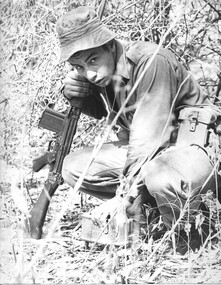
... A black and white photograph of an NZ infantry soldier Pte Growden a member of 4 RAR/NZ sets up a claymore mine ambush....Photograph Pte Growden 4RAR NZ Claymore Mine Gibbons Collection Catalogue Denis Gibbons A black and white photograph of an NZ infantry soldier Pte Growden a member of 4 RAR/NZ sets up a claymore mine ambush. ...Denis Gibbons (1937 – 2011) Trained with the Australian Army, before travelling to Vietnam in January 1966, Denis stayed with the 1st Australian Task Force in Nui Dat working as a photographer. For almost five years Gibbons toured with nine Australian infantry battalions, posting compelling war images from within many combat zones before being flown out in late November 1970 after sustaining injuries. The images held within the National Vietnam Veterans Museum make up the Gibbons Collection. A black and white photograph of an NZ infantry soldier Pte Growden a member of 4 RAR/NZ sets up a claymore mine ambush.photograph, pte growden, 4rar nz, claymore mine, gibbons collection catalogue, denis gibbons -
 National Vietnam Veterans Museum (NVVM)
Poster - Information Board - The Infantry War, The Infantry War
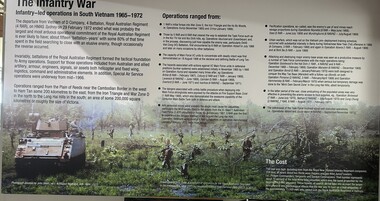
... Text superimposed on colour photo of infantry soldiers on operations with APC. See media file for more information....Text superimposed on colour photo of infantry soldiers on operations with APC. See media file for more information. ...Photo donated by John Smith ex 1 Armoured Regiment SVN, 1969-1970 Drawn from A Duty Done: A summary of operations by the Royal Australian Regiment in the Vietnam War 1965-1972 by Lieutenant Colonel Fred Fairhead (Rtd) (2012) p.487Summary of Infantry Operations 1965-1972. Text superimposed on colour photo of infantry soldiers on operations with APC. See media file for more information.Photo donated by John Smith ex 1 Armoured Regiment SVN, 1969-1970 Drawn from A Duty Done: A summary of operations by the Royal Australian Regiment in the Vietnam War 1965-1972 by Lieutenant Colonel Fred Fairhead (Rtd) (2012) p.487infantry, d company, 4th battalion, the royal australian regiment, 4rar, hmas sydney, cambodian border, ham tan, long hai hills, operations hump, ho bob woods, operation crimp, 5rar, 6rar, nui thi vai, nui dinh mountains, operations vaucluse, operation queanbeyan, d445 battalion (nva/vietcong), operation hobart, battle of long tan, operation bribie, operation coburg, operation lavarack, operation camden, operation overlord, operation ivanhoe, fire support base - coral, 1rar, centurion tank, anti personnel mines, m16 landmines, 1st australian task force, route 44, operation renmark, 8rar, operation hammersley, operations reynella, operation mundingburra, tet offensive, a company, 3rar, operation nowra, binh ba, operation goodwood, hat dich, operation marsden, may tao base, operation bondi, operation pinnaroo, minh dam secret zone, operation birdwood, operation nathan, operation cung chung, 2 rar/nz, 7rar, operation valiant, operation south ward, capt maurice frederick fairhead, lt col maurice frederick fairhead, 57064, royal australian infantry corps, 6th battalion -
 The 5th/6th Battalion Royal Victoria Regiment Historical Collection
Sculpture - Best soldier, C Company Best Soldier Award
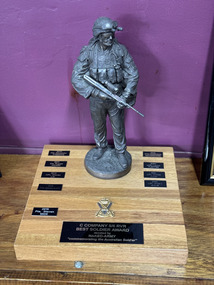
... a statute of a modern Australian Infantry soldier holding a F-88 with NVG, it recorded the best soldier of C Company 5/6 RVR of each year...a statute of a modern Australian Infantry soldier holding a F-88 with NVG, it recorded the best soldier of C Company 5/6 RVR of each year C Company Best Soldier Award Sculpture Best soldier ...a statute of a modern Australian Infantry soldier holding a F-88 with NVG, it recorded the best soldier of C Company 5/6 RVR of each year -
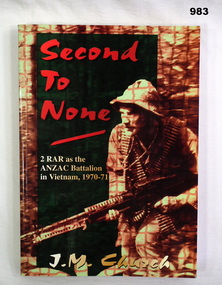 Bendigo Military Museum
Book, Second to None. 2RAR as the ANZAC Batttalion in Vietnam, 70 -71, 1996
... Sepia photograph of an infantry soldier on front. Title in red on a green background. 230 pages with black and white illustrations and cut edges....Sepia photograph of an infantry soldier on front. Title in red on a green background. 230 pages with black and white illustrations and cut edges. ...Book documents the role of 2RAR in Vietnam 1970 - 71. The author J. M. Church was C.O. of 2RAR.Illustrated soft card cover. Sepia photograph of an infantry soldier on front. Title in red on a green background. 230 pages with black and white illustrations and cut edges.Inside on first page: "P. Chapman".books-military-history, vietnam -
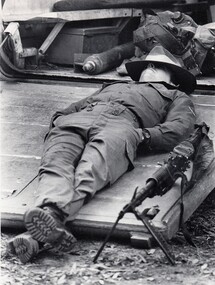 8th/13th Victorian Mounted Rifles Regimental Collection
Photograph
... Black and white photograph of infantry soldier lying on ramp of M113 Armoured Personnel Carrier during Exercise "Fiery Cauldron " , Puckapunyal. ...The training focussed on armoured/infantry cooperation, in particular the use of armoured personnel carriers. " L/Cpl Jef Marsh resting, March 1988 " Black and white photograph of infantry soldier lying on ramp of M113 Armoured Personnel Carrier during Exercise "Fiery Cauldron " , Puckapunyal. ...In the period 5-20 March 1988, ‘A’ Squadron 8th/13th Victorian Mounted Rifles participated in an exercise conducted at Puckapunyal by 4th Infantry Brigade (Reserve) codenamed ‘Fiery Cauldron’. Other units participating included 5th/6th Battalion and 8th/7th Battalion Royal Victorian Regiment, 4th/19th Prince of Wales’s Light Horse Regiment and 1st Armoured Regiment. The training focussed on armoured/infantry cooperation, in particular the use of armoured personnel carriers. Black and white photograph of infantry soldier lying on ramp of M113 Armoured Personnel Carrier during Exercise "Fiery Cauldron " , Puckapunyal. Tube of 81mm mortar on floor of carrier. " L/Cpl Jef Marsh resting, March 1988 " -
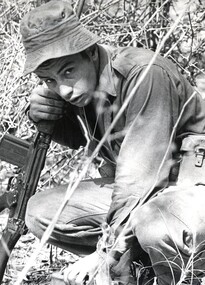 National Vietnam Veterans Museum (NVVM)
Photograph, Gibbons, Denis, Private Growden
... A black and white photograph of a NZ infantry soldier Pte Growden a member of 4 RAR/NZ sets up a claymore mine ambush (note there is now text at the bottom of the photograph....Photograph 4 RAR NZ Pte Growden Claymore Mine Gibbons Collection Catalogue Denis Gibbons A black and white photograph of a NZ infantry soldier Pte Growden a member of 4 RAR/NZ sets up a claymore mine ambush (note there is now text at the bottom of the photograph. ...Denis Gibbons (1937 – 2011) Trained with the Australian Army, before travelling to Vietnam in January 1966, Denis stayed with the 1st Australian Task Force in Nui Dat working as a photographer. For almost five years Gibbons toured with nine Australian infantry battalions, posting compelling war images from within many combat zones before being flown out in late November 1970 after sustaining injuries. The images held within the National Vietnam Veterans Museum make up the Gibbons Collection. A black and white photograph of a NZ infantry soldier Pte Growden a member of 4 RAR/NZ sets up a claymore mine ambush (note there is now text at the bottom of the photograph.photograph, 4 rar nz, pte growden, claymore mine, gibbons collection catalogue, denis gibbons -
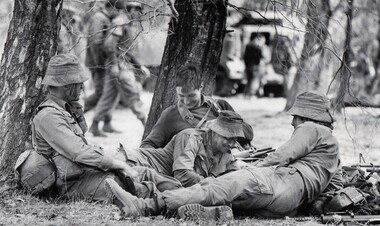 8th/13th Victorian Mounted Rifles Regimental Collection
Photograph
... Black and white photograph of four infantry soldiers resting prior to mounting Armoured personnel Carriers in background during Exercise " Fiery Cauldron " Puckapunyal 5 - 20 March 1988....Black and white photograph of four infantry soldiers resting prior to mounting Armoured personnel Carriers in background during Exercise " Fiery Cauldron " Puckapunyal 5 - 20 March 1988. ...In the period 5-20 March 1988, ‘A’ Squadron 8th/13th Victorian Mounted Rifles participated in an exercise conducted at Puckapunyal by 4th Infantry Brigade (Reserve) codenamed ‘Fiery Cauldron’. Other units participating included 5th/6th Battalion and 8th/7th Battalion Royal Victorian Regiment, 4th/19th Prince of Wales’s Light Horse Regiment and 1st Armoured Regiment. The training focussed on armoured/infantry cooperation, in particular the use of armoured personnel carriers. Black and white photograph of four infantry soldiers resting prior to mounting Armoured personnel Carriers in background during Exercise " Fiery Cauldron " Puckapunyal 5 - 20 March 1988. -
 Australian Army Museum of Western Australia
Photograph
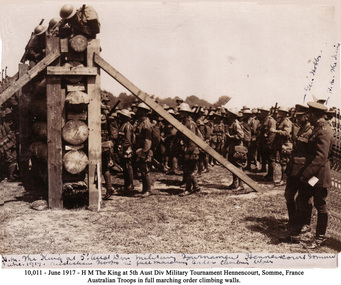
... HM The King at the 5th Division Sports Day, Hennecourt, Somme , France. Infantry soldiers negotiating a palisade in full marching order. ...HM The King at the 5th Division Sports Day, Hennecourt, Somme , France. Infantry soldiers negotiating a palisade in full marching order. ...June 1917. HM The King at the 5th Division Sports Day, Hennecourt, Somme , France. Infantry soldiers negotiating a palisade in full marching order. Digital copy of photograph from a personal album of Lieutenant General JJT Hobbs.hennecourt, somme, 5th division, world war 1 -
 City of Moorabbin Historical Society (Operating the Box Cottage Museum)
Photograph, 1916 William Henry Thomas in WW1 Uniform, 1916 William Henry Thomas in WW1 Uniform, 1916
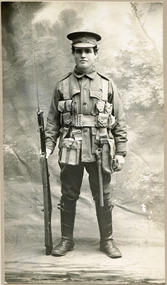
... world war 1 1914- 1918, thomas street,early settlers, pioneers, market gardeners, australian infantry force, soldiers, key's cup, victorian war memorials, cheltenham, mckinnon,...Private Thomas returned to Australia on the hospital transport Castalia 13 April 1919 and his enlistment was terminated 26 September 1919 Private William Henry Thomas and his family are examples of the patriotism exhibited by the market gardeners, and indeed throughout Australia, during the World War 1 1914-1918. william henry thomas 1916 1894 first ww world war one uniform wickham road south brighton moorabbin world war 1 1914- 1918, thomas street,early settlers, pioneers, market gardeners, australian infantry force, soldiers, key's cup, victorian war memorials, cheltenham, mckinnon, keys road moorabbin ss castalia, british expeditionary force ww1 1914- 1918, 24th battalion 1st aif, 6th australian machine gun company 1st aif, influenza epidemic 1919, alexandria egypt, methodist church, Front of Mount : Ainor Studio Auburn Back of Mount : William Henry Thomas / 1st World War 1916 / Keys Rd., Moorabbin / Born 1894 / Christened at Wesleyan ( Methodist ) Church / Wickham Rd., / South Brighton / now Uniting Church unsigned undated Photograph is black and white. ...1916 William Henry Thomas of Keys Road , South Brighton (now Moorabbin ) in WW 1 1914 -1918 1st AIF uniform. William was born in 1894 , Christened at the Wesleyan Church. (Methodist), Wickham Road, South Brighton and attended Moorabbin State School. . Private Thomas was a market gardener in Moorabbin prior to his enlistment in the Australian Imperial Force on 19 July 1915. Both his parents wrote separate letters giving their consent for their son to serve overseas due to " the pressing request of my son William Henry, also the urgent need of recruits do give my consent that he shall go to the front." September 29th 1915 he left Australia with the 5th Reinforcements of the 24th Battalion for Egypt. March 1916 he was hospitalised with Mumps and shortly after left Alexandria to join the British Expeditionary Force for France where he transferred to the 6th Australian Machine Gun Company.. Whilst on leave in England he received medical attention before returning to France and 13 November 1918 he spent a week in the care of the 7rh Field Ambulance suffering with influenza . Private Thomas returned to Australia on the hospital transport Castalia 13 April 1919 and his enlistment was terminated 26 September 1919Private William Henry Thomas and his family are examples of the patriotism exhibited by the market gardeners, and indeed throughout Australia, during the World War 1 1914-1918. Photograph is black and white. William Henry Thomas is standing straight and tall in the centre of the photograph, looking directly at the photographer while holding a weapon in his right hand. He is in his military uniform (WW1) .Front of Mount : Ainor Studio Auburn Back of Mount : William Henry Thomas / 1st World War 1916 / Keys Rd., Moorabbin / Born 1894 / Christened at Wesleyan ( Methodist ) Church / Wickham Rd., / South Brighton / now Uniting Church unsigned undatedwilliam henry thomas, 1916, 1894, first ww, world war one, uniform, wickham road, south brighton, moorabbin, world war 1 1914- 1918, thomas street,early settlers, pioneers, market gardeners, australian infantry force, soldiers, key's cup, victorian war memorials, cheltenham, mckinnon,, keys road moorabbin, ss castalia, british expeditionary force ww1 1914- 1918, 24th battalion 1st aif, 6th australian machine gun company 1st aif, influenza epidemic 1919, alexandria egypt, methodist church, -
 National Vietnam Veterans Museum (NVVM)
Photograph, Gibbons, Denis, Ap Sui Nge Refugee Village
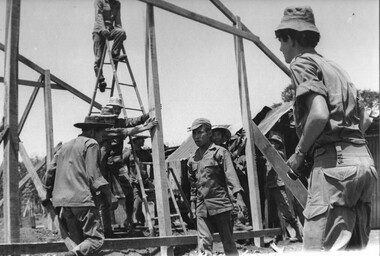
... A black and white photograph of Pte Mike Coyle an infantry soldier with the 1st Australian Civil Affairs Unit (1ACA) supervises Ap Sui Nge villagers in the construction of their homes. ...Photograph 1st Australian Civil Affairs Unit 1st ATF Base Ap Sui Nge Village Pte Mike Coyle Gibbons Collection Catalogue Refugee Village 1 ACA Denis Gibbons A black and white photograph of Pte Mike Coyle an infantry soldier with the 1st Australian Civil Affairs Unit (1ACA) supervises Ap Sui Nge villagers in the construction of their homes. ...Denis Gibbons (1937 – 2011) Trained with the Australian Army, before travelling to Vietnam in January 1966, Denis stayed with the 1st Australian Task Force in Nui Dat working as a photographer. For almost five years Gibbons toured with nine Australian infantry battalions, posting compelling war images from within many combat zones before being flown out in late November 1970 after sustaining injuries. The images held within the National Vietnam Veterans Museum make up the Gibbons Collection. A black and white photograph of Pte Mike Coyle an infantry soldier with the 1st Australian Civil Affairs Unit (1ACA) supervises Ap Sui Nge villagers in the construction of their homes. The village was designed and implimented by 1ACA to house refugees from North Vietnamphotograph, 1st australian civil affairs unit, 1st atf base, ap sui nge village, pte mike coyle, gibbons collection catalogue, refugee village, 1 aca, denis gibbons -
 Stawell Historical Society Inc
Photograph, 18th 16th Infantry Reinforcements
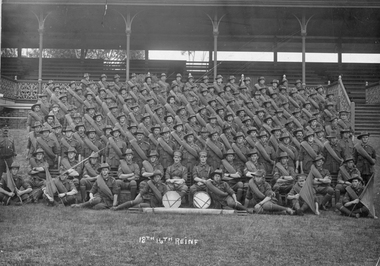
... WW1 Infantry soldiers. Eight rows plus one row sitting down. ...WW1 Infantry soldiers. Eight rows plus one row sitting down. ...WW1 Infantry soldiers. Eight rows plus one row sitting down. Stand in the background. Drums in the foreground, 1914-1918Probably Rathgeber or Giles. White pen on front of photo 18th 16th Reinforcementsww1, military, uniform -
 Diamond Valley Vietnam Veterans Sub-Branch
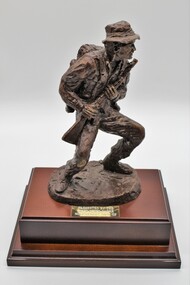
Sculpture - Infantryman, c2002
... infantry...vietnam...soldier...Depiction of Australian Infantry soldier, Vietnam - typical of the soldier of the day. ...Depiction of Australian Infantry soldier, Vietnam - typical of the soldier of the day. ...Depiction of Australian Infantry soldier, Vietnam - typical of the soldier of the day. Statuette presented to the DViet in 2002 by Padre Noel Boyce in appreciation of his DViet connection.This item is significant in respect that, distinct from a 2D picture, it is a 3D depiction of how the vast number of Australian infantry soldiers appeared in the field, in Vietnam - infantry was the major component of the Australian Defence Force in Vietnam.Statuette, Moulded. Infantryman, in action pose; brown in colour. On a step-up wood base.Presented by the first DViet Padre, Noel Boyce, November 2002infantry, vietnam, soldier, figurine, vietnam war, diamond valley vietnam veterans sub branch -
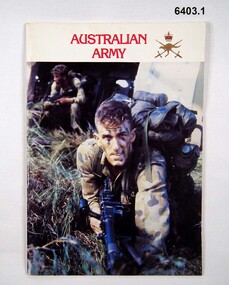 Bendigo Military Museum
Booklet - Australian Army 2007, Defence Public Relations, 22 Jan 2007
... Gloss paper with coloured printed images and supporting text, stapled in the centre. 6403.1 is the front cover has a photo of an infantry soldier in battle camouflage DCPU and pack with a machine gun. 6403.2 is an extract of page 17 describing RASVY showing Cpl Grant Mcguinness (RASVY) with a theodolite and tripod....Gloss paper with coloured printed images and supporting text, stapled in the centre. 6403.1 is the front cover has a photo of an infantry soldier in battle camouflage DCPU and pack with a machine gun. 6403.2 is an extract of page 17 describing RASVY showing Cpl Grant Mcguinness (RASVY) with a theodolite and tripod. ...An A5 Booklet containing information on the Australian Army as at 2007 produced by Defence Public Relations. The first section describes "Defence Policy" and the organisations of the Army. This is followed by descriptions of the various Corps with the Australian Army including the Royal Australian Survey Corps. 6403.2 shows Cpl Grant Mcguinness (RASVY) with a theodolite and tripod.An A5 sized booklet of 20 pages plus light cardboard covers. Gloss paper with coloured printed images and supporting text, stapled in the centre. 6403.1 is the front cover has a photo of an infantry soldier in battle camouflage DCPU and pack with a machine gun. 6403.2 is an extract of page 17 describing RASVY showing Cpl Grant Mcguinness (RASVY) with a theodolite and tripod.royal australian survey corps, rasvy, fortuna, army survey regiment, army svy regt, asr -
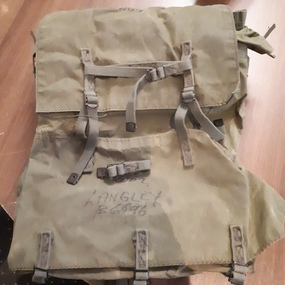 Diamond Valley Vietnam Veterans Sub-Branch
Equipment - Webbing, 22/2/2009
... The back pack and webbing was the infantry soldiers 'house on feet'; whilst on patrol, he carried all that was required for days/weeks at a time with some re-supplies during the course of time sometimes; it was common practice to slide into the backpack whilst prone on the ground and then slowly turn and rise to standing as the most convenient of loading up....The back pack and webbing was the infantry soldiers 'house on feet'; whilst on patrol, he carried all that was required for days/weeks at a time with some re-supplies during the course of time sometimes; it was common practice to slide into the backpack whilst prone on the ground and then slowly turn and rise to standing as the most convenient of loading up. ...The back pack and webbing was the infantry soldiers 'house on feet'; whilst on patrol, he carried all that was required for days/weeks at a time with some re-supplies during the course of time sometimes; it was common practice to slide into the backpack whilst prone on the ground and then slowly turn and rise to standing as the most convenient of loading up.Despite the effort required to patrol long distances with a heavy load, many soldiers had a close affinity with the backpack and webbing as it provided him with comefort and necessities during an Operation.Standard issue of infantry back pack and webbing kit for carrying of day-to-day needs whist on patrol or other duties. Contents included, but not limited to (and In no particular order): food, clothing, cooking utensils, water, spare ammunition, arms, maintenance tools, hootchie/mosquito net, personal items, machete; six pieces in total.Pic 01: Backpack Front Pic 02: Backpack Rear Pic 03: Belt with full compliments: ammunition pouch x 2, water bottle x 2, bumpack x 1 Pic 04: Bumpack in isolationvietnam, vietnam war, diamond valley vietnam veterans sub branch, equipment -
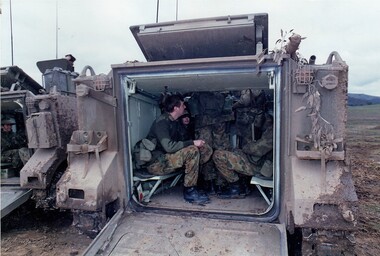 8th/13th Victorian Mounted Rifles Regimental Collection
Photograph - Hamel Wood
... Training exercise codename "Hamel Wood" was conducted at Puckapunyal to teach infantry and armoured soldiers techniques for cooperative action....Training exercise codename "Hamel Wood" was conducted at Puckapunyal to teach infantry and armoured soldiers techniques for cooperative action. military - vmr apc puckapunyal exercise Infantry on board an M113 APC of VMR Squadron 4/19 Prince of Wales Light Horse during Exercise " Hamel Wood ", Puckapunyal 24 August - 8 Sept. 1991. ...Training exercise codename "Hamel Wood" was conducted at Puckapunyal to teach infantry and armoured soldiers techniques for cooperative action.Infantry on board an M113 APC of VMR Squadron 4/19 Prince of Wales Light Horse during Exercise " Hamel Wood ", Puckapunyal 24 August - 8 Sept. 1991.military -, vmr, apc, puckapunyal, exercise -
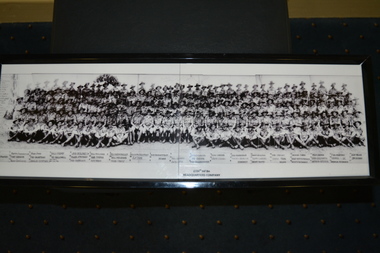 Wangaratta RSL Sub Branch
Photograph - Framed Photograph, 2/24 Battalion, c1940
... Group photograph of the 2/24 Infantry Battalion Headquarters Company soldiers who served during WW2...Group photograph of the 2/24 Infantry Battalion Headquarters Company soldiers who served during WW2 The Battalion was raised in Wangaratta in June 1940 and known as Wangaratta's Own. 2/24 battalion WW2 Wangaratta's Own 2/24th Inf Bn Headquarters Company Black plastic frame containing reproduced black and white photograph of soldiers formed in five rows. ...Group photograph of the 2/24 Infantry Battalion Headquarters Company soldiers who served during WW2The Battalion was raised in Wangaratta in June 1940 and known as Wangaratta's Own.Black plastic frame containing reproduced black and white photograph of soldiers formed in five rows. Soldiers are numbered with most names listed top left and below.2/24th Inf Bn Headquarters Company2/24 battalion, ww2, wangaratta's own -
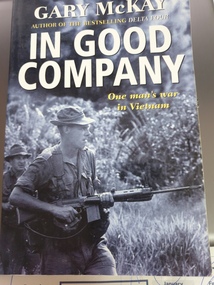 Clayton RSL Sub Branch
soft cover non-fiction book, In Good Company, 1987
... .' - Mark Thomas, Canberra Times 'An enthralling, accurate account of infantry soldiering in the Vietnam era. Very readable; a must for those who have never experienced combat and a vivid reminder for all veterans.' - Major General M. ....' - Mark Thomas, Canberra Times 'An enthralling, accurate account of infantry soldiering in the Vietnam era. Very readable; a must for those who have never experienced combat and a vivid reminder for all veterans.' - Major General M. ...Vietnam War veteran An enthralling account of an Australian infantryman and his companions in the Vietnam War. On Friday 8th March 1968, 20-year-old Gary McKay lost the lottery. He was conscripted. From a comfortable and carefree life of surfing and rugby football, he was drafted into the deadly serious preparation for war in the jungles of South Vietnam. In Good Company is his story told in his own words. It begins with induction and selection for the officer academy for national servicemen at Scheyville, a six-month 'pressure cooker' course which produced second lieutenants ready to lead troops into action against the Viet Cong. It ends three and a half years later with a burst of NVA machine-gun fire during a battle among enemy-held bunkers in the hills of Nui Le. Here is a grass-roots account of the blood, sweat and tears shared by a rifle platoon in jungle warfare, a straightforward story of the fears and the camaraderie which soldiers experience in combat. Gary McKay fashioned this account from his experience in action, leading his platoon. The detail is provided from the 80 letters he wrote to his wife while he served. He wrote his story for the reader who wants to know what the soldier on the ground went through - in the fetid jungle, in battle. Anyone who wants to understand what service in South Vietnam meant to those who were there should read this book. 'Reading In Good Company leaves a vivid and disconcerting impression of how the Vietnam War smelt, felt and sounded. One of the most honest and affecting war memoirs which Australians have so far published.' - Mark Thomas, Canberra Times 'An enthralling, accurate account of infantry soldiering in the Vietnam era. Very readable; a must for those who have never experienced combat and a vivid reminder for all veterans.' - Major General M. P. Blake, AM, MC, former CO 5th Battalion RARGary John McKay MC (born 1947) is a writer and former Australian Army officer. He was awarded the Military Cross while serving with the 4th Battalion, Royal Australian Regiment during the Vietnam War.[1] He later served as Commanding Officer of 8th/9th Battalion, Royal Australian Regiment between 1988 and 1990Soft cover non fiction book -
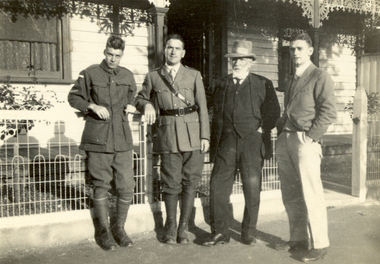 Federation University Historical Collection
Frank and William Wright and friends, early 1930s
... The left hand man is dressed in a soldier's uniform, the middle, left hand man is dressed in the 71st Infantry Band uniform, the man to his right is an older man with a beard and dressed in a dark suit and the fouth man is dressed in a jacket and light trousers. ...The Frank Wright Medal at the Royal South Street competition is awarded to an individual recognized as making an outstanding contribution to brass music in Australia. frank wright william wright 71st infantry band Black and white photograph of four men standing beside the fence of a weatherboard and lacework house. The left hand man is dressed in a soldier's uniform, the middle, left hand man is dressed in the 71st Infantry Band uniform, the man to his right is an older man with a beard and dressed in a dark suit and the fouth man is dressed in a jacket and light trousers. ...Frank Wright was a renown resident of Smeaton, where he was born on 2 August 1901. He lived at Laura Villa, and attended Smeaton State School. His father William was a gold miner and his mother's name was Sarah. Their family won many singing and instrumental awards. Frank was tutored by Percy Code and was awarded a gold medal for the highest marks in the ALCM examinations in the British Colonies at the age of seventeen years. He became the Australian Open Cornet Champion by the age of eighteen. A year later, Frank conducted the City of Ballarat Band, and later the Ballarat Soldiers’ Memorial Band. He formed the Frank Wright Frisco Band and Frank Wright and his Coliseum Orchestra. These bands won many South Street awards, and Frank as conductor won many awards in the Australian Band Championship contest. In 1933 Frank Wright sailed to England to conduct the famous St Hilda’s Band and was later appointed Musical Director of the London County Council, where he organized many amazing concerts in parks, in and around the London district. He was made Professor of Brass and Military Band Scoring and conducted at the Guildhall of Music and Drama. Frank was often invited to adjudicate Brass Band Championships around Europe, in Australia, including South Street and in New Zealand. The Frank Wright Medal at the Royal South Street competition is awarded to an individual recognized as making an outstanding contribution to brass music in Australia.Black and white photograph of four men standing beside the fence of a weatherboard and lacework house. The left hand man is dressed in a soldier's uniform, the middle, left hand man is dressed in the 71st Infantry Band uniform, the man to his right is an older man with a beard and dressed in a dark suit and the fouth man is dressed in a jacket and light trousers. The middle, left hand man is Frank Wright and the man to his right is his father William Wright.frank wright, william wright, 71st infantry band -
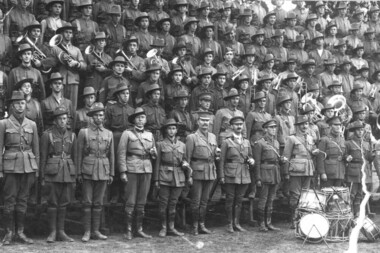 Federation University Historical Collection
Photos, 71st Infantry Band Broadmeadows Camp
... In the years between its formation and the outbreak of War in 1914, the battalion went through a series of name changes as follows: Victorian Colonial Defence Force: 1858 – Ballarat Volunteer Rifle Regiment 1860 – Ballarat Volunteer Rifle Rangers 1863 – Ballarat Volunteer Rangers 1884 – 3rd Battalion, Victorian Rifles 1892 – 1st Battalion, 3rd Victorian Regiment 1898 – 3rd Battalion, Victorian Infantry Brigade Under the new Federal Government: 1901 – 3rd Battalion, Infantry Brigade Australian Army: 1903 – 7th Australian Infantry Regiment 1908 – 1st Battalion, 7th Australian Infantry Regiment 1912 – 70th Infantry (Ballarat East, Geelong and Queenscliff) 1912 – 71st Infantry (Ballarat West, Warrnambool) 1914 – 70th Infantry (Ballarat Regiment) - in Ballarat East 1914 – 71st (City of Ballarat) Infantry – in Ballarat West 71st infantry band broadmeadows camp percy code code frank wright brass band percy shackles shackles 71st Infantry Band (Percy Code Bandmaster) Broadmeadows Camp 1917 .1 Large group photo of members of the band .2 Photograph of part of the band The soldier in the front holding the conductor's batton is Percy Code. ...71st Infantry Band based at the Broadmeadows Camp 1917. Percy Code write a piece of music called the 71st Infantry Quick March. (http://trove.nla.gov.au/work/31795246?selectedversion=NBD11485892) The Ballarat phase of the battalion's history was formed as the Ballarat Volunteer Rifle Regiment on 9 August 1858 as a result of the Crimean War, coupled with the withdrawal of the British Army in 1857. In the years between its formation and the outbreak of War in 1914, the battalion went through a series of name changes as follows: Victorian Colonial Defence Force: 1858 – Ballarat Volunteer Rifle Regiment 1860 – Ballarat Volunteer Rifle Rangers 1863 – Ballarat Volunteer Rangers 1884 – 3rd Battalion, Victorian Rifles 1892 – 1st Battalion, 3rd Victorian Regiment 1898 – 3rd Battalion, Victorian Infantry Brigade Under the new Federal Government: 1901 – 3rd Battalion, Infantry Brigade Australian Army: 1903 – 7th Australian Infantry Regiment 1908 – 1st Battalion, 7th Australian Infantry Regiment 1912 – 70th Infantry (Ballarat East, Geelong and Queenscliff) 1912 – 71st Infantry (Ballarat West, Warrnambool) 1914 – 70th Infantry (Ballarat Regiment) - in Ballarat East 1914 – 71st (City of Ballarat) Infantry – in Ballarat West.1 Large group photo of members of the band .2 Photograph of part of the band The soldier in the front holding the conductor's batton is Percy Code. The trombone player next to Percy Code is Jack Shackles. 71st Infantry Band (Percy Code Bandmaster) Broadmeadows Camp 191771st infantry band, broadmeadows camp, percy code, code, frank wright, brass band, percy shackles, shackles -
 Frankston RSL Sub Branch
Photograph
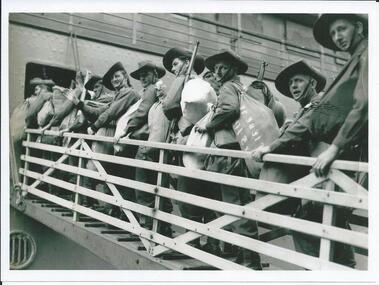
... The men are infantry embarking for an overseas posting. Nine soldiers, looking back over their shoulder, are depicted as they make their way up a gangway to a ship. ...The men are infantry embarking for an overseas posting. Nine soldiers, looking back over their shoulder, are depicted as they make their way up a gangway to a ship. ...Photograph of Australian Army World War 2 servicemen boarding a ship with weapons and full kit. The men are infantry embarking for an overseas posting. Nine soldiers, looking back over their shoulder, are depicted as they make their way up a gangway to a ship. One soldier can be identified with his name and part of his service number prominently displayed on his kitbag. The soldier is James Ellis Liebe, service number VX21644. This photograph appeared in the Melbourne Sun newspaper of the time and a copy of the photograph was obtained by his family. This photograph is a modern reproduction.Liebe J E VX21644 -
 Federation University Historical Collection
Document - Document - Correspondence, ZILLES COLLECTION: Letter paper and cards - Defence Forces, Portsea and Queenscliff
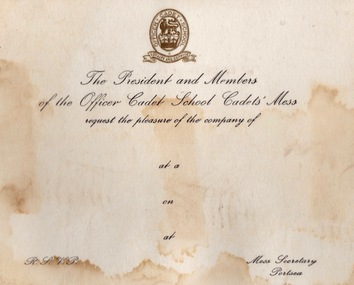
... infantry. It was a Coastal Defence Installation from 1883-1946. The base on Swan Island was part of this and soldiers from the Fort would go on detail to the Island each day. ...infantry. It was a Coastal Defence Installation from 1883-1946. The base on Swan Island was part of this and soldiers from the Fort would go on detail to the Island each day. ...Zilles Printers was begun by Lewis Zilles in the early 1930s. It was in McKenzie Street Ballarat. His son Jeffrey also became a printer - letterpress, offset and screen printer. The business became Zilles Printers/Graphics and was in Armstrong Street and later Bell Street Ballarat. Items are work done for the Australian Defence Force bases at Portsea and Queenscliff. They were training bases - Officer Cadet School and Australian Staff College. Originally the base at Portsea was the Quarantine Station established in the late 1800s. International protocols required captains of arriving ships to provide a clean bill of health from the last port of call. If this was not possible all on board would be transferred to the Quarantine Station by boat for observations. This was to stop the spread of diseases such as cholera, small pox, typhoid fever, influenza and the plague. In 1952 it became a military training base - Officer Cadet School. The quarantine station still operated and the Army had to be prepared to evacuated in an emergency. This occurred in 1954 when 113 passengers on board the Strathaird were quarantined with smallpox. Cadets and staff came with their families and was a small township. Training for the Vietnam War was here, Now gone the remnants of the quarantine station and army activites can be seen. Under Point Nepean Community Trust. Fort Queenscliff dates from 1860 when it was an open battery known as Shortlands Bluff. The Garrison included volunteer artillery, engineers and infantry. It was a Coastal Defence Installation from 1883-1946. The base on Swan Island was part of this and soldiers from the Fort would go on detail to the Island each day. A permanent group with their families were housed there. The children would attend the local school in Queenscliff. It eventually became and still is a restricted area. In 1946 the Fort became home of the Army Command and Staff College. Officers came from overseas to train. Families would come with them and be accommodated in the main officers residence "Maytone" or private housing rented by the Army. Their children would attend local schools. Staff Colleges were all moved to Canberra. The Fort is now the Army Soldiers Career Management Agency and houses all historical documents related to the Army. .1 Off-white card with gold badge and black writing. .2 White card with separate page held together with blue and red ribbon. Badge in gold on front. Two Officer Cadet School flags - crossed and Christmas Greeting in blue inside card. .3 Off-white paper with Australian Staff College emblem. Blue print.2 Officer Cadet School emblem - lion and crown in centre. Flags - British and Australian .3 Emblem - crossed swords, owl and crownzilles printers, australian defence force, quarantine station portsea, officer cadet school, fort queenscliff, open battery, swan island, staff college, army command, zilles collection
