
Showing 331 items matching "inside classes"
-
 University of Melbourne, Burnley Campus Archives
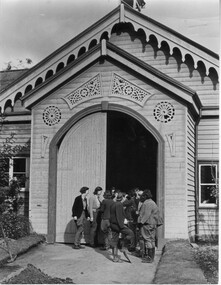
Photograph - Black and white print, Steven Henty, Students Outside Entrance to Pavilion, 1940-1941
... ...inside classes...Pixie Scott" (1941). students pavilion j.m. pixie scott 1941 inside classes Black and white photograph. A group of mostly female students crowded around the entrance to the Pavilion Students Outside Entrance to Pavilion Photograph Black and white print Steven Henty ...Note by T.H. Kneen and E.B. Littlejohn 04.03.1992, who believe it was probably taken c.1940-1941. "Student with foot on spade could be (J.M.) Pixie Scott" (1941).Black and white photograph. A group of mostly female students crowded around the entrance to the Pavilionstudents, pavilion, j.m. pixie scott, 1941, inside classes -
 University of Melbourne, Burnley Campus Archives
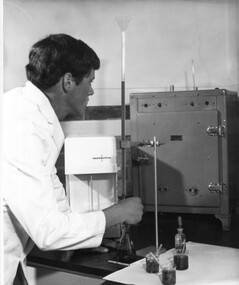
Photograph - Black and white print, Information Branch, Victorian Department of Agriculture, Student Using Laboratory Equipment, 1967-1968
... ...inside classes...Kneen 18 December 1991, "Student Adrian Wells 1968." students adrian wells 1968 laboratory equipment inside classes On reverse stamp, "Photograph by Information Branch Victoria Department Of Agriculture Ref. ...Note by T.H. Kneen 18 December 1991, "Student Adrian Wells 1968."Black and white photograph. Student using laboratory equipmentOn reverse stamp, "Photograph by Information Branch Victoria Department Of Agriculture Ref. No. D1100.A.students, adrian wells, 1968, laboratory equipment, inside classes -
 Torquay and District Historical Society
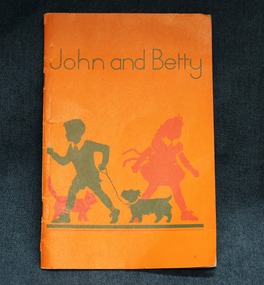
Book - School reader, Howden, Marjorie, John and Betty: the earliest reader for the little ones, 1951
... Business card pasted on inside front cover "Class Act"...Business card pasted on inside front cover "Class Act" School reader, orange paperback cover, 24 pages John and Betty: the earliest reader for the little ones Book School reader Howden, Marjorie Education Department of Victoria ...This reader was used at Torquay Primary School, State School Number 3368. It is from a series of official Prep readers used in Victorian schools from 1951 to mid 1960s.School reader, orange paperback cover, 24 pagesfictionThis reader was used at Torquay Primary School, State School Number 3368. It is from a series of official Prep readers used in Victorian schools from 1951 to mid 1960s.education -
 University of Melbourne, Burnley Campus Archives
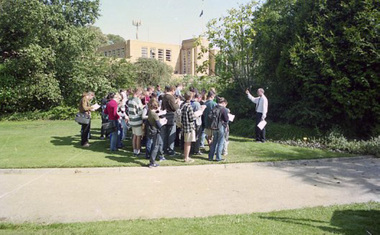
Album - Colour negatives, Stuart Miller, Miscellaneous, c. 1999
... ...students inside class...Students working in the Orchard, 13,19,20 Students in the Nursery, 14-16 James Hitchmough Grasslands, 21,24,25 Students inside class, 23. Garden view, 26. John Delpratt and his Grassland Project, 27-30. ...Students working in the Orchard, 13,19,20 Students in the Nursery, 14-16 James Hitchmough Grasslands, 21,24,25 Students inside class, 23. Garden view, 26. John Delpratt and his Grassland Project, 27-30. ...Collection of negatives with instructions for developing. Probably belonged to Stuart Miller (Staff). Some scanned. 1-4,17,18,22,31 Student outside class, 5-8 Oak Lawn, 9-11. Students working in the Orchard, 13,19,20 Students in the Nursery, 14-16 James Hitchmough Grasslands, 21,24,25 Students inside class, 23. Garden view, 26. John Delpratt and his Grassland Project, 27-30. Administration Building, Order list attached dated 08.04.99stuart miller, staff, john delpratt, grassland project, students inside class, laboratory, landscape design, nursery, potting in nursery, trees in suburbs, students outside class, herb garden, administration building, plants -
 Bendigo Military Museum
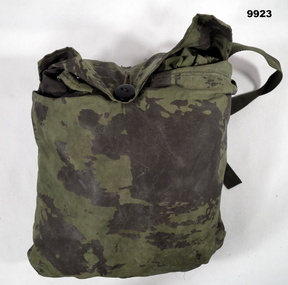
Equipment - RAINCOAT, CAMOUFLAGED, 1967
... Inside marked "M-Class 8415 66-021-5442". with place for Army No. and name....John Young Collection Equipment Raincoat for Tropics Inside marked "M-Class 8415 66-021-5442". with place for Army No. and name. ...Water proof raincoat issued to all soldiers in pouch. Part of the collection of "John Young". Refer Cat No. 1181.3 for service details.Black and green camouflage, water proof raincoat jammed into a small similar colour bag. Bag is actually attached to coat and coat is then able to be folded and squashed into the pocket and buttoned up.Inside marked "M-Class 8415 66-021-5442". with place for Army No. and name.john young collection, equipment, raincoat for tropics -
 Melbourne Tram Museum
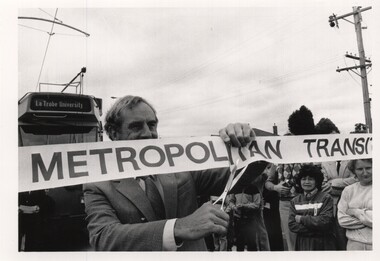
Photograph - Black & White Photograph/s, 10/01/1985 12:00:00 AM
... Has John cutting the ribbon and sitting inside a class tram. Photographer unknown See Reg Item 298 for another photo....Has John cutting the ribbon and sitting inside a class tram. Photographer unknown See Reg Item 298 for another photo. ...Set of 6 Black and white photographs of John Cain opening the Bundoora Tramway on 10/1/1985. Has John cutting the ribbon and sitting inside a class tram. Photographer unknown See Reg Item 298 for another photo.trams, tramways, opening, la trobe university, bundoora -
 Federation University Historical Collection
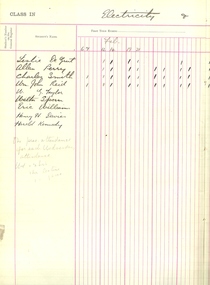
Register, Ballarat School of Mines Register of Attendance in the Subject of Electricity and Magnetism I, 1912, 1912
... Hard covered school register with charcoal green tape spine. Inside is a handwritten class and attendance list....He later went on to teach the subject himself henry sutton john m sutherland john mckenzie sutherland leslie de grut allan perry charles smith urn reid urn john reid w g taylor walter sporn eric williams henry davies henry h davies harold kennedy Hard covered school register with charcoal green tape spine. Inside is a handwritten class and attendance list. Ballarat School of Mines Register of Attendance in the Subject of Electricity and Magnetism I, 1912 Register Education Department Victoria John M. ...John McKenzie Sutherland was taught Electricity and Magnetism at the Ballarat School of Mines. He later went on to teach the subject himselfHard covered school register with charcoal green tape spine. Inside is a handwritten class and attendance list.henry sutton, john m sutherland, john mckenzie sutherland, leslie de grut, allan perry, charles smith, urn reid, urn john reid, w g taylor, walter sporn, eric williams, henry davies, henry h davies, harold kennedy -
 Glenelg Shire Council Cultural Collection
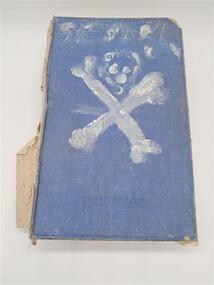
Book, Manuel of Seamanship 1937, 1944
... Front Cover: white skull and cross bones (painted on) / Admiralty / Inside cover: W.BARRY. CLASS 30 MESS EG (handwritten)/ W.M. ...Includes how to put on a life jacket etc Front Cover: white skull and cross bones (painted on) / Admiralty / Inside cover: W.BARRY. CLASS 30 MESS EG (handwritten)/ W.M. ...Handbook for a seaman. Contains information about marine and sailing. Includes how to put on a life jacket etcBlue hardbacked book. The spine is missing. Front cover title is barely visible but a skull and crossbones has been painted over it. Across the pages on the fore edge is handwritten W BARRY 30. non-fictionHandbook for a seaman. Contains information about marine and sailing. Includes how to put on a life jacket etcmaritime, sailing, seamanship -
 Ballarat Tramway Museum
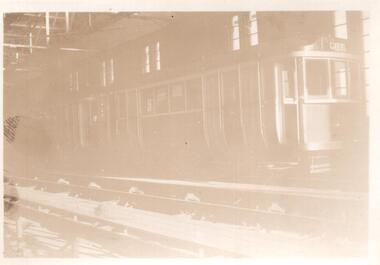
Photograph - MMTB K or Q class car in a depot, Wal Jack
... Black & white photograph - poorly exposed of either an MMTB 'K' or 'Q' class tram inside a depot. On rear in top LH corner is number '290/' and stamped in blue ink is 'Taylors super snaps, Ballarat' (within a box), on Velox photographic paper. ...Black & white photograph - poorly exposed of either an MMTB 'K' or 'Q' class tram inside a depot. On rear in top LH corner is number '290/' and stamped in blue ink is 'Taylors super snaps, Ballarat' (within a box), on Velox photographic paper. ...Black & white photograph - poorly exposed of either an MMTB 'K' or 'Q' class tram inside a depot. On rear in top LH corner is number '290/' and stamped in blue ink is 'Taylors super snaps, Ballarat' (within a box), on Velox photographic paper. Reimaged 17/7/2017 front only.Black and white photograph with a plain back.trams, tramways, mmtb, k or q class tram. -
 Melbourne Tram Museum
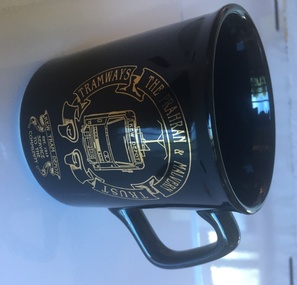
Decorative Object - China Cup, Prime Promotional Products, "Kew Tram Depot Est. 1915 Service to the Community", 1990
... Black China cup with black handle with a line drawing in gold of the outer part of the PMTT logo with an A class tram inside with the destination of Kew Depot. ...Trams tramways Crockery Kew Depot PMTT Anniversary Black China cup with black handle with a line drawing in gold of the outer part of the PMTT logo with an A class tram inside with the destination of Kew Depot. ...Black China cup with black handle with a line drawing in gold of the outer part of the PMTT logo with an A class tram inside with the destination of Kew Depot. Has the manufacturers detail on the base of the cup - "Prime Promotional Products" - cup made in China, designed and decorated in Australia. Made to celebrate the 75th Anniversary of Malvern Depot - 1990.trams, tramways, crockery, kew depot, pmtt, anniversary -
 Melbourne Tram Museum
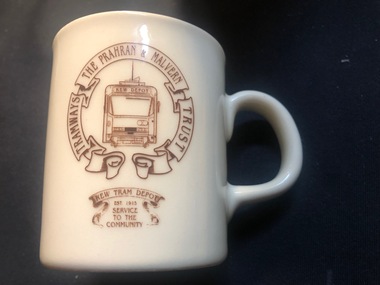
Decorative Object - China Cup, Mt Atken Estates, "Kew Tram Depot 75th Celebrations 1991", 1991
... Cream China cup with cream handle with a line drawing in brown of the outer part of the PMTT logo with an A class tram inside with the destination of Kew Depot. ...Trams tramways Crockery Kew Depot PMTT Anniversary Cream China cup with cream handle with a line drawing in brown of the outer part of the PMTT logo with an A class tram inside with the destination of Kew Depot. ...Cream China cup with cream handle with a line drawing in brown of the outer part of the PMTT logo with an A class tram inside with the destination of Kew Depot. Has a brief history of the Kew Tram depot, its place in Melbourne's public transport and that it is an A Class depot. Has the manufacturers detail on the base of the cup - "National Ceramics Australia 03-5552777" on the base. Made to celebrate the 75th Anniversary of Malvern Depot - 1991.trams, tramways, crockery, kew depot, pmtt, anniversary -
 Ballarat Tramway Museum
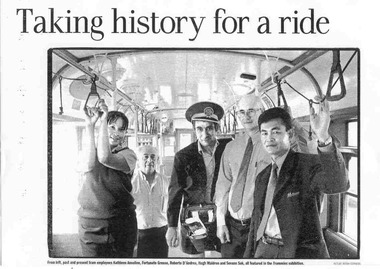
Document - Photocopy, Roberto D'Andrea, "Taking history for a ride", Feb. 2003
... Features a photograph by Penny Stephens of Kathleen Anseline, Fortunato Grosso, Roberto D'Andrea, Hugh Waldron and Sovann Sok inside a W class tram. Article written by Carolyn Webb, noting the exhibition, how it illustrates Melbourne's ethnic melting pot through its trammies. ...Features a photograph by Penny Stephens of Kathleen Anseline, Fortunato Grosso, Roberto D'Andrea, Hugh Waldron and Sovann Sok inside a W class tram. Article written by Carolyn Webb, noting the exhibition, how it illustrates Melbourne's ethnic melting pot through its trammies. ...Photocopy of an article from the Melbourne Age, 19 Feb. 2003, titled "Taking history for a ride" publicity for the 'Trammies' exhibition to opening the following day. Features a photograph by Penny Stephens of Kathleen Anseline, Fortunato Grosso, Roberto D'Andrea, Hugh Waldron and Sovann Sok inside a W class tram. Article written by Carolyn Webb, noting the exhibition, how it illustrates Melbourne's ethnic melting pot through its trammies. Supplementary File contains papers concerning the exhibition and BTM involvement. See also Reg Item 2454 2455, 2457 for other parts of the exhibition. trams, tramways, trammies, exhibitions, immigration museum, connies -
 Melbourne Tram Museum
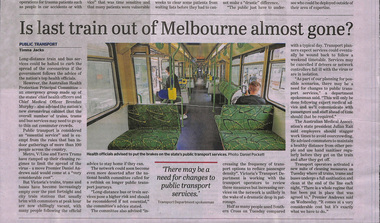
Newspaper, The Age, “Is last train out of Melbourne almost gone?” "Crisis as public transport slumps" "New seating rules on buses and trams", 20/03/2020 12:00:00 AM
... Transport planners expect services to reduce due to lower patronage. Photo of inside a B class tram. 2.- Newspaper clippings titled: “Crisis as public transport slumps” Newspaper clipping from the Age 28/03/2020, by Timna Jacks Public transport usage down by about 90%. ...Transport planners expect services to reduce due to lower patronage. Photo of inside a B class tram. 2.- Newspaper clippings titled: “Crisis as public transport slumps” Newspaper clipping from the Age 28/03/2020, by Timna Jacks Public transport usage down by about 90%. ...1.- Newspaper clippings titled: “Is last train out of Melbourne almost gone?” Newspaper clipping from the Age 20/03/2020, by Timna Jacks Victoria's trains, trams and buses are considered an essential service during the Covid-19 pandemic and are being thoroughly cleaned each night to stop the spread of the virus. Transport planners expect services to reduce due to lower patronage. Photo of inside a B class tram. 2.- Newspaper clippings titled: “Crisis as public transport slumps” Newspaper clipping from the Age 28/03/2020, by Timna Jacks Public transport usage down by about 90%. Leaked figures show number of people using Melbourne's trams down by 88% this week with 81,600 passengers compared with an expected 708,300. Previous week about 285,000 passengers used tram network. Yarra Trams was set to make $164M from fares this year. 3.- Newspaper clippings titled: “New seating rules on buses and trams” Newspaper clipping from the Age 24/03/2020, by Timna Jacks Front row of seats on Melbourne's trams will be out of bounds to commuters and inquiry holes on tram driver cabins will be sealed to protect drivers from coronavirus.trams, tramways, public transport, melbourne, cleaning, virus, yarra trams -
 Flagstaff Hill Maritime Museum and Village
Oar, early 20th century
... inside the hull. A copy of the blueprint plans has the name “V.E.E. Gotch” printed on it. His advertisement in Footscray’s ‘Independent’ newspaper of Saturday 11th May 1901 states he is “Principal and Skilled member (Naval Architect) to the Court of Marine Inquiry of Victoria and holds classes for naval architectural drawing and arithmetic.” ...inside the hull. A copy of the blueprint plans has the name “V.E.E. Gotch” printed on it. His advertisement in Footscray’s ‘Independent’ newspaper of Saturday 11th May 1901 states he is “Principal and Skilled member (Naval Architect) to the Court of Marine Inquiry of Victoria and holds classes for naval architectural drawing and arithmetic.” ...This oar is from the Lifeboat Warrnambool, which is on sit at Flagstaff Hill Maritime Village. The construction of the lifeboat ‘Warrnambool’ began 15th September 1909 and was completed almost 12 months later, 1st September 1910. It was built at the Government Dockyard in Williamstown, Victoria, along the lines designed by the Great Britain’s Royal Lifeboat Institution, and included whaleback decks fore and aft, mast and centreboard, and rudder and tiller hung from the sternpost. It could be propelled by both sail and oar. At that time Captain Ferguson was Chief Harbour Master and Mr Beagley was foreman boat builder. Mr Beagley built the lifeboat with his fellow workmen. The boat was described as “… a fine piece of workmanship and does credit to her builders and designers…” It had all the latest improvements in shape, disposition of weight and watertight compartments, and it had space for a large number of people in addition to the crew. It appears that 'H Meiers' whose signature was on the plaque that was found concealed in the hull, was involved with the building of the lifeboat. His signature and the dates of the start and finish of the boat’s construction are pencilled on the raw timber 'plaque' found in the hull in the early 1990’s when the lifeboat was being restored. It is interesting that the ‘Melbourne Directory’ of 1911, published by Sands and MacDougal, lists McAuley and Meiers, boat builders, Nelson Place foreshore, between Pasco and Parker Streets, Williamstown, (Victorian Heritage Database, ‘Contextual History, Maritime Facilities’), It is quite possibly the business of the person whose name is inscribed on the lifeboat plaque. Flagstaff Hill’s documentation also mentions that the keel was laid at ‘Harry Myers, boat builders, Williamstown, Melbourne’ – the name ‘Myers’ can also be spelled ‘Meiers’, which could be the same person as the Meiers in “McAuley and Meiers” (as mentioned in genealogy lines of Myers). The new lifeboat, to be named ‘Warrnambool’ was brought to town by train and launched at the breakwater on 1st March 1911 using the Titan crane (the old lifeboat built in 1858, was then returned to Melbourne in 1911). This new lifeboat was stationed at Warrnambool in a shed located at the base of the Breakwater, adjacent to the slipway. A winch was used to bring it in and out of the water. The lifeboat ‘Warrnambool’ was similar in size to the old lifeboat but far superior in design, build and sea-going qualities such as greater manoeuvrability. The ‘self-righting, self-draining’ design was “practically non-capsizeable” and even if the boat overturned it would right itself to an even keel and the water would drain away. The hull was built of New Zealand Kauri, using double diagonal planking, laid in two layers at right angles, with a layer of canvas and red lead paint between the timbers to help seal the planking. It has “… plenty of freeboard, high watertight spaces between the deck and bottom… through which pipes lead…” The backbone timbers were made of Jarrah. The lifeboat Warrnambool was one of several rescue boats used at Port Fairy and Warrnambool in early 1900's. In late 1914 the Warrnambool lifeboat and crew were used to help find what was left of the tragic wreckage of the Antares, and were able to discover the body of one of the crewmen, which they brought back to Warrnambool. Between 1951 and 1954 the lifeboat was manned under the guidance of Captain Carrington. He held lifeboat practice each month on a Sunday morning, to comply with the Ports and Harbour’s request that lifeboats be manned by a strong and competent crew, ready for action in case of emergency. In the early 1960’s it ended its service as a lifeboat and was used in Port Fairy as a barge to help dredge the Moyne River, bolted to the Port Fairy lifeboat. Flagstaff Hill obtained the Warrnambool in 1975. In 1984 it was on display at Flagstaff Hill Maritime Village, Warrnambool. On 23rd May 1990 she was lifted from the water and placed in a cradle for restoration. The name ‘WARRNAMBOOL could be seen faintly on the lifeboat before it was restored. It was during the restoration that Flagstaff Hill's boat builder discovered the 'plaque' inside the hull. A copy of the blueprint plans has the name “V.E.E. Gotch” printed on it. His advertisement in Footscray’s ‘Independent’ newspaper of Saturday 11th May 1901 states he is “Principal and Skilled member (Naval Architect) to the Court of Marine Inquiry of Victoria and holds classes for naval architectural drawing and arithmetic.” The oar is significant for its association with the lifeboat WARRNAMBOOL, which is significant for its half century service to the local community as a lifesaving vessel. She was also used to help retrieve the body of a shipwrecked crew member of the ANTARES. Large wooden oar, shaped two handgrip with tapering shaft to large flattened blade, (2) copper reinforcing strips on blade. Sweep oar is from the Lifeboat Warrnambool. flagstaff hill, warrnambool, shipwrecked-coast, flagstaff-hill, flagstaff-hill-maritime-museum, maritime-museum, shipwreck-coast, flagstaff-hill-maritime-village, oar, lifeboat warrnambool, sweep oar -
 Flagstaff Hill Maritime Museum and Village
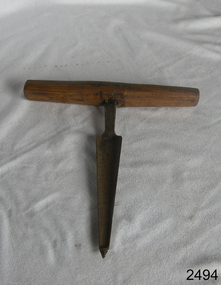
Tool - Bung borer, Prior to 1950
... Bung borer are a class of tools that bore a tapered hole in a wooden barrel, cask or flask, the tool makes a graduated tapered hole called a bung hole. The bung that goes into the hole can be made from wood, rubber or cork to make a tight seal or a tap is used to dispense the liquid inside the barrel. ...Bung borer are a class of tools that bore a tapered hole in a wooden barrel, cask or flask, the tool makes a graduated tapered hole called a bung hole. The bung that goes into the hole can be made from wood, rubber or cork to make a tight seal or a tap is used to dispense the liquid inside the barrel. ...Bung borer are a class of tools that bore a tapered hole in a wooden barrel, cask or flask, the tool makes a graduated tapered hole called a bung hole. The bung that goes into the hole can be made from wood, rubber or cork to make a tight seal or a tap is used to dispense the liquid inside the barrel. Often two holes would be made the first in the middle of the barrel and its highest location when laying on its side, this is use to fill the barrel. The second one, with the barrel now standing up, would be bored on one side of the head, near the rim, opposite the filling bung. That would be the one that would receive a tapered wooden or metal tap for dispensing liquid. There have been many models of bung borer used, the age old pattern is of a simple tapered spoon, later more sophisticated models would appear to do the same job and over the years numerous types of design have been patented.The subject item at this time cannot be associated with an historical event, person or place, provenance is unknown, item assessed as a collection asset as it is believed to have been produced before 1950.Bung borer threaded with wooden handle. Nonewarrnambool, flagstaff-hill, flagstaff-hill-maritime-museum, maritime-museum, shipwreck-coast, flagstaff-hill-maritime-village, barrel bung hole borer, barrels, coopers tools -
 Flagstaff Hill Maritime Museum and Village
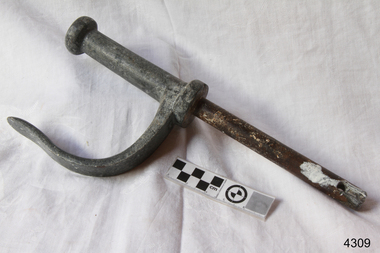
Functional object - Rowlock, early 20th century
... inside the hull. A copy of the blueprint plans has the name “V.E.E. Gotch” printed on it. His advertisement in Footscray’s ‘Independent’ newspaper of Saturday 11th May 1901 states he is “Principal and Skilled member (Naval Architect) to the Court of Marine Inquiry of Victoria and holds classes for naval architectural drawing and arithmetic.” ...inside the hull. A copy of the blueprint plans has the name “V.E.E. Gotch” printed on it. His advertisement in Footscray’s ‘Independent’ newspaper of Saturday 11th May 1901 states he is “Principal and Skilled member (Naval Architect) to the Court of Marine Inquiry of Victoria and holds classes for naval architectural drawing and arithmetic.” ...This row lock was fitted onto the Warrnambool Lifeboat, which is also on-site at Flagstaff Hill Maritime Village. The construction of the lifeboat 'Warrnambool' began 15th September 1909 and was completed almost 12 months later 1st September 1910. It was built at the Government Dockyard in Williamstown, Victoria, along the lines designed by Great Britain's Royal Lifeboat Institution, and included whale back decks fore and aft, mast and centre board, and rudder and tiller hung from the stern post. It could be propelled by both sail and oar. At that time Captain Ferguson was Chief Harbour Master and Mr Beagley was a foreman boat builder. Mr Beagley built the lifeboat with his fellow workmen. It had all the latest improvements in shape, disposition of weight with watertight compartments, and it had space for a large number of people in addition to the crew. It appears that 'H Meiers' whose signature was on the plaque that was found concealed in the hull, was involved with the building of the lifeboat. His signature and the dates of the start and finish of the boat's construction are penciled on the raw timber 'plaque' found in the hull in the early 1990s when the lifeboat was being restored. It is interesting that the 'Melbourne Directory' of 1911, published by Sands and MacDougal, lists McAuley and Meiers, boat builders, Nelson Place foreshore, between Pasco and Parker Streets, Williamstown, It is quite possibly the business of the person whose name is inscribed on the lifeboat plaque. Flagstaff Hill's documentation also mentions that the keel was laid at 'Harry Myers, boat builders, Williamstown, Melbourne the name 'Myers' can also be spelled 'Meiers', which could be the same person as the Meiers in "McAuley and Meiers" (as mentioned in genealogy lines of Myers). The new lifeboat, to be named 'Warrnambool' was brought to town by train and launched at the breakwater on 1st March 1911 using the Titan crane (the old lifeboat built-in 1858, was then returned to Melbourne in 1911). This new lifeboat was stationed at Warrnambool in a shed located at the base of the Breakwater, adjacent to the slipway. The lifeboat ‘Warrnambool’ was similar in size to the old lifeboat but far superior in design, with new sea-going qualities such as greater maneuverability. The ‘self-righting, self-draining’ design was made the vessel difficult to capsize and even if the boat overturned it would right itself to an even keel and the water would drain away. The hull was built of New Zealand Kauri, using double diagonal planking, laid in two layers at right angles, with a layer of canvas and red lead paint between the timbers to help seal the planking. It has plenty of free board. The backbone timbers were made of Jarrah. The Warrnambool lifeboat was one of several rescue boats used at Port Fairy and Warrnambool in the early 1900s. In late 1914 the Warrnambool lifeboat and crew were used to help find what was left of the tragic wreckage of the Antares and were able to discover the body of one of the crewmen. Between 1951 and 1954 the lifeboat was manned under the guidance of Captain Carrington. He held lifeboat practice each month on a Sunday morning, to comply with the Ports and Harbour’s request that lifeboats be ready for action in case of an emergency. In the early 1960’s it ended its service as a lifeboat and was used in Port Fairy as a barge to help dredge the Moyne River. Flagstaff Hill obtained the Warrnambool lifeboat in 1975. In 1984 it was on display at Flagstaff Hill Maritime Village, Warrnambool. On 23rd May 1990, she was lifted from the water and placed in a cradle for restoration. The name 'WARRNAMBOOL could be seen faintly on the lifeboat before it was restored. It was during the restoration that Flagstaff Hill's boat builder discovered the 'plaque' inside the hull. A copy of the blueprint plans has the name “V.E.E. Gotch” printed on it. His advertisement in Footscray’s ‘Independent’ newspaper of Saturday 11th May 1901 states he is “Principal and Skilled member (Naval Architect) to the Court of Marine Inquiry of Victoria and holds classes for naval architectural drawing and arithmetic.” The subject row lock is significant due to its association the Warrnambool Lifeboat which was an integral part of an important service to the local community as a lifesaving vessel for a half-century. One of the lifeboats many achievements was when it was used to help retrieve the body of a shipwrecked crew member of the ship Antares. Rowlock from the Warrnambool Lifeboat.Noneflagstaff hill, warrnambool, shipwrecked-coast, flagstaff-hill, flagstaff-hill-maritime-museum, maritime-museum, shipwreck-coast, flagstaff-hill-maritime-village, lifeboat warrnambool, life boat, life saving vessel, 1910 vessel, port fairy, boat builder plaque, rescue boat, beagley, government dockyard, williamstown, v.e.e. gotch, royal lifeboat institution, captain ferguson, non-capsizeable lifeboat, self-righting lifeboat, antares shipwreck, double diagonal planking, captain carrington, rowlock, lifeboat rowlock -
 Federation University Historical Collection
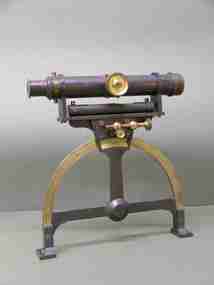
Instrument - Scientific Equipment, Miner's Dial, c1893 - 1901
... classes at the Ballarat School of Mines. Purchased/acquired during Queen Victoria's reign. The 1893 Ballarat School of Mines Calendar states that mine surveying instruments "always at the disposal of the students" including "one miner's dial". ballarat school of mines surveying scientific instruments scientific objects otto boettger optician Miner's Dial On suppliers label: "Instrument maker to the surveying and engineering departments of her Majesty's Government of South Australia" A surveying instrument consisting of theodolite with single crosshair(.1) mountable on a magnetic compass (.2), designed to sit inside a polished wood carry box. ...Used for surveying classes at the Ballarat School of Mines. Purchased/acquired during Queen Victoria's reign. The 1893 Ballarat School of Mines Calendar states that mine surveying instruments "always at the disposal of the students" including "one miner's dial".A surveying instrument consisting of theodolite with single crosshair(.1) mountable on a magnetic compass (.2), designed to sit inside a polished wood carry box. Serial Number 4470On suppliers label: "Instrument maker to the surveying and engineering departments of her Majesty's Government of South Australia"ballarat school of mines, surveying, scientific instruments, scientific objects, otto boettger, optician, miner's dial -
 Federation University Historical Collection
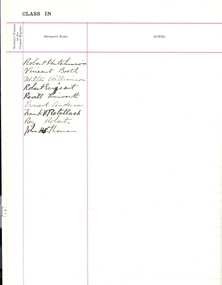
Register, Education Department Victoria, Ballarat School of Mines Register of Attendance in the Subject of Electrical Technology III (Practical Work), 1912, 1912
... Inside the register is a handwritten class and attendance list...Inside the register is a handwritten class and attendance list Ballarat School of Mines Register of Attendance in the Subject of Electrical Technology III (Practical Work), 1912 Register Education Department Victoria John M. ...John McKenzie Sutherland was taught by Henry Sutton in the subject of Electricity and Magnetism at the Ballarat School of Mines. He later lectured in the same subjects.Hard covered book with brown taped spine. Inside the register is a handwritten class and attendance listhenry sutton, ballarat school of mines, john m sutherland, john mckenzie sutherland, vincent booth, robert hutchinson, wilton williamson, robert serjeant, revill tinworth, ernest anderson, frank retallack, reg roberts, john h thomas, john thomas -
 Federation University Historical Collection
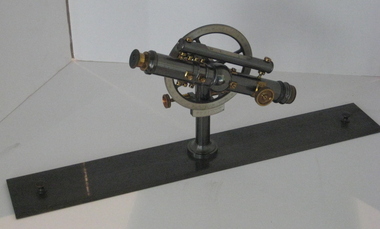
Instrument - Surveyor's Instrument, Boxed Theodolite, c late 1880s
... According to Max Clarke this item was used by the surveying classes at the Ballarat School of Mines ballarat school of mines surveying equipment gurley max clarke theodolite stadia measurement calibration scientific instrument On box in black paint "A 1". Inside ...According to Max Clarke this item was used by the surveying classes at the Ballarat School of MinesA boxed (timber) theodolite with crossbars and full-length stadia wires. The theodolite can be mounted on a metal straightedge base. The box also contains a magnetic compass with two bubble levels, a plumbing folk, and 4 brass paper clips designed to suit a plan table. On box in black paint "A 1". Inside box lid is manufacturer's label and Stadia measurement zero reference calibration.ballarat school of mines, surveying equipment, gurley, max clarke, theodolite, stadia measurement, calibration, scientific instrument -
 Federation University Historical Collection
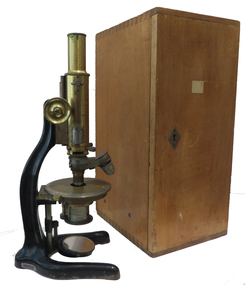
Instrument - Scientific Instrument, Boxed Petrographic Microscope, c1912
... classes. Probably a second generation petrological microscope used at SMB. Earlier reference ; to " Petrological Microscope" is made in SMB 1908 - 9 calendar page 35. Reference to "Mineral Microscopy" found in calendar for 1896, page 47. ballarat school of mines geology petrography microscope scientific objects scientific instruments "E. Leitz Wetzlar No. 139041 Made for Kilpatrick & Co Melbourne" A removable label inside ...Used at the Ballarat School of Mines Petrology classes. Probably a second generation petrological microscope used at SMB. Earlier reference ; to " Petrological Microscope" is made in SMB 1908 - 9 calendar page 35. Reference to "Mineral Microscopy" found in calendar for 1896, page 47. Petrographic Microscope with two-lens objective turret in a timber case. The microscope black enameled frame with brass components. Housed in a polished wood case. Three additional polarizing filters in accessory drawer. "E. Leitz Wetzlar No. 139041 Made for Kilpatrick & Co Melbourne" A removable label inside storage case door, dated "I.II.1912" and stating the obtainable magnification ratios.ballarat school of mines, geology, petrography, microscope, scientific objects, scientific instruments -
 Federation University Historical Collection
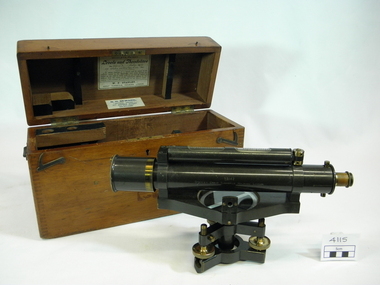
Instrument, W. H. Stanley, Surveying level, July 1899
... Used by students attending surveying classes at the School of Mines & Industries, Ballarat. level theodolite surveying instrument surveying scientific instruments *The timber lid of the carry case has 'L3' painted on it in white paint. *The paper label glued to reverse side lid of inside ...Used by students attending surveying classes at the School of Mines & Industries, Ballarat.Surveyor's level caste in metal with brass trimmings. Features external focus, twin inclined vertical crosshairs with stadia wires. With ray-shade clinomenter. Three levelling screws. Without transverse level (mounting provided). dust shield for object. Features glass lens x 2. Timber carry case features dovetailed joints, separate lid attached to body of case with two brass piano hinges along back side. Case has a metal carry handle screwed to each end. Matches tripod Item 4116 Item's serial number: 99142*The timber lid of the carry case has 'L3' painted on it in white paint. *The paper label glued to reverse side lid of inside carry box reads: STANLEY'S PATENT LEVELS AND THEODOLITES No.99142 July 1899 STADIA POINTS SET=1 : 100. In taking readings of a distant staff by means of the subtense points in the diaphragm, read every 1/100 foot (or metre) on the staff as being equal to one foot (or metre) of distance from the centre of the instrument adding to the reading of plus constant of 18 3/4 inchess from any distance shown. W.F. Stanley, Great Turnstile, Holborn, London. *The paper label glued to lower edge inside lid of carry box reads: N. H. SEWARD, "Optical House" 457 BOURKE STREET (Near Queen Street) MELBOURNE *Engraving on brass plate encompassing the catch on front edge of the timber carry case reads: H&C L (inside an engraved heart on LSH) EUCHRE LEVER (engraved on RHS of brass plate) *Maker's mark is engraved along the length of the telescope barrel: 99142 Stanley. Great Turnstile Holborn, London. level, theodolite, surveying instrument, surveying, scientific instruments -
 Federation University Historical Collection
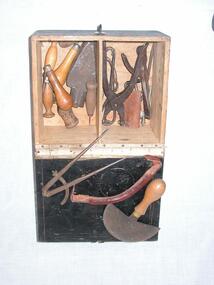
Tool - Leatherwork Toolkit, Leatherwork Toolkit in Timber Box, c1920
... classes held for repatriated soldiers at Ballarat School of Mines. At the Ballarat Technical Art School, during the early twentieth century, leather art was popular but had little industrial value and was usually a minor study. The Victorian Education Department set examinations in art leather work. Copies of many Technical School Examination Papers are kept within the University's historical collection. leather tools box world war one ballarat school of mines shoemaking bootmaking bootmaker leatherwork repatriation Black wooden box with metal latch and handle. Contains assortment of tools, some with timber handles, some metal. Two halves inside ...Thought to have been used in shoemaking classes held for repatriated soldiers at Ballarat School of Mines. At the Ballarat Technical Art School, during the early twentieth century, leather art was popular but had little industrial value and was usually a minor study. The Victorian Education Department set examinations in art leather work. Copies of many Technical School Examination Papers are kept within the University's historical collection.Black wooden box with metal latch and handle. Contains assortment of tools, some with timber handles, some metal. Two halves inside box. Lid is attatched by canvas nailed to bottom. leather, tools, box, world war one, ballarat school of mines, shoemaking, bootmaking, bootmaker, leatherwork, repatriation -
 Flagstaff Hill Maritime Museum and Village
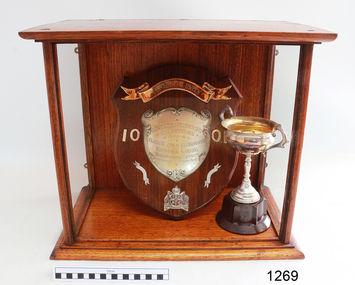
Trophy, 1933-1934
... Contains shield and silver cup with gold colour inside (stand for cup has separated but is still in case). Inscription on shield "Manchester Unity Increased Membership Competition 1933-4 Class D 200 - 300 Members. ...Class D 200 - 300 Members. Victoria Lodge Warrnambool District' Increase 28 - 13.93 per cent" also on each side of shield "IO OF" Trophy in glass case, stained timber top, base and backing with 4 mounting brackets. Contains shield and silver cup with gold colour inside ...Trophy in glass case, stained timber top, base and backing with 4 mounting brackets. Contains shield and silver cup with gold colour inside (stand for cup has separated but is still in case). Inscription on shield "Manchester Unity Increased Membership Competition 1933-4 Class D 200 - 300 Members. Victoria Lodge Warrnambool District' Increase 28 - 13.93 per cent" also on each side of shield "IO OF" (Independent Order of Odd Fellows) Inscription on shield "Manchester Unity Increased Membership Competition 1933-4 Class D 200 - 300 Members. Victoria Lodge Warrnambool District' Increase 28 - 13.93 per cent" also on each side of shield "IO OF"flagstaff hill, warrnambool, shipwrecked-coast, flagstaff-hill, flagstaff-hill-maritime-museum, maritime-museum, shipwreck-coast, flagstaff-hill-maritime-village, trophy, manchester unity increased membership competition 1933, sport -
 Flagstaff Hill Maritime Museum and Village
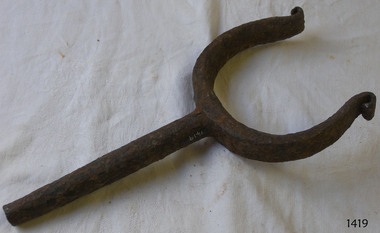
Rowlock, early 20th century
... inside the hull. A copy of the blueprint plans has the name “V.E.E. Gotch” printed on it. His advertisement in Footscray’s ‘Independent’ newspaper of Saturday 11th May 1901 states he is “Principal and Skilled member (Naval Architect) to the Court of Marine Inquiry of Victoria and holds classes for naval architectural drawing and arithmetic.” ...inside the hull. A copy of the blueprint plans has the name “V.E.E. Gotch” printed on it. His advertisement in Footscray’s ‘Independent’ newspaper of Saturday 11th May 1901 states he is “Principal and Skilled member (Naval Architect) to the Court of Marine Inquiry of Victoria and holds classes for naval architectural drawing and arithmetic.” ...Rowlock from the Lifeboat Warrnambool, which is on site at Flagstaff Hill Maritime Village. The construction of the lifeboat ‘Warrnambool’ began 15th September 1909 and was completed almost 12 months later, 1st September 1910. It was built at the Government Dockyard in Williamstown, Victoria, along the lines designed by the Great Britain’s Royal Lifeboat Institution, and included whaleback decks fore and aft, mast and centreboard, and rudder and tiller hung from the sternpost. It could be propelled by both sail and oar. At that time Captain Ferguson was Chief Harbour Master and Mr Beagley was foreman boat builder. Mr Beagley built the lifeboat with his fellow workmen. The boat was described as “… a fine piece of workmanship and does credit to her builders and designers…” It had all the latest improvements in shape, disposition of weight and watertight compartments, and it had space for a large number of people in addition to the crew. It appears that 'H Meiers' whose signature was on the plaque that was found concealed in the hull, was involved with the building of the lifeboat. His signature and the dates of the start and finish of the boat’s construction are pencilled on the raw timber 'plaque' found in the hull in the early 1990’s when the lifeboat was being restored. It is interesting that the ‘Melbourne Directory’ of 1911, published by Sands and MacDougal, lists McAuley and Meiers, boat builders, Nelson Place foreshore, between Pasco and Parker Streets, Williamstown, (Victorian Heritage Database, ‘Contextual History, Maritime Facilities’), It is quite possibly the business of the person whose name is inscribed on the lifeboat plaque. Flagstaff Hill’s documentation also mentions that the keel was laid at ‘Harry Myers, boat builders, Williamstown, Melbourne’ – the name ‘Myers’ can also be spelled ‘Meiers’, which could be the same person as the Meiers in “McAuley and Meiers” (as mentioned in genealogy lines of Myers). The new lifeboat, to be named ‘Warrnambool’ was brought to town by train and launched at the breakwater on 1st March 1911 using the Titan crane (the old lifeboat built in 1858, was then returned to Melbourne in 1911). This new lifeboat was stationed at Warrnambool in a shed located at the base of the Breakwater, adjacent to the slipway. A winch was used to bring it in and out of the water. The lifeboat ‘Warrnambool’ was similar in size to the old lifeboat but far superior in design, build and sea-going qualities such as greater manoeuvrability. The ‘self-righting, self-draining’ design was “practically non-capsizeable” and even if the boat overturned it would right itself to an even keel and the water would drain away. The hull was built of New Zealand Kauri, using double diagonal planking, laid in two layers at right angles, with a layer of canvas and red lead paint between the timbers to help seal the planking. It has “… plenty of freeboard, high watertight spaces between the deck and bottom… through which pipes lead…” The backbone timbers were made of Jarrah. The lifeboat Warrnambool was one of several rescue boats used at Port Fairy and Warrnambool in early 1900's. In late 1914 the Warrnambool lifeboat and crew were used to help find what was left of the tragic wreckage of the Antares, and were able to discover the body of one of the crewmen, which they brought back to Warrnambool. Between 1951 and 1954 the lifeboat was manned under the guidance of Captain Carrington. He held lifeboat practice each month on a Sunday morning, to comply with the Ports and Harbour’s request that lifeboats be manned by a strong and competent crew, ready for action in case of emergency. In the early 1960’s it ended its service as a lifeboat and was used in Port Fairy as a barge to help dredge the Moyne River, bolted to the Port Fairy lifeboat. Flagstaff Hill obtained the Warrnambool in 1975. In 1984 it was on display at Flagstaff Hill Maritime Village, Warrnambool. On 23rd May 1990 she was lifted from the water and placed in a cradle for restoration. The name ‘WARRNAMBOOL could be seen faintly on the lifeboat before it was restored. It was during the restoration that Flagstaff Hill's boat builder discovered the 'plaque' inside the hull. A copy of the blueprint plans has the name “V.E.E. Gotch” printed on it. His advertisement in Footscray’s ‘Independent’ newspaper of Saturday 11th May 1901 states he is “Principal and Skilled member (Naval Architect) to the Court of Marine Inquiry of Victoria and holds classes for naval architectural drawing and arithmetic.” The rowlock is significant for its association with the lifeboat WARRNAMBOOL, which is significant for its half century service to the local community as a lifesaving vessel. She was also used to help retrieve the body of a shipwrecked crew member of the ANTARES. Rowlock, iron, upper ends scroll over, from the Lifeboat Warrnambool.flagstaff hill, warrnambool, shipwrecked-coast, flagstaff-hill, flagstaff-hill-maritime-museum, maritime-museum, shipwreck-coast, flagstaff-hill-maritime-village, life boat, life saving vessel, 1910 vessel, port fairy, boat builder plaque, rescue boat, beagley, government dockyard, williamstown, v.e.e. gotch, royal lifeboat institution, captain ferguson, non-capsizeable lifeboat, self-righting lifeboat, antares shipwreck, double diagonal planking, captain carrington, rowlock, lifeboat rowlock, lifeboat warrnambool -
 Flagstaff Hill Maritime Museum and Village
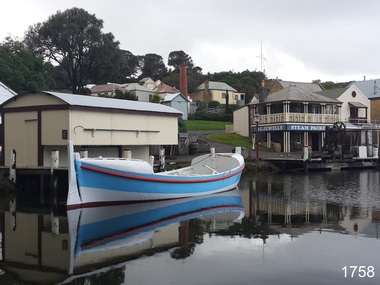
Vehicle - Vessel, Lifeboat Warrnambool, 01/09/1910
... inside the hull. A copy of the blueprint plans has the name “V.E.E. Gotch” printed on it. His advertisement in Footscray’s ‘Independent’ newspaper of Saturday 11th May 1901 states he is “Principal and Skilled member (Naval Architect) to the Court of Marine Inquiry of Victoria and holds classes for naval architectural drawing and arithmetic.”...inside the hull. A copy of the blueprint plans has the name “V.E.E. Gotch” printed on it. His advertisement in Footscray’s ‘Independent’ newspaper of Saturday 11th May 1901 states he is “Principal and Skilled member (Naval Architect) to the Court of Marine Inquiry of Victoria and holds classes for naval architectural drawing and arithmetic.” ...The construction of the lifeboat ‘Warrnambool’ began 15th September 1909 and was completed almost 12 months later, 1st September 1910. It was built at the Government Dockyard in Williamstown, Victoria, along the lines designed by the Great Britain’s Royal Lifeboat Institution, and included whaleback decks fore and aft, mast and centreboard, and rudder and tiller hung from the sternpost. It could be propelled by both sail and oar. At that time Captain Ferguson was Chief Harbour Master and Mr Beagley was foreman boat builder when he and his fellow workmen built the boat. The boat was described as “… a fine piece of workmanship and does credit to her builders and designers…” It had all the latest improvements in shape, disposition of weight and watertight compartments, and it had space for a large number of people in addition to the crew. It appears that 'H Meiers' whose signature, along with building dates, is pencilled on a concealed timber 'plaque' in the hull, was involved with the building of the lifeboat. It is interesting that the ‘Melbourne Directory’ of 1911, published by Sands and MacDougal, lists McAuley and Meiers, boat builders, Nelson Place foreshore, between Pasco and Parker Streets, Williamstown, (Victorian Heritage Database, ‘Contextual History, Maritime Facilities’), It is probably the company of the person whose name is inscribed on the lifeboat plaque. Flagstaff Hill’s documentation also mentions that the keel was laid at ‘Harry Myers, boat builders, Williamstown, Melbourne’ – the name ‘Myers’ can also be spelled ‘Meiers’, which could be the same person as the Meiers in “McAuley and Meiers” (as mentioned in genealogy lines of Myers). The new lifeboat, to be named ‘Warrnambool’ was brought to town by train and launched at the breakwater on 1st March 1911 using the Titan crane (the old lifeboat built in 1858, was then returned to Melbourne in 1911). This new lifeboat was stationed at Warrnambool in a shed located at the base of the Breakwater, adjacent to the slipway. A winch was used to bring it in and out of the water. The lifeboat ‘Warrnambool’ was similar in size to the old lifeboat but far superior in design, build and sea-going qualities such as greater manoeuvrability. The ‘self-righting, self-draining’ design was “practically non-capsizeable” and even if the boat overturned it would right itself to an even keel and the water would drain away. The hull was built of New Zealand Kauri, using double diagonal planking, laid in two layers at right angles, with a layer of canvas and red lead paint between the timbers to help seal the planking. It has “… plenty of freeboard, high watertight spaces between the deck and bottom… through which pipes lead…” The backbone timbers were made of Jarrah. The lifeboat Warrnambool was one of several rescue boats used at Port Fairy and Warrnambool in early 1900's. In late 1914 the Warrnambool lifeboat and crew were used to help find what was left of the tragic wreckage of the Antares, and were able to discover the body of one of the crewmen, which they brought back to Warrnambool. Between 1951 and 1954 the lifeboat was manned under the guidance of Captain Carrington. He held lifeboat practice each month on a Sunday morning, to comply with the Ports and Harbour’s request that lifeboats be manned by a strong and competent crew, ready for action in case of emergency. In the early 1960’s it ended its service as a lifeboat and was used in Port Fairy as a barge to help dredge the Moyne River, bolted to the Port Fairy lifeboat. Flagstaff Hill obtained the Warrnambool in 1975. In 1984 it was on display at Flagstaff Hill Maritime Village, Warrnambool. On 23rd May 1990 she was lifted from the water and placed in a cradle for restoration. The name ‘WARRNAMBOOL could be seen faintly on the lifeboat before it was restored. It was during the restoration that Flagstaff Hill's boat builder discovered the 'plaque' inside the hull. A copy of the blueprint plans has the name “V.E.E. Gotch” printed on it. His advertisement in Footscray’s ‘Independent’ newspaper of Saturday 11th May 1901 states he is “Principal and Skilled member (Naval Architect) to the Court of Marine Inquiry of Victoria and holds classes for naval architectural drawing and arithmetic.”The lifeboat WARRNAMBOOL is significant for its half century service to the local community as a lifesaving vessel. She was also used to help retrieve the body of a shipwrecked crew member of the ANTARES. Lifeboat "Warrnambool", a wooden, clinker hull, 'self-righting, self-draining design, single mast, pivoting centreboard. Complete with sail and yardarm. A 'plaque' was found inside the hull of the lifeboat, made of untreated wood, disc-shaped with one straight edge (Diam 15.5cm), inscribed by one of the boat builders in pencil script "Life Boat Start building / 15/9/09 - complete 1/9/10 / (signature looks like H Meiers) / Boat Builder)."'Plaque' inside body of boat is inscribed in pencil, script writing "Life Boat Start building / 15/9/09 - complete 1/9/10 / (signature looks like H Meiels) / Boat Builder)." flagstaff hill, warrnambool, shipwrecked-coast, flagstaff-hill, flagstaff-hill-maritime-museum, maritime-museum, shipwreck-coast, flagstaff-hill-maritime-village, lifeboat, life boat, vessel, life saving, 1910 vessel, port fairy, boat builder plaque, rescue boat, beagley, williamstown, government dockyard, v.e.e. gotch, royal lifeboat institution, captain ferguson, meiers, nelson place, non-capsizeable, self-righting, titan crane, double diagonal planking, captain carrington, barge, antares, self righting, crew of twelve, capacity of 30 survivors -
 Flagstaff Hill Maritime Museum and Village
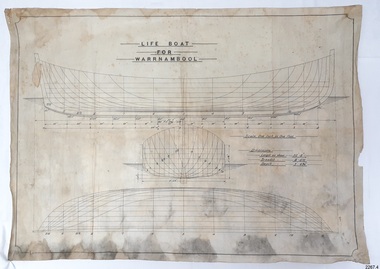
Plan - Vessel Line Drawing, Life Boat for Warrnambool, ca. 1900-1909
... inside the hull. A copy of the blueprint plans has the name “V.E.E. Gotch” printed on it. His advertisement in Footscray’s ‘Independent’ newspaper of Saturday 11th May 1901 states he is “Principal and Skilled member (Naval Architect) to the Court of Marine Inquiry of Victoria and holds classes for naval architectural drawing and arithmetic.” ...inside the hull. A copy of the blueprint plans has the name “V.E.E. Gotch” printed on it. His advertisement in Footscray’s ‘Independent’ newspaper of Saturday 11th May 1901 states he is “Principal and Skilled member (Naval Architect) to the Court of Marine Inquiry of Victoria and holds classes for naval architectural drawing and arithmetic.” ...The plans were used for the construction of the lifeboat ‘Warrnambool’, which began 15th September 1909 and was completed almost 12 months later 1st September 1910. It was built at the Government Dockyard in Williamstown, Victoria, along the lines designed by Great Britain’s Royal Lifeboat Institution, and included whaleback decks fore and aft, mast and centreboard, and rudder and tiller hung from the sternpost. It could be propelled by both sail and oar. At that time Captain Ferguson was Chief Harbour Master and Mr Beagley was the foreman boat builder. Mr Beagley built the lifeboat with his fellow workmen. The boat was described as “… a fine piece of workmanship and does credit to her builders and designers…” It had all the latest improvements in shape, disposition of weight and watertight compartments, and it had space for a large number of people in addition to the crew. It appears that 'H Meiers' whose signature was on the plaque that was found concealed in the hull, was involved with the building of the lifeboat. His signature and the dates of the start and finish of the boat’s construction are pencilled on the raw timber 'plaque' found in the hull in the early 1990s when the lifeboat was being restored. It is interesting that the ‘Melbourne Directory’ of 1911, published by Sands and MacDougal, lists McAuley and Meiers, boat builders, Nelson Place foreshore, between Pasco and Parker Streets, Williamstown, (Victorian Heritage Database, ‘Contextual History, Maritime Facilities’), It is quite possibly the business of the person whose name is inscribed on the lifeboat plaque. Flagstaff Hill’s documentation also mentions that the keel was laid at ‘Harry Myers, boat builders, Williamstown, Melbourne’ – the name ‘Myers’ can also be spelled ‘Meiers’, which could be the same person as the Meiers in “McAuley and Meiers” (as mentioned in genealogy lines of Myers). The new lifeboat, to be named ‘Warrnambool’ was brought to town by train and launched at the breakwater on 1st March 1911 using the Titan crane (the old lifeboat built in 1858, was then returned to Melbourne in 1911). This new lifeboat was stationed at Warrnambool in a shed located at the base of the Breakwater, adjacent to the slipway. A winch was used to bring it in and out of the water. The lifeboat ‘Warrnambool’ was similar in size to the old lifeboat but far superior in design, build and sea-going qualities such as greater manoeuvrability. The ‘self-righting, self-draining design was “practically non-capsizeable” and even if the boat overturned it would right itself to an even keel and the water would drain away. The hull was built of New Zealand Kauri, using double diagonal planking, laid in two layers at right angles, with a layer of canvas and red lead paint between the timbers to help seal the planking. It has “… plenty of freeboard area, high watertight spaces between the deck and bottom… through which pipes lead…” The backbone timbers were made of Jarrah. The lifeboat Warrnambool was one of several rescue boats used at Port Fairy and Warrnambool in the early 1900s. In late 1914 the Warrnambool lifeboat and crew were used to help find what was left of the tragic wreckage of the Antares and were able to discover the body of one of the crewmen, which they brought back to Warrnambool. Between 1951 and 1954 the lifeboat was manned under the guidance of Captain Carrington. He held lifeboat practice each month on a Sunday morning, to comply with the Ports and Harbour’s request that lifeboats be manned by a strong and competent crew, ready for action in case of emergency. In the early 1960’s it ended its service as a lifeboat and was used in Port Fairy as a barge to help dredge the Moyne River, bolted to the Port Fairy lifeboat. Flagstaff Hill obtained the Warrnambool in 1975. In 1984 it was on display at Flagstaff Hill Maritime Village, Warrnambool. On 23rd May 1990, she was lifted from the water and placed in a cradle for restoration. The name ‘WARRNAMBOOL could be seen faintly on the lifeboat before it was restored. It was during the restoration that Flagstaff Hill's boat builder discovered the 'plaque' inside the hull. A copy of the blueprint plans has the name “V.E.E. Gotch” printed on it. His advertisement in Footscray’s ‘Independent’ newspaper of Saturday 11th May 1901 states he is “Principal and Skilled member (Naval Architect) to the Court of Marine Inquiry of Victoria and holds classes for naval architectural drawing and arithmetic.” The line drawing is significant for its connection with the lifeboat WARRNAMBOOL. The lifeboat is very significant to local and state history for its use in the lifesaving rescues of seafarers, particularly in Lady Bay. It was part of the local rescue equipment. It gave a half-century of service to the local community as a lifesaving vessel, including its involvement in retrieving the body of a shipwrecked crew member of the ANTARES. Line drawing in black ink and pencil on rectangular parchment or waxed linen. Drawing has diagrams of three profiles of a vessel, with measurements and connecting pencil lines on the left quarter. The plan is for the lifeboat named “Warrnambool”, which was built in Melbourne and completed in 1910. Old blue copies of the Lifeboat plan are archived also.“LIFE BOAT / FOR / WARRNAMBOOL” “Scale, One Inch to One Foot” “ “Length as shown 30’ – 8” “ “Breadth “ “ 8’ – 6 ½ “ “ “Depth “ “ 3’ – 4 ¾” “flagstaff hill, warrnambool, shipwrecked-coast, flagstaff-hill, flagstaff-hill-maritime-museum, maritime-museum, shipwreck-coast, flagstaff-hill-maritime-village, lifeboat, warrnambool lifeboat, boat plans, lifeboat plans, boat construction, boat building, line drawing, plan for lifeboat, life boat, life boat 'warrnambool', clinker design, 1910 lifeboat, life saving equipment, shipbuilding -
 Federation University Historical Collection
Photograph - Photograph - Black and White, Ballarat Post Office, 1938, 1938
... inside. The tower - a feature of the building. Top has a cast iron balustraded widow's walk. The Post Office building is now part of Federation University Ballarat Camp Street Campus - Arts Academy. The official opening of the Arts Academy, by Steve Bracks, Premier of Victoria, was on 11 October 2002. Classes...inside. The tower - a feature of the building. Top has a cast iron balustraded widow's walk. The Post Office building is now part of Federation University Ballarat Camp Street Campus - Arts Academy. The official opening of the Arts Academy, by Steve Bracks, Premier of Victoria, was on 11 October 2002. Classes ...The first section of the Post Office was built in 1864. During 1865 the second section and tower were built. Building is of a Victorian Italianate design. Arched headed windows on the ground floor originally formed a colonnade. These were filled in to give additional space inside. The tower - a feature of the building. Top has a cast iron balustraded widow's walk. The Post Office building is now part of Federation University Ballarat Camp Street Campus - Arts Academy. The official opening of the Arts Academy, by Steve Bracks, Premier of Victoria, was on 11 October 2002. Classes commenced at the Arts Academy in 2002.Black and white photograph showing the Ballarat Post Office on corner of Sturt and Lydiard Streets. Banner across building "1838-1938 POST A SOUVENIR"sturt street, lydiard street, post office, anniverary, centenary, william parker, victorian italianate style -
 Blacksmith's Cottage and Forge
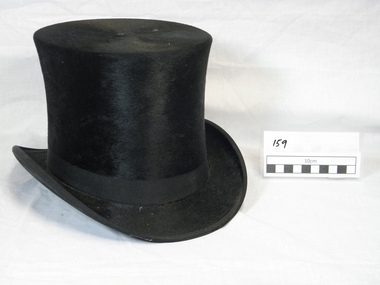
Top Hat, late 19th century
... It is representative of formal gentlemen's dress in the latter part of the 19th century/early 20th century. 1910 top hat gentlemen s fashion mr grant velour ninteenth century attire skilled hatter upper class attire formal wear monopoly token president bacchus marsh shire federation celebrations 1910 federation owner millbank mad hatter opening parliament 1910 royal exhibition building original box greaseproof prize medal royal isignia the sea breeze no 5044 size 6 7 8 Inscription in gold inside hat reads "GREASE PROOF / Prize Medal" / Royal Insignia with motto "Honi soit qui mal y pense" / "VENTILATED / AND / FELT BANDED". ...This hat belonged to Mr William Grant, Shire President of Bacchus Marsh. Mr Grant and his wife were invited to the opening of the first Federal Parliament held in the Royal Exhibition Building, Carlton, on the 9th May 1901. The opening was attended by the Duke and Duchess of Cornwall and York (later George V and Queen Mary) and 12,000 guests. Mr Grant's family were early settlers in Bacchus Marsh, and both he and his father were influential people in the town. They owned the property "Millbank". When William Grant died in 1924, his obituary in the 'Express' listed 17 public positions he held, including severaal terms as Shire President.This item has historical significance at a local, state and national level. It is representative of formal gentlemen's dress in the latter part of the 19th century/early 20th century.Gentleman's black shiny velour top hat with silk ribbon band, bound inside with leather sweat band, adjustable with silk ties. Inscription inside hat. Purple lining with gold embossing. Light canvas coated inside. Protective silver paper sweat band under leather sweat band.Inscription in gold inside hat reads "GREASE PROOF / Prize Medal" / Royal Insignia with motto "Honi soit qui mal y pense" / "VENTILATED / AND / FELT BANDED".1910, top hat, gentlemen s fashion, mr grant, velour, ninteenth century attire, skilled hatter, upper class attire, formal wear, monopoly token, president bacchus marsh shire, federation celebrations 1910, federation, owner millbank, mad hatter, opening parliament 1910, royal exhibition building, original box, greaseproof prize medal royal isignia, the sea breeze, no 5044, size 6, 7 8 -
 Marysville & District Historical Society
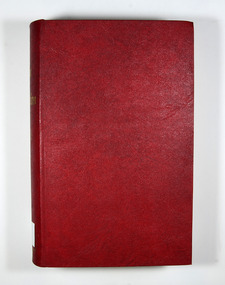
Book, Education Department of Victoria, Vision and Realisation-A Centenary History of State Education in Victoria-Volume 2, 1973
... Class No. 379.945 / VIC / Acc. No. 41766 Stamp / COUNCIL OF ADULT EDUCATION / LIBRARY / 30 APR 1973 CANCELLED stamp To the teachers of Victoria Inside back cover has labels that have been partially removed and a pocket for a library card....Class No. 379.945 / VIC / Acc. No. 41766 Stamp / COUNCIL OF ADULT EDUCATION / LIBRARY / 30 APR 1973 CANCELLED stamp To the teachers of Victoria Inside back cover has labels that have been partially removed and a pocket for a library card. ...A centenary history of state education in VictoriaRed cover with the title and volume written on the spine in gold lettering. Both front and back inside covers have a photograph of 'The school at Drummond North' Photo: Geoff Maugernon-fictionA centenary history of state education in Victoriaeducation, state education, victoria, history, glenelg, wimmera, mallee, loddon, central highlands, corangamite, barwon -
 Marysville & District Historical Society
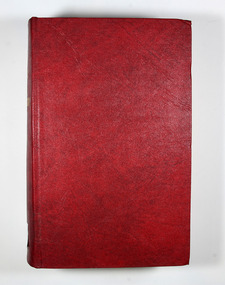
Book, Education Department of Victoria, Vision and Realisation-A Centenary History of State Education in Victoria-Volume 3, 1973
... Class No. 379.945 / VIC / Acc. No. 42672 Stamp / COUNCIL OF ADULT EDUCATION / LIBRARY / 30 APR 1973 CANCELLED stamp To the teachers of Victoria Inside back cover has library labels and a pocket for a library card. ...Class No. 379.945 / VIC / Acc. No. 42672 Stamp / COUNCIL OF ADULT EDUCATION / LIBRARY / 30 APR 1973 CANCELLED stamp To the teachers of Victoria Inside back cover has library labels and a pocket for a library card. ...A centenary history of state education in Victoria.Red cover with the title and volume written on the spine in gold lettering. Both front and back inside covers have a photograph of 'The school at Drummond North' Photo: Geoff Mauger non-fictionA centenary history of state education in Victoria.education, state education, victoria, history, port phillip western, port phillip eastern, upper goulburn, goulburn, upper murray, east gippsland, west gippsland
