
Showing 11 items matching "intake 21"
-
 Federation University Historical Collection
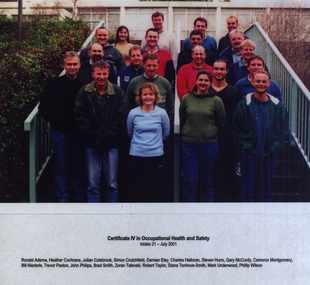
Photograph - Laminated Photograph - Colour, VIOSH: Certificate IV in Occupational Health and Safety; Intake 21, July 2001
... VIOSH: Certificate IV in Occupational Health and Safety; Intake 21, July 2001......intake 21...Photograph of thirteen students enrolled in Certificate IV in Occupational Health and Safety: Intake 21, July 2001...Names of students under photograph VIOSH: Certificate IV in Occupational Health and Safety; Intake 21, July 2001 Photograph Laminated Photograph - Colour ...Victorian Institute of Occupational Safety and Health (VIOSH) Australia is the Asia-Pacific centre for teaching and research in occupational health and safety (OHS) and is known as one of Australia's leaders in the field. VIOSH has a global reputation for its innovative approach within the field of OHS management. VIOSH had its first intake of students in 1979. At that time the Institution was known as the Ballarat College of Advanced Education. In 1990 it became known as Ballarat University College, then in 1994 as University of Ballarat. It was 2014 that it became Federation University. VIOSH Australia students are safety managers, senior advisors and experienced OHS professionals. They come from all over Australia and industry. Students are taught active research and enquiry; rather than textbook learning and a one-size fits all approach. VIOSH accepts people into the Graduate Diploma of Occupational Hazard Management who have no undergraduate degree - on the basis of extensive work experience and knowledge. Photograph of thirteen students enrolled in Certificate IV in Occupational Health and Safety: Intake 21, July 2001Colour photograph laminated. Names of students under photographNames of studentsviosh, victorian institute of occupational safety and health, occupational health and safety, certificate iv, intake 21, july 2001, ronald adema, heather cochrane, julian colebrook, simon crutchfield, damian eley, charles halloran, steven hunn, gary mccurdy, cameron montgomery, bill niederle, trevor paxton, john philips, brad smith, zoran talevski, robert taylor, diana tenhove-smith, mark underwood, phillip wilson -
 Federation University Historical Collection
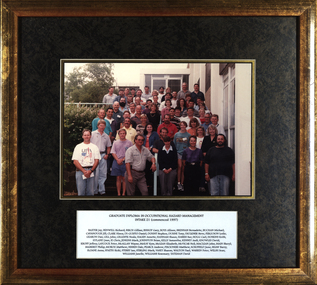
Photograph - Photograph - Colour, VIOSH: Graduate Diploma of Occupational Hazard Management: Intake 21, 1997, 1997
... VIOSH: Graduate Diploma of Occupational Hazard Management: Intake 21, 1997...Brown and gold framed photograph with title and names of students who completed the VIOSH Graduate Diploma in Occupational Hazard Management Intake 21....VIOSH accepts people into the Graduate Diploma of Occupational Hazard Management who have no undergraduate degree - on the basis of extensive work experience and knowledge. viosh viosh australia victorian institute of occupational safety and health joy baxter richard benwell gillian birch gary bishop, allison boys bernadette brennan michael buchan jill cavanough hinea clark daniel di-guisto stephen dohnt tony duhne steve faulkner leslie ferguson dan gearon john gill neala gillespie annette hagan shaun hannam sue harris carl hogg keith hoskins joan hyland chris ie mark jenkins brian johnson samatha kelly andi kenney david knowles jeffery kropp peter laycock wayne mcallan kym mckay elizabeth mcclean niel mcvicar john mcclean sheryl main philip maskrey mathew moroz dale nissan andrew pearce mathew piscioneri june scholfield barry shaw anna sloane ricki speath ian sterry mark stirling sharon vasey paul walton sean welsh janelle williams rosemary williams university of ballarat Framers details verso lls: "Artafact" Brown and gold framed photograph with title and names of students who completed the VIOSH Graduate Diploma in Occupational Hazard Management Intake 21. VIOSH: Graduate Diploma of Occupational Hazard Management: Intake 21, 1997 Photograph Photograph - Colour Artafact ...Victorian Institute of Occupational Safety and Health (VIOSH) Australia is the Asia-Pacific centre for teaching and research in occupational health and safety (OHS) and is known as one of Australia's leaders on the field. VIOSH has a global reputation for its innovative approach within the field of OHS management. VIOSH had its first intake of students in 1979. At that time the Institution was known as the Ballarat College of Advanced Education. In 1990 it became known as Ballarat University College, then in 1994 as University of Ballarat. It was 2014 that it became Federation University. VIOSH Australia students are safety managers, senior advisors and experienced OHS professionals. They come from all over Australia and industry. Students are taught active research and enquiry; rather than textbook learning and a one-size fits all approach. VIOSH accepts people into the Graduate Diploma of Occupational Hazard Management who have no undergraduate degree - on the basis of extensive work experience and knowledge. Brown and gold framed photograph with title and names of students who completed the VIOSH Graduate Diploma in Occupational Hazard Management Intake 21.Framers details verso lls: "Artafact"viosh, viosh australia, victorian institute of occupational safety and health, joy baxter, richard benwell, gillian birch, gary bishop,, allison boys, bernadette brennan, michael buchan, jill cavanough, hinea clark, daniel di-guisto, stephen dohnt, tony duhne, steve faulkner, leslie ferguson, dan gearon, john gill, neala gillespie, annette hagan, shaun hannam, sue harris, carl hogg, keith hoskins, joan hyland, chris ie, mark jenkins, brian johnson, samatha kelly, andi kenney, david knowles, jeffery kropp, peter laycock, wayne mcallan, kym mckay, elizabeth mcclean, niel mcvicar, john mcclean, sheryl main, philip maskrey, mathew moroz, dale nissan, andrew pearce, mathew piscioneri, june scholfield, barry shaw, anna sloane, ricki speath, ian sterry, mark stirling, sharon vasey, paul walton, sean welsh, janelle williams, rosemary williams, university of ballarat -
 Bendigo Historical Society Inc.
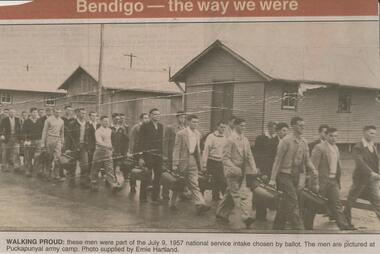
Newspaper - JENNY FOLEY COLLECTION: WALKING PROUD
... 21 yrs were required to register for 3 months training for service in Australia and its territories. This was expanded in 1942 when all men 18-35 yrs and single men 35-45 yrs were required to register for the CMF (Citizens Military Force) Many of these then volunteered for the regular army during WW2. However the biggest National Service intake...21 yrs were required to register for 3 months training for service in Australia and its territories. This was expanded in 1942 when all men 18-35 yrs and single men 35-45 yrs were required to register for the CMF (Citizens Military Force) Many of these then volunteered for the regular army during WW2. However the biggest National Service intake ...From 1909-1929, all boys 12-14 yrs and men 18-20 were required to enrol for army training only for domestic service. In 1939 all unmarried men aged 21 yrs were required to register for 3 months training for service in Australia and its territories. This was expanded in 1942 when all men 18-35 yrs and single men 35-45 yrs were required to register for the CMF (Citizens Military Force) Many of these then volunteered for the regular army during WW2. However the biggest National Service intake occurred between 1951 and 1972 as a reaction to the Korean and Vietnam Wars. Initially this required all 18 yr olds to complete 176 days of military service. Then in 1964 the lottery system was invoked.Bendigo Advertiser ''The way we were'' from 2002. Walking proud: these men were part of the July 9, 1957 national service intake chosen by ballot. The men are pictured at Puckapunyal army camp. Photo supplied by Ernie Hartland.newspaper, bendigo advertiser, the way we were -
 Charlton Golden Grains Museum Inc
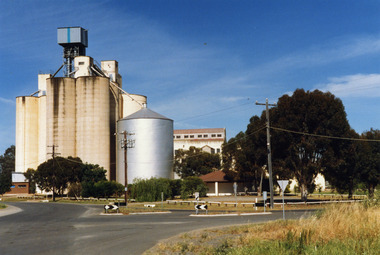
Photograph, Charlton Shire, Charlton Flour Mill, c.1987
... In the record-breaking 1968 season, the mill received a colossal wheat intake of **695,000 bushels**. However, the mill also faced setbacks. On January 21, 1949, disaster struck when a **large fire** erupted in the storage shed, which contained 500 tons of bagged flour ready for export and new flour bags. ...In the record-breaking 1968 season, the mill received a colossal wheat intake of **695,000 bushels**. However, the mill also faced setbacks. On January 21, 1949, disaster struck when a **large fire** erupted in the storage shed, which contained 500 tons of bagged flour ready for export and new flour bags. ...A previous mill had operated in Charlton by Mr. W.E. Foreman on the banks of the Avoca River and was acquired in 1919 by Noske Bros. The present Flour Mill was built by Noske Bros and opened in May 1927. It was taken over by the Grain Elevator Board in the 1970s. Noske's Flour Mill, with its commanding presence and towering silos, has long **dominated the Charlton skyline** and remains a significant landmark, even though it no longer mills flour. The mill's history is deeply intertwined with the development of Charlton and the grain industry of the surrounding district. The foundation for the mill's presence was laid in 1919 when Messrs Noske Bros. Pty. Ltd., already owning mills in Horsham, Nhill, and Murray Bridge, acquired G. H. Foreman’s Mill located by the Avoca River. The founder, **T. J. Noske**, was an early pioneer of flour exporting, expanding his milling business after unexpectedly acquiring the Horsham mill. ### A State-of-the-Art Operation The original mill by the river operated until August 1926 before being closed and dismantled. Plans were well underway for a **new, state-of-the-art mill** to be located at the former Cobb and Co site. In 1927, the new mill began operation. It was one of the largest in the state, boasting a capacity of three tons of flour per hour, a 250 h.p. diesel engine, and three initial silos. The mill quickly gained a reputation for **excellence** for both its design and its flour, which was sold successfully in local and overseas markets. ### Periods of Expansion and Trial The mill continued to grow, reflecting the importance of the local agricultural industry. Between 1940 and 1941, **nine new silos** were built, adding bulk receival points. In the record-breaking 1968 season, the mill received a colossal wheat intake of **695,000 bushels**. However, the mill also faced setbacks. On January 21, 1949, disaster struck when a **large fire** erupted in the storage shed, which contained 500 tons of bagged flour ready for export and new flour bags. The blaze was so intense that smoke was visible as far away as Wycheproof, and it threatened to destroy the entire mill. Thanks to the monumental efforts of the Charlton, St. Arnaud, Wycheproof, and Wedderburn Brigades, who ran the main pump almost continuously for 26 hours, the damage was contained, though the estimated loss was a substantial £60,000. ### Transformation of the Site At its peak, the mill was a major employer, providing work for approximately 65–70 men. But after over 45 years of operation, flour production at the mill ceased on October 25, 1973. Noske Industries Ltd. sought to adapt, converting the operation to a less successful stock feed production centre. In 1977, the **Grain Elevators Board** took over the site as a grain receival depot, building a large elevator tower that surpassed the height of the original buildings. The site eventually returned to private hands and, since 2000, has been owned and operated as a primary grain receival site for **GrainCorp**, cementing its continued, vital role in Charlton's agricultural life. Colour photograph of Charlton Flour Mill and silos. Intersection of Kaye & Davies Streets in the foreground. One large silver silo and three taller greyish concrete silos to the left. Three other cream coloured silos behind. There are pipes and sheds on top of the silos. There is a cream single story building to the right of the silver silo and a multi-storey building behind with eight window in the upper level. There is a small red brick building on the far left of the photo.w.e. foreman, noske bros, flour mill charlton, business, industry -
 Charlton Golden Grains Museum Inc
Photograph - Lithograph, Rider & Mercer, Views of Charlton
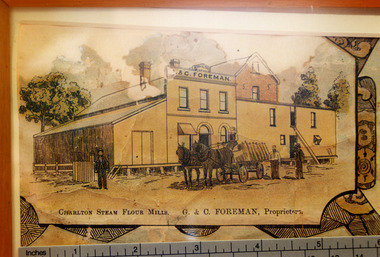
... In the record-breaking 1968 season, the mill received a colossal wheat intake of **695,000 bushels**. However, the mill also faced setbacks. On January 21, 1949, disaster struck when a **large fire** erupted in the storage shed, which contained 500 tons of bagged flour ready for export and new flour bags. ...In the record-breaking 1968 season, the mill received a colossal wheat intake of **695,000 bushels**. However, the mill also faced setbacks. On January 21, 1949, disaster struck when a **large fire** erupted in the storage shed, which contained 500 tons of bagged flour ready for export and new flour bags. ...Close up photograph of part of the Charlton Lithograph showing the Charlton Steam Power Flour Mill of G & C Foreman. Located in on the bank of the Avoca river. The mill owners attempted to dam the river during the 1870s. The mill was built in 1876 as recorded by the local traveling correspondent . Foreman's flour mill established 1876 at the west end of High Street. Sold to Norske in 1925. Replaced by Noske's Flour Mill on Kays Street in 1927. Noske's Flour Mill, with its commanding presence and towering silos, has long **dominated the Charlton skyline** and remains a significant landmark, even though it no longer mills flour. The mill's history is deeply intertwined with the development of Charlton and the grain industry of the surrounding district. The foundation for the mill's presence was laid in 1919 when Messrs Noske Bros. Pty. Ltd., already owning mills in Horsham, Nhill, and Murray Bridge, acquired G. H. Foreman’s Mill located by the Avoca River. The founder, **T. J. Noske**, was an early pioneer of flour exporting, expanding his milling business after unexpectedly acquiring the Horsham mill. ### A State-of-the-Art Operation The original mill by the river operated until August 1926 before being closed and dismantled. Plans were well underway for a **new, state-of-the-art mill** to be located at the former Cobb and Co site. In 1927, the new mill began operation. It was one of the largest in the state, boasting a capacity of three tons of flour per hour, a 250 h.p. diesel engine, and three initial silos. The mill quickly gained a reputation for **excellence** for both its design and its flour, which was sold successfully in local and overseas markets. ### Periods of Expansion and Trial The mill continued to grow, reflecting the importance of the local agricultural industry. Between 1940 and 1941, **nine new silos** were built, adding bulk receival points. In the record-breaking 1968 season, the mill received a colossal wheat intake of **695,000 bushels**. However, the mill also faced setbacks. On January 21, 1949, disaster struck when a **large fire** erupted in the storage shed, which contained 500 tons of bagged flour ready for export and new flour bags. The blaze was so intense that smoke was visible as far away as Wycheproof, and it threatened to destroy the entire mill. Thanks to the monumental efforts of the Charlton, St. Arnaud, Wycheproof, and Wedderburn Brigades, who ran the main pump almost continuously for 26 hours, the damage was contained, though the estimated loss was a substantial £60,000. ### Transformation of the Site At its peak, the mill was a major employer, providing work for approximately 65–70 men. But after over 45 years of operation, flour production at the mill ceased on October 25, 1973. Noske Industries Ltd. sought to adapt, converting the operation to a less successful stock feed production centre. In 1977, the **Grain Elevators Board** took over the site as a grain receival depot, building a large elevator tower that surpassed the height of the original buildings. The site eventually returned to private hands and, since 2000, has been owned and operated as a primary grain receival site for **GrainCorp**, cementing its continued, vital role in Charlton's agricultural life.Colour photo taken of a small portion of the Charlton Lithograph. Showing the Charlton Steam Flour Mill of G. C. Foreman.Charlton Steam Flour Mills. G & C Foreman proprietors.lithograph, business, industry, charlton, flour mill, noske bros, foreman -
 Charlton Golden Grains Museum Inc
Photograph, c.1948
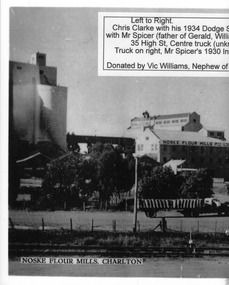
... In the record-breaking 1968 season, the mill received a colossal wheat intake of **695,000 bushels**. However, the mill also faced setbacks. On January 21, 1949, disaster struck when a **large fire** erupted in the storage shed, which contained 500 tons of bagged flour ready for export and new flour bags. ...In the record-breaking 1968 season, the mill received a colossal wheat intake of **695,000 bushels**. However, the mill also faced setbacks. On January 21, 1949, disaster struck when a **large fire** erupted in the storage shed, which contained 500 tons of bagged flour ready for export and new flour bags. ...Black and white photo copied and enlarged from small photo which was part of a set produced in c.1948. Chris Clarke with his 1934 Dodge semi trailer and W Spicer in his 1930 International truck line up to unload wheat at Noske's mill. Noskes flour mill built in 1927 with extra silos added in 1940's.Photo enlarged by Vic Williams of Bendigo nephew of Chris Clarke transport driver. Noske's Flour Mill, with its commanding presence and towering silos, has long **dominated the Charlton skyline** and remains a significant landmark, even though it no longer mills flour. The mill's history is deeply intertwined with the development of Charlton and the grain industry of the surrounding district. The foundation for the mill's presence was laid in 1919 when Messrs Noske Bros. Pty. Ltd., already owning mills in Horsham, Nhill, and Murray Bridge, acquired G. H. Foreman’s Mill located by the Avoca River. The founder, **T. J. Noske**, was an early pioneer of flour exporting, expanding his milling business after unexpectedly acquiring the Horsham mill. ### A State-of-the-Art Operation The original mill by the river operated until August 1926 before being closed and dismantled. Plans were well underway for a **new, state-of-the-art mill** to be located at the former Cobb and Co site. In 1927, the new mill began operation. It was one of the largest in the state, boasting a capacity of three tons of flour per hour, a 250 h.p. diesel engine, and three initial silos. The mill quickly gained a reputation for **excellence** for both its design and its flour, which was sold successfully in local and overseas markets. ### Periods of Expansion and Trial The mill continued to grow, reflecting the importance of the local agricultural industry. Between 1940 and 1941, **nine new silos** were built, adding bulk receival points. In the record-breaking 1968 season, the mill received a colossal wheat intake of **695,000 bushels**. However, the mill also faced setbacks. On January 21, 1949, disaster struck when a **large fire** erupted in the storage shed, which contained 500 tons of bagged flour ready for export and new flour bags. The blaze was so intense that smoke was visible as far away as Wycheproof, and it threatened to destroy the entire mill. Thanks to the monumental efforts of the Charlton, St. Arnaud, Wycheproof, and Wedderburn Brigades, who ran the main pump almost continuously for 26 hours, the damage was contained, though the estimated loss was a substantial £60,000. ### Transformation of the Site At its peak, the mill was a major employer, providing work for approximately 65–70 men. But after over 45 years of operation, flour production at the mill ceased on October 25, 1973. Noske Industries Ltd. sought to adapt, converting the operation to a less successful stock feed production centre. In 1977, the **Grain Elevators Board** took over the site as a grain receival depot, building a large elevator tower that surpassed the height of the original buildings. The site eventually returned to private hands and, since 2000, has been owned and operated as a primary grain receival site for **GrainCorp**, cementing its continued, vital role in Charlton's agricultural life.Black and white photo copied and enlarged from small photo.charlton, flour mill, noske's, noske bros -
 Charlton Golden Grains Museum Inc
Photograph, c.1948
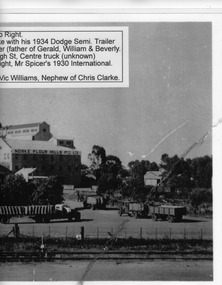
... In the record-breaking 1968 season, the mill received a colossal wheat intake of **695,000 bushels**. However, the mill also faced setbacks. On January 21, 1949, disaster struck when a **large fire** erupted in the storage shed, which contained 500 tons of bagged flour ready for export and new flour bags. ...In the record-breaking 1968 season, the mill received a colossal wheat intake of **695,000 bushels**. However, the mill also faced setbacks. On January 21, 1949, disaster struck when a **large fire** erupted in the storage shed, which contained 500 tons of bagged flour ready for export and new flour bags. ...Black and white photo copied and enlarged from small photo which was part of a set produced in c.1948. Chris Clarke with his 1934 Dodge semi trailer and W Spicer in his 1930 International truck line up to unload wheat at Noske's mill. Noskes flour mill built in 1927 with extra silos added in 1940's. Photo enlarged by Vic Williams of Bendigo nephew of Chris Clarke transport driver. Noske's Flour Mill, with its commanding presence and towering silos, has long **dominated the Charlton skyline** and remains a significant landmark, even though it no longer mills flour. The mill's history is deeply intertwined with the development of Charlton and the grain industry of the surrounding district. The foundation for the mill's presence was laid in 1919 when Messrs Noske Bros. Pty. Ltd., already owning mills in Horsham, Nhill, and Murray Bridge, acquired G. H. Foreman’s Mill located by the Avoca River. The founder, **T. J. Noske**, was an early pioneer of flour exporting, expanding his milling business after unexpectedly acquiring the Horsham mill. ### A State-of-the-Art Operation The original mill by the river operated until August 1926 before being closed and dismantled. Plans were well underway for a **new, state-of-the-art mill** to be located at the former Cobb and Co site. In 1927, the new mill began operation. It was one of the largest in the state, boasting a capacity of three tons of flour per hour, a 250 h.p. diesel engine, and three initial silos. The mill quickly gained a reputation for **excellence** for both its design and its flour, which was sold successfully in local and overseas markets. ### Periods of Expansion and Trial The mill continued to grow, reflecting the importance of the local agricultural industry. Between 1940 and 1941, **nine new silos** were built, adding bulk receival points. In the record-breaking 1968 season, the mill received a colossal wheat intake of **695,000 bushels**. However, the mill also faced setbacks. On January 21, 1949, disaster struck when a **large fire** erupted in the storage shed, which contained 500 tons of bagged flour ready for export and new flour bags. The blaze was so intense that smoke was visible as far away as Wycheproof, and it threatened to destroy the entire mill. Thanks to the monumental efforts of the Charlton, St. Arnaud, Wycheproof, and Wedderburn Brigades, who ran the main pump almost continuously for 26 hours, the damage was contained, though the estimated loss was a substantial £60,000. ### Transformation of the Site At its peak, the mill was a major employer, providing work for approximately 65–70 men. But after over 45 years of operation, flour production at the mill ceased on October 25, 1973. Noske Industries Ltd. sought to adapt, converting the operation to a less successful stock feed production centre. In 1977, the **Grain Elevators Board** took over the site as a grain receival depot, building a large elevator tower that surpassed the height of the original buildings. The site eventually returned to private hands and, since 2000, has been owned and operated as a primary grain receival site for **GrainCorp**, cementing its continued, vital role in Charlton's agricultural life.Black and white photocharton, business, noske bros, flour mill -
 Charlton Golden Grains Museum Inc
Photograph, c.1960
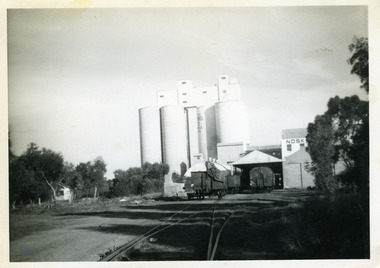
... In the record-breaking 1968 season, the mill received a colossal wheat intake of **695,000 bushels**. However, the mill also faced setbacks. On January 21, 1949, disaster struck when a **large fire** erupted in the storage shed, which contained 500 tons of bagged flour ready for export and new flour bags. ...In the record-breaking 1968 season, the mill received a colossal wheat intake of **695,000 bushels**. However, the mill also faced setbacks. On January 21, 1949, disaster struck when a **large fire** erupted in the storage shed, which contained 500 tons of bagged flour ready for export and new flour bags. ...Noske's mill in mid 1960s. Noske's Flour Mill, with its commanding presence and towering silos, has long **dominated the Charlton skyline** and remains a significant landmark, even though it no longer mills flour. The mill's history is deeply intertwined with the development of Charlton and the grain industry of the surrounding district. The foundation for the mill's presence was laid in 1919 when Messrs Noske Bros. Pty. Ltd., already owning mills in Horsham, Nhill, and Murray Bridge, acquired G. H. Foreman’s Mill located by the Avoca River. The founder, **T. J. Noske**, was an early pioneer of flour exporting, expanding his milling business after unexpectedly acquiring the Horsham mill. ### A State-of-the-Art Operation The original mill by the river operated until August 1926 before being closed and dismantled. Plans were well underway for a **new, state-of-the-art mill** to be located at the former Cobb and Co site. In 1927, the new mill began operation. It was one of the largest in the state, boasting a capacity of three tons of flour per hour, a 250 h.p. diesel engine, and three initial silos. The mill quickly gained a reputation for **excellence** for both its design and its flour, which was sold successfully in local and overseas markets. ### Periods of Expansion and Trial The mill continued to grow, reflecting the importance of the local agricultural industry. Between 1940 and 1941, **nine new silos** were built, adding bulk receival points. In the record-breaking 1968 season, the mill received a colossal wheat intake of **695,000 bushels**. However, the mill also faced setbacks. On January 21, 1949, disaster struck when a **large fire** erupted in the storage shed, which contained 500 tons of bagged flour ready for export and new flour bags. The blaze was so intense that smoke was visible as far away as Wycheproof, and it threatened to destroy the entire mill. Thanks to the monumental efforts of the Charlton, St. Arnaud, Wycheproof, and Wedderburn Brigades, who ran the main pump almost continuously for 26 hours, the damage was contained, though the estimated loss was a substantial £60,000. ### Transformation of the Site At its peak, the mill was a major employer, providing work for approximately 65–70 men. But after over 45 years of operation, flour production at the mill ceased on October 25, 1973. Noske Industries Ltd. sought to adapt, converting the operation to a less successful stock feed production centre. In 1977, the **Grain Elevators Board** took over the site as a grain receival depot, building a large elevator tower that surpassed the height of the original buildings. The site eventually returned to private hands and, since 2000, has been owned and operated as a primary grain receival site for **GrainCorp**, cementing its continued, vital role in Charlton's agricultural life.Black and white photograph with white border.charlton, business, noske's, flour mill -
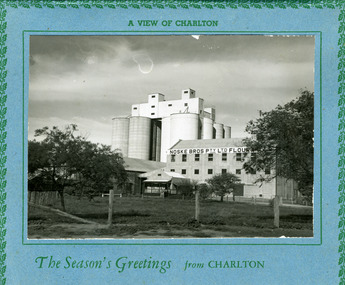 Charlton Golden Grains Museum Inc
Postcard, A view of Charlton. The seasons greeting from Charlton, c.1946
... In the record-breaking 1968 season, the mill received a colossal wheat intake of **695,000 bushels**. However, the mill also faced setbacks. On January 21, 1949, disaster struck when a **large fire** erupted in the storage shed, which contained 500 tons of bagged flour ready for export and new flour bags. ...In the record-breaking 1968 season, the mill received a colossal wheat intake of **695,000 bushels**. However, the mill also faced setbacks. On January 21, 1949, disaster struck when a **large fire** erupted in the storage shed, which contained 500 tons of bagged flour ready for export and new flour bags. ...Eight silos added in 1940s. Noske's Flour Mill, with its commanding presence and towering silos, has long **dominated the Charlton skyline** and remains a significant landmark, even though it no longer mills flour. The mill's history is deeply intertwined with the development of Charlton and the grain industry of the surrounding district. The foundation for the mill's presence was laid in 1919 when Messrs Noske Bros. Pty. Ltd., already owning mills in Horsham, Nhill, and Murray Bridge, acquired G. H. Foreman’s Mill located by the Avoca River. The founder, **T. J. Noske**, was an early pioneer of flour exporting, expanding his milling business after unexpectedly acquiring the Horsham mill. ### A State-of-the-Art Operation The original mill by the river operated until August 1926 before being closed and dismantled. Plans were well underway for a **new, state-of-the-art mill** to be located at the former Cobb and Co site. In 1927, the new mill began operation. It was one of the largest in the state, boasting a capacity of three tons of flour per hour, a 250 h.p. diesel engine, and three initial silos. The mill quickly gained a reputation for **excellence** for both its design and its flour, which was sold successfully in local and overseas markets. ### Periods of Expansion and Trial The mill continued to grow, reflecting the importance of the local agricultural industry. Between 1940 and 1941, **nine new silos** were built, adding bulk receival points. In the record-breaking 1968 season, the mill received a colossal wheat intake of **695,000 bushels**. However, the mill also faced setbacks. On January 21, 1949, disaster struck when a **large fire** erupted in the storage shed, which contained 500 tons of bagged flour ready for export and new flour bags. The blaze was so intense that smoke was visible as far away as Wycheproof, and it threatened to destroy the entire mill. Thanks to the monumental efforts of the Charlton, St. Arnaud, Wycheproof, and Wedderburn Brigades, who ran the main pump almost continuously for 26 hours, the damage was contained, though the estimated loss was a substantial £60,000. ### Transformation of the Site At its peak, the mill was a major employer, providing work for approximately 65–70 men. But after over 45 years of operation, flour production at the mill ceased on October 25, 1973. Noske Industries Ltd. sought to adapt, converting the operation to a less successful stock feed production centre. In 1977, the **Grain Elevators Board** took over the site as a grain receival depot, building a large elevator tower that surpassed the height of the original buildings. The site eventually returned to private hands and, since 2000, has been owned and operated as a primary grain receival site for **GrainCorp**, cementing its continued, vital role in Charlton's agricultural life.Large landscape black and white photo set on a blue card backing. The card has a green holly leaf pattern embossed on the edge.A view of Charlton. The Season's Greetings from Charlton.charlton, noske bros, noske's, flour mill -
 Northern District School of Nursing. Managed by Bendigo Historical Society Inc.
Booklet - Northern District School of Nursing Graduates Association - Latrobe University Annual Presentation Prizes and Scholarships, 2008
... intakes per year; waiting periods are short if qualifications are met. Nurse Training Lister House latrobe university Northern District School of Nursing Graduates Association - Latrobe University Annual Presentation Prizes and Scholarships Booklet 2008 This item contains the following documents: 3792.21a Northern District School of Nursing Graduates Association - Latrobe University Annual Presentation Prizes and Scholarships 2008 21 page A4 booklet Booklet Northern District School of Nursing Graduates Association - Latrobe University Annual Presentation Prizes and Scholarships ...The Northern District School of Nursing in Victoria, Australia Graduates Association: History of the School Managed by a committee including hospital administrators, medical professionals, and nursing leaders from several regional hospitals. Associated with major hospitals in the Northern District, including Bendigo Base, Mildura Base, Castlemaine, Echuca, Swan Hill, St. Arnaud, and Kyneton District Hospitals. Provide high-quality theoretical and practical nursing training. Raise the standard of nursing education in the region. Maintain the highest principles of nursing practice. Applicants must be at least 17 years old and hold a Proficiency Certificate or higher educational qualification. Application involves submitting forms, certificates, an interview, an aptitude test, and a medical examination. A three-month probationary period follows initial acceptance. Preliminary Training School: Four-week introductory course covering basic nursing, anatomy, hygiene, and practical skills. Practical experience in various hospital departments, guided by senior staff. Study Block Plan: Includes several blocks of theoretical and practical instruction throughout the three-year program. Regular school exams and two state exams (First Professional and Final State) are required for progression and graduation. Nurses work a 40-hour week with at least one or two days off per week and three weeks of annual leave. Accommodation is provided in comfortable hostels with good facilities. Uniforms are supplied free; nurses provide their own shoes and stockings. Salaries and allowances are regulated, with deductions for board and free medical care. Additional Information Post-Graduate Opportunities. Senior positions require further experience and additional certificates (e.g., Midwifery, Infant Welfare).Diploma courses available in administration, teaching, and specialized nursing fields. Bursaries are available for advanced study.Career Prospects: Graduates can pursue roles in administration, teaching, ward and departmental leadership, district and visiting nursing, industrial and school nursing, and more. Opportunities existed both within hospitals and in community or specialized settings.FAQs and Practical Details. Minimal training costs (mainly exam fees and personal items).Living out allowances and travel expenses are covered. Four training intakes per year; waiting periods are short if qualifications are met.Northern District School of Nursing Graduates Association - Latrobe University Annual Presentation Prizes and Scholarships Booklet 2008 This item contains the following documents: 3792.21a Northern District School of Nursing Graduates Association - Latrobe University Annual Presentation Prizes and Scholarships 2008 21 page A4 bookletnurse training, lister house, latrobe university -
 Northern District School of Nursing. Managed by Bendigo Historical Society Inc.
Booklet - Northern District School of Nursing Graduates Association - Latrobe University Prizes and Scholarships, 2011
... intakes per year; waiting periods are short if qualifications are met. Nurse Training Lister House latrobe university Northern District School of Nursing Graduates Association - Latrobe University Annual Presentation Prizes and Scholarships Booklet 2011 This item contains the following documents: 3792.23a Northern District School of Nursing Graduates Association - Latrobe University Annual Presentation Prizes and Scholarships 2011 21 page A4 booklet Front Cover Booklet Northern District School of Nursing Graduates Association - Latrobe University Prizes and Scholarships ...The Northern District School of Nursing in Victoria, Australia Graduates Association: History of the School Managed by a committee including hospital administrators, medical professionals, and nursing leaders from several regional hospitals. Associated with major hospitals in the Northern District, including Bendigo Base, Mildura Base, Castlemaine, Echuca, Swan Hill, St. Arnaud, and Kyneton District Hospitals. Provide high-quality theoretical and practical nursing training. Raise the standard of nursing education in the region. Maintain the highest principles of nursing practice. Applicants must be at least 17 years old and hold a Proficiency Certificate or higher educational qualification. Application involves submitting forms, certificates, an interview, an aptitude test, and a medical examination. A three-month probationary period follows initial acceptance. Preliminary Training School: Four-week introductory course covering basic nursing, anatomy, hygiene, and practical skills. Practical experience in various hospital departments, guided by senior staff. Study Block Plan: Includes several blocks of theoretical and practical instruction throughout the three-year program. Regular school exams and two state exams (First Professional and Final State) are required for progression and graduation. Nurses work a 40-hour week with at least one or two days off per week and three weeks of annual leave. Accommodation is provided in comfortable hostels with good facilities. Uniforms are supplied free; nurses provide their own shoes and stockings. Salaries and allowances are regulated, with deductions for board and free medical care. Additional Information Post-Graduate Opportunities. Senior positions require further experience and additional certificates (e.g., Midwifery, Infant Welfare).Diploma courses available in administration, teaching, and specialized nursing fields. Bursaries are available for advanced study.Career Prospects: Graduates can pursue roles in administration, teaching, ward and departmental leadership, district and visiting nursing, industrial and school nursing, and more. Opportunities existed both within hospitals and in community or specialized settings.FAQs and Practical Details. Minimal training costs (mainly exam fees and personal items).Living out allowances and travel expenses are covered. Four training intakes per year; waiting periods are short if qualifications are met.Northern District School of Nursing Graduates Association - Latrobe University Annual Presentation Prizes and Scholarships Booklet 2011 This item contains the following documents: 3792.23a Northern District School of Nursing Graduates Association - Latrobe University Annual Presentation Prizes and Scholarships 2011 21 page A4 booklet Front Covernurse training, lister house, latrobe university
