
Showing 12 items matching "internal medicine"
-
 Alfred Hospital Nurses League - Nursing History Collection
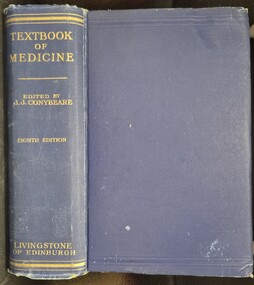
Book - Textbook, Sir John Conybeare, Textbook of medicine, 1946
... Internal medicine...First edition published in 1929 provides insight into medical practice in the 1940's Internal medicine Medical practice Vintage textbook compilation of medical knowledge previous catalogue number at top right of front end-page[pencil] ' Doreen Henricksen/April 1947' top right of page i [blue ink] 'D. ...Vintage textbook compilation of medical knowledgeBook with dark blue binding. Gilt stamping on spine details title, editor, edition and publisher. At top and bottom of front and back covers there are some embossed lines.non-fictionVintage textbook compilation of medical knowledgeinternal medicine, medical practice -
 Flagstaff Hill Maritime Museum and Village
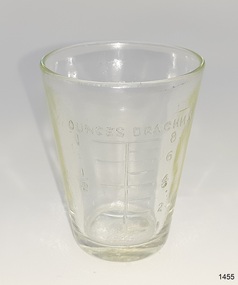
Container - Medicine Glass, ca. 1887 to early 20th century
... medicine measurement...sambell pharmacy warrnambool...sambell chemist and dentist...internal...medicine glass has ho manufacturer's or owner's marks. It has no side seams, the base is slightly concave, the embossed inscriptions are inside the glass, the clear glass has slight imperfections and ripples, and the glass is slightly opaque below the lip; these features point to the glass being blown into a mould, partially set, and spun between that mould and an internal mould that had the embossing on it, called a turn-mould process. ...medicine glass has ho manufacturer's or owner's marks. It has no side seams, the base is slightly concave, the embossed inscriptions are inside the glass, the clear glass has slight imperfections and ripples, and the glass is slightly opaque below the lip; these features point to the glass being blown into a mould, partially set, and spun between that mould and an internal mould that had the embossing on it, called a turn-mould process. ...This small medicine glass has ho manufacturer's or owner's marks. It has no side seams, the base is slightly concave, the embossed inscriptions are inside the glass, the clear glass has slight imperfections and ripples, and the glass is slightly opaque below the lip; these features point to the glass being blown into a mould, partially set, and spun between that mould and an internal mould that had the embossing on it, called a turn-mould process. The lip was then ground to be smooth. The process was patented in 1887 with the title of "Mold for blowing turned bottles".This medicine glass is significant as an example of medical equipment that has a design still used today. It is significant also for having the embossing inside the glass, which was likely produced by the turn-mould method of bottle (and container) making.Medicine glass or dose cup; clear glass with small imperfections and ripples in the glass, no side seams and a slightly concave base. All embossed marks are inside the glass. The imperial measurements are in graduated scales for tablespoons, teaspoons, and ounces and drachmas. "OUNCES DRACHMS" "TABLE TEA"flagstaff hill, warrnambool, shipwrecked coast, flagstaff hill maritime museum, maritime museum, shipwreck coast, flagstaff hill maritime village, great ocean road, medicine glass, measuring glass, dose cup, medicine dispensing, medicine measurement, sambell pharmacy warrnambool, sambell chemist and dentist, internal embossing, glass embossed inside, 20th century chemist, blown glass, two-piece mould, turn-moulded glass, turned bottles -
 Flagstaff Hill Maritime Museum and Village
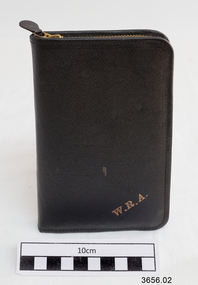
Container - Surgical Instrument Case, mid 20th century
... medicine from late 19th to mid-20th century. Dr Angus assisted Dr Tom Ryan, a pioneer in the use of X-rays and in ocular surgery. flagstaff hill warrnambool shipwrecked coast flagstaff hill maritime museum maritime museum shipwreck coast flagstaff hill maritime village great ocean road dr w r angus dr ryan surgical instrument t.s.s. largs bay warrnambool base hospital nhill base hospital mira hospital flying doctor medical treatment surgical instrument case surgical kit portable surgical instruments medical carry case medical instruments and accessories Gold print initials across corner on outside of case "W.R.A.". Maker's stamp on internal ...This surgical instrument case belonged to Dr. W.R. Angus, who had many portable medical and surgical sets in his possession. The case was donated to Flagstaff Hill Maritime Village by the family of Doctor William Roy Angus, Surgeon and Oculist. It is part of the “W.R. Angus Collection” that includes historical medical equipment, surgical instruments and material once belonging to Dr Edward Ryan and Dr Thomas Francis Ryan, (both of Nhill, Victoria) as well as Dr Angus’ own belongings. The Collection’s history spans the medical practices of the two Doctors Ryan, from 1885-1926 plus that of Dr Angus, up until 1969. ABOUT THE “W.R.ANGUS COLLECTION” Doctor William Roy Angus M.B., B.S., Adel., 1923, F.R.C.S. Edin.,1928 (also known as Dr Roy Angus) was born in Murrumbeena, Victoria in 1901 and lived until 1970. He qualified as a doctor in 1923 at University of Adelaide, was Resident Medical Officer at the Royal Adelaide Hospital in 1924 and for a period was house surgeon to Sir (then Mr.) Henry Simpson Newland. Dr Angus was briefly an Assistant to Dr Riddell of Kapunda, then commenced private practice at Curramulka, Yorke Peninsula, SA, where he was physician, surgeon and chemist. In 1926, he was appointed as new Medical Assistant to Dr Thomas Francis Ryan (T.F. Ryan, or Tom), in Nhill, Victoria, where his experiences included radiology and pharmacy. In 1927 he was Acting House Surgeon in Dr Tom Ryan’s absence. Dr Angus had become engaged to Gladys Forsyth and they decided he would take time to further his studies overseas in the UK in 1927. He studied at London University College Hospital and at Edinburgh Royal Infirmary and in 1928, was awarded FRCS (Fellow from the Royal College of Surgeons), Edinburgh. He worked his passage back to Australia as a Ship’s Surgeon on the on the Australian Commonwealth Line’s T.S.S. Largs Bay. Dr Angus married Gladys in 1929, in Ballarat. (They went on to have one son (Graham 1932, born in SA) and two daughters (Helen (died 12/07/1996) and Berenice (Berry), both born at Mira, Nhill ) Dr Angus was a ‘flying doctor’ for the A.I.M. (Australian Inland Ministry) Aerial Medical Service in 1928 . The organisation began in South Australia through the Presbyterian Church in that year, with its first station being in the remote town of Oodnadatta, where Dr Angus was stationed. He was locum tenens there on North-South Railway at 21 Mile Camp. He took up this ‘flying doctor’ position in response to a call from Dr John Flynn; the organisation was later known as the Flying Doctor Service, then the Royal Flying Doctor Service. A lot of his work during this time involved dental surgery also. Between 1928-1932 he was surgeon at the Curramulka Hospital, Yorke Peninsula, South Australia. In 1933 Dr Angus returned to Nhill where he’d previously worked as Medical Assistant and purchased a share of the Nelson Street practice and Mira hospital from Dr Les Middleton one of the Middleton Brothers, the current owners of what was once Dr Tom Ryan’s practice. Dr L Middleton was House Surgeon to the Nhill Hospital 1926-1933, when he resigned. [Dr Tom Ryan’s practice had originally belonged to his older brother Dr Edward Ryan, who came to Nhill in 1885. Dr Edward saw patients at his rooms, firstly in Victoria Street and in 1886 in Nelson Street, until 1901. The Nelson Street practice also had a 2 bed ward, called Mira Private Hospital ). Dr Edward Ryan was House Surgeon at the Nhill Hospital 1884-1902 . He also had occasions where he successfully performed veterinary surgery for the local farmers too. Dr Tom Ryan then purchased the practice from his brother in 1901. Both Dr Edward and Dr Tom Ryan work as surgeons included eye surgery. Dr Tom Ryan performed many of his operations in the Mira private hospital on his premises. He too was House Surgeon at the Nhill Hospital 1902-1926. Dr Tom Ryan had one of the only two pieces of radiology equipment in Victoria during his practicing years – The Royal Melbourne Hospital had the other one. Over the years Dr Tom Ryan gradually set up what was effectively a training school for country general-practitioner-surgeons. Each patient was carefully examined, including using the X-ray machine, and any surgery was discussed and planned with Dr Ryan’s assistants several days in advance. Dr Angus gained experience in using the X-ray machine there during his time as assistant to Dr Ryan. Dr Tom Ryan moved from Nhill in 1926. He became a Fellow of the Royal Australasian College of Surgeons in 1927, soon after its formation, a rare accolade for a doctor outside any of the major cities. He remained a bachelor and died suddenly on 7th Dec 1955, aged 91, at his home in Ararat. Scholarships and prizes are still awarded to medical students in the honour of Dr T.F. Ryan and his father, Dr Michael Ryan, and brother, John Patrick Ryan. ] When Dr Angus bought into the Nelson Street premises in Nhill he was also appointed as the Nhill Hospital’s Honorary House Surgeon 1933-1938. His practitioner’s plate from his Nhill surgery states “HOURS Daily, except Tuesdays, Fridays and Saturday afternoons, 9-10am, 2-4pm, 7-8pm. Sundays by appointment”. This plate is now mounted on the doorway to the Port Medical Office at Flagstaff Hill Maritime Village, Warrnambool. Dr Edward Ryan and Dr Tom Ryan had an extensive collection of historical medical equipment and materials spanning 1884-1926 and when Dr Angus took up practice in their old premises he obtained this collection, a large part of which is now on display at the Port Medical Office at Flagstaff Hill Maritime Village in Warrnambool. During his time in Nhill Dr Angus was involved in the merging of the Mira Hospital and Nhill Public Hospital into one public hospital and the property titles passed on to Nhill Hospital in 1939. In 1939 Dr Angus and his family moved to Warrnambool where he purchased “Birchwood,” the 1852 home and medical practice of Dr John Hunter Henderson, at 214 Koroit Street. (This property was sold in1965 to the State Government and is now the site of the Warrnambool Police Station. ). The Angus family was able to afford gardeners, cooks and maids; their home was a popular place for visiting dignitaries to stay whilst visiting Warrnambool. Dr Angus had his own silk worm farm at home in a Mulberry tree. His young daughter used his centrifuge for spinning the silk. Dr Angus was appointed on a part-time basis as Port Medical Officer (Health Officer) in Warrnambool and held this position until the 1940’s when the government no longer required the service of a Port Medical Officer in Warrnambool; he was thus Warrnambool’s last serving Port Medical Officer. (The duties of a Port Medical Officer were outlined by the Colonial Secretary on 21st June, 1839 under the terms of the Quarantine Act. Masters of immigrant ships arriving in port reported incidents of diseases, illness and death and the Port Medical Officer made a decision on whether the ship required Quarantine and for how long, in this way preventing contagious illness from spreading from new immigrants to the residents already in the colony.) Dr Angus was a member of the Australian Medical Association, for 35 years and surgeon at the Warrnambool Base Hospital 1939-1942, He served as a Surgeon Captain during WWII 1941-45, in Ballarat, Victoria, and in Bonegilla, N.S.W., completing his service just before the end of the war due to suffering from a heart attack. During his convalescence he carved an intricate and ‘most artistic’ chess set from the material that dentures were made from. He then studied ophthalmology at the Royal Melbourne Eye and Ear Hospital and created cosmetically superior artificial eyes by pioneering using the intrascleral cartilage. Angus received accolades from the Ophthalmological Society of Australasia for this work. He returned to Warrnambool to commence practice as an ophthalmologist, pioneering in artificial eye improvements. He was Honorary Consultant Ophthalmologist to Warrnambool Base Hospital for 31 years. He made monthly visits to Portland as a visiting surgeon, to perform eye surgery. He represented the Victorian South-West subdivision of the Australian Medical Association as its secretary between 1949 and 1956 and as chairman from 1956 to 1958. In 1968 Dr Angus was elected member of Spain’s Barraquer Institute of Barcelona after his research work in Intrasclearal cartilage grafting, becoming one of the few Australian ophthalmologists to receive this honour, and in the following year presented his final paper on Living Intrasclearal Cartilage Implants at the Inaugural Meeting of the Australian College of Ophthalmologists in Melbourne In his personal life Dr Angus was a Presbyterian and treated Sunday as a Sabbath, a day of rest. He would visit 3 or 4 country patients on a Sunday, taking his children along ‘for the ride’ and to visit with him. Sunday evenings he would play the pianola and sing Scottish songs to his family. One of Dr Angus’ patients was Margaret MacKenzie, author of a book on local shipwrecks that she’d seen as an eye witness from the late 1880’s in Peterborough, Victoria. In the early 1950’s Dr Angus, painted a picture of a shipwreck for the cover jacket of Margaret’s book, Shipwrecks and More Shipwrecks. She was blind in later life and her daughter wrote the actual book for her. Dr Angus and his wife Gladys were very involved in Warrnambool’s society with a strong interest in civic affairs. Their interests included organisations such as Red Cross, Rostrum, Warrnambool and District Historical Society (founding members), Wine and Food Society, Steering Committee for Tertiary Education in Warrnambool, Local National Trust, Good Neighbour Council, Housing Commission Advisory Board, United Services Institute, Legion of Ex-Servicemen, Olympic Pool Committee, Food for Britain Organisation, Warrnambool Hospital, Anti-Cancer Council, Boys’ Club, Charitable Council, National Fitness Council and Air Raid Precautions Group. He was also a member of the Steam Preservation Society and derived much pleasure from a steam traction engine on his farm. He had an interest in people and the community He and his wife Gladys were both involved in the creation of Flagstaff Hill, including the layout of the gardens. After his death (28th March 1970) his family requested his practitioner’s plate, medical instruments and some personal belongings be displayed in the Port Medical Office surgery at Flagstaff Hill Maritime Village, and be called the “W. R. Angus Collection”. The W.R. Angus Collection is significant for still being located at the site it is connected with, Doctor Angus being the last Port Medical Officer in Warrnambool. The collection of medical instruments and other equipment is culturally significant, being an historical example of medicine from late 19th to mid-20th century. Dr Angus assisted Dr Tom Ryan, a pioneer in the use of X-rays and in ocular surgery. Surgical instrument case, black leather pouch with metal zipper closure, part of the W.R. Angus Collection. Inside is a removable white fabric insert with loops for storing surgical instruments, attached with press studs. Initials are embossed on the case in gold “W.R.A.”. The cloth insert has a maker’s stamp on it (illegible).Gold print initials across corner on outside of case "W.R.A.". Maker's stamp on internal clot (Illegible).flagstaff hill, warrnambool, shipwrecked coast, flagstaff hill maritime museum, maritime museum, shipwreck coast, flagstaff hill maritime village, great ocean road, dr w r angus, dr ryan, surgical instrument, t.s.s. largs bay, warrnambool base hospital, nhill base hospital, mira hospital, flying doctor, medical treatment, surgical instrument case, surgical kit, portable surgical instruments, medical carry case, medical instruments and accessories -
 Flagstaff Hill Maritime Museum and Village
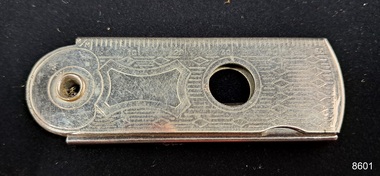
Tool - Cigar Cutter
... medicine from late 19th to mid-20th century. Dr Angus assisted Dr Tom Ryan, a pioneer in the use of X-rays and in ocular surgery. Flagstaff Hill Maritime Museum and Village Great Ocean Road Shipwreck Coast Cigar Cutters Cigars Tobacco Smoking W.R. Angus 'Ever-Ready BRITISH MADE'. Small ruler: 2 inches and 50 millimetres on the sides. Incised decorative pattern. A chrome plated metal cigar cutter. Ruler measurements are marked along one edge. A swivel joint joins an internal ...This cigar cutter belonged to Dr.William Roy Angus, Surgeon and Oculist. It was donated to Flagstaff Hill Maritime Village by his daughter, Bernice McDade. It is part of the “W.R. Angus Collection” that includes historical medical equipment, surgical instruments and material once belonging to Dr Edward Ryan and Dr Thomas Francis Ryan, (both of Nhill, Victoria) as well as Dr Angus’ own belongings. The Collection’s history spans the medical practices of the two Doctors Ryan, from 1885-1926 plus that of Dr Angus, up until 1969. ABOUT THE “W.R.ANGUS COLLECTION” Doctor William Roy Angus M.B., B.S., Adel., 1923, F.R.C.S. Edin.,1928 (also known as Dr Roy Angus) was born in Murrumbeena, Victoria in 1901 and lived until 1970. He qualified as a doctor in 1923 at University of Adelaide, was Resident Medical Officer at the Royal Adelaide Hospital in 1924 and for a period was house surgeon to Sir (then Mr.) Henry Simpson Newland. Dr Angus was briefly an Assistant to Dr Riddell of Kapunda, then commenced private practice at Curramulka, Yorke Peninsula, SA, where he was physician, surgeon and chemist. In 1926, he was appointed as new Medical Assistant to Dr Thomas Francis Ryan (T.F. Ryan, or Tom), in Nhill, Victoria, where his experiences included radiology and pharmacy. In 1927 he was Acting House Surgeon in Dr Tom Ryan’s absence. Dr Angus had become engaged to Gladys Forsyth and they decided he would take time to further his studies overseas in the UK in 1927. He studied at London University College Hospital and at Edinburgh Royal Infirmary and in 1928, was awarded FRCS (Fellow from the Royal College of Surgeons), Edinburgh. He worked his passage back to Australia as a Ship’s Surgeon on the on the Australian Commonwealth Line’s T.S.S. Largs Bay. Dr Angus married Gladys in 1929, in Ballarat. (They went on to have one son (Graham 1932, born in SA) and two daughters (Helen (died 12/07/1996) and Berenice (Berry), both born at Mira, Nhill ) Dr Angus was a ‘flying doctor’ for the A.I.M. (Australian Inland Ministry) Aerial Medical Service in 1928 . The organisation began in South Australia through the Presbyterian Church in that year, with its first station being in the remote town of Oodnadatta, where Dr Angus was stationed. He was locum tenens there on North-South Railway at 21 Mile Camp. He took up this ‘flying doctor’ position in response to a call from Dr John Flynn; the organisation was later known as the Flying Doctor Service, then the Royal Flying Doctor Service. A lot of his work during this time involved dental surgery also. Between 1928-1932 he was surgeon at the Curramulka Hospital, Yorke Peninsula, South Australia. In 1933 Dr Angus returned to Nhill where he’d previously worked as Medical Assistant and purchased a share of the Nelson Street practice and Mira hospital from Dr Les Middleton one of the Middleton Brothers, the current owners of what was once Dr Tom Ryan’s practice. Dr L Middleton was House Surgeon to the Nhill Hospital 1926-1933, when he resigned. [Dr Tom Ryan’s practice had originally belonged to his older brother Dr Edward Ryan, who came to Nhill in 1885. Dr Edward saw patients at his rooms, firstly in Victoria Street and in 1886 in Nelson Street, until 1901. The Nelson Street practice also had a 2 bed ward, called Mira Private Hospital ). Dr Edward Ryan was House Surgeon at the Nhill Hospital 1884-1902 . He also had occasions where he successfully performed veterinary surgery for the local farmers too. Dr Tom Ryan then purchased the practice from his brother in 1901. Both Dr Edward and Dr Tom Ryan work as surgeons included eye surgery. Dr Tom Ryan performed many of his operations in the Mira private hospital on his premises. He too was House Surgeon at the Nhill Hospital 1902-1926. Dr Tom Ryan had one of the only two pieces of radiology equipment in Victoria during his practicing years – The Royal Melbourne Hospital had the other one. Over the years Dr Tom Ryan gradually set up what was effectively a training school for country general-practitioner-surgeons. Each patient was carefully examined, including using the X-ray machine, and any surgery was discussed and planned with Dr Ryan’s assistants several days in advance. Dr Angus gained experience in using the X-ray machine there during his time as assistant to Dr Ryan. Dr Tom Ryan moved from Nhill in 1926. He became a Fellow of the Royal Australasian College of Surgeons in 1927, soon after its formation, a rare accolade for a doctor outside any of the major cities. He remained a bachelor and died suddenly on 7th Dec 1955, aged 91, at his home in Ararat. Scholarships and prizes are still awarded to medical students in the honour of Dr T.F. Ryan and his father, Dr Michael Ryan, and brother, John Patrick Ryan. ] When Dr Angus bought into the Nelson Street premises in Nhill he was also appointed as the Nhill Hospital’s Honorary House Surgeon 1933-1938. His practitioner’s plate from his Nhill surgery states “HOURS Daily, except Tuesdays, Fridays and Saturday afternoons, 9-10am, 2-4pm, 7-8pm. Sundays by appointment”. This plate is now mounted on the doorway to the Port Medical Office at Flagstaff Hill Maritime Village, Warrnambool. Dr Edward Ryan and Dr Tom Ryan had an extensive collection of historical medical equipment and materials spanning 1884-1926 and when Dr Angus took up practice in their old premises he obtained this collection, a large part of which is now on display at the Port Medical Office at Flagstaff Hill Maritime Village in Warrnambool. During his time in Nhill Dr Angus was involved in the merging of the Mira Hospital and Nhill Public Hospital into one public hospital and the property titles passed on to Nhill Hospital in 1939. In 1939 Dr Angus and his family moved to Warrnambool where he purchased “Birchwood,” the 1852 home and medical practice of Dr John Hunter Henderson, at 214 Koroit Street. (This property was sold in1965 to the State Government and is now the site of the Warrnambool Police Station. ). The Angus family was able to afford gardeners, cooks and maids; their home was a popular place for visiting dignitaries to stay whilst visiting Warrnambool. Dr Angus had his own silk worm farm at home in a Mulberry tree. His young daughter used his centrifuge for spinning the silk. Dr Angus was appointed on a part-time basis as Port Medical Officer (Health Officer) in Warrnambool and held this position until the 1940’s when the government no longer required the service of a Port Medical Officer in Warrnambool; he was thus Warrnambool’s last serving Port Medical Officer. (The duties of a Port Medical Officer were outlined by the Colonial Secretary on 21st June, 1839 under the terms of the Quarantine Act. Masters of immigrant ships arriving in port reported incidents of diseases, illness and death and the Port Medical Officer made a decision on whether the ship required Quarantine and for how long, in this way preventing contagious illness from spreading from new immigrants to the residents already in the colony.) Dr Angus was a member of the Australian Medical Association, for 35 years and surgeon at the Warrnambool Base Hospital 1939-1942, He served as a Surgeon Captain during WWII1942-45, in Ballarat, Victoria, and in Bonegilla, N.S.W., completing his service just before the end of the war due to suffering from a heart attack. During his convalescence he carved an intricate and ‘most artistic’ chess set from the material that dentures were made from. He then studied ophthalmology at the Royal Melbourne Eye and Ear Hospital and created cosmetically superior artificial eyes by pioneering using the intrascleral cartilage. Angus received accolades from the Ophthalmological Society of Australasia for this work. He returned to Warrnambool to commence practice as an ophthalmologist, pioneering in artificial eye improvements. He was Honorary Consultant Ophthalmologist to Warrnambool Base Hospital for 31 years. He made monthly visits to Portland as a visiting surgeon, to perform eye surgery. He represented the Victorian South-West subdivision of the Australian Medical Association as its secretary between 1949 and 1956 and as chairman from 1956 to 1958. In 1968 Dr Angus was elected member of Spain’s Barraquer Institute of Barcelona after his research work in Intrasclearal cartilage grafting, becoming one of the few Australian ophthalmologists to receive this honour, and in the following year presented his final paper on Living Intrasclearal Cartilage Implants at the Inaugural Meeting of the Australian College of Ophthalmologists in Melbourne In his personal life Dr Angus was a Presbyterian and treated Sunday as a Sabbath, a day of rest. He would visit 3 or 4 country patients on a Sunday, taking his children along ‘for the ride’ and to visit with him. Sunday evenings he would play the pianola and sing Scottish songs to his family. One of Dr Angus’ patients was Margaret MacKenzie, author of a book on local shipwrecks that she’d seen as an eye witness from the late 1880’s in Peterborough, Victoria. In the early 1950’s Dr Angus, painted a picture of a shipwreck for the cover jacket of Margaret’s book, Shipwrecks and More Shipwrecks. She was blind in later life and her daughter wrote the actual book for her. Dr Angus and his wife Gladys were very involved in Warrnambool’s society with a strong interest in civic affairs. Their interests included organisations such as Red Cross, Rostrum, Warrnambool and District Historical Society (founding members), Wine and Food Society, Steering Committee for Tertiary Education in Warrnambool, Local National Trust, Good Neighbour Council, Housing Commission Advisory Board, United Services Institute, Legion of Ex-Servicemen, Olympic Pool Committee, Food for Britain Organisation, Warrnambool Hospital, Anti-Cancer Council, Boys’ Club, Charitable Council, National Fitness Council and Air Raid Precautions Group. He was also a member of the Steam Preservation Society and derived much pleasure from a steam traction engine on his farm. He had an interest in people and the community He and his wife Gladys were both involved in the creation of Flagstaff Hill, including the layout of the gardens. After his death (28th March 1970) his family requested his practitioner’s plate, medical instruments and some personal belongings be displayed in the Port Medical Office surgery at Flagstaff Hill Maritime Village, and be called the “W. R. Angus Collection”.The W.R. Angus Collection is significant for still being located at the site it is connected with, Doctor Angus being the last Port Medical Officer in Warrnambool. The collection of medical instruments and other items and equipment is culturally significant, being an historical example of medicine from late 19th to mid-20th century. Dr Angus assisted Dr Tom Ryan, a pioneer in the use of X-rays and in ocular surgery.A chrome plated metal cigar cutter. Ruler measurements are marked along one edge. A swivel joint joins an internal blade at one end. Inscriptions are on moulded into the cutter. Made in Britain.The object is part of the W.R. Angus Collection. 'Ever-Ready BRITISH MADE'. Small ruler: 2 inches and 50 millimetres on the sides. Incised decorative pattern. flagstaff hill maritime museum and village, great ocean road, shipwreck coast, cigar cutters, cigars, tobacco, smoking, w.r. angus -
 Flagstaff Hill Maritime Museum and Village
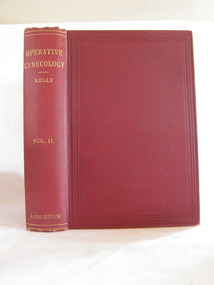
Book - Reference Medical/ Gynaecology, Howard Kelly et al, Operative Gynaecology Vol 2, 1906
... internal reproductive organs and neighbouring abdominal structures. The books are a technical, richly illustrated manuals for gynaecological surgery rather than a general medicine text. ...The subject texts, Operative Gynaecology, Volume I & 2 is a surgical two volume textbook on diseases and operations involving the female reproductive system, written by Howard A. Kelly and illustrated in part by Max Brödel. In the division between Volume 1 and Volume 2 there follows a logical anatomical and procedural split. Whereas Volume 1 concentrates on fundamental surgical principles, diagnostics, and operations on the lower genital/urinary tract. Volume 2 shifts focus to intra-abdominal, pelvic, and major organ surgeries. Volume 2 transitions into major intra-abdominal procedures (laparotomies/celiotomies) involving internal reproductive organs and neighbouring abdominal structures. The books are a technical, richly illustrated manuals for gynaecological surgery rather than a general medicine text. Its subject is operative treatment, anatomy, instruments, procedures, and surgical technique in women’s diseases, reflecting the early 20th-century development of gynaecology as a specialised surgical field.Operative Gynecology Vol 2 Author: Howard Kelly Illustrator: Max Brodel Publisher: D. Appleton & Co. Date: 1906 Further Information: Red Cloth Cover and Spine Lettering to Spine in Gilt.non-fictionThe subject texts, Operative Gynaecology, Volume I & 2 is a surgical two volume textbook on diseases and operations involving the female reproductive system, written by Howard A. Kelly and illustrated in part by Max Brödel. In the division between Volume 1 and Volume 2 there follows a logical anatomical and procedural split. Whereas Volume 1 concentrates on fundamental surgical principles, diagnostics, and operations on the lower genital/urinary tract. Volume 2 shifts focus to intra-abdominal, pelvic, and major organ surgeries. Volume 2 transitions into major intra-abdominal procedures (laparotomies/celiotomies) involving internal reproductive organs and neighbouring abdominal structures. The books are a technical, richly illustrated manuals for gynaecological surgery rather than a general medicine text. Its subject is operative treatment, anatomy, instruments, procedures, and surgical technique in women’s diseases, reflecting the early 20th-century development of gynaecology as a specialised surgical field.flagstaff hill, warrnambool, shipwrecked-coast, flagstaff-hill, flagstaff-hill-maritime-museum, maritime-museum, shipwreck-coast, flagstaff-hill-maritime-village, operative gynecology vol 1, book, howard kelly -
 Geoffrey Kaye Museum of Anaesthetic History
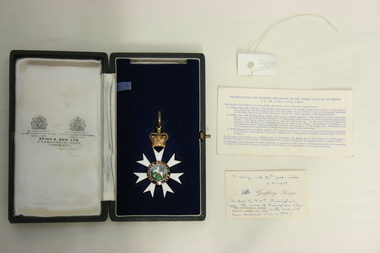
Ceremonial object - Medal, Companion of the Third Class of the Order of St Michael and St George, Circa 1966
... medicine and anaesthesia. Medal St Michael St George Anaesthesia Harry Daly Printed on internal satin lining: BY APPOINTMENT / TO HER MAJESTY THE QUEEN / MEDALLISTS / BY APPOINTMENT / H.R.H. ...In 1966 Harry Daly was admitted to the Order of St Michael and St George in recognition of over 35 years of service to medicine and anaesthesia.Large white enamelled seven armed Maltese Cross set around a dark blue ring bearing the Latin motto 'Auspicium Melioris Aevi'. The obverse depicting St Michael standing on the devil and the reverse St George on horseback killing a dragon. The medal comes with its blue-crimson-blue ribbon folded and stored under the velour badge holder. Medal and ribbon are set and stored in its custom made black case with the badge acronym in gold lettering on the top of the case [C.M.G.]. There is a card with instructions for wearing the medal under the velour holder along with a note from Geoffrey Kaye to Harry Daley.Printed on internal satin lining: BY APPOINTMENT / TO HER MAJESTY THE QUEEN / MEDALLISTS / BY APPOINTMENT / H.R.H. THE DUKE OF EDINBURGH / MEDALLISTS. / SPINK & SON, LTD. / 5 - 7, KING STREET, ST. JAMES'S, / LONDON, S.W.1.medal, st michael, st george, anaesthesia, harry daly -
 Bendigo Historical Society Inc.
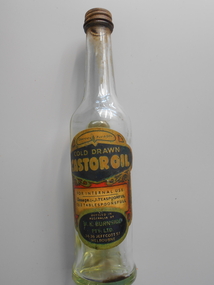
Container - PHARMACY COLLECTION: CASTOR OIL BOTTLE, 1930's
... MEDICINE First aid castor oil bottle 121 504 Object. Tall clear glass bottle with label for 'Cold Drawn Castor Oil", for internal use dosage 1 teaspoon - 2 tablespoons full. ...Object. Tall clear glass bottle with label for 'Cold Drawn Castor Oil", for internal use dosage 1 teaspoon - 2 tablespoons full. Bottled in Australia by W.K.Burnside Pty Ltd, 34-36 Jeffcott Street Melbourne. W.K.Burnside founding member of Eaglehawk United Friendly Society. EUFS opened in the building that had originally been his Pharmacy in Eaglehawk.121 504medicine, first aid, castor oil bottle -
 Bendigo Historical Society Inc.
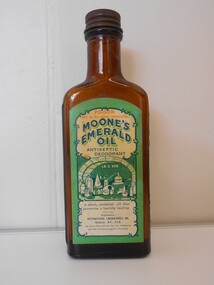
Container - PHARMACY COLLECTION: BOTTLE OF MOONES EMERALD OIL, 1920's
... MEDICINE First aid Emerald oil Poison.. Not to be Taken internally. Object. ...Object. Small amber glass bottle rectangular in cross section. Label in green, white and red for moone's Emerald Oil. Antiseptic and deodorant by International Laboratories Inc. Rochester New York USA. For whom Riley-Williams Pty Ltd Melbourne are sole distributing Agents in Australia. Small stamped metal screw top cap. Directions label on back.Poison.. Not to be Taken internally.medicine, first aid, emerald oil -
 Friends of Westgarthtown
Functional object - Bottle
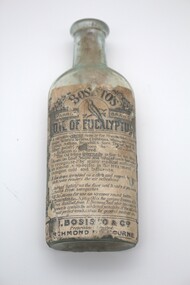
... medicine first aid bosisto richmond eucalyptus domestic remedy oil. Paper label on front of bottle reads " A valuable external remedy for rheumatism lumbago, sciatica, sprains, chilblains, whooping cough, Croop, asthma, bronchitis, sore throat and all other painful afflictions whenever stimulating applications is required. The oil taken internally ...Clear glass bottle oval shaped. Embossed on back J. Bosisto Richmond. Paper label on front reads "Bossisto's Parrot Brand Oil of Eucalyptus".Paper label on front of bottle reads " A valuable external remedy for rheumatism lumbago, sciatica, sprains, chilblains, whooping cough, Croop, asthma, bronchitis, sore throat and all other painful afflictions whenever stimulating applications is required. The oil taken internally in five to six drop doses on loaf sugar and inhaled over hot water is recognised as many medical authorities as almost a specific in the treatment of common cold and influenza. A few drops sprinkled on a cloth and suspended in a sick room renders the air refreshing. Rubbed lightly on the face and hands it prevents attacks from mosquitoes. Full directions for use on full wrapper around bottle. Bosistos Eucalyptus Oil is the genbuine essence of the Tree distilled from E. Ihumosa and other speicies best known to contain the medicial purposes of the oil in the most perfect combination for general medical use. Embossed on back of bottle reads J. Bosisto Richmond.medicine, first aid, bosisto, richmond, eucalyptus, domestic, remedy, oil. -
 Mont De Lancey
Domestic object - Four Medicinal Bottles, Sigma, Unknown
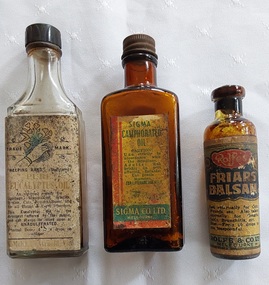
... Could be taken internally for Coughs, Colds, Bronchitis, etc. 10 drops to one teaspoonful. The Bosisto bottle probably contained eucalyptus oil. Medicines ...These medicinal products were used in the 1900's. Eucalyptus oil was used both externally for Lumbago, Rheumatism, Sciatica, Sprains, Cuts, Bruises and Burns and for all Throat and Cough disorders. McKean's Camphorated Oil was to be used carefully and under strict Accordance with the instructions. Adults to rub briskly on part affected, Infant use to be massaged gently. McKean's were in operation from 1890's - c1960's. The company appeared to have ceased in 2012. Friars Balsam similarly was used externally for Cuts, Wounds, etc. Could be taken internally for Coughs, Colds, Bronchitis, etc. 10 drops to one teaspoonful. The Bosisto bottle probably contained eucalyptus oil.Four glass medicinal bottles: 1. A small clear glass McKean's "Helping Hand' Eucalyptus Oil bottle, with a faded paper label with Trade Mark surrounding a hand illustration with leaves. Unadulterated is printed at the bottom of this label. Pure Eucalyptus Oil with its uses is included. On the back is a paper label with further instructions for use. The screw top bakelite lid is broken. 2. An angular shaped small brown SIGMA Camphorated Oil bottle with a stained paper label of the manufacturer details and uses. It has 'NOT TO BE TAKEN' stamped into one of the edges on the side of the bottle. Two other sides have three rows of crosses as a pattern. The metal screwtop lid is rusted. F1071 is stamped on the base. 3. A very small round brown Rolfe's Friars Balsam bottle with a broken cork stopper. It has a faded paper label with uses and the manufacturer's details. 4. A small blue tinted clear glass J. Bosisto medicine bottle with rounded corners and flattened sides on the front and back surfaces.The flat lip at he opening could have been sealed with a stopper. The sides of the bottle have a vertical joining line.1. 'McKean's 'Helping Hand' Eucalyptus Oil'. It has a faded paper label with 'Trade Mark (Registered) surrounding a hand illustration with leaves. Pure Eucalyptus Oil' 2. 'SIGMA Camphorated Oil SIGMA CO. LTD Melbourne'. 3. 'Rolfe's FRIARS BALSAM Rolfe & Co. Ltd. Melbourne'. 4. 'J. Bosisto Richmond' is stamped on front side of the front. On the base is stamped ' "English Bottles" '.medicines, medicine bottles, medicinal containers -
 Mont De Lancey
Glass bottle
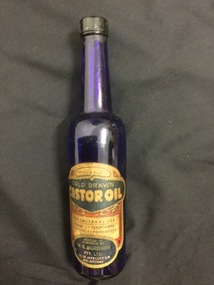
... bottles, containers, medicine containers On label: "Contents 6 fluid ozs. Cold drawn Castor Oil. For internal use. ...Narrow, blue castor oil bottle with bakelite screw-on top and distinctively-shaped label.On label: "Contents 6 fluid ozs. Cold drawn Castor Oil. For internal use. Dosage: 1 teaspoonful to 2 tablespoons full. Bottled in Australia by W.K. Burnside Pty. Ltd. 34-36 Jeffcott St. Melbourne.bottles, containers, medicine containers -
 Mont De Lancey
Glass bottle, Pitt & Sons
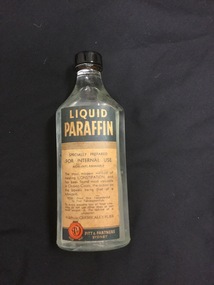
... bottles, containers, medicine bottles On label: "Liquid Paraffin. Specially prepared for Internal use. ...Clear glass liquid paraffin oil bottle with black bakelite screw-on top and label. 3/4 full of liquid.On label: "Liquid Paraffin. Specially prepared for Internal use. Non inflammable. The most modern method of treating CONSTIPATION an d has been found most valuable in chronic cases, the action on the bowels being that of a lubricant. DOSE: from one teaspoonful to 2 tablespoonfuls. To avoid loss of food vitamins, do not use other than at bedtime, except on the advice of a physician. BB 1932 CHEMICALLY PURE. PITT & PARTNERS SYDNEY."bottles, containers, medicine bottles
