
Showing 53 items matching "irish settlers"
-
 City of Moorabbin Historical Society (Operating the Box Cottage Museum)
Book - The Living Harvest - A history of St. Peter's Parish, East Bentleigh, by W. T. Dobson, 1974
... ...Irish settlers...St Peter's School, East Bentleigh was erected by the many Irish Market Gardeners of Moorrabin in 1865 and was integral to the education, spiritual well being and social life of the early settlers. early settlers parish of moorabbin city of moorabbin county of bourke shire of moorabbin market gardeners Center Road Irish settlers East Bentleigh St Peter's Church East Bentleigh Religion Catholic A book on the history of St Peter's Parish, Centre Road, East Bentleigh, with pictures. 57 pages. ...The first building that was erected in the Parish of St Peter's was a little wooden school house, built by local market gardeners in February 1865. The school was demolished and a brick school building was erected and opened in1903. St Peter's School, East Bentleigh was erected by the many Irish Market Gardeners of Moorrabin in 1865 and was integral to the education, spiritual well being and social life of the early settlers.A book on the history of St Peter's Parish, Centre Road, East Bentleigh, with pictures. 57 pages. Contains local history, history of early pioneer families, St Peter's School and the church.early settlers, parish of moorabbin, city of moorabbin, county of bourke, shire of moorabbin, market gardeners, center road, irish settlers, east bentleigh, st peter's church east bentleigh, religion, catholic -
 Sunshine and District Historical Society Incorporated
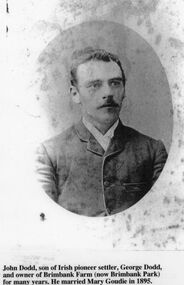
Photograph - Dodd and Goudie family connections, 1905
... Six photos of several members of the Dodd family and their connection through marriage with the Goudie family John Dodd son of Irish pioneer settler George Dodd owned Brimbank Farm now Brimbank Park for many years He married Mary Goudie in 1895 George Dodd came out from Ireland as an assisted migrant in 1840 with his four sisters Mary Delahey Bridget McIntyre Margaret Fitzgerald and Jane He married Mary Coffey and they settled at Oakly Park where nine children were born including John who later owned nearly Brimbank Farm now Brimbank Park George supervised the building of St Augustines Keilor The Dodd family had close links with this church overy many years...Susan Dodd Jane Goudie Six photos of several members of the Dodd family and their connection through marriage with the Goudie family John Dodd son of Irish pioneer settler George Dodd owned Brimbank Farm now Brimbank Park for many years He married Mary Goudie in 1895 George Dodd came out from Ireland as an assisted migrant in 1840 with his four sisters Mary Delahey Bridget McIntyre Margaret Fitzgerald and Jane He married Mary Coffey and they settled at Oakly Park where nine children were born including John who later owned nearly Brimbank Farm now Brimbank Park George supervised the building of St Augustines Keilor The Dodd family had close links with this church overy many years Dodd and Goudie family connections Photograph Dodd and Goudie family connections ...Six photos of several members of the Dodd family and their connection through marriage with the Goudie family John Dodd son of Irish pioneer settler George Dodd owned Brimbank Farm now Brimbank Park for many years He married Mary Goudie in 1895 George Dodd came out from Ireland as an assisted migrant in 1840 with his four sisters Mary Delahey Bridget McIntyre Margaret Fitzgerald and Jane He married Mary Coffey and they settled at Oakly Park where nine children were born including John who later owned nearly Brimbank Farm now Brimbank Park George supervised the building of St Augustines Keilor The Dodd family had close links with this church overy many yearssusan dodd, jane goudie -
Eltham District Historical Society Inc
Document - Folder, Sweeney
... Sweeney, Eltham's first Irish settler", Associated Newspapers Eltham Cenenary Supplement, 30 March 1971. ...Sweeney, Eltham's first Irish settler", Associated Newspapers Eltham Cenenary Supplement, 30 March 1971. ...Thomas Sweeney (1802-1867) was transported in 1823 and granted a conditional pardon in 1838. He married and moved to the Port Phillip District, buying land at Eltham. His house, "Culla Hill" (renamed "Sweeneys") still stands. Contents Typed notes, no author, no date, biography of Thomas Sweeney with copy of parish plan showing Sweeney's original and later land purchases. Typed timeline Thomas Sweeney and typed transcriptions of letters to and from La Trobe archives to Thomas Sweeney. Handwritten notes: Biography of Thomas Sweeney and his descendants, also transcription of letter 10 April 1849 wanting a bridge over the Plenty River, and transcription of C J La Trobe's reply. Photocopy magazine article: "Sweeneys: A home with a hisitory", Australian Home Beautiful, 1 February 1940. Story of Thomas Sweeney and his house, with photographs. Newspaper article: "Capt. Sweeney, Eltham's first Irish settler", Associated Newspapers Eltham Cenenary Supplement, 30 March 1971. Notes on Thomas Sweeney and his house. Photocopy of p.30, "Diamond Valley Sketchbook", Brian McKinlay, 1973. "Sweeney's Cottage, Eltham. Notes and drawing of Sweeneys. Newspaper article: "A convict's cottage", Diamond Valley News, 6 October 1981. Notes on Thomas Sweeney and his house. Newspaper article: "Talented cartoonist depicts story of an Eltham pioneer", Diamond Valley News, 18 February 1986. Judith Russell had drawn cartoons of Thomas Sweeney's life called "Sweeney". Prospectus "Historic Sweeneys Culla Hill, Auction 27 Noveber 1993, 3.00 pm": Photographs and history of property, with map of lots and vegetation.. Newspaper article: "A pioneer's cottage, new-age apartments and a leafy city retreat", The Age Real Estate, 21 June 1997. Photograph and details of "Sweeneys" Newspaper article: "Legacy of convict's success", Diamond Valley News, 2 July 1997. Notes on Thomas Sweeney and his house (for sale), photograph of John Sweeney and family. Printout, National Trust register: Sweeney's. History and description of Sweeneys. Letter Mary Nelson to Eltham District Historical Society, 14 October 2004, enclosing photocopies of material on "Culla Hill" and Mary Sweeney and Michael Carrucan.Newspaper clippings, A4 photocopies, etcthomas sweeney, mary sweeney, patrick sweeney, ship isabella, mary sweeney nee meehan, "culla hill" eltham, "sweeneys" eltham, sweeneys lane eltham, michael connors, patrick guyder, george brown of illawarra district, margaret sweeney nee meehan, paddy sweeney, john sweeney, kate sweene, margaret sweeney, ellen sweeney, annie sweeney], johanna sweeney, annie sweeney, caroline sweeney, mary carrucan nee sweeney, agatha sweeney, agnes sweeney, arthur sweeney, cassie sweeney, frank sweeney, victor burston, peter cuffley, jim murray, bridget sweeney nee coleman, graham caulfield, mccorlick real estate eltham, mary nelson, betty erickson nee carrucan, michael carrucan -
Glen Eira Historical Society
Article - St Peter's Catholic Church, Bentleigh East
... From The First White Settlers, The Irish Exodus, And The Irish Catholic families, The School House And The History Of The Parish & Clergy Up To 1974....From The First White Settlers, The Irish Exodus, And The Irish Catholic families, The School House And The History Of The Parish & Clergy Up To 1974. ...Included In The File is A Newspaper Clipping From The Age Newspaper, Dated Sat 09/11/1974 On The Opening Written By Stuart Sayers. The Article Mentions A Brief History Of The Church & School Beginnings & The Opening Ceremony. There Are Two Copies Of The Living Harvest (One Without The Cover), The Book Gives A Detailed History Of St Peter's Catholic Church, Bentleigh East Written By W.T. Dobson And Published in 1974. From The First White Settlers, The Irish Exodus, And The Irish Catholic families, The School House And The History Of The Parish & Clergy Up To 1974.st peter's catholic church, niall patrick rev, emerald hill, bentleigh east, dobson w. t., yarra, moorabbin, heriot m. b., elsternwick, north road, quinn fred, bentleigh, centre road, kennedy james joseph, melbourne south, bignell road, kennedy market garden, oakleigh, st peter's parish, st james parish, the living harvest, catholic church, hibernian society, bavarian brass band, st peter's primary school, st james regional college, brighton catholic school, brighton – st kilda mission, niall patrick william fr, dendy henry, guiney john mr, king richard, king john, keys george, o’ shanassy john, keys robert, were jonathan b., o’ connell john fr, glass hugh mr, o’ farrell peter, brady peter, kennedy james, boland michael, mccormick francis, orrong road, little brighton, oakleigh, port phillip bay, east boundary road, north road, ormond, old dandenong road, mordialloc creek, moorabbin, springvale, no good damper road, kingstown, keysborough, bignell road, south road, heatherton, big brighton, gardenvale, elsternwick, brady road, jasper road, chesterville road, cochrane road, mcguinness road, h.a.c.b.s., school house, st patrick's church, brighton parish, denominational school, little brighton school, moorabbin catholic school, temporary chapel, st james regional college, sister of mercy, lanigans ball, east brighton public hall company ltd, east bentleigh hall, messrs. robert dunn & son, bavarian brass band, st joan of arc parish, east bentleigh parish, the sisters of our lady of sacred heart, the anchor club, mccormick cornelius, cochrane james, cochrane david, mcguinness margaret, cormick john, cahill james, quinn frederick, prendegast john patrick, naughton dennis, leary william, charlston john, carey matthew fr, gibbons patrick, kennedy joseph james, o’ sullivan tim fr, mckenna fred fr, casey william fr, browne joseph fr, crawford mal fr, hanrahan mr, gillon rose miss, sampson kate mrs, horan miss, coakley daniel fr, dillon kevin fr, whitehouse ray fr, mannix daniel dr, dobson william mr, gahan patrick, hallinan thomas, delaney john, fitzgerald patrick, st peter's catholic church -
 Eltham District Historical Society Inc
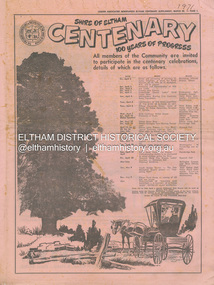
Newspaper - Supplement, Leader Associated Newspapers, Shire of Eltham Centenary; 100 Years of Progress, March 30, 1971
... Sweeney, Eltham’s first Irish settler Page 6 Station a tribute to ex-concillor Page 7 Eltham 25 Years Ago just a street Page 9 Kangaroo Ground – once the hub of the shire Page 10 Festival of Arts and Crafts at Montsalvat Page 11 Obelisk honours their memory Page 11 Henry Dendy – an Eltham venture Page 12 Free by rail – if they worked Page 12 The long shadow of Ween Cameron Page 13 McMahon’s – a momentous era Page 14 50 Years Ago . . . ...Sweeney, Eltham’s first Irish settler Page 6 Station a tribute to ex-concillor Page 7 Eltham 25 Years Ago just a street Page 9 Kangaroo Ground – once the hub of the shire Page 10 Festival of Arts and Crafts at Montsalvat Page 11 Obelisk honours their memory Page 11 Henry Dendy – an Eltham venture Page 12 Free by rail – if they worked Page 12 The long shadow of Ween Cameron Page 13 McMahon’s – a momentous era Page 14 50 Years Ago . . . ...Poduced as a supplement to the Diamond Valley News in celebration of the centenary of the Shire of Eltham in 1971. Contains stories of historical note about people and places of the shire as well as numerous advertisng by local businsesses. Also on page 1 lists the program of events commencing Friday, April 2 commencing with a dinner and previewing of paintings by Justus Jorgensen at Montsalvat attended by the Prime Minister, the Rt. Hon. W. H. McMahon running through to the publication of Pioneers & Painters edited by Alan Marshall. Contents: Page 1 Program of Events Page 2 Wingrove . . man of Eltham Page 3 Council people of 100 years Page 5 Capt. Sweeney, Eltham’s first Irish settler Page 6 Station a tribute to ex-concillor Page 7 Eltham 25 Years Ago just a street Page 9 Kangaroo Ground – once the hub of the shire Page 10 Festival of Arts and Crafts at Montsalvat Page 11 Obelisk honours their memory Page 11 Henry Dendy – an Eltham venture Page 12 Free by rail – if they worked Page 12 The long shadow of Ween Cameron Page 13 McMahon’s – a momentous era Page 14 50 Years Ago . . . Lyon Bros Ford Page 15 Beer at 3d. a pint Page 17 Oldest Home Built in 1850 Page 19 History in black and white . . . . Page 20 Historical Pigeon Bank Page 22 Bridge over log crossing Page 22 Pioneer shot by outlaw Page 23 Milestone for Smith Family Page 24 The Eltham Chamber of Commerce Mardi Gras Advertisers: F.J. & R. Favier (Butcher & Delicatessen Lower Plenty) Eltham Hotel Country Art Store (Eltham) A.R. Warren (Eltham) Heidelberg Travel Service Williams Butcher (Lower Plenty) Greensborough Bulk Store Mac’s Meats (Eltham) Buxton Garden Ornaments (Eltham) Hugh Fisher Photographer (Eltham) Para (Mach. Trading Co. (Greensborough) Westfield Shoppingtown (Doncaster) Clinton’s (Eltham) Gillespie & Lewis P/L (Soft Furnishings Greensborough) T. Hutchinson’s Engineers (Greensborough) Knox & Hellemons Pty Ltd (Builders) Angliss Butchers (Eltham) Rainbow Real Estate (Research) Research Licensed Supermarket Gibsons Research Meat Supply Owen Holmes Motors (Greensborough) Research Pharmacy R. & P. Humphries Delicatessen (Eltham) Montsalvat Eltham Apex Mowerama (Eltham) R.H. Dean & Son Real Estate (Greensborough) L.J. & J.D. Avery Butchers (Eltham) Deylen & Torikov (Motor Engineers Eltham) George Lovitt & Co. Pty Ltd Precision Engineers and Toolmakers Montmorency) Fred’s Mower Repairs (Lower Plenty) Gray’s Milk Bar (Montmorency) Maranne Beauty Salon (Montmorency) Evans Bros. & Newell Pty Ltd (Printing Greensborough) La Ronde Restaurant (Eltham) Terry & Margaret’s Garage (Caltex Lower Plenty) Kevin Dawson Building & Joinery Contractors (Eltham) Montmorency Authorised Newsagency Eltham Produce Store (W.J. Cameron) Consolidated Aluminium (Aust.) Pty Ltd (Eltham) Briar Hill Timber & Trading Co. Pty Ltd Diamond Valley Coaches (Eltham) Lyon Bros Ford (Eltham) The Natural Development Association (Eltham Shire) Alan Whitmore R.E.S.I. (Eltham) Keith Wilkie’s Mensland (Montmorency) Eltham Home Supplies (Eltham) Safeway (Greensborough) Lower Plenty Fish Supply Blue Gum Milk Bar (Eltham) W. Hutchinson Sand Soil & Gravel Suppliers (Greensborough) Keyzers Milk Bar (Greensborough) P.J. Timber & Trading Pty Ltd (Eltham) Diamond Valley Motocycles (Honda Macleod) Neville F. Emerson Real Estate (Lower Plenty) Edon Engineering (Eltham) Mobil Service Centre (Eltham) C.A. & J.M. Kohlman (Panton Hill General Store) C.A. & J.M. Kohlman (Smiths Gully General Store) ANZ (Eltham) Diamond Valley Demolition (Eltham) Volkswagen Specialists (D. Young Greensborough) N.F. Thorpe Pty Ltd Precision Engineers (Briar Hill) Ashley’s Milk Bar (Montmorency) J. Turnbull (General Blacksmith Greensborough) Airlook Service Station (Montmorency) A. & L. Mallios (Grocer Hurstbridge) United Refrigeration Pty Ltd (Greensborough) Peter McDougall & Associates Real Estate (Eltham) Hurstbridge Bus & Taxi Service Pty Ltd Browne Bros. Safeway (Eltham) St Andrews Hotel Eltham Real Estate Pty Ltd Eltham Chamber of Commerce B.P. Evergreen Service Station (Eltham) A.R. Warren Fuel Merchant (Eltham) W. Penna Chemist (Eltham) PPH Produce Paint Hardware (Eltham) Eltham Cake Kitchen (Eltham) Fred Ramak Continental Hairdresser (Eltham) Clinton’s (Eltham) Thompson’s Pharmacy (Eltham) Tillings Timber Supermarket (Eltham) Lyon Bros Ford (Eltham) Bob Clarke’s Men’s Wear (Eltham) Eltham Glen Service Station (Eltham) Miss V. Rampton Naturopath (Eltham) Eltham South Milk Bar (Eltham) Eltham Jewellers (Eltham) Baines Supa-Valu Supermarket (Eltham) Sibbel Builders P/L (Eltham) G. & E. Reivers Fly and Shower Screens (Eltham) Kenton Shoeland (Eltham) Eltham Newsagency (Eltham)One copy marked '1971' on fronta. & l. mallios (grocer hurstbridge), a.r. warren (eltham), a.r. warren fuel merchant (eltham), airlook service station (montmorency), alan whitmore r.e.s.i. (eltham), angliss butchers (eltham), anz (eltham), ashley’s milk bar (montmorency), b.p. evergreen service station (eltham), baines supa-valu supermarket (eltham), blue gum milk bar (eltham), bob clarke’s men’s wear (eltham), briar hill timber & trading co. pty ltd, browne bros. safeway (eltham), buxton garden ornaments (eltham), c.a. & j.m. kohlman (panton hill general store), c.a. & j.m. kohlman (smiths gully general store), clinton’s (eltham), consolidated aluminium (aust.) pty ltd (eltham), country art store (eltham), deylen & torikov (motor engineers eltham), diamond valley coaches (eltham), diamond valley demolition (eltham), diamond valley motocycles (honda macleod), edon engineering (eltham), eltham apex, eltham cake kitchen (eltham), eltham chamber of commerce, eltham glen service station (eltham), eltham home supplies (eltham), eltham hotel, eltham jewellers (eltham), eltham newsagency (eltham), eltham produce store (w.j. cameron), eltham real estate pty ltd, eltham south milk bar (eltham), evans bros. & newell pty ltd (printing greensborough), f.j. & r. favier (butcher & delicatessen lower plenty), fred ramak continental hairdresser (eltham), fred’s mower repairs (lower plenty), g. & e. reivers fly and shower screens (eltham), george lovitt & co. pty ltd precision engineers and toolmakers montmorency), gibsons research meat supply, gillespie & lewis p/l (soft furnishings greensborough), gray’s milk bar (montmorency), greensborough bulk store, heidelberg travel service, hugh fisher photographer (eltham), hurstbridge bus & taxi service pty ltd, j. turnbull (general blacksmith greensborough), keith wilkie’s mensland (montmorency), kenton shoeland (eltham), kevin dawson building & joinery contractors (eltham), keyzers milk bar (greensborough), knox & hellemons pty ltd (builders), l.j. & j.d. avery butchers (eltham), la ronde restaurant (eltham), lower plenty fish supply, lyon bros ford (eltham), mac’s meats (eltham), maranne beauty salon (montmorency), miss v. rampton naturopath (eltham), mobil service centre (eltham), montmorency authorised newsagency, montsalvat, mowerama (eltham), n.f. thorpe pty ltd precision engineers (briar hill), neville f. emerson real estate (lower plenty), owen holmes motors (greensborough), p.j. timber & trading pty ltd (eltham), para (mach. trading co. (greensborough), peter mcdougall & associates real estate (eltham), pph produce paint hardware (eltham), r. & p. humphries delicatessen (eltham), r.h. dean & son real estate (greensborough), rainbow real estate (research), research licensed supermarket, research pharmacy, safeway (greensborough), shire of eltham centenary, sibbel builders p/l (eltham), st andrews hotel, t. hutchinson’s engineers (greensborough), terry & margaret’s garage (caltex lower plenty), the natural development association (eltham shire), thompson’s pharmacy (eltham), tillings timber supermarket (eltham), united refrigeration pty ltd (greensborough), volkswagen specialists (d. young greensborough), w. hutchinson sand soil & gravel suppliers (greensborough), w. penna chemist (eltham), westfield shoppingtown (doncaster), williams butcher (lower plenty), a. roy ford, a.g. thomas, agnes bell, albert h. price, andrew ross, anton w. brinkkotter, arthur brindley, b. bessant, b.w. plant, bell family, charles wingrove, culla hill, dave lyon, david w. bell, e.j. andrew, edwin smith, eltham court house, eltham obelisk, ewen hugh cameron, f.e. griffith, f.v. squire, frank mcmahon, george green, george stebbing, h. eric rundle, harold e. bartlett, henry dendy, henry hurst, henry stooke, herbert a. davies, herbert hewitt, i.g. smedley, j.a. mcdonald, jack baker, jack williams, james k. brice, james rossiter, john lyon, john s. smedley, justus jorgensen, kangaroo ground, larry burke, martin mcmahon, menzies jackson, mott family, mrs andrew, mrs harper, p. harmer, p.j. lester, patrick joseph mcmahon, r.j. galbraith, robert burke, robert charles harris, rosehill, s. willey, shillinglaw cottage, shire of eltham war memorial tower, thomas sweeney, tiny carroll, tom orford, w.b. thomas, william morris -
 Warrnambool and District Historical Society Inc.
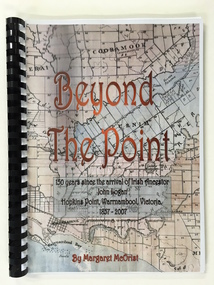
Booklet, Beyond the Point, 2007
... settlers, John Logan and Mary Gardner. The area where they first settled is now of major interest as Logans Beach (named for the Logan family) is the well-known whale watching area. Southern Right Whales return to this beach each year and the females calve and remain up to three months at this beach, making it an important ‘whale nursery’. john logan and mary gardner hopkins point logans beach tooram history of warrnambool Front Cover: ‘Beyond the Point, 150 years since the arrival of Irish ancestor, John Logan, Hopkins Point, Warrnambool, Victoria, 1857-2007, by Margaret McOrist’. ...This book was written in 2007 by Margaret McOrist to mark the 150th anniversary of the arrival in the Warrnambool area of John Logan. It is a sequel to a 1991 book, ‘Clotted Cream and Mangels’ which told the story of John Logan and his wife Mary Gardner. They lived at Hopkins Point, Warrnambool and the book, ‘Beyond the Point’ tells the story of the Logan descendants. When the farm land was sub-divided and sold the nearby beach was named ‘Logans Beach’. This book is of considerable interest as it tells the story of the descendants of important early settlers, John Logan and Mary Gardner. The area where they first settled is now of major interest as Logans Beach (named for the Logan family) is the well-known whale watching area. Southern Right Whales return to this beach each year and the females calve and remain up to three months at this beach, making it an important ‘whale nursery’. This is a soft cover book with black plastic ring binding and clear plastic sheets covering the front and back paper covers. The front cover has a reproduction of an 1891 map of Warrnambool and district with the title of the book and other information superimposed on the map. The back cover is black. The book has 101 pages and contains information on the Logan families who lived at Tooram in Allansford and their descendants. There are many black and white and colour photographs, diagrams, maps and family trees. Front Cover: ‘Beyond the Point, 150 years since the arrival of Irish ancestor, John Logan, Hopkins Point, Warrnambool, Victoria, 1857-2007, by Margaret McOrist’. john logan and mary gardner, hopkins point, logans beach, tooram, history of warrnambool -
 Warrnambool and District Historical Society Inc.
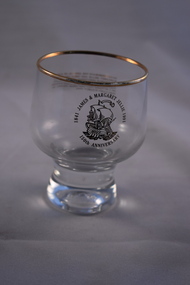
Household, Jellie Souvenir Glass
... souvenir glass was produced to commemorate the 1841 arrival in Australia from Ireland of James and Margaret Jellie . They were early settlers in the Warrnambool district, settling first at Port Fairy and then acquiring property along the Merri River in the Warrnambool area. ...Warrnambool and District Historical Society Inc. 2 Gilles Street (south of Merri St) Warrnambool great-ocean-road souvenir glass was produced to commemorate the 1841 arrival in Australia from Ireland of James and Margaret Jellie . They were early settlers in the Warrnambool district, settling first at Port Fairy and then acquiring property along the Merri River in the Warrnambool area. ...souvenir glass was produced to commemorate the 1841 arrival in Australia from Ireland of James and Margaret Jellie . They were early settlers in the Warrnambool district, settling first at Port Fairy and then acquiring property along the Merri River in the Warrnambool area. Their children and families were prominent in the 19th and 20th centuries in the Warrnambool district as pastoralists, particularly in the Grasmere area. One son, James had an auctioneering firm in Warrnambool in the late 19th century and two of James’ and Margaret’s granddaughters, Mary and Dorcas. were well-known as teachers at the Warrnambool State School in the 20th century. This glass is of interest as a memento of the Jellie families who have been so prominent in the history of Warrnambool and district.This is a glass tumbler with a rounded base and a rounded body with a gilt rim around the top of the glass. An image of a ship and gold lettering have been impressed on both sides of the glass. ‘James & Margaret Jellie 1841-1991 150th Anniversary’ ‘To commemorate the arrival of James & Margaret Jellie and their children on the Thomas Arbuthnot at Hobson’s Bay, Port Phillip District of New South Wales on 2 October 1841 and their journey to Port Fairy in early 1842’ jellie families, warrnambool, history of warrnambool -
 Warrnambool and District Historical Society Inc.
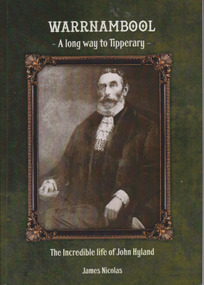
Book, Warrnambool A Long way to Tipperary The incredible life of John Hyland, 2014
... Ireland. He is one of 204 early pioneers commemorated on the Pioneer Board. This book tells the story of one of Warrnambool’s most influential early settlers. ...Biography of early Warrnambool settler, John Hyland.Paperback Background is dark green with sepia photo in bronze coloured frame. Precis on back cover is printed in white lettering. 132 pages.non-fictionBiography of early Warrnambool settler, John Hyland.warrnambool, john hyland, james nicholas, warrnambool mayors -
 Warrnambool and District Historical Society Inc.
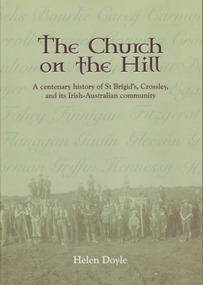
Book, Helen Doyle, The Church on the Hill :A centenary history of St. Brigid’s Crossley and its Irish Catholic community, 2014
... It commences with the original Gunditjmara story and the story of the settlers original homes in Ireland. It traces farming and religious and school life of the region. ...This book relates the story of the settlement and life of one of the earliest communities of Irish settlers in Australia. With many of the descendants of the original families still in the area today, it has strong relevance to the people of the Crossley area today warrnambool crossley st brigid's church crossley catholic church helen doyle History of St Brigid's Catholic Church and the Irish-Australian community This book is dedicated to the people of St Brigids, past and present, who have been makers and keepers of history- to the forebears of the St Brigid’s community who left their homes in search of a better life and to their descendants for whom St Brigid’s will always be a special place: a place where they have lived, loved, mourned and celebrated. ...History of St Brigid's Catholic Church and the Irish-Australian communityGreen tinted paperback with photograph of farming men with children and horses on front cover. Title and other text is dark brown edged in white. A number of Irish surnames are written in darker green on the paler part of front cover. This effect is also on back cover in tan lettering. The back cover description is written in brown text with image in oval above text.non-fictionHistory of St Brigid's Catholic Church and the Irish-Australian community warrnambool, crossley, st brigid's church, crossley catholic church, helen doyle -
 Warrnambool and District Historical Society Inc.
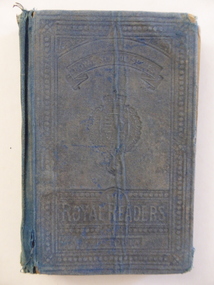
Book, The Royal Readers No 2 Victoria, Late 19th century
... Irish Readers and continued to be used until the 1920s. They have no Australian content. The book is also of interest as it was used by Christina and Allan Giles, members of a family of early settlers in the Warrnambool district. ...This is a school text book used at the Wangoom State School late in the 19th century by members of the Giles family. The Wangoom school was established in1865 as the Wangoom Common School No. 645 and later it became Wangoom State School. It is now closed. Allan and Christina Giles used this book and their home was on the Allansford Road. Christina Giles, the seventh child of Henry and Mary Jane Giles, was born at The Maam, Wangoom. She died in 1899 at the age of seven from heart failure and kidney disease after a three months’ illness.This book is of interest as it is an example of the reading books used in Victorian schools at the end of the 19th century. Royal Readers were introduced into Victorian school in the 1870s to replace the Irish Readers and continued to be used until the 1920s. They have no Australian content. The book is also of interest as it was used by Christina and Allan Giles, members of a family of early settlers in the Warrnambool district.This is a hard cover book of 188 pages. Some pages at the front and back of the book are missing. The cover (once blue?) has embossed lettering and ornamentation but mostly this is now indecipherable. The pages are partly detached from the cover. The inscription is handwritten in black ink. The text contains many illustrations and some of these have been hand-coloured and defaced. The first page has a mauve stamp of the Warrnambool and District Historical Society. ‘Allan Giles, Wangoom State School No. 645’ (partly obliterated) ‘Christina G.’ christina giles, allan giles, wangoom state school -
 Eltham District Historical Society Inc
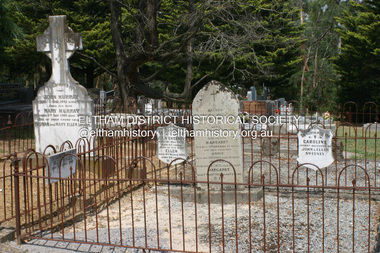
Photograph - Digital Photograph, Alan King, Graves of Thomas Sweeney and family, Eltham Cemetery, Victoria, 27 January 2008
... The Murray and Sweeney families were both early settlers of the Eltham district and connected by marriage. Their family plots are located side by side in the Catholic section of the Eltham Cemetery. Irish...The Murray and Sweeney families were both early settlers of the Eltham district and connected by marriage. Their family plots are located side by side in the Catholic section of the Eltham Cemetery. Irish ...The grave of Thomas Sweeney, former convict turned respectable citizen. The Murray and Sweeney families were both early settlers of the Eltham district and connected by marriage. Their family plots are located side by side in the Catholic section of the Eltham Cemetery. Irish-born Thomas Sweeney is regarded as the first settler in Eltham. He was transported to Sydney in 1823 after being convicted of arson. He was granted his freedom in 1838 and married Margaret Meehan in the same year. They moved to Melbourne and in 1842 Thomas purchased 110 acres beside the Yarra River in the vicinity of present-day Sweeneys Lane. He called the property ‘Culla Hill’ and built a small slab hut (reputedly with Wurundjeri help; Margaret is said to have run an informal hospital for them in return). This was followed in 1846 by more substantial buildings consisting of a three-roomed Irish-style ‘longhouse’ and a barn made of stone and handmade bricks, with doors large enough to accommodate a fully loaded wagon. When the gold rush came, Thomas prospered by selling meat and potatoes to the prospectors, enabling him to purchase a further 308 acres in 1856. He promoted the construction of a bridge over the Plenty River and the establishment of a school at Eltham. Roman Catholic Church services were held at Culla Hill in the early years. When he died in 1867, he was regarded as a respected member of the community. Thomas and Margaret are buried in Eltham Cemetery with many of their descendants. Their first son John continued to farm Culla Hill until his death in 1909. Culla Hill passed out of the Sweeneys' possession in 1939. The house and barn remain today, though lesser outbuildings have gone. The facade of the house is much the same as it was in the 1840s. Sacred To the memory of Thomas Sweeney Who died Sep 6th 1867 Aged 65 years May his soul res in peace Also his wife Margaret Died Oct 3rd 1884 aged 73 years And their daughters Annie Died Aug 22nd 1860 aged 21 years Johanna Died Aug 19th 1872 aged 22 years Margaret Died 7th Sep 1913 aged 72 years R.I.P. Also In Memory Of John Sweeney Died 24th May 1909 Aged 65 years Also of his wife Ellen Died 8th March 1910 Aged 64 years R.I.P Also In Memory Of Caroline Infant daughter of John & Ellen Sweeney Published: Nillumbik Now and Then / Marguerite Marshall 2008; photographs Alan King with Marguerite Marshall.; p55 From the piety and poverty of 19th century Eltham, 20th century artists and environmentalists, to today’s comfortable middle class, Eltham Cemetery records it all — and more. A visit to Eltham Cemetery reveals an important social record since its beginnings in 1858. The cemetery was situated on about six acres (2.4ha) (now around 4.8ha) at the corner of Mount Pleasant and Metery Roads.1* It is thought that Metery Road was originally called Cemetery Road, but in the early 1940s, a resident, possibly a councillor, objected to the name resulting in the change.2 Much can be gleaned about the developing Eltham community from burial styles and the names of former local residents. Originally the cemetery was divided into Christian denominations, like others of that time, following the United Kingdom burial system. In 1861 the cemetery included Church of England, Presbyterian, Roman Catholic and Wesleyans (later Methodist) sites. Graves also indicated social class. Some had grand tombstones, perhaps fenced with ornamental cast iron railing, but most in the 1860s and 1870s were constructed of modest stone slabs.3 This indicated the poverty of the district, which was largely inhabited by farmers on small landholdings. A poignant reminder of the high rates of infant mortality of those times, are the many infants and young children recorded on the headstones. Major changes occurred in the cemetery in the late 20th century as Christian adherence weakened and society became more egalitarian and informal. In the early 1970s a non-denominational lawn section for burials was established. Since then all new areas have been non-denominational to accommodate the more diverse local community. Now, instead of large ornamental headstones, some mourners have chosen boulders, reflecting the natural Eltham style, while others choose graves in the lawn areas or niches in walls. In the late 1970s, the University Donor Section was established north-west of Candlebark Lawn for those who donated their bodies for The University of Melbourne medical research. In the early 1980s the natural Australian garden style, popular in Eltham, was mirrored in a new section called Ashes Walk. Local landscape architect Gordon Ford, who had popularised this style, designed the Walk using boulders shaded by native plants beside curved pathways. Landscape architect Robert Boyle later redesigned Ashes Walk and developed other parts of the cemetery in keeping with this style.4 Appropriately Ford, who died in 1999, was interred in the Native Garden Section in a cluster of sites shaded by a large eucalyptus tree.5 By 2007, about 6400 interments were recorded in the Eltham Cemetery. Close inspection reveals notable names in the district’s history. The grave of Thomas Sweeney, a former convict who became a respected citizen, can be found in the Roman Catholic section near the path. Eltham Primary School’s first headmaster, David Clark, is buried in a modest grave in the Church of England section to the east of the path from the main entrance. Sir William Irvine, Victorian Premier from 1900 to 1902, whose grave is in the north-east Presbyterian section was at various times Victoria’s Chief Justice, Deputy Governor and Treasurer.6 Further south is the grave of social reformer Bertram Wainer, born in Scotland in 1928 and died in 1987. He campaigned to legalise abortion and exposed police corruption in allowing illegal ‘backyard’ abortions. Other prominent local residents interred in the cemetery include: Justus Jörgensen, who founded Montsalvat; Alistair Knox, the mud-brick housing pioneer and Eltham Shire Councillor from 1971 to 1975 and President in 1975; Clem and Nina Christensen, who had a major influence on the literary development of post World War Two Australia. Others were: composer Dorian Le Gallienne; artist Peter Glass; Stephen Dattner, a prominent Melbourne furrier; ALP parliamentarian for Greensborough, Pauline Toner and political scientist and commentator, Professor William Macmahon Ball.This collection of almost 130 photos about places and people within the Shire of Nillumbik, an urban and rural municipality in Melbourne's north, contributes to an understanding of the history of the Shire. Published in 2008 immediately prior to the Black Saturday bushfires of February 7, 2009, it documents sites that were impacted, and in some cases destroyed by the fires. It includes photographs taken especially for the publication, creating a unique time capsule representing the Shire in the early 21st century. It remains the most recent comprehenesive publication devoted to the Shire's history connecting local residents to the past. nillumbik now and then (marshall-king) collection, annie sweeney, caroline sweeney, ellen sweeney, eltham cemetery, graves, gravestones, johanna sweeney, john murray, john sweeney, margaret sweeney, mary ellen drain, mary murray, thomas murray, thomas sweeney -
 Eltham District Historical Society Inc
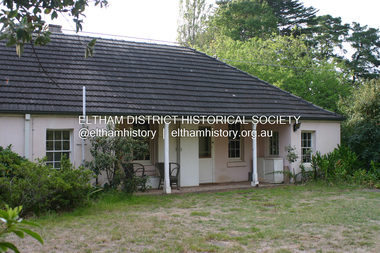
Photograph - Digital Photograph, Alan King, Sweeney's Cottage, Sweeneys Lane, Eltham, 30 January 2008
... As Sweeney was one of the district’s first settlers, the property is registered by the National Trust. Thomas Sweeney was born in 1802, son of impoverished tenant farmers in Tipperary County, Ireland. ...As Sweeney was one of the district’s first settlers, the property is registered by the National Trust. Thomas Sweeney was born in 1802, son of impoverished tenant farmers in Tipperary County, Ireland. ...Part of the original cottage named Culla Hill built by Thomas Sweeney (a former convict) remains as a small section of today’s house. Covered under Heritage Overlay, Nillumbik Planning Scheme National Estate National Trust of Australia (Victoria) Local Sifgnificance Published: Nillumbik Now and Then / Marguerite Marshall 2008; photographs Alan King with Marguerite Marshall.; p19 Thomas Sweeney, a former convict who became a respected citizen, once lived on a property at what is now the corner of Sweeneys Lane and Culla Hill, Eltham. As Sweeney was one of the district’s first settlers, the property is registered by the National Trust. Thomas Sweeney was born in 1802, son of impoverished tenant farmers in Tipperary County, Ireland. He became a ploughman, then at 21 he was sentenced to hang for setting on fire the house of Patrick Guyder at Gullshill. It is said the arson was due to a dispute over undelivered guns to a social justice guerilla group, the White Boys, of which Sweeney was a member. But the sentence was commuted to life transportation to Australia in 1823.1 Apparently in Sydney he became a servant to James Chandler at Botany. Soon James Chandler leased his farm and became a catechist on the Hawkesbury River, so Sweeney was reassigned to a former convict, John Brown, at Liverpool. Later Sweeney was assigned to George Brown of Lake Illawarra. In 1831, Sweeney was granted a ticket-of-leave and bought a boat to carry goods between Illawarra district and Sydney Town. He married his first wife who had come to Australia as a free woman. However she drowned after bearing him a daughter. In 1838, one month after he had received a conditional pardon, Sweeney married a blacksmith’s daughter, Margaret Meehan, newly arrived from Ireland. They then moved to Port Phillip and squatted on the south side of the Yarra River, about seven miles (11km) from Melbourne. Around 1842, Sweeney bought 110 acres (44.5ha) in the parish of Nillumbik for £110. He built a slab hut 12 x 10 feet (3.6m x 3m) and then his homestead, Culla Hill, a typical Tipperary style cottage, now known as Sweeney’s Cottage. It was here that many generations of Sweeneys lived for almost 100 years. Culla Hill became a social centre for the district and the Catholic community used it as a church. Sweeney was apparently on good terms with a tribe of Aborigines living on the river nearby, who helped him build his house.2 Sweeney proved himself a civic-minded leader. In 1844, he led a call for a bridge over the Plenty River. He was on the first school board and supplied the first grain for Eltham’s mill. Sweeney profited during the gold rush, not by gold digging, but by providing supplies for nearby fields and others as far away as Beechworth.3 Thomas Sweeney died in 1867 and was buried at the Eltham Cemetery, leaving two sons, five daughters, and 300 acres (121.4ha), as well as Culla Hill. Culla Hill – by then reduced to 75 acres (30ha) – was sold out of the family in 1939, then renamed Sweeneys. The present Sweeneys Lane, running diagonally through the original holding, was the track to the house. Part of the original cottage remains as a small section of today’s house. The dining-family room fronted by a veranda is original, and although there have been some changes, the cedar door and most of the small 12-paned wooden-framed windows are original. The walls are made of the original hand-made brick. After buying the property in 1952 Mr and Mrs Burston demolished a dilapidated slab hut, a three-roomed detached kitchen and cellar, as materials needed to restore them were very difficult to obtain so soon after the war.4 However the barn remains almost in its original condition. It is believed to have been built from stone quarried on the property. Now roofed with iron sheets it was probably originally thatched. The sandstone barn has a peaked roof supported by the original saplings and a doorway large enough to accommodate a fully loaded wagon.This collection of almost 130 photos about places and people within the Shire of Nillumbik, an urban and rural municipality in Melbourne's north, contributes to an understanding of the history of the Shire. Published in 2008 immediately prior to the Black Saturday bushfires of February 7, 2009, it documents sites that were impacted, and in some cases destroyed by the fires. It includes photographs taken especially for the publication, creating a unique time capsule representing the Shire in the early 21st century. It remains the most recent comprehenesive publication devoted to the Shire's history connecting local residents to the past. nillumbik now and then (marshall-king) collection, culla hill, eltham, sweeney's cottage, sweeneys lane, thomas sweeney -
Glen Eira Historical Society
Article - COANE, JOHN MONTGOMERY
... Ireland Mordialloc Ballyshannon Mines Department Sludge Abatement Board Coane Henry Edward Surveyors Engineers Land Surveyors Board Coane Henry James J.M. and H.E. Coane Coane Jane nee Montgomery Coane John Montgomery Junior Victorian Education Department Australian Roads Collas Emma Anna Hunt Books Grant George Hudson Coutie B.M. State Electricity of Victoria Melbourne Epsom Racecourse Racecourses Brighton City of Brighton Brighton Re-adaptation Society Brighton Cemetery Cemeteries Southern Roger J Australian Dictionary of Biography Vol. 8 Early settlers ...This file contains one item about Coane and his family: 1/A one page extract from The Australian Dictionary of Biography Vol. 8 page 35 on John Montgomery Coane, Surveyor and Consulting Engineer, his partnership with George Hudson and later when his two sons joined the business. It details many of the projects he designed for rural Victoria and New South Wales and his other areas including Consulting to The Pacific Phosphate Co. Ltd of London and to the City of Brighton where he lived.coane john montgomery, blacker’s orchard & cannery co., victorian institute of surveyors, county donegal, ireland, mordialloc, ballyshannon, mines department sludge abatement board, coane henry edward, surveyors, engineers, land surveyors board, coane henry james, j.m. and h.e. coane, coane jane nee montgomery, coane john montgomery junior, victorian education department, australian roads, collas emma anna hunt, books, grant george hudson, coutie b.m., state electricity of victoria, melbourne, epsom racecourse, racecourses, brighton, city of brighton, brighton re-adaptation society, brighton cemetery, cemeteries, southern roger j, australian dictionary of biography vol. 8, early settlers -
 Eltham District Historical Society Inc
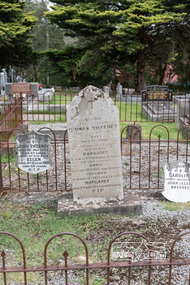
Photograph, Peter Pidgeon, Graves of Thomas Sweeney and family, Eltham Cemetery, Victoria, 5 April 2021
... Irish-born Thomas Sweeney is regarded as the first settler in Eltham. ...Eltham District Historical Society Inc 728 Main Rd Eltham melbourne Irish-born Thomas Sweeney is regarded as the first settler in Eltham. ...Irish-born Thomas Sweeney is regarded as the first settler in Eltham. He was transported to Sydney in 1823 after being convicted of arson. He was granted his freedom in 1838 and married Margaret Meehan in the same year. They moved to Melbourne and in 1842 Thomas purchased 110 acres beside the Yarra River in the vicinity of present-day Sweeneys Lane. He called the property ‘Culla Hill’ and built a small slab hut (reputedly with Wurundjeri help; Margaret is said to have run an informal hospital for them in return). This was followed in 1846 by more substantial buildings consisting of a three-roomed Irish-style ‘longhouse’ and a barn made of stone and handmade bricks, with doors large enough to accommodate a fully loaded wagon. When the gold rush came, Thomas prospered by selling meat and potatoes to the prospectors, enabling him to purchase a further 308 acres in 1856. He promoted the construction of a bridge over the Plenty River and the establishment of a school at Eltham. Roman Catholic Church services were held at Culla Hill in the early years. When he died in 1867, he was regarded as a respected member of the community. Thomas and Margaret are buried in Eltham Cemetery with many of their descendants. Their first son John continued to farm Culla Hill until his death in 1909. Culla Hill passed out of the Sweeneys' possession in 1939. The house and barn remain today, though lesser outbuildings have gone. The facade of the house is much the same as it was in the 1840s. Sacred To the memory of Thomas Sweeney Who died Sep 6th 1867 Aged 65 years May his soul res in peace Also his wife Margaret Died Oct 3rd 1884 aged 73 years And their daughters Annie Died Aug 22nd 1860 aged 21 years Johanna Died Aug 19th 1872 aged 22 years Margaret Died 7th Sep 1913 aged 72 years R.I.P. Also In Memory Of John Sweeney Died 24th May 1909 Aged 65 years Also of his wife Ellen Died 8th March 1910 Aged 64 years R.I.P Also In Memory Of Caroline Infant daughter of John & Ellen SweeneyBorn Digitalannie sweeney, eltham cemetery, gravestones, johanna sweeney, john murray, margaret sweeney, mary ellen drain, mary murray, thomas drain, thomas sweeney -
 Flagstaff Hill Maritime Museum and Village
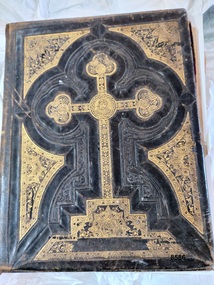
Book - Bible, Thomas Kelly & Sons, The Holy Bible - Douay Bible and Rheims Testament, 1880
... Irish immigrants as the four "Family Register" pages are decorated with borders of shamrocks. The donor found the Bible in a box of secondhand books on a market stall in Gippsland and recognised its links to the Shipwreck Coast through the name of previous owners (a well-known Warrnambool name) and the story of it being found on a beach near Peterborough. This Bible is a rare example of Douay and Reims Catholic Bible of the late 19th century that was once a treasured item belonging to the Kermond family - one of Warrnambool's early settlers ...The Douay (Douai) Rheims Bible is an English translation of the Latin Vulgate Bible (which had been the Latin Bible used by the Catholic Church since the 4th century). It was produced by Roman Catholic scholars in exile from Elizabethan Protestant England at the English College of Douai (then in the Spanish Netherlands but later part of France). The New Testament translation was published in 1582 at Rheims where the English College had temporarily located in 1578. The Old Testament was translated shortly afterwards but was not published until 1609-1610 in Douay (which makes it older than the King James version). The completed work was the only authorized Bible in English for Roman Catholics until the 20th Century. Its purpose was to uphold the Catholic tradition in the face of the Protestant Reformation and was produced as an alternative to the several Protestant translations then in existence. Prior to it being published, the Roman Catholic practice had restricted personal use of the Bible, in the Latin Vulgate, to the clergy. Bishop Richard Challoner issued a series of revisions (1749 - 1772) intended to make the translation more easily understandable and subsequent editions (including this one) were based upon this revision. In 1871, an edition of the Douay - Rheims Bible was published by Thomas Kelly & Sons of Philadelphia (and later, New York). Thomas Kelly described himself as a "Publisher, Printer, Binder, Lithographer and Steel Plate Engraver". In 1876, Thomas Kelly won an award (a Diploma of Honor and a Medal of Merit) for "the Best Catholic Bibles and Prayer Books" at the International Centennial Exhibition held in Philadelphia and his firm continued to print editions of the Bible throughout the 1870's but little is known of him after 1880 when this edition was published. This Bible has been in the Kermond family from 1888 until 1984 when Laurence Kermond (its last owner) died. The Kermonds were an old Warrnambool family with ties to the district going back to the mid 1840's. Joseph Kermond's mother, Catherine (1818 - 1895) and her husband John Kermond,, an ex-convict (1809 - 1877), had moved from Tasmania around 1843 and were living in the Warrnambool area in 1844 where their eldest son was born. They had six more children born at Port Fairy (or Belfast as it was then called). Catherine is buried at the Tower Hill cemetery. The last owner of the Bible was Laurence Kermond (1918 - 1984). He was the great grandson of John and Catherine Kermond and was a well known painter who lived in the Merimbula and Paynesville areas of N.S. W. and Victoria during the 1970's and early 1980's. The story of Joseph Kermond finding the Bible on a beach on the Shipwreck Coast near Peterborough on the southern coast of Victoria, Australia is plausible as it was not uncommon for items from shipwrecks to be washed ashore. However this Bible would not have come from the wreck of the Loch Ard as the dates don't align. The Loch Ard was wrecked in 1878 and this Bible was printed in 1880. It appears to have been printed for the Australian market as there is a page (with an engraved portrait) dedicated to the "Most Rev. Roger Bede Vaughan, O. S. B. Archbishop of Sydney, N. S. W.". It may also have been aimed at the Irish immigrants as the four "Family Register" pages are decorated with borders of shamrocks. The donor found the Bible in a box of secondhand books on a market stall in Gippsland and recognised its links to the Shipwreck Coast through the name of previous owners (a well-known Warrnambool name) and the story of it being found on a beach near Peterborough. This Bible is a rare example of Douay and Reims Catholic Bible of the late 19th century that was once a treasured item belonging to the Kermond family - one of Warrnambool's early settlers. It also has a most unusual story attached to it - being found (and rescued) washed up on a local beach and almost one hundred years later, being rescued again from a secondhand book stall.This Catholic Bible is an 1880 edition of a "Douay Bible and Rheims Testament", printed and published by Thomas Kelly of New York. Its full title is "The Holy Bible translated from the Latin Vulgate Diligently Compared with The Hebrew, Greek and Other Editions in Various Languages". It is revised with annotations by the Right Rev. R. Challoner D.D. The Bible has brown leather embossed front and back covers decorated with identical ornate gilt patterns and a central picture of a cross. It has two coloured illustrations and numerous black and white lithographs and engravings including portraits of past popes, events and places from Bible stories and decorative borders. The Bible includes the Old and New Testaments, approbations from Pope Pius the Sixth and Archbishops of the United States and other countries (including Archbishop Vaughan of Sydney), a Family Register with handwritten notes on births, deaths and marriages from the Kermond family (as well as a description of how they obtained the bible), a Catholic dictionary of the Bible, a history of the Holy Scriptures, a chronological list of heretics (Theological history) and a description of the "Centennial Award - Diploma of Honor and medal of Merit" won by Thomas Kelly (for the "Best Catholic Bible") at the Centennial Exhibition at Philadelphia in 1876. The Records section has a note on the Memoranda page written by William John Kennard in 1920.Spine: HOLY BIBLE Title Page: THE/ HOLY BIBLE /TRANSLATED FROM/ THE LATIN VULGATE/ DILIGENTLY COMPARED WITH/THE HEBREW, GREEK AND OTHER EDITIONS/ IN VARIOUS LANGUAGES/ THE OLD TESTAMENT WAS FIRST PUBLISHED BY THE ENGLISH COLLEGE AT DOUAY, A.D. 1600 / AND THE NEW TESTAMENT, BY THE ENGLISH COLLEGE AT RHEIMS, A.D. 1582./ REVISED WITH ANNOTATIONS/ BY THE RIGHT REV. R. CHALLONER D.D./ TOGETHER WITH REFERENCES, AND AN HISTORICAL AND CHRONOLOGICAL INDEX./ NOW CAREFULLY CORRECTED ACCORDING TO THE CLEMENTINE EDITION OF THE SCRIPTURES/ NEW YORK / THOMAS KELLY, PUBLISHER/ 17 BARCLAY STREET. / 1880 Dedication Page: DEDICATION OF THE ORIGINAL EDITION/ TO/ THAT LOYAL, RELIGIOUS AND ENLIGHTENED BODY OF MEN / THE/ CATHOLICS OF THE UNITED STATES OF AMERICA/ IN ADMIRATION OF THE STEADY ZEAL WITH WHICH THEY HAVE KEPTTHE/DEPOSIT OF FAITH/ BEQUEATHED THEM BY THEIR FOREFATHERS/ AND HANDED DOWN, WITHOUT INTERRUPTION OT ADULTERATION, TO THEIR GRATEFUL POSTERITY/ THIS EDITION/ OF THE/DOUAY BIBLE AND RHEIMS TESTAMENT/ IS / WITH GRATITUDE FOR PAST FAVORS AND HOPES OF FUTURE ENCOURAGEMENT/ MOST RESPECTFULLY ENSCRIBED. Handwritten note: ""This Holy Book was found . on the beach . near Peterborough Vic. having been washed ashore . from the wreck of the Loch Ard, (sailing ship) in the year 1888 . By .Joseph . Kermond; and presented to . his mother . Catherine Kermond , who in turn passed it - on . to her youngest . son ; one Jacob Kermond. He in turn presented . it to his son . William John Kermond , (the writer), 23/3/20)" [Original punctuation]flagstaff hill maritime museum and village, warrnambool, shipwreck coast, peterborough, kermond, kermond family, loch ard, bible, douay and rheims bible, catholic bible, thomas kelly and sons publiisher, douai, rheims, holy bible, religious bible, catherine kermond, john kermond, william john kermond' -
 Flagstaff Hill Maritime Museum and Village
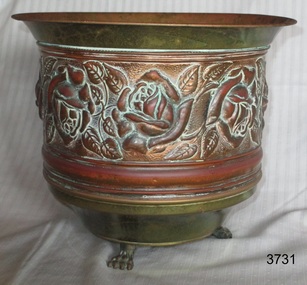
Container - Jardiniere, ca 1920
... settlers in the Warrnambool District in the late 19th and early 20th century. The Jardinière is a good example of late Victorian memorabilia that was to be found in many homes of the period. flagstaff hill warrnambool shipwrecked coast flagstaff hill maritime museum flagstaff hill maritime village great ocean road emigrants from ireland giles collection henry giles tower hill cooramook warrnambool breakwater mailor’s flat wangoom 19th century household goods brass jardinière plant pot potted plant domestic decor copperware lion paw feet rose design Handwritten: "$85" Plant container: brass and copper jardinière, with tooled and pressed ornamental rose design on a band of copper around the planter and braised seam joins. ...This jardinière is one of many 19th and early 20th-century items donated to Flagstaff Hill Maritime Village by the Giles Family. It would have been used to contain a potted plant or similar foliage to decorate a room. Donated to Flagstaff Hill Maritime Village by Vera and Aurelin Giles, this item is associated with Warrnambool and the Giles Family history. Many items have been donated by the family and have come to be known as the “Giles Collection”. Many items in the Lighthouse Keeper’s Cottage that were donated by Vera and Aurelin Giles mostly came from the home of Vera’s parents-in-law, Henry Giles and his wife Mary Jane (nee Freckleton), who married in 1880 and whose photos are on display in the parlour. Henry was born at Tower Hill in 1858 and was a labourer on the construction of the Warrnambool Breakwater before leaving in 1895 for around seven years to build bridges in NSW. Mary Jane was born in 1860 at Cooramook, and she attended Mailor’s Flat State School and where she eventually became a student teacher. After which she became a governess at “Injemiara”, where her grandfather, Francis Freckleton, had once owned land. Henry and Mary’s family consisted of six; some of the children were born at Mailor’s Flat, and later, some children were born at Wangoom. They lived with their parents at Wangoom and Purnim west, and this is where Henry died in 1933 and Mary Jane died in 1940. The Giles family collection has social significance at a local level, because it illustrates the level of material support the Warrnambool community gave to Flagstaff Hill when the Museum was established. It also represents typical furniture and household goods owned by settlers in the Warrnambool District in the late 19th and early 20th century. The Jardinière is a good example of late Victorian memorabilia that was to be found in many homes of the period.Plant container: brass and copper jardinière, with tooled and pressed ornamental rose design on a band of copper around the planter and braised seam joins. Three short lion paw feet support the base. Part of the Giles Collection. An inscription is on a sticker under the base.Handwritten: "$85"flagstaff hill, warrnambool, shipwrecked coast, flagstaff hill maritime museum, flagstaff hill maritime village, great ocean road, emigrants from ireland, giles collection, henry giles, tower hill, cooramook, warrnambool breakwater, mailor’s flat, wangoom, 19th century household goods, brass jardinière, plant pot, potted plant, domestic decor, copperware, lion paw feet, rose design -
 City of Moorabbin Historical Society (Operating the Box Cottage Museum)
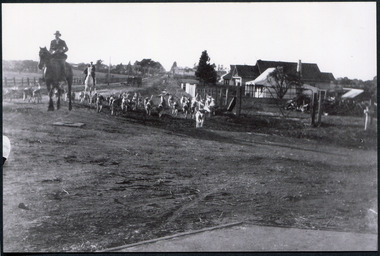
Photograph, Black & White Oakleigh Hunt Club in Jasper Rd c 1920, c1920
... Ireland. As the Melbourne suburbs spread the Club moved several times. 1920 it was in Oakleigh and now is possibly situated in Packenham watson george, oakleigh, melbourne hunt club, smith j l; smith mary ann, stanley helen, smith vic, smith harry redvers, chaff cutter, horse drawn carts, toll gates brighton, motor cars 1900, steam engines, early settlers, bentleigh, parish of moorabbin, city of moorabbin, county of bourke, moorabbin shire, king richard, charman s, highett william, ormond francis, maynard dennis, market gardeners, vineyards, orchards Black & White photograph showing men riding horses with a pack of hounds coming down a dirt road . ...The Melbourne Hunt Club was founded by Mr George Watson in 1852 with hounds brought to Australia from Ireland and moved its headquarters a number of times as the city grew between 1897 and 1929, The kennels were originally at Kirk's Bazaar, in Bourke Street, Melbourne, subsequently they moved to St Kilda, Caulfield, Deer Park, Oakleigh, Cranbourne and finally to their current location in Packenham. Oakleigh was the favoured spot, mainly because of the railway and the unloading ramp at the station. Riders and horses arrived on special trains and hunted over the surrounding market gardens, but not without friction. After 1929, significant numbers of Hunt Club members had access to motorized horse transport and besides, Oakleigh was becoming too built up. The Hunt Club moved on to Cranbourne The club maintains the oldest continual pack of hounds in Australia. The Melbourne Hunt Club was founded 1852 by George Watson and imported foxhounds from Ireland. As the Melbourne suburbs spread the Club moved several times. 1920 it was in Oakleigh and now is possibly situated in Packenham Black & White photograph showing men riding horses with a pack of hounds coming down a dirt road . Houses and vacant land in backgroundwatson george, oakleigh, melbourne hunt club, smith j l; smith mary ann, stanley helen, smith vic, smith harry redvers, chaff cutter, horse drawn carts, toll gates brighton, motor cars 1900, steam engines, early settlers, bentleigh, parish of moorabbin, city of moorabbin, county of bourke, moorabbin shire, king richard, charman s, highett william, ormond francis, maynard dennis, market gardeners, vineyards, orchards -
 City of Moorabbin Historical Society (Operating the Box Cottage Museum)
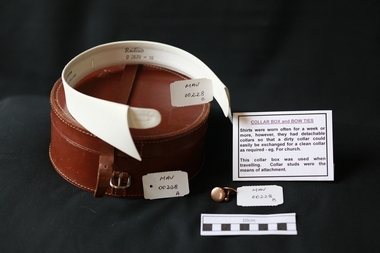
Accessory - Clothing, menswear 4 x collars and studs with leather box, early 20thC
... The Blackburn family were early settlers in Moorabbin Shire menswear clothing shirts collars early settlers fashion cheltenham moorabbin dairy farmers market gardeners Inside collar : a) Radiac / 0 2639 - 16 / ALL COTTON / MADE IN IRELAND; b) LAUNDRY / FOR BEST RESULT DIP / IN THIN COOKED STARCH/ Semi / 161/2 ; c) nil d) nil 4 x mens white, stiffly starched, detachable collars and 2 x brass studs with the leather box used for storage and transport of these items. ...In the 19thC and early 20thC men often wore their shirts for a week or more. However the collars were detachable so that they could be changed when they became dirty or for special occasions eg Church on Sundays Collar studs were used to attach the collar to the shirt. The leather box was used for storage and when travelling. The collars were very stiffly starched so as to maintain their shape.The Blackburn family were early settlers in Moorabbin Shire4 x mens white, stiffly starched, detachable collars and 2 x brass studs with the leather box used for storage and transport of these items. Each collar has 3 button holes - 2 at neck and 1 centre back for attachment to the shirt. The Leather box has saddle stitching and a strap with a metal buckle for securingInside collar : a) Radiac / 0 2639 - 16 / ALL COTTON / MADE IN IRELAND; b) LAUNDRY / FOR BEST RESULT DIP / IN THIN COOKED STARCH/ Semi / 161/2 ; c) nil d) nilmenswear, clothing, shirts, collars, early settlers, fashion, cheltenham, moorabbin, dairy farmers, market gardeners -
 City of Moorabbin Historical Society (Operating the Box Cottage Museum)
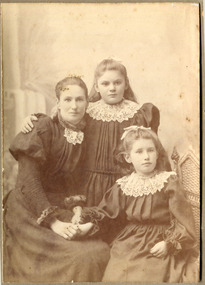
Photograph - Photograph, Mrs Carroll c1910, Mrs Carroll c1910, possibly c1910
... . & Daniel are shown in the Rate Book 1862 as owner occupiers and owner of property in Tuckers Road, Bryants Road and Centre Road. children chapel st 287 prahran carroll edward, carroll, j.w., carroll daniel, ireland, brighton, henry dendy's special survey 1841, market gardeners, pioneers, early settlers, dairy farmers, poultry farmers, bentleigh, mckinnon, ormond, prahran, yeoman photographers co. ...Date unknown: Mrs Caroll and children. In 'Moorabbin A Pictorial History 1862 - 1994 ' by John Cribbin, The Carroll family migrated from Ireland and purchased land in the East Brighton ( now Bentleigh ) area of Henry Dendy's Special Survey 1841. Edward, J.W. & Daniel are shown in the Rate Book 1862 as owner occupiers and owner of property in Tuckers Road, Bryants Road and Centre Road.Photograph is black and white. There are three women in this photograph, a mother and her two children. The mother is sitting down on a chair to the left and her daughter sitting next to her, on the right (they are both holding hands), and her other daughter (child) right in between her mother and sister, with he arm around the mother's shoulder. All three of them are wearing their best dresses that have lace collars. As the clothes are similar to MAV Cat No. 00519 the photo may have been taken c 1910Front of Mount : Yeoman Co 287 Chapel St. Prahran, Victoria.children, chapel st, 287, prahran, carroll edward, carroll, j.w., carroll daniel, ireland, brighton, henry dendy's special survey 1841, market gardeners, pioneers, early settlers, dairy farmers, poultry farmers, bentleigh, mckinnon, ormond, prahran, yeoman photographers co. -
 City of Moorabbin Historical Society (Operating the Box Cottage Museum)
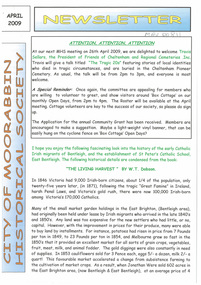
Newsletter, City of Moorabbin Historical Society Apr 2009, April 2009
... irish immigrants c1850pioneers...early settlers...The Newsletter is an important record of the activities of the CMHS. city of moorabbin historical society stanley helen dobson w.t. melbourne moorabbin brighton friends of cheltenham and reional cemeteries cheltenham ormond bentleigh market gardeners irish immigrants c1850pioneers early settlers moorabbin shire box cottage museum port phillip bay brighton estate jasper road ormond east boundary road brighton dendy’s special survey 1851 point nepean road south road brighton thomas street brighton north road brighton county of bourke box h. box william parish of moorabbin parish of prahran markets shingle roof weather-board mr. mckinnon were jonathan niall rev. fr. patrick quinn fred elsternwick catholic church directory 1878 hibernian society melbourne brady peter. kennedy mr. boland mr. leary mr. gahan mr. archbishop carr rev. fr. gough. presentation convent gardenvale sister mary vincent charlston john bavarian dress band hales jasper CITY of MOORABBIN HISTORICAL SOCIETY / APRIL 2009 NEWSLETTER 2 x A4 paper printed on 4 sides Issue 11 of the bi-monthly, City of Moorabbin Historical Society Newsletter produced by Society member and Secretary, Mrs Helen Stanley in April 2009. ...The City of Moorabbin Historical Society was formed c 1960 by a group of Moorabbin residents who were concerned that the history of the area should be preserved. A good response to a call for items related to the historical area of Moorabbin Shire brought donations of a wide variety of artefacts which are now preserved by the current members of CMHS at Box Cottage Museum . Helen Stanley, Secretary of CMHS, began producing a Newsletter for members in April 2007 to provide current information and well researched items of historical interest.Helen Stanley has produced a bi-monthly Newsletter, 2007 - 2013, for the members of the City of Moorabbin Historical Society that contains well researched interesting historical items, notification of upcoming events, current advice from Royal Australian Historical Society , Museums Australia Victoria and activities of Local Historical Societies. The Newsletter is an important record of the activities of the CMHS.2 x A4 paper printed on 4 sides Issue 11 of the bi-monthly, City of Moorabbin Historical Society Newsletter produced by Society member and Secretary, Mrs Helen Stanley in April 2009. Notice that Mr Travis Sellars, Friends of Cheltenham and Regional Cemeteries, will talk about ‘The Tragic 20’s’ at the meeting April 26th . Volunteers are needed to show visitors around on Open Days each month and a Roster will be made on April 26th . Suggestions are requested for the Community Grant Application to be submitted by CMHS. Historical details are condensed from ‘ The Living Harvest’ by W.T Dobson, describing the establishment of St. Peter’s Catholic School East Bentleigh 1865 on land donated by Fred Quinn , in Centre Road, East Brighton ( East Bentleigh). A photo copy of Parts of Country Portion 39 of Dendy’s Special Survey or Brighton Estate showing the Land Sales of Lot 2, & 3 North Road and Jasper Road 1841 – 1869. Interesting note on the origin of ‘Jasper Road’. 3 photocopied photographs of St Peter’s School building 1903, School Children at East Brighton Railway Station, 1903, A Lorry in the parade 1903. CITY of MOORABBIN HISTORICAL SOCIETY / APRIL 2009 NEWSLETTERcity of moorabbin historical society, stanley helen, dobson w.t., melbourne, moorabbin, brighton, friends of cheltenham and reional cemeteries, cheltenham, ormond, bentleigh, market gardeners, irish immigrants c1850pioneers, early settlers, moorabbin shire, box cottage museum, port phillip bay, brighton estate, jasper road ormond, east boundary road brighton, dendy’s special survey 1851, point nepean road, south road brighton, thomas street brighton, north road brighton, county of bourke, box h., box william, parish of moorabbin, parish of prahran, markets, shingle roof, weather-board, mr., mckinnon, were jonathan, niall rev. fr. patrick, quinn fred, elsternwick, catholic church directory 1878, hibernian society melbourne, brady peter., kennedy mr., boland mr., leary mr., gahan mr., archbishop carr, rev. fr. gough., presentation convent gardenvale, sister mary vincent, charlston john, bavarian dress band, hales jasper -
 City of Moorabbin Historical Society (Operating the Box Cottage Museum)
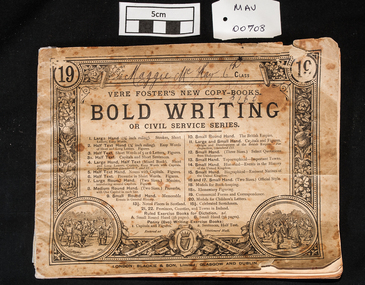
Education kit - Vere Foster's New Copy-Book No 19, Bold Writing or Civil Service Series, c1890
... in Moorabbin Shire market gardners pioneers early settlers mooorabbin brighton east brighton bentleigh correspondence writing equipment pen and ink education Vere Foster Irish VERE FOSTERS NEW COPY BOOKS / BOLD WRITING / OR CIVIL SERVICE SERIES London BLACKIE & SON Glasgow and Dublin A school writing copy book with 14 pages divided so that the student copied the text on one half of the page. ...This copy book was used by Maggie McKay in 1902 when in 6th Grade at Meeniyan State School (no 3165) and was learning to write in the approved manner. Vere Henry Louis Foster (1819-1900), an educationist, philanthropist, and humanist, who worked devotedly to improve the situation of the Irish poor, published a series of these copy books to improve writing skills, as better literacy and penmanship meant better chances of employment. The books were first published in 1865 and were sold for 1 penny, a fraction of what they cost to produce. In the first year alone one million Foster's Copy Books were sold. The series of books taught children the alphabet and writing. Copy books for older children taught basic business studies and book-keeping.The family of Maggie McKay were early settlers in Moorabbin ShireA school writing copy book with 14 pages divided so that the student copied the text on one half of the page. VERE FOSTERS NEW COPY BOOKS / BOLD WRITING / OR CIVIL SERVICE SERIES London BLACKIE & SON Glasgow and Dublin market gardners, pioneers, early settlers, mooorabbin, brighton, east brighton, bentleigh, correspondence, writing equipment, pen and ink, education, vere foster, irish -
 City of Moorabbin Historical Society (Operating the Box Cottage Museum)
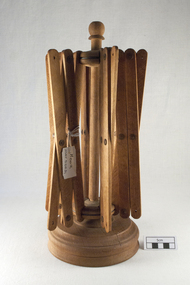
Craft - Craft equipment, wool winder, c1860
... Circa 1860s this winder was made in Ireland. The pioneer settlers and market gardeners of Moorabbin Shire had to be self reliant and made their own clothing and utensils. ...Pioneers migrating to Moorabbin Shire brought items they thought would assist them in the new Country. They had to be self reliant and made their own clothing and utensils while establishing their market gardens and farms. A wooden wool winder, with extending arms for winding hanks of wool into balls prior to knitting. For ease of use the winder also rotates. Circa 1860s this winder was made in Ireland.The pioneer settlers and market gardeners of Moorabbin Shire had to be self reliant and made their own clothing and utensils. This is one of many items used to exhibit the skill and craftsmanship of the women in these families. Phillip Jones migrated from Ireland c1852 and his son, James Jones 1857 – 1940 was born in East Brighton , married Mary Ann Moore and raised his family in Bentleigh, as the area became known. A wooden wool winder, with extending arms for winding hanks of wool into balls prior to knitting. For ease of use the winder also rotates. Circa 1860s this winder was made in Ireland.brighton, moorabbin, pioneers, bentleigh, market gardeners, wool, craft work, early settlers, knitting, craft equipment, jones mary ann, jones james, jones phillip, herron john -
 City of Moorabbin Historical Society (Operating the Box Cottage Museum)
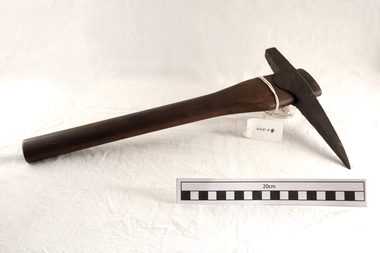
Tool - Gold-miner's Pick, Ballarat c 1920, c1920
... Irish immigrants to work the farms. This pick is an example of the hand made tools many pioneers took with them when they abandoned their farms and market gardens in the District of Brighton to try their luck at prospecting when gold was discovered in Ballarat and Bendigo c1853. Some were successful , most were not and retuned again to the hard life of farming. gold mining ballarat bendigo early settlers ...This gold miner's pick from the Ballarat Goldfields c 1920 was donated by Mr David Hopcraft, a dealer at the Arkuna Market Berwick, Victoria in December 2010. When Gold was discovered in Victoria c1853 most of the labourers and some landowners left the market gardens and farms to try their luck on the goldfields. Local Blacksmiths made picks similar to this one for them. There was a great shortage of labour in Melbourne and at the same time, due to the huge influx of people lured by the Gold, there was an increased demand for food. The market gardeners were getting very good prices for their produce and many increased their wealth considerably and many of these tenant farmers were able to purchase their blocks of land and live a profitable life. There was such a shortage of labour that J.B.Were applied for Irish immigrants to work the farms. This pick is an example of the hand made tools many pioneers took with them when they abandoned their farms and market gardens in the District of Brighton to try their luck at prospecting when gold was discovered in Ballarat and Bendigo c1853. Some were successful , most were not and retuned again to the hard life of farming. A forged steel pick with a wooden handle. The steel pick-head was hand-forged by a blacksmith. This miner's pick was used on the Ballarat gold-fields c1920gold mining, ballarat, bendigo, early settlers, market gardeners, moorabbin, bentleigh, mining equipment, gold rush, immigrants, blacksmiths, forges, tools -
 City of Moorabbin Historical Society (Operating the Box Cottage Museum)
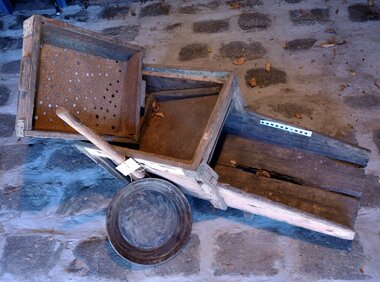
Functional object - Gold Mining, prospector's "rocker", c1870
... This gold prospector's 'cradle' is hand made and typical of those used by many hopeful Moorabbin Shire pioneers as they abandoned their market gardens to try their luck at finding gold in the Ballarat and Bendigo minefields c1850 moorabbin brighton market gardens pioneers early settlers fruit vegetable ballarat bendigo gold mining gold prospedtors gold rush were j. b. irish immigrants chinese immigrants gold panning gold digger This gold miner's rocker is very old, and very well-used. ...Gold was discovered in Victoria c1850 and people came from all over the world to seek their fortune at Ballarat and Bendigo and surrounding gold fields. This large wooden rocking- box or cradle was used by gold prospectors. A handle on the rocker is pushed back and forth, as the miner put gravel into the top part and finer and heavier particles dropped through a screen, helped along by buckets of water. The bottom part of the device had slats, that caught the heavier metals. After many shovel loads of gravel were pushed through the rocker, the miner would then use his gold pan to sort out the heavy minerals to find gold. Most of the pioneer settlers in Moorabbin Shire left the area to try their luck at gold mining and there was a desperate shortage of workers to maintain the market gardens and supply food to the ever increasing population of Melbourne.This gold prospector's 'cradle' is hand made and typical of those used by many hopeful Moorabbin Shire pioneers as they abandoned their market gardens to try their luck at finding gold in the Ballarat and Bendigo minefields c1850This gold miner's rocker is very old, and very well-used. It is a large wooden rocking- box or cradle used by gold prospectors. A handle on the rocker is pushed back and forth, as gravel is put in the top part of the box so that finer and heavier particles drop through a screen.. The bottom part of the device had slats, that caught the heavier metals. i.e gold particles. The water passed through the shute at the base back into the creek or river.moorabbin, brighton, market gardens, pioneers, early settlers, fruit, vegetable, ballarat, bendigo, gold mining, gold prospedtors, gold rush, were j. b., irish immigrants, chinese immigrants, gold panning, gold digger -
 City of Moorabbin Historical Society (Operating the Box Cottage Museum)
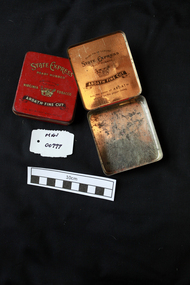
Containers, Tobacco, ‘State Express x2 tins, 20th C
... Ireland on 10 March 1896. In the United Kingdom, Ardath's brands endured, to the point where they were granted a Royal Warrant by King George VI in 1946 and again later by H.M Queen Elizabeth II. In 1961, British American Tobacco bought out Imperial Tobacco's share of Ardath, thus gaining full control of Ardath's trademarks tobacco cigarettes moorabbin bentleigh cheltenham early settlers ardath tobacco company ltd, levy sir albert, state express cigarettes, lucky strike, cigarettes, british american tobacco company ltd, imperial tobacco company ltd, Outside: STATE EXPRESS / READY RUBBED / Absolutely Unique in its quality / VIRGINIA TOBACCO / ARDATH FINE CUT Inside lid : EVERY TIN OF GENUINE / STATE EXPRESS / READY RUBBED / ARDATH FINE CUT / has the name of ARDATH / printed on the paper lining 2x Tins with hinged lids to contain State Express Ready Rubbed Virginia Tobacco . ...State Express 555, simply known as 555, is a brand of cigarette originally manufactured in the United Kingdom by the Ardath Tobacco Company. The overseas rights to the brand, excluding the United Kingdom, were acquired by British American Tobacco (B.A.T.) in 1925. It was sold widely throughout the world. Sir Albert Levy (1864 – 1937), born in England became a successful tobacco trader, cigarette manufacturer and exporter. On 31 July 1895 Sir Albert Levy registered the trademark ARDATH in the Republic of Ireland.. He visited the United States and while in New York State, he was a passenger on the Empire State Express train. . The word trademark was first registered in Ireland on 10 March 1896. In the United Kingdom, Ardath's brands endured, to the point where they were granted a Royal Warrant by King George VI in 1946 and again later by H.M Queen Elizabeth II. In 1961, British American Tobacco bought out Imperial Tobacco's share of Ardath, thus gaining full control of Ardath's trademarks2x Tins with hinged lids to contain State Express Ready Rubbed Virginia Tobacco . Outside: STATE EXPRESS / READY RUBBED / Absolutely Unique in its quality / VIRGINIA TOBACCO / ARDATH FINE CUT Inside lid : EVERY TIN OF GENUINE / STATE EXPRESS / READY RUBBED / ARDATH FINE CUT / has the name of ARDATH / printed on the paper liningtobacco, cigarettes, moorabbin, bentleigh, cheltenham, early settlers, ardath tobacco company ltd, levy sir albert, state express cigarettes, lucky strike, cigarettes, british american tobacco company ltd, imperial tobacco company ltd, -
 City of Moorabbin Historical Society (Operating the Box Cottage Museum)
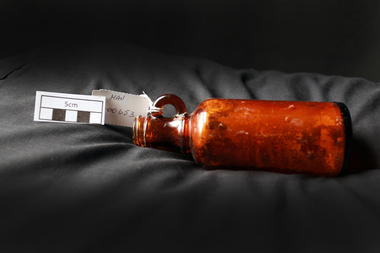
Manufactured Glass, brown bottle, 20thC
... settler family. A local resident discovered it when digging his garden in McKinnon 2013. James Hardie immigrated to Australia in 1888 from Linlithgow, Scotland, and created a business importing oils and animal hides. Andrew Reid, also from Linlithgow, came to join Hardie in Melbourne, and became a full partner in 1895. When Hardie retired in 1911, he sold his half of the business to Reid. James Hardie Industries Ltd first listed on the Australian Stock Exchange in 1951 and is an industrial building materials company headquartered in Ireland...February 2010, James Hardie moved its corporate domicile from The Netherlands to Ireland, In May 2012 the High Court of Australia found that seven former James Hardie non-executive directors misled the stock exchange over the asbestos victims compensation fund early settlers pioneers market gardeners moorabbin bentleigh ormond mvkinnon glass bottles medine containers medical supplies james hadie pty ltd. hardie around bottom " THIS BOTTLE ALWAYS REMAINS THE PROPERTY OF JAMES HARDIE PTY. ...This bottle may have held medicine used by a local early settler family. A local resident discovered it when digging his garden in McKinnon 2013. James Hardie immigrated to Australia in 1888 from Linlithgow, Scotland, and created a business importing oils and animal hides. Andrew Reid, also from Linlithgow, came to join Hardie in Melbourne, and became a full partner in 1895. When Hardie retired in 1911, he sold his half of the business to Reid. James Hardie Industries Ltd first listed on the Australian Stock Exchange in 1951 and is an industrial building materials company headquartered in Ireland which specialises in fibre cement products. James Hardie manufactures and develops technologies, materials and processes for the production of building materials. For over 20 years, Hardie has also operated a research and development facility devoted solely to fibre-cement technology. The company was a key player in asbestos mining and manufacturing in Australia through most of the twentieth century. Working with products containing asbestos - including the building material known as "Fibro" - caused people to develop various pleural abnormalities such as asbestosis and malignant mesothelioma. In December 2001, the company shareholders unanimously voted to restructure and relocate the company in the Netherlands as a parent company. This was part of a strategy to separate the company from the stigma of its asbestos liabilities. February 2010, James Hardie moved its corporate domicile from The Netherlands to Ireland, In May 2012 the High Court of Australia found that seven former James Hardie non-executive directors misled the stock exchange over the asbestos victims compensation fundA brown glass bottle, with finger grip handlearound bottom " THIS BOTTLE ALWAYS REMAINS THE PROPERTY OF JAMES HARDIE PTY. LTD. SYDNEY' on base 'IS985 / 7early settlers, pioneers, market gardeners, moorabbin, bentleigh, ormond, mvkinnon, glass bottles, medine containers, medical supplies, james hadie pty ltd. hardie -
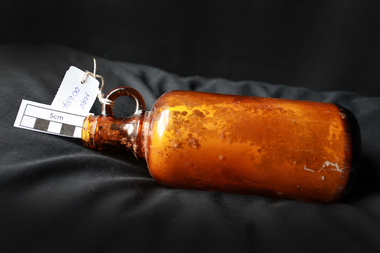 City of Moorabbin Historical Society (Operating the Box Cottage Museum)
Manufactured Glass, brown bottle, 20th C
... settler family. A local resident discovered it when digging his garden in McKinnon 2013. James Hardie immigrated to Australia in 1888 from Linlithgow, Scotland, and created a business importing oils and animal hides. Andrew Reid, also from Linlithgow, came to join Hardie in Melbourne, and became a full partner in 1895. When Hardie retired in 1911, he sold his half of the business to Reid. James Hardie Industries Ltd first listed on the Australian Stock Exchange in 1951 and is an industrial building materials company headquartered in Ireland...settler family. A local resident discovered it when digging his garden in McKinnon 2013. James Hardie immigrated to Australia in 1888 from Linlithgow, Scotland, and created a business importing oils and animal hides. Andrew Reid, also from Linlithgow, came to join Hardie in Melbourne, and became a full partner in 1895. When Hardie retired in 1911, he sold his half of the business to Reid. James Hardie Industries Ltd first listed on the Australian Stock Exchange in 1951 and is an industrial building materials company headquartered in Ireland ...This bottle may have held medicine used by a local early settler family. A local resident discovered it when digging his garden in McKinnon 2013. James Hardie immigrated to Australia in 1888 from Linlithgow, Scotland, and created a business importing oils and animal hides. Andrew Reid, also from Linlithgow, came to join Hardie in Melbourne, and became a full partner in 1895. When Hardie retired in 1911, he sold his half of the business to Reid. James Hardie Industries Ltd first listed on the Australian Stock Exchange in 1951 and is an industrial building materials company headquartered in Ireland which specialises in fibre cement products. James Hardie manufactures and develops technologies, materials and processes for the production of building materials. For over 20 years, Hardie has also operated a research and development facility devoted solely to fibre-cement technology. The company was a key player in asbestos mining and manufacturing in Australia through most of the twentieth century. Working with products containing asbestos - including the building material known as "Fibro" - caused people to develop various pleural abnormalities such as asbestosis and malignant mesothelioma. In December 2001, the company shareholders unanimously voted to restructure and relocate the company in the Netherlands as a parent company. This was part of a strategy to separate the company from the stigma of its asbestos liabilities. February 2010, James Hardie moved its corporate domicile from The Netherlands to Ireland, In May 2012 the High Court of Australia found that seven former James Hardie non-executive directors misled the stock exchange over the asbestos victims compensation fund' A brown glass bottle with finger ring hold at neck that may have been used by a local home owner to hold medicine c1900around base ' THIS BOTTLE ALWAYS REMAINS THE PROPERTY OF JAMES HARDIE PTY LTD SYDNEY ' on base ' IS 994 ' pioneers, market gardeners, moorabbin, bentleigh, ormond, mvkinnon, glass bottles, medine containers, medical supplies, james hadie pty ltd. hardie, early settlers -
City of Moorabbin Historical Society (Operating the Box Cottage Museum)
Newsletter - CMHS October 2013 pdf, October 2013
... Jim Dale continued to produce the Newsletter in 2013 after Helen resigned. city of moorabbin historical society stanley helen dale jim melbourne moorabbin brighton cheltenham ormond bentleigh market gardeners pioneers early settlers the moorabbin roads board 1862 city of glen eira city of kingston moorabbin shire parish of moorabbin brighton east south brighton bent tommy scouting australia cheltenham scout group hawker harry aeroplanes moorabbin airport world war 1 baden-powell sir robert City of Moorabbin Historical Society Newsletter October 2013. 5 x A4 paper with Colour photos Jim Dale recounts the Commemoration of Harry Hawker and Harry Kauper’s landing at Loughshinny, County Fingal Ireland in August 1913. ...The City of Moorabbin Historical Society was formed c 1960 by a group of Moorabbin area residents who were concerned that the history of the area should be preserved. A good response to a call for items related to the historical area of Moorabbin Shire brought donations of a wide variety of artefacts that are now preserved by the current members of CMHS at Box Cottage Museum. Helen Stanley, Secretary of CMHS, began producing a Newsletter for members in April 2007 to provide current information and well researched items of historical interest. Jim Dale continued to produce the Newsletter in 2013 after Helen resigned.5 x A4 paper with Colour photos Jim Dale recounts the Commemoration of Harry Hawker and Harry Kauper’s landing at Loughshinny, County Fingal Ireland in August 1913. At our August Open Day Elizabeth Miller MP for Bentleigh and Jamie Hyams, CMHS member and Mayor of Glen Eria welcomed the Hawker Family on their visit and display on their relative Harry George Hawker. On the same day and we watched the days event in Loughshinny when Project Hawker 2013 with Jeff Boying and his crew in their Catalina came to the end. A spark plug which was retrieved from Hawker's aircraft at Loughshinney in 1913 will be forwarded to CMHS However,an item that was to be of National importance could not be safely stored at the Box Cottage Museum. On 5th September, the Director of RAAF Museum Point Cook, Victoria, Mr David Gardener received the 'Spark Plug ' from Jim and Chris Hawker Notices for members re AGM in October. Jim has compiled a 'History of The Cheltenham Scouts' 1911 (1909) - current.City of Moorabbin Historical Society Newsletter October 2013.city of moorabbin historical society, stanley helen, dale jim, melbourne, moorabbin, brighton, cheltenham, ormond, bentleigh, market gardeners, pioneers, early settlers, the moorabbin roads board 1862, city of glen eira, city of kingston, moorabbin shire, parish of moorabbin, brighton east, south brighton, bent tommy, scouting australia, cheltenham scout group, hawker harry, aeroplanes, moorabbin airport, world war 1, baden-powell sir robert -
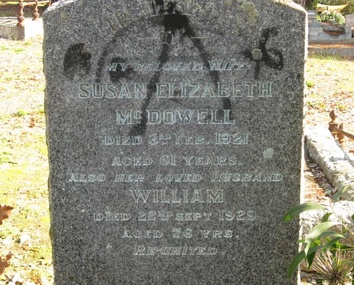 Greensborough Historical Society
Photograph - Digital image, Grave of Susan E McDowell and William McDowell, Greensborough Cemetery, 03/02/1921
... Ireland.] Greensborough Cemetery was created when land was given for the cemetery by Mr William Poulter, a local settler, about 1864. ...Grave of Susan E McDowell (died 1921) and William McDowell (died 23/09/1929) in Plot# F14/F15 Greensborough Cemetery. [Caption by Bruce McDowell: Susan Elizabeth McDowell was the daughter of William and Mary Poulter (nee Chapman) - grand daughter of James and Susan Chapman (nee Palmer) - William McDowell was the son of James and Alice McDowell (nee Skillen) - William McDowell was born in County Down; Ireland.]Greensborough Cemetery was created when land was given for the cemetery by Mr William Poulter, a local settler, about 1864. The cemetery holds the graves of many early settlers in the district. Digital copy of colour photograph of grave/headstone.susan mcdowell, william mcdowell, greensborough cemetery -
 Narre Warren and District Family History Group
Book, Alexandra Hasluck, Portrait in a mirror : an autobiography, 1981
... In her autobiography she brings her discerning eye to bear on her own ancestors, and with vivid sketches of her English, Irish and Scottish forebears portrays what she regards as the typical experiences of British settlers. ...Alexandra Hasluck is well-known as one of a distinguished group of female historians who have done so much, by their perceptive biographies, to enlarge our knowledge of the characters of our history. In her autobiography she brings her discerning eye to bear on her own ancestors, and with vivid sketches of her English, Irish and Scottish forebears portrays what she regards as the typical experiences of British settlers. The same observing eye and mind follow her basically happy childhood and youth in Western Australia to becoming herself a 'Governor's Lady'. She married Paul Hasluck, then sub-editor on the West Australian newspaper. When he entered the diplomatic sphere she moved with him to Canberra and her descriptions of life in war-time Canberra and later in America, are enlivened by humorous sketches of people and events which few people have been fortunate enough to experience. These opportunities increased when, on their return to Australia, her husband became a member of Parliament and a Cabinet Minister in Sir Robert Menzies' Government, first as Minister for Territories and later as Foreign Minister. Both positions provided them with many new experiences: of journeys to the remoter parts of Australia and New Guinea in his responsibility for Territories and, later, as Foreign Minister, of visits to the capitals of the world, meeting most of the great men of our time. Even wider vistas opened when her husband became Governor General of Australia and the observing historian was able to record characteristically life at Government House with its constant stream of visitors colouring its own equally interesting inner life. Portrait in a Mirror is not only a fascinating story but also a remarkable self-portrait, told through letters diaries and speeches as well as her own commentaries ot a watching woman: a dispassionate observer of the famous people and great events of her time, who was unaffected by her varying environments and remained, as she had begun, a typical scion of that early colonial stock - intelligent, literate, strongly-opinioned - and staunchly Australian. (Cover)non-fictionAlexandra Hasluck is well-known as one of a distinguished group of female historians who have done so much, by their perceptive biographies, to enlarge our knowledge of the characters of our history. In her autobiography she brings her discerning eye to bear on her own ancestors, and with vivid sketches of her English, Irish and Scottish forebears portrays what she regards as the typical experiences of British settlers. The same observing eye and mind follow her basically happy childhood and youth in Western Australia to becoming herself a 'Governor's Lady'. She married Paul Hasluck, then sub-editor on the West Australian newspaper. When he entered the diplomatic sphere she moved with him to Canberra and her descriptions of life in war-time Canberra and later in America, are enlivened by humorous sketches of people and events which few people have been fortunate enough to experience. These opportunities increased when, on their return to Australia, her husband became a member of Parliament and a Cabinet Minister in Sir Robert Menzies' Government, first as Minister for Territories and later as Foreign Minister. Both positions provided them with many new experiences: of journeys to the remoter parts of Australia and New Guinea in his responsibility for Territories and, later, as Foreign Minister, of visits to the capitals of the world, meeting most of the great men of our time. Even wider vistas opened when her husband became Governor General of Australia and the observing historian was able to record characteristically life at Government House with its constant stream of visitors colouring its own equally interesting inner life. Portrait in a Mirror is not only a fascinating story but also a remarkable self-portrait, told through letters diaries and speeches as well as her own commentaries ot a watching woman: a dispassionate observer of the famous people and great events of her time, who was unaffected by her varying environments and remained, as she had begun, a typical scion of that early colonial stock - intelligent, literate, strongly-opinioned - and staunchly Australian. (Cover)autobiography, alexandra hasluck, paul hasluck, governor-general
