
Showing 29 items matching "iron and steel industry"
-
 Moorabbin Air Museum
Book (Item) - Textbook Of Air Armament Part 2 , Chapter 8 Vulnerability Of The Iron And Steel Industry
... Textbook Of Air Armament Part 2 , Chapter 8 Vulnerability Of The Iron And Steel Industry....Textbook Of Air Armament Part 2 , Chapter 8 Vulnerability Of The Iron And Steel Industry....Air Publication 110A-0300-1B8 Textbook Of Air Armament Part 2 , Chapter 8 Vulnerability Of The Iron And Steel Industry. Book Textbook Of Air Armament Part 2 , Chapter 8 Vulnerability Of The Iron And Steel Industry. ...Air Publication 110A-0300-1B8 -
 City of Melbourne Libraries
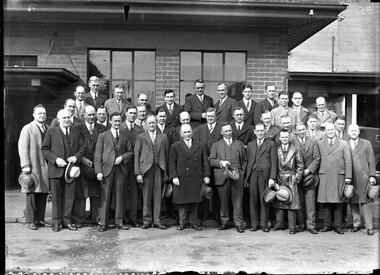
Photograph, Bull, Hugh Jones, 1897-1993, Steel manufacturers, McPherson's Ltd, Melbourne
... ...Iron and steel industry...Even attempts at smelting the iron ore in a blast furnace to create pig iron were unsuccessful due to the poor quality of iron ore and coke available to the budding industry. ...u=12430d30453a77059b7d10d49006a521 Robyn Annear, Bearbrass: imagining early Melbourne, Black Inc., 2014 (originally published 1995 by Mandarin) 'Company details', Ajax Fasteners, http://www.minesuppliersonline.com.au/australia/braeside/hardware/ajax-fasteners 'Former McPherson's Building', Victorian Heritage Database, https://vhd.heritagecouncil.vic.gov.au/places/741 1930-1939 industrial workers clothing and dress 1930 Iron and steel industry Businesses Bridges Industry Melbourne Gold Rush Moderne style architecture Photographer notations on slide: "Steel manuf'rs at McPherson's Ltd 1933 B5". ...Photographer notations on slide: Steel Manuf’rs at McPherson’s Ltd 1933 Published: The Age, 30 August 1933 BUREAU OF STEEL MANUFACTURERS OF AUSTRALIA. (1933, August 30). The Age (Melbourne, Vic. : 1854 - 1954), p. 11. Retrieved January 25, 2026, from http://nla.gov.au/nla.news-article204372874 Published title: Bureau of Steel Manufacturers of Australia Published caption: A group of Inter-State Visitors, from the Bureau of Steel Manufacturers of Australia, on a tour of inspection at the Bolt Works of McPhersons Pty. Ltd., Burnley-Richmond, yesterday. Research by Project Volunteer, Louise McKenzie: The photo shows a line up of 36 men, in three rows, in front of a building. They are mostly dressed in dark 3-piece suits, or camel coats. But one gentleman stands out in his full length leather coat! Striped ties are popular, and they are all holding hats. One man, at the rear towards the right, looks a bit younger with his thick, black, brylcreamed hair.. These interstate gentlemen are described in the newspaper caption as representatives of the Bureau of Steel Manufacturers "...on a tour of inspection at the Bolt Works of McPhersons Pty Ltd, Burnley, Richmond." Interestingly, the Bureau of Steel Manufacturers of Australia (BOSMA) still exists, and is the industry body for major Australian steel producers like BlueScope, Liberty, and InfraBuild, representing their interests, engaging with government, and participating in standards setting for the domestic steel market, with a history dating back to 1923. While BOSMA focuses on primary manufacturing, the Australian Steel Institute (ASI) serves as the broader peak body for the entire steel supply chain, from mills to end-users, promoting and supporting the industry. But at the time of this photo, the Australian steel industry was just starting to make headway. As the AST website explains, "Steelmaking in Australia began just a decade prior to the start of the 1851 Gold Rush whilst Australia was still divided into colonies. Iron ore deposits were discovered in 1840 at Iron Knob, South Australia but a lack of equipment meant that the process of producing steel was impossible. Even attempts at smelting the iron ore in a blast furnace to create pig iron were unsuccessful due to the poor quality of iron ore and coke available to the budding industry. In the other colonies at the time, such as Victoria, Tasmania, and New South Wales, there were minor discoveries of iron ore but poor technical expertise and limited quantity meant that the quality of steel was poor. Compared to the far superior steel being imported from Britain at the time, the steel manufacturing industry simply couldn’t compete and was unviable. By the 1870s, almost all steel production in Australia had been abandoned. The situation began to change at the turn of the century. Rapid growth sparked higher demand for industrial machinery made from steel and infrastructure such as rail. It became apparent that there was a need for locally manufactured steel and soon there would be an answer. In 1901, the year Australia united into a federation, the nation’s first blast furnace went into production at Eskbank near Lithgow in New South Wales. The development was spearheaded by William Stafford and his son Esk, and Stafford is known as the father of Australian steel production. In 1915, production expanded with another steel mill in Newcastle that was opened by BHP. It sourced coke from local mines and iron ore from South Australia, creating a domestic loop for steel manufacturing. In the following years, more steelworks opened in Whyalla, South Australia and Port Kembla in NSW. Steel manufacturing in Australia was now underway." The company mentioned in the photo’s notation and in the newspaper caption, was McPhersons, "...an Australian hardware firm, for many years a leading merchant of woodworking and metal-working machinery... [and founded by] Thomas McPherson (c.1823–1888) who had a home "Dudley House" at 142 Dudley Street, West Melbourne. [The] ironmongery business [was located] in 1860 at 149 Spencer Street, Melbourne. Merchandise carried included bells, lathes, horseshoes and steam engines." (Wikipedia - McPherson's Pty Ltd) Anyone who has read Robyn Annear’s excellent award-winning 2014 book Bearbrass – the name for early Melbourne - will remember only too well her description of West Melbourne, from where the city of Melbourne as we know it, emerged. Her book resurrects the village that was early Melbourne – from the arrival of white settlers in 1835 until the first gold rushes shook the town – and brings it to life in vivid colour. The McPherson family, whose arrival in Bearbrass coincides with this period (Thomas arrived in 1852), became intimately involved in the growth and development of Melbourne. Thomas was Mayor of Melbourne (1870-1871); his eldest son Hunter became a successful Sydney businessman; second son Edward and third son William inherited the company, and ran it together until 1896 when Edward killed himself. William had a notable career in politics as treasurer of Victoria 1917-1923, in which year he was knighted. 1928-1929 he was Premier of Victoria, and a noted philanthropist. The family were significant property owners in the city of Melbourne: 149 Spencer Street, 582-588 Collins Street, 554-566 Collins Street, together with a property on Jeffcott Street, West Melbourne, and factories in Sunshine, Tottenham, Kensington and Richmond – all by the mid 1940s. By that time they also had controlling interests in several Australasian industries, including Ajax Bolt and Rivet Pty Ltd of NZ, F W Hercus Manufacturing Co Ltd, manufacturers in South Australia of lathes, guillotines and other heavy machinery, also of Patience and Nicholson (P & N), manufacturers in Maryborough, Victoria, of twist drills and thread-forming tools; also Wiltshire Files on Sunshine Road, Tottenham, manufacturing files and rasps. The Acme Machine Tool Company became a branch of McPhersons, and the company claimed to have supplied, from their own manufacture, all five million rivets (some 3,600 tonnes) used in the building of the Sydney Harbour Bridge – described as a steel through arch bridge, which opened in 1932; the tallest of its kind in the world (Wikipedia – Sydney Harbour Bridge) McPherson’s was also innovative in other ways. It published a comprehensive catalogue, extensively detailed with prices, available free of charge to farmers and other businesses. In 1908 it had 148 pages. By 1937 it had grown to 372 pages. The University of Melbourne’s Archives entry on McPherson’s Limited notes: "After the outbreak of the Second World War, McPherson’s factories worked at full capacity and were crucial to Australia’s war efforts. On 5 December 1944 McPherson's converted to a public company named McPherson's Ltd, with William Edward as Chairman of Directors. By the start of the 1950s the company had a very different Board of Directors; in 1947 the Managing Director Oliver Addison died, and his replacement Marshall Eady died only six months later. Both had been Directors since McPherson’s became a proprietary company in 1913. Another Director, Philip Bevan, died in 1948 and this was followed by the death of William Edward in 1950. S.B Holder, F.G. Thorpe, H.L. Hastie, F. Grassick and D.G. Syme all joined the Board before 1950. The company continued to prosper for many years after the death of William Edward. His son, William David, was invited to join the McPherson’s Ltd Board in 1951. He married Angela Cumming in 1955 and soon after was sent to Brisbane as Director in Charge to oversee the building of a new warehouse. The opening of this warehouse in Queensland meant that the company now had major outlets in five states. As time went on, manufacturing in Australia began to decline and imports of everyday tools began arriving from Asia. These tools were being produced with much lower labour costs and could be sold at cheaper prices. William David retired in 1984 and eventually parts of the company were divested, such as the Richmond Bolt Works which closed in the early 1990s. Since the 1980s, McPherson's has diversified into housewares, printing, and health and beauty care products." This article also contains photos, one of which is a photograph of 'Bolt works picnic' 1920, showing workers in their shirt sleeves participating in a tug of war in a rural "picnic" setting. McPherson’s premises at 554-566 Collins Street more than lasted the test of time and is listed as historically significant. The magnificent art deco building from the 1930s in the heart of Melbourne was first commissioned in 1934 and completed in 1937. It is an imposing building fronting almost a quarter of the city block between Spencer Street and King Street, and was designed to be a warehouse, office and showroom for the hardware empire. International architects Stuart P Calder, and Reid and Pearson designed the four-storey building with a basement level and a stair tower at the centre that provides access to what was a tennis court on the roof. It is considered an example of the streamlined modern style in Melbourne and shows how the McPherson company, protected from taxes after World War I, was able to manufacture goods without being affected by the competition. The building has survived, and its current iteration is as the home to il Mercato Centrale – an Italian style artisan market concept. The University of Melbourne Archives hold a particularly good image of the building from its heyday, complete with Collins Street lamps on the pavement outside the store. And to return to our image, sited at "Bolt Works of McPhersons". Today this segment of McPhersons is still very well known - Ajax. A good summary of the company’s history, and the development of the name and business, can be found on the Mine Suppliers Online website: "AJAX Fasteners can trace its heritage back to 1900, when the Acme Bolt Company was established in West Melbourne, Victoria. In 1909, William McPherson used the company as the basis for establishing McPherson’s Bolt Works – adopting the brand ‘Ajax’ – and moved it to Richmond. Over the years, the company changed many times in response to industry needs to ensure that it remained the premier manufacturer of high quality fasteners in Australia. Many other names in the industry, such as Firth Cleveland, Spurway Cooke and Nettlefolds were merged or acquired into the company. McPhersons ended their 80-year ownership of Ajax in the early 90s when they sold their shares to National Consolidated, which was also a major shareholder at the time. In 1997, Ajax Fasteners moved to new purpose-built premises in Braeside, Victoria. Soon after, National Consolidated was taken over by the diversified manufacturer Austrim. The group soon acquired the iconic Nylex, and adopted the name Nylex Corporation. In January 2007, ACME Operations Pty Ltd acquired Ajax Fasteners and continues to operate the business today from the Braeside plant. The name ACME provides a nostalgic return by the new owners to the company’s heritage, when the Acme Bolt Company was founded in July 1900." REFERENCES: BUREAU OF STEEL MANUFACTURERS OF AUSTRALIA. (1933, August 30). The Age (Melbourne, Vic. : 1854 - 1954), p. 11. Retrieved January 25, 2026, from http://nla.gov.au/nla.news-article204372874 Wikipedia, McPherson’s Pty Ltd, https://en.wikipedia.org/wiki/McPherson%27s_Pty_Ltd Wikipedia, Richmond, Victoria, https://en.wikipedia.org/wiki/Richmond,_Victoria Industry: From the mid-19th century, Richmond was a centre of manufacturing industry, including many large complexes such as the Bryant & May match factory, Jaques Limited engineering works, the Wertheim Piano factory and Pelaco. Wikipedia, Sydney Harbour Bridge, https://en.wikipedia.org/wiki/Sydney_Harbour_Bridge eMelbourne, Manufacturing, https://www.emelbourne.net.au/biogs/EM00896b.htm 'New life for Melbourne's McPherson Building', The Urban Developer, https://www.theurbandeveloper.com/articles/mcphersons-building-melbourne-il-mercato-centrale-food-retail-destination Bureau Of Steel Manufacturers Of Australia Limited, http://www.bosma.org.au/ 'A Brief History of Steel Manufacturing in Australia', AST, https://astraders.com.au/a-brief-history-of-steel-manufacturing-in-australia/ 'Steel manufacturing in Australia: a brief history', Hard Bakka Steel Fabrication, https://www.hardbakka.com.au/component/virtuemart/steel-manufacturing-in-australia-a-brief-history?Itemid=494 McPherson's Limited, University of Melbourne Archives, https://archives.library.unimelb.edu.au/nodes/view/58364 Source of Description: 'Nuts and Bolts: A story of a family and a firm', Barbara Hamer (2006), McPherson’s Printing Group 'Photograph of 'Bolt works picnic' 1920', University of Melbourne Archives, https://archives.library.unimelb.edu.au/assets/display/1287217-max?u=dea2e4d2fd07ac822e624f1e7d39adb3 'Photograph of the exterior of the McPhersons Department store at 546 Collins Street, Melbourne.', University of Melbourne Archives, https://archives.library.unimelb.edu.au/assets/display/1287215-max?u=12430d30453a77059b7d10d49006a521 Robyn Annear, Bearbrass: imagining early Melbourne, Black Inc., 2014 (originally published 1995 by Mandarin) 'Company details', Ajax Fasteners, http://www.minesuppliersonline.com.au/australia/braeside/hardware/ajax-fasteners 'Former McPherson's Building', Victorian Heritage Database, https://vhd.heritagecouncil.vic.gov.au/places/741Photographer notations on slide: "Steel manuf'rs at McPherson's Ltd 1933 B5".1930-1939, industrial workers, clothing and dress, 1930, iron and steel industry, businesses, bridges, industry, melbourne, gold rush, moderne style architecture -
 Sunshine and District Historical Society Incorporated
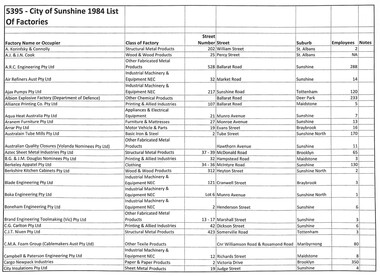
Archive - City of Sunshine 1984 List Of Factories, K.G. Wilson, L.R. Dryer & R.A. Scaramella, 1984
... Pty Ltd Sign City Pty Ltd Smithweld Pty Ltd Smorgan Consolidated Industries Solo Signs Spafco Pty Ltd Stafford Engineering Pty Ltd Star of Paris Pty Ltd Steel Improvement Pty Ltd Sunset Joinery Pty Ltd Sunshine Engineering Pty Ltd Sunshine Group Industries Pty Ltd Sunshine Joinery Pty Ltd Sunshine Metal Polishing Pty Ltd Sunshine Trailers Sunshine Vitreous Enamellers Pty Ltd Sunshine Wrought Iron Super Cartridge Superstyle Tubular Manufacturers Pty Ltd Talkprint Pty Ltd Tenderfoot Shoes Treble Printing Co. ...Pty Ltd Sign City Pty Ltd Smithweld Pty Ltd Smorgan Consolidated Industries Solo Signs Spafco Pty Ltd Stafford Engineering Pty Ltd Star of Paris Pty Ltd Steel Improvement Pty Ltd Sunset Joinery Pty Ltd Sunshine Engineering Pty Ltd Sunshine Group Industries Pty Ltd Sunshine Joinery Pty Ltd Sunshine Metal Polishing Pty Ltd Sunshine Trailers Sunshine Vitreous Enamellers Pty Ltd Sunshine Wrought Iron Super Cartridge Superstyle Tubular Manufacturers Pty Ltd Talkprint Pty Ltd Tenderfoot Shoes Treble Printing Co. ...This list of factories in the City of Sunshine is an extract from a report by K.G. Wilson, L.R. Dryer & R.A. Scaramella, prepared for the Melbourne Western Region Commission (WRC). The Melbourne Western Region Commission was a major inter‑municipal planning and advocacy body operating across Melbourne’s western suburbs in the late 1970s and 1980s. It coordinated planning, heritage studies, and regional development across multiple councils. The Commission brought together a broad sweep of western-region councils City of Altona, City of Essendon, City of Footscray, City of Keilor, City of Sunshine, City of Williamstown, Shire of Bacchus Marsh, Shire of Melton & Shire of Werribee. The Melbourne Western Region Commission was one of the most important institutional predecessors to the region’s later heritage, planning, and community‑development frameworks.This report records the business name, type of industry and address of businesses operating in the City of Sunshine in 1984.Factory Name or Occupier A. Korinfsky & Connolly A.J. & J.N. Cook A.R.C. Engineering Pty Ltd Air Refiners Aust Pty Ltd Ajax Pumps Pty Ltd Albion Explosive Factory (Department of Defence) Alliance Printing Co. Pty Ltd Aqua Heat Australia Pty Ltd Aranem Furniture Pty Ltd Arrar Pty Ltd Australain Tube Mills Pty Ltd Australian Quality Closures (Volanda Nominees Pty Ltd) Aztec Sheet Metal Industries Pty Ltd B.G. & J.M. Douglas Nominees Pty Ltd Berkeley Appatel Pty Ltd Berkshire Kitchen Cabinets Pty Ltd Blade Engineering Pty Ltd Boka Engineering Pty Ltd Boneham Engineering Pty Ltd Brand Engineering Toolmaking (Vic) Pty Ltd C.G. Carlton Pty Ltd C.J.T. Niven Pty Ltd C.M.A. Foam Group (Cablemakers Aust Pty Ltd) Campbell & Paterson Engineering Pty Ltd Cargo Newpack Industries City Insulations Pty Ltd Classic Garage Construction Cliff Poole Industries Pty Ltd Collie Cooke Consolidated Conlo Constructions Pty Ltd Connor Shea & Co. Pty Ltd Consolidated Partition Industries Holding Pty Ltd Cosmoplitan Clothing Manfacturers Crea Fashions Pty Ltd Currie Furniture Manufacturing Pty Ltd D. Richardson & Son Ltd Dalco Hardware (Dalco Pty Ltd) Daveyduke Industries (Mimvic Nominees Pty Ltd) Debora Downs Pty Ltd Deer Park Engineering Pty Ltd Deer Park Flyscreens (Azzopardi & Associates Pty Ltd) Dieselflex Pty Ltd Donald Minahan Pty Ltd Drava Continental Butchers & Smallgoods Manufacturer Drilling Equipment (Van Dyke Pty Ltd) Dunham Welding Engineering Pty Ltd E. & F. Industries Pty Ltd E.P. Morrisey & Co. Pty Ltd Elite-Built Holdings Ltd Englehold Engineering Pty Ltd Everlast Steel Products Explosive Factory (Department of Defence Support) Extruded Metals Pty Ltd Exy-Fit Screens F. & D.M. Costa Pty Ltd F. & I. Pfeffer Holdings Pty Ltd F.J. Humphrey Pty Ltd Fallshaw Holdings Pty Ltd Ferrous Forgings Pty Ltd Fleet Engineering Pty Ltd Fletcher Chemical Co. Ltd Franklin Printing & Lithographic Co. Pty Ltd Fraser Cabinets Pty Ltd G. & L. Stone Pty Ltd G.A.M. Engineering Industries Pty Ltd G.P.I. Automotive Products Pty Ltd G.U.D. Manufacturing Co. Pty Ltd G.W. Gregory Engineering (Aust) Pty Ltd General Printing Ink (Aust) Pty Ltd George Press Pty Ltd Griffiths & Beeren Pty Ltd Gubbata Nominess Pty Ltd Harkrome Electroplaters Pty Ltd Hills & Mason Pty Ltd Hydraulic Equipment & Cylinder Service Pty Ltd Hy-Du-Ex I.C.I. Australia Operations Pty Ltd I.H. Mono & Co. Idea General Engineering Industrial Engineering Invicta Group Industries Pty Ltd K. & B. Windows Pty Ltd K.C. Furniture & Cabinets K.D.S. Manufacturing K.M. Tubular Industries (Aust) Pty Ltd K.P.T. Clothing Manufacturers (K.T.P. Fashions Pty Ltd) Kanga Engineering Pty Ltd Keilor Footwear Pty Ltd Kelgrif Patterns Pty Ltd Klipspringer Pty Ltd Krueger Transports Equipment Pty Ltd Langmar Pty Ltd Layton Granite Industries Pty Ltd Lesvos General Products (Gabbia Pty Ltd) Lewis Foundry Lysaght Durham Chemical Company (Austram Corporation Ltd) M.C.I. (Aust) Pty Ltd M.J. Billings M.S.M. Cabinets Pty Ltd Maidstone Cabinet Works Marble Art Company Marib Cutter Sharpening Service Massey-Ferguson (Aust) Ltd McIntyre Steel Industries (Vic) Pty Ltd Midway Press Business Forms Mirna Cabinets Manufacturers Pty Ltd Monsanto Aust Ltd Morgan Cabinets Morris Structural & Engineering Newroll Industries Pty Ltd North Sunshine Cases Novio Insulation (Vic) Pty Ltd Olex Cables (Dunlop Olympic Ltd) Ordnance Factory (Department of Defence Support) P. & S. Siegel Pty Ltd P.S. Fenech Pty Ltd Pacific Carpets Internations Pty Ltd Pattern Productions Pauls Woodworking Pty Ltd Penthouse Furniture Co. Pty Ltd Peter Bouris General Steel Work Pomona Printers Pty Ltd Presstool Manufacturing & Grinding R.E.M. Constructions Pty Ltd R.J. Thompson Nominees Pty Ltd R.M.D. Press Co. Pty Ltd Ralph McMay Ltd Reeco Industries Pty Ltd Regina Terrazzo Tile Robcliff Printing Rockwell Standard of Australia Ltd Saturn Quality Trailers Pty Ltd Sedco Pty Ltd & Sunshine Extrusion Die Co. Pty Ltd Sign City Pty Ltd Smithweld Pty Ltd Smorgan Consolidated Industries Solo Signs Spafco Pty Ltd Stafford Engineering Pty Ltd Star of Paris Pty Ltd Steel Improvement Pty Ltd Sunset Joinery Pty Ltd Sunshine Engineering Pty Ltd Sunshine Group Industries Pty Ltd Sunshine Joinery Pty Ltd Sunshine Metal Polishing Pty Ltd Sunshine Trailers Sunshine Vitreous Enamellers Pty Ltd Sunshine Wrought Iron Super Cartridge Superstyle Tubular Manufacturers Pty Ltd Talkprint Pty Ltd Tenderfoot Shoes Treble Printing Co. Trifoleum Pty Ltd Ultra Scales Pty Ltd United Scales Pty Ltd V.P. Hawthorne Nominees Pty Ltd Vinidex Tubemakers Pty Ltd Vitas Engineering W. & H. General Engineering Pty Ltd W. Pridham (Aust) (Peerless Processing Co Pty Ltd) W.G. Engels Pty Ltd W.L. Allen Foundry Co. Pty Ltd Wakefield Repetition & General Engineers Warren & Brown Co. (Repco Ltd) Westbury Joinery Co. Holdings Pty Ltd Western Containers Pty Ltd & Chanel Press Pty Ltd Westgate Engineering Westside Joinery Pty Ltd (The Bulman Family Trust) Westwork Industries Wiltshire Tools Pty Ltd Worsted Finishers (Aust) Pty Ltd melbourne western region commission -
 Flagstaff Hill Maritime Museum and Village
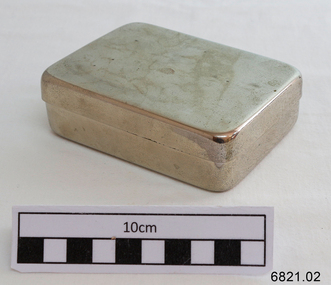
Container - Medical container, Late 19th century or early 20th century
... In 1906 Guillet went on to analyse iron-nickel-chrome alloys, which would now be considered the basics of the 300 series. ...In 1906 Guillet went on to analyse iron-nickel-chrome alloys, which would now be considered the basics of the 300 series. ...THE DISCOVERY OF STAINLESS STEEL Harry Brearley Since the dawn of man colonies have raced against each other to uncover new technologies, to be the first to stamp their names on a discovery, and although we’ve evolved over millions of years, the urge to be the first remains at the very core of our nature. This sense of passion and pride can lead some of the more unscrupulous humans to claim others discoveries as their own. Of course many breakthroughs are genuinely made in tandem, or are simultaneously occurring, but unless you can categorically prove that you were the pioneer of these incredible findings, then the other party involved will always dispute the fact. And so we come to stainless steel. The first point to note is that ‘inventor’ is a very ambiguous term. Is this the first person to think, to document, to patent, or to produce? The second point is that stainless steel wasn’t truly defined until 1911, so are we to cast aside those chromium-iron alloys that don’t quite meet the minimum requirement of 10.5% chromium? It seems like anyone and everyone has a different claim to being labelled the ‘inventor’ of stainless steel; from Britain, Germany, France, Poland, the U.S.A., and even Sweden. The cogs were set in motion by Englishmen Stoddart and Faraday circa 1820 and Frenchman Pierre Berthier in 1821. These scientists, among others, noted that iron-chromium alloys were more resistant to attack by certain acids, but tests were only carried out on low chromium content alloys. Attempts to produce higher chromium alloys failed primarily because of scientists not understanding the importance of low carbon content. In 1872 another pair of Englishmen, Woods and Clark, filed for patent of an acid and weather resistant iron alloy containing 30-35% chromium and 2% tungsten, effectively the first ever patent on what would now be considered a stainless steel. However, the real development came in 1875 when a Frenchman named Brustlein detailed the importance of low carbon content in successfully making stainless steel. Brustlein pointed out that in order to create an alloy with a high percentage of chromium, the carbon content must remain below around 0.15%. Thus ensued two decades of stagnation for the development of stainless steel, and while many scientists attempted to create a low carbon stainless steel, none succeeded. Hans Goldschmidt It wasn’t until 1895, when Hans Goldschmidt of Germany developed the aluminothermic reduction process for producing carbon-free chromium, that development of stainless steels became a reality. In 1904 French Scientist Leon Guillet undertook extensive research on many iron-chromium alloys. Guillet’s work included studies on the composition of what would now be known as 410, 420, 442, 446 and 440-C. In 1906 Guillet went on to analyse iron-nickel-chrome alloys, which would now be considered the basics of the 300 series. However, while noting the chemical composition of his alloys, Guillet failed to acknowledge the potential corrosion resistance of his materials. Albert Portevin In 1909 Englishman Giesen published an in-depth work regarding chromium-nickel steels, while the French national, Portevin, studied what is now regarded as 430 stainless steel. However, it wasn’t until 1911 that the importance of a minimum chromium content was discovered by Germans P. Monnartz and W. Borchers. Monnartz and Borchers discovered the correlation between chromium content and corrosion resistance, stating that there was a significant boost in corrosion resistance when at least 10.5% chromium was present. The pair also published detailed works on the effects of molybdenum on corrosion resistance. It is at this point we introduce Harry Brearley, born in Sheffield, England in 1871, he was appointed lead researcher at Brown Firth Laboratories in 1908. In 1912 Brearley was given a task by a small arms manufacturer who wished to prolong the life of their gun barrels which were eroding away too quickly. Brearley set out to create an erosion resistant steel, not a corrosion resistant one, and began experimenting with steel alloys containing chromium. During these experiments Brearley made several variations of his alloys, ranging from 6% to 15% chromium with differing levels of carbon. On the 13th August 1913 Brearley created a steel with 12.8% chromium and 0.24% carbon, argued to be the first ever stainless steel. The circumstances in which Brearley discovered stainless steel are covered in myth; some enchanted tales of Brearley recite him tossing his steel into the rubbish, only to notice later that the steel hadn’t rusted to the extent of its counterparts, much like Alexander Fleming’s experience 15 years later. Other more plausible, (but less attractive), accounts claim it was necessary for Brearley to etch his steels with nitric acid and examine them under a microscope in order to analyse their potential resistance to chemical attack. Brearley found that his new steel resisted these chemical attacks and proceeded to test the sample with other agents, including lemon juice and vinegar. Brearley was astounded to find that his alloys were still highly resistant, and immediately recognised the potential for his steel within the cutlery industry. The Half Moon Brearley struggled to win the support of his employers, instead choosing to produce his new steel at local cutler R. F. Mosley. He found difficulty producing knife blades in the new steel that did not rust or stain and turned to his old school friend, Ernest Stuart, Cutlery Manager at Mosley’s Portland Works, for help. Within 3 weeks, Stuart had perfected the hardening process for knives. Brearley had initially decided to name his invention ‘Rustless Steel’, but Stuart, dubbed it ‘Stainless Steel’ after testing the material in a vinegar solution, and the name stuck. And that’s how Harry Brearley discovered stainless steel…. well, not quite… During the 5 year period between 1908 and Brearley’s discovery in 1913 many other scientists and metallurgists have potential claims to Brearley’s title. In 1908 the Germans entered the fray, the Krupp Iron Works in Germany produced a chrome-nickel steel for the hull of the Germania yacht. The Half Moon, as the yacht is now known, has a rich history and currently lies on the seabed off the east coast of Florida. Whether the steel contains the minimum 10.5% chromium content remains inconclusive. Employees of the Krupp works, Eduard Maurer and Benno Strauss, also worked from 1912-1914 on developing austenitic steels using <1% carbon, <20% nickel and 15-40% chromium. Not happy with Europe hogging the glory, the USA got in on the act. Firstly, Elwood Haynes, after becoming disenchanted at his rusty razor, set out to create a corrosion resistant steel, which he supposedly succeeded in doing during 1911. Two other Americans, Becket and Dantsizen, worked on ferritic stainless steels, containing 14-16% chromium and 0.07-0.15% carbon, in the years 1911-1914. Elwood Haynes During 1912 Max Mauermann of Poland is rumoured to have created the first stainless steel, which he later presented to the public during the Adria exhibition in Vienna, 1913. Finally, a recently discovered article, which was published in a Swedish hunting and fishing magazine in 1913, discusses a steel used for gun barrels, (sound familiar?), which seems to resemble stainless steel. Although this is purely speculation, the Swedes have still made an audacious claim that they were in fact responsible for the first practical application for stainless steel. That concludes the shambolic discovery of stainless steel! Although there is much mystery and speculation behind the discovery of this wonderful material, there is no question that without the combined effort of all the above scientists and metallurgists, (and all the many more that were not mentioned), we would not have such a rich and versatile metal at our fingertips. https://bssa.org.uk/bssa_articles/the-discovery-of-stainless-steel/#:~:text=On%20the%2013th%20August%201913,the%20first%20ever%20stainless%20steel. This stainless steel container was donated to Flagstaff Hill Maritime Village by the family of Doctor William Roy Angus, Surgeon and Oculist. It is part of the “W.R. Angus Collection” that includes historical medical equipment, surgical instruments and material once belonging to Dr Edward Ryan and Dr Thomas Francis Ryan, (both of Nhill, Victoria) as well as Dr Angus’ own belongings. The Collection’s history spans the medical practices of the two Doctors Ryan, from 1885-1926 plus that of Dr Angus, up until 1969. ABOUT THE “W.R.ANGUS COLLECTION” Doctor William Roy Angus M.B., B.S., Adel., 1923, F.R.C.S. Edin.,1928 (also known as Dr Roy Angus) was born in Murrumbeena, Victoria in 1901 and lived until 1970. He qualified as a doctor in 1923 at University of Adelaide, was Resident Medical Officer at the Royal Adelaide Hospital in 1924 and for a period was house surgeon to Sir (then Mr.) Henry Simpson Newland. Dr Angus was briefly an Assistant to Dr Riddell of Kapunda, then commenced private practice at Curramulka, Yorke Peninsula, SA, where he was physician, surgeon and chemist. In 1926, he was appointed as new Medical Assistant to Dr Thomas Francis Ryan (T.F. Ryan, or Tom), in Nhill, Victoria, where his experiences included radiology and pharmacy. In 1927 he was Acting House Surgeon in Dr Tom Ryan’s absence. Dr Angus had become engaged to Gladys Forsyth and they decided he would take time to further his studies overseas in the UK in 1927. He studied at London University College Hospital and at Edinburgh Royal Infirmary and in 1928, was awarded FRCS (Fellow from the Royal College of Surgeons), Edinburgh. He worked his passage back to Australia as a Ship’s Surgeon on the on the Australian Commonwealth Line’s T.S.S. Largs Bay. Dr Angus married Gladys in 1929, in Ballarat. (They went on to have one son (Graham 1932, born in SA) and two daughters (Helen (died 12/07/1996) and Berenice (Berry), both born at Mira, Nhill ) Dr Angus was a ‘flying doctor’ for the A.I.M. (Australian Inland Ministry) Aerial Medical Service in 1928 . The organisation began in South Australia through the Presbyterian Church in that year, with its first station being in the remote town of Oodnadatta, where Dr Angus was stationed. He was locum tenens there on North-South Railway at 21 Mile Camp. He took up this ‘flying doctor’ position in response to a call from Dr John Flynn; the organisation was later known as the Flying Doctor Service, then the Royal Flying Doctor Service. A lot of his work during this time involved dental surgery also. Between 1928-1932 he was surgeon at the Curramulka Hospital, Yorke Peninsula, South Australia. In 1933 Dr Angus returned to Nhill where he’d previously worked as Medical Assistant and purchased a share of the Nelson Street practice and Mira hospital from Dr Les Middleton one of the Middleton Brothers, the current owners of what was once Dr Tom Ryan’s practice. Dr L Middleton was House Surgeon to the Nhill Hospital 1926-1933, when he resigned. [Dr Tom Ryan’s practice had originally belonged to his older brother Dr Edward Ryan, who came to Nhill in 1885. Dr Edward saw patients at his rooms, firstly in Victoria Street and in 1886 in Nelson Street, until 1901. The Nelson Street practice also had a 2 bed ward, called Mira Private Hospital ). Dr Edward Ryan was House Surgeon at the Nhill Hospital 1884-1902 . He also had occasions where he successfully performed veterinary surgery for the local farmers too. Dr Tom Ryan then purchased the practice from his brother in 1901. Both Dr Edward and Dr Tom Ryan work as surgeons included eye surgery. Dr Tom Ryan performed many of his operations in the Mira private hospital on his premises. He too was House Surgeon at the Nhill Hospital 1902-1926. Dr Tom Ryan had one of the only two pieces of radiology equipment in Victoria during his practicing years – The Royal Melbourne Hospital had the other one. Over the years Dr Tom Ryan gradually set up what was effectively a training school for country general-practitioner-surgeons. Each patient was carefully examined, including using the X-ray machine, and any surgery was discussed and planned with Dr Ryan’s assistants several days in advance. Dr Angus gained experience in using the X-ray machine there during his time as assistant to Dr Ryan. Dr Tom Ryan moved from Nhill in 1926. He became a Fellow of the Royal Australasian College of Surgeons in 1927, soon after its formation, a rare accolade for a doctor outside any of the major cities. He remained a bachelor and died suddenly on 7th Dec 1955, aged 91, at his home in Ararat. Scholarships and prizes are still awarded to medical students in the honour of Dr T.F. Ryan and his father, Dr Michael Ryan, and brother, John Patrick Ryan. ] When Dr Angus bought into the Nelson Street premises in Nhill he was also appointed as the Nhill Hospital’s Honorary House Surgeon 1933-1938. His practitioner’s plate from his Nhill surgery states “HOURS Daily, except Tuesdays, Fridays and Saturday afternoons, 9-10am, 2-4pm, 7-8pm. Sundays by appointment”. This plate is now mounted on the doorway to the Port Medical Office at Flagstaff Hill Maritime Village, Warrnambool. Dr Edward Ryan and Dr Tom Ryan had an extensive collection of historical medical equipment and materials spanning 1884-1926 and when Dr Angus took up practice in their old premises he obtained this collection, a large part of which is now on display at the Port Medical Office at Flagstaff Hill Maritime Village in Warrnambool. During his time in Nhill Dr Angus was involved in the merging of the Mira Hospital and Nhill Public Hospital into one public hospital and the property titles passed on to Nhill Hospital in 1939. In 1939 Dr Angus and his family moved to Warrnambool where he purchased “Birchwood,” the 1852 home and medical practice of Dr John Hunter Henderson, at 214 Koroit Street. (This property was sold in1965 to the State Government and is now the site of the Warrnambool Police Station. ). The Angus family was able to afford gardeners, cooks and maids; their home was a popular place for visiting dignitaries to stay whilst visiting Warrnambool. Dr Angus had his own silk worm farm at home in a Mulberry tree. His young daughter used his centrifuge for spinning the silk. Dr Angus was appointed on a part-time basis as Port Medical Officer (Health Officer) in Warrnambool and held this position until the 1940’s when the government no longer required the service of a Port Medical Officer in Warrnambool; he was thus Warrnambool’s last serving Port Medical Officer. (The duties of a Port Medical Officer were outlined by the Colonial Secretary on 21st June, 1839 under the terms of the Quarantine Act. Masters of immigrant ships arriving in port reported incidents of diseases, illness and death and the Port Medical Officer made a decision on whether the ship required Quarantine and for how long, in this way preventing contagious illness from spreading from new immigrants to the residents already in the colony.) Dr Angus was a member of the Australian Medical Association, for 35 years and surgeon at the Warrnambool Base Hospital 1939-1942, He served as a Surgeon Captain during WWII1942-45, in Ballarat, Victoria, and in Bonegilla, N.S.W., completing his service just before the end of the war due to suffering from a heart attack. During his convalescence he carved an intricate and ‘most artistic’ chess set from the material that dentures were made from. He then studied ophthalmology at the Royal Melbourne Eye and Ear Hospital and created cosmetically superior artificial eyes by pioneering using the intrascleral cartilage. Angus received accolades from the Ophthalmological Society of Australasia for this work. He returned to Warrnambool to commence practice as an ophthalmologist, pioneering in artificial eye improvements. He was Honorary Consultant Ophthalmologist to Warrnambool Base Hospital for 31 years. He made monthly visits to Portland as a visiting surgeon, to perform eye surgery. He represented the Victorian South-West subdivision of the Australian Medical Association as its secretary between 1949 and 1956 and as chairman from 1956 to 1958. In 1968 Dr Angus was elected member of Spain’s Barraquer Institute of Barcelona after his research work in Intrasclearal cartilage grafting, becoming one of the few Australian ophthalmologists to receive this honour, and in the following year presented his final paper on Living Intrasclearal Cartilage Implants at the Inaugural Meeting of the Australian College of Ophthalmologists in Melbourne In his personal life Dr Angus was a Presbyterian and treated Sunday as a Sabbath, a day of rest. He would visit 3 or 4 country patients on a Sunday, taking his children along ‘for the ride’ and to visit with him. Sunday evenings he would play the pianola and sing Scottish songs to his family. One of Dr Angus’ patients was Margaret MacKenzie, author of a book on local shipwrecks that she’d seen as an eye witness from the late 1880’s in Peterborough, Victoria. In the early 1950’s Dr Angus, painted a picture of a shipwreck for the cover jacket of Margaret’s book, Shipwrecks and More Shipwrecks. She was blind in later life and her daughter wrote the actual book for her. Dr Angus and his wife Gladys were very involved in Warrnambool’s society with a strong interest in civic affairs. Their interests included organisations such as Red Cross, Rostrum, Warrnambool and District Historical Society (founding members), Wine and Food Society, Steering Committee for Tertiary Education in Warrnambool, Local National Trust, Good Neighbour Council, Housing Commission Advisory Board, United Services Institute, Legion of Ex-Servicemen, Olympic Pool Committee, Food for Britain Organisation, Warrnambool Hospital, Anti-Cancer Council, Boys’ Club, Charitable Council, National Fitness Council and Air Raid Precautions Group. He was also a member of the Steam Preservation Society and derived much pleasure from a steam traction engine on his farm. He had an interest in people and the community He and his wife Gladys were both involved in the creation of Flagstaff Hill, including the layout of the gardens. After his death (28th March 1970) his family requested his practitioner’s plate, medical instruments and some personal belongings be displayed in the Port Medical Office surgery at Flagstaff Hill Maritime Village, and be called the “W. R. Angus Collection”. The W.R. Angus Collection is significant for still being located at the site it is connected with, Doctor Angus being the last Port Medical Officer in Warrnambool. The collection of medical instruments and other equipment is culturally significant, being an historical example of medicine from late 19th to mid-20th century. Dr Angus assisted Dr Tom Ryan, a pioneer in the use of X-rays and in ocular surgery. Medical box; rectangular stainless steel base and separate lid, from the W.R. Angus Collection.warrnambool, flagstaff hill maritime museum, great ocean road, dr w r angus, dr ryan, surgical instrument, t.s.s. largs bay, warrnambool base hospital, nhill base hospital, mira hospital, flying doctor, medical treatment, stainless steel medical container, medical container, stainless steel -
 Flagstaff Hill Maritime Museum and Village
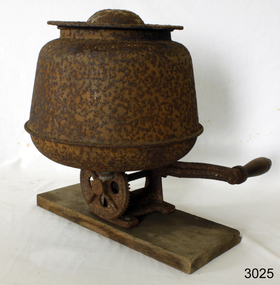
Domestic object - Butter Churn, Malleys Ltd, 1930-1950
... Churns were typically constructed from wood, glass and cast-iron; with tin or steel commonly used for some fixtures. ...This is a steel, bench-mounted, hand-operated (60 rpm) butter churn for making small amounts of butter from cream in the home. It was made by the Sydney firm of Malleys Ltd from the 1930s until the 1950s and came in 3 and 5 quart sizes. Malleys Ltd was established in about 1890 by Francis Malley (1863-1932). This firm was located in the Sydney suburb of Alexandria, in McEvoy Street. They manufactured items for use in the dairy industry, as well as for hardware related to building and plumbing. Many of the Malley dairy products were sold under the "Sunrise" name. Malley retired in 1912. In 1931 there were branches at Parramatta, Hurstville & North Sydney. Butter churns were machines used to produce butter by the violent agitation of separated cream. Depending on the design of the churn, the agitation would be variously achieved by a repetitive thrashing, centrifugal motion or internal paddles. Churns were typically constructed from wood, glass and cast-iron; with tin or steel commonly used for some fixtures. The subject item gives an insight into domestic life where butter was made in the home.Heavy red cast iron base, with a long handle, wooden grip, connected to a shaft along the base, thence, to a cog wheel, and gear, to a second shaft and paddle in a metal basin. Basin has lid, and hole in base with a screw cap to allow the draining of the butter milk. Designed to be placed on a bench, with the handle over the edge. Malleys is written in raised letters on the base, and on the handle, '60 rev. pr. min.'warrnambool, flagstaff-hill, flagstaff-hill-maritime-museum, shipwreck-coast, flagstaff-hill-maritime-village, malleys, butter churn, domestic object, dairy machine -
 Flagstaff Hill Maritime Museum and Village
Tool - Bench Saw Vice, Henry Disston & Sons, 1910 -1925
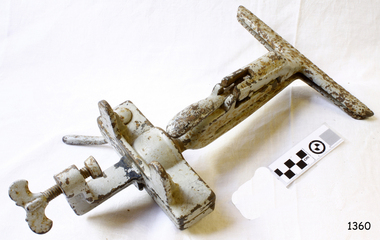
... of Philadelphia and became known as Disston Precision Incorporated, a maker of specialized flat steel products. In 2013, R.A.F. Industries sold Disston Precision Inc. in a private sale. ...The subject item is a saw blade sharpening clamp that attaches to a bench allowing the operator to sharpen the teeth on a saw with a file while keeping the saw blade in an upright position. Henry Disston (1819–1878) began his career as an American saw maker in Philadelphia. He emigrated from England in 1833 and started making saws and squares in 1840. In 1850, he founded the company that would become the largest saw maker in the world the ”Keystone Saw Works” on the Delaware River. Some five years later, Disston built a furnace possibly the first melting plant for steel in America and began producing the first crucible saw steel ever made in the United States. While his competitors were buying good steel from Britain, he was making his own, to his specification, for his own needs. Disston subsequently constructed a special rolling mill exclusively for saw blades. Over the following decade, the Disston company continued to grow, even while dedicating itself to the Union Army's war effort. In 1865, when his son Hamilton Disston rejoined the business after serving in the Civil War, Disston changed the company's name to Henry Disston & Son. Henry Disston and his sons set the standards for American saw makers, both in terms of producing high-quality saws and developing innovative manufacturing techniques. Disston also started making files in 1865. In September 1872, Henry Disston and two other men dug a part of the foundation for what was to become the largest saw manufacturing facility in the world: Disston Saw Works. This was in the Tacony section of Philadelphia. Having previously moved his expanding business from near Second and Market Streets to Front and Laurel Streets, Disston sought to establish his business away from this cramped area. It took over 25 years to move the entire facility to Tacony. This Philadelphia neighborhood seems to have been the only company town in the United States established within an existing city. At its peak of operations, Disston Saw Works employed 8,000 people and the factory covered 300 acres. The company, known as Henry Disston and Sons, Inc by the early 20th century, cast the first crucible steel in the nation from an electric furnace in 1906. The firm's Armour plate building near Princeton Avenue and Milnor Street contributed tremendously to the World War II effort. But the company's innovation and industriousness would not last forever. In 1955, with mounting cash-flow problems and waning interest on the family's part to run the firm, Henry Disston and Sons were sold to the H.K. Porter Company of Pittsburgh. Porter's Disston Division was sold in 1978 and became the Henry Disston Division of Sandvik Saw of Sweden. This division was then sold in 1984 to R.A.F. Industries of Philadelphia and became known as Disston Precision Incorporated, a maker of specialized flat steel products. In 2013, R.A.F. Industries sold Disston Precision Inc. in a private sale. Although the company has ceased making Disston handsaws, the Disston brand name still exists in this firm. A significant American company that pioneered the making of high-quality steel and saws along with other tools and accessories. The subject item is significant as it was made at a time when the company was in its hay day. Adjustable Ball & Socket Saw Sharpening vice, cast iron, with clamp to attach to a workbench. Made by Henry Disston & Co. No 1 painted greyflagstaff hill, warrnambool, flagstaff-hill, flagstaff-hill-maritime-museum, maritime-museum, shipwreck-coast, flagstaff-hill-maritime-village, saw clamp, henry disston & sons, saw sharpening, tool accessories, wood saws -
 The Beechworth Burke Museum
Geological specimen - Hematite (iron oxide)
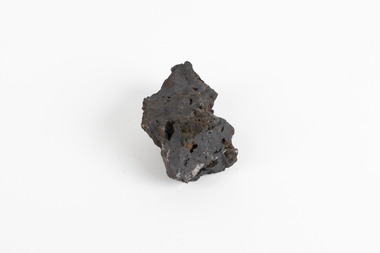
... This mineral specimen was collected from the Middleback Ranges before the area was identified as holding large reserves of iron ore and being commercially mined and is representative of South Australia's significant and ongoing history of iron ore mining, and its contribution to Australia's steel manufacturing industry of the early 20th century (this specimen being collected in the prelude to these events). ...Hematite is an iron ore significant for its high iron content (70%) and as being one of the two main iron oxide minerals, the other being magnetite. Hematite has a rating of 5-6 on the Moh's hardness scale and is often found as an accessory mineral in many igneous rocks. (an accessory mineral being "any mineral in an igneous rock not essential to the naming of the rock" - Britannica) Hematite has historically been the mainstay of South Australia’s iron ore production. (Magnetite: South Australia’s potential) Making up the eastern section of the Gawler Rangers, the Middleback Range is a mountain range on the eastern side of Eyre Peninsula in South Australia that has been a source of iron ore (its main commodity in minerals) for over a century. (see https://www.mindat.org/loc-22576.html). "Large reserves of high-grade iron ore were identified in 1890 in the Middleback Range, west of Whyalla. From 1915 these ores were shipped to Newcastle and later to Port Kembla, both in New South Wales. Local production of pig iron began when the first blast furnace was opened at Whyalla in 1941, and construction of an integrated iron and steel plant began there in 1958." (Britannica, South Australia: Resources and power). This area is home to 24 mines/mineral deposits (according to mindat.org, thought the Sarig Map provided by SA gov on their Energy and Mining website indicates significantly more mining leases).This mineral specimen was collected from the Middleback Ranges before the area was identified as holding large reserves of iron ore and being commercially mined and is representative of South Australia's significant and ongoing history of iron ore mining, and its contribution to Australia's steel manufacturing industry of the early 20th century (this specimen being collected in the prelude to these events).A small ferric oxide mineral composition a mid-blue-grey in colour with specks of rust-brown throughout.HEMATITE / (iron oxide) / Locality: Middleback Ranges, S. Aust.middleback ranges, iron ore mining, mining, south australia -
 The Beechworth Burke Museum
Geological specimen - Mangan Hedenbergite
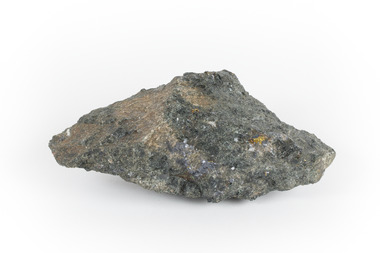
... Manganese is the world’s fourth most used mineral after iron, aluminium, and copper primarily because it has no satisfactory substitute in its major applications. ...This specimen was recovered from Broken Hill, NSW. It was given the name Mangan Hedenbergite in 1819 by Jöns Jakob Berzelius in honor of Mr. Anders Ludvig of Hedenberg who was the first to define hedenbergite as a mineral. Hedenbergite, belongs in the pyroxene group having a monoclinic crystal system. The mineral is extremely rarely found as a pure substance. Mangan Hedenbergite is a manganese bearing variety of Hedenbergite. Manganese is the world’s fourth most used mineral after iron, aluminium, and copper primarily because it has no satisfactory substitute in its major applications. Globally, the steel industry is the primary user of manganese metal, utilizing it as an alloy to enhance the strength and workability of steel and in the manufacture of tin cans. Manganese is a key component of certain widely used aluminium alloys and, in oxide form, dry cell batteries used in electric vehicles. These batteries are in high demand. Another potential use for manganese may as an additive to help coat and protect a car’s engine. Manganese is also used for non-metallurgical purposes such as plant fertilizers, animal feed, and colorants for bricks. This specimen is part of a larger collection of geological and mineral specimens collected from around Australia (and some parts of the world) and donated to the Burke Museum between 1868-1880. A large percentage of these specimens were collected in Victoria as part of the Geological Survey of Victoria that begun in 1852 (in response to the Gold Rush) to study and map the geology of Victoria. Collecting geological specimens was an important part of mapping and understanding the scientific makeup of the earth. Many of these specimens were sent to research and collecting organisations across Australia, including the Burke Museum, to educate and encourage further study.A hand-sized mineral specimen in shades of silver and blackmanganese, open cut mine, manganese ore processing, bell bay, tasmania, northern territory, steel industry, zinc-carbon batteries, alkaline batteries, tin cans -
Federation University Historical Collection
Document - Document - Design, E J Barker: University of Melbourne: Bachelor of Mechanical Engineering; Machine Design Assignments, 1947
... Reports on visits to various industries: Bristo Plastic Industries. b. Australian Iron and Steel. c. Olympic Cable Factory No 2: Medium Duty Centre Lathe Head Stock No.3: Vertical Multitubular Double Effect Evaporator No.4: Design and Drawings of 120 HP Diesel Engine Jack chose to do Engineering while still at Footscray Technical School as it gave access to Diploma Courses and tertiary studies. ...Reports on visits to various industries: Bristo Plastic Industries. b. Australian Iron and Steel. c. Olympic Cable Factory No 2: Medium Duty Centre Lathe Head Stock No.3: Vertical Multitubular Double Effect Evaporator No.4: Design and Drawings of 120 HP Diesel Engine Jack chose to do Engineering while still at Footscray Technical School as it gave access to Diploma Courses and tertiary studies. ...Four folders of Machine Design projects. No.1: a. Reports on visits to various industries: Bristo Plastic Industries. b. Australian Iron and Steel. c. Olympic Cable Factory No 2: Medium Duty Centre Lathe Head Stock No.3: Vertical Multitubular Double Effect Evaporator No.4: Design and Drawings of 120 HP Diesel Engine Jack chose to do Engineering while still at Footscray Technical School as it gave access to Diploma Courses and tertiary studies. This enabled him to enter the University of Melbourne and do a Bachelor in Mechanical Engineering - 1945, 1946, and 1947. In 1948 he did a Diploma in Education at Melbourne University. From this path he was able to follow a career in teaching and his first appointment was at the School of Mines in Ballarat, (SMB) 1949. He became the first Vice Principal of SMB in 1960 and then Principal in 1964 to 1976. From 1976 to his retirement in 1987, he was the Foundation Director of Ballarat College of Advanced Education (BCAE). The Library building at Mount Helen Campus is named after him.Manila folders with design assessments. Written descriptions and detailed drawings.e j barker, jack barker, melbourne university, engineering, diploma of mechanical engineering, diploma of electrical engineering, school of mines ballarat, smb, diploma in education, vice principal, principal, foundation director, ballarat college of advanced education, bcae, bachelor of mechanical engineering, library, mount helen campus, engineering drawing, design, specifications, manufacture, bristo plastic industries, australian iron and steel, olympic cable factory, centre lathe head stock, multitubular double effect evaporator, 120 hp diesel engine -
 Flagstaff Hill Maritime Museum and Village
Bolt Cutter, 1878
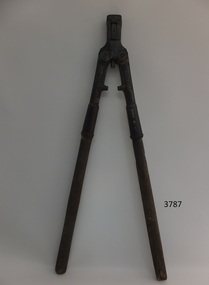
... This cutter is just one of the many inventions and mechanical improvements that Cyrus Chambers made during his lifetime, contributing to the ongoing development of mechanical improvements that were occurring in American industry of the time and therefore a notable addition to the Flagstaff collection. flagstaff hill warrnambool shipwrecked coast flagstaff hill maritime museum maritime museum shipwreck coast flagstaff hill maritime village great ocean road cyrus chambers bolt cutter paper folding machine brick making machine elliot cresson elliot cresson medal franklin institute gold medal rivet cutter Raised embossed lettering on cast body of cutter "New No 2" on one side, "Chambers Bros & Co" on the other side Cast iron bolt cutter with removable tempered steel cutter. ...Cyrus Chambers was a self-described mechanic who started out winding bobbins in his father's woollen mill and went on to invent machines that changed their industries. Cyrus Chambers came from Quaker parents the ninth of thirteen siblings, he once said a year before his death. “I believe I have succeeded because, first, I was industrious; second, because I made a study of the subject that was before me.” At age 7, Chambers went to work in his father’s mill. His job was to monitor bobbins—wooden spindles around which thread was wound and to remove and replace them as they became full. "There was no child labour law at that time," he later recalled. Chambers loved machinery and always regarded himself as a mechanic rather than an inventor. At age 16, Chambers was sent to learn dentistry with an older brother, (Edwin) who was already in the field and willing to take him on as an apprentice. Chambers was talented at working with small parts. He used his brother's dental instruments to build a miniature high-pressure steam engine of silver. It ran at 3,000 revolutions per minute and weighed less than a half-ounce. At that time it was the smallest engine that had ever been constructed. The engine was displayed at the 1876 Centennial and is now in a permanent collection at the Franklin Institute USA. Chambers major invention was the paper folding machine and came from reading that school teachers made less than the young girls who were employed to fold book pages as they came off the press. He told friends that his first efforts were to make the machine that would fold newspapers after demonstrating his device he met with Horace Greeley of the New York Tribune who advised Chambers would never invent the machine that would be able to fold his newspaper or books. In less than a year Chambers had built a full-size machine capable of folding large newspapers and books and was installed at J B Lippincott & Co folding pages for the "Comly Speller" this machine ran successfully for twenty-five years until the printing works burnt down. Chambers then went into partnership with a brother and they established the firm "Chambers, Brother & Co" at a plant in Philadelphia. It was also observed in 1910 and a fact that there was not a periodical or newspaper printed or recently published book that had not gone through one of Chambers inventions. Chambers went on to produce many mechanical inventions and improvements to existing tools and machinery most notable was his invention for the machine that would make clay bricks. This machine made forty bricks per hour and by the end of Chambers life after many improvements, it could make more than four hundred. Although there were a large number of bold cutters made of this patent at Cyrus Chamber’s foundry in Philadelphia, the item is associated with a notable American inventor of the nineteenth century. This particular patent for a bolt and rivet cutter won Chambers the prestigious Elliott Cresson Medal. This cutter is just one of the many inventions and mechanical improvements that Cyrus Chambers made during his lifetime, contributing to the ongoing development of mechanical improvements that were occurring in American industry of the time and therefore a notable addition to the Flagstaff collection.Cast iron bolt cutter with removable tempered steel cutter. Chambers New No. 2.Raised embossed lettering on cast body of cutter "New No 2" on one side, "Chambers Bros & Co" on the other sideflagstaff hill, warrnambool, shipwrecked coast, flagstaff hill maritime museum, maritime museum, shipwreck coast, flagstaff hill maritime village, great ocean road, cyrus chambers, bolt cutter, paper folding machine, brick making machine, elliot cresson, elliot cresson medal, franklin institute, gold medal, rivet cutter -
 Flagstaff Hill Maritime Museum and Village
Tool - Pliers, Early 20th Century
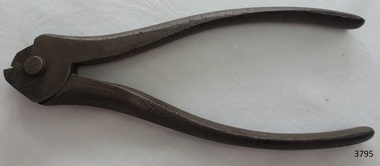
... In 1892 they were incorporated as a Limited Company and by 1914 were known as the manufacturers of hand tools for all trades, iron and steel stampers, die sinker, and in the process of press working in sheet and metal for various items. ...In 1887 the long established steel toy business of Richard Timmins and Sons of Pershore Street Birmingham was sold to W C Wynn & sons, of Commercial Street Birmingham. They proceeded to extend their works and eventually concentrated on the amalgamation of both businesses under the name of Wynn and Timmins at the one address in Commercial Street. In 1892 they were incorporated as a Limited Company and by 1914 were known as the manufacturers of hand tools for all trades, iron and steel stampers, die sinker, and in the process of press working in sheet and metal for various items. The company around this time employed 200 people and the directors of the company in 1914 were W. H. Wynn, H. S. Wynn, W. L. Wynn. In 1929 they were producing tools under the heart brand until in 1969 the company was taken over by Balfour and Darwins of Sheffield, and the manufacturing facility in Birmingham was closed.An early manufacture of tradesman's tools, from 1900 into the late 1960s the company was a major suppler of tools to various industries and pioneered a number of improvements for individual hand tools for specific industries.Steel snub nosed pliers designed for a specific use unidentified at this time."WYNN & TIMMINS" stamped into the steel handle tools, pliers, metal pliers, wynn & timmins, birmingham manufacturer, tool manufacturer, richard timmins, sheet metal manufactures -
Glenelg Shire Council Cultural Collection
Tool - Whaling Spade, n.d
... The blades of later spades, after the 1850's, were usually made of cast steel, while the sockets and shanks were wrought iron. Cast steel held a cutting edge far better than the earlier wrought iron, and was necessary for repeated cutting. ...Part of the collection purchased from Brendan Kurtze by the City of Portland. From the Kurtze Museum. Spades were used primarily for cutting up a whale. They were flat-bladed implements (except the gouge spade) with a chisel cutting edge and were mounted on wood poles by means of a socket at the aft end of the spade. The blades of later spades, after the 1850's, were usually made of cast steel, while the sockets and shanks were wrought iron. Cast steel held a cutting edge far better than the earlier wrought iron, and was necessary for repeated cutting. The sockets of spades were forge welded closed, without an open seam, for added strength. They were secured to the pole with a nail, screw or pinWhaling implement, iron, painted gloss black. Flat blade and handle sleeve on either end of shaft, no handle. Spades were used primarily for cutting up a whale. They were flat-bladed implements (except the gouge spade) with a chisel cutting edge and were mounted on wood poles by means of a socket at the aft end of the spade. The blades of later spades, after the 1850's, were usually made of cast steel, while the sockets and shanks were wrought iron. Cast steel held a cutting edge far better than the earlier wrought iron, and was necessary for repeated cutting. The sockets of spades were forge welded closed, without an open seam, for added strength. They were secured to the pole with a nail, screw or pinkurtze museum, whaling, tools, industry, maritime -
Glenelg Shire Council Cultural Collection
Tool - Anvil, Bradford and Kendall, n.d
... Blacksmith anvil, 5CWT, iron BK Sydney Australia. Anvil Tool Anvil Bradford and Kendall ...Port of Portland Collection Bradken, originally Bradford and Kendall, began as a steel foundry in Sydney in 1920 and produced BK anvils at its factories in Alexandria and Mascot NSW. Leslie Bradford (General Manager) and Jim Kendall (Chief Mechanical Engineer), two BHP steelworks employees, got lucky at the races one day in 1920 and pledged their £15,000 winnings to start a steel foundry business. The horse they backed, ‘Jack Findlay’ completed a remarkable sequence of five wins during 1919 and 1920. With each win Leslie Bradford, Jim Kendall and a group of friends rolled-over their bets. By January 24, 1920 they had won a small fortune. On April 28 1920, the group used their winnings to establish the Alloy Steel Syndicate and build a steel foundry in Alexandria, Sydney to take advantage of what they saw as an untapped potential for industrial growth. Bradford Kendall Ltd was incorporated on 20th March 1922.Metal blacksmiths anvil. An anvil is used by blacksmiths to forge and shape his work pieces. The conical horn is used for hammering curved work pieces. The anvil is a common tool of the blacksmiths (‘smithies’) and other metalworkers. There has been very little change in the basic design of the anvil since Greek and Roman times. Blacksmith anvil, 5CWT, iron BK Sydney Australia.Front: 'BK SYDNEY AUST. 5CWT' Back: -port of portland, anvil, blacksmith, industry, bk anvil, bradken, brandford and kendall -
 Flagstaff Hill Maritime Museum and Village
Mast Collar, c. 1886
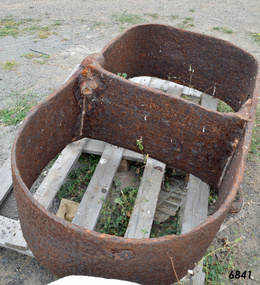
... Configuration: Four masted sailing ship; iron-hulled barque; iron masts, wire rigging, fore & aft lifting bridges. ...The husband of the donor of this mast collar chanced to be staying a night at a motel in Peterborough, along the Great Ocean Road in Victoria. He had a keen interest in maritime items and recognise the mast collar at the motel’s back fence line. The motel owner told his guest the story of a customer, a doctor, who had organised and paid for divers to raise the mast collar from a local shipwreck, the Falls of Halladale. Shortly afterwards the doctor passed away, so the mast collar had remained at the motel site. The owner was leaving the motel the following week and wasn’t at all interested in the artefact. He was very happy for his guest to remove it. It took five men to load the mast collar up for the trip to the new owner’s two storey shed in Ballarat. It stayed there undercover, in the company of his collection of 5 buggies, for the next 40 or so years until the property was for sale. A friend, who realised the significance of the mast collar, suggested that it be donated to Flagstaff Hill Maritime Village where other artefacts from the Falls of Halladale, such as the slate tiles, were on display. This mast collar, or masthead, from the Falls of Halladale would have been used to join two sections of one of the tall masts. As sailing ships became larger there was a need for taller masts or spars, which became difficult or impossible to find. To overcome this problem mast was divided into sections; lower and top or upper mast (on some of the ‘tall ships’ a mast could be divided into three or even four sections). The Falls of Halladale was a four-masted British barque built-in 1886. On what turned out to be her fatal journey, she had left New York for Melbourne in late 1908. She ran aground on a reef close to the shore west of Peterborough, South West Victoria, on November 14th. All 29 crew eventually landed safely onshore. The wrecked ship stayed on the reef for several months as locals watched the sails slowly deteriorate. The salvaged cargo included slate tiles, as mentioned above, and many of these have been used on the roof of buildings at the Flagstaff Hill Maritime Village. The iron-hulled, four-masted barque, the Falls of Halladale, was a bulk carrier of general cargo. She left New York in August 1908 on her way to Melbourne and Sydney. In her hold, along with 56,763 tiles of unusual beautiful green American slates (roofing tiles), 5,673 coils of barbed wire, 600 stoves, 500 sewing machines, 6500 gallons of oil, 14400 gallons of benzene, and many other manufactured items, were 117 cases of crockery and glassware. Three months later and close to her destination, a navigational error caused the Falls of Halladale to be wrecked on a reef off the Peterborough headland at 3 am on the morning of the 15th of November, 1908. The captain and 29 crew members all survived, but her valuable cargo was largely lost, despite two salvage attempts in 1908-09 and 1910. ABOUT THE ‘FALLS OF HALLADALE’ (1886 - 1908) Built: in1886 by Russell & Co., Greenock shipyards, River Clyde, Scotland, UK. The company was founded in 1870 (or 1873) as a partnership between Joseph Russell (1834-1917), Anderson Rodger and William Todd Lithgow. During the period 1882-92 Russell & Co., standardised designs, which sped up their building process so much that they were able to build 271 ships over that time. In 1886 they introduced a 3000 ton class of sailing vessel with auxiliary engines and brace halyard winches. In 1890 they broke the world output record. Owner: Falls Line, Wright, Breakenridge & Co, 111 Union Street, Glasgow, Scotland. Configuration: Four masted sailing ship; iron-hulled barque; iron masts, wire rigging, fore & aft lifting bridges. Size: Length 83.87m x Breadth 12.6m x Depth 7.23m, Gross tonnage 2085 ton Wrecked: the night of 14th November 1908, Curdies Inlet, Peterborough south west Victoria Crew: 29 The Falls of Halladale was a four-masted sailing ship built-in 1886 in Glasgow, Scotland, for the long-distance cargo trade and was mostly used for Pacific grain trade. She was owned by Wright, Breakenridge & Co of Glasgow and was one of several Falls Line ships, all of which were named after waterfalls in Scotland. The lines flag was of red, blue and white vertical stripes. The Falls of Halladale had a sturdy construction built to carry maximum cargo and able to maintain full sail in heavy gales, one of the last of the ‘windjammers’ that sailed the Trade Route. She and her sister ship, the Falls of Garry, were the first ships in the world to include fore and aft lifting bridges. Previous to this, heavily loaded vessels could have heavy seas break along the full length of the deck, causing serious injury or even death to those on deck. The new, raised catwalk-type decking allowed the crew to move above the deck stormy conditions. This idea is still used today on the most modern tankers and cargo vessels and has proved to be an important step forward in the safety of men at sea. On 4th August 1908, with new sails, 29 crew, and 2800 tons of cargo, the Falls of Halladale left New York, bound for Melbourne and Sydney via the Cape of Good Hope. The cargo on board was valued at £35,000 and included 56,763 tiles of American slate roofing tiles (roof slates), 5,673 coils of barbed wire, 600 stoves, 500 sewing machines, 6,500 gallons of oil, 14,400 gallons of benzene, plumbing iron, 117 cases of crockery and glassware and many other manufactured items. The Falls of Halladale had been at sail for 102 days when, at 3 am on the night of 14th November 1908, under full sail in calm seas with a six knots breeze behind and misleading fog along the coast, the great vessel rose upon an ocean swell and settled on top of a submerged reef near Peterborough on the south-west Victoria’s coast. The ship was jammed on the rocks and began filling with water. The crew launched the two lifeboats and all 29 crew landed safely on the beach over 4 miles away at the Bay of Islands. The postmistress at Peterborough, who kept a watch for vessels in distress, saw the stranding and sent out an alert to the local people. A rescue party went to the aid of the sailors and the Port Campbell rocket crew was dispatched, but the crew had all managed to reach shore safely by the time help arrived. The ship stayed in full sail on the rocky shelf for nearly two months, attracting hundreds of sightseers who watched her slowly disintegrate until the pounding seas and dynamiting by salvagers finally broke her back, and her remains disappeared back into deeper water. The valuable cargo was largely lost, despite two salvage attempts in 1908-09 and 1910. Further salvage operations were made from 1974-1986, during which time 22,000 slate tiles were recovered with the help of 14 oil drums to float them, plus personal artefacts, ship fittings, reams of paper and other items. The Court of Marine Inquiry in Melbourne ruled that the foundering of the ship was entirely due to Captain David Wood Thomson’s navigational error, not too technical failure of the Clyde-built ship. The shipwreck is a popular site for divers, about 300m offshore and in 3 – 15m of water. Some of the original cargo can be seen at the site, including pieces of roof slate and coils of barbed wire. This mast collar is significant due to its association with the ship FALLS OF HALLADALE, which is listed on the Victorian Heritage Register, VHR S255 The Falls of Halladale shipwreck is listed on the Victorian Heritage Register (No. S255). She was one of the last ships to sail the Trade Routes. She is one of the first vessels to have fore and aft lifting bridges. She is an example of the remains of an International Cargo Ship and also represents aspects of Victoria’s shipping industry. The wreck is protected as a Historic Shipwreck under the Commonwealth Historic Shipwrecks Act (1976). Mast collar, steel, salvaged from the shipwreck FALLS OF HALLADALE, wrecked off the coast of Peterborough, South West Victoria. Oval shaped a band of metal with a straight band of same heights attached between the long sides. Two metal loops are attached to the outside of the oval shape, next to the crossing band. flagstaff hill, warrnambool, shipwrecked coast, flagstaff hill maritime museum, maritime museum, shipwreck coast, flagstaff hill maritime village, great ocean road, falls of halladale, shipwreck peterborough vic, sailing ship mast collar, masthead of sailing ship, falls of halladale mast collar, masthead, mast collar, ship rigging 1908, russell & co. -
 Cheese World Museum
Milk weighing machine, Perfect Cheese company weighing machine
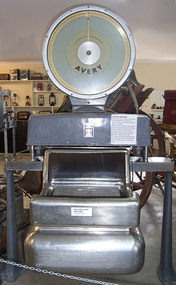
... This weighing machine is significant as it represents the machinery used by an early cheese production company. allansford perfect cheese company avery cheese manufacturing dairy industry Made in England Birmingham - AVERY SOLE AGENTS Large metal machine with cast iron with a cast iron frame and a stainless steel rectangular bowl in a cradle. ...Perfect Cheese Company was founded in 1930 by newly-arrived Italian migrant Natale Paquale Italiano. The company specialised in traditional Italian-style cheese but also produced Greek, Cypriot and Maltese origin cheeses. The cheeses were sold in Australia and Italy with all products being matured and non-processed. The company remained in operation until the early 2000s.This weighing machine is significant as it represents the machinery used by an early cheese production company.Large metal machine with cast iron with a cast iron frame and a stainless steel rectangular bowl in a cradle. The round weighing scale at the top shows a weight scale up to 1100 pounds. A mesh stainless steel baffle strains the milk.Made in England Birmingham - AVERY SOLE AGENTSallansford, perfect cheese company, avery, cheese manufacturing, dairy industry -
 Warrnambool and District Historical Society Inc.
Brass Plate, Bruce & McClure Distributer, C early 20th century
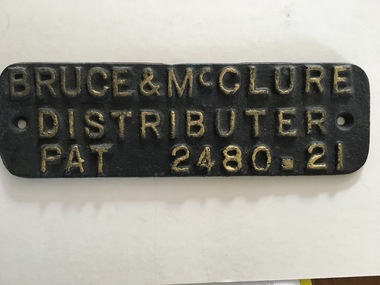
... Bruce & McClure were manufacturers of windmills and agricultural machinery including motor engines , pumps, tanks,and appliances for supplying and conserving water.Also included was brass,iron and steel foundry works. They won 11 first prizes at the Grand national Show of 1907 and in 1914 designed and manufactured a new water boring machine which could also be used for oil and gold exploration They operated from Lava Street well into the 1940's as well as from the geelong area. ...Bruce & McClure were manufacturers of windmills and agricultural machinery including motor engines , pumps, tanks,and appliances for supplying and conserving water.Also included was brass,iron and steel foundry works. They won 11 first prizes at the Grand national Show of 1907 and in 1914 designed and manufactured a new water boring machine which could also be used for oil and gold exploration They operated from Lava Street well into the 1940's as well as from the geelong area. This plaque is possibly from one of their machines.A tangible link to one of Warrnambool's manufacturing businesses which was innovative and an essential part of the beginnings of machine use in farms and industry in the district. Cast iron plaque with moulded text which is coloured in gold. rectangular with rounded corners. Back is painted grey.Bruce & McClure Distributer Pat 2480.21warrnambool, bruce & mcclure, bruce & mcclure machinery -
 Kiewa Valley Historical Society
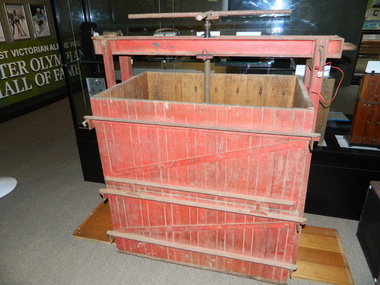
Tobacco Hand Press
... Diagonal steel between bottom and middle iron on the front. Ends: 2 iron bars from the ground curved up to top holding an iron rectangular beam that goes from end to end. ...Tobacco farming began circa 1960 in the Kiewa Valley and consequently became one of it major industries. Many of the italian families were involved in tobacco farming.Historical: This equipment was used on one of the first tobacco farms in the Kiewa Valley at Mongans Bridge. Provenance: This tobacco farmer came from Italy and was sponsored to visit a tobacco farmer in Myrtleford to learn how to grow tobacco so that he could transfer those skills to his own farm in the Kiewa Valley.Wooden, panelled red (painted on outside) rectangular box on side are iron bars with steel reinforcements around the box, near the top and bottom on 4 sides and across the middle on the 2 ends and front (not back). Diagonal steel between bottom and middle iron on the front. Ends: 2 iron bars from the ground curved up to top holding an iron rectangular beam that goes from end to end. Midway of beam is a vertical long screw at the top of which is a cross formation of 4 iron rods forming a handle for turning. Inside, the screw is attached to an iron frame which is attached to a wooden panelled platform enabling it to be raised or lowered as required.tobacco. mongans bridge. kiewa valley. hand press. parmesan. rossaro. lorenzi brothers. -
Warrnambool and District Historical Society Inc.
Administrative record (collection) - Bruce & McClure Records, Bruce & McClure, 1901-1945
... The business was based at 159 to 167 Lava Street, Warrnambool and manufactured windmills, motor engines, troughs, pumps, milk cans, tanks and other iron, brass ans steel items. It had branches at Penshurst, Murtoa and Berrigan. ...Private collectionBusiness interestno particular orderbrochures, advertisements, photocopies, illustrations of machineswarrnambool industries, edwin bruce, james mcclure, bruce & mcclure, windmillswarrnambool industries, edwin bruce, james mcclure, bruce & mcclure, windmills -
 Bendigo Historical Society Inc.
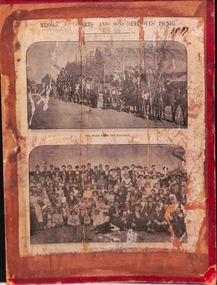
Photograph - Messrs A. Roberts and Sons Employees Picnic 1897, 1897
... Roberts arrived on Bendigo in 1853 with his family and engaged in gold-prospecting, then about 1861 opened the United Iron Works, a small engineering shop in Williamson Street, making forge and hand tools. ...Roberts arrived on Bendigo in 1853 with his family and engaged in gold-prospecting, then about 1861 opened the United Iron Works, a small engineering shop in Williamson Street, making forge and hand tools. ...Abraham Roberts (1819-1897), ironfounder, was born on 13 July 1819 in Cornwall, England, son of Abraham Roberts, blacksmith, and his wife Mary, née Pentreath. Nothing is known of his education and early training but it is likely that he served an engineering apprenticeship and worked in engineering workshops in Cornwall. Undoubtedly he observed much machinery among the tin mines of Cornwall and absorbed the principles of sound engineering design and high-grade workmanship, which bore fruit in his later years in Sandhurst (Bendigo). On 19 August 1841 he married Elizabeth Tonkin at the parish church at Paul, Cornwall. Roberts arrived on Bendigo in 1853 with his family and engaged in gold-prospecting, then about 1861 opened the United Iron Works, a small engineering shop in Williamson Street, making forge and hand tools. With expansion the business moved to Mitchell Street, until by 1880 it absorbed an entire block covering three acres (1.2 ha) in the heart of the town and employed nearly two hundred men. Three of his sons, William, Abraham and Arthur, helped to run A. Roberts & Sons. As well as being a skilful and enterprising engineer, Roberts was a shrewd businessman, who anticipated that the market for machinery on the local goldfields would diminish, and widened the sphere of his activities accordingly. Though the requirements of the mining industry maintained the firm, no class of foundry work was ignored. Roberts secured orders for machinery for the two major Broken Hill mines and built steam winding engines for several Western Australian mines, as well as undertaking orders for machinery in South Africa and New Zealand. He introduced poppet-heads constructed of steel to the Bendigo goldfield and the 105-head stamp battery for Lansell's Big Blue mine was the largest quartz-crushing battery in Australia at that time. The pair of steam winding engines built by his works for the Hustler's Royal Reserve Co. were the largest on the Bendigo field. The company also carried out steamship repairs, bridgework and many important railway contracts and in 1891 supplied the largest outlet valves in Victoria at Laanecoorie weir.Two photographs in black and white of the picnic for employees of Messrs A. Roberts and Sons in 1897. Photographs are mounted on piece of red cardboard. A. Roberts and Sons owned a foundry that was established in 1865. The event was noted in the Bendigo Advertiser on 18 March 1901.'1897' in ink top right hand corner.bendigo, foundry, roberts and sons, picnic, 1897 -
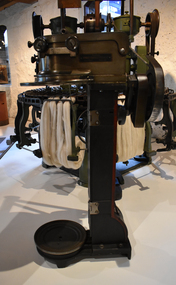 National Wool Museum
Machine - Windchest, Prince-Smith & Stells Ltd
... Consists of a cast iron stand and base with steel pinch rollers and a rotating iron feed tube to empty the top into a receiving bin. ...Used to collect the combed top from a noble comb. Consists of a cast iron stand and base with steel pinch rollers and a rotating iron feed tube to empty the top into a receiving bin.combing, windchest, machine, wool processing, industry, wool, rollers, bin -
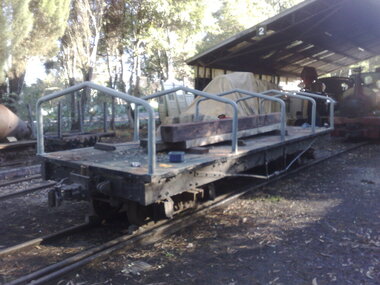 Puffing Billy Railway
H Class Bogie Flat Wagon
... Industries. The wagon has been donated to the Museum and sees use on the Museum's 2'0" gauge line. Historic - Industrial Narrow gauge Railways - Rolling stock - Innisfail tramway line in Northern Queensland h class, bogie, flat wagon, 2'0" gauge H Class Bogie Flat Wagon made of Iron, wrought iron and steel H Class Bogie Flat Wagon ...This vehicle was used on the Innisfail tramway line in Northern Queensland and given the "H" Classification. It was later sold to Howard Smith Industries. The wagon has been donated to the Museum and sees use on the Museum's 2'0" gauge line. Historic - Industrial Narrow gauge Railways - Rolling stock - Innisfail tramway line in Northern Queensland H Class Bogie Flat Wagon made of Iron, wrought iron and steelh class, bogie, flat wagon, 2'0" gauge -
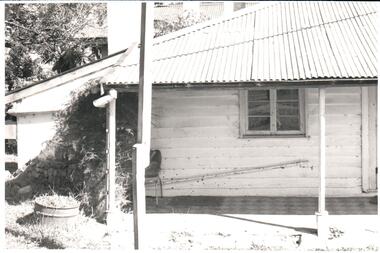 Hume City Civic Collection
Photograph
... industry over the years along with the neighbouring properties of 'Cumberland' and 'Attwood'. In 1978 654 acres of the original property was purchased by the state government and placed under the management of the National Park Service. woodlands homestead greene william pomeroy anne woodlands park gellibrand hill george evans collection A black and white photograph of part of a building showing the verandah with a paved floor. The hipped roof is covered with corrugated iron and the walls are weatherboard. An old steel ...Woodlands Homestead was erected by William Greene in 1843 and is one of the state's oldest buildings. Over the years the complex has been renovated and extended. The property has connections with the racing industry over the years along with the neighbouring properties of 'Cumberland' and 'Attwood'. In 1978 654 acres of the original property was purchased by the state government and placed under the management of the National Park Service.A black and white photograph of part of a building showing the verandah with a paved floor. The hipped roof is covered with corrugated iron and the walls are weatherboard. An old steel kitchen chair is on the LHS at the end of the verandah and asparagus fern is growing up over the rear wall.woodlands homestead, greene, william pomeroy, anne, woodlands park, gellibrand hill, george evans collection -
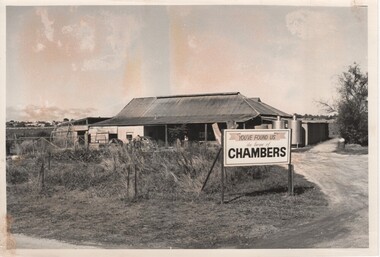 Rutherglen Historical Society
Photograph - Image, 1970s
... Established in 1858 by William Chambers and his son Phillip, the Chambers family have been making wine at Rosewood for over six generations. wineries north east victoria wine industry chambers winery chambers rosewood rutherglen winery rutherglen australia winemaker On sign in photo: "You've found us. The home of Chambers." On back of photo: "Chambers Rosewood" "78% p 27" Black and white photograph of an iron roofed building with stainless steel tanks on one side, and sign in front. ...Established in 1858 by William Chambers and his son Phillip, the Chambers family have been making wine at Rosewood for over six generations. Black and white photograph of an iron roofed building with stainless steel tanks on one side, and sign in front.On sign in photo: "You've found us. The home of Chambers." On back of photo: "Chambers Rosewood" "78% p 27"wineries, north east victoria, wine industry, chambers winery, chambers rosewood, rutherglen winery, rutherglen australia, winemaker -
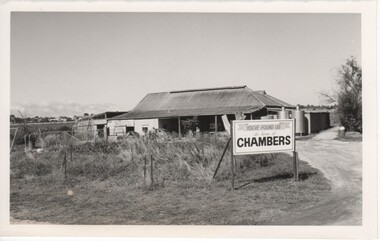 Rutherglen Historical Society
Image, 1970s
... Established in 1858 by William Chambers and his son Phillip, the Chambers family have been making wine at Rosewood for over six generations. wineries north east victoria wine industry rosewood cellars chambers winery chambers rosewood rutherglen winery rutherglen australia winemaker On sign in photo: "You've found us. The home of Chambers." On back of photo: "140% [upper case D in small circle] Chambers 'Rosewood' " Black and white photograph of an iron roofed building with stainless steel tanks on one side, and sign in front. ...Established in 1858 by William Chambers and his son Phillip, the Chambers family have been making wine at Rosewood for over six generations.Black and white photograph of an iron roofed building with stainless steel tanks on one side, and sign in front.On sign in photo: "You've found us. The home of Chambers." On back of photo: "140% [upper case D in small circle] Chambers 'Rosewood' "wineries, north east victoria, wine industry, rosewood cellars, chambers winery, chambers rosewood, rutherglen winery, rutherglen australia, winemaker -
Unions Ballarat
The ironworkers : a history of the Federated Ironworkers' Association of Australia, Murray, Robert et al, 1982
... ...steel industry and trade...Relevant to union history in Australia and related industries. btlc ballarat trades hall ballarat trades and labour council unions fia federated ironworkers' association of australia steel industry and trade iron and steel workers iron industries balmain mort's dock wwi wwii Front cover: author's name and title. ...History of the FIA from the early 20th century; has coverage of the steel industry that became significant through the first and second world wars. Relevant to union history in Australia and related industries.Paper; book. Front cover: yellow background, images of banners and other pictures; red and blue text.Front cover: author's name and title.btlc, ballarat trades hall, ballarat trades and labour council, unions, fia, federated ironworkers' association of australia, steel industry and trade, iron and steel workers, iron industries, balmain, mort's dock, wwi, wwii -
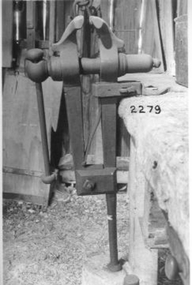 Whitehorse Historical Society Inc.
Tool - Vice, c1920
... industry farm machinery trades blacksmithing Blacksmith's vice called a leg vice. It rests on a solid block on the floor and secured on the bench with bolts. The vice was made of wrought iron with hardened steel ...Blacksmith's vice called a leg vice. It rests on a solid block on the floor and secured on the bench with bolts. The vice was made of wrought iron with hardened steel jaws.rural industry, farm machinery, trades, blacksmithing -
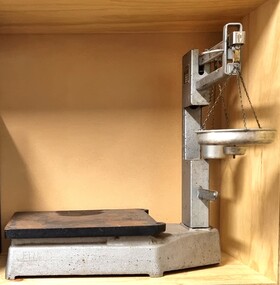 Wodonga & District Historical Society Inc
Functional object - Scales - J. Mann & Sons, Mercury Scale Co. Pty. Ltd, c1980
... Q. 760253 CAP 101 kg MODEL No. 211 C A set of cast iron scales. The measurement on the balance arm is in kilograms. ...J. Mann and Sons was first established as a farm produce store in 1921. The range of products was extended in the 1930s and included groceries and hardware, as well as the first petrol bowser in Wodonga outside the store. After WWII, the premises were extended and the range of products continued to increase. In the 1960s the Mann Family opened a new supermarket in Wodonga, in addition to the hardware business, providing steel, plumbing and industrial supplies, and they employed over 100 people at one stage. With changes in the retail industry, the Mann Family sold the main hardware business to Bunnings and the steel and rural produce business to the Kelly brothers in 2006. Mercury Scales was founded in Thebarton, South Australia in 1946. The business experienced rapid growth, leading to its joining with A&D’s global organisation and evolving into A&D Mercury. IN 2023 A&D Weighing is an Australian leader in the supply of electronic weighing scales, balances, metal detectors, checkweighers and weighing systems. This model was approved on 13 February 1980. On 25 March 1988 approval to change the business name to A & D Mercury Pty Ltd was granted by the Australian National Standards Commission. A set of cast iron scales. The measurement on the balance arm is in kilograms. There are 2 trays suspended by chains. bas is fitted with a level indicator and four adjustable feet.On Manufacturer's plate: MERCURY SCALE CO. PTY. LTD. SCALE MANUFACTURERS THEBARTON, S. AUST. INSTRUMENT APPROVAL NUMBERS N.S.C 6/9A/109 M/C No. Q. 760253 CAP 101 kg MODEL No. 211 Cj. mann & sons, mercury scales, wodonga businesses -
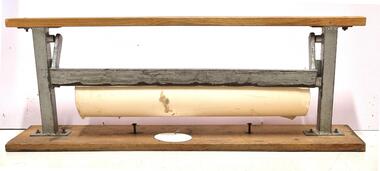 Wodonga & District Historical Society Inc
Functional object - Paper Dispenser - Mann & Son
... In the 1960s the Mann Family opened a new supermarket in Wodonga, in addition to the hardware business, providing steel, plumbing and industrial supplies, and they employed over 100 people at one stage. With changes in the retail industry, the Mann Family sold the main hardware business to Bunnings and the steel and rural produce business to the Kelly brothers in 2006. ...J. Mann and Sons was first established as a farm produce store in 1921. The range of products was extended in the 1930s and included groceries and hardware, as well as the first petrol bowser in Wodonga outside the store. After WWII, the premises were extended and the range of products continued to increase. In the 1960s the Mann Family opened a new supermarket in Wodonga, in addition to the hardware business, providing steel, plumbing and industrial supplies, and they employed over 100 people at one stage. With changes in the retail industry, the Mann Family sold the main hardware business to Bunnings and the steel and rural produce business to the Kelly brothers in 2006.This item was an important everyday feature in many stores when items were wrapped in brown paper before the introduction of plastic bags.The paper dispenser has a wooden top and base, with a cast iron frame and lever. There is a removable metal rod which holds the paper roll in place. It was used for dispensing brown wrapping paper. The Blade" lever is not sharp, but was used to stabilise the paper roll so the paper can be easily torn off at the required length. An empty paper roll is included.mann wodonga, wodonga businesses -
Emerald Museum & Nobelius Heritage Park
Photograph - Bullock Team - Emerald wagon, Unknown photographer, 1870s-1960s
... The hay wain is parked beside a corrugated iron shed. In the background, are a few sparse trees. ...The wagons were used for hauling wood out of the forests or for transporting bales of wool from farms to the city. They were often pulled by a team of up to eight oxen and led by a bullocky.The importance of these large vehicles was huge during the 1800s when they were used to carry large, heavy loads of wood, wool and household goods along mainly unmade roads and tracks. It shows the material used to build them and the skill of the maker in what was a mostly handmade process.Black and white rectangular photograph printed on matte photographic paper. This photograph depicts a large wooden hay wain. It has 4 large spoked wheels rimmed with steel. Leaning against the hay wain are 2 wooden structures used to attach the oxen to the hay wain. Slightly behind the wagon are 3 metal 44 gallon drums. The hay wain is parked beside a corrugated iron shed. In the background, are a few sparse trees.bullock teams, wagon, sawmills, timber industry, wool
