
Showing 128 items matching "irons (domestic)"
-
 Clunes Museum
Domestic object - IRON
... irons...domestic items...local history domestic item irons domestic items KNOB AT BASE OF FUEL TANK MARKED - CLOSE SHELLITE IRON - WOODEN HANDLE - BLUE FUEL CONTAINER - BLUE - MINUS SCREW ON TOP IRON BASE - BLUE AND SILVER Domestic object IRON ...SHELLITE IRON - WOODEN HANDLE - BLUE FUEL CONTAINER - BLUE - MINUS SCREW ON TOP IRON BASE - BLUE AND SILVERKNOB AT BASE OF FUEL TANK MARKED - CLOSElocal history, domestic item, irons, domestic items -
Clunes Museum
Domestic object - GAS IRON
... irons...domestic items...local history domestic item irons domestic items 2 PATENT 'HOT CROSS' WRITTEN WITHIN SHAPE OF A MALTESE CROSS. ...IRON - CAST. HEAVY BASE WITH OPEN FIRE BOX. FUNNEL AT REAR, POSSIBLY FOR AIR INTAKE. METAL HANDLE CORE.2 PATENT 'HOT CROSS' WRITTEN WITHIN SHAPE OF A MALTESE CROSS. RD. NO.440920local history, domestic item, irons, domestic items -
Clunes Museum
Domestic object - IRON
... IRONS...DOMESTIC ITEMS...LOCAL HISTORY DOMESTIC ITEM IRONS DOMESTIC ITEMS IRONS SMOOTHING IRON - CAST IRON BASE WITH WOODEN HANDLE - BACK OPENING WITH SLIDING PLATE Domestic object IRON ...SMOOTHING IRON - CAST IRON BASE WITH WOODEN HANDLE - BACK OPENING WITH SLIDING PLATElocal history, domestic item, irons, domestic items, irons -
Clunes Museum
Domestic object - IRON, SILVESTER'S PATENT - SALTER
... IRONS...DOMESTIC ITEMS...LOCAL HISTORY DOMESTIC ITEM IRONS DOMESTIC ITEMS IRONS MARKING ON TOP OF IRON - 3 - SILVESTER'S PATENT - SALTER STICKER ON BASE - "SMOOTHING IRON - LOANED P. ...CAST IRON WITH WOODEN HANDLEMARKING ON TOP OF IRON - 3 - SILVESTER'S PATENT - SALTER STICKER ON BASE - "SMOOTHING IRON - LOANED P. DAVIES, TALBOTlocal history, domestic item, irons, domestic items, irons -
Clunes Museum
Domestic object - IRON
... IRONS...DOMESTIC ITEMS...LOCAL HISTORY DOMESTIC ITEM IRONS DOMESTIC ITEMS IRONS CONTROLLED AIR VENT HAS MARKING "S" CHARCOAL IRON - WOODEN KNOB AND HANDLE MISSING - HINGED TOP. ...CHARCOAL IRON - WOODEN KNOB AND HANDLE MISSING - HINGED TOP. SEPERATE SPRING HANDLE (SHOULD BE ATTACHED TO WOODEN KNOB)CONTROLLED AIR VENT HAS MARKING "S"local history, domestic item, irons, domestic items, irons -
Clunes Museum
Domestic object - IRON
... IRONS...DOMESTIC ITEMS...LOCAL HISTORY DOMESTIC ITEM IRONS DOMESTIC ITEMS IRONS STICKER ON BASE - WHITE WITH BLACK - "90" TRADEMARK ON HANDLE BASE "PUMPLESS - GLORIA - PAT. ...SHELLITE IRON WITH WOODEN HANDLE - FUEL TANK MISSINGSTICKER ON BASE - WHITE WITH BLACK - "90" TRADEMARK ON HANDLE BASE "PUMPLESS - GLORIA - PAT. NO.100153/37"local history, domestic item, irons, domestic items, irons -
 Whitehorse Historical Society Inc.
Domestic object - Charcoal Iron
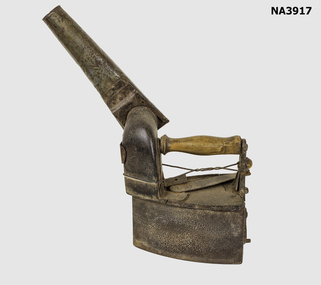
... Irons...DOMESTIC ITEMS...Purchased for the collection by Barbara Gardiner at auction An example of the evolution of irons some of which date from the 1830s DOMESTIC ITEMS Irons DOMESTIC ITEMS Laundering K Cast iron charcoal burning clothes iron. ...Purchased for the collection by Barbara Gardiner at auctionAn example of the evolution of irons some of which date from the 1830sCast iron charcoal burning clothes iron. The main body has a lid which is opened by a handle which swings across to unlock the lid and swings back to lock under two brackets. The iron has a wooden handle and is supported by an upright which is cracked and wired together. There is a tin chimney attached to the outlet on the main body of the iron and a small trapdoor in the back.Kdomestic items, irons, domestic items, laundering -
 Wodonga & District Historical Society Inc
Functional object - CARRON brand Tailor's "Goose" Iron With Twist Handle, Carron Iron Company, c1850s - 1900
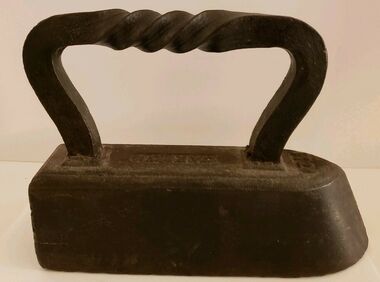
... irons...Domestic appliances... appliances used throughout Australia up until electricity became widely available for domestic use. flat irons Domestic appliances On top of iron "CARRON" An antique Carron iron made of solid cast iron. ...THE CARRON COMPANY The Carron Company established its ironworks on the banks of the River Carron in Falkirk, Stirlingshire, Scotland, in 1759, and became an incorporated company in 1773. The company was the largest ironworks in Europe during the 19th century. It supplied ammunition and armaments, steamboat engines, pig iron, cast iron goods such as flat irons, balustrades, fire grates and bath tubs, pillar boxes and telephone boxes, and even cast iron rings for underground tunnels. In 1982 it became insolvent and was taken over by the Franke Corporation, using the brand Carron Phoenix.This iron is representative of the domestic appliances used throughout Australia up until electricity became widely available for domestic use.An antique Carron iron made of solid cast iron. These types of iron were nicknamed "sad irons" from the Old English where "sad" was originally a word which meant "heavy and solid". Typically, there would be two irons simultaneously in use: one to iron with and one being heated up on the stove or in the fire. This iron has a flat bottom and back and it curves to a point at the front. It has a goose neck handle which has a twist. Irons such as this were often given the name "goose" irons. Near the front of the iron on its top '11' is marked. These irons were used from the late 18th to mid 20th centuries before electricity was widely available in all areas, particularly in rural environments.On top of iron "CARRON"flat irons, domestic appliances -
Emerald Museum & Nobelius Heritage Park
Domestic object - Flat iron, to be assessed
... ...irons (domestic)...Domestic Life irons (domestic) Wooden handle, cast iron with steel base, with spherical water compartment to generate steam.Metal|Wood Domestic object Flat iron ...Wooden handle, cast iron with steel base, with spherical water compartment to generate steam.Metal|Wooddomestic life, irons (domestic) -
Emerald Museum & Nobelius Heritage Park
Domestic object - Iron, The General Electric Co. Ltd, c. 1930s
... ...irons (domestic)...Emerald Victoria Australia irons (domestic) Travel goods Doug Twaits "Magnet" on top On rear: Made in England by The General Electric Co Ltd Plug in connector so that arrow points to correct voltage range Weight: 3lbs Watts: 300 Cat No: D5828 Electric cord: Ring Grip, 10amp 250 V, Made in Australia Small electric travelling iron, with attached cord and plug - made of steel, wood, bakelite Domestic object Iron The General Electric Co. ...Small electric travelling iron, with attached cord and plug - made of steel, wood, bakelite"Magnet" on top On rear: Made in England by The General Electric Co Ltd Plug in connector so that arrow points to correct voltage range Weight: 3lbs Watts: 300 Cat No: D5828 Electric cord: Ring Grip, 10amp 250 V, Made in Australiaemerald, victoria, australia, irons (domestic), travel goods, doug twaits -
Emerald Museum & Nobelius Heritage Park
Equipment - Trouser press, 1930s
... ...irons (domestic)...Emerald Victoria Australia irons (domestic) clothing E. Gwythr Made in England for London Stores GPO Melbourne Trouser Press. ...Trouser Press. Three timber planks joined by 4 metal strips and 4 metal screwsMade in England for London Stores GPO Melbourneemerald, victoria, australia, irons (domestic), clothing, e. gwythr -
Emerald Museum & Nobelius Heritage Park
Equipment - Collar press, 1930s
... ...irons (domestic)...Emerald Victoria Australia clothing irons (domestic) E Gwythr Made Expressly For The London Stores Ltd Melbourne Wooden collar press with metal clips, made for The London Stores Melbourne Equipment Collar press ...Wooden collar press with metal clips, made for The London Stores MelbourneMade Expressly For The London Stores Ltd Melbourneemerald, victoria, australia, clothing, irons (domestic), e gwythr -
Emerald Museum & Nobelius Heritage Park
Domestic object - Shellite iron
... ...irons (domestic)...Petrol irons were potentially dangerous - they were known to explode. Emerald Victoria Australia Domestic Life irons (domestic) shellite Shellite' Iron - A metal iron enamelled in blue colour, with a silver metal fuel reservoir. ...Petrol irons were manufactured as early as 1900. The types of fuel used included petrol, alcohol, methylated spirits and kerosene.The petrol iron was regarded by many as a great improvement on the flat iron because a flat iron had to be heated (and be continually reheated) on top of a hot wood stove. Electricity did not become available in Emerald until 1934 - and then not to everybody - so that irons such as the flat iron or the petrol iron continued to be used for some time. Petrol irons were potentially dangerous - they were known to explode.Shellite' Iron - A metal iron enamelled in blue colour, with a silver metal fuel reservoir. Shellite was the fuel used to heat the iron. The handle is also blue and made of wood. Metal stand for the iron. Metal pourer for the fuel.emerald, victoria, australia, domestic life, irons (domestic), shellite -
Emerald Museum & Nobelius Heritage Park
Domestic object - Petrol iron, 1920's
... ...irons (domestic)...Emerald Victoria Australia irons (domestic) Joyce Little Petrol iron with separate pump Domestic object Petrol iron ...Petrol iron with separate pumpemerald, victoria, australia, irons (domestic), joyce little -
Emerald Museum & Nobelius Heritage Park
Domestic object - Petrol Iron, 1920s approx
... ...irons (domestic)...Used by Joyce Little Emerald Victoria Australia Domestic Life irons (domestic) laundry Joyce Little Petrol iron, with pump. ...Used by Joyce LittlePetrol iron, with pump. Handle, base and container light blue.emerald, victoria, australia, domestic life, irons (domestic), laundry, joyce little -
Bright & District Historical Society operating the Bright Museum
Fire irons
... irons...fire...domestic...irons fire domestic utensil Brass stand in shape of a cobra, with four brass fireplace utensils - Long poker, short poker, tongs, shovel Fire irons ...Brass stand in shape of a cobra, with four brass fireplace utensils - Long poker, short poker, tongs, shovelirons, fire, domestic, utensil -
 Hume City Civic Collection
Domestic object - iron stand, Servex
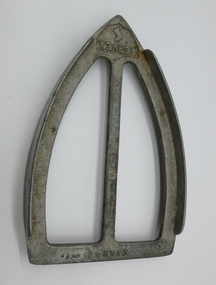
... irons...laundering...domestic...The stand used when ironing was done on a bench which didn't have iron stands. servex irons laundering domestic items george evans collection SERVEX / S A metal iron stand with the words 'Servex and 'S' embossed at the pointed end and etched into the straight end. ...The stand used when ironing was done on a bench which didn't have iron stands.A metal iron stand with the words 'Servex and 'S' embossed at the pointed end and etched into the straight end. A straight bar down the centre links the pointed tip with the straight back. The sides are raised to hold the iron in place.SERVEX / Sservex, irons, laundering, domestic items, george evans collection -
 Hume City Civic Collection
Domestic object - Flat Iron
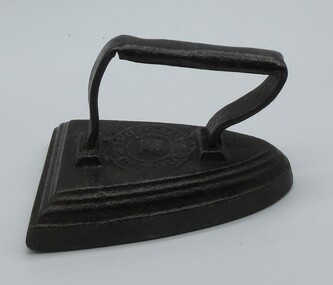
... irons...Ironing...Domestic...Flat irons were used in the 1800's and in the early 1900's. social history irons Ironing Domestic items 1800's Unreadable round possibly manufacturers logo. ...These small heavy flat irons were used to iron clothes prior to electric irons being invented. They were heated on a wood fire stove top and used quickly before they lost heat to iron items of clothing and other small items. These irons were very heavy so that they retained the heat when heated by a wood fire stove top prior to electricity being connected to houses. Flat irons were used in the 1800's and in the early 1900's.Heavy black small flat iron with handle on top. Iron tapers from flat wide base to rounded point. It has a round logo on front under the handle.Unreadable round possibly manufacturers logo.social history, irons, ironing, domestic items, 1800's -
 Mont De Lancey
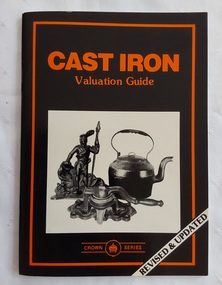
Book, Ken Arnold, Cast Iron Valuation Guide, 1995
... There is an Introduction, Makers, Conversions, Foreword, followed by photographic the history of cast iron products made in Australia. Old domestic Irons are featured at the back. On the back cover is a detailed blurb about Ken Arnold, the author. ...There is an Introduction, Makers, Conversions, Foreword, followed by photographic the history of cast iron products made in Australia. Old domestic Irons are featured at the back. On the back cover is a detailed blurb about Ken Arnold, the author. ...A comprehensive 1st edition paperback focusing on valuing various cast iron items, including historical context.A small black covered book with the title printed in orange lettering with a photograph of three pieces of cast iron including a statue and a kettle. The series is printed below with a diagonal band in white across the bottom right of the cover with Revised and Updated printed on it. The title page has the title, author and a symbol for Crown Series. On the back of the title page is a list of other title in the series and full publication details. There is an Introduction, Makers, Conversions, Foreword, followed by photographic the history of cast iron products made in Australia. Old domestic Irons are featured at the back. On the back cover is a detailed blurb about Ken Arnold, the author. Pp. 52.non-fictionA comprehensive 1st edition paperback focusing on valuing various cast iron items, including historical context.cast iron - history, australian history, australian early life -
 Wodonga & District Historical Society Inc
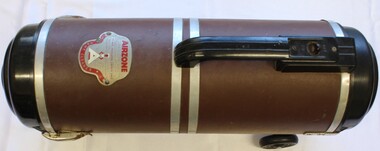
Domestic object - Airzone Vacuum Cleaner, 1950
... domestic radio receivers, telecom cables, military equipment and electron tubes. The company returned to peacetime manufacture. Rather than reduce staff it used its excess capacity to produce electric irons and other domestic appliances including vacuum cleaners and floor polishers. ...domestic radio receivers, telecom cables, military equipment and electron tubes. The company returned to peacetime manufacture. Rather than reduce staff it used its excess capacity to produce electric irons and other domestic appliances including vacuum cleaners and floor polishers. ...Standard Telephones and Cables Pty Ltd was a telecommunications company that began as part of Western Electric, a telephone manufacturing company set up by Alexander Graham Bell. Following the First World War, Western Electric diversified to include electric generators and wireless receivers, all still imported. In 1925, Western Electric was sold to the International Telephone and Telegraph Company. In Australia, it became known as Standard Telephones and Cables (Australasia) They worked closely the Postmaster Generals department to set up telephone and radio networks throughout Australia. Its first factory was in Chippendale, New South Wales but ut developed to have branches in all stated of Australia. By the end of the Second World War STC was Australia's biggest manufacturer due to its critical role in producing telecommunications equipment, domestic radio receivers, telecom cables, military equipment and electron tubes. The company returned to peacetime manufacture. Rather than reduce staff it used its excess capacity to produce electric irons and other domestic appliances including vacuum cleaners and floor polishers. This model was produced at the beginning of the 1950s. It was once owned by Mr. Stiff from Stiff and Gannon, Wodonga.This item has local and national significance. It was used in a local Wodonga business and is representative of domestic appliances used in the 1950s. It also has national significance as it is an excellent example of good produced by the manufacturing industry in Australia during that period.Model 30 Airzone Vacuum Cleaner and accessories. Manufactured in AustraliaMetal logo for Airzone including engine specificationsdomestic appliances, standard telephones and cables pty ltd -
 City of Moorabbin Historical Society (Operating the Box Cottage Museum)
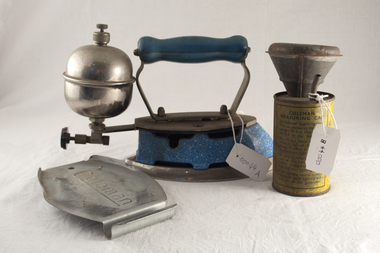
Domestic object - Kitchen equipment, spirit-fuelled sad iron, c1920
... irons. William Coleman began selling Kerosene lanterns in 1900 in Kingfisher, Oklahoma, USA. He moved to Wichita, Kansas in 1902 and the company became world wide. The company also produced a range of cooking stoves and domestic...irons. William Coleman began selling Kerosene lanterns in 1900 in Kingfisher, Oklahoma, USA. He moved to Wichita, Kansas in 1902 and the company became world wide. The company also produced a range of cooking stoves and domestic ...Sad-irons or "solid" irons were made by blacksmiths and used to smooth out material by pressing the hot iron over it. A piece of sheet -iron was placed over the kitchen fire and the irons placed on it could be heated whilst remaining clean of ash.. The women used 2 irons - one heating while the other was used. Thick cloth or gloves protected their hands from the hot irons. The handle was removed from the cool iron and re- attached to remove the hot iron from the fire. The cool iron was replaced on the fire or stove to heat again. These irons were cleaned with steel wool to prevent them marking the material. If the iron was too hot the material would scorch. Most homes set aside one day for ironing and some large households had an ironing room with a special stove designed to heat irons. However, most women had to work with a heavy, hot iron close to the fireplace even in summer. Late in the 19thC designers experimented with heat retaining fillings for these irons. William Coleman began selling Kerosene lanterns in 1900 in Kingfisher, Oklahoma, USA. He moved to Wichita, Kansas in 1902 and the company became world wide. The company also produced a range of cooking stoves and domestic irons. This spirit- fuelled flat iron was very popular in 1920s - 30s These sad irons remind us of the difficult circumstances experienced in their daily routines by the pioneers and early settlers of Moorabbin Shire The family of Miss M Curtis were early settlers in Moorabbin ShireA) spirit- fuelled, sad iron with chrome plated sole c1920, and metal trivet The iron is blue enamel with a white speckled body, with a hemispherical tank for the Coleman 'Lighting Petrol' that provided the heat for smoothing the material B) Coleman Fuel measuring can and funnellMetal Trivet/stand " COLEMAN" ; Petrol can " COLEMAN" / MEASURING CAN / for INSTANT LIGHTING IRON/ with printed instructionssad iron, kitchen equipment, coleman william, kansas, oklahoma, pioneers, early settlers, market gardeners, sewing, craftwork, clothing, moorabbin, brighton, bentleigh, fireplaces, stoves, petrol fuelled irons, spirit flat irons, coleman lamp stove co. ltd. -
 Flagstaff Hill Maritime Museum and Village
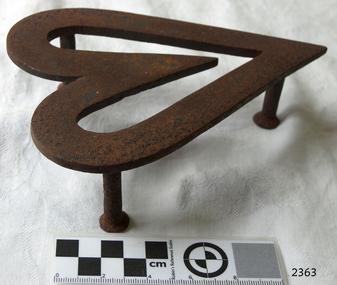
Domestic object - Stand
... irons. The wrought iron stand is painted black. Domestic object Stand ...A stand or support for utensils near or on the fire. Usually made of wrought iron, the most common variety, from the 17th century, stands on three legs and has a circular plate with perforated decoration, often in the form of a date. Another early type, short-legged, stood in the fire to support a cast-iron pot. Later, in the second half of the 18th century, trivets designed to be hung from fire bars were made. These were of two types: an oblong, standing trivet with a handle at one end and projections to fit over the fire bars at the other, and a plate that could be attached to the fire bar. Some of the latter were hung inside the grate supporting a vessel over the fire. Large quantities of cast-brass fender trivets were manufactured at Birmingham, in England, in the last quarter of the 18th century; these were suspended from the top rails of the fender as muffin and kettle stands. Four-legged trivets that stood under the spit holding the dripping pan were made in the 18th and 19th centuries. The cat, an entirely different type of plate stand that was made in the 18th century, consisted of six spokes, three at the top and three at the bottom; it could be used either way up. The term trivet is also used in reference to a metal stand with short feet, used on a table to support a hot dish.Trivets have been used since the invention of iron and are essential for placing hot items on surfaces. This trivet is an example of a trivet used in the late 19th and early 20th centuries.Metal stand, heart-shaped, with three metal feet or supports. Made to rest and sppport hot items such as pots or irons. The wrought iron stand is painted black.flagstaff hill, flagstaff hill maritime museum and village, warrnambool, maritime museum, maritime village, great ocean road, shipwreck coast, wrought iron, pot stand, trivet, stand, kitchenalia, iron stand, heart shape, heart shaped trivet, cooking, ironing -
 Flagstaff Hill Maritime Museum and Village
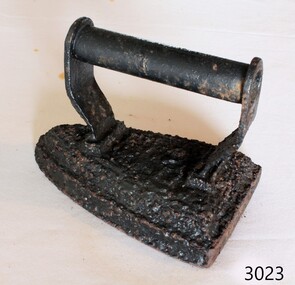
Domestic object - Flat Iron, circa 1900
... Some were fitted with slots for several irons, and a water-jug on top. An early domestic object that gives an insight into how the ironing of clothes was done before the electric type irons we use and take for granted today. flagstaff hill warrnambool shipwrecked-coast flagstaff-hill flagstaff-hill-maritime-museum maritime-museum shipwreck-coast flagstaff-hill-maritime-village iron flat iron domestic iron laundery ironing equipment Sad Iron None Iron; small flat domestic iron. ...Blacksmiths started forging simple flat irons in the late Middle Ages. Plain metal irons were heated by a fire or on a stove. Some were made of stone. Earthenware and terracotta were also used, from the Middle East to France and the Netherlands. Flat irons were also called sad irons or smoothing irons. Metal handles had to be gripped in a pad or thick rag. Some irons had cool wooden handles and in 1870 a detachable handle was patented in the US. This stayed cool while the metal bases were heated and the idea was widely imitated. Cool handles stayed even cooler in "asbestos sad irons". The sad in sad iron (or sadiron) is an old word for solid, and in some contexts this name suggests something bigger and heavier than a flat iron. Goose or tailor's goose was another iron name, and this came from the goose-neck curve in some handles. In Scotland people spoke of gusing (goosing) irons. At least two irons were needed on the go together for an effective system, one would be in use, and the other re-heating. Large households with servants had a special ironing-stove for this purpose. Some were fitted with slots for several irons, and a water-jug on top. An early domestic object that gives an insight into how the ironing of clothes was done before the electric type irons we use and take for granted today. Iron; small flat domestic iron.Noneflagstaff hill, warrnambool, shipwrecked-coast, flagstaff-hill, flagstaff-hill-maritime-museum, maritime-museum, shipwreck-coast, flagstaff-hill-maritime-village, iron, flat iron, domestic iron, laundery, ironing equipment, sad iron -
 Flagstaff Hill Maritime Museum and Village
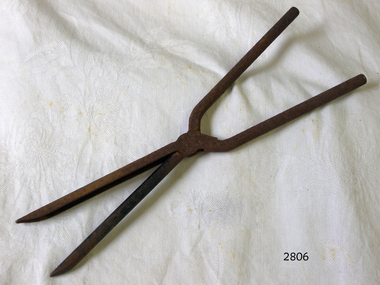
Domestic object - Hair Tongs, Marcel Grateau, 1900 +
... irons were invented and the temperature could be regulated. A significant item that gives us a snapshot not only into women's hairstyles of the 1920s and 1930s but a look into the social norms of that era. Therefore the item is of social interest in regards to the story it tells and the development of women's fashion in hair styling. flagstaff hill warrnambool shipwrecked coast flagstaff hill maritime museum maritime museum shipwreck coast flagstaff hill maritime village great ocean road tongs curling tongs hairdressing None Marcel Tongs, metal, used to impart a hair wave by heating and crimping the hair Domestic object Hair Tongs Marcel Grateau ...Marcelling is a hair styling technique in which hot curling tongs are used to induce a curl into the hair. Its appearance was similar to that of a finger wave but it is created using a different method. Marcelled hair was a popular style for women's hair in the 1920s and 30s often in conjunction with a bob cut. For those women who had long hair, it was common to tie the hair at the nape of the neck and pin it above the ear with a stylish hairpin or flower. Accounts vary about the invention of the style, but Marcel Grateau (1852–1936) is widely credited with inventing the hair styling technique in the 1870s. He started with a small salon in Montmartre, Paris where his clients were the poorer classes. As he developed the waving method that would later become the Marcel wave, using heated curling irons, The inventor and stylist emigrated to the United States and changed his name to François Marcel Woelfflé, sometimes reported as François Marcel. He was granted U.S. patents for implements for performing the technique; the first, U.S. patent 806386, entitled "Curling-Iron", was published in 1905, and the second, entitled "Hair-Waving Iron", for an electric version, under the name François Marcel, was published in 1918. His obituary appeared under the name Francois Marcel Grateau in 1936. Originally the irons had to be heated in the fire, but hair easily got burnt until 1924 when electric irons were invented and the temperature could be regulated. A significant item that gives us a snapshot not only into women's hairstyles of the 1920s and 1930s but a look into the social norms of that era. Therefore the item is of social interest in regards to the story it tells and the development of women's fashion in hair styling.Marcel Tongs, metal, used to impart a hair wave by heating and crimping the hairNoneflagstaff hill, warrnambool, shipwrecked coast, flagstaff hill maritime museum, maritime museum, shipwreck coast, flagstaff hill maritime village, great ocean road, tongs, curling tongs, hairdressing -
 Flagstaff Hill Maritime Museum and Village
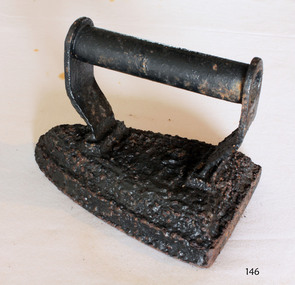
Domestic object - Clothes Iron, last quarter of the 19th century
... Some were fitted with slots for several irons, and a water-jug on top. An early domestic object that gives an insight into how the ironing of clothes was done before the electric type irons we use and take for granted today. flagstaff hill warrnambool shipwrecked coast flagstaff hill maritime museum flagstaff hill maritime village great ocean road iron flat iron laundry equipment Sad iron Domestic object None Clothes Iron, wedge shaped, cast iron painted black with cylindrical handle small funnel through centre of handle. ...Blacksmiths started forging simple flat irons in the late Middle Ages. Plain metal irons were heated by a fire or on a stove. Some were made of stone. Earthenware and terracotta were also used, from the Middle East to France and the Netherlands. Flat irons were also called sad irons or smoothing irons. Metal handles had to be gripped in a pad or thick rag. Some irons had cool wooden handles and in 1870 a detachable handle was patented in the US. This stayed cool while the metal bases were heated and the idea was widely imitated. Cool handles stayed even cooler in "asbestos sad irons". The sad in sad iron (or sadiron) is an old word for solid, and in some contexts this name suggests something bigger and heavier than a flat iron. Goose or tailor's goose was another iron name, and this came from the goose-neck curve in some handles. In Scotland people spoke of gusing (goosing) irons. At least two irons were needed on the go together for an effective system, one would be in use, and the other re-heating. Large households with servants had a special ironing-stove for this purpose. Some were fitted with slots for several irons, and a water-jug on top.An early domestic object that gives an insight into how the ironing of clothes was done before the electric type irons we use and take for granted today.Clothes Iron, wedge shaped, cast iron painted black with cylindrical handle small funnel through centre of handle.Noneflagstaff hill, warrnambool, shipwrecked coast, flagstaff hill maritime museum, flagstaff hill maritime village, great ocean road, iron, flat iron, laundry equipment, sad iron, domestic object -
 Flagstaff Hill Maritime Museum and Village
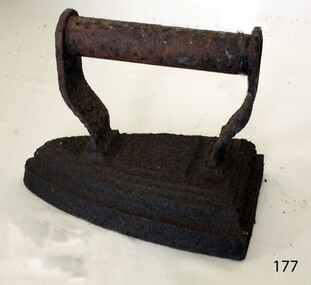
Domestic object - Flat Iron, 1890-1935
... Some were fitted with slots for several irons, and a water-jug on top. An early domestic object that gives an insight into how the ironing of clothes was done before the electric type irons we use and take for granted today. flagstaff hill warrnambool flagstaff hill maritime museum shipwreck coast flagstaff hill maritime village great ocean road iron flat iron laundry clothes ironing sad iron tailors goose None Flat iron cast iron with traces of original black finish on handle. ...Blacksmiths started forging simple flat irons in the late Middle Ages. Plain metal irons were heated by a fire or on a stove. Some were made of stone. Earthenware and terracotta were also used, from the Middle East to France and the Netherlands. Flat irons were also called sad irons or smoothing irons. Metal handles had to be gripped in a pad or thick rag. Some irons had cool wooden handles and in 1870 a detachable handle was patented in the US. This stayed cool while the metal bases were heated and the idea was widely imitated. Cool handles stayed even cooler in "asbestos sad irons". The sad in sad iron (or sadiron) is an old word for solid, and in some contexts this name suggests something bigger and heavier than a flat iron. Goose or tailor's goose was another iron name, and this came from the goose-neck curve in some handles. In Scotland people spoke of gusing (goosing) irons. At least two irons were needed on the go together for an effective system, one would be in use, and the other re-heating. Large households with servants had a special ironing-stove for this purpose. Some were fitted with slots for several irons, and a water-jug on top.An early domestic object that gives an insight into how the ironing of clothes was done before the electric type irons we use and take for granted today. Flat iron cast iron with traces of original black finish on handle. Noneflagstaff hill, warrnambool, flagstaff hill maritime museum, shipwreck coast, flagstaff hill maritime village, great ocean road, iron, flat iron, laundry, clothes ironing, sad iron, tailors goose -
 Flagstaff Hill Maritime Museum and Village
Domestic object - Iron
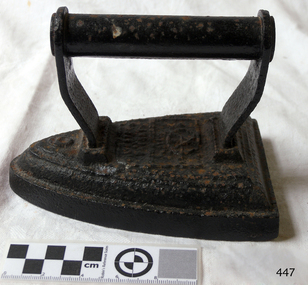
... https://en.wikipedia.org/wiki/Clothes_iron This iron is typical of the clothes iron used before electric irons superseded it. flagstaff hill warrnambool shipwrecked-coast flagstaff-hill flagstaff-hill-maritime-museum maritime-museum shipwreck-coast flagstaff-hill-maritime-village Iron Clothes Laundry Salter iron no. 6. Salter iron no. 6, painted black but with rust showing through. Domestic ...Before the introduction of electricity, irons were heated by combustion, either in a fire or with some internal arrangement. An "electric flatiron" was invented by American Henry Seely White and patented on June 6, 1882. It weighed almost 15 pounds (6.8 kg) and took a long time to heat. The UK Electricity Association is reported to have said that an electric iron with a carbon arc appeared in France in 1880, but this is considered doubtful. Two of the oldest sorts of iron were either containers filled with a burning substance, or solid lumps of metal which could be heated directly. Metal pans filled with hot coals were used for smoothing fabrics in China in the 1st century BC. A later design consisted of an iron box which could be filled with hot coals, which had to be periodically aerated by attaching a bellows. In the late nineteenth and early twentieth centuries, there were many irons in use that were heated by fuels such as kerosene, ethanol, whale oil, natural gas, carbide gas (acetylene, as with carbide lamps), or even gasoline. Some houses were equipped with a system of pipes for distributing natural gas or carbide gas to different rooms in order to operate appliances such as irons, in addition to lights. Despite the risk of fire, liquid-fuel irons were sold in U.S. rural areas up through World War II. In Kerala in India, burning coconut shells were used instead of charcoal, as they have a similar heating capacity. This method is still in use as a backup device, since power outages are frequent. Other box irons had heated metal inserts instead of hot coals. From the 17th century, sadirons or sad irons (from Middle English "sad", meaning "solid", used in English through the 1800s[4]) began to be used. They were thick slabs of cast iron, triangular and with a handle, heated in a fire or on a stove. These were also called flat irons. A laundry worker would employ a cluster of solid irons that were heated from a single source: As the iron currently in use cooled down, it could be quickly replaced by a hot one. https://en.wikipedia.org/wiki/Clothes_ironThis iron is typical of the clothes iron used before electric irons superseded it.Salter iron no. 6, painted black but with rust showing through. Salter iron no. 6.flagstaff hill, warrnambool, shipwrecked-coast, flagstaff-hill, flagstaff-hill-maritime-museum, maritime-museum, shipwreck-coast, flagstaff-hill-maritime-village, iron, clothes, laundry -
 Blacksmith's Cottage and Forge
Iron, Flat, 1800 (estimated); 19th. century
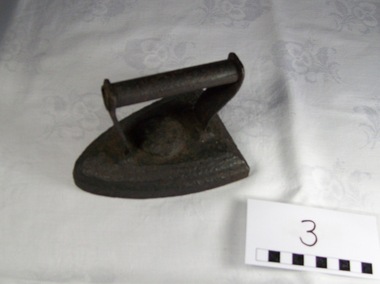
... Another solution was to employ a cluster of solid irons that were heated from the single source: as the iron currently in use cools down, it could be quickly replaced by another one that is hot. Source: www.wikipedia.org Local social history, domestic ...From the 17th century, sadirons or sad irons (from an old word meaning solid) began to be used. They were thick slabs of cast iron, delta - shaped and with a handle, heated in a fire. These were also called flat irons. Another solution was to employ a cluster of solid irons that were heated from the single source: as the iron currently in use cools down, it could be quickly replaced by another one that is hot. Source: www.wikipedia.orgLocal social history, domestic itemBlack cast iron with handleon top plate but not decipherabledomestic, iron, work, womens, laundry -
Blacksmith's Cottage and Forge
Arm, Ironing, Home made - carpentry
... domestic...laundering...ironing...irons...domestic laundering ironing irons cotton sheeting Home-made stand of wood with 'arm' covered in padding and cotton sheeting in a tapered shape and attached with drawing pins. ...Home-made stand of wood with 'arm' covered in padding and cotton sheeting in a tapered shape and attached with drawing pins. The stand is made from floor-board type material. Grooved base is a wooden block. Metal screws and drawing pins hold the sheeeting in place.domestic, laundering, ironing, irons, cotton sheeting -
 Flagstaff Hill Maritime Museum and Village
Domestic object - Flat Iron, 1890-1935
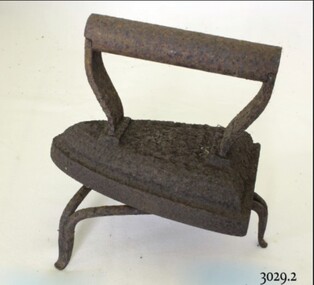
... Some were fitted with slots for several irons, and a water-jug on top. An early domestic object that gives an insight into how the ironing of clothes was done before the electric type irons we use and take for granted today. flagstaff hill warrnambool flagstaff hill maritime museum shipwreck coast flagstaff hill maritime village great ocean road iron flat iron laundry clothes ironing sad iron tailors goose None item too badly corroded Flat iron cast iron with stand Domestic object Flat Iron ...Blacksmiths started forging simple flat irons in the late Middle Ages. Plain metal irons were heated by a fire or on a stove. Some were made of stone. Earthenware and terracotta were also used, from the Middle East to France and the Netherlands. Flat irons were also called sad irons or smoothing irons. Metal handles had to be gripped in a pad or thick rag. Some irons had cool wooden handles and in 1870 a detachable handle was patented in the US. This stayed cool while the metal bases were heated and the idea was widely imitated. Cool handles stayed even cooler in "asbestos sad irons". The sad in sad iron (or sadiron) is an old word for solid, and in some contexts this name suggests something bigger and heavier than a flat iron. Goose or tailor's goose was another iron name, and this came from the goose-neck curve in some handles. In Scotland people spoke of gusing (goosing) irons. At least two irons were needed on the go together for an effective system, one would be in use, and the other re-heating. Large households with servants had a special ironing-stove for this purpose. Some were fitted with slots for several irons, and a water-jug on top.An early domestic object that gives an insight into how the ironing of clothes was done before the electric type irons we use and take for granted today. Flat iron cast iron with stand None item too badly corrodedflagstaff hill, warrnambool, flagstaff hill maritime museum, shipwreck coast, flagstaff hill maritime village, great ocean road, iron, flat iron, laundry, clothes ironing, sad iron, tailors goose
