
Showing 201 items matching "james short"
-
 Flagstaff Hill Maritime Museum and Village
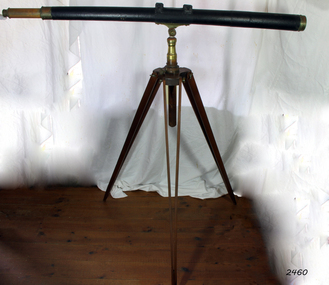
Instrument - Telescope, Mid-18th Century
... ...James Short...That same year, the Scottish instrument maker James Short developed parabolic and elliptical mirrors that were better suited to reflecting telescopes because they reduced optical distortion. ...That same year, the Scottish instrument maker James Short developed parabolic and elliptical mirrors that were better suited to reflecting telescopes because they reduced optical distortion. ...This Day or Night telescope, made by John Dollond, was designed for use in a range of lighting conditions, as its name suggests. Telescopes are optical instruments that make distant objects appear larger and closer, thereby extending the range of what the human eye can observe. The development of the telescope was gradual, shaped by a series of important advances in optical science. In 1608, the Dutch spectacle-maker Hans Lippershey discovered that when two lenses were held apart in a particular way, distant objects appeared closer. He applied for a patent for this invention, creating the first documented telescope. In 1668, Isaac Newton produced the first successful reflecting telescope, using a two-inch concave spherical mirror. This marked a major step forward, demonstrating that mirrors could overcome some of the limitations of lenses and greatly improve magnification. Further progress followed in the eighteenth century. In 1729, Chester Moor Hall developed the achromatic lens by combining two types of glass with different refractive properties. This reduced colour distortion and produced a sharper image, although some edge distortion remained. That same year, the Scottish instrument maker James Short developed parabolic and elliptical mirrors that were better suited to reflecting telescopes because they reduced optical distortion. Building on these advances, John Dollond improved the achromatic objective lens by placing a concave flint-glass lens between two convex crown-glass lenses, considerably enhancing image quality. Maker’s information. John Dollond (1707–1761), of London, was a maker of optical, scientific and astronomical instruments best known for developing the achromatic refracting telescope. He also introduced a practical heliometer, a telescope fitted with a divided lens that could be used to measure the Sun’s diameter and the angular distance between celestial bodies. The son of Huguenot refugees, Dollond first learned the family trade of silk weaving before turning his attention to optics and astronomy, in which he became highly skilled. In 1753, Dollond patented his improved lenses, the same year he had introduced the heliometer. In 1761, John Dollond was appointed as optician to George III and the Duke of York. He was also elected a Fellow of the Royal Society in May 1761, but died suddenly later that year in November. His share of the patent then passed to his eldest son, Peter. In later disputes between Peter Dollond and rival London opticians who challenged the patent, Peter consistently argued that, whatever earlier precedents may have existed, his father had independently developed a practical method for producing achromatic lenses through his command of Newtonian optics. By successfully defending the patent, the Dollond firm became one of the leading manufacturers of optical instruments. During the eighteenth and nineteenth centuries, the name ‘Dollond’ was at times used almost generically to mean ‘telescope,’ reflecting the firm’s reputation. Genuine Dollond telescopes were regarded as among the finest available. Peter Dollond (1731–1820) was the driving force behind the family business. He had founded a small optical business in 1750 on Vine Street, Halton Garden, with his father's guidance. The success of the business led to his father joining him in partnership in 1752. In 1959, J Dollond and Son opened a shop on The Strand, London. Dollonds appear to have produced both reflecting and refracting telescopes, and they possessed the technical skill to manufacture significant numbers of lenses largely free from chromatic aberration. In 1766, Peter went into partnership with his younger brother, John, and they traded under the name P and J Dollond. They supplied optical instruments for Captain Cook and George Hadley, an English lawyer and Meteorologist. In 1769, Captain Cook travelled with a Dollond telescope on the voyage to observe the Transit of Venus. Other notable customers included Thomas Jefferson and Admiral Lord Nelson. In 1781, Peter Dollond made bifocal spectacles. In 1804, young John Dollond passed away. The following year, Peter Dollond went into partnership with his nephew, George Huggins, and Huggins legally changed his surname to Dollond, and the firm remained P and J Dollond. In the early 20th century, the company sold film cameras. The firm remained in the hands of Dollond family members until 1927, when Dollond & Co. merged with James Aitchison & Co. to form Dollond & Aitchison, the well-known high street chain of opticians, which continued making and selling prescription spectacles. Now fully part of Boots Opticians, the company no longer manufactures instruments and operates exclusively as a retail business. The telescope in the collection is an excellent example of one of Dollond’s early library telescopes. Its association with one of eighteenth-century England’s leading innovators in optical development gives it considerable historical significance and makes it an important object within the collection. John Dollond’s experiments in optics advanced the understanding of the divergent properties of lenses and made a lasting contribution to the development of practical optical science. His work helped lay the foundation for major improvements in the design and performance of optical instruments. In his own time, Dollond was celebrated as the “Father of practical optics” and received widespread recognition for his achievements in the field. Dollond telescopes were associated with the renowned mariners, Captain James Cook and Admiral Lord Nelson Telescope: Dollond's Telescope, Day or Night model navigational instrument. Telescope is mounted on wooden tripod stand that has folding legs. Brass telescope with leather sheath over barrel, adjustable angle fitting with brass wing nuts that join the legs to the top frame, which is then joined to the telescope pole by an adjustable screw fitting. Manufactured by Dollond, London. Inscription reads "Dollond London, Day or Night" and "DOLLOND LONDON"flagstaff hill maritime museum and village, maritime museum, maritime village, great ocean road, warrnambool, optical instrument, achromatic telescope, heliometer, light refraction, instrument maker, lens, transit of venus, astronomical telescope, concave lens, scientific instrument, navigation, navigational instrument, astronomy, dollond, dollond london, john dollond, peter dollond, dollond telescope, day or night telescope, floor-standing telescope, library telescope, hans lippershey, isaac newton, chester moor hall, james short, captain cook, thomas jefferson, admiral lord nelson, dollond & co, aitchison & co, dollond & aitchison, boots opticians, george iii, duke of york, george huggins, george dollond, p and j dollond, j dollond and son, spectacles, cameras -
 Clunes Museum
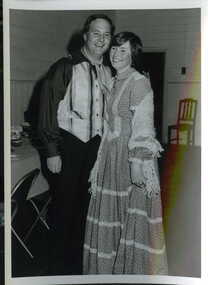
Photograph
... BLACK & WHITE PHOTOGRAPH OF JIM SHORT MP AND MRS. JAN SHORT AT JAMES ESMOND FESTIVAL BALL...JAN SHORT AT JAMES ESMOND FESTIVAL BALL Photograph PHOTOGRAPH ...BLACK & WHITE PHOTOGRAPH OF JIM SHORT MP AND MRS. JAN SHORT AT JAMES ESMOND FESTIVAL BALLlocal history, photography, photographs, events and celebrations, james esmond ball -
 Glen Eira Historical Society
Article - Service Family
... This file contains three items Printed article on James Service from the Australian Sketcher, dated 13/03/1880 Printed article from Victorian and Its Metropolis, by Sutherland, undated Handwritten article on James Service, one short summary taken from Cannon-Land Boomers (page 31) undated. ...This file contains three items Printed article on James Service from the Australian Sketcher, dated 13/03/1880 Printed article from Victorian and Its Metropolis, by Sutherland, undated Handwritten article on James Service, one short summary taken from Cannon-Land Boomers (page 31) undated. ...This file contains three items Printed article on James Service from the Australian Sketcher, dated 13/03/1880 Printed article from Victorian and Its Metropolis, by Sutherland, undated Handwritten article on James Service, one short summary taken from Cannon-Land Boomers (page 31) undated. Additional paragraph noting “Servicton” named after him. Handwritten undated list of properties held by James Service from 1876 to 1872, from Rate Books possibly.service james, politian’s, merchants, premiers, kilwinning, house names, mansions, hotham street, balaclava road, james service and co., caulfield north -
 Flagstaff Hill Maritime Museum and Village
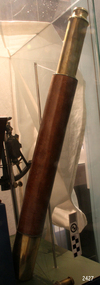
Instrument - Optical, Telescope, 1869
... Then in 1729 Scottish instrument maker James Short invents the first parabolic and elliptic, distortion-less mirror ideal for reflecting telescopes. ...Then in 1729 Scottish instrument maker James Short invents the first parabolic and elliptic, distortion-less mirror ideal for reflecting telescopes. ...The discovery of the first telescope in 1608 can be attributed to Hans Lippershey of the Netherlands when he discovers that holding two lenses up some distance apart bring objects closer. He applies for a patent on his invention and this becomes the first documented creation of a telescope. Then in 1668, Newton produces the first successful reflecting telescope using a two-inch diameter concave spherical mirror. This opened the door to magnifying objects millions of times far beyond what could ever be obtained with a lens. It wasn’t until 1729 that Chester Moor Hall develops an achromatic lens (two pieces of glass with different indices of light refraction combined produce a lens that can focus colours to almost an exact point resulting in much sharper images but still with some distortion around the edges of the image. Then in 1729 Scottish instrument maker James Short invents the first parabolic and elliptic, distortion-less mirror ideal for reflecting telescopes. We now come to John Dollond who improves upon the achromatic objective lens by placing a concave flint glass lens between two convex crown glass lenses. This had the effect of improving the image considerably. Makers Information: John Dollond (1707-1761) London England he was a maker of optical and astronomical instruments who developed an achromatic (non-colour distorting) refracting telescope and practical heliometer. A telescope that used a divided lens to measure the Sun’s diameter and the angles between celestial bodies. The son of a Huguenot refugees Dollond learned the family trade of silk weaving. He became proficient in optics and astronomy and in 1752 his eldest son, Peter joined his father in an optical business, in 1753 he introduced the heliometer. In the same year, he also took out a patent on his new lenses. He was elected a fellow of the Royal Society in May 1761 but died suddenly in November and his share in the patent passed to his son Peter. In subsequent squabbles between Peter and the many London opticians who challenged his patent, Peter’s consistent position was that, whatever precedents there may have been to his achromatic lenses, his father had independently reached his practical technique on the basis of his theoretical command of Newtonian optics. As a result of maintaining his fathers patent, Dollond s became the leading manufacturer of optical instruments. For a time in the eighteenth and nineteenth century the word 'Dollond' was almost a generic term for telescope rather like 'Hoover; is to vacuum cleaner. Genuine Dollond telescopes were considered to be amongst the best. Peter Dollond (1731-1820) was the business brain behind the company which he founded in Vine Street, Spitalfields in 1750 and in 1752 moved the business to the Strand London. The Dollonds seem to have made both types of telescopes (reflecting and refracting), possessing the technology to produce significant numbers of lenses free of chromatic aberration for refracting telescopes. A Dollond telescope sailed with Captain Cook in 1769 on his voyage to observe the Transit of Venus. Thomas Jefferson and Admiral Lord Nelson were also customers of the Dollonds. Dollond & Co merged with Aitchison & Co in 1927 to form Dollond & Aitchison, the well-known high street chain of opticians, now fully part of Boots Opticians. They no longer manufacture but are exclusively a retail operation. John Dollond's experiments in optics and how different combinations of lenses refract light and colour gave a better understanding of the divergent properties of lenses. That went on to inform and pave the way for the improvement of our understanding of optics that are represented today. Dollond was referred to in his time as the "Father of practical optics" as a leader in his field he received many prestigious awards. The telescope in the collection is a good example of one of Dollonds early library telescopes and its connection with one of England's 18th-century pioneers in optical development is in itself a significant and an important item to have within the collection. Telescope: one tube ships Day and Night telescope, with a brass inner tube and a timber main tube covered in leather. Made in 1869 by Dolland, London."Dolland London" "Day or Night" "Royal National Life Boat Institution" "1869"flagstaff hill, shipwreck coast, warrnambool, maritime museum, maritime village, telescope, dolland, night and day, royal national life boat instution -
 Flagstaff Hill Maritime Museum and Village
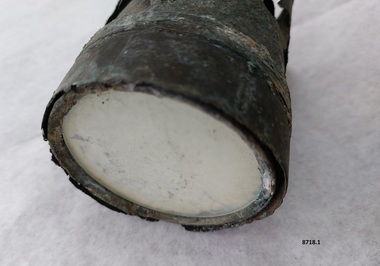
Instrument - Telescope lens, circa 1870's
... That same year, the Scottish instrument maker James Short developed parabolic and elliptical mirrors that were better suited to reflecting telescopes because they reduced optical distortion. ...That same year, the Scottish instrument maker James Short developed parabolic and elliptical mirrors that were better suited to reflecting telescopes because they reduced optical distortion. ...Telescopes are optical instruments that make distant objects appear larger and closer, thereby extending the range of what the human eye can observe. The development of the telescope was gradual, shaped by a series of important advances in optical science. In 1608, the Dutch spectacle-maker Hans Lippershey discovered that when two lenses were held apart in a particular way, distant objects appeared closer. He applied for a patent for this invention, creating the first documented telescope. In 1668, Isaac Newton produced the first successful reflecting telescope, using a two-inch concave spherical mirror. This marked a major step forward, demonstrating that mirrors could overcome some of the limitations of lenses and greatly improve magnification. Further progress followed in the eighteenth century. In 1729, Chester Moor Hall developed the achromatic lens by combining two types of glass with different refractive properties. This reduced colour distortion and produced a sharper image, although some edge distortion remained. That same year, the Scottish instrument maker James Short developed parabolic and elliptical mirrors that were better suited to reflecting telescopes because they reduced optical distortion. Building on these advances, John Dollond improved the achromatic objective lens by placing a concave flint-glass lens between two convex crown-glass lenses, considerably enhancing image quality. Telescopes were used by astronomers to observe planets and stars however they were also used for military and nautical purposes. Telescopes from the mid 1700 onwards consisted of anywhere between two and five brass sections, one sliding inside another to make the instrument's size more manageable when not in use. The brass tubes were called "draws" because they were drawn out of the main barrel. Our two artefacts appear to be two different sized "draws". It is not possible to say if they belonged to the same telescope or were from different instruments and nor is it possible to identify a maker. Both telescopic "draws" were recovered from the wreck of the Loch Ard, on the southwest coast of Victoria and donated by a friend of the diver. The ship Loch Ard was built on the River Clyde in Scotland in 1873 for the prestigious Loch Line of colonial clipper ships, designed for the Australian run. It sailed from England on 1st March 1878 carrying 37 crew, 17 passengers and a load of cargo. The general cargo reflected the affluence of Melbourne at the time. On board were straw hats, umbrellas, perfumes, clay pipes, pianos, clocks, confectionary, linen and candles, as well as a heavier load of railway irons, cement, lead and copper. There were items included that were intended for display in the Melbourne International Exhibition in 1880 - a diverse general cargo ranging from luxury items to bulk railway iron. On 1 June 1878, emerging from fog and hearing too late the sound of breakers against the tall limestone cliffs, the vessel struck the southern foot of Mutton Bird Island and sank in 23 metres of water. Of the fifty-four people on board only two survived, one young male crewman, Tom Pearce, and one young female passenger, Eva Carmichael. Ten days after the Loch Ard tragedy, salvage rights to the wreck were sold at auction for £2,120. Cargo valued at £3,000 was salvaged and placed on the beach, but most washed back into the sea when another storm developed. The wreck of Loch Ard still lies at the base of Mutton Bird Island. Much of the cargo has now been salvaged and some was washed up into what is now known as Loch Ard Gorge. Cargo and artefacts have also been illegally salvaged over many years before protective legislation was introduced. One of the most unlikely pieces of cargo to have survived the shipwreck was a Minton porcelain peacock - one of only seven in the world. The peacock was destined for the Melbourne International Exhibition in 1880. It had been well packed, which gave it adequate protection during the violent storm. Today, the Minton peacock can be seen at the Flagstaff Hill Maritime Museum in Warrnambool. From Australia's most dramatic shipwreck it has now become Australia's most valuable shipwreck artefact and is one of very few 'objects' on the Victorian State Heritage Register.Flagstaff Hill’s collection of artefacts from LOCH ARD is significant for being one of the largest collections of artefacts from this shipwreck in Victoria. It is significant for its association with the shipwreck, which is on the Victorian Heritage Register (VHR S417). The collection is significant because of the relationship between the objects, as together they have a high potential to interpret the story of the LOCH ARD. The LOCH ARD collection is archaeologically significant as the remains of a large international passenger and cargo ship. The LOCH ARD collection is historically significant for representing aspects of Victoria’s shipping history and its potential to interpret sub-theme 1.5 of Victoria’s Framework of Historical Themes (living with natural processes). The collection is also historically significant for its association with the LOCH ARD, which was one of the worst and best known shipwrecks in Victoria’s history.Two metal (possibly brass) cylinders that appear to be parts of a telescope salvaged from the wreck of the Loch Ard. The larger cylinder 8718.1 has a smaller cylinder sitting inside the larger outer cylinder with a circular piece of opaque glass in one end. The metal on both inner and outer cylinders are very thin, fragile and brittle. The outside has verdigris oxidation. One end has a thin track of fine threads where another part would have been screwed on. The smaller cylinder, 8718.2, is in better condition. It appears to be a brass cylinder with a circular opening (one small and one larger) at each end. Inside the cylinder (about halfway down) is a pane of opaque glass. One end of the cylinder had a slightly flared cap screwed into it. An indistinct "8" appears to be printed in the casing."8"flagstaff hill maritime museum and village, warrnambool, great ocean road, loch ard, wreck of the loch ard, loch ard salvage, telescope, loch ard artefact, telescopic draw -
 Flagstaff Hill Maritime Museum and Village
Document - Plan, Pilots Quarters Warrnambool
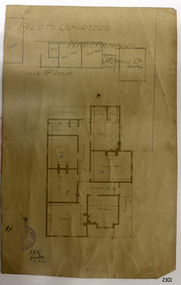
... James Nicol was Harbourmaster in Warrnambool for a time, including 1906 (b. 1840 – d. 1926) - Thomas Smith Drewett (1853 - 15-3-1905) past Captain of the Helen Nicoll, Pilot and Harbourmaster of Warrnambool. Warrnambool’s Tourist Guide of 1888 advises that “At the Port of Warrnambool there are two Leading Lighthouses. A licensed sea pilot, Captain Drewett, is stationed at the Port.” In 1915 plans for the Pilot’s Quarters were drawn up for the Department of Public Work. It was at that time, when personnel was short...James Nicol was Harbourmaster in Warrnambool for a time, including 1906 (b. 1840 – d. 1926) - Thomas Smith Drewett (1853 - 15-3-1905) past Captain of the Helen Nicoll, Pilot and Harbourmaster of Warrnambool. Warrnambool’s Tourist Guide of 1888 advises that “At the Port of Warrnambool there are two Leading Lighthouses. A licensed sea pilot, Captain Drewett, is stationed at the Port.” In 1915 plans for the Pilot’s Quarters were drawn up for the Department of Public Work. It was at that time, when personnel was short ...Warrnambool was officially made a Port of Entry in 1855 and by the 1870s had became the dominant port in the Western District. Sadly, due to an increasing problem with silting in the harbour, by the 1890s only small vessels could navigate the harbour. Men with the position of Pilot and Harbourmaster in Warrnambool were employed by the government to enforce government regulations and to help guide vessels safely into the port of Lady Bay, which was difficult to navigate. Some of the Pilots and Harbour Masters of Warrnambool were – - Captain Christopher Gwatkin, the first Harbourmaster for Warrnambool (1857 - his death in 1859). - Captain Helpman was Warrnambool’s second Harbourmaster 1859-1869 - James Nicol was Harbourmaster in Warrnambool for a time, including 1906 (b. 1840 – d. 1926) - Thomas Smith Drewett (1853 - 15-3-1905) past Captain of the Helen Nicoll, Pilot and Harbourmaster of Warrnambool. Warrnambool’s Tourist Guide of 1888 advises that “At the Port of Warrnambool there are two Leading Lighthouses. A licensed sea pilot, Captain Drewett, is stationed at the Port.” In 1915 plans for the Pilot’s Quarters were drawn up for the Department of Public Work. It was at that time, when personnel was short due to the First World War, that apparently the Pilot and Harbourmaster was also responsible for maintaining the light (lighthouse). The new Pilot and Harbourmaster’s house would be built on the site at 88 Merri Street, overlooking Lady Bay and right beside the Flagstaff and the Lady Bay Upper Lighthouse. Other Pilot and Harbourmasters were - - James Menzies was the Pilot and Harbourmaster at Warrnambool in 1929 . In 1932, he was appointed to the position of Acting Secretary to the Warrnambool Harbour Board. A hundred or so years later Flagstaff Hill Maritime Village has fully renovated the former Harbourmaster’s quarters, changed the name to Lighthouse Lodge, and is now allowing guests to stay in the home, which is still neighbour to the operational Lady Bay Lighthouses, now over 150 years old. The association of the old Pilot and Harbourmaster’s Quarters (currently renamed as Lighthouse Lodge) with the Port of Warrnambool, and its maritime activities, is historically significant. The Pilot’s quarters are connected to a time when access to Warrnambool’s Port was important to the colonial settlers for income and supplies. Plan of Pilots Quarters, Warrnambool. Printed and handwritten plan shows house, garage, out buildings and maid's room. The plan's lower left corner has an official stamp and text beside the stamp. Department of Public Works, Melbourne, Victoria, March 11th, 1915. "PILOTS QUARTERS WARRNAMBOOL" "Department of Public works, Melbourne, Victoria I.P.K. , 11.3.15"flagstaff hill, warrnambool, shipwrecked-coast, flagstaff-hill, flagstaff-hill-maritime-museum, maritime-museum, shipwreck-coast, flagstaff-hill-maritime-village, plan, pilot's quarters warrnambool, pilot and harbourmaster's quarters warrnambool, pilot and harbour master's quarters warrnambool, port of warrnambool, department of public works victoria, lady bay lighthouses, warrnambool ports and harbours, light keeper -
 Flagstaff Hill Maritime Museum and Village
Functional object - Standard Measure, James McEwan & Co, 1860s-1900s
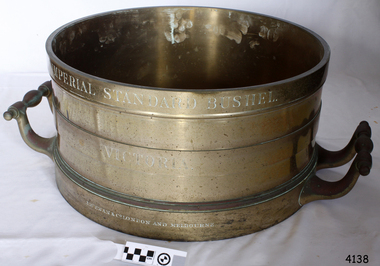
... Functional object Standard Measure James McEwan & Co. De Grave, Short Robert Bates ...This container is a pre-Decimal, Imperial Standard Bushel, part of a three-piece set of Standard measures used in Victoria from around 1900 to 1940. The measures were made in Melbourne by J. McEwan & Co. These three measures were likely used by the local Melbourne authority that monitored weights and measures in the mid to late 19th century. . An Imperial Bushel was equal to 8 gallons, or 36.36872 litres . An Imperial Peck equals a quarter of a Bushel, or 9.09 litres Standards for weights and measures began in Victoria when the Melbourne Observatory received primary sets of Imperial Standard Weights and Measures from Britain. These were tested against the then British Imperial Standards to measure length, weight and currency. Administrative bodies in the Colony of Australia could then compare their weights and measures against these British Primary Standards and adjust their Measures accordingly, to maintain the Standards. The Weights and Measures Act of 1862 was passed in Victoria, and local inspectors were established throughout the colony. By the 1870s, local councils and shires in Victoria held a set of Standards used to test scales, weights, and measures used by manufacturers, wholesalers, and retailers. Every ten years, the councils’ Standards needed to be rechecked against the Victorian Standards. In the 19th Century, the Victorian Customs Department inspected and maintained the Standards. In 1901, the Customs Department was transferred to the Federal Government, but the Weights and Measures authority remained with the Victorian Government and relocated to the Melbourne Observatory. In 1904, the Standard weights and measures, and testing equipment, were installed in the room of a new building erected at the south end of the Great Melbourne Telescope House. The room became known as the Whirling Room, due to its large whirling apparatus that tested air meters. When the Melbourne Observatory closed in 1944, the Weights and Measures Branch was formed to continue maintaining the Standards. On February 14th, 1966, Australia began its conversion to metric measures and currency, and a new set of Standard Measures was introduced; the conversion took place in stages. The Weights and Measures Branch remained at the Observatory site until 1995. James McEwan & Co.: - The maker of this set of Standard Measures was James McEwan. His Melbourne business was established in 1852 and sold retail furniture and wholesale ironmongery. The firm’s warehouses were situated at the intersection of 81-83 Elizabeth and Little Collins Streets. Shortly afterwards, the firm partnered with William Kerr Thomson and Samuel Renwick. When McEwan died in 1868, his partners carried on and expanded the business under his name, J McEwan. The business was expanded to provide a retail shop, counting-house and private offices. Wholesale warehouses adjoined these premises at 4, 6 and 10 Little Collins Street, West. This company provided and sold a large and varied amount of imported goods into the colony; agricultural equipment, building materials, mining items, steam engines, tools of all types and marble fireplaces. The company grew to employ over 150 people in Melbourne and opened offices at 27 Lombard St, London, as well as in New Zealand and Fiji. It also serviced the Mauritius islands and the Pacific area with its steamship, the Suva, and a brig, the ShannonThe set of Imperial Standard Measures is an example of a bronze measure container made specifically for J. McEwan & Co. Today, it helps us to understand how imperial weights and measures were used, and how a standard of measurement for merchants was developed in the Australian colonies based on the Imperial British measurement system. The container has social significance as an item retailed by J McEwan, and used by Victoria’s authorities legally responsible for ensuring that dry goods sold in Victoria by wholesalers and retailers are correct.Imperial Standard Measure: a container to measure the volume of a Busel. It is part of a set of three precision measures - a Peck, a Half Bushel and a Bushel – used by government authorities in Victoria. The cast brass cylinder has straight sides and a flat base, and two handles are attached near the base by two posts on each handle. The wall inside is straight, and outside has grooves and horizontal bands. Inscriptions are engraved on the outside. The Measures were made for the retailer, J. McEwan & Co., London and Melbourne.Engraved on side: "IMPERIAL STANDARD BUSHEL. / VICTORIA ./ J. MCEWAN & CO. LONDON AND MELBOURNE."flagstaff hill, flagstaff hill maritime museum and village, warrnambool, maritime museum, maritime village, great ocean road, shipwreck coast, weights and measurements, science, james mcewan & co., precision instrument, technology, melbourne observatory, british imperial standards, standard weights & measures, volume measure, dry measure, customs, commerce, victorian standard measure, pre-decimal measure, imperial standard, imperial bushel, peck measure, bronze container, brass container, cast container -
 Federation University Historical Collection
Magazine - Newsletter, The Flag, 1995-2001, 1995-2001
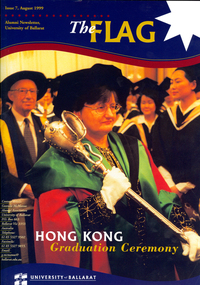
... Sandy Blythe, Geoffrey Blainey,Jamie Shaw, Kiran Mazumdar, Stuart Pursell, Tony Singh, Ballarat Teachers' College, Frank Nolan, Carolyn Blackman. .4) David James, Malini Chitaranjan, Chandker Varadhan, Lola Montez, Regina Molloy, Bert Labont'e, Jayne Reynolds, Amanda Sandwith, Roger Short, Stephen Kemmis, Barney Glover, Thomas O'Donnell, Sandy Blythe, Laurier Prosser, John Sharpham, Jack Barker, Xiaoli Jiang, Catherine Pearce, Nepal, Ballarat Teachers' College, John Culvenor, Richards Medal, Karl McCann. .5) Gwenda McManus, David James, Ron Wild, Merger, Wimmera Institute of TAFE, Katherine Birkin. .6) David Caro, Chancellor appointment, David James, Ellen Sellers, Ballarat Teachers' College Reunion, Briana Folkes, Lorri Coburn, Paul O'Donohue, Graeme Kelly, Tracy Plunkett, Julie Kellett, Unisports rehabilitation, Hong Kong graduation, China, koalas. .7) Hong Kong graduation, David Janes, Argentina, Richard Alder, threatened animals, reconciliation, Leoda Atkinson, mural, Jodie Lowe, indigenous Australians, Sue Turale, nursing, Hong Kong, Geoffrey Richards, Janice Edwards, Laura Chibnall, Franky Christiano, Nessa Jenkins, Kerrie Powell. .8) David James, Graduate Centre, Greenhill Enterprise Centre, Warren Young, Parks Victoria, Maxitrans, netball, John Magrath, maths, Catering for the Olympics, Eddie Turker, Maryanne Coutts, Sonia Colville, Daryl Wisely, Laura Wakeling. .9) Camp Street Redevelopment, Arts Academy, David James, Gwenda McManus, Doug Lloyd, Ian Gordon, University Appeal, Hong Kong, Sue Turale, Edward Wong, Hakodate University, Paris, nursing, Malaysia, Yuri Tanabe, Amanda Mead, Mary Modeen, Barry Judd. .10) Kerry Cox, Gwenda McManus, wildlife, MartinWestbrooke Brian McLennan Art Scholarship. ...Sandy Blythe, Geoffrey Blainey,Jamie Shaw, Kiran Mazumdar, Stuart Pursell, Tony Singh, Ballarat Teachers' College, Frank Nolan, Carolyn Blackman. .4) David James, Malini Chitaranjan, Chandker Varadhan, Lola Montez, Regina Molloy, Bert Labont'e, Jayne Reynolds, Amanda Sandwith, Roger Short, Stephen Kemmis, Barney Glover, Thomas O'Donnell, Sandy Blythe, Laurier Prosser, John Sharpham, Jack Barker, Xiaoli Jiang, Catherine Pearce, Nepal, Ballarat Teachers' College, John Culvenor, Richards Medal, Karl McCann. .5) Gwenda McManus, David James, Ron Wild, Merger, Wimmera Institute of TAFE, Katherine Birkin. .6) David Caro, Chancellor appointment, David James, Ellen Sellers, Ballarat Teachers' College Reunion, Briana Folkes, Lorri Coburn, Paul O'Donohue, Graeme Kelly, Tracy Plunkett, Julie Kellett, Unisports rehabilitation, Hong Kong graduation, China, koalas. .7) Hong Kong graduation, David Janes, Argentina, Richard Alder, threatened animals, reconciliation, Leoda Atkinson, mural, Jodie Lowe, indigenous Australians, Sue Turale, nursing, Hong Kong, Geoffrey Richards, Janice Edwards, Laura Chibnall, Franky Christiano, Nessa Jenkins, Kerrie Powell. .8) David James, Graduate Centre, Greenhill Enterprise Centre, Warren Young, Parks Victoria, Maxitrans, netball, John Magrath, maths, Catering for the Olympics, Eddie Turker, Maryanne Coutts, Sonia Colville, Daryl Wisely, Laura Wakeling. .9) Camp Street Redevelopment, Arts Academy, David James, Gwenda McManus, Doug Lloyd, Ian Gordon, University Appeal, Hong Kong, Sue Turale, Edward Wong, Hakodate University, Paris, nursing, Malaysia, Yuri Tanabe, Amanda Mead, Mary Modeen, Barry Judd. .10) Kerry Cox, Gwenda McManus, wildlife, MartinWestbrooke Brian McLennan Art Scholarship. ...Eleven copies of the University of Ballarat Alumni newsletter called The Flag. .1) David James, Gwenda McManus, Kerrie Edwards, Steve Bracks, Cordell Kent, Australian Native Gold, Koori Education Unit, Pat Hope, Rozeena Begum, Lidcha Mul. .2) Gwenda McManus, Wilhelmus, David James, University Mace, Trefor Prest, Steve Moneghetti, Shaun Creighton, Peter Blackburn, David Waite, Sandy Blythe, Kim Ross, Michael Wilson, Betty Gill, Betty Fish, Tom Hill, Bill Pryor . .3) David James. Sandy Blythe, Geoffrey Blainey,Jamie Shaw, Kiran Mazumdar, Stuart Pursell, Tony Singh, Ballarat Teachers' College, Frank Nolan, Carolyn Blackman. .4) David James, Malini Chitaranjan, Chandker Varadhan, Lola Montez, Regina Molloy, Bert Labont'e, Jayne Reynolds, Amanda Sandwith, Roger Short, Stephen Kemmis, Barney Glover, Thomas O'Donnell, Sandy Blythe, Laurier Prosser, John Sharpham, Jack Barker, Xiaoli Jiang, Catherine Pearce, Nepal, Ballarat Teachers' College, John Culvenor, Richards Medal, Karl McCann. .5) Gwenda McManus, David James, Ron Wild, Merger, Wimmera Institute of TAFE, Katherine Birkin. .6) David Caro, Chancellor appointment, David James, Ellen Sellers, Ballarat Teachers' College Reunion, Briana Folkes, Lorri Coburn, Paul O'Donohue, Graeme Kelly, Tracy Plunkett, Julie Kellett, Unisports rehabilitation, Hong Kong graduation, China, koalas. .7) Hong Kong graduation, David Janes, Argentina, Richard Alder, threatened animals, reconciliation, Leoda Atkinson, mural, Jodie Lowe, indigenous Australians, Sue Turale, nursing, Hong Kong, Geoffrey Richards, Janice Edwards, Laura Chibnall, Franky Christiano, Nessa Jenkins, Kerrie Powell. .8) David James, Graduate Centre, Greenhill Enterprise Centre, Warren Young, Parks Victoria, Maxitrans, netball, John Magrath, maths, Catering for the Olympics, Eddie Turker, Maryanne Coutts, Sonia Colville, Daryl Wisely, Laura Wakeling. .9) Camp Street Redevelopment, Arts Academy, David James, Gwenda McManus, Doug Lloyd, Ian Gordon, University Appeal, Hong Kong, Sue Turale, Edward Wong, Hakodate University, Paris, nursing, Malaysia, Yuri Tanabe, Amanda Mead, Mary Modeen, Barry Judd. .10) Kerry Cox, Gwenda McManus, wildlife, MartinWestbrooke Brian McLennan Art Scholarship. Anne Saunders, Shenzhen, Hong Kong. .11) CFA, Kerry Cox, Wayne Robinson appointment, Terry Lloyd, Empire Rubber, Churchill Fellowship, Russell Rees, bus mural, Janice Croggon, John McDonald, Imogen Schwarz, Andrew Dark, Jacqueline Dark, building, Jeff Goodiesonmcmanus, kent, bracks, vermeend, university games, greenhill, netball, magrath, coutts, turker, colville, wisely, wakeling, moneghetti, alder, atkinson, lowe, tirale, richards, blackburn, pryor, blainey, shaw, pursell, singh, blackman, wild, ballarat school of mines, wimmera, wimmera institute of tafe, merger, birkin, caro, sellers, folkes, coburn, o'donogue, kelly, plunkett, kellett, unisports, hong kong, alumni, koala, muzumdar-shaw, arts academy, camp street precinct, camp street -
 Flagstaff Hill Maritime Museum and Village
Equipment - Dentist Drill, Late 19th century
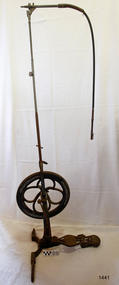
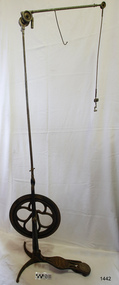
... Short history of early pedal powered machines”) The invention of a machine to speed up the process of excavation of a tooth lead to the invention of new burs and drills for the handpieces, improving speed and the surgical process of dentistry. They were the fore-runner of today’s electrically powered dental engines. flagstaff hill warrnambool shipwrecked coast flagstaff hill maritime museum maritime museum shipwreck coast flagstaff hill maritime village great ocean road dentist teeth dental drill dental engine treadle drill foot powered drill treadle engine orthodontics dental surgery james morrison Lettering on the base is peeling and difficult to read. ...The design of this and other similar treadle powered dental engine (or dentist drill) was in common use by dentists from the 1870’s into the 1920's. When electricity became accessible to most communities the electrically powered dental engines began to take over from the treadle power. Over the ages teeth were extracted using picks and scissors and other gouging instruments. Bow drills, hand drills and even a "bur thimble" drill were later used to prepare cavities for filling. Some drills were made bendable by attaching flexible shanks between the metal bur and the handle, giving access to the teeth at the back of the mouth. Other mechanical devices were introduced along the way, such as clockwork drills, but they were hard to handle and inefficient. Over the centuries “dentistry has been performed by priests, monks and other healers. This was followed by barbers; the barber’s chair may well have been the precursor to the dental chair. “(SA Medical Heritage Society Inc.) In 1871 James Morrison patented the first commercially manufactured 'foot treadle dental engine', the first practica dental engine although others had been introduced as early as 1790 (by John Greenwood). Handmade steel burs or drills were introduced for dental handpieces, taking advantage of the significant increase in the speed of the drill. In 1891 the first machine-made steel burs were in use. The treadle drill reduced the time to prepare a cavity from hours to less than ten minutes. In 1876 the Samuel S. White Catalogue of Dentist Instruments listed a 12 ½ inch wheel diameter dental engine, with 14 bright steel parts, for sale at US $55 In today’s market, this is the equivalent to US $1200 approx. The specifications of that dental engine are very similar to the this one in our Flagstaff Hill Maritime Village’s collection. It is interesting to note that workings of a similar treadle dentist drill were used and modified to power a treadle spinning wheel of one of the volunteer spinners at Flagstaff Hill Maritime Village. The foot treadle dental engine was a milestone in dental history. “Historic importance of treadle powered machines; they made use of human power in an optimal way” (Lowtech Magazine “Short history of early pedal powered machines”) The invention of a machine to speed up the process of excavation of a tooth lead to the invention of new burs and drills for the handpieces, improving speed and the surgical process of dentistry. They were the fore-runner of today’s electrically powered dental engines. This treadle-powered dentist drill, or dentist engine, is made of iron and steel and provides power for a mechanical dental hand-piece that would be fitted with a dental tool. The drill has a three footed cast iron base, one foot being longer than the other two. A vertical C shaped frame is joined into the centre of the base, holding an axle that has a driving-wheel (or flywheel) and connecting to a crank. A slender, shoulder height post, made from telescoping pipes, joins into the top of this frame and is height adjusted by a hand tightened screw with a round knob. On the post just above the frame is a short metal, horizontal bar (to hold the hand-piece when it is not in use). A narrow tubular arm is attached to the top of the stand at a right angle and can move up and down. At the end of the arm is a firmly fixed, flexible rubber hose protected for a short distance by a sheath of thin metal. At the end of the hose there is a fitting where the drill’s hand-piece would be attached; a small, silver coloured alligator clip is also at the end. A treadle, or foot pedal, is hinged to the heel to the long foot of the base, and joined at the toe to the crank that turns the driving-wheel. There is a spring under the toe of the treadle. The metal driving-wheel has a wide rim. Touching the inside of the rim are four tubular rings that bulge towards the outside of the driving-wheel, away from the pole, and all meet at the hub of the axle. The axle is bulbous between the inside of the driving-wheel and the frame then passes through the frame and is attached on the other side. The driving-wheel has a groove around which a belt would sit. The belt would also fit around a pulley on the arm, at the top of the post. The pulley is joined to a rod inside the arm and this spins the drill's hand-piece and dental tool holder. The two shorter feet of the base are made from a long metal bar that has been curved outwards, and its centre is bolted to the base of the pole. Under the ends of the curved legs of the base are wedge shaped feet. The driving-wheel is decorated in light coloured paint on both sides, each side having three sets of floral decals evenly spaced around them, and each about a sixth of the wheel's circumference. Similar decoration is along the sides of the frame. The foot pedal has decorative cutout patterns in the centre of the foot and at the toe. On the long foot of the stand is some lettering with a fine, light coloured border around it. The lettering is hard to read, being a dark colour and flaking off. There are also remnants of fine, light coloured flourishes. The foot pedal has lettering of the maker’s trade mark cast into the metal at the ball of the foot. Lettering on the base is peeling and difficult to read. The foot pedal has a trade mark cast into it that looks like a combination of ‘C’ , ‘S’ , ‘A’, ‘R’. flagstaff hill, warrnambool, shipwrecked coast, flagstaff hill maritime museum, maritime museum, shipwreck coast, flagstaff hill maritime village, great ocean road, dentist, teeth, dental drill, dental engine, treadle drill, foot powered drill, treadle engine, orthodontics, dental surgery, james morrison -
 Flagstaff Hill Maritime Museum and Village
Equipment - Dentist Drill, Late 19th century
... Short history of early pedal powered machines”) The invention of a machine to speed up the process of excavation of a tooth lead to the invention of new burs and drills for the handpieces, improving speed and the surgical process of dentistry. They were the fore-runner of today’s electrically powered dental engines. flagstaff hill warrnambool shipwrecked coast flagstaff hill maritime museum maritime museum shipwreck coast flagstaff hill maritime village great ocean road dentist teeth dental drill dental engine treadle drill foot powered drill treadle engine orthodontics dental surgery james morrison the brentfield richter de trey german dental fitting london dental drill "The ____/ Brentfield / __ DE IN L___" (Made in London) painted on the long foot of the base. ...The design of this and other similar treadle powered dental engine (or dentist drill) was in common use by dentists from the 1870’s into the 1920's. When electricity became accessible to most communities the electrically powered dental engines began to take over from the treadle power. Over the ages teeth were extracted using picks and scissors and other gouging instruments. Bow drills, hand drills and even a "bur thimble" drill were later used to prepare cavities for filling. Some drills were made bendable by attaching flexible shanks between the metal bur and the handle, giving access to the teeth at the back of the mouth. Other mechanical devices were introduced along the way, such as clockwork drills, but they were hard to handle and inefficient. Over the centuries “dentistry has been performed by priests, monks and other healers. This was followed by barbers; the barber’s chair may well have been the precursor to the dental chair. “(SA Medical Heritage Society Inc.) In 1871 James Morrison patented the first commercially manufactured 'foot treadle dental engine', the first practica dental engine although others had been introduced as early as 1790 (by John Greenwood). Handmade steel burs or drills were introduced for dental handpieces, taking advantage of the significant increase in the speed of the drill. In 1891 the first machine-made steel burs were in use. The treadle drill reduced the time to prepare a cavity from hours to less than ten minutes. In 1876 the Samuel S. White Catalogue of Dentist Instruments listed a 12 ½ inch wheel diameter dental engine, with 14 bright steel parts, for sale at US $55 In today’s market, this is the equivalent to US $1200 approx. The specifications of that dental engine are very similar to the this one in our Flagstaff Hill Maritime Village’s collection. It is interesting to note that workings of a similar treadle dentist drill were used and modified to power a treadle spinning wheel of one of the volunteer spinners at Flagstaff Hill Maritime Village. The foot treadle dental engine was a milestone in dental history. “Historic importance of treadle powered machines; they made use of human power in an optimal way” (Lowtech Magazine “Short history of early pedal powered machines”) The invention of a machine to speed up the process of excavation of a tooth lead to the invention of new burs and drills for the handpieces, improving speed and the surgical process of dentistry. They were the fore-runner of today’s electrically powered dental engines. This treadle-powered dentist drill, or dentist engine, is made of iron and steel and provides power for a mechanical dental handpiece that would be fitted with a dental tool. On the foot is painted lettering naming it "The Brentfield" and there is a fine line of light coloured paint creating a border around the name. The paint under the lettering is peeling off. The drill has a Y-shaped, three footed cast iron base, one foot being longer than the other two. A vertical frame is joined into the centre of the base, holding an axle that has a driving-wheel (or flywheel) and connecting to a crank. A slender, shoulder height post, made from adjustable telescoping pipes, joins into the top of this frame. On the post just above the frame is a short metal, horizontal bar (to hold the hand-piece when it is not in use). A narrow tubular arm is attached to the top of the stand at a right angle and can move up, down and around. There is a pulley each side of the joint of the arm and a short way along the arm is fitted a short metal pipe. A little further along the arm a frayed-ended cord hangs down from a hole. At the end of the arm is another pulley and a joint from which hangs a long, thin metal pipe with two pulleys and a fitting on the end. A treadle, or foot pedal, is joined to the long foot of the base, and joined at the toe to the crank that turns the driving-wheel. The metal driving-wheel has a wide rim. Touching the inside of the rim are four tubular rings that bulge towards the outside of the driving-wheel, away from the pole, and all meet at the hub of the axle. The axle fits between the inside of the driving-wheel and the frame then passes through the frame and is attached on the other side. The driving-wheel has a groove around which a belt would sit. The belt would also fit around a pulley on the arm, at the top of the post. The pulley is joined to a rod inside the arm and this spins the drill's hand-piece and dental tool holder. The foot pedal has a cross-hatch pattern on the heel and the ball of the foot has tread lines across it. The end of the toe and the instep areas have cut-out pattern in them. "The ____/ Brentfield / __ DE IN L___" (Made in London) painted on the long foot of the base. Marked on the drill connection is “Richter De Trey, Germany”flagstaff hill, warrnambool, shipwrecked coast, flagstaff hill maritime museum, maritime museum, shipwreck coast, flagstaff hill maritime village, great ocean road, dentist, teeth, dental drill, dental engine, treadle drill, foot powered drill, treadle engine, orthodontics, dental surgery, james morrison, the brentfield, richter de trey, german dental fitting, london dental drill -
 The Beechworth Burke Museum
Audio - Oral History, Jennifer Williams, Mrs May Sewell, 23rd November 2000
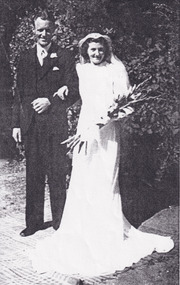
... James as a lovely boy. May had multiple connections to the Zwar Brothers' Beechworth Tannery. Her father and then her three brothers worked there, and also her husband for a short period of time. ...James as a lovely boy. May had multiple connections to the Zwar Brothers' Beechworth Tannery. Her father and then her three brothers worked there, and also her husband for a short period of time. ...May Sewell was born in Beechworth in 1917, her paternal grandparents had come to Beechworth from Ireland and her maternal grandparents from Scotland. She was the youngest of five siblings and the only one to be born in a hospital rather than at home. May loved growing up and living in Beechworth, and fondly recalls knowing all her neighbours, meeting friends at the pictures, attending girl guides, picking wildflowers around the gorge, participating keenly in the Church of England choir and dances, and the big Easter festivals. May worked various jobs before getting married. After leaving school at fifteen, May learnt dressmaking with Lal Anderson (and was delighted with her wage of two and six pence a week) and then went on to learn tailoring with Mr Charles. May then worked in the dining rooms at the Commercial Hotel and Hotel Nicholas. May was at the Hotel Nicholas for seven years but stopped when she got married as female employees were not asked to stay once they were married. May married her husband in 1944 and had known him since school. They went on to have six children, sadly three did not live past infancy. Her first children were twin girls who died six hours after birth. May briefly discusses the difficulty in grieving her twin daughters, the lack of available support, and the expectancy to carry on. Her next child, a son named Ian James, died when he was only ten months old from a tumour. May described Ian James as a lovely boy. May had multiple connections to the Zwar Brothers' Beechworth Tannery. Her father and then her three brothers worked there, and also her husband for a short period of time. The tannery was a major employer in Beechworth, and May having multiple family members employed by the tannery underlines the significant role of the tannery in Beechworth. May described her husband as very hardworking, he worked as a cleaner overnight at the Ovens and Murray Hospital for the Aged while during the day tended his cattle and sheep farm. This oral history recording was part of a project conducted by Jennifer Williams in the year 2000 to capture the everyday life and struggles in Beechworth during the twentieth century. This project involved recording seventy oral histories on cassette tapes of local Beechworth residents which were then published in a book titled: Listen to what they say: voices of twentieth century Beechworth. These cassette tapes were digitised in July 2021 with funds made available by the Friends of the Burke. Miss May Sewell’s account of her life in Beechworth is historically and socially significant to the cultural heritage of the region. May in reflecting on her experiences of leisure opportunities, town festivals, work available for women, leaving the workforce once married, the tannery, post-natal care, grief and child mortality provide essential historic, economic, social, and healthcare insights. May’s oral history recording is part of a larger collection of oral histories recorded by Jennifer Williams in 2000, collectively they provide invaluable insights into Beechworth during the 20th century, much of the information in these oral histories would be lost if not documented and missed in the interpretation of tangible objects. This is a digital copy of a recording that was originally captured on a cassette tape. The cassette tape is black with a horizontal white strip and is currently stored in a clear flat plastic rectangular container. It holds up 40 minutes of recordings on each side.Mrs May Sewellmay sewell, oral history, jennifer williams, listen to what they say: voices of twentieth century beechworth, beechworth church of england, easter festival, beechworth girl guides, hospital birth 1917, lal anderson, tailor beechworth, commercial hotel, hotel nicholas, zwar brother's beechworth tannery, ovens and murray hospital for the aged, dressmaking beechworth, beechworth cinemas, paul voglis -
 The Beechworth Burke Museum
Photograph, 1990s--estimated
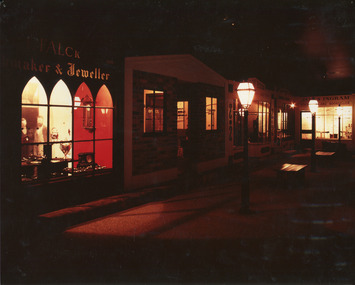
... James Ingram was a 'devoted instigator and supporter of the town's welfare institutions', who raised funds for to establish a hospital, primary school and benevolent asylum, and assisted people who'd fallen on hard times with his wife. He was also a mainstay of the early Baptist church, holding meetings in his house. He died in 1928, six weeks short ...Taken in 1990, this photograph depicts a row of shops in Beechworth, with the shopfront of watchmaker and jewellers, William Turner and C.F. Falck, in the foreground, and newsagent and bookseller James Ingram's shop in the background.This photograph is of social significance to the Beechworth community in depicting the Street of Shops, the creation of curator, Roy Harvey, which opened in 1979 at Burke Museum. According to the Indigo Shire Council webpage for Burke Museum, this addition 'began a new period of collecting with Roy Harvey calling to the community for donations. The response resulted in an influx of material adding to the town history/ development and local identities collections. The Shops and their contents reflect another period in museology.' The historic shopfronts in this image portray those of local settlers, William Turner and CF Falck's Watchmaker and Jeweller store, and James Ingram's news agency and bookshop. William Turner was originally a goldfields official who became a commissioner on the Ovens goldfield, and later a resident warden, at times performing magisterial duties and chairing the Local Court. Charles Frederick Falck, born in Korlin, Germany, in 1833, a skilled watchmaker and jeweller, ran the jewellery business from 1862. Along with William Turner and Melbourne barrister, George Milner Stephen, he prepared a dazzling display of gems and jewellery from Beechworth for the Royal Society's Exhibition in Melbourne in 1865. This act signposted Beechworth's progress as a nineteenth-century gold rush town with a population of around 3000. In the mid-1850s, newsagent James Ingram established a newsagency and supplied papers and stationary to the goldfields. He and bookseller R.T. Vale stocked a wide range of literary, historical and religious works, textbooks, periodicals and newspapers, as well as hosting a reading and writing room on Camp Street{?}. James Ingram was a 'devoted instigator and supporter of the town's welfare institutions', who raised funds for to establish a hospital, primary school and benevolent asylum, and assisted people who'd fallen on hard times with his wife. He was also a mainstay of the early Baptist church, holding meetings in his house. He died in 1928, six weeks short of his 100th birthday. Ingram's Rock, north-west of Beechworth near where he lived in later life, was named after him. Colour rectangular photograph printed on matte photographic paper.Obverse: FALCK 1880 / maker & Jeweller/ WARDENS OFFICE/COACHING OFFICE/ EST. ??55/ ????ON HOUSE/ JAMES INGRAM/ NEWS?????? AND BOOKSELLER/ TOYS visible above shopfront in left foreground. Reverse: Catalogue item number 3305 pencilled in top right-hand corner.beechworth, beechworth historic shops, william turner, cf falck, james ingram, turner and falck watchmaker and jeweller, james ingram newsagent and bookseller, burke museum, promoting settlement, marketing and retailing, living in country towns, making regional centres, preserving traditions and commemorating, beechworth founders, victorian gold rush towns, beechworth pioneers, ingram's rock, 1860s beechworth, street of shops, roy harvey -
 Federation University Historical Collection
Photograph - Photograph - Colour, VIOSH: Graduate Diploma in Occupational Hazard Management, Intake 5 1983, at 5th Annual Dinner
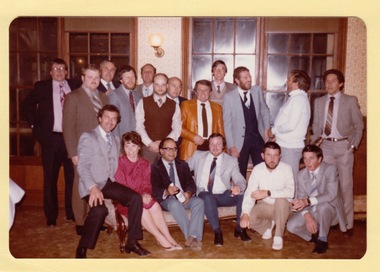
... james aitken...bob arthur...norman casey...cip corva...john edwards...ian lowe...glen mcphee...elizabeth miles...john read...douglas reynolds...gary rowe...brian short...Graduate Diploma in Occupational Hazard Management (Intake 5 at the 5th Annual Dinner. 1983. viosh victorian institute of occupational safety and health graduate diploma in hazard management 1983 intake 5 james aitken bob arthur norman casey cip corva john edwards ian lowe glen mcphee elizabeth miles john read douglas reynolds gary rowe brian short peter tunaley donald weimer robin yardley Colour photograph mounted on yellow card. ...Victorian Institute of Occupational Safety and Health (VIOSH) Australia is the Asia-Pacific centre for teaching and research in occupational health and safety (OHS) and is known as one of Australia's leaders in the field. VIOSH has a global reputation for its innovative approach within the field of OHS management. VIOSH had its first intake of students in 1979. At that time the Institution was known as the Ballarat College of Advanced Education. In 1990 it became known as Ballarat University College, then in 1994 as University of Ballarat. It was 2014 that it became Federation University. VIOSH Australia students are safety managers, senior advisors and experienced OHS professionals. They come from all over Australia and industry. Students are taught active research and enquiry; rather than textbook learning and a one-size fits all approach. VIOSH accepts people into the Graduate Diploma of Occupational Hazard Management who have no undergraduate degree - on the basis of extensive work experience and knowledge. Graduate Diploma in Occupational Hazard Management (Intake 5 at the 5th Annual Dinner. 1983.Colour photograph mounted on yellow card.viosh, victorian institute of occupational safety and health, graduate diploma in hazard management, 1983, intake 5, james aitken, bob arthur, norman casey, cip corva, john edwards, ian lowe, glen mcphee, elizabeth miles, john read, douglas reynolds, gary rowe, brian short, peter tunaley, donald weimer, robin yardley -
Federation University Historical Collection
Book - Register, Ballarat School of Mines and Industries, Ballarat, Register of members, directors, managers and secretaries of the School of Mines and Industries Ballarat, 1971
... james smail...w. gordon smith...albet edward stohr...g. kingsley sutton...edgar john trevella tippett...kenneth crago webb...robert dobell...kenneth neerhut...e.j barker...n.a crouch...r. elsworthy...k.j flecknoe...l.f.j hillman...r. knowles...b.c muir...r.j selkirk...f.r uhe...l.c yandell...g.h beanland...p.r shiells...j. bell...p. kisler...s.a mendelson...j. chambers...r.b christie...i.c clarke...j. short...It shows projects that were being undertaken at the institution at the time and gives us an historical perspective on project costs and the type of work being done register of members register of directors register of managers and secretaries william anderson matthew griffith beanland rex hollioake morgan bevan john arthur nicholson william james child north hugh arthur patterson keith price james victor robertson james smail w. gordon smith albet edward stohr g. kingsley sutton edgar john trevella tippett kenneth crago webb robert dobell kenneth neerhut e.j barker n.a crouch r. elsworthy k.j flecknoe l.f.j hillman r. knowles b.c muir r.j selkirk f.r uhe l.c yandell g.h beanland p.r shiells j. bell p. kisler s.a mendelson j. chambers r.b christie i.c clarke j. short t.a wiseman l. wallis r. mcfarlane l.j obrien l. murphy j.f mckay Book with red spine and blue crocodile print cover and large label on the front with lined pages inside. ...School of Mines is a predecessor of Federation UniversityThis register lists the members, directors, mangers and secretaries of School of Mines in the 1970's and 80's giving us an understanding of the operations of the School of Mines in that era and of the people involved with the institution at that time. It shows projects that were being undertaken at the institution at the time and gives us an historical perspective on project costs and the type of work being doneBook with red spine and blue crocodile print cover and large label on the front with lined pages inside.register of members, register of directors, register of managers and secretaries, william anderson, matthew griffith beanland, rex hollioake, morgan bevan john, arthur nicholson, william james child north, hugh arthur patterson, keith price, james victor robertson, james smail, w. gordon smith, albet edward stohr, g. kingsley sutton, edgar john trevella tippett, kenneth crago webb, robert dobell, kenneth neerhut, e.j barker, n.a crouch, r. elsworthy, k.j flecknoe, l.f.j hillman, r. knowles, b.c muir, r.j selkirk, f.r uhe, l.c yandell, g.h beanland, p.r shiells, j. bell, p. kisler, s.a mendelson, j. chambers, r.b christie, i.c clarke, j. short, t.a wiseman, l. wallis, r. mcfarlane, l.j obrien, l. murphy, j.f mckay -
Federation University Historical Collection
Handbook, The School Paper Grades V and VI Victoria Education Department, 1964-1966
... short story...charles kingsford smith...1965...1966...matthew flinders...baron sir ferdinand von mueller...patrick hannan...paddy hannan...charles yelverton o'connor...john ridley...thomas sutcliffe mort...sir sidney kidman...hugh victor mckay...robert hoddle...james...The short story "The ANZACS at Gallipoli" includes a photograph of James Simpson Kirkpatrick with his donkey, bearing a wounded soldier (Page 33). ...The short story "The ANZACS at Gallipoli" includes a photograph of James Simpson Kirkpatrick with his donkey, bearing a wounded soldier (Page 33). ...Three handbooks with green patterns on recto and verso. Linen tape is on the spine. Paper is bound by string, connected at the top and bottom. .1)This handbook is a collection of The School Paper for grades V and VI, by the Victorian Education Department for 1964. It's contents are including by not limited to poetry and short stories submitted to the paper from a variety of authors such as "Beside the Road" by Louis H. Clark, information regarding the events of the time such as Air Force Commemoration Week, writings such as piece regarding self-control while using alcohol. and sheet music for various songs, such as "God save the queen". A history of Port Melbourne is included on page 2. A history of Australia's cattle trade is included on pages 11-12. In addition, A biography of Sid Kidman, Australia's "cattle king" is included between pages 36-37. .2)This handbook is a collection of The School Paper for grades V and VI, by the Victorian Education Department for 1965. It's contents are including by not limited to poetry and short stories submitted to the paper from a variety of authors, such as "Pit-Pony" by S.A. Bainbridge, information regarding the events of the time such as the Fig Harvest at El-Flaye, and sheet music for various songs, such as "Old John Braddleum". The short story "The ANZACS at Gallipoli" includes a photograph of James Simpson Kirkpatrick with his donkey, bearing a wounded soldier (Page 33). A piece titled "A good-bye and a welcome" on pages 50-51 details the farewell to Alex McDonell, the director of Education for Victoria from 1960 to 1965, and the welcoming of Frederick H. Brooks as the new Director of Education in Victoria. A supplement is included in regards to "Scholarships and Allowances available for further education" for July 1965. A biography of Rudyard Kipling is on pages 103-105. A monthly series titled "The Seed from which they grew" detailed the history of some of Victoria's historical institutions: Victoria's Government House, The Royal Botanic Gardens, Victorian Railways, School Broadcasts, (Victorian) Public Libraries, The Forests Commission of Victoria, The Correspondence School, The Royal Mint, Her Majesty's Mail, Victoria Police, and Fire brigades. .3)This handbook is a collection of The School Paper for grades V and VI, by the Victorian Education Department for 1966. It's contents are including by not limited to poetry and short stories submitted to the paper from a variety of authors such as "The Emu" by Joan Wise, information regarding the events of the time such as Australian Literature Week, and sheet music for various songs, such as "Potatoes"'. "The Nation Builders" was a monthy series serialised in the paper about explorers who helped to found Australia, such as Matthew Flinders, Baron Sir Ferdinand Von Mueller, Patrick ("Paddy") Hannan, Charles Yelverton O'Connor, John Ridley, Thomas Sutcliffe Mort, Sir Sidney Kidman, Hugh Victor McKay,Robert Hoddle, and Charles Kingsford Smith. A supplement is included in regards to "Scholarships and Allowances available for further education" for July 1966..1) , "Grade 5 Classroom Copy" and "1964" recto. Pages 17, 32, 81, 97,113, 129 features the text "A.J. Mathieson".Page 49 has the text "Grades 5/6 Staff Copy A.J. Mathieson". Page 17 has tick marks on lower right hand corner. Registration number written on verso bounding as "11735.1" in pencil. .2)"Grade 5 Classroom Copy" and "1965" recto.Registration number written on verso bounding as "11735.2" in pencil. .3)"Classroom Copy", "1966", "5" and a black curved line in the middle of the page recto. Page 1 has "A.J. Mathieson" on the top right hand side in red marker. In the middle of Page 35, there is some text underlined, and the comment "Quote Governor King" in green ink.Registration number written on verso bounding as "11735.3" in pencil.1964, handbook, alex ball, victorian education department, school paper, grade v and vi, hymns, poetry, songs, short story, charles kingsford smith, 1965, 1966, matthew flinders, baron sir ferdinand von mueller, patrick hannan, paddy hannan, charles yelverton o'connor, john ridley, thomas sutcliffe mort, sir sidney kidman, hugh victor mckay, robert hoddle, james simpson kirkpatrick, alex mcdonell, frederick h. brooks, rudyard kipling, victorian government house,, royal botanic gardens, victorian railways, school broadcasts,, victorian public libraries, forests commission of victoria, correspondence school, royal mint, her majesty's mail, victoria police, fire brigades, port melbourne, sid kidman, cattle king, cattle trade -
 Federation University Historical Collection
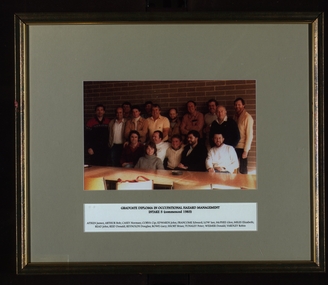
Photograph, VIOSH - Graduate Diploma of Occupational Hazard Management, Intake 5, 1983, 1983
... james aitken...bob arthur...norman casey...cip corva...john edwards...edward francome...ian low...glen mcphee...elizabeth miles...john read...douglas reynolds...gary rowe...brian short...VIOSH accepts people into the Graduate Diploma of Occupational Hazard Management who have no undergraduate degree – on the basis of extensive work experience and knowledge. viosh viosh australia james aitken bob arthur norman casey cip corva john edwards edward francome ian low glen mcphee elizabeth miles john read douglas reynolds gary rowe brian short peter tunaley donald weimer robin yardley Framer - Creative Framing Brown and gold framed photograph with title and names of students underneath. ...Federation University VIOSH Australia students are safety managers, senior advisors and experienced OHS professionals. They come from all over Australia and industry. Students are taught active research and enquiry; rather than textbook learning and a one-size fits all approach. VIOSH accepts people into the Graduate Diploma of Occupational Hazard Management who have no undergraduate degree – on the basis of extensive work experience and knowledge.Brown and gold framed photograph with title and names of students underneath.Framer - Creative Framing viosh, viosh australia, james aitken, bob arthur, norman casey, cip corva, john edwards, edward francome, ian low, glen mcphee, elizabeth miles, john read, douglas reynolds, gary rowe, brian short, peter tunaley, donald weimer, robin yardley -
 Flagstaff Hill Maritime Museum and Village
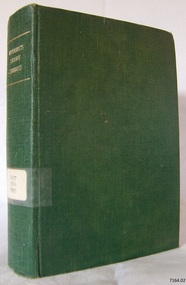
Book - Literary Work, James Anthony Froude, Short Studies on Great Subjects Vol 2, 1872
... short studies on great subjects vol 2...james...Short Studies on Great Subjects Vol 2 by James Anthony Froude Author:James Anthony Froude Publisher: Longmans Green and Co. ...Date: 1872 Short Studies on Great Subjects Vol 2 Book Literary Work James Anthony Froude Longmans, Green & Co. ...Pattison Collection This item is from the ‘Pattison Collection’, a collection of books and records that was originally owned by the Warrnambool Mechanics’ Institute, which was founded in Warrnambool in 1853. By 1886 the Warrnambool Mechanics’ Institute (WMI) had grown to have a Library, Museum and Fine Arts Gallery, with a collection of “… choice productions of art, and valuable specimens in almost every branch and many wonderful national curiosities are now to be seen there, including historic relics of the town and district.” It later included a School of Design. Although it was very well patronised, the lack of financial support led the WMI in 1911 to ask the City Council to take it over. In 1935 Ralph Pattison was appointed as City Librarian to establish and organise the Warrnambool Library as it was then called. When the WMI building was pulled down in 1963 a new civic building was erected on the site and the new Warrnambool Library, on behalf of the City Council, took over all the holdings of the WMI. At this time some of the items were separated and identified as the ‘Pattison Collection’, named after Ralph Pattison. Eventually the components of the WMI were distributed from the Warrnambool Library to various places, including the Art Gallery, Historical Society and Flagstaff Hill. Later some were even distributed to other regional branches of Corangamite Regional Library and passed to and fro. It is difficult now to trace just where all of the items have ended up. The books at Flagstaff Hill Maritime Village generally display stamps and markings from Pattison as well as a variety of other institutions including the Mechanics’ Institute itself. RALPH ERIC PATTISON Ralph Eric Pattison was born in Rockhampton, Queensland, in 1891. He married Maude Swan from Warrnambool in 1920 and they set up home in Warrnambool. In 1935 Pattison accepted a position as City Librarian for the Warrnambool City Council. His huge challenge was to make a functional library within two rooms of the Mechanics’ Institute. He tirelessly cleaned, cleared and sorted a disarrayed collection of old books, jars of preserved specimens and other items reserved for exhibition in the city’s museum. He developed and updated the library with a wide variety of books for all tastes, including reference books for students; a difficult task to fulfil during the years following the Depression. He converted all of the lower area of the building into a library, reference room and reading room for members and the public. The books were sorted and stored using a cataloguing and card index system that he had developed himself. He also prepared the upper floor of the building and established the Art Gallery and later the Museum, a place to exhibit the many old relics that had been stored for years for this purpose. One of the treasures he found was a beautiful ancient clock, which he repaired, restored and enjoyed using in his office during the years of his service there. Ralph Pattison was described as “a meticulous gentleman whose punctuality, floorless courtesy and distinctive neat dress were hallmarks of his character, and ‘his’ clock controlled his daily routine and his opening and closing of the library’s large heavy doors to the minute.” Pattison took leave from 1942 to 1945 to serve in the Royal Australian Navy, Volunteer Reserve as Lieutenant. A few years later he converted one of the Museum’s rooms into a Children’s Library, stocking it with suitable books for the younger generation. This was an instant success. In the 1950’s he had the honour of being appointed to the Victorian Library Board and received more inspiration from the monthly conferences in Melbourne. He was sadly retired in 1959 after over 23 years of service, due to the fact that he had gone over the working age of council officers. However, he continued to take a very keen interest in the continual development of the Library until his death in 1969. WARRNAMBOOL PUBLIC LIBRARY The Warrnambool Mechanics’ Institute (WMI) was formed by a voluntary community group in 1863, within six years of Warrnambool’s beginnings, and its Reading Room opened in 1854. The WMI operated until 1963, at which time it was one of the oldest Mechanics’ Institutes in Victoria. Mechanics’ Institutes offered important services to the public including libraries, reading rooms and places to display and store collections of all sorts such as curiosities and local historical relics. In 1886 a Museum and Fine Arts Gallery were added to the WMI and by the beginning of the 20th century, there was also a billiards room and a School of Art. By this time all Mechanics’ Institutes in country Victoria had museums attached. Over the years the Warrnambool Mechanics’ Institute Library was also known as the Warrnambool Public Library the Warrnambool Library and the Free Library. Early funding from the government was for the “Free Library”. The inscription in a book “Science of Man” was for the “Warrnambool Public Library”, donated by Joseph Archibald in 1899. Another inscription in the book “Catalogue of Plants Under Cultivation in the Melbourne Botanic Gardens 1 & 2, 1883” was presented to the “Warrnambool Library” and signed by the author W.R. Guilfoyle. In 1903 the Warrnambool Public Library decided to add a Juvenile Department to library and stock it with hundreds of books suitable for youth. In 1905 the Public Library committee decided to update the collection of books and added 100 new novels plus arrangements for the latest novels to be included as soon as they were available in Victoria. In July 1911 the Warrnambool Council took over the management of the Public Library, Art Gallery, Museum and Mechanics’ Institute and planned to double the size of the then-current building. In 1953, when Mr R. Pattison was Public Librarian, the Warrnambool Public Library’s senior section 10,000 of the 13,000 books were fiction. The children’s section offered an additional 3,400 books. The library had the equivalent of one book per head of population and served around 33 per cent of the reading population. The collection of books was made up of around 60 per cent reference and 40 per cent fiction. The library was lending 400 books per day. In 1963 the Warrnambool City Council allocated the site of the Mechanics’ Institute building, which included the Public Library, Museum and Art Gallery, for the new Municipal Offices and the Collections were dispersed until 1971. The Warrnambool Library took over the Mechanics’ Institute Library’s holdings on behalf of the Warrnambool City Council. Since the closure of the Warrnambool Mechanics’ Institute the exact location and composition of the original WMI books and items have become unclear. Other materials have been added to the collection, including items from Terang MI, Warrnambool Court House and Customs House. Many of the books have been identified as the Pattison Collection, named after the Librarian who catalogued and numbered the books during his time as Warrnambool Public Librarian in the time before the Mechanics’ Institute closed. It seems that when Warrnambool became part of the Corangamite Regional Library some of the books and materials went to its head office in Colac and then back to Warrnambool where they were stored at the Art Gallery for quite some time. Some then went to the Warrnambool Historical Society, some stayed at the Art Gallery and some were moved to Flagstaff Hill Maritime Village. The various stamps and labels on the books held at Flagstaff Hill show the variety of the collection’s distribution and origin. The books in the collection at Flagstaff Hill Maritime Village date from the 1850s to the late 1950s and include rare and valuable volumes. Many of the books are part of the “Pattison Collection” after the Warrnambool’s Public Librarian, Mr R. Pattison. The Pattison Collection, along with other items at Flagstaff Hill Maritime Village, was originally part of the Warrnambool Mechanics' Institute’s collection. The Warrnambool Mechanics’ Institute Collection is primarily significant in its totality, rather than for the individual objects it contains. Its contents are highly representative of the development of Mechanics' Institute libraries across Australia, particularly Victoria. A diversity of publications and themes has been amassed, and these provide clues to our understanding of the nature of and changes in the reading habits of Victorians from the 1850s to the middle of the 20th century. The collection also highlights the Warrnambool community’s commitment to the Mechanics’ Institute, reading, literacy and learning in the regions, and proves that access to knowledge was not impeded by distance. These items help to provide a more complete picture of our community’s ideals and aspirations. The Warrnambool Mechanics Institute book collection has historical and social significance for its strong association with the Mechanics Institute movement and the important role it played in the intellectual, cultural and social development of people throughout the latter part of the nineteenth century and the early twentieth century. The collection of books is a rare example of an early lending library and its significance is enhanced by the survival of an original collection of many volumes. The Warrnambool Mechanics' Institute’s publication collection is of both local and state significance. Short Studies on Great Subjects Vol 2 by James Anthony Froude Author:James Anthony Froude Publisher: Longmans Green and Co. Date: 1872The label on the spine with typed text PAT 824 FRO Pastedown front endpaper has sticker from Warrnambool Public Library covered by a sticker from Corangamite Regional Library Serviceshipwrecked-coast, flagstaff-hill, flagstaff-hill-maritime-museum, warrnambool, maritime-museum, shipwreck-coast, flagstaff-hill-maritime-village, shipwrecked-artefact, book, pattison collection, warrnambool library, warrnambool mechanics’ institute, ralph eric pattison, corangamite regional library service, warrnambool city librarian, mechanics’ institute library, victorian library board, warrnambool books and records, warrnambool children’s library, short studies on great subjects vol 2, james anthony froude -
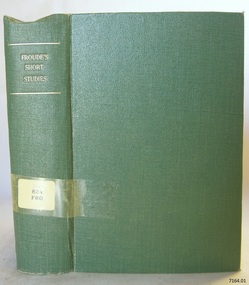 Flagstaff Hill Maritime Museum and Village
Book - Literary Work, James Anthony Froude, Short Studies on Great Subjects Vol 1, 1872
... ...short studies on great subjects...james...Short Studies on Great Subjects Vol 1 Author: James Anthony Froude Publisher: Longmans Green and Co. ...Date: 1872 Fly page has inscriptions Short Studies on Great Subjects Vol 1 Book Literary Work James Anthony Froude Longmans, Green & Co. ...This book was part of a large group of books referred to as the Pattison Collection, which belonged to the Warrnambool Public Library, part of the Warrnambool Mechanics’ Institute. The publisher firm, Longmans, Green & Co, was originally founded in 1724 in London by Thomas Longman under the name Longman. In August of that year, he bought the two shops and goods of William Taylor and set up his publishing house there at 39 Paternoster Row. The shops were called Black Swan and Ship, and it is said that the 'ship' sign was the inspiration for Longman's Logo. After many changes of name and management, the firm was incorporated in 1926 as Longmans, Green & Co. Pty Ltd. The firm was acquired by Pearson in 1968 and was known as Pearson Longman or Pearson PLC.The book is also significant for its connection to the publisher Longmans, Green and Co., of London, a firm that has been established for around two centuries and is renowned for publishing and printing reference works that contributed to the education of scholars over many years. The book has additional importance for its connection to the Pattison Collection, which, along with other items at Flagstaff Hill Maritime Village, was originally part of the Warrnambool Mechanics' Institutes’ Collection. The Warrnambool Mechanics’ Institute book collection has historical and social significance for its strong association with the Mechanics Institute movement and its important role in people's intellectual, cultural and social development throughout the latter part of the nineteenth century and the early twentieth century. The collection of books is a rare example of an early lending library and its significance is enhanced by the survival of an original collection of many volumes. The Warrnambool Mechanics' Institute’s publication collection is of both local and state significance.Short Studies on Great Subjects Vol 1 Author: James Anthony Froude Publisher: Longmans Green and Co. Date: 1872 Fly page has inscriptionsThe label on spine cover with typed text PAT 824 FRO Pastedown front endpaper has a sticker from Warrnambool Public Library Front loose endpaper has a stamp from Corangamite Regional Library Service Fly paye inscriptions: in pencil: - "111" "103"(crossed out), "102" "974" "3" P/w" "4455" " Fly paye inscriptions: in blue pen:- "824"flagstaff hill, warrnambool, shipwrecked coast, flagstaff hill maritime museum, maritime museum, shipwreck coast, flagstaff hill maritime village, great ocean road, book, pattison collection, warrnambool library, warrnambool mechanics’ institute, ralph eric pattison, corangamite regional library service, warrnambool city librarian, mechanics’ institute library, victorian library board, warrnambool books and records, warrnambool children’s library, short studies on great subjects vol 1, short studies on great subjects, james anthony froude, longmans green and co., l & co., 1724, thomas longman, paternoster row london, free library -
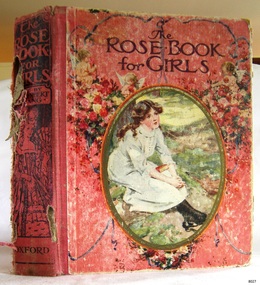 Flagstaff Hill Maritime Museum and Village
Book - Fiction, Mrs Herbert Strang, editor, The Rose Book for Girls, 1916
... short stories...Henry Frowde...Hodder & Stoughton...London...Morrison & Gibb Ltd...1916...Alma McCullagh...James...Flagstaff Hill Flagstaff Hill Maritime Museum and Village Warrnambool Maritime Museum Maritime Village Great Ocean Road Shipwreck Coast book The Rose Book for Girls Mrs Herbert Strang short stories Henry Frowde Hodder & Stoughton London Morrison & Gibb Ltd 1916 Alma McCullagh James McCullagh Elizabeth Eccles McCullagh ca. 1928 Dennington southwest Victoria Warrnambool district Presbyterian Sabbath School Presbyterian Sunday School Dennington Presbyterian Church book award book prize book presentation R. ...Alma McCullagh was a student at the Presbyterian Sabbath School located in Dennington, near Warrnambool. In January, around 1928, she received a book as an award from R. Conn, her Sabbath School teacher, in recognition of her involvement and achievements at the school. The exact year of this award is based on available records: in January 1928, Alma was presented with a prize by R. Conn, whereas by 1930, the role of awarding prizes had passed to F. Jones. Alma was probably the granddaughter of James McCullagh (1831–1911) and Elizabeth Eccles (1831–1909), who were pioneering settlers in the region. James and Elizabeth married in 1856 and established their home at Oak Grove, Yangery, Illowa from 1859, residing there until their deaths. One of their sons, William McCullagh (1873–1940), married Margaret Jane Russell (1879–1981). William and Margaret continued the family tradition, making their home at Oak Grove as well. They raised eleven children, with Alma likely being among the youngest of their children.The book, “The Rose Book for Girls”, edited by Mrs Herbert Strang, represents an example of literature accessible to older girls during the early 20th century. It was specifically selected as an end-of-year award, recognising consistent attendance at Sabbath School. Such choices highlight the role of books in supporting the educational and moral development of young women during this period. The book is important as a connection to the early township of Dennington, a community distinguished by its established school and church. This association reflects the values the community placed on education and religious instruction. The book’s significance is further enhanced by its relationship with colonial pioneer families in Australia, particularly those from Victoria and the Warrnambool district in southwest Victoria. It is a tangible link to the history and legacy of these early settlers, who were instrumental in shaping the regional development. In addition, the book is notable for its connection to the McCullagh family, a prominent farming family whose contributions supported the social and economic growth of the local district. This historical association enriches its value, situating the book within the broader narrative of community progress and pioneer achievement in the area, and highlighting its place within a tradition of religious life and community building.The Rose Book for Girls A collection of short stories by various authors Edited by Mrs Herbert Strang Publisher: Henry Frowde, Hodder & Stoughton, London Printer: Morrison & Gibb Ltd., Tanfield, Edinburgh, Scotland, UK Date: 1916 Hardcover book. Deep pink front and back covers, decorated with garlands of pink and white flowers, cupids and blue ribbons. The front has a cameo with a seated girl in white, with a book in her lap. Details on the spine: title, author, publisher and a sketched female in 19th-century dress holding a fan. The fly page shows details of the book and has a black and red sketch of two seated girls, one reading, the other stitching. Twenty-five books are listed on the Contents page, as well as the printer's details. Within the book are several colourful sketches. Inscriptions include the name of the book's previous owner, Alma McCullagh.Front loose-end paper: "Presbyterian Sabbath School, Dennington. Prize Awarded to: Alma McCullagh. January. (year is unreadable, circa 1928) R. Conn, Teacher"flagstaff hill, flagstaff hill maritime museum and village, warrnambool, maritime museum, maritime village, great ocean road, shipwreck coast, book, the rose book for girls, mrs herbert strang, short stories, henry frowde, hodder & stoughton, london, morrison & gibb ltd, 1916, alma mccullagh, james mccullagh, elizabeth eccles mccullagh, ca. 1928, dennington, southwest victoria, warrnambool district, presbyterian sabbath school, presbyterian sunday school, dennington presbyterian church, book award, book prize, book presentation, r. conn, sabbath school superintendent -
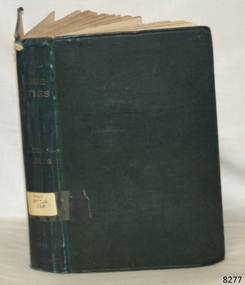 Flagstaff Hill Maritime Museum and Village
Book - Fictional Novel, Henry James Jr, Tales of Three Cities, 1884
... While Tales of Three Cities is not as universally famous today as James’s towering masterpieces, it remains highly significant to scholars and enthusiasts because it captures James at a peak transitional moment in his career. It showcases his absolute mastery of the short story and novella formats. ...The novel Tales of Three Cities (1884) is not a single narrative, but rather a collection of three distinct novellas inspired by Henry James’s travels and his deep fascination with regional and transatlantic cultural clashes. The first novella, ‘Lady Barberina’, is a classic exploration of James’s famous ‘international theme’. It focuses on the marriage between a wealthy American doctor and an aristocratic Englishwoman, exposing the rigid social expectations of British high society. The second, ‘A New England Winter’, is a witty, satirical look at the distinct social nuances, manners, and artistic attitudes dividing New York and Boston. The third, ‘The Impressions of a Cousin’, is a story structured around a young woman’s personal journal, detailing a complex web of family relationships, trust, and art.Hard cover book, Tales of Three Cities Author: Henry James Publisher: Macmillan And Co Date: 1884 Blue cloth hardcover and spine with spine lettering in black texter. The spine has a Library label with inscription.fictionThe novel Tales of Three Cities (1884) is not a single narrative, but rather a collection of three distinct novellas inspired by Henry James’s travels and his deep fascination with regional and transatlantic cultural clashes. The first novella, ‘Lady Barberina’, is a classic exploration of James’s famous ‘international theme’. It focuses on the marriage between a wealthy American doctor and an aristocratic Englishwoman, exposing the rigid social expectations of British high society. The second, ‘A New England Winter’, is a witty, satirical look at the distinct social nuances, manners, and artistic attitudes dividing New York and Boston. The third, ‘The Impressions of a Cousin’, is a story structured around a young woman’s personal journal, detailing a complex web of family relationships, trust, and art.flagstaff hill, warrnambool, shipwrecked coast, flagstaff hill maritime museum, maritime museum, shipwreck coast, flagstaff hill maritime village, great ocean road, book, pattison collection, warrnambool library, warrnambool mechanics’ institute, ralph eric pattison, corangamite regional library service, warrnambool city librarian, mechanics’ institute library, victorian library board, warrnambool books and records, warrnambool children’s library, tales of three cities, henry james -
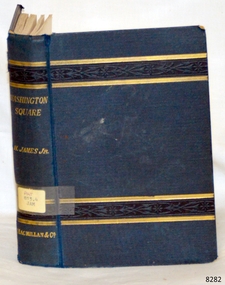 Flagstaff Hill Maritime Museum and Village
Book - Fictional Stories, Henry James Jr, Washington Square, 1881
... short story told entirely through letters, featuring a cast of international guests staying at a Paris hotel. Each letter writer reveals their own cultural biases, blind spots, and vanity. The label on the spine cover with typed text PAT 813.4 JAM Paste down front end paper has a sticker from Warrnambool Mechanics Institute and Free Library Front loose end paper has a sticker from Corangamite Regional Library Service Front loose end paper has a stamp from Corangamite Regional Library Service Flyleaf has a stamp from Warrnambool Mechanics Institute and Free Library Washington Square Author: Henry James Jr Publisher: MacMillian & Co Date: 1881 Further Information: Blue cloth hardcover and spine with spine lettering in gilt. ...This volume compiles three distinct early works by Henry James that explore his signature theme of the clash of social manners, money, and personal integrity. Set in 1840s New York City, the masterpiece Washington Square follows Catherine Sloper, a plain, introverted heiress. She is caught between her cold, brilliant father, Dr Austin Sloper, who often views his daughter with disappointment and contempt, and Morris Townsend, a charming but penniless suitor whom the doctor rightly suspects is a mercenary fortune-hunter. It is a devastating, brilliantly controlled story about emotional manipulation and dignity. The second story, The Pension Beaurepas, is a comic yet biting sketch set at a boarding house in Geneva, Switzerland. It satirizes the 'American abroad', focusing on wealthy American tourists and the stark cultural differences between the Old World and the New. The third story, A Bundle of Letters, is an epistolary short story told entirely through letters, featuring a cast of international guests staying at a Paris hotel. Each letter writer reveals their own cultural biases, blind spots, and vanity.Washington Square Author: Henry James Jr Publisher: MacMillian & Co Date: 1881 Further Information: Blue cloth hardcover and spine with spine lettering in gilt. Cover & spine have black patterned strip edged with gilt. The spine has a Library label with inscription. Book has 3 parts 1. Washington Square 2. The Pension Beaurepas 3. A Bundle of LettersfictionThis volume compiles three distinct early works by Henry James that explore his signature theme of the clash of social manners, money, and personal integrity. Set in 1840s New York City, the masterpiece Washington Square follows Catherine Sloper, a plain, introverted heiress. She is caught between her cold, brilliant father, Dr Austin Sloper, who often views his daughter with disappointment and contempt, and Morris Townsend, a charming but penniless suitor whom the doctor rightly suspects is a mercenary fortune-hunter. It is a devastating, brilliantly controlled story about emotional manipulation and dignity. The second story, The Pension Beaurepas, is a comic yet biting sketch set at a boarding house in Geneva, Switzerland. It satirizes the 'American abroad', focusing on wealthy American tourists and the stark cultural differences between the Old World and the New. The third story, A Bundle of Letters, is an epistolary short story told entirely through letters, featuring a cast of international guests staying at a Paris hotel. Each letter writer reveals their own cultural biases, blind spots, and vanity.flagstaff hill, warrnambool, shipwrecked coast, flagstaff hill maritime museum, maritime museum, shipwreck coast, flagstaff hill maritime village, great ocean road, book, pattison collection, warrnambool library, warrnambool mechanics’ institute, ralph eric pattison, corangamite regional library service, warrnambool city librarian, mechanics’ institute library, victorian library board, warrnambool books and records, warrnambool children’s library, washington square, henry james jr -
 Flagstaff Hill Maritime Museum and Village
Equipment - Harness Buckle, Alexander Hall and Son, Ca. 1855
... Flagstaff Hill Flagstaff Hill Maritime Museum and Village Warrnambool Maritime Museum Maritime Village Great Ocean Road Shipwreck Coast Schomberg 1855 clipper ship James Baines & Co Black Ball line luxury ship emigrant ship Captain Forbes Bully Forbes SS Queen Peterborough shipwreck Harnes fitting horse brass buckle horse harness horse harness buckle Horse harness buckle, plated brass, two oval shapes joined at a 180 degrees angle on one of the short sides. ...Harness fittings like this buckle were amongst the cargo on the sailing ship Schomberg. ABOUT THE SCHOMBERG (October 6 to December 27, 1855)- When the ship Schomberg was launched in 1855, she was considered the most perfect clipper ship ever to be built. James Baine’s Black Ball Line had commissioned her for their fleet of passenger liners. The Aberdeen builders designed her to sail faster than the clippers designed the three-masted wooden clipper ship to be fast. The timber used for the diagonal planking was British oak with layers of Scottish larch. This luxury emigrant vessel was designed for superior comfort. She had ventilation ducts to provide air to the lower decks and a dining saloon, smoking room, library and bathrooms for the first-class passengers. The master for Schomberg’s maiden voyage was Captain ‘Bully’ Forbes. He drunkenly predicted at her launch that he would make the journey between Liverpool and Melbourne in 60 days. Schomberg departed Liverpool on 6 October 1855 with 430 passengers and 3000 tons of cargo including iron rails and equipment intended the build the Geelong Railway and a bridge over the Yarra from Melbourne to Hawthorn. The poor winds slowed Schomberg’s sail across the equator. She was 78 days out of Liverpool when she ran aground on a sand spit near Peterborough, Victoria, on 27 December; the sand spit and currents were not marked on Forbes’s map. The ship’s Chief Officer spotted the coastal steamer SS Queen at dawn and sent a signal. The master of the SS Queen approached the stranded vessel and all of Schomberg’s passengers safely disembarked. In 1975, 120 years after the Schomberg was wrecked, divers from Flagstaff Hill found an ornate communion set at the wreck site along with many other artefacts. In 1978 a diamond ring was discovered under the concretion in the lid of the communion set, which is currently on display. Former Director of Flagstaff Hill, Peter Ronald, had salvaged most of the artefacts from the wreck.This object is significant as an example of an item in common use in the mid-19th century. The Schomberg collection as a whole is of historical and archaeological significance at a State level. Flagstaff Hill’s collection of artefacts from the Schomberg is also significant for its association with the Victorian Heritage Registered shipwreck (VHR S 612). The collection is of prime significance because of the relationship between the objects salvaged, as together they help us to interpret the story of the Schomberg. The collection as a whole is historically significant for representing aspects of Victoria's maritime history and its potential to interpret social and historical themes.Horse harness buckle, plated brass, two oval shapes joined at a 180 degrees angle on one of the short sides. One ring has a bar between the long sides. Recovered from the wreck of the Schomberg.flagstaff hill, flagstaff hill maritime museum and village, warrnambool, maritime museum, maritime village, great ocean road, shipwreck coast, schomberg, 1855, clipper ship, james baines & co, black ball line, luxury ship, emigrant ship, captain forbes, bully forbes, ss queen, peterborough shipwreck, harnes fitting, horse brass, buckle, horse harness, horse harness buckle -
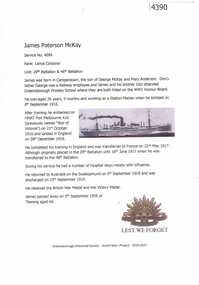 Greensborough Historical Society
Article, Greensborough Historical Society et al, James Paterson McKay, 1914-1918
... A short article about James Paterson McKay and his service in World War 1. ...A short article about James Paterson McKay and his service in World War 1. ...A short article about James Paterson McKay and his service in World War 1. James and his brother attended Greensborough State School.One page, text and colour images.world war 1 project, james paterson mckay -
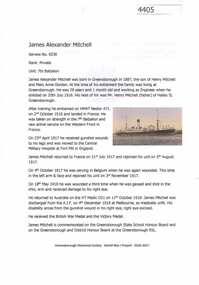 Greensborough Historical Society
Article, Greensborough Historical Society et al, James Alexander Mitchell, 1914-1918
... A short article about James Alexander Mitchell and his service in World War 1. ...A short article about James Alexander Mitchell and his service in World War 1. ...A short article about James Alexander Mitchell and his service in World War 1. At the time of his enlistment he was living at GreensboroughOne page, text and colour images.world war 1 project, james alexander mitchell -
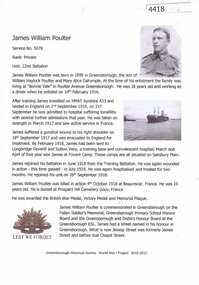 Greensborough Historical Society
Article, Greensborough Historical Society et al, James William Poulter, 1914-1918
... A short article about James William Poulter and his service in World War 1. ...A short article about James William Poulter and his service in World War 1. ...A short article about James William Poulter and his service in World War 1. At the time of his enlistment he was living at Greensborough.One page, text and colour images.world war 1 project, james william poulter -
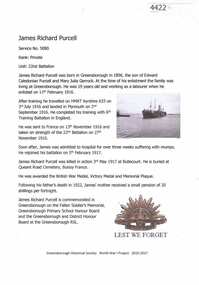 Greensborough Historical Society
Article, Greensborough Historical Society et al, James Richard Purcell, 1914-1918
... A short article about James Richard Purcell and his service in World War 1. ...A short article about James Richard Purcell and his service in World War 1. ...A short article about James Richard Purcell and his service in World War 1. At the time of his enlistment he was living at GreensboroughOne page, text and colour images.world war 1 project, james richard purcell -
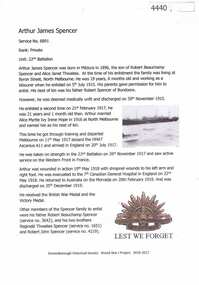 Greensborough Historical Society
Article, Greensborough Historical Society et al, Arthur James Spencer, 1914-1918
... A short article about Arthur James Spencer and his service in World War 1. ...A short article about Arthur James Spencer and his service in World War 1. ...A short article about Arthur James Spencer and his service in World War 1. At the time of his enlistment he was living at North Melbourne; the Spencer family later moved to Bundoora.One page, text and colour images.world war 1 project, arthur james spencer -
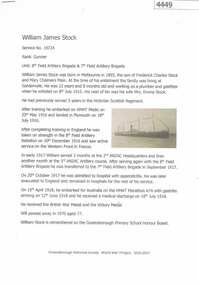 Greensborough Historical Society
Article, Greensborough Historical Society et al, William James Stock, 1914-1918
... A short article about William James Stock and his service in World War 1. ...A short article about William James Stock and his service in World War 1. ...A short article about William James Stock and his service in World War 1. William Stock is remembered on the Greensborough State School Honor Board.2 pages, text and colour images.world war 1 project, william james stock -
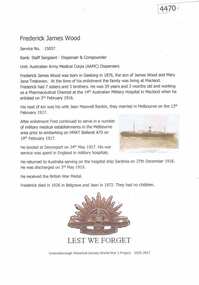 Greensborough Historical Society
Article, Greensborough Historical Society et al, Frederick James Wood, 1914-1918
... A short article about Frederick James Wood and his service in World War 1. ...A short article about Frederick James Wood and his service in World War 1. ...A short article about Frederick James Wood and his service in World War 1. Fred Wood lived in Macleod.1 page, text and colour images.world war 1 project, frederick james wood -
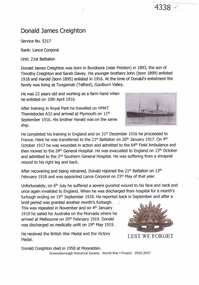 Greensborough Historical Society
Article, Greensborough Historical Society et al, Donald James Creighton, 1914-1918
... A short article about Donald James Creighton and his service in World War 1. ...A short article about Donald James Creighton and his service in World War 1. ...A short article about Donald James Creighton and his service in World War 1. Donald Creighton was born in Bundoora.1 Page, text and colour images.world war 1 project, donald james creighton
