
Showing 194 items matching "james styles"
-
 Mont De Lancey
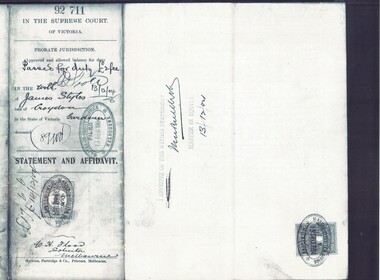
Legal record - Statement of Assets, 08.12.1904-14.12.1904
... James Styles...Statement of James Styles' assets on his death (1904) by Rebecca Styles (nee Parr)...Statement of James Styles' assets on his death (1904) by Rebecca Styles (nee Parr) James Styles Rebecca Styles (nee Parr) Styles Family Parr Family 1900s law Croydon 6 onesided A4 pages photocopied in black and white typed form filled with handwritten text Legal record Statement of Assets ...Statement of James Styles' assets on his death (1904) by Rebecca Styles (nee Parr)6 onesided A4 pages photocopied in black and white typed form filled with handwritten textjames styles, rebecca styles (nee parr), styles family, parr family, 1900s, law, croydon -
 Mont De Lancey
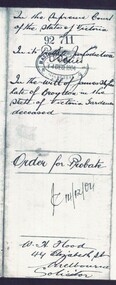
Legal record - Transfer of Assets, 04.12.1904
... ...James Styles...Death transfer of assets from James Styles to Rebecca Styles (nee Parr) after James' death in 1904...Death transfer of assets from James Styles to Rebecca Styles (nee Parr) after James' death in 1904 Croydon law James Styles Rebecca Styles (nee Parr) 1900s Styles Family Parr Family 2 onesided A4 pages photocopied in black and white typed form filled with handwritten pen Legal record Transfer of Assets ...Death transfer of assets from James Styles to Rebecca Styles (nee Parr) after James' death in 19042 onesided A4 pages photocopied in black and white typed form filled with handwritten pencroydon, law, james styles, rebecca styles (nee parr), 1900s, styles family, parr family -
 Glen Eira Historical Society
Document - Alnwick, Railway Parade,|11-11A,|Murrumbeena
... James... Architectural Styles...Railway Parade Patterson James Architectural Styles Patterson James Sir Alnwick Victorian Style Murrumbeena Document Alnwick, Railway Parade,|11-11A,|Murrumbeena ...A Caulfield conservation study on ‘Alnwick’, 11 Railway Parade, Murrumbeena, including a description of the exterior of the house and a brief history of the life of its owner, Sir James Brown Patterson. Also includes a statement of significance for Alnwick. Assessment by Andrew Ward dated to March, 1995.railway parade, patterson james, architectural styles, patterson james sir, alnwick, victorian style, murrumbeena -
 Westbourne Grammar Heritage Collection
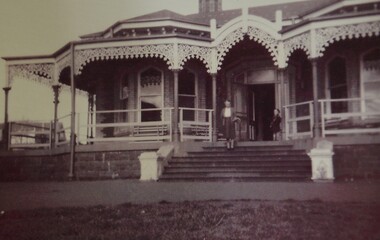
Photograph - Mabel Molland at Monomeith 1962
... Monomeith is a Victorian Heritage Register listed (VHR number H0452), italianate styled brick villa, built in 1887 for one of Williamstown’s most important identities, James Styles. Styles’ distinguished career in public life included membership of the Williamstown Council, a stint in state parliament as the Member for Williamstown (1894-1900) and, in 1901, election to the first commonwealth parliament as a senator. ...Monomeith is a Victorian Heritage Register listed (VHR number H0452), italianate styled brick villa, built in 1887 for one of Williamstown’s most important identities, James Styles. Styles’ distinguished career in public life included membership of the Williamstown Council, a stint in state parliament as the Member for Williamstown (1894-1900) and, in 1901, election to the first commonwealth parliament as a senator. ...This reproduction photograph was donated at a major reunion in 2008, organised by students of the school from the 1950s. It pictures Mabel Molland and a young student at Monomeith, home to the school since 1956. Monomeith is a Victorian Heritage Register listed (VHR number H0452), italianate styled brick villa, built in 1887 for one of Williamstown’s most important identities, James Styles. Styles’ distinguished career in public life included membership of the Williamstown Council, a stint in state parliament as the Member for Williamstown (1894-1900) and, in 1901, election to the first commonwealth parliament as a senator. During the 1890s he was also a commissioner of both the Melbourne Harbour Trust and the Melbourne and Metropolitan Board of Works and one of the trustees of the Williamstown Grammar School. The property comprises the residence designed by W Bennett Hall and built by James Styles in 1887 and the former migrant hostel buildings (now administration and classrooms), erected around 1951 by the then owner the Melbourne Harbour Trust, and intended to house migrant workers during the dredging of Port Phillip Bay. By the 1950s, the School had outgrown its home at Holy Trinity Hall and Mabel Molland reached out to Mr. Keith White, president of the Parent's Association and well-respected member of Williamstown Council for assistance. In 1956, following lengthy negotiations led by Mr. White, Monomeith was leased from the Melbourne Harbour Trust under a seven-year lease, which eventuated as a twenty-one year lease, followed by purchase of the property in 1972. Since then this historic building has come to be a much-loved symbol of the history of Westbourne Grammar School. This is a rare image of Mabel Molland at Monomeith, taken in the year prior to her retirement having taken over the school in 1914 and then set it on a path for the future as an incorporated company in the hands of a school council, with Mr Keith White as president, in 1956. Black and white reproduction photograph of a a residence (Monomeith) with steps in the middle ground, leading up to a verandah with ornate ironwork. Mabel Molland stands on the steps and a young student can be seen on the verandah. -
 Mission to Seafarers Victoria
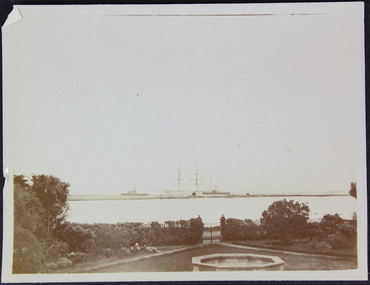
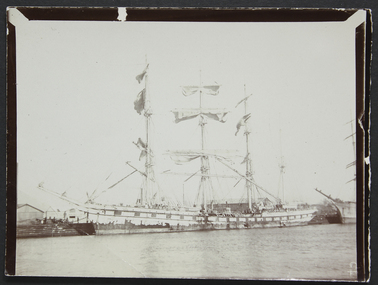
Photograph - Photograph, Sepia, Mr and Mrs Gurney Goldsmith, Disabled French Barque: Towing up the Yarra from Monomeith Gardens Newport, 1906
... Monomeith, located 67 the Strand, in Newport was built in 1887, and was the house of Senator James Styles. Reverend Gurney Goldsmith lived in Monomeith from 17 Octoberr 1905 to at least November 1907 (See Victorian Government Gazette: 14 November 1907) until he and his wife could move in the new central Seamen Institute open in December 1907. ...Monomeith, located 67 the Strand, in Newport was built in 1887, and was the house of Senator James Styles. Reverend Gurney Goldsmith lived in Monomeith from 17 Octoberr 1905 to at least November 1907 (See Victorian Government Gazette: 14 November 1907) until he and his wife could move in the new central Seamen Institute open in December 1907. ...Monomeith, located 67 the Strand, in Newport was built in 1887, and was the house of Senator James Styles. Reverend Gurney Goldsmith lived in Monomeith from 17 Octoberr 1905 to at least November 1907 (See Victorian Government Gazette: 14 November 1907) until he and his wife could move in the new central Seamen Institute open in December 1907. "Senator Styles' house, “Monomeith," Strand, has been leased to the Rev. A. Gurney Goldsmith, who has been sent to Victoria from England to establish a Church of England mission to seamen. Tho new tenant will enter into possession on October 17th and proposes to make it a rendezvous for seamen, and to get about the bay and river on an oil motor launch. It is his intention to establish a mission church and home near Victoria dock. Senator Styles and family will reside at Hawthorn." (Williamstown Advertiser, Saturday 2 September 1905, page 3) Monomeith has been housing the Westbourne Grammar School, Williamstown Campus, since it was leased from the Harbour Trust in 1956 then purchased by the school in 1972. Small monochrome photograph, view of ships from a parkHandwritten in pencil on verso: 83 (?) and a 3 in bottom right cornermonomeith, newport, french, barque, towing, yarra river -
 Mission to Seafarers Victoria
Photograph - Photograph, Sepia, Mr and Mrs Gurney Goldsmith, c. 1906-1907
... Monomeith, located 67 the Strand, in Newport was built in 1887, and was the house of Senator James Styles. Reverend Gurney Goldsmith lived in Monomeith from 17 Octoberr 1905 to at least November 1907 (See Victorian Government Gazette: 14 November 1907) until he and his wife could move in the new central Seamen Institute open in December 1907. ...Monomeith, located 67 the Strand, in Newport was built in 1887, and was the house of Senator James Styles. Reverend Gurney Goldsmith lived in Monomeith from 17 Octoberr 1905 to at least November 1907 (See Victorian Government Gazette: 14 November 1907) until he and his wife could move in the new central Seamen Institute open in December 1907. ...Possibly a photograph of a damaged vessel. The inscription at the back: Monomeith is a Victorian mansion, located on 67 the Strand in Williamstown. Monomeith, located 67 the Strand, in Newport was built in 1887, and was the house of Senator James Styles. Reverend Gurney Goldsmith lived in Monomeith from 17 Octoberr 1905 to at least November 1907 (See Victorian Government Gazette: 14 November 1907) until he and his wife could move in the new central Seamen Institute open in December 1907. "Senator Styles' house, “Monomeith," Strand, has been leased to the Rev. A. Gurney Goldsmith, who has been sent to Victoria from England to establish a Church of England mission to seamen. Tho new tenant will enter into possession on October 17th and proposes to make it a rendezvous for seamen, and to get about the bay and river on an oil motor launch. It is his intention to establish a mission church and home near Victoria dock. Senator Styles and family will reside at Hawthorn." (Williamstown Advertiser, Saturday 2 September 1905, page 3) Monomeith has been housing the Westbourne Grammar School, Williamstown Campus, since it was leased from the Harbour Trust in 1956 then purchased by the school in 1972. Small monochrome photograph with a black border depicting a sailing ship berthed in docks.Disabled French Barque: Towing up the Yarra from Monomeith Gardens Newportship, melbourne., sailing ship, 1900's, french, barque, williamstown -
 Flagstaff Hill Maritime Museum and Village
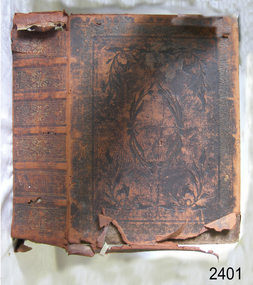
Book - Reference/Bible, Rev. John Eadie, The Holy Bible (with the Commentaries of Scott and Henry 1862), 1862
... James Version. However, from a historical standpoint, it is incredibly significant. This is because It stands as a prime example of the Victorian push for self-improvement and literacy. A book like this was often the single most expensive, valued possession in a 19th-century home serving as a spiritual guide, an encyclopaedia, and the official family archive all in one. It also reflects the incredible advancements in mid-Victorian printing technology, specifically using stereotype plates which allowed McPhun to infinitely reprint the massive text cheaply and showcasing the early commercial rise of decorative plates and binding styles ...This specific 1862 Bible is a fascinating artifact from the height of 19th-century British industrial printing, combining massive theological authority with an effort to make large-scale Family Bibles accessible to the general public.The Holy Bible with the Commentaries of Scott and Henry 1862 Edited by Rev John Eadie Publisher: W R McPhun Date: 1862non-fictionThis specific 1862 Bible is a fascinating artifact from the height of 19th-century British industrial printing, combining massive theological authority with an effort to make large-scale Family Bibles accessible to the general public.flagstaff hill, warrnambool, shipwrecked-coast, flagstaff-hill, flagstaff-hill-maritime-museum, maritime-museum, shipwreck-coast, flagstaff-hill-maritime-village, book, bible, the holy bible, scott and henry -
 Flagstaff Hill Maritime Museum and Village
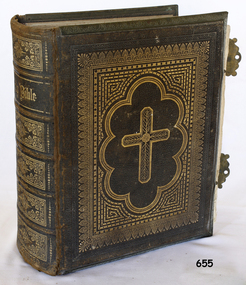
Book - Reference/ Religious Study, James Semple, The Holy Bible, Old & New Testaments, c. 1875
... Bibles of this style were peak Victorian subscription publishing, and publishers like Semple typically issued these in unbound parts or sold them via travelling canvassers, bound in heavy, blind stamped or gilt leather meant to serve as a visual centerpiece in a Victorian home. No Library label on the spine no identifying stickers on front or loose end paper Hard cover book: Bible, Old & New Testaments Editor: Rev. George Leo Haydock Publisher: James ...This edition is part of what Bible bibliographers classify as the Haydock Quarto Series. It uses the Douay Rheims version (the standard English translation of the Latin Vulgate for Roman Catholics) and is heavily updated with extensive annotations. The subject volume is a large, decorative family Bible. Bibles of this style were peak Victorian subscription publishing, and publishers like Semple typically issued these in unbound parts or sold them via travelling canvassers, bound in heavy, blind stamped or gilt leather meant to serve as a visual centerpiece in a Victorian home.Hard cover book: Bible, Old & New Testaments Editor: Rev. George Leo Haydock Publisher: James Semple, 7 Stirling Road, Glasgow Date: 1875 Further Information: Brown leather bound with extensive gilt pattering to Spine and Front Board, Cross icon to front board and brass book clasps to corners.non-fictionThis edition is part of what Bible bibliographers classify as the Haydock Quarto Series. It uses the Douay Rheims version (the standard English translation of the Latin Vulgate for Roman Catholics) and is heavily updated with extensive annotations. The subject volume is a large, decorative family Bible. Bibles of this style were peak Victorian subscription publishing, and publishers like Semple typically issued these in unbound parts or sold them via travelling canvassers, bound in heavy, blind stamped or gilt leather meant to serve as a visual centerpiece in a Victorian home.flagstaff hill, warrnambool, shipwrecked-coast, flagstaff-hill, flagstaff-hill-maritime-museum, maritime-museum, shipwreck-coast, flagstaff-hill-maritime-village, the holy bible the old testament and the new testament, bible, book, religion, holy bible, rev geo leo haydock, latin vulgate, family bible -
 Flagstaff Hill Maritime Museum and Village
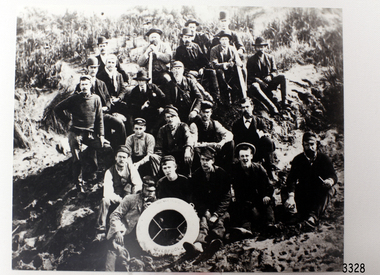
Photograph - Ship Crew, 1889-1892
... James McKenzie and Gerard Irvine. Seventeen men survived the shipwreck but the captain and eight of his crew perished. The Newfield remained upright on the reef with sails set for a considerable time as the wind slowly ripped the canvas to shreds and the sea battered the hull to pieces. The Marine Board inquiry found the wreck was caused by a "one man style...James McKenzie and Gerard Irvine. Seventeen men survived the shipwreck but the captain and eight of his crew perished. The Newfield remained upright on the reef with sails set for a considerable time as the wind slowly ripped the canvas to shreds and the sea battered the hull to pieces. The Marine Board inquiry found the wreck was caused by a "one man style ...This black and white photograph shows the crew of the barque Newfield. They are pictured seated on a grassy slope and rock, a lifebuoy from the Newfield, Liverpool, resting on the men in the front row. The men are formally dressed, some with bowler hats, a bow tie and pipe, rather than in their sailing uniforms. ABOUT THE NEWFIELD The Newfield left Sharpness, Scotland, on 28th May 1892 with a crew of 25 under the command of Captain George Scott and on 1st June left Liverpool. She was bound for Brisbane, Australia, with a cargo of 1850 tons of fine rock salt, the main export product of Sharpness. At about 9pm on 28th August 1892, in heavy weather, Captain Scott sighted, between heavy squalls, the Cape Otway light on the mainland of Victoria but, due to a navigational error (the ship’s chronometers were wrong), he assumed it to be the Cape Wickham light on King Island, some 40 miles south. He altered his course to the north, expecting to enter Bass Strait. The ship was now heading straight for the south west Victorian coast. At about 1:30am the Newfield ran aground on a reef about 100 yards from shore and one mile east of Curdie’s Inlet, Peterborough. The ship struck heavily three times before grounding on an inner shoal with 6 feet of water in the holds. Rough sea made the job of launching lifeboats very difficult. The first two lifeboats launched by the crew were smashed against the side of the ship and some men were crushed or swept away. The third lifeboat brought eight men to shore. It capsized when the crew tried to return it to the ship for further rescue The rescue was a difficult operation. The Port Campbell Rocket Crew arrived and fired four rocket lines, none of which connected with the ship. Peter Carmody, a local man, volunteered to swim about one mile off shore to the ship with a line to guide the fourth and final lifeboat safely to shore. He was assisted by James McKenzie and Gerard Irvine. Seventeen men survived the shipwreck but the captain and eight of his crew perished. The Newfield remained upright on the reef with sails set for a considerable time as the wind slowly ripped the canvas to shreds and the sea battered the hull to pieces. The Marine Board inquiry found the wreck was caused by a "one man style of navigation" and that the Captain had not heeded the advice of his crew. According to Jack Loney ‘… when the drama was over . . the Newfield was deserted except for the Captain’s dog and two pigs.’ Peter Carmody was awarded the Bramley Moore medal by the Liverpool Shipwreck and Humane Society for Saving Life at Ssea, which he received by mail on January 21st 1893. Flagstaff Hill’s collection of artefacts from the Newfield is significant for its association with the shipwreck Newfield, which is listed on the Victorian Heritage Registry. The collection is significant because of the relationship between the objects. The Newfield collection is archaeologically significant as the remains of an international cargo ship. The Newfield collection is historically significant for representing aspects of Victoria’s shipping history and its association with the shipwreck. The Letter accompanying the Medal for Bravery awarded to Peter Carmody is significant because the attempt to save lives is associated with the shipwreck Newfield. Black and white photograph of the crew of the sailing ship “Newfield”. The men in formal dress are seated on rocky slope with the ship’s lifebuoy showing the name “NEWFIELD, LIVERPOOL”. Photograph taken 1889-1892 flagstaff hill, warrnambool, shipwrecked-coast, flagstaff-hill, flagstaff-hill-maritime-museum, maritime-museum, shipwreck-coast, flagstaff-hill-maritime-village, newfield, photograph, crew of the newfield, 19th century sailing ship, peterborough, cape otway, medal for bravery -
 Federation University Historical Collection
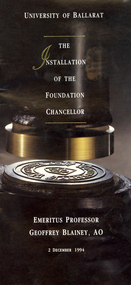
Photograph - Documents, Installation of Emeritus Professor Geoffrey Blainey as the Foundation Chancellor of the University of Ballarat, 1994
... style of an English Queen's Counsel gown, with appropriate traditional adornment (chevrons) on the sleeves and edges. The decorative braiding is in gold oak-leaf braid. The velvet trencher with gold tassel is the traditional headwear for a Chancellor. university of ballarat chancellor geoffrey blainey blainey governor of victoria richard mcgarvie bill pryor nina valentine david james vern robson lee francis david fitzgerald redmond barry ballarat school of mines Black and white 16 page booklet with a primarily black cover. ...The Chancellor is the head of the university and presides over meetings of Council. The Chancellor is also an ex officio member of all other bodies of the University. As well as being the traditional colour of embellishment on a Chancellor's gown, gold also provides a tangible link between the new university and its Ballarat ancestry. Academic gowns distinguish between the university's senior office holders, The design of the Chancellor's gown at the University of Ballarat is based on an Oxford and Cambridge tradition for university Chancellors' robes. It is made after the style of an English Queen's Counsel gown, with appropriate traditional adornment (chevrons) on the sleeves and edges. The decorative braiding is in gold oak-leaf braid. The velvet trencher with gold tassel is the traditional headwear for a Chancellor. Black and white 16 page booklet with a primarily black cover. The booklet is the programme for the installation of Emeritus Professor Geoffrey Blainey as the foundation Chancellor of the University of Ballarat. The contents include an order of proceedings, history, Geoffrey Blainey, the role of Chancellor, the chancellor's regalia, University of Ballarat logo.university of ballarat, chancellor, geoffrey blainey, blainey, governor of victoria, richard mcgarvie, bill pryor, nina valentine, david james, vern robson, lee francis, david fitzgerald, redmond barry, ballarat school of mines -
 Federation University Historical Collection
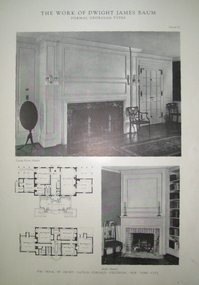
Book, The Work of Dwight James Baum, 1927 (exact)
... James Baum is an American architect. He was born in 1886 in Newville, New York. As a young man, Baum moved to Syracuse. In 1909, he graduated from Syracuse University with an architecture degree. He worked for Boring and Tilton and Sanford White which are well known Architecture firms in America. Around 1912, he started his own residential design firm. During the 1920s, Baum designed a significant buildings and several houses in Sarasota, Tampa, Terrace, Temple and Florida all in the Mediterranean Revival Style...James Baum is an American architect. He was born in 1886 in Newville, New York. As a young man, Baum moved to Syracuse. In 1909, he graduated from Syracuse University with an architecture degree. He worked for Boring and Tilton and Sanford White which are well known Architecture firms in America. Around 1912, he started his own residential design firm. During the 1920s, Baum designed a significant buildings and several houses in Sarasota, Tampa, Terrace, Temple and Florida all in the Mediterranean Revival Style ...Dwight James Baum is an American architect. He was born in 1886 in Newville, New York. As a young man, Baum moved to Syracuse. In 1909, he graduated from Syracuse University with an architecture degree. He worked for Boring and Tilton and Sanford White which are well known Architecture firms in America. Around 1912, he started his own residential design firm. During the 1920s, Baum designed a significant buildings and several houses in Sarasota, Tampa, Terrace, Temple and Florida all in the Mediterranean Revival Style such as the Ringlings dubbed Cà d'Zan, which is now known as the John and Mable Ringling Museum of Art. In 1923-1924, he also designed Sunset Hill for Mrs. Eugene D. Stocker at Warren, New York which was listed on the National Register of Historic Places in 2007. During the Depression Baum became involved with Good Housekeeping Magazine as consulting architect, and as designer of their building exhibit at the 1933 Chicago World's Fair. His later work includes Hendricks Memorial Chapel at Syracuse University, with John Russell Pope in 1929–1930 and the pedestal for V. Renzo Baldi's statue of Columbus in the city's Columbus Circle. Dwight James Baum died in 1939. Book with large blue hard cover. Title is written on the front cover and the spine in gold. Manufacturer's logo is written on front cover in gold. The book includes index, preface and an introduction. black and white illustrations, plates and floor planes of the architect's work such as Ca d Zan, the fantastical Venetian Gothic waterfront palace of John and Mable Ringling in Sarasota, Florida and the stately Italianate house of Anthony Campagna in Riverdale, New York and more.architecture, architectural designs, art moderne, domestic designs, ca d zan -
 Flagstaff Hill Maritime Museum and Village
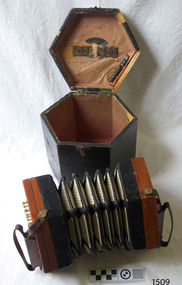
Instrument - Concertina, Lachenal and Co, 1879-1933
... James Street in London. In 1863 the firm began advertising both 'Anglo and English concertinas, which were more expensive. Lachenal passed away in 1861, so his wife Elizabeth took over the business. The firm was sold to a group of five businessmen in about 1873 and in 1874 the firm became ‘Lachenal & Co.’ A Trade Mark application was made by Richard Ballinger on behalf of Lachenal & Co. on 31st August 1878 and the Number 19,555 was published in the Trade Mark Journal January 8, 1879. The symbol was an English-style...James Street in London. In 1863 the firm began advertising both 'Anglo and English concertinas, which were more expensive. Lachenal passed away in 1861, so his wife Elizabeth took over the business. The firm was sold to a group of five businessmen in about 1873 and in 1874 the firm became ‘Lachenal & Co.’ A Trade Mark application was made by Richard Ballinger on behalf of Lachenal & Co. on 31st August 1878 and the Number 19,555 was published in the Trade Mark Journal January 8, 1879. The symbol was an English-style ...Louis Lachenal manufactured concertinas for C Wheatstone & Co. from around 1848-1858 in a combined home and manufactory in Cheswick, England. He then establish up his own business 'Lachenal's' at 8 Little James Street in London. In 1863 the firm began advertising both 'Anglo and English concertinas, which were more expensive. Lachenal passed away in 1861, so his wife Elizabeth took over the business. The firm was sold to a group of five businessmen in about 1873 and in 1874 the firm became ‘Lachenal & Co.’ A Trade Mark application was made by Richard Ballinger on behalf of Lachenal & Co. on 31st August 1878 and the Number 19,555 was published in the Trade Mark Journal January 8, 1879. The symbol was an English-style reed-shoe with the words 'Trade Mark' and 'English Make'. It was stamped on the right-hand rail (handle) of the Lachenal Anglos, to distinguish them from the German-made ones. It seems that the company ceased business in 1933.This concertina, made in the late 19th to early 20th century, represents the portable musical entertainment of the early settlers in the colony of Australia. Concertina, six sided, 21 buttons, with fitted case. Wooden ends have carved cut-outs and leather straps attached to brass buttons. Five-fold bellows have light coloured sides with reinforced edges and corners. Constructed with steel reeds and bone key-buttons. Wooden, black fabric-covered hexagonal case with triangular metal catch, two brass hinges, leather handle and faded red lining. Inscriptions on label inside lid and on wooden ends of bellows. Lachenal, Anglo design, made by Lachenal & Co. of London. Label within oval cut-out "LACHENAL & Co / PATENT CONCERTINA / MANUFACTURERS / LONDON", Label inside lid " - CHENAL -", Impressed into wood STEEL REEDS", "ENGLAND", "TRADE MARK ENGLISH MAKE [reed-shoe symbol]" , (originally marked with Number "98030" )flagstaff hill, warrnambool, shipwrecked-coast, flagstaff-hill, flagstaff-hill-maritime-museum, maritime-museum, shipwreck-coast, flagstaff-hill-maritime-village, concertina, squeeze box, musical instrument, london, english make, trade mark 15222, english-style reed, richard ballinger, louis lachenal, concertina manufacturer, reed-shoe, lachenal anglo, lachenal & co, lachenal -
 Flagstaff Hill Maritime Museum and Village
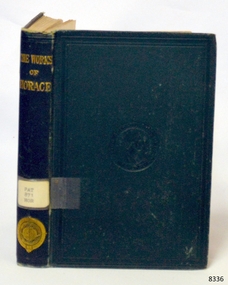
Book - Lyrical Poems, Samuel Lee (Translator), The Works of Horace, 1890
... His style is characterized by urbanity, structural perfection, philosophical irony, and a deep appreciation for moderation and the quiet life. He popularized the phrase "Seize the day." He died in 8 BCE, just months after his patron Maecenas, and was buried near his tomb. James...His style is characterized by urbanity, structural perfection, philosophical irony, and a deep appreciation for moderation and the quiet life. He popularized the phrase "Seize the day." He died in 8 BCE, just months after his patron Maecenas, and was buried near his tomb. James ...The original author of this work was Quintus Horatius Flaccus, one of the leading Roman lyric poets during the time of Augustus Caesar (1st century BCE). This volume features the complete surviving works of Horace, rendered entirely into English prose. It includes his famous Odes, or lyrical poems, as well as his earlier poems on politics and social issues of the time. It also features his Satires, which offer humorous commentaries on Roman life, and his Epistles, or letters in verse, which include his highly influential work on literary criticism, the Ars Poetica (or The Art of Poetry).The Works of Horace Author: James Lonsdale and Samuel Lee Publisher: Macmillan And Co Date: 1890 Further Information: non-fictionThe original author of this work was Quintus Horatius Flaccus, one of the leading Roman lyric poets during the time of Augustus Caesar (1st century BCE). This volume features the complete surviving works of Horace, rendered entirely into English prose. It includes his famous Odes, or lyrical poems, as well as his earlier poems on politics and social issues of the time. It also features his Satires, which offer humorous commentaries on Roman life, and his Epistles, or letters in verse, which include his highly influential work on literary criticism, the Ars Poetica (or The Art of Poetry).flagstaff hill, warrnambool, shipwrecked coast, flagstaff hill maritime museum, maritime museum, shipwreck coast, flagstaff hill maritime village, great ocean road, book, pattison collection, warrnambool library, warrnambool mechanics’ institute, ralph eric pattison, corangamite regional library service, warrnambool city librarian, mechanics’ institute library, victorian library board, warrnambool books and records, warrnambool children’s library, the works of horace, samuel lee, james lonsdale, latin translated text -
 Flagstaff Hill Maritime Museum and Village
Document - Permit, Miner's Right - Collins, 1888
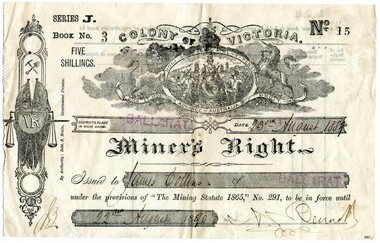
... The issue to “James Collins”, is dated “23rd August 1889” to “22nd August 1890”. The signature of the authority could be Bennet. All handwriting is script style...The issue to “James Collins”, is dated “23rd August 1889” to “22nd August 1890”. The signature of the authority could be Bennet. All handwriting is script style ...This Miner’s Right, one of a pair of two in our collection, was issued post the rush of the 1850s-60s but is testament to the ongoing interest in gold although the great rush had dwindled. Local papers continued to report on findings and hopes of success, including syndicates and explorations across the south-west district of Victoria and Otways. The Warrnambool correspondent of the “Hamilton Spectator”, 31/1/1878, p4 attest to the price of a good season of potatoes comparing “favourably with the unsteady returns of any precarious gold-bearing quartz reefs in the colony.” A James Collins (1842-1918) is listed in the Pioneers’ Register, Warrnambool, Township and Shire 1839-1900, Volume One, A.I.G.S Warrnambool Branch, 2004, p137. As are numerous other Collins pioneer families of the district. This item is significant in that it illustrates that people associated with the region were interested in taking their chances in prospecting for gold similar to many others. A lure that is still present for some today. Although the southwest region found it's source of wealth in other industries from whaling and fishing, wool and other agricultural pursuits. Miner's Rights permit, one of two, This is a top to bottom upright image of a Miner’s Right. It is a buff coloured document printed in black ink. It was issued in “BALLARAT” and rubber stamped twice in red ink. The issue to “James Collins”, is dated “23rd August 1889” to “22nd August 1890”. The signature of the authority could be Bennet. All handwriting is script style in black ink. Looking from the front the lefthand side has a serrated edge. The back is printed in black ink and there are no “particulars of registration”. The Miner’s Right is from “Series J, Book No. 3, ticket “No. 15”. A “Colony of Victoria” coat of arms is displayed at the top of the document. An insignia runs along the lefthand side of the license featuring coat of arms with a kangaroo and emu, then a miner’s pick and shovel, two crossed Union Jack flags sit behind a monogram “VR” with a hanging set of scales supported by a sword. "By Authority Robt. S. Brain, Government Printer.""Series J. Book No. 3 Five Shillings. No. 15. Colony of Victoria. Miner's Right"flagstaff hill, warrnambool, shipwrecked coast, flagstaff hill maritime museum, maritime museum, shipwreck coast, flagstaff hill maritime village, great ocean road, james collins, australian goldfields, miner's rights, the history of ballarat, gold rush -
 Flagstaff Hill Maritime Museum and Village
Book - Periodical Essays, Dr. Samuel Johnson et al, The Rambler, The Idler, The Adventurer & The Connoisseur, 1876
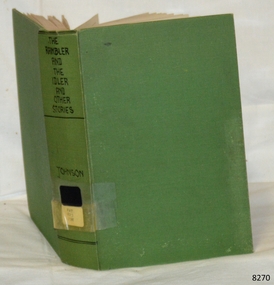
... style is famously dense, deeply moral, and serious. The next is the author of The Adventurer, John Hawkesworth (1715–1773), a close friend and literary disciple of Samuel Johnson. He launched The Adventurer to mimic the success of The Rambler and was a prominent editor who was later commissioned by the Admiralty to edit the official papers of Captain James Cook’s first voyage. ...style is famously dense, deeply moral, and serious. The next is the author of The Adventurer, John Hawkesworth (1715–1773), a close friend and literary disciple of Samuel Johnson. He launched The Adventurer to mimic the success of The Rambler and was a prominent editor who was later commissioned by the Admiralty to edit the official papers of Captain James Cook’s first voyage. ...This single 1876 volume combines four of the most influential weekly and semi weekly periodical essay series of the mid-18th century. Despite the phrasing of the era, these are not fiction stories or novels. They are periodical essays brief, single-topic pieces written to critique, educate, and entertain 18th-century readers. The collection covers three themes: morality and human nature, with a focus on reflections relating to the disappointments of life, the inevitability of death, managing one's passions, and the search for true happiness, featuring mainly in The Rambler; social satire and manners, with lighthearted and witty take downs of London high society, modern trends, vanity, and standard eccentric characters of the town; and literary criticism, with essays that analyse contemporary poetry and the theatre, along with the evolving English language.Hard cover book,The Rambler & The Idler Author: Dr. Samuel Johnson, Mr. Town, John Hawkesworth Publisher: William P Nimmo, 14 King William St, The Strand, London. W1. Date: 1876 Further Information: The flyleaf reads The Rambler and the Idler. By Samuel Johnson. The Adventurer. By John Hawkesworth. The Connoisseur. By (Mr. Town Pen Name) Green Cloth hardcover with a green spine and lettering in black texter. The spine has a Library label with an inscription.non-fictionThis single 1876 volume combines four of the most influential weekly and semi weekly periodical essay series of the mid-18th century. Despite the phrasing of the era, these are not fiction stories or novels. They are periodical essays brief, single-topic pieces written to critique, educate, and entertain 18th-century readers. The collection covers three themes: morality and human nature, with a focus on reflections relating to the disappointments of life, the inevitability of death, managing one's passions, and the search for true happiness, featuring mainly in The Rambler; social satire and manners, with lighthearted and witty take downs of London high society, modern trends, vanity, and standard eccentric characters of the town; and literary criticism, with essays that analyse contemporary poetry and the theatre, along with the evolving English language.flagstaff hill, warrnambool, shipwrecked coast, flagstaff hill maritime museum, maritime museum, shipwreck coast, flagstaff hill maritime village, great ocean road, book, pattison collection, warrnambool library, warrnambool mechanics’ institute, ralph eric pattison, corangamite regional library service, warrnambool city librarian, mechanics’ institute library, victorian library board, warrnambool books and records, warrnambool children’s library, the rambler and the idler, john hawkesworth., mr. town, samuel johnson -
 Flagstaff Hill Maritime Museum and Village
Book - Fictional Novel, Henry James Jr, Tales of Three Cities, 1884
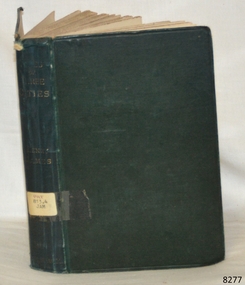
... In ‘The Impressions of a Cousin’, James uses a diary format to experiment with unreliable narration and deeply buried psychological motives. This experimentation laid the direct groundwork for the intricate, interior psychological style that would later define high literary modernism. ...In ‘The Impressions of a Cousin’, James uses a diary format to experiment with unreliable narration and deeply buried psychological motives. This experimentation laid the direct groundwork for the intricate, interior psychological style that would later define high literary modernism. ...The novel Tales of Three Cities (1884) is not a single narrative, but rather a collection of three distinct novellas inspired by Henry James’s travels and his deep fascination with regional and transatlantic cultural clashes. The first novella, ‘Lady Barberina’, is a classic exploration of James’s famous ‘international theme’. It focuses on the marriage between a wealthy American doctor and an aristocratic Englishwoman, exposing the rigid social expectations of British high society. The second, ‘A New England Winter’, is a witty, satirical look at the distinct social nuances, manners, and artistic attitudes dividing New York and Boston. The third, ‘The Impressions of a Cousin’, is a story structured around a young woman’s personal journal, detailing a complex web of family relationships, trust, and art.Hard cover book, Tales of Three Cities Author: Henry James Publisher: Macmillan And Co Date: 1884 Blue cloth hardcover and spine with spine lettering in black texter. The spine has a Library label with inscription.fictionThe novel Tales of Three Cities (1884) is not a single narrative, but rather a collection of three distinct novellas inspired by Henry James’s travels and his deep fascination with regional and transatlantic cultural clashes. The first novella, ‘Lady Barberina’, is a classic exploration of James’s famous ‘international theme’. It focuses on the marriage between a wealthy American doctor and an aristocratic Englishwoman, exposing the rigid social expectations of British high society. The second, ‘A New England Winter’, is a witty, satirical look at the distinct social nuances, manners, and artistic attitudes dividing New York and Boston. The third, ‘The Impressions of a Cousin’, is a story structured around a young woman’s personal journal, detailing a complex web of family relationships, trust, and art.flagstaff hill, warrnambool, shipwrecked coast, flagstaff hill maritime museum, maritime museum, shipwreck coast, flagstaff hill maritime village, great ocean road, book, pattison collection, warrnambool library, warrnambool mechanics’ institute, ralph eric pattison, corangamite regional library service, warrnambool city librarian, mechanics’ institute library, victorian library board, warrnambool books and records, warrnambool children’s library, tales of three cities, henry james -
 Flagstaff Hill Maritime Museum and Village
Book - Literary Work, John Milton, Selections from the Prose Works of John Milton, 1870
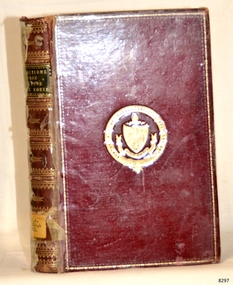
... style. Milton was also a fierce advocate for individual liberties, such as free speech, and republicanism. The editor, the Reverend James John George Graham (M.A. ...style. Milton was also a fierce advocate for individual liberties, such as free speech, and republicanism. The editor, the Reverend James John George Graham (M.A. ...Selections from the Prose Works of John Milton (1870) is a curated compilation of the non-poetic writings of John Milton. While Milton is globally famous for epic poems like Paradise Lost, he spent a significant portion of his adult life writing fiery political and religious tracts. This specific volume, compiled and annotated by the Rev. James J.G. Graham, extracts the most powerful segments of Milton’s prose. The book organizes his writings to give readers a cohesive look at Milton's philosophy, including his arguments for the freedom of the press known as Areopagitica. This was a famous 1644 prose pamphlet by Milton, written to protest Parliament's Licensing Order of 1643, which mandated government pre-approval for all published books. It remains one of the most historically significant defences of freedom of speech and the press. This work also encompasses his thoughts on the right to overthrow tyrannical rulers, his views on church reform, and various autobiographical passages.Selections from the Prose Works of John Milton Author: John Milton Edited by the Rev.James J G Graham Publisher: Hurst and Blackett Date: 1870 Further Information: Red embossed hardcover with a red spine and lettering in gold. The spine has a Library label with an inscription.fictionSelections from the Prose Works of John Milton (1870) is a curated compilation of the non-poetic writings of John Milton. While Milton is globally famous for epic poems like Paradise Lost, he spent a significant portion of his adult life writing fiery political and religious tracts. This specific volume, compiled and annotated by the Rev. James J.G. Graham, extracts the most powerful segments of Milton’s prose. The book organizes his writings to give readers a cohesive look at Milton's philosophy, including his arguments for the freedom of the press known as Areopagitica. This was a famous 1644 prose pamphlet by Milton, written to protest Parliament's Licensing Order of 1643, which mandated government pre-approval for all published books. It remains one of the most historically significant defences of freedom of speech and the press. This work also encompasses his thoughts on the right to overthrow tyrannical rulers, his views on church reform, and various autobiographical passages.flagstaff hill, warrnambool, shipwrecked coast, flagstaff hill maritime museum, maritime museum, shipwreck coast, flagstaff hill maritime village, great ocean road, selections from the prose works of john milton, colac municipal library, rev.james j ggraham -
 Flagstaff Hill Maritime Museum and Village
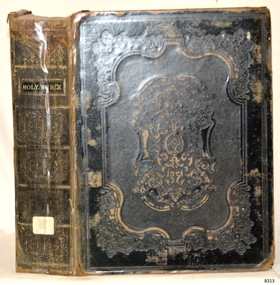
Book - Reference /Bible (King James Version), Dr Benjamin Blayney (Editor), The Holy Bible containing the Old and New Testaments 1871, 1871
... James Version. However, from a historical standpoint, it stands as a prime example of the Victorian push for self-improvement and literacy. A book like this was often the single most expensive, valued possession in a 19th-century home, serving as a spiritual guide, an encyclopaedia, and the official family archive all in one. It also reflects the incredible advancements in mid-Victorian printing technology, specifically using stereotype plates, which allowed printers to infinitely reprint massive texts cheaply, while showcasing the early commercial rise of decorative plates and binding styles meant to look luxurious yet remain affordable. ...This specific 1871 Bible is a fascinating artifact from the height of 19th-century British industrial printing, combining massive theological authority with an effort to make large-scale family Bibles accessible to the general public. This specific edition represents a collaboration between two powerhouse institutions of 19th-century publishing. As one of the privileged "Royal Patent" holders in England, Oxford University Press (OUP) had the legal monopoly—alongside Cambridge University Press and the King's/Queen's Printer—to print the authorised King James Version of the Bible. Founded in 1804, the British and Foreign Bible Society (BFBS) was a massive charitable organisation dedicated to making Bibles affordable and accessible worldwide. Because they were a society and not a printer, they commissioned official presses like OUP to mass-produce Bibles according to strict guidelines.Hard cover book,The Holy Bible. Editor. Dr. Benjamin Blayney of Hertford College, Oxford. Publisher: Oxford University Press, Oxford. Date: 1871 Further Information: Black heaverly embossed pattered hardcover with a brown spine and lettering in gilt. The spine has a Library label with an inscription.non-fictionThis specific 1871 Bible is a fascinating artifact from the height of 19th-century British industrial printing, combining massive theological authority with an effort to make large-scale family Bibles accessible to the general public. This specific edition represents a collaboration between two powerhouse institutions of 19th-century publishing. As one of the privileged "Royal Patent" holders in England, Oxford University Press (OUP) had the legal monopoly—alongside Cambridge University Press and the King's/Queen's Printer—to print the authorised King James Version of the Bible. Founded in 1804, the British and Foreign Bible Society (BFBS) was a massive charitable organisation dedicated to making Bibles affordable and accessible worldwide. Because they were a society and not a printer, they commissioned official presses like OUP to mass-produce Bibles according to strict guidelines.flagstaff hill, warrnambool, shipwrecked coast, flagstaff hill maritime museum, maritime museum, shipwreck coast, flagstaff hill maritime village, great ocean road, book, pattison collection, warrnambool library, warrnambool mechanics’ institute, ralph eric pattison, corangamite regional library service, warrnambool city librarian, mechanics’ institute library, victorian library board, warrnambool books and records, warrnambool children’s library, the holy bible containing the old and new testaments 1871, dr benjamin blayney -
 Flagstaff Hill Maritime Museum and Village
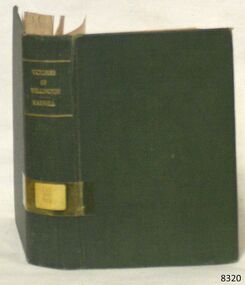
Book - Biographical/ Military History, W. H. Maxwell, The Victories of Wellington, 1871
... style is lively, conversational, and highly romanticised. The publisher Bell & Daldy was a highly regarded London publishing firm active during the mid-19th century, formed by George Bell and James Daldy. ...style is lively, conversational, and highly romanticised. The publisher Bell & Daldy was a highly regarded London publishing firm active during the mid-19th century, formed by George Bell and James Daldy. ...This book is a detailed military history and biographical tribute celebrating Arthur Wellesley, the Duke of Wellington, and the triumphs of the British military during the early 19th century. It focuses heavily on the Peninsular War fought against Napoleon's forces in Spain and Portugal and concludes with the famous Battle of Waterloo in 1815. Written with a flair for action, it blends tactical overviews of famous battles with dramatic anecdotes of soldierly bravery, making it highly accessible to the general Victorian public, who voraciously consumed patriotic military histories.The Victories of Wellington Author: W. H. Maxwell Publisher: Bell & Daldy Date: 1871 Further Information: non-fictionThis book is a detailed military history and biographical tribute celebrating Arthur Wellesley, the Duke of Wellington, and the triumphs of the British military during the early 19th century. It focuses heavily on the Peninsular War fought against Napoleon's forces in Spain and Portugal and concludes with the famous Battle of Waterloo in 1815. Written with a flair for action, it blends tactical overviews of famous battles with dramatic anecdotes of soldierly bravery, making it highly accessible to the general Victorian public, who voraciously consumed patriotic military histories.flagstaff hill, warrnambool, shipwrecked coast, flagstaff hill maritime museum, maritime museum, shipwreck coast, flagstaff hill maritime village, great ocean road, book, pattison collection, warrnambool library, warrnambool mechanics’ institute, ralph eric pattison, corangamite regional library service, warrnambool city librarian, mechanics’ institute library, victorian library board, warrnambool books and records, warrnambool children’s library, the victories of wellington, w h maxwell, the duke of wellington, waterloo, 1812 -
 Flagstaff Hill Maritime Museum and Village
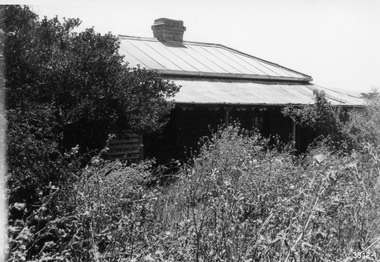
Photograph - Set of Photographs, John Chance, late 1960s to early 1970s
... James Murray bought Kerman’s land in 1856-57, combined it with nearby land, and named it Glenample Homestead. The ruins of huts Murray built on the property were still there until recently. Glenample was sold in 1866 to the partnership of Gibson and McArthur, who built a Georgian style...James Murray bought Kerman’s land in 1856-57, combined it with nearby land, and named it Glenample Homestead. The ruins of huts Murray built on the property were still there until recently. Glenample was sold in 1866 to the partnership of Gibson and McArthur, who built a Georgian style ...This set of glossy black and white photographs is a set of images of Glenample Homestead circa late 1960s to early 1970s. They were taken by John Chance and are part of the John Chance Collection. The Colonial Georgian style Glenample Homestead was built from 1866 to 1869 from locally quarried sandstone. In is built on the top of a hill amongst trees. There are paddocks below and around the building. The building is basically a rectangular shape with a recessed room on the right side of the front. The pitched roof is covered in corrugated iron. The veranda, added in 1886, also has a corrugated iron room and is supported by square posts with decorative tops. It shelters three sides of the building. The edge of the veranda is decorated with scalloped shapes along the front and left side of the building. On the right is a brick wall incorporating a chimney. Another chimney on the left is contained within the building. The four-panelled outside doors are visible in some of the photos, as are the 12-paned glass windows, which are framed in contrasting stone. The veranda is trimmed with scalloped metal work on two sides and had some enclosed corners. There appears to be a cubical water tank on the roof line. Out-buildings include a toilet built against the house's brick wall. Another building appears to have two rooms with outside doors, perhaps for workers. There is the remains of a two-wheeled cart under a shelter. GLENAMPLE & the LOCH ARD Glenample Homestead became famous after the disastrous wreck of the sailing ship Loch Ard on June 1, 1878. The owners, Hugh Hamilton Gibson and Peter McArthur, were involved in the rescue and recovery of the only two survivors, as well as overseeing the salvage of items from the shipwreck and the burial of those who lost their lives. Glenample Homestead is on the Great Ocean Road at Princetown. Originally the land was part of Kennan’s Station lease, one of the district’s early settlements, circa 1847. James Murray bought Kerman’s land in 1856-57, combined it with nearby land, and named it Glenample Homestead. The ruins of huts Murray built on the property were still there until recently. Glenample was sold in 1866 to the partnership of Gibson and McArthur, who built a Georgian style house there using local sandstone, completing it by 1869. On 1st June 1878 the Loch Ard was wrecked at what is now called Loch Ard Gorge. Apprentice crewman Tom Pearce and eighteen year old passenger Eva Carmichael were the only survivors. Pearce had brought Eva ashore and sheltered her in a cave, reviving her with whiskey found amongst items washed up from the wreck. He climbed the cliffs and came across two riders from Glenample. No other survivors were found and sadly, Eva’s family members were amongst those who drowned. Hugh and Lavinia Gibson cared for Pearce and Eva at Glenample and extended their hospitality to Eva, who stayed on for about six weeks as she recovered from the ordeal physically and emotionally. Mrs Gibson introduced Eva to Jane Shields and the young ladies became lifelong friends. Years after Eva had returned to England, Jane’s daughter visited her. Eva handed her a blue china tea set to pass onto her mother as a gift. A descendant of Jane’s donated part of the tea set to Flagstaff Hill Maritime Village while another descendant donated her inherited share of the tea set to the Warrnambool and District Historical Society. In 1886 Glenample Homestead was updated to include a veranda on three sides. In 1887 Gibson sold his share to partner Peter McArthur. McArthur’s son Ernest inherited the property in 1897. Ernest established the Glenample Cheese Factory in around 1911. It was closed due to the World War and reopened in 1929 by McArthur’s sons, Robert and Colin, when they took control. In 1945 they sold Glenample and several owners followed but it was left unoccupied and became dilapidated. It was during this time that John Chance visited the property and photographed the buildings. In the 1980s the National Parks Service acquired the Glenample Homestead and began a restoration program. Work began in 1989 by Cathedral Stone, which was established in 1989 by James Charlwood, a specialist stonemason and son of maritime author Don Charlwood. This set of photographs are significant as a record of Glenample Homestead as it was from around the late 1860s to the late 1960s. The photographs are also significant as they were taken by John Chance, a diver from the wreck of the Loch Ard in the 1960s-70s. Items that come from several wrecks along Victoria's coast have since been donated to the Flagstaff Hill Maritime Village’s museum collection by his family, illustrating this item’s level of historical value. The photographs are significant as a link between Glenample, the vessel Loch Ard, and the only survivors of the Loch Ard. Glenample Homestead is of historical, social and architectural significance to the State of Victoria and is listed on the Victorian Heritage Register (VHR H0392). It is a historical example of early settlement and development of a run in the coastal land of South West Victoria, and it is constructed from locally quarried sandstone but doesn’t take away from its Georgian design. Glenample Homestead is of State significance through its unique connection with the wreck of the ship Loch Ard and the connection to its owners, Hugh and Lavinia Gibson and Peter McArthur, played a historically and socially significant role in the rescue and care of the survivors, the salvage of goods and the burial of those who lost their lives. The shipwreck of the Loch Ard itself is of significance for Victoria and is registered on the Victorian Heritage Register (S417). The set of ten rectangular black and white photographs of the Glenample Homestead, taken in the late 1960s or early 1970s, give san overview of the Glenample property. The views include the front, back and one side of the building, three outbuildings, and the situation of the homestead on the property. The details on the photographs show the materials used and the Colonial Georgian style. The photographs are also a record of the deterioration of the property over the years it was unoccupied.flagstaff hill, warrnambool, flagstaff hill maritime museum, maritime museum, shipwreck coast, flagstaff hill maritime village, great ocean road, kennans station, glenample homestead, georgian homestead, loch ard, princetown, victoria, james murray, hugh hamilton gibson, lavinia gibson, jane shields, eva carmichael, tom pearce, blue china tea set, peter mcarthur, ernest mcarthur, robert mcarthur, colin mcarthur, glenample cheese factory, cathedral stone, don charlwood, james charlwood, antique door key, glenample photographs, john chance, victorian heritage database 392 -
 Flagstaff Hill Maritime Museum and Village
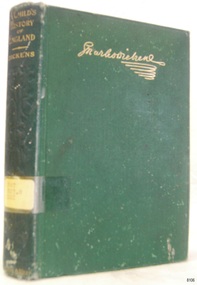
Book - A Fictional Story, Charles Dickens, A Childs History of England, 1900
... James II, with a brief closing summary up to Queen Victoria’s accession to the crown. Dickens wrote it as a readable, lively alternative to dry school history, aiming to interest his own children and young readers. The work is outspoken, often anti monarchical and anti aristocratic in tone, and it uses Dickens’s usual vivid style ...Charles Dickens (1812–1870) was one of the great English novelists of the Victorian era, famous for vivid characters, social criticism, and stories that were first published in serial form. He began as a journalist, rose to enormous popularity during his lifetime, and wrote major works such as Oliver Twist, David Copperfield, and Great Expectations. “A Child’s History of England” is Dickens’s three volume, child directed history of England, originally serialised in Household Words from 1851 to 1853 and later issued in book form in 1853. It covers English history from ancient times through the fall of James II, with a brief closing summary up to Queen Victoria’s accession to the crown. Dickens wrote it as a readable, lively alternative to dry school history, aiming to interest his own children and young readers. The work is outspoken, often anti monarchical and anti aristocratic in tone, and it uses Dickens’s usual vivid style rather than detached academic prose.A Childs History of England. Author: Charles Dickens. Publisher: Chapman & Hall Ltd, London. Date: 1900. (See note section this document for more information on Edition). Green leather hardcover with title on spine in gold lettering, Charles Dickens signature on front cover written in gold lettering. The spine has a Library label and no Volume information.fictionCharles Dickens (1812–1870) was one of the great English novelists of the Victorian era, famous for vivid characters, social criticism, and stories that were first published in serial form. He began as a journalist, rose to enormous popularity during his lifetime, and wrote major works such as Oliver Twist, David Copperfield, and Great Expectations. “A Child’s History of England” is Dickens’s three volume, child directed history of England, originally serialised in Household Words from 1851 to 1853 and later issued in book form in 1853. It covers English history from ancient times through the fall of James II, with a brief closing summary up to Queen Victoria’s accession to the crown. Dickens wrote it as a readable, lively alternative to dry school history, aiming to interest his own children and young readers. The work is outspoken, often anti monarchical and anti aristocratic in tone, and it uses Dickens’s usual vivid style rather than detached academic prose.book, the old curiosity shop, charles dickens, shipwrecked-coast, flagstaff-hill, flagstaff-hill-maritime-museum, warrnambool, maritime-museum, flagstaff-hill-maritime-village, pattison collection, warrnambool library, warrnambool mechanics’ institute, ralph eric pattison, corangamite regional library service, warrnambool city librarian, mechanics’ institute library, victorian library board, warrnambool books and records, warrnambool children’s library, great ocean road -
 Flagstaff Hill Maritime Museum and Village
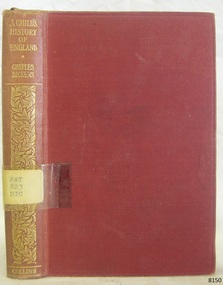
Book - A Fictional Story, Charles Dickens et al, A Childs History of England, 1910
... James II, with a brief closing summary up to Queen Victoria’s accession to the crown. Dickens wrote it as a readable, lively alternative to dry school history, aiming to interest his own children and young readers. The work is outspoken, often anti monarchical and anti aristocratic in tone, and it uses Dickens’s usual vivid style ...Charles Dickens (1812–1870) was one of the great English novelists of the Victorian era, famous for vivid characters, social criticism, and stories that were first published in serial form. He began as a journalist, rose to enormous popularity during his lifetime, and wrote major works such as Oliver Twist, David Copperfield, and Great Expectations. “A Child’s History of England” is Dickens’s three volume, child directed history of England, originally serialised in Household Words from 1851 to 1853 and later issued in book form in 1853. It covers English history from ancient times through the fall of James II, with a brief closing summary up to Queen Victoria’s accession to the crown. Dickens wrote it as a readable, lively alternative to dry school history, aiming to interest his own children and young readers. The work is outspoken, often anti monarchical and anti aristocratic in tone, and it uses Dickens’s usual vivid style rather than detached academic prose.A Childs History of England. Author: Charles Dickens. Illustrator. Harry Furniss. Publisher: Collins Clear Type Press, London. Date: 1910. (See note section this document for more information on Edition). red cloth hardcover with title on spine in gold lettering and pattern. The spine has a Library label and no Volume information only title and author.fictionCharles Dickens (1812–1870) was one of the great English novelists of the Victorian era, famous for vivid characters, social criticism, and stories that were first published in serial form. He began as a journalist, rose to enormous popularity during his lifetime, and wrote major works such as Oliver Twist, David Copperfield, and Great Expectations. “A Child’s History of England” is Dickens’s three volume, child directed history of England, originally serialised in Household Words from 1851 to 1853 and later issued in book form in 1853. It covers English history from ancient times through the fall of James II, with a brief closing summary up to Queen Victoria’s accession to the crown. Dickens wrote it as a readable, lively alternative to dry school history, aiming to interest his own children and young readers. The work is outspoken, often anti monarchical and anti aristocratic in tone, and it uses Dickens’s usual vivid style rather than detached academic prose.book, the old curiosity shop, charles dickens, shipwrecked-coast, flagstaff-hill, flagstaff-hill-maritime-museum, warrnambool, maritime-museum, flagstaff-hill-maritime-village, pattison collection, warrnambool library, warrnambool mechanics’ institute, ralph eric pattison, corangamite regional library service, warrnambool city librarian, mechanics’ institute library, victorian library board, warrnambool books and records, warrnambool children’s library, great ocean road -
 Flagstaff Hill Maritime Museum and Village
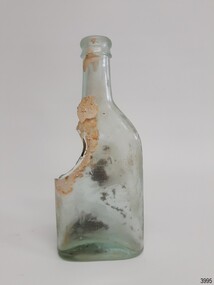
Container - Medicine Bottle, J.C. Ayer & Co, 1868-1878
... It was made by Ayer & Co. and its shape and maker's mark matches one of Ayer's early style bottles that contained J.C. Ayer's Hair Vigor, which was made from about 1868 to 1915. James...It was made by Ayer & Co. and its shape and maker's mark matches one of Ayer's early style bottles that contained J.C. Ayer's Hair Vigor, which was made from about 1868 to 1915. James ...The glass medicine bottle is an example of an early 20th-century medicine bottle. Moulton glass was blown into a two-piece mould and a tool with an inscription was used to stamp the base. The mouth was added after the bottle was blown. The bottle has encrustations and residue on the surface of the glass. The cargo of the Falls of Halladale included medicine. It was made by Ayer & Co. and its shape and maker's mark matches one of Ayer's early style bottles that contained J.C. Ayer's Hair Vigor, which was made from about 1868 to 1915. James C. Ayer, born in Connecticut, US in 1818, was a medicine manufacturer. His first medicine was Cherry Pectoral, for pulmonary illness. His medicine was very popular in the 1850s. Ayer died in 1878. A section of his home town Groton Junction was nameed 'Ayer' in his honour. The FALLS of HALLADALE 1886 – 1908: - The sailing ship Falls of Halladale was an iron-hulled, four-masted barque, used as a bulk carrier of general cargo. She left New York in August 1908 bound for Melbourne and Sydney. In her hold was general cargo consisting of roof tiles, barbed wire, stoves, oil, benzene, and many other manufactured items. After three months at sea and close to her destination, a navigational error caused the Falls of Halladale to be wrecked on a reef off the Peterborough headland on the 15th of November, 1908. The captain and 29 crew members survived, but her cargo was largely lost, despite two salvage attempts in 1908-09 and 1910. The Court of Marine Inquiry in Melbourne ruled that the foundering of the ship was entirely due to Captain David Wood Thomson's navigational error, not too technical failure of the Clyde-built ship. The Falls of Halladale was built in1886 by Russell & Co., at Greenock shipyards on the River Clyde, Scotland for Wright, Breakenridge & Co of Glasgow. The ship had a sturdy construction built to carry maximum cargo and was able to maintain full sail in heavy gales, one of the last of the 'windjammers' that sailed the Trade Route. She and her sister ship, the Falls of Garry, were the first ships in the world to include fore and aft lifting bridges. The new raised catwalk-type decking allowed the crew to move above the deck in stormy conditions. The medicine bottle is an example of medicine containers in the late 19th to early 20th century. It is also significant for its association with the historic cargo ship Falls of Halladale, wrecked in local waters in the early 20th century. The ship is listed on the Victorian Heritage Register, No. S255. It was one of the last ships to sail the Trade Routes and one of the first vessels to have fore and aft lifting bridges. The ship is an example of the design, materials and fittings of a late-19th-century sailing vessel. Its cargo represents several aspects of Victoria’s shipping trade. The wreck is now protected as a Historic Shipwreck under the Commonwealth Historic Shipwrecks Act 1976.Clear glass bottle with a green tinge. The bottle has a rolled applied lip, narrow mouth, slim neck, rounded shoulders and straight rectangular body and an indented base. The body has side seams and irregular thicknesses of glass. Glass has imperfections and bubbles, and one shoulder is missing. An embossed inscription is on the base. The bottle was recovered from the wreck of the Falls of Halladale. "AYER"flagstaff hill, maritime museum, maritime village, warrnambool, great ocean road, shipwreck coast, falls of halladale, iron ship, four-masted ship, sailing ship, clipper ship, windjammer, shipwreck, peterborough, 1908 shipwreck, russell & co., fore and aft lifting bridges, medicine bottle, health care, ayer, j c ayer & co., james c ayer, hair vigor, men's hair care, personal care -
Glenelg Shire Council Cultural Collection
Souvenir - Tea Towel - Maretimo, Portland, n.d
... Maretimo is rivalled only by the stylistically similar Henty residence, Burwsood of 1853 by James Barrow, as perhaps the finest Australian Colonial Georgian style residence erected within the first twenty years of settlement in Victoria. ...Maretimo is rivalled only by the stylistically similar Henty residence, Burwsood of 1853 by James Barrow, as perhaps the finest Australian Colonial Georgian style residence erected within the first twenty years of settlement in Victoria. ...From the National Trust register: Statement of Significance Maretimo, a 22 room single storey Australian Colonial Georgian style mansion set on a prominent bluff overlooking Portland harbour, was erected c. 1854 for John Norman McLeod. The design of Maretimo, which is constructed of basalt ashlar with fine-axed parapet entablature, delicate open timber work verandah and Regency interior, has been tenuously attributed to Adelaide architect James Barrow. Maretimo is rivalled only by the stylistically similar Henty residence, Burwsood of 1853 by James Barrow, as perhaps the finest Australian Colonial Georgian style residence erected within the first twenty years of settlement in Victoria. The residence, which was occupied for twenty years by distinguished English-born gentleman parliamentarian, pastoralist and former Van Deimen's Land settler, J H McLeod, is now notable for the disciplined facade and elegantly crafted interiors. Maretimo has been meticulously maintained and is presented in near perfect original condition. The interiors have been sensitively enhanced and redecorated.Linen souvenir tea towel 'Maretimo'. Green and black on cream. 'MARETIMO' at top, front view of Maretimo beneath, then map of locaion, then view from air. 'HISTORIC HOME PORTLAND, VICTORIA' beneath 'Pure Linen', bottom right.historic building, historic homestead, maretimo, henty, souvenir -
Glenelg Shire Council Cultural Collection
Photograph - Photograph - Portland Lifeboat, n.d
... James Peake and adopted by the Royal National Lifeboat Institution (RNLI) in the UK. The Portland Lifeboat's 9.14 m (30 ft) long hull is double diagonally planked in New Zealand kauri, and many of the planks run from gunwale to gunwale in one piece under the inner keel section. Eucalyptus and oregon were used elsewhere and the local blacksmith made the iron work. The fastenings are copper. There are two flotation or buoyancy tanks at either end, with prominent whaleback style...James Peake and adopted by the Royal National Lifeboat Institution (RNLI) in the UK. The Portland Lifeboat's 9.14 m (30 ft) long hull is double diagonally planked in New Zealand kauri, and many of the planks run from gunwale to gunwale in one piece under the inner keel section. Eucalyptus and oregon were used elsewhere and the local blacksmith made the iron work. The fastenings are copper. There are two flotation or buoyancy tanks at either end, with prominent whaleback style ...Built in 1858 at the Port and Harbour Master's yard in Williamstown Victoria, the Portland Lifeboat was overseen by Harbour Master Charles Ferguson. It is understood to have been constructed from the same moulds used to build the Port Fairy Lifeboat, designed by William White, in 1857. Both boats are similar to the lifeboats designed in England by James Peake and adopted by the Royal National Lifeboat Institution (RNLI) in the UK. The Portland Lifeboat's 9.14 m (30 ft) long hull is double diagonally planked in New Zealand kauri, and many of the planks run from gunwale to gunwale in one piece under the inner keel section. Eucalyptus and oregon were used elsewhere and the local blacksmith made the iron work. The fastenings are copper. There are two flotation or buoyancy tanks at either end, with prominent whaleback style decking. Under the thwarts is a deck with scuppers so that the craft is both buoyant and self draining whenever large waves are taken aboard in rough conditions. The lifeboat was oar-powered with a sailing rig. The original rig was a lug mainsail, but this was replaced with a lug and headsail rig taken from a fishing boat in 1903. The lifeboat was manned by volunteer crews, mostly local fishermen from Portland. They maintained this service until 1915 when the boat was replaced with a new motorised craft. The lifeboat's most outstanding service was to the steamer ADMELLA in 1859 when the ship grounded on a reef off Cape Banks in South Australia, 150 km to the west of Portland. Survivors clung to the rigging in heavy seas for over a week and 89 people lost their lives in the shipwreck. Taken to the scene by the steamer LADY BIRD, the Portland Lifeboat was unable to assist until eight days after the ADMELLA's grounding when the seas abated enough for the lifeboat to manoeuvre close to the ship and rescue the last 19 survivors. Since its retirement in 1915 the lifeboat has been a memorial to those who manned it and those it rescued. For a long period it was on display in the Portland Gardens, first in the open and then under a canopy. In 2008 it was on display inside the Portland Maritime Discovery Centre, still in original condition complete with the rig from 1915. It is one of the oldest vessels of its type in Australia, and the world.Portland LifeboatPhotograph showing the Portland Lifeboatphotography, portland lifeboat, admella -
Glenelg Shire Council Cultural Collection
Photograph - Sheet of 12 contact prints - Various historic Portland buildings and Landmarks, c. 1970
... James Fawthrop (h) Residence Abraham Barrett, baker (i) Group of 6 in tennis clothes late 1900's - early 1900's style (j) Portland Tennis Club (k) Tasmanian Inn (l) Windsor Cottage...James Fawthrop (h) Residence Abraham Barrett, baker (i) Group of 6 in tennis clothes late 1900's - early 1900's style (j) Portland Tennis Club (k) Tasmanian Inn (l) Windsor Cottage Photograph Sheet of 12 contact prints - Various historic Portland buildings and Landmarks ...Sheet of 12 contact prints of rephotographed photographs. Identification numbers 5719 a, b, c, d, e, f, g, h, i, j, k, l (a) Portland Tennis Club (b) Portland Show (c) Court House (d) Row of single storey wooden buildings on beach, Lighthouse of Observatory Hill back left (e) Fishing party Bridgewater (f) Dray loaded with bales outside Grant & Co Merchants (g) Image of Capt. James Fawthrop (h) Residence Abraham Barrett, baker (i) Group of 6 in tennis clothes late 1900's - early 1900's style (j) Portland Tennis Club (k) Tasmanian Inn (l) Windsor CottageFront: (a) Working-Bee, Portland Tennis Club approx 1900 (b) Portland Show (c) Court House (e) Angling Party, Bridgewater approx 1900 (g) Capt. Fawthrop -
 Orbost & District Historical Society
bookmaker's bag, late 19th century
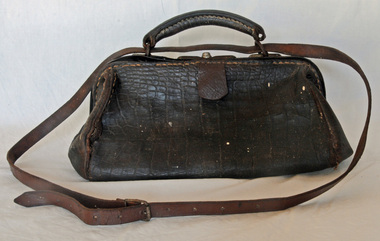
... James Cowell at Jarrahmond. For a long time horse races were part of the Marlo Picnic Races. This item is connected to an activity once popular in the Orbost district. gladstone-bag bookmaker's-bag horse-racing On the base - SOLID LEATHER A very worn leather bookmaker's bag. It is a Gladstone style ...A Gladstone bag is a small portmanteau suitcase built over a rigid frame which could separate into two equal sections. Unlike a suitcase, a Gladstone bag is deeper in proportion to its length.They are typically made of stiff leather and often belted with lanyards. The bags are named after William Ewart Gladstone (1809–1898), the four-time Prime Minister of the United Kingdom. This one has been adapted to suit the needs of a bookmaker. The leather neck strap has been added. Horse racing was a popular past-time in early Orbost. The Nixon family was involved through Keith Nixon. Some of the earliest horse races were held on a course in a paddock belonging to Mr James Cowell at Jarrahmond. For a long time horse races were part of the Marlo Picnic Races.This item is connected to an activity once popular in the Orbost district. A very worn leather bookmaker's bag. It is a Gladstone style bag with a leather neck strap. It has a spring lock with a key hole. It has a curved handle at the top. The leather neck strap does not appear to be original. The inside lining is cotton and there is a metal hinged frame. On the base are four metal studs.On the base - SOLID LEATHERgladstone-bag bookmaker's-bag horse-racing -
 Orbost & District Historical Society
tin, Circa 1900
... tin Wilson-Bros Kassa-tea James-Service Bottom left - Union is Strength Printed - Wilson Bros North Melbourne Large rectangular shaped tea tin with round lid inset. Kassa Tea . Painted pictures are in Indian style ...Large rectangular shaped tea tin with round lid inset. Kassa Tea . Painted pictures are in Indian style.Bottom left - Union is Strength Printed - Wilson Bros North Melbournetin wilson-bros kassa-tea james-service -
 Orbost & District Historical Society
spectacles and spectacle cases, late 19th early 20th century
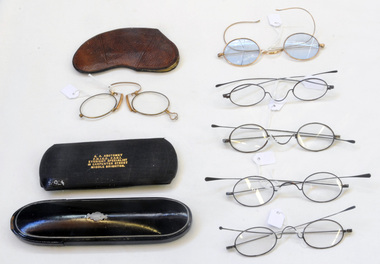
... James Kerr. As the 19th Century came to a close, more and more people wore their eyeglasses everyday. A popular style...James Kerr. As the 19th Century came to a close, more and more people wore their eyeglasses everyday. A popular style ...This collection of glasses and cases was donated by Miss Connie Cruickshank. She was part of the family of Orbost's first doctor, Dr James Kerr. As the 19th Century came to a close, more and more people wore their eyeglasses everyday. A popular style of inexpensive, everyday spectacles was the pince-nez. French for "pinch nose," the pince-nez was first developed in France circa 1840 and began to be imported after the 1850s. Pince-nez have no temples, but are fit snugly on the bridge of the nose. Pince- nez could be uncomfortable to wear and broke often from falling off the nose. These items demonstrate how glasses' styles have changed over time. One pair of pince-nez glasses and its brown leather case shaped to fit. One solid black wooden case with a small hinged door at one end. One blue/black case with the words A A Abotomey 14 Carpenter Street Middle Brighton in gold lettering. Five pairs of spectacles, one with blue coloured glass with crack in one lens.A A Abotomey 14 Carpenter Street, Middle Brightonspectacles spectacles-cases pinz-nez -
 Ringwood and District Historical Society
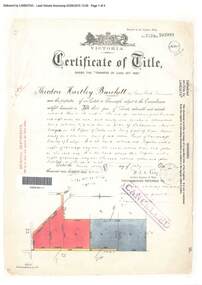
Document, Certificate of Title - Theodore Hartley Burchett - part of Crown Section 20, Parish of Warrandyte, County of Evelyn - 1911
... Transfers include Anna Maria Wicks and Henry James Trowbridge, 3rd October, 1911 Elizabeth Ann Walden, 18th September, 1912 - 28ac 3rds 5per. Edward Thomas Miles, 22nd September, 1913 - 27ac 19per. Samuel Styles...Transfers include Anna Maria Wicks and Henry James Trowbridge, 3rd October, 1911 Elizabeth Ann Walden, 18th September, 1912 - 28ac 3rds 5per. Edward Thomas Miles, 22nd September, 1913 - 27ac 19per. Samuel Styles ...A4 copies of Landata Victoria Historical Search documents - Vol 3520 Fol 703991.Theodore Hartley Burchett of Lara Lake, Farmer, is now the proprietor of an Estate in Fee-simple subject to the Encumbrances notified hereunder ... 180 acres 01 rood 27 perches or thereabouts, being lots 1, 8, 9 and 10 on plan of subdivision no.4315. Subdivision map includes un-named roads - lower western side is Wonga Road (later Warranwood Road), and eastern side is Grandview Grove (later Bemboka Road), both north of Plymouth Road, Ringwood, Vic. Transfers include Anna Maria Wicks and Henry James Trowbridge, 3rd October, 1911 Elizabeth Ann Walden, 18th September, 1912 - 28ac 3rds 5per. Edward Thomas Miles, 22nd September, 1913 - 27ac 19per. Samuel Styles, 10th October, 1916 - balance.
