
Showing 3 items matching "janes baler"
-
 Federation University Historical Collection
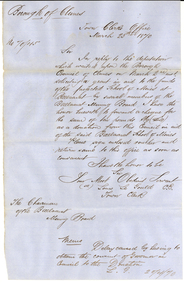
Document, Establishment of the Ballarat School of Mines, 1870, 1870
... ...janes baler...It's first president was Redmond Barry. ballarat school of mines frieberg mining academy learmonth somerville learmonth wreford weymouth bland rivet henry bland barry redmond barry mcculloch phillips john phillips robson gillies duncan gillies warrington rogers melbourne public library whitty robert park newman william newman charles abbott janes baler de la poer wall odgers louis le gould wood harrie wood steinfeld emanuel steinfeld ainswood pucke thomas robson telegraph telegram state library of victoria fulks architecture reed j. reed rosales abbott charles a. abbott mechanical drawing drawing ballarat circuit courthouse ballarat courthouse national insurance company of australia grenville college chief secretary's office robert sandon school of mines schools of mines establishment ballarat school of mines establishment germany london ercildoun Correspondence and planning documents relating to the setting up of the Ballarat School of Mines. it includes tenders for contractors for the refurbishment of the former Ballarat Circuit Court. .1) Rules for the pupils of the Mining School at Zurickau, 18/11/1870 (not translated by Emanuel Steinfeld, perhaps by W. ...The Ballarat School of Mines was the first site of technical edducation in Australasia. It is now a predecessor institution of Federation University Australia. It's first president was Redmond Barry.Correspondence and planning documents relating to the setting up of the Ballarat School of Mines. it includes tenders for contractors for the refurbishment of the former Ballarat Circuit Court. .1) Rules for the pupils of the Mining School at Zurickau, 18/11/1870 (not translated by Emanuel Steinfeld, perhaps by W. Henderson) .2) Regulations of the Mining Academy at Frieberg, 18/11/1870 .3) Einrichtungen, Freiberg, 1870 (written in German) .4) Letter from Somerville Learmonth of Ercildoun to Harrie Wood, Clerk of the Board of Mines Ballarat, accepting a position as one of three trustees of the Ballarat School of Mines, along with Redmond Barry and R.H. Bland, 08/01/1870 .5) Printing order with Robert Wreford, 26/01/1870 .6) H. Waymouth to Mr Bickett re the Ballarat School of Mines, 1780 .7) Letter from R.H. Bland of Clunes to Harrie Wood of the Ballarat Mining Board, 27/01/1870 .8) Letter from Somerville Livingstone Learmonth of Ercildoun to Harrie Woods of the Ballarat Mining Board refusing the offer to be a Trustee of the Ballarat School of Mines, 28/01/1870 .9) Minutes of the meeting of the Ballarat School of Mines Executive Council, 05/02/1870 and Correspondence from Harrie Wood to J. Warrington Rogers re the lease of the building for the Ballarat School of Mines, 21/01/1870 .10) Chief Secretary's Office to Ballarat Mining Board re Life Membership of the Ballarat School of Mines, 02/02/1870 .10b) Letter from Redmond Barry, Carlton Gardens, Melbourne re the visit of the Governor of Victoria to the Ballarat School of Mines, 04/02/1870 .12) Letter from Charles Pucke on behalf of Mr McCulloch to H, Ainswood, Secretary of the Ballarat Mining Board, 11/07/1870 .13) Correspondence from Henry Rosales of Walhalla (Chairman of the Gippsland Mining Board) to James Baker of the Ballarat School of Mines, 28/12/1870 .11) Meeting of the Executive Council, Bickett, Eddy Downes, 08/02/1870 .14) Letter from John Phillips, contract surveyor of St Arnaud to Mr Newman, Vice-President of the Ballarat School of Mines, 15/12/1870 .15) Articles ordered and obtained for the Ballarat School of Mines, 03/01/1870 .16) Telegram from John Lewis of Clunes to the Ballarat School of Mines. .16b) Quote from painter Thomas Robson for painting the Ballarat School of Mines, 05/06/1870 .17) Note from Duncan Gillies to Harrie Wood re grant for the Ballarat School of Mines, 05/06/1870 .18) Correspondence re Grant to the Ballarat School of Mines, Duncan Gillies, 04/07/1870 .19) Correspondence concerning the Ballarat School of Mines from F. Valient to Harrie Wood, 14/05/1870 .19b) Correspondence from Somerville Livingstone Learmonth to Harrie Woods - an apology for a meeting with Judge Rogers, 23/05/1870 .20) Letter from R.H. Bland to Harrie Wood, 15/07/1870 .22) Telegraph from J. Warrington Rogers to Harrie Wood of the Ballarat Mining Board concerning tenders for the Ballarat School of Mines, which was established in 1870. .23) Letter from Ballarat Mining Board to Judge Warrington Rogers, 31/05/1870 .24) Telegraph to Harrie Wood of the Ballarat Mining Board from J. Warrington Rogers concerning Sir Redmond Barry. A note at the bottom of the telegraph notes ‘This telegram has been delayed through repairs on line. .25) Letter on Melbourne Public Library Letterhead from librarian Augustus Fulk, 05/08/1870 .26) Letter from R.H. Bland to Harrie Wood, 30/05/1870 .27) Letter from Robert Park re alteration of the former Ballarat Court House for use as the Ballarat School of Mines, 05/05/1870. .28) Letter from G. Whitty re painting of the former Ballarat Court House for use as the Ballarat School of Mines, 04/05/1870 .29) Letter from William Newman re plastering of the former Ballarat Court House for use as the Ballarat School of Mines, 05/05/1870 .30) Letter from Charles A. Abbott re teaching Mechanical Drawing at the Ballarat School of Mines, 04/04/1870 .32) Letter from Redmond Barry to the Ballarat School of Mines, 07/1870 .31) National Insurance Company of Australia insurance for the Ballarat School of Mines (former Ballarat Circuit Court), 01/05/1870 .33) Letter from R.H. Bland to Harrie Wood, 09/1870 .34) Letter from Somerville Livingstone Learmonth to Harrie Wood, 06/09/1870 .35) Letter to the Chief Secretary to the Ballarat School of Mines Library & Museum, 30/11/1870 .36) Parliament house (Kitto) to the Ballarat Mining Board, 15/11/1870 .37) H. de la Poer Wall of Grenville College to R.W. Newman of the Ballarat School of Mines, 27/04/1971 .38) W.H. Odgers to the Ballarat East Town Clerk, 20/05/1870 .39) Correspondence to the Borough of Clunes for the Ballarat Mining Board requesting a grant to set of a school of mines at Ballarat. 25/03/1870 .40) Surveyor to Harrie Wood, Mining Registrar, 27/04/1870 .40) Letter to Judge Warrington Rogers re the contractor's account for satisfactory completion of work on the Ballarat School of Mines, 11/07/1870 .43) Desks for the Ballarat School of Mines by Henry Gough, 1870 .44) Ballarat Star Office to James Baker of the Ballarat School of Mines, 1870ballarat school of mines, frieberg mining academy, learmonth, somerville learmonth, wreford, weymouth, bland, rivet henry bland, barry, redmond barry, mcculloch, phillips, john phillips, robson, gillies, duncan gillies, warrington rogers, melbourne public library, whitty, robert park, newman, william newman, charles abbott, janes baler, de la poer wall, odgers, louis le gould, wood, harrie wood, steinfeld, emanuel steinfeld, ainswood, pucke, thomas robson, telegraph, telegram, state library of victoria, fulks, architecture, reed, j. reed, rosales, abbott, charles a. abbott, mechanical drawing, drawing, ballarat circuit courthouse, ballarat courthouse, national insurance company of australia, grenville college, chief secretary's office, robert sandon, school of mines, schools of mines, establishment, ballarat school of mines establishment, germany, london, ercildoun -
 Warrnambool and District Historical Society Inc.
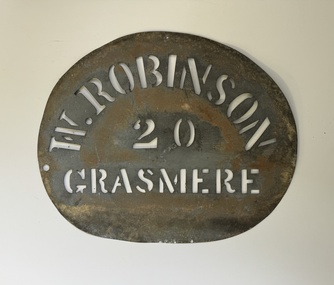
Functional object - Robinson Farm Labelling Stencil, c.1950
... This stencil has been made to label packaged produce (wool bales, packaged meat etc) from a farm in Grasmere, near Warrnambool. The name, W. Robinson, suggests that this is William Robinson the son of James and Jane Robinson. ...This stencil has been made to label packaged produce (wool bales, packaged meat etc) from a farm in Grasmere, near Warrnambool. The name, W. Robinson, suggests that this is William Robinson the son of James and Jane Robinson. ...This stencil has been made to label packaged produce (wool bales, packaged meat etc) from a farm in Grasmere, near Warrnambool. The name, W. Robinson, suggests that this is William Robinson the son of James and Jane Robinson. James Robinson came to Australia in 1857 and he and his family farmed at Springvale at Hopkins Point, then at what was termed 'Manning's old Purnim Farm' on the Merri Rive at Grasmere (the Manning brothers, Frederick and John were early farmers in the district). The Robinson brothers, James and Stuart were well-known in the Warrnambool district as champion ploughmen. James's son, William married firstly Christina MacLennan and then Elizabeth Neale of Tooram, Allansford. William died in 1959 but the stencil was probably used on the property after his death. This farm stencil is of interest as a memento of farming at Grasmere in the first half of the 20th century.This is a metal stencil, oval in shape. It has letters cut out in the metal for stencilling purposes. It has been painted or sprayed and is rusted in places.W. Robinson 20 Grasmerewilliam robinson grasmere, manning's purnim farm -
 National Wool Museum
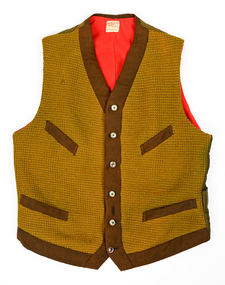
Textile - Waistcoat, R. Collins Hocking, c.1910
... Jane (Jenefer) Pearce and William Roberts in Crowan, Cornwell, England and it is thought arrived in Victoria on the British Trident in 1855. In 1878 Andrew moved to the newly purchased “Hillside” at Mt Duneed with his family including Alfred. By 1880 Andrew held 11,095 acres in South Barwon and Barrabool. As well as being a landowner, he had other business interests including Auctioneers, Stock and Station Agents Learmonth White from 1886. However farming at Hillside, particularly wool production, was an important part of his life. For example, in 1893 10,350 sheep were shorn although the highest number of bales...Jane (Jenefer) Pearce and William Roberts in Crowan, Cornwell, England and it is thought arrived in Victoria on the British Trident in 1855. In 1878 Andrew moved to the newly purchased “Hillside” at Mt Duneed with his family including Alfred. By 1880 Andrew held 11,095 acres in South Barwon and Barrabool. As well as being a landowner, he had other business interests including Auctioneers, Stock and Station Agents Learmonth White from 1886. However farming at Hillside, particularly wool production, was an important part of his life. For example, in 1893 10,350 sheep were shorn although the highest number of bales ...The Waistcoat’s Owners The first owner of the waistcoat was Alfred (Alf) Gilbert White, 1868 Stretton Park, Connewarre – 1946, Mt Duneed. He was the fourth child of Andrew White, 1828-1900, and Jane Roberts, 1827-1871. His father Andrew White was born at Stretton-on-Dunsmore, Warwickshire, England, the sixth child of William White and Sarah Elkington. Andrew had come to Victoria on the James L. Bogart in 1852 with his first wife, Emily Walker. From 1854, records show he was the owner of livery stables in central Geelong before he moved into land ownership. In 1862, Andrew became a landowner with 1,400 acres in Connewarre, the Salt Water Run, then re-named Stretton Park by Andrew. Thereafter he is usually noted as a Farmer or Sheep Farmer. Emily died in 1861 and Andrew remarried Jane Roberts in 1863. Jane was the daughter of Jane (Jenefer) Pearce and William Roberts in Crowan, Cornwell, England and it is thought arrived in Victoria on the British Trident in 1855. In 1878 Andrew moved to the newly purchased “Hillside” at Mt Duneed with his family including Alfred. By 1880 Andrew held 11,095 acres in South Barwon and Barrabool. As well as being a landowner, he had other business interests including Auctioneers, Stock and Station Agents Learmonth White from 1886. However farming at Hillside, particularly wool production, was an important part of his life. For example, in 1893 10,350 sheep were shorn although the highest number of bales of wool produced was in 1892 with 174 bales under AW’s wool mark and 8 under that of Stretton Park. This was the result of shearing 9,234 sheep. There were usually six or seven shearers, shearing over a two to three week period, beginning in early or mid October. Some of the shearers bore names familiar in the district such as Gogoll, Duffield, and Baensch. Andrew White held a number of local positions including: •1863-1874 Connewarre Road Board, Chairman 1871-73 •1875-1900 South Barwon Shire Council. When the Board amalgamated with South Barwon to form the Shire of South Barwon, he was an inaugural representative of Connewarre. He was a council member for 44 years and president for the following terms: 1878-1879; 1885-1887; 1889; 1894; 1895-1896; and 1898-1899. •1878-1886, Barrabool Shire Council, President 1882 •In 1885 he was appointed a Justice of the Peace in the Southern Bailiwick •Committee member of the Geelong Racing Club, 1890-96 •In 1892 he was appointed returning officer for the South-Western Province and the electoral district of Barwon •Foundation President of Torquay Racing Club, 1893 •Mount Duneed Cemetery Trustee, 1893 Alfred Gilbert White went to Connewarre School and then to Mt Duneed School after the family moved to Mt Duneed. He then went to Geelong Grammar School as a boarder from 31 July 1883. After leaving school, in 1886, he worked as a bookkeeper for the family business Learmonth-White stock and station agents and lived at home at Hillside. He and Bessie Orchard Mathews were married in 1894. Bessie was born in Geelong in 1869, the sixth child of William Matthews and Amelia Orchard. Her family lived at “Turley,” Malop Street, Geelong, named after the hamlet of Turleigh in West Wiltshire, England. Bessie’s father, William Mathews, a butcher from Winsley, Wiltshire, arrived on the Queen of the East in Sydney in 1854 and established a successful butcher’s business with his brother James in Geelong. Her mother, Amelia Orchard, also from Winsley, arrived on the Thames in Melbourne in 1857. Alfred, Bessie and their family lived at Stretton Park, Connewarre, leasing it from Andrew. They had six children including their fourth child Douglas Alfred White, the second owner of the waistcoat. His father Andrew supported Alfred’s sheep farming at Stretton Park. In 1896 “.... eight splendid 2-tooth Lincoln rams in the wool were purchased by Mr Andrew White for his son, Mr Alfred G. White….intended for Mr White’s sheep run at Connewarre.“ Alfred White bought ‘Hillside’, 640 acres, after his father’s death and moved there with his family from Stretton Park in Connewarre. (Stretton Park was bought by his half sister Emily and her family and renamed “Morangarell”.) A family partnership was formed to run the wider station. It was then Alfred who managed the new partnership, called Stretton Park. Alfred meticulously kept the financial records of the station, as might be expected from a former bookkeeper. The detail kept is exemplified in the annual shearing records, including the names of the paddocks, the number of lambs and ewes and the shearers’ tallies. In the spring of 1900, after Andrew White had died, shearing began on 7 October and was finished on 6 November. On some days well over 500 sheep were shorn. The highest tally was 616 on 11 October. That year the overall total of sheep shorn was 9,101. Alfred was an active community member including: •South Barwon Council member (46 years), president: 1903-04; 1906-07; 1921-22; and 1931-33 •Geelong Grammar School Council member, 1908-1946 (over 37 years) •Active member of St. Wilfred’s Church of England, Mt Duneed •Director of Dennys Lascelles, 1932-1946 •Mt Duneed Cemetery Trustee, 1900 •Honorary member of the Mt Duneed Rifle Club, 1900 •Mt Duneed Mutual Improvement Association •Mt Duneed Recreation Reserve Trustee •Torquay Improvement Association Trustee •Barwon Returning Officer Douglas Alfred White, 1900 Stretton Park, Connewarre-1976, Geelong. Initially Douglas and his sisters were taught at home by a governess. Then, like his father, Douglas attended Geelong Grammar. After finishing school, he studied Engineering at Melbourne University where he met Violet Fullerton, 1900-1992, who was studying Medicine. They married in 1926 and had two children including Douglas Robert Stretton (DRS) White Melbourne, 1928–Geelong, 1989, the final owner of the waistcoat. After a successful career as an engineer with the Department of Main Roads, NSW, and serving as a Major in the Royal Australian Engineers in NT, New Guinea and Borneo during the Second World War, Douglas purchased part of Stretton Park when it was sold in 1952. He farmed “South Beach Farm” until his death in 1975. (This area now includes The Sands and Stretton Estate subdivisions.) His son DRS White also attended Geelong Grammar before studying at Dookie Agricultural College. In 1955 DRS purchased land from Peter Fisher, John Fisher and Frank Walter, naming the property “Lambidgee”. (This was part of the land that had originally belonged to Andrew White that had been sold previously.) He farmed this land for the rest of his life, continuing the family tradition. After his father’s death in 1975, the waistcoat became his and so passed to a third generation of the family.Chartreuse green and red waistcoat featuring woven wool front with six buttons, silk back with metal clasp, and red lining. The buttons feature small green beads in the centre.Label [printed]: R. Collins Hocking / GEELONG Label [handwritten]: A. G. White Esqwaistcoat, vest, design, textiles, fashion, alfred white, sheep farming, mt duneed, rural life
